Blog Article Category: Theater / Film
Area Stage director gives audience seat at the table for Disney’s ‘Beauty and the Beast’
Written By Christine Dolen
August 8, 2022 at 1:16 PM
Maxime Prissert is the Beast and Yardén Barr is Belle in Area Stage Company’s “Beauty and the Beast” at the Carnival Studio Theater inside the Adrienne Arsht Center for the Performing Arts, Miami, through Sunday, Aug. 28. (Photo courtesy of Giancarlo Rodaz)
Since its 1991 debut as an Oscar-winning animated movie, Disney’s “Beauty and the Beast” spawned a 1994 Broadway musical that ran until 2007 (in 5,461 performances), toured the country, and played all over the world. The show has endured as an immensely popular title for regional, community, and school theater groups.
Now “Beauty and the Beast” is back, this time as an Area Stage Company production in the Carnival Studio Theater at Miami’s Adrienne Arsht Center for the Performing Arts. But the show, which will preview Tuesday, Aug. 9 through Thursday, Aug. 11 and officially open on Friday, Aug. 12, is not – emphasis on not – a typical version of the Disney hit.
Based on the 1756 French fairy tale “Le Belle et la Bête” by Jeanne-Marie Leprince de Beaumont, “Beauty and the Beast” is, as the housekeeper Mrs. Potts sings in the musical, a “tale as old as time.”
In Disney’s version, an enchantress’s spell turns the vain, cruel Prince Adam into a frightening man-beast. If he can experience true love before the final petal falls from an enchanted rose, he – and his servants, who are transforming into household objects – can revert to human form. But after the beautiful, brainy villager Belle takes her father’s place as the Beast’s prisoner, her captor behaves so badly that true love seems highly unlikely.

Yardén Barr’s Belle makes her way through the dark woods in Area Stage’s “Beauty and the Beast.” (Photo courtesy of Giancarlo Rodaz)
The beloved story is a classic. But that doesn’t mean the Disney favorite has to be produced in a traditional way.
As he did in the summer of 2021 with Area Stage’s immersive version of “Annie,” director Giancarlo Rodaz is taking a fresh approach to a treasured show.
“I’m amazed that no one’s done it this way before,” says Rodaz, who is associate artistic director of the company founded by his parents, artistic director John Rodaz and executive director Maria Banda-Rodaz. “When you do theater, you’re competing with every great piece of media ever made. You have to take a risk.”
In this case, the risks include scale (16 actors are in the cast, with a number playing multiple parts), cost (Banda-Rodaz reports that Area Stage’s typical large-musical budget of more than $275,000 has to grow by 25 percent for shows at the Arsht because of additional production costs there), and faith that audiences will respond as enthusiastically to becoming part of the action as they did to “Annie.”
The director concedes that he sometimes says to his parents, “What have I gotten myself into?” But the 26-year-old South Florida native, who grew up going to Disney theme parks, continues to dream big about giving audiences experiences that provide a deeper kind of fun.
“You think about what fun is. ‘Fun’ is cheap. It can be an inflatable pool in your backyard. What is something that’s truly transporting, that makes a huge impression on your memory?” Rodaz says. “I thought, ‘How great would it be to have people really be our guest?’ I sat down with the actors, (set designer) Frank Oliva, and my parents to talk about what it would mean to make the story around the audience.”
To that end, Area’s “Beauty and the Beast” takes place in a massive castle hall – Rodaz describes it as a blend of the ballroom from the film and the Hogwarts castle from the Harry Potter series – with the audience seated at three long tables. He insisted the story be told using only elements that could be found in an 18th-century castle.
The musical’s title characters are being played by New York-based Yardén Barr as Belle and Maxime Prissert (who grew up in Palm Beach Gardens) as the Beast. Barr’s resume includes such shows as “Sleeping Beauty,” “The Wizard of Oz,” “Something Rotten!,” “Brigadoon,” “A Very Potter Musical” and more. Prissert, who has a degree in musical theater and studied opera in Austria, has had leading roles in “Oklahoma!,” “Cabaret,” “Man of La Mancha” and “Shrek the Musical.”
Prissert, who played the self-adoring Gaston in an earlier production of “Beauty and the Beast,” observes, “The Beast and Gaston are the ultimate foils. I read the script from Gaston’s point of view before. Now I’ve noticed little things in the writing that are very obvious. The characters are similar, but the Beast handles things better.”
Now he’s playing a man who badly needs to learn several lessons, including the one about true beauty coming from within.

From left, Area Stage Company associate artistic director Giancarlo Rodaz (Photo courtesy of Katharine Duerr); Yardén Barr is Belle in Area Stage’s ‘Beauty and the Beast’ (Photo courtesy of Shani Hadjian), and Maxime Prissert plays Prince William and the Beast in ‘Beauty and the Beast’ (Photo courtesy of Sally Prissert).
“I am Prince Adam. The ‘beastness’ is an affliction, an exaggeration of his selfishness,” Prissert says. “But he learns how to be a prince, how to love; Belle shows him that.”
Adds Rodaz: “The prince was always a beast. Now he looks like what he is.”
Belle, the Israeli-born Barr’s favorite Disney princess, is a role the performer has long coveted. When she found an audition notice for Area Stage’s production on Playbill.com, she went for it.
“Belle knows what she wants, but she doesn’t necessarily have the tools to get there. She rejects Gaston. She has her own dreams, her own passions,” Barr says.
A number of Area Stage veterans are in the cast, and they’re excited about large-scale performing immersive theater at the Arsht Center.
“The size of this sticks out the most,” says Frank Montoto, who plays Gaston and the servant Lumiere in the show. “It’s massive.”
“It’s so much grander,” says Katie Duerr, who plays the morphing-into-a-teapot Mrs. Potts. “It’s a fairy tale, it’s magic, it’s Disney. We’re going all the time.”
Imran Hylton, who donned a dress to play Miss Hannigan in Area’s “Annie,” is taking on two very different roles in “Beauty and the Beast.” Audiences will see him as Belle’s eccentric father Maurice and as the opera-singing Madame de la Grande Bouche.
What Hylton appreciates in the process of reinventing a musical, he says, is “taking a show and stripping it down… It’s a lot of fun.”
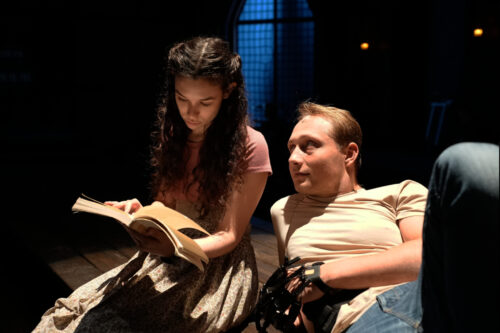
Yardén Barr’s Belle shares her love of reading with Maxime Prissert’s Beast in Area Stage’s “Beauty and the Beast.” (Photo courtesy of Giancarlo Rodaz)
Adds Tico Chiriboga, an ensemble member making his Area Stage debut, “Once we started to get into it, this felt like it’s the most natural way to do the show.”
Rodaz concedes that most of the musical numbers in “Beauty and the Beast” are large-scale, so he was challenged to find ways to make the audience part of the action.
“In the big number about Belle, we are gossiping to the audience,” he says. “In the tavern number about Gaston, the audience at the center table will get prop mugs. We’re making them complicit in cheering on a villain. It’s interesting and fun.”
Rodaz has faith that Area Stage is taking a deep dive into what he considers one of the two best Disney musical scripts (“The Lion King” being the other). He has savored the creative process with his collaborators, the “journey of discovery” that he hopes will bring another dimension to a very successful piece of musical theater.
“We’re trying to amplify what’s there. This doesn’t feel like a kids’ show. It feels like a proper musical that’s beautifully written, with a great score,” he says.
WHAT: Area Stage Company: Disney’s “Beauty and the Beast”
WHERE: Carnival Studio Theater at the Adrienne Arsht Center for the Performing Arts, 1300 Biscayne Blvd., Miami
WHEN: Previews 7:30 p.m. Tuesday, Aug. 9, Wednesday, Aug. 10, and Thursday, Aug. 11, opens 7:30 p.m. Friday, Aug. 12; regular performances 7:30 p.m. Friday, 2 and 7:30 p.m. Saturday, 2 p.m. Sunday, through Aug. 28
COST: $32 and $63
INFORMATION: 305-949-6722 or arshtcenter.org
ArtburstMiami.com is a nonprofit source of dance, visual arts, music and performing arts news. Sign up for our newsletter and never miss a story.
No posts found
Review: Nilo Cruz explores a distanced world in ‘Kisses Through the Glass’
Written By Christine Dolen
July 29, 2022 at 2:54 PM
Hannia Guillén and Leo Oliva in the world premiere of Nilo Cruz’s “Kisses Through the Glass” at the Miami Dade County Auditorium through Aug. 7. (Photo courtesy of Julio de la Nuez)
A man and a woman meet in a truck stop diner, a place that can be conducive to connections of the fleeting physical kind. She is an edgy, ravishing beauty looking for a ride south. He is a good-looking trucker, and he is a man mesmerized – as is every other guy in the place – by the irresistible woman he spies through the window.
That setup could lead, well, anywhere. But because the play, “Kisses Through the Glass,” is a world premiere piece by Pulitzer Prize winner Nilo Cruz, the journey that follows blends symbolism, poetic language, allegory, and realism.
Commissioned by Miami’s bilingual Arca Images and presented by Arca and Miami-Dade County Auditorium (MDCA), “Kisses Through the Glass” is getting a two-week run at MDCA’s On.Stage Black Box, the venue’s more intimate space where actors and audience occupy the stage. The Cuban-American Cruz, who also directed the production, wrote the play in English (as is his custom). Simultaneous translation in Spanish is also available through headsets.
Truth be told, the language in “Kisses Through the Glass” is Cruz’s own dramatic/literary blend, a lexicon suited to dialogue suffused with imagery. This is his pandemic play, though COVID isn’t referenced, and the mysterious virus infecting and killing people is most often referred to as the “malady.”
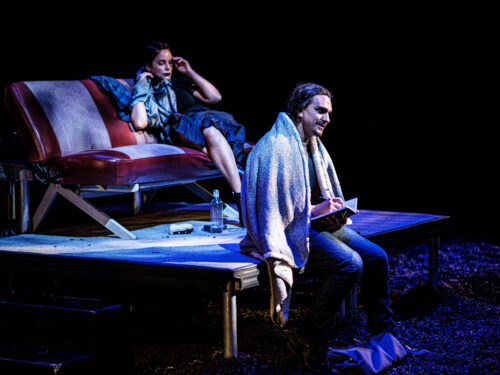
Hannia Guillén and Leo Oliva come to the end of a passionate road in the Arca Images world premiere of Nilo Cruz’s “Kisses Through the Glass.” (Photo courtesy of Julio de la Nuez)
The strangers on a journey without a set destination are truck driver Trevor dos Santos (Leo Oliva) and actress Anabella Lundi (Hannia Guillén).
Their attraction is such that, in a world free of the malady, they would doubtless become lovers. Vibrant Anabella is a caution-to-the-wind type, ready to act on their growing passion. Trevor shares her desire but, because he is obviously becoming ill, he won’t do anything that could lead to her death. He won’t even touch her, much as he wants to.
Sometimes, Trevor and Anabella do what Cruz calls “…speaking their thoughts through the language of the gaze.” They also talk about the events that happen on their journey – a run-in with a deer, nature itself, Trevor’s exhaustion and near-delirium. He helps her rehearse dialogue from a play-within-a-play about a persecuted priest and nun in 1920s Mexico. He wants to leave Anabella and the truck, abandonment being his solution to keeping her safe.
“Kisses Through the Glass” is a difficult play to stage, and despite his prodigious gifts as a director and the talents of his collaborators, Cruz hasn’t fully met his script’s challenges.
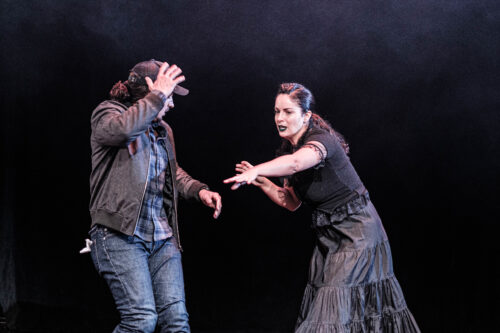
Leo Oliva and Hannia Guillén navigate a dangerous world in Nilo Cruz’s “Kisses Through the Glass” at Miami Dade County Auditorium’s On.Stage Black Box. (Photo courtesy of Julio de la Nuez.)
Perhaps a story set in a big rig needs to be a movie, so you have the vehicle and the road and the closed-in environment of the truck’s cabin. Here, set designer Amalia Restrepo puts a truck seat on a platform with a few stairs leading to invisible driver and passenger “doors.” Nature takes the form of ever-changing projected paintings or a rainy deluge, with rocky red mulch representing the forest floor. Imagining contagion in a wide-open space – despite our several years of experience with it – isn’t easy.
The playwright-director has ideal storytellers in Oliva and Guillén, both of whom appeared in his November Arca images world premiere “Hotel Desiderium.”
The New York-based Guillén, who launched her acting career at Miami-Dade College’s Prometeo under Teresa María Rojas, has appeared in numerous Cruz plays throughout the country; the author and the actor get each other. She’s a brilliant, physically engaging, captivating performer, and in celebrity designer Danny Santiago’s all-black costume for Anabella, she gives off a Goth-meets-“Sex and the City” vibe.
Oliva, a Miami native based in Los Angeles (he’s also the producer-writer and an actor on the streaming series “Home Invasion”), exudes strength and sensitivity as Trevor. His decline as the “malady” takes hold is distressing and thoroughly believable. And he, too, has a way with Cruz’s words.
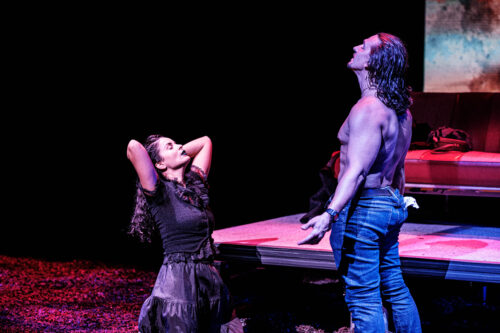
Hannia Guillén and Leo Oliva share an electric passion in the world premiere of Nilo Cruz’s “Kisses Through the Glass.” (Photo courtesy of Julio de la Nuez)
As with so many of the plays Cruz has staged for Arca, “Kisses Through the Glass” underscores the artistry of theatrical collaboration. Ernesto Pinto’s lighting is vital to emphasizing the shifting moods of the couple’s journey. Sound designer Mariana Restrepo summons crickets, birdsong, the roar of the truck engine. And the music woven throughout the play is haunting and emotionally illuminating.
“Kisses Through the Glass” is different from so many plays in Cruz’s body of work. Some of its language seems almost formal, while other lines blaze with vivid imagery. Anyone – everyone – who endured pandemic isolation and engaged with others through a distancing computer screen will understand – as Trevor and Anabella do – the ferocious need for no-filter human contact.
WHAT: Arca Images world premiere of “Kisses Through the Glass” by Nilo Cruz, in English with simultaneous Spanish translation
WHERE: On.Stage Black Box at Miami-Dade County Auditorium, 2901 W. Flagler St., Miami
WHEN: 8:30 p.m. Thursday-Saturday, 5 p.m. Sunday, through Aug. 7
COST: $30 ($25 students and seniors)
INFORMATION: 305-547-5414, miamidadecountyauditorium.org or arcaimages.org
ArtburstMiami.com is a nonprofit source of dance, visual arts, music and performing arts news. Sign up for our newsletter and never miss a story.
No posts found
Review: Main Street Players Lean Into the Absurd with ‘Black Sheep’
Written By Christine Dolen
July 25, 2022 at 10:09 PM
Michael Vadnal is Nelson and Kyran Wright is Carl in Main Street Players’ production of Lee Blessing’s “Black Sheep” through Sunday, Aug. 14 in Miami Lakes. (Photo courtesy of Juan Gamero)
Playwright Lee Blessing has been a prolific mainstay of American regional theater throughout much of his long career. Though his best-known play “A Walk in the Woods,” about a pair of Russian and American nuclear arms negotiators, was his only work to get a Broadway run, Blessing’s many other plays have had high-profile productions at regionals of all sizes.
Manalapan’s much-honored Florida Stage, which shut down in 2011, commissioned one Blessing play (1993’s “Patient A”) and staged the world premiere of another, “Black Sheep,” in 2001. Now a smaller regional company, Main Street Players in Miami Lakes, has chosen “Black Sheep” as its second production in its new theater a block west of its longtime Main Street home.
“Black Sheep” is an absurdist dark comedy, a piece that is very difficult to pull off tonally. Blessing is experimenting with style in this play about racism, greed and ravenous desire. But until the 90-minute production’s waning moments, director Brandon Urrutia and the cast leave the audience as baffled and unsettled as the play’s central character.
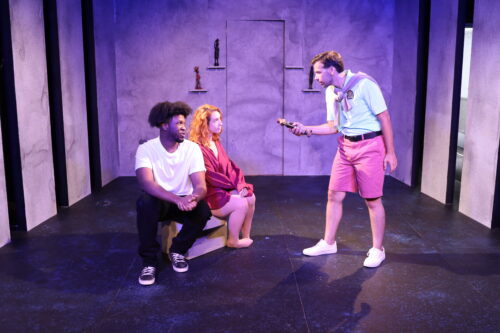
Anthony Wolff (standing) confronts Kyle Wright and Lucy Lopez in Main Street Players’ “Black Sheep.” (Photo courtesy of Juan Gamero)
He is Carl Winship (Kyran Wright), the biracial “black sheep” in the fabulously wealthy (and white) Winship family. Though still young, Carl has just served 10 years in prison for the accidental killing of his half-brother. His uncle Nelson (Michael Vadnal), who agrees with everyone that Carl should not have been tried as an adult, has invited his nephew to take up residence in the guest house on his estate and thus rejoin the extended family.
Nelson’s wife Serene (Jennifer Leah) is anything but what her first name implies whenever she’s in Carl’s presence; she is, in fact, a predator, constantly making moves on him regardless of his lack of interest.
Carl’s cousin Max (Anthony Wolff) is possibly the horniest dude alive, likely because his porn actress girlfriend Elle (Lucy Lopez) is holding out for marriage. Max, who has perfected the art of building a career as a film critic despite doing the tiniest amount of work possible, is the personification of a scion of the idle rich.
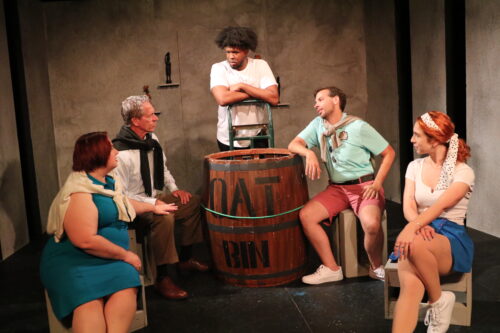
Jennifer Leah, Michael Vadnal, Kyran Wright, Anthony Wolff and Lucy Lopez are an unsettling family in “Black Sheep.” (Photo courtesy of Juan Gamero)
Soon enough, the reason for Carl’s presence on the Winship estate becomes clear. Each of the characters suggests that, in return for half of Nelson’s fortune, Carl should “accidentally” murder the others. After all, he’s experienced, right?
“Black Sheep” explores insidious racism, the micro- and macroaggressions, among those who insist they are absolutely not racist. Just one example: Nelson asks Carl where in Africa his “people” are from. Then he looks at one of the many primitive figures now in the guest house. “Why don’t African artists carve what they see?” Nelson asks. Carl’s response? “Maybe that is what they see.”
Much is made of dreams or nightmares in “Black Sheep,” as characters provoke each other or claim some upsetting act took place in a dream state. Ghosts enter into the picture, too, via references to the 1953 Japanese classic “Ugetsu,” though no one but the most devoted cineaste is going to get that.
Set and lighting designer Amanda Sparhawk has created a kind of gray void with multiple doors to represent the guest house. A few tiny shelves hold the carved figures, but the predominant “furniture” consists of a single barrel moved around on a handcart until it becomes part of yet another noisily expressed sexual fantasy for the man-boy Elle calls “Maxie Millions.”
Urrutia is working with a mostly young, less experienced cast that tends to make obvious choices rather than deepening their line readings. As Carl, Wright at first tends to scowl, coming off as skeptical or puzzled. He grows through the play, though, eventually exploiting the character’s power over the others.

Kyran Wright’s Carl (left) is justifiably wary of Jennifer Leah’s Serene in Main Street Players’ “Black Sheep.” (Photo courtesy of Juan Gamero)
Vadnal and the younger Leah are a mismatch as a couple, she too obviously young to be Max’s mother (stepmom maybe, though the script refers to her as his mother and to Nelson and Serene as Max’s parents). Wolff is outrageously amusing as he explains his career strategy to Carl and just outrageous when he’s acting out sexually. Lopez portrays Elle as a conniving beauty who imagines she’s way smarter than she is.
Sound designer Alex Tarradell and Sparkhawk’s lighting contribute to the spooky surreal vibe of “Black Sheep,” and costume designer Angie Esposito effectively contrasts the country club look of the wealthy Winships with Carl’s post-prison attire, which is meager enough to fit in a backpack.
Though the style of Main Street’s “Black Sheep” doesn’t coalesce until later in the play, it would help any theatergoer to know this going in: This is a play that operates on dream logic. It isn’t linear. Not everything makes sense. If you can surrender to a story told in an unconventional way, you’ll enjoy it more.
WHAT: “Black Sheep” by Lee Blessing
WHERE: Main Street Playhouse, 6812 Main St., Miami Lakes
WHEN: 8 p.m. Friday-Saturday, 2 p.m. Sunday, through Aug. 14
COST: $30 ($25 for students and military personnel).
INFORMATION: 305-558-3737 or mainstreetplayers.com
ArtburstMiami.com is a nonprofit source of dance, visual arts, music and performing arts news. Sign up for our newsletter and never miss a story.
No posts found
Review: Actors’ Playhouse delivers a concert and cautionary tale in ‘Hank Williams: Lost Highway’
Written By Christine Dolen
July 21, 2022 at 12:18 AM
Jeremy Sevelovitz, Andy Christopher, Lindsey Corey and Stephen G. Anthony in Actors’ Playhouse’s “Hank Williams: Lost Highway” through July 31 in Coral Gables. (Photo courtesy of Alberto Romeu)
In 1987, singer-songwriter Hank Williams was given a posthumous Grammy Lifetime Achievement Award.
The honor, bestowed to a country music icon whose body of work included “I Can’t Help It (If I’m Still in Love with You),” “I’m So Lonesome I Could Cry,” “Hey Good Lookin’,” “Your Cheatin’ Heart” and countless Billboard Country and Western chart toppers, was richly deserved.
But Williams’ lifetime? That was tragically brief. From hardscrabble beginnings in Alabama to his lonely death on the way to a concert in West Virginia, he never made it to his 30th birthday. Yet he packed so much living, self-destruction and success into those years that he had enough material for dozens of unforgettable hits.
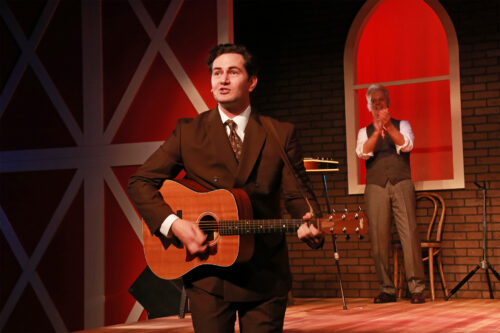
Andy Christopher plays country legend Hank Williams, with Barry Tarallo as “Pap” Rose, in “Hank Williams: Lost Highway” at Actors’ Playhouse. (Photo courtesy of Alberto Romeu)
Whether or not you know much about Williams’ songs and the man who wrote them, you’ll encounter a fascinating, complex, charismatic version of a gone-too-soon artist if you catch the new Actors’ Playhouse production of “Hank Williams: Lost Highway.” The Randal Myler-Mark Harelik show, which premiered at the Denver Center the same year Williams got the Lifetime Achievement Grammy, went on to play other major regional theaters, which included Nashville’s Ryman Auditorium and a 2002-2003 off-Broadway run, among its many productions.
Actors’ Playhouse artistic director David Arisco is justifiably proud of his company’s version of
“Hank Williams: Lost Highway,” which is running in the upstairs Balcony Theatre space at Coral Gables’ Miracle Theatre through the end of the month. Performed by a cast of 10 actor-singer-musicians – some of them South Florida-based talent, others from places near and far – the performers deliver at the level Williams’ music deserves. Listening to them sing and play is moving, entertaining, and many times thrilling.
The Myler-Harelik script hits the highs and cautionary lows of Williams’ short life, which could be a template for many a subsequent star lost to disorienting fame and substance abuse. Williams’ severe back pain (he was born with spina bifida occulta) and bad heart, coupled with alcoholism and drug abuse (amphetamines, Seconal, morphine, and the addictive sleep drug chloral hydrate) did him in.

Chaz Rose, Andy Christopher and Lindsey Corey sing blues and classic country in the Actors’ Playhouse production of “Hank Williams: Lost Highway.” (Photo courtesy of Alberto Romeu)
The show begins with the shocking news of the star’s death in the back seat of his baby-blue Cadillac convertible on New Year’s Day 1953. Then it scrolls back to his beginnings as he learns blues-infused phrasing and guitar playing from street singer Rufus “Tee-Tot” Payne, here played by the magnificent Chaz Rose (from the Actors’ production of “Memphis”).
Any bio-musical requires a chameleonic actor-singer in the title role, and Arisco found an ideal Hank in Andy Christopher. Christopher has played Williams and rock ‘n’ roll original Buddy Holly in different productions, so he’s obviously successful at tailoring his voice and in-the-spotlight charisma in transformative ways.
He’s a sensational Williams: tall, more handsome than the original, deft at inserting a well-placed yodel at the right moment in some of the lyrics. He charms, yes, but doesn’t stint on the ugliness when Williams’ life is disintegrating. Christopher’s rendition of “I’m So Lonesome I Could Cry” is haunting and heartbreaking, sad and beautiful at the same time.
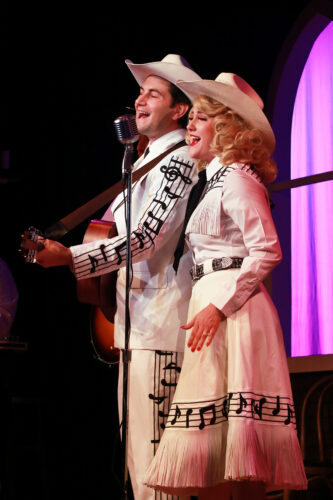
Andy Christopher and Lindsey Corey as Hank and Audrey Williams navigate a volatile marriage in “Hank Williams: Lost Highway.” (Photo courtesy of Alberto Romeu)
A stellar group of actor-musicians portrays Williams’ band, The Drifting Cowboys. Bass player Stephen G. Anthony, reprising his role as Hoss from the off-Broadway production, serves as musical director, sometime narrator and Williams’ increasingly frustrated old friend. The towering Jeremy Sevelovitz is Jimmy, aka “Burrhead,” the talented and too-frank guitar player. H. Drew Perkins’ fiddle player Leon, called “Loudmouth,” earns his way into the band with a scorching version of “Sally Goodin.” As the steel guitar player Shag, Russ Wever (who also did the show off-Broadway) infuses classic country into the sound.
As music publisher Fred “Pap” Rose,” Barry Tarallo also narrates and frequently butts heads with Christopher’s stubborn Williams. He’s good, very good as yet another victim of Williams’ increasingly erratic behavior, but it’s a shame that the character sings only with the group at the beginning and end of the show – his tenor voice is a thing of beauty.
Elizabeth Dimon plays Mama Lilly, Williams’ driven, church-going mother who served as his first manager. She’s a no-nonsense gal who doesn’t have much more luck controlling her alcohol-abusing son than anyone else will, and though we get a taste of Dimon’s terrific voice before another woman supplants Mama in Williams’ life, it’s not enough.
The “other” woman is Lindsey Corey as Williams’ first wife (and second manager) Audrey. Attractive, ambitious and aggressive, she is determined to follow her hubby into country music stardom. Trouble is, she has no discernible talent – a problem Corey herself does NOT have. The actor is a glorious singer – just listen to her during the “I Saw the Light” finale – so playing off-key Audrey can’t be easy. Myler and Harelik have written the role as a caricature of the pushy wife, but Corey makes the comedic most of it.
Sofia Porcel plays a character known only as Waitress, a woman who works in a truck-stop diner while she smokes and obsessively listens to Williams on the radio. She’s representative of his legion of fans and one-night stands – as we see, finally, when the two end up in a cow pasture – but keeping her onstage through most of the show is distracting; ditto with having Rose’s Tee-Tot parked on the porch of a country gas station.
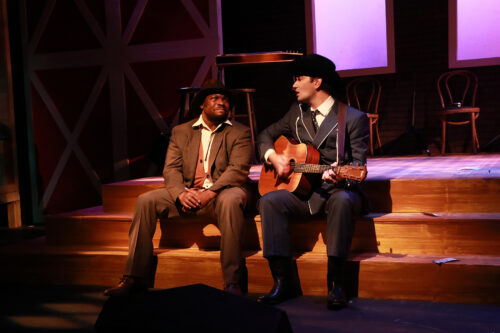
Chaz Rose (left) as Tee-Tot and Andy Christopher as Hank Williams influence each other in “Hank Williams: Lost Highway” at Actors’ Playhouse. (Photo courtesy of Alberto Romeu)
It’s impossible to guess whether the Actors’ Playhouse design team contains any hardcore country music fans, but all seem to have been inspired by Williams, his music and his story.
Ellis Tillman, whose work is always excellent, has outdone himself in creating a huge array of period- and genre-perfect costumes, particularly his versions of the famous Nudie-brand suits Williams favored. Those suits cost $500 back in the early ‘50s; in today’s dollars, that translates to more than $5,000 apiece.
Set designer/set dresser Jodi Dellaventura has filled the small Balcony Theatre stage with three different environments, which lighting designer Eric Nelson bathes in a nostalgic glow (Tee-Tot’s porch), unforgiving illumination (the diner) and bright concert lights. Alex Bonilla’s sound design is a match for the cast’s glorious voices.
Just one more note: If you try to see “Hank Williams: Lost Highway” after July 31, you won’t. That’s the closing date, and because Actors’ has another show waiting in the wings, there won’t be an extension. So, get a move on or you’ll be left, like Williams, singing the “Long Gone Lonesome Blues.”
WHAT: “Hank Williams: Lost Highway” by Randal Myler and Mark Harelik
WHERE: Actors’ Playhouse in the Balcony Theatre at the Miracle Theatre, 280 Miracle Mile, Coral Gables
WHEN: 8 p.m. Wednesday-Saturday, 3 p.m. Sunday, through July 31
TICKETS: $40 to $90 (seniors 65 and over get 10 percent off weekdays only; students 25 and under with valid student ID pay $15 for a rush ticket available 15 minutes before a weekday performance. Special Lunch Break deal offers half-price tickets between noon and 2 p.m. to same-day weeknight performances; Tix @ 6 offers half-price tickets weeknights between 6 and 6:30 p.m., with both requiring an in-person purchase at the box office, subject to availability)
INFO: 305-444-9293 or actorsplayhouse.org
ArtburstMiami.com is a nonprofit source of dance, visual arts, music and performing arts news. Sign up for our newsletter and never miss a story.
No posts found
Filmmakers ‘Pass the Mic’ to their subjects in trio of Miami-based documentaries
Written By Josie Gulliksen
July 19, 2022 at 1:13 PM
Caribbean-American filmmaker Ronald Baez created the short documentary “Apart < A Part” in collaboration with community experts Fidel Aquino (aka Aquino the Tailor) and the Allapattah Collaborative CDC. (Photo courtesy of Ronald Baez)
Three filmmakers selected to submit documentaries to Oolite Arts’ “Pass the Mic: We Will Tell Our Stories” focus on issues from gentrification in Miami’s Allapattah neighborhood to the plight of day laborers in Homestead as well as tenants’ rights in Miami.
Danielle Bender of Oolite Arts and Nadege Green of the Community Justice Project selected Ronald Baez, Diana Larrea and Terrence Price II for Oolite’s second commissioned film series, which will be screened at the Little Haiti Cultural Center at 7 p.m., Friday, July 22, followed by a discussion moderated by Green.
Baez, Larrea and Price were given a list of organizations from which to select. “We wanted to look at ways to work with filmmakers collaboratively with community members as experts,” says Green.
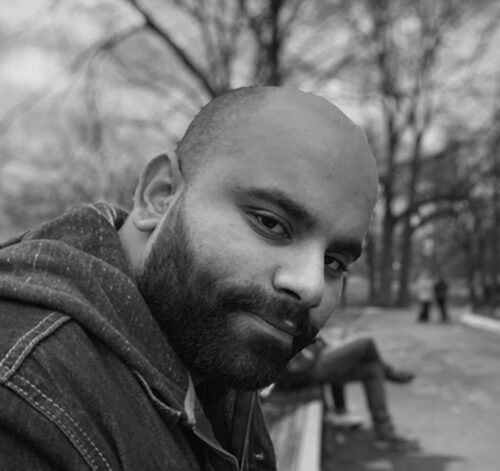
Ronald Baez was one of three filmmakers selected to create documentaries for “Pass the Mic: We Will Tell Our Stories” commissioned by Oolite Arts in collaboration with the Community Justice Project. (Photo courtesy of Ronald Baez)
Bender adds that in selecting the filmmakers they were “deliberate in choosing people that are thoughtful and focused on being collaborative and great storytellers.”
Baez’s film “Apart < A Part” zooms in on the Allapattah neighborhood, particularly the Allapattah Collaborative CDC, and features business owner Fidel Aquino as the “community expert.” The film’s focus is the ever-present threat of gentrification in the neighborhood and the Collaborative’s personal approach to the issue.
Baez explains the unusual title comes from a cartoon he once watched. “I tend to name my films after things I’ve read and seen . . . There was a small cartoon about two dinosaurs and two trees that were growing apart,” he explains. “What stayed with me was an image that showed that although the trees grow apart above ground the roots still grow together, so that felt like what we should do with developing neighborhoods.”
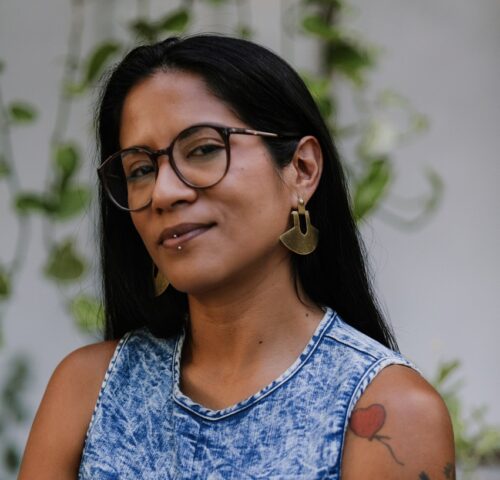
Miami-based, Peruvian filmmaker Diana Larrea created the short documentary
“Monarcas” for “Pass the Mic: We Will Tell Our Stories.” (Photo courtesy of Diana Larrea)
The filmmaker met Aquino, a master tailor and local business owner, through the Allapattah Collaborative CDC.
“I figured maybe we could tackle the gentrification issue through the commercial corridor,” says Baez. “I met Aquino and I loved that he had a way of feeling hopeful despite being frustrated.”
He says he spent time with Aquino even before shooting his film, just one-on-one, getting to know Aquino and his wife at their shop.
“It helped me earn their trust as well as express my intentions rather than telling them what my intentions were. The different approach allowed Aquino to become more and more candid throughout the process,” says Baez.
Baez’s own background also influenced work on his film. He chose Allapattah because of his Dominican roots, he says, and how he felt he could relate to the neighborhood and the many Dominican residents and business owners. “I know their culture although I don’t understand their plight. I felt their work is very important and I was able to speak to them and the community on a cultural level.”
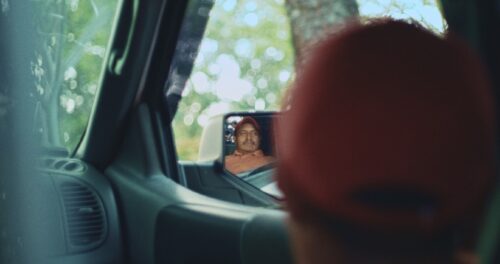
In “Monarcas,” Pedro learns his rights as an immigrant with the help of the group WeCount! (Photo courtesy of Diana Larrea)
Larrea also says she related to those portrayed in her film, eventually joining the organization she spotlighted. She was drawn to the voices of day laborers in Homestead, who are leaders of the non-profit WeCount! and their transformation after arriving in the United States. Larrea, who is Peruvian and has an American passport, says she is still sometimes “afraid they’re going to take it away from me.”
Her film, “Monarcas,” features community experts Alejandro and Pedro (the filmmaker did not want the men to be identified by their last names out of fear for their immigration status), who are both Guatemalan, and their transformation to becoming spokespersons for WeCount! Their path, she says, has now brought them to being the ones teaching immigrants that they “have rights and need to maintain their dignity.”
“I really wanted the film to focus on them, the stories of the two men, one of them even still speaks a Guatemalan dialect, Spanish is his second language,” said Larrea.

Miami-based filmmaker Terence Price II created the short documentary
“Rooted like a Tree” in collaboration with the nonprofit Miami Workers Center. (Photo courtesy of Terence Price II)
The title, “Monarcas,” represents the monarch butterfly as a symbol. “It’s a very well-known symbol of migration,” she explains.
It was a very personal experience that led to Price create his film “Rooted like a Tree,” which features community expert Keisha Guyton, a member of Miami Workers Center, fighting for tenants’ rights and the fight to pass the first Tenant’s Bill of Rights in Miami.
Price first learned about Miami Workers Center when his apartment was sold to a development company from Colorado who told those who lived there that the building was going to be demolished. “They put us on a monthly lease so basically after each month they could tell us to leave,” says Price.
That’s when he and the tenants reached out to Miami Workers Center. “We sought the support of our neighbors to rally together to fight the developers and Miami Workers Center found us pro bono lawyers who helped us navigate the situation and stay out of any legal trouble,” he explains.
Price eventually became a member of Miami Workers Center in January 2022 and began working on the film after he joined the group.
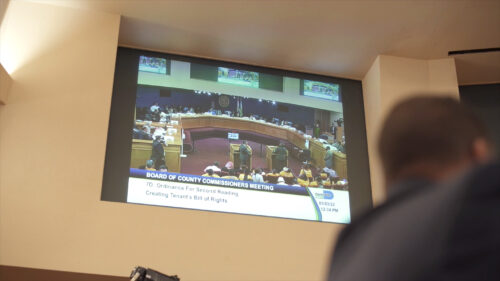
Terence Price’s film “Rooted like a Tree” sheds light on the fight for a tenants’ bill of rights. (Photo courtesy of Terence Price II)
His film focuses on the Tenant’s Bill of Rights which MWC began in July 2021. He documented what he says was a three-month journey of the creation of the bill. The Miami-Dade Board of County Commissioners ultimately approved an ordinance creating Miami-Dade’s first Tenant’s Bill of Rights in May of 2022.
“It was a personal journey I felt compelled to document,” says Price.
In addition to highlighting important issues, Green and Bender both hope the documentaries – all around 11 to 15-plus minutes in length – will continue to benefit people in similar circumstances.
“These films create a historical framework that will remain in archives and will forever show how these neighborhoods are changing. They create a historical record of these stories that otherwise might not have existed in this way,” says Green.
WHAT: “Pass the Mic: We Will Tell Our Stories”
WHERE: Little Haiti Cultural Center, 212 NE 59th Terrace, Miami
WHEN: 7 p.m. Friday, July 22
TICKETS: Free but RSVP required Pass-the-Mic-We-Will-Tell-Our-Stories-Screening
INFORMATION: 305-576-4390 or oolitearts.org/pass-the-mic/
ArtburstMiami.com is a nonprofit source of dance, visual arts, music and performing arts news. Sign up for our newsletter and never miss a story.
No posts found
Review: Ruben Rabasa contemplates his funny, rich long life in ‘Rubenology’ at GableStage
Written By Christine Dolen
July 18, 2022 at 2:12 PM
Ruben Rabasa stars in “Rubenology: The Making of an American Legend” at Gablestage through July 31 at the theater inside the Biltmore Hotel. (Photo courtesy of Magnus Stark)
Actor Ruben Rabasa is 84 years old, and he’s not one of those performers who tries to hide his age to keep his casting options open.
He mentions it right off the top in the GableStage world premiere of “Rubenology: The Making of an American Legend,” just after he has emerged from the wings wearing a gold sequined bomber jacket and dancing enthusiastically to “Hot, Hot, Hot.” Rabasa comes off as being much younger, but that’s not the point: This is a man ready to share stories from decades of showbiz/life experience and wisdom from his ageless soul. That’s a potent combination.
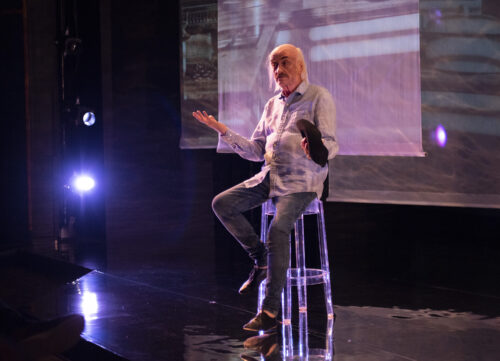
In “Rubenology: The Making of an American Legend” at Gablestage, Ruben Rabasa shares personal stories of his life and career along with wisdom from his ageless soul. (Photo courtesy of Magnus Stark)
“Rubenology” is a collaboration between GableStage and the Abre Camino Collective, the self-described “storytelling studio” run by playwright Vanessa Garcia and director Victoria Collado. Garcia wrote the script in English based on extensive interviews with Rabasa in Spanish (both are credited), and Collado shaped and staged the play, remaking it in several significant ways during rehearsals, according to the director.
In content, “Rubenology” is many things. First and foremost, it’s a celebration of a performer who emigrated with his mom and younger brother from Havana to New York in 1955 at the age of 17. The play also examines the joys and frustrations of being a multicultural artist, how Rabasa’s Cuban roots suffuse just about everything in his American experience, and how the deepest of bonds transcend death.
Not that “Rubenology” is a somber solo show. Far from it. Like its ageless philosopher-performer, the play is funny and whimsical, brimming with warmth, yet deeply emotional when it should be.
Because he has been in more than 70 movies and television shows in addition to his work in theater, Rabasa’s is a familiar face, especially to the Spanish-speaking contingent in the audience. When you enter the theater, you see projected images of him – as a little boy beside his mother in Cuba, as a handsome young man, a goofy character in a wig, an older gent with a mostly bald head and a long fringe of wispy white hair.
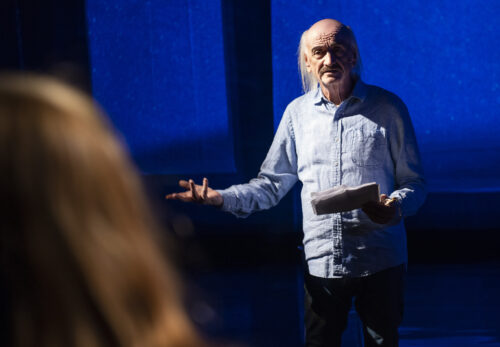
Ruben Rabasa turns serious as he talks about the loss of his mother in the world premiere of “Rubenology” at GableStage. (Photo courtesy of Magnus Stark)
An experienced standup comedian as well as an actor, Rabasa makes connecting with the audience look easy. By the time he emerges from behind those projected portraits, the whole crowd is ready to stand up and clap (or wiggle) along to “Hot, Hot, Hot.” Later, he spies someone he thinks he knows in the audience and begins a little exchange – one that will pay off near the end as he muses about legacy, resilience and connection. Another audience member, chosen because he or she is bilingual, translates a short Spanish passage into English.
Several times, Rabasa refers to things coming in threes, everything from the ingredients of a Cuban pan con timba (bread, cheese, guayaba) to the frightening options for dealing with his nonagenarian mother’s last illness (surgery, hospice, and a tube down her throat).
“Rubenology” is also organized into three sections, the first about his crazy experiences as a teen busboy (who spoke zero English) in wintery New York in the mid 1950s; the second about his dealings with a santero (birds were involved) as he tried to take his career to the next level; the third about the eccentricities of his beloved tell-it-like-it-is mother, along with his devastation at her passing.
Here and there, Rabasa has storytelling help from Mimi (Marialexia Hernandez, the show’s assistant stage manager), who takes the stage briefly to bring him coffee, read a few of his lines when he’s offstage or jolt him from a lost-in-thought space into his last story. Their interactions sometimes sweet, sometimes faux combative, but the vibe between these artists of very different generations is charmingly affectionate.
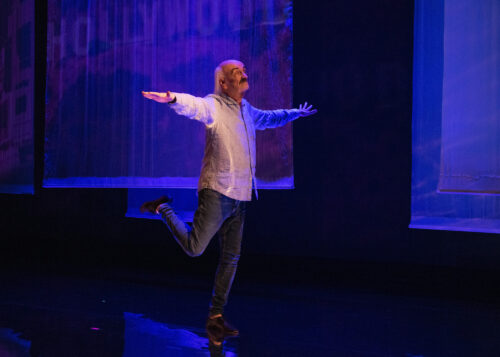
An experienced standup comedian as well as an actor, Ruben Rabasa makes connecting with the audience look easy. (Photo courtesy of Magnus Stark)
“Rubenology” isn’t a show that requires spectacle to tell the story of a life. Set and lighting designer Frank J. Oliva, projection designer Joel Zishuk, sound designer Brandye Bias and costume designer Nobarte go for simplicity, the better to make a show that Rabasa can easily take on the road at some point.
Right now, the piece is still evolving as speeches get tweaked and the actor settles in. On opening night, the hat that’s a key to telling his first story didn’t function as it should have so Rabasa had to keep adjusting it. When he’s speaking English (as he is 99 percent of the time), his Cuban-Spanish accent is strong, so he needs to be mindful of clarity. There are sporadic f-bombs in the script, which are unnecessary.
Most movingly, “Rubenology” doesn’t consider only the breadth of an impressive career. The play also demonstrates Rabasa’s range as an actor. As he reads his account of ongoing guilt over his mother’s death, tears well in his eyes. His voice catches. This is not the funny guy who so easily makes people laugh. This is an 84-year-old missing his mother.
As we move from the autumn to the winter of life, it’s natural to look back, to consider what we did or didn’t do, to ponder what our legacy might be. Thanks to Abre Camino and GableStage, that process – so full of warmth and sincere feeling in Rabasa’s case – has been captured and made ready for sharing in “Rubenology.
WHAT: “Rubenology: The Making of an American Legend” by Vanessa Garcia and Ruben Rabasa
WHERE: GableStage in the Biltmore Hotel, 1200 Anastasia Ave., Coral Gables
WHEN: 7 p.m. Thursday, 8 p.m. Friday-Saturday, 2 p.m. Sunday through July 31
COST: $40-45 (tickets start at $20 for those under 35)
INFORMATION: 305-445-1119 or gablestage.org
ArtburstMiami.com is a nonprofit source of dance, visual arts, music and performing arts news. Sign up for our newsletter and never miss a story.
No posts found
Review: Virtuoso musicians bring personal stories to light in Miami New Drama’s ‘Papá Cuatro’
Written By Christine Dolen
July 11, 2022 at 10:37 AM
Mafer Bandola explains her musical evolution in a short-ruffled dress, the same costume she wore as a youngster, in Miami New Drama’s “Papá Cuatro.” (Photo courtesy of Chris Crass)
In Miami Beach, Miami and Coral Gables, July has become a focal month for theater by and about Latinx artists. Some shows are in Spanish, others in English. Some artists were born here, others are visiting, still others are living as exiles or immigrants.
Miami New Drama’s extraordinary world premiere musical “Papá Cuatro,” playing at Miami Beach’s Colony Theatre through July 31, has just opened. And there’s more: The 36th International Hispanic Theatre Festival is ongoing through July 25 at Miami’s Arsht Center and Miami-Dade County Auditorium’s On.Stage Black Box, the world premiere of Vanessa Garcia and Ruben Rabasa’s “Rubenology” debuts at GableStage on July 1, and Pulitzer Prize winner Nilo Cruz will direct the world premiere of his “Kisses Through the Glass” for a two-weekend run at the On.Stage Black Box starting July 28. (Editor’s Note: Miami New Drama extended the run of “Papá Cuatro” twice, first through Aug. 7 and then through Aug. 21.)
For anyone eager to experience the wealth of multicultural artistry that makes theater here so distinctive, Miami New Drama’s “Papá Cuatro” is a thrilling place to start.

Percussionist Adolfo Herrera brings a wry, practical style to his storytelling in Miami New Drama’s “Papá Cuatro.” (Photo by Chris Crass)
The company’s second world premiere collaboration with Venezuelan-Canadian director Juan Souki (after 2019’s “Viva La Parranda!”) celebrates the talents and stories of five musicians who have become part of the Venezuelan diaspora. It is quite different from “Viva La Parranda!,” a folkloric exploration of village culture, music traditions, and cuisine that Souki crafted with performer Betsayda Machado.
“Papá Cuatro” takes as its unifying sound and symbol the four-stringed cuatro. Resembling a small classical guitar, the traditional cuatro in considered the national instrument of Venezuela. And indeed, the cast members share photos of themselves learning to play the cuatro as kids, though the percussionist jokes: “My name is Adolfo Herrera, and I am not a cuatro player. I am the cuatro’s drummer.”
Set in designer Frank J. Oliva’s rendition of a recording studio, “Papá Cuatro” is performed in Spanish with English supertitles. Lyrics of the dozens of carefully chosen songs aren’t translated, but the qualities inherent in the music – longing, joy, loss, nostalgia, sheer virtuosity – always come through clearly.
Singer-actor Mariaca Semprún, harpist Eduardo Betancourt, cuatro virtuoso Miguel Siso, bandola llanera player Mafer Bandola (whose given name is María Fernanda González Olivo) and percussionist Herrera are world-class musicians with several Latin Grammy Awards among them.
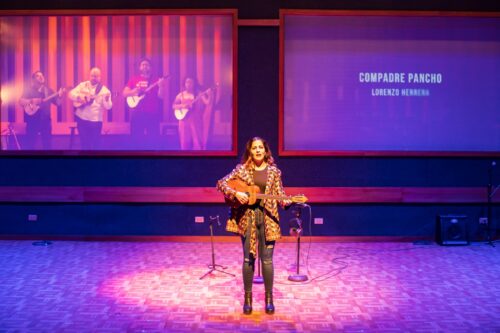
Miguel Siso, Eduardo Betancourt, Adolfo Herrera and Mafer Bandola (in booth) accompany Mariaca Semprún as she sings in “Papá Cuatro.” (Photo courtesy of Chris Crass)
Director Souki, who conceived and assembled the show, interviewed the performers and assembled their personal stories into a script. The result is a musical-documentary of sorts that conveys the influences of family and cultural traditions, the trajectory of dreams and success, and the myriad challenges of starting anew after politics and violence made staying in their beloved Venezuela impossible.
Speaking, singing, and playing, the artists convey their personalities and backstories, with projection designer Fernando Mendoza illustrating some of their words with videos and family photos.
In regard to the latter, some of Herrera’s are particularly mind-blowing: His mother Gloria, who was a militant Venezuelan communist in the 1960s and ’70s, is pictured with the Dalai Lama. His grandfather Humberto is seen posing with Mao Tse Tung. It was on his parents’ second trip to China, in 1979, “where they truly realized, 40 years ahead of all Venezuelans, that communism was going nowhere,” he says, grinning.
The radiantly beautiful Semprún – who starred in the Venezuelan TV show “La Popular Shirley” performed for huge concert, opera and theater audiences, and recently did the Telemundo Global series “Malverde: El Santo Patron” – talks about coming to Miami with her writer-husband Leonardo Padrón to prepare for their musical “Edith Piaf, Voz y Delirio.” An airline employee called her to say the SEBIN, or political police, kept asking when the couple would be returning to Caracas. They never did.
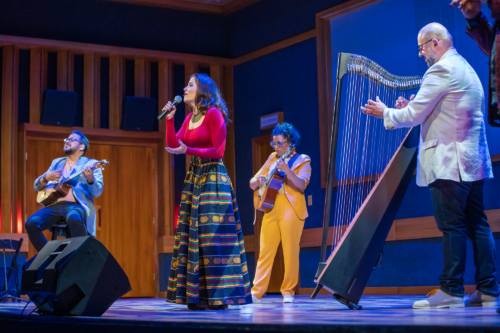
Miguel Siso, Marica Semprún, Mafer Bandola and Eduardo Betancourt in the concert-like finale of Miami New Drama’s “Papá Cuatro” at the Colony Theatre, Miami Beach. (Photo courtesy of Chris Crass)
Herrera, who has a knockout singing voice, pulls off an adroit balancing act of keeping things amusing while underscoring the realities of what being an artist in exile means. He puts together a drum kit while storytelling, talking about cleaning up construction debris at the Venetian Way condo owned by the father-in-law of a Venezuelan radio host who interviewed him many times. He’s happy with his wife and two kids at their home in Kendall. He plays with the Miami Symphony Orchestra, the Raices Jazz Orchestra and has contributed to five Latin Grammy-nominated albums. He has perspective.
“The migratory experience has offered me those crazy moments where people rediscover you: ‘Hey, man, you’re a beast. You could dedicate your life to this,’ ” Herrera says.
Betancourt speaks of working construction, playing in restaurants and driving for Uber before getting hired to teach – Spanish, not music. He recounts his difficulties with revisiting the rules of grammar and does a good job of trying on other accents, Cuban and “gringo.” Today, he’s a special education teacher’s assistant at a Boston school. In “Papá Cuatro,” playing Juan Vicente Torrealba’s “Concierto en la Llanura” and other songs, he proves himself one of the most moving and masterful harp players anywhere.
Siso shares what sounds like an improbable tale of emigrating from Venezuela to Ireland, of starting out in an Irish pub, playing in a Latin band with a Cuban lead singer, and winning the Latin Grammy for “Identity,” his farewell album to Venezuela. Though he could not celebrate with family in his homeland, Irish President Michael D. Higgins had him over for dinner – Soto shows us the photos.
All of this is after his blistering cuatro rendition of Consuelo Velázquez’s “Bésame Mucho,” which is anything but dreamy.

Miguel Siso brings breathtaking virtuosity to his playing in Miami New Drama’s world premiere of “Papá Cuatro.” (Photo courtesy of Chris Crass)
Bandola recounts the traditional – sexist, if you will – teaching methods of the great Carlos Hidalgo as she learned the bandola in a class that was all-male. Later she shares her experiences competing in the Festival Internacional de Música Llanera El Silbón, in which she had to dance, sing, recite and play the bandola, all while wearing the short-ruffled dress from her childhood in green and purple (her favorite colors), brought from Venezuela. It’s complemented by a flower headdress and sparkle-bedecked shoes. The show’s other costumes are the work of designer Angela Esposito.
Bandola, fierce and powerful as she plays, eventually concluded that her instrument’s male-dominated culture probably wasn’t the best way for her talents to flourish, so now the songwriter and activist performs with the four-woman multinational band Ladama.
With vivid lighting by Ernesto Pinto and crisp sound by Javier Casas, “Papá Cuatro” is already an impressive, enlightening, and thoroughly enjoyable piece of musical theater.

Adolfo Herrera, Mafer Bandola, Miguel Siso, Mariaca Semprun and Eduardo Betancourt prepare to take a bow in “Papá Cuatro.” (Photo courtesy of Chris Crass)
Because each performer gets two solo segments, however, the show runs long – two hours with no intermission, though a break is listed in the program. Some precision trimming and restructuring could make the piece even more powerful, though there’s no denying that each time someone says his or her name and adds “…and I am an artist in exile,” you feel overwhelming sorrow. Yet you are thrilled, sometimes overwhelmed, by the sheer talent and determination of such remarkable musicians.
Miami New Drama’s core mission is making theater that reflects and connects with South Florida’s diverse array of communities. “Papá Cuatro” resoundingly does that for the region’s Venezuelan residents, but even if your background is different, even if you don’t speak Spanish, you’re missing out on theater and music that will move you. Culturally, this is a place of many treasures, and “Papá Cuatro” is one of them.
WHAT: “Papá Cuatro” at Miami New Drama
WHEN: 8 p.m. Thursday-Saturday, 3 p.m. Sunday, through July 31 (extended through Aug. 21)
WHERE: Colony Theatre, 1040 Lincoln Road, Miami Beach
COST: $45.50, $61.50 and $71.50 (prices include $6.50 service charge)
INFORMATION: miaminewdrama.org or 305-674 -1040.
ArtburstMiami.com is a nonprofit source of dance, visual arts, music and performing arts news. Sign up for our newsletter and never miss a story.
No posts found
‘Are You There, Bette Davis?’ from Uruguay opens Hispanic Theatre Festival of Miami
Written By Jose Antonio Evora
July 6, 2022 at 10:52 AM
María Elena Pérez as Graciela, Martha Vidal as Azucena, and Carlos Sorriba as Aníbal in “Are You There, Bette Davis?,” which is part of the 36th International Hispanic Festival of Miami. (Photo courtesy of Domingo Milesi).
That cinema came to steal space from the theater at the beginning of the last century was a challenge for the stage, and since then, there have been many acts of revenge. One of the most recent is titled “Are You There, Bette Davis?,” a play written and directed by Uruguayan playwright Domingo Milesi that the International Hispanic Theatre Festival (IHTF) of Miami premieres on Friday, July 8 at the Black Box in the Miami Dade County Auditorium.
Azucena, played by Martha Vidal, faces two shocks: she retires, and her mother dies. Emptiness has her searching for nothing less than love and the meaning of life. That exploration takes her to a small neighborhood movie theater where she and her friend Graciela (María Elena Pérez) meet Aníbal (Carlos Sorriba), an inveterate movie buff. As if that were not enough, Azucena also indulges in experimentation with esoteric practices that, according to the program notes, “could establish a new interpretation of the present and a line of communication with the beyond.”
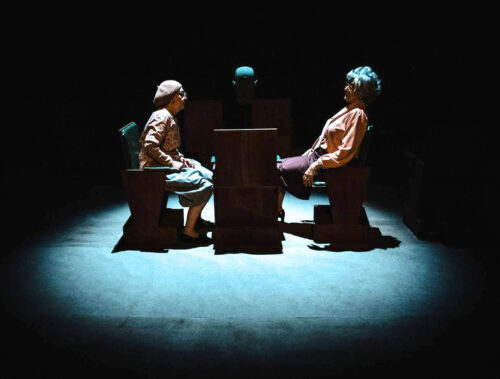
Martha Vidal, left, and María Elena Pérez, right, and the head that works as a microphone for the binaural sound system in “Are You There, Bette Davis?” (Photo courtesy of Domingo Milesi)
Spectators wear headphones to hear the performance as if they were sitting on stage. The effect is achieved thanks to “binaural sound,” a technique that records the voices of the actors with two microphones installed in what would appear to be a mannequin head placed on stage. This is also used to reproduce music simultaneously and pre-recorded sounds, such as street and beach environments.
“I always say that, above all things, this work is a sensory experience that has comedy, drama, melodrama, suspense; there is a bit of everything,” Sorriba told Chany Robson in Uruguay on the radio program “El Gato en el Tejado.”
In conversation with Artburst Miami from Montevideo, the play’s author and director describes the passion of mixing the languages of cinema and theater.
The fruits of that crossing “have been the motivators of my writing,” assures Domingo Milesi. “I like to think from the cut of a shot, from the fragmentation of an image, how a movie scene looks and how one language can be nurtured from the other without falling into the cinematographic representation of the shooting,” explains Milesi. “I use elements of cinema translated into theatricality.”
He underlines that he finds “the motor of theater” fascinating, referring to the body of the actor live, the stage presence, and the energy of the spectator coexisting in the same space with the actor. “But there are always certain resources of cinema that have been magnetic to me, such as intimacy, proximity, because they help empathy and the most hypnotic game,” he says.
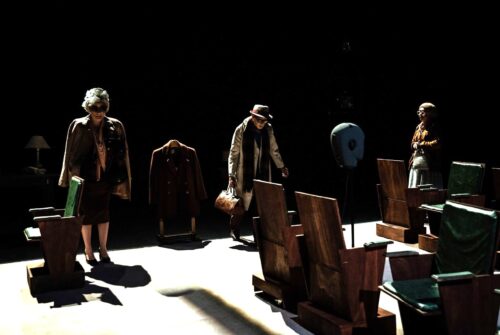
Martha Vidal (Azucena), Carlos Sorriba (Aníbal) and María Elena Pérez (Graciela) in a scene from “Are You There, Bette Davis?” (Photo courtesy of Domingo Milesi).
He confesses that it is harder for him to be distracted in a movie than in a theater and that while the atmosphere of the 1950s of the last century flies over “Are You There, Bette Davis?” the work pays tribute to a way of seeing cinema that is disappearing: the small neighborhood rooms. Milesi remembers when he was just over 20 years old in evening screenings at the Uruguayan Cinematheque, “a tiny room that is already disappearing here in Montevideo. We were very few, just four people, and that inspired me a lot.”
As proof of the cinematographic element used in the stage performance, he cites the use of actors with their backs to the public. “It’s a rule to say in theater: you can’t turn your back,” he says. “I review my staging and realize that I use the back as a narrative resource. I want to narrate from the back, and here I do it too. Having the viewers in headphones gives me certain freedom; I can compose visual frames that are not subject to sound, so the sound is a very cinematic narrative component in the story.”
Milesi reveals that the seed of the play was a concise text that he wrote when he was invited to participate in the workshop “Theater and Death” in Barcelona and that he made the definitive text knowing that he was going to have binaural sound in the performances. In his previous works, he says he experimented with physical resources such as dividing the audience space in half and making shots and reverse shots translated into theatrical language. In this one, he investigates more how sound generates dramatic tension.
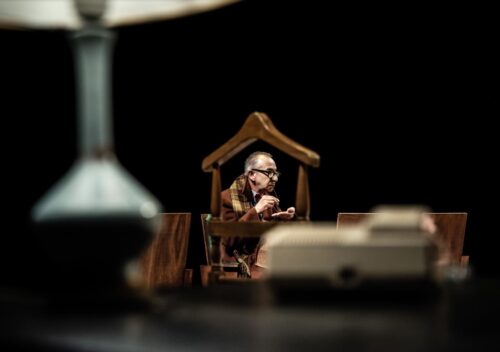
“Above all things, this work is a sensory experience that has comedy, drama, melodrama, suspense; there is a bit of everything,” says actor Carlos Sorriba about “Are You There, Bette Davis?” (Photo courtesy of Domingo Milesi).
Thanks to an award from the National Research and Innovation Agency of his country, he could count on the binaural sound system. It is the first time he uses it, and it is also the first time that the system is used in the Uruguayan theater, declares Milesi.
“Considering that everything happens in a movie theater, it works as if we had a spectator sitting there . . . We spent several months investigating because this technology enables whispering, it enables secrecy, it enables the sounds of clothing; everything takes on a new dimension, and the work becomes a truly immersive experience.”
I ask him to try to forget the official synopsis and say how he would tell a friend what “Are You There, Bette Davis?” is all about.
“I would start by telling that friend that it is a story of three solitudes; that although there is a protagonist, there are three co-protagonists because the three characters are important and relevant in their game; I would say that this is a story that talks about life, about old age, about humanity,” answers Milesi, and then, he falls into a confession: “When I wrote it I was not so aware of why I was doing it. I am 38 years old now, my parents are alive, and I have no direct connection with that age nor with Bette Davis, but there is something in the story that connects with questions about the meaning of our existence. The three characters are going through their old age in a very solitary way, and they accompany each other thanks to the cinema.”
He warns that the three characters are not fully revealed and have areas of mystery; however, that does not stop them from being endearing.
“I don’t like to load them with words: I want to go to the place where the character is alive, and I don’t have to explain it,” he says. “. . . Although there are things from the original script that do not reach the public, indeed, the character is greatly enriched by the construction made by the actors,” explains Milesi. “Theater happens thanks to that process.”
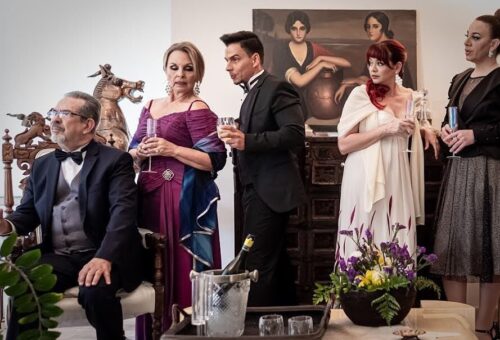
For the closing performance of its 36th season’s program, the International Hispanic Theater Festival of Miami presents a four-day run from Thursday, July 28 – Sunday, July 31 of “Mejor Me Callo (I’d Better Shut Up)” at the Arsht Center’s Carnival Studio Theater. (Photo courtesy of Teatro Avante)
In addition to “Are You There, Bette Davis?”, the 36th International Hispanic Theater Festival of Miami will stage six productions from Argentina, Chile, Spain, Puerto Rico, and the United States. Immediately after each premiere, the director of the Festival’s Educational Program, Beatriz Risk, will present forums in Spanish and English about the works.
On Sunday, July 17, on International Children’s Day, there will be workshops on manual arts, painting, puppetry, and mimicry, as well as a function of “Los Colores de Frida,” all with free admission between 2 and 6 p.m. at the Mid-Stage Theater of the Miami Dade County Auditorium. Prior to the performance of “Mejor me Callo” by Teatro Avante on Thursday, July 28, the festival will present its Award for a Lifetime Dedication to the Arts to the actress and teacher Adriana Barraza.
WHAT: The 36th International Hispanic Theatre Festival: “Are You There, Bette Davis?” from Uruguay, “Scorpion of The Ceremony,” from Spain, “Brief Encounters with Repulsive Men” from Chile, “Broken” from Argentina, “Quintuplets” from Puerto Rico, “The Colors of Frida” and “I’d Better Shut Up” from U.S.A.
WHERE: MDCA On.Stage Black Box Theatre, 2901 West Flagler St., Miami, Carnival Studio Theater, Adrienne Arsht Center, 1300 Biscayne Boulevard, Key Biscayne Community Center, and MDCA’s Mid-Stage Theatre.
WHEN: Various times, Friday, July 8 through Sunday, July 31
COST: $23-$27.50
INFORMATION: teatroavante.org or call 305-445-8877
ArtburstMiami.com is a nonprofit source of dance, visual arts, music and performing arts news. Sign up for our newsletter and never miss a story.
No posts found
At GableStage, ‘Rubenology’ actor, 84, is finally in spotlight
Written By Christine Dolen
July 4, 2022 at 10:13 PM
Actor Ruben Rabasa moves from his usual sidekick/supporting roles into the spotlight as the star of “Rubenology: The Making of an American Legend” running in a limited engagement at GableStage from July 14 through July 31. (Photo courtesy of Abre Camino Collective)
Unless you really know the Cuban-American talent pool, Ruben Rabasa’s name may not ring a bell, despite his many decades of success as an actor.
Rabasa has more than 70 film and television credits (his latest is as Tio Walter in the Miami-set “Father of the Bride” remake). His theater experience in Spanish and English stretches over more than six decades.
He’s also a standup comedian, an irresistible storyteller and a man who performed Spanish street theater in New York while taking opera lessons at Carnegie Hall. In 2019, he became a meme as the eccentric focus group guy from Tim Robinson’s Netflix comedy series “I Think You Should Leave.”
Now, at 84, Rabasa is moving from his usual sidekick/supporting roles into the spotlight as the star of “Rubenology: The Making of an American Legend,” a show that explores both his Cuban back story and his life as a proud American. The world premiere coproduction from the Abre Camino Collective and GableStage, billed as a special event, has a 12-performance run from Thursday, July 14 through Sunday, July 31.

“Rubenology: The Making of An American Legend” has its roots in the immersive Miami hit “Amparo,” created by the same team. (Photo courtesy of Abre Camino Collective)
“Rubenology” has its roots in the immersive Miami megahit “Amparo,” which opened in 2019 and ran for months in a dramatically reimagined old home not far from the Arsht Center. Rabasa wasn’t part of the original cast, but he went into the show a month after opening and stayed for seven months. Playing Miguel, the exiled former emcee of Havana’s Club Náutico, he quickly formed a lasting bond with playwright Vanessa Garcia and director Victoria Collado, the women behind Abre Camino.
Before long, the life stories Rabasa would share with Garcia, Collado and Robby Ramos, the actor who played his grandson in “Amparo,” got the Abre Camino partners thinking.
“We’re obsessed with preserving Cuban and Cuban-American stories,” Collado says. “It felt like we needed to do this, like a responsibility . . .Robby had recently lost his grandfather, I had lost mine, and Vanessa was very close to hers (he passed away on her birthday in 2021). Ruben has this ability, with those who love him, to make them family. . .During ‘Amparo,’ I felt like I’d known him all my life. It’s impossible not to love Ruben.”
In January 2020, before the pandemic began, Rabasa appeared as Manolito in the Miami New Drama’s world premiere of “The Cubans” by Michael Leon. After the world shut down, Rabasa, Garcia and Collado had time to focus on devising “Rubenology.”

Playwright Vanessa Garcia, left, and director Victoria Collado, are the women behind Abre Camino Collective, creators of “Rubenology,” which is co-produced by GableStage. (Photo courtesy of Diego Texeria.)
Transforming memories into a compelling, engaging solo show is, however, anything but simple.
“We started over two years ago, with Robby and me gathering Ruben’s stories. I’d press ‘record’ on my iPhone, and Ruben would talk for hours in Spanish,” Garcia says. “After we got a week’s worth of interviews, I transcribed them, then later translated them into English.”
Rabasa left Fulgencio Batista’s Cuba with his mother and brother in 1955, when he was 17. They arrived from their tropical homeland in the dead of winter, and he was not smitten.
“My mom lived at 135th and Broadway, where the subway came out. It was very cold. I thought, ‘Oh my God, is this hell?’ I thought I was inside of a refrigerator,” Rabasa recalls.
His early days of working as a busboy and struggling to learn English are in the show. So is the tale of how he worked a santero to get a bad-luck dead man off his back. So are funny, touching stories about his beloved mother – she, like his other relatives, is gone now.
Selecting and honing those stories wasn’t easy. Rabasa and Garcia didn’t always agree.
“Some stuff we thought was important, but he didn’t want to tell those stories. We’d go back and forth. We’d have arguments. There was always a push-pull between English and Spanish, between generations and what happens in a theater,” says Garcia, who was also mindful of choosing English words that are easier for Rubasa to pronounce.
After the creators tested material with pandemic-era digital shorts in different cinematic styles on IGTV (now Instagram Video) and YouTube, “Rubenology” has emerged as a multimedia piece, one that calls attention to its own theatricality; as Collado describes it, “Ruben exposes the process.”
Garcia and Collado appear in videos, interacting with the live Rabasa and keeping the show going when he briefly leaves the stage. A stagehand helps ready him, onstage, for his final story. The structure is, says Garcia, both “practical and logistical. He’s 84. We had to give him some breaks.”
“He’s an 84-year-old actor who makes you feel like he’s 24. He challenges himself,” Collado observes.
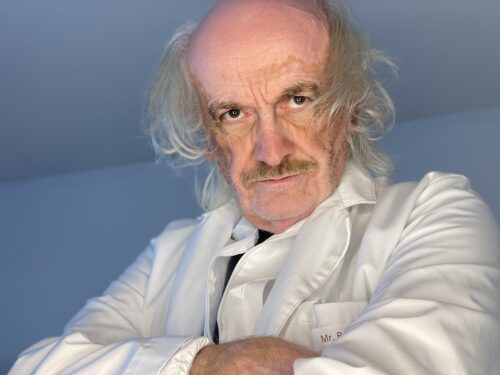
Ruben Rabasa stars in “Rubenology: The Making of an American Legend,” a show that explores his Cuban back story and his life as a proud American. (Photo courtesy of Abre Camino Collective)
After his years in New York, Rabasa lived in Miami for a time, appearing in the movies “Guaguasi” and “Amigos” (and others), five episodes of “Miami Vice,” 39 episodes of the Spanish-language series “Corte Tropical” and many more. After he moved to California, his movie and TV resume grew, with film work alongside Andy Garcia, Marisa Tomei, Colin Firth, Adam Sandler, Gloria Estefan and others. But when “Amparo” came calling, he gladly came back to Miami and stayed
“The majority of Spanish-speaking actors in California are Mexican, and directors would want me to sound Mexican. I just want to be me,” he says.
Garcia notes, “He’s been trying to tell his story forever. But people kept getting in the way. We thought, ‘How do we stop people from taking the mic away from him?’ ”
After he established his strong connection with Collado and Garcia – Rubasa calls them “my new family” – he got the chance to put his life onstage. His play is both serious and funny, and he believes the latter is harder to pull off.
“It’s more difficult to make people laugh. You have to have the right timing,” he says.
He would love to do a version of “Rubenology” in Spanish – “it would be easier,” he says with a smile – but looks forward to its debut in English and to sharing his life journey so far.
“In the beginning, it was difficult, but then I started loving New York and freedom,” he says. “I get to tell about my experiences in the United States and how I grew as a human being.”
Garcia – and Rabasa as well – would love it if “Rubenology” could help transform the actor from well-known supporting player to leading man. Whatever happens, the playwright is happy to be bringing some long-overdue focus to the resonant life of a man brimming with stories.
“Ruben has been busy paving the road,” she says. “There is only one Ruben.”
WHAT: “Rubenology: The Making of an American Legend” by Vanessa Garcia and Ruben Rabasa
WHERE: GableStage in the Biltmore Hotel, 1200 Anastasia Ave., Coral Gables
WHEN: 7 p.m. Thursday, 8 p.m. Friday-Saturday, 2 p.m. Sunday (July 14 opening is at 8 p.m.); runs July 14-31
COST: $40-45 (tickets start at $20 for those under 35 with ID)
INFORMATION: gablestage.org or 305-445-1119.
ArtburstMiami.com is a nonprofit source of dance, visual arts, music and performing arts news. Sign up for our newsletter and never miss a story.
No posts found
Miami New Drama’s ‘Papa Cuatro,’ debuts original musical based on performers’ life experiences
Written By Fernando Gonzalez
July 4, 2022 at 9:49 AM
Eduardo Betancourt, Mariaca Semprún and Miguel Siso in Miami New Drama’s “Papá Cuatro” at the Colony Theatre, Miami Beach. (Photo courtesy of Andres Manner)
The cuatro, a small, four-string guitar, deceptively simple to play, seems too little, too innocent-looking to hold the heart of a country — and yet.
As the quintessential Venezualan instrument, the cuatro is a connection to home for the South American musicians, “without fail,” says Venezuelan-Canadian director Juan Souki. “But sometimes it is for non-musicians as well. A cuatro hanging on a wall in a Venezuelan household is an invitation to get together. The cuatro is there, and if the moment calls for it, it is lowered, someone plays it, and it unites the group,” says Souki. For those who chose to emigrate, “it’s a reminder of rootedness,” he says.
“Papá Cuatro,” Miami New Drama’s original world premiere, opens with previews on Thursday, July 7 and Friday, July 8, with opening night on Saturday, July 9 at the Colony Theatre in Miami Beach. Souki describes it as “something between a musical, a documentary, and a house party.”
The director also created “Viva La Parranda,” an immersive experience of Venezuelan music, food, and small-town culture presented by Miami New Drama in 2019. “Papá Cuatro” is a tribute to a group of virtuoso musicians, he explains.

“Papá Cuatro” at Miami New Drama features, from left, Adolfo Herrera, Eduardo Betancourt, Mariaca Semprún, and Mafer Bandola. (Photo courtesy of Andres Manner)
“All very successful in their chosen discipline or instrument, who in recent years have left Venezuela and are in the process of rewriting their histories, reconstructing their lives,” says Souki.
The performers in “Papá Cuatro” are actor, singer, and songwriter Mariaca Semprún; cuatro player Miguel Siso; harpist Eduardo Betancourt; Mafer Bandola on bandola, a pear-shaped string instrument related to the mandolin; and drummer and percussionist Adolfo Herrera.
For the play-as-musical documentary, Souki interviewed the musicians, who all emigrated to South Florida in the same period in the past five or six years.
“In this group, you have people that were in billboards all over Venezuela, playing big auditoriums, and today their musical career continues, but it is shared with being an Uber driver or working in construction,” notes Souki. “You also have some 30-somethings who recorded an album before leaving Venezuela thinking of bringing a cover letter, and six months after they left, they were winning a Grammy. Their stories coexist in the play, and little by little, as if by chance, their songs also tell pieces of our history.”
The pieces create the fabric of “Papá Cuatro” which is told in songs, including original compositions and traditional works in which they share their story and relationship with the instrument.
Semprún, the main vocalist in “Papá Cuatro,” is a remarkably versatile performer. Her credits include work in theater, film, and television. She has interpreted a wildly varied repertoire as a singer, from music by Mozart, Handel, and Verdi to starring in shows about Edith Piaf and La Lupe. Semprún’s recording of “Soy Puro Teatro (Homenaje a la Lupe)” was nominated for a 2020 Latin Grammy award.
The cuatro, the performer notes, has been part of her life since she was a child. “I was in music school since I was very, very young, and the cuatro was a compulsory subject,” she recalls. “Without even thinking about it, it just became part of my life,” she says.
Semprún talks about “Venezuelizing” her interpretations of Piaf and La Lupe, notably adding a cuatro to a medley of songs by the Cuban singer. “It was not in the original recording, but . . . if the cuatro is not there, it doesn’t feel fully Venezuelan.”
In her personal life, the performer wasn’t planning to emigrate to the United States.
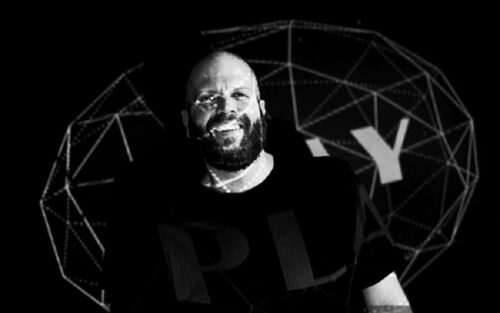
Juan Souki conceived and directed “Papá Cuatro” making its world premiere at Miami New Drama. (Photo courtesy of Erik Galindo)
“Like with everyone else in the play, there is part of my personal story in this work,” says Semprún, who looks at “Papá Cuatro” as “a musical documentary, an experience.”
“Perhaps my story is a little more political because of how my departure was. My husband and I came to Miami for a week — and we’ve been out of the country for five years. We found out that the political police were waiting for our return, and we didn’t know what could happen if we went back. 2017 was a very murky time, so we decided to stay — and it has been a very violent and unexpected adaptation process.”
The interviews that Souki conducted to construct his play, which are at the heart of “Papa Cuatro,” explore who the artists are, he says.
“Who they were before they came, why did they come, and where they feel they are now in their process (of reinvention)? They are all living very different experiences, and their stories reveal the emigrant experience.”
WHAT: Papá Cuatro at Miami New Drama
WHEN: 8 p.m. Thursday-Saturday, 3 p.m. Sunday, through July 31
WHERE: Colony Theatre, 1040 Lincoln Road, Miami Beach
COST: $45.50, $61.50 and $71.50 (prices include $6.50 service charge)
INFORMATION: miaminewdrama.org or 305-674 -1040.
(Performances are in Spanish with English supertitles.)
ArtburstMiami.com is a nonprofit source of dance, visual arts, music and performing arts news. Sign up for our newsletter and never miss a story.
No posts found
Review: It’s a game of cat-and-mouse in two-person thriller ‘Borrowed’
Written By Christine Dolen
June 27, 2022 at 2:07 PM
Ernesto Reyes as Justin and Caleb Scott as David in the world premiere of Jim Kierstead’s “Borrowed” at House of Games at Miami Ironside. (Photo courtesy of Melissa Almaguer)
Two men with dovetailing psychosexual needs find a way to connect in “Borrowed,” the first drama by Broadway producer-turned-playwright Jim Kierstead.
After previous iterations as a 2020 pandemic Zoom reading and a film that debuted at the Miami Film Festival in March 2022, “Borrowed” is now getting its stage world premiere in the House of Games space at Miami Ironside. You can find the sprawling complex of shops, restaurants and offices at 7610 NE 4th Court in Miami, not far from Biscayne Boulevard and NE 79th Street. If you’re hungry before or after the show, grab a bite at the inviting indoor-outdoor spot Ironside Pizza.
Produced by Broadway Factor’s William Fernandez, Deborah Ramirez and Kierstead – the team that, with the late George Cabrera, was behind Miami’s long-running theatrical experience “Amparo” – “Borrowed” is a deliberately disturbing thriller.
The list of content warnings you’ll find in the digital program is 10 items long, and it includes violence, kidnapping and four kinds of abuse (physical, verbal, sexual and mental). You are warned.
You’re also told that, once the play begins, do not leave the intimately immersive performance space – if you do, you can’t come back in. That makes sense, as anyone bailing to use the bathroom or whatever would disrupt the show since the actors use nearly every inch of the converted event space. Best to put that out of your mind, though, or you may start feeling like the younger of the two characters – trapped in a no-exit situation.

Ernesto Reyes as Justin, left, and Caleb Scott as David in the world premiere of “Borrowed” by Jim Kierstead at Miami Ironside House of Games. (Photo courtesy of Lyvan Verdecia)
In fairness to future audiences, some of the plot points of the 90-minute play need to be revealed in the moment. What is or isn’t a spoiler can be debated, but we’ll try to remain as spoiler-free as possible.
“Borrowed” unfolds in 2010 in a small, less-than-chic New Jersey cottage near the Hudson River. Though the place is modest and isolated, it provides a bonus for amateur painter David (Caleb Scott): a multimillion-dollar view of the water and the Manhattan skyline.
An Army veteran, David is a damaged man. A thicket of red scars on his face makes “hookups” recoil. A brace helps with a knee ruined by a grenade. Self-loathing misery masquerading as machismo, hair-trigger violence and hurled epithets are all part of David’s arsenal when things so south – which they do, almost instantly – once his younger visitor shows up.
Justin (Ernesto Reyes), a handsome Latino who often seeks out older men for sex, shows up late then takes one look at David and nervously starts making excuses about having to leave for a party in the city. But David, primed by his flirty text exchanges with Justin, wants what the younger man promised to provide. After trying persuasion, David makes a decision: he locks the door and refuses to let Justin leave.
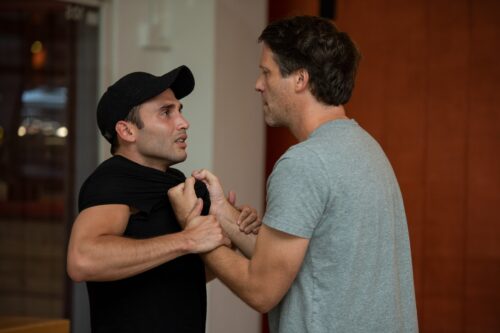
Ernesto Reyes’s Justin (left) tries to defend himself from Caleb Scott’s David in the world premiere of “Borrowed.” (Photo courtesy of Roger Alejandro Gonzalez)
What happens over a long night and morning is a mixture of fear, intimidation, violence and revelation. The balance for director Melissa Almaguer, assistant director Natalie Cabo and the cast is a tricky one.
The audience has to feel the tension between the demanding David and the panicked Justin, but it also needs to surrender to the storytelling and attempts at connection when the men share some gentler moments or talk about their histories – Justin’s as a teen whose attachment to older guys began with a teacher and a friend’s father, David’s as a married man who concealed his sexual orientation and fathered a deeply troubled son.
Though David insists he has merely “borrowed” Justin for a while, that’s semantic manipulation. Justin knows he’s being held prisoner, so in the moments when he’s pleasant or charming, survival is underpinning his actions.
“Borrowed” is a two-hander, and so much depends on the performances. In this world premiere production, that balance (much like the ebb and flow of tension) is unstable.
Scott is by far the more experienced and technically skilled actor. His David is frightening and intimidating, whether he’s belittling Justin by bellowing homophobic epithets or demonstrating his combat-honed physical dominance. Do we feel for the character? Maybe, somewhat, by the end of the play. But Scott’s portrayal of a haunted, troubled man is so effective that you may find yourself shrinking back in your seat any time he moves closer to you.
As a young man whose inattentive father helped shape his desire to please, Reyes is frightened, pleasant, and sometimes miserable. Mostly his Justin is watchful, except when he’s making an ill-fated attempt to escape. A more scheming, manipulative Justin would help even the cat-and-mouse game between the two.
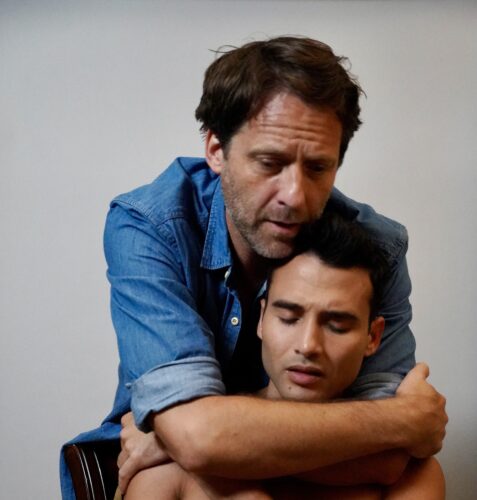
Caleb Scott’s David (standing) tries to connect with Ernesto Reyes’s Justin in the world premiere of “Borrowed.” (Photo courtesy of Lyvan Verdecia)
Set/prop designer Jennifer Ivy, lighting designer Tony Galaska, sound designer Ernesto K. Gonzalez, fight choreographer Lee Soroko and intimacy director Nicole Perry have all contributed to crafting a production that can feel claustrophobic in its in-your-face danger. It is jarring (Gonzalez provides a metallic sound effect to emphasize the more frightening moments) and it is provocatively creepy (as when David “disciplines” Justin). There are some laughs in “Borrowed,” but they’re few and far between, as you’d expect from a play that burrows into two men’s psyches.
The script is more the work of a craftsman than a writer with a distinctive voice, though Kierstead’s master’s degree in psychology informs that facet of his storytelling.
“Borrowed” is a small-scale play that could be easily produced by any company looking for an intense, shocking drama. Since the producers are aiming for an Off-Broadway production, a rewrite that would make Justin a cagier character and stronger adversary could heighten the play’s impact.
WHAT: “Borrowed” by Jim Kierstead
WHEN: 8 p.m. Thursdays-Saturday, 3 p.m. Sunday, through July 17
WHERE: House of Games at Miami Ironside, 7610 NE 4th Ct., Miami
COST: $50
INFORMATION: BorrowedThePlay.com or 786-383-2755
ArtburstMiami.com is a nonprofit source of dance, visual arts, music and performing arts news. Sign up for our newsletter and never miss a story.
No posts found
The American Black Film Festival is back on Miami Beach
Written By Jonel Juste
June 14, 2022 at 10:52 AM
George Taylor as Coy in Carlos Miller’s “Between Sins” getting its world premiere at the American Black Film Festival. (Photo courtesy of Carlos Miller)
“It feels wonderful to be back in person after being virtual for the past two years,” says Jeff Friday, the founder of the American Black Film Festival (ABFF).
The American Black Film Festival is returning to Miami Beach after going virtual for the past two years. It will be a hybrid event. From Wednesday, June 15 to Sunday, June 19, the festival will be presented live while a virtual version continues from Monday, June 20 to Thursday, June 30.
“The community of Miami Beach is critical to the festival’s success. The virtual festival was fantastic since it helped us extend our brand, but we sadly missed out on the chance to get together and celebrate movies in a beautiful location like Miami Beach,” says Friday.

Jeff Friday is the founder of the American Black Film Festival (ABFF). (Photo courtesy of ABFF)
Live events will take place at different locations throughout South Beach including the New World Center Performance Hall, the Bass Museum, the Black Archives Historic Lyric Theatre, and the Regal South Beach.
The American Black Film Festival, now in its 26th year, was founded in 1997 by Friday after he attended the Sundance Film Festival and noted its lack of diversity. “It was mostly white men, with very few women and people of color at that time,” he recalls.
So, with the help of advertising CEO Byron E. Lewis and film director and producer Warrington Hudlin, Friday came up with the idea of creating a festival comparable to Sundance, but with content showcasing Black culture around the world.
They launched what was known as the Acapulco Black Film Festival until the name was changed in 2002, providing a platform for Black filmmakers to connect, network, collaborate, and celebrate their work.
For the first five years of the festival, from 1997 to 2002, the festival was held in Acapulco then arrived in Miami in 2003 at the invitation of David Whitaker, who is now the president and CEO of the Greater Miami Convention and Visitors Bureau, according to Friday. At the time, Whitaker was working as a member of the GMCVB team. He was appointed president and CEO in 2021.
“Miami Beach has the same desirable elements (as) Acapulco: It is tropical, the weather is fantastic, and so is the food; Miami Beach has upscale restaurants and hotels, and most significantly, it is more accessible by plane and car,” says Friday. “Since we’ve been in Miami, we have on average 7,000 people each year who come from all over the country.”

The 26th American Black Film Festival opens with the documentary “Civil,” directed and produced by Nadia Hallgren. (Photo courtesy of Netflix)
According to Friday, festivalgoers can expect offerings from major studios and television networks as well as 50 new movies and television series by emerging directors and writers. Films, including narratives, documentaries, and shorts, are a diverse selection, promises Friday.
“Our mission is to promote the work of new people, to showcase new talents, new voices of color,” says Friday.
The festival opens with “Civil” at the New World Center Performance Hall, directed and produced by Nadia Hallgren known for her Emmy-nominated documentary “Becoming” and the Academy Award shortlisted “After Maria.” The Netflix biographical documentary offers an intimate look at the life of Ben Crump, who has become a high-profile civil lawyer representing the families of Ahmaud Arbery, Trayvon Martin, George Floyd, and Breonna Taylor.
As a Florida-based festival, moviemakers from The Sunshine State are featured, too. Carlos Miller’s film, “Between Sins” was selected for the festival.
To Miller, the benefits of such a festival are “the concentration of the quality of eyes that can identify with these stories (and) the opportunity to immediately have access to the people these films are intended for.”
Miller’s movie is competing in the narrative features category with nine other selections on Thursday, June 16, Friday, June 17 and Saturday, June 18 at the Regal South Beach cinemas. Miller’s screens at 10:30 a.m. on Friday, June 17.
“It’s a luxury not to have to search for your audience or look here and there for people that will get it. It’s like fishing and pulling out a full net. You know you’re in the right waters.”
The ABFF also highlights TV and streaming shows from Miami such as the HBO series “Rap Sh!t: Something for the City” a show set in The Magic City, written and executive produced by Issa Rae. Yung Miami and JT, the Miami duo behind the popular rap group City Girls, are co-executive producers on the series, which is the closing night screening on Saturday, June 18 at 6 p.m. in the New World Center Performance Hall.
South Florida filmmaker Carlos Miller whose film “Between Sins” will have its world premiere at the American Black Film Festival. (Photo courtesy of Carlos Gonzalez)
Actress and director Rae is this year’s festival ambassador for 2022, following in the footsteps of high-profile ambassadors over the years such as Halle Berry, Idris Elba, Taraji P. Henson, and others.
While the pandemic restricted the live interaction of the festival, Friday says organizers learned a few things. They built a custom streaming platform called ABFF Play to keep the festival going during the pandemic. He says it has since allowed them to extend their brand and grow their audience around the world.
“We had attendees from more than 90 countries online from Europe, Asia, Middle East, South America, and Africa.”
For this reason, organizers have decided to keep the virtual component that will launch and run for 10 days after the live festival.
“Before that, we thought of ourselves as a domestic brand catering primarily to African Americans, but we realized we were a global brand during the pandemic,” says Friday.
WHAT: American Black Film Festival
WHERE: New World Center, 500 17t St., Miami Beach; Regal South Beach, 1120 Lincoln Road Mall, Miami Beach; Black Archives – Historic Lyric Theater, 819 NW Second Ave., Miami; 1 Hotel South Beach, 2341 Collins Ave., with registration at the Ritz Carlton South Beach, 1 Lincoln Road. Online screenings at ABFF Play.
WHEN: Wednesday, June 15 to Sunday, June 19, (onsite at various locations), Monday, June 20 to Thursday, June 30 (virtual).
TICKETS: $12 (single ticket) – $1,495 (industry pass)
INFORMATION: abff.com/miami. Download the complete schedule here.
(Some COVID requirements in place. At the time of check in to the festival, all attendees are required to present documentation of a negative PCR or rapid antigen test taken within 72 hours of your arrival. Masks are strongly encouraged for all indoor events.)
ArtburstMiami.com is a nonprofit source of dance, visual arts, music and performing arts news. Sign up for our newsletter and never miss a story.
No posts found

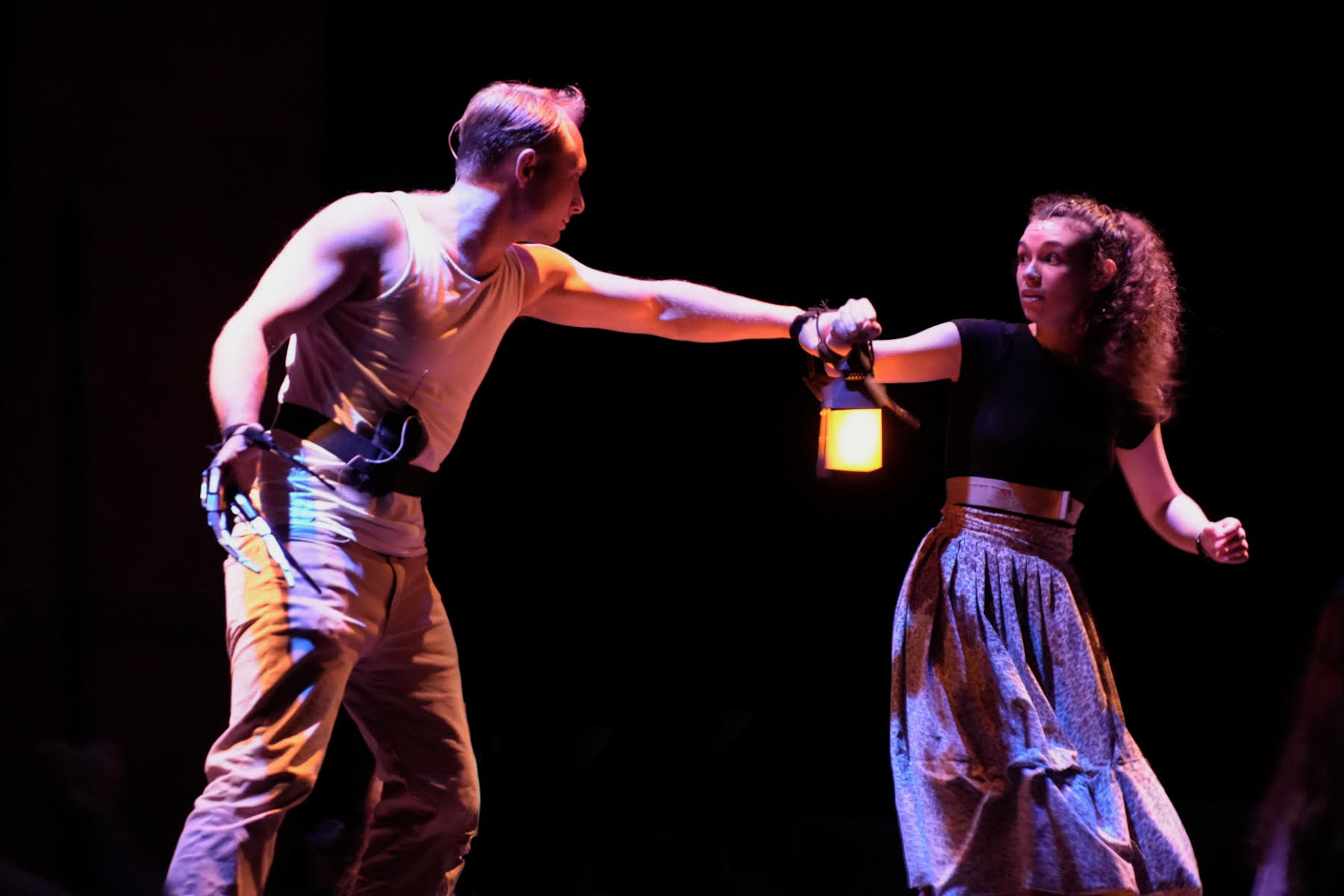
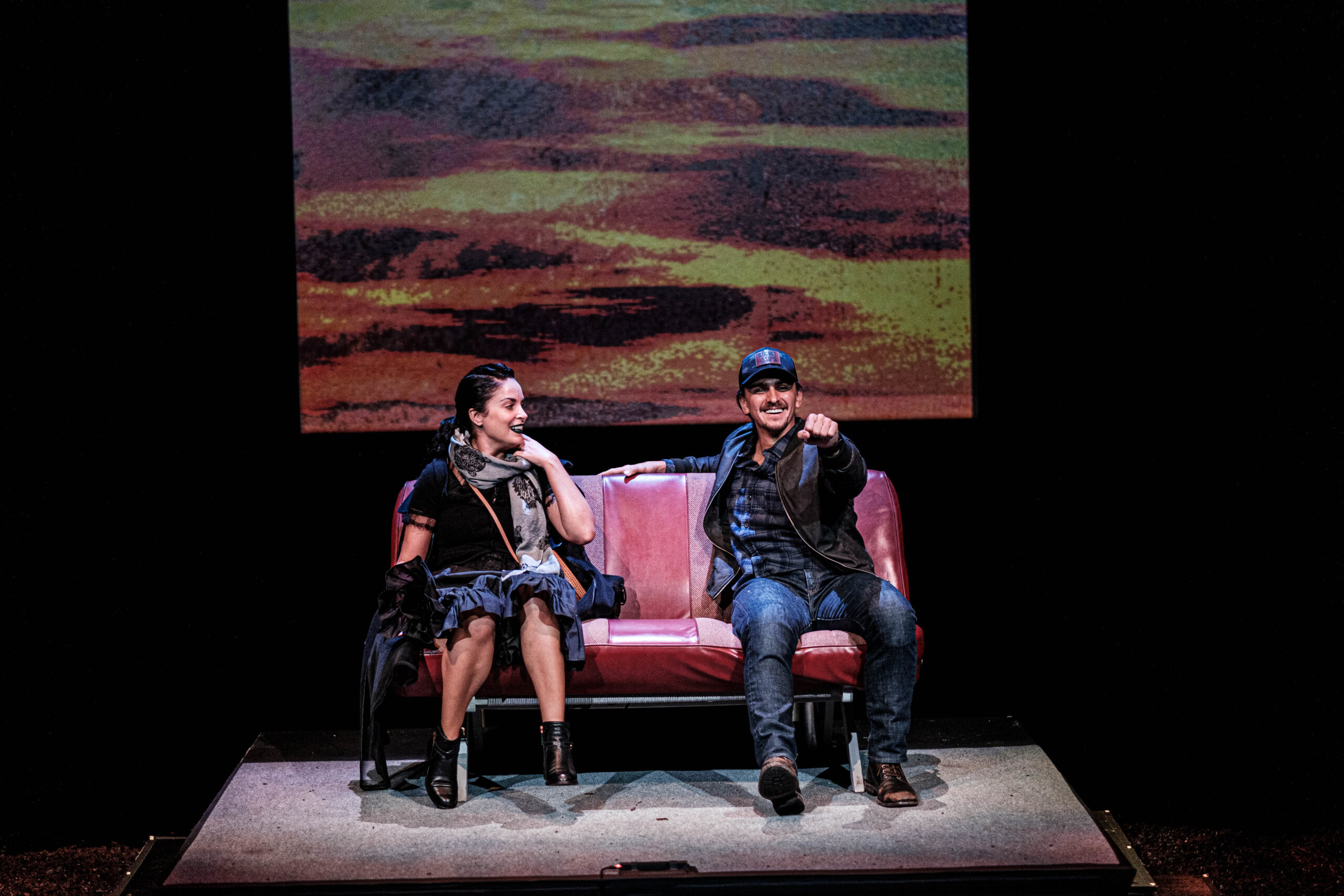
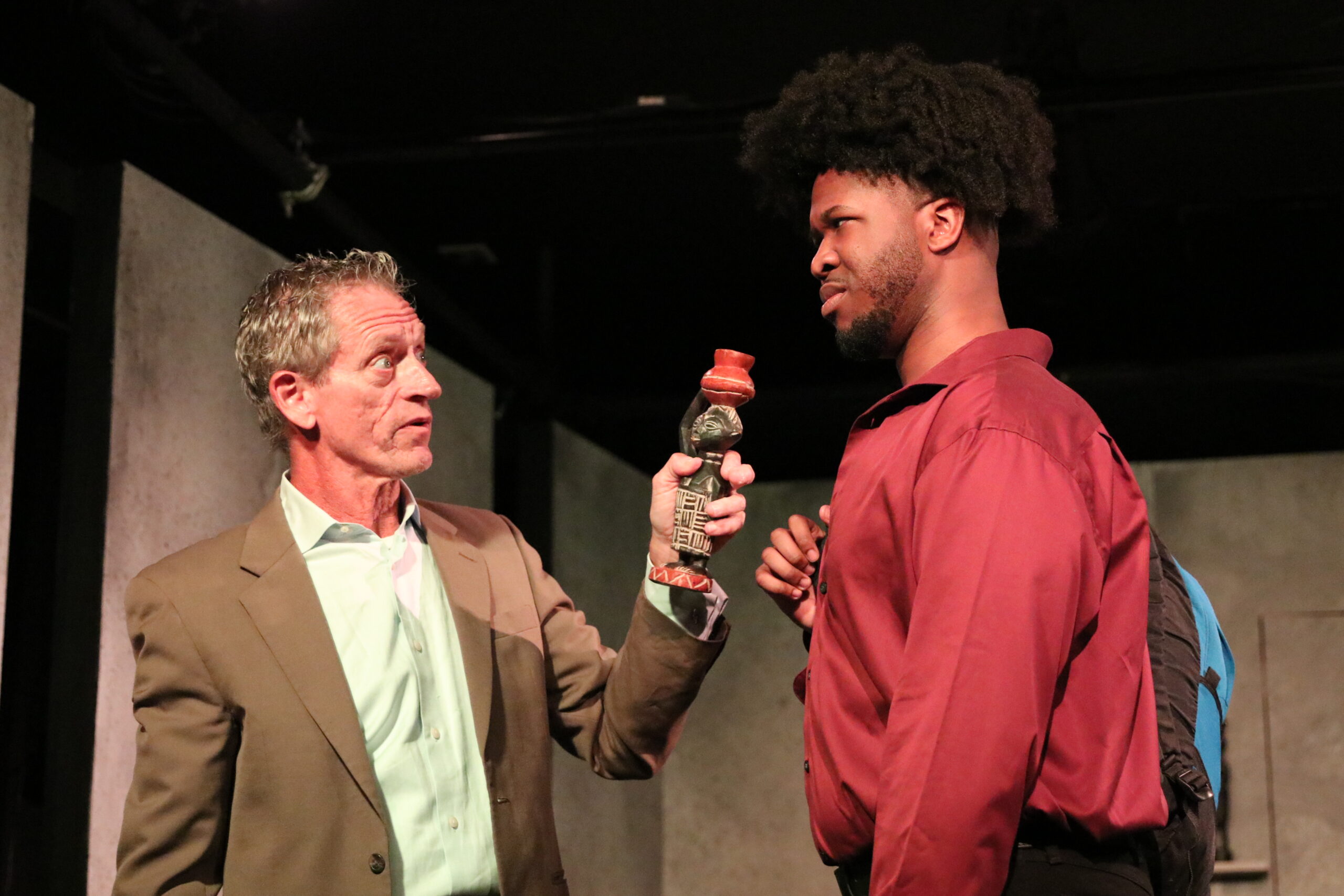

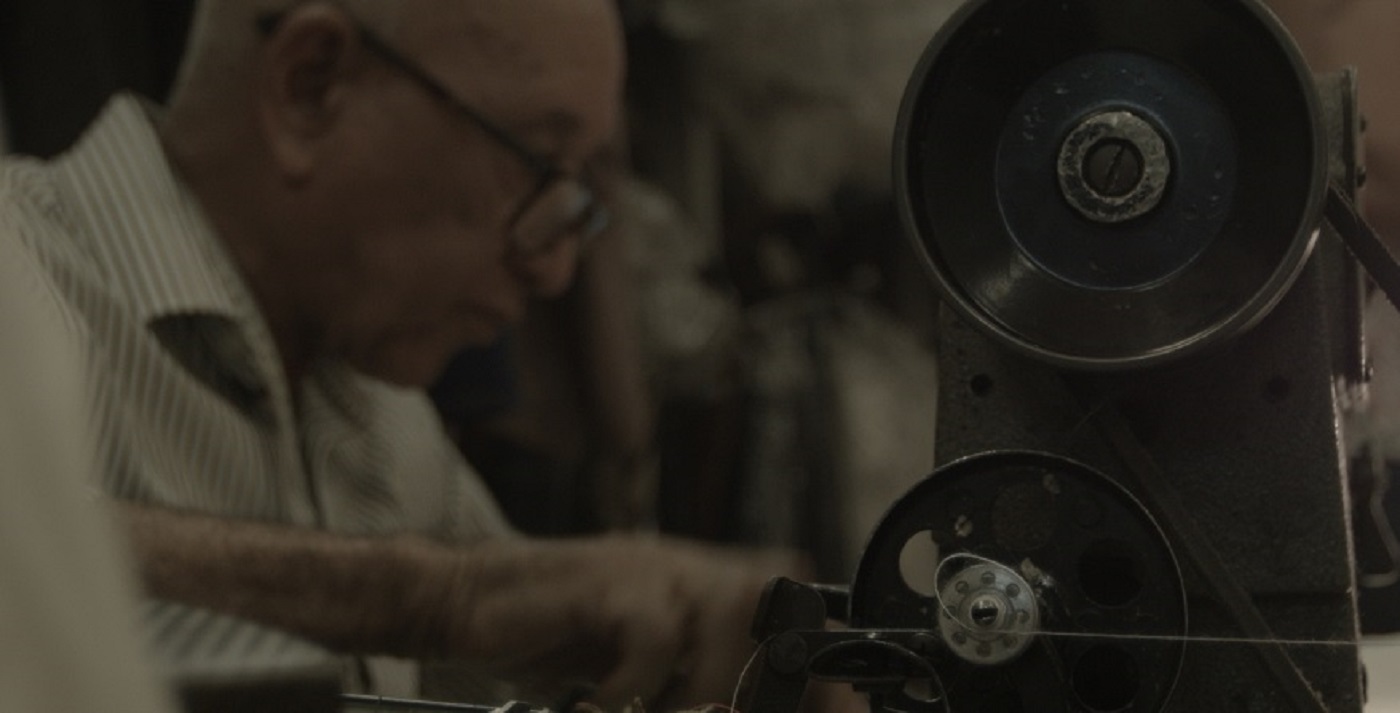
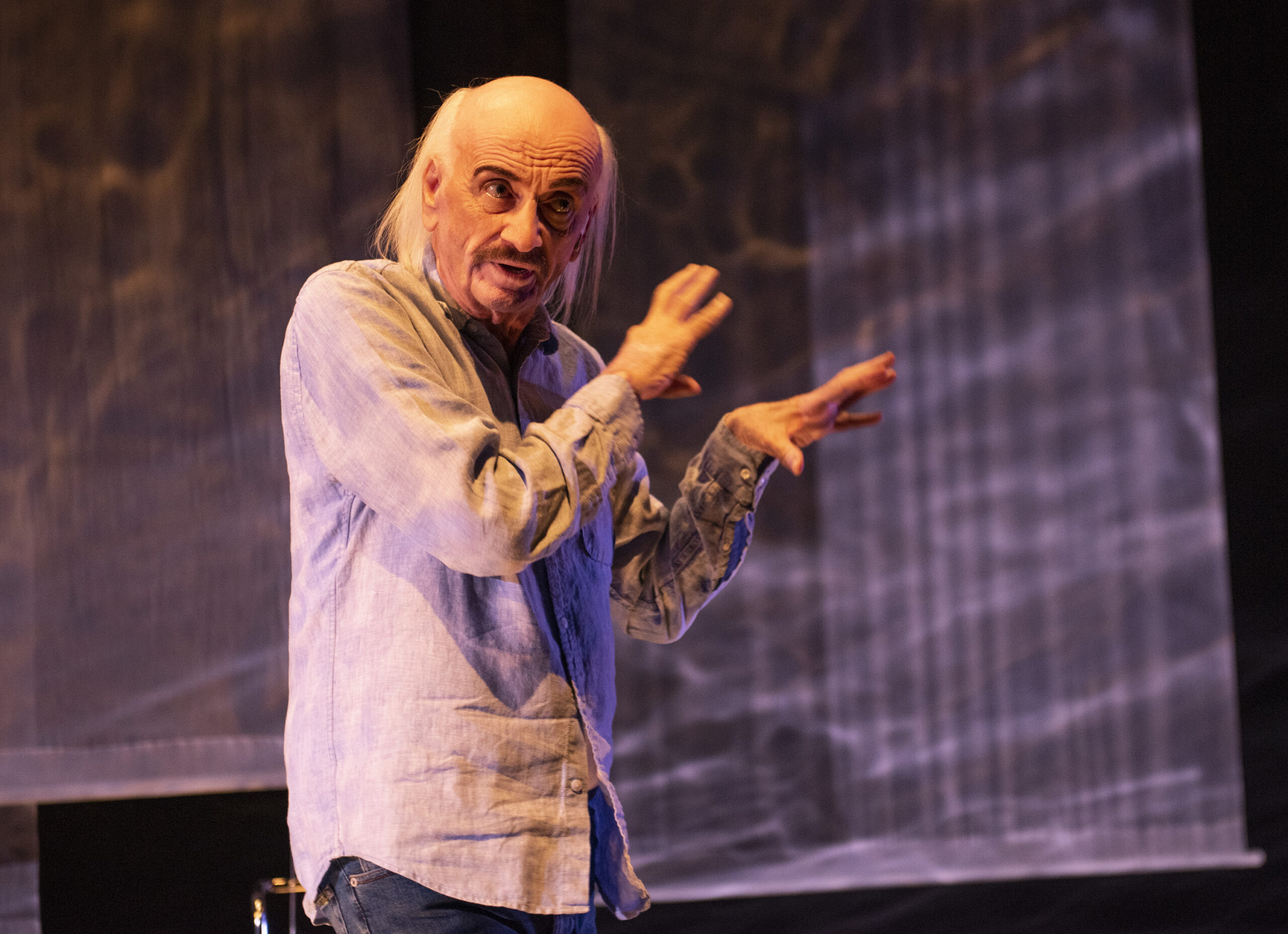
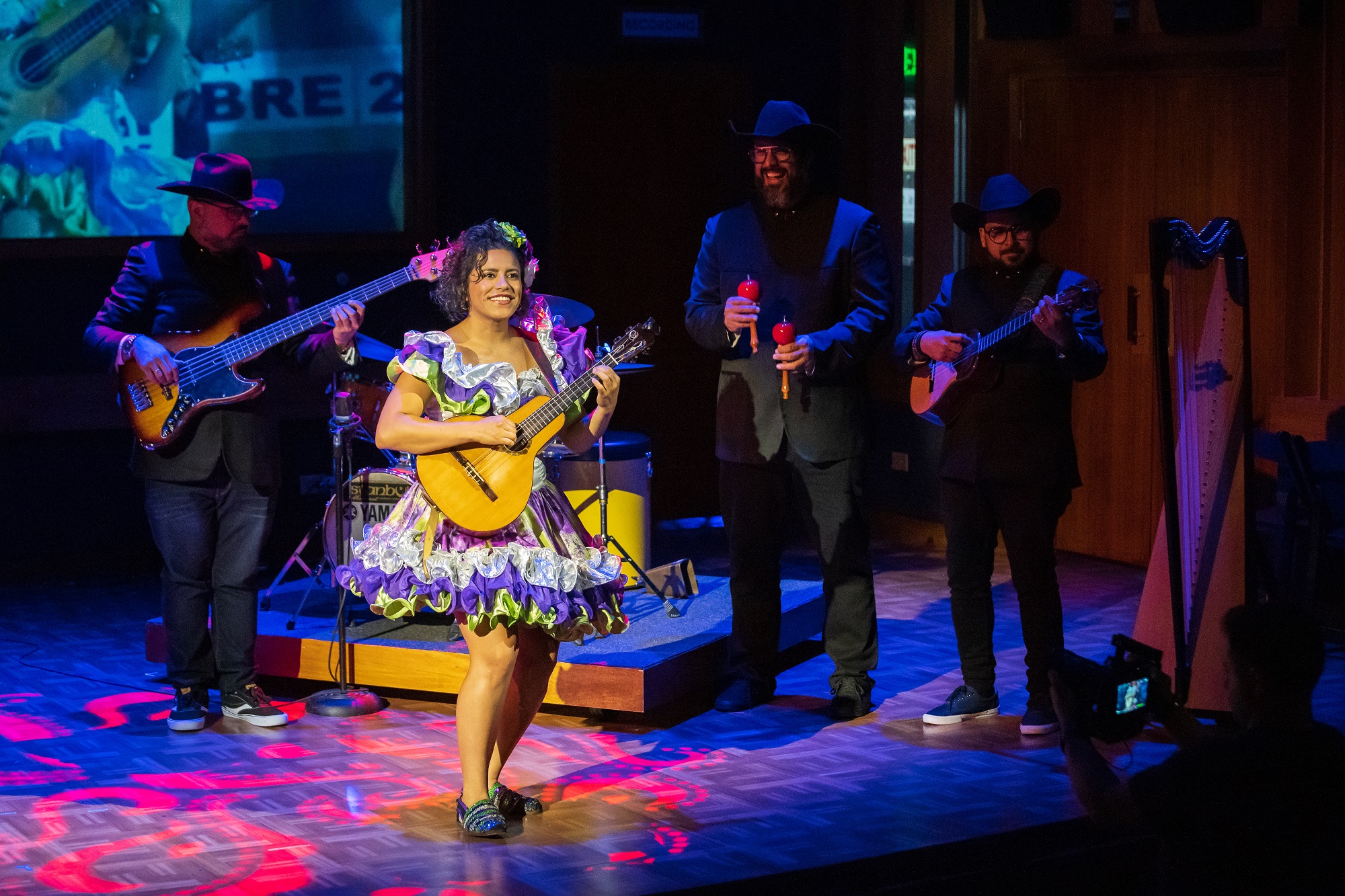

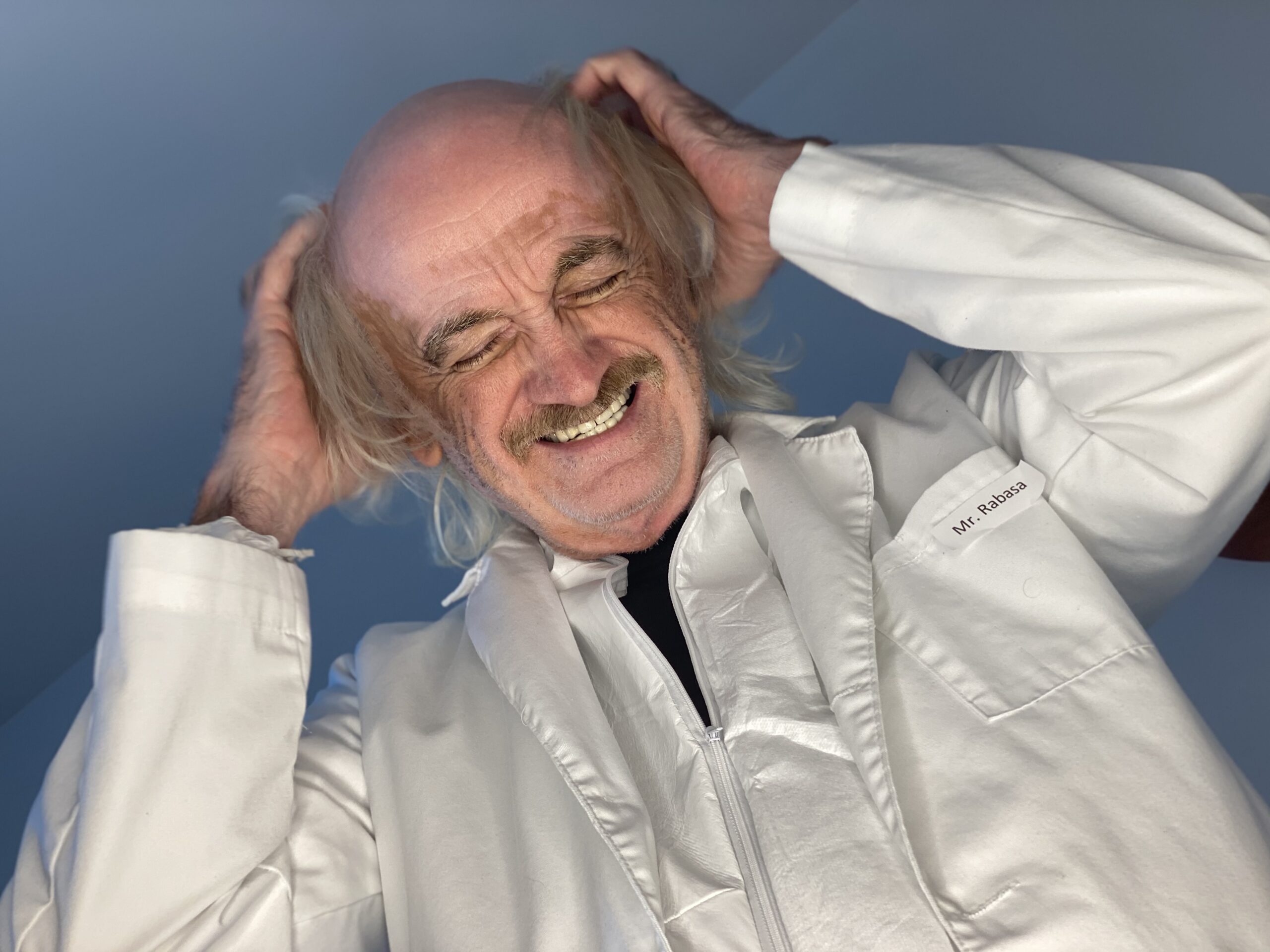
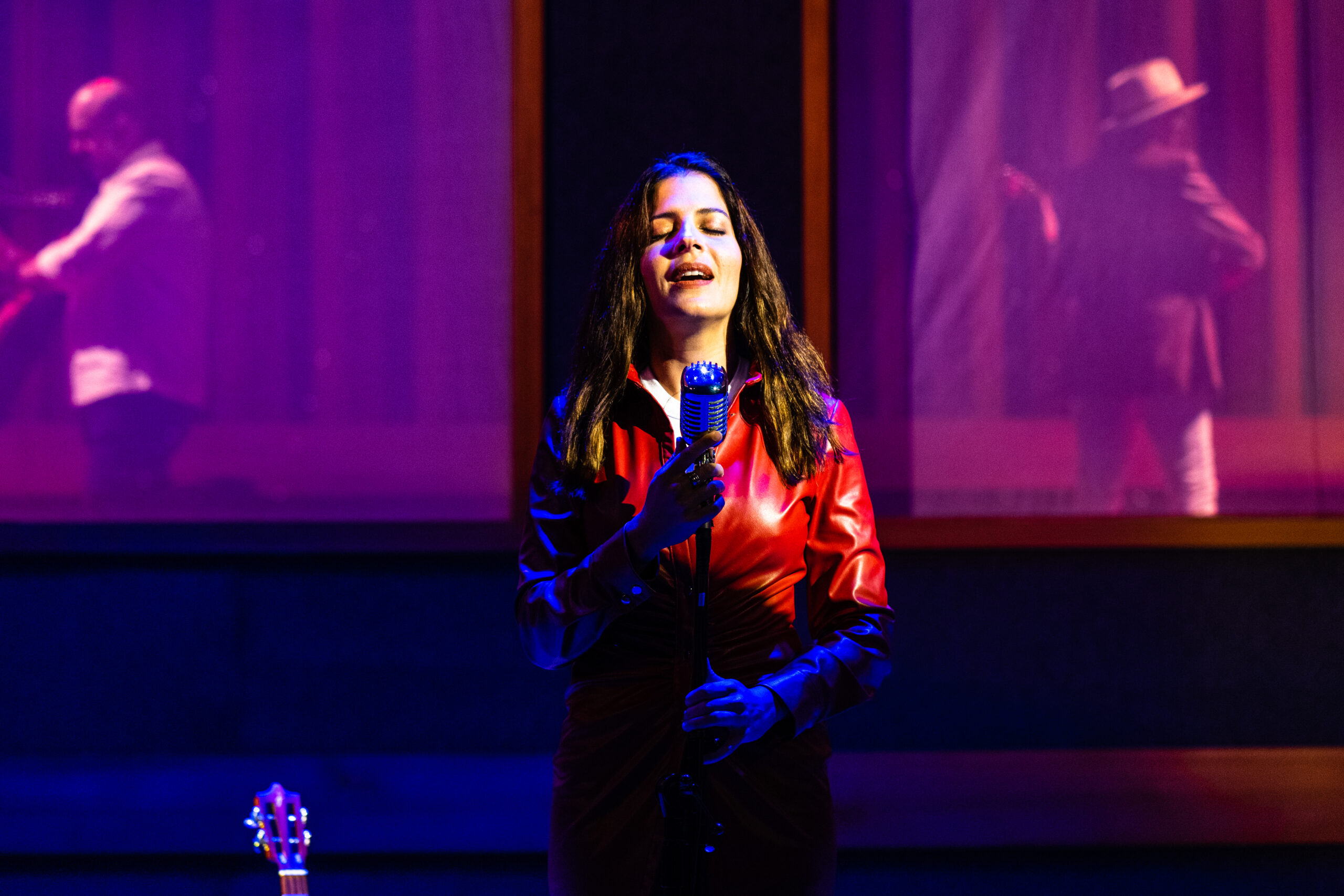
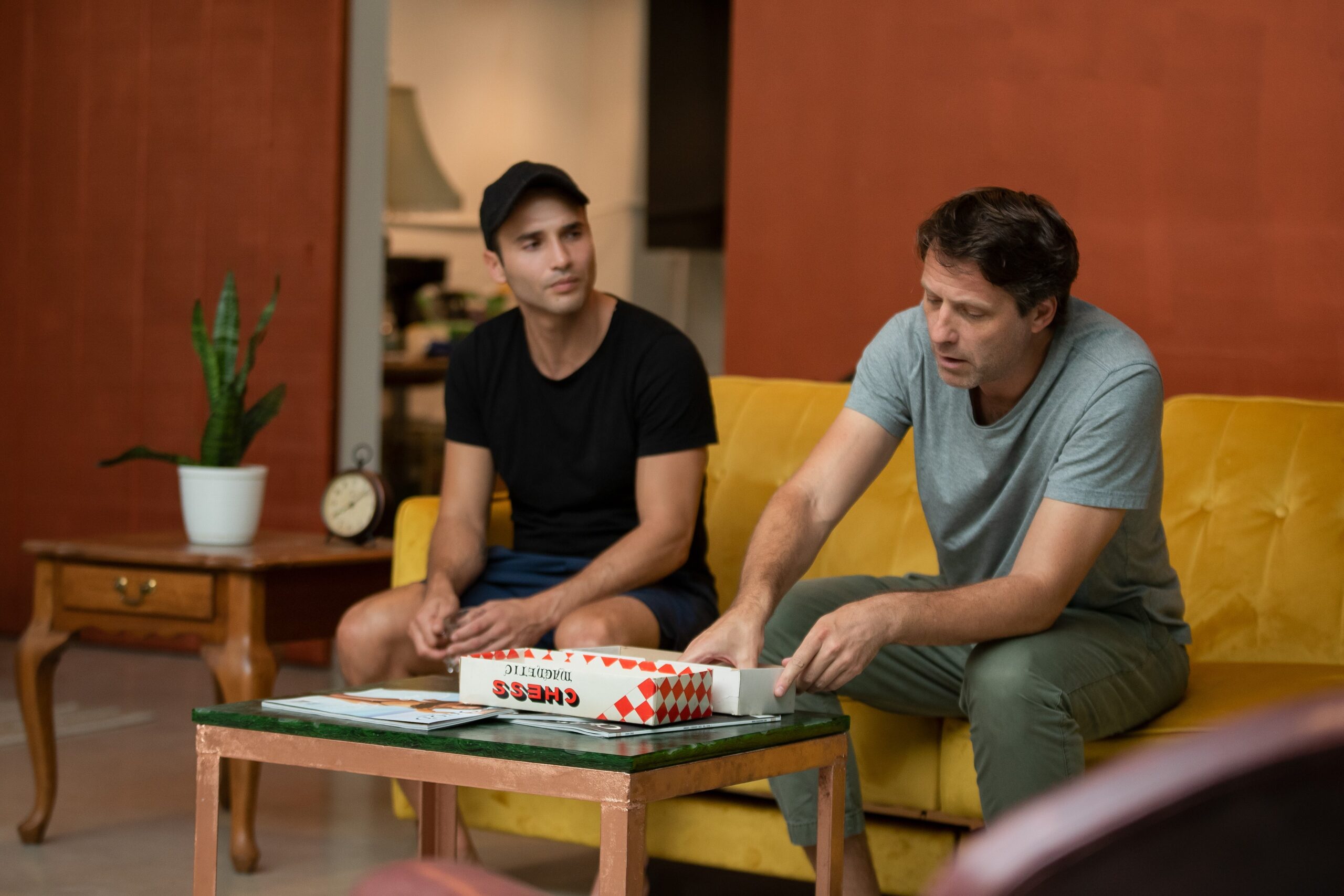
Recent Comments