Blog Article Category: Theater / Film
City Theatre’s Summer Shorts Returns in Fine Form for 25th Anniversary
Written By Christine Dolen
June 8, 2022 at 10:34 AM
Diana Garle, Margot Moreland and Lindsey Corey share a celebratory toast in the 25th Summer Shorts festival through July 2 at the Carnival Studio Theater at the Arsht Center. (Photo courtesy of Justin Namon)
After a two-year pandemic pause, Miami’s City Theatre is finally celebrating its 25th anniversary in the best way possible, presenting a Summer Shorts festival that amply demonstrates the engaging allure of short-form comedies, plays and musicals.
In these tumultuous times, the festival is a celebration of the art and craft of playwriting, the versatility of skilled actors, a director’s vital invisible hand, and a dedicated company’s presentational inventiveness. To borrow a term from Marie Kondo, Summer Shorts sparks joy, and it has returned none too soon in fine form.
Playing through Saturday, July 2 in the Carnival Studio Theater at Miami’s Arsht Center, the back-in-business Summer Shorts consists of 10 varied plays and musicals. Some are new versions of favorites from past festivals. Others are world or regional premieres. Start to finish, the quality of the work remains high.
This year’s festival, which runs two hours plus a 15-minute intermission, has some fancy anniversary tweaks.
The musical accompaniment and stand-alone tunes that carry the audience from play to play come from a live four-piece band assembled by music director Caryl Fantel.

Margot Moreland melts into a tango lesson from Alex Alvarez in “Tango! The Musical!” by City Theatre co-founder Susan Westfall. (Photo courtesy of Justin Namon)
As is the case at many theaters now, only digital programs are offered via a scanned QR code, but City Theatre came up with a great work-around: With a few exceptions, each playwright offers a brief video introduction before his or her play. It’s a nice user-friendly, clarifying touch.
The fun begins with Daniel Hirsch’s “A Small Breach in Protocol at Big Rick’s Rockin’ Skydive Academy,” a short comedy with one very long title.
(See the preview of the Summer Shorts festival by clicking here.)
Directed by Elena Maria Garcia, one of South Florida theater’s comedy masters, the piece features instructors Tina (Lindsey Corey) and Chad (Daniel Llaca) jumping out of a plane as they’re strapped to a pair of first-time skydivers. Extremely apprehensive Rae (Stephon Duncan) and exhilarated Alicia (Diana Garle) are a couple, and they’re having an adventure courtesy of Groupon. Rae contemplates death on the way down, and not just because she’s hurtling toward the ground. Hirsch’s message: No matter how long or short your life, savor each day.
“A Little Bit of Culture” by the late Staci Swedeen was first done at the 1999 Summer Shorts festival. Businessman Kenny (Tom Wahl) and arts aficionado Charlie (Alex Alvarez) have gone to a concert, and before long the overtired Kenny is nodding off and snoring.
Charlie elbows his husband and gets plenty irritated. Soon, Kenny is on the verge of checking out again, but then in fantasy, he takes the stage and does his own wacky version of “Swan Lake.” With graceful direction by Gail S. Garrisan and a mini-star turn by Wahl – sign this guy up for the Les Ballets Trockadero de Monte Carlo – “A Little Bit of Culture” is a tiny treasure about the different ways we connect with the arts.

Stephon Duncan (left) and Tom Wahl portray at-odds playwrights in “Winner,” part of City Theatre’s Summer Shorts festival. (Photo courtesy of Justin Namon)
Directed by James Randolph, the world premiere of Amy Berryman’s “Winner” explores the same sort of thematic territory as Claudia Rankine’s “The White Card,” produced at GableStage earlier this year.
Duncan is Tori Walker, a Black playwright in her early 30s, who has just won a coveted award. She has bested three-time Pulitzer winner Charlie Harvard (Wahl), a white writer whose comeback play was 10 years in the making. Elegantly dressed in formal wear, the two talk on a New York balcony at an after-party in her honor. At first, their exchanges seem friendly enough. She’s a longtime admirer of his work; he has been impressed by hers.
Before long, the gloves come off as the seriously soused Charlie suggests Tori’s win had as much to do with her race and gender as it did with her buzzed-about play. Duncan and Wahl skillfully portray the combatants in this short but incendiary piece.
Pulitzer-winning playwright David Lindsay-Abaire and director Garrisan deliver the festival’s flat-out funniest play. “Misdial” involves cell phones, three women named Amy (Corey, Garle and Margot Moreland share the name), and Fran (Duncan), who has two pairs of contacts stuck in her eyes and can’t get them out. Her possibly ex (but still loving) boyfriend Malcolm (Alvarez) also joins the increasingly confusing conversation. The perfectly timed comedy is the cellphone equivalent of a door-slamming farce, and everyone is hilarious.
The program’s first half closes out with a reboot of Lin-Manuel Miranda’s “21 Chump Street,” a compact musical first done in the 2017 festival. Narrated by Wahl, the story follows high school senior Justin (Daniel Llaca) as he crushes on new girl Naomi (Garle), a beauty shrouded in mystery. Much trouble – serious trouble – ensues.

Jovon Jacobs, Diana Garle, Lindsey Corey, Alex Alvarez. Stephon Duncan and Daniel Llaca, here in “21 Chump Street,” are the Summer Shorts acting company. (Photo courtesy of Justin Namon)
Director Margaret M. Ledford, who is also City Theatre’s artistic director, guides a cast that includes Jovon Jacobs, Corey, Alvarez, Moreland and several festival interns to performances worthy of a surefire Miranda hit. The ear-worm music has echoes of his “In the Heights” and “Hamilton,” and Sandra Portal-Andreu’s choreography is a piece of electric beauty.
Written by hot-right-now playwright Dominique Morriseau and staged by Randolph, “Night Vision” focuses on an expectant couple shaken by an encounter in the park near their apartment. Ayanna (Duncan) and Ezra (Jacobs) have shifting interpretations of the violent incident they witnessed, and as they debate calling the police, the complex undercurrents of race come into play.
Dead-serious lexicographers encounter a social media tsunami in Jacqueline Bircher’s “Webster’s Bitch,” a smart comedy staged by Michael Yawney. Focused Gwen (Corey) and her snippy colleague Nick (Llaca) are on deadline for weekly online updates of Webster’s Dictionary. Gwen’s smilingly disruptive sis Ellie (Garle) raises a ruckus about going out for tequila, then drops a bombshell gleaned from Twitter: Their editor-in-chief has called Joyce (Moreland), their immediate supervisor, “my bitch.” And there’s video. Frantic chaos doesn’t begin to describe the aftermath of that discovery.

Stephon Duncan and Jovon Jacobs witness an unsettling crime in “Night Vision” by Dominique Morriseau. (Photo courtesy of Justin Namon)
“Tango! The Musical!” by City Theatre co-founder Susan Westfall and composer-lyricist Joe Ilick, offers a new take on a play first produced at the 2013 festival. Director Ledford and her savvy cast – Wahl as set-in-his-ways hubby Joe, Moreland as his dutiful wife Sandy, Alvarez as the charismatic server Carlos, Garle as his beautiful coworker Maria – convey all the humor, poignance and reawakened connection in the tango-infused piece. Moreland’s responses to Alvarez, who oozes sensuality as he guides her around the dance floor, are priceless.
Festival favorite Steve Yockey has contributed another world premiere, “Go Get ‘Em, Tiger!.” Staged by Yawney, the play finds husband John (Alvarez) and his wife Linda (Corey) in hot water as they sit in a holding room at the zoo. Linda, it seems, dropped her purse into the tiger enclosure, so John hopped in to retrieve it. He’s a little dirty and sporting some claw marks, sure, but he’s alive. The deadpan funny Zookeeper (Llaca) arrives to try to make them feel as terrible as possible, then sends in a guest who has asked to speak with them: none other than the Tiger himself (Jacobs).
Endlessly inventive designer Ellis Tillman, who has created innumerable Summer Shorts costumes through the years, outdoes himself in dressing the Tiger. Jacobs sports a flashy tiger-striped suit and glittering gold slip-on shoes, and his delivery sounds a bit like Idris Elba trying out tiger growls. He’s the very definition of a glorious scene stealer in a play that, for all its early laughs, takes a serious turn.
The 25th edition of Summer Shorts wraps up with Rolin Jones’s “Chronicles Simpkins Will Cut Your Ass.” Directed by Garcia and first staged at the 2008 festival, the bonkers play features a terrorizing trio of fourth-grade girls – Chronicles Simpkins (Corey), Rachel Melendez (Duncan) and their dental headgear-wearing pal Jessica (Moreland) – who bully one and all on the playground.

The 25th edition of Summer Shorts wraps up with Rolin Jones’s “Chronicles Simpkins Will Cut Your Ass,” which features Jovon Jacobs (foreground). (Photo courtesy of Justin Namon)
Tetherball champ Chronicles is only too happy to take on sixth-grader Billy Conn (Jacobs) in her preferred form of warfare. But she plays dirty, and when the principal Mr. Finkel (Wahl) gets involved, Chronicles and her girl gang do their best to mess him up too. Jones’s play is funny, but it’s also anarchic and unsettling.
Like Tillman, set designer Jodi Dellaventura, lighting designer Eric Nelson, sound designer Steve Shapiro, properties designer Jameelah Bailey and projection designer Steven Covey (whose contributions include moving clouds in the skydiving play and ominous park views in “Night Vision”) have elevated this special version of a much-missed festival.
So, too, do the masterful actors, who change costumes and characters in a matter of seconds.
If you’ve been to past Summer Shorts festivals, you should know that the 25th is especially strong. If not, and you need some laughter in your life, City Theatre is ready to make that happen.
WHAT: City Theatre’s 25th annual Summer Shorts Festival
WHERE: Carnival Studio Theater in the Ziff Ballet Opera House at the Adrienne Arsht Center for the Performing Arts, 1300 Biscayne Blvd., Miami.
WHEN: Regular performances 7:30 p.m. Thursday-Friday, 3 and 7:30 p.m. Saturday, 3 p.m. Sunday, through July 2.
TICKETS: $50 and $60 (VIP, $65 and $75)
INFORMATION: 305-949-6722 or arshtcenter.org
ArtburstMiami.com is a nonprofit source of dance, visual arts, music and performing arts news. Sign up for our newsletter and never miss a story.
No posts found
One-person show multi-dimensional in GableStage’s ‘The Year of Magical Thinking’
Written By Christine Dolen
June 6, 2022 at 9:54 AM
Sara Morsey as author Joan Didion in GableStage’s “The Year of Magical Thinking” at the Biltmore Hotel, Coral Gables, through June 26. (Photo courtesy of Magnus Stark)
Perhaps you have read Joan Didion’s “The Year of Magical Thinking,” her 2005 memoir about the year following the sudden death of her husband John Gregory Dunne. Maybe you’ve seen a production of her 2007 solo show on the subject, a piece that also explores the loss of the couple’s beloved only child.
But it’s safe to say that, even if you are familiar with Didion’s exploration of loss, profound grief, and gradual healing, you have never experienced the story in the way GableStage is now telling it.
Producing artistic director Bari Newport and her creative collaborators imagine Didion, here portrayed by Sara Morsey, speaking from inside a void – a void representing the magical thinking that helped carry her through her first year as a widow. From the reflective black floor to dark walls that become a canvas for the projection of abstract images, the space is a physical manifestation of the darkness that can afflict a survivor after a profound loss.
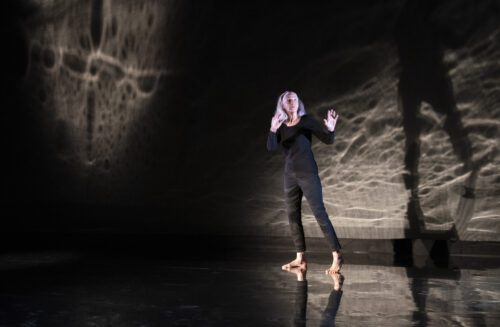
Sara Morsey amid the dark palette enhanced by Tony Galaska’s lighting in GableStage’s “The Year of Magical Thinking” (Photo courtesy of Magnus Stark)
The dark palette, artfully pierced by Tony Galaska’s lighting, brings Morsey into sharp relief. About the same age Didion was when Dunne died of a heart attack, Morse is slender and fit, the latter vital to staying on her feet for the play’s 100-minute running time. She doesn’t much look or sound like the petite, reed-thin Didion, but that scarcely matters. The words, the reflections, the storytelling, the commonality of grief – those are the things that matter.
Costume designer Camilla Haith has Morsey dressed in black, from the headband that holds back the actor’s shoulder-length white hair to the simple shirt and pants she wears. She walks the stage barefoot, and her expressive face and hands become even more powerful storytelling tools as they glow in light or recede into darkness.
Early on, she shares this observation from the memoir: “Life changes fast. Life changes in the instant. You sit down to dinner and life as you know it ends…”
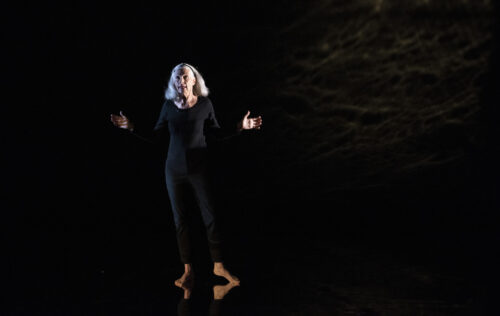
Sara Morsey in the one-person show, “The Year of Magical Thinking,” written by Joan Didion. (Photo courtesy of Magnus Stark)
Such insights are laced throughout the play, enriching Didion’s stories about her life with Dunne, her spouse of four decades, and daughter Quintana Roo, who died at 39.
Theirs was an uncommonly glamorous existence, one filled with books, magazine pieces, screenplays and acclaim, not to mention a host of famous friends (actor Katharine Ross, Didion says, taught Quintana to swim in her Malibu pool).
But what makes “The Year of Magical Thinking” speak to and connect with an audience are the common experiences of loss as expressed by an observant writer.
(Read the interview with Sara Morsey in the Artburstmiami.com preview here.)
In less than two years, the deep ongoing bonds of Didion’s life as a wife and mother ended. She tried to cope with journalistic research, controlling what she could, engaging in magical thinking – which, at its worst, became a kind of obsessive vortex. Slowly, so slowly, healing and acceptance happened, as they do.
Newport, who has been busy running and growing GableStage since directing the season-opening production of Arthur Miller’s “The Price,” underscores her range as a director with “The Year of Magical Thinking.” The roots of her creative approach are in the script, but she has interpreted the work in a highly original way.
Didion, who died in December at the age of 87, never came across as a showy dynamo. Nor, deliberately, does Morsey. She speaks in the confiding tones of a woman with a personal yet resonant story to tell. Though the production requires real physical and mental stamina, her movement is generally contained and controlled. Thanks in part to Galaska’s lighting, she appears to glow from within.
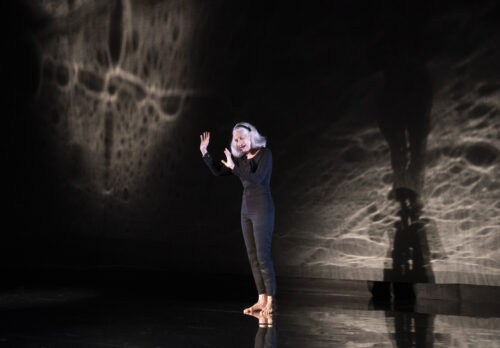
Although a solo show, “The Year of Magical Thinking” is a collaborative work of theater at GableStage. (Photo courtesy of Magnus Stark)
Newport’s bold interpretation of “The Year of Magical Thinking” becomes a collaborative work of theater art with the collective talents of Galaska, Haith, and the rest of the design team’s contributions.
Frank J. Oliva, scenic and projection designer, has created eerie patterns – something like water on a window or an X-ray view of something inside the body – that appear and vanish. Matt Corey underscores the play with music and sound, muted enough so that Morsey can be heard.
Some may find GableStage’s version of the play too dark and stark as it adheres to Newport’s concept. Not everything works as it should; at first, we see only a sliver of Morsey’s face, for instance. The actor does an engaging job of guiding theatergoers through Didion’s journey, but perhaps once the daunting amount of text becomes ingrained, that engagement can deepen.
GableStage announced its 2022-2023 season and it’s a safe bet that the productions will be as eclectic as Newport’s choices for her second season at the helm. But as “The Year of Magical Thinking” demonstrates, it’s likely she has only begun to explore the possibilities and potential of the much-admired company.
Two more shows close out its 2021-2022 season: “Rubenology” by Vanessa Garcia and Ruben Rabasa (July 14-31), and “Fade” by Tanya Saracho (Aug. 19-Sept. 18). After a break, the new season begins with Simon Stephens’s “Heisenberg” (Oct. 28-Nov. 20), followed by David Meyers’ “We Will Not Be Silent” (Jan. 6-29), Lucas Hnath’s “A Doll’s House, Part 2” (Feb. 24-March 19), Charise Castro Smith’s “El Huracán” (April 14-May 24) and Karen Zacarias’s “Native Gardens” (June 9-July 1, 2023). Go to gablestage.org/season for information.
WHAT: “The Year of Magical Thinking” by Joan Didion
WHERE: GableStage in the Biltmore Hotel, 1200 Anastasia Ave., Coral Gables
WHEN: Performances 2 and 7 p.m. Wednesday, 7 p.m. Thursday, 8 p.m. Friday, 2 and 8 p.m. Saturday, 2 p.m. Sunday, through June 26 (streaming version available June 8-26 during regular performances. Find out more about streaming here.)
TICKETS: $35-$70 (processing fee additional; ticket discounts for students, groups, artists, military, veterans and Biltmore staff members)
INFORMATION: 305-445-1119 or gablestage.org.
(Check theater’s COVID policies before you go.)
ArtburstMiami.com is a nonprofit source of dance, visual arts, music and performing arts news. Sign up for our newsletter and never miss a story.
No posts found
A year’s worth of work comes to light in ‘Here and Now 2022’
Written By Michelle F. Solomon
June 2, 2022 at 5:47 PM
“In the Brackish Water,” a theatrical praise song to Miami by Alejandro Rodriguez, features Vanya Allen, Ranses Colon on bass, Donell McCant on percussion, and Richard Padron on guitar, as part of “Here and Now: 2022.” (Photo courtesy of Kevin Alvarez Cordova)
Alejandro Rodriguez remembers being a theater kid in Miami. He vividly recalls his mother trying her darndest to support his interest in arts.
“She drove me to Coconut Grove Playhouse and inside its smaller Encore Room, there was a solo show going on,” Rodriguez says.
It was 2002 and Teo Castellanos was performing in his original “NE 2nd Avenue.” It was Beth Boone, artistic and executive director of Miami Light Project, who had first commissioned the piece as MLP’s inagural full-length work from a Miami artist.
Rodriguez decided he wanted to be an actor and left for New York to attend The Juilliard School. He worked in theater, on television, and doing other performing arts jobs, but in 2020, after 15 years, he returned to Miami.
“The first outing I did when it felt safe enough to go out after COVID-19 was the 2021 ‘Here & Now’ showings. Beth was there as she so often is.” He had never forgotten that “NE 2nd Avenue,” which had such a profound effect on him, was incubated at Miami Light Project. That night, he told Boone how he had been thinking he might like to try something. “I was so jazzed by what I saw at ‘Here & Now,’ I went home and started my application.”
He is now one of six artists included in “Here & Now: 2022” at The Light Box at Goldman Warehouse, Thursday, June 2, Friday, June 3 and Saturday, June 4.
In addition to Rodriguez’s work, “In the Brackish Water,” other commissions include Jenna Balfe’s “Organesis,” Cecilia Benitez and Stephanie Perez in “Manteca,” Symone Titania Major’s “Home” and Randolph Ward’s “Unconventional.”
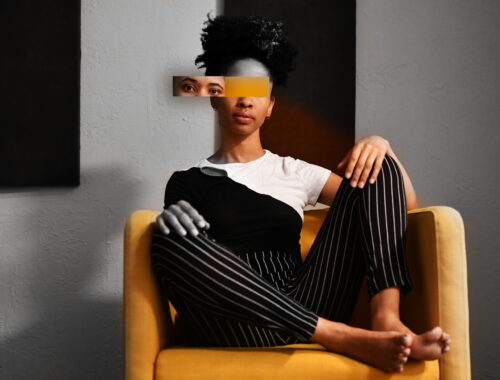
Symone Titania Major’s “Home” is an expressional journey of poetry, performance and photography. (Photo courtesy of the artist)
Miami Light Project launched “Here & Now” in 1999, a year after Boone came on board. In addition to a commission fee of $5,000 for South Florida-based performing and multi-media artists selected from submitted applications, the artists receive rehearsal space, technical assistance, and professional development. Boone says “Here & Now” artists have access to everything Miami Light Project has to offer in “perpetuity.”
“This is truly my favorite program initiative that we have at Miami Light Project because I believe it is our most important work — investing in the artists who make Miami home. I am so moved by the creativity and the generosity of all the artists when they come to this blank slate,” she says. Since its inception, Miami Light Project has commissioned work from more than 100 South Florida-based creatives. Artists are in residence for a year developing their commissions. “Here and Now” is the culmination of that work.
For Ward, the “Here and Now” opportunity gave him time to dig into “Unconventional,” which is constructed in four acts and explores notions of identity through the work of a drag queen, pole dancer, female boxer, and a Black transgender Vogue dance artist. “These are all people who have all made their money in very unconventional ways.”
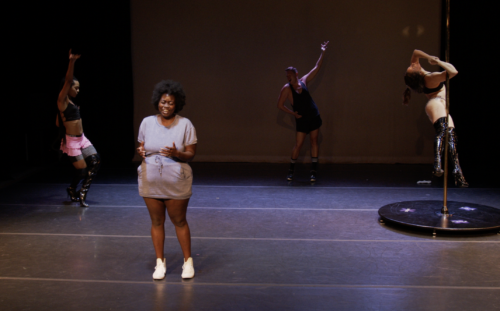
Randolph Ward’s “Unconventional” examines archetypes that break the mold of traditional masculinity and femininity. (Photo courtesy of Kevin Alvarez Cordova)
While he’s not new to staging original productions, Ward says for him, “Here and Now” was all about having the space and time for development. And, there was another concrete plus. “I was actually in the theater using the theater space where we’d be performing. I didn’t have to rent a studio space. ‘Here and Now’ is just a great platform.”
Rodriguez says that having a place that is all about the creative process has made an impact. “As an artist who is still very much in the learning and growing phase, you just desperately need a place to try stuff. To make bad choices, go too far, mix art forms that maybe haven’t gone together before. To put it bluntly, you need to be able to fail as an artist before you can break any new ground. This is a place with a safety net,” he says.
His work, “In the Brackish Water,” combines spoken word, live music, and movement in a theatrical monument to Miami’s precarious future. “There’s a priestess character backed by a trio of musicians who has gathered us all for a ceremony to show us something that we ought to see as people who call this city home.”
The other pieces in “Here and Now: 2022” are “Organesis,” a performative narrative that explores human value and fulfillment in a time of overstimulation, overpopulation, and perceived emotional scarcity. “It is a mash up of music, dance, and theater. You can’t pin it to a discipline because Jenna (Balfe) has got all of it. It’s smart and very funny,” Boone says.
“Manteca“ is a dance tribute to the game of dominoes— with a feminist twist. Boone says the three-part piece by Cecilia Benitez and Stephanie Perez is about identity and is “beautifully expressed in dance and choreography.”
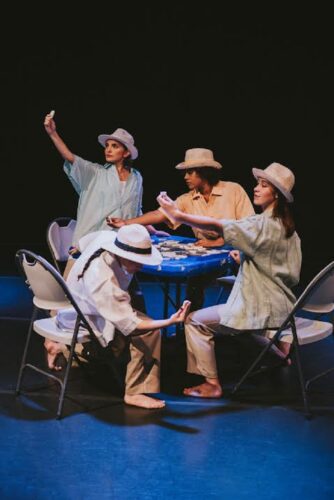
In “Manteca,” Cecilia Benitez, Stephanie Perez, Scarlett G. Quinto, and Maytte Subirana-Albarellos, play the game through dance in an homage to Cuban culture and tradition. (Photo courtesy of Maya Billig)
“Home” is described as an expressional journey of poetry, performance, and photography in an interactive work of art. “Symone (Titania Major) is just joyful to watch. ‘Home’ is told in such a personal way on issues that we are all grappling with every single day in our world. It’s just exquisitely realized,” Boone says.
For those like Rodriguez who become immediately inspired after “Here and Now: 2022,” Boone says to be on the lookout. “We try to make the applications (for next year) available right on the heels of the ‘Here and Now’ performance program because artists in the community are all jazzed up and saying, ‘How can I do this?’ ”
WHAT: Miami Light Project’s “Here and Now: 2022”
WHERE: The Light Box at Goldman Warehouse, 404 NW 26th St., Miami
WHEN: 8 p.m. Thursday, June 2, Friday, June 3 and Saturday, June 4.
TICKETS: $15 and $25 (processing fee additional) at eventbrite.com
INFORMATION: 305-576-4390 or miamilightproject.com.
ArtburstMiami.com is a nonprofit source of dance, visual arts, music and performing arts news. Sign up for our newsletter and never miss a story.
No posts found
In a time of loss and grief, GableStage brings Joan Didion’s ‘The Year of Magical Thinking’ to life
Written By Christine Dolen
May 30, 2022 at 12:16 PM
Sara Morsey as author Joan Didion in GableStage’s “The Year of Magical Thinking” at the Biltmore Hotel, Coral Gables, opening June 4 through June 26. (Photo courtesy of Nick Adams/Florida Repertory Theatre)
Celebrated writers Joan Didion and John Gregory Dunne were married for four decades, partners in life and sometimes in their work.
They were, as she said to her nephew Griffin Dunne in the 2017 Netflix documentary “The Center Will Not Hold,” each other’s first reader. If one wrote the first draft of a screenplay, the other would function as a kind of “super editor (“Didion’s term), changing and rewriting until it was nearly impossible to tell who did what.
In other words, their lives were uncommonly entwined.
So when Dunne died suddenly of a heart attack in December 2003, Didion’s world was forever altered.
After some months, the novelist-screenwriter-essayist – author of “Play It As It Lays,” “A Book of Common Prayer,” “Slouching Towards Bethlehem,” “The White Album,” “Miami” and so much more influential work – responded as she so often did throughout her long career. In personal ways and in a larger cultural context, she made sense of her loss and grief by writing about them in 2005’s “The Year of Magical Thinking,” which became a finalist for the Pulitzer Prize and the National Book Critics Circle Award.
Didion then challenged herself by transforming the book into a play, a piece that (unlike the book) also deals with the death of the couple’s beloved daughter, Quintana Roo Dunne Michael. In 2011, Didion wrote about her relationship with her daughter and the loss in the book “Blue Nights.” Her death, of acute pancreatitis at the age of 39, was less than two years after her father’s passing.
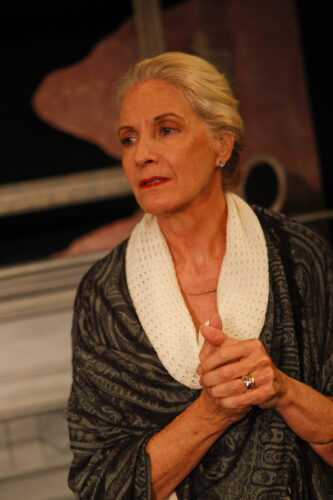
Sara Morsey, seen here in the Florida Repertory Theatre production of “The Year of Magical Thinking,” reprises the role in GableStage’s new production. (Photo courtesy of Nick Adams/Florida Repertory Theatre)
The solo show, “The Year of Magical Thinking,” opened on Broadway in 2007 with the very tall Vanessa Redgrave portraying the very tiny Didion under the direction of British playwright-screenwriter David Hare.
Paying artistic tribute to Didion, who died in December at the age of 87, GableStage is about to open a new production of “The Year of Magical Thinking” with Gainesville-based actor Sara Morsey as Didion.
A preview is set for Friday, June 3, then the play officially opens Saturday, June 4, and run through Sunday, June 26 at the company’s intimate space at the Biltmore Hotel in Coral Gables.
It was first produced in South Florida a dozen years ago by the now-defunct Women’s Theatre Project. After Didion’s death, GableStage producing artistic director Bari Newport made room in her inaugural season for “The Year of Magical Thinking.”
“At first I thought we should do a reading of it. Then, after the omicron variant (of COVID) hit, I thought we could reimagine it in a different way. I’d read the play a number of times but had never seen it, and I wondered about doing it in an abstract way,” says Newport, who is staging the production and directed Morsey in “Ripcord” when Newport was running the Penobscot Theatre Company in Bangor, Maine.
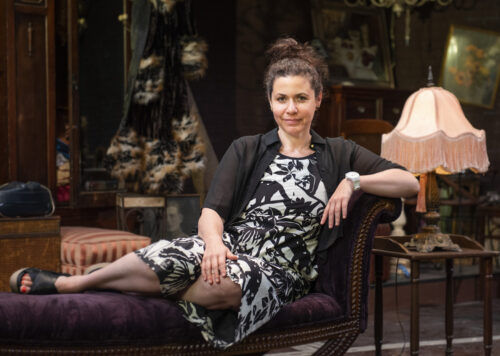
Bari Newport, GableStage’s producing artistic director, is directing “The Year of Magical Thinking.” (Photo courtesy of Magnus Stark)
Newport’s concept is to place Morsey and thus the audience in a space representing that magical thinking –”if I do this, then that will happen” – which Didion used to help her cope in the year after Dunne’s death. She refused to give his shoes away, for instance, because she knew he would need them when he came back. Not if he came back. When he came back. If only wishing could make it so.
“Sara is one of the best actresses I’ve known. She’s in incredible shape physically and mentally, which is good because there’s nowhere to sit (on the set),” Newport says. “I’ve never not seen it as an activated piece. It’s easy to just tell the audience a story. If you’re going to do that, you might as well read the book.”
Morsey first played Didion a decade ago at Florida Repertory Theatre in Fort Myers. That production was done in a small space on a set designed to look like an inviting room in a home.
During rehearsals, Morsey’s mother died. So the kind of grief Didion expresses in the play was painfully fresh.
“I thought I was too young then. Now I’m as old as Joan was when John died,” says Morsey, who will turn 70 in late June. “And I have so many more thoughts about death and grief. I never married or had children. I’ve entered that part of my life when I’m losing people. So many. COVID has done something to all of us.”
Newport concurs.
“Everybody is grieving now,” she says. “The piece is the epitome of catharsis – that’s its purpose.”
The play’s opening lines underscore the commonality of profound loss and grief.
“This happened on December 30, 2003. That may seem awhile ago but it won’t when it happens to you,” Didion wrote.”And it will happen to you. The details will be different, but it will happen to you.”
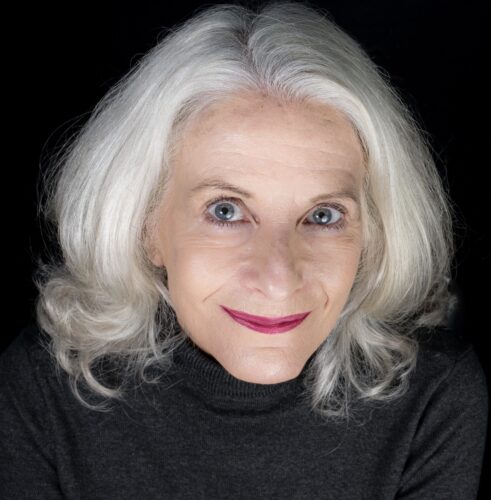
Gainesville-based actor Sara Morsey stars in the one-woman show Joan Didion’s “The Year of Magical Thinking” at GableStage. (Photo courtesy of Niall McGinty, Felix Photography)
Morsey, whose work recording audiobooks kept her busy during pandemic isolation, has played some challenging and often lengthy roles onstage, including Mary Tyrone in “Long Day’s Journey into Night,” Violet Weston in “August: Osage County” and Maria Callas in “Master Class.” But playing Didion is daunting in another way, she says.
“This one’s scarier. It’s only me,” she says. “It’s also inordinately long for a one-person show… But this is really a wonderful experience.”
The show runs 1 hour and 40 minutes without an intermission.
Morsey adds that as a director Newport “is fearless and articulate. She’s very encouraging and always has more notes. You begin and end (rehearsals) in a regular space, but then you have to be ready to go.”
For her part, Newport is relishing being able to exercise her artistic muscles as a director after some months of focusing on the challenges involved in running GableStage, including losing the last week of the successful run of “Boca” when the latest COVID wave hit the cast.
“I love working on one-person shows. You just get to have a more intimate relationship. It’s such a personal journey. I admire Sara – she’s an effervescent, spiritual being,” says Newport, whose design team for the production is filling the space with shifting lights, sounds, and underscoring. “This will have theatrical beauty galore.”
The play’s only performer is quick to emphasize that, while she has done her research by reading Didion’s work and watching multiple video interviews with the late author, she isn’t trying to transform into the woman she’s playing. For one thing, like Redgrave, Morsey is tall and fit. Didion was petite, weighed under 100 pounds, and for many years started her writing day with a cold Coca-Cola, a handful of nuts, and one cigarette after another.
“She had this ethereal quality. I watched a lot of her, not to be like her but to see her thinking, see how the world added up for her,” Morsey says. “I have not in any way tried to do a capturing of her personality. She’s fairly inarticulate as a speaker, but she gets it on the page – it’s totally articulate… I’m not trying to impersonate her, but I hope I’m closer to her essence.”
WHAT: “The Year of Magical Thinking” by Joan Didion
WHERE: GableStage in the Biltmore Hotel, 1200 Anastasia Ave., Coral Gables
WHEN: Preview 7 p.m. June 3, opening 8 p.m. June 4; regular performances 2 and 7 p.m. Wednesday, 7 p.m. Thursday, 8 p.m. Friday, 2 and 8 p.m. Saturday, 2 p.m. Sunday, through June 26 (streaming version available June 8-26 during regular performances. Find out more about streaming here.)
TICKETS: $35-$70 (processing fee additional; ticket discounts for students, groups, artists, military, veterans and Biltmore staff members)
INFORMATION: 305-445-1119 or gablestage.org.
(Check theater’s COVID policies before you go.)
ArtburstMiami.com is a nonprofit source of dance, visual arts, music and performing arts news. Sign up for our newsletter and never miss a story.
No posts found
After a pandemic pause, ‘Summer Shorts’ marks 25 years with new plays, proven hits
Written By Christine Dolen
May 27, 2022 at 3:59 PM
Daniel Llaca, Lindsey Corey, Stephon Duncan, and Diana Garle take a leap in City Theatre’s “Summer Shorts” through July 2 at the Adrienne Arsht Center. (Photo courtesy of Morgan Sophia Photography)
Miami’s City Theatre was preparing to produce and party in 2020 with a splashy 25th-anniversary edition of “Summer Shorts,” its annual festival of short-form comedies, dramas, and musicals.
After the COVID-19 pandemic hit hard that March, those plans were put on indefinite hold. The company did plenty of virtual programming, but returning to a full-fledged, in-person indoor event still looked risky in June 2021, so that festival was scratched too.
But cofounder/literary director Susan Westfall and artistic director Margaret M. Ledford are as tenacious as they are creative. And so, 27 years after Westfall, Stephanie Heller and Elena Wohl created City Theatre, the postponed 25th festival is happening Thursday, June 2 to Saturday, July 2 in the Carnival Studio Theater at the Adrienne Arsht Center for the Performing Arts – on the Susan Westfall Playwrights Stage, no less.
Ledford, who is directing the Lin-Manuel Miranda musical “21 Chump Street” (first presented in the 2017 festival) and the world premiere of “Tango! The Musical!” by Westfall and composer Joe Illick, is also overseeing the festival. This year’s “Summer Shorts” goes big with eight additional plays, four more directors, eight actors, a musical director and a choreographer.
“Being back started feeling normal around Day 2 of rehearsals,” says Ledford. “There’s been such anticipation about this. We’re ready and excited, but at the same time it’s a little unfamiliar – which allows it to be new, in a way.”
Initially, the thought was that this special festival would return to its two-program roots, with audiences being able to see a lineup of all-new plays, a collection of favorites from earlier festivals, or both. But after discussions with a core group, company leaders decided on a single program combining new works and past hits.
“We didn’t know what health and safety would mean at the time of the festival,” says Westfall. “National surveys show a situation of audience reluctance (to return to theaters), and it’s generational.”
Indeed, the company must now contend with South Florida’s spike to a high-risk COVID transmission category, so a two-program lineup likely would have been a tougher sell at the box office.
Playwright Steve Yockey, whose “Go Get ‘em, Tiger!” will have its world premiere in this year’s festival, has been commissioned by City Theatre more than any other playwright. He made his Summer Shorts debut with “Serendipity” in 2013. “Go Get ’em, Tiger!” will be his ninth City-produced script.
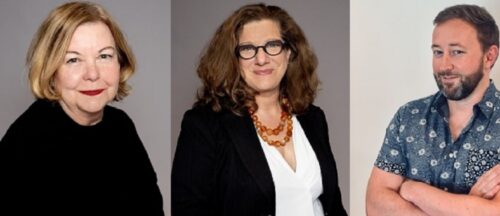
From left, City Theatre cofounder and literary director Susan Westfall, City Theatre artistic director Margaret M. Ledford, and Steve Yockey, playwright. (Photos courtesy of Morgan Sophia Photography and Mary Ann Welshans)
Yockey, you should know, is one very prolific writer, producer and television showrunner. He was a producer on “Supernatural” in 2017-2018, is executive producer and showrunner for “The Flight Attendant” on HBO Max, has a pilot called “Dead Boy Detectives” filming and may get another series, “Cindy Snow” (a black comedy about a meteorologist) picked up by FOX.
He’s also continuing to create full-length plays – often dark comedies – which “allows me to write about a topic or emotional turmoil. It’s free therapy, then you get to walk around happy, and the audience has the turmoil,” Yockey says via Zoom from his office in Los Angeles.
Yet busy as he is, when City Theatre asks him for a new short play, he says yes.
“A great short play has real emotional heft and real spectacle. You can do anything to people for 10 minutes… And when I saw the level of City Theatre’s production values, I knew I could go to town,” he says.
He continues: “I don’t think you can overstate how important City is at a national level in finding new talent. They bring thoughtfulness and care to how they select a slate of plays, how they bring playwrights in, how they do so many bookstore readings.”
Ledford, who directed “Serendipity” and remains a Yockey fan, says his voice is “so fresh, so smart, so emotionally connected. So funny and outlandish. The audience has to know within a minute they’re in good hands.”
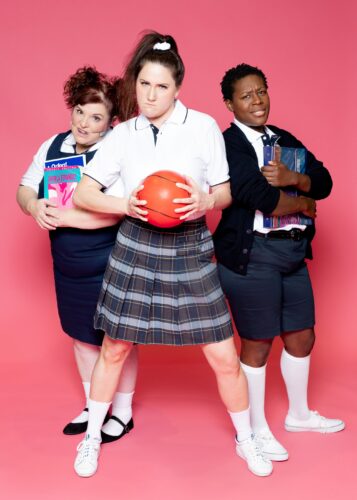
Margot Moreland, Lindsey Corey and Stephon Duncan get tough in “Chronicles Simpkins Will Cut Your Ass.” (Photo courtesy of Morgan Sophia Photography)
This year’s acting company, hired for the canceled 2020 festival, consists of “Summer Shorts” veterans and newbies.
Of the eight actors, Tom Wahl holds the record for most “Summer Shorts” appearances – this is his 11th, plus two editions of “Winter Shorts.” Margot Moreland, Alex Alvarez, Lindsey Corey, Diana Garle, and Jovon Jacobs have all done the festival before, while Stephon Duncan and Daniel Llaca (both of whom have appeared in other City Theatre productions) are “Summer Shorts” newcomers.
“I’m in five (pieces), including Susi’s musical. I don’t sing but I do a little dancing,” says Wahl. “I like being in a room when all that creativity is happening – it’s miraculous.”
Fellow veteran Moreland, who was part of the company for the first three festivals, cites varied roles as part of the “Summer Shorts” appeal for an actor.
“You’re so easily pigeonholed in this business, but not in ‘Summer Shorts,’ ” says Moreland, who will also appear in five of the 10 plays. “This gets you back to your soul of being an actor. It’s electrifying, and the directors are great… It’s an extraordinary experience.”
This year’s company, she adds, is “kick-ass.”
Jacobs’s last show before the pandemic had him playing a philologist courting a princess (played by his “Summer Shorts” castmate Garle) in Alix Sobler’s “The Glass Piano” at Theatre Lab in Boca Raton. He began doing more film and television work during the long COVID pause, then returned to the stage not long ago with a powerful performance in Lynn Nottage’s “Intimate Apparel” at Palm Beach Dramaworks.
The St. Croix native appreciates the chances he gets to stretch in “Summer Shorts,” “different things you might not do in any other theater… and it brings together actors who otherwise might not work together. It’s a melting pot of different things, refreshing.”
Though theater itself went through a period of deep self-examination in terms of equity, diversity, and inclusion for BIPOC artists during the pandemic, Jacobs believes inclusive companies like City Theatre are still more the exception than the rule.
“I wish I would be seen for more things, but I don’t think things will change so fast. I do see more Black plays inserted in seasons, and I have played non-traditional roles. But I’m usually seen for Black roles,” he says.
Four of the five festival directors have been at the helm of “Summer Shorts” productions before.

Daniel Llaca and Diana Garle connect in Lin-Manuel Miranda’s “21 Chump Street,” first presented in 2017 and included in this year’s “Summer Shorts.” (Photo courtesy of Morgan Sophia Photography)
Ledford is doing the musicals, and City Theatre’s founding artistic director Gail S. Garrisan is directing the late Staci Swedeen’s “A Little Bit of Culture” (first done in the 1999 festival) and David Lindsay-Abaire’s “Misdial.”
Elena Maria Garcia, who has performed in multiple editions of “Summer Shorts,” is making her festival directing debut with two short comedies: Daniel Hirsch’s “A Small Breach in Protocol at Big Rick’s Rockin’ Skydive Academy” and Rolin Jones’s “Chronicles[CQ] Simpkins Will Cut Your Ass” (a hit at the 2008 festival). Michael Yawney is directing the world premiere of Yockey’s “Go Get ’em, Tiger!” and Jacqueline Bircher’s “Webster’s Bitch.” James Randolph is staging MacArthur “genius grant” fellow Dominique Morriseau’s “Night Vision” and Amy Berryman’s “Winner.”
Yawney, who teaches theater at Florida International University and runs FIU’s new play development program The Greenhouse, appreciates the creative freedom of Summer Shorts.
“The plays are so short that you can really be bold. And if the audience hates it, don’t worry – there’s another 10-minute play coming up,” he says. “It’s exciting. Like jumping out of a plane and hoping the ground will be there.”
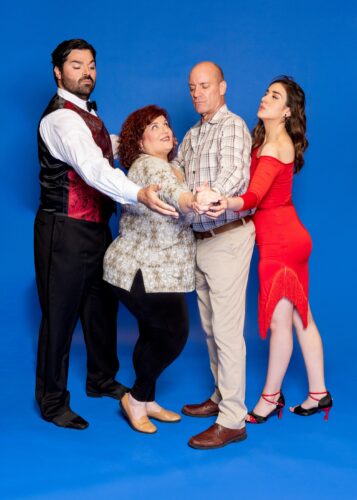
Alex Alvarez, Margot Moreland, Tom Wahl and Diana Garle dance and connect in “Tango! The Musical!” (Photo courtesy of Morgan Sophia Photography)
He describes “Go Get ’em, Tiger!” as being like “all the best Steve Yockey plays. You think it’s one thing, then it’s another. It’s funny, heartbreaking, a fantasy that seems real. It’s like working with nitroglycerine.”
Yawney, who once worked in publishing and in the world of reference books, relates to “Webster’s Bitch” (winner of City Theatre’s 2020 National Contest for Short Playwriting and was staged previously as part of the 2019 City Theatre-Thinking Cap Theatre She Shorts festival in Fort Lauderdale). He says it is spot-on in its depiction of office politics and pop culture.
“It’s interesting how some of these plays that are being revisited feel different with a different cast,” he says, adding, “the ending of ‘Webster’s Bitch’ was Margot’s idea. It’s much better than anything I could have come up with.”
Garcia, a Carbonell Award-winning actor who teaches at Barry University, recently co-directed “Our Dear Dead Drug Lord” at the Carnival Studio Theater with Zoetic Stage artistic director Stuart Meltzer. She blocked both “Skydive” and “Chronicles” the first day and communicated what she believes Summer Shorts should be.
“You need enthusiasm and energy. It’s a festival. It’s fun. We’re not doing Lorca,” says Garcia.
But though she arrives to rehearsals prepared, she stays open to collaborating with her casts.
“It’s a misconception that the director knows exactly what they want,” she says. “I don’t know who’s going to give me a gift.”
In addition to the playwrights, directors, and actors who have been so vital to the long-running success of “Summer Shorts,” numerous other artists are playing key roles in this year’s festival.
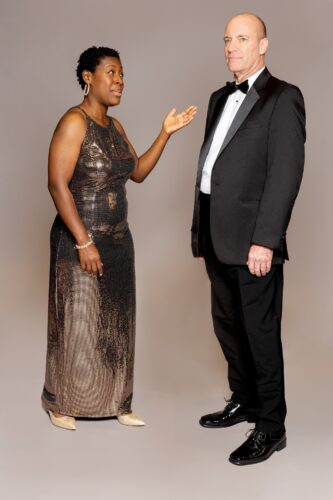
Stephon Duncan and Tom Wahl portray very different playwrights in “Winner.” (Photo courtesy of Morgan Sophia Photography)
Musical director Caryl Fantel, who will also lead a live band at performances, joined Ledford in rehearsing the musicals. Choreographer Sandra Portal-Andreu, scenic designer Jodi Dellaventura, sound designer Steve Shapiro, costume designer Ellis Tillman, props designer Jameelah Bailey, plus a host of interns and others are part of the creative village bringing Summer Shorts to life.
Also, a significant part of the City’s festival programming is the production of “Bob Marley’s Three Little Birds,” which runs June 22-July 9.
With music by the late, great Marley, the family-friendly show is based on the children’s book “Every Little Thing” by his daughter Cedella. Tickets are $30 ($20 for children under 12), and they’re still available for the 7:30 p.m. performances June 22 and July 8-9, plus 11 a.m. matinees June 25 and July 2. Visit www.arshtcenter.org for information.
And another longtime component of the festival, the annual CityWrights playwrights’ gathering, also returns June 29-July 2. As literary director and cofounder, Westfall will again lead that conference.
First, though, there’s the newest iteration of a piece that began in 2013 as a play titled “Feel the Tango.” Westfall did some rewriting and rechristened it “Be the Change” for a 2016 Shorts Gone Wild coproduction with Island City Stage in Wilton Manors. Then her friend Illick, a Santa Fe-based opera composer and conductor, suggested turning the play into a short opera titled “Feel the Tango, the Opera” for a 2017 festival of short operas – and indeed, the short score for that version was quite operatic.
“In 2019, I asked Joe if he could adapt it into a musical with me,” says Westfall, who wrote the book and collaborated with composer Ilick on lyrics for “Tango! The Musical!”
“The piece just tickled me as it changed. I guess that’s the playwright and producer in me… But I do believe this is the end for something that started as a little play.”
WHAT: City Theatre’s 25th annual Summer Shorts Festival
WHERE: Carnival Studio Theater in the Ziff Ballet Opera House at the Adrienne Arsht Center for the Performing Arts, 1300 Biscayne Blvd., Miami.
WHEN: Previews 7:30 p.m. June 2-3, opens 7:30 p.m. June 4; regular performances 7:30 p.m. Thursday-Friday, 3 and 7:30 p.m. Saturday, 3 p.m. Sunday, through July 2.
TICKETS: $50 and $60 (VIP, $65 and $75)
INFORMATION: 305-949-6722 or arshtcenter.org
ArtburstMiami.com is a nonprofit source of dance, visual arts, music and performing arts news. Sign up for our newsletter and never miss a story.
No posts found
Review: Hop aboard Actors’ Playhouse’s madcap ‘Murder on the Orient Express’
Written By Michelle F. Solomon
May 23, 2022 at 3:33 PM
The cast of the Actors’ Playhouse production of the stage adaptation of Agatha Christie’s “Murder on the Orient Express” now at the Miracle Theater in Coral Gables through June 5. (Photo courtesy of Alberto Romeu)
In the history of fictional literary detectives, British mystery writer Agatha Christie’s fussy Belgian sleuth Hercule Poirot is tops on the list. Known for his magnificent mustache that he treats as delicately as his clues, Christie’s Poirot is the focus in any whodunnit in which she’s placed him.
A particular fan fave is “Murder on the Orient Express,” the expertly crafted mystery yarn about a group of strangers on a train and a murder that’s committed during the trek from Istanbul to London.
Actors’ Playhouse at the Miracle Mile Theatre is presenting the adapted-for-the-stage version. Ken Ludwig, who is known for his madcap farces, most especially the Tony Award-winning “Lend Me a Tenor,” was called upon by the Christie estate to adapt one of the Queen of Crime’s novels for the stage.
The stage version of “Murder on the Orient Express” had its premiere in 2017. There may be a love-hate relationship for Christie fans in this version as Ludwig adds his variety of farce akin to a mystery dinner theater show, more than one might expect from something born of Dame Agatha. But the screwball antics work with credit to Playhouse director David Arisco who finds the balance between Ludwig’s lunacy and Christie’s suspense.
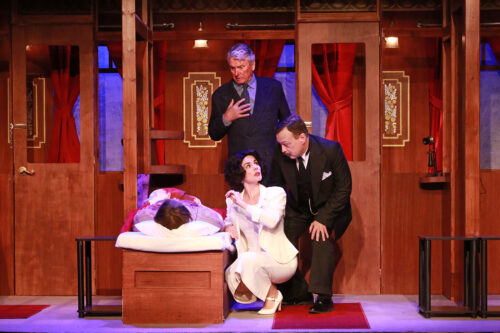
Michael McKenzie, Gaby Tortoledo and Terry Hardcastle in “Agatha Christie’s Murder on the Orient Express” at Actors’ Playhouse, Coral Gables. (Photo courtesy of Alberto Romeu)
Ludwig has pared the number of suspects in the original from 12 to 8, which works quite well to keep tabs on who’s who as the plot thickens. Someone aboard the train has been found murdered in their bed and Poirot, who was hoping for a brief vacation from the crime business, is now back on the clock.
Despite the infused antics, the story stays true to Christie’s book and the gaggles of re-dos of “Express” (most people are familiar with the novel from the movie versions – Sidney Lumet’s 1974 film starring Albert Finney as Poirot and Kenneth Branaugh’s 2017 effort in which he casts himself as the internationally renowned detective).
While the main character is no doubt, Poirot, the wonderful ensemble cast assembled here makes each character equally worthy.
Terry Hardcastle is Poirot. As any seasoned actor should do when performing a character that’s been inhabited by so many before him, Hardcastle brings as much originality to the role as possible. While Poirot has quirks (you’ll see him in his train compartment staring at his mustache, fussing compulsively with it in a mirror), Hardcastle makes the eccentricities part of Poirot’s persona, never relying on them to get laughs. While there are plenty of “a ha” moments, Hardcastle, like his detective would, takes them seriously. That’s not to say his Poirot is dull. Not in the least.
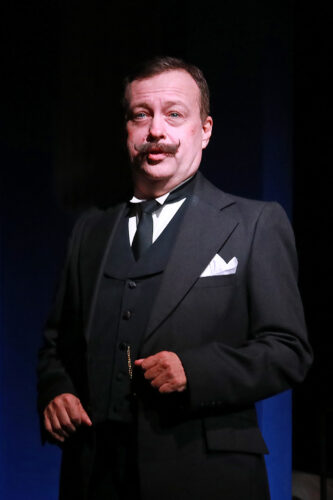
Terry Hardcastle inhabits the role of Detective Hercule Poirot in “Murder on the Orient Express” at Actors’ Playhouse. (Photo courtesy of Alberto Romeu)
The rest of the cast, each a misfit in their own way, are meant to be “characters” and characters they are.
Irene Adjan is Helen Hubbard the multi-times married Minnesota housewife. She’s the only American on vacation aboard the train. The veteran actress, who is adept at comedy, knows she has been given the part that can steal the show, and steal it she does right up to the very end. Her character’s transformation, so skillfully created by Christie and equally attended to by Adjan, is stunning.
Speaking of veteran actresses, Lourelene Snedeker is the Russian Princess Dragomiroff (and on a personal note, her Mother Abbess in the Wick Theatre’s 2013 production is still one of the most unforgettable). A faceoff between her and Adjan’s Hubbard is one of many comic highlights in the production.
Mallory Newbrough plays the anxiety-ridden, uber-religious, Greta Ohlsson, the Swedish travel companion to Dragomiroff. Gaby Tortoledo is the glamorous Hungarian Countess Andrenyi, who can balance wearing a white suit while using her physician skills to examine bloody stab wounds. The playwright has written in a “crush” for Poirot with the object of his affections being the Countess.
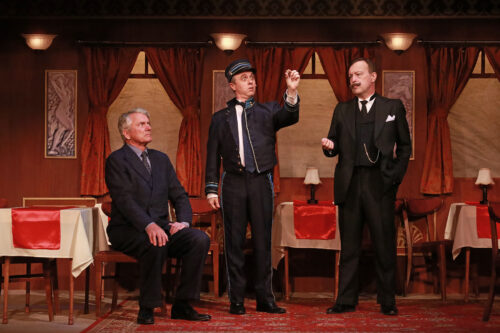
Michael McKenzie, Seth Trucks and Terry Hardcastle take in a clue in the Actors’ Playhouse production of “Murder on the Orient Express.” (Photo courtesy of Alberto Romeu.)
Krystal Millie Valdes is the picture of virtue as the innocent English governess Mary Denebaum. Seth Trucks is the dependable French conductor, Michel, who harbors a secret that is revealed at the end. Alexander Blanco’s Hector McQueen as Ratchett’s personal secretary and the son of a prominent district attorney also displays deft as his character’s cover is blown.
Iain Batchelor is a master of disguise playing double roles as the over-protective Scottish Colonel Arbuthnot and the dastardly Samuel Ratchett.
Michael McKenzie is Monsieur Bouc, who comes undone as the manager when the heat is turned up as his train becomes the scene of a crime. McKenzie’s mastery of facial expression and body language conveys some of the best comic moments Ludwig has written for Monsieur Bouc. McKenzie milks them for all they are worth in the best possible way.
Tim Bennett’s sets are wonderfully creative and make the small space open up the world of the Orient Express in the small theater. Two sides of the exterior of the train slide in and out to expose the dining car. They close and reopen to reveal the three rooms of the train compartment, where Poirot, Ratchett and Hubbard’s quarters all connect. It also opens for a third playing space, a platform between the cars.
Shaun Mitchell’s sound design with period music sets the mood. Eric Nelson’s sepia-inspired lighting casts an antique feel over the playing area. Jodi Dellaventura’s detail to the set dressing of the 1930s train does the same. And costumer Ellis Tillman’s love of all things fur, elegance, and refinement adorn the actors.
Arisco’s direction, as usual, is spot on and, in a subtle, yet remarkable study of the script, the major events happening in the time and place of “Express” seep in like the smoke and fog effect that brings to life the setting of the steam locomotive. It’s 1934, the time of the rise of fascists and dictators like Hitler and Stalin, only 5 years before the Nazi invasion of Poland.

Terry Hardcastle, Iain Batchelor and Irene Adjan in the train compartments of Tim Bennett’s creative set in the Balcony Theater of Actors’ Playhouse. (Photo courtesy of Alberto Romeu)
In between the comedy, the ghastly elephant in the room is addressed. It’s how the show opens. We’re in the dark theater and we don’t see it, but we hear it. A 3-year-old named Daisy from a wealthy family is snatched from her bedroom and kidnapped for a large ransom. Eventually, the kidnapper kills her. Christie is said to have based the Daisy subplot on the renowned Lindbergh baby case in 1932, right before she began writing her book.
As the crime becomes somewhat central to Poirot’s murder on the train, it may become less easy to lean into the laughs and that’s where Ludwig and Christie don’t particularly meet on the same train track.
Still, the 120-minute romp is a fun night out with high production values and a superb ensemble theater troupe. As Poirot himself says in the play, “What better way to spend a pleasant evening together?”
WHAT: “Murder on the Orient Express” by Ken Ludwig, based on Agatha Christie’s novel
WHERE: Actors Playhouse in the Balcony Theatre at the Miracle Theatre, 280
Miracle Mile, Coral Gables
WHEN: 8 p.m. Wednesday-Friday, 2 and 8 p.m. Saturday, 3 p.m. Sunday, through June 5
TICKETS: $55 to $85 (seniors 65 and over get 10 percent off weekdays only; students 25 and under with valid student ID pay $15 for a rush ticket available 15 minutes before a weekday performance; Tix @ 6 offers $30 tickets weekdays between 6 and 6:30 p.m. in person at the box office, subject to availability)
INFO: 305-444-9293 or actorsplayhouse.org
ArtburstMiami.com is a nonprofit source of dance, visual arts, music and performing arts news. Sign up for our newsletter and never miss a story.
No posts found
Review: In Little Havana, Uncle Scotchy is serving up his heart and soul in immersive ‘Blues Opera’
Written By Michelle F. Solomon
May 18, 2022 at 2:24 PM
Eric Garcia, a.k.a. Uncle Scotchy, plays the blues and tells stories in Juggerknot Theatre Company’s “The Blues Opera,” an immersive theater show in a house in Little Havana, running Thursdays through Sundays until June 26. (Photo courtesy of Scott Mclntyre)
Eric Garcia’s friends told him he was a storyteller. He knew he was a musician. One friend told him he should combine the two and create an opera. An opera? “Yeah,” the friend said. “Something like a rock opera à la ‘The Who’s Tommy.’ ”
Well, Garcia was a blues musician, and he did have plenty of stories.
That’s part of the genesis of “The Blues Opera,” a one-man autobiographical experience. With plenty of help from the Juggerknot Theatre Company, “The Blues Opera” is another ace in Miami’s immersive theater experience scene. Known for its Miami Motel Stories series, Juggerknot’s first production, in 2017, was in Little Havana inside The Tower Hotel. Now it is the same Miami neighborhood to immerse an audience with Garcia in the company’s first one-person show.
This time the setting is a duplex just off Calle Ocho where the audience play “friends” invited over to Garcia’s Little Havana house for game night.
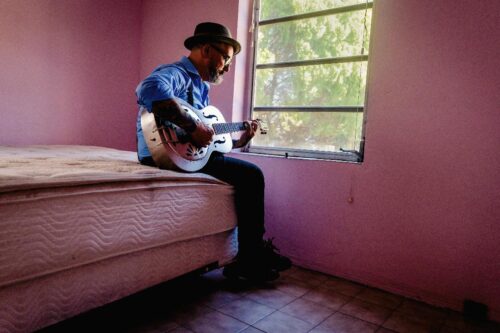
Eric Garcia tells personal stories about being a caregiver to his mother and father. Theatergoers move through different rooms of the house, including the pink room of his mother’s. (Photo courtesy of Scott Mclntyre)
The exact location is kept secret until only a few hours before the day of the performance. A text and an email arrive from “Uncle Scotchy,” a nickname Garcia earned because of his love for Scotch whisky. “It’s Uncle Scotchy here. I can’t wait to see you for game night at my house tonight!”
Scotchy gives you the address, tells you not to be late, to wear comfortable shoes, to bring a picture of your mom (yes, it can be on your phone), and most importantly, “bring your tough skin. My games are NOT Candyland.”
The experience begins from the get-go, really, just searching for the address. It doesn’t lead to a house but a Calle Ocho bakery. Out in front, a guide checks in ticketholders. Only 10 tickets are sold for each performance to keep it intimate — four performances per week, Thursday through Saturday evenings and Sunday afternoons.
Everyone gets a name tag and is handed a Sharpie. The name tag serves a few purposes, one of which is immediate — your name on the sticker gets you a free croqueta inside the bakery.
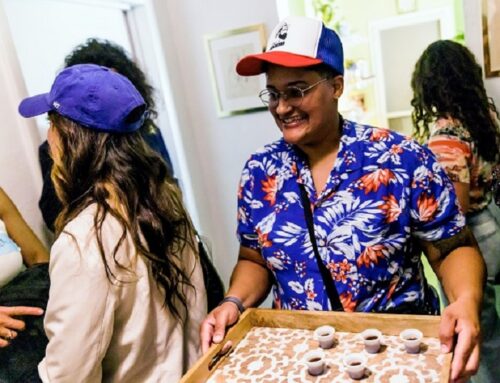
Adele Robinson is Scotchy’s “friend” who arrives to get everyone together for game night. She’s also the gracious hostess and guide. (Photo courtesy of Scott Mclntyre)
Once the group is checked in, Scotchy’s friend, Adele (actress Adele Robinson, who also works the show on-site as the production manager), shows up. She’s been sent to walk everyone over to the duplex.
Things kick off on a fun note on the short jaunt. Think kindergarten, think school patrol. Let’s leave it at that. No spoilers here.
Garcia, a.k.a., Uncle Scotchy opens the door. He’s dressed in a black tank top, black pants, and skin and arms full of tattoos. One that particularly stands out is that of an attractive woman on his left wrist.
Have a seat in the living room, and if you please, Adele will get you a Kentucky Owl Scotch whisky on the rocks. Otherwise, there’s Perrier on ice in a bucket atop the coffee table.
Then, let the games begin. Toss a soft fuzzball onto the wheel of fortune painted on the wall. Each one leads to a story. Participants get poker chips for hitting different subjects. Sande in the center is worth 50, other topics, such as Ballerina, I’m Late, and Mirror, for instance, are worth 20 and 10 points.

Poker chips are awarded as part of the interactive theater experience in “The Blues Opera.” Whoever racks up the most points gets a surprise at the end of the night. (Photo courtesy of Scott McIntyre)
Someone hits Song for 10. Garcia sits down at his one-man-band kit. Foot pedals hit against boxes for the drum beat, a hi-hat cymbal has a small rubber chicken affixed to the top. He plays a harmonica in a wire holder around his neck. He picks and strums his guitar. He trades off between harmonica and vocals. He sings the blues, a twist on the traditional “When I Lay My Burden Down.”
Hearing Garcia perform in this intimate space is a treat and yet another added bonus of “The Blues Opera.” In 2006, Garcia founded Juke, a touring blues band that’s played from Florida to Southern California. Garcia is a great musician.
The song’s over and it’s another person’s turn to toss the fuzzball. They hit the big one. Sande for 50 points. That’s when the whole of “The Blues Opera” comes to light. Sande is the woman drawn on Garcia’s wrist, his mother who was diagnosed in 2002 with early-onset Alzheimer’s disease at age 59. In 2009, she died. “People call those with Alzheimer’s disease patients, I call them victims,” Garcia says.
And this is what Garcia’s “The Blues Opera” is all about. His days of caregiving. The only son who became responsible for his two parents. If you ask him, he’d tell you he’d do it again.
The stories are personal and raw, and, yes, no Candyland.

Blues musician and storyteller Eric Garcia takes an audience of 10 on a journey through a house in Little Havana in Juggerknot Theatre Company’s immersive “The Blues Opera.” (Photo courtesy of Scott McIntyre)
New York director, Ana Margineanu, who has collaborated with Juggerknot previously, is a master at site-specific productions. Her skill is what keeps the glue together here as she finds creative ways to keep the audience moving through the space. To get from the first set, the living room, to the next, we hear a voice that calls out to Garcia. It’s presumably Sande and he leaves for a minute. Adele motions everyone to follow.
Garcia’s in the bathroom with the door open so the audience can look in. It appears as if he is tending to someone. He stops and looks over. He tells of the many times he had to help his mother, unable to wipe herself after she had gone to the toilet. Alzheimer’s had robbed her of memory and daily living skills so that she couldn’t remember how to perform regular tasks, including how to lift up her pants.
Again, Sande’s voice calls from another room and Garcia goes in a flash. Adele leads the way to a small pink room. Garcia sits on the bed. There are more stories about Sande. The room is filled with authentic items, all from Garcia’s own collection, remembrances of his mother and father. Before everyone leaves the room to be shuttled on to the next, they are invited to stop and look at the mementos. There’s one of a young Sande as a ballerina, pictures of Sande with Eric as a boy, of Sande and husband, Victor, in their younger years.
A seamless but thunderous transition leads to the other side of the house. It soon becomes clear that the less colorful side and the dark living room signal the next chapter. This will be the location for the stories of Garcia’s father and the days post-Sande.
Now, it’s Garcia’s taking care of aging Victor, who is battling old age and physical infirmities and, most of all, doesn’t have a will to live.
Garcia explains that the living room where everyone is seated is an “escape room” where clues are scattered about to lead the audience into different areas. His stories lead to a prop, an umbrella, for instance, that leads to the next clue, a book, then a key that leads to a locked door.
We eventually end up in Victor’s bedroom. The day he arrived at the house to do his laundry like he always did. The day of Victor’s death in 2019. Garcia folds laundry while he recalls the details of the day. More personal items are in the room. Victor’s driver’s license sits on a nightstand by the bed. There’s an empty water bottle with a straw in it.
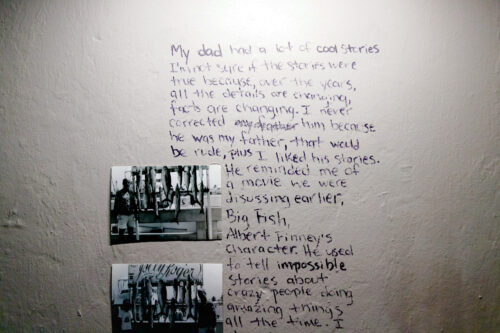
Handwritten stories are on the walls of Victor’s bedroom, along with personal pictures. (Photos courtesy of Scott McIntyre)
The gray walls of the room have text handwritten on them. Photographs are tacked up around them. They are more stories, more of Garcia’s memories, yet they elicit a feeling of a prisoner’s scrawls.
They are part of the culmination of the experience. They are also a theatrical diversion so that as the audience is looking around the room, Garcia can slip out and get ready for the final scene.
He’s ended up outside of the bedroom in the hallway seated in a chair in a shadow box. The group is led out. There’s a red light overhead and the rest of the area is pitch black. He looks like a bluesman, wearing a derby hat, suspenders, a jacket, dress pants, and nice black shoes. It’s time for his final soliloquy.
He talks about the loneliness he suffered after both parents were gone; the feeling of a lack of purpose now that he wasn’t a caregiver. He speaks about the girlfriend who left him. And what everyone could relate to regarding isolation during two years of the pandemic. It’s the final baring of his soul. “The Blues Opera” is an emotional catharsis and a way for him to purge the demon that haunted him, he says, by allowing him to finally bring his darkness into the light.
“The Blues Opera” leaves you wanting more – more of Scotchy’s soul-baring stories and music, more of Adele’s hospitality. By the end of a quick 90 minutes, you and the others have bonded through the parlor games, drinks of whisky, Perrier, Cafecito, and the black-and-white cookies served from what looks like it could have been Sande’s favorite glass-domed cake dish. But especially the time well spent with Eric, Sande and Victor Garcia.
The exit leads to the home’s backyard where there’s a chance to stick around to mingle, grab another drink and hang out for a while. It’s another wise director’s choice. After being immersed in Scotchy’s world, it takes a little time to ease back into reality.
WHAT: Juggerknot Theatre Company’s “The Blues Opera”
WHERE: Location disclosed after ticket purchased. Begins in 1300 block of SW 8th Street, Miami.
WHEN: 7:30 p.m. Thursday, 8 p.m. Friday and Saturday, 4 p.m. Sunday, through June 26
TICKETS: $85
INFO: 786-757-1986, juggerknottheatrecompany.com, or email info@juggerknottheatre.com
ArtburstMiami.com is a nonprofit source of theater, dance, visual arts, music and performing arts news. Sign up for our newsletter and never miss a story.
No posts found
Review: Set almost 100 years ago, M Ensemble’s ‘Alabama Sky’ rings true today
Written By Christine Dolen
May 16, 2022 at 12:54 AM
Jean Hyppolite, Chasity Hart and Chat Atkins in a scene from M Ensemble’s “Blues for an Alabama Sky” at the Sandrell Rivers Theater weekends through May 29. (Photo courtesy of Christa Ingraham)
The characters in Pearl Cleage’s “Blues for an Alabama Sky” are caught somewhere between the creative, hopeful heaven of the Harlem Renaissance and the hellish economic collapse of the Great Depression.
The gay designer, the singer-showgirl, the neighborhood doctor and a family planning crusader aren’t blood relatives. But they have become a kind of family by choice, looking out for each other as they try to navigate the highs and lows of Harlem in 1930. And oh, does Cleage’s play give them plenty to navigate.
Miami’s M Ensemble, the 51-year-old Black theater troupe that is Florida’s oldest continuously producing professional company, first presented “Blues for an Alabama Sky” in the summer of 2001. The play is having its encore production at the Sandrell Rivers Theater in Liberty City.
What no one could have anticipated in scheduling the show is that, not long before the opening, a draft of a Supreme Court opinion striking down Roe v. Wade as settled law would be leaked. The battle over abortion has again become a raging pro-choice/pro-life war, leading to protests throughout the United States. That most volatile of issues figures into “Blues for an Alabama Sky,” giving the play a freshly powerful resonance.
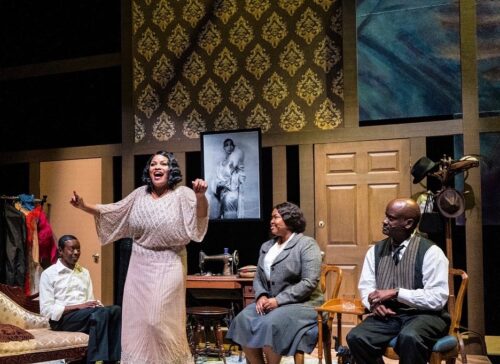
Chat Atkins, Chasity Hart, Sarah Gracel and Keith Wade let the good times roll in M Ensemble’s “Blues for an Alabama Sky.” (Photo courtesy of Christa Ingraham)
Cleage’s tale (which clocks in at just under three hours, not that it needs to be that long) takes place in neighboring Harlem apartments and on the sidewalks outside.
Guy Jacobs (Chat Atkins) and Angel Allen (Chasity Hart), longtime pals who came up from Georgia to conquer the big city, become roommates again. She’s been dumped by her shady Italian boyfriend, leading to a huge public scene and getting the friends both fired from their steady jobs at the Cotton Club.
Guy, an out-and-proud costume designer whose social circle includes poet Langston Hughes, keeps the wolf from the door by making showgirl outfits for local clubs. But his incessant dream, his raison d’être, is to go to Paris and design for the great performer-activist Josephine Baker. Angel? She’s a self-centered beauty with an outsized personality. Fiercely focused on self-preservation, pragmatic when it comes to taking advantage of besotted men, she’s cut from the same cloth as Sally Bowles in “Cabaret.” To say she’s an emotionally erratic combination of hope and disillusionment is an understatement.
Their next-door neighbor is Delia Patterson (Sarah Gracel), a young woman working with birth control pioneer Margaret Sanger to set up a family planning clinic in Harlem. To get the community on board, Delia is trying to gain the support of the dreamy Rev. Adam Clayton Powell Jr. and her fellow worshippers at the Abyssinian Baptist Church.
Both apartments become a refuge for the weary local doctor Sam Thomas (Keith C. Wade), who follows endless hours of delivering babies with imbibing Prohibition hooch or Champagne with his pals, then going out to clubs. Work hard, play hard. Or as Sam is always saying, “Let the good times roll!”
A stranger arrives in the very first scene, pitching in as Guy guides the ferociously drunken, barely ambulatory Angel back to his place. Leland Cunningham (Jean Hyppolite) has left Tuscaloosa, Alabama, mourning the deaths of his wife and newborn son. Like so many Southerners in the Great Migration, he has come north to start over. And after he spies Angel, who looks eerily like his late wife, Leland becomes focused on starting over with her.
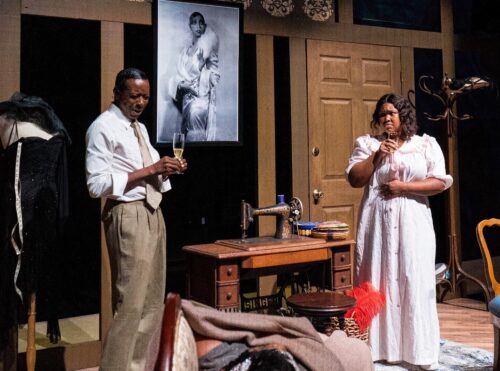
Chat Atkins and Sarah Gracel toast to the future in M Ensemble’s “Blues for an Alabama Sky.” (Photo courtesy of Christa Ingraham)
Cleage, a novelist as well as a prolific playwright, paints a portrait of excess and loss with the evocative images in the play’s dialogue. The homeless in Harlem are “a bunch of sad-eyed souls wondering who pulled the rug out.” Angel wants to flee the shards of her romantic past, Harlem itself and “all those cryin’ colored ghosts.” She is, she says, “tired of Negro dreams.”
Among the issues Cleage explores in “Blues for an Alabama Sky” are women’s body autonomy, homophobia, gun violence and the unending struggle of survival in hard times – all of which make a 1995 play set in 1930 freshly impactful for audiences in 2022.
Director Carey Brianna Hart, who has a long history with M Ensemble and other South Florida companies as an actor, director and stage manager, has drawn fine performances from her talented cast, and her staging of scenes in the two apartments is intimate and effective.
However, timing glitches on opening night slowed the play down. Mitchell Ost’s set looks unfinished, and the “outside” space requires the actors to walk around it on the black-box theater’s barren floor as they pretend to be in bustling Harlem. The uncredited scene-bridging music contributes mightily to the play’s atmosphere, and lighting-projection designer Aatiyah Malik knows how to amplify both a romantic moment and harsh reality. Company founders Patricia E. Williams and Shirley Richardson are part of the production’s design team, Williams with period props and Richardson with costumes (though some of the latter aren’t right for the era).
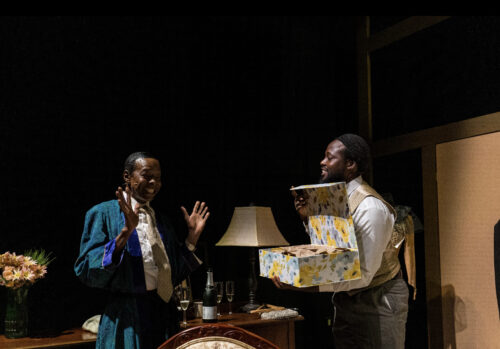
Chat Atkins passes smiling judgment on a gift Jean Hyppolite plans to give the woman he’s wooing in the M Ensemble production of “Blues for an Alabama Sky.” (Photo courtesy of Christa Ingraham)
Two veteran M Ensemble actors give significant, very different performances in the play. Atkins, whose work I’ve observed for years, explores new territory here. He turns his character Guy, a man who has faced racial and sexual orientation bias, and whose dreams are on the cusp of coming true, into a layered and sympathetic figure. Wade conveys Sam’s steadiness, his need for escape from the stress of delivering babies, and his later-in-life experience of falling in love.
Hyppolite has the tough but meaty challenge of playing Leland, a man with traditional conservative values who becomes the villain of the play after his relationship with Angel goes into a tragic spiral. Gracel, a Carbonell Award winner for “Dreamgirls,” offers a quiet contrast to Angel as Delia, a loyal friend and a woman driven to change her community for the better.
Chasity Hart (no relation to the show’s director) gives a sublime, heartbreaking performance as Angel, who has come to yet another messy crossroads in a life full of such moments. She’s complicated yet still surprisingly naïve for a woman who has been repeatedly exploited as she struggles to survive.
Hart gets and communicates all the facets of Angel’s character, whether through Cleage’s words or through emotions that play across her striking face. The New World School of the Arts grad is also a singer, a terrific one, as the audience gets to hear (all too briefly) when Angel sings a bit of W.C. Handy’s “The Saint Louis Blues,” her equivalent of worship on a Sunday morning. Here’s hoping someone will cast her in a musical sooner rather than later.
WHAT: “Blues for an Alabama Sky” by Pearl Cleage
WHERE: M Ensemble production at the Sandrell Rivers Theater, 6103 NW Seventh Ave., Miami
WHEN: 8 p.m. Friday and Saturday, 3 p.m. Sunday, through May 29
TICKETS: $31 (student and senior discounts available at the door)
INFO: 305-200-5043 or themensemble.com
ArtburstMiami.com is a nonprofit source of theater, dance, visual arts, music and performing arts news. Sign up for our newsletter and never miss a story.
No posts found
Review: Smart girl magic turns dark in Zoetic Stage’s ‘Our Dear Dead Drug Lord’
Written By Christine Dolen
May 9, 2022 at 9:29 PM
Gina Fonseca, Mikayla Queeley, Rachel Eddy and Sofia Duemichen try to summon the spirit of Pablo Escobar in Zoetic Stage’s “Our Dear Dead Drug Lord” at the Arsht Center’s Carnival Studio Theater (Photo courtesy of Justin Namon)
Any way you slice it, the path from childhood to adulthood is neither simple nor trouble-free. Evolving teens have to deal with forging an identity, transitioning into independence, and imagining, then becoming, their future selves. Love and loss enter their lives, sometimes in the same situation.
In her off-Broadway hit “Our Dear Dead Drug Lord,” playwright Alexis Scheer, a Miami native now living in Boston, takes audiences on that journey as experienced by four smart, curious, articulate private school girls in their mid-to-late teens.
Zoetic Stage is closing out its season with a new production of the play in the Carnival Studio Theater at Miami’s Arsht Center, and as theatrical experiences go, it’s a doozy.
Co-directed by Zoetic artistic director Stuart Meltzer and Elena Maria Garcia, the genre-defying dark comedy (if you insist on classifying it) weaves plenty of observant laughs into the script, particularly if you happened to live in Miami circa 2008 when the story is set. But it’s also true that the blood rituals and gathering darkness of “Our Dear Dead Drug Lord” are there from the beginning, building steadily toward a horrifying, other-worldly yet transformational final scene.
The Colombian drug lord invoked in the title is the late Pablo Escobar, the infamous founder of the Medellín Cartel. He has become the latest study focus of the Dead Leaders Club (DLC), a school group that, back in the day, focused on President John F. Kennedy and other admired leaders. But the members’ previous choice, Adolf Hitler, got the DLC suspended.
Now, as the Barack Obama-John McCain presidential race is hurtling toward election day, the four girls are meeting in a surprisingly spacious treehouse to strategize and send a little antihero worship Escobar’s way.
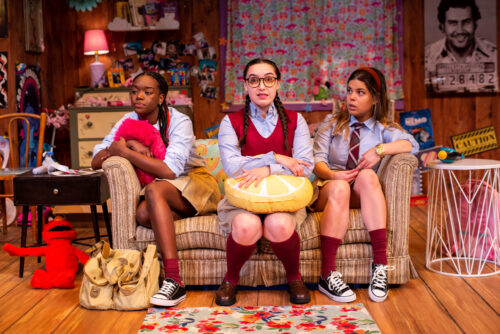
Mikayla Queeley, Rachel Eddy and Sofia Duemichen strategize in Miami native playwright Alexis Scheer’s “Our Dear Dead Drug Lord” at Zoetic Stage. (Photo courtesy of Justin Namon)
Known by the nicknames chosen for them in a revelatory ritual involving a Ouija board, the teens are distinct individuals, each representing a different facet of the Miami melting pot.
Pipe (Sofia Duemichen), the DLC leader and the one who took the club in its more controversial direction, is the daughter of Cuban-American Republicans. She’s domineering, insistent on just-so rituals, ready to out-shout the others if the overlapping talk grows too cacophonous. As she continues to grapple with the drowning death of a younger sister, she’s also struggling with how fully and openly to embrace her sexual orientation.
Squeeze (Mikayla Queeley), a theater kid who’s Haitian on her father’s side and Puerto Rican on her mother’s, is also dealing with tragic family loss – her depressed dad’s death by suicide. And she happens to be highly allergic to cats, a fact that forces Queeley to keep sneezing loudly through much of a first scene that begins in a kind of chaotic excitement and ends in a genuinely disturbing ritual.
Zoom (Rachel Eddy), at 15 and the youngest member of the group, is a Jewish girl with an outsized imagination. She’s the dramatic equivalent of an unreliable narrator, easily influenced, and though she insists she’s a virgin, she thinks she might be pregnant.
Kit (Gina Fonseca), the newest to the fold, is a Colombian-American who never knew her father. The DLC members take up the idea that just maybe she’s the daughter of Escobar and a prostitute. Despite the implications involving her single mom, cool Kit just goes with the flow.
Examining “Our Dear Dead Drug Lord” without giving away its darker twists and surprises is tough, but to do so would rob Zoetic’s audiences of their startling in-the-moment experiences. We will say that two more actors, Rio Chavarro and Tai Fruitstone, appear in the play but we’ll just leave it there.
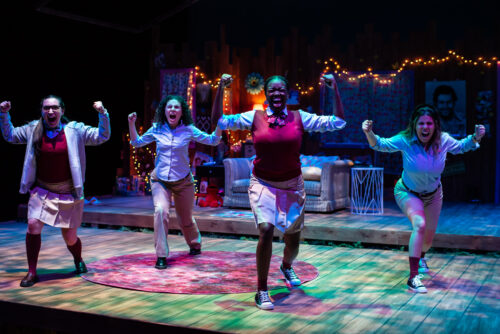
Rachel Eddy, Gina Fonseca, Mikayla Queeley and Sofia Duemichen rehearse a tribute dance in Zoetic Stage’s production of Alexis Scheer’s “Our Dear Dead Drug Lord.” (Photo courtesy of Justin Namon)
For Meltzer, Garcia, and intimacy director Jeni Hacker, staging Scheer’s play was as challenging as performing it is for the actors. The script’s use of overlapping dialogue requires split-second timing, and initially, the aural bombardment is tough to sort out, though the actors soon find a rhythmic groove.
One scene involving a sacrifice is made “real” through sound design and precise placement of the actors. A grisly later scene involves combat and bloody violence, and how the actors pull it off without anyone getting hurt is a minor miracle of staging.
At the playwright’s direction, a key interaction involves Pipe speaking English to another character who challenges her in Spanish, urging her to claim her power. Those lines are translated in the show’s digital program, but if you aren’t bilingual and don’t happen to read the translation before the show, you’ll miss the full impact of those exchanges. And they shouldn’t be missed.
The acting in “Our Dear Dead Drug Lord” is necessarily fearless, and Zoetic’s young cast of college grads etches compelling portraits of girls on the cusp of womanhood.
Initially overbearing, Duemichen makes Pipe a persuasive teen who works overtime to conceal her emotional damage. Queeley, who gets to sing a bit and lead a tribute dance to Squeeze’s father, is a more subtly commanding figure, and the crimson red woven into her braids hints at the violence to come. Eddy, whose Zoom sports little-girl braids, conveys her character’s quicksilver emotions and vulnerability to influence. Fonseca makes Kit a young woman of mystery, as irresistible to the audience as she is to Pipe.
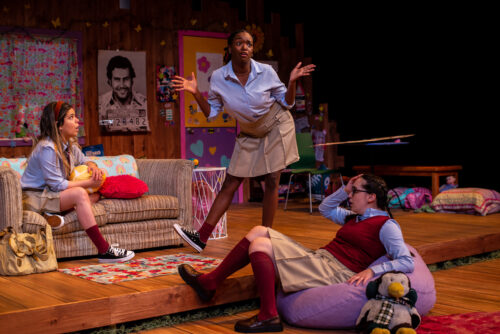
Sofia Duemichen, Mikayla Queeley and Rachel Eddy figure out life and each other in Zoetic Stage’s “Our Dear Dead Drug Lord.” (Photos courtesy of Justin Namon)
Jodi Dellaventura’s imposing treehouse set, a space made a bit cozier by properties designer Miriam Sierra and scenery-props assistant Shannon Veguilla, is a place decorated with flowers, stuffed animals, and an “isn’t-he-dreamy” poster made from Escobar’s mug shot. If you put it on the market today, it would sell in a nanosecond at way over asking price.
Lighting designer Tony Galaska is a wizard at shifting mood or summoning up a storm, as is sound designer Matt Corey, whose judicious use of thundering drums underscores the ritualistic magic to come. Together, Galaska and Corey become key players in creating the disturbing end-of-play magic.
Costume designer Marina Pareja largely works with the pale blue-burgundy-khaki palette of the teens’ school uniforms, but subtle variations in what the girls choose over the play’s four-month period convey individual differences.
If you see “Our Dear Dead Drug Lord,” you may find it deeply resonant, thought-provoking, and very different from Miami’s usual diet of naturalistic theater. Or you might find the storytelling a bit confusing or some key plot points too shocking to bear. But engage with it and you’ll discover a truth: Indifference to this play is impossible.
WHAT: “Our Dear Dead Drug Lord” by Alexis Scheer
WHEN: 7:30 p.m. Thursday-Friday, 3 and 7:30 p.m. Saturday, 3 p.m. Sunday (additional performance 7:30 p.m. May 11, no matinee May 14), through May 22.
WHERE: Zoetic Stage in the Carnival Studio Theater at the Adrienne Arsht Center for the Performing Arts, 1300 Biscayne Blvd., Miami
TICKETS: $55-$60
INFO: 305-949-6722 or arshtcenter.org
(Read the interview with the playwright here.)
ArtburstMiami.com is a nonprofit source of theater, dance, visual arts, music and performing arts news. Sign up for our newsletter and never miss a story.
No posts found
Miami’s Alexis Scheer comes home to see her play in the city that shaped her
Written By Christine Dolen
May 4, 2022 at 4:15 PM
The cast of “Our Dear Dead Drug Lord” at Zoetic Stage through May 22 are, clockwise from top left, Gina Fonseca, Mikayla Queeley, Rachel Eddy and Sofia Duemichen. (Photo courtesy of Justin Namon)
Alexis Scheer is a young, multifaceted theater artist whose resume is already pretty mind-boggling.
The Miami native and New World School of the Arts high school grad is an award-winning playwright with commissions and premieres pending at theaters all over the country. She is a theater company founder (and producer-director), a musical theater performer, a writer on the upcoming HBO Max series “Pretty Little Liars: Original Sin” and is working on an English-language adaptation of the opera “Così fan tutti” with conductor-composer Dan Ryan, her husband of three months.
Just last December, she celebrated her 30th birthday.
“Alexis was a whole other breed,” says Elena Maria García, the Carbonell Award-winning actor-playwright who was Scheer’s acting teacher at New World and who treated her more like an artist-colleague than a student. “She wanted to learn. She was infinite.”
Elena Maria Garcia, who is co-directing Zoetic Stage’s “Our Dear Drug Lord,” and playwright Alexis Scheer reunite at New World in 2014. (Photo courtesy of Alexis Scheer)
Now the Boston-based Scheer is coming home, and not just for a visit. Her hit 2019 Off-Broadway play “Our Dear Dead Drug Lord,” which had its run extended three times before the COVID-19 pandemic hit, is closing out the Zoetic Stage season in the Carnival Studio Theater at Miami’s Arsht Center. The playwright plans to be in the opening night audience with her family.
“I remember when the Arsht Center opened,” says Scheer, who earned a bachelor of fine arts degree in musical theater from the Boston Conservatory and a master’s of fine arts in playwriting from Boston University after graduating from New World in 2010. “It will be the first time I’ve seen one of my plays without being involved in (the production). You write a play as a living document, and you hope it will outlive you.”
Scheer began crafting “Our Dear Dead Drug Lord” after former President Donald Trump’s inauguration left her feeling disenfranchised. She was then in her master’s program studying playwriting with Melinda Lopez, whose “Sonia Flew” was the last show produced by Miami’s Coconut Grove Playhouse before its abrupt shutdown in 2006.
The drug lord of the title is the notorious Pablo Escobar, the late Colombian founder-kingpin of the Medellín Cartel. Daughter of a Colombian immigrant mother and an American Jewish father, Scheer says, “Pablo Escobar was the looming figure in my family’s mythology.”
Escobar, she adds, “is my content warning” to those who see the play.
Set in 2008, “Our Dear Dead Drug Lord” centers on four private school Miami teens – Pipe (Sofia Duemichen), a Cuban-American; Squeeze (Mikayla Queeley), whose parents are from Puerto Rico and Haiti; Kit (Gina Fonseca), a Colombian-American; and Zoom (Rachel Eddy), who’s Jewish – ranging in age from 15 to 18.

The cast of Zoetic Stage’s “Our Dear Dead-Drug Lord.” clockwise from top left, are Gina Fonseca, Mikayla Queeley, Sofia Duemichen, and Rachel Eddy. (Photo by Justin Namon)
Members of a suspended school group called the Dead Leaders Club (choosing Adolf Hitler as a subject went many steps too far), the girls use the names given them by a Ouija board when they meet in a weathered tree house. There they talk about anything and everything: life, politics, their parents, secrets, personal crises, unwanted pregnancy, school, their sexuality, embracing their power and abortion, that hottest of hot-button issues.
Scheer says the treehouse setting likely came in part from Mary Pope Osborne’s “Magic Treehouse” books that she read as a kid, and that she thought about what might be exciting for a set designer to create. She also wanted the space, a place “suspended above the world,” to be different.
“I think of treehouses as a very male space – you know, ‘no girls allowed,’” she says. “So, I wanted to subvert that.”
Co-directed by artistic director Stuart Meltzer and García, both former New World teachers, the Zoetic production came about after Meltzer heard the buzz about the play and asked for the script.
“The humor in it initially struck me. I loved it. It has such wonderful (craftsmanship) in the way the jokes and circumstances are engineered,” says Meltzer, who also responded to the clear musicality of its language and overlapping dialogue. “But then when I read it, it was a complete shock to me at the end.”
“Our Dear Dead Drug Lord” is, he says, a scary coming-of-age play about the moment in time between childhood and adulthood. Ritual and magic are vital to it, as is the shocking conclusion, but Meltzer feels prepared to deal with any blowback.
“At the funeral for (longtime GableStage producing artistic director) Joe Adler, I learned that you can’t win a war if you’re going to limit artistic freedom or freedom of speech,” he says.
The play’s ending, which requires the girls to work some serious magic, is dark and violent. That Scheer would take her story there isn’t so surprising if you know that she’s an admirer of the late British playwright Sarah Kane and that she so loved the 2010 GableStage production of Kane’s shocking “Blasted” that she saw it twice.
“I’d never seen anything like that. It rewired my brain,” she says. “The theater is a place where we can touch on the dark underbelly of humanity. It’s a safe space to do that. It provides catharsis.”
The young actors in Zoetic’s cast appreciate that García and intimacy director-combat coordinator Jeni Hacker have been working with them on the harrowing final scene, taking them “step by step and moment by moment,” as García describes it.
“Having women guide us has been incredibly helpful,” says Eddy, who graduated from the University of Miami. “There has been lots of checking in with us. It’s being handled with the gravity of what the situation is.”
Says Duemichen, who counted Meltzer and García among her New World high school teachers, “This play is by a woman for women. It shows the depths of female friendships…I know (girls like the characters) Squeeze. I went to school with Pipe. We all know Zoom . . . Setting the play in 2008 gets you thinking about culture and politics then, about the unrest over the election of the first Black president. It feels a bit like a boiling point.”
Now based in New York, Miami native Fonseca was part of the magnet program at South Miami Middle School, as was Scheer, though the women attended at different times.
“I love Alexis’s writing,” the actor says. “It’s dark, genuine, heartwarming and dynamic. It’s a gift to play such complex female characters, and each is unique.”
Queeley, who earned her bachelor of fine arts degree from New World, appreciates the way Scheer so thoroughly evokes place and time in the play.
“Definitely, this is 2008 Miami – the language, the wittiness, the jokes, the banter,” she says. “There are not a lot of places that talk the way we do in Miami. Everything we say has meaning to it . . . She really brings the outside world into this treehouse.”

Playwright and Miami native Alexis Scheer,
the author of “Our Dear Dead Drug Lord,” produced by Zoetic Stage in the Carnival Studio Theater at the Arsht Center through May 22. (Photo courtesy of Gabrielle Carrubba)
As a kid, Scheer spent time working in her parents’ Wynwood button factory and singing with the Musical Miracles at Actors’ Playhouse. At New World, she bought into the ethos of artists creating their own work, then kept right on going.
After her check-in with the city that first forged her as an artist – “a place unlike anywhere else in this country,” she says – Scheer will return to juggling myriad projects.
Her play “Laughing in Spanish,” set in a Wynwood gallery, will get its world premiere at the Denver Center Jan. 27 through March 12, 2023. She’s working on commissions from Miami New Drama, Second Stage and other companies. She and composer-lyricist Zoey Sarnak will premiere their commission musical “Shook,” about high school theater kids at a Shakespeare Festival, Sept. 23 through Oct. 23 at Northern Stage in White River Junction, Vermont. She’s also developing another project with HBO Max and Salma Hayek’s production company Ventanarosa.
Scheer remains devoted to “telling stories about women, Latinas, young people. I hope people will go see this show. I’m hopeful for the future.”
She then observes, “This is a Latinx play, but not in the way you’d assume or expect. Latinx theater is not a monolith. I’m happy to carry Miami’s banner all over the world.”
WHAT: “Our Dear Dead Drug Lord” by Alexis Scheer
WHERE: Zoetic Stage production in the Carnival Studio Theater at the Adrienne Arsht Center for the Performing Arts, 1300 Biscayne Blvd., Miami
WHEN: Previews 7:30 p.m. May 5, opens 7:30 p.m. May 6; 7:30 p.m. Thursday-Friday, 3 and 7:30 p.m. Saturday, 3 p.m. Sunday (additional performance 7:30 p.m. May 11, no matinee May 14), through May 22
COST: $55-$60
INFORMATION: 305-949-6722 or arshtcenter.org
ArtburstMiami.com is a nonprofit source of theater, dance, visual arts, music and performing arts news. Sign up for our newsletter and never miss a story.
No posts found
Review: ‘The Cuban Vote’ at Miami New Drama captures essence of local – Miami politics, people and places
Written By Christine Dolen
May 3, 2022 at 2:29 PM
Jonathan Nichols-Navarro and Carmen Pelaez debate the issues in the world premiere of her play “The Cuban Vote.” (Photo courtesy of Stian Roenning)
A fight-to-the-finish Miami-Dade mayoral campaign meets gentle romance, a bit of Shakespearean inspiration and lots of affectionate satire in “The Cuban Vote” by Carmen Peláez.
Commissioned by Miami New Drama, the comedy is getting its world premiere and generating abundant laughs at the Colony Theatre on Lincoln Road. At the same time, the play is another key building block in co-founder/artistic director Michel Hausmann’s mission of creating theater that reflects and speaks to Miami’s diverse communities.
Staged by former Miamian Loretta Greco, who was recently named the first woman artistic director at Boston’s 40-year-old Huntington Theatre, “The Cuban Vote” stars author-actor Peláez as Carolina Clarens, a passionate, brainy, often unfiltered candidate for Miami-Dade mayor.
In her third Miami New Drama world premiere, the playwright (who has worked on many local and national political campaigns) got boisterous entrance applause from an opening-night crowd filled with actual Miami-Dade politicians – who then proceeded to laugh and nod knowingly at Peláez’s inside-béisbol take on their world as the comedy unfolded.
The story in brief: Despite Carolina’s solid experience working with her late father, a former Miami-Dade mayor, her poll numbers are faltering, thanks in part to an easily ignited temper and her refusal to reframe any of her messages in a less confrontational way.
Two family political advisers, her elegant mother Ofelia (Evelyn Perez) and influencer kid sister Blanca (Marcela Paguaga), keep offering disregarded suggestions. So, Blanca’s fiancé, aspiring bitcoin bro Benji Carbonell (Kristian Bikic), sends for the cavalry.
That polished political knight is an old Miami friend, Alex Mesa (Andhy Mendez), now a sought-after Washington D.C. consultant with an unblemished track record. He’s both savvy and dreamy, and it isn’t long before the initially testy Carolina starts to soften, though she keeps on fighting hard for her vision of a more progressive, caring Miami.
After her chief opponent drops out of the race, the final puzzle piece slips into place. In a move patterned after the Christopher Sly prank at the beginning of William Shakespeare’s “The Taming of the Shrew,” Alex and Benji recruit barfly Gilberto Ruiz (Jonathan Nichols-Navarro) to run against Carolina, certain that the guayabera-sporting, slogan-spouting viejo will be easy to beat. Pero eso no es verdad.
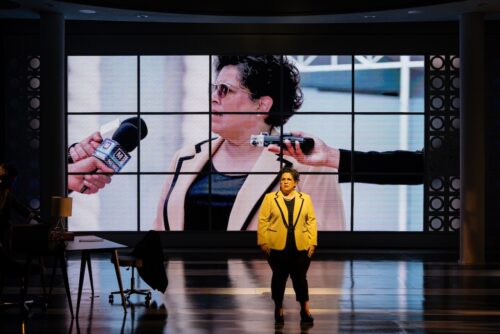
Carmen Pelaez hits the campaign trail in the Miami New Drama world premiere of her play “The Cuban Vote.” (Photo courtesy of Stian Roenning)
As delivered by Peláez, Greco and company, “The Cuban Vote” is both rollicking satire and a resonant, well-informed cautionary tale. The comedy underscores the fact that Miami-Dade’s vast Cuban-American voting bloc is not a monolith, neither purely red nor blue, but a group that includes traditionalists, progressives and everyone in between.
As this is a play about a campaign, debates, interviews and speeches are part of the package, and sometimes the rhetoric slows the momentum. Some surgical trimming could keep the production, which runs about an hour and 45 minutes with no intermission, hurtling along in a more consistently engaging way.
Among its myriad topics, the script also takes on disinformation-dealing Spanish radio talk hosts, the privilege enjoyed by wealthy men whose belief systems were forged in Miami’s pricey private schools, and the sizeism that imagines larger people are somehow inferior or less deserving of happiness than others. To wit:
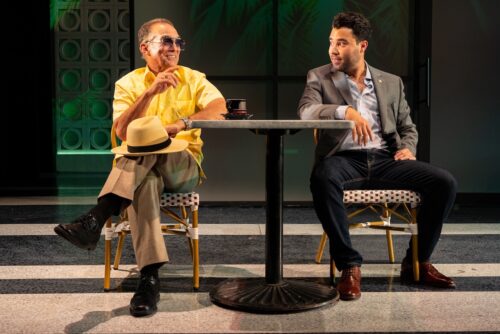
Jonathan Nichols-Navarro and Andhy Mendez talk politics in the Miami New Drama world premiere of “The Cuban Vote.” (Photo courtesy of Stian Roenning)
In their final debate, Gilberto finishes his answer to a question about climate change by saying, “Let the seas rise. I float! [To Carolina] Especially you, gorda!”
Painful though common as that barb may be in Carolina’s life, as the playwright, Peláez has crafted a more-than-worthy opponent in Gilberto Ruiz. From the moment that he transforms from barely sentient drunk into a persuasive politician with a manufactured back story, Nichols-Navarro owns the stage every time he’s on it.
Slender though the actor may be, his Gilberto is a type, a man who fills any room with his outsized personality, his declarations that Carolina’s ideas smack of comunismo or socialismo, his dated aviator glasses and toothy grin and fat hand-rolled cigar. His performance is, plain and simple, a comic treasure.
As Carolina, Peláez has a great deal to shoulder, including extensive dialogue. She must delineate the many issues that drive the candidate while transforming from a woman who habitually lives inside a protective emotional shell into someone open to romance. The political content proves to be her strong suit, the budding romance not so much.
But for the latter, she has a wonderful scene partner in Mendez as Alex, who is as surprised as Carolina when he starts falling for his client. An accomplished Miami actor with significant theater, film and television credits, Mendez comes across as genuine and sympathetic, and his playfulness in the Carolina-Alex relationship helps build an affectionate bond.
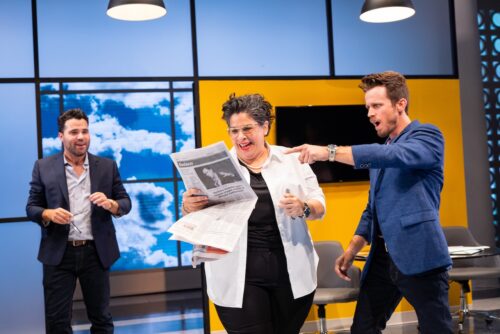
Andhy Mendez, Carmen Pelaez and Kristian Bikic exult over an endorsement in the Miami New Drama world premiere of “The Cuban Vote.” (Photo courtesy of Stian Roenning)
Also eminently believable is Perez as Ofelia. Costume designer Alex Jaeger has made the woman with the elegant blonde updo look perpetually chic, and the actor persuasively conveys the career sacrifices that she, a highly educated woman, made to further her family’s success. She’s also a master at getting her difficult daughter’s attention when she barks a genteel “Carolina Maria!” at precisely the right moment.
Benji and Blanca are young, striving Miami types, and Bikic and Paguaga play them as such. Bikic’s Benji, whose actions, attire and styling scream “notice me!,” is generally the loudest and most intrusive guy in any room. Paguaga’s attractive Blanca, sincerely dedicated to helping her sister become mayor, is an influencer as stereotype, a woman who lives for coupling a hashtag to just about any phrase.
The high-level storytelling in “The Cuban Vote” would literally (to borrow one of Blanca’s favorite words) not be possible without the production’s design team, particularly the collaboration of scenic designer brothers Christopher and Justin Swader and projection designer Yuki Izumihara.
They are magicians, summoning to the Colony stage everything from the iconic elements of Little Havana to the hanging gardens at the Pérez Art Museum Miami. Together with composer and sound designer Obadiah Eaves, lighting designer Mary Ellen Stebbins and costume designer Jaeger they bring fast-moving 21st century Miami to life. Watch, for instance, as the two candidates frantically work the final hours before the polls open – that’s some genius staging, for sure – and consider how many artists brought that moment to life.
“The Cuban Vote” is written in English, but as in Miami itself, plenty of Spanish mixes and mingles with the dialogue, sometimes within the same sentence. Will you grasp the most if you’re fully bilingual? Sure, but Peláez skillfully contextualizes everything so that understanding is seldom a problem. Ditto with whether you happen to live in Miami-Dade or recognize every reference in the script. The play speaks to its intended audience – and to anyone else who cares to listen and laugh.
WHAT: “The Cuban Vote” by Carmen Pelaez
WHEN: 8 p.m. Friday-Saturday, 3 p.m. Sunday (additional 8 p.m. performances May 5 and May 12), through May 15
WHERE: Miami New Drama at the Colony Theatre, 1040 Lincoln Rd., Miami Beach.
COST: $51.50-$71.50
INFORMATION: 305-674-1040; colonymb.org
ArtburstMiami.com is a nonprofit source of theater, dance, visual arts, music and performing arts news. Sign up for our newsletter and never miss a story.
No posts found
Review: GableStage’s ‘Boca’ looks at late life with poignant affection
Written By Christine Dolen
April 25, 2022 at 6:41 PM
The characters played by Avi Hoffman (left) and Robert Zukerman sing as they wait for their cars in Jessica Provenz’s “Boca.” (Photo/Magnus Stark)
As bad news bombards us 24/7, perhaps Jessica Provenz’s “Boca” is the play we need right now.
Getting a significant second production at GableStage after its world premiere last summer at Barrington Stage in Massachusetts, this comedy about retirees in an over-55 Boca Raton condo community is resonant, playful and poignant.
If you happen to belong to the demographic represented by its characters, you’ll likely laugh harder. But the longing for love, the intricacies of friendships, the ability to survive and thrive after loss? Those themes touch everyone sooner or later.
Illuminatingly directed by Julianne Boyd, the Barrington Stage artistic director who helmed the play’s premiere, “Boca” is a collection of 10 short related scenes about life at Boca Oasis, a luxury condo development where the grass is literally always greener (and never more than a maximum 3 inches in height).
Five actors play 11 characters, giving the performers a chance to display their versatility, which they do. Style-reflecting costume changes and different wigs for the women help, but the transformations come from the actors altering their voices and physicality – a challenge for the actors and fun for the audience to watch.
A recurring situation begins the 85-minute play, as Mo (Avi Hoffman) and Marty (Robert Zukerman) sit on a bench outside the clubhouse waiting for the valet, Sergio, to bring Mo’s Tesla and Marty’s saffron-colored Porsche. The men razz each other, as guys do, and talk about their lengthy marriages. Mo is about to celebrate 48 years of wedded bliss to the sometimes-cranky Iris (Deborah Kondelik), and he has come up with a sentimental if decidedly odd gift to mark the occasion. Marty, who complains that he’s in a 45-year “spite marriage,” likens his ultra-disciplined wife Deann (Beverly Blanchette) to “Satan on a Peloton bike.”
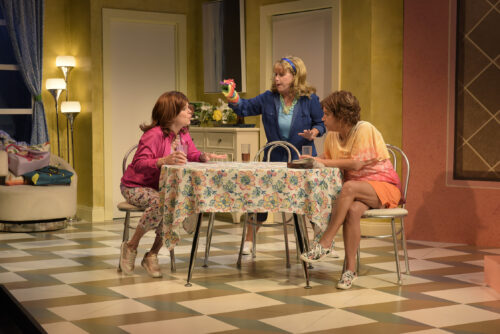
(l-r): Deborah Kondelik, Beverly Blanchette and Barbara Bonilla gather for an important talk in GableStage’s “Boca.” (Photo/Magnus Stark)
Over in one of the condos, friends Susan (Blanchette), Janet (Kondelik) and Elaine (Barbara Bonilla) have gathered for a post-pickleball hangout. Janet is a three-time widow, Elaine a divorcee, and one of their debates involves the proper waiting period before going after a widower – used to be three months, now it’s two. Whenever the conversation gets too chaotic, former kindergarten teacher Susan puts on a sock puppet named Mr. Noodle to demand their attention in a goofy voice. She has a far more important matter to discuss, one involving her attractive podiatrist husband, Robbie (Zukerman), and a poker game.
A condo board Zoom meeting is, as anyone who tried to do business during the height of the COVID-19 pandemic would attest, a glitch-filled ordeal.
Janet lets everyone into the meeting: dictatorial board president Deann, fiercely breaking a sweat on her exercise bike; Stan (Zukerman), trembling as he holds something wrapped in a plaid blanket to his chest; and Bruce (Hoffman), the widower of the moment at the Oasis. Topics range from the mundane (what color to paint the pickleball courts) to the power politics of the upcoming board election to the deadly serious (just why is the Boca Oasis grass so green?).
In Mo’s beloved Tesla, an annoyed Iris and her latter-day hippie pal Louise (Bonilla) are stuck in Boca’s perpetually hideous traffic. A missed turn leads to a seized opportunity – why not hit the road ala Thelma and Louise? And they do.
We watch as Susan tends to her all-blue garden; Mo worries to Marty about Iris’ absence; and Susan makes a campaign speech about the importance of friendship and community as she attempts to unseat Deann.
Then comes what is arguably the play’s best scene, “Stay, Please.” Bruce returns from yet another date to find Elaine in his condo, her signature lasagna and a fine Merlot at the ready, romance on her mind.
She points out that there are 400 women living at Boca Oasis and just 105 men, only 22 of them single (and some of those are gay or weird). Bruce is, she says, “fresh meat.” But when he tries to put her off, Elaine demonstrates that “no” isn’t an answer she’s prepared to accept.
The final major scene in “Boca” is a dinner party that devolves into door-slamming farce.
Hoffman and Kondelik do quick changes so they appear in both of the roles each one plays – he as Bruce and Mo, she as Janet and Iris. Robbie is the host, though he keeps disappearing into the bedroom to tend to Susan, sick in bed with a killer migraine.

From left, Louise (Barbara Bonilla) and her pal, Iris (Deborah Kondelik) hit the road together. (Photo/Magnus Stark)
Everyone can’t help noticing how freezing cold it is in the condo – Elaine borrows Susan’s winter wear – and as it turns out, there’s a reason Robbie has turned the thermostat way, way down. But you’ll have to see “Boca” to find out what that reason is.
The seasoned “Boca” cast delivers, even in the moments when the material is so-so, which it sometimes is.
Kondelik has a tougher time making much of the sweet-though-bland Janet, but her fiery Iris is totally believable as a woman whose conversational arsenal includes many an f-bomb.
Blanchette is likable and nurturing as Susan – though the puppet bit Provenz has devised for her is, sorry, ridiculous – and as Deann, she’s as hard as the character’s toned body.
Bonilla, a New York and regional theater actor who is making her stage debut in the state she now calls home, gets every comedic flourish wielded by ex-New Yorker Elaine just right. She’s a goofy caricature of an older New Age gal as Louise, but that’s the way Provenz has written the character.
Hoffman has a big, affable personality as Mo and a more restrained one as Bruce, playing wonderfully off Bonilla’s Elaine. Zukerman, who was in the original Barrington production of “Boca,” is a terrifically versatile actor, absolutely different as he becomes Marty, then Robbie, then Stan.
Longtime GableStage designer Lyle Baskin created the set, fitting a pair of condos on either side of the central area where Mo and Marty await their cars, and Iris and Louise take off on their extended road trip. The yellow and blue condos, decorated by Clara Fath, are true to form for an upscale 55+ community. That central area and Mo’s “Tesla,” however, are cartoonishly at odds with the condos.
Lighting designer Barbara Samuels, costume designer Camilla Haith, and music and sound designer Alexander Sovronsky effectively bring the other aspects of “Boca” to life, with Haith getting the casual Florida resort vibe just right.
Although GableStage has presented comedies and farces during its long history, the company’s usual fare has been edgier, grittier, more seriously topical. “Boca” is more like something mentioned multiple times in the play: Stevia, the sweetener the clubhouse restaurant just can’t seem to keep in stock.
Provenz’s play is a sweet contemplation of the issues and concerns that mark the autumn and winter of life. Whether you’re at that stage or not, “Boca” is likely to make you laugh.
WHAT: “Boca” by Jessica Provenz
WHEN: 2 p.m. and 7 p.m. Wednesdays, 7 p.m. Thursdays, 8 p.m. Fridays, 2 p.m. and 8 p.m. Saturdays, 2 p.m. Sundays, through May 22, 2022
WHERE: GableStage in The Biltmore Hotel, 1200 Anastasia Ave., Coral Gables; streaming tickets also available
COST: $35-$65
Cost: $35-$65 (ticket discounts available for students, groups, artists, military personnel, veterans and Biltmore staff members)
INFORMATION: 305-445-1119; gablestage.org/boca
To read Christine Dolen’s preview for “Boca,” click here.
ArtburstMiami.com is a nonprofit source of theater, dance, visual arts, music and performing arts news. Sign up for our newsletter and never miss a story.
No posts found


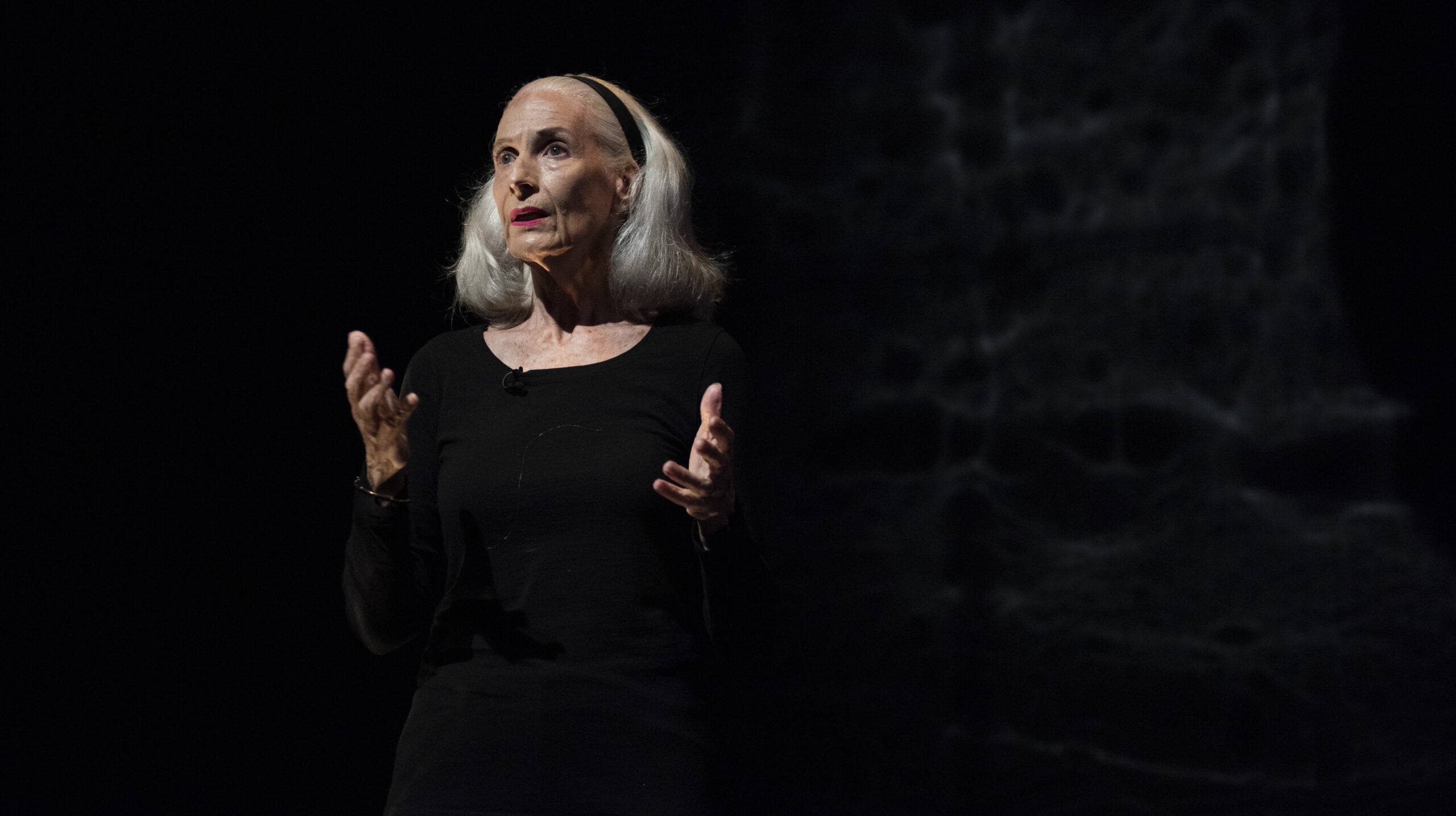
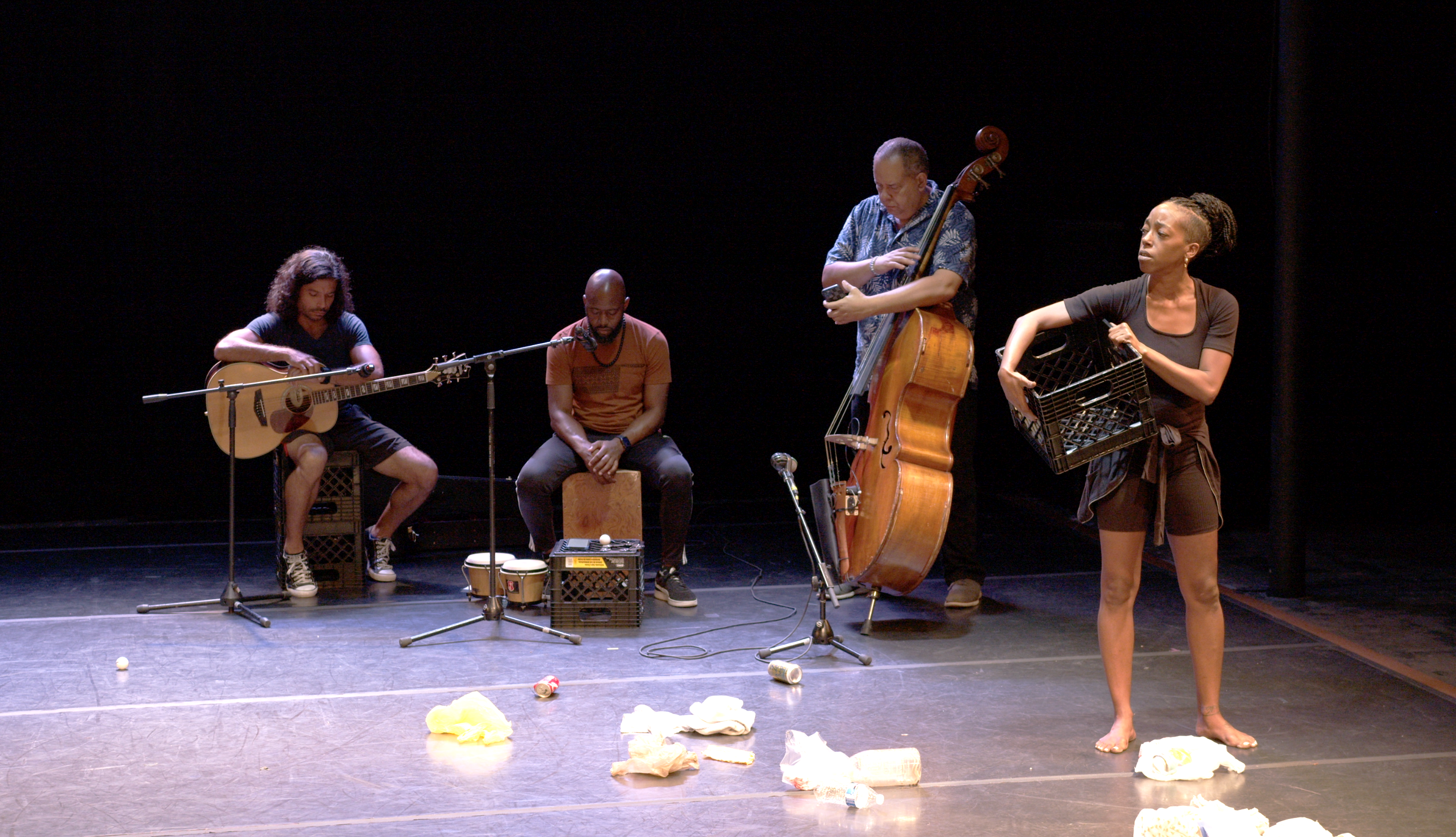
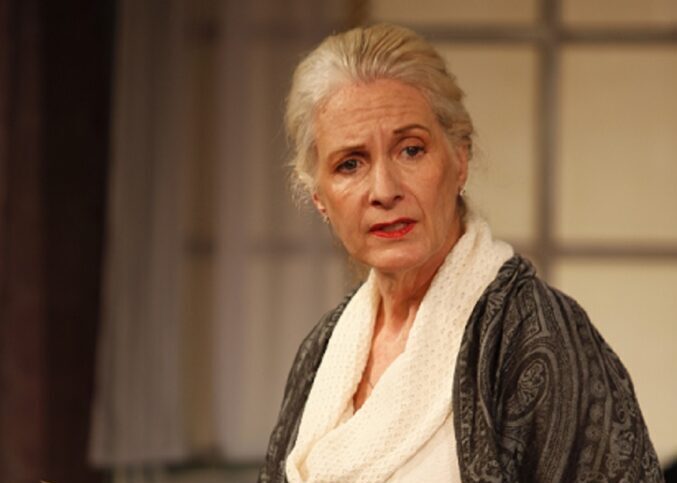

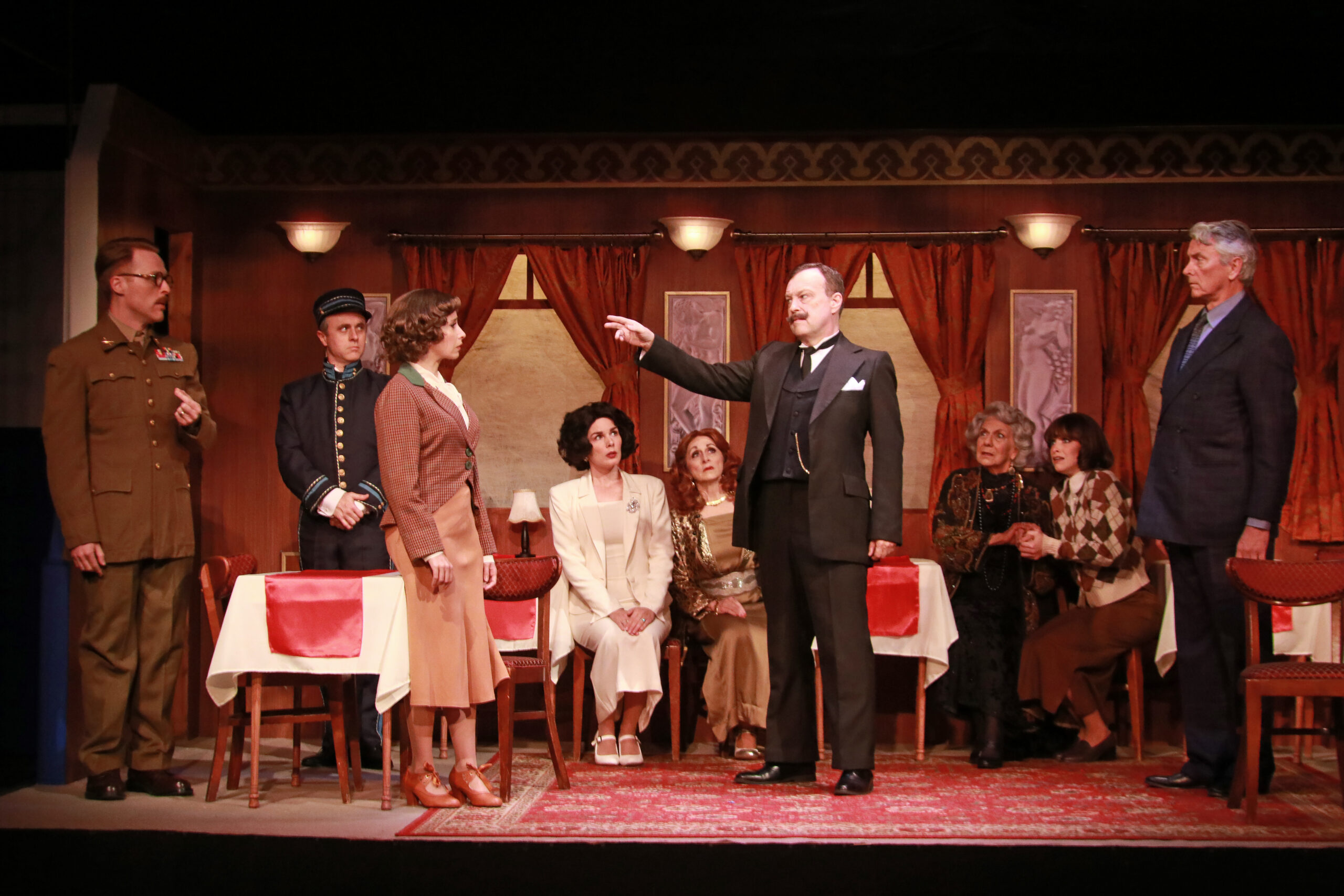

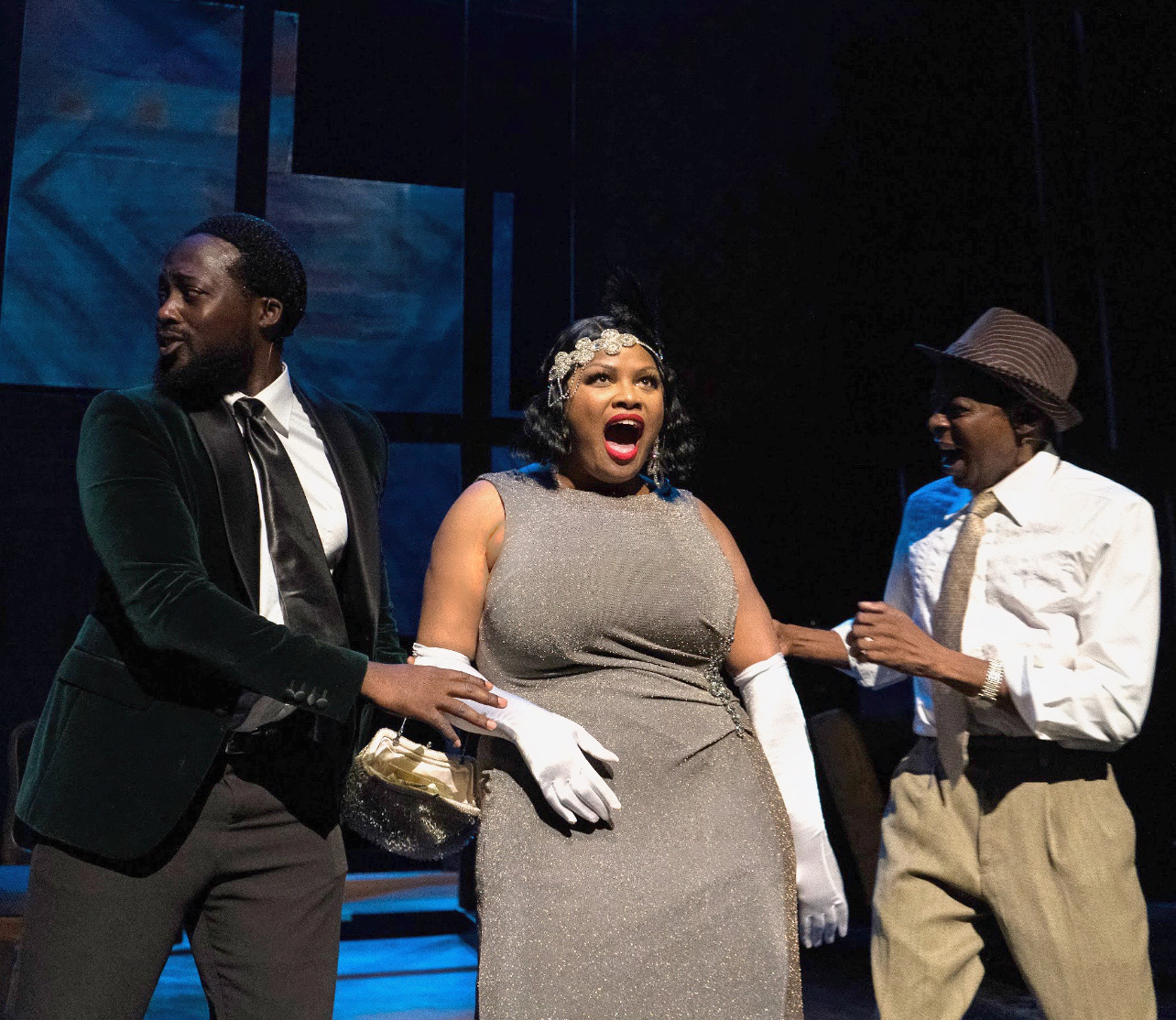
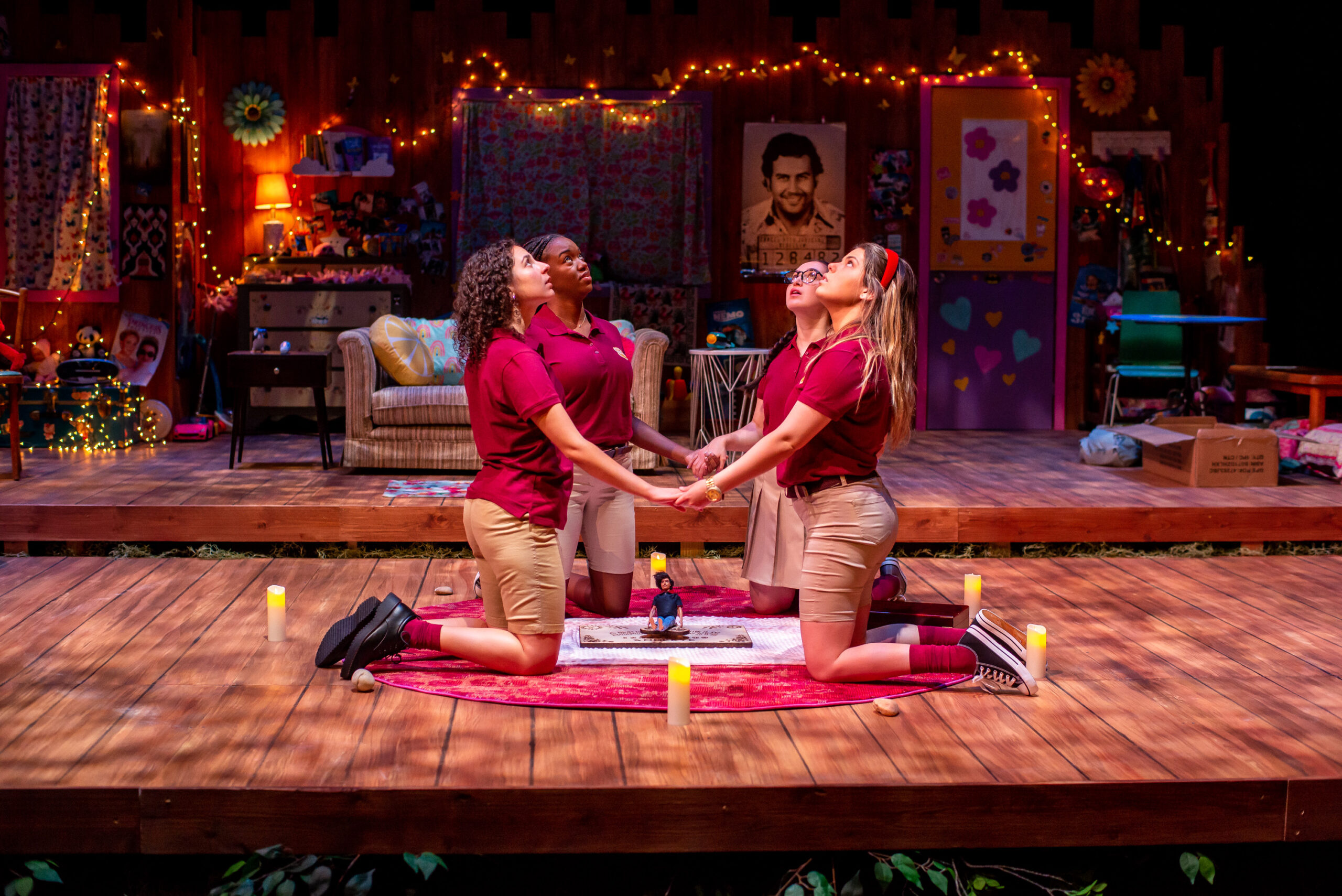
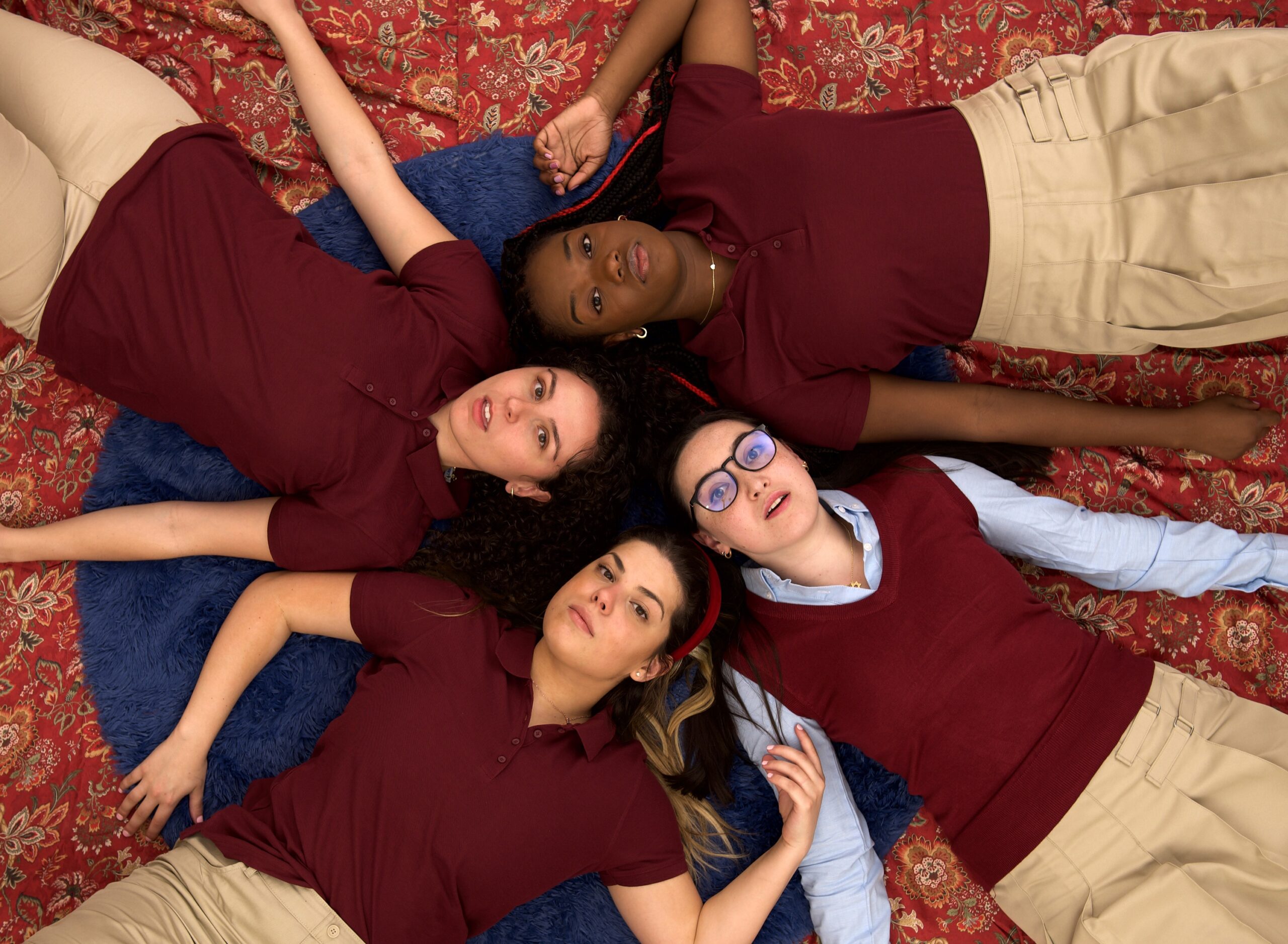
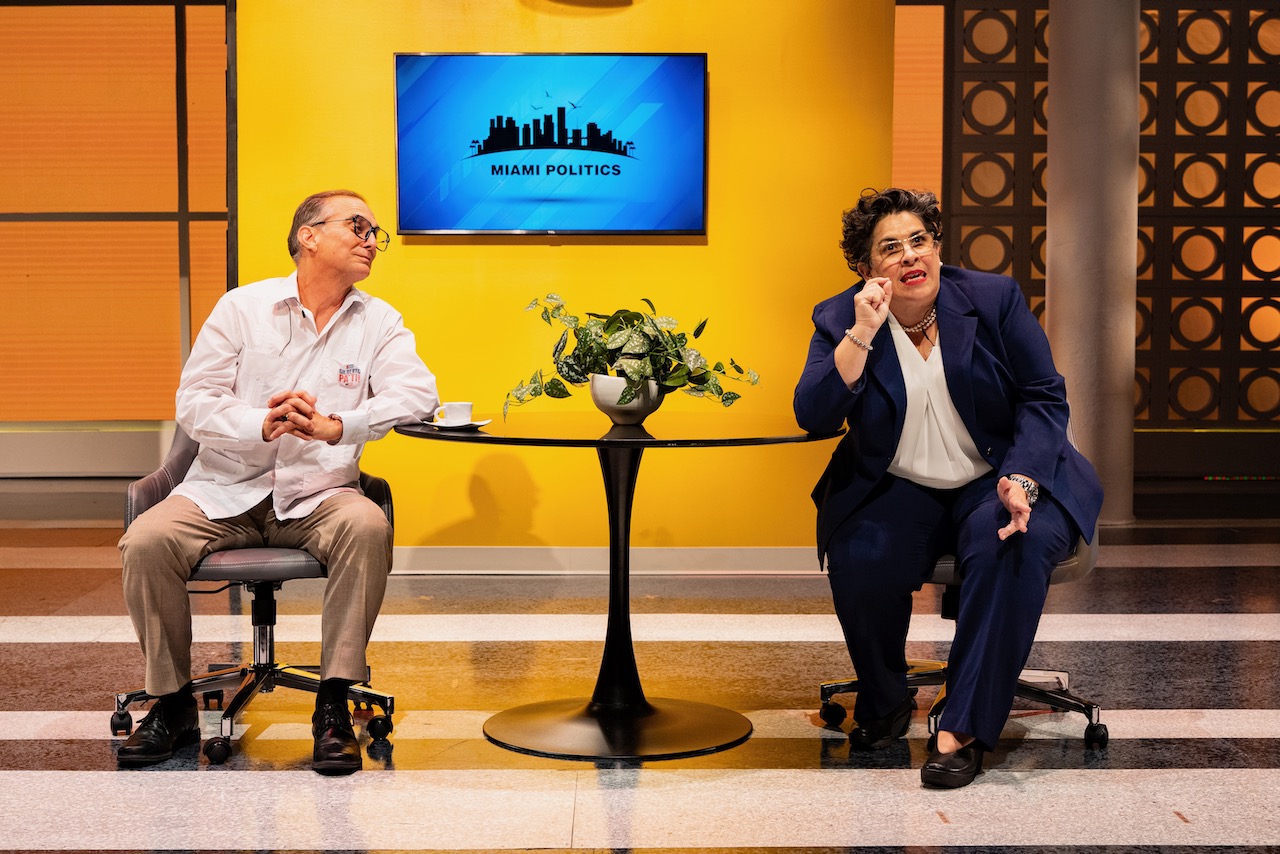
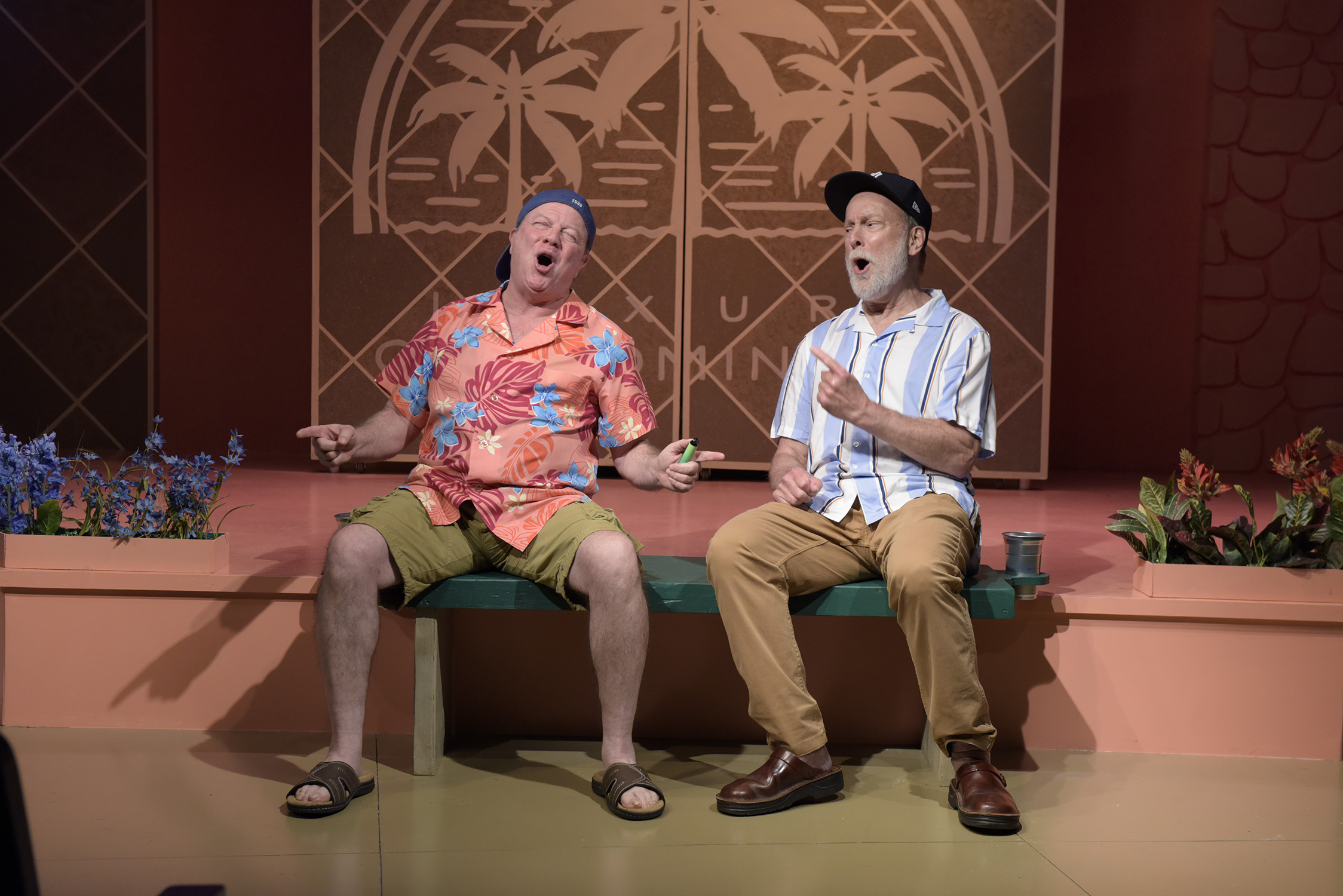
Recent Comments