FGO’s ‘Agrippina’ takes Handel’s Baroque opera in whole new direction
Written By Michelle F. Solomon May 11, 2022 at 5:26 PM
Christine Lyons is Agrippina, one of opera’s fiercest characters, in FGO’s production of the George Frideric Handel opera at the Miami Scottish Rite Temple. (Photo courtesy of Catherine Largo)
While Florida Grand Opera had plans to stage George Frideric Handel’s “Agrippina” as the finale of its 80th anniversary season, it was the location selected for the performances that ultimately shaped the production.
“Agrippina” is on stage at the Miami Scottish Rite Temple opening Saturday, May 14 through Thursday, May 19.
The notion of taking opera out of the grand prosceniums and into smaller spaces had been done before, but during the pandemic when the opera wanted to keep performing and the big halls were shut down, the idea came fully to the fore. Susan T. Danis, FGO’s general director and CEO, decided to stick with it when the larger theaters started re-opening.
While its bigger shows remain in the usual large spaces at the Adrienne Arsht Center in Miami and the Broward Center for the Performing Arts in Fort Lauderdale, Danis says there is opportunity for audiences in bringing shows to different places. The smaller venues may be less intimidating for those who aren’t sure they’ll like opera. Plus, audiences may find that an alternative space is closer to where they live. For her company, its artistic and production staff, Danis says it is a chance for them to be pushed in a different direction creatively.
“It may not look as big and grand, but the outcome and the art are in a different league,” she says.
Her idea for the Baroque era “Agrippina,” which is set in ancient Rome, tells the story of the manipulative wife of emperor Claudius who wants to secure the throne of the Roman Empire for her son, Nero, was to place FGO’s production in the 1800s. “The Regency era, a la Netflix’s series ‘Bridgerton,’ ” Danis explains.
FGO studio artist bass-baritone Christopher Humbert in costume for his role of Pallante in “Agrippina.” (Photo courtesy of Catherine Largo)
She and director Jeffrey Marc Buchman had discussions about creating an environment in the 800-seat Scottish Rite Temple auditorium where the audience would feel as if they were sitting in a 19th century theater. But then, Buchman says when he stepped inside and became immersed, an entirely new concept began for FGO’s “Agrippina.”
“When I walked (throughout) the space, it resonated like the Hollywood movie set stages of the early 1930s. On the back of the Scottish Rite stage, there was this whole rack of painted backdrops; some of them were hanging in the air,” Buchman says. “So, our production of ‘Agrippina’ will occur during the golden years of Hollywood filmmaking.”
He references American director Cecil B. DeMille directing “Cleopatra” whose story setting is 48 B.C. – DeMille on a Hollywood soundstage in 1934. “That will be the look,” he says.
Buchman’s “concept” production will re-create a 1930s Hollywood soundstage where a production company is filming the opera “Agrippina.” The painted early 20th-century backdrops from the Scottish Rite’s collection will be used as part of the “Agrippina” stage setting.
The backdrops at the Miami Scottish Rite Temple convinced director Jeffrey Marc Buckman to create the production around the aesthetic of the theater. (Photo courtesy of Florida Grand Opera)
Miami’s Scottish Rite was completed in 1924. It was four years later that Hollywood would debut its first “all-talking” film, “Lights of New York” by Warner Bros. Pictures.
“When you enter the space, you are as much engulfed in the Scottish Rite design as you are with what will be the production,” Danis says.
Danis says “Agrippina,” with all its comedy and drama, lends itself to the idea of a play-within-a-play type concept, or in this case an opera-within-a-film. In fact, New York’s Metropolitan Opera took a different spin on “Agrippina” in its 2019-2020 season placing the Baroque black comedy in the present day, full of power games and sexual politics.
“With the right spin, it can be very telenovela-esque, for sure,” Danis says. Buchman couldn’t agree more: “(Our ‘Agrippina’) takes all of the heart of Handel’s opera, all of the venom, all of the comedy and the drama that he has put together and we embrace all of that in this production.”
Its concept will capture the elegance of over-the-top Hollywood personalities. He told his artists to “bring their biggest personalities” to the opera –Agrippina will be a quintessential Hollywood diva.
He sets the stage for what the audience can expect. “We will see the cast in a variety of situations on set. Sometimes rehearsing a scene, sometimes having their make-up touched up. There will be times where the actors are ‘rehearsing’ the opera and then go into filming,” Buchman says.
Through all the theatrics, however, Handel’s music will not be understated. Jeri Lynne Johnson, appearing with FGO through Opera America’s 2022 Grant for Women Stage Directors and Conductors, will be at the podium. The barrier-breaking conductor, founder, and director of Philadelphia’s Black Pearl Chamber Orchestra, made history as the first African-American woman to win an international conducting prize while still a student at the University of Chicago. Opera America’s initiative is to encourage the hiring of women in key artistic roles.
She says that the initiative is important to her on many levels, but it isn’t merely about representation. “This is about empowering women at the highest levels. Not just having their presence somewhere on stage. “Women in positions of authority within the productions and that itself is rare and it is becoming more common, thankfully.”
Maestra Jeri Lynne Johnson is conductor for “Agrippina” as part of FGO’s Opera America 2022 Opera Grant for Women Stage Directors and Conductors. (Photo courtesy of the artist)
For Johnson, who had dreamt of being a conductor since the age of 7 when she saw her first Beethoven symphony, it’s about what she can bring to the production.
“In full disclosure, I was not a huge fan of Baroque opera before I started preparing and studying for this performance. But once I started looking through the lens as an academic musician – music history and theory, form and structure – I fell in love with Handel’s work.
Johnson’s orchestra for “Agrippina” will be in the Scottish Rite’s small pit and made up of only four violins, a viola, a cello, two oboes, two flues, two trumpets, and a bassoon. In Baroque music, there must be a theorbo, which is a large bass lute, and a harpsichord.
“Those instruments will give us an opportunity to ‘color the text,’ ” says Johnson, adding that Handel’s score is nothing short of “amazing.”
Handel wrote “Agrippina,” his second opera, while in Italy with the first performance taking place in Venice during the winter carnival season of 1709. Cardinal Vincenzo Grimani, whose family owned the theater, wrote the libretto expressly for Handel.
” ‘Agrippina’ is a story of the love of power and the power of love depending on which characters’ point of view we are talking about. We will tell this story with lots of heart, great intensity, and we will take the audience on a wonderfully, farcical comic ride,” Buchman says.
WHAT: Florida Grand Opera’s “Agrippina”
WHEN: 7 p.m., Saturday, May 14, 2 p.m. Sunday, May 15, and 8 p.m., Tuesday, May 17 and Thursday, May 19.
TICKETS: $16, $29, $44, $72, $89, $101, $155, and $179. Also, Free shuttle service for Fort Lauderdale ticketholders from Broward Boulevard Tri-Rail Park and Ride, 216 N.W. 22nd Ave., Fort Lauderdale. Service is free but must be reserved at fgo.org. Only for Saturday, May 14 and Sunday, May 15 performances.
Story of Haiti’s rebel radio station told through performance at Miami Theater Center
Written By Jonel Juste May 6, 2022 at 11:34 AM
Leyla McCalla at a dress rehearsal of “Breaking the Thermometer to Hide the Fever” in Durham, N.C., in 2020. McCalla is bringing the work, co-commissioned by Live Arts Miami, to Miami Theater Center, Friday, May 6. (Photo courtesy of Alex Boerner)
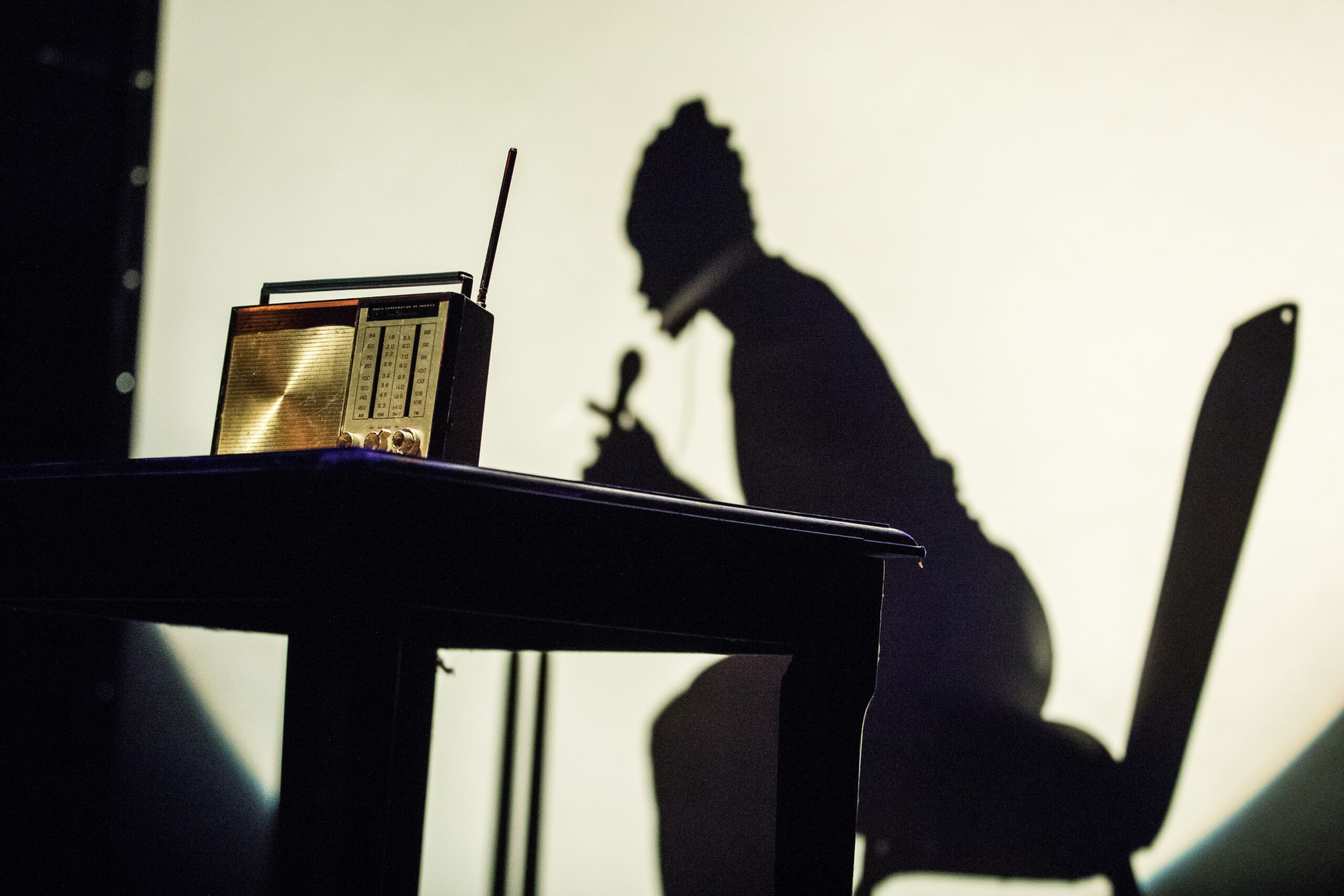
Haitian-American singer Leyla McCalla unveils “Breaking the Thermometer to Hide the Fever,” a multi-disciplinary work about Haiti’s iconic radio station, Radio Haiti-Inter.
The performance is Friday, May 6, at the Miami Theater Center in Miami Shores, and the work was co-commissioned by Live Arts Miami and Duke University, as part of Haitian Heritage Month celebrations in May.
On April 3, 2000, in Haiti, a thunderclap erupted in a serene sky. The journalist, agronomist, and human rights activist Jean Leopold Dominique, the director of Radio Haiti Inter, had been shot dead as he prepared to broadcast the morning news in Port-au-Prince. Jean-Claude Louissaint, a station employee, was also killed in the attack.
Known for his famous editorials, Dominique often took on the political regime in power and addressed sensitive topics. It was his station, Radio Haiti-Inter, which first broadcast news, investigations, and political analysis in Haitian Creole, the language spoken by most Haitians.
Twenty-two years after the crime, the perpetrators remain at large as an investigation into the killings failed to identify them. It is within this context that McCalla’s piece takes form. The title is from a phrase that Dominique used to throw at the opposition to journalists or those who threatened them for reporting facts. He would tell them that the press is just the thermometer. Breaking it will not stop the fever but will only hide it.
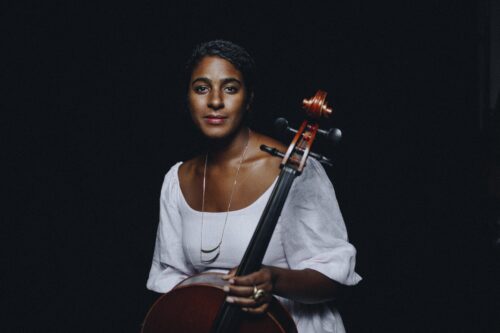
Multidisciplinary artist Leyla McCalla (Photo courtesy of Noé Cugny)
Taking its cues from the legacy of Radio Haiti-Inter, “Breaking the Thermometer” explores themes of exile and return, what it means to be Haitian, and the contribution of an independent press to the fight for Haitian cultural identity, freedom, and democracy.
McCalla first became acquainted with Radio Haiti-Inter at the age of 15, when she met Michèle Montas, Dominique’s widow and former co-director of the station. It was at that time that Leyla’s father, Jocelyn McCalla, the executive director of the National Coalition for Haitian Rights in New York City, was screening Jonathan Demme’s “The Agronomist,” a film about Dominique.
Several years later, Duke University commissioned Leyla McCalla to create a multimedia theater performance based on the Radio Haiti-Inter archives it had acquired in 2015.
The piece originally premiered at Duke Performances in March 2020, just before the Covid-19 shutdown. It features archival recordings and interviews combined with her original compositions and arrangements, dance, and dynamic video projection design.
“I decided to turn the theatrical performance into an album, fleshing out the songs with my full band and so the album ‘Breaking the Thermometer’ serves as a sort of soundtrack to the theater piece,” explains the New Orleans-based multi-instrumentalist who plays cello, guitar and banjo. She sings in Haitian Creole, English and French, deeply influenced by traditional Creole, Cajun, and Haitian music, as well as by American jazz and folk.
In researching at the Radio Haiti-Inter Archive and trying to understand how the story could become an artistic expression, the Haitian American artist grappled with her ties to Haiti and her “Haitianness,” she says.
“A lot of my nostalgia for Haiti and my experiences visiting Haiti as a child emerged as threads that could connect an audience to Haiti through my experience.”
As McCalla reflects on the sacrifices made by Radio Haiti’s journalists in exposing truths about what was happening in the country and in the world, while putting her experiences in Haiti into a historical context, she finds that it has been a very healing and emotional journey.
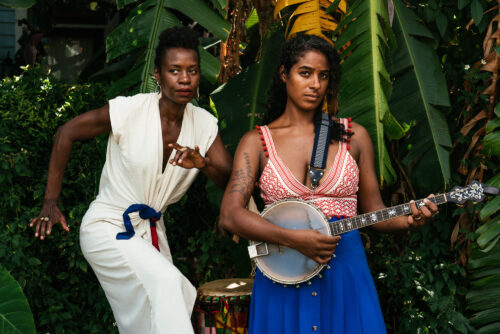
Layla McCalla with dancer Sheila Anozie, at left. (Photo courtesy of Rush Jagoe)
The singer believes that the press, anywhere in the world, should be free to speak and investigate what’s going on in society without fear of retribution or persecution. She expresses the sentiment in “Boukman’s Prayer,” a song that encourages her audience to “listen to the voice of liberty that sings in their hearts.”
She describes her music as part of a holistic expression and a quest for truths about life to better understand the world we live in.
“The listeners are invited to explore this history with me, both in a macroscopic way and in a very personal way,” she says.
“Breaking the Thermometer” weaves together music with traditional dances, audio and video recordings from the Radio Haiti archive and McCalla’s personal storytelling. It was directed by theater director Kiyoko McCrae and features dancer Sheila Anozier with McCalla and her ensemble of musicians.
The commission was led by Duke Performances at Duke University. The university had just acquired the Radio Haiti archives and sought to make its stories more accessible to a broader public through the commissioning of the work. “Duke approached us about partnering in the commission, which we immediately signed onto, along with the Contemporary Arts Center in New Orleans,” explains Kathryn Garcia, the executive and artistic director of Live Arts Miami.
“We are thrilled to celebrate Haitian Heritage Month with this stunning new performance by Leyla McCalla,” Garcia says. “This project is an exciting extension of Leyla’s musical career – bringing life to this important story on a theatrical stage.”
McCalla gained fame as a cellist with the Grammy award-winning Carolina Chocolate Drops and is set to release her new album incorporating music from the project entitled “Breaking the Thermometer” in tandem with the May 6 performance in Miami.
With lyrics in both English and Haitian Creole, the album features sophisticated melodies and Afro-Caribbean rhythms.
The songstress concludes by saying that her ancestral homeland serves as an endless source of inspiration and pride for her. “As a country that has been so stigmatized and misconceived, I find myself drawn to stories and songs that dissolve those illusions and create more nuanced pictures of the country. I also find that there is a huge educational component that is so necessary for our spiritual growth as a society.”
WHAT: Leyla McCalla in “Breaking the Thermometer to Hide the Fever”
WHEN: Friday, May 6 at 8 p.m.
WHERE: Miami Theater Center, 9806 NE 2nd Avenue, Miami Shores, FL, 33138
ArtburstMiami.com is a nonprofit source of theater, dance, visual arts, music and performing arts news. Sign up for our newsletter and never miss a story.
No posts found
After a two-year pandemic pause, the Haitian Compas Festival gets its groove back
Written By Jonel Juste May 5, 2022 at 6:58 PM
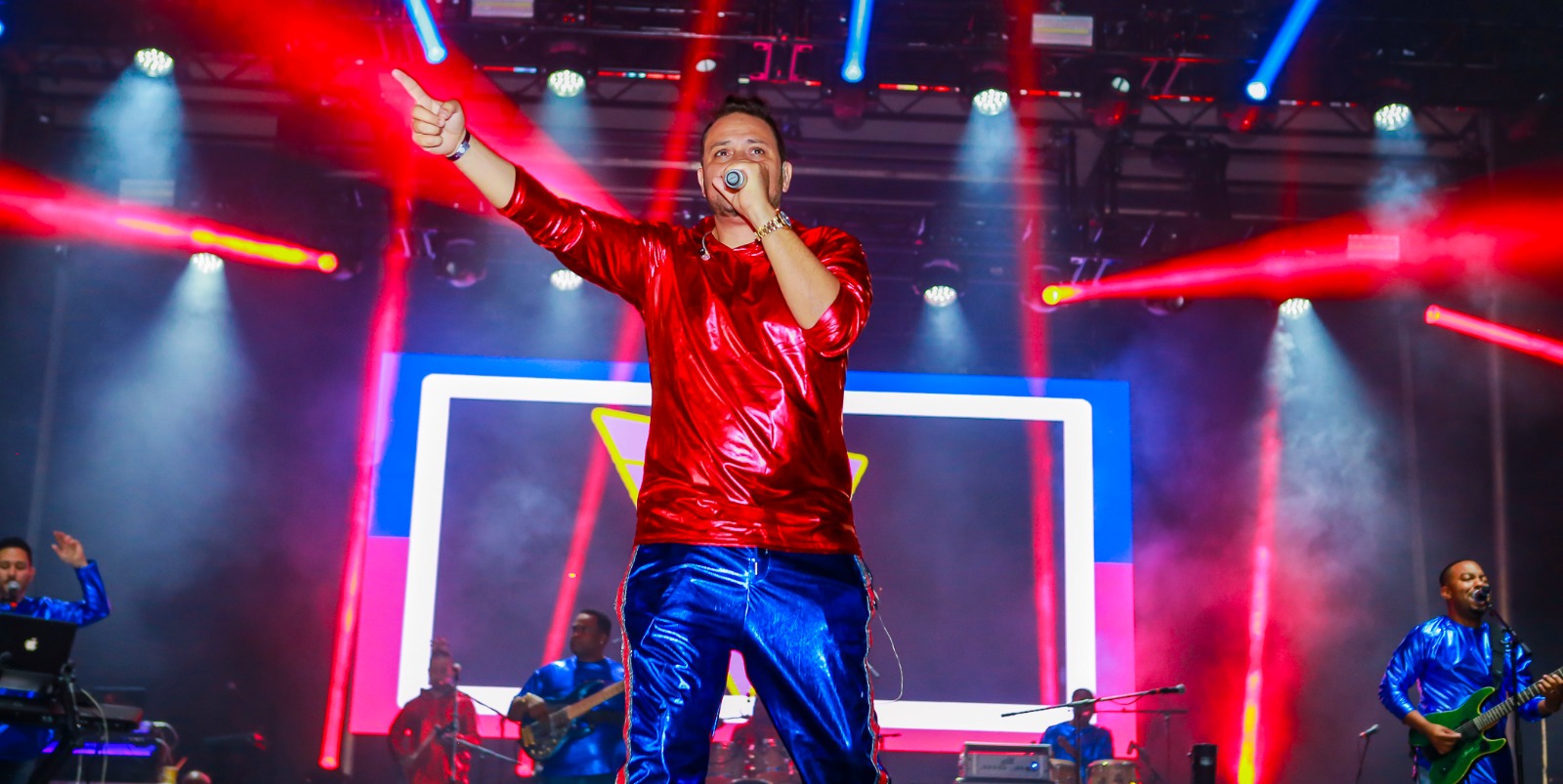
Roberto Martino is the lead singer of T-Vice. The compas band has been part of the Haitian music festival since its inception and is on the lineup again this year. (Photo courtesy of Ricardo St Cyr)
Like everything that was put on the back burner because of Covid-19, the Haitian Compas Festival had to wait for two years before making a comeback. This year, the event will unfold over two days on Saturday, May 14 and Sunday, May 15, at the Miramar Regional Park Amphitheater.
“To be back after two years is a big deal for us, for the fans, for the music bands,” says Rodney Noel, one of the organizers of the Haitian Compas Festival, which has been held in South Florida for 24 years.
Roberto Martino, the lead singer of T-Vice, a compas band that has been part of the festival since its inception, can’t contain his enthusiasm to get back on stage. His last performance at the festival was in 2019. “I am excited because it has been a long time since we have performed in front of such a large crowd. This is a great way to reconnect with our fans and the public.” The musician added that he is looking forward to people coming together, too, after the pandemic shut everything down 2020.
Founded in 1999 by Noel and Cecibon Production, the Haitian Compas Festival celebrates compas (or konpa in Haitian Creole), the Haitian pop music that combines African and Latin rhythms, an extremely popular genre in Haiti and in the Haitian Diaspora.
“Twenty-four years ago, we looked around and we noticed that every ethnic group (Jamaican, Colombian, etc.) had its own festival, but the Haitian community was left out. Therefore, we created the Haitian Compas Festival to promote Haitian music and culture,” Noel says.
According to Noel, the event’s purpose was to create something for the Haitian community in Miami.
Noel’s associate, Jean Michel Cerenord, recalls that the first years were challenging. But by the fourth year, the festival’s popularity had soared. “Since then, the festival has become a hallmark of Haitian American culture.”
Virginia Key hosted the Haitian Compas Festival for its first year. In the following years, it would be held at Bayfront Park and Bicentennial Park. In 2016 and 2017, it moved to Hard Rock Stadium. For the next two years, it found a home at Mana Wynwood. After its pandemic pause, this year the festival heads to Broward County to Miramar.
The Haitian Compas Festival spent two years at Mana Wynwood attracting huge crowds in 2018 and 2019. (Photo by Ricardo St Cyr)
“I remember when it was launched, it wasn’t nearly as big as it is now. There were a handful of bands, a small crowd, but I couldn’t wait to perform,” says Martino.
As a festival veteran, Martino says he has watched the festival flourish from its humble origins.
“The event has grown in reputation, production, and is now a full weekend of festivities. For Haitians, it is an honor to be able to showcase our music and our culture at such an important event in Florida,” Martino says.
Over the years, the festival has become not only attracted large crowds but more entertainment acts. The festival began with only four bands (T-Vice, System Band, Coupé Cloué Jr., Top Vice) and now counts 20 groups, artists and deejays performing over two days, according to the event’s promoters.
Bands such as Nu Look, Harmonick, Kai, Vayb, Djakout #1, Ekip, Klass, and T-Vice as well as others will perform. Noel says, “we also have many solo female artists such as Misty Jean, Darline Desca, Danola, who are very popular in Haiti.”
Rodney Noel, is one of the co-founders of the Haitian Compas Festival, which began in 1999. (Photo courtesy of Ricardo St Cyr)
The music festival has become one of the highlights of Haitian Heritage Month in May that celebrates the culture. There are book fairs and comedy shows, cook offs ad art exhibitions. (See a complete list of Haitian Heritage Month happenings here.)
But it is the music festival that attracts Haitians to South Florida from far and wide, organizers say. “(They come) from New York, Boston, Montreal, Haiti, Martinique, Guadeloupe, French Guiana, the Bahamas, and of course from Florida,” according to Cerenord.
The festival has had a significant impact on the Haitian community as well as the state in general.
For the community, Cerenord comments that one of the most positive aspects of the festival is that young Haitian Americans have embraced it and the festival has come to be a place for them to celebrate Haitian pride.
Noel says it is an economic engine for the city and notes that it typically attracts 15,000 to 20,000 people a day, a majority of those who come from places outside of Miami-Dade County. And while they come for the festival, many of them extend their stay to enjoy South Florida’s sun, sand and lifestyle.
“The majority of these people will be here for at least one or two weeks. They’ll be staying in hotels, renting cars, using Ubers, and eating out,” Cerenord says.
Bringing in the funk, the GroundUP Music Festival set to return May 6-8
Written By Helena Alonso Paisley April 26, 2022 at 9:27 PM
Grammy Award-winning Snarky Puppy performs at the North Beach Bandshell to close out the 2020 edition of the GroundUP Music Festival. (Photo courtesy of Stella K.)
After a two-year pandemic pause, the GroundUP Music Festival is set to return May 6-8, 2022, to the 305.
Musicians and music lovers from more than 50 countries – and nearly every state in the nation – are expected to converge on Miami Beach for three days packed with jazz, fusion, funk, progressive rock and indie performances. There will be master classes in everything from songwriting to marketing to music production, brunch-time acoustic sets, after-hours jam sessions, relaxed connection-building and all-around bonhomie.
For the many musicians of Snarky Puppy, the Grammy-winning Brooklyn-based collective that is the center of GroundUP’s orbit, it’s a weekend spent playing with friends old and new on a stage in the sunshine just steps from the ocean.
The festival, now in its fifth edition, is unusual, not just for the beauty of the setting, but also because of its chill, welcoming ambience. Ground zero for GroundUP is the renovated North Beach Bandshell, with its state-of-the-art sound system and other improvements, but the festival grounds also encompass a wide swath of the adjacent park. At the adjoining Palm Glade, for example, festivalgoers can lounge on hammocks between sets, then stroll next door to a small outdoor stage for more music. Even the beach itself becomes a performance space where musicians and audience members can come together for a drum circle to end all drum circles or a mega-sing-along-on-the-sand.
More cool breeze than hurricane, the festival has a laid-back vibe that’s like an antidote to the more frenzied, hyped-up energy of Ultra or Rolling Loud. And unlike other festivals, GroundUP artists tend to stick around for the entire event, so audiences really do have a good chance of rubbing shoulders with their favorite performers or hearing them on multiple occasions as musicians sit in on sets with other artists. It is an event that has stayed small on purpose, to keep audiences feeling that sense of community that has become its hallmark.
GroundUP Miami was founded by South Florida arts promoter Paul Lehr and Snarky Puppy leader Michael League. Like two medieval alchemists combining disparate elements in a quest to create gold, Lehr and League put together unlikely pairings of artists in the hopes that a match made at the event will lead to future recordings and concerts.
They struck pay dirt some years back when famed Doobie Brothers’ pianist and vocalist Michael McDonald and legendary GroundUP-er David Crosby performed with indie singer-songwriter Michelle Willis at the festival. The two then ended up doing backup vocals for Willis on her latest album. The warm atmosphere that the GroundUp team cultivates encourages artists to step out of their comfort zones, “play with different artists … and basically create something new,” Lehr said.
On Saturday evening’s bill, for example, GroundUP headliner Kimbra – who, with Gotye, sang the 2012 mega-hit, “Somebody That I Used to Know,” – will do a completely free-form set she is calling “Space Jam.” With a cadre of consummate musicians ready and willing to collaborate and experiment with new sounds, artists feel more inclined to take chances that they might not normally risk.
One of the highlights of the GroundUP Music Festival is Banda Magda’s A Capella by the Sea, in which festivalgoers head to the beach for a community singalong led by Magda Giannikou. (Photo courtesy of Stella K.)
“There’s lots of musicians who go back and forth to play with each other,” Lehr said.
It’s not all laid-back licks by any means. From the edgy energy of funkmaster extraordinaire Louis Cole to the rollicking Brazilian beats of South Florida’s own Miamibloco, GroundUP 2022 will offer plenty of opportunities to let the rhythm shake your bones.
For flights of virtuoso musicianship, audiences can check out any number of stellar players: there’s Brazilian bassist Munir Hossn, British pianist Bill Laurance and U.S. jazz violinist and inspired improviser Zach Brock. Never heard Max ZT of House of Waters, whom NPR called the “Jimi Hendrix of the hammered dulcimer”? This is your chance. As Lehr pointed out, “GroundUP is a musician’s music festival.”
Some of the most memorable events, however, don’t occur onstage, but on the sand. This year, as always, there will be an a cappella oceanfront sing-along including festival musicians alongside all willing audience members. Greek singer Magda Giannikou typically takes on the role of uninhibited and charismatic choir director at what seems for a minute like the greatest summer camp for music geeks ever. With a powerful voice, an engaging presence and an inimitable, fun-loving spirit that oozes generosity and good will, Giannikou offers her ad-hoc choir an experience that is as memorable as any at the festival. Simply put, it’s a blast.
“The role of music in lifting people’s spirits, and making you feel alive and that life is worth living, is second to none,” said Lehr.
As the world creeps hesitantly out of the pandemic and watches from the sidelines as tragedies play out across the globe, a little musical wind beneath our wings might be just the lift our spirits are craving.
WHAT: GroundUP Music Festival 2022
WHEN: May 6-8, 2022
WHERE: North Beach Bandshell, 7275 Collins Ave., Miami Beach
COST: $119 for single-day regular pass; $199 for single-day premium pass; $319 for three-day regular pass; $519 for three-day premium pass
Coral Gables lawyer ready to open the curtain on lifelong dream: a Sanctuary of the Arts
Written By Michelle F. Solomon April 20, 2022 at 11:57 PM
Mike Eidson, cofounder of Sanctuary of the Arts, left, with Rafi Maldonado-Lopez, principal managing director, outside of the 1-acre site that has become a the multidisciplinary arts complex. (Photo courtesy of Gaby Yero)
For years, Coral Gables lawyer Lewis S. “Mike” Eidson poured his passion for the arts into a vision for the Coconut Grove Playhouse. But after it became too much of a burden, tied up in political and legal ping-pong, Eidson turned his attention elsewhere.
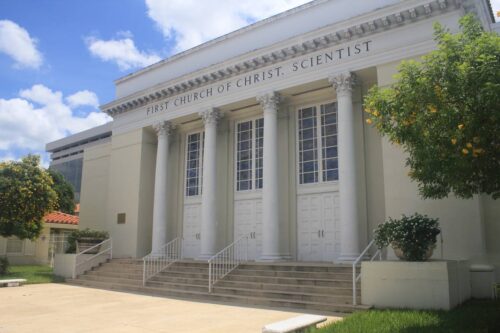
“I have said that I’m still willing to help [the Coconut Grove Playhouse] because that’s a very important building and it is in a very important location,” he says. But with a grin a mile long, the devoted preservationist and arts advocate shows off his latest diamond — the First Church of Christ Scientist on Andalusia Avenue in Coral Gables.
Inside, Eidson runs up and down the aisles in an energetic frenzy. He sits in one of the church’s original theater seats, which is now refurbished. (“Lots of leg room,” he points out.)
With a long-term lease in a partnership with the First Church of Christ, Eidson’s lifelong dream of an arts complex has become a reality: Sanctuary of the Arts, which he cofounded with his wife, Margaret Eidson, is celebrating its Grand Opening Weekend, with festivities set for April 22-24, 2022.
The space is envisioned as a multidisciplinary arts venue, where small and mid-size arts organizations and individuals who can’t find affordable and accessible space can feel welcome and supported. “It also fulfills another passion — the preservation of historic properties that are so important to Miami-Dade [County],” Eidson says.
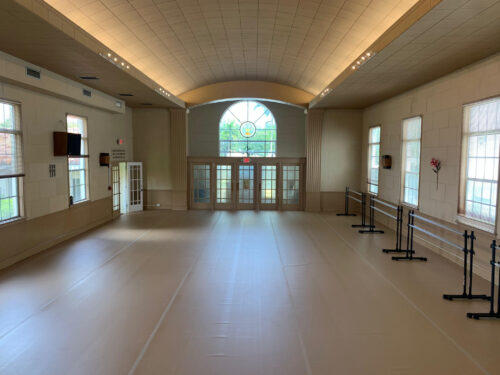
In the second building is a professional dance studio, which Sanctuary of the Arts plans to use as a dance, theater and music rehearsal space. (Photo courtesy of Sanctuary of the Arts)
It took “about a year to convince the church that that we would be able to do something good here,” Eidson adds. In 2021, the congregation moved into a smaller sanctuary building where they are able to continue their services.
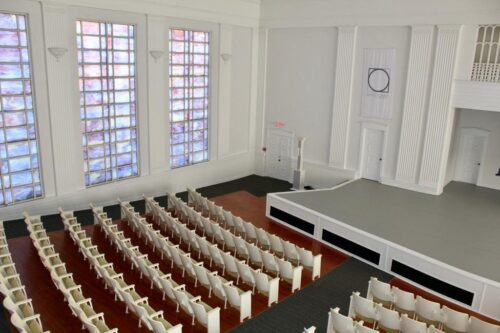
Sanctuary of the Arts operates within two large church buildings on a 1-acre stretch. The centerpiece is the 326-seat theater, and there’s also a professional-sized dance studio that is meant to double as a space for music or theater rehearsals or workshops. A courtyard separates the buildings.
“This location is world-class, and there isn’t a better site in all of Coral Gables,” Eidson said. “I couldn’t have bought this in a million years.”
Eidson has, however, committed $1 million to the project, some of which has already gone into refurbishing and upgrades. He zips down one of the aisles again to pat his hand on the stage.
“This is a Harlequin professional sprung dance floor,” Eidson says. “I wanted dancers to be able to soar. This allows them to do anything.”
Dancer and choreographer Rafi Maldonado-Lopez, who is principal managing director for Sanctuary of the Arts, chimes in to say that dance companies usually must rent a floor such as the one Eidson is beaming over. “Not here,” Maldonado-Lopez says.
Dance is only a part of what will be happening at the Sanctuary, but — at this point in the organization’s young life — it may be the most fully formed. At one point during a tour of the complex, Alice Arja ducks into one of the courtyard offices. The general and artistic director of Cia de Ballet in Rio de Janeiro, Brazil, is also the Sanctuary’s international curriculum consultant.
“We have the best ballet teacher,” Maldonado-Lopez says. “We are currently working hard to get a schedule of events together that she will curate.”
The main church building features the theater space with 364 seats and other upgrades made to the stage and interior. (Photo courtesy of Sanctuary of the Arts)
Already, jazz dance classes take place each Tuesday and Thursday evening, led by faculty member, choreographer and dance coach, Richard Amaro. And Eidson promises more classes in every arts discipline to come.
The full breadth of what the Sanctuary of the Arts is expected to offer South Florida will be on display during the weekend’s celebrations. All of the events are free, and the opening night will feature a concert and dance performance with Miami Chamber Music Society artistic director and pianist Marina Radiushina, mezzo-soprano Solange Merdinian, prima ballerina Mary Carmen Catoya, and American Repertory Ballet’s Hernan Montenegro.
Having the Miami Chamber Music Society on-stage will cement its importance to the Sanctuary. The Eidsons and Radiushina formed the Miami Chamber Music Society in 2013, and now the space will be its permanent home.
Eidson has been involved with the arts for decades. In 2010, he was elected as chairman of the Adrienne Arsht Center’s Performing Arts Center Trust (PACT) board of directors, and before that he served as chair-elect. He was president of the board of trustees for the Miami City Ballet and has served on the boards of the Florida Grand Opera and Art Basel Miami Beach.
He remembers the time he became enthralled with the arts, culture and historic preservation. While an undergraduate at the University of South Carolina, he spent a year at Warwick University in Coventry, England, studying Renaissance history.
“In Europe, the arts are so much a part of kids’ lives,” he says.
The First Church of Christ Scientist in Coral Gables is now the site of Sanctuary of the Arts. (Photo courtesy of Sanctuary of the Arts)
His professional career path was law, and he then went on to Emory University School of Law in Atlanta, where he graduated in 1971. Along with his wife, a pediatric endocrinologist, the couple moved to Miami in 1972. By 1974, he joined the Coral Gables law firm Colson Hicks and in no time became a partner. He is currently the president of Colson Hicks Eidson.
There’s a third space in the Sanctuary of the Arts portfolio, and it was actually the first to be acquired. A little more than 2 miles away from the “main campus” is St. Mary First Missionary Baptist Church on Frow Avenue, within the MacFarlane Homestead Historic District. Eidson says he bought the 4,000-square-foot building for almost $600,000.
“The church was dilapidated and was going to be torn down,” he says, but now it will serve as Sanctuary’s community arts center component. “This may be the most important of the three spaces.”
Inside this historic church, which is still in the midst of construction, Eidson looks around and sees his field of dreams.
“It will be vibrant with young people,” he says, before dashing to the back of the space painting a picture in the air of what he can see happening when the arts center on Frow Avenue opens this summer.
“Here, there will be pianos, cellos, musical instruments. They can do dance. They can do theater. The kids are dying for this. We are bringing something here for them that they need, and they need this to be here for them.”
Adds Eidson: “What we’re doing here [with Sanctuary of the Arts], there isn’t anyone in town that’s doing anything even close to this. We are free to do what we want here. Free to create and curate.”
WHAT: Sanctuary of the Arts Grand Opening Weekend
WHEN: 7 p.m. April 22 — “A Classic Celebration of the Arts” concert and dance performance 7:30 p.m. April 23 — Dance Now! Miami’s Grand Opening Performance Noon-4 p.m. April 24 — Family Fun Day featuring children’s activities and performances by Les Ailes du Desir Contemporary Circus School, Armour Dance Theatre, and Miami Movement Co.
WHERE: Sanctuary of the Arts, First Church of Christ Scientist, 410 Andalusia Ave., Coral Gables.
REVIEW: TOGETHER WITH AN IMPRESSIVE ARTISTIC TEAM, JOSHUA BELL OFFERS HOPE IN THE STORM
Written By Sebastián Spreng March 11, 2022 at 6:49 PM
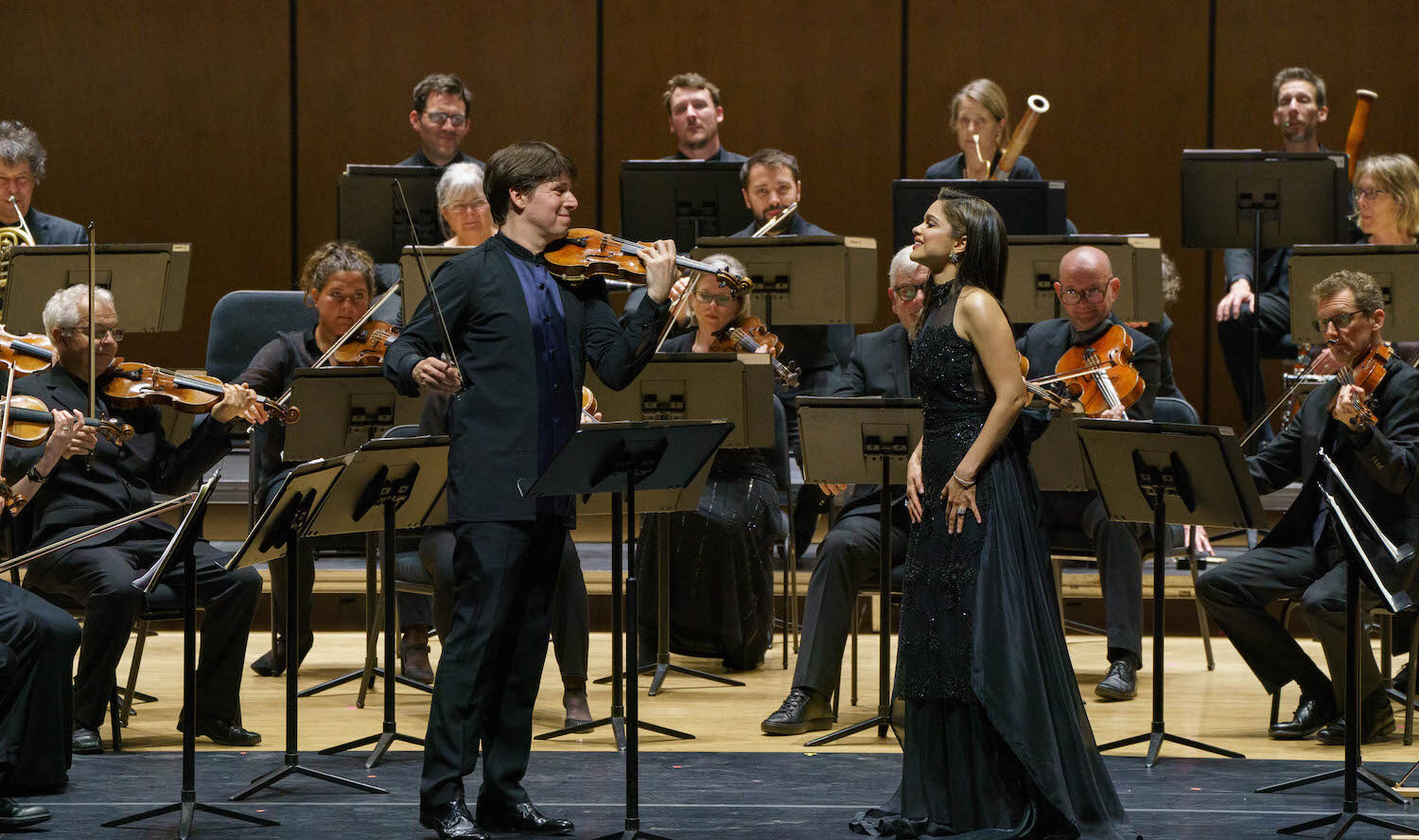
Husband and wife Joshua Bell and Larisa Martínez. (Photo/Daniel Azoulay)
After a flood of grim news during the first week of March, a concert at Miami’s Adrienne Arsht Center for the Performing Arts brought forth a hopeful moment of light.
The onstage reunion of illustrious violinist Joshua Bell as a soloist and also as conductor of “his” orchestra, the venerable London’s Academy of St. Martin in the Fields with the Miami City Ballet (MCB) and the Miami Chamber Music Society, gave rise to an auspicious evening in a practically soldout house on March 4, 2022. The concert brought together various disciplines, high artistic level, and a budding initiative for the slowly emerging musical future of the city, after two years of pandemic.
The evening marked the culmination of Bell and the academy’s brand-new Miami residency based on a proposal from the Miami Chamber Music Society teaming up with the Arsht Center. From the New World Symphony to the Miami Music Project to the University of Miami Frost School of Music and the Greater Miami Youth Orchestra, a whole week of events, master classes, and seminars was offered at all music education levels.
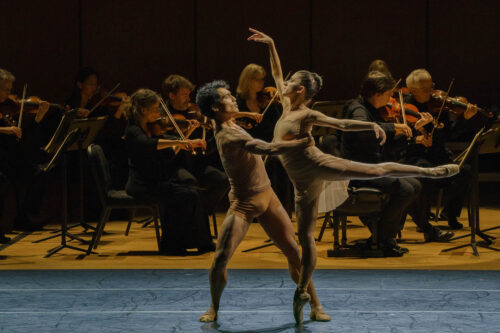
Andrei Chagas and Taylor Naturkas in “Daybreak.” (Photo/Daniel Azoulay)
First, Taylor Naturkas and Andrei Chagas, soloists from the MCB, premiered “Daybreak,” a duet by Swedish choreographer Pontus Lidberg over the famous “Adagio for Strings” by Samuel Barber — adding a subtle, special touch to a generous evening of dance and music. The excellence of the dancers was framed by the traditionally splendid strings of the academy in a sober lecture of the composer’s best-known work. Evocative and bucolic, it was the right prelude to the “First Trio in D minor” by Felix Mendelssohn, featuring three top-class instrumentalists.
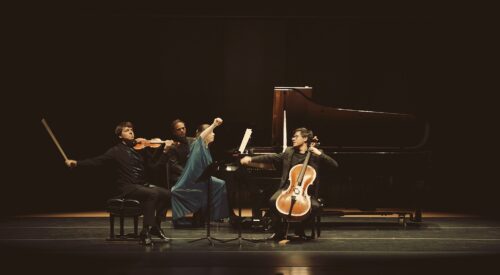
One of the pinnacles of chamber music, admired by great composers and highly popular, the piece makes superlative demands on the piano, violin, and cello. As masterful as Bell were Zlatomir Fung on cello and Marina Radiushina on piano. The three of them literally sparked. Radiushina’s proverbial clarity and Fong’s velvet sound were fierce rivals for the distinguished violinist; fittingly a meeting of friends making, enjoying, and sharing “small” but indisputably “big” music.
The second half of the evening brought the debut of Larisa Martínez with the academy, with three pieces worthy of the voice of the Puerto Rican soprano, who displayed agility and a clear timbre. Originally composed for voice and violin, the cavatina “Ah ritorna età dell’oro” from Mendelssohn’s opera “Infelice” was the perfect vehicle to showcase the violinist and his wife.
Joshua Bell, Marina Radiushina and Zlatomir Fong. (Photo/Daniel Azoulay)
The second welcome rarity was “Jours de mon enfance” from Ferdinand Hérold’s “Le Pre-aux-clercs,” a sweet evocation of childhood, presented with vocal pyrotechnics that Martínez delivered with delightful precision. With “Bachiana Brasileira Number 5” by Hector Villa Lobos, surrounded by the cellos of the academy, the young soprano rounded off a golden performance.
The concert began and ended with Barber’s captivating lyricism. Bell chose the “Violin Concerto,” one of his “workhorses,” which he owns like few or none, elegantly framed by the academy. The first two movements, as suffocating and at the same time balmy in their romanticism, contrasted with the complex, vertiginous finale that demands the impeccable virtuosity that Bell rightly honored.
Global Cuba Fest: Pianist Alfredo Rodríguez to open a truly multicultural event
Written By Fernando Gonzalez March 1, 2022 at 10:55 PM
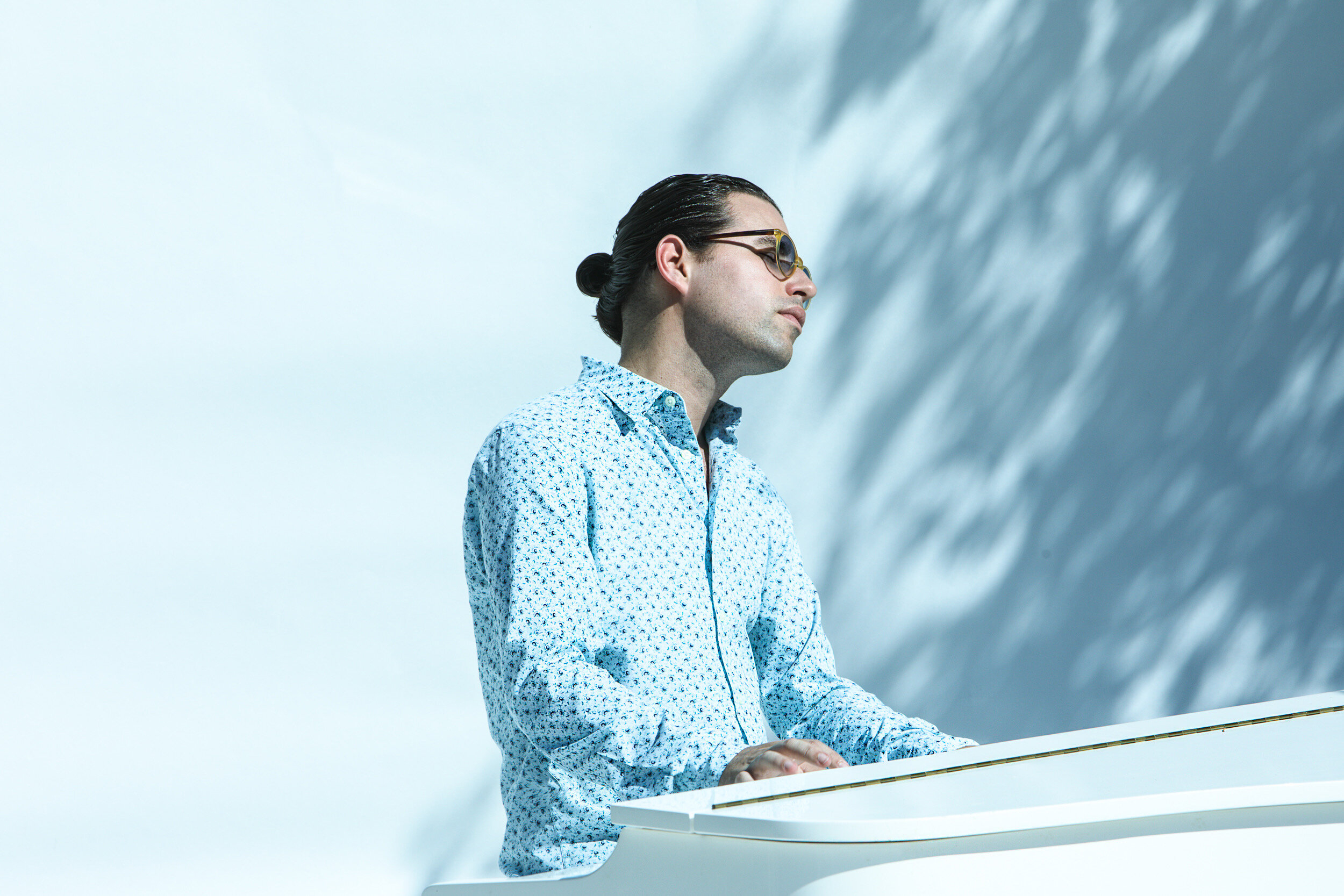
Alfredo Rodríguez’s music has been opened to global influences by constant travels and producer Quincy Jones’ ecumenical musical outlook. (Photo/Anna Webber)
The 15th edition of Global Cuba Fest — presented by Miami Light Project and FUNDarte on March 5 and 12 — will offer a snapshot of the island’s music and culture constructed from images and sounds from a dozen different angles. Few are more improbable than those by pianist and composer Alfredo Rodríguez and Cameroonian bassist, singer and composer Richard Bona.
The son of a well-known television presenter, singer and entertainer of the same name, Rodríguez, 36, has turned a personal story that reads like a Hollywood script into an international music career. Producer Quincy Jones heard Rodríguez at the Montreux Jazz Festival in 2006 and sought to work with him. Rodríguez had to return to Cuba, but apparently neither one forgot.
Three years later, Rodríguez tried to make his way from Mexico to Laredo, Texas, and was arrested at the border, carrying a suitcase with a sweater and a pair of jeans. He pleaded with immigration officials, told the absurd-sounding truth — that he was coming to work with Quincy Jones — and they eventually put him on a cab to the border, where he started his trek to Los Angeles and a new life. His first concert in his new home was at the Hollywood Bowl. He has since recorded five albums, three of them co-produced by Jones.
Once anchored on formal classical studies, and the schooling on Cuban popular music he got playing on stage in his father’s orchestra, Rodríguez’s music has been opened to global influences by constant traveling and Jones’ ecumenical musical outlook.
(Video by Heber Siqueiros, courtesy of FUNDarte and Miami Light Project)
“I am much more of a global artist now,” Rodríguez said recently. “The world that I would like to see has no walls and no borders.”
Rodríguez, who has been living in South Florida for the past two years, is putting his globalism to work in this show.
“We have many, many different Latin American populations living here, and obviously many Cubans. I haven’t played here in a while, and I wanted to do something special for this show,” he said. “We have musicians from many different places, and at the end, it’s going to be a big celebration of culture.”
Once a jazz musician inspired by Keith Jarrett’s “The Köln Concert,” Rodríguez has continued to add pop elements to his music. It might bother some jazz fans, but he remains unapologetic.
“Music is just one. I really don’t think ‘pop’ or ‘jazz’ or ‘world music.’ I just play or compose whatever feels right to me in that specific moment, and then, I just want to have fun, and that’s what I’m doing,” he said. “The one thing I’ve always been very careful about is doing something that I’m passionate about and being honest. That’s it. As years pass and you have different experiences, they influence you and your work, and yes, my music has been changing — but I’m keeping my roots.”
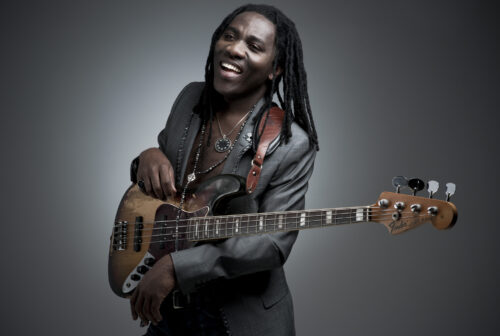
Musician Richard Bona can smoothly move from jazz and R&B to pop and traditional African grooves, and back. (Photo/Ingrid Hertfelder)
The program at Global Cuba Fest on Saturday suggests a personal summation of sorts of Rodríguez’s work since moving to the United States. For this event, he engaged his regular trio, featuring Brazilian bassist and guitarist Munir Hossn and Cuban drummer Michael Olivera — and he also called on longtime collaborators Richard Bona and Cuban percussionist and singer Pedrito Martínez. He will have as special guests Venezuelan cuatro player Jorge Glem, and percussionists Tony Succar (Peru) and Gilmar Gomes (Brazil).
The following Saturday, Global Cuba Fest continues with a double bill at Miami-Dade County Auditorium, featuring pianist and composer Jorge Luis Pacheco with singer Daymé Arocena, and a group including Ramses Rodríguez (drums), Yorgis Goiricelaya (bass) and Otto Santana (percussion). Also scheduled: saxophonist Carlos Averhoff Jr. with pianist Harold López-Nussa, trumpeter Brian Lynch, flutist Nestor Torres, singer Maggie Marquez and guitarist Ahmed Barroso.
For the March 5 show, Rodríguez will be joined by Bona, one of his key musical partners for the past decade. A first-rate player and vocalist, Bona left his native Cameroon to study music in Düsseldorf, Germany, before moving to Paris, France, and eventually settling in New York in 1995. He has since moved to South Florida.
Bona has worked with African superstars such as Salif Keita and Manu Dibango, R&B powerhouse Chaka Khan, and jazz luminaries such as Pat Metheny, Joe Zawinul, Michael and Randy Brecker, and George Benson. He can smoothly move from jazz and R&B to pop and traditional African grooves, and back.
He met Rodríguez as bandmates in the Global Gumbo All-Stars, a Quincy Jones project. Hearing Rodríguez talk about it suggests musical love at first sight.
“Music is like life,” said Rodríguez. “Sometimes you just connect with people, have a good chemistry, and that’s that.”
For the March 5 show, Alfred Rodríguez also called on another longtime collaborator, percussionist Pedrito Martínez. (Photo/Richard Termine)
Since then, they have toured extensively as a duo and in trios, and Bona appeared on two of Rodríguez’s albums.
“To be honest, I’m always trying to find opportunities to keep playing and collaborating with Richard,” Rodríguez said.
Meanwhile, Bona’s fascination with Cuban music dates to his childhood, he said.
“As a kid in Central Africa, in the late ’60s and through the ’70s, our radios in Africa played Cuban music all the time. Not just West Africa, everywhere,” he recalled. “I grew up listening to Cuban music — and I know we share one thing: the clave (the organizing five-beat pattern underlying so much of Afro-Cuban music). Clave is African,” he said. “So when I heard this music as a kid, my question was: What is this African music in a language that I don’t understand? Who are these people?!
“I’ve never had to study this music because this music belongs to my background,” Bona said.
Intrigued, years later, he traveled to Cuba on his own, and the music and the musicianship he encountered in the island “floored me,” he said. “It was unbelievable. I was in Africa.”
Bona has featured Cuban rhythms occasionally (as in the swinging “Te Dikalo” on 1999’s “Scenes From My Life” and “Ekwa Mwato” on 2001’s “Reverence”). But in 2016, Bona focused on the cultural connections between Africa and Cuba and recorded “Heritage” with his group, Mandekan Cubano. Most of the music is by Bona, including “Cubanized” remakes of some of his old songs. Sung in African languages, they are all set in traditional Cuban styles.
Bona continues to surprise some fans: a “Cubano” from Cameroon?
“They come and ask: ‘Oh man, where did you study Cuban music?’ And I’m like: ‘Listen, no, we Africans do not study Cuban music. It’s called Afro-Cuban music. We are the “Afro” part,’” he said, with a laugh.
Written By Jonel Juste February 22, 2022 at 9:35 PM
Jazz at MOCA in North Miami is billed as South Florida’s longest-running free outdoor jazz concert series. (Photo/Daniel Bock)
MOCA Plaza had been quiet since March 2020.
Usually, the public square adjacent to the Museum of Contemporary Art North Miami and City Hall buzzes with music, voices, lights and laughter every last Friday evening of the month. But then COVID-19 came along.
Almost two years later, the music and voices, the lights and laughter are back at the plaza, with the official relaunching of Jazz at MOCA.
Billed as South Florida’s longest-running free outdoor jazz concert series, this event is “one of the museum’s most beloved public programs,” said Amanda Covach, MOCA’s curator of education.
Since 1999, Jazz at MOCA has invited people from diverse backgrounds to unite for a night of music in the heart of downtown North Miami, presenting a variety of styles including swing, Brazilian, Afro-Cuban and Latin jazz. The lineup typically has ranged from classic staples to newer sounds, from acts like the South Florida Jazz Orchestra to the Ashley Pezzotti Jazz Quartet.
The Luis Disla Latin Jazz Ensemble performed in September 2021 at the Museum of Contemporary Art North Miami event. (Photo/Daniel Bock)
“Over the course of COVID, the jazz program is one that we certainly missed,” says the museum’s executive director, Chana Budgazad Sheldon. “It brings people together, which is what MOCA seeks the most.”
Like many institutions, MOCA pivoted to online programming to keep serving the community throughout the pandemic. In this way, jazz lovers had access to continued free concerts via livestream and on the radio, at WDNA-FM 88.9. That series, titled Virtual Jazz at MOCA, was hosted by Carter Jackson-Brown, and – though it’s no longer offered this year – past concerts are still available to view online.
Then in September 2021, for Hispanic Heritage Month, MOCA organized an in-person concert at the plaza after months of virtual programming. The performance by the Luis Disla Latin Jazz Ensemble served to woo back the crowds and set the stage for the official relaunch in the new year.
The crowds reappeared for the special occasion – “the response was incredible,” Sheldon said – and the jubilant sound of jazz resounded once again.
Finally, in January, Australian saxophonist and composer Troy Roberts took the stage.
“The energy was palpable across the plaza, with hundreds of neighbors filling our seats for an evening of fun and dance together,” Covach said.
The crowd enjoys the music at MOCA Plaza during September’s Hispanic Heritage Month concert. (Photo/Daniel Bock)
The next concert, on Feb. 25, honors Black History Month with a special performance of energetic-yet-soulful blues by Miami-based duo Ike and Val Woods.
Although Jazz at MOCA is an outdoor concert, seats are spaced out to allow social distancing, and guests are encouraged to wear masks. The event takes place rain or shine, with seating available on a first-come, first-served basis. The museum galleries are open from 7 p.m. to 10 p.m. by donation.
Sheldon announced an “exciting lineup for the next six months.”
“Now that we are back, I would say the plaza was animated as ever,” she said. “Certainly, artists and musicians are excited to play in person again.”
JAZZ AT MOCA 2022 SCHEDULE
Feb. 25: Ike and Val Woods (Miami-based blues duo) in celebration of Black History Month
March 25: Fanni Sarkozy (pianist, singer)
April 29: Ed Calle (saxophonist, composer, orchestrator, producer)
May 27: Chardavoine (guitarist) in celebration of Haitian Heritage Month
June 24: Julio Montalvo (trombonist, songwriter, producer, arranger)
July 29: The French Horn Collective (jazz, swing, and modern original French music)
Aug. 26: Karina Iglesias (singer-songwriter)
Sept. 30: Dante Vargas & The Cat Band (trumpet player)
IF YOU GO
WHAT: Jazz at MOCA concert series
WHEN: 8 p.m. on the last Friday of every month, rain or shine.
WHERE: Museum of Contemporary Art North Miami (MOCA), 770 NE 125th St.
Seraphic Fire finally gets to present its second Enlightenment Festival
Written By Mike Hamersly February 10, 2022 at 9:16 PM
Soprano Nola Richardson will perform in both programs as well as lead pre-concert talks. (Photo/Suzanne Vinnik)
Two years ago, South Florida’s preeminent choral vocal group Seraphic Fire unveiled its inaugural Enlightenment Festival, which over multiple performances narrowed the ensemble’s focus to notable works by 18th-century masters Haydn, Bach and Handel.
The festival was a “long time coming” for Seraphic Fire, according to conductor and artistic director Patrick Dupré Quigley, who founded the group in 2002 and relished the opportunity to explore more deeply music from a particular time period, rather than covering its typical millennium’s worth of material.
Alas, the festival’s second installment, which had been pegged for February 2021, never had a chance to shine because of the COVID-19 shutdown, and was scuttled for a year.
Fortunately, it’s back and expected to be better than ever in 2022. Seraphic Fire’s Enlightenment Festival II: Music of Bach, Moore & Purcell has expanded to two programs this year and will grace various locations in South Florida on Thursdays through Sundays from Feb. 17-27, 2022.
Program I rightfully centers around Valentine’s Day and is dubbed “If Music Be the Food of Love: A Valentine’s Day Concert.” It features Henry Purcell’s playful English madrigals and intimate love songs, plus Thomas Moore’s renowned “Irish Melodies.”
“I’m really looking forward to this as a singer, because this music was written for people to have fun singing together, both professionals and amateurs,” says soprano Nola Richardson, who will perform in both programs as well as lead pre-concert talks. “So for singers, it’s really a joy to get to do it with your friends and other really good musicians, because they’re so cleverly put together.”
And as with all deliciously complex music, it’s not 100 percent a happy vibe: “I think there’s some love lost in there, too, but most of it is pretty fun and cheerful,” Richardson says.
“The first program definitely should appeal to a romantic type,” says tenor James Reese, who will also perform in each program, both in choral and as a soloist. “There’s some really amazing love songs from the late Baroque and early classical period, which includes Thomas Moore’s ‘Irish Melodies,’ which are really familiar melodies that everyone in the audience will know, but they’ll be arranged very beautifully.”
Reese is a frequent participant in Seraphic Fire, but is also a founding member of the Philadelphia vocal sextet Variant 6.
“A number of colleagues of mine and I started Variant 6 about seven years ago, and we saw an opportunity for there to be a vocal equivalent of a high-level string quartet, like a vocal chamber music ensemble,” Reese said. “Our mission is to perform music that requires a high degree of virtuosity, and so we often perform very difficult music, which can be new, contemporary music. But we also perform a lot of early music as well, particularly music that maybe has not been heard so much by contemporary audiences. It’s all classical, and we all come from classically trained backgrounds.”
If that sounds familiar, consider Reese’s summary of Seraphic Fire: “Their mission is to bring really high-level, world-class ensemble singing to South Florida. The repertoire they’ve chosen for the festival this year is a collection of really incredible choral music that requires a very high degree of ensemble execution, and I think they want to use the festival as a chance to showcase the choir’s ability to sing really beautifully together.”
Tenor James Reese Reese is a frequent participant in Seraphic Fire and a founding member of the Philadelphia vocal sextet Variant 6.(Photo/Jiyang Chen)
Program II of the Enlightenment Festival takes a 180-degree turn, going all-in on Bach, and features two of his greatest cantatas: Cantata 147, “Hertz und Mund und Tat und Leben,” which contains one of the most memorable melodies in all of music, known in English as Jesu, Joy of Man’s Desiring; and Cantata 62, “Nun komm, der Heiden Heiland,” which features arresting choruses and luxurious arias.
The second program also features Bach’s seldomly performed “Mass in G minor,” an exercise in exhilarating vocal counterpoint.
“Few people do Bach better than Seraphic Fire,” says Reese. “I love counterpoint, which is the way that voices interact with one another in musical time, the relationship that voices have to one another. I love that way of using my brain and my ears when I sing, because it forces me to listen to what somebody else is doing, and in turn relate my vocal part to what they’re doing. And Bach is one of the kings of vocal counterpoint, just in the way that he thought about the way voices move together.”
Richardson specializes in singing the works of Bach, but “when I was younger, I really didn’t know as much about him as I should, and I think my impression of him was kind of stodgy based on what I had heard [laughs].
“I was a violinist before I was a singer, and I really loved the way that the voice is treated so instrumentally in his writing, and how you’re never just a soloist who stands in front of the ensemble and does your own thing. … I think you have to really be aware of the articulation of other instruments and where the dissonances fall, so you can lean into them, or come away from them if need be. Just being in touch with the overall harmonic structure that you’re a part of, because you’re much more woven into the texture as a singer in Bach than you are in a lot of other vocal work.”
Obviously, although events such as the Enlightenment Festival are now becoming feasible, the pandemic is not over, and so the folks running this event are taking the necessary precautions.
“Everyone has safety foremost in our minds,” says Richardson, “and we have a set of protocols we’re supposed to follow in terms of testing, and wear masks at the appropriate times, and avoiding situations to try and make sure that we can have a full two weeks without anyone getting sick.”
Adds Reese: “Luckily, we’re at a point where we can gather relatively safely when we take the right steps.
“It’s extremely exciting. I think people who perform for a living have now really learned to not take what we do for granted. It’s really a gift to be able to be in the same room as other people to make music with them, and for them, and so I personally will never take the sound of an orchestra and voices working together for granted again. It’s really special.”
WHAT: Seraphic Fire presents The Enlightenment Festival II
WHEN: Thursdays through Sundays from Feb. 17-27, 2022
WHERE: Venues in Miami, Coral Gables, Miami Beach, Fort Lauderdale, Boca Raton and Naples
‘I Dream a World’: Rediscover the Harlem Renaissance during Black History Month
Written By Jonel Juste January 31, 2022 at 4:52 PM
The special, five-day, multidisciplinary festival is presented by the New World Symphony (NWS), America’s Orchestral Academy, in Miami Beach. (Photo/New World Symphony)
When we think about the Harlem Renaissance, we think of the giants: Langston Hughes. Louis Armstrong. Duke Ellington. Bessie Smith. Fats Waller. Florence Price. William Grant Still. Ma Rainey.
During this Black History Month, we are invited to rediscover these artists during “I Dream a World: The Harlem Renaissance and Beyond,” a five-day, multidisciplinary festival presented by the New World Symphony (NWS), America’s Orchestral Academy, in Miami Beach.
The festival — set for Feb. 1-5, 2022, at the New World Center, 500 17th St. — will highlight visual arts and poetry, as well as all types of music including classical, gospel, blues and jazz. The goal is to celebrate Black culture and the significance of such a profound cultural movement in American art history. Born in Harlem in the mid-1920s, it spread throughout the United States, the Caribbean, Latin America, and even Europe.
“Sometimes we think of the movement only as being in Harlem, but there were many different Black communities around the country that had their own mini movements that embodied the ideology of the Harlem Renaissance,” says musicologist Tammy Kernodle, professor of musicology at Miami University of Ohio.
There was even a Florida connection. Two figures of the movement came from Jacksonville: James Weldon Johnson and John Rosamond Johnson, brothers who both collaborated with musicians in Harlem.
The impact of Harlem Renaissance
Considered a golden age in African-American culture, the Harlem Renaissance’s impact is vast, and the effects are visible to this day.
To musicologist Kernodle, it would be a mistake to think that the Harlem Renaissance ended at a certain period because each generation, after the peak of this movement, continued the work and continued to fashion their own form of Black art.
Musicologist Tammy Kernodle says the effects of the Harlem Renaissance live on today. (Photo/New World Symphony)
“The Harlem Renaissance lives on today. Its ripple effects are not just far-reaching in terms of time but in terms of geography,” she says.
Howard Herring, president and CEO of the New World Symphony, agrees: “Each generation of artists evolves from the artists who came before them … The evolution from one generation to the next comes all the way down to the music from this time.
“I went back and listened to [2021 inaugural poet] Amanda Gorman reading, ‘The Hill We Climb,’ and through her poetry, I can hear her predecessors,” he adds.
According to organizers, “I Dream a World” will present music from the Harlem Renaissance “in all of its glory,” allowing guests to also hear some contemporary music and understand how one influences the other.
“What we’ll hear is a good bit of music from the Harlem Renaissance period, also some brand-new music that flows from that tradition,” Herring says. “That’s going to be an interesting connection between the traditions and the styles of the ’20s and the ’30s in Harlem and around the U.S. as Black expression was coming forward.”
The festival also aims to explore the link between the Harlem Renaissance and the civil rights movement of the 1960s, Kernodle says. The art created in Harlem — whether it was sculpture, painting, poetry, photography, literature, music or dance — was purposeful, she says, and that purpose was not always related to monetary gain.
“These individuals understood that they had no political or economic power, they were challenging a system, and art was the only weapon they had,” Kernodle says. “The purpose of their art was illuminating blackness but also inspiring a conversation, and hopefully creating the kind of dialogue that will bring about real systemic change.”
Kevin Young is director of the Smithsonian’s National Museum of African American History and Culture and poetry editor for The New Yorker. (Photo/Maciek Jasik)
Music, poetry, exhibition and film
The weeklong festival is being presented by the New World Symphony, under the direction of Michael Tilson Thomas, the NWS co-founder and artistic director, with the collaboration of Kernodle as well as poet Kevin Young, director of the Smithsonian’s National Museum of African American History and Culture and poetry editor for The New Yorker; conductor Thomas Wilkins, pianist Michelle Cann and soprano Michelle Bradley.
The 2022 schedule is as follows:
Feb. 1: “Noir Reverberations: A Night of the Music and Poetry of the Harlem Renaissance and Beyond”
Feb. 2: “A Handful of Keys: A Retrospective of American Keyboard Music”
Feb. 3: “Inside the Music: Echoes of the Harlem Renaissance”
Feb. 4: American Black Film Festival screening of “Ma Rainey’s Black Bottom,” a Netflix award-winning movie starring Viola Davis and Chadwick Boseman
Feb. 5: “Victory Stride: The Orchestral Legacy of the Harlem Renaissance”
The Tuesday, Wednesday and Saturday events are ticketed, while those on Thursday and Friday are free of charge, with RSVP required. The Saturday concert will also be available via WALLCAST broadcast, projected at the adjacent SoundScape Park for free, and via livestream.
WHAT: “I Dream a World: The Harlem Renaissance and Beyond” festival
WHEN: Feb. 1-5, 2022
WHERE: New World Center, 500 17th St, Miami Beach
COST: $10-$25 tickets available for Tuesday, Wednesday, and Saturday concerts; free events on Thursday and Friday (with RSVP required)
SAFETY PROTOCOLS: Masks and proof of vaccinations or a recent negative COVID-19 test (72 hours) are required.
Miami soprano takes on iconic role in Florida Grand Opera’s ‘A Streetcar Named Desire’
Written By Michelle F. Solomon January 14, 2022 at 4:58 PM
Miami soprano Elizabeth Caballero takes on a tour de force role in the 80th anniversary season production of Florida Grand Opera’s “A Streetcar Named Desire.” (Photo/Koke Photography)
It’s an iconic moment in movie history when Marlon Brando stands at the bottom of the stairs of a New Orleans tenement in a ripped T-shirt, disheveled and screaming the name of his wife — “Stellaaaa!” — in the 1951 movie version of Tennessee Williams’ “A Streetcar Named Desire.”
Yet, despite Brando turning this dramatic plea into a pop culture pearl, the story of “Streetcar” really belongs to one of the most tragic heroines in American theater, Stella’s recently widowed sister, Blanche DuBois.
DuBois is so perfectly complex that it’s no wonder the late composer Andre Previn sought to create a tour de force role for a soprano in the operatic version of Williams’ Pulitzer Prize-winning play. An adaptation of “Streetcar” by Previn, with a libretto by Philip Littell, will open the Florida Grand Opera’s 80th anniversary season on Saturday, Jan. 22, 2022, at the Adrienne Arsht Center for the Performing Arts in Miami. The show will run through Jan. 25, then move to the Broward Center for the Performing Arts in Fort Lauderdale in February.
In the role of DuBois, this version will showcase Miami soprano Elizabeth Caballero, who says she’s ready to bring to life the intensely dramatic, yet fragile fading beauty.
“I just want to be honest with the portrayal,” Caballero says. “I don’t want to be a caricature of what everyone thinks the Southern belle of Blanche DuBois would be.”
Susan Danis, Florida Grand Opera’s general director and CEO, says casting Caballero was the right choice on multiple levels — including the soprano’s previous work with the opera company and her Miami roots. Caballero emigrated from Cuba in 1980’s Mariel boatlift when she was 6 years old.
“Everything that is part of who Liz is as a human, and the experience that she has had in her lifetime, are all the things that she will be able to pull from to get through emotionally,” Danis says.
Vocally and emotionally, DuBois is incredibly intense, Danis says, and it takes an experienced singer-actor like Caballero to tackle the role Previn wrote specifically for world-renowned star Renee Fleming.
Set in the 1940s, “Streetcar” has DuBois leaving her job as a Mississippi schoolteacher because of “bad nerves” and arriving at the New Orleans apartment of Stella and Stanley Kowalski for an indefinite amount of time. Her arrival creates a tension that threatens the very existence of the couple and everyone else in their circle.
“The role of Blanche is beautiful, yet bittersweet,” Caballero says. “There are moments when I truly want to hate her. She is a self-saboteur. And then there are moments when I want to cradle her and tell her that everything is going to be OK.”
The cast also includes Rebecca Krynski Cox (as Stella Kowalski), Hadleigh Adams (Stanley Kowalski), Nicholas Huff (Harold Mitchell), Stephanie Doche (Eunice Hubbell), David Margulis (Steve Hubbell), Amanda Olea (Mexican woman) and Charles Calotta (young collector).
Going full steam ahead with a large, live production as the Omicron variant of the COVID-19 pandemic continues to sweep through the United States wasn’t an easy decision to make, Danis says.
“A lot of it was that we knew we could do everything we could to keep people safe,” she says. “The performing arts centers are doing a great job at keeping everyone safe.”
Danis believes those who have been waiting patiently for big opera’s return will show up.
“Is the audience going to be a little light? Yes, I expect it will be,” she says. “We haven’t produced a large-scale opera production as of two years in March. So I have to say that the passion and the energy that we have all put into this and the amount of excitement of getting back to a big mainstage production are wonderfully overwhelming.”
WHAT: Florida Grand Opera’s “A Streetcar Named Desire”
WHEN/WHERE:
**7 p.m. Jan. 22, 2 p.m. Jan. 23 and 8 p.m. Jan. 25 at Ziff Ballet Opera House in the Adrienne Arsht Center for the Performing Arts, 1300 Biscayne Blvd., Miami
**7:30 p.m. Feb. 3 and Feb. 5 at Au-Rene Theater in the Broward Center for the Performing Arts, 201 SW Fifth Ave., Fort Lauderdale
COST: $21-$255
SAFETY PROTOCOLS: Masks and proof of a recent negative COVID-19 test or vaccination required.
South Beach Jazz Festival to kick off 2022 with top stars, outdoor shows
Written By Tracy Fields December 29, 2021 at 10:42 PM
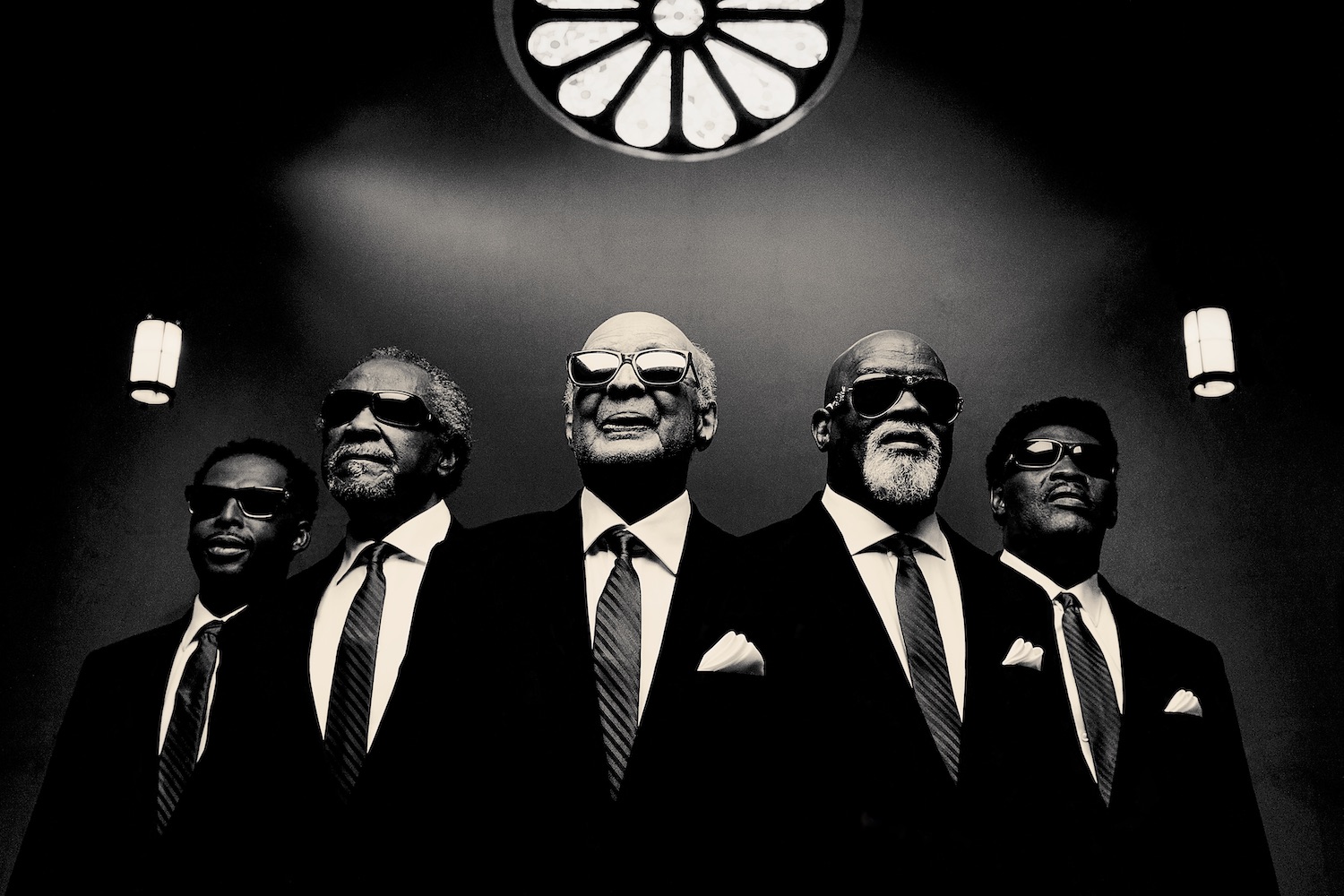
The festival’s opening night headliners are the Grammy Award-winning Blind Boys of Alabama. (Photo courtesy of Jim Herrington)
When it comes to the South Beach Jazz Festival, the shows will go on.
This annual event, which brings top jazz performers to venues throughout Miami Beach, took place as scheduled in January 2021 – and the same is planned for January 2022. Except for a pre-festival show, all of the performances are expected to take place outside.
“We are taking every precaution possible to make our event safe and enjoyable for the entire community,” said festival founder R. David New. “[For the 2021 edition], we had full COVID protocols in place, and the events were very successful.”
(Video courtesy of South Beach Jazz Festival)
Set for Jan. 7-9, 2022, the festival was designed to help showcase the extraordinary musical abilities of people with disabilities. New is an advocate for people with disabilities and president of the nonprofit organization, Power Access, which presents the festival. He became blind, deaf and partially paralyzed from a rare disease, but he managed to regain his hearing and ability to walk, though not his sight.
“It is in our mission to provide opportunities for musicians with disabilities and so at least one musician in each group does have a disability,” he said.
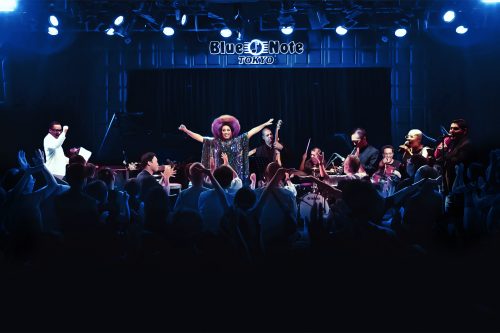
A special pre-festival show is planned for Thursday, Jan. 6, at the Faena Theater, featuring pianist Gonzalo Rubalcaba and singer Aymee Nuviola. Their 2020 album, “Viento y Tiempo” (“Wind and Time”), was nominated for a Grammy Award in the “Best Latin Jazz Album” category. Recorded live at the Blue Note Tokyo club, it’s a tribute to their mothers and their native Havana.
Singer Aymee Nuviola and jazz pianist Gonzalo Rubalcaba perform at the famed Blue Note Tokyo club last year. (Photo courtesy of Blue Note Tokyo)
Opening night headliners on Friday, Jan. 7, are the multiple Grammy Award-winning Blind Boys of Alabama. The gospel singing group traces its roots to the late 1930s, when the original members sang together as kids at the Alabama Institute for the Negro Blind. Through the decades, they have worked with stars such as Mavis Staples, Aaron Neville and Willie Nelson.
Their performance is part of “SoBe in NoBe: The Opening Night of the 6th Annual South Beach Jazz Festival,” presented at the North Beach Bandshell in partnership with The Rhythm Foundation.
Also playing that night will be New Orleans-born saxophonist Donald Harrison. Once one of the late drummer Art Blakey’s famed Jazz Messengers, Harrison is a member of the latest class of the National Endowment for the Arts’ Jazz Masters to be honored in 2022.
He is also part of the supergroup The Cookers, whose latest album, “Look Out!”, rose to no. 31 on the JazzWeek chart this past fall. Harrison is scheduled to perform as part of his quartet, which also features Joe Dyson (drums), Nori Naraoka (bass) and Dan Kaufman (piano).
Multi-instrumentalist Munir Hossn with the group, Elas. (Photo courtesy of South Beach Jazz Festival)
While the Thursday and Friday shows require paid admission, the remainder of the weekend’s performances are free of charge.
Student musicians will rule the day on Saturday, Jan. 8, when they’ll be featured on the Jazz for Tomorrow stage on Lincoln Road. Appearing will be the Jazz Education Community Coalition (JECC) ensemble, the University of Miami Jazz Quintet featuring singer Kaleen Barton, and the Florida Memorial University Jazz Ensemble. An ensemble from the Lighthouse for the Blind will perform as well.
The coordinator of the student stage is a local favorite: violinist, vocalist and educator Nicole Yarling. She is looking forward to also performing with her quintet on Sunday, Jan. 9, on the Power Access Main Stage, which is on Lincoln Road as well.
“It’ll be a cross between original music and some covers, but you know I always rework the covers,” she said. “I’m working with people that I love to play with, and the attachment to this festival is really kind of cool.”
(Video interview with festival founder R. David New is courtesy of Florida International University’s Inspicio Arts e-magazine. Find more videos with New by clicking here.)
Sunday’s other stars include the Russ Spiegel Organ Group, featuring noted local artist and teacher Jim Gasior on organ; Negroni’s Trio – father Jose Negroni at the piano, son Nomar Negroni on drums, and bassist Josh Allen – which released the album, “Esperanzas/Hopes,” in 2021; The French Horn Collective, specializing in French gypsy jazz and hot swing; and the Brazilian-born, multi-instrumentalist and composer Munir Hossn with his band, Elas.
Back again this year, the festival will allow guests to enjoy music outside in South Florida, which is the place to be in January.
“It’s a really nice way to spend your weekend if you want to hear great music and just enjoy the weather,” Yarling said. “Even if it’s a little bit chilly, it’s so much warmer than the rest of the country.”
WHAT: South Beach Jazz Festival
WHEN: Jan. 7-9, 2022; with a special event planned on Jan. 6
WHERE: Locations throughout Miami Beach
COST: Some shows are free (registration requested), but admission to the ticketed events ranges from $35-$75.
SAFETY PROTOCOLS: Mask use and social distancing will be encouraged, according to festival founder R. David New.




Recent Comments