Blog Article Category: Theater / Film
Elizabeth Price shines in City Theatre’s thought-provoking ‘What the Constitution Means to Me’
Written By Christine Dolen
December 4, 2022 at 3:11 PM
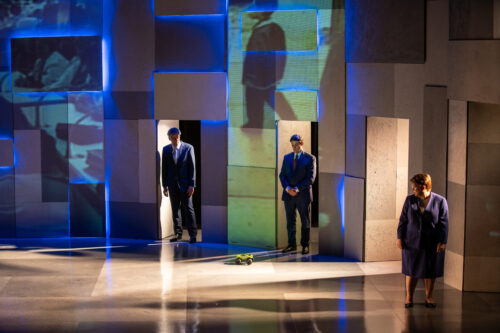
Elizabeth Price as Heidi, with Seth Trucks as the Legionnaire in City Theatre’s “What the Constitution Means to Me” inside the Carnival Studio Theater at the Adrienne Arsht Center through Dec. 18. (Photo courtesy of Justin Namon)
Elizabeth Price comes bounding into the Arsht Center’s Carnival Studio Theater happily waving, greeting the audience, smiling so hard you just know her cheeks are going to hurt (later, after so many more broad smiles, she confesses they do).
She’s wearing a mustard yellow suit jacket, and the hue – in combination with glowing lighting and golden panels sporting headshots of long-gone American Legion leaders – makes the radiant Price the embodiment of sunshine.
Portraying playwright-actor Heidi Schreck in City Theatre’s production of “What the Constitution Means to Me,” the veteran South Florida actor is giving one of those performances that makes you doubt anyone could top her or so thoroughly convey the shifting emotional facets of an impassioned artist. (Take note that understudy Melissa Almaguer will perform as Heidi at the Thursday shows Dec. 8 and Dec. 15.)
You’d be tempted to say Price is giving the performance of a lifetime if you’ve not seen her interpretative excellence on so many stages throughout the region. So whether or not her work in “Constitution” is the culmination of her decades of study and experience, it is a peak moment in her body of work.
And it is every bit as gripping and endearing as Schreck’s own 2019 Tony Award-nominated performance in the role.

A joyous Elizabeth Price as Heidi Schreck debates the protections and flaws of the U.S. Constitution in City Theatre’s “What the Constitution Means to Me.” (Photo courtesy of Justin Namon)
Staged with a sculptor’s precision by City Theatre artistic director Margaret M. Ledford, “What the Constitution Means to Me” doesn’t fall into the classic well-made play genre. A finalist for the Pulitzer Prize for drama, the piece operates on a number of levels – as a memory play, a trenchant comedy, an exploration of personal and familial trauma, participatory political theater that examines the strengths and deficiencies of the United States Constitution.
After a brief explanatory preamble, Price’s Heidi reverts to her 15-year-old self, a small-town girl from Wenatchee, Washington. She is re-creating the life-changing period when she traveled the country vying for college money by participating in debates about the Constitution at various American Legion posts. The content of those long-ago speeches, she confesses, has been pulled from her memory since her mother tossed out the originals.
After an American Legionnaire (Seth Trucks) explains the rules of the debate and starts the time clock, teen Heidi launches into an exploration of the Constitution and key amendments, personalizing the centuries-long ramifications of a document written in the late 18th century by white male landowners.
Her illustrative examples are smart, ironic, funny, and chilling. The movie “Dirty Dancing” figures in, as does a horrifying account of the male violence and sexual abuse visited upon generations of women and children in her family.

Seth Trucks as the American Legionnaire explains the rules of the debate in City Theatre’s “What the Constitution Means to Me.” (Photo courtesy of Justin Namon)
Eventually, adult Heidi sheds her blazer and teen persona to take us even more deeply into the ways a debatably flawed document touches or dictates so many facets of our lives. Discarding that persona and using her real name, Price debates a Miami high school student (at the opening performance, Felix Varela Senior High junior Carlotta Avila did the honors) on the question of whether the Constitution should be kept or thrown out.
“What the Constitution Means to Me” is a play with multiple layers, one that calls attention to its theatrical devices, and not just in the Heidi character and the actor who plays her.
After the American Legionnaire details some of the most brutal rulings in battered women cases, Price’s Heidi notes that he’s being played by an actor named Mike (the part was originated by Mike Iveson, a New York actor who most recently appeared as Roger Stone and Bill Clinton in Miami New Drama’s world premiere of Rogelio Martinez’s “Elián”). She says he’s there because she wanted some “positive male energy” in the play, and he seems a little rattled by that.
But then Trucks-as-Mike stands, starts talking, rids himself of his Legionnaire paraphernalia, and launches into a powerful monologue illustrating the idea that things – and people – are often quite different from what they seem to be. Like Price, he’s wonderful.
At certain points, “Constitution” is quite interactive, with the audience encouraged to respond with applause, foot-stomping or comments. Given the fractious state of our political engagement these days, you might expect some ugliness to surface. That’s possible, of course, but the way the play is written, the cast’s positive energy and director Ledford’s invisible control seem to keep nastiness at bay.
The production itself is exquisitely realized. Jodi Dellaventura’s set pointedly lacks a door for entrances and exits (the reason is spelled out in the script), but it evokes a long-ago American Legion post. Eric Nelson’s lighting encompasses the golden glow of memory, the harshness of some women’s lives, the tender promise of a better future.

Elizabeth Price speaks about the U.S. Constitution as Seth Trucks listens in City Theatre’s “What the Constitution Means to Me” at the Arsht Center. (Photo courtesy of Justin Namon)
Among sound designer Matt Corey’s contributions are snippets of Supreme Court sessions dealing with birth control, parsing the meaning of the word “shall,” and a comment about female representation on the court from the late Justice Ruth Bader Ginsberg. Kudos to costume designer Ellis Tillman for helping to give Price’s teen Heidi her glow and turning Trucks into a Legionnaire so classic that you wouldn’t be at all surprised to find his portrait among all the others on the set.
“What the Constitution Means to Me” is an important play, sometimes sobering, sometimes disturbing. Ultimately, it sends you home thinking hard, maybe debating about how the Constitution and American political life can be made better.
You will also likely feel uplifted, thanks to a skilled playwright sharing her story and to Price, whose thrilling work generates an empathetic connection that is one of theater’s greatest gifts.
WHAT: “What the Constitution Means to Me” by Heidi Schreck
WHERE: City Theatre production in the Carnival Studio Theater at the Adrienne Arsht Center for the Performing Arts, 1300 Biscayne Blvd., Miami
WHEN: 7:30 p.m Thursday-Friday, 3 and 7:30 p.m. Saturday, 3 p.m. Sunday (additional 7:30 p.m. show Dec. 7, no matinee Dec. 10), through Dec. 18 (After each Friday performance, moderator Deborah Magdalena will host half-hour conversations exploring the play’s themes; attorneys Diana C. Mendez and Michele Samaroo are scheduled for Dec. 9, and attorney-playwright Christopher Demos Brown and Miami Urban Debate League Co-Chair Osvaldo Garcia Dec. 16.)
COST: $55 and $60
INFORMATION: 305-949-6722 or arshtcenter.org
ArtburstMiami.com is a nonprofit source of dance, visual arts, music and performing arts news. Sign up for our newsletter and never miss a story.
No posts found
City Theatre’s ‘What the Constitution Means to Me’ ready to debate
Written By Christine Dolen
November 28, 2022 at 3:15 PM
Elizabeth Price portrays playwright Heidi Schreck in City Theatre’s “What the Constitution Means to Me” at the Carnival Studio Theater inside the Adrienne Arsht Center. (Photo courtesy of Morgan Sophia Photography)
When actor, playwright and screenwriter Heidi Schreck was a teen growing up in Wenatchee, Washington (aka “The Apple Capital of the World”), she began entering debate competitions at various American Legion posts around the country, vying for prize money to help her pay for college.
Her subject? The United States Constitution, a document that became a 15-year-old’s obsession, one right up there with the Salem witch trials, theater and Patrick Swayze.
We know about those objects of her teen affections because she wrote them into her play “What the Constitution Means to Me,” which will get its southeastern premiere in a City Theatre production. The show runs at the Carnival Studio Theater in Miami’s Arsht Center Dec. 1-18.
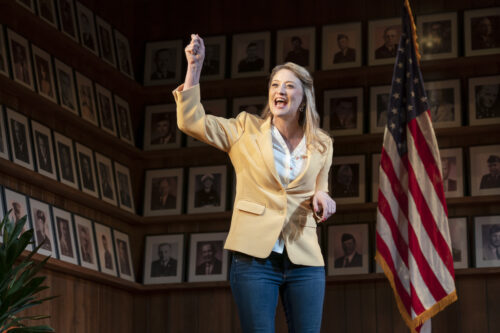
Heidi Schreck wrote and performed in “What the Constitution Means to Me,” off-Broadway, on Broadway and on Amazon Prime Video. (Photo courtesy of Joan Marcus)
Schreck, now 51, proved to be an excellent debater. She graduated from the University of Oregon, then went on to further adventures as an English teacher in Siberia and a journalist in St. Petersburg (the one in Russia, not the one near Tampa) before beginning her theater career in Seattle.
In New York, she became an Obie Award-winning actor, then began to see her plays produced and recognized in playwriting competitions. But little did she imagine that the 2017 play inspired by those long-ago debates would lead to her becoming a finalist for the 2019 Pulitzer Prize for drama as well as a 2019 Tony Award nominee for best play and best actress in a play.
“I started noodling around with it, revisiting the contest in 2009 or 2010,” says Schreck, who’s currently down to the wire with a television pilot. “I’m interested in writing about teen girls, and this was a weird, funny, formative experience that made me feel powerful.”
City Theatre’s Margaret M. Ledford, artistic director of the company best known for its Summer Shorts festival since 2017, chose “What the Constitution Means to Me” for its annual December full-length play slot because “it’s such an empowering play, as a woman and a U.S. citizen. It made me think everyone should see it. The script is tight, concise, funny and engaging. It has such an earnestness, but there’s nothing preachy about it.”
Operating on multiple levels, the play focuses on Schreck telling her story, first as a 15-year-old, then as an adult, followed by a debate with a student on whether the Constitution should be abolished. An American Legion member talks about the rules and keeps things running smoothly, but he eventually reveals his own backstory in a riveting monologue.

South Florida’s Elizabeth Price steps into the role that playwright Heidi Schreck played herself on Broadway. (Photo courtesy of Morgan Sophia Photography)
The concept of constitutionally enshrined negative and positive rights is explored in the play, with the former prohibiting an action and the latter requiring one. If that sounds dry or confusing, the way it plays out is anything but.
As she talks, Schreck’s character reveals exactly how she believes the negative rights enshrined in a Constitution devised by 18th-century white male landowners failed to protect generations of women in her family. That is the beating, valiant heart of “What the Constitution Means to Me.”
“The question was always, ‘How did this document change your life?’ I took that deeply seriously, so I researched my family history in relationship to the document,” says Schreck, whose discoveries became a vividly shocking part of her play. “I was heartbroken about what I discovered. But the women in my family lived through it, and I’m lucky my mom was such an amazing person and survivor.”
Yet, as Ledford noted, the play is sometimes very funny and so inventive that it sounds almost improvisational, but it isn’t. Though the world surrounding the play is constantly evolving and giving fresh urgency to Schreck’s words, the script itself holds up.
“The contest portion doesn’t need changes, since it’s set in 1989 and is historical,” Schreck observes. “I’ve made a couple of tiny edits to the part where I’m a middle-aged woman. The biggest changes come in the debates (at the end), where elements change from night to night.”
Schreck performed in a filmed version of the play shown on Amazon’s Prime Video in 2020, but she always intended for other actors to play the Heidi character. In Miami, Elizabeth Price will do the honors, calling the role “the biggest thing I’ve ever done.”
That’s saying something, since Price – who is also a director, producer and associate artistic director of Fort Lauderdale’s New City Players – is an award-winning actor whose resume includes “Twelfth Night,” “The Importance of Being Earnest,” “The Normal Heart,” “August: Osage County,” “Misery” and a host of other plays at theaters around South Florida and in other cities.
A two-time Silver Palm Award winner and three-time Carbonell Award nominee, Price is also a determined survivor. When she was teaching and earning her master’s degree in acting at Florida Atlantic University, a car hit her at night as she was riding her bike one night. From 2017 to 2019, she endured seven surgeries – although she did take on certain physically limited roles during that time – and today, she says, “I’m doing pretty well. I have the agility and use of my body back, just some small daily challenges.”

Seth Trucks, left, is playing an American Legion member in City Theatre’s “What the Constitution Means to Me,” directed by Margaret M. Ledford, City Theatre’s Artistic Director, right. (Trucks photo courtesy of Michael Price/Ledford photo courtesy of Morgan Sophia Photography)
Ledford cast Price, whose relationship with City Theatre began as a literary manager while the actor was earning her bachelor of fine arts degree from Barry University, after auditioning a number of performers.
“Elizabeth has that nerdy, goofy, earnest, smart quality. The role calls for a strong female who doesn’t have authority to be strong,” the director says.
When she heard City would be doing the play, Price read and loved the script, then watched Schreck in the Prime Video version. She loved that too and thought about what she could bring to the role that gives her the lion’s share of lines in the play.
For Price, rehearsing to play 15-year-old Heidi, adult Heidi and herself (as she does in the last part of the play) has brought its own kind of healing and inspiration.
“The more time I spend with the characters, the more I identify with the with the play, the way Heidi talks about making decisions and choices as a woman influenced by centuries of laws,” Price says. “I’ve picked up a lot of people pleasing. Things I’ve experienced were being named. How I behaved when I felt I was in danger. That’s a lot in my 48 years.”
The play’s nature allows for a complex range of emotions for the actor and the audience.
“Every time I’m rehearsing the personal stories, I’m crying,” Price says. “The play takes us to places in the dark recesses of the human heart, then lets us out, then takes us back. It’s cathartic, really. It doesn’t bring us down. It allows us to laugh and grieve.”
Sharing the stage with Price are actor-director Seth Trucks as an American Legion member, and recent New World School of the Arts grad Janine Raquel Johnson as a young debater (others will also take on that role during the run). Trucks and Price shared the stage in an Outré Theatre Company production of “The Normal Heart” in 2016, he directed her in a production of Palm Beach Shakespeare Festival’s “Twelfth Night” in 2021, and the two are longtime friends.
“I’m extremely excited by the somewhat improvised ending and the way it engages the audience in a conversation,” says Trucks, son of the late Allman Brothers drummer Butch Trucks. “I couldn’t be happier. Politics is concerned with art, so as an artist, I love to concern myself with politics . . . The idea of negative vs. positive protections in the Constitution hones in on things a lot of people don’t know about.”
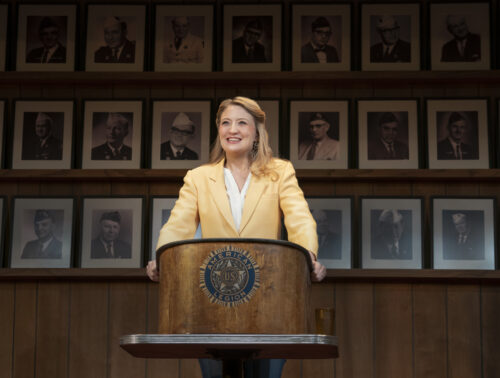
Heidi Schreck’s “What the Constitution Means to Me” was nominated for a Tony Award for Best Play in 2019, and earned Schreck a nominee for Best Actress in a Play and also as a finalist for Pulitzer Prize for drama. (Photo courtesy of Joan Marcus)
“What the Constitution Means to Me” comes at a time of transition, evaluation and potential growth for City Theatre. Susan Westfall, the only one of City’s three founders still involved in day-to-day operations of the 27-year-old company, will now serve solely as a board member. Ledford will continue leading the artistic side, while newly promoted executive director Gladys Ramirez heads City’s business and developmental operations.
“Our focus is putting the ‘city’ in City Theatre. We have a national platform and great connections to playwrights around the country, but we want to elevate our presence in Miami – to reflect, uplift and serve the community,” says Ramirez, who notes that City’s Homegrown new play development project led by playwright Vanessa Garcia is just one such initiative.
“City Theatre is short plays. That will always be part of the brand. . . How do we stay true to that while we keep developing new work and also connect through full-length plays? We can’t rely on audiences of the past to take us into the future.”
Schreck and those involved in City Theatre’s production feel that some of the nation’s current divisions can be linked to the Constitution – although Schreck doesn’t believe Americans are as divided as recent elections might suggest.
“It seems clear that a lot of what’s harming our democracy is structural and embedded in the Constitution,” says Schreck, who suggests that legally protected bodily autonomy, limits to corporate campaign contributions, an impartial body to oversee redistricting, the right to health care for all and the Electoral College system all need addressing.
“We are just living in such a polarizing climate, where people don’t talk to one another,” says Ledford. “We are individually so disconnected from our roots, our food sources, original thought – we’re very sheeplike.”
WHAT: “What the Constitution Means to Me” by Heidi Schreck
WHERE: City Theatre production in the Carnival Studio Theater at the Adrienne Arsht Center for the Performing Arts, 1300 Biscayne Blvd., Miami
WHEN: Preview 7:30 p.m. Dec. 1, opens 7:30 p.m. Dec. 2; regular performances 7:30 p.m Thursday-Friday, 3 and 7:30 p.m. Saturday, 3 p.m. Sunday (additional 7:30 p.m. show Dec. 7, no matinee Dec. 10), through Dec. 18. (After each Friday performance, moderator Deborah Magdalena will host half-hour conversations exploring the play’s themes; attorneys Damaris Del Valle and Carmen Maria Vizcaino are scheduled Dec. 2, attorneys Diana C. Mendez and Michele Samaroo Dec. 9, and attorney-playwright Christopher Demos Brown and Miami Urban Debate League Co-Chair Osvaldo Garcia Dec. 16.)
COST: $55 and $60
INFORMATION: 305-949-6722 or www.arshtcenter.org
ArtburstMiami.com is a nonprofit source of dance, visual arts, music and performing arts news. Sign up for our newsletter and never miss a story.
No posts found
Epic ‘The Head and the Load’ headed for Adrienne Arsht Center
Written By Helena Alonso Paisley
November 25, 2022 at 5:40 PM
William Kentridge’s “The Head & the Load” is a massive collage of a performance told in music, dance, projections and poetry at the Adrienne Arsht Center. (Photo courtesy of Stella Olivier)
It’s a production of epic proportions on every scale imaginable. More than a straightforward performance in the traditional sense, “The Head and the Load” is a protean pageant of shadow play, projections, music and movement featuring 39 actors, dancers, singers and other musicians, most of them from South Africa.
The production, opening Dec. 1 at the Adrienne Arsht Center for the Performing Arts, is the brainchild of William Kentridge, a whirlwind of a creator whose extraordinary output of film animations, opera adaptations, collage, sculpture, and charcoal drawings have put him firmly in the vanguard of international artists. In his four decades plus in the studio, he has developed an intriguing visual language of artistic techniques and of objects—megaphones, maps, rotary telephones, typewriters—that is instantly recognizable.
“A Kentridge is a Kentridge,” says Johann Zietsman, president and CEO of the Arsht Center. “It doesn’t look like anyone else.”
In 2018, Kentridge was commissioned to create a piece to be performed at the Turbine Hall of the Tate Modern for London’s commemoration of the centenary of World War I. At roughly the same time, he was invited to premiere a work at New York’s cavernous Park Avenue Armory. Both called for something mammoth in scale.
“The formal thinking about space and performance in a way precedes the theme of the piece,” he says in a telephone interview from his native Johannesburg. “I know it sounds back to front, but the studio often works that way.”
He thus began an investigation into Africa’s involvement in the Great War. “It’s history that I should have known, but I didn’t know,” he says.
The British, he soon learned, had conscripted nearly one hundred thousand Black Africans to serve as porters in their campaign against the Germans in East Africa. These recruits, referred to as the Carrier Corps, were viewed as utterly expendable. Paid a miserly sum so as not to be considered slave labor, they were expected to be dead or of no use after a brief period of service hauling munitions and materiel across the dense jungle. When they expired, they would simply be left where they lay, to be replaced by other nameless conscripts.
“In the end, (‘The Head and the Load’) does have a very strong sense of this unknown history, what is it to elide histories and to make them disappear,” Kentridge says.
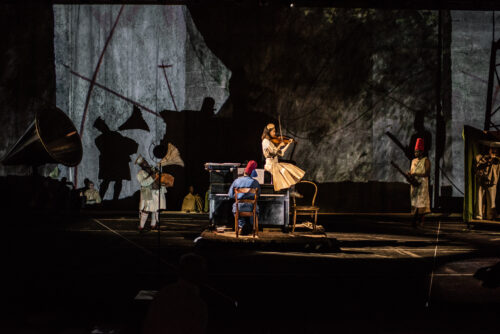
In addition to the performers from South Africa, U.S. productions of “The Head and the Load” also use musicians from New York City’s The Knights. (Photo courtesy of Stella Olivier)
I asked Zietsman if a work of this magnitude and technical complexity had ever been produced at the Arsht Center. “Not in the history of the Arsht,” he says. “Not on this scale.” The audience will enter the theater through the loading dock and sit onstage with the performers, looking out in the direction the house would usually be. “The challenge is not just how we mount the show. We have to build risers for over 500 audience members . . . I’m looking right now at a thousand feet of trusses and miles and miles of cables. But when the curtain goes up, it goes up. That’s what we do.”
The title of the piece refers to an enigmatic West African proverb, one of many that adorn the walls of Kentridge’s Johannesburg studio: “The head and the load are the troubles of the neck.” “I couldn’t quite figure out what it meant,” Kentridge says. “It’s not only the physical load that bears you down, but also the psychic load.”
Kentridge’s work has long interrogated systems of colonialism and oppression—and so did his parents’ work before him. His father, Sydney Kentridge, a legendary attorney and still alive at age 100, defended in the course of his career three Nobel Peace Prize recipients: Nelson Mandela, Desmond Tutu and Albert Luthuli. His late mother, human rights lawyer and fierce anti-apartheid advocate Felicia Kentridge, cofounded Johannesburg’s Legal Resources Center. The ethical reverberations of his parents’ work, he says, “kind of disappear in the studio and maybe reappear in the finished work… No doubt that there’s a connection.”

Actor Hamilton Diamini in “The Head and the Load.” (Photo courtesy of Stella Olivier)
His father would read the classics aloud to his children—everything from Greek myths to Victorian novels. As an adolescent, however, the son was more moved by Dada than Dickens. It was a fascination that would stay with him until this day.
“Dada is so strange,” Kentridge says. “In high school, I was intrigued by the Dadaists when we were doing art history. But it took me a long time to understand that every contemporary artist or all contemporary artists are in debt to the Dadaists, in what they made possible. For you to be able to think to yourself, ‘I’m an artist, but my drawing today is going to be this poem, or my drawing is going to be this performance of a poem, or my drawing is going to be this theater piece with sixty performers in it.’”
The quality of those performers, Kentridge would tell you, is the secret to his success.
“I’m very good at choosing collaborators,” he says. He has worked with composer Philip Miller for over 25 years and with the extraordinary Belgian costume designer Greta Goiris for 17; Australian singer/actor Joanna Dudley has been with him for 7. Thuthuka Sibisi, musical director and cocomposer and choreographer Gregory Maqoma are more recent additions to Kentridge’s artistic tribe, which developed “The Head & the Load” together at the Centre for the Less Good Idea, an arts incubator he created in 2016 in downtown Johannesburg. “Apart from the orchestra and the chorus, the main roles, both danced, sung and acted, were created by the people who now perform them . . . There’s a real agency of everyone in it, making the piece together.”

Britain conscripted nearly 100,000 Black Africans to haul materiel through the jungle in WWI. Dancer Thulani Chauke, shown here, has collaborated with The Centre for the Less Good Idea since its first season. (Photo courtesy of Stella Olivier)
He says there are elements that change each performance.
“People have to be very aware and sensitive to where they are and what’s happening on the stage and how they relate to the other people, because it’s never the same. There are too many people and too many moving parts to set it precisely,” he says.
Even for a seasoned creator like Kentridge—who has seldom met an artistic limb he wasn’t tempted to stroll out on—this production is a devilishly ambitious work.
“At the moment, our crisis for today is that our container with everything we need in it is still stuck at Jacksonville… there’s a snarl up at the ports, so they have to U-Haul it down piece by piece.” Add to that the challenge of arranging for U.S. visas for close to sixty South African artists and technicians and you have an idea of the logistical heavy lifting a production of this scale entails.
In a twist that is as worthy of Dada’s absurdist vision as anything else, the production owes its Miami run not just to the generosity of diehard arts patrons like Valerie Dillon and Dan Lewis, but also to Knoxville’s Roy Cockrum, the former actor and one-time Episcopalian monk who used his 2014 Powerball winnings to create a foundation to promote theater on a grand scale here in the U.S.
One can only imagine what the Dadaists with their manifesto would have made of that.
WHAT: William Kentridge’s “The Head & the Load”
WHERE: Adrienne Arsht Center for the Performing Ziff Ballet Opera House, 1300 Biscayne Blvd, Miami, FL 33132. (Note: Entrance is through stage loading dock)
WHEN: 8 p.m., Thursday, Dec. 1, Friday, Dec. 2 and Saturday, Dec. 3. 2 p.m. matinee Saturday, Dec. 3 followed by post-show conversation with William Kentridge and creative team.
COST: $50 – $175
INFORMATION: 305-949-6722 or arshtcenter.org
ArtburstMiami.com is a nonprofit source of dance, visual arts, music and performing arts news. Sign up for our newsletter and never miss a story.
No posts found
‘Million Dollar Quartet Christmas’ regifts four music legends at Actors’ Playhouse
Written By Christine Dolen
November 21, 2022 at 1:57 PM
Dominique Scott as Jerry Lee Lewis at the piano in “Million Dollar Quartet Christmas” at Actors’ Playhouse through Jan. 1. (Photo courtesy of Alberto Romeu)
An impromptu jam session by four future Rock and Roll Hall of Fame giants has become one of those showbiz gifts that keeps on giving.
On Dec. 4, 1956, Sun Records founder Sam Phillips wanted to record some new tracks with Carl Perkins, whose “Blue Suede Shoes” had been a hit for Perkins and Sun superstar Elvis Presley.
Phillips brought in the young Jerry Lee Lewis to play piano on the session. And then two other Phillips stars – Presley, whose contract had been sold to RCA to keep Sun Records afloat, and Johnny Cash, who was about to jump ship to Columbia Records – came by the Memphis studio.

Dominique Scott, Jeremy Sevelovitz, Eddie Clendening and Sky Seals in “Million Dollar Christmas.” (Photo courtesy of Alberto Romeu)
When the four started jamming, the Sun engineer pressed “record,” and a one-time-only group dubbed the Million Dollar Quartet made a piece of music history.
In 2006 at the Seaside Music Theatre in Daytona Beach, that night and those stars spawned “Million Dollar Quartet,” a piece of musical theater jam-packed with hits. The show would go on to a major production at Chicago’s Goodman Theatre in 2008, to Broadway in 2010, Off-Broadway, London, a tour and productions at theaters all over the United States – including two by Actors’ Playhouse in Coral Gables.
With the smash success of those 2016 and 2018 productions at the Miracle Theatre, it’s no surprise that Actors’ Playhouse and artistic director David Arisco would go back to the “Million Dollar” well to kick off the company’s 35th anniversary season.
While the new show, “Million Dollar Quartet Christmas,” isn’t precisely a sequel – it takes place on the same night as the original, because Elvis, Johnny, Carl and Jerry Lee got together just the one time – it serves up a fresh collection of songs linked by a different story.
The music, as anyone in the delighted Actors’ audience would tell you, is sung and played to a fare-thee-well by talented actor-musicians who have been part of one or both of the company’s “Million Dollar Quartet” productions.
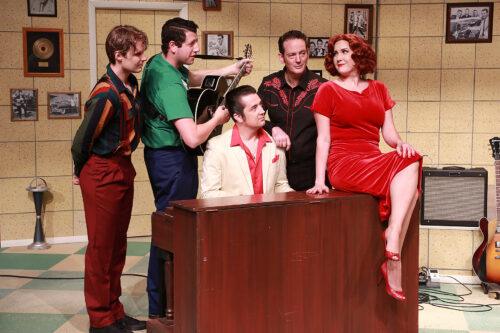
Dominque Scott, Jeremy Sevelovitz, Eddie Clendening, Sky Seals and Lindsey Corey make some music in “Million Dollar Quartet Christmas.” (Photo courtesy of Alberto Romeu)
Colin Escott’s new book, however, pales in comparison to his Tony Award-nominated original (he co-wrote the first one with Floyd Mutrux). All of the really good stuff about these stars, Sam Phillips, Sun, jealousies, betrayals, gossip – that was all used in “Million Dollar Quartet.” Escott has struggled to construct a story that isn’t half as compelling, and no amount of finesse on the part of the performers and Arisco can disguise that.
Fortunately, at least with this particular show, theatergoers aren’t focused on listening to the characters talk to each other. They want to hear the music, the hits, Elvis singing “Blue Christmas,” thank you very much. And they do.
Led by Arisco and musical director Dominique Scott, who’s reprising his Carbonell Award-winning role as Jerry Lee Lewis, the actors deliver the vocal and instrumental goods.

Eddie Clendening as Elvis and Lindsey Corey as Dyanne in “Million Dollar Christmas” at Actors’ Playhouse. (Photo courtesy of Alberto Romeu)
Eddie Clendening, who played Elvis on Broadway and in the first Actors’ production, is back as the King, again with a sultry singer named Dyanne in tow (Lindsey Corey, here a redhead in a fits-like-a-glove red velvet dress). Sky Seals is back as Cash, Jeremy Sevelovitz as Perkins, with David Sonneborn on drums and Jonny Bowler on bass. Gregg Weiner has returned as Phillips, whom he first played at Actors’ in 2018.
Solos, duets and songs by the cast as a whole flow like spiked eggnog at a company Christmas party.
Clendening’s Elvis croons “Don’t Be Cruel,” a yearning “I’ll Be Home for Christmas” and sings a lovely duet with Seals’s Cash on “Silent Night.” Seals sends a happy jolt through the audience with “Ring of Fire,” and Sevelovitz’s Perkins blazes on guitar as he sings “Cotton Top.”
Scott, playing the controversial rock ‘n’ roll legend who passed away just last month, is a wild man as Lewis, singing “Chantilly Lace,” “Boogie Woogie Santa Claus,” “Bad Kid,” then easily topping himself more than once during the concert-style finale.

The cast of “Million Dollar Quartet Christmas” raises the roof at Actors’ Playhouse. (Photo courtesy of Alberto Romeu)
Corey adds vocal spice with a sultry “Santa Baby” and other tunes, but her mission appears to be slinking around the studio and draping her arm over this musician or that one. Her talented, charismatic Dyanne deserves more. Weiner plays Phillips in a pleasant, low-key way rather than as a music pioneer facing the loss of stars he helped create.
The design team – set designer Gene Seyffer, lighting designer Eric Nelson, sound designer Eric Bonilla, costume designer Ellis Tillman and set dresser/properties designer Jodi Dellaventura – effectively re-creates the “Million Dollar” Sun studio, the period look of the actors, the shifting moods of different songs.
In going back to the creative well, “Million Dollar Quartet Christmas” doesn’t deliver as reliably as its predecessor. But it is a rollicking holiday mood-enhancing experience for music lovers looking for a different way to get into the spirit of the season.
WHAT: “Million Dollar Quartet Christmas” by Colin Escott
WHERE: Actors Playhouse in the Balcony Theatre at the Miracle Theatre, 280 Miracle Mile, Coral Gables
WHEN: 8 p.m. Wednesday-Saturday, 3 p.m. Sunday, through Jan. 1
COST: $40 to $125 (seniors 65 and over get 10 percent off weekdays only; students 25 and under with valid student ID pay $15 for a rush ticket available 15 minutes before a weekday performance)
INFORMATION: 305-444-9293 or actorsplayhouse.org
ArtburstMiami.com is a nonprofit source of dance, visual arts, music and performing arts news. Sign up for our newsletter and never miss a story.
No posts found
Miami native tells father’s story of dying wish in her documentary film ‘Last Flight Home’
Written By Michelle F. Solomon
November 16, 2022 at 4:46 PM
Eli, Lisa, Rachel, Ondi and David Timoner in an archival image circa 1979 from Ondi Timoner’s film “Last Flight Home,” opening Friday at Coral Gables Art Cinema. (Photo courtesy of MTV Documentary Films)
Eli Timoner was known to Miamians for his no-frills airline Air Florida, which he founded in 1972. It was an intra-state carrier that offered low rates and began a Miami-to-London route that beat out the big-name airlines when it charged as little as $175 for a transatlantic trip.
Documentary filmmaker and Ransom Everglades graduate Andrea Doane “Ondi” Timoner, the middle child of three, was daddy’s girl, right up until the very end. She didn’t set out to document the last days of her father’s life in what’s become her latest film “Last Flight Home.” But the labor of love and what was meant to be a private memorial video for the family turned into a full-length feature documentary. “It just poured out of me,” Ondi, 49, says.

Ondi Timoner and her 92-year-old father, Eli, during his final days in a scene from the documentary “Last Flight Home.” (MTV Documentary Films)
“Last Flight Home” has played the big festival circuits, which included a premiere at Sundance, and was an official selection at Telluride and London. Now in release through MTV Documentary Films, “Last Flight Home” comes “home to Miami” opening Friday at Coral Gables Art Cinema.
It was in January of 2021 after her father was hospitalized because of breathing problems that he had made his wishes known. He had a series of health issues since a stroke in 1982 paralyzed and blinded him on his left side. On that day in January, he told his family, “I am going to take my life on the 3rd of March. I don’t want to fight anymore. I want peace.”
In the film, we see Ondi’s sister, Rachel, a rabbi, asking her father “Are you definitely, definitely sure you are ready to go?” 92-year-year-old Eli, totally of sound mind, responds: “I am ready to go to the next adventure.”
His dying wish was put into motion through the California End of Life Option Act and Ondi captures those 15 days leading up to March 3, 2021, where she filmed in her parents’ Pasadena bungalow (they had moved in 2005 from Miami to California to be closer to their children and grandchildren). At this point, Eli is in a hospital bed in the middle of the living room.
California is one of ten U.S. states and the District of Columbia where medical aid in dying is authorized and legally allowed.

Ondi Timoner grew up in Miami, went to Yale University and became a filmmaker. Her latest documentary chronicles his father’s wish to end his own life. (Photo courtesy of MTV Documentary Films)
“My real motivation and urge to film Dad’s final days was not to forget him. I thought it would be something that I could give to my family that we would have forever,” she says. She kept a camera behind a closed door so as to be unobtrusive as people would come to say their final goodbyes to Eli. At other times, cameras were present. She says the family was used to Ondi’s filmmaking with cameras around all the time.
Since she wasn’t filming with a public documentary in mind, she unflinchingly shows so many personal moments including the exact process, the delivery of the medications that will be used to stop Eli’s heart, and the day she has the burdensome job of preparing the cocktail.
When everything was over and she was “no longer seeing him suffering or worrying about quarterbacking his care,” she recalls taking in all the video she had amassed. “I was able to look through the objective eyes of the camera and see all the people coming in there and what they were bringing in terms of grappling with facing a man that’s going to die.”
Ondi says that she only remembers her father as disabled. She was nine years old when, after leading an Air Florida meeting of 1,000 employees then running his usual six miles, Eli went in to the Doral Hotel spa for his weekly massage. The masseur who had worked with him for years would crack his neck as a usual part of the procedure.
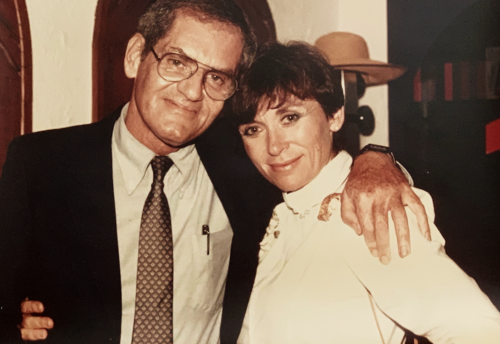
Eli and Lisa Doane Timoner when they lived in Miami. (Photo courtesy of MTV Documentary Films)
“My mom was watching television two days before and on ‘Hour Magazine’ she saw a segment about not having your neck manipulated because it could cause stroke. It was like a warning from above,” Ondi recalls.
Ten minutes after the massage, her father, then 53, collapsed in the locker room shower of the spa. He had suffered a stroke ultimately caused by the neck manipulation.
Life changed completely for the family. He was told to step down from the airline not long after the stroke. “On July 10, 1982, the board of directors said to him, ‘What do you think Wall Street will think of a cripple running an airline?’ ”
Ondi remembers their idyllic life for her mother and dad in Miami – “pillars of Miami society” before the debilitating stroke paralyzed his left side. “They were so active in bringing the arts to Miami – on the board of the Miami City Ballet, YoungArts and so many arts organizations.”
The family lived for a bit in Coral Gables, but she says her growing years were spent in South Miami, SW 101st Street and Ludlam Road. “I went to Pinecrest Elementary School and I remember riding bikes in our neighborhood. There was also one time when we had an alligator in our swimming pool and my mother didn’t believe it when my brother told her,” Ondi recalls.
Seven months prior to Eli’s stroke, on Jan. 13, 1982, Air Florida Flight 90 heading to Fort Lauderdale from Washington National Airport crashed shortly after takeoff. Investigators found that the cause of the crash was ice, snow and slush on the wings of the Boeing 737, which ended up dragging the plane down killing 78 people.

The Timoner family at Boeing headquarters in Seattle on Oct. 30, 1979. (Photo courtesy of MTV Documentary Films)
But it wasn’t that ill-fated flight that forced Air Florida into a tailspin and plunged Eli and his family into bankruptcy, according to Ondi. After his forced retirement, he was replaced by a man named Donald Lloyd-Jones. “He was the guy who pushed Dad out. He had only been there a month and after my father’s stroke he saw an opportunity to steal the airline. He apparently drank a bottle of vodka a day and did crossword puzzles while the airline went into the ground.”
In 1984, Air Florida went bankrupt and shut down.
There are glimpses of the heydays of Air Florida in the documentary and, as part of the film, Zoom calls lined up for people to say their last goodbyes to Eli, including some of his past employees.
Ondi says she’ll save the story of Air Florida for the narrative film she’s creating on the life of her father, the businessman. “I have wanted to do a documentary for so long about him and Air Florida, but there isn’t a lot of archival footage, so I thought I would make it another way.” She says she read him the script by his bedside during those final days of his life.
In “Last Flight Home,” Rabbi Rachel sits with her father for the vidui, the Jewish ritual of a final confessional. “The shame that he was carrying wasn’t the accident,” says Ondi, who makes it clear that there were four parties sued in the settlement for the series of deicing errors from that 1982 accident – American Airlines, Boeing, air traffic control and Air Florida.
“The confessional was more about the shame he carried about how he felt like a failure because he couldn’t provide for us.”

The siblings David, Ondi and Rachel with their father, Eli, in the film “Last Flight Home.” (Photo courtesy of MTV Documentary Films)
“Last Flight Home” will make audiences question their own mortality, she believes, and share in how it felt for Eli in his last days and the life’s lessons she watched him learn.
The film has left her with many things to think about, too, and her own fate.
She shares the story that while part of a question-and-answer session at the British Academy of Film and Television Arts recently, someone brought an interesting thought to mind. “‘ Do you think maybe you were born into this family and became a filmmaker so that you could make this film?’ ”
She’s come to a conclusion based on the query.
“I do think making ‘Last Flight Home’ was something I had been preparing for and it is part of my destiny,” says Ondi.
WHAT: “Last Flight Home”
WHERE: Coral Gables Art Cinema, 260 Aragon Ave., Coral Gables.
WHEN: Opens Friday, 11/18 runs through Thursday, 11/24. Opening night screening and in-person question and answer, 6 p.m. Friday with director Ondi Timoner and her mother and Eli’s wife, Lisa Timoner.
COST: $21.75 for opening night screening and question and answer session, $17 for cinema members. Regular screening price, $12.75, $8 for cinema members.
INFORMATION:786-472-2249 or gablescinema.com
ArtburstMiami.com is a nonprofit source of dance, visual arts, music and performing arts news. Sign up for our newsletter and never miss a story.
No posts found
‘Ocean Filibuster’ lights a fuse as a theatrical wake-up call on climate change
Written By Helena Alonso Paisley
November 9, 2022 at 5:25 PM
Jennifer Kidwell as The Ocean in PearlDamour’s “Ocean Filibuster” opening Saturday, Nov. 12 inside the Carnival Studio Theater at the Adrienne Arsht Center as part of Live Arts Miami’s EcoCultura series. (Photo courtesy of Maggie Hall)
The telltale brown dots on the map of Miami-Dade’s coastline don’t lie. According to a recent Blue Water Task Force report, enterococcus bacteria levels were dangerously high at four of Miami-Dade’s beaches. In layman’s terms, that means there are too much feces in the water. It was not always this way.
The ocean, if we bother to listen, has a message for us.
Here to convey that message is “Ocean Filibuster,” a work of multimedia immersive theater playing Saturday, Nov. 12 through Sunday, Nov. 20 inside the Carnival Studio Theatre at the Adrienne Arsht Center’s Carnival Studio Theater.

Actress Jennifer Kidwell in PearlDamour’s “Ocean Filibuster,” a work of multimedia immersive theater. (Photo courtesy of Maggie Hall)
PearlDamour, the Brooklyn-based creative duo made up of director Katie Pearl and writer Lisa D’Amour, envision an imaginary showdown between the Ocean and a fictional World Senate that wants to cut her down to size, thus making room for—you guessed it—more people and more of their stuff.
The action takes place at the Senate’s international chambers, where Mr. Majority is lobbying. In his view, according to Pearl, the Ocean is “dangerous and sick and needing to be tamed” and he wants to ship her off the planet. After all, wouldn’t it be great to be able to just hop into your car and drive from Hialeah to Havana?
As Mr. Majority argues his case, the Ocean arrives to give her defense, making her entrance on a mound of trash. The kicker is that both Mr. Majority and Ocean are embodied by one actor, OBIE-winning performer Jennifer Kidwell.
A graduate of Philadelphia’s Pig Iron School, Kidwell is well-versed in the rigors of experimental, physical theater. Critics often praise both her acting chops and her onstage charisma. She recently appeared in the Tony-nominated “Fat Ham” at New York’s The Public Theater and this October premiered the comedy “Those with 2 Clocks” at Philadelphia’s Wilma Theater.

Jennifer Kidwell morphs between the roles of the Ocean and Mr. Majority, who is lobbying the World Senate to shrink the oceans down to a “more manageable size” in “Ocean Filibuster.” (Photo courtesy of Pin Lim, Forest Photography)
“Jenn just loves a performance challenge,” says D’Amour, “and what a challenge it is to play these two roles. The piece is not that long, but it really is quite demanding.”
The actor morphs from one character to the other in transformations that are subtle but compelling.
“It’s a jacket coming on and off, sometimes it’s glasses coming on and off . . . it’s very slippery and sneaky,” according to D’Amour.
Whether the Ocean fascinates you or frightens you, audiences learn in this show how crucial it is to our survival on this planet. If you enjoy breathing, thank the ocean, which produces more than half of our oxygen. Hungry? The ocean is the primary source of protein for a third of the world’s population. Finally, oceans are a critical carbon sink, sequestering in their depths the carbon dioxide we humans so busily produce on Terra Firm. In that regard, Pearl says that the ocean “is a little bit of a human enabler because we’re putting all this carbon into the air and the ocean is just taking care of it—until it can’t anymore.”
Although the work’s subject matter is about as serious as a heart attack, Pearl says that the show can nevertheless be “abstract and experimental and playful,” often using music to convey its message. The wildly creative New York composer Sxip Shirey, who turns to everything from electronics to found objects in order to create rhythm and melody, explores many different musical genres in “Ocean Filibuster.”
“There’s one song that feels like a faux patriotic anthem, one feels like a ballad, one feels like a straight-up pop song, one has a little bit of a sort of a punk energy to it,” D’Amour says. “We don’t call it a musical because it doesn’t have a traditional musical structure, but there’s song throughout.”
Here in Miami, singers Tyle Hooker, Nikita Orlhac, Kevin Martinez, Caterina Petti, Gabriella Villalobos, all BFA opera students from New World School of the Arts, join Kidwell on stage and do much of the singing. In flowing, pleated costumes designed by award-winning Serbian costumer Olivera Gajic, the chorus looks like they could have just stepped off a winning float from Key West’s Fantasy Fest. Gajic fashioned their fanciful headpieces from water bottles that were heated, melted and stretched to form elaborate coronas.

The Ocean Choir enters in costumes and headdresses designed by award-winning Serbian costumer Olivera Gajic in “Ocean Filibuster” in a photo from the American Repertory Theater Production. The headpieces are fashioned from heated and stretched plastic water bottles. (Photo courtesy of Maggie Hall)
The show also uses expansive video with animated, hand-drawn images that aim to create a sense of wonder and to allow the audience to experience the ocean not from above the water, but from within. ” ‘The Ocean,’ D’Amour says, “hypnotizes the audience into thinking that they are a deep-sea fish . . . I just wanted the audience to feel immersed, to be able to get taken to places that they would never get a chance to go.”
The intermission is a hands-on affair, where theater-goers will be able to playfully embody and imagine some of the concepts the piece discusses. “It’s a combo of, like, science concepts and whimsy and wonder,” D’Amour says.
There are games that were designed by Ph.D. students from The Girguis Laboratory, a lab at Harvard University that investigates all manner of astonishing deep-sea critters. If you could have your brain redistributed, one game asks, would you put in each of your extremities, as does the octopus with its independently “thinking” tentacles, or would you, perhaps, prefer it in your stomach? The Ocean Conservancy and the University of Miami’s Rescue-a-Reef scientists helped develop the Coral Reef “Thrive or Die” game, with crocheted corals by yarn artist Debora Rosental, sculpture by the Miami Dade College Earth Ethics Institute and 3-D printing by the college’s Makers Lab.
This week, for the first time, the UN Climate Change Conference will have an Ocean Pavilion at the delegations-only Blue Zone. Scientists recognize that it will take a diverse array of voices to find solutions to the crises our oceans face.
With “Ocean Filibuster,” PearlDamour has made itself part of this vital conversation.
WHAT: Live Arts Miami’s EcoCultura series presents PearlDamour’s “Ocean Filibuster”
WHERE: Adrienne Arsht Center for the Performing Arts Carnival Studio Theater, 1300 Biscayne Blvd, Miami
WHEN: Opens 8 p.m., Saturday, Nov. 12. Shows are at 8 p.m. Thursday, Nov. 17, Friday, Nov. 18 and Saturday, Nov. 19 with matinees at 2:30 p.m. Sunday, Nov. 13, Saturday, Nov. 19 and Sunday, Nov. 20
TICKETS: $45, $10 discount with promo code WAVES valid Nov. 12 and 13
INFORMATION:305-949-6722 or arshtcenter.org
ArtburstMiami.com is a nonprofit source of dance, visual arts, music and performing arts news. Sign up for our newsletter and never miss a story.
No posts found
Miami Book Fair turns the city into a book lover’s dream
Written By Jonel Juste
November 9, 2022 at 1:35 PM
The weekend street fair is a draw to the eight-day Miami Book Fair, buzzing with live music, art, performances, and live readings. (Photo courtesy of the Miami Book Fair)
Miami. The Magic City. Known for its nightlife, parties, and beaches. But this month, Miami becomes the Book City.
During eight days, from Sunday, Nov. 13 through Sunday, Nov. 20, the Miami Book Fair 2022 will host approximately 250 booksellers and exhibitors, and more than 500 authors with both in-person and virtual events in English, Spanish and Haitian Creole.
Among the authors that will meet readers at the Wolfson Campus at Miami-Dade College are Russell Banks (“The Magic Kingdom”), Matthew Ball (“The Metaverse: And How It Will Revolutionize Everything”), “Saturday Night Live’s” Kevin Nealon (“I Exaggerate: My Brushes with Fame”), Azar Nafisi (“Reading Dangerously: The Subversive Power of Literature in Troubled Times”), Patti Smith (“A Book of Days”), Anne McCrary Sullivan (“The Everglades: Stories of Grit and Spirit from the Mangrove Wilderness”), Maud Newton (“Ancestor Trouble: A Reckoning and a Reconciliation”), and Jose “Fat Joe” Cartagena (“The Book of Jose: A Memoir.”)
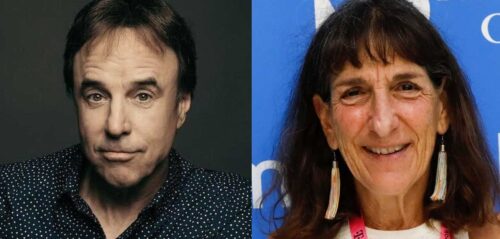
Kevin Nealon opens the Miami Book Fair with his memoir, journalist and author Kathie Klarreich will participate in the fair with her anthology “Don’t Shake the Spoon: A Journal of Prison Writing, Volume 3.” (Photos courtesy of Miami Book Fair)
Miami Book Fair has been running for 39 years, making it one of the longest-running literary events in the country.
So, Miami, the Book City?
“Most definitely,” agrees Lissette Mendez, director of programs at Miami Book Fair. “I think Miami is known for much more now – lots of art and culture events have been nurtured and grown roots since 1984, when the fair was founded. The fair, which has always been produced by Miami-Dade College, was part of a small vanguard that proved you can enjoy the beach and the nightlife, but also books and literary culture activities,” says Mendez.
So apart from its leisure aspect, Miami is also gaining a reputation as a city of literature, and hundreds of authors contribute each year to make Miami stand out, especially local authors such as Christina Diaz Gonzalez, Edwidge Danticat, Julie Marie Wade, Nadege Green, Vanessa Garcia, Pablo Cartaya, Chantel Acevedo, Natalia Sylvester and many more.
Mendez says that a good deal of the book fair program is focused on Miami and Florida, featuring authors who live and work in this city. Their contributions have cemented Miami in the larger literary ecosystem as a place where great stories are written, whether in English, Spanish, or Creole.
As a city, Miami itself is the setting of many novels. Mendez agrees that there’s something about the city that makes it prime for writers. “There is so much going on in Miami all the time. So much history related to the many waves of immigrants who have contributed to the creation of Miami. There is so much mythology – going back hundreds of years. There’s just a lot of source material for authors to be inspired by, or to cover, in nonfiction,” says Mendez.
She says regardless of the genre the writers work in, whether it be poetry, fiction, or non-fiction, they all have something in common.
“(It is) the nuance they bring to these Miami- or Florida-centric writings. This is the level of detail about our home state and city that allows for a deeper knowledge and understanding and contributes to a more expansive view of what Miami is all about,” explains Mendez.
Miamian author Pablo Cartaya, who will sign “The Last Beekeeper” at this year’s event, takes great pride in calling the 305 his home. “Whenever I travel around the country discussing books with readers, I represent Miami with all my heart.”
“My abuelos called this place home after losing their beloved homeland in Cuba. My family is here. My community, and my culture. When you love a place, you feel great pride in coming home to contribute to a beautiful event like the Miami Book Fair,” Cartaya says.
A journalist and author, Kathie Klarreich will participate in the fair with her anthology “Don’t Shake the Spoon: A Journal of Prison Writing, Volume 3.” She describes her journal as unique in that “the voices of writers who have been incarcerated (and have been) are being shared with the public.” Klarreich says the writers will participate in a panel. “Their participation on our panel authenticates the voices in the book and adds a dimension to the reality that tens of thousands of writers face, not just in Florida prisons but worldwide,” she says.
Nadege Green will participate in the exchange of ideas with “More Than What Happened: The Aftermath of Gun Violence in Miami,” a community book written by Miamians about gun violence.

Nadege Green’s “More Than What Happened: The Aftermath of Gun Violence in Miami” is a community book written by Miamians about gun violence. Tackling another issue, Pablo Cartaya, wants to educate about the environment in “The Last Beekeeper.” (Photo courtesy of Miami Book Fair)
A longtime Miami Book Fair fan, an avid book buyer, a moderator, and reporter, the 36-year-old Haitian American author confesses that the book is all about memory, healing, grief, survival, resisting, and more.
“O Miami reached out to me to edit the last book in the ‘Miami Trilogy,’ a three-book series that speaks to our city’s most pressing issues. I immediately knew I wanted this book to be about local gun violence,” says the former WLRN reporter.
“We’re used to hearing about gun violence as a crime story, not a human story. What happens after? How do people process loss and grief over time? What does it mean to always be on alert at school because of the threat of shootings? This anthology made up of contributions from people in Miami delves into the interior of how our neighbors deal and react to this very real issue,” says Green.
Tackling another issue, Cartaya, wants to educate about the environment in his dystopian middle-grade publication, “The Last Beekeeper.” Set about 125 years in the future, a pair of sister bees are fighting greedy forces in order to save the world’s last bee colony and repopulate the earth’s crops.
“I wrote this book taking into account the increasing intensity of natural disasters across the world,” Cartaya says, recalling the Texas freeze a few years ago and Hurricane Ian that swept through Florida’s west coast recently.
“I want young people to imagine a world where nature has done her worst. The novel is set in an isolated, desolate world. As humans begin to rebuild, the battle between technology and nature rages once again. The question I leave for my young readers is: What side do they want to be on? With respect to living with nature or with an over-dependence on technology? The choice is theirs,” the author concludes.
Miami is, as we all know, a multicultural city with a kaleidoscope of cultures, whether Hispanic, Caribbean, Caucasian, Haitian, or African American. The organizers say they ensure the fair reflects this diversity.
“There are authors and books that reflect all of these cultures and themes and topics that explore most facets of life,” says Mendez. “I particularly love that even when a culture is not as widely represented in Miami as in other cities or states, we bring those authors and books to the Fair too – for example, our 2022 emphasis on stories from the Middle East and South Asia.”
Because Miami is a Hispanic and Caribbean city, there is a space dedicated to Hispanic and Caribbean authors. In the IberoAmerican Authors section, fair participants can find conversations and panels with noted Latinx and Hispanic authors, journalists, poets, essayists, storytellers, and visual artists and photographers who travel to Miami Book Fair each year to share their work and thoughts.
The Read Caribbean section presents literary events centered on Haitian and Caribbean diaspora including readings and panel discussions, storytelling for children, music, and more. Florida has the highest Haitian population in the country, with most of them settling in Miami. Every year, Haitian authors are invited to discuss literature and other related topics. This year is no different as the book fair has invited authors Jacky Lumarque, Herold Toussaint, Michel Frantz Grandoit, Phillipe Matthieu and journalists Marie-Lucie Bonhomme, Frantz Duval, and Roberson Alphonse to talk about Haiti.

Music is also present during Miami Book Fair at Wolfson campus as part of its street fair activities. (Photo courtesy of Miami Book Fair)
Miami Book Fair launches on Sunday, Nov. 13, with an evening with “Saturday Night Live” alum Kevin Nealon on his book “I Exaggerate: My Brushes with Fame”, and Alan Zweibel, author of “Laugh Lines: My Life Helping Funny People Be Funnier: A Conversation.”
The fair will continue during the week with the “Evenings with” series, which are “intimate conversations” between the authors and their audience including notable names like Harvey Fierstein with his memoir, New York Times bestselling author Michael Pollan talking about his book “This Is Your Mind on Plants,” Charlayne Hunter-Gault with “My People: Five Decades of Writing About Black Lives” and former Dallas Cowboys coach Jimmy Johnson talking about his book “Swagger: Super Bowls, Brass Balls, and Footballs: A Memoir” joined by Sun Sentinel newspaper sports columnist David Hyde.”
The weekend street fair is another draw where, through the streets of the Miami Book Fair, is an open-air marketplace where books and everything related to writing, including pencils, pens, journals, and stationary, are sold over three days from Friday, Nov. 18 through Sunday, Nov. 20. There’s also entertainment including a street fair buzzing with live music, art, performances, live readings, and activities for the kids at Children’s Alley.
Mendez says Miami Book Fair’s vision remains the same as it approaches four decades.
“Our vision is to build a community of writers, readers, and collaborators across all disciplines and cultures in South Florida,” says Mendez.
WHAT: Miami Book Fair 2022
WHERE: Miami-Dade College, Wolfson Campus, 300 NE Second Ave, Miami, FL 33132.
WHEN: November 13-20
COST: Single-day admissions: $10, $5, ages 13 through 18 and those over 62 years of age; free for those ages 12 and younger
INFORMATION: 305-237-3258 or miamibookfair.com
ArtburstMiami.com is a nonprofit source of dance, visual arts, music and performing arts news. Sign up for our newsletter and never miss a story.
No posts found
Review: An improbable couple finds what’s missing in ‘Heisenberg’ at GableStage
Written By Christine Dolen
November 1, 2022 at 1:20 PM
Colin McPhillamy as Alex resists Margery Lowe as Georgie taking his photo in “Heisenberg” at GableStage. Photo by Magnus Stark.
Science and art sometimes collide – or coalesce, maybe – when a playwright decides to craft a drama suffused with an idea from the world of physics.
Nick Payne did it in “Constellations.” Simon Stephens, who adapted “The Curious Incident of the Dog in the Night-Time” into a Tony (and Olivier) Award-winning play, uses the device in “Heisenberg,” a two-hander which has just kicked off the 2022-23 season at GableStage.
Producing artistic director Bari Newport explains in her program notes German physicist Werner Heisenberg’s 1927 uncertainty principle this way: “…the uncertainty principle states that we cannot know both the position and speed of an object with perfect accuracy; the more we nail down the object’s position, the less we know about its speed and vice versa.”
The woman in the play, she adds, has “speed but no anchor.” The man is “stuck,” with no clear way forward.
So of course, in the way these things tend to go, the two meet and change each other’s lives.
A few things to know about the 80-minute play, which was done Off-Broadway in 2015 and on Broadway in 2016: You needn’t understand physics in general or the uncertainty principle specifically to experience and enjoy “Heisenberg.” There is no connection between Walter White’s drug alias in “Breaking Bad” and the play title. And you won’t learn anything about Werner Heisenberg – for that, turn to Wikipedia or read the script of Michael Frayn’s “Copenhagen.”
Staged by Newport, “Heisenberg” plays out over six scenes as strangers in London become, however improbably, the life-changing answer to unspoken prayers.

Colin McPhillamy as Alex is briefly bemused by Margery Lowe’s Georgie in “Heisenberg” at GableStage. Photo by Magnus Stark
Georgie Burns (Margery Lowe) is a kooky, potty-mouthed 42-year-old American who speaks at two volumes: loud and louder. Alex Priest (Colin McPhillamy) is a 75-year-old British butcher whose accent ever so slightly hints at his childhood in Ireland.
They don’t meet cute, as characters so often do in the movies. Instead, before the lights go up, Alex is sitting on a bench at St. Pancras railway station, minding his own business as he listens to music. Georgie walks up behind him and kisses the back of his neck. Then the play begins, with Alex rattled and Georgie apologetic.
Revelations come quickly from Georgie, who abhors silence, but her sometimes outlandish claims are those of a self-confessed liar, so who knows which autobiographical nuggets are true? At one point she asks Alex, “Do you find me exhausting but captivating?” Yes to the first part.

Margery Lowe’s Georgie offers another opinion to Colin McPhillamy’s Alex in “Heisenberg” at GableStage. Photo by Magnus Stark
Alex, on the other hand, takes time to loosen up and begin sharing, a process that accelerates a wee bit after the two have sex. He’s a contemplative type who experienced too much loss in youth and thus created an ordered, isolated existence for himself. But Georgie is wrong when she tells him, “You’re not so much a creature of routine as a psychopathic raging monster of it.” Um, no he’s not.
Secrets are embedded in “Heisenberg,” secrets that it wouldn’t be fair to share. See the play if you’re curious as to how these two, so different in age and personality, deal with the unexpected turns in their lives.
Newport and her design collaborators have kept the look of play’s world simple, largely using black-and-white projections by Alessandra Cronin along the back wall of Frank J. Oliva’s archway set. Clear rectangular cubes, moved before each scene by silent black-clad figures, become everything from a railway bench to Alex’s bed. Sean McGinley provides the sounds of trains, traffic, Alex’s beloved Sonata for Violin and Piano in B Minor by Bach. Lighting designer Tony Galaska enhances each scene’s mood.
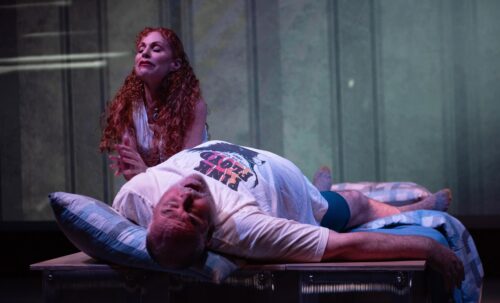
Margery Lowe as Georgie and Colin McPhillamy as Alex enjoy some bedded bliss in “Heisenberg” at GableStage. Photo by Magnus Stark
In New York, Georgie Burns (a nod to the late, legendary comedian?) was played by Mary Louise Parker, who does irresistible craziness as well as anybody. Lowe, who urged Newport to produce “Heisenberg,” puts her own spin a role designed by Stephens to be big and, now and then, alienating. This performance is thus as far away as possible from the dreamy, layered complexity Lowe conveyed as in her much lauded-turn as Emily Dickinson in “The Belle of Amherst” at Palm Beach Dramaworks.
Even Camilla Haith’s costumes for Georgie seem to yell, “Look at me! I’m eccentric!” Lowe’s Georgie is seldom still, a physical match to her verbal excess. In part because of that, when she has a quiet, truthful, revelatory moment, it lands with far more emotional impact, as when she confesses the pain in her estrangement with her son: “I don’t know what I’m supposed to have done wrong.”

Colin McPhillamy and Margery Lowe share a tender moment in “Heisenberg” at GableStage. Photo by Magnus Stark
McPhillamy, whose lengthy acting resume includes Broadway, London, major regional theaters and many a South Florida theater company, is a master craftsman when it comes to rich silences and painting pictures with words. His Alex slowly thaws, rejoins the living despite the comparative brevity of the life remaining to him. When he takes Lowe’s Georgie into his arms for a dance (beautifully choreographed by Jeni Hacker), the moment becomes a physicalized sigh of joy and relief.
Whether you experience “Heisenberg” through the more challenging lens of a play rooted in the uncertainty principle or decide to watch an unlikely relationship play out, know this: Stephens has layered plenty of truths about navigating life into his script, truths illuminated by Newport, Lowe and McPhillamy.
WHAT: “Heisenberg” by Simon Stephens
WHERE: GableStage in the Biltmore Hotel, 1200 Anastasia Ave., Coral Gables
WHEN: 2 and 7 p.m. Wednesday, 8 p.m. Thursday-Saturday, 2 p.m. Sunday (additional matinee 2 p.m. Nov. 19), through Nov. 20 (streaming available from Nov. 4)
COST: $45-$75 (includes fees)
INFORMATION: 305-445-1119 or gablestage.org.
ArtburstMiami.com is a non-profit source of theater, dance, music, film and performing arts news. Sign up for our newsletter and never miss a story.
No posts found
Review: Miami New Drama’s world premiere of ‘Elián’ is surprising and superbly acted
Written By Christine Dolen
November 1, 2022 at 12:14 PM
The cast of Rogelio Martinez’s world premiere of “Elián” at Miami New Drama is shown with their real-life counterparts. Photo credit Andres Manner.
In the moment, the battle over Elián González was a hugely impactful struggle for those who lived it and for Miami’s Cuban exile community.
Twenty-three years later, the story of a Cuban boy whose mother drowned trying to bring him to freedom in the United States still has lessons to impart, nuances to explore, political ramifications to ponder.
Rogelio Martinez’s “Elián,” a commissioned Miami New Drama world premiere, is revisiting that volatile time in late 1999 and early 2000 when Elián was at the center of an international custody battle.
Ostensibly, the fight was between his father Juan Miguel, who wanted the boy returned to him in Cuba, and Elián’s Miami relatives, who took him in after his Thanksgiving Day rescue from the Atlantic Ocean three miles off the Fort Lauderdale coast. In truth, at least as “Elián” sees it? Fidel Castro knew a six-year-old could be a powerful propaganda tool.
Staged by Miami New Drama artistic director Michel Hausmann, Martinez’s play has an intermingling duality.

Andhy Mendez plays attorney and future Miami Mayor Manny Diaz in the world premiere of “Elián” at Miami New Drama. Photo credit Andres Manner.
One is a fairly straightforward, deeply researched retelling of the story by those who lived it, with González family attorney and future Miami mayor Manny Diaz (Andhy Mendez) as its strategic center. The other is a wild, narcissistic recounting by political operative and dirty trickster Roger Stone (Mike Iveson), who does have a link to the Elián story – and, the script suggests, to Vice President Al Gore’s loss in the 2000 presidential election.
For this ambitious drama – or maybe, given Stone’s character, the play verges on becoming a dramedy – Hausmann uses nine actors to play more than 20 characters.
Elián himself is seen only in projected videos or photos from that time, the most chilling being Alan Diaz’s Pulitzer-winning photo of an armed federal agent pointing his weapon at a terrified boy during the early-morning raid that would return him to his father. Otherwise, we hear the sound of too-loud childish laughter offstage or see one of the boy’s toys appear to remind us that yes, an innocent child is present in a small home surrounded by chaos.
The actors in “Elián” embody such excellence and versatility that savoring their work becomes a key reason to see the production.

Mike Iveson plays a trouble-making, sardonic Roger Stone in the world premiere of “Elián” at Miami New Drama. Photo credit Andrés Manner.
Iveson plays both Stone and President Bill Clinton, transforming into the latter by altering his accent and unzipping his fly, a running bit that never fails to get giggles from the audience. His Stone is a comic wonder, charismatic, crude, awful, irresistible.
Mendez is quietly intense as Manny Diaz, who led the dramatic 11th hour negotiations to keep Elián in Miami, and he also voices the puppet comically representing Fidel Castro. Putting aside the fact that Castro was more the puppeteer (he threatened to launch a second massive Mariel boatlift if Elián wasn’t returned to his father), the actor’s Castro voice is so high and quick that some of the lines don’t land.
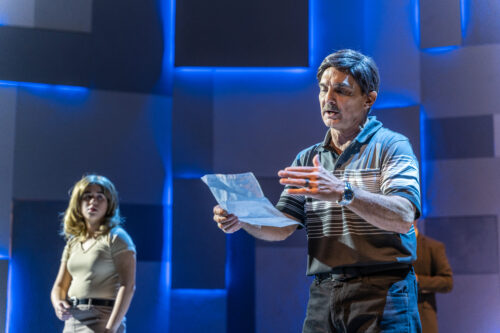
Cristina Ortega as Marisleysis looks on as Jonathan Nichols-Navarro as Lázaro González makes a decision in the world premiere of “Elián” at Miami New Drama. Photo credit Andres Manner.
Jonathan Nichols-Navarro, whose roles include Cuban National Assembly president Ricardo Alarcón and the ghost of Cuban American National Foundation (CANF) founder Jorge Mas Canosa, is compelling and sometimes wry as Elián’s great uncle Lázaro, whose Little Havana home was ground zero in a media circus.
Nichols-Navarro also transforms before our eyes into Lázaro’s older brother Delfin, a former political prisoner who was first in the González family to come to Miami. He delivers a speech in Spanish about La Virgen de la Caridad del Cobre, Cuba’s patron saint, linking her to Elián’s rescue. The actor’s performance of that passage is so powerfully heart-wrenching yet filled with faith and joy that you cannot fail to be moved, even if you don’t know a word of Spanish.
Carmen Pelaez, a fine playwright and actor who has found a creative home at Miami New Drama, gets to demonstrate her transformative chops, including a bit as future Vice President Dick Cheney’s assistant, charged with keeping the obnoxiously condescending Stone away from her boss.
Caleb Scott as Greg Craig, Daniel Capote as Jorge Mas Santos and Carmen Pelaez as Janet Reno contemplate a little boy’s future in the world premiere of “Elián” at Miami New Drama. Photo credit Andres Manner.
Pelaez gets laughs as the fierce and very recognizable media personality Ninoska Pérez Castellón, whose fiery approach to the Elián situation didn’t sit well with Jorge Mas Santos, her then-boss at CANF. She is also (after a bizarre yet hilarious introductory dance) a low-key and logical U.S. Attorney General Janet Reno, the Miami native who was bullied by Clinton into resolving the Elián fight and taking the political heat.
Playing a variety of roles, René Granado conveys the nervousness of Elián’s father Juan Miguel in his first meeting with Castro, subtly suggesting that bringing Elián home to Cuba may not have been his original plan. He’s also amusing as Armando Gutierrez, a “family” spokesman trying to monetize the situation at Lázaro’s home and insisting all checks be made out to him.
Caleb Scott’s work in “Elián” is also an absolute marvel of versatility. He morphs from a politically calculating Al Gore to Clinton attorney Greg Craig to Donato Dalrymple, the “fisherman” who became a González family groupie addicted to media attention.

Andhy Mendez as Manny Diaz gets into a verbal tussle with Caleb Scott as Greg Craig in the world premiere of “Elián” at Miami New Drama. Photo credit Andres Manner.
Daniel Capote is sincere and straightforward as Mas Santos, the man determined to take CANF and its power in a new direction, and he gets a comic turn as one of two men named Carlos who advise Diaz on how to resolve the crisis. Cristina Ortega, a recent New World School of the Arts grad making her debut as Lázaro’s daughter Marisleysis, conveys the intense emotion of a young woman who assumed the main caregiving role for her little cousin. Gaby Tortoledo plays several wives – Diaz’s, Mas’s, Stone’s – as well as media types, effectively differentiating each character.
To create the environment for telling such a sweeping story with multiple locations, Miami New Drama turned again to the Carbonell Award-winning, New York-based design team of Christopher and Justin Swader, who have created six previous sets for the company. This one consists of a towering wall of squares surrounded by lights that can disappear or change color, with multiple doorways set into the wall.
Projections by Yana Biryukova shift locations from Miami to Cuba to Washington D.C., and they allow for the emotion-stirring child version of Elián to be shown. Kirk Baran-Bookman’s lighting anchors the shifting scenes, and Salomon Lerner’s sound-music design summons time and place. Costume designer Christopher Vergara respects the turn-of-the-century styles and uses them to help communicate place and class, and wig designer Carol Raskin does her bit to help with all of those actor transformations.
New plays are tricky to pull off, and though this one has been polished and honed and edited, this first production of a play by the incisive Martinez offers the opportunity for more tweaking.

Andhy Mendez as Manny Diaz and Mike Iveson as Roger Stone tell dueling stories in the world premiere of “Elián” at Miami New Drama. Photo credit Andres Manner.
The playwright and Hausmann might look at finding an even better balance between the serious story and the abundant laughs. Though the play runs just a couple of hours with an intermission, there are so many scenes that sometimes it seems as if the characters are charging in from the doors, standing in a near-void, then quickly departing to make way for the next scene.
Several lines pointedly make connections between politics circa 2000 and today, and a bit more of that would certainly resonate. And although “Elián” was written as a piece for and about Miami’s Cuban-American community, the cascade of characters is large enough that it wouldn’t hurt to put an insert in the program briefly describing each of the real figures being portrayed.
Hausmann and his Miami New Drama colleagues continue to hew to the company’s mission as they tell fresh stories about our diverse, unique community. “Elián” turns out to be a thought-provoking surprise, one that is bringing out the best in a company of actors from South Florida and beyond.
WHAT: “Elián” by Rogelio Martinez
WHERE: Miami New Drama world premiere at the Colony Theatre, 1040 Lincoln Rd., Miami Beach.
WHEN: 8 p.m. Thursday-Saturday, 3 p.m. Sunday, through Nov. 20
COST: $46.50-$76.50 (includes service fee)
INFORMATION: 305-674-1040 or miaminewdrama.org
ArtburstMiami.com is a non-profit source of theater, dance, music and performing arts news. Sign up for our newsletter and never miss a story.
No posts found
Miami New Drama’s ‘Elián’ ready to revisit flashpoint in Cuban exile history
Written By Christine Dolen
October 26, 2022 at 11:42 AM
The cast of Miami New Drama’s “‘Elián,” from left are: Mike Iveson, Gaby-Tortoledo, Daniel Capote, Rene Granado, Caleb Scott, Carmen Pelaez, Jonathan Nichols-Navarro, Cristina Ortega, and Andhy Mendez. (Photo courtesy of Andrés Manner)
When two cousins who were out fishing found a boy bobbing in an inner tube three miles off the Fort Lauderdale coastline, he was so small the men thought they were looking at a doll, someone’s idea of a cruel joke.
They were wrong.
Elián González was rescued that day – Nov. 25, 1999 – after a frightening journey in a small boat that left Cuba from Cárdenas, its passengers bound for Miami and hoping for a better life. Only five-year-old Elián and two others made it to Florida. The other 11, including the boy’s mother Elizabeth Brotons Rodríguez, drowned after the boat capsized.
If you lived in Miami then, if you followed what happened after Elián’s rescue, you know that the boy who had just lost his mother became a high-stakes symbol – or a pawn – in an escalating tug-of-war.
On one side: Fidel Castro, Elián’s father Juan Miguel González, advocates for fathers’ rights and, ultimately, the United States Justice Department, all declaring Elián should be returned to his father in Cuba.
On the other: The boy’s relatives who took him into their Little Havana home, outraged members of the Miami Cuban exile community and countless politicians, who demanded Elián be allowed to stay and grow up in freedom.
You know that story, right? Perhaps. But 23 years after the painful battle played out, Miami New Drama is preparing to provide fresh insight into a saga that continues to sting.
The world premiere of “Elián” by Cuban-American playwright Rogelio Martinez – a surprising, tragic, farcical, moving version of the story – will preview Thursday and Friday, Oct. 27 and 28 and open on Saturday, Oct. 29 for a run through Nov. 20 in the company’s home at the Colony Theatre on Miami Beach’s Lincoln Road.
“At the end of the day, it’s a human story. Everybody knows what happened to the boy. What they don’t know is the narrative,” says actor Andhy Mendez, who plays two very different characters in “Elián.”

Playwright Rogelio Martinez and director Michel Hausmann working together on the world premiere of Miami New Drama’s “Elián.” (Photo courtesy of Andrés Manner)
Michel Hausmann, Miami New Drama’s cofounder and artistic director, commissioned the play and is directing its premiere. He had a deep involvement in the developmental process, accompanying Martinez when the playwright made multiple research trips to Miami to interview key figures in a story that, judging from some social media comments on “Elián” promotional posts, can still provoke rage.
“This was a holy moment, a pivotal moment for our community. The play has to be smart and sophisticated enough to be part of the conversation,” says Hausmann, who points out that “Elián” is a dramatic work, not a journalistic one, but that the script is grounded in fact. “I think it’s the most important play we’ve ever presented.”
Martinez, who left Cuba with his mother as a nine-year-old on the Mariel boatlift in 1980, grew up in New Jersey and still lives in the northeast. He is an award-winning playwright – a Guggenheim Fellowship, a Princess Grace Award and multiple other honors – whose work has been produced by major regional theaters all over the United States.
His gluttony-themed play “Itsy Bitsy Spider” (about ex-president Richard Nixon, dreaming of a comeback) was part of Miami New Drama’s acclaimed “Seven Deadly Sins” project. His Cold War Trilogy plays – “Ping Pong” (United States-Chinese relations during the Nixon era), “Born in East Berlin” (the impact of a 1988 Bruce Springsteen concert on East Germans before the fall of the Berlin Wall) and “Blind Date” (Ronald Reagan’s 1985 summit meeting with Mikhail Gorbachev in Geneva) – demonstrate his highly theatrical treatment of history, politics and policy.
Hausmann, who comes from Venezuela, says that collaborating with Martinez, who brought a different perspective to the storytelling as both a Miami outsider and a Cuban-American, has been deeply rewarding.
“[The resolution of] Rogelio’s story is the opposite of Elián’s. He’s a Marielito. He came to the United States with his mother on a boat and never saw his father again,” Hausmann says.
The “Elián” collaboration works, Martinez believes, because of what he, Hausmann and Miami New Drama bring to the table.
“Michel is great at storytelling. I am strong with character. We complement each other, and we both love the theatrical,” Martinez says. “I think I had enough distance to tell a story that can be both gripping and entertaining,” the playwright says of his perspective. “Maybe I would have been less inclined to make those bold choices in comedy. But I am an exile. I have strong opinions.”
In rehearsals, Martinez has whittled his original 140-page script to about 100 pages, eliminating some characters, moving other things around. Figuring out the ideal form for a new play is, he says, “like a little puzzle.”
Arguably the playwright’s most surprising choice is his decision to make controversial lobbyist and political operative Roger Stone – yes that Roger Stone – not only a character but the metatheatrical play’s self-anointed narrator. There is an actual connection between Stone and the Elián story, but Martinez had several reasons for incorporating the controversial Stone.
“I thought, ‘How do I tell this story in a way that will be surprising?’” he says. “Roger had been fired from the Bob Dole campaign. He was in a form of exile from Washington… He needed this to play out in a certain way so he would once again be at the center of the political universe.”

Jonathan Nichols-Navarro plays Elián’s great uncle Lázaro in the world premiere of “Elián” at Miami New Drama. (Photo courtesy of Andrés Manner. )
9 Actors, 20 Characters
Nine actors play more than 20 characters in “Elián,” with the majority of a powerhouse cast coming from South Florida. Most are walking a performative tightrope, portraying the real people who lived the Elián story (some of whom are expected to be in the opening night audience) while conveying the playwright’s version of them.
Many play multiple, sometimes diametrically opposed characters.
Actor-playwright Carmen Pelaez, for instance, portrays outspoken Radio Mambi talk host Ninoska Pérez Castellón as well as U.S. Attorney General (and Miami native) Janet Reno.
Jonathan Nichols-Navarro plays Elián’s great uncle Lázaro, whose home was a refuge for the boy as well as the target of protests covered by a massive media circus; Lázaro’s older brother Delfin; Cuban American National Foundation (CANF) founder Jorge Mas Canosa; and Ricardo Alarcón, the powerful president of the Cuban National Assembly.
Mendez portrays the González family attorney Manny Diaz, who would go on to become a two-term Miami mayor and now heads the Florida Democratic Party, Mendez also operates and voices a Fidel Castro puppet.
Mike Iveson, who made his Broadway debut in Heidi Schreck’s “What the Constitution Means to Me” (a play being produced by City Theatre at Miami’s Arsht Center in early December), gets two juicy roles as Roger Stone and President Bill Clinton. Daniel Capote plays Jorge Mas Santos, the billionaire businessman and successor to his father as the head of CANF.

Daniel Capote (left) plays Jorge Mas Santos and Andhy Mendez portrays Manny Diaz in the world premiere of “Elián” at the Colony Theatre, Miami Beach. (Photo courtesy of Andrés Manner)
Caleb Scott plays Vice President Al Gore and Donato Dalrymple, one of the cousins who rescued Elián. The latter is the man who was holding a terrified Elián when armed federal agents conducted a predawn raid to remove the boy from Lázaro’s home, whisking him off to be reunited with his father at Andrews Air Force Base. It is also etched in memories from one of the most famous photos taken during the raid.
Also in the cast: René Granado in multiple roles including Elián’s father Juan Miguel, Cristina Ortega as Elián’s cousin Marisleysis, and Gaby Tortoledo in a variety of roles.
Real-Life Research
To become their characters, the actors are drawing on what Martinez put on the page, Hausmann’s vision and research including video footage, though a few have met someone they’re portraying.
Pelaez is enjoying the process of playing “two vastly different characters” and is outspoken about portraying Ninoska, whom she has met a number of times.
“I was dying to play her. I understand her vitriol. It’s delicious to play what she considers qualities and I consider defects,” says Pelaez, who put a Ninoska-like character into her Miami New Drama world premiere “The Cuban Vote,” which is up for eight Carbonell Awards at this year’s Nov. 7 ceremony.
The outspoken actor adds of Ninoska: “I have a hard time listening to her. We are both anti-Castro and both anti-Revolution, but she’s so grating. I want to say, ‘Just stop and be honest.’ I’m at the opposite end of the political spectrum from her – but at the same time, what she was saying would happen to Elián did happen.”
Which was, in brief, that he went back to Cuba after Castro threatened to unleash a second massive boatlift if Elián wasn’t returned. The dictator became like a second father to a boy who was educated and indoctrinated in Cuban communism, and in news footage, the adult Elián – now 28 and a father – extols the values of the revolution and in so many words deifies the late Cuban leader.
Mendez, who played Pelaez’s campaign manager and love interest in “The Cuban Vote,” portrayed Fidel Castro in the world premiere of Eduardo Machado’s “Celia and Fidel” at Washington D.C.’s Arena Stage in 2021. This time, Fidel is a puppet operated and voiced by Mendez.
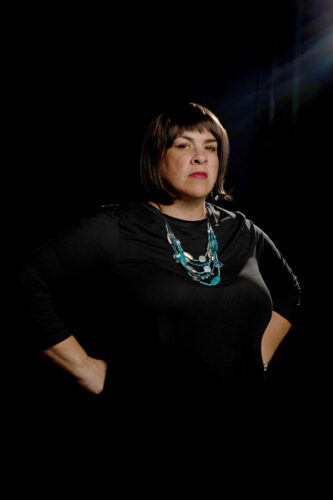
Carmen Pelaez plays Radio Mambi talk host Ninoska Perez in the Miami New Drama world premiere of “Elián.” (Photo courtesy of Andrés Manner)
“A puppet will always be funny. Castro had a level of manipulation that made him a genius – thinking before he spoke, using precise language and absurd metaphors. That translates into farce,” Mendez observes. “This is a caricature of him, using an exaggerated, high-pitched voice.”
Though Manny Diaz spoke at length to Martinez and Hausmann as they were researching the play, Mendez hasn’t met the former mayor. The actor has watched plenty of video featuring Diaz – though he says there is “little footage of him at that time” – and is hoping to emulate rather than imitate one of the players at the center of the Elián story.
Mendez also admits to another challenge in playing Diaz: “I have played real people before, but not ones who are alive and might see the play.”
Capote also began building his interpretation of Jorge Mas Santos by watching videos, absorbing impressions of his “mannerisms and quirks” and finding Mas Santos’s voice.
When the events in the play unfolded, Capote was a 15-year-old Miami high school student. He remembers that, shortly after the raid that returned Elián to his father, “I saw Marisleysis at a book sale. She looked distraught, very emotionally beat up.”
The play, he says, is “not what I was expecting. It tackles all kinds of points of view….It’s less about Elián the person and more about everything going on around him, showing how many people didn’t have his best interest at heart.”
Although Nichols-Navarro plays multiple roles, he sees the one as Elián’s great uncle Lázaro as vital to the play’s potential impact.
“As Lázaro, I am the touchstone of the family. I’ve fought for those family scenes, which show what happened inside the house,” says the Miami-raised actor, who is Carbonell nominated for his performance as a quintessential old-school Cuban-American mayoral candidate in “The Cuban Vote.”
“If you looked outside at that time, you’d think the Beatles had shown up. But what happened inside that 1,000-square-foot house is more interesting. That’s what we don’t know…With facts, you can tell a story. With heart, you can move people.”
Approaching the Subject Matter
Iveson read Martinez’s script after Miami New Drama reached out to him about “Elián.” He was impressed with the playwright’s approach.
“I could see he was doing a super creative take on the story. You have to pick a lane because there are 30 different ways to think about it,” the actor says. “He has tried to incorporate a lot of different ways, and that’s what theater should do. It’s such a sprawling story.”
Working in a cast with a number of actors who are of Cuban descent or who arrived from Cuba as children, Iveson has become far more aware of the impact of the Elián González story.
“This is real Miami stuff, theater for people who it affects. I don’t know what does that better than theater,” he says. “I’m getting an up-close picture of how emotional this was for Cuban-Americans at the time. It remains a really big deal. Still, 23 years after Elián, it’s very alive.”
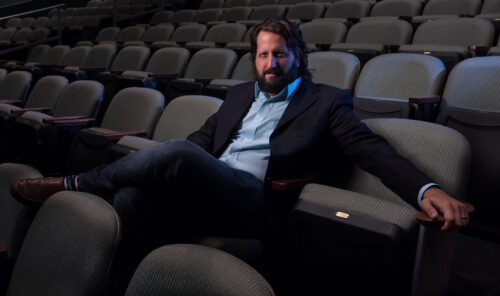
Miami New Drama artistic director Michel Hausmann commissioned Rogelio Martinez to write the world premiere play “Elián.”(Photo courtesy of Juancho Hernández Husband)
Today, as huge numbers of would-be Cuban exiles are making the same dangerous journey toward freedom that Elián and his mother did, Pelaez makes note of the transformative damage done by the highly publicized battle over a little boy.
“This shattered the perception of the Cuban exile community. The Cuban government used it brilliantly against us,” she says. “We went from being model exiles to ‘oh, those crazy Cubans.’ We became a monolith outside the 305. This took away our agency.”
Says Hausmann: “The narrative was that the Cubans went crazy. But this was similar to a Black Lives Matter moment for people dealing with significant, multi-generational trauma.”
WHAT: Miami New Drama’s “Elián” by Rogelio Martinez
WHERE: Colony Theatre, 1040 Lincoln Rd., Miami Beach.
WHEN: Previews Thursday, Oct. 27 and Friday, Oct. 28, opens Saturday, Oct. 29 (opening sold out); performances are 8 p.m. Thursday-Saturday, 3 p.m. Sunday, through Nov. 20
COST: $46.50-$76.50 (includes service fee)
INFORMATION: 305-674-1040 or miaminewdrama.org
ArtburstMiami.com is a nonprofit source of dance, visual arts, music and performing arts news. Sign up for our newsletter and never miss a story.
No posts found
Review: Zoetic Stage’s Mlima’s Tale’ is incisive, inspired theater
Written By Christine Dolen
October 17, 2022 at 2:57 PM
Jerel Brown as a majestic African elephant leads the audience on a harrowing journey in Zoetic Stage’s “Mlima’s Tale” at the Adrienne Arsht Center through Oct. 30. (Photo courtesy of Justin Namon)
Zoetic Stage’s stunning Florida premiere of “Mlima’s Tale” is mindful of the suggestions Pulitzer Prize-winning playwright Lynn Nottage offers in brief notes at the beginning of her script.
The stage, sparse and open, “invites transformation.” Projections provide a shifting sense of place. The play’s 16 scenes flow from one to the next with a constantly shifting cast of characters orbiting around what remains of a tragic presence they cannot see: Mlima, an African “big tusker” elephant slaughtered for his incomparable, perfect, priceless ivory.
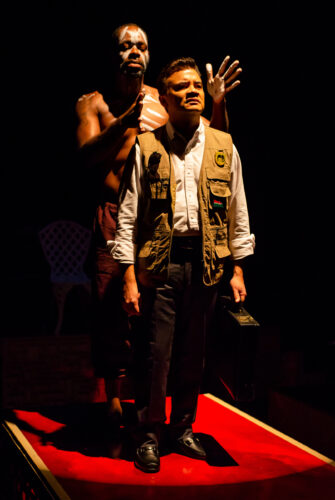
Jerel Brown as Mlima haunts Paul Torres Wong in the Zoetic Stage production of “Mlima’s Tale.” (Photo courtesy of Justin Namon)
Nottage, whose eclectic body of work is being produced throughout the country this season, tells the painful story of the illegal international ivory trade in a powerfully evocative way — impeccable research blends with her observational skills and intricately revelatory dialogue.
But what Zoetic’s minimalist yet highly stylized “Mlima’s Tale” also underscores is the way a great play can become an invitation to risk-taking creativity and a spur to excellence as artists collaborate on a new production.
“Mlima’s Tale,” now playing in the Carnival Studio Theater at Miami’s Arsht Center through Oct. 30, is not, as you might fear, a play that becomes too overwhelming to watch because of its grim subject.
Zoetic artistic director Stuart Meltzer draws from a vast emotional palette – loyalty, cruelty, love, loss, humor, betrayal, avarice, deception, vengeance – to mine the script’s many tonal shifts.

It’s selfie time for Sydney Presendieu and Paul Torres Wong in “Mlima’s Tale.” (Photo courtesy of Justin Namon)
The design team’s vital contributions are breathtaking, absolutely key to the storytelling in a piece that blends elements of an African folk tale with a stinging rebuke to man’s failed stewardship of nature.
Michael McKeever’s set uses a traverse stage sliced down the middle by a gap that transforms into a river or valley or a place awash in blood. On screens floating above each side of the playing area, video director DelaVega, media producer Nathaniel Connella and projection mapping designer Steven Covey communicate place and feeling via shifting images – a menacing crocodile swimming just beneath the surface of a river, an elephant family happily congregating, a haunting moon so massive it dwarfs Mlima, brutal death symbolized by a roomful of ivory tusks on a floor in Vietnam.
Lattice work that evokes an elephant’s rough hide surrounds the stage. Stenciled onto the video screens, it subtly imprints on the images, further transforming as Rebecca Montero’s lighting washes over it – the blood-red and ivory-white lighting in particular.

Jerel Brown as Mlima is dwarfed by the huge African moon in Zoetic Stage’s “Mlima’s Tale.” (Photo courtesy of Justin Namon)
Sound designer Matt Corey brings Africa into the space as startled birds take off, a lion roars and hidden poachers struggle to remain unseen by their prey. The work of Corey and costume designer Marina Pareja helps to pinpoint locations on the journey with Mlima’s flawless tusks as they’re moved from Africa to Vietnam to China.
Mlima and more than 20 other characters tell Nottage’s story, but just four actors appear onstage. Jerel Brown plays Mlima, embodying the elephant, his tusks and his spirit. All other roles are divided among Phillip Andrew Santiago, Paul Torres Wong and Sydney Presendieu, who must change characters, costumes, accents, and sometimes gender from scene to scene.
Brown’s challenges in “Mlima’s Tale” are daunting. He’s a man portraying an elephant, a creature who moves with grace, power and control through a world where death lies in wait. In his opening monologue – his longest speech in the play, delivered with a Kenyan accent – the anthropomorphized Mlima speaks of his history, his beloved mate Mumbi and their offspring, the wisdom of elders and his desperation to keep his family safe.

Paul Torres Wong plays a master carver inspecting the tusks of Jerel Brown’s Mlima in “Mlima’s Tale.” (Photo courtesy of Justin Namon)
With movement direction by Herman Payne, the tall and muscular Brown uses his dancer’s body with utter control, conveying the stealth of the live Mlima, his fighting spirit and the agony of his death.
After, embodying Mlima’s tusks, he is an unseen force haunting everyone who seeks to profit from his death. Imposing (Mlima means “mountain” in Swahili), ominous as he marks each scheming player in the saga with white paint representing his ivory, Brown is dignified, expressive and magnetic. His final appearance, when Mlima’s tusks have been transformed from a $300 payday for the poachers into a work of art sold for nearly $1 million, is soul-shattering.
Torres Wong, Santiago and Presendieu display their transformational mojo as they move from character to character, some more significant than others. The necessary quick costume changes aren’t always quick enough, briefly slowing the story’s momentum, but that will likely get tighter during the run.
Certain characters seem to inspire the actors – for Santiago, for instance, it’s a Vietnamese hipster who’s a player in the ivory carving trade; for Presendieu, it’s a power-conscious Vietnamese customs official who enjoys tormenting an American cargo ship captain – but it’s Torres Wong who most consistently delivers an array of finely detailed characters. Very impressive.

Jerel Brown as Mlima marks Phillip Andrew Santiago in Zoetic Stage’s “Mlima’s Tale.” (Photo courtesy of Justin Namon)
Overseeing everything is Meltzer, who found the right collaborators to bring his vision for this production to life.
The director made the decision to have the characters flinch or recoil in pain as Mlima leaves his mark of complicity, lies and cruelty on each one. For Nottage’s proverb-like scene titles – including “No one tests the depth of the river with both feet,” “Don’t think there are no crocodiles because the water is calm,” “Do not look where you fell but where you stepped” – he chose to have them projected onto the video screens, thus reinforcing the play’s folk tale quality.
Depending on the theatergoer, “Mlima’s Tale” can be a call to action and involvement. But for anyone who sees it, the production is thought-provoking theater of the highest order, the work of a superb playwright inspiring her fellow artists.
WHAT: “Mlima’s Tale” by Lynn Nottage
WHERE: Zoetic Stage production in the Carnival Studio Theater at the Adrienne Arsht Center for the Performing Arts, 1300 Biscayne Blvd., Miami
WHEN: 7:30 p.m. Thursday-Friday, 3 and 7:30 p.m. Saturday, 3 p.m. Sunday (additional performance 7:30 p.m. Oct. 19, no matinee Oct. 22), through Oct. 30; Zoo Miami communications director Ron Magill will lead talkbacks after the matinee Oct. 23 and the matinee and evening performances Oct. 29.
COST: $55-$60
INFORMATION: 305-949-6722 or arshtcenter.org
ArtburstMiami.com is a nonprofit source of dance, visual arts, music and performing arts news. Sign up for our newsletter and never miss a story.
No posts found
Review: Bistoury Physical Theatre’s latest chapter explores ‘Fear of Freedom’
Written By Sean Erwin
October 13, 2022 at 8:27 PM
Carla Forte wearing a box on her head in Bistoury Physical Theatre and Film’s “The Commune, Chapter 3: Fear of Freedom” at Miami Dade County Auditorium’s On.Stage Black Box Theatre. (Photo by Alexey Taran)
If Bistoury Physical Theatre and Film’s first part of “The Commune” constituted a search for alternative ways of being in the world and 2022’s part 2 “The Commune” presented practices of freedom, its latest did a deep dive into the existential consequences of rejecting freedom and abandoning the self.
On Thursday, Oct. 6 and Friday, Oct. 7, BFTF (the acronym by which they identify the group) performed “The Commune, Chapter 3: Fear of Freedom,” at the Miami Dade County Auditorium’s On.Stage Black Box Theatre. Miami Dade County Auditorium commissioned “The Commune.” I attended both performances and, although on different nights, the execution differed minimally.
Choreographer Alexey Taran and filmmaker Carla Forte founded the company in Caracas, Venezuela, in 2005 as an avant-garde creative platform for dance and film. In 2007, BFTF moved to the city of Miami. The company’s projects reflect a philosophy of respect, admiration, and curiosity for the extraordinary creative movement and diversity of Latin American megalopolises.
In its latest “The Commune” chapter, BFTF laid out the psychological tics and neuroses of four people trapped in a pandemic-like form of physical and emotional isolation.

Performer Heather Maloney dances in her square in Bistoury Physical Theatre and Film’s “Fear of Freedom.” (Photo by Alexy Taran)
In show notes published online, the group claimed “Fear of Freedom” reflects on the thought of Frankfurt School psychoanalyst and political theorist, Erich Fromm (1900-1980). For Fromm, freedom occurs in the sphere of the interpersonal. In the practice of freedom, people aim at knowledge of what others really need which emerges only through caring and having respect for their autonomy.
People either embrace or reject their freedom, and those who reject it do so in different ways – by socially conforming or submitting entirely to powerful personalities or deepening the destructive tendencies of their isolation until they destroy their world.
Whatever the strategies they employ, the rejection of freedom initiates profound mental conflicts that can deepen into acute forms of mental illness.
BFTF’s performance opened with the theater divided into four large squares. One square contained a suitcase, another a huge pile of clothes. The two squares at the back of the stage was strewn with sheets of crumpled white paper and the last contained a potted white orchid and a box.
The show began by showing four videos of the performers – Taran, Forte, Heather Maloney and Carlos Fabian – doing different actions like staring at their faces in a mirror, climbing a wall, shuffling through photos, hugging themselves or undressing and raising a fist.
Clips showed Forte with a box over her face and Fabian with a bag over his head.
The Christmas song, “Carol of the Bells” – a recurring musical motif of the piece – played faintly in the background.
As the film ended, the stage was illuminated by a bank of lights from the left and a timer flashed on the back of the stage and started to count backwards from 40 minutes.
In one of the back squares, Forte sat with her head covered by a cardboard box and a white orchid in her lap. She recited into a microphone statements about grief like “El luto es la Avenida principal de la ciudad” (“Grief is the main avenue of the city”) and “El luto es las memorias” (“Grief is the memories”).
Sometimes she would begin sobbing, sing scales or call out for “Gloria,” presumably a pet. At one point she dumped a box of what looked like cat litter over her head.
With his back to the audience, Taran sat in the square adjacent to Forte in the midst of huge sheaths of white paper, which he either shredded or folded up and snapped beneath his arm. His movements were erratic and robotic. At times he would snatch a tablet and launch into a pantomimed lecture or fiercely conduct Tchaikovsky’s “Pathétique” Symphony from his chair.
Occasionally he would stand, salute and declare: “Aqui por la patria!” (“Here, for the Fatherland!”)
In the square in front of Forte, Fabian shuffled through a huge pile of clothes and then frantically began dressing and undressing. At times he had a difficult time keeping his pants on while at others he stuffed more and more clothes into his shirt and pants until they clownishly bulged.
At one point Fabian kneeled and recited the “Apostle’s Creed” in Spanish before donning a red dress and leopard print jacket and running circles in his square.
In front of Taran, Heather Maloney – her face pained – hugged herself tightly or slowly ran her hands up her legs, briefly palming her face. At times she moved as if drugged.
At other moments, she would tie on a red dress and dance, pirouetting or standing en pointe before collapsing on the floor and slowly spinning in place.
None of the performers behaved as if they were aware that others shared their space. Each played out their compulsive behaviors as if entirely engaged in medicating the internal sense of deep conflict each experienced.
With the stage trashed, the countdown hit six minutes. Fabian in black jeans and black sunglasses held his phone in front of him as if beginning a FaceTime call, waving and repeating,
“Hi Everyone! Love you guys!”
As he did so, he crossed the stage and became the first performer to break from his square, crossing Maloney’s space who then danced along the full floor’s diagonal.

Carlos Fabian wrapped in clothes in “Fear of Freedom,” conceived and performed by Bistoury Physical Theatre and Film. (Photo by Alexey Taran)
At the cue, Taran hung over his chest a disco ball and bright white light then spun and danced around the theater to Laura Branigan’s 1982 pop hit, “Gloria.”
Facing the audience Forte danced and joined in with the vocals. Given the chaos on the stage, Branigan’s line, “I think you’re headed for a breakdown so be careful not to show it” hit home.
For these four characters that ship had already sailed.
Then the timer struck zero, flashed red, and the house lights went black.
After a few seconds of darkness a bright blue light streamed from the ceiling to the center of the performance floor. As the four performers all huddled in its beam, Fabian opened an umbrella over them.
For the first time in the 50-minute show they spoke to one another in low tones and touched as a stream of what looked like snow fell from the ceiling onto the umbrella.
BFTF’s “Fear of Freedom” constituted a brilliant, risk-taking work of multimedia theater. The performers powerfully brought to life Fromm’s thesis concerning the neurotic, self-destructive mindsets that capture people in their gambit to escape the demands posed by their lives and other human beings.
The work’s closing with the four performers huddled together for protection stayed consistent with Fromm’s thesis – that only through the sphere of the intersocial can the emotional disturbances initiated by rejection of freedom be healed.
If you didn’t get the chance to catch “The Commune, Chapter 3” this time around, BFTF plans on staging it again in December, on a date yet to be determined, at inkub8, 2021 NW 1st Place, Miami. For information, call 305-482-1621.
ArtburstMiami.com is a nonprofit source of dance, visual arts, music and performing arts news. Sign up for our newsletter and never miss a story.
No posts found



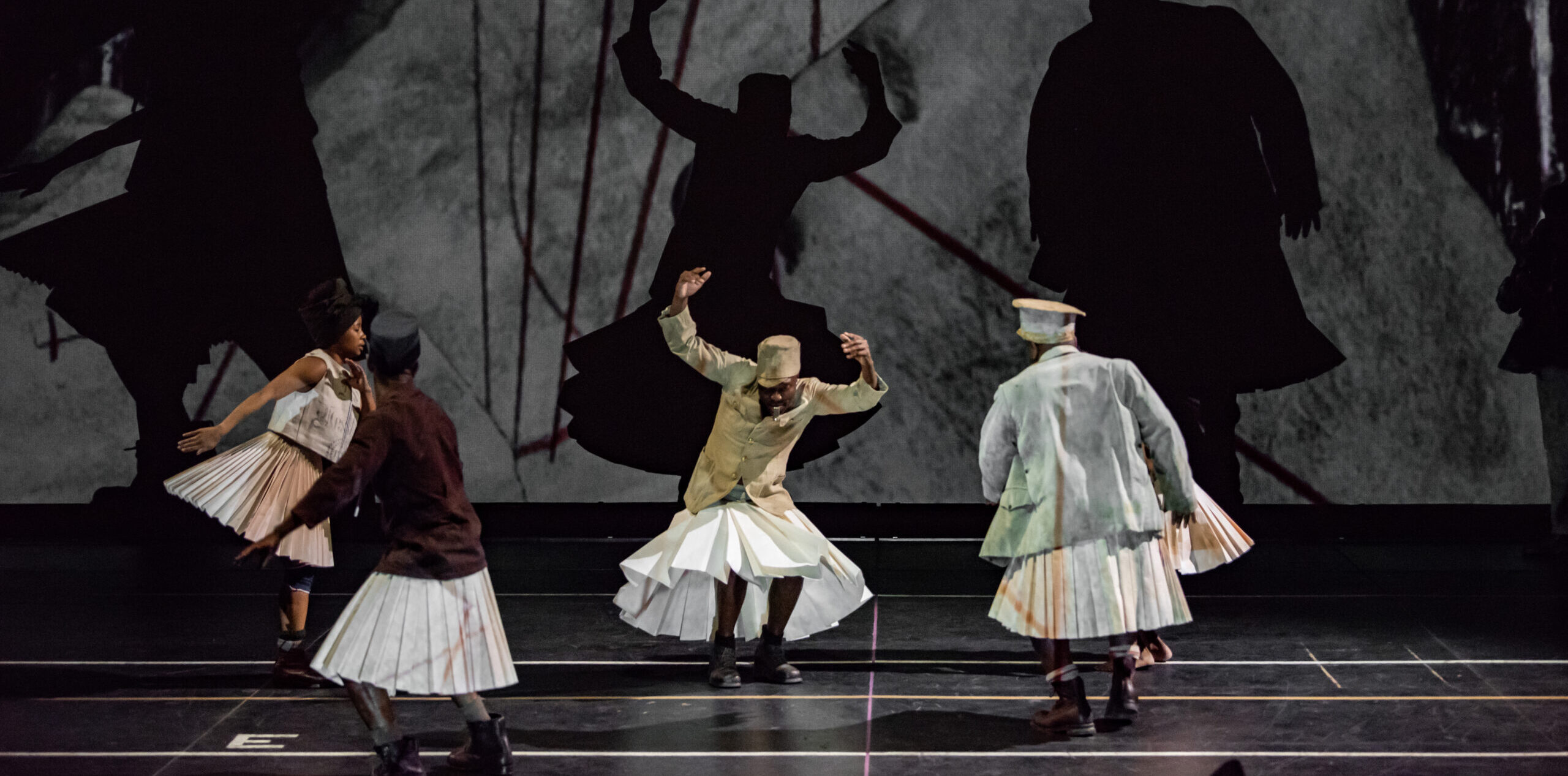




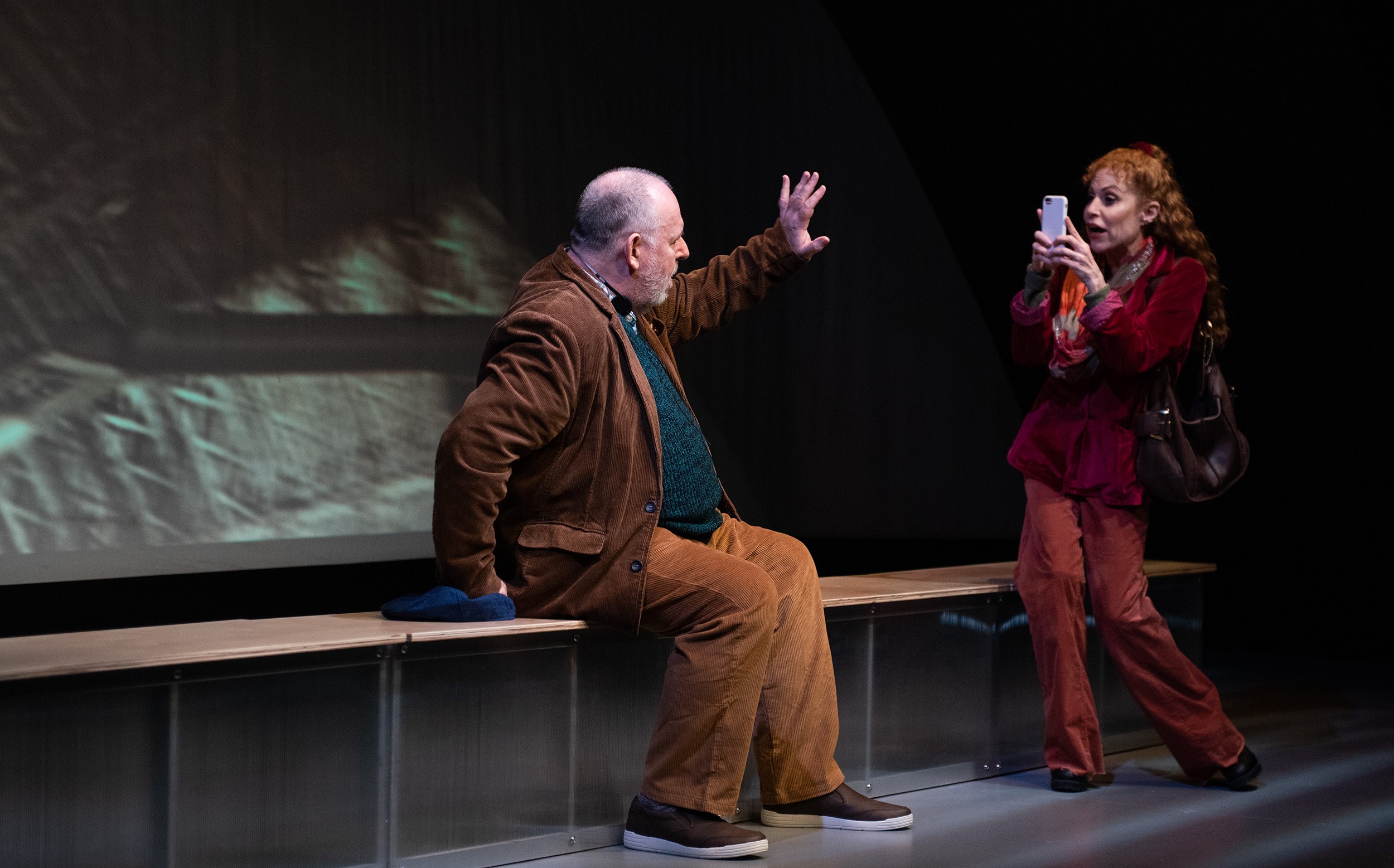

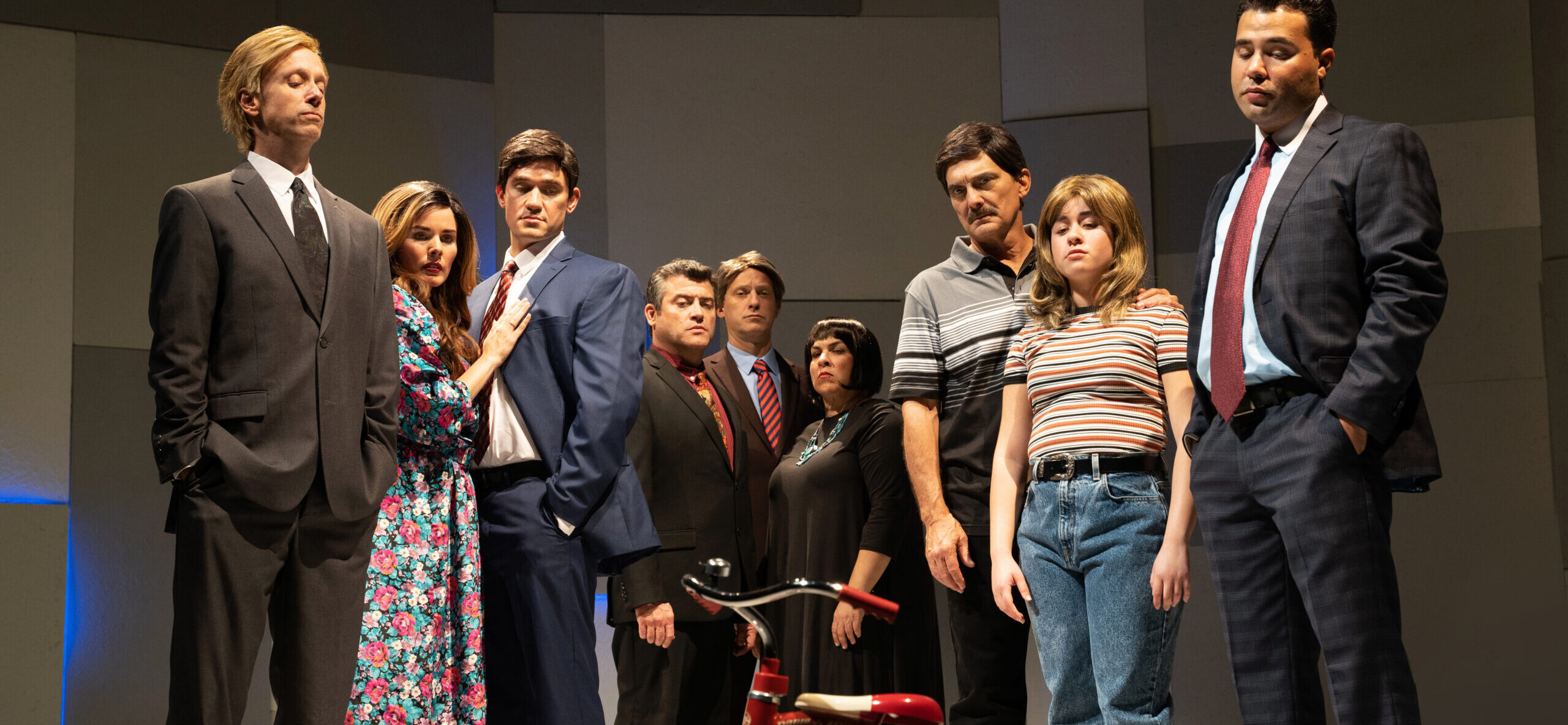


Recent Comments