Blog Article Category: Theater / Film
Review: Nothing’s fragile in GableStage’s wildly entertaining ‘A Doll’s House, Part 2’
Written By Christine Dolen
February 27, 2023 at 4:27 PM
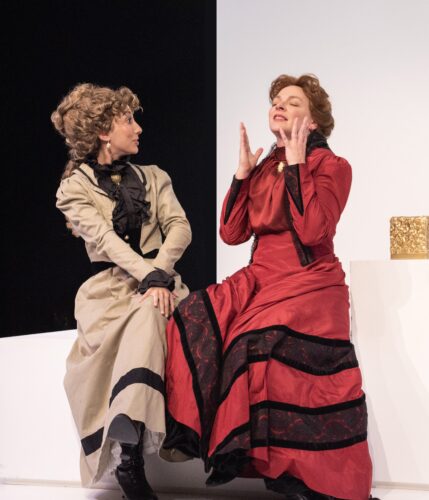
Elizabeth Dimon as Anne Marie and Rachel Burttram as Nora in Lucas Hnath’s “A Doll’s House, Part 2,” directed by Bari Newport, at GableStage in the Biltmore Hotel through Sunday, March 19. (Photo courtesy of Magnus Stark)
The stage looks nearly empty, not counting arguably the most famous door in all of drama. A fleeting refresher via oversized projected words reminds the audience of the play that inspired the one it’s about to watch. Then four actors, beautifully dressed in period clothing, enter dancing and twitching, seemingly transported from the 19th to the 21st century.
Welcome to GableStage’s wildly entertaining, engaging production of Lucas Hnath’s “A Doll’s House, Part 2.”
Director Bari Newport and her artistic collaborators have wholeheartedly embraced the modernity of Hnath’s 2017 Broadway follow-up to 1879’s “A Doll’s House” by Henrik Ibsen, the hugely influential playwright considered the father of theatrical modernism.
In imagining what might have happened to Nora Helmer in the 15 years since she left her husband and three children to begin a journey of self-discovery, Hnath utilizes contemporary language (vulgarities included) and notions (Nora’s ex, Torvald, dives into mansplaining) to draw the audience into a boisterous comedy brimming with thought-provoking ideas. Women’s roles and options, marriage as an institution, self-delusion versus self-knowledge are just some of the concepts up for debate in “A Doll’s House, Part 2.”
Newport, in her second season as GableStage’s producing artistic director, delivers a crisply assured version of Hnath’s play, and it’s among the best work she’s done to date since her arrival.
The cast blends tonally in-synch performances from a trio of theater veterans and a newcomer.
Yasmine Harrell as Emmy and Rachel Burttram as her dramatic mother Nora in GableStage’s “A Doll’s House, Part 2.” (Photo courtesy of Magnus Stark)
As Nora, who suddenly returns after a decade and a half of being mysteriously incommunicado, Rachel Burttram paints an adroit portrait of a complex woman. She’s wide-eyed, calculating, manipulative, funny, sometimes cruel. Listen as she describes the “few” lovers she’s had – the list is a bit longer and more detailed than expected – then follows that with gasping-for-breath laughter when Torvald tells her of his one relationship with a widowed neighbor. For the wife and husband who parted so suddenly, the settling of scores is clearly incomplete.
Brendan Powers, Burttram’s real-life husband, plays Torvald. The two were paired in a 2020 production of “A Doll’s House, Part 2” at Florida Repertory Theatre in Fort Myers, but the COVID-19 pandemic forced that company to film and stream its dress rehearsal. It’s wonderful that Powers and Burttram are able to circle back to bring their characters to life for rapt, delighted audiences in Newport’s vision of the play.
Tall and striking, Powers portrays a man of Torvald Helmer’s place and time, someone determined to preserve his good reputation at all costs. Though scarred by Nora’s abandonment, he maintains emotional control while tossing cool digs her way. So, when he loses it – and he does, justifiably, thoroughly – it’s a grandly dramatic moment. Knowing he and Burttram are happily married, watching them play Ibsen and Hnath’s unhappy duo is all the more impressive.
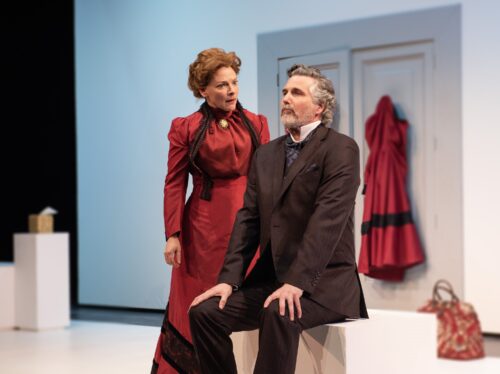
Rachel Burttram as Nora and Brendan Powers as Torvald get into their unfinished business in “A Doll’s House, Part 2” at GableStage. (Photo courtesy of Magnus Stark)
As Anne Marie, the former nanny and housekeeper who raised Nora and Nora’s three children, four-time Carbonell Award winner Elizabeth Dimon deploys her vast array of skills in portraying a woman who gave up a life of her own to tend to the Helmers.
She gets laughs on her first entrance from the back of the theater, responding to the unseen Nora’s repeated knocking, when she gives the audience the stink eye as if to say, “What? You couldn’t answer the door?” Her Anne Marie combines warmth with a brutally honest assessment of Nora’s behavior and its enduring consequences.
Making her professional debut, New World School of the Arts grad Yasmine Harrell plays the Helmers’ youngest, their engaged daughter Emmy. With zero memory of her mother, Emmy says politely, “It’s very nice to meet you.”
Ill-at-ease but determined to enlist her daughter’s help in getting Torvald to sign a life-altering document, Nora applies her intellectual wiles, only to discover that her clever daughter is a formidable opponent. Harrell convincingly conveys Emmy’s strength and self-possession as she talks about how her mother’s decisions helped shape her own.
Throughout the brisk 90-minute play, the four characters engage in one-on-one debates, exchanges that land with power or humor or both thanks to Hnath’s craftsmanship and Newport’s staging. When Nora and Torvald are verbally duking it out, they take turns snapping their fingers, changing the lighting to signal who’s in control.
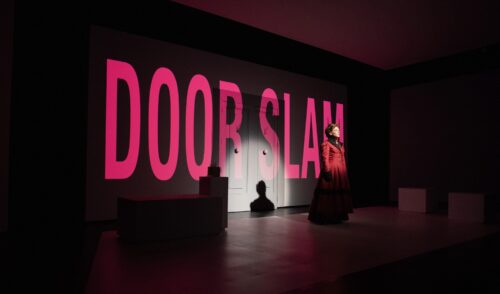
Oversized projected words remind the audience of Henrik Ibsen’s play that inspired “A Doll’s House, Part 2” now at GableStage. (Photo by Magnus Stark)
The invisible fourth wall separating the world of the play from the audience doesn’t exist here. Nora and Emmy take big steps off the stage and into the audience. You never know where Anne Marie will turn up. The message: We’re all having this artistic experience together.
In terms of design, the traditional look of Jacquelyn Loy’s costumes (the period is specified in Hnath’s script) contrasts with every other element. Nora’s ensemble is especially grand: a huge red hat bedecked with feathers and flowers, an elegant coat and gown in rich red with black details. The scarlet hue isn’t meant to suggest a “fallen” woman; rather, her striking style conveys her success and the different person she has become.
The deceptively simple set by in-demand Frank J. Oliva, whose career began at nearby Area Stage Company and now includes work throughout the country (Broadway included), is a clean open space in which those big projections of words (by Jamie Godwin) can live.
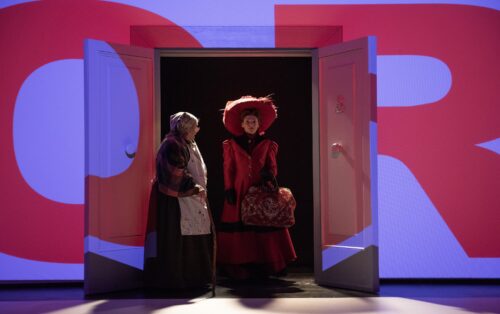
Elizabeth Dimon as Anne Marie opens the door for a returning Rachel Burttram as Nora in “A Doll’s House, Part 2” at GableStage. (Photo courtesy of Magnus Stark)
The “furniture” consists of simple cubes, at one point boldly employed by Burttram’s Nora in a way that suggests she’s marking her territory. Tony Galaska’s terrific, change-on-a-dime lighting and Sean McGinley’s great sound design (which inspires Powers’s Torvald to do something that looks like an awkward version of the macarena) are impeccable.
In “A Doll’s House, Part 2,” Hnath looks through contemporary eyes at the world Ibsen created. Now at GableStage, thanks to Newport and company, so do we.
WHAT: “A Doll’s House, Part 2” by Lucas Hnath
WHERE: GableStage in the Biltmore Hotel, 1200 Anastasia Ave., Coral Gables
WHEN: 2 and 7 p.m. Wednesday, 8 p.m. Thursday-Saturday, 2 p.m. Sunday (additional matinee Saturday, March 18), through Sunday, March 19 (streaming version available March 3-19 during regular performances). Free reading of Henrik Ibsen’s “A Doll’s House,” 2 p.m. Saturday, March 11.
COST: $45-$75 (streaming ticket $27)
INFORMATION: 305-445-1119 or gablestage.org.
ArtburstMiami.com is a nonprofit source of theater, dance, visual arts, music and performing arts news. Sign up for our newsletter and never miss a story.
No posts found
GableStage’s ‘A Doll’s House, Part 2’ imagines what happened after Nora walked out
Written By Christine Dolen
February 21, 2023 at 1:10 PM
Yasmine Harrell, Rachel Burttram, Brendan Powers and Elizabeth Dimon in Lucas Hnath’s spin on Henrik Ibsen’s classic “A Doll’s House” at GableStage. (Photo courtesy of Magnus Stark)
The slamming door that brings Henrik Ibsen’s “A Doll’s House” to its shocking close has been reverberating on stages since 1879, when the masterpiece about a Norwegian wife and mother who dared to defy societal conventions ushered modernism into theater.
Fast forward to 2017, when one of America’s “it” playwrights, Orlando native Lucas Hnath, imagined what might happen if an incommunicado Nora Helmer came back 15 years later, knocking on that very same door.
“A Doll’s House, Part 2,” which will get its first Miami-area production at GableStage Feb. 24-March 19, isn’t precisely a sequel to the classic that inspired it. Rather, it’s a clever four-character, 90-minute exploration of one way the story of a 19th century woman who controversially left her home, husband and three children might have played out.
One of the most-produced plays in American regional theaters (the Maltz Jupiter Theatre did it in 2019), “A Doll’s House, Part 2” marked the Broadway debut of the topically and stylistically eclectic Hnath, whose subjects have included the ethical shortcuts of a would-be Olympian and the horrific kidnapping of Hnath’s mother.

In “A Doll’s House, Part 2” playwright Lucas Hnath imagines what might have happened to Nora Helmer after the end of Henrik Ibsen’s classic. (Photo courtesy of Rebecca Martinez)
Among his works are “A Public Reading of an Unproduced Screenplay About the Death of Walt Disney” (done at Fort Lauderdale’s Thinking Cap Theatre in 2016), the Obie Award-winning “Red Speedo” (presented by Plays of Wilton in Wilton Manors in late 2022), “The Christians” (staged by Outré Theatre Company in Pompano Beach in 2018), “Hillary and Clinton,” “Dana H” and “The Thin Place.”
Though Hnath wasn’t available for an interview prior to the new GableStage production, in a 2017 Vogue story, he told writer Adam Green that when he asked participants in a workshop what they thought happened to Nora, “Almost everybody said that she went off to work in a factory or became a prostitute and died.”
Hnath’s play resoundingly turns that expectation on its head.
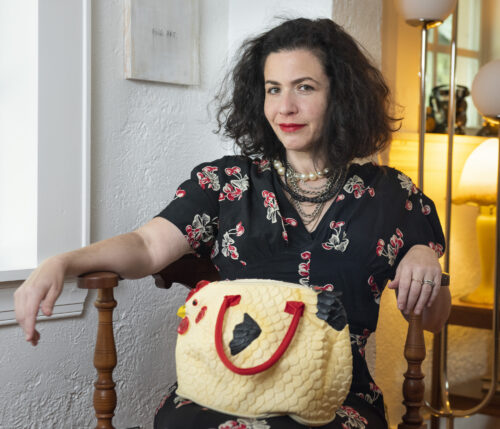
GableStage producing artistic director Bari Newport is staging “A Doll’s House, Part 2.” (Photo courtesy of Magnus Stark)
GableStage producing artistic director Bari Newport is staging the new production and says of Hnath, “I really love Lucas’s writing. He has such a sense of humor. It’s wry and smart.”
What audiences should anticipate about “A Doll’s House, Part 2,” she notes, is that “it’s not only a comedy, it’s not only a drama, it’s not only based on a classic. It lives within so many styles…It’s a humanist play, not just a feminist story about the price of individual freedom.”
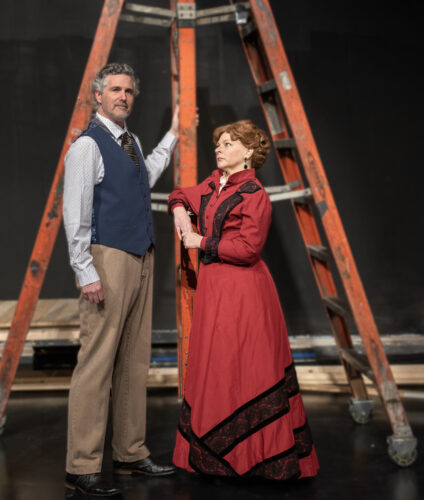
Real-life spouses Brendan Powers and Rachel Burttram play Torvald and Nora Helmer in “A Doll’s House, Part 2” at GableStage. (Photo courtesy of Magnus Stark)
Married actors Rachel Burttram and Brendan Powers will play the long-parted Nora and Torvald Helmer, with Carbonell Award winner Elizabeth Dimon as housekeeper/former nanny Anne Marie and recent New World School of the Arts grad Yasmine Harrell making her professional debut as the Helmers’ engaged daughter Emmy.
Burttram and Powers, longtime company members at Florida Repertory Theatre in Fort Myers, were to have done the play there in March 2020. But when the COVID-19 pandemic hit and the world was about to shut down, Florida Rep made a video of the final dress rehearsal, streaming it and earning a glowing review from the late Wall Street Journal critic Terry Teachout, known for championing the high-quality work done in the country’s best regional theaters.
“This modernization is delicious and fabulous. It was such a heartbreak not to share it with a live audience,” says Burttram. “Three years later, you approach the text differently because of what we went through.”
Adds Powers: “We’re all changed in ways you aren’t really able to articulate. In our scenes, there are different nuances, things that hit in a more poignant way or that you remember differently.”
Burttram was an apprentice at Actors Theatre of Louisville and Newport associate director at Florida Rep when they met 21 years ago, and Newport has directed the actors – whom she calls “my dearest friends” – either solo or as a couple in many productions since.
Powers and Burttram, now based in Birmingham, Alabama, consider themselves fortunate to be able to work in the same production as often as they do. They have squared off as the warring priest and nun in John Patrick Shanley’s “Doubt” and have appeared together in numerous other productions, most recently in the world premiere of Mark St. Germain’s “Public Speaking 101” at Great Barrington Public Theater in Massachusetts and “God of Carnage” at North Carolina’s Flat Rock Playhouse.
During the run of “A Doll’s House, Part 2” the couple will make another joint appearance when GableStage presents a reading of Ibsen’s original at 2 p.m. March 11 (tickets are free, but subscribers get priority; register at www.gablestage.org).
“We have a shorthand, a great chemistry and connection,” says Burttram. “We know each other so, so well, even our body language. You can dig in and play and have trust.”
Burttram describes the role of Nora Helmer as iconic. Childlike in her dependency, first as a daughter then as a wife, Nora feels her blinders falling away when a crisis reveals the true nature of her marriage, igniting that journey toward self-awareness at the end of “A Doll’s House.” The Nora who returns in “A Doll’s House, Part 2” is a very different woman.
Powers, who played Torvald in a production of Ibsen’s play several years ago, describes Nora’s husband as “a fairly upright person in a system that’s flawed. He’s naïve and clueless. He comes off very badly…But as the story unfolds, you discover he’s a perfectly human character. It’s fun to play someone who has two sides.”

GableStage resident dramaturg Karina Batchelor helps the company and the audience take a deep dive into “A Doll’s House, Part 2.” (Photo courtesy of Karla Ruiz-Gomez)
GableStage’s resident dramaturg, Karina Batchelor, has played a key role in immersing the company in the worlds created by Ibsen and Hnath. The Miami native and Florida International University graduate met her husband, British actor Iain Batchelor (who was in GableStage’s “The White Card”), when she was earning her master’s degree at the Shakespeare Institute at Stratford-Upon-Avon. Her thesis subject, on point for her current assignment: adaptations.
“I try to make sure I remove my own opinions. I provide facts [such as] what it was like to be married then, to get a divorce, the worldwide effect of the industrialization period. I’m choosing what they get, and you have to make sure you’re not biased,” says Batchelor, whose deep-dive research also provides links to Victorian primary sources as well as topically relevant newer works.
She is, she says, very appreciative of what Hnath achieves in his dramatic postscript to “A Doll’s House,” which features period costumes but an otherwise minimalist look, contemporary language and artfully conveyed information from Ibsen’s original.
“This play is amazing. Everyone is right. I very much understand Nora – I’m a mom myself – but I don’t want to be unfair to Torvald, Emmy and Anne Marie,” Batchelor says.
“From the moment Nora walks in the door, she’s already being judged. Lucas created a play where you change your mind so often… ‘A Doll’s House’ ends with Nora choosing herself, and at the end of the day, there are consequences. Nora has the bravery to come to terms with that.”
Another aspect of Batchelor’s work is audience education. She and Newport will share in doing the company’s popular preshow talks before each performance of “A Doll’s House, Part 2,” and one of Batchelor’s will be filmed and made available to anyone who chooses to watch the streaming version of the play. (Some subscribers are taking an even deeper plunge via a pilot program dubbed “Diary of a Production,” which offers six classes on various aspects of the play, attendance at a technical rehearsal and a group outing to a performance.)
Anyone thinking about seeing “A Doll’s House, Part 2” may be wondering whether not knowing or remembering the details of Ibsen’s play will affect their enjoyment of Hnath’s carefully crafted follow-up. Powers notes that “all the important bones of the story are relayed in Part 2.”
Newport and Batchelor agree, with an asterisk.
Knowing “A Doll’s House” can enrich the experience of seeing “A Doll’s House, Part 2,” but Batchelor calls the latter “very different. I look at it like a boxing match. Each character has [their] own perspective. It feels very much like an argument, with everyone putting forth [their] case.”
“Lucas mitigates his play so it’s not an enigma for those who don’t remember ‘A Doll’s House.’ It’s very accessible,” Newport says. “With all of our preshow talks, we give a broader, deeper lens into the work. The more you know, the more you can appreciate.”
WHAT: “A Doll’s House, Part 2” by Lucas Hnath
WHERE: GableStage in the Biltmore Hotel, 1200 Anastasia Ave., Coral Gables
WHEN: Preview 8 p.m. Feb. 24, opening 8 p.m. Feb. 25; regular performances 2 and 7 p.m. Wednesday, 8 p.m. Thursday-Saturday, 2 p.m. Sunday (additional matinee March 18), through March 19 (streaming version available March 3-19 during regular performances) Special Event: Free reading of Henrik Ibsen’s “A Doll’s House” 2 p.m. March 11
COST: $45-$75 (streaming ticket $27)
INFORMATION: 305-445-1119 or www.gablestage.org.
ArtburstMiami.com is a nonprofit source of theater, dance, visual arts, music and performing arts news. Sign up for our newsletter and never miss a story.
No posts found
Review: Strong family drama ‘The River Niger’ flows at M Ensemble
Written By Christine Dolen
February 10, 2023 at 3:59 PM
Roderick Randle and Tyquisha Ariel Braynen in M Ensemble’s “The River Niger” at the Sandrell Rivers Theater through Sunday, Feb. 26. (Photo courtesy of Christa Ingraham)
Miami’s venerable M Ensemble Company was founded in 1971, the year before Joseph A. Walker’s “The River Niger” had its off-Broadway premiere. That first production by the Negro Ensemble Company won a best play Obie Award, transferred to Broadway in 1973, then captured the best play Tony Award in 1974.
Now, for its Black History Month season opener, M Ensemble has given new generations of actors the chance to explore and embody this 51-year-old piece of theater history.
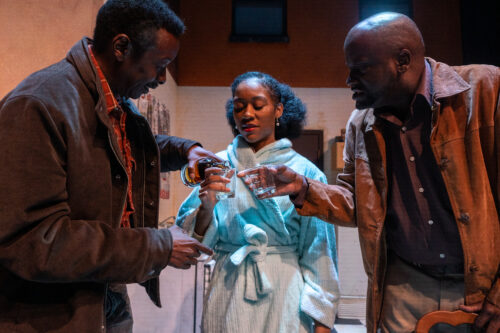
Chat Atkins, Tyquisha Ariel Braynen and Keith C. Wade make a toast in M Ensemble’s “The River Niger.” (Photo courtesy of Christa Ingraham)
Still led by Patricia E. Williams and Shirley Richardson, two of its three founders, M Ensemble has continued to enrich South Florida’s cultural life with professional productions of great Black plays and lesser known (or less often produced) ones. Despite its Tony Award, “The River Niger” falls into the latter category. It is resonant and relevant, but not enduringly impactful like “A Raisin in the Sun,” “Ceremonies in Dark Old Men” or “A Soldier’s Play,” for example.
Staged by Carbonell Award-winning actor-director André L. Gainey, Walker’s sprawling drama takes place inside a Harlem brownstone that the extended Williams family calls home.
Reflective of its early ‘70s era, the script explores issues that endure, disturb and haunt us still – the sacrificing of dreams, expectations we place on our offspring, the different ways Black men and women cope. The fraught, sometimes tragic relationship between the Black community and law enforcement – a story that never seems to end – is also part of “The River Niger.”
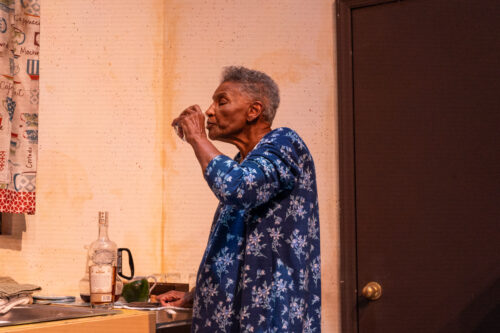
Carolyn Johnson-Davis as Grandma Wilhelmina sneaks a drink in M Ensemble’s “The River Niger.” (Photo courtesy of Christa Ingraham)
Multiple storylines intertwine, and at a running time of more than three hours (a single brief intermission comes more than two hours into the action), the production is in need of strategic tightening and a quicker pace. Too, the playwright’s device of having most scenes or segments begin with someone pounding on a door becomes so predictable that you start waiting for the next character to arrive.
Those 11 characters and the way this cast plays them, however, largely keep the audience engaged.
Patriarch John Williams (Chat Atkins, giving one of his strongest performances in his long history with M Ensemble) keeps food on the table and supports his wife’s extended family by painting houses. He discarded his dreams of becoming a lawyer but clings to his true passion: writing poetry. But late in the play, as he delivers the poem that gives “The River Niger” its title, we experience the powerful vestiges of what might have been.
His stalwart, loving wife Mattie (Jade L. Jones, who radiates a loyal warmth) has been complicit in John becoming an alcoholic. She pretends to fuss, to keep him in line, but she knows how much a lifetime of sacrifice has cost and wants him, in his 60s, to grab all the happiness he can.
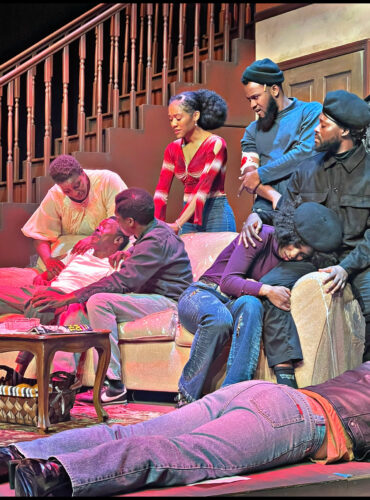
Tragedy comes calling at the end of M Ensemble’s “The River Niger.” (Photo courtesy of Chasity Hart)
Mattie’s mother Wilhelmina Brown, played with masterful comedic flair by Carbonell winner Carolyn Johnson-Davis, is there to get in everybody’s business, pass judgment and compete with her son-in-law at sneaking hidden booze. She lives there, but their Jamaica-born next-door neighbor Dr. Dudley Stanton (Keith C. Wade, another M Ensemble veteran who is an adept grounding force in this production) practically does, popping in and out to trade joking insults, debate politics, drink and loan John a little money when Mattie isn’t looking.
Everyone is waiting for a homecoming, the return of John and Mattie’s 25-year-old son Jeff (the magnetic Roderick Randle, so adept at conveying Jeff’s quicksilver emotional changes) from his time in the U.S. Air Force as a navigator. Among the surprises awaiting Jeff is Ann Vanderguild (Tyquisha Ariel Braynen), a South African-born nurse who met Jeff in Canada and aims to marry him.
Less welcome is Jeff’s old Harlem gang, a mixture of militants inspired by the Black Power movement and armed thugs ready to take what they want. Leader Big Moe Hayes (Jean Hyppolite) wants to draw his lifelong friend Jeff back into the group’s police-baiting criminal life. Jeff is determined to take on the law school part of his father’s abandoned dream and change his community that way.
Inevitably, tensions mount and explode. The gang members – junkie Skeeter (Martin Davis), sexual predator Chips (Xavier Latorture) and volatile Al (Kedar Myers) – bring danger with them every time they come through the door, though Moe’s girlfriend Gail (Nairobi) proves to be a positive force.
Set designer Mitchell Ost has created three key playing areas: a neatly kept living room (set dresser Patricia E. Williams wraps the sofa covered in protective plastic) and, just one step down, a neat kitchen. An extremely tall staircase leading to the upstairs bedrooms becomes part of the action more than once, and you feel for Johnson-Davis’s Wilhelmina, who must climb up and come down it repeatedly.
Richardson and Chasity Hart collaborated on the costumes, making Braynen’s Ann look particularly ’70s chic. Quanikqua “Q” Bryant’s lighting underscores the emotional content of Jeff’s eventual confessional about his Air Force experience, and Marcus Banks threads a subdued yet ominous bass through the show.
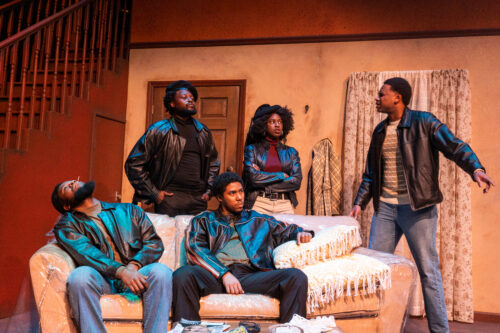
The neighborhood gang shows up to demand help from an old friend in M Ensemble’s “The River Niger.” (Photo courtesy of Christa Ingraham)
Something else you should know about “The River Niger” though, particularly since a number of young kids were part of the opening night audience.
Walker’s language, which can be poetic and quite funny, is also shocking and offensive at times.
John and Dudley go at each other verbally, tossing insults, hauling out the n-word and far, far worse. They’re not mad, just kidding each other in a kind of nonstop roast, but that’s how they do it. The sexual talk and threats among the younger characters is equally raw. Consider yourself warned.
“The River Niger” still needs to gel. The actors have most, but not all, of their lines down. Braynen’s supposed South African accent sounds nothing like one, and Nairobi is too soft-spoken. More tightening, more confidence should make for a better experience for the actors and the audience.
Walker’s most celebrated play may not have stood the test of time as firmly as “A Raisin in the Sun” and others. But watching the final scene, taking in the aftermath of a sacrifice as blue and red police lights whirl outside, your heart sinks as you acknowledge that a half-century later, such tragedies go on and on and on.
WHAT: “The River Niger” by Joseph A. Walker
WHERE: M Ensemble production at the Sandrell Rivers Theater, 6103 NW Seventh Ave., Miami
WHEN: 8 p.m. Thursday-Saturday, 3 p.m. Sunday, through Feb. 26
TICKETS: $36 (student and senior discounts available at the door)
INFO: 305-200-5043 or themensemble.com
ArtburstMiami.com is a nonprofit source of dance, visual arts, music and performing arts news. Sign up for our newsletter and never miss a story.
No posts found
Review: Actors’ Playhouse Has a Ball Turning Miracle Theatre into ‘Margaritaville’
Written By Michelle F. Solomon
February 7, 2023 at 12:30 PM
Jordan Bell, Cindy Pearce, Sam Sherwood and Kayleen Seidl in “Jimmy Buffett’s Escape to Margaritaville” at Actors’ Playhouse at the Miracle Theatre. (Photo courtesy of Alberto Romeu)
While it may have been fitting for Actors’ Playhouse to celebrate its 35th anniversary by presenting the musical the company started with, it certainly wouldn’t have been as much fun.
It was Feb. 3, 1988, when its first production, “Man of La Mancha,” opened in a converted Kendall movie theater – a space where the company would perform for its first seven years until its move to the Miracle Theatre in Coral Gables in 1995.
Thirty-five years to the day, on Friday, Feb. 3, 2023, Actors’ Playhouse marked its anniversary not with Don Quixote, but with a character on a different quest. There’s only one pursuit for Tully Mars (Sam Sherwood, who has magnetism and charisma, plus musical talent to boot) and the rest of the cast in “Jimmy Buffet’s Escape to Margaritaville” – to maintain their “license to chill.” And for Mars, it’s no impossible dream, it’s his reality.
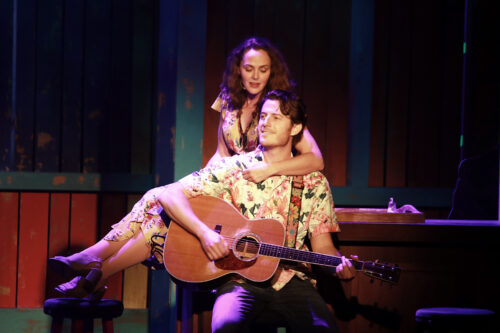
Kayleen Seidl as Rachel and Sam Sherwood as Tully in “Jimmy Buffett’s Escape to Margaritaville” at Actors’ Playhouse at the Miracle Theatre. (Photo courtesy of Alberto Romeu)
The plot follows the guitar-slinging ladies’ man who sings at Margaritaville’s hotel bar on a Caribbean island. Vacationers stream in and out but the island workers and a barfly named J.D. (the ultra-talented Stephen G. Anthony getting the laughs as the guy who keeps losing his shaker of salt) are ever-present.
Marley (the affable Kareema Khouri whose comic timing is impeccable) runs the place with the help of Jamal (Elijah Word proving he can play any character he’s given). Behind the bar and always ready to concoct an island special of the day: Tuesday’s “Sex on the Beach” or Wednesday’s “Mountain Dew Me” is Brick (Jordan Bell, gifted with the juiciest comic role in the show and maximizing every opportunity with aplomb).
While women have obviously come and gone, none stealing Tully’s heart, it takes a level-headed scientist, Rachel (Kayleen Seidl, who has the most difficult task as the only character who takes anything seriously), whose only purpose to visit the island is to collect dirt and celebrate her best friend, Tammy’s (Cindy Pearce, a perfect fit as the bride-to-be), last few days of single womanhood before getting married. They’ve left Cincinnati for the trip but not before Tammy’s future husband, Chad (Jeremy Sevelovitz) has fat-shamed her into packing only carrot juice and sunflower seeds for the trip so she can squeeze into the wedding dress he has waiting – she’ll need to drop a whole size in a week to fit into it.
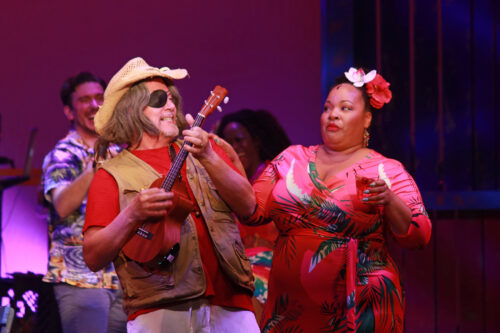
Stephen G. Anthony and Kareema Khouri in “Jimmy Buffett’s Escape to Margaritaville” at Actors’ Playhouse at the Miracle Theatre. (Photo courtesy of Alberto Romeu)
Like the typical jukebox musical, the storyline only exists to service the songs; sometimes the book writers succeed, but oftentimes the segues fail.
Brick reaches for something to eat after the girls go and he’s lovesick– it’s sponge cake. Cue the song: “Nibblin’ on sponge cake, watching the sun bake,” the opening lines to “Wasting Away in Margaritaville.” The biggest diet cheat comes in the form of an anthem to the deliciousness of a cheeseburger in “Cheeseburger in Paradise,” which somehow turns into a female liberation anthem.
Dramatic action in “Margaritaville” is a volcano eruption, a hidden treasure, and dancing insurance salesman zombies, this particular oddity saves itself from falling flat when it turns into a kick line fantasy of Brick’s, complete with sparkly gold costumes (top hats off to costumer Ellis Tillman) and some spectacular tap dancing (another set of hats off to choreographer Ron Hutchins). Triple hats off to Bell as Brick whose high-kicks rival any Rockette in a number that brings the musical to new heights.
The score features some 25 Buffett tunes (all probably under 3 minutes), including some new songs written for the show as well as his most famous hits from “Fins” to “Volcano” to “Why Don’t We Get Drunk and Screw?” (this complete with audience callback built-in) all played by a spectacular on-stage band of nine musicians led by conductor Nick Guerrero.
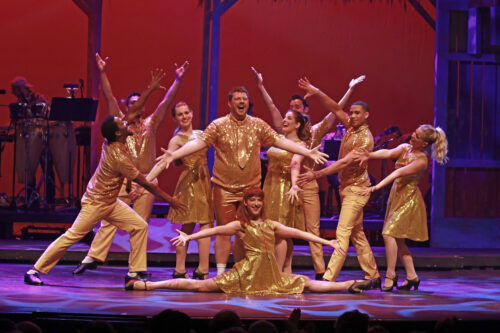
Jordan Bell as Brick surrounded by the ensemble in a tap-dancing number from “Jimmy Buffett’s Escape to Margaritaville” at Actors’ Playhouse in the Miracle Theatre. (Photo courtesy of Alberto Romeu)
Director David Arisco chooses to give the characters hearts and souls instead of coasting along as window dressing for songs and he’s assembled a cast that’s willing to dive right in.
Sean McClelland captures the vibe of the beachy keen island retreat creating almost a picture frame of the surroundings and lighting design by Eric Nelson keeps everything sun-drenched. Shaun Mitchell’s sound design captures the island environment and when the volcano is ready to blow, there isn’t a doubt it just may.
It’s a guilty pleasure to enjoy “Margaritaville,” escapist fare that Actors’ Playhouse obviously picked purposefully in an effort to celebrate their occasion. It’s a way to ease audiences back into the theater post-COVID. Face it. Who wants “La Mancha?” Dig out the Hawaiian shirt, throw on a pair of flip-flops and get lost in island time for a while.
WHAT: “Jimmy Buffett’s Escape to Margaritaville”
WHERE: Actors’ Playhouse production at the Miracle Mile Theatre, 280 Miracle Mile, Coral Gables
WHEN: Performances 8 p.m., Wednesday, Thursday, Friday, and Saturday; 2 p.m. Saturday; 3 p.m. Sunday. Through Sunday, Feb. 26.
COST: $$55, $65, $75, $80, $85, $100
INFORMATION: 305.444.9293 or actorsplayhouse.org
ArtburstMiami.com is a nonprofit source of dance, visual arts, music and performing arts news. Sign up for our newsletter and never miss a story.
No posts found
Review: ‘American Rhapsody’ Explores Issues, Events and Family in Michael McKeever’s New Play
Written By Christine Dolen
January 18, 2023 at 1:54 PM
Lindsey Corey, Aloysius Gigl, Alex Weisman (on floor) and Laura Turnbull in the world premiere of Michael McKeever’s “American Rhapsody” at Zoetic Stage inside Miami’s Adrienne Arsht Center through Sunday, Jan. 29. (Photo by Justin Namon)
Michael McKeever is pondering big questions in Zoetic Stage’s “American Rhapsody,” a world premiere that boldly traverses more than 60 years in an extended family and an ever-evolving country.
Running through Sunday, Jan. 29 in the Carnival Studio Theater at Miami’s Adrienne Arsht Center, the play examines how major issues and events – the AIDS crisis, post-traumatic stress disorder, 9/11, Black Lives Matter protests, women’s rights and more – play out in individual lives.
The audience sees a changing America through the lens of the Cabot family of Lawrence, Kansas, and New York City. This Cabot line begins with the distinguished, much-admired judge Franklin Cabot, a man already deceased when he first appears onstage. His descendants include a celebrated poet, several attorneys and a rising politician. Diversity in sexual orientation, ethnicity and race enriches the generations as they become a family by birth and by choice.
Plenty of sorrow and tragedy play out through McKeever’s story – because, you know, that’s life – but this is a playwright who is deft at comedy and knows that’s part of life too. Director Stuart Meltzer, Zoetic’s artistic director (and McKeever’s husband), has proven himself masterful at finding laughter at just the right moment, and thanks to the combination of playwright and director, “American Rhapsody” elicits a richly varied tapestry of emotions.
Poet Franky Cabot (Alex Weisman) is the narrator and fulcrum of this memory play, a piece in which time is both orderly and fluid. The patriarch everyone calls Papa Frank (Stephen Trovillion), for example, has a hilarious and enlightening interaction with Franky’s future BFF Nat Morris (Lela Elam) when the judge has already lived his life and Nat, a Black lesbian, is yet to be born.

Alex Weisman and Lela Elam are the best of friends in Zoetic Stage’s world premiere of “American Rhapsody.” (Photo by Justin Ramon)
After Franky reads from an epic poem he’s struggling to get right, the play shifts to the 1969 lunar landing, as a sleepy five-year-old Franky (then called Little Frank) is plucked from bed to join his family as they watch Neil Armstrong become the first human to set foot on the moon.
His father Big Frank (Aloysius Gigl), intense mother Eleanor (Laura Turnbull) and big sister Jenny (Lindsey Corey) have gathered around their television to watch history being made. Big Frank insists his little boy should also share in a moment he’s convinced will propel America into its future. Eleanor and Jenny are dubious about a five-year-old’s capacity to take it all in, and as it turns out, they’re right.
Grown-up narrator Franky confides: “I don’t remember a thing.”
Expectations, hopes and the sometimes-brutal sting of reality collide repeatedly in “American Rhapsody,” as they do in life.
The driven and outspoken Jenny, described as having the same sort of “blue fire” in her heart that Papa Frank did, finds herself at a crossroads when she discovers that she and her Cuban-American boyfriend Albert Bernal (Carlos Alayeto) are expecting. Their personal crisis – have the baby or have an abortion – is vividly conveyed through some of McKeever’s finest writing.
Franky, who has abandoned his extremely flat and conservative home state for gay-friendly Manhattan, navigates his own career struggles against the backdrop of the AIDS crisis. He approaches famous literary agent Terrence Ray (Trovillion who, like the majority of the cast, plays more than one role) about representing him and gets a short, polite, devastating response, which includes these words: “I find what your work currently lacks is a sense of experience. The weight that comes from facing tragedy.”

Alex Weisman and Lindsey Corey are brother and sister in Zoetic Stage’s world premiere of Michael McKeever’s “American Rhapsody.” (Photo courtesy of Justin Namon)
Soon enough, Franky’s work will acquire that weight as the poet-essayist grows famous and ever more furious.
The eight versatile actors who play 15 different roles on McKeever’s broad canvas include three who have performed on Broadway (Weisman, Trovillion, Turnbull) and four Carbonell Award winners (Elam, Corey, Gigl, Turnbull). All eight are adroit performers who evolve convincingly over the play’s 63-year time span.
Weisman, who grew up in Davie, won Chicago theater’s prestigious Joseph Jefferson Award for his work in “The History Boys” and “Hand to God,” and his many TV roles include gay dad Frank on “Sesame Street.”
Still boyish in his mid-30s, he is an inspiringly skilled actor whose performance as Franky embraces the character’s weaknesses as well as his talents. Evolving from that confused five-year-old to a debilitated 68-year-old nearing the end of his life, Weisman earns every moment in the spotlight.
Trovillion, veteran of many a Summer Shorts festival, demonstrates his versatility yet again as the curious, progressive Papa Frank and the supremely snooty Terrence Ray. As Big Frank, Gigl is a man-of-few-words midwestern farmer. Then he changes utterly as he becomes Justin, Franky’s New York editor and friend, a gay man whose experience of the AIDS crisis begins when he locks eyes with a smiling stranger in a bar.

Carlos Alayeto and Laura Turnbull react to Stephanie Vazquez in a scene from “American Rhapsody.” (Photos courtesy of Justin Namon)
Turnbull makes Eleanor a prickly woman who fails to realize for far too long that she might have made other choices in life. Then as Miss Cunningham, she becomes an outraged sparring partner with transgressive college student Jenny.
Like Jenny, Corey keeps that blue fire blazing in her character’s heart, aging from girl to young woman facing a life-changing decision to on-the-rise lawyer with a suffering husband and young daughter at home. She also briefly plays Sally, the woman who brings true contentment into Nat’s life, but it is her journey as Jenny that’s so powerfully captivating.
Elam’s Nat isn’t the first role McKeever has written with the actor’s voice in mind, but this one – complex, wry, provocative, funny – is a perfect fit. Elam has theatergoers in the palm of her hand from the get-go, and as she becomes increasingly important to Franky and others in his family, the audience falls for her too. The actor also fleetingly plays Judge Emily Barnett, a woman who will help Franky’s niece pursue a career path she never imagined.
Stephanie Vazquez plays Maddie Cabot-Bernal, the daughter of Franky’s sister Jenny and Albert Bernal. She’s a pistol, another blue fire kind of woman, emphatic in the correctness of her ideas and ready to take on the world. The young Vazquez plays Maddie from girlhood to a pivotal moment in 2032 when both she and the country are about to change. She’s energetic, enthusiastic, sometimes overwhelming, but her evolution isn’t entirely convincing.
In his Zoetic debut as Maddie’s father Albert, Alayeto transforms from a tender caretaker to a man suffering from PTSD. Moving from strength to despair, he heartbreakingly illustrates the post-service reality for too many veterans. Alayeto also has a short scene as Senator Mendez, a politician who helps fuel the biggest change in Maddie’s life.
As for how the story is delivered, what it looks and sounds like, it’s rather strange and not as enveloping or inviting as most Zoetic shows.

Stephen Trovillion plays patriarch Franklin Cabot in the Zoetic Stage world premiere of Michael McKeever’s “American Rhapsody” at the Adrienne Arsht Center in Miami. (Photo courtesy of Justin Namon)
Robert F. Wolin’s abstract set allows for Delavega’s videos and Steven Covey’s projection mapping to offer up multiple elevated images when the play moves into a new year (that particular year is projected onto the stage itself). While the photos and videos serve as timeline touchstones, they’re generally so numerous that you can’t possibly take them all in before they vanish.
Differently shaped faux metal containers dot the stage, serving as seats and places to conceal the props by designer Natasha Hernandez. The containers may be utilitarian, but they’re also unappealing.
Marina Pareja’s costumes effectively assist in the play’s time travel, as well as commenting on a character’s age, taste and urban or rural lifestyle. The only miss is Maddie’s schoolgirl getup, which looks out of place on Vazquez’s grownup figure.
Rebecca Montero’s lighting helps shape each scene – she’s a truly fine designer – but she comes up with an eerie golden glow in which to bathe the actors as they oh-so-slowly walk onto the stage from who-knows-where. Maybe they’re being summoned from Franky’s memories. Maybe the afterlife is that color.
Matt Corey has created the soundscape and woven in selected music, including some from composer Steve Reich whose work Meltzer describes in his program note as “pulses, counterpoints, minimal, complex and, at times, aggravating.” That’s quite right.
However, you should know this: Whether or not any design elements bother you, “American Rhapsody” is a new play worth experiencing.
McKeever makes you laugh, tear up, feel nostalgic. He captures the dynamics of a family bonded by love but struggling as its members face life-and-death challenges. Those big moments that affect the country as a whole? The playwright demonstrates how they claim a place in our memories, how they change us. He finds the constants in the cycle of life, illuminates them, and makes you feel their resonance in your own experience.
WHAT: “American Rhapsody” by Michael McKeever
WHERE: Zoetic Stage production in the Carnival Studio Theater at the Adrienne Arsht Center for the Performing Arts, 1300 Biscayne Blvd., Miami
WHEN: 7:30 p.m. Thursday-Friday, 3 and 7:30 p.m. Saturday, 3 p.m. Sunday (no matinee Jan. 21), through Sunday, Jan. 29
COST: $55-$60
INFORMATION: 305-949-6722 or arshtcenter.org
ArtburstMiami.com is a nonprofit source of dance, visual arts, music and performing arts news. Sign up for our newsletter and never miss a story.
No posts found
Review: Revival of ‘Anna in the Tropics’ Brings Miami Pulitzer Winner’s Play To Vibrant Life
Written By Christine Dolen
January 16, 2023 at 4:08 PM
Saundra Santiago as Ofelia and Daniel Capote as Cheché in Nilo Cruz’s “Anna in the Tropics” at Miami New Drama through Sunday, Feb. 5. (Photos courtesy of Andres Manner)
In his best-known play, Nilo Cruz blends vivid imagery, Cuban-American history and tradition, the imagination-inspiring power of great literature, and a sensuality so electric you can almost hear it sparking.
Two decades after “Anna in the Tropics” made him the first Latino playwright to win the Pulitzer Prize for drama, Cruz is now revisiting the work that sent his career soaring.
Miami New Drama’s exquisite anniversary production of the play features Cruz in the dual roles of author and director. In the years since “Anna in the Tropics” had its world premiere at the intimate New Theatre in Coral Gables, Cruz has become an impressively artful interpreter of his own work – the new production of “Anna” included.
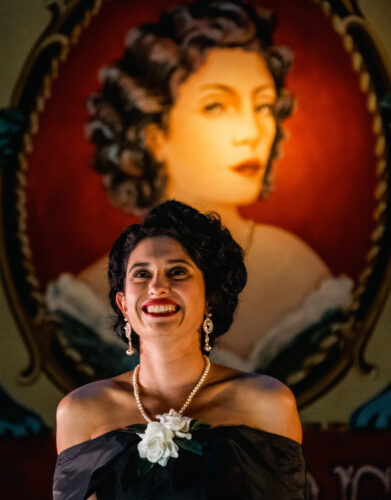
Andrea Ferro’s Marela poses with her cigar-label portrait in Miami New Drama’s 29th anniversary of “Anna in the Tropics.” (Photo courtesy of Andres Manner)
Set in Ybor City near Tampa in 1929, “Anna in the Tropics” honors, explores and laments the impending end of traditional practices in a small Cuban-American cigar factory.
One of those traditions is to have a lector read novels and newspapers to the workers, entertaining and enlightening them, relieving the monotony of hand-rolling hundreds of cigars each day. “Anna in the Tropics” also becomes a testament to the life-altering possibilities of literature when the factory’s handsome new lector, Juan Julian Rios (Gabriell Salgado), chooses Leo Tolstoy’s “Anna Karenina” as the first novel he’ll read.
The Alcalar family’s women – matriarch Ofelia (Saundra Santiago), unhappily married elder daughter Conchita (Hannia Guillen) and vivacious younger daughter Marela (Andrea Ferro) – are quickly besotted with Tolstoy’s romantic tragedy and the dashing Juan Julian.
Patriarch Santiago (Serafin Falcon), struggling with gambling and alcohol abuse, avoids the work area for a while but is still near enough to know that he likes what he hears from the lector. His half-brother Cheché (Daniel Capote) and Conchita’s cheating husband Palomo (Brandon Espinoza), on the other hand, mock Juan Julian. For different reasons, both want him gone.

Hannia Guillen’s Conchita and Gabriell Salgado’s Juan Julian talk of love and logistics in Nilo Cruz’s “Anna in the Tropics.” (Photo courtesy of Andres Manner)
Girlish Marela tries but fails to get Juan Julian to reciprocate her crush. He has eyes for Conchita; soon enough, the two are sharing their personal histories, flights of fancy and kisses that cascade into an unrelenting passion.
Sometimes funny, sometimes fiery, “Anna in the Tropics” is also a gathering tragedy. For the play to fully pay off in the heart-stopping way the best dramas do, Cruz as director and his cast have to precisely elicit and deliver a spectrum of emotions. And they do, in a collection of superb performances.
The striking Guillen, who radiates allure and a mysterious complexity as Conchita, transforms from a dissatisfied wife to an ardent, awakened lover. She navigates her love triangle unapologetically, changing from a traditional woman into a modern one who would risk trysts in the place where her entire family works.
Thanks to Cruz’s direction, as well as the chemistry and skill of Guillen and Salgado, the scene that ends the first act – the words are about one thing, the actions another – becomes inevitable, emotionally potent and irresistible.
Salgado, who has been in demand since graduating from the New World School of the Arts in 2019 and making his debut in Zoetic Stage’s “Frankenstein” in 2021, is notably younger than most other actors who have played Cruz’s life-changing lector.
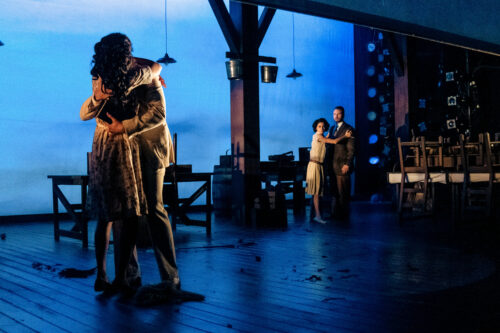
Hannia Guillen and Gabriell Salgado embrace as Andrea Ferro holds back a furious Brandon Espinoza in Nilo Cruz’s “Anna in the Tropics.” (Photo by Andres Manner)
Yet the choice works and imbues this “Anna” with different emotional colors. Salgado’s Juan Julian is dreamy, whether he’s in his off-white three-piece suit or shirtless with Conchita on the factory floor.
But the actor is also effectively playful, particularly with Marela as a way of trying to keep her romantic feelings at bay. He conveys the seductive power of words, whether Tolstoy’s or Cruz’s, and once Conchita has begun applying Juan Julian’s love lessons to her marriage, he looks lost and emotionally adrift.
Espinoza has a challenge as Palomo, a character mysterious in his own way. He observes his wife and the lector making love, then greedily demands details from Conchita, even insisting that she demonstrate what the lector does with her. Yet Espinoza’s Palomo convincingly reclaims his transformed wife, so much so that you feel (at least a little) for Juan Julian.
Ferro is a wonder as Marela, a sparkplug of a human being whose hope and joy make her nearly incandescent. She has many notes to play, including unrequited love and a traumatizing attack.
But she’s not always the sweet girl. Her half-uncle Cheché, whom she calls by his given name Chester as if it were a curse, is the frequent target of her disdain. The two share a pair of disturbing scenes, and as staged by Cruz, the second one is horrifying if not surprising.
Though Cheché becomes the villain of the piece, Capote brings such a range of emotions to the role that his deeply effective performance is arguably his best ever – and it’s among the best from a long line of actors who have played Cheché.
Capote communicates the character’s loneliness and longing, the sting of his past humiliation, his frustration at having his ideas dismissed. Yes, his final actions are terrible, but Capote makes it crystal clear how a broken man arrived at that place.
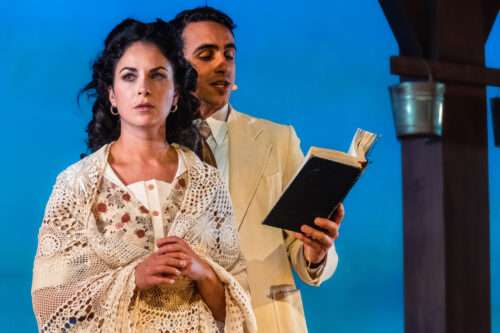
Hannia Guillen as Conchita takes in the words of Gabriell Salgado as Juan Julian as he reads from a Leo Tolstoy masterpiece in “Anna in the Tropics.” (Photo courtesy of Andres Manner)
Falcon’s appealing Santiago is a man at one of those later-in-life crossroads, a loving husband and father whose self-destructive behavior is eating away at his life and livelihood. When he cares to be, he’s strong and decisive. But he’s also capable of vulnerability, as when he asks the frequently angry Ofelia whether she is done with loving him.
As Ofelia, Santiago (a University of Miami grad who launched her career on “Miami Vice”) is almost fragile, though she’s angry enough as she watches Cheché scheming to play a bigger role in the factory while her husband is mentally checked out.
But she, too, changes in the party scene celebrating the factory’s launch of a new “Anna Karenina” cigar. Her Ofelia grows uninhibited the more she drinks, dances with her dashing husband, then beautifully sings a snippet of “Can’t Help Lovin’ That Man,” from the musical “Show Boat,” which made its debut two years earlier than “Anna in the Tropics” takes place.
Miami New Drama’s “Anna in the Tropics” design team strikingly creates the play’s visual and aural world while honoring the author-director’s minimalist aesthetic.
Arnulfo Maldonado’s set features rustic cigar-rolling tables and an elevated seat for the lector, as well as nearly-transparent white curtains that create different playing areas while soaking up Yuki Nakase Link’s remarkable lighting. Link’s stunning work helps to drive every scene, changing a moment from romantic to ominous, painting Tampa’s endless skies a cloudless blue or the glorious golden rose of a sunset. Composer and sound designer Salomon Lerner further conveys time, place and culture.
Christopher Vergara mainly opts for a sepia-toned palette in his lovely-to-look-at collection of period costumes. The most striking exception is the black ball gown worn by Marela, chosen by her father to be the face of the company’s new cigar. The dress helps transform Ferro’s petite Marela from energetic girl to the embodiment of Tolstoy’s tragic beauty.
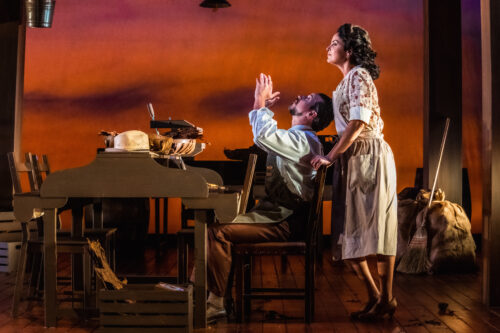
Brandon Espinoza’s Palomo expresses his feelings to Hannia Guillen as his wife Conchita in Nilo Cruz’s “Anna in the Tropics.” (Photo courtesy of Andres Manner)
The 20th anniversary “Anna in the Tropics” illustrates yet again a truth about theater. Unlike many kinds of art, theater is an in-the-moment communal experience for the actors and audience. And when a particular production’s run ends, that’s almost always it, no matter how special or successful the show is.
Born in Cuba and raised in Miami, Cruz is an artist of international renown, a man dedicated to looking at his work with fresh eyes. He does that even with a play as acclaimed as “Anna in the Tropics,” finding a just-right cast to bring the piece to vibrant life. It is special. But after Feb. 5, this decidedly special celebration of an artist’s deeply moving work will close. And though there have been and will be other productions of “Anna in the Tropics,” this one stands out.
WHAT: 20th-anniversary production of “Anna in the Tropics” by Nilo Cruz
WHERE: Miami New Drama at the Colony Theatre, 1040 Lincoln Rd., Miami Beach
WHEN: Performances are 8 p.m. Thursday, Friday and Saturday, 3 p.m. Sunday, extended through Thursday, Feb. 12.
COST: $46.50-$86.50 (includes service fee)
INFORMATION: 305-674-1040 or miaminewdrama.org
ArtburstMiami.com is a nonprofit source of dance, visual arts, music and performing arts news. Sign up for our newsletter and never miss a story.
No posts found
Review: ‘We Will Not Be Silent’ Examines Last Days of Courageous Life, Speaks to Today
Written By Christine Dolen
January 10, 2023 at 6:55 PM
Jason Peck is Kurt Grunwald and Meredith Casey is Sophie Scholl in GableStage’s “We Will Not Be Silent” through Sunday, Jan. 29 at GableStage at the Biltmore, 1200 Anastasia Ave., Coral Gables. (Photo courtesy of Magnus Stark)
Imagine this: You are a key part of a student group advocating nonviolent resistance to a brutal government. A true believer sees you scattering pamphlets in support of your cause, and you’re immediately arrested. Within five days, you have been interrogated, convicted and executed.
That horrific scenario is precisely what happened in 1943 to Sophie Scholl, a student at the University of Munich and anti-Nazi activist in the White Rose movement.
Scholl and the White Rose have been the subjects of movies, docudramas, plays and books. In 2015, playwright and actor David Meyers wrote “We Will Not Be Silent,” a play about the last brutal days of Scholl and her brother Hans. After a developmental period, the play premiered in 2017, and it was produced at Boca Raton’s Theatre Lab in 2019.
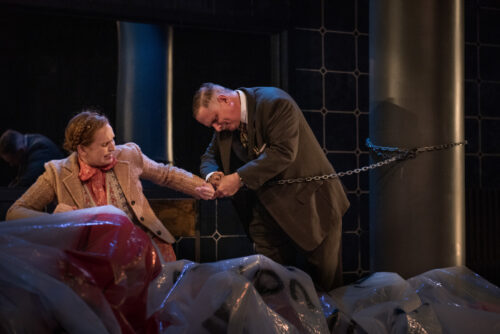
Jason Peck as Kurt Grunwald removes a handcuff tethering a frightened Meredith Casey as Sophie Scholl in GableStage’s “We Will Not Be Silent.” (Photo courtesy to Magnus Stark)
Now, with GableStage producing artistic director Bari Newport at the helm, “We Will Not Be Silent” is getting a new production at a time when having the courage to stand up to tyrants seems increasingly urgent.
Scholl embraced Nazi youth organizations as a child, as did her brother, despite the objections of their father Robert, who was later imprisoned for making an anti-Hitler remark to one of his employees. The Scholl family was Lutheran. “We Will Not Be Silent” isn’t a Holocaust play per se, though there is a line about the dubious claim that the Nazis were “relocating” the Jewish population.
Soon, the siblings and their student friends began rejecting Nazi ideology, and Sophie focused on religion, philosophy, teaching children and the arts. She also became active in the White Rose as the group found ways to get its pamphlets calling for resistance distributed in cities throughout Germany.
Facts about Scholl’s too-short life – she was guillotined at the age of 21 – are woven into “We Will Not Be Silent.” But Meyers has chosen to focus on the intense, frightening few days when a Nazi interrogator tried to get Scholl to confess to treason.
Scholl’s actual inquisitor was a Gestapo member named Robert Mohr. Meyers has made the character a former policeman named Kurt Grunwald (Jason Peck), a man who shifts between playing good cop and bad cop several times during the course of the play.
Sophie (Meredith Casey) begins the play fiercely screaming, pulling down a semi-transparent banner painted with graffiti urging Germans to act against the Nazi regime. Moments later, she appears distraught and chained to a fat golden pillar. Grunwald faux-apologizes as he removes her handcuff, then he awkwardly stuffs the banner almost out of sight.
What then unfolds on designer Frank J. Oliva’s mysterious set – its tiled walls and floor vaguely suggest a kind of cage – is a session filled with debates, lies, attempts at persuasion, deprivation, and torment both psychological and physical.
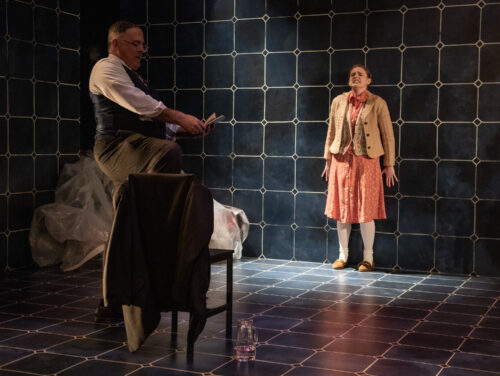
Jason Peck’s Kurt Grunwald torments Meredith Casey’s Sophie Scholl in Bari Newport’s production of”We Will Not Be Silent” at GableStage. (Photo courtesy of Magnus Stark)
At first, Casey’s Sophie, her red hair done in youthful braids, claims to know nothing of the White Rose, and her demeanor is fairly convincing. Peck’s Grunwald tries convincing her that he’s open to believing her innocence and her brother’s. But before long, he pulls evidence from a folder and starts turning invisible screws as an anonymous Nazi watches from behind a window, documenting the discussion in his notes.
As Sophie is deprived of food, water and rest, and as Grunwald tries to persuade her that the others will be tried and executed, she tries to exonerate them by shouldering the blame. Grunwald knows better, and in one awful protracted scene he forces her to stand with her back against the wall and her feet straight until her body begins shaking uncontrollably.
Hans (Bobby Eddy) does make an appearance, entering the space as an exhausted Sophie is lying fitfully on the floor. Whether he is real or an imaginary presence born of her despair, this version of her brother is hale and hearty, which seems odd given Sophie’s condition.
Emotionally, Casey has the most to work with in the cast, and you ache for her Sophie when she makes statements that will obviously doom her. Peck’s portrayal of Grunwald is so much the low-key “ordinary” German that it’s hard to buy him as a man who may help bring Sophie’s life to an abrupt end.
GableStage’s creative team has made the world of “We Will Not Be Silent” an eerie one, with whispering voices and unsettling music from sound designer Jason Peck. Victoria Murawski’s lighting is, by turns, harsh and haunting. Costume designer Camilla Haith dresses Casey and Eddy in the sort of period clothing Sophie and Hans wore, and Peck’s nondescript three-piece suit suddenly looks more sinister with the addition of a swastika armband.
Meyers’s script is part discussion, part drama. That makes Newport’s task as director all the more difficult: A 90-minute play feels longer than it is, and the tension flows and ebbs in a story that should have more of it.
If you don’t know Sophie Scholl’s story, “We Will Not Be Silent” may inspire you to learn more. And with its chilling contemporary resonance, the play may also serve as a reminder that the courage to oppose tyranny isn’t relegated to one moment in history.
WHAT: “We Will Not Be Silent” by David Meyers
WHERE: GableStage in the Biltmore Hotel, 1200 Anastasia Ave., Coral Gables
WHEN: 2 and 7 p.m. Wednesday, 8 p.m. Thursday-Saturday, 2 p.m. Sunday (additional matinees 2 p.m. Jan. 21 and Jan. 28), through Jan. 29 (streaming available from Jan. 13); pre- and post-show talks listed here.
COST: $45-$75 (includes fees)
INFORMATION: 305-445-1119 or gablestage.org.
ArtburstMiami.com is a nonprofit source of dance, visual arts, music and performing arts news. Sign up for our newsletter and never miss a story.
No posts found
As Playwright and Director, Nilo Cruz Revisits Life-changing ‘Anna in the Tropics’ at Miami New Drama
Written By Christine Dolen
January 9, 2023 at 2:25 PM
Brandon Espinoza, Hannia Guillen and Gabriell Salgado in Miami New Drama’s 20th-anniversary production of “Anna in the Tropics” at the Colony Theatre, Miami Beach, Saturday, Jan. 14 through Sunday, Feb. 5. (Photo courtesy of Camilo Buitrago Gil).
The stunning play that altered the course of Nilo Cruz’s life began with a commission from the 104-seat New Theatre in Coral Gables. Supported by a national grant, the company led by Rafael de Acha asked the Cuban-American playwright, whose work was being produced by significant regional theaters throughout the country, for a new play.
Cruz delivered “Anna in the Tropics.”
After its world premiere in October 2002, the play won the prestigious American Theater Critics Association/Steinberg Award in April 2003 and, two days later, the Pulitzer Prize for drama. Thus, the artist who had arrived in Miami as a nine-year-old on a 1970 Freedom Flight from Cuba became the first Latino to win drama’s highest honor, taking his place in history and being elevated to a higher-profile career.

Hannia Guillen plays the restless elder daughter of cigar factory owners in Miami New Drama’s “Anna in the Tropics.” (Photo courtesy of Camilo Buitrago Gil)
“Anna in the Tropics” has now turned 20, and in celebration, Miami New Drama is presenting a new production in its home at the Colony Theatre on Miami Beach’s Lincoln Road. As he did at the Coconut Grove Playhouse in 2004, Cruz is directing his piece about a family of Cuban-American cigar makers in Ybor City near Tampa in 1929.
“It has been a long journey with ‘Anna in the Tropics.’ It completely transformed my life,” says Cruz, who eventually moved back to Miami from New York. “It brought international visibility to my work, and also allowed me to write screenplays, operas, and oratorios.”
Produced at Broadway’s Royale Theatre in late 2003, Cruz’s prize-winning play has been staged not just throughout the United States but in numerous countries, including Germany, Spain, Belarus, Cuba, Canada, Japan, China, the Philippines, Ecuador, Puerto Rico and three cities in Russia.
The last is particularly significant because “Anna in the Tropics” is inspired in part by Leo Tolstoy’s great Russian novel “Anna Karenina.” Cruz’s play honors the then-waning tradition of the lector, an educated person who would read everything from newspapers to novels aloud as the workers repetitively toiled. Once the playwright decided Tolstoy’s tragic love story would be the captivating, influential book the lector was reading to the Ybor City workers, his passionate play coalesced.
Set just as the Depression and the push for modernization were looming, “Anna in the Tropics” uses Cruz’s poetic, image-conjuring language to explore the lives of its extended Cuban-American family.
Patriarch Santiago (Serafin Falcon) and his wife Ofelia (Saundra Santiago) are the cigar factory’s long-married owners, given to bickering but still in love. Their restless elder daughter Conchita (Hannia Guillen) and her husband Palomo (Brandon Espinoza) are at odds, in part because of his string of affairs. Conchita’s younger sister Marela (Andrea Ferro) is dreamy, playful, and imaginative.
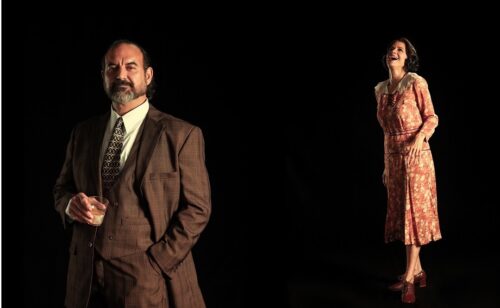
Serafin Falcon plays factory owner Santiago and “Miami Vice” veteran Saundra Santiago plays the matriarch Ofelia in Nilo Cruz’s “Anna in the Tropics” at Miami New Drama. (Photo courtesy of Camilo Buitrago Gil)
Santiago’s half-brother Cheché (Daniel Capote) is trying to gain more power at the factory as he struggles with the loss of his wife, who ran off with the previous lector. So when the handsome new lector Juan Julian (Gabriell Salgado) arrives literally fresh off the boat from Cuba, Cheché sees an enemy, while the women are enraptured.
“Nilo is such a specific writer. He lives in a temperature different from mainstream America. He really knows how to navigate this world… he’s a great director,” says Miami New Drama cofounder and artistic director Michel Hausmann. “‘Anna in the Tropics’ is such an umami of flavors: funny, sensual, poetic.”
In September, “Anna in the Tropics” made unwelcome headlines when Miami Dade County Public Schools informed Miami New Drama it would not bus high school juniors and seniors to the Colony to see special performances of the play.
The conflict over age-appropriate content has since been resolved, Hausmann says, and three groups of public school students and one audience of students from private schools will see the play.
Cruz found the short-lived controversy painful and ironic. “This is the city where I grew up, studied, and fell in love with the theater – of all the cities in the world,” he says. “‘Anna in the Tropics’ has to do with the power of words. It’s significant to do ‘Anna’ at this moment in time when books are being banned. The play embraces literature.”
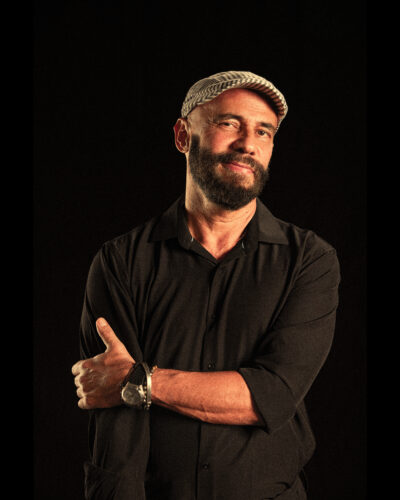
Pulitzer-prize winner Nilo Cruz is directing a 20th-anniversary production of his play “Anna in the Tropics” for Miami New Drama. (Photo courtesy of Camilo Buitrago Gil)
As it evolves, Miami New Drama has become more intensely focused on commissioning and premiering works that reflect the richly diverse communities, which call South Florida home.
That’s a good thing, Cruz says, but so is revisiting an existing play, exploring it with fresh eyes and different actors.
“I wanted this cast to be a sexy cast – elegant, sensorial,” says Cruz, who has worked with three of the seven actors multiple times.
As he does when he stages a play for Arca Images, a smaller bilingual Miami company where he serves as artistic director, Cruz loves to explore a play – even one as successful as “Anna in the Tropics” – with his cast in the rehearsal room, taking in the ideas of each actor.
For instance, he is seeing Cheché in a new way because of what Capote is bringing to the role.
“In the past, he was played more as an angry man. He was devastated because of his wife leaving with the previous lector,” says Cruz. “Through Capote, I see more of the pain in him. The solitude, the sadness. He wants to be loved. Capote brought that, and I said, ‘I love it, let’s use it.’ It’s a lot more profound.”
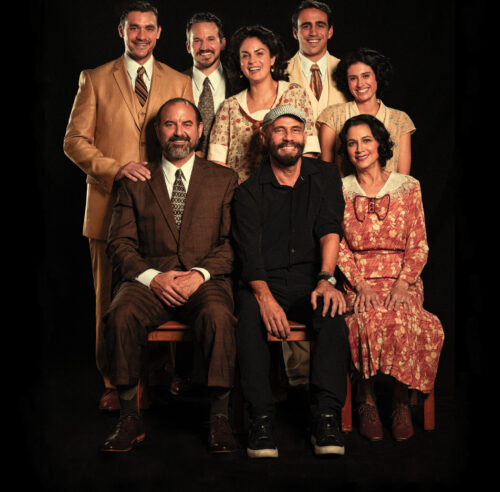
Miami New Drama’s “Anna in the Tropics” cast poses for a family portrait with playwright-director Nilo Cruz. (Photo courtesy of Camilo Buitrago Gil)
Central to the play is the life-changing relationship between Guillen’s Conchita and Salgado’s Juan Julian. The words he reads from “Anna Karenina” spark her imagination and desire, and they begin an affair. Their lovemaking isn’t depicted in the Miami New Drama production, but the imagery conjured by Cruz’s words is vivid, passionate, and powerful – its own kind of literary achievement.
“‘Anna in the Tropics’ at the Coconut Grove Playhouse is the first play I ever saw. It dawned on me then that I wanted to be an actress, that I wanted to transport people,” says Guillen, who later met Cruz through their mutual mentor, Teatro Prometeo founder Teresa María Rojas. “Nilo has been a blessing and a gift, a miracle… A lot of people try to do what is hot now, what’s trendy. He believes in his craft, what he brings to the world. But he remains humble.”
Guillen, who was born in Cuba and moved to Miami with her family at age 11, has appeared in multiple Cruz plays (including a 2011 Spanish-language “El color del deseo”/“The Color of Desire” directed by Hausmann in New York), but this is her first production of “Anna in the Tropics.” This cast, she believes, “is in tune with Nilo. It’s a magical connection with his text.”
Salgado, a 2019 New World School of the Arts grad who made his professional debut as the Creature in Zoetic Stage’s 2021 production of “Frankenstein,” has become one of the region’s most in-demand actors. He’s far younger than most who have played the lector (Jimmy Smits, now 67, starred as Juan Julian in the 2003 Broadway production), but Cruz believes Salgado has all the qualities needed for the part – plus an undeniable chemistry with Guillen’s Conchita.
“Gabriell is a very, very elegant actor. He has a sense of the language, a lyricism, and a sensuality. He is the quintessential gallant man – un galán,” says Cruz, who sees fire onstage between Salgado and Guillen. “He’s timeless. He is a theater creature with all the tools to deliver on his promise. I don’t see the age. I see a brilliant man, gifted in the same way Mozart was when he was composing at an early age. That intelligence has no age.”
Salgado acknowledges that chemistry with Guillen and believes she embodies the qualities in Cruz’s writing. At first, he found the playwright’s style to be “the most unique writing I’ve ever encountered. It’s the most poetic, and its spiritual component and magical realism excite me.”
Working with the author as director is also a new experience.
“He has such a confidence and a fluidity. He’s in his territory, on his playground. He’s such an incredible person, so kind, fascinating and extremely generous,” Salgado says.
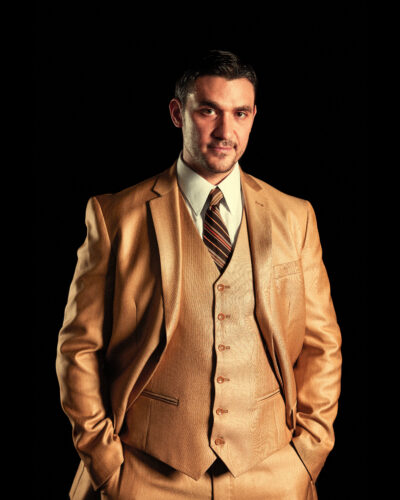
Daniel Capote plays the wounded, angry Cheché in Miami New Drama’s “Anna in the Tropics.” (Photo courtesy of Camilo Buitrago Gil)
Santiago, who grew up in Homestead and graduated from the University of Miami, and Miamian Falcon play the older generation in “Anna in the Tropics.” Both have a host of theater, television, and film credits; Santiago is arguably the best-known actor in the Miami New Drama cast by virtue of her role as detective Gina Calabrese on “Miami Vice” from 1984 to 1990.
“‘Anna in the Tropics’ was on Broadway at the same time I was doing ‘Nine’ with Antonio Banderas,” Santiago recalls. “I went to see Daphne Rubin-Vega (the original Mimi in ‘Rent’), who was playing Conchita, and I was blown away. I played so much attention to what she was doing and thought, ‘Oh, this is a good part for me.’ And now I’m playing Ofelia.”
Santiago has played powerful women and matriarchs in a number of shows, including Mama Rose in “Gypsy,” Amanda in “The Glass Menagerie” and the title role in “Evita.” Ofelia, she says, “keeps the factory running. She is always checking up on everyone. She loses her temper, has her faults, gets drunk. But she’s a typical matriarch, doing the best she can.”
Falcon wasn’t familiar with Cruz or his plays when he was hired to portray Palomo in a production of “Anna in the Tropics” in 2010 at California’s small Sierra Madre Playhouse near Pasadena. He was the only Cuban-American in the largely Mexican-American cast, and he remembers marveling at the script the first time he read it.
“I thought, ‘What is this? This is my family’s history.’ My grandma and her siblings were all cigar rollers in Cuba,” he says. “This is the fifth production in which I’ve been directed by Nilo. When he calls and says, ‘I want you to do this for me,’ I jump at the opportunity to work with him. It’s like life being breathed into me. Theater isn’t the best-paying medium. But what it has done for my soul I can’t express in words.”
WHAT: 20th-anniversary production of “Anna in the Tropics” by Nilo Cruz
WHERE: Miami New Drama at the Colony Theatre, 1040 Lincoln Rd., Miami Beach
WHEN: Previews Thursday, Jan 12 and Friday, Jan. 13, opens Saturday, Jan. 14 (opening night sold out); performances are 8 p.m. Thursday-Saturday, 3 p.m. Sunday, through Sunday, Feb. 5
COST: $46.50-$76.50 (includes service fee)
INFORMATION: 305-674-1040 or miaminewdrama.org
ArtburstMiami.com is a nonprofit source of dance, visual arts, music and performing arts news. Sign up for our newsletter and never miss a story.
No posts found
Music And Politics Mix In Two Movies Premiering at Miami Jewish Film Festival
Written By Michelle F. Solomon
January 9, 2023 at 10:06 AM
The band National Wake, Ivan Kadey, Gary Khoza, Steve Moni and Punka Khoza, circa 1981, is chronicled in the documentary “This Is National Wake” premiering at the Miami Jewish Film Festival, which opens Thursday, Jan. 12 through Thursday, Jan. 26. The film screens on Monday, Jan. 16 at O Cinema South Beach. (Photo courtesy of the film).
Two movies in this year’s Miami Jewish Film Festival have at their core stories about music as a political statement, or rather the implications that arise when music becomes intertwined with societal conflict.
Director Lilia Levitina adapted South African writer Victor Gordon’s one-act play “You Will Not Play Wagner” (7:30 p.m., Thursday, Jan. 19, Miami Beach JCC, 4221 Pine Tree Drive, Miami Beach) about a debate that erupts between a wealthy arts patron and a young Israeli conductor over his choice of composers. In Israel, there is an informal ban on the playing of 19th-century German composer Richard Wagner’s works because of his well-known anti-Semitic sentiments and for his position as a favorite composer of Adolf Hitler.

Scenes with Ofek Cohen as Yakov were filmed on location in Tel Aviv, Israel in “You Will Not Play Wagner.” (Photo courtesy of Jewish Arts Collaborative)
In Mirissa Neff’s documentary, “This is National Wake” (7 p.m., Monday, Jan. 16, O Cinema South Beach, 1130 Washington Ave., Miami Beach) apartheid-era South Africa is at the center of controversy as seen through the chronicled story of a multiracial punk rock band who defied the establishment in the late 1970s and early 1980s.
The films are an enlightening look at how music plays an essential role in politics and culture.
Neff says she grew up in the 1980s in New York with a “cursory knowledge” of what was going on at the time in South Africa. The Apartheid in South Africa (from 1948 to 1994) was a legal system of racial segregation under an all-white government.
“This Is National Wake” is Neff’s directorial debut. “You have to wonder,” she muses, “do you choose projects, or do they choose you?”
Of mixed race – her father is Jewish and her mother is Barbadian from Barbados – Neff says she was drawn to the story of the band National Wake. “In part because it parallels to my own life.” For one, she says, “it would have been illegal for my parents to marry (in the United States) a couple of years sooner than they did.”
Guitarist Ivan Kadey formed National Wake after the Soweto protests in 1976 when Black students revolted against the government. At Soweto, outside of Johannesburg, two South African student protesters died from police gunfire, sparking unrest across the country.
Two of Kadey’s bandmates were Black, brothers Gary and Punka Khoza. Kadey tells much of the story in the film since both brothers are now dead – Gary from suicide and Punka from an AIDS-related illness.
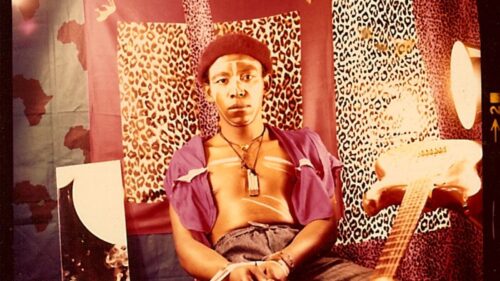
National Wake’s bass player Gary Khoza. (Photo courtesy of the film)
The movie uses much of the band’s archival footage shot on Super 8mm film with the film’s score the punk, funk and reggae music of the band. Much of the footage was shot by Kadey’s wife, Nadine, who is co-producer on “This Is National Wake.”
“There was definitely the excitement of living on the edge and saying ‘F-You’ to an absolutely brutal system that we were living in,” Ivan Kadey says about forming the band. “There were dangers and there was reason to fear but the best way to face that fear was to make the music.”
Nadine had been covering what was happening in South Africa for British television when she became involved with National Wake. “It was so extraordinary what they were doing. It was so powerful for them to even develop this band together – a strike against the system.”
Nadine says she encountered her own risks. “Some of my key footage was seized by the police,” she recalls.
Ivan Kadey, who is of Jewish heritage, says there were a significant number of people in South Africa involved in the struggle during apartheid that were Jewish. “I think it’s definitely something in the history of being an oppressed people that struck a chord in terms of people being persecuted based on race.” While his residence is in Los Angeles, as an architect now by trade, he says he has spent the past six years involved in projects in Miami and Miami Beach. “I spend a good proportion of my time there,” he says.
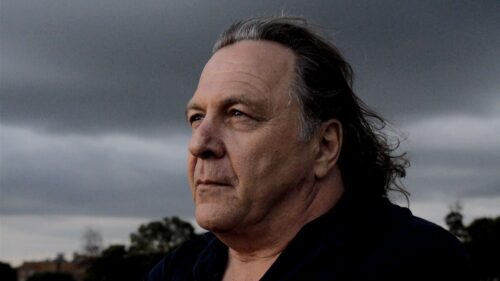
Ivan Kadey in Mirissa Neff’s “This Is National Wake,” the story of a band that defied apartheid-era establishment in South Africa. (Photo courtesy of Philip Bell)
Neff discovered National Wake through a documentary 2012’s “Punk In Africa” and, as a music journalist, knew there was something more. She says she wanted to locate Ivan to interview him for a PBS show she was working on at the time. They connected on Facebook. “The (PBS) show about the intersection of music and politics,” she explains.
She went to Los Angeles where Ivan was living to learn more about National Wake. After spending time with Ivan and Nadine, she realized there was more to tell than just a short television piece about the band. She also discovered that Nadine had more footage than clips of the band used in the “Punk in Africa” film.
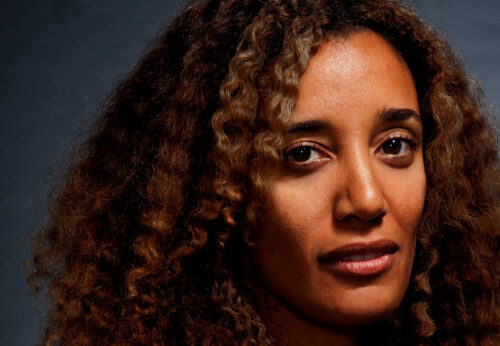
“This Is National Wake” is Mirissa Neff’s first feature film as a director. (Photo courtesy of the filmmaker)
About an hour of the film had been digitized for the other film, but the rest was still on Super 8 reels, never before-seen-footage.
“I knew I had a film,” she says.
Levitina, director of “You Will Not Play Wagner,” didn’t plan on making her first feature film either. The project started off with a one-act play introduced to her by actress Annette Miller during COVID-19. The theater director envisioned it as a play via Zoom like many theater companies were doing during the pandemic. But she saw something more and decided to not just capture her actors playing their parts on a small Zoom screen. There would be extended shots to develop the character’s stories: Miller’s scenes as the adamant arts patron, Esther, with a personal story on her own distaste for Wagner, were filmed in her home in Lenox, Mass., and Levitina flew to Tel Aviv to direct Ofek Cohen who plays the young conductor, Yakov.
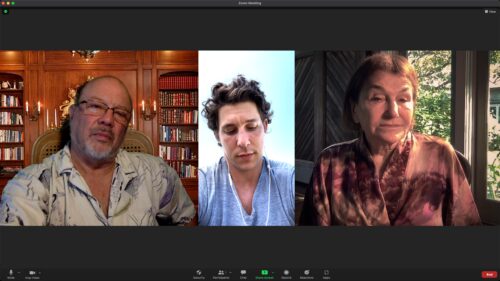
Avi Hoffman as Morris, Ofek Cohen as Yakov and Annette Miller as Esther in “You Will Not Play Wagner.” (Photo courtesy of Jewish Arts Collaborative)
South Florida actor Avi Hoffman was brought on board by Miller to play Morris, the harried organizer of the Esther Greenbaum International Conductors’ Competition. While the character’s locale is meant to be Brooklyn, N.Y., Hoffman worked out of his Coral Springs home. He says he rehearsed with the director and ultimately recorded his own parts. In the end, editor Christo Tsiaras put all the pieces together.
As far as the storyline, Hoffman says he was familiar with Israel’s taboo of Wagner’s works.
“I grew up in Israel from the time I was 11 years old until I was 20. I don’t remember when the controversy began, but I do remember it pretty clearly that there was this whole thing about you can’t play Wagner in Israel. You just don’t. It’s like saying, okay, let’s celebrate Hitler’s birthday. You just don’t do it.”
Hoffman says he was familiar with the concept of which Gordon based his play but the added subplot of Esther’s backstory was another interesting aspect for Hoffman.
“This is my third film in a row in as many years at the Miami Jewish Film Festival. My first film (“Shehita” in 2018) was 30 minutes long and it was in Yiddish and it was about the Holocaust. My second film (“Boxed” in 2022) was 13 minutes long and it was in Yiddish and it was about the Holocaust. And now, this is the first full-length film I’m involved in and it’s not in Yiddish. But the apropos is the Holocaust.”
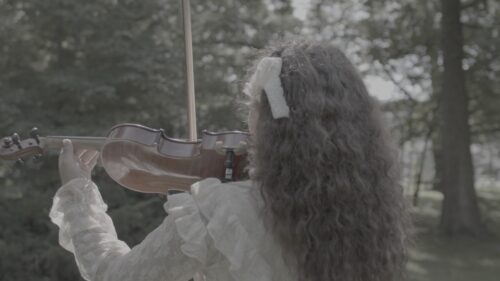
A scene from “You Will Not Play Wagner.” (Photo courtesy Jewish Arts Collaborative)
He says the film comes at a time in United States history that the 64-year-old says has taken him by surprise.
“I feel like we’re living in an age that I never thought I would see in my lifetime, which is this enormous mainstream revival of antisemitism and Holocaust denial. . . So, how do you combat that? . . . Through the arts. By making movies about the Holocaust; by doing things that show how absurd and wrong it is to have that kind of hatred and prejudice.”
WHAT: Miami Jewish Film Festival
WHEN: Thursday, Jan. 12 through Thursday, Jan. 26. Ivan Kadey will perform live and Marissa Neff, director, will be in attendance for “This is National Wake” on Monday, Jan. 16 at O Cinema South Beach. Director Lilia Levitina and actors Avi Hoffman and Annette Miller of “You Will Not Play Wagner” will be in attendance for a question and answer segment on Thursday, Jan. 19 at the Miami Beach JCC.
WHERE: Various venues including Bill Cosford Cinema, 5030 Brunson Drive and Coral Gables Art Cinema, 260 Aragon Ave., Coral Gables; Miami Beach Bandshell, 7275 Collins Ave., Miami Beach JCC, 4221 Pine Tree Drive, O Cinema South Beach, 1130 Washington Ave., Miami Beach; Michael-Ann Russell JCC, 18900 NE 25th Ave., Miami, and Miami Theater Center, 9806 NE 2nd Ave., Miami Shores. Also, digital screening program.
COST: Single tickets, $15-$36; all-access pass for in-person screenings is $325.
INFORMATION: miamijewishfilmfestival.org
ArtburstMiami.com is a nonprofit source of dance, visual arts, music and performing arts news. Sign up for our newsletter and never miss a story.
No posts found
Prolific South Florida playwright’s ‘American Rhapsody’ gets world premiere at Zoetic Stage
Written By Christine Dolen
January 6, 2023 at 2:43 PM
Stephanie Vazquez, Carlos Alayeto, Lindsey Corey, Alex Weisman, Lela Elam, Laura Turnbull, Stephen Trovillion and Aloysius Gigl in the world premiere of Michael McKeever’s “American Rhapsody.” (Photo courtesy of Tony Tur)
Since writing his first-produced play, 1996’s “That Sound You Hear,” Michael McKeever has become a writer with a notably eclectic range and a prodigious drive.
In those 27 years, the South Florida playwright has written 35 full-length comedies and dramas that have been produced throughout the region, the country (Off-Broadway included), and in other countries. His subjects have included hate crimes, a hurricane, bullying, Hollywood secrets, artists, gay marriage, grief, hoarding, diverse Miami – well, you get the idea.
This week, McKeever is preparing to debut his 36th full-length. “American Rhapsody” was written for Sarasota’s Florida Studio Theatre as a commission during the pandemic, but it will get its world premiere Thursday, Jan. 12 through Sunday, Jan. 29 at Zoetic Stage, a company of which he is a co-founder, and will be staged by artistic director Stuart Meltzer. The play previews Thursday, Jan. 12 and opens Friday, Jan. 13 in the Carnival Studio Theater at Miami’s Arsht Center.
“American Rhapsody” – the “rhapsody” refers to an epic poem, not to a piece of music – is a play that weds the personal to impactful events and societal shifts.
It begins in 1969, as the Cabot family of Lawrence, Kansas, huddles around their television set to watch grainy video of Neil Armstrong and Buzz Aldrin landing on the moon. It ends in 2032, in a country forever evolving, an America and an extended family vastly changed.
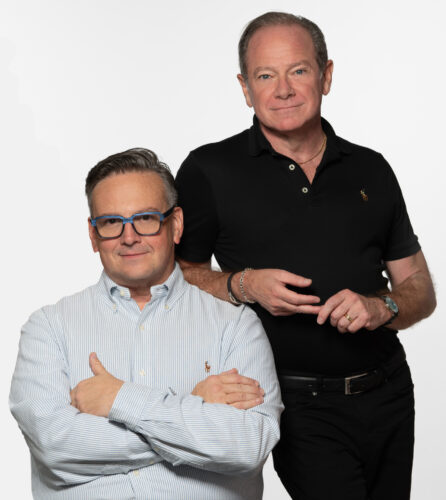
Director Stuart Meltzer, seated, and playwright Michael McKeever, together for two decades and married since 2017, are collaborating on the Zoetic Stage world premiere of “American Rhapsody.” (Photo courtesy of Chris Headshots)
“Sixty years is a lot of play,” says McKeever, who sports a T-shirt that reads “Write On” during a Zoom interview. “Stuart is keeping everything beautifully clear, so active and moving… Few people know my work better than Stuart; he knows my writing. He’s enormously insightful.”
That Meltzer connects so thoroughly with McKeever’s work is no surprise. Winners of multiple Carbonell Awards, Meltzer is also one of Zoetic’s five co-founders (Christopher Demos-Brown, Stephanie Demos-Brown and Kerry C. Shiller are the others). Meltzer and McKeever have worked together on multiple Zoetic shows, including the company’s first, “South Beach Babylon,” in 2010 and written by McKeever. Together for two decades and married since 2017, the artists’ lives are creatively and personally enmeshed; it was during a cross-country driving vacation with Meltzer that McKeever hit on Kansas and its utter flatness as the location for “American Rhapsody.”
McKeever acknowledges the autobiographical underpinnings of his new play, though focal character Franky Cabot is a poet, not a playwright. Meltzer says that initially, the play was intended to be “a reexamination of the beaten-up American dream from a family’s perspective.”
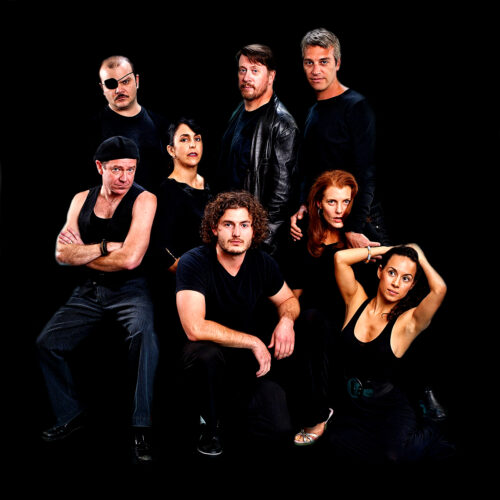
Clockwise from top, Erik Fabregat, Stephen G. Anthony, Octavio Campos, Amy McKenna, Rosie Herrera, Andrew Rosenberg, Michael McKeever, and Elena Maria Garcia in “South Beach Babylon,” Zoetic Stage’s first production in 2010 and written by McKeever. (Photo courtesy of George Schiavone)
As the script has evolved, the director says, “we’ve figured out a way to connect the milestones in one man’s life with the art of creation. You get family, events and the art of writing, all in one play.”
McKeever includes four generations of Cabots: patriarch Franklin “Papa Frank” Cabot (Steve Trovillion), a distinguished jurist; his son “Big Frank” (Aloysius Gigl) and daughter-in-law Eleanor (Laura Turnbull); the couple’s offspring Jenny (Lindsey Corey) and Franky (Alex Weisman); and Jenny’s daughter Maddie (Stephanie Vazquez). Jenny’s husband Albert Bernal (Carlos Alayeto), family friend Nat Morris (Lela Elam) and six other characters also figure into the sweeping yet intimate story.
Weisman, who grew up in Davie and began acting in South Florida as a child, became an in-demand Chicago actor after graduating from Northwestern University (he received the best supporting actor Joseph Jefferson Award for “The History Boys”), expanding his career to film, television (he plays the LGBTQ+ character Frank on “Sesame Street”) and Broadway (“Harry Potter and the Cursed Child”).
He has seen plenty of McKeever’s work and was part of a one-night Zoom reading of “Daniel’s Husband,” the writer’s play about gay marriage, from his New York apartment during the pandemic. When he read “American Rhapsody,” Weisman says, “I fell in love with it. It reminded me of Michael Cunningham’s ‘Flesh and Blood’ in its scope, its storytelling, and the Americana in it.”
Weisman also relished the idea of originating the complex role of Franky, “this queer figure who doesn’t have to be innocent and likable and funny all the time. He has allowed me to be flawed, even nasty. So many times when we play these characters, we have the shimmer of a halo around us. I appreciate how unhappy this character is.”
Meltzer argues that Franky is closer in spirit to him than to McKeever.
“Franky has the opposite qualities of Michael. His is more of a Peer Gynt story: You work so hard that you lose yourself to find yourself,” the director says.

Lela Elam, Alex Weisman and Lindsey Corey in Michael McKeever’s “American Rhapsody” opening Jan. 12 through Jan. 29 at the Carnival Studio Theater in the Adrienne Arsht Center, Miami. (Photo courtesy of Tony Tur)
Weisman, now 35, says he has looked up to McKeever since he was 10, that the playwright was an influence in his decision to become an artist. Other than the pandemic reading of “Daniel’s Husband” (which was inspired by McKeever-Meltzer debates on gay marriage), he hadn’t worked with the director on a full production, and he’s finding the experience different and exhilarating.
“Stuart is incredibly impulsive. Every moment feels like you’re walking through an electrical field, and when you put it all together, it’s like fireworks,” the actor says. “I don’t work that way. I’m very in my head and go back to these cerebral impulses.”
Playing the Colombian-American Albert, Alayeto is also new to Zoetic, McKeever and Meltzer. The son of Cuban parents who came to Miami in 1961, he is relishing being able to originate the role of a husband and father with post-traumatic stress disorder and, like his character, has a wife who travels for work, a daughter and a close relationship with his mother-in-law.
“It’s amazing how efficiently Michael goes through the history. It’s very much a family play that doesn’t get bogged down,” he observes. “I’m very impressed with his rhythm and the melody of his prose… Stuart is very, very specific. I’m amazed at his attention to detail… He provides solid anchor points to connect with, and nothing feels arbitrary.”
Corey, who plays Albert’s driven lawyer-wife Jenny, and Elam, whose black lesbian bartender character Nat becomes a close friend to several Cabots, are both members of Zoetic’s extended artistic family. Both have been in multiple productions done by the company, and both find this McKeever play especially resonant.
“This play in particular is relatable to everyone: to people affected by 9/11, the feminist movement, the Black Lives Matter movement, the American experience, the female experience, the gay experience, the human experience,” says Corey. “The first time I read the play, I fell in love with Jenny. She has a ‘blue fire’ in her heart, like Papa Frank did. I also feel that fire in me.”
Elam, who originated roles in McKeever’s “Moscow” and “Clark Gable Slept Here” at Zoetic, says it’s an “honor and a privilege” to be playing characters written with her in mind.
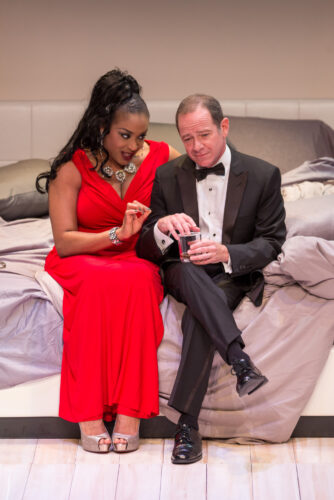
Lela Elam and Michael McKeever in Zoetic Stage’s 2014 production of “Clark Gable Slept Here.” McKeever had the actress in mind to play the character Morgan Wright when he wrote it. (Photo courtesy of Justin Namon)
“I can relate to Nat in so many ways. She’s gay, she’s black. Nothing she says is foreign to me,” Elam says. “Alex and I shared things about our personal lives. We play best friends, and we just clicked. He’s like so many of my gay homeboys.”
“American Rhapsody” is a memory play, a work of imagination grounded in McKeever’s experiences and perceptions of the world. His Cabot family deals with loss and joy, tragedy and triumph, little decisions, and life-changing ones. The play is suffused with warmth and humor, as well as pain.
Alayeto believes that, even with the challenges the family and the country endure, the takeaway is a point of view that can benefit anyone.
“This paints a hopeful picture of America, which we sorely need. This is a country of optimism and hope. We can make this the land of the possible,” he says. “I think it’s a play audiences need.”
WHAT: “American Rhapsody” by Michael McKeever
WHERE: Zoetic Stage, Carnival Studio Theater at the Adrienne Arsht Center for the Performing Arts, 1300 Biscayne Blvd., Miami
WHEN: Previews 7:30 p.m. Thursday, Jan. 12, opens 7:30 p.m. Friday, Jan. 13; 7:30 p.m. Thursday-Friday, 3 and 7:30 p.m. Saturday, 3 p.m. Sunday (no matinee Jan. 21), through Sunday, Jan. 29
COST: $55-$60
INFORMATION: 305-949-6722 or arshtcenter.org
ArtburstMiami.com is a nonprofit source of dance, visual arts, music and performing arts news. Sign up for our newsletter and never miss a story.
No posts found
Filmmakers create ‘Local Love Letters’ to Miami Beach through Oolite Arts, city funding
Written By Taima Hervas
December 13, 2022 at 12:58 PM
Karla Caprali’s “South of Fifth,” is about her mother-in-law, Barbara Gillman, a Miami Beach resident and renowned art dealer. Caprali was one of nine filmmakers who received $5,000 to create a short film, which premiere for free outdoors on Thursday, Dec. 15. (Photo courtesy of the filmmaker)
When Karla Caprali, a Miami-based film animator and director, heard about the open call for “Local Love Letters,” she knew she had the perfect story.
Last March, Oolite Arts and the City of Miami Beach awarded nine Miami-based filmmakers $5,000 each to create 3 to 5 minute narrative or documentary film shorts as “Local Love Letters” to Miami Beach.
Caprali’s film, “South of Fifth,” will be one of the films premiering Thursday, Dec. 15, at 7 p.m. in a free screening outdoors on Wallcast at New World Symphony’s SoundScape Park on Miami Beach.
The winning stories share a love for Miami Beach and the special places, compelling moments and local heroes, who make up its very DNA.
Christopher Duasso and Edward Santander portray a couple who reminisce
about the wild night on South Beach that kicked off their 10-year relationship in “It Had to Be You” by Juan Barquin and Trae DeLellis. (Photo courtesy of the filmmakers)
Caprali’s love story to Miami Beach uses frame-by-frame, hand-drawn animation, on-camera interviews, and black and white family photos to tell the story of Miami Beach arts pioneer Barbara Gillman.
“When they said it has to be something about Miami Beach, I began to think . . . ‘I do have a perfect story about a girl born in Miami Beach,” Caprali says. “And she’s actually my mother-in-law.”
Caprali says of Gillman: “She’s an art pioneer. She is one of the first gallery owners in Miami, and she was the first who actually brought Andy Warhol to Miami. And she was just this fantastic art connoisseur.”
The Barbara Gillman Gallery featured national and international 20th-century and contemporary artists for 30 years from 1979 to 2008 and Gillman was a strong supporter of the Miami art scene. Gillman continued to represent artists until 2015 from her storage space, which she called the “Museum Vault.” Her shows featured works by Andy Warhol, James Rosenquist, Jim Dine, Christo, Robert Rauschenberg, Picasso, Jasper Johns, and Judith Page, many of whose works remain in her private collection which her family now manages.
The film is also a sensitive living testament for a much-loved mother-in-law as she succumbs to dementia.
Abhi Chatterjee-Dutt’s “Toxic Beach” created animation for a short film which uses flags that fly on lifeguard towers as a metaphor to explore all that is to love about Miami Beach. (Photo courtesy of the filmmaker)
Caprali says she also wanted to tell a bigger story. “I’m concerned because Miami unfortunately has this thing of a lack of memory. We are not really so good at memory. If you ask younger people in the arts, “Who is Barbara Gillman? They don’t know.’ They don’t really know about the history of Miami. If you ask somebody, “Did you know that in the ’30s and ’40s the Jewish people we only allowed to live down south of Fifth?” . . . nobody knows that.”
The animation is brought to life with an original jazz score. Caprali says she enlisted Jesse Katz. “He is a very young musician. He just graduated from University of Miami, he has a band, and this is all his original music. Barbara was a jazz lover. She loved jazz.”
The narration for the film is based on a 2013 interview with Gillman by Miami Design Preservation League.
Another film in the premiere is “I Care About Your Mailbox,”

“I Care About Your Mailbox” by Andres Gimenez and Isabella Rivera Suazo finds quirky mailboxes that will no doubt soon disappear from Miami Beach’s landscape. (Photo courtesy of the filmmakers)
“I think it has what we are calling a hybrid tone of a few things: not a documentary, or narrative film, rather it floats in between. It’s something that we really are proud of,” explains Gimenez.
The film takes the audience on a heartwarming tour through Miami Beach and suburban Miami in search of and appreciation for quirky, imposing, funny, broken and sometimes forgotten mailboxes.
“We are seeing that Miami is really changing a lot right now, and we really wanted to document it before it flashes before our eyes. There are some really beautiful mailboxes we need to capture before they are taken down,” explains Suazo about the idea behind the film.
“I Care About Your Mailbox” has a light comedic touch.

Melanie Wu’s “Loveboat Takeout” is about an immigrant family’s former business, a Chinese restaurant. (Photo courtesy of the filmmaker)
“I think the mailboxes are texture and throughline, but without the people there is no story,” comments Gimenez, who gave kudos to Suazo, who found the mailboxes and encouraged the team to speak with the quirkiest of mailbox owners.
“(Isabella) is good at following the lead of something in the moment. What we realized is that (the mailboxes) are a representation of that neighborhood and its people. People say, ‘. . . I know that mailbox; that’s right by this place where I had my first kiss.’ ”
When asked how the $5,000 award stretched to produce such finely textured film shorts, both Caprali and Gimenez responded that the money was “just enough” to allow for them to get the shorts made.
For Caprali, it paid for the animation software she needed, and the competition was the catalyst that motivated her to make a film to tell a story she had long wanted to get out into the world.
Gimenez says: “$5,000 in filmmaking is usually not that much but in this specific project, it was just enough, mostly because it funded our time. . .”
A father and son run along the beach in one of three chapters of a Haitian couple’s life intertwined at the shore of North Miami Beach in “La Vie” by Al’lkens Plancher. (Photo courtesy of the filmmaker)
Meanwhile, both filmmakers are also looking for new funding to expand their short films into feature-length films.
The other films premiering include:
“Fire Moon Rising” by Felipe Aguilar: The heartbeat of Miami gets revitalized every full moon, as it illuminates a “secret” Beach Drum Circle.
“It Had to Be You” by Juan Barquin and Trae DeLellis: A couple reminisces on the wild night on South Beach that kicked off their ten-year relationship.

Two percussionists join an eclectic crowd on a powerful, percussive and fiery journey during “Fire Moon Rising” by Felipe Aguilar. (Photo courtesy of the filmmaker)
“Toxic Beach” by Abhi Chatterjee-Dutt: Flags flying on lifeguard towers warning swimmers about the tide are used as a metaphor to explore all that is to love about Miami Beach.
“How to make a movie in Miami” by Carla Jerez: A local filmmaker explains how to make a Miami movie in this surrealist desktop documentary.
“La Vie” by Al’lkens Plancher: Three periods of a Haitian couple’s life intertwined together at the shore of North Miami Beach.
“Letter From the Age of Ecocide” by Shireen Rahimi: A woman thrives in her beloved underwater home when suddenly, the natural beauty around her begins to decay. A wise sage narrates her grieving process from another dimension, using the ancient poetry of her ancestors to reveal a universal story of radical acceptance.
“Loveboat Takeout” by Melanie Wu: An experimental docu-fiction short about an immigrant family’s former business, a Chinese restaurant in Miami.
WHAT: “Love Letters to Miami Beach”
WHERE: New World Center SoundScape Park, 500 17th St., Miami Beach
WHEN: 7 to 9 p.m., Thursday, Dec. 15
COST: Free; RSVP recommended.
INFORMATION: oolitearts.org
ArtburstMiami.com is a nonprofit source of dance, visual arts, music and performing arts news. Sign up for our newsletter and never miss a story.
No posts found
The Foundry’s ‘Red Speedo’ skewers Olympic dreams and the cost of compromise
Written By Christine Dolen
December 7, 2022 at 2:49 PM
Gabriell Salgado as an Olympic hopeful and Christopher Anthony Ferrer as his brother in “Red Speedo” at The Foundry. (Photo courtesy of Dennis Dean)
When you go to a Ronnie Larsen-produced play at The Foundry in Wilton Manors, you never know quite what you’re going to get.
It could be something over-the-top wild like Larsen’s naked gay comedy “Truck Stop Sally’s Sex Party” or Patrick Cuccaro’s upcoming drag musical “Slammer Girlz.”
Or it could be a very different sort of play, like Larsen’s autobiographically-inspired “The Actors” or the play that’s onstage through the end of December – Lucas Hnath’s “Red Speedo.”
Collaborating for the third time with guest director Stuart Meltzer, the artistic director of Miami’s Zoetic Stage, Larsen is presenting an Obie Award-winning play about the moral compromises of an Olympic-class swimmer and those who would profit from his success.
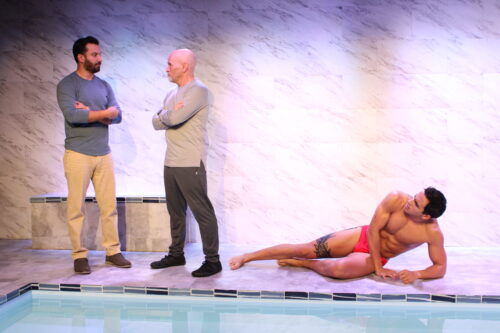
Christopher Anthony Ferrer and Jerry Seeger face off while Gabriell Salgado listens in “Red Speedo” at The Foundry in Wilton Manors. (Photo courtesy of Dennis Dean)
Hnath, an Orlando native whose 2017 Broadway play “A Doll’s House, Part 2” will be produced by GableStage in February-March, is known for his eclectic range in subject and style, and 2013’s “Red Speedo” is in part his nod to the work of David Mamet.
Miami-based actors Gabriell Salgado and Chris Anthony Ferrer (both graduates of Miami’s New World School of the Arts) are joined by Casey Sacco and Jerry Seeger in this taut exploration of malleable values, shifting allegiances and flat-out lies. Hnath’s plotting is intricately twisting, full of surprises, so we’ll be stingy in sharing certain details.
But we will tell you this: When you enter the 53-seat theater space at The Foundry, the first thing you’ll notice is the sleek pool that set designer Melquisedel Dominguez built on the elevated stage. Because if you’re producing “Red Speedo,” a play about a swimmer on the cusp of career-transforming success, of course you need a real pool, no matter how small your theater may be.
Salgado, a Silver Palm Award recipient who appeared in the world premiere of Michael McKeever’s “The Code” at The Foundry, stars as a rising swimming talent named Ray. Playing a closeted 1950s would-be movie star in “The Code,” the chiseled Salgado wore a suit; here, his entire costume consists of a tiny red bathing suit, a swim cap and goggles, plus a massive sea serpent tattoo (designed by Avi Ram) encircling his body. “Red Speedo” isn’t a gay-themed play, but it’s clear that the poster featuring a swimming Salgado and his extremely low body fat percentage has helped drive the show’s brisk ticket sales.

Gabriell Salgado plays a top-tier swimmer at a crossroads in “Red Speedo” at The Foundry.
(Photo courtesy of Dennis Dean)
With a growing body of professional work, the young actor stunned in his Carbonell Award-nominated professional debut as the Creature in Zoetic’s “Frankenstein,” and he’ll soon appear in the 20th-anniversary revival of Nilo Cruz’s “Anna in the Tropics” at Miami New Drama and Charise Castro Smith’s “El Huracán” at GableStage.
His challenge in “Red Speedo” is playing a childlike, manipulative, obsessive athlete who’s maybe a quarter as smart as Salgado himself. With the help of Meltzer, who has a genius for finding funny undercurrents in the smallest moments and gestures, Salgado nails pretty-boy Ray’s hubris and deficiencies.
For example: As Ray’s lawyer brother Peter, Ferrer lays into Seeger as Ray’s longtime swim coach. Seeger silently radiates intense disapproval as Peter argues that Coach should not report the discovery of performance-enhancing drugs in the facility’s refrigerator. Not on the eve of the Olympic qualifying trials, not as Ray may ink a life-changing spokesmodel deal with Speedo.
As the men escalate into a full-blown verbal conflict delivered in Mamet-like sentence fragments, Salgado’s seated Ray follows the back-and-forth with his large brown eyes, as if he were a spectator at Wimbledon. His rationale for the giant tattoo (he’d stand out more easily on TV) and his ideas for future nicknames (Ray Gun? Raydar?) show his intensifying focus on the glittering aftermath of Olympic success.
Ray is not, however, the only flawed character in “Red Speedo.” All four have issues.
Peter, played with an always-there undercurrent of desperation by the skillful Ferrer, sees his problematic brother’s success as his ticket out of a law firm job he hates, a fast pass into the lucrative world of sports agentry.
Seeger’s commanding Coach at first appears to be an honorable man, one who knows every mental and physical facet of his star swimmer. But as it starts to look like Ray may jump ship, honor becomes situational.
The warmly appealing Sacco plays Ray’s sad and bitter ex Lydia, a sports-focused therapist he was ready to marry (and he still has a cockamamie matrimonial plan in mind). He has asked her to the training facility because he desperately needs something from her, and in the course of their conversation, we learn how much she’s lost because of Ray and Peter and her own actions.
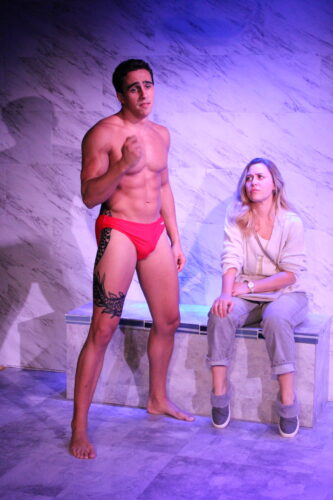
Gabriell Salgado as a world-class swimmer makes his case to Casey Sacco as his therapist ex in “Red Speedo” at The Foundry.(Photo courtesy of Dennis Dean)
As amusing as “Red Speedo” can be, Hnath’s play is ultimately unsettling, deeply so when the brothers finally come to blows. At first, Paul Homza’s fight choreography has Ray and Peter trading gut punches. But then the pool, silently waiting the whole time, gets weaponized. And you, like one of the actors, agonizingly hold your breath.
Adding to Dominguez’s tile-dominated set, Preston Bircher’s lighting reinforces the quiet shimmer of water, the stark glare of confrontation, the bloody potential of cheating. Panos Mitos mixes the startling blast of competition sounds with the music – some calming, some energizing – Ray hears through his earbuds.
“Red Speedo” is a play that might have shown up on any number of South Florida stages. But Larsen is the producer who said yes, had the pool built and collaborated with Meltzer on a powerful production. His is the little theater that could – and does.
WHAT: “Red Speedo” by Lucas Hnath
WHERE: The Foundry, 2306 N. Dixie Hwy., Wilton Manors
WHEN: 8 p.m. Wednesday-Saturday, 7 p.m. Sunday (added matinee 2 p.m. Dec. 7), through Dec. 30
COST: $35-$50
INFORMATION: 954-826-8790 or playsofwilton.com
ArtburstMiami.com is a nonprofit source of dance, visual arts, music and performing arts news. Sign up for our newsletter and never miss a story.
No posts found

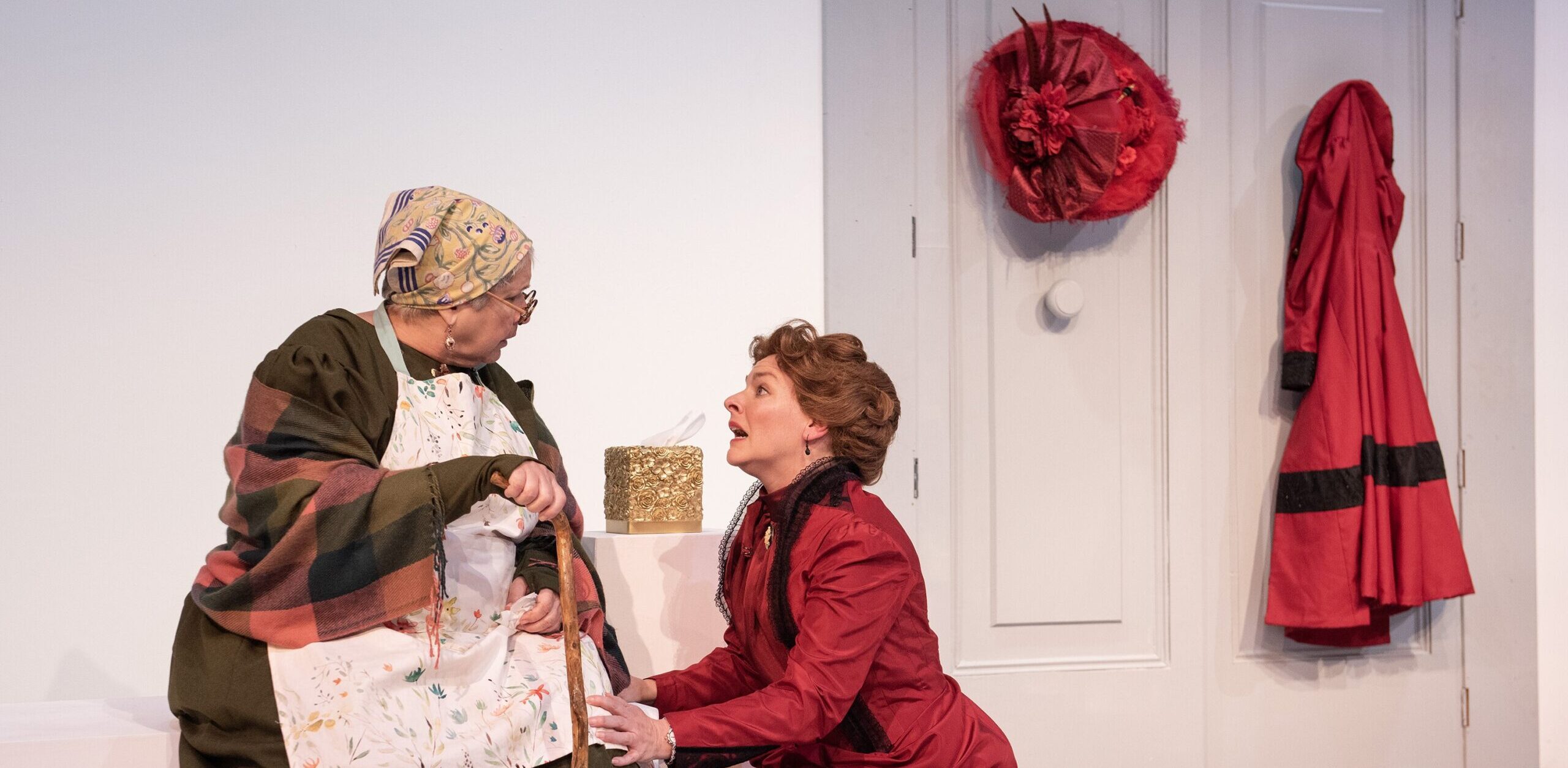
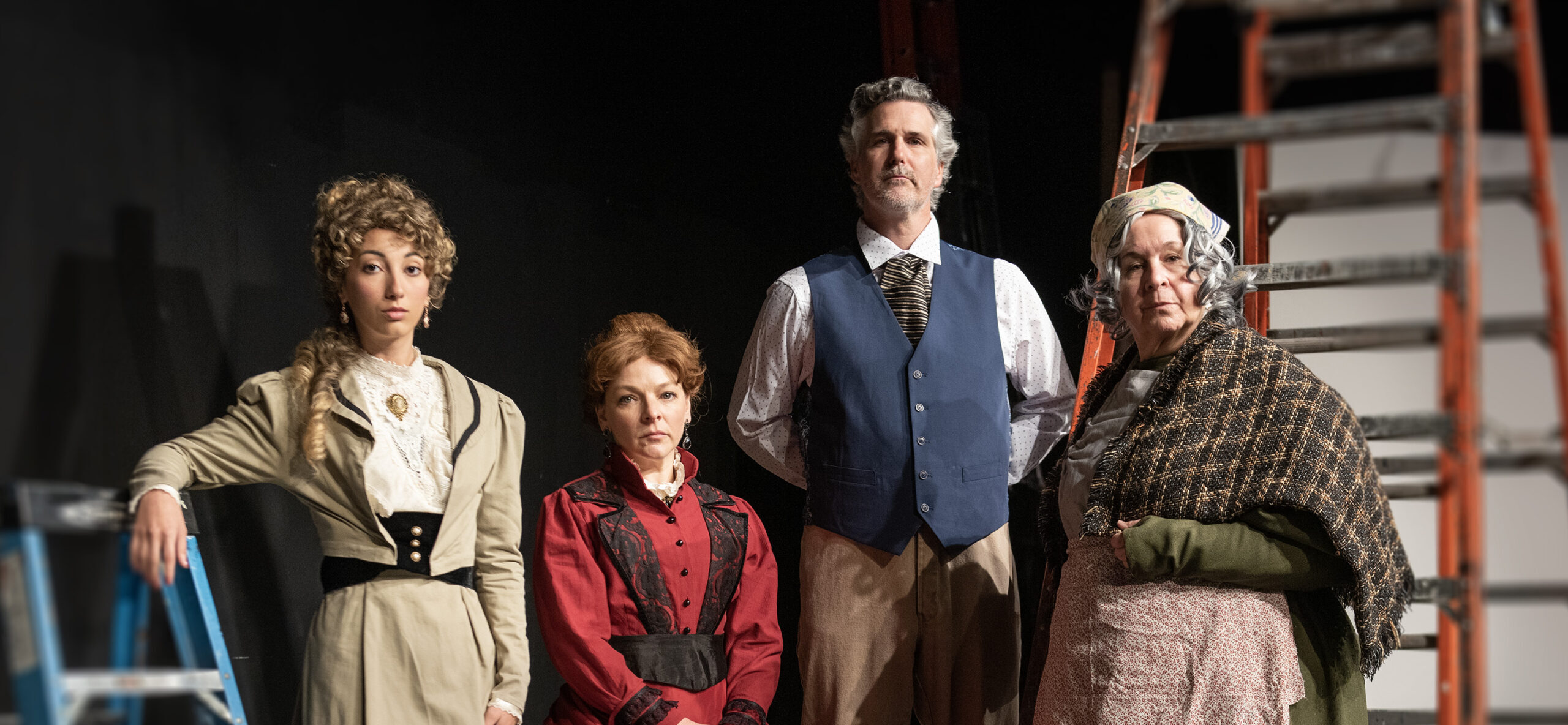
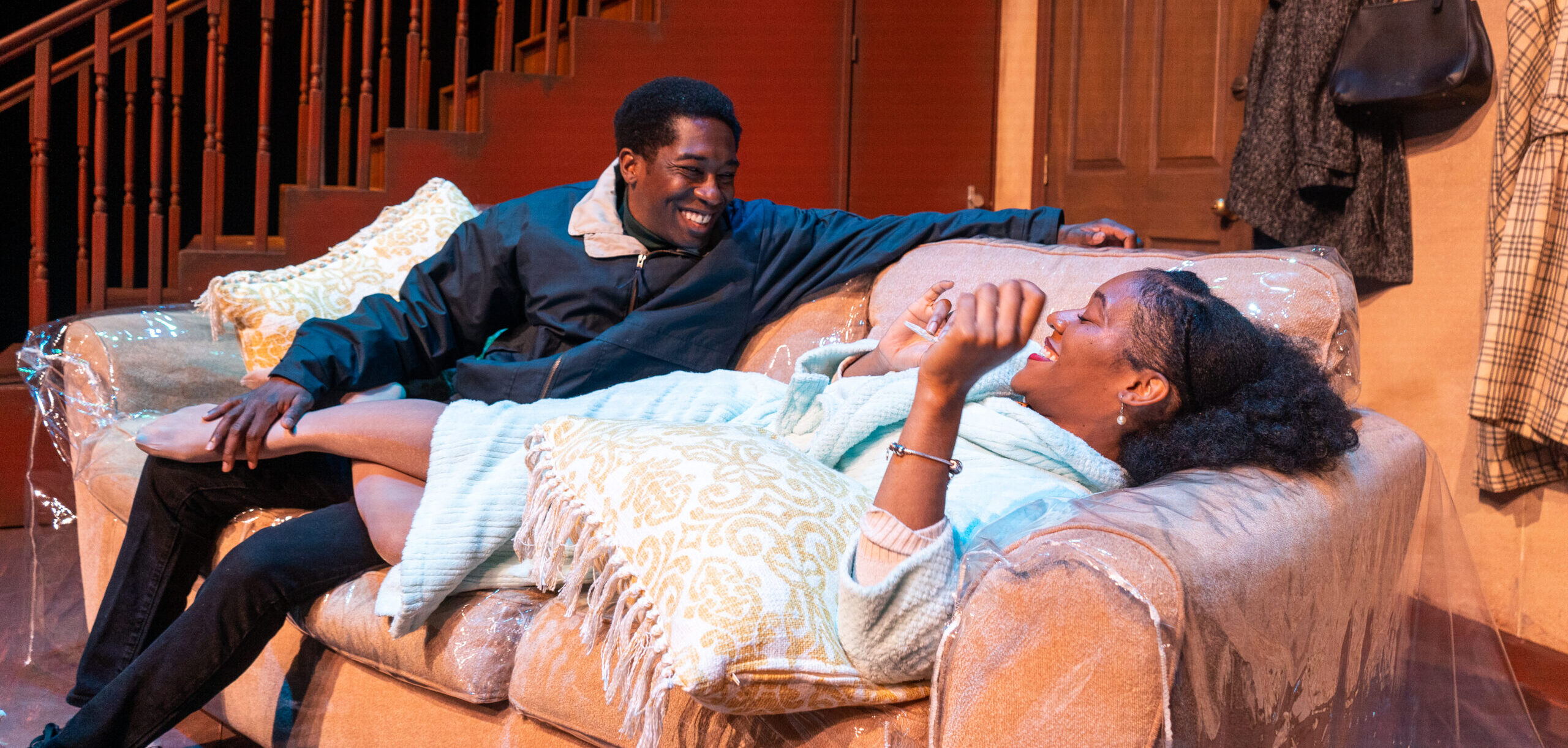
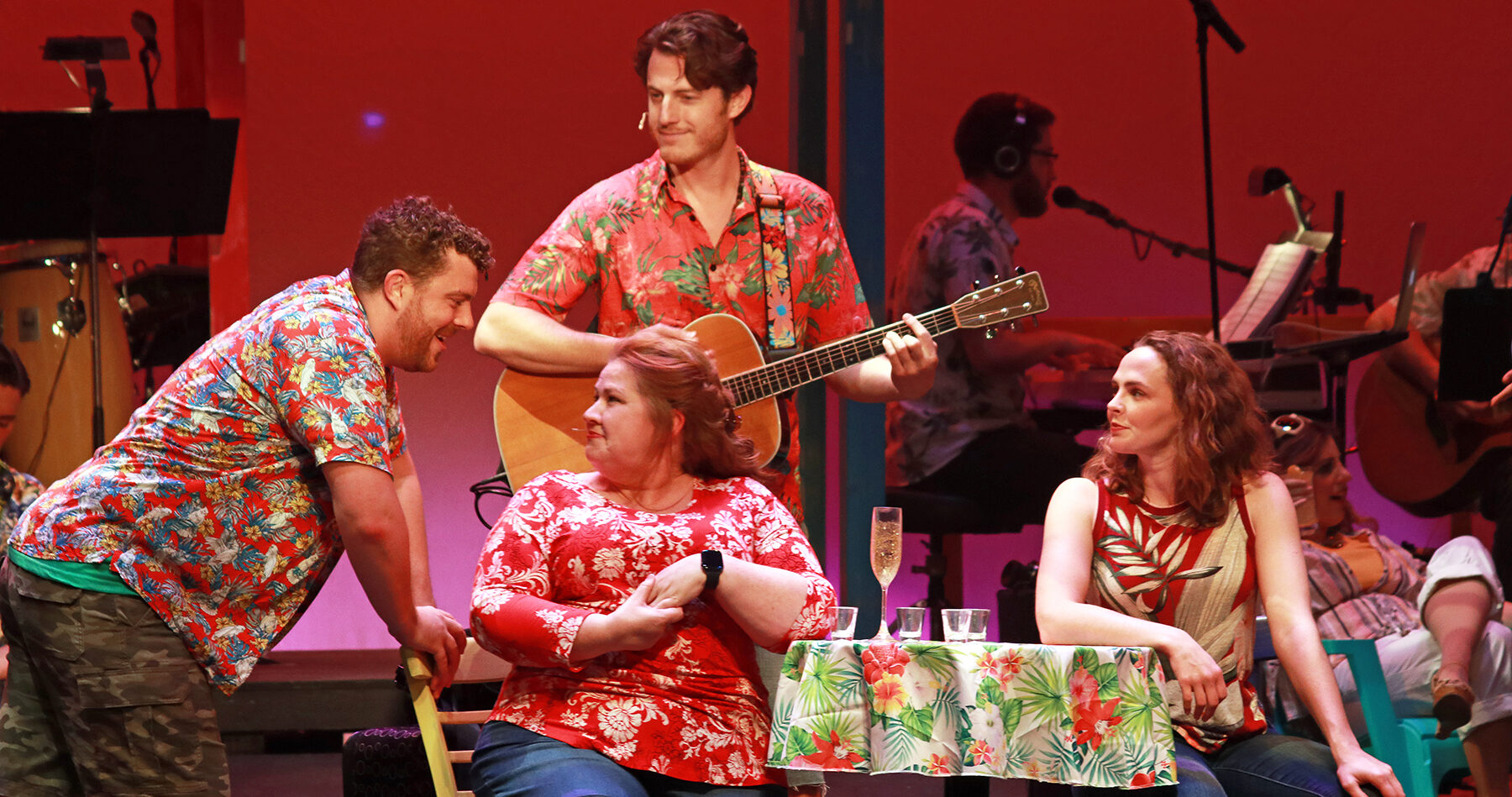

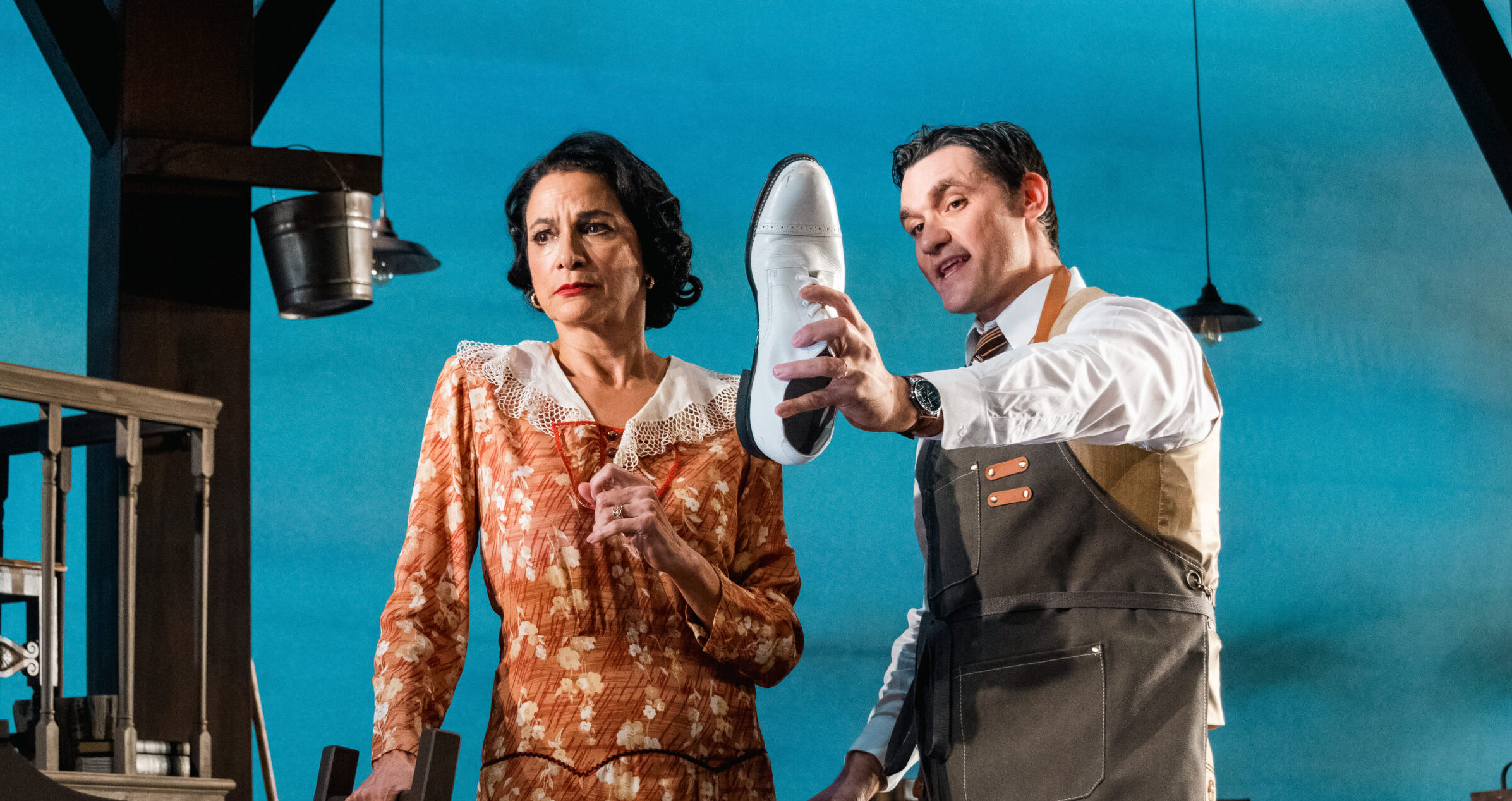
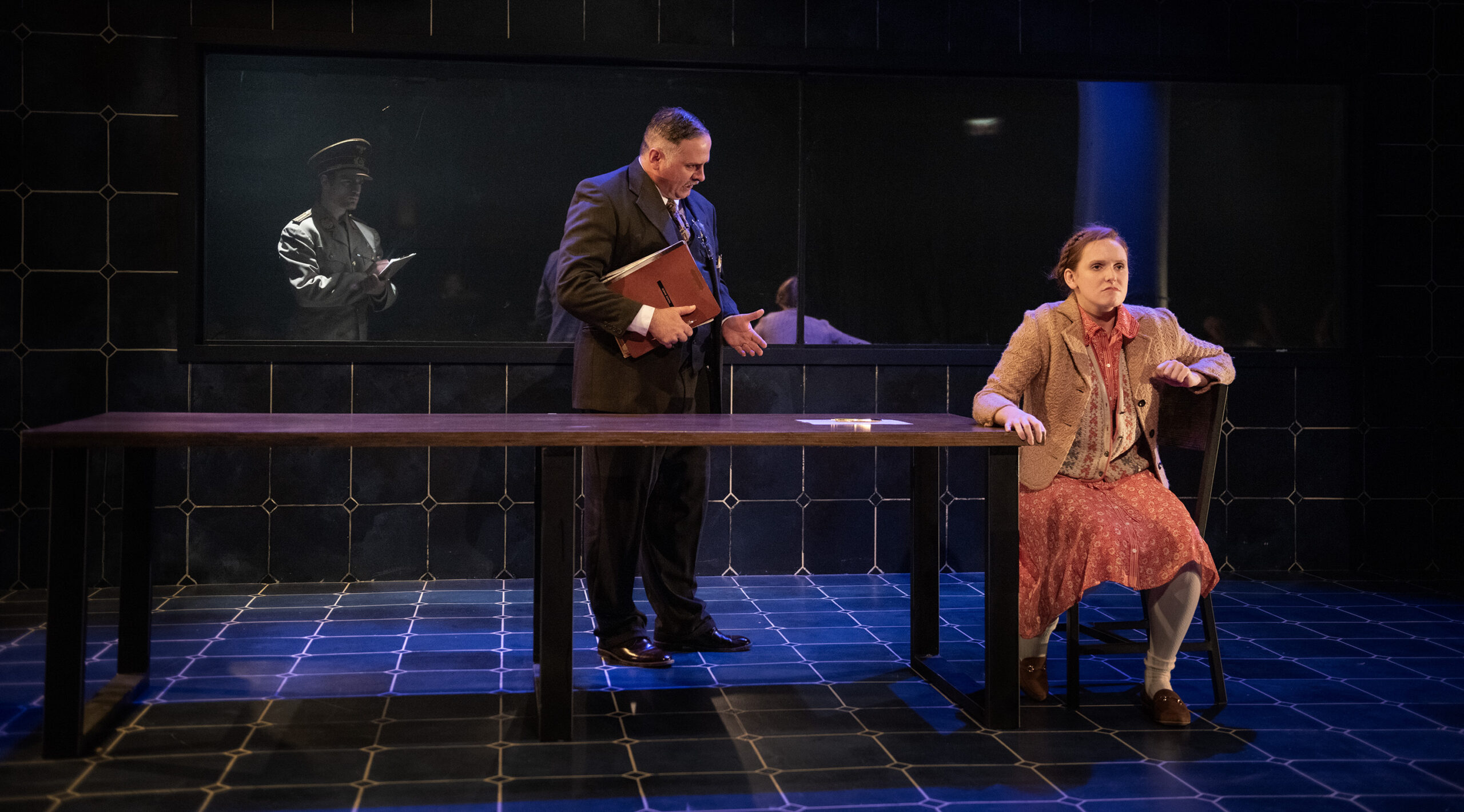
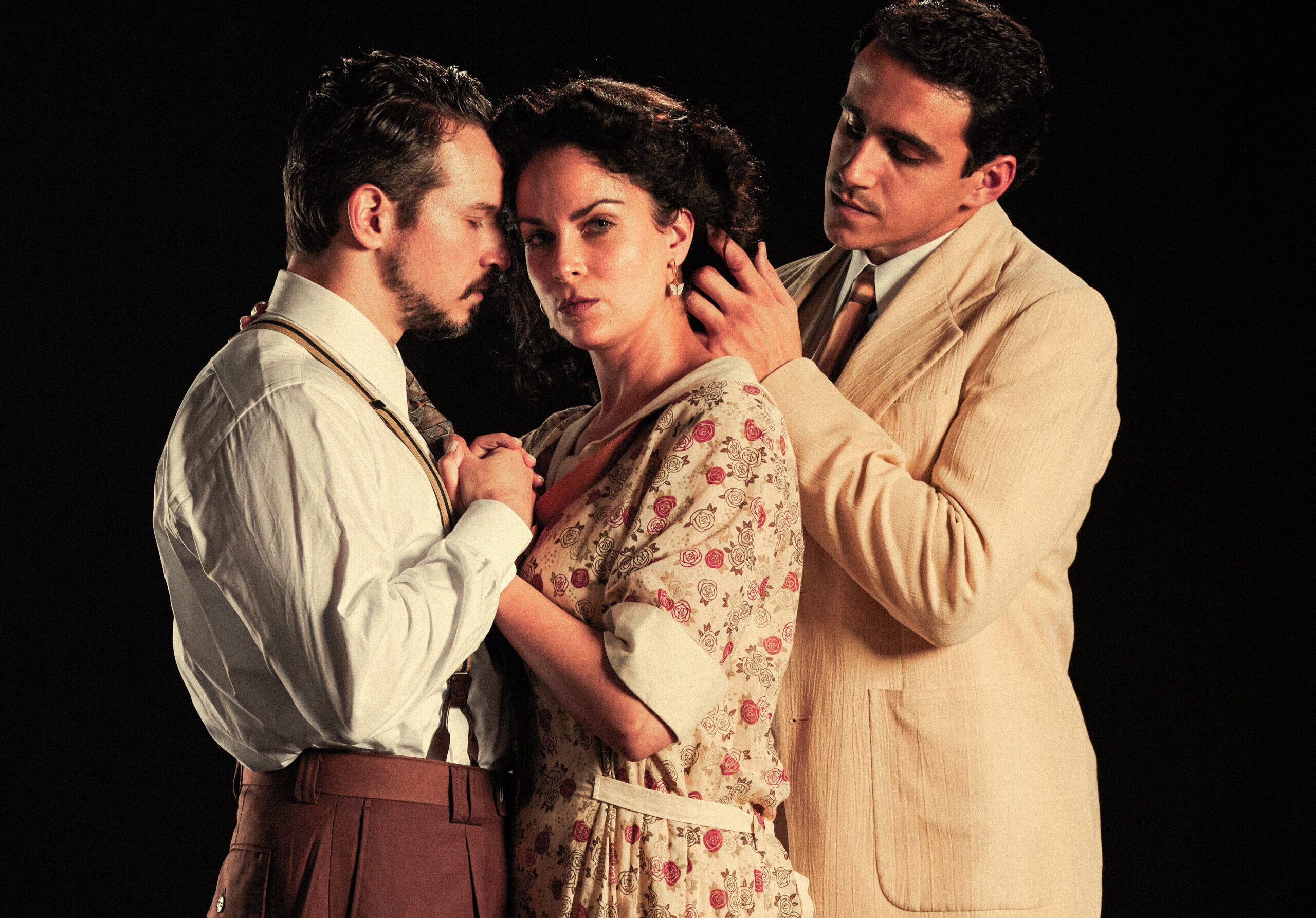



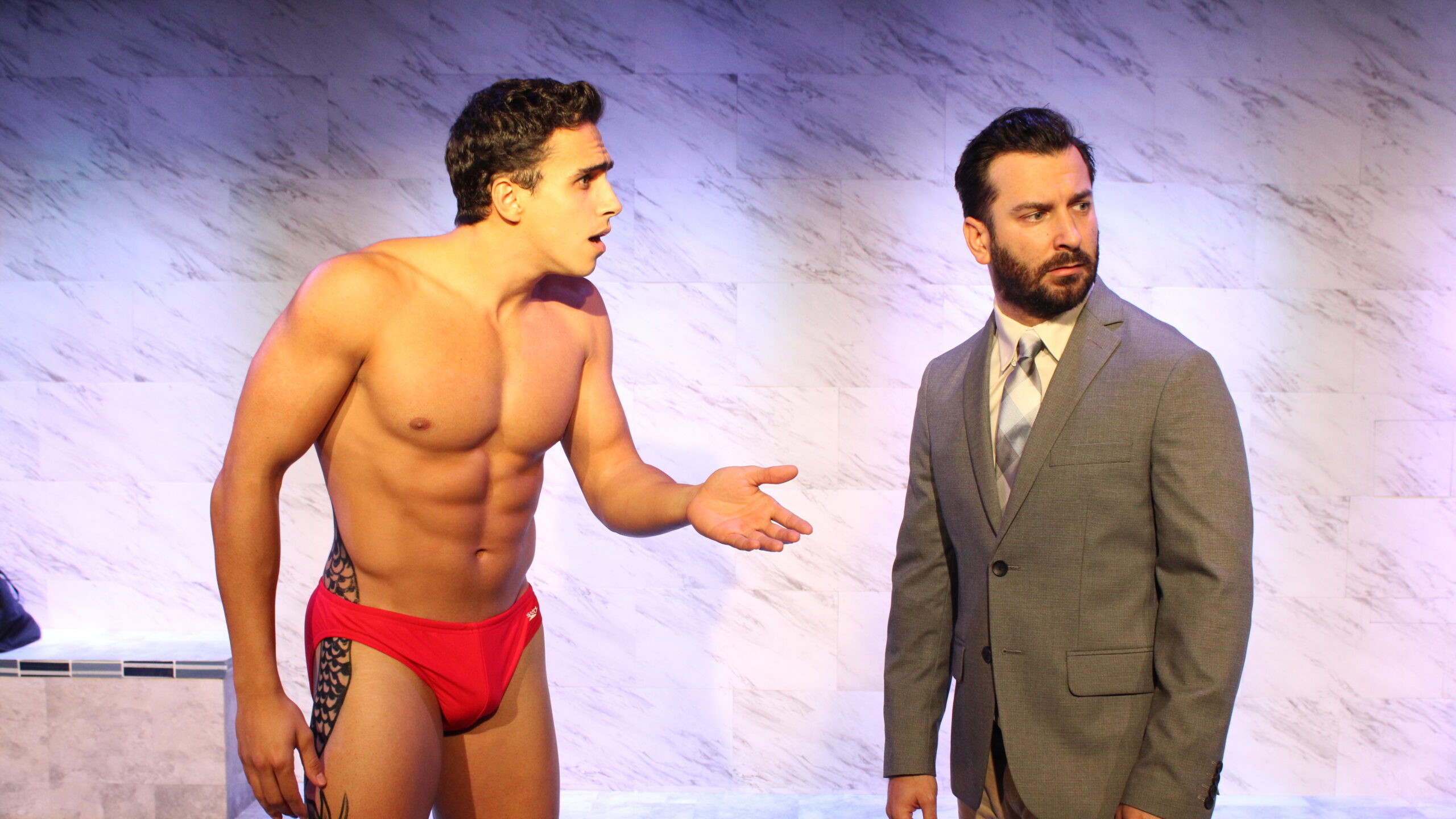
Recent Comments