Blog Article Category: Visual Arts
Belkis Ayón and Carlos Alfonzo Unite in ‘Odyssey’ at Freedom Tower
Written By Douglas Markowitz
February 25, 2026 at 7:24 PM
The Museum of Art and Design (MOAD) at Miami Dade College brings together Cuban artists Carlos Alfonzo and Belkis Ayón for the first time in “Odyssey” now on exhibit at Miami’s Freedom Tower. (Photo by Oriol Tarridas, courtesy of MOAD)
Two of the most significant artists of 20th-century Cuba are being brought together for the first time at Freedom Tower.
Carlos Alfonzo and Belkis Ayón, who each gained art world acclaim outside of Cuba before dying young, are the dual subject of the latest exhibition at the Museum of Art and Design (MOAD) at Miami Dade College, which is headquartered in the downtown landmark.
The exhibition, titled “Belkis Ayón and Carlos Alfonzo: Odyssey,” pairs expressive abstract paintings on canvas and paper by Alfonzo with Ayón’s signature collagraph prints featuring imagery and iconography sourced from the Afro-Cuban Abakuá fraternal religious order.

A painting by Alfonzo,”Thirst,” next to a print by Ayón depicting a woman removing a mask. Alfonzo’s painting exemplifies his darker later work from the time before he died of complications from AIDS. (Photo by Oriol Tarridas, courtesy of MOAD)
Both Alfonzo and Ayón have seen reappraisal in recent years: Alfonzo received retrospectives at the Pérez Art Museum Miami in 2016 and the Institute of Contemporary Art, Miami in 2022, while Ayón’s art world reputation has soared ever since a traveling exhibition in 2016. LnS Gallery and David Castillo, two local galleries that represent the estates of Alfonzo and Ayón, respectively, have also mounted solo shows for the two artists.
Those familiar with both artists and their sharp stylistic differences may find themselves confused by such a pairing. At first glance, Ayón’s moody figurations and dark, muted colors feel a world away from Alfonzo’s energetic and bold abstract scenes.
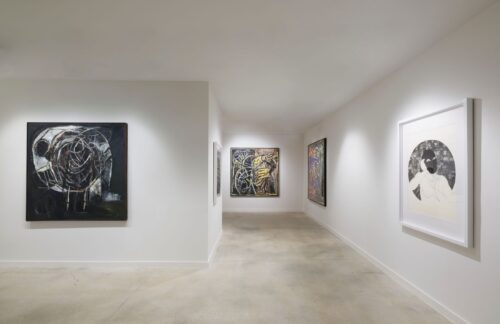
“Odyssey” is MOAD’s second presentation at Freedom Tower since the building debuted a sleek renovation. (Photo by Oriol Tarridas, courtesy of MOAD)
But Amy Galpin, the museum’s executive director and chief curator, explains that the two have more in common than one might expect. The curator points to a mutual interest in mythology, both of the Western Greco-Roman tradition and of Afro-Cuban origins, as well as influences from European and Cuban art shared among the two artists.
“I thought it would be interesting to pair them together and maybe surprise people a bit,” says Galpin. “I hope that when people come to the show, if they’re skeptical, they might be surprised by the connections that they see in their work.”
The show is the museum’s second presentation at Freedom Tower since the building debuted a sleek renovation. The historic landmark now hosts new interactive galleries highlighting its onetime role as the Cuban Refugee Center, as well as a soccer-themed exhibition presented by the FIFA Museum ahead of the 2026 World Cup. While those exhibitions are fixed, the MOAD gallery features changing exhibitions.

Three collography works by Belkis Ayón. The artist lived in Havana until her death in 1999. (Photo by Oriol Tarridas, courtesy of MOAD)
MOAD’s programming thus far has tied into the historical overtones of its home, with an initial group show focusing on migration. “Odyssey” likewise ties into the national origin of its subjects and their journeys outside of Cuba. Alfonzo exiled himself to the U.S. during the Mariel Boatlift in 1980, while Ayón traveled out of the country for residencies and exhibitions while maintaining residency on the island.
“The title of the show is Odyssey, and (it) was chosen because both artists were aware of Greek myth, and very complex storytelling is at the core of both of their works,” says Galpin. “But this notion of journeys too, I think is really a big part of our exhibits…(and) that is a bit of a connection here, this notion of movement, of journeys. I think also resiliency, both artists experienced challenges in their lives and in their work and being committed to what they wanted to make and getting recognition for that.”

Two works on paper by Carlos Alfonzo, each titled “Self Portrait.” The artist migrated to Miami during the Mariel boatlift in 1980. (Photo by Oriol Tarridas, courtesy of MOAD)
Alfonzo’s work in particular reflects those struggles. After leaving Cuba during the Mariel Boatlift, Alfonzo settled in Miami and began developing his career and practice. He earned public art commissions, including murals at the Santa Clara Metrorail Station and at Florida International University that are still on view. His work became darker as he struggled with AIDS, eventually passing away in 1991 shortly before appearing in the Whitney Biennial.
Two works in the show from this era speak to the artist’s state of mind at the time. “Circolo #1” (1990) features geometric shapes and circular lines in white and grey against a black backdrop, with a composition recalling a hurricane spiral and, alternately, a human skull. “Thirst” (1986), a more chaotic earlier canvas in which a swirl of abstracted bodies attack each other with knives and arrows, meditates on the human propensity towards violence.

Carlos Alfonzo (1950–1991), “Circolo #1.” Oil on canvas, 1990, 60 x 60 inches. Collection of Craig Robins. (Photo by Oriol Tarridas, courtesy of MOAD)
Both works come from the collection of Craig Robins, the property developer and arts patron most famous for revitalizing the Miami Design District. The two were friends during the artist’s lifetime, and Robins speaks fondly of their relationship.
“I was thrilled to be able to help him have a studio space during his first years in Miami,” Robins says. “That was a special time in Miami Beach, and my friendship with Carlos was an exciting component of it all. I would visit him in his studio almost daily, and we spent hours there talking about art and life. He helped forge my sensibility towards art and artists – I am forever indebted to him.”
WHAT: “Belkis Ayón and Carlos Alfonzo: Odyssey”
WHERE: Museum of Art and Design at Miami Dade College, Freedom Tower, 600 Biscayne Blvd., Miami.
WHEN: 10 a.m. to 6 p.m. Wednesday through Sunday. Through May 10, 2026.
COST: $18 for general admission; $14 for seniors; $12 for students with ID and children ages 7-18; free for MDC students and employees with ID, children 6 and under, active U.S. military and veterans, and disabled visitors and caregivers.
INFORMATION: 305-237-7700 and moadmdc.org
ArtburstMiami.com is a nonprofit media source for the arts featuring fresh and original stories by writers dedicated to theater, dance, visual arts, film, music and more. Don’t miss a story at www.artburstmiami.com
No posts found
Dolce&Gabbana Exhibition at ICA Miami: Go Inside ‘From the Heart to the Hands’
Written By Jane Wooldridge
February 19, 2026 at 9:53 AM
“From the Heart to the Hands: Dolce&Gabbana” at the Institute of Contemporary Art-Miami features hundreds of creations and celebrates the Italian fashion house’s artistry. The availability of ICA’s wing recently acquired from the now-closed de la Cruz Collection provided a generous, adaptable space. (Photo by Greg Kessler, courtesy of “Dolce&Gabbana”)
It’s been called a love letter to Italy and a grand tour through the nation’s history and culture. The Dolce&Gabbana fashion exhibition at the Institute of Contemporary Art (ICA) in Miami’s Design District is all that – and more.
“From the Heart to the Hands” is an exuberant paean to beauty, excess, detail, ritual and creativity that is deeply intentional. Taken together, says curator Florence Muller, the 300 handmade garments are an expression of passion by designers Domenico Dolce and Stefano Gabbana, and the artisans that transform their designs into artworks for human bodies.

A mosaic-like embroidered jacket required the constant work of five artisans over seven months and is in the exhibition “From the Heart to the Hands: Dolce&Gabbana” now at ICA Miami through June. (Photo by Jane Wooldridge)
The intricacy is overwhelming, and it’s no wonder that some people returned again and again to a trio of previous showings in Milan, Paris and Rome. “You need hours to look at all the detail,” explains Muller. The fashion house decided on Miami for its U.S. tour launch because of its multiculturalism and rich Latin roots, explains Muller; when the Miami show closes in June it will go on to a handful of other U.S. cities not yet announced.
“For the team – and Dominico in particular – the idea of launching in Miami really resonated,” says Alex Gartenfeld, the ICA’s artistic director. The availability of ICA’s wing recently acquired from the now-closed de la Cruz Collection provided a generous, adaptable space.
“We’re very enthusiastic about the exhibition and the level of detail. The connections between art and history are very clear.” Audience response since the Feb. 5 opening has been very positive, according to Gartenfeld. The show runs through Sunday, June 14.
Inside the Alta Moda Collections: Handmade Couture at Its Finest
Each garment was crafted by hand as part of Dolce&Gabbana’s Alta Moda (haute couture) collections for women, men and jewelry: a floor-length jacket embossed with elaborate silk appliqués of cherubs, petals and twining leaves; a dress trimmed in folkloric patterns dotted with sequins over a petticoat inspired by tablecloths crafted in Puglia; a gentleman’s cape painstakingly embroidered with an elaborate scene of Venice’s Grand Canal; religious vestments glittering with sequins; lacy wedding dresses conveying the ethereal nature of union; and eight-inch-high platform sandals encrusted with jewels.
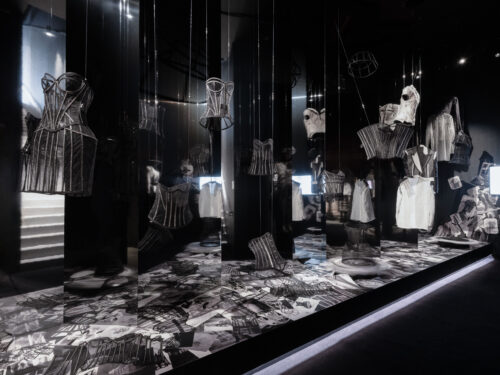
“Anatomy of Tailoring” goes deep inside the craft of Dolce&Gabbana. (Photo by Greg Kessler, courtesy of Dolce&Gabbana)
For Miami fashionistas and aficionados, the show is a coup. Close inspection of Dolce&Gabbana’s one-of-a-kind pieces is normally reserved for a few hundred wealthy “collectors’’ invited to private presentations. In the exhibition foyer, videos offer a peek at dramatically staged showings at the Roman Forum, in Venice’s Doge’s Palace and Milan’s La Scala. They provide context, explaining how each annual show is held in a different distinctive corner of the country, showcasing its traditions and craftsmen. The videos also testify to Italy’s reverence for the design house, giving it access to palaces and monuments normally closed to commercial activity.

Every detail is carefully curated in “From the Heart to the Hands: Dolce & Gabbana,” including a gentleman’s silk shoes. (Photo by Jane Wooldridge)
That reverence derives from Dolce&Gabbana’s investment in promoting and preserving Italy’s culture and artisanal traditions. Unlike some legendary designer brands – think Valentino, Dior, St. Laurent – that began as couture workshops for the discerning and wealthy, Dolce & Gabbana launched in 1985 as a ready-to-wear brand focused on distinctly feminine styling before expanding into menswear, beachwear, perfumes, makeup.
Celebrity Influence and the Rise of a Global Fashion Powerhouse
Madonna picked up the mantle – or in this case, a gemstone-studded bustier – collaborating with the firm for her Girlie Show world tour. Beyonce, Mary J. Blige and the late Whitney Houston soon followed.
In 2011 the firm closed its D&G brand aimed at younger consumers to add Alta Moda collections of hand-made garments that support in-house studios and a school for training future generations. The first Alta Moda collection was shown in 2012 in Taormina, Sicily.

An installation showcasing D&G Alta Moda designs surrounded by paintings by Anh Duong marries historical tradition with contemporary culture in “From the Heart to the Hands: Dolce&Gabbana,” an exhibition at ICA Miami. (Photo by Jane Wooldridge)
Like the video wall, the exhibition’s first full installation is a preview of splendor to come. Mannequins dressed in appliqued gowns, brocade jackets, tunics of crocheted gold and an elaborately sequined floral dress are staggered on a mirrored stage beneath a mirrored ceiling.
The 20-foot walls are hung salon-style with gilt frames surrounding oil paintings flirting at once with modernism and Renaissance styles. Most are self-portraits of the artist, Anh Duong, a model who was once synonymous with designer Christian Lacroix.
There are other familiar faces here, most notably Naomi Campbell in a bold feathered gown that would wow even Cinderella. And just around the next corner appears the dress itself, with its giant organza skirt covered in feathers that, we’re assured, are common and not endangered.
The following dozen rooms and hallways are Dolce&Gabbana’s homage to Italy’s artisanal excellence. In one, cross-stitched gowns and sable-collared coats bear familiar depictions of madonnas by Botticelli and Raphael Titian’s Bacchus, Leonardo da Vinci’s “Unknown Woman.”

Many garments honor Italy’s Renaissance painters, including this gown bearing a scene from Raphael’s “Madonna in the Meadow.” (Photo by Jane Wooldridge)
Gold lace demurely veils a woman’s face beneath a crown-like headpiece. Pearls and portraiture and pearls are combined in headdresses; a gentleman’s glove is adorned with filigree and tourmalines. Around them all, cherubs and gods dance among the clouds in a wall projection of Carracci’s “Triumph of Bacchus and Ariadne.”
Each piece is one of a kind,” says Muller, an art and fashion historian who spent three years working with the designers to create the exhibition. “You can feel the hours that go into it.”
Immersive Set Design: Murano Glass, Baroque Stucco and Ancient Columns
So are the sets that showcase the clothes. Decorative floors, delicate chandeliers – Murano of course – and ancient columns from the designers’ personal collection travel with the show. The result is a museum-quality immersion. Mannequins wearing garments inspired by Greek mythology appear amid a columned temple.
The adjacent chamber is in glittering gold tiles and features designs that are themselves mosaics of jewels, silks, sequins and even mink. “ (One single coat depicting Biblical scenes of encrusted beads took five artisans a full seven months to complete.) The firm does not reveal the price of its couture.

In the display dedicated to Sicily, the heels on a pair of shoes incorporate folkloric dolls in “From the Heart to the Hands: Dolce & Gabbana.” (Photo by Jane Wooldridge)
Other rooms honor the Italian art of glass, with glass and Lucite-beaded garments in a maze of mirrors and delicate chandeliers, and baroque stucco, with jackets and dresses ingenuously appliqued with giant silk cherubs. There are nods to ancient Rome and a compelling enclave devoted to Sardian inspiration.
Another exhibit honors Italian film, with the lens centered on the 1963 film “The Leopard” featuring Burt Lancaster and Claudia Cardinale. Film clips play silently in windows throughout the room, and even without words guests can sense the tension between old aristocracy and the rising influence of the merchant class. In Italy, and in D&G’s world, tradition and future are forever entwined in a delicate dance.
The Sicilian room exudes joy, with bright tile floors, painted walls and even refrigerators adorned with folkloric scenes; all were made by Sicilian craftspeople, as was a wooden transport wagon that was used to bring guests to its 2017 fashion presentation in Palmero.

In the display dedicated to Sicily, a whimsical purse is decorated with jeweled cannoli and other regional sweets in “From the Heart to the Hands: Dolce&Gabbana.” (Photo by Jane Wooldridge)
A purse is decorated with cannoli and other sweets executed in ceramic sits beneath a glass vitrine; a second holds impossibly high shoes with heels made from ceramic folkloric dolls. Voluminous dresses decorated with heraldic symbols and folk scenes overflow their couches. “You can’t help but smile,” says a guard-host in the room. “I’m lucky to be in here.”
Devotion and Catholic Symbolism in Dolce&Gabbana’s Designs
Muller’s favorite room, “Devotion,” is set behind a golden grill, gates open to a chapel centered by a gold sacred heart above an altar. Within, a woman with bowed head is draped in a long lace mantle elaborately appliqued with gold flowers and feathers; her attendees are clad in black and gold, their faces veiled in black. The explanation reads, “A symbol of life and love, in this exhibition the heart reminds us that creativity cannot happen without a sense of giving oneself, fully, to artistic enterprise…The sensation of overwhelming splendor … produces a form of mystic fervor.”
Ecclesiastical themes throughout the show culminate in a series of men’s tunics – a new addition to the show following Dolce&Gabbana’s 2025 presentation processional on Rome’s Aelian Bridge. A canonical-style coat is encrusted with beads, a cardinal’s cape shot with silver threads. A mitred-bishop figure glows with jewels, gold and pearls.
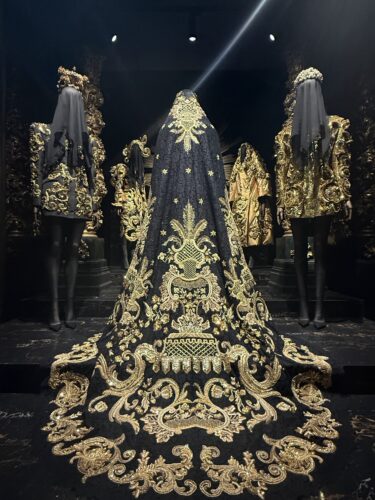
A gilt chapel setting and the clothing within nods to Italy’s Catholic traditions in “From the Heart to the Hands: Dolce&Gabbana,” an exhibition at ICA Miami. (Photo by Jane Wooldridge)
The question is inevitable: How does the Catholic Church view these overt references? In a conversation hosted by the Italian Cultural Institute in Miami in conjunction with the Miami opening, Monsignor Alberto Rocca of Milan’s Pinocoteca Ambrosiano, applauded D&G’s use of the Catholic symbols so integral to Italian culture. “They are meant to inspire admiration and devotion. There is no sign of mockery but a sense of belief. (D&G’s presentations) are never vulgar or blasphemous. When you are astonished by the beauty, you have a spiritual experience.”
As the exhibition winds to a close, you finally get a glimpse behind the glory. Unadorned corsets, half-tailored jackets and sketches of gowns to come are set in a recreation of D&G’s atelier, complete with antique furniture from one of its actual workshops. There are cabinets filled with buttons, trays of trimmings, bolts of old fabric rescued from defunct fashion houses. Tailor’s dummies are shaped with extra padding in just the same places as a well-fed patron. Such one-of-a-kind works take dedication not just by the designers but by an entire team, putting to rest the question of whether fashion is art.
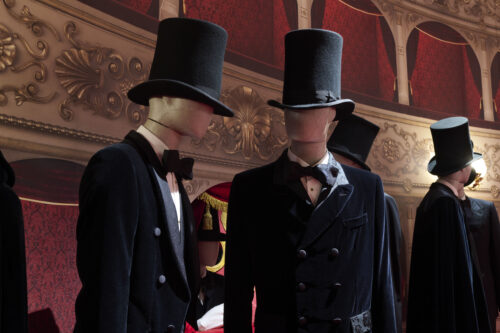
The finale of the exhibition is Dolce&Gabbana’s tribute to the grand pageant that is Italian opera. (Photo by Greg Kessler, courtesy of Dolce&Gabbana)
The finale is, fittingly, D&G’s tribute to Puccini and Verdi and the grand pageant that is Italian opera. Arias sweep silk and jeweled capes dedicated to “Turandot,” “Aida,” “Madama Butterfly” and gowns inspired by heroines, kings and princesses stolen into captivity.
Regardless of the opera, the ending is inevitably heartbreak and death. But in Dolce&Gabbana’s hands, the tale is transformed from tragedy to triumph. So may all stories end.
WHAT: “From the Heart to the Hands: Dolce&Gabbana”
WHERE: Institute for Contemporary Art (ICA)-Miami, 61 NE 41st St., Miami
WHEN: 10 a.m. to 7:30 p.m., Sunday to Wednesday, 10 a.m. to 10:30 p.m., Thursday, Friday and Saturday.
COST: $26-$28
INFORMATION: 305-901-5272 and miami.dolcegabbanaexhibition.com/
ArtburstMiami.com is a nonprofit media source for the arts featuring fresh and original stories by writers dedicated to theater, dance, visual arts, film, music and more. Don’t miss a story at www.artburstmiami.com.
No posts found
Art Happenings: Miami Exhibitions, Openings, and Artist Talks
Written By Michelle F. Solomon, Artburst Editor
February 10, 2026 at 9:11 PM
Visual poet and conceptual artist Rubem Robierb, whose design was recently selected as Miami’s Official Host City Poster for the FIFA World Cup 2026, is exhibiting at VISU Contemporary with “Roots to Fly.” (Photo courtesy of VISU Contemporary)
Artburst Miami’s editor picks a selection of what’s happening now in Miami’s galleries, exhibitions, and artist-run spaces.
“Roots to Fly,” Rubem Robierb
On view through Sunday, March 15.
VISU Contemporary, 2160 Park Ave., Miami Beach
From winged installations on Lincoln Road to the city’s Official Host Poster for the 2026 FIFA World Cup, Rubem Robierb’s work has become part of Miami’s visual fabric.
Now at VISU Contemporary, Robierb’s “Roots to Fly” brings together nearly 30 works in sculpture, painting, and mixed media. The exhibition traces Robierb’s path from Maranhão, Brazil, to Miami.
The title frames the exhibition’s core tension. Roots speak to origin and inheritance. Wings suggest movement, resilience, and self-definition. Robierb’s practice operates between the two, balancing personal history with an expanding public presence.
“Roots to Fly” also reflects VISU Contemporary’s continued growth as a platform for ambitious contemporary artists, following the gallery’s recent high-profile David LaChapelle exhibition
More information at visugallery.com

Chilean-born artist Constanza Alarcón Tennen presents ?Tu, yo, y todo el viento entremedio,” a solo exhibition at Nina Johnson. (Photography by Cristóbal Cea/courtesy of Nina Johnson and the artist)
“Tu, yo, y todo el viento entremedio,” Constanza Alarcón Tennen
Opening with reception 6 to 8 p.m., Thursday, Feb. 16. On view through Saturday, April 18.
Nina Johnson, 6315 NW 2nd Ave, Miami
Working across sculpture, sound, performance, and video, Constanza Alarcón Tennen treats sound as material—physical, relational, and activated through the body.
Tennen’s solo exhibition, “Tu, yo, y todo el viento entremedio” at Nina Johnson, centers on a suspended stoneware whistle sculpture designed for collective use, surrounded by ceramic sound works that function as both objects and instruments. Drawing from pre-Columbian sound artifacts, Alarcón Tennen reimagines sculpture as exchange rather than form, collapsing distinctions between viewer and performer, touch and sound.
Installed within the gallery’s bookshelves, drawings, videos, and ancillary objects operate as an open notebook or cabinet of curiosities—satellites to the primary sculptures that reveal the conceptual and material thinking behind the work. Together, these elements underscore the exhibition’s multivalent nature, blurring distinctions between sculpture and performance, object and instrument, stillness and activation.
Born and raised in Chile, Alarcón Tennen is based between Boston and Santiago.
More information at Nina Johnson

“Now, Voyager,” Anastasia Samoylova
Through Friday, Feb.20
Dot Fiftyone Gallery, 7275 NE 4th Ave., Miami
In “Now, Voyager,” Anastasia Samoylova extends her photographic language into the territory of painting—and of reckoning. These hybrid works, formed by overlaying photographs with poured and dripped paint, inhabit a charged space between document and abstraction, between the seen and the felt. Taking its title from Walt Whitman’s exhortation, “Now, Voyager, sail thou forth, to seek and find,” the series follows the artist’s ongoing search for meaning within the shifting image of America.
The exhibition opened in November at DotFiftyOne Gallery; it has been extended through Friday, Feb. 20.
More information at DotFiftyOne
ArtburstMiami.com is a nonprofit media source for the arts featuring fresh and original stories by writers dedicated to theater, dance, visual arts, film, music and more. Don’t miss a story at www.artburstmiami.com
No posts found
Mark Thomas Gibson’s ‘The Voyage’ Brings a Shipwrecked America Home to Miami
Written By Douglas Markowitz
January 19, 2026 at 7:39 PM
Mark Thomas Gibson, “Returns on a Homeward Tide,” 2025, is part of the painter’s show at KDR Gallery in Miami through Monday, Feb. 23. (Image courtesy of the artist and KDR Gallery)
It’s hard to think of a more potent metaphor for the chaotic state of America in 2026 than a sinking ship. That’s the idea behind a new show from painter Mark Thomas Gibson at KDR Gallery in Miami.
Functioning as a homecoming show for the Miami-born artist, “The Voyage” brings together 10 new canvases from Gibson, all featuring nautical scenes that offer macabre commentary on the condition of our culture and where it’s going.
“The idea of ‘The Voyage,’ for me, has been a lot about, well, who’s leading? Who’s steering the ship, and what’s our idea around the future?” says Gibson. “Who speaks in a way about the future that brings us all together so we can all get on this vessel together and move forward? And I don’t think I hear that. So I have to put that out there too.”
A few sets sets of work make up the exhibition.
One is a diptych of a ship before and after its wreckage. Gibson took inspiration from the “Ship of Theseus,” the philosophical parable that could easily apply to a changing America: Is a ship (or any object or entity) that has had all its parts replaced still the same as the original, or is it a different thing altogether?
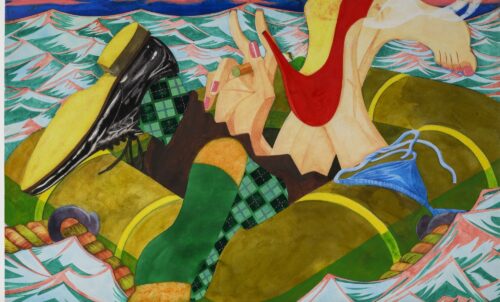
Mark Thomas Gibson, “Swept Away,” 2025, (Image courtesy of the artist and KDR Gallery)
The other depicts a series of scenes featuring various people and objects treading water amidst flaming wreckage. The human figures – no faces, just limbs flailing about – are all in the midst of some unseemly activity. In “Crew of Saboteurs,” one suited, pale-skinned hand punctures a lifeboat while another in a pinstriped sleeve cuts a vital rope lifeline. In another work, “Swept Away,” two sets of feet stick out of a raft, one in men’s dress shoes and the other wearing red stiletto heels. A blue bikini top has been conspicuously cast aside.
Florida iconography also makes its way into the paintings, sometimes in unflattering ways. “Bound to Roost” features a flock of chickens and roosters, referencing the birds’ ubiquity in Miami “Everybody who’s from Miami has a relationship culturally to the rooster and chickens, from African-Americans to Haitians and Cubans and Latin Americans,” he says. “Conspirators at Sea” features the state flag amid a tangle of white-robed arms, one holding a match near a pair of wooden beams conspicuously placed in the shape of a cross.
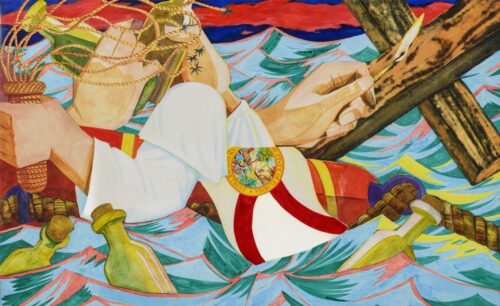
Mark Thomas Gibson, “Conspirators at Sea,” 2025. The painting pairs the Florida state flag with Ku Klux Klan imagery. (Image courtesy of the artist and KDR Gallery)
“Being from here, you know you’re in the south. And if you’ve ever shared space with people, with their flags and their beliefs, if you’ve ever had dinner with people, you will find that often people don’t want to talk about their politics. They don’t want to broach that line, because a lot of those lines have very specific cultural histories that are also attached to them. But at the same time, with humor, everyone has to deal with the power dynamics that kind of give humor its fuel.”
Though he now lives in Philadelphia, Gibson knows the territory of Miami well, having spent much of his early life here. He attended the New World School of the Arts before moving on to Cooper Union and Yale, and his father served as postmaster of Homestead after Hurricane Andrew. The flat, yet vibrant colors in the paintings are as much a reflection of the culture in South Florida as they are a tribute to his father, who became an artist himself and an aficionado of Caribbean art before he passed away in 2023. In particular, the artist praises his “strong, steady hand and a great sense of space,” as well as a knack for color.
“He started painting after he retired, and it turns out he was actually kind of good,” he says. “I was like ‘damn it, he can actually do this.”
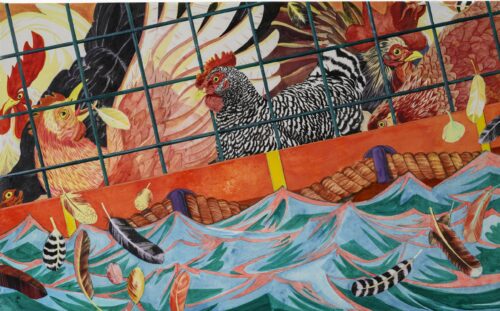
Mark Thomas Gibson, “Bound to Roost,” 2025. The artist painted the chickens in the work as a tribute to the Miami neighborhoods where the birds roam freely. (Image courtesy of the artist and KDR Gallery)
Gibson learned of his father’s artistic skills one day when he asked his son to take him to an art supply store. He later found out he had always had artistic talent, but sacrificed a potential creative career, including a scholarship to study architecture at Northwestern University, in order to support his family. It wasn’t until he finally retired that he decided to explore this side of himself in earnest.
“He really started becoming interested in Caribbean art, and looking at stuff from Haiti and looking at things that had a very particular kind of stacked, flat sense of space,” he says. “I want to push-pull on that. I want to figure out ways to like, deal with bright color, deal with radiant things, deal with things that don’t exactly quite fit, and with some of the style and some of the ways I’ve been painting over the years.”
Despite Gibson’s history in Miami, the artist has rarely exhibited in his hometown, making the homecoming show something of a special occasion for KDR Gallery and its owner Katia David Rosenthal.
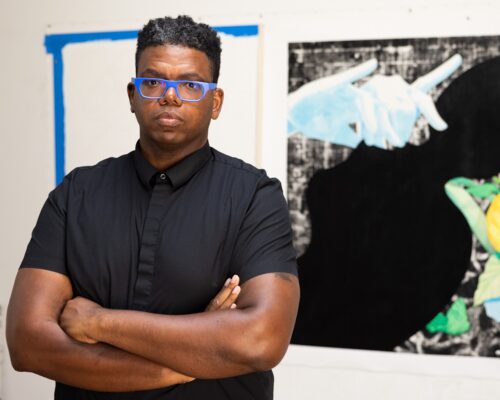
Born and raised in Miami and now working and living in Philadelphia, Mark Thomas Gibson’s homecoming show is at KDR Gallery, Miami. (Photo by Ryan Collerd, courtesy of The Pew Center for Arts & Heritage)
“Mark has shown us some of the best museums and galleries, and as a Miami based gallery, as a regional gallery, it’s sometimes hard to call on artists that have had such an extensive resume,” she says. “So it’s very special to have an artist like this come show in Miami, especially in my space.”
Rosenthal first became interested in working with Gibson after seeing a painting of his at the NADA (New Art Dealers Alliance) art fair in Miami. They kept in touch for several years before the artist came for a visit in person.
“We spoke about works that I really loved that he was making, and he kind of riffed on that,” she says. “I think it’s like a very interesting time to have the show open, especially a few weeks past what’s happening here in the U.S.”
Likewise, Gibson hopes the work will provoke some kind of response in viewers, although he doesn’t see himself as putting out any specific call to action.
“Maybe they can find in the show that they can convene and have those conversations and maybe do some actual action,” he says. “But I’m not the leader. I’m the drummer. It’s more about the backbeat. It’s more about witnessing. I’m witnessing a train wreck. I’m witnessing a shipwreck. I’m witnessing something falling apart. And we can do that wearing very nice clothes and driving very nice cars, but it’s all going to end up in the same place. That’s how I feel.”
WHAT: “Mark Thomas Gibson: The Voyage”
WHERE: KDR Gallery, 790 NW 22nd St., Miami
WHEN: 11 a.m. to 5 p.m. Tuesday through Saturday. Closed Sundays and Mondays. Open Saturday, Jan. 17 through Monday, Feb. 23
COST: Free
INFORMATION: 305-392-0416 and kdr305.com
ArtburstMiami.com is a nonprofit media source for the arts featuring fresh and original stories by writers dedicated to theater, dance, visual arts, film, music and more. Don’t miss a story at www.artburstmiami.com.
No posts found
Art Notes: Miami Exhibitions, Openings, and Artist Talks
Written By Michelle F. Solomon, Artburst Editor
January 9, 2026 at 11:06 AM
Sepideh Kalani, Nakh (نخ), 2025, porcelain cone 10, 20 x 20 x 13 in.
Artburst Miami’s editor picks a selection of what’s happening now in Miami’s galleries, exhibitions, and artist-run spaces.
“Transit Memory”— Baker—Hall
Opening with reception from 5 to 8 p.m., Saturday, Jan. 10. On view through Sunday, Feb. 22.
Baker—Hall, 1294 NW 29th St., Miami
Baker—Hall partners with Oolite Arts for an exhibition entitled, “Transit Memory,” featuring a selection of artists from Oolite Arts’ 2025 Studio and Live.In.Arts Residencies. Co-curated by Baker—Hall and Gabi Di Giammarco “Transit Memory” brings together four artists—Sepideh Kalani, Diana Larrea, Ana Mosquera, and Zonia Zena,
“Transit Memory” considers how identity is constructed, negotiated, and reassembled across shifting cultural, political, and geographic terrains. Through photography, video, technical drawing, embroidery, ceramics, and porcelain sculpture, the exhibition approaches memory as an active process and transit as both condition and material. Each artist examines systems that shape selfhood—bureaucracy, migration, censorship, and inherited traditions—revealing how belonging and autonomy persist under conditions of displacement and uncertainty.
Info at bakerhall.art/exhibition/transit-memory/
“Energy Vortex” — Pablo Contrisciani
Opening with reception 6 to 8 p.m., Thursday, Jan. 15. On view through Thursday, Jan. 29.
Miami International Fine Arts (MIFA), 5900 NW 74th Ave., Miami
“Energy Vortex,” a solo exhibition by Pablo Contrisciani, curated by Ross Karlan and Sophia Ballesteros, draws from ideas in quantum physics and the physicality of gestural abstraction, where bold colors and expressive brushwork pulse with energy. References to South Florida’s coastline, the void, and the act of taking a leap internally reflect Contrisciani’s engagement with painting as a tool for navigating perception and emotion. Contrisciani has lived and worked in Miami since 1998 and holds an MFA from the National University of Fine Arts of La Plata, Argentina. He is currently a resident artist at Laundromat Art Space.
More information at mifamiami.com

Olivia Reavey’s photographic works are featured at City State. (Photo by Olivia Reavey, photo courtesy of City State)
“Drive My Car” — Olivia Reavey
City State in conjunction with Open Artist Studios
City State, 6381 NW 2nd Ave., Miami.
Through Saturday, March 7
This photographic exhibition captures the tension between industrial objects and human bodies. Curated by MATTE, Olivia Reavey’s work features springs, wires, and mirrors interacting with human forms, creating tension between the mechanical and the organic. Reavey’s darkroom prints are jaggedly cut and textured, emphasizing the physicality of her process. Her photographs explore themes of intimacy, identity, and the negotiation between vulnerability and control, often incorporating spontaneous performances with friends or models. She is currently an MFA candidate at Yale University. Curator Matthew Leifhelt is an American photographer, magazine editor, and professor based in Brooklyn. A graduate of Rhode Island School of Design and the Yale School of Art, Leifheit is Editor-in-Chief of MATTE Magazine. He is currently on the faculty at the Yale School of Art and a resident at City State.
More information at citystateenterprises.com
“Vision/Version” at The Camp Gallery
The CAMP Gallery, 791-793 NE 125th St., North Miami
Opening Saturday, Jan. 17 through Saturday, Feb. 21.
“Vision/Version” featuring the work of New York based artist Pablo Power.
“Vision/Version” is Power’s first solo show in Miami, and his second solo exhibition with our gallery. This comeback to the city for the first time in nearly a decade stems from Power’s curiosity to revisit the genesis of his creative inspiration. This exhibition features a collection of both new and old mixed media works, wall hanging sculpture, video works, and unique prints produced in collaboration with Keigo Prints, which all together create a visual roadmap for the development of Power’s unique artistic language.
Hours: 11 a.m. to 6 p.m., Wednesday through Saturday. Private tours can be scheduled by emailing hello@thecampgallery.com or calling 786-953-8807.
“Artist Panel and Curator Conversation — An Evening With Contemporary Photographers Tyler Shields, Jeffrey Czum, and Nick Mele”
The Arlo Wynwood Living Room Gallery, 2217 NW Miami Court, Miami
6 to 8 p.m., discussion begins at 7 p.m., Thursday, Jan. 22
A curator led conversation with Tyler Shields, Jeffrey Czum, and Nick Mele. Attendees will have the opportunity to learn about the artists’ creative processes, inspirations, and the themes behind their work. The discussion provides insight into contemporary art practice in Miami and offers a chance to engage directly with the artists.
Shields is an American fine art photographer whose work moves seamlessly between photography, fashion, and cinema. Through his signature “clean collages,” he reimagines familiar urban and roadside scenes, giving ordinary environments new context and meaning.
Mele is a lifestyle, fashion, and fine art photographer known for his whimsical take on American luxury and elegance. Drawn to richly layered interiors and the people who inhabit them, his images evoke a blend of old-world glamour and modern irreverence.
RSVP: info@1950contemporary.com
ArtburstMiami.com is a nonprofit media source for the arts featuring fresh and original stories by writers dedicated to theater, dance, visual arts, film, music and more. Don’t miss a story at www.artburstmiami.com
No posts found
‘Suns + Shadows’ Brings Out the Best of Miami’s Black Artists
Written By Douglas Markowitz
December 18, 2025 at 11:34 PM
Installation view of “Suns + Shadows” at the Marshall L. Davis, Sr. African Heritage Cultural Arts Center. (Photo by Nazir Forbes)
As a revered cultural institution in Liberty City celebrates its 50th anniversary, one Miami artist is taking the opportunity to reflect on its impact.
“Suns + Shadows,” an art exhibition at the Marshall L. Davis, Sr. African Heritage Cultural Arts Center, convenes some of Miami’s most celebrated artists of Black diasporic lineage. It also marks the curatorial debut of a beloved figure in the Miami arts community, lens-based artist Roscoè B. Thické III.
The exhibition was originally proposed as a solo presentation by Thické, who was approached to do a solo show at the gallery by its manager Bayunga Kialeuka. But the artist had just wrapped the group show “Summer School” at Homework Gallery and was reticent about doing another so soon. He offered to curate a show instead, something he hadn’t done before. Then, during a residency in Suriname, supported by the Diaspora Vibe Cultural Arts Incubator, his research into the center’s 50th anniversary gave him the exhibition’s theme: Legacy.

From left, Roscoè B. Thické III, Mark Delmont, and Lance Minto-Strouse survey the exhibition. (Photo by Gregory Reed)
“I was over there writing a lot about legacy, what it would have meant to me, what it means, period, how does it even reflect in my work and other artists’ work,” he says. “I just started talking to artists, talking about how they practice, how they think about it in passing, and what they think about legacy and how that shows in their practice.”
Thické decided on the final list after sending out a prompt, eventually settling on five artists that seemed “the most enthused.” Some of the participants are already well-established in Miami’s art scene; Reginald O’Neal, for instance, showed at the Rubell Museum in 2021 and at Art Basel Miami Beach in 2023, while T. Elliot Mansa staged one of the final shows at the former Locust Projects space in the Design District in 2022.

T. Elliot Mansa, Ubuntu (For Marcus), 2025. (Photo by Jarem Hodges)
Each employed a range of different materials and angles. Mansa’s florally inspired collages incorporate found materials such as seashells, sand, stuffed animals, and nails in a series titled “Ubuntu,” after the pan-African philosophy of universal human connection. Mark Fleuridor’s textile works incorporate quilting and digital collaging, while Mark Delmont, who previously exhibited in 2024 at the Center in a solo show titled “Papers,” presents figurative paintings reflecting on the impact of unseen Black laborers in Miami.
Some artists treat the idea of legacy from a personal angle. O’Neal is known for both his neo-impressionist paintings and for large-scale installations of souvenir caricature figurines reflecting on the historic commodification of Black creativity. His work for “Suns + Shadows” takes on a sculptural element with the use of poured concrete slabs. One piece, “The opposite side of headcracks is losers,” embeds dice in the concrete, its name a reference to the highest scoring move in the dice game cee-lo.

Reginald O’Neal explored concrete as a material for the first time for his work in “Suns + Shadows.” Mark Fleuridor’s work can be seen on the wall. (Photo by Nazir Forbes)
In “I wrote my name in the concrete,” he places a painting of his recently deceased brother, also named Reginald, and etches his initials in the concrete as if it were an actual sidewalk panel. Thické says O’Neal came up with the idea for the two artworks after discussions between the curator and artist.
“Reggie…wanted to memorialize him and let his legacy live on,” says the curator, who like O’Neal also grew up in Miami’s Black community. “And we started thinking about how we did that when we were young. We would see wet concrete and write ‘Long live so-and-so,’ that’s how we would memorialize people in the neighborhood. So, I think that got him on a path of what he wanted to do.”

Reginald O’Neal is known for both his neo-impressionist paintings and for large-scale installations of souvenir caricature figurines reflecting on the historic commodification of Black creativity. (Photo by Jarem Hodges)
The art exhibition itself is only one half of the project. Thické has also produced a sumptuous catalog that both expands and accompanies “Suns + Shadows” , featuring poetry, essays, photos, and other documentation. Part of the impetus for the book is to counterbalance a deficiency in the show, the fact that all five of the exhibiting artists are men, according to Thické
“I know I wanted a woman’s perspective, but the budget didn’t allow for more than five artists,” Thické remarks. “With the book, I wanted to lead with the women. The women are major and the guys are minor in the book, since the guys are major in the show itself.”
Indeed the catalog provides much more expansive reflection on the five female creatives selected to participate, particularly in terms of mediums covered. There are pages and stills from film director Monica Sorelle’s feature “Mountains” about a demolition worker in Little Haiti and his emotional tug of war over working in a job that is leading to the neighborhood’s gentrification, as well as an interview between Sorelle and fellow filmmaker Faren Humes. The book also features stills from Humes’ film “Liberty,” documenting the community around the Liberty Square housing project. Thické even included poetry from his daughter, Jada Forbes, a high schooler and budding artist herself.

Mark Delmont’s paintings reflect on the legacy of Black laborers in Miami. (Photo by Gregory Reed)
Reflections on feminine influence can also be found in the show itself, however. Jamaican-American artist Lance Minto-Strouse, who claims a mix of Afro-Chinese, Anglo, and Native American heritage, discusses family in his work “Guidance from the Matriarchs.” The collage of text and photos, with faces blurred as a way of “protecting” the family according to the artist, came about after he revisited archives from his mother’s upbringing in Jamaica. It’s also meant to be a meditation on the matriarchal nature of Caribbean culture.
“In Caribbean culture, women tend to lead the children into ideas (and help them to) understand the world around them,” says Minto-Strouse. “My mother was a photographer and pushed me into the art and art ideologies. So (I was) revisiting that after her death and making it, in a way ,of honoring all the things that came before me.”
WHAT: “Suns + Shadows”
WHERE: Marshall L. Davis, Sr. African Heritage Cultural Arts Center, 6161 NW 22nd Ave., Miami
WHEN: 9 a.m. to 6 p.m. Monday through Friday. Closed Saturdays and Sundays. Through Saturday, Jan. 31, 2026.
COST: Free
INFORMATION: 305-638-6771 and ahcacmiami.org
ArtburstMiami.com is a nonprofit media source for the arts featuring fresh and original stories by writers dedicated to theater, dance, visual arts, film, music and more. Don’t miss a story at www.artburstmiami.com.
No posts found
Downtown’s Queue Gallery is Rebelling Against Miami’s Art World Conventions
Written By Douglas Markowitz
December 5, 2025 at 5:04 PM
Queue Gallery’s muted aesthetic and interest in conceptual art sets it apart from the Miami art scene. (Photo courtesy of Queue Gallery)
Queue Gallery is a bit off the beaten path in more ways than one. It’s in downtown Miami, close to the New World School of the Arts but far from art scene hotspots like Allapattah and the Design District. It’s housed in a well-worn downtown Miami loft space, across the hall from the dance music vinyl emporium T-Bag Records. The floors are well-worn, with dark-painted wood contrasting with whitewashed walls, and a moldy smell hanging in the air outside thankfully dissipates once inside the building.
It’s not the typical place for a fine art gallery, and slightly inconvenient given the second-floor space’s lack of direct street access. But for Catherine Camargo, Queue Gallery’s owner and curator and a self-described “river rat” who grew up nearby along the Miami River, the powerful feeling of nostalgia pulled her in.

Catherine Camargo is the owner and curator of Queue Gallery. (Photo by Clarence Josey II)
“I kind of fell in love with the building, because it’s one of the last remaining old school buildings around here,” she says. “There used to be a pizza shop downstairs called Nino’s that I would go to every day during high school. So it’s very full circle being here, it feels good.”
The gallery’s ideas are even more unconventional. Camargo issued a bold rebuke to the city’s art scene when she launched the gallery with a debut group show, “Memory Stick,” in August, with a press statement declaring that Miami’s galleries and institutions were playing it too safe.
“The notion that we must safely exhibit only what can be simply understood reads as an insult to many art enthusiasts in our city—those who attend show after show seeking an experience that challenges perception, that disrupts the surface and digs deeper,” the statement read. “‘Memory Stick’ rejects the notion that audiences are incapable of engaging with complexity. Instead, it embraces work that confronts the subconscious and seeks value beyond the purely aesthetic—a thirst born not of pessimism, but of a contemporary hope, with language evolving alongside us.”
Indeed, the works in Queue’s presentations don’t feel like anything one would associate with Miami, an intentional choice from Camargo. The gallerist is a veteran of the Miami scene, having spent much of her career at the Margulies Collection and briefly at the Pérez Art Museum Miami. She took Queue around town as a nomadic gallery and magazine, curating presentations at spaces across the city in recent years, before opening up shop downtown. In that time she established an almost anti-Miami aesthetic of muted colors and utilitarian materials – Concrete, metal, fabric, found objects – as well as experimental takes on two-dimensional image-making.

Karryl Eugene’s work uses photo collage and calligraphic elements to address the ways in which black culture is transformed into status symbols for the wealthy. (Photo courtesy of Queue Gallery)
“I really wanted to make sure that for the first show the text was kind of a critique of our overall perception of ourselves,” Camargo says. “There’s an idea down here that people aren’t complex enough, or that we don’t have the capacity to indulge in conceptual art, and talk about it and enjoy it. And I have an issue with that, because I’m from here.”
In other words, it’s a rebellion in favor of art focused on ideas and against the typically decorative brightness and Caribbean joie de vivre that Miami sells to the world. An upcoming show from Phoenix, Arizona-based artist Morgan Leigh is a good example of their aesthetic: Her works made from foam wrapped in cloth, leather, and snakeskin, occasionally saturated with desert sand, feature flesh tones of brown, beige, and black but nevertheless transmit a sensual charge.
Beyond looks, conceptual ideas certainly animate Queue’s most recent show. “BLACK MANS SHADOW WORK” pairs photo-based work from Torrance Hall and Karryl Eugene, two New York-based artists interrogating themes of selfhood and identity beyond stereotypical conceptions of black manhood. Each also presents a perspective that feels rooted in the 2000s, both belonging to Gen Z, such as Hall’s digitally-manipulated self-portraits that take on a smooth, metallic aesthetic reminiscent of the Y2K era. Eugene’s photo collages, meanwhile, splice together hip-hop calligraphy with images of video game characters, celebrities, and photos taken at businessman Michael Rubin’s 2023 “All-White Party” to interrogate how black cultural signifiers are appropriated as status symbols for the wealthy.
Although Camargo has worked mainly with artists from outside of the city since Queue Gallery opened, she mentions a few key collaborators and artists working in Miami that have influenced the project, including Luna Palazzolo-Daboul, Alberto Checa, David Correa, and Fared Manzur. She too is a product of the city, and of an artistic family: Her mother Kareen Pauld Camargo, who was born in Haiti, was one of the first black dancers for the Miami City Ballet.
After graduating from the New World School of the Arts, Catherine moved on to the Maryland Institute College of Art in Baltimore, where she began to develop her curatorial sensibilities. Initially intending to become an artist herself, she found herself painting “very Caribbean, figurative, colorful paintings” that she eventually got sick of.

Catherine Camargo, Queue Gallery’s owner and curator grew up near her gallery along the Miami River and the powerful feeling of nostalgia pulled her in. (Photo courtesy of Queue Gallery)
“I felt like I was falling into a cliche and I was not making for myself, I was making for everyone else. And that translated over into my taste as a curator, because I think I got so sick of making work like that that I just started becoming obsessed with looking at other artists who were making work that looked nothing like my own.”
That mindset has carried through into her stewardship of Queue and its mission to change what art from Miami can look like and the things it can say.
“Obviously, as a half-Haitian woman, I think the Caribbean diasporic, colorful, beautiful art is still really important,” she continues, “but I think we have enough of it in Miami.”
WHAT: Queue Gallery
WHEN: Gallery hours: 1 to 6 p.m., Tuesday through Saturday
WHERE: 212 N. Miami Ave., Miami
COST: Free
INFORMATION: queuegallery.net
ArtburstMiami.com is a nonprofit media source for the arts featuring fresh and original stories by writers dedicated to theater, dance, visual arts, film, music and more. Don’t miss a story at www.artburstmiami.com.
No posts found
Miami Art Week Is Here: So Much To See, So Little Time
Written By Michelle F. Solomon, Artburst Editor
December 1, 2025 at 8:12 PM
Visitors pass by art at the Nara Roesler gallery booth at Art Basel Miami Beach 2024. This year’s Art Basel Miami Beach will feature 287 galleries from 44 countries inside the Miami Beach Convention Center. (Photo courtesy of Art Basel Miami Beach)
With so much happening during Miami Art Week, ArtburstMiami has put together a curated list—far from exhaustive—covering everything from major fairs and VIP events to gallery exhibitions.
Art Basel Miami Beach – Wednesday, Dec. 3 to Sunday, Dec. 7, 2025
Miami Beach Convention Center, 1901 Convention Center Drive, Miami Beach
International modern and contemporary art fair showcasing hundreds of top galleries from around the world — painting, sculpture, photography, installations, new media, curated sectors (Galleries, Meridians, Nova, etc.). Private “First Choice” viewing and preview on Wednesday, Dec. 3, vernissage on Thursday, Dec. 4; public access Friday, Dec. 5 to Sunday, Dec. 7, 11 a.m. to 6 p.m.
INFO: www.artbasel.com
Art Miami & CONTEXT Art Miami – Tuesday, Dec. 2 to Sunday, Dec. 7, 2025
The Art Miami Pavilion / CONTEXT Pavilion, One Herald Plaza, NE 14th Street and Biscayne Bay, Miami
Long running contemporary and modern art fair (Art Miami) plus a sister fair (CONTEXT) highlighting mid career and emerging artists — broad mix across painting, sculpture, photography, mixed media. VIP previews morning/early afternoon Dec. 2; public hours begin 4 p.m. that day, then Dec. 3–6 from 11 a.m. to 7 p.m., and Sunday, Dec. 7, 11 a.m. to 6 p.m.
INFO: artmiami.com
Aqua Art Miami – Wednesday, Dec. 3 to Sunday, Dec. 7, 2025
Aqua Hotel, 1530 Collins Ave., Miami Beach
Boutique style hotel fair dedicated to emerging and mid career artists — a more intimate, relaxed setting for contemporary art, ideal for first-time buyers or those looking for fresh, smaller works. VIP preview Wednesday, Dec. 3 from 3 p.m. to 10 p.m.; public hours Thursday, Dec. 4, noon to 9 p.m.; Friday & Saturday, Dec. 5–6, 11 a.m. to 9 p.m.; Sunday, Dec. 7, 11 a.m. to 6 p.m.
INFO: aquaartmiami.com
Design Miami – Tuesday, Dec. 2 to Sunday, Dec. 7, 2025
Convention Center Drive and 19th Street, across from Convention Center, Miami Beach
Global collectible design fair — fine furniture, decorative arts, design objects, architectural pieces, design art crossover. Preview day Dec. 2 (members & collectors), then public days Dec. 3–7.
INFO: designmiami.com
Red Dot Miami – Thursday, Dec. 4 to Sunday, Dec. 7, 2025
Mana Wynwood, 2217 NW 5th Ave., Miami
Red Dot Miami is another well established satellite fair with a broad international gallery lineup, often showcasing accessible contemporary art and serves as a complement to the major fairs. Public hours: Thursday, Dec. 4 to Saturday, Dec. 6, 12 p.m. to 8 p.m.; Sunday, Dec. 7, 12 p.m. to 6 p.m.
INFO: redwoodartgroup.com/red-dot-miami/
HIVE Wynwood (Creative District Activation) – Thursday, Dec. 4 to Sunday, Dec. 7, 2025
Wynwood Marketplace, 2250 NW 2nd Ave., Wynwood
Street culture meets art event blending live painting, installations, music, vendor village, and brand activations — a vibrant, festival style complement to gallery fairs.
INFO: hivewynwood.com
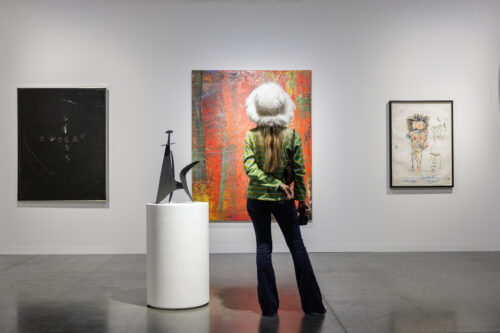
Looking at art at the Vedovi Gallery booth during Art Basel Miami Beach 2024. (Photo courtesy of Art Basel Miami Beach)
INK Miami Art Fair – Dec. 3 to Dec. 7, 2025
Suites of Dorchester, 1850 Collins Avenue, Miami Beach
Fair dedicated exclusively to works on paper — prints, editions, photography — offering a curated, specialized format that appeals to collectors seeking affordability and collectability.
INFO: inkartfair.com/
NADA Miami – Tuesday, Dec. 2 to Saturday, Dec. 6, 2025
Ice Palace Studios, 1400 North Miami Avenue, Miami
Independent and artist run galleries from around the world, showcasing new and emerging voices in contemporary art — often experimental, affordable, and edgy. Public hours Dec. 2–6, 11 a.m. to 7 p.m.
INFO: newartdealers.org
Pinta Miami – Thursday, Dec. 4 to Sunday, Dec. 7, 2025
The Hangar, 3385 Pan American Drive, Coconut Grove
Only fair during Art Week focused exclusively on Latin American and Iberian contemporary art, offering a boutique style, curated gallery fair with a Latin American focus. Public hours: Thursday, Dec. 4, 3 to 8 p.m.; Friday & Saturday, Dec. 5–6, noon to 8 p.m.; Sunday, Dec. 7, noon to 6 p.m.
INFO: pinta.art/miami/home
Point Comfort Art Fair + Show – Thursday, Dec. 4 to Sunday, Dec. 7, 2025
Historic Ward Rooming House, Overtown, Miami
Boutique style fair and exhibition presenting art, history and culture, with a focus on Black heritage, community revitalization, and accessible contemporary art.
INFO: hamptonartlovers.com
Scope Miami Beach – Tuesday, Dec. 2 to Sunday, Dec. 7, 2025
801 Ocean Drive (between 8th and 10th Streets), Miami Beach
High energy contemporary fair on the sand — immersive installations, new media, emerging galleries, bold presentation; ideal for a younger, vibrant crowd looking for edgy, experimental work. VIP/press previews Dec. 2 (invite only); public days Dec. 3–7, 11 a.m. to 8 p.m.
INFO: scope-art.com
Spectrum Miami – Thursday, Dec. 4 to Sunday, Dec. 7, 2025
Mana Wynwood, 2217 NW 5th Avenue, Miami
Contemporary art fair offering a broad mix of galleries and works — often more affordable and experimental than the biggest fairs, making it a good option for first-time collectors or casual visitors. Public hours: Thursday, Dec. 4 to Saturday, Dec. 6, 12 p.m. to 8 p.m.; Sunday, Dec. 7, 12 p.m. to 6 p.m.
INFO: redwoodartgroup.com/spectrum-miami
UNTITLED Art, Miami Beach – Tuesday, Dec. 2 to Sunday, Dec. 7, 2025
Ocean Drive and 12th Street, Miami Beach
Beachfront contemporary art fair with a curated mix of emerging and established galleries offering painting, sculpture, photography and mixed media in a tent on the sand. VIP & Press Preview Tuesday, Dec. 2; public hours Wednesday, Dec. 3 to Sunday, Dec. 7.
INFO: untitledartfairs.com
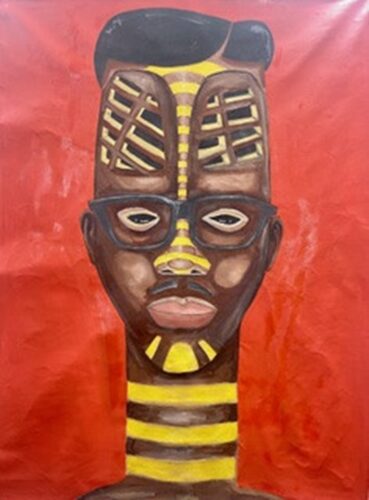
Ahmed Paertey, “Lumumba,” (2020), oil on canvas at AfriKin Art Fair. (Photo courtesy of Afrikin.org)
AfriKin Art Fair – Sunday, Dec. 1 to Sunday, Dec. 7, 2025
Maison AfriKin / Scott Galvin Community Center, 1600 NE 126th Street, North Miami
Fair highlighting art from African and African-diaspora artists — a cultural centric, community-driven event that broadens the geographic and cultural reach of Art Week. Public hours daily throughout the week.
INFO: afrikin.org
ICA Miami – Tuesday, Dec. 2 to Sunday, Dec. 7, 2025
61 NE 41st Street, Miami
ICA Miami opens several overlapping exhibitions and events in conjunction with Art Week — ideal for contemporary‑art lovers seeking museum‑scale shows: On view: “Joyce Pensato” (survey of 65 works), “Richard Hunt: Pressure,” “Andreas Schulze: Special,” “Masaomi Yasunaga,”,and a major stairwell commission “Igshaan Adams: Lulu, Zanele, Zandile, Savannah.” VIP Opening Reception for members and pass‑holders: Tuesday, Dec. 2, 6–9 PM. Museum hours during Art Week: Wednesday–Sunday, 11:00 AM – 6:00 PM.
INFO: icamiami.org
Kindred Animal Spirit Festival – Wednesday, Dec. 3 to Saturday, Dec. 6, 2025
Overtown — NW 9th Street Pedestrian Mall, Miami
Cultural festival blending open air art, music, community gatherings, and public space installations — giving space to grassroots creatives and local community energy.
INFO: muce305.org
LOUD Week (via AOBM) – Wednesday, Dec. 3 to Saturday, Dec. 6, 2025
Miami Gardens (various venues)
Urban culture festival — art, fashion, design, community events, and cultural activations across neighborhoods, spotlighting Afro diasporic contributions to Miami’s creative landscape. Public event hours vary; check official schedule.
INFO: loud-week-miami-gardens-all-event-access
Mana Fashion Art Basel Edition Pop-Up – Wednesday, Dec. 3 to Saturday, Dec. 6, 2025
Mana Wynwood, 318 NW 23rd Street, Miami
Immersive fashion-meets-art pop-up featuring global and Miami-based designers, contemporary art installations, wellness sessions, interactive experiences, curated brand showcases, and cultural programming.
INFO: manacommon.com
BitBasel Miami Art Week – Tuesday, Dec. 3 to Saturday, Dec. 7, 2025
Sagamore South Beach
Merges art, technology, and culture through exhibitions, panels, and evening events including curated discussions, immersive installations, and music activations.
INFO: www.bitbasel.miami/
photoMIAMI – Tuesday, Dec. 2 to Sunday, Dec. 7, 2025
The Miami Art Week Gallery, 2300 N. Miami Ave., Wynwood, Miami
A photography focused show showcasing works from international and local photographers, providing a more specialized, medium specific experience within the larger art week ecosystem. Open concurrently with Arte NXT.
INFO:
Satellite Art Show – Thursday, Dec. 4 to Sunday, Dec. 7, 2025
1520 Collins Ave., Miami Beach (near hotel fair cluster)
Independent gallery and artist run show featuring installations, contemporary works, and alternative media — often with a relaxed, less commercial vibe than major fairs. Public hours: Dec. 5–6, 12 p.m. to 10 p.m.; Dec. 7, 12 p.m. to 6 p.m. Preview/press day Thurs., Dec. 4.
INFO: www.satellite-show.com
MOCA North Miami – Tuesday, Dec. 2 to Saturday, Dec. 7, 2025
770 NE 125 Street, North Miami
Featured exhibitions: “Hiba Schahbaz: The Garden”, “Diana Eusebio: Field of Dreams”, and the plaza installation “Magnus Sodamin: Gateway (between the sun and moon)” as part of MOCA’s Art on the Plaza series. Special event: MOCA’s Miami Art Week Reception — Tuesday, Dec. 2, 8:30–10:30 p.m. (free for members, North Miami residents, and VIP passholders). Public artist‑ and curator‑led tours: Saturday, Dec. 6 at 11 a.m. Extended museum hours throughout the week (check site for daily times).
INFO: mocanomi.org
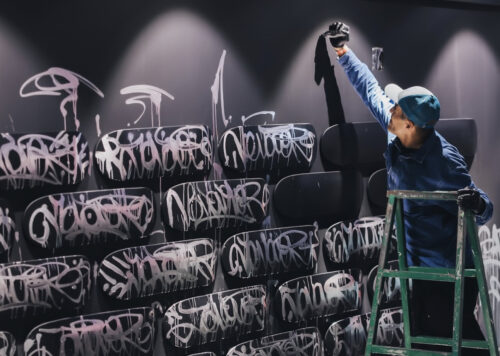
The Museum of Graffiti will feature a working studio inside the building during Art Week, where visitors can watch JonOne create in real time. Photo is JonOne in action at the Museum of Graffiti in Shanghai, China, 2024. (Photo courtesy of Museum of Graffiti)
Museum of Graffiti – Tuesday, Dec. 3, 2025- Friday, Dec.5, 2025
276 NW 26th St., Wynwood, Miami
Museum of Graffiti, ranked as one of best museums in the United States by U.S. News & World Report, is celebrating its 6th anniversary during Miami Art Week with a brand new semi-permanent exhibition that traces the birth and evolution of the graffiti movement from its earliest days on the streets and subways of New York City to its current position as a globally recognized legitimate art form. Museum of Graffiti opens all exhibitions along with its outdoor interactive patio that will boast an incredible line up of top parties, brand activations, and musical talent. “ORIGINS” features original paintings from the 1973 Razor Gallery exhibition in New York, showcasing graffiti pioneers PHASE2, FLINT 707, SNAKE 1, and COCO144 — works that have not been publicly seen for over 50 years. Running alongside it is JonOne’s “El Tiguere,” a solo show highlighting John Andrew Perello’s journey from painting subway trains in Harlem to international acclaim. Visitors can watch JonOne paint in a working studio space. These paired shows trace graffiti’s path from street art to the gallery and provide rare historical documentation of its early evolution.
INFO: www.museumofgraffiti.com
Tribeca Festival at Art Basel Miami Beach – Friday, Dec. 5 to Saturday, Dec. 6, 2025
Miami Beach Bandshell, 1001 Ocean Drive, Miami Beach
Tribeca Festival returns for its fourth edition during Art Basel Miami Beach, featuring two nights of live performances and conversations highlighting emerging artists reshaping contemporary culture. Friday, Dec. 5, features Latin Grammy-nominated Monsieur Periné with opener Cucu, while Saturday, Dec. 6, spotlights instrumental duo Hermanos Gutiérrez, with Jitwam and DJ Willy Soul. Guests can also experience the Google Gemini Photobooth, an interactive AI-powered photo experience.
INFO: tribecafilm.com/miami
24th Iconic Sagamore Brunch – Saturday, Dec. 6, 9 a.m. – 1 p.m.
1671 Collins Avenue, Miami Beach
Features The Orb of Harmony by KEF!, NASA astronaut Nicole Stott, live South Florida Symphony Orchestra performances, interactive art, live mural painting, signature mixology, and curated culinary offerings.
INFO: sagamoresouthbeach.com/experiences/
74th Arts Miami Layover – Tuesday, Dec. 2, 11:30 a.m. to 1 p.m.
El Espacio 23, 2270 NW 23rd Street, Miami
Guided exhibition walkthrough followed by a panel discussion on the past, present, and future of Latin American art — an intimate moment within Art Week for collectors, curators, artists, and inquisitive attendees.
INFO: https://elespacio23.org/
Art of Black Miami – Sunday, Nov. 30 to Sunday, Dec. 7, 2025
Maison AfriKin, Scott Galvin Community Center, 1600 NE 126th Street, North Miami
City-wide cultural initiative spotlighting Black and Afro diasporic art, featuring exhibitions, performances, film screenings, installations, and community centered events throughout the week. Public fair & pop-up hours: daily Nov. 30–Dec. 7.
INFO: https://afrikin.org/index2.html
Art of Transformation (Opa Locka / AOBM affiliate) – Wednesday, Dec. 3 to Saturday, Dec. 6, 2025
Various venues across Ten North Group Campus & Opa Locka Arts District (including Historic City Hall and The Garden of Humanity)
Multimedia showcase exploring African American identity, history, resilience and community through exhibitions, performances, sculpture, photography and public installations under the 2025 theme “At the Edge of Entanglement.”
Specific events:
• Dec. 3, 5–6 p.m.: Unveiling of commissioned work “African Diaspora: Memory in Motion”
• Dec. 3, 6–9 p.m.: Opening night celebration
• Dec. 3, 9 p.m.–12 a.m.: Evening lounge experience and live jazz performance
INFO: https://artoftransformation.tennorthgroup.com/
Elixir Lounge by ORO Miami VIP Opening Night – Thursday, Dec. 5, 2025
818 Lincoln Road, Miami Beach
Exclusive launch event with music by Guy Gerber.
Admission: VIP invitation only
INFO: oro-miami.com/elixir-lounge
Flow Brickell – WRAP Sustainable Art Activation – Wednesday, Dec. 3, 1 p.m. – 8 p.m.
Flow Brickell, 275 SW 6th Street, Miami
Launch of a sustainability-themed art activation by the Waste Reduction Art Project, including live art creation, reflection sessions, author showcase, wine tasting, panel discussion, and gallery reception — spotlighting eco-conscious contemporary art.
INFO: wrapnow.org/
Harmont & Blaine Brickell — First U.S. Flagship Private Preview – Sunday, Nov. 30 to Wednesday, Dec. 3, 2025 | By appointment
701 S Miami Avenue #272C, Miami
Meet-and-greet with H&B artist Jay C. Lohmann, view art installation, and limited dachshund sculptures made from recycled/upcycled materials.
INFO: www.harmontblaine.com/home/
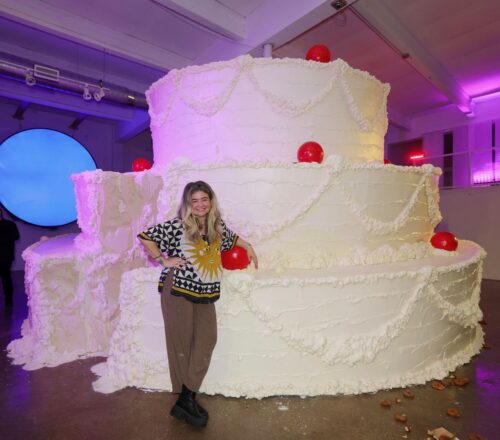
Tara Long in LA ESQUINITA at Locust Projects. (Photo by Logan Fazio)
Locust Projects – ‘LA ESQUINITA’ by Tara Long – Saturday, Nov. 15, 2025 to Saturday, Jan. 17, 2026 | During Art Week public hours: Wednesday–Saturday, 11 a.m. – 5 p.m.
297 NE 67th Street, Miami
Long-running nonprofit alternative art space. “LA ESQUINITA” is a gallery takeover by Tara Long featuring 500+ mini sculptures, blending art, performance, and conceptual experience. Art Week special: Saturday, Dec. 6, 7–10 p.m. meet-the-artist party and performance.
INFO: locustprojects.org
Baker—Hall, “Menagerie” – Sunday, Nov. 30, 2025 to Friday, Jan. 3, 2026
1294 NW 29th St., Miami
Lizzie Gill’s first solo exhibition with Baker—Hall, exploring domestic life, inheritance, and the intimate theater of interior spaces. Inspired by Tennessee Williams’s The Glass Menagerie, the paintings turn still life into staged tableaux where objects, animals, and mythic vessels act as proxies for memory, identity, and emotional inheritance. The works feature Gill’s signature material translation, using marble dust emulsion and image transfer to create layered bas-relief surfaces that evoke care, lineage, and psychological landscapes.
INFO: bakerhall.art
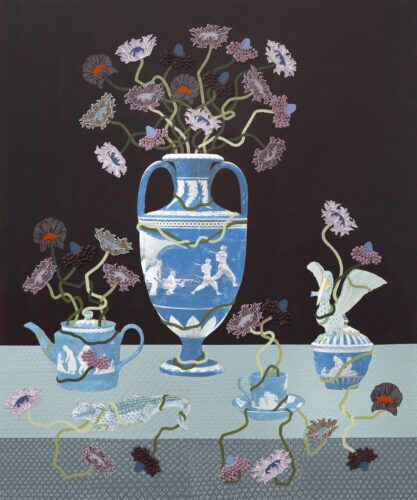
Lizzie Gil, Menagerie at Baker-Hall, “Crimson Poodle (Steeplechase),” 2025, acrylic, image transfer & marble dust emulsion on panel, 24 x 30 in. (Courtesy of the Baker-Hall)
Mana Fashion Art Basel Edition VIP Opening Night – Wednesday, Dec. 3, 6 p.m. – 10 p.m.
Mana Wynwood, 318 NW 23rd Street, Miami
Invitation-only celebration of fashion, art, music, and cultural performance, including a live performance by Radmila Lolly, immersive installations, DJ sets, artisanal bites, cocktails, and curated brand experiences.
INFO: fashion.manacommon.com
Mana Fashion Public Pop-Up Experience – Thursday, Dec. 4 to Saturday, Dec. 6, 11 a.m. – 7 p.m.
Mana Wynwood, 318 NW 23rd Street, Miami
Three days of immersive shopping, discovery, and community-building. Curated marketplace with global designers, luxury fashion houses, sustainable brands, wellness sessions, interactive readings, and fireside chats.
INFO: fashion.manacommon.com/experience-fashion-glamour-mana-fashion-pop-up-bazaar-vip-night/
Mindy Solomon Gallery – Wednesday, Dec. 3 to Sunday, Dec. 7
111 NE 2nd Avenue, Miami
Contemporary gallery presenting a thoughtfully curated selection of works by emerging and mid-career artists across painting, sculpture, and mixed media.
INFO: mindysolomongallery.com
Oolite Arts — ‘One Is Two and Two Are Many More’ Exhibition & Open Studios – Tuesday, Nov. 19, 2025 to Saturday, Jan. 18, 2026 | Daily gallery hours 12 p.m. – 5 p.m.
924 Lincoln Road, Miami Beach
Features a broad range of contemporary works by local and visiting artists. During Art Week: Saturday, Dec. 6, 10:30 a.m. – 12:30 p.m. public brunch + open studios — an opportunity to meet artists, see works in progress, and explore the gallery’s scope beyond fair-related programming.
INFO: oolitearts.org
The Betsy South Beach – Artist talk and Book Signing, Deborah Willis – Saturday, Dec. 6, 2025, 3–4 p.m.
The Gallery at The Betsy Hotel, 1443 Collins Ave., Miami Beach
Artist talk and book signing with Dr. Deborah Willis for the 25th anniversary of her landmark publication, featuring a conversation with Denise Stephanie Hewitt, Roy Wallace, Cornelius Tulloch, and Joan Morgan.
INFO: thebetsyhotel.com
The Leesfield Family Garden: ‘Estrella de Luz’ Sculpture Unveiling – Tuesday, Dec. 2, 1–1:45 p.m.
The Underline, 2358 SW 27th Street, Miami
Public unveiling of “Estrella de Luz,” a new sky-blue bronze sculpture by Pablo Atchugarry. Ceremony includes artist remarks, dedication statements, and ribbon-cutting — celebrating art, community, and public space.
INFO: www.theunderline.org/
Bakehouse Art Complex – Thursday, Dec. 4, 2025
561 NW 32nd St., Wynwood
Free open-studio event with resident artists, tours, and exhibitions. On view: “Bakehouse at Forty: Past, Present, Future,” celebrating Bakehouse’s 40-year legacy.
INFO: bacfl.org
The Bass Museum of Art – Sunday, Nov. 30 to Sunday, Dec. 7, 2025
2100 Collins Avenue, Miami Beach
Extended hours during Art Week with guided tours, artist talks, and special programming under “The Bass Dialogues.” Exhibitions include “Jack Pierson: The Miami Years,” “Lawrence Lek: NOX Pavilion,” “Sarah Crowner in Dialogue with Etel Adnan,” “Isaac Julien: Vagabondia,” “The Kaleidoscopic: Writing Histories Through the Collection,” and “assume vivid astro focus: XI.” Free “Community Day” on Dec. 7.
INFO: thebass.org
The Wolfsonian–FIU – Monday, Dec. 1 to Sunday, Dec. 7, 2025
1001 Washington Avenue, Miami Beach
Free admission for Art Basel/Design Miami VIP cardholders. Exhibitions on view include “Modern Design Across Borders,” “La Superba: Genoa and The Wolfsoniana,” “World’s Fairs: Visions of Tomorrow,” and “Harry Clarke and the Geneva Window.” Special VIP event: “UTOPIA: A Wolfsonian Art Basel Miami Beach VIP Party” on Friday, Dec. 5.
INFO: wolfsonian.org
“Bodyscapes Miami Art Week” – Tuesday, Dec. 2, 2025 to Saturday, Jan. 31, 2026
Jayaram Law Studio, 3800 NE 1st Ave., Suite 500, Miami
A group exhibition curated by a European gallery that’s being re‑imagined for Miami: “Bodyscapes” features works by 11–14 women artists exploring the body, identity, memory, and digital/experiential portraiture.
INFO: load‑gallery.com
ArtburstMiami.com is a nonprofit media source for the arts featuring fresh and original stories by writers dedicated to theater, dance, visual arts, film, music and more. Don’t miss a story at www.artburstmiami.com.
No posts found
Artists Transform 12 Miami Beach Hotels For ‘No Vacancy’
Written By Douglas Markowitz
November 23, 2025 at 9:52 PM
James Sprang’s “Take Me Home” is part of the sixth edition of “No Vacancy,” an art exhibition across 12 hotels throughout Miami Beach.
Miami Beach may be famous as the home of Art Basel, but thanks to an initiative from the city government, visitors don’t even have to leave their hotels to experience great works of art.
Started in 2019, “No Vacancy” is an annual art exhibition taking over around a dozen hotels and resorts across Miami Beach. Artists are selected after a rigorous open call and application process to transform a certain space with their artworks. Most of the commissioned artists are locals or have roots in Miami; this year’s crop includes Amanda Linares, Lee Pivnik, Pepe Mar, and Edison Peñafel.

Amanda Linares’ artwork “Tierra Humida” hangs in the Miami Beach EDITION as part of “”No Vacancy.” Photo by Monica McGivern Photography for Art in Public Places, City of Miami Beach)
The program was started as a way to bring together two important industries for the city, hospitality and culture. Participating properties range from gleaming resorts like the Casa Faena and the Miami Beach EDITION to smaller, more characterful hotels such as The Betsy Hotel on Ocean Drive. All of the artworks are placed in areas accessible to the public, so non-guests can view the work. In fact, the city is encouraging South Florida-based area art lovers to come out by expanding the program to four weeks from its original run of two.
“A fun thing about ‘No Vacancy’ is you can make a day of it with friends and rent a Citi Bike, and go around to the different stops, almost like a scavenger hunt,” says Lisette Garcia Arrogante, director of tourism and culture for the City of Miami Beach. “And it’s a very inexpensive way to really have a fun day of viewing art and getting to know local artists and the hotel properties that we have on Miami Beach.”
According to Garcia Arrogante, the program is popular among artists as well. The open call for this year’s edition meanwhile yielded over 200 submissions from artists.
“It just speaks to the notoriety of the program and showcases Miami Beach and the artists in a very positive way during a time that I think not a lot of local artists get a platform, during Art Week.” she says. “It’s a program we’re really proud of.”

Nathalie Alfonso used colored vinyl strips to activate the windows in a way that didn’t disrupt the picturesque view of Biscayne Bay at the International Inn on the Bay for Miami Beach’s “No Vacancy.” (Photo by RodrigoGaya.com/Gayaman Visual Studio LLC)
Part of the appeal of “No Vacancy” is seeing how each artist utilizes the spaces they’re given, occasionally even integrating the architecture of the hotels. Nathalie Alfonso, for instance, was assigned the International Inn on the Bay, a vintage motel on the water just off the North Bay Causeway on Normandy Isle. The two-story lobby space features large windows facing the water — clearly visible from the causeway when driving towards the beach. It was a perfect fit for the artist, who typically works on site-specific projects.
“My work is only possible when given a space,” says Alfonso. “I think about the work in my studio, but the work actually happens when I’m given a location. So in this case, my location was the windows.”
Alfonso, who usually works in drawing with materials such as charcoal and graphite, attempted to find a way of activating the windows that didn’t disrupt the picturesque view of Biscayne Bay. She settled on using colored vinyl strips to decorate the windows, similar to stained glass. The colors filtering through the space change as a result of the shifting sunlight throughout the day.

“BayScape “by Nathalie Alfonso, “No Vacancy,” at International Inn on the Bay, Miami Beach. (Photos by RodrigoGaya.com/Gayaman Visual Studio LLC)
“Even though the material itself is attached to the window, to me the artwork is more about those moments of light being reflected on the ground,” she says. “Throughout the day you get to see how the sun is directly hitting those windows, but then at night, when the sun sets, you still get that beautiful horizon line with those oranges and pinks that happen in Miami.”
James Sprang, meanwhile, took a different approach. His work “Take Me Home” at the Sherry Frontenac Hotel in North Beach consists of a single 9 ft. by 13 ft. photograph taken at Toronto’s Carnival celebrations, featuring two women “preparing to hit stage and hit road,” in the words of the artist. The image is suspended from the ceiling in the hotel lobby.
The work is part of a larger ongoing project documenting Carnival celebrations across the Caribbean diaspora. Sprang, born in Miami but now living between Brooklyn and Philadelphia, wanted to converse with ideas of diaspora and community, especially considering his relationship to the city and his Trinidadian heritage. He has memories of watching steel drum bands and learning about Trinidad from his father and about the rest of the Caribbean from the wider community in Miami.

James Sprang’s monumental photo “Take Me Home” is suspended from the ceiling in the lobby at the Sherry Frontenac Hotel. (Photo by Monica McGivern Photography for Art in Public Places, City of Miami Beach)
“I started thinking about ways in which I could represent and be in conversation with the diaspora, not only in Miami, but the larger diaspora,” says Sprang. “And going through the images I had on hand, there was something about this one particular photograph that, for me, really celebrates care and really celebrates the black interior alongside the spectacle that is Carnival.”
The choice to display the work as a black and white photo is also intentional.
“Carnival is so much about color,” he says. “Black and white photography is a beautiful and simple abstraction, it’s a removal of color. We’re forced to think about texture and form and light and expression. And it’s interesting to kind of tune into those aspects of the image and see the vibrance of the people depicted.”
WHAT: “No Vacancy”
WHEN: Hours vary by location. Through Saturday, Dec. 20.
WHO & WHERE: Andrea Myers, “A Soft Pixelation,” Avalon Hotel Miami, 700 Ocean Drive; LIZNBOW, “Portal to Niña,” The Betsy Hotel, 1440 Ocean Drive; Denise Treizman, “Wish You Were Here,” Cadillac Hotel & Beach Club, 3925 Collins Ave.; Edison Peñafiel, “Florida Florarium,” The Catalina Hotel & Beach Club, 1732 Collins Ave.; Pepe Mar, “Tropical stomping ground,” Casa Faena, 3500 Collins Ave.; Nathalie Alfonso, “BayScape,” International Inn on the Bay, 2301 Normandy Drive; Patty Suau, “Unexpected Encounters,” Kimpton Surfcomber Hotel, 1717 Collins Ave.; Amanda Linares, “Tierra Húmeda,” The Miami Beach EDITION, 2901 Collins Ave.; Evelyn Sosa, “No Place is Far Away,” Nautilus Sonesta Miami Beach, 1825 Collins Ave.; Fabiola Larios, “Heartware,” Riviera Suites Miami Beach, 318 20th St.; Lee Pivnik, “Wellspring,” The Shelborne by Proper, 1801 Collins Ave.; James Sprang, “Take Me Home,” Sherry Frontenac Hotel, 6565 Collins Ave.
INFORMATION: miamiandbeaches.com
ArtburstMiami.com is a nonprofit media source for the arts featuring fresh and original stories by writers dedicated to theater, dance, visual arts, film, music and more. Don’t miss a story at www.artburstmiami.com.
No posts found
El Espacio 23 Exhibition Reimagines Territory and Belonging
Written By Miguel Sirgado
November 14, 2025 at 4:53 PM
A World Far Away, Nearby and Invisible” transforms El Espacio 23 into a living map of shifting territories, gathering nearly 150 works that echo across continents yet remain rooted in Miami’s own porous ground. Shown is Jennifer Basile’s “Loop Road” (2023), included in the exhibition. (Photo courtesy of El Espacio 23)
In a city where borders feel permeable and reinvention is a local instinct, El Espacio 23 returns with a timely question: What is territory now? Is it land? History? A wound? A spiritual force? A place we inherit, or a place we imagine? That inquiry anchors “A World Far Away, Nearby and Invisible: Territory Narratives in the Jorge M. Pérez Collection,” the sixth exhibition at the contemporary art space founded by Miami developer, art collector and philanthropist Jorge M. Pérez.
The show opened on Thursday, Nov. 13 and is on view through Saturday, Aug. 26. It gathers nearly 150 works by more than 100 artists from the Americas, Europe, Africa and beyond, yet its pulse is distinctly Miami.
The exhibition is curated by Claudia Segura Campins, head of collection at Museu d’Art Contemporani de Barcelona (MACBA), in collaboration with Patricia Hanna, director at El Espacio 23 and Jorge M. Pérez Collection, and Anelys Alvarez, curator of the collections and programs, El Espacio 23 and Jorge M. Pérez Collection. When the project began, the proposed theme was “landscape,” a starting point Segura quickly challenged.
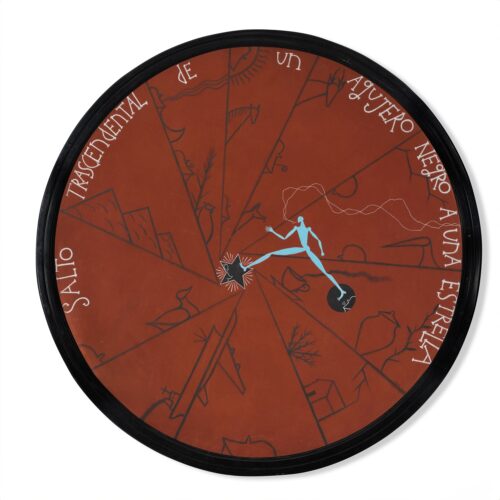
Miami voices remain central to the exhibition’s narrative. This year’s lineup includes José Bedia, Didier William, Teresita Fernández, and Nina Surel. Pictured is José Bedia’s “Salto transcendental de un agujero negro a una estrella” (c. 1990). (Photo courtesy of El Espacio 23)
“Landscape is a concept built from a distanced gaze,” she says. “Historically, it belongs to the colonizer describing and fragmenting a place. I wasn’t interested in a static image of land. I wanted the living, porous, shifting idea of territory.”
That shift widened the exhibition’s scope. “Territory let us move past the visible surface,” explains Segura. “It allowed for memory, politics, ancestral knowledge, violence, ecology, spirituality. ‘Landscape’ was a frame. ‘Territory’ was an opening.”
Hanna says they wanted to tell a broader story. “Territory wasn’t just soil, it was community, energy, the invisible forces underneath.”
The exhibition unfolds in four conceptual “chapters,” not as fixed categories but as lenses: “The Pulse,” “Whispers from the Land,” “Shelter Among the Scars,” and “Landscapes in the Making.” In “The Pulse,” the earth is not a backdrop but protagonist: water, fire, minerals and biological life asserting their own agency. “What forces are shaping us that we don’t control?” asks Segura. “Miami understands that question better than most cities. This place is literally built on mangrove and uncertainty.”
Guest curator Claudia Segura Campins, who oversees the collection at MACBA in Barcelona, brings an expansive, research-driven approach to the exhibition. (Photo courtesy of Claudia Segura Campins)
“Whispers from the Land” carries the spiritual and ancestral dimension of territory, including the moment that gave the exhibition its title. Segura recalls the turning point: “We struggled for weeks to name the show. Then we realized the title was already inside the collection.” She refers to a work by artist Tania Candiani depicting the Mazatec healer and poet María Sabina. “Sabina spoke of a world far away, invisible but very near, a world you access by listening to the land. The title had already been given to us by the work. The exhibition just had to receive it.”
If territory can whisper, it can also scar. The third chapter addresses extraction, displacement, forced migration and environmental devastation, without flattening them into a single message. “Territory remembers the violence written on it,” says Segura. “But it also remembers resistance, regeneration, joy. That duality matters.”
Throughout the show, artists appear in unexpected constellations: women abstractionists from different decades, Indigenous cartographies alongside digital landscapes, Caribbean eco-futurisms in dialogue with post-Soviet geographies. “The most fascinating thing was realizing how many artists in the Pérez Collection were already speaking to each other across time,” notes Segura. “You place a Venezuelan artist next to a South African one, and suddenly they are asking the same question in different languages.”
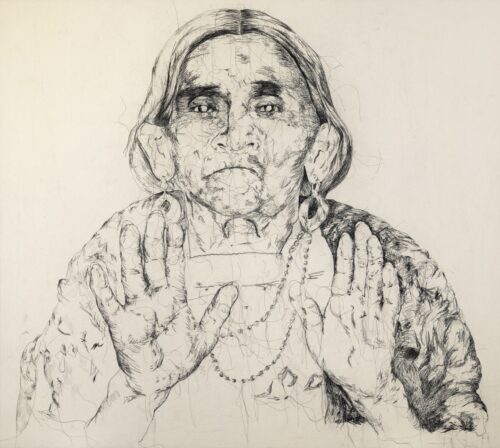
The exhibition takes its title from a work inside the collection—Tania Candiani’s portrait of Mazatec healer María Sabina, whose chants spoke of “a world far away, invisible but near,” says curator Claudia Segura Campins. Above, Tania Candiani’s “María Sabina” (2024). (Photo courtesy of El Espacio 23)
That interconnection reflects the collection itself. “Every exhibition here is a moment of reflection,” says Álvarez. “The collection is always expanding, so the threads shift, but they are always global, always in conversation.”
That global reach was underscored just weeks ago, when the Tate in London announced a landmark gift from Jorge M. and Darlene Pérez: 36 works by artists from Africa and the African diaspora, including El Anatsui, Yinka Shonibare, Joy Labinjo and Bruce Onobrakpeya, along with a major endowment creating the new position of Jorge M. Pérez Senior Curator, International Art, Africa and Diaspora, held by Osei Bonsu. Coming after the Pérez donation of a monumental Joan Mitchell triptych, the gift signals what Segura calls “a collector expanding the borders of institutional memory.”
That sense of widening territory also applies to Miami, a city where climate, migration and myth crash into each other daily. “Miami is a threshold city,” says Segura. “A place made of crossings: languages, waters, storms, arrivals. Even geologically, the land is unstable. That instability became a curatorial key.”
El Espacio 23 has long treated that instability as an invitation rather than an obstacle. Though privately funded, its mission is public: free admission, multilingual tours, residencies, and an open-door policy designed to dissolve the distance between collection and community. “There are no borders inside El Espacio,” says Hanna. “No matter your story, we want at least one work to look back at you.”
Miami voices remain central to the exhibition’s narrative. This year’s lineup includes José Bedia, Didier William, Teresita Fernández and Nina Surel.
Also included is printmaker Jennifer Basile, whose large-scale relief works translate the Everglades into vivid, painterly topographies. “I want you to feel that grandiosity the way the Hudson River School painters did,” says Basile. “That sense of beauty and vastness but tied to the ecology we are losing in real time.” A New Yorker who has spent three decades in South Florida, Basile calls her work “a form of preservation and a warning.”
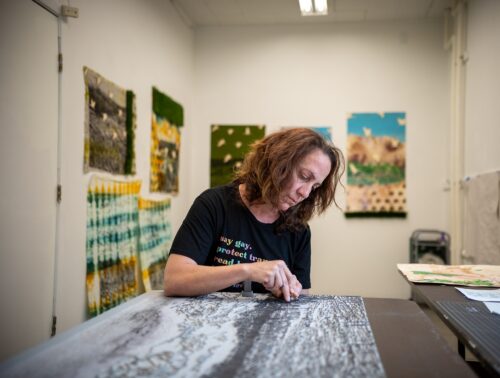
Miami-based printmaker Jennifer Basile (pictured) is among the local artists featured in the exhibition, known for her large-scale relief works that translate the Everglades into sculptural, almost painterly landscapes. “I want you to feel that grandiosity the way the Hudson River School painters did,” she says. (Photo by Carolina Porras Monroy, courtesy of the artist)
Basile’s connection to the land is not a metaphor. “I hike it, I swamp-walk it, I study it with scientists and tribal leaders,” she says. “You can’t advocate for a place you don’t breathe.” Her print in the show depicts Loop Road in the Everglades, a site she fears may soon disappear under development. “If someone sees the work and asks, ‘Where is this? Can we go?’, that is the beginning of protection.”
For Segura, that kind of lived relationship to territory is the core of the exhibition. “Territory is not a map,” she says. “It is something inhabited, negotiated, dreamed, damaged, defended. It is not neutral. It is neither still.” If territory were a living voice, she adds, “it would ask us to listen, to place the invisible at the same level as the visible, and to accept that we are never separate from the ground we stand on.”
In that sense, “A World Far Away, Nearby and Invisible” is less a definition than a rehearsal, an open question staged in artworks rather than answered by them. “Territory is the memory we inherit and the future we imagine,” says Hanna. “It is not just a place. It is a force.”
WHAT: “A World Far Away, Nearby, and Invisible from The Jorge M. Pérez Collection.”
WHEN: Through Saturday, Aug. 15, 2026. Gallery hours, 10 a.m. to 5 p.m., Thursday to Saturday
WHERE: El Espacio 23, 2270 NW 23rd St., Miami
COST: Free.
INFORMATION: 786-490-9090 or elespacio23.org
ArtburstMiami.com is a nonprofit media source for the arts featuring fresh and original stories by writers dedicated to theater, dance, visual arts, film, music and more. Don’t miss a story at www.artburstmiami.com.
No posts found
Who Is That Face In The Water in North Beach’s Ocean Terrace Park?
Written By Douglas Markowitz
November 13, 2025 at 11:57 PM
French artist Prune Nourry’s “Reflection” is an ancient-looking sculpture of a head that sits on its side in the middle of a pond, as if left behind by a vanished civilization. The artwork is the centerpiece of the new Ocean Terrace Park in North Beach. (Photo by Thomas Loof, courtesy of M18 Public Relations)
At a newly completed park in Miami Beach, a new piece of public art is turning heads – literally.
Officially unveiled during a ceremony on Thursday, Oct. 30, “Reflection” is a giant stone sculpture in the shape of a woman’s head. Conceived and designed by French artist Prune Nourry, the artwork is the centerpiece of the Ocean Terrace Park in North Beach.
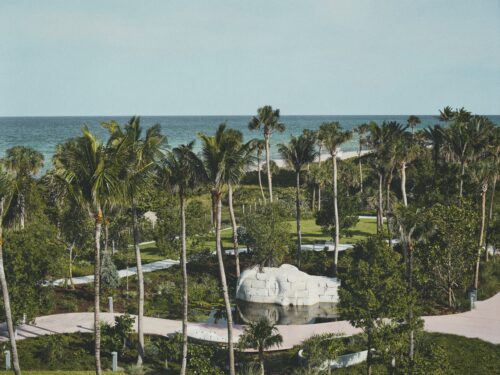
The new five-acre Ocean Terrace Park in North Beach has a new piece of art that’s 25 feet long and 8 feet high. (Photo by Thomas Loof, courtesy of M18 Public Relations)
Located along Ocean Terrace between 73rd and 75th streets, just north of the Miami Beach Bandshell, the new green space takes up what was once a street with parking on either side. It’s part of a larger development that will see a once-dilapidated strip of beachside hotels updated with a hotel, a 75-unit condo tower, and newly-built retail and restaurants.
Inspired by the likes of Angkor Wat in Cambodia and the colossal Olmec heads of pre-Columbian Mesoamerica, “Reflection” is meant to resemble an ancient ruin given over to nature. The head sits on its side in the middle of a pond, as if left behind by a vanished civilization, with a tree growing out of the upper side.
According to the artist, the gridded brickwork that forms the statue references Carl Jung’s concept of collective unconsciousness, the idea that all human beings share an instinctual understanding of certain symbols and ideas. And as the title implies, its reflection in the water creates an optical illusion that allows the full face to be seen.
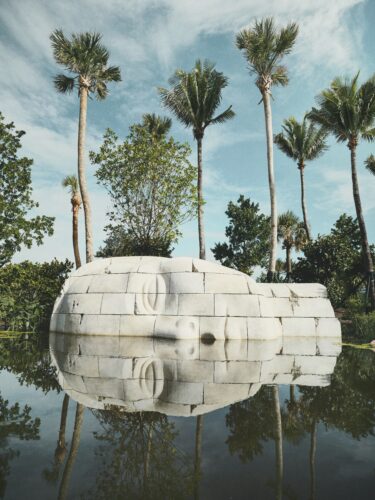
Prune Nourry’s “Reflection” was unveiled in October in the recently completed Ocean Terrace Park on Miami Beach. (Photo by Thomas Loof, courtesy of M18 Public Relations)
But who is that face in the water?
The statue actually uses the likeness of a real person: Nellie Locust, a Cherokee woman who was stationed in Miami during World War II as part of the SPARs, the Coast Guard Women’s Reserve. The process that culminated in her likeness being used for “Reflection” began when Nourry learned about the Biscayne Bay House of Refuge, a Coast Guard station that stood on a site adjacent to Ocean Terrace until it was destroyed in the Great Miami Hurricane of 1926.
Learning about the station is what convinced Nourry to weave in reference to the SPARs, women recruited into the Coast Guard in order to compensate for the lack of male servicemen available during World War II. She contacted a historian, Donna Vojvodich, who specialized in the SPARs, and while searching through photos of the SPARs she had provided, she found one with an enticing signature: “Sincerely, Nellie.”
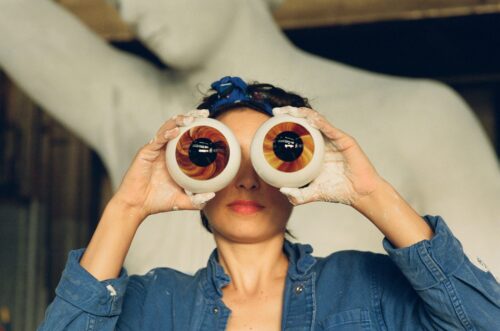
Prune Nourry designed “Reflection,” a giant stone sculpture in the shape of a woman’s head that now has a home in North Beach. (Photo by Franklin Burger)
“When I picked her portrait, I didn’t yet know her story, but I was drawn to her by the message and her face on that black and white picture,” says Nourry.
Originally from Vinita, Oklahoma, Locust was one of several indigenous women in the Sooner Squadron and earned the rank of Yeoman First Class in the Coast Guard. She joined the Coast Guard in 1943, training in Palm Beach, and served at stations in Fort Pierce and Miami. She died in 1947 at the age of 26 from an illness.
After selecting the photo, Nourry contacted Locust’s family to secure permission to use her likeness. The sculpture was assembled on site using locally fabricated 3D printed concrete blocks before Nourry provided the finishing touches to make it appear more weathered.
Though the piece is Nourry’s first public art commission in North America, the artist’s work has been exhibited extensively across the world. Her installation “Terracotta Daughters,” which featured female versions of the famous terracotta warriors of Xi’an, was toured around the world and eventually interred in China. And next year the artist will mount a show at the Petit Palais in Paris.
Raymond Jungles, the landscape architect in charge of the park, says Prune Nourry’s “Reflection” fit in well with the scale of the park. (Photo courtesy of M18 Public Relations)
The artist earned the Ocean Terrace commission after Raymond Jungles, the landscape architect in charge of the park, saw her work at the home of another client, the nightlife impresario and restaurateur David Grutman. Jungles says he was enticed by the opportunity to enhance a neighborhood he already knew quite well.
“I used to be a lifeguard when I was 19, right there,” he says. “It was always a special place to me.”
According to the architect, it was another of Nourry’s pieces, “Anima” from 2015, that inspired the idea to reflect the sculpture’s face in the pond.
“It’s on this huge beach with this huge ocean and horizon line just beyond it, so we wanted something that had some real impactful scale,” he says. “I figured if we reflected the piece, we could get twice as much for the price of one.”
The artist created the statue in the likeness of a real person: Nellie Locust, a Cherokee woman who was stationed in Miami during World War II as part of the SPARs, the Coast Guard Women’s Reserve. (Photo by Thomas Loof, courtesy of M18 Public Relations)
For Nourry, whose work frequently incorporates references to unseen women throughout history, the piece’s resonance goes deeper. The opportunity to honor Locust, the SPARs, and their role in the fabric of Miami’s history is significant.
“As a woman artist, or maybe just an artist, I feel very touched by the point of view we can have on history and how, in the end, it’s written by human beings. And some people will be highlighted, some won’t, but history is made by so many people whose names are forgotten.”
WHAT: “Reflection” at Ocean Terrace Park
WHEN: Open daily from sunrise to 10 p.m.
WHERE: 73rd Street and Collins Avenue, Miami Beach
COST: Free
INFORMATION: 305-673-7730 or miamibeachfl.gov
ArtburstMiami.com is a nonprofit media source for the arts featuring fresh and original stories by writers dedicated to theater, dance, visual arts, film, music, and more. Don’t miss a story at www.artburstmiami.com.
No posts found
Dennis Scholl Explores Collective Memory and Space in ‘A Day of Four Sunsets’
Written By Michelle F. Solomon
November 4, 2025 at 11:24 AM
With his latest exhibition, “A Day of Four Sunsets,” at the Hollywood Art and Culture Center, Dennis Scholl continues his ongoing inquiry into collective memory through assemblages, this time with an eye toward space exploration. (Photo by Marco Bellochio)
Dennis Scholl’s art work from his first U.S. solo show in Miami, in March of 2025, tapped into a multitude of memories from different eras – some of what was included were three dodecagon newspaper triptychs of President John F. Kennedy’s 1963 assassination, ephemera from the 1972 Munich Olympics with the original Olympic torch as its centerpiece, and a collection of Charles Dickens’ paperbacks from 1895.
With his latest exhibition, “A Day of Four Sunsets,” at the Hollywood Art and Culture Center, Scholl continues his ongoing inquiry into collective memory through assemblages, this time with an eye toward space exploration.
Untitled (Kapton Foil), 2024, acquired objects. A small sculptural work arranged with a dodecagonal framework incorporating Kapton foil used on many missions to protect the capsule from overheating. (Photo by Marco Bellochio)
“These are not everyday objects, but they’re actual, real material from NASA that he’s using to tell the story of the space race,” says Jodi Sypher, curator at Hollywood Art and Culture Center.
Over the past decade, the avid collector, whose passion started with a bottle cap collection when he was five years old, gathered NASA-related memorabilia—photographs, patches, declassified documents, vintage press clippings, and diagrams.
Untitled (Russian Rations), 2024, acquired objects. n assemblage on a plinth featuring Russian space food used on the International Space Station. (Photo Marco Bellachio)
“When I started thinking about the show, I began to ask myself, ‘What memories are out there? What memories can I look to?’ Because that’s such a big part of my practice,” says the Miami Beach-based artist.
There should also be a throughline, he decided, one with subtle shades of optimism. The idea soon began to take shape.
“What’s the seminal moment of the space program? Of course, man landing on the moon. But there was also that moment when John Glenn blasted off to become the first person to orbit the Earth. He did three revolutions, starting at sunset. In four hours and 55 minutes, he saw the sun set four times. When he came back, that was all he could talk about. He didn’t care that he was the first guy to circle the Earth—he just kept saying, ‘You can’t believe what that’s like.’”
It became the inspiration for the name of the show. As curator, Sypher says she worked with Scholl on the themes: “Liftoff and ascent, orbit and observation, and re-entry and reflection. It is laid out to tell a story. Within each, there are those themes.”
With Scholl’s background as a documentary filmmaker—he’s made 87 films and won more than 20 regional Emmy Awards—Sypher says the exhibition unfolds much like a documentary. “Each artwork acts as a single frame, incorporating both light and sound.” In her essay about the exhibition, she writes: “Like a skilled cinematographer, he draws the viewer in for a closer look, revealing the stories hidden within.”
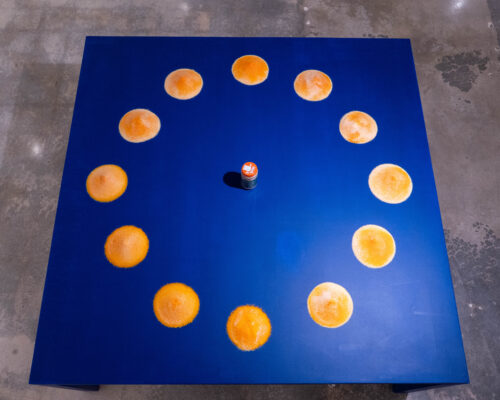
Untitled (Tang): An original 1960s bottle of Tang powdered orange drink, surrounded by twelve scoops of current day Tang orange powder. (Photo by Marco Bellochio)
Scholl again turns to the dodecagon, which Sypher notes not only frames the objects but “suggests the passage of time.”
Using the geometric shape as a structural element, Scholl intentionally draws on the associations with time, order, and continuity.
“It’s an orbital type of idea. Something that goes around and around. It’s mostly about time, right? Hours on a clock, months in a year, the signs of the Zodiac,” says the artist.
Sypher concludes it is a “powerful technique and method for conceptual art making.”
Scholl uses the symmetry of 12 differently in “Untitled (Tang).” A six-foot by six-foot platform was built where stacks of the orange powdered drink are placed on a dark blue background and organized in a circle around a bottle of Tang.
“When I was a kid, I drank more Tang than anything else because that’s what the astronauts did,” says the artist. The drink mix, made by General Foods, was used during the Gemini space mission in the mid-1960s. As is part of his art-making, he went on the hunt for an original bottle even after discovering that the drink is still made. In order for the piece to be authentic, it had to incorporate the original bottle and design from the 1960s.
“His three-dimensional works are very exciting,” says Sypher.
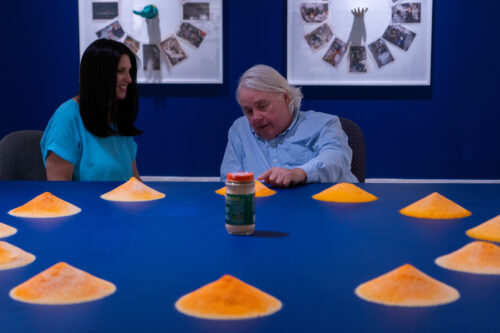
Jodi Sypher, curator at Hollywood Art and Culture Center, with Dennis Scholl discussing “A Day of Four Sunsets” running through Sunday, Jan. 4. (Photo by Marco Bellochio)
The exhibition includes hanging sculptures fashioned from space gloves, alongside works incorporating View-Masters—cultural relics that invite viewers to peer into miniature images of the universe.
He was also able to acquire Russian space food – “actual Russian rations used in space” and a “decent size of Kapton,” a foil used on spacecraft for radiation shielding. “These are the original pieces of foil that were actually on the capsule of Apollo 15 as it came back to Earth and kept it from burning up.” The small, sculptural work using the foil is arranged within a dodecagonal framework.
“Years of collecting and evaluating objects have made Scholl’s eye incredibly discerning,” said Larry Ossei-Mensah, who curated last March’s Piero Atchugarry Gallery in Miami.
But not everything in the show is bright and shiny. He includes “Untitled (Tragedy),” New York Daily News’ front pages of the 1986 Challenger disaster, which also appeared in his Miami show.
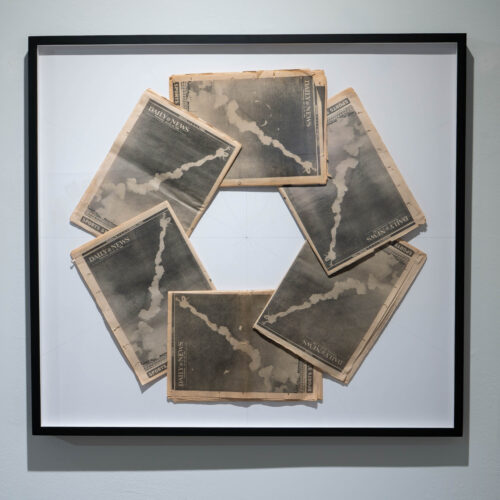
Six identical Daily News newspapers, displaying the contrails of the exploded Challenge spacecraft, where seven astronauts were lost. This was included in Dennis Scholl’s first U.S. solo exhibition, too, in Miami. (Photo courtesy of Dennis Scholl)
“It was another thing I wanted to consider – that globally and as a country, we want to chase and master this technology but, on the way, there are real costs and there are real difficulties,” says Scholl. “I wanted to show the difference between man’s technology, the technological achievement, and the price you pay for obtaining that achievement.”
Sypher adds that Scholl’s work fits seamlessly within the educational mission of the Hollywood Art and Culture Center. “We’re excited about both the science and space exploration aspects, as well as the mathematical component of the dodecagon framing. But more than that, his work is just a great fit for the center overall.”
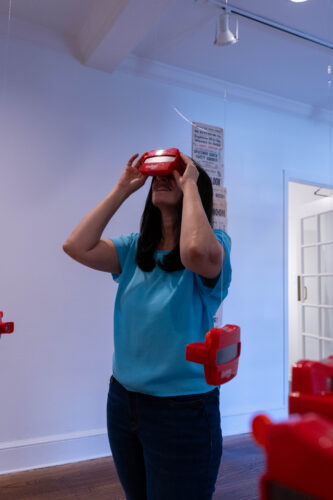
Hanging View-Masters, cultural relics, invite viewers to peer into miniature images of the universe. (Photo by Marco Bellochio)
The exhibition coincides with the Hollywood Arts Hub, which officially opened on Nov. 2, a recent expansion of the Hollywood Art and Culture Center, which will provide more space for the center’s arts and community activities. Construction of the Arts Hub was funded by the City of Hollywood through funding from a 2019 General Obligation Bond that was approved by city voters in a special election.
In addition to Scholl’s exhibition, two other artists have works on display, including Miami Beach–based Felice Grodin’s “Where Do I Go From Here?,” which features intricate ink drawings on translucent Mylar that blend architectural structure and surreal imagination. Miami-based artist Brian Reedy is presenting “Gothic Pop Prints,” custom linoleum block prints with a Lizzie Borden theme inspired by Thinking Cap Theatre’s “Lizzie the Musical,” which was presented at the center.
WHAT: Dennis Scholl: “A Day of Four Sunsets.”
WHERE: Hollywood Art and Culture Center, 1650 Harrison St., Hollywood
WHEN: Through Sunday, Jan. 4, 2026. Gallery hours: Tuesday by appointment, 11 a.m. to 6 p.m., Wednesday and Friday, 11 a.m. to 8 p.m., Thursday; noon to 4 p.m. Saturday and Sunday.
COST: $10 general admission, $5 seniors ages 65 or older, students with valid school ID, and children ages 13 to 17; free admission for members, children 12 and younger, teachers and active military personnel with valid ID.
INFORMATION: (954) 921-3274 and www.artandculturecenter.org
ArtburstMiami.com is a nonprofit media source for the arts featuring fresh and original stories by writers dedicated to theater, dance, visual arts, film, music and more. Don’t miss a story at www.artburstmiami.com.
No posts found

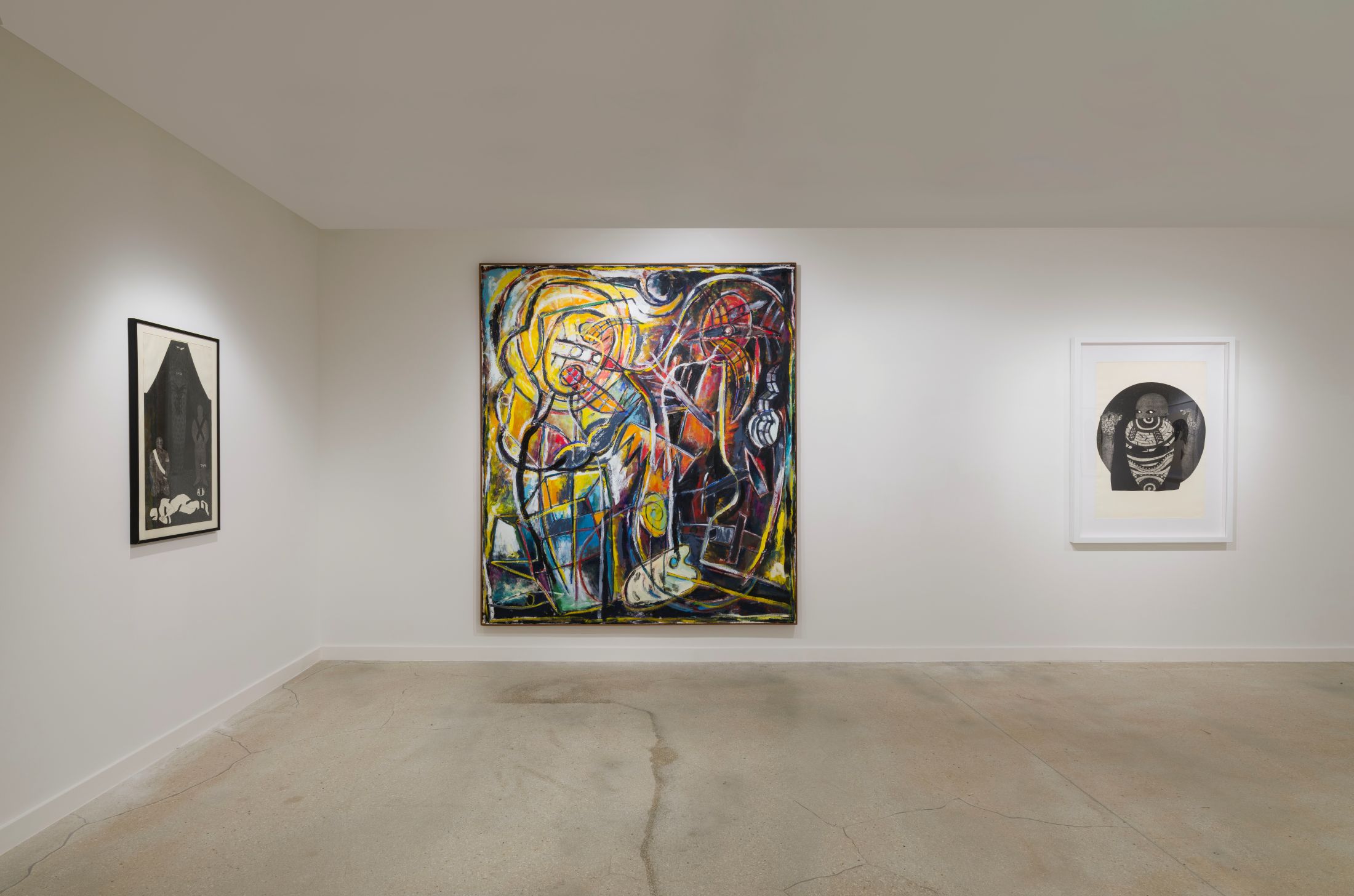


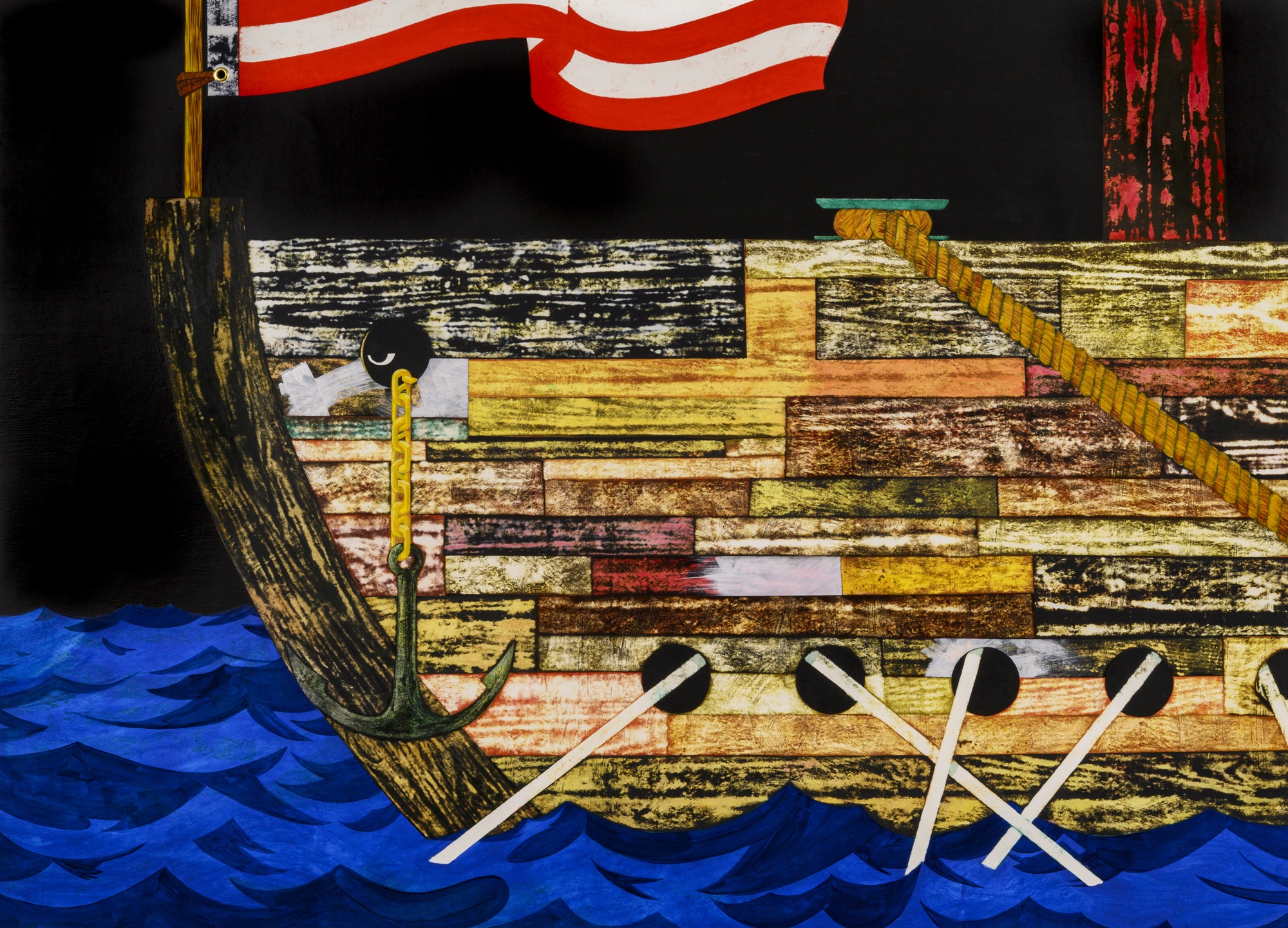


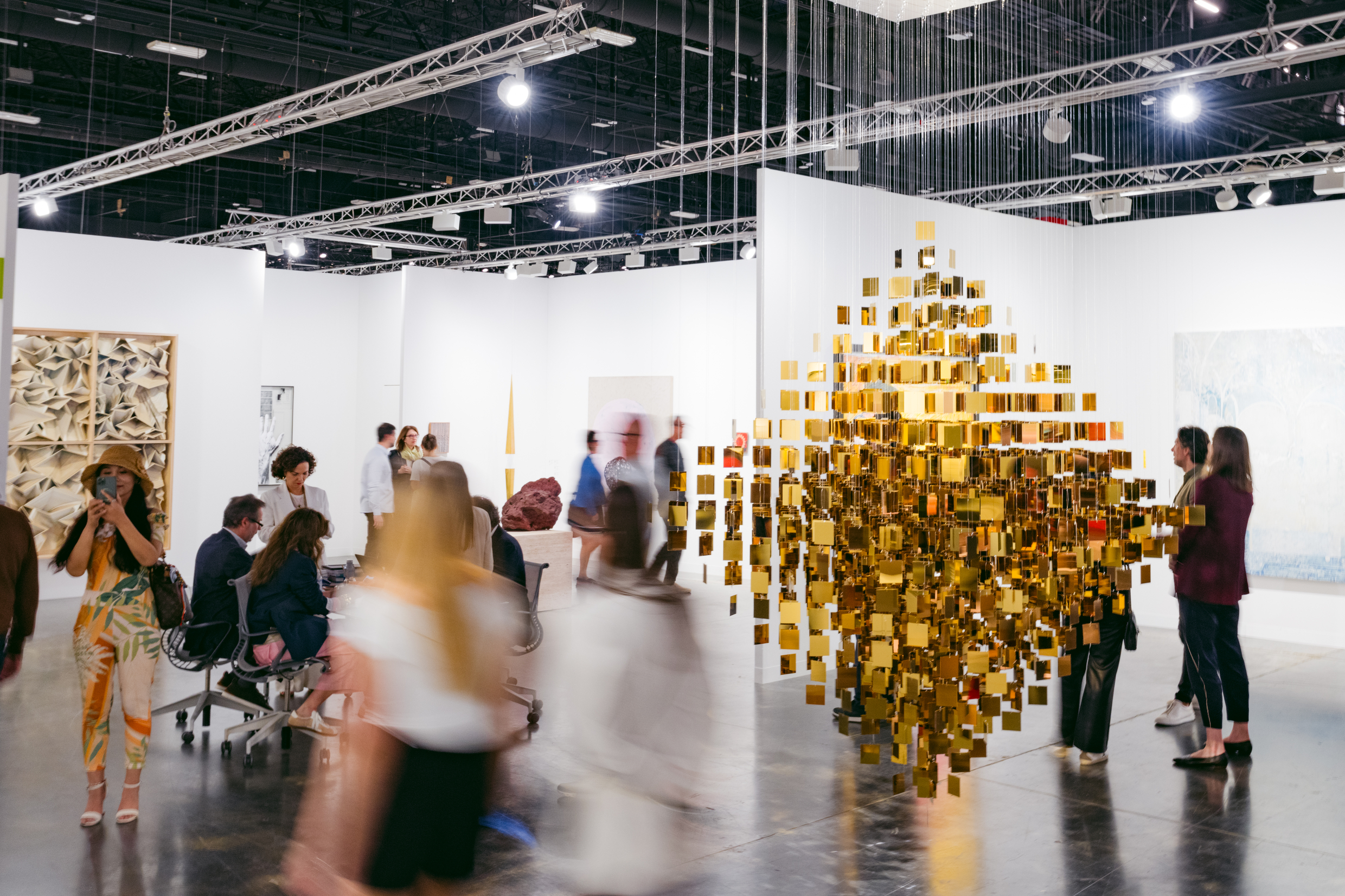

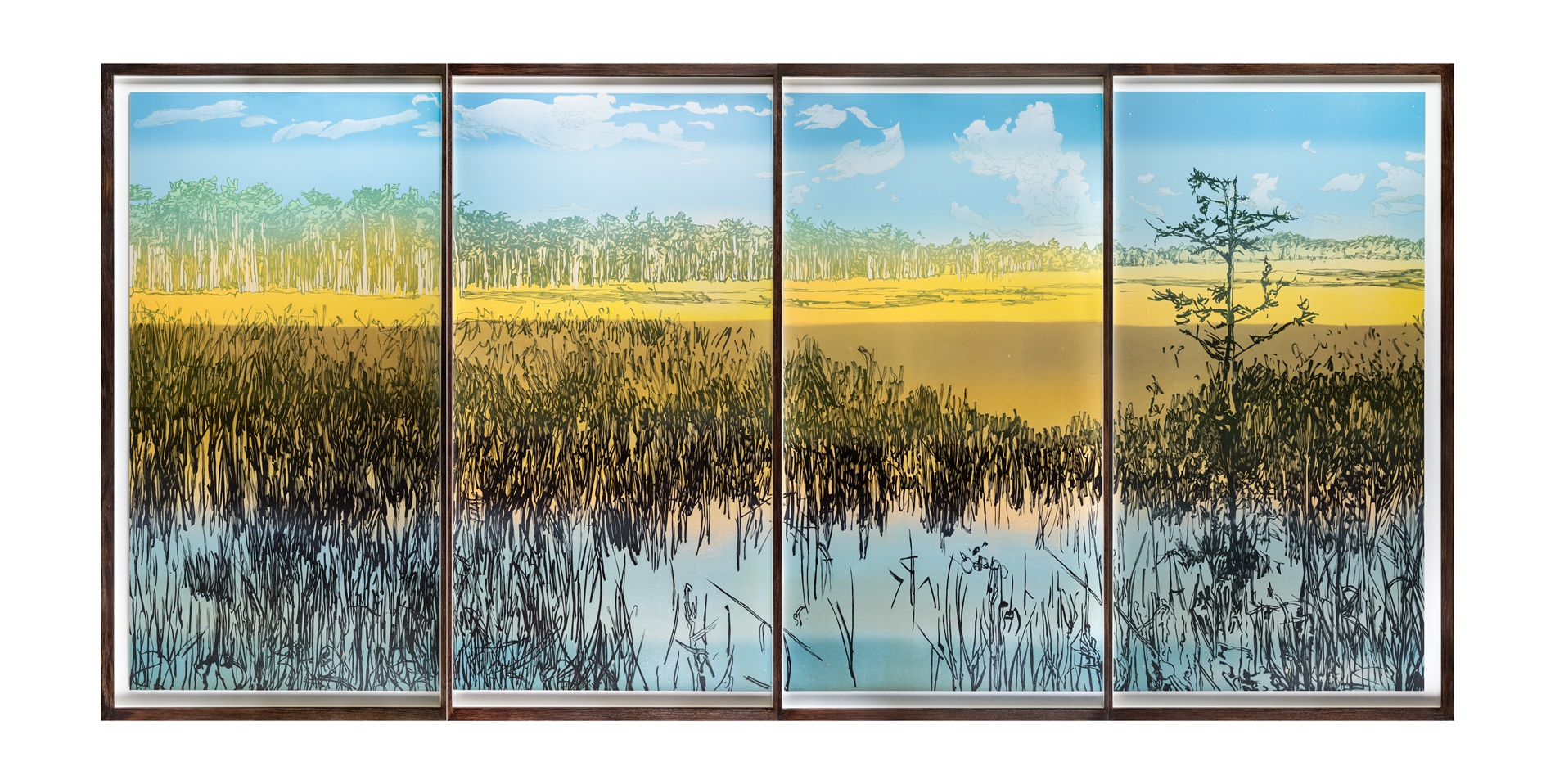
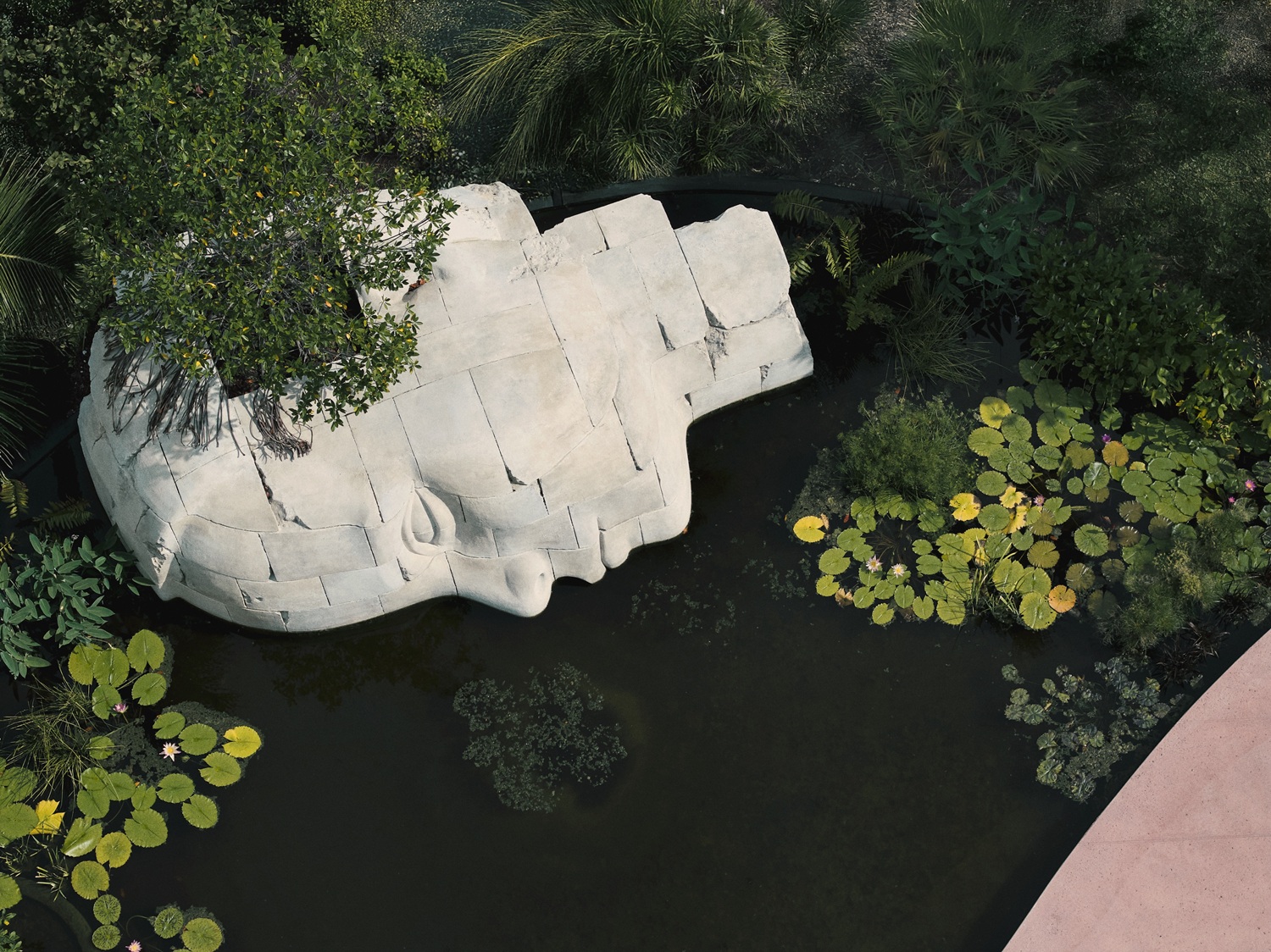
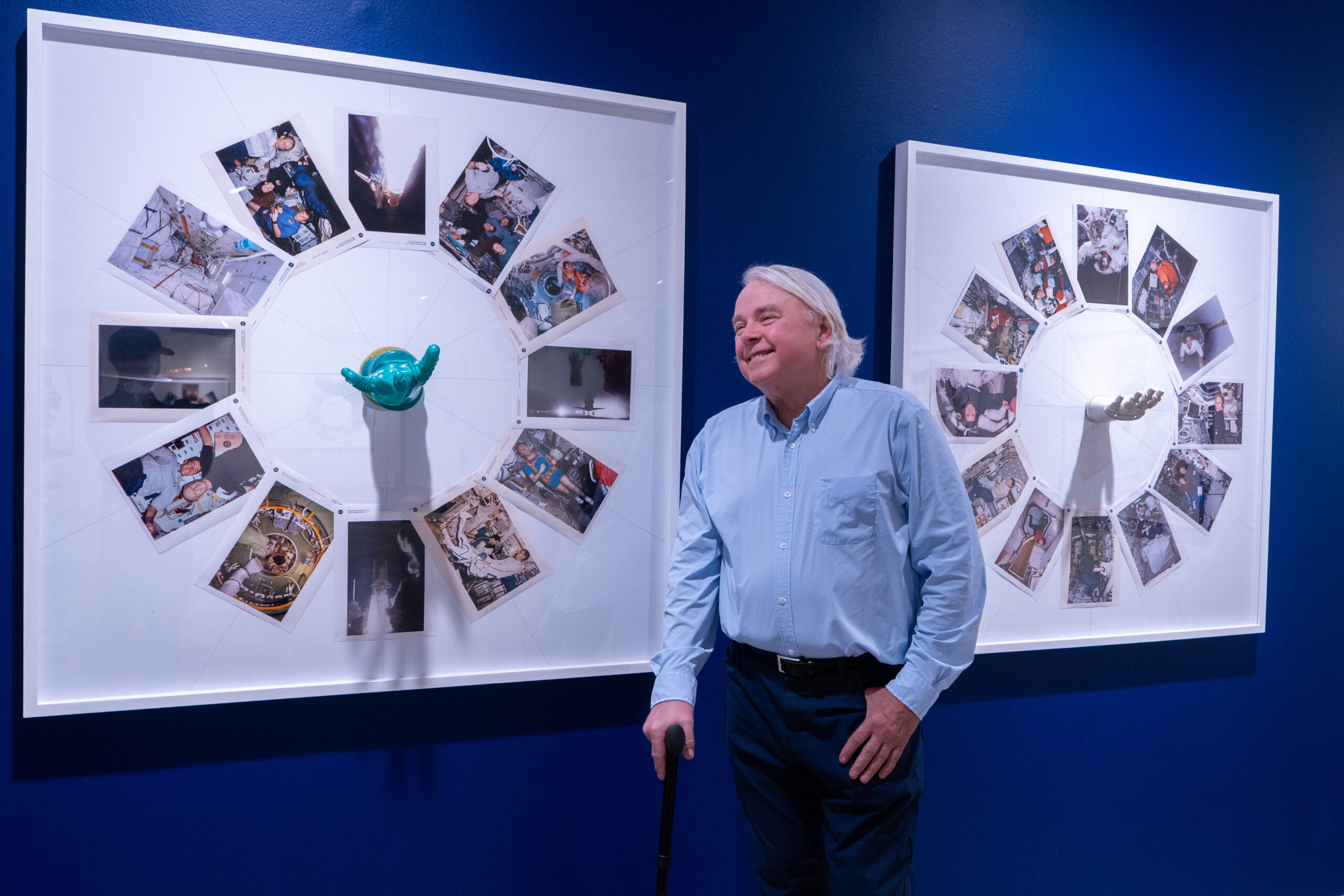
Recent Comments