American Black Film Festival Finds Its Muse in Miami Beach
Written By Jonel Juste June 9, 2025 at 9:40 PM
“The Reject,” inspired by the life of Miami-Dade County Commissioner Kionne McGhee, screens at the American Black Film Festival (ABFF), which takes place in various locations throughout Miami Beach beginning Wednesday, June 11 through Sunday, June 15. (Photo courtesy of Florida Film House)
The American Black Film Festival (ABFF) is once again set to highlight its strong connection with Miami, a city whose rich diversity is central to the festival’s identity. More than just a host city, Miami’s vibrant culture and multicultural landscape are deeply woven into ABFF’s mission to celebrate Black storytelling and talent.
Miami is also recognized for a notable history within the film industry. During the 1980s and 1990s, the city emerged as a prominent filming location for Hollywood productions. Miami was featured prominently on television, notably with “Miami Vice,” and in movies such as “Ace Ventura: Pet Detective,” “True Lies,” and “Bad Boys,” demonstrating its appeal as a cinematic setting.
“This year features one of our most well-rounded programs to date,” says Jeff Friday, founder and CEO of Nice Crowd, the company behind ABFF. (Photo courtesy of The American Black Film Festival)
Building on that legacy, the American Black Film Festival (ABFF) returns for its 28th edition from Wednesday, June 11 to Sunday, June 15, bringing together filmmakers, actors, industry professionals, and audiences for five days of celebrating cinema, innovation, and cultural dialogue. This year’s program includes a diverse lineup of films and a range of discussions on topics from immersive storytelling to wellness.
“This year features one of our most well-rounded programs to date,” says Jeff Friday, founder and CEO of Nice Crowd, the company that produces ABFF. “We’re screening more than 70 independent films from across the globe, including the debut of our new South African Stories section. We’ve also expanded our Talk Series to explore a broader range of topics, spanning sports, immersive storytelling, finance, and health and wellness.”
Friday says the festival closes with “ABFF Remembers ‘Love Jones,’ a special tribute to the iconic film starring his “dear friends Larenz Tate and Nia Long.” The film will be screened on Saturday, June 14 at 8:30 p.m. at the New World Center Performance Hall.
A scene from “Hoorah 99!” featuring from left, actresses Brittany Drays, Thashley Ulysse, and Tarisha Hicks (Movie still by Eli Difiore, courtesy of kleanslateCREATIVE)
Founded by Friday as the Acapulco Black Film Festival in 1997, the cinematic event was rebranded as the American Black Film Festival and later relocated to Miami Beach with the support of the Greater Miami Convention and Visitors Bureau.
Friday reflected on the festival’s evolution, saying, “We’ve grown from a modest independent showcase into a globally respected cultural institution. We’ve helped launch countless careers while providing a consistent platform to celebrate and elevate Black stories. I’m proud of how far we’ve come, but I also recognize there’s more to do. The mission remains as urgent and relevant as ever.”
Integral to that mission is Miami itself. “Miami/Miami Beach isn’t just our location, it’s part of the ABFF story,” says Friday. “The city’s vibrancy, multiculturalism, and energy reflect the very spirit of the festival. After two decades here, ABFF is deeply woven into the cultural fabric of South Florida.”
This year’s program includes free film screenings and a business expo highlighting local entrepreneurs.” Screenings include local films such as “Hoorah 99” and “The Reject,” inspired by the life of Miami-Dade County Commissioner Kionne McGhee.
Marco Mall Molinet produced and co-wrote “The Reject” drawing from real experiences. (Photo courtesy of Florida Film House)
Produced and co-written by Marco Mall Molinet, “The Reject” draws from real experiences growing up alongside McGhee. “‘The Reject’ was born from real-life pain and perseverance,” says Molinet. “His story, and so many others, inspired this film.” Molinet emphasized the importance of giving a platform to often overlooked youth. “These aren’t ‘bad kids.’ These are future leaders, creators, and thinkers who need support, not punishment.”
Shot entirely in South Miami, including Homestead and Naranja, “The Reject” is deeply rooted in the local landscape. “Miami isn’t just the backdrop; it’s the heartbeat of this story,” Molinet said. “The city’s energy, culture, and struggle gave the film its texture, truth, and urgency.” The movie will be screened at 2 p.m. Wednesday, June 11 at O Cinema South Beach.
The festival also marks a full circle moment for Miami native Ashley Smith, who, alongside creative partner Brooklynite Ci Smith, will premiere their film “Hoorah 99!” right across from Ashley’s alma mater, Miami Beach Senior High School. “I spent the first half of my life right here in Miami. My high school graduation was literally in the same building as ABFF, in the Miami Beach Convention Center,” says Ashley Smith, whose film screens at 1:30 p.m. on Saturday, June 14. “To have ‘Hoorah 99!,’ my debut feature world premiere, across the street is a blessing.”
“Hoorah 99!” blends dark comedy with family drama, inspired by Ash’s father and the challenges the couple faced after a financial crisis. “Before Ash’s father passed away, he was taken advantage of by a reverse mortgage scam,” explains Ci Smith. “To save the home, our family leveraged all our assets. As we stood on the cusp, literally about to lose everything, we asked ourselves, ‘If we’re going to lose everything, what would we want to do before then?'”
The result was a film that the Smiths wrote, directed and financed as a couple.
“We’ve worked together since 2007, so this process felt quite familiar, just more intense. Ash and I are exact opposites: Ash is the artist. He’s impulsive and brilliant. I’m the steady one who gets it all done. He has the vision of a genius. I relentlessly make sure it’s executed. We balance each other out,” says Ci.
The collaboration extended to hip-hop icon Ja Rule, who stars in the film as a spirit guide, and played a creative role behind the scenes. “Rule is great,” says Ashley. “Our relationship is honest and true. The thing about Rule, he does what he says he’s going to do.”
Hip-hop star Ja Rule features in the film “Hoorah 99!”, set to screen at the festival, marking a full-circle moment for Miami native Ash Smith, who, alongside creative partner Ci Smith, will premiere their film just steps away from Ash’s alma mater, Miami Beach Senior High School. (Movie still by Eli Difiore; courtesy of kleanslateCREATIVE)
Ci says the couple was hesitant to approach Rule.
“But I summoned up the nerve, called him up and he responded, ‘You guys are making a feature?’ Without hesitation, he said, ‘Alright, I’m in!'”
For the Smiths, ABFF is the ideal launchpad. “It’s an honor and a privilege to be recognized and welcomed by a platform as respected and culturally vital as ABFF,” says Ci. “Although we know ‘Hoorah 99!’ crosses demographic lines, it is humbling to first stand with the many powerful voices ABFF continues to uplift.”
“Hoorah 99” will be screened at 1:30 p.m. Saturday, June 14 at the Miami Beach Convention Center.
One of the most anticipated elements of the 2025 edition is the City of Miami Community Day, set to take place at the Historic Lyric Theater in Overtown on Sunday, June 15, the last day of the film festival. Created through partnerships with the City of Miami and organizations such as the Greater Miami Convention & Visitors Bureau, the initiative is designed to spotlight South Florida creatives and local entrepreneurs. It also serves as a platform for filmmakers based in the region to present their work.
At the American Black Film Festival, filmmaking duo Ashley, in the back, and Ci Smith, front, will premiere their self-financed film “Hoorah 99!”, a dark comedy infused with family drama drawing inspiration from Ash’s father and their shared struggles after a financial crisis. (Photo by Hayden M. Greene; courtesy of kleanslateCREATIVE)
“City of Miami Community Day is one of the most important activities of the week,” said Jeff Friday. “It’s our way of giving back to the community that’s embraced us for so many years. It’s part of our ongoing commitment to supporting the regional film community.”
As the festival enters its 29th year, its Miami home remains central to both its identity and impact. “The Greater Miami region is dynamic, international, and unapologetically diverse, making it the ideal setting for a global celebration of Black culture and creativity,” says Friday.
WHAT: American Black Film Festival (ABFF) 2025
WHERE: New World Center, 500 17th St., Miami Beach; Miami Beach Convention Center, 1901 Convention Center Drive, Miami Beach; O Cinema, 1130 Washington Ave., Miami Beach; New York Film Academy (NYFA), 420 Lincoln Rd #300, Miami Beach; Bass Museum, 2100 Collins Ave., Miami Beach; The Lyric Theater, 819 NW 2nd Ave., Miami
WHEN: Wednesday, June 11 through Sunday, June 15
COST: Tickets range from free admission to $52.72 for some events. Click here for tickets.
ArtburstMiami.com is a nonprofit media source for the arts featuring fresh and original stories by writers dedicated to theater, dance, visual arts, film, music, and more. Don’t miss a story at www.artburstmiami.com
No posts found
Review: Actors’ Playhouse takes audiences on a thrill ride with ‘The Girl on the Train’
Written By Michelle F. Solomon May 27, 2025 at 4:12 PM
Gaby Tortoledo, Gregg Weiner, Krystal Millie Valdes and Iain Batchelor in “The Girl On The Train” at Actors’ Playhouse at the Miracle Theatre, Coral Gables through Sunday, June 8. (Photo by Alberto Romeu/courtesy Actors’ Playhouse)
There’s something about the intimate Balcony Theatre at the Actors’ Playhouse that lends itself to a good thriller. In May of 2022, it was British mystery writer Agatha Christie’s “Murder on the Orient Express” that stood out as the perfect Spring whodunnit. Three years later, Artistic Director David Arisco returns to the British thriller, this time with “The Girl on the Train,” based on the novel by Paula Hawkins.
Many will be familiar with “The Girl on the Train” from the 2015 bestselling mystery novel or the 2016 film starring Emily Blunt, which moved the locale to the United States from Hawkins’ England. The play adaptation by Rachel Wagstaff and Duncan Abel stays true to Hawkins’ setting and is currently on a UK and Ireland tour through August of 2025. But South Florida audiences needn’t go any further than Coral Gables where Arisco and a cast of professional regional actors bring the complex drama to life.
Iain Batchelor, Ryan Didato, Krystal Millie Valdes and Gaby Tortoledo in “The Girl On The Train” at Actors’ Playhouse at the Miracle Theatre. (Photo by Alberto Romeu/courtesy Actors’ Playhouse)
Falling apart after the breakup of her marriage, Rachel Watson (Gaby Tortoledo) is an alcoholic. She’s “The Girl” who rides the train into London every day passing by the house she shared with her husband Tom (Iain Batchelor), now inhabited by his new wife, Anna (Krystal Millie Valdes), and the couple’s baby, Evie – something that adds to Rachel’s torment since she was unable to have a child. In a house a few doors down, she catches glimpses of a couple – embracing, kissing – on a balcony. She’s given them names – Jess and Jason, fantasizing about their perfect lives together, the one she believed she had, then lost. “Don’t you ever see someone and think, if I could step out of my shoes and into theirs, just for a day . . .” says Rachel about her imagining the couple’s lives.
One day, she spies “Jess” – real name Megan Hipwell (Allie Beltran) – on the terrace in a real-life situation that breaks the spell. The fantasy shattered, Rachel spins off into a rage. When Megan suddenly disappears, Rachel shows up to the husband, Scott’s (Ryan Didato) door claiming to be a close friend of his missing wife.
Detective D.I. Gaskill (Gregg Weiner) tracks down Rachel at her fleabag flat – he’s questioning her about the disappearance since she was spotted stumbling around a tunnel where Megan may have last been seen. Meanwhile, Rachel has a gash on her forehead and is unable to recall – because of one of her drunken blackouts – how it happened.
Detective Gaskill (Gregg Weiner) questions Rachel Watson (Gaby Tortoledo) in “The Girl On The Train” at Actors’ Playhouse at the Miracle Theatre. (Photo by Alberto Romeu/courtesy of Actors’ Playhouse)
Rounding out the cast of characters is Megan’s therapist Kamal Abdic (Nate Promkul). Rachel will visit him, too, engaging him in her web.
The minimalist setting by Brandon M. Newton consists of a backdrop that resembles puzzle pieces, a constant reminder of Rachel’s jumbled memory. Different areas of the stage are playing areas for locales – Rachel’s untidy flat; the Hipwell’s house (with a bar cart as its centerpiece); Tom and his new wife’s place; the two chairs that represent the therapist’s office; and the detective’s workspace.
Drawn along the floor is a train track pattern, skewed in different ways and a constant reminder of Rachel’s disjointed perspective.
Sound design by Reidar Sorensen adds to the tension with the realistic train horn blaring at key points; when Rachel is in her flat in her drunken stupor, a deafening rock music soundtrack whips her into a frenzy.
Gaby Tortoledo as Rachel Watson and Iain Batchelor as her ex-husband, Tom, in “The Girl On The Train” at Actors’ Playhouse at the Miracle Theatre. (Photo by Alberto Romeu/courtesy of Actors’ Playhouse)
Lighting designer Eric Nelson has created a hazy quality for the “lost memory” play. His use of a red light that comes from the side of the stage in between the curtains is haunting as Rachel tries to recreate what happened on the night in question. At other times, lighting choices are reminiscent of an Alfred Hitchcock film, sepia tone and black and white. The lighting also helps to mark transitions from one location to another, and dialogue from the past and the present.
“The Girl on the Train” as a book and a film benefited from narrative scene setting and voice over. The play adaptation is more difficult because it relies heavily on the bare bones of the storytelling. Arisco allows the suspense of the play to unfold strategically. The pacing is what creates the tension – at times slow and cautious, at others barreling down the tracks like a locomotive.
As the alcoholic amateur sleuth, Tortoledo takes us along for the ride – we get caught up in her confusion and self-doubt, with the actress drawing sympathy yet, at times, conjuring loathing for her recklessness. With so many armchair detectives who have been created from the pop culture true crime phenomenon, Tortoledo gives Rachel an infusion of the “mom next door” who has set out to crack the case – putting together clues and meddling in places she probably shouldn’t be. The actress also never gives a portrayal of the slurring, caricatured drunk, but is utterly convincing that her drinking goes beyond the bottle.
Allie Beltran as Megan Hipwell confides in her therapist played by Nate Promkul in “The Girl On The Train” at Actors’ Playhouse, Coral Gables. (Photo by Alberto Romeu/courtesy of Actors’ Playhouse)
Batchelor captures the dual personality of Tom – nice guy on the surface, pathological, abusive liar in every other crevice. Beltran’s Megan is at her best when she’s retelling a tragic past, and Didato, who was so compelling in Zoetic Stage’s “The Pillowman,” brings to Scott a slow burn of intensity.
Promkul as the empathetic therapist is believable as the man caught in the middle. Valdes plays new mom Anna as a woman yearning for an idyllic life free of the tribulations of her new husband’s ex, Rachel. Weiner adds a sly humor to what could otherwise be a dullish gumshoe.
The decision to have the cast speak in British dialect is appropriate for the setting and isn’t a distraction; to each actor, it seems natural. (Cast member Batchelor, a native of the U.K., doubled as dialect coach.)
Allie Beltran as Megan and Ryan Didato as her husband, Scott, in “The Girl On The Train” at Actors’ Playhouse, Coral Gables. (Photo by Alberto Romeu/courtesy of Actors’ Playhouse)
Ellis Tillman’s costumes, especially Rachel’s long dowdy sweater and Megan’s wispy dresses, are appropriately realistic.
Adding realism, too, are Nicole Perry as intimacy director and Lee Soroko as fight director.
Fans of the film and the book will find the Actors’ Playhouse rendering of the stage adaptation a different take on the story. For those who have never seen “The Girl on the Train,” it’s a great theatrical ride.
WHAT: “The Girl on the Train”
WHERE: Actors’ Playhouse at the Miracle Theatre, 280 Miracle Mile, Coral Gables
WHEN: 8 p.m. Wednesday, Thursday, Friday and Saturday; 3 p.m. Sunday through June 8.
COST: $50, $60, and $70, weekdays; $65, $75 and $85, weekends.
ArtburstMiami.com is a nonprofit media source for the arts featuring fresh and original stories by writers dedicated to theater, dance, visual arts, film, music and more. Don’t miss a story at www.artburstmiami.com.
No posts found
Review: Pondering Matters of Life and Death in Zoetic Stage’s ‘The Comeuppance’
Written By Michelle F. Solomon May 15, 2025 at 10:12 AM
Jovon Jacobs, Mallory Newbrough, and Joline Mujica in Zoetic Stage’s “The Comeuppance” at the Adrienne Arsht Center’s Carnival Studio Theater through Sunday, May 25. (Photo by Morgan Sophia Photography, courtesy Adrienne Arsht Center)
Zoetic Stage’s “The Comeuppance” is a satisfying punctuation mark as the theater season winds down; an exclamation point to keep theater lovers satiated through the leaner times of summer.
Branden Jacobs-Jenkins, this year’s Pulitzer Prize winner for Drama (For his play “Purpose”), created a challenging, almost surreal dramedy with layers upon layers of emotions in the present dredged up from the past.
Joline Mujica as Ursula and Mallory Newbrough as Cailtin share drinks and a laugh in Zoetic Stage’s “The Comeuppance.” (Photo by Morgan Sophia Photography, courtesy Adrienne Arsht Center)
The setting is a porch in Prince George’s County, Maryland (“in fall in the year of our Lord 2022,” Jacobs-Jenkins wrote in the play notes). Twenty years after graduation from St. Anthony’s High School, a Catholic academy in Washington, DC, a group of friends are gathering to pregame before their high school reunion. This particular group had named itself the “Multi-Ethnic Reject Group” (MERGE for short).
It’s Ursula’s grandmother’s house, but grandma has passed away and Ursula (Joline Mujica) is living there alone. She enters with a patch on her eye, carrying a pitcher of her watermelon-muddled “jungle juice.” But, she isn’t the first character we meet. That would be Death in his first incarnation, inhabiting the body of Emilio (Jovon Jacobs). The Grim Reaper appears throughout the play, merging with the bodies of each of the characters. Every cast member gets a Death monologue, just one of the many acting acrobatics that the playwright has devised to ensure that the play, heavy on dialogue, is constantly in motion.
Director Stuart Meltzer embraces Jacobs-Jenkins’ fly-on-the-wall sensibility. We can relate to Death’s comments, “I like to watch.” There’s a wonderful undercurrent that’s meant to make us feel like silent party crashers, eavesdropping on this group who are trying to make sense of fraught personal lives and revisit what they thought would be a fun reunion. But reliving the past is much akin to Thomas Wolfe’s “Look Homeward, Angel,” and the phrase “You can’t go home again.”
Members of the Multi Ethnic Reject Group continue their shenanigans before their 20th high school reunion in Zoetic Stage’s “The Comeuppance.” (Photo by Morgan Sophia Photography, courtesy Adrienne Arsht Center)
There are more than a few comparisons to the 1983 comedy-drama “The Big Chill.” Old college friends have been brought together for a funeral. The Vietnam War and its effects hover over the group. They find out that inevitable changes in their lives have made it impossible to connect as they once did.
The same happens here, just in a different era. The millennials have gone through the horrors of Columbine and 9/11. Now, as adults, they are gathering shortly after COVID. “How was your COVID?” is the phrase in this post-pandemic gathering. A classmate, Simon, who has cancelled on the group, calls in every once in a while. And although he isn’t seen, he speaks for all when he says: “Look at all the shit we’ve been through – It’s like too much, Columbine, 9/11, the war, the war, the endless war, then Trump, then COVID, whatever the f— is going on in the Supreme Court… Roe v. Wade….”
Emilio is an artist now living in Germany. He’s in for the reunion but off to Manhattan, where his work will be shown in a biennial, presumably the Whitney. He’s done well for himself, able to afford the luxuries of staying in a high-end hotel while in town.
Rayner Gabriel as Francisco aka Paco and Mallory Newbrough as Caitlin rekindle their bad romance from high school in Zoetic Stage’s “The Comeuppance.” (Photo by Morgan Sophia Photography, courtesy Adrienne Arsht Center)
Caitlin (Mallory Newbrough) has married an ex-cop, a man older than her, who participated in January 6 at the Capitol. “Michael was not in the group that actually stormed the Capitol,” she makes sure her classmates hear loud and clear.
Kristina (Amy Lee Gonzalez) is an overworked anesthesiologist with five kids and a drinking problem, a carryover from so much time at the hospital during COVID. She dated Emilio in high school.
She’s brought along her cousin Francisco, aka Paco (Rayner Gabriel), who is an unwelcome guest because he wasn’t part of MERGE. He’s a military veteran suffering from PTSD after two tours of duty in Iraq; he has a past with Caitlin.
Kristina (Amy Lee Gonzalez) in her military doc uniform is more than ready for the reunion in “The Comeuppance” at Zoetic Stage.(Photo by Morgan Sophia Photography, courtesy Adrienne Arsht Center)
The dowdy and shy Ursula is diabetic and has lost her eyesight in one eye. An orphan whose grandmother raised her, she’s now alone and has a woman who stops by a few times a week to check in on her.
This is a brilliant all-local Equity ensemble, Mujica’s tenderly sweet Ursula, Newbrough’s carefully calibrated yet lonely Caitlin, Gonzalez’s “I’ve had it” doc mom, and Gabriel’s amped up Francisco, with each actor working off of one another with obvious guidance from Meltzer. This is how the complex characters Jacobs-Jenkins created develop throughout the two-hour and 10-minute show without an intermission (a difficult but wise choice since an interval would interrupt the necessary continuous momentum and worth every minute).
When they must step out of their realistic portrayals to become Death, it is done with seamless precision so as not to seem out of character. It’s a difficult tightrope and one that each of the actors maneuvers with finesse. It’s not easy, mind you.
Death becomes him. Jovon Jacobs as Death in “The Comeuppance” at Zoetic Stage. (Photo by Morgan Sophia Photography, courtesy Adrienne Arsht Center)
Jacobs, who has appeared in productions throughout South Florida, makes his Zoetic Stage debut here and has the weightiest role. His Emilio is the protagonist and, although all the characters are given a shot at Death, Jacobs as Emilio is the most unsettling. He begins the play as Death and winds it up at the end. It is his Death that makes you wonder whose soul he has come to collect. The steeped in reality Emilio (in some aspects based on the playwright himself) is also the character who seems the least to have crossed over to adulthood. These two spectrums call for an actor with range and Jacobs aces it.
The lighting design by Leonardo Urbina creates the atmosphere of the outdoors at dusk. During the tricky Death monologues, Urbina subtly shines a spotlight on the actor, while the others, frozen in place, are dimly lit, still able to be seen. Sound design by Haydn Diaz adds an eerie reverb to each actor’s voice for Death. Then there’s the realistic sounds of a neighborhood, dogs barking and birds chirping, a car driving up and a door slamming, a limousine speeding off.
Costume design by Lorena Lopez fits each character’s persona – the oversized sweater and long skirt for Ursula, Emilio’s richly looking beige turtleneck, brown pants, leather boots, Caitlin’s breezy dress, Paco’s oversized suit, and a skirt uniform for military doc Kristina.
.
Jovon Jacobs, Mallory Newbrough and Joline Mujica in Zoetic Stage’s “The Comeuppance.” (Photo by Morgan Sophia Photography, courtesy Adrienne Arsht Center)
Scenic design by Michael McCLain is a back porch filled with odds and ends shoved in a back corner, things that should have gone to the trash, but never did. At stage right are overstuffed garbage cans. There’s plenty of places for the characters to move about in addition to the porch: a lawn, a picnic table. A non-realistic faux stump, which is used as a playing area seems out of place, however, affecting the realism.
While some may find the 130-minute running time daunting at the outset, once the clock begins to tick, the play and this production, like life and death, have you in its grips, and it isn’t about to let you go.
WHAT: Zoetic Stage’s “The Comeuppance” by Branden Jacobs-Jenkins
WHEN: 7:30 p.m., Thursday, Friday and Saturday; 2:30 p.m. Sunday. Through Sunday, May 25.
COST: $66-$72
WHERE: Carnival Studio Theater at the Adrienne Arsht Center for the Performing Arts, 1300 Biscayne Blvd., Miami
ArtburstMiami.com is a nonprofit media source for the arts featuring fresh and original stories by writers dedicated to theater, dance, visual arts, film, music and more. Don’t miss a story atwww.artburstmiami.com
No posts found
GableStage’s ‘Fat Ham’ Is Part Of A Juicy Regional Collaboration
Written By Michelle F. Solomon May 13, 2025 at 4:17 PM
Cassidy Joseph, Henry Cadet, Mikhael Mendoza, and Toddra Brunson head to GableStage after appearing in the Island City Stage production of “Fat Ham,” a collaboration between three regional theater companies. The play opens at GableStage on Saturday, May 17. (Photo by Matthew Tippins, courtesy Island City Stage)
Maybe the seemingly long haul on I-95 made treacherous by traffic congestion creates the Miami-Dade County and Broward County division among its residents. While there are plenty of reasons someone from one county or the other will say they don’t venture north or south, arts groups are well aware there’s a definite line in the sand.
So, when three professional theater companies, two from Broward and one from Miami-Dade, came together to collaborate on the production of James Ijames’ Pulitzer Prize-winning “Fat Ham,” it was, in no uncertain terms, heralded as a historic partnership.
Then there was a fourth cog in the wheel, the Fort Lauderdale-based Warten Foundation that wanted to support the newly formed theater trinity of Wilton Manors’ Island City Stage, Pompano Beach’s Brévo Theatre, and Coral Gables’ GableStage, with a $250,000 grant to help fund the South Florida premiere of “Fat Ham.”
TM Pride, right, works with the “Fat Ham” cast as it readies the production at GableStage. From left, is Dina Lewis, Toddra Brunson, and Cassidy Joseph. (Photo by Magnus Stark, courtesy GableStage)
“Fat Ham” opened at Island City Stage on Friday, April 3 and ran through Sunday, May 4. Now it moves to GableStage, opening Friday, May 16 and running through Sunday, June 15.
A modern interpretation of Wiliam Shakespeare’s “Hamlet” set at a Southern Black family’s backyard barbecue, the playwright, originally from North Carolina, creates parallel’s between the classic play as Juicy, a 20-year-old gay Black man living in the South is visited by the ghost of his father asking him to avenge his death, Pap, Juicy’s father, says his brother had him killed so that he could marry his widow and take over the family business.
Bari Newport, producing artistic director of GableStage, had plans to produce “Fat Ham.” She says she obtained the rights to stage the show but hadn’t moved forward in putting it on GableStage’s season calendar.
“I was sitting on the rights,” she says.” It’s an incredible piece of writing and it isn’t a Pulitzer Prize winner for nothin.’ But I wanted to partner with the right director.” Newport received a call from the licensing agent at Concord Theatricals, explaining that another theater company “about 30 miles away” wanted to present “Fat Ham.”
“They didn’t think that would be a problem because, quote, we didn’t share an audience. And I said, ‘Well, I think it is a problem,’ and I asked who the company was.” When the agent said Island City Stage, Newport’s wheels started turning. What if the two companies did it together somehow? “Why say no to their production when I could just say yes to our production?”
The cast and director of the GableStage production of “Fat Ham” opening at the Coral Gables theater on Saturday, May 17. From left, Toddra Brunson, Melvin Huffnagle, director TM Pride, Cassidy Joseph, Henry Cadet, Dina Lewis and Denzel McCausland. (Photo by Magnus Stark, courtesy GableStage)
She says that the Warten Foundation, which had a relationship with Island City Stage, was “tickled” by this experiment and that some of the foundation members had been to plays at GableStage. Island City’s founding artistic director Andy Rogow then mentioned that he had been in conversations with Brévo Theatre, a young Black theater company based in Pompano Beach, founded by Florida A&M grads Zaylin Yates and TM Pride. The company had worked with Island City on Tarell Alvin McCraney’s “The Brothers Size.”
Pride was the perfect fit to direct the production, which would keep the same cast for both companies. (There is one replacement in the GableStage production because of a scheduling conflict with the first actress who played Tedra. At GableStage, Tedra will be played by Dina Lewis).
“Zaylin says it best when he talks about the play,” says Pride. “The fact that Ijames was able to write a play that can fit three completely different visions – Island City Stage who focuses on LBGTQ issues, GableStage where one part of their mission is the idea of tackling today’s issues, and then Brévo, where we put the focus on Black voices and young artists, so it was the perfect play for us to come to the table with.”
In rehearsal at GableStage are Toddra Brunson, Cassidy Joseph, Dina Lewis, Henry Cadet, and director TM Pride. (Photo by Magnus Stark, courtesy of GableStage)
Newport’s idea to hold on to the play until she could fit the pieces together with the right director who understood the play’s voice and perspective was on point. Pride agrees about knowing the narrative intrinsically. “The beautiful thing about being able to direct ‘Fat Ham’ is having that experience. I know what Juicy is going through. I know this story. I know this family. And bringing the actors together who share that with me. They’ve said to me, ‘We get to be ourselves. We don’t even have to do all this deep, intense character development.’ And all within a framework that is traditionally white America, or European theater.”
Pride says he believes audiences will relate to the family dynamics present in the play. “What we’ve done with the collaboration, too, is really about building community and establishing relationships and helping people to see how we’re more alike than different.”
GableStage artistic director Bari Newport on the set of “Fat Ham.” (Photo by Magnus Stark, courtesy of GableStage)
Other cast members in the GableStage production, all South Florida actors, are Toddra Brunson, Henry Cadet, Melvin Huffnagle, Cassidy Joseph, Denzel McCausland, and Mikhael Mendoza.
There were slight adjustments that had to be made to have the play move from Island City Stage to GableStage. “None of us have ever done it before in terms of creating a show for two different spaces, and two very different spaces, at that.” Moving “Fat Ham” south didn’t require many changes. GableStage’s stage is a bit wider so it allowed for the set to expand a bit. Island City Stage’s intimate venue has 65 seats while GableStage has more than double the amount at 135, but also not a large theater. “We’ve made some subtle changes with costuming. Also, we’ve done a more elaborate light design at GableStage.”
Henry Cadet as Juicy and Melvin Huffnagle as Pap in “Fat Ham” at Island City Stage, Wilton Manors. The production heads to GableStage opening Saturday, May 16 and running through Sunday, June 15. (Photo by Matthew Tippins, courtesy Island City Stage)
Both artistic directors, who often direct their shows, were integral in shaping the productions, too.
‘ “Fat Ham” is an extremely smart script and that’s who our audience is. They are a sophisticated group of theater lovers who want to go away talking about the piece that they just experienced and they want to see it excellently executed,” says Newport.
For the Warten Foundation, the regional production of “Fat Ham” ticked all the boxes for its funding mission.
“ . . . The collaboration, the diversity, all of it,” says Clifford J. Cideko, chairman of the Fort-Lauderdale based philanthropy group founded by the late Frederick Warten.
“I said, ‘We have to do this.’ We are focused on diversity and bringing people together. If there is someone on the fence about certain issues, or someone who isn’t aware, even if one person sees this show and it changes their perspective, that we use the power of live theater to get people talking, then (our contribution) has been a success.”
WHAT: “Fat Ham” by James Ijames, a coproduction of Island City Stage, Brévo Theatre, and GableStage
WHERE: GableStage in the Biltmore Hotel, 1200 Anastasia Ave., Coral Gables
WHEN: Opens with a preview on Friday, May 16 with public opening on Saturday, May 17. 7:30 p.m., Wednesday, Thursday, Friday and Saturday. 2 p.m. Wednesday and Sunday. Through Sunday, June 15. The show closes with a “Fat Ham” barbecue following the performance.
COST: $55 and $65 includes $10 service fee (discounts for students, teachers, artists, military and groups).
ArtburstMiami.com is a nonprofit media source for the arts featuring fresh and original stories by writers dedicated to theater, dance, visual arts, film, music and more. Don’t miss a story at www.artburstmiami.com.
No posts found
Inspired By Personal and City’s History, Playwright Celebrates Coral Gables Centennial
Written By Carolina del Busto April 22, 2025 at 7:39 PM
Rehearsing “Greetings from Paradise” are actor Gregg Wiener as Carl Fisher and actor Caleb Scott as
reporter Frank Harris. Directed by David Arisco at Actors’ Playhouse, the play by June Thomson Morris begins Tuesday, April 29. (Photo by Allen Morris)
The year was 1925 and Miami looked very different — a lot less buildings, a lot more marshy wetland. Prohibition was in full effect and there was a land boom that could put today’s real estate market to shame. It was also the same year the City of Coral Gables was incorporated.
In celebration of the City Beautiful’s centennial, the Actors’ Playhouse at the Miracle Theatre is hosting “Greetings From Paradise,” a limited five-night engagement theatrical experience by June Thomson Morris that will transport audiences back in time.
The play, opening on Tuesday, April 29, tells the story about Miami’s development and the land boom of the 1920s that changed the city’s landscape forever. It parallels the stories of developers George Merrick, who established Coral Gables, and Carl Fisher, who built the Miami Beach we know today.
Journalist-turned-playwright June Thomson Morris always wanted to tell the story of how her grandparents fell in love. (Photo by Jonathan Dann)
Behind the plot of these two real estate titans is a love story about a young girl from Indiana who boards a train to meet a boy in Miami. As Lucy and Robert’s relationship progresses, so does the city around them.
The story is particularly personal for playwright Morris. The characters of Lucy and Robert are based on her grandparents.
“As a little girl, I heard the story [about Miami’s development] directly from my grandmother’s lips. She would tell me how she got on a train at age 19 back in 1924 and left her small town in Indiana and rode Henry Flagler’s East Coast Railroad down to Miami… all to meet a man that she had met at a dance in Indianapolis.”
While Morris has always dreamed of writing the story of how her grandparents met and fell in love, she has also been fascinated by Florida’s history.
“I’ve been intrigued with the story of the great Florida land boom of 1925,” says Morris. “And I love the fact that my grandparents are part of that history.”
Lucy Mae and Robert Thomson are the inspiration for “Greetings From Paradise.” (Photo courtesy of June Thomson Morris)
A journalist by trade (she earned a master’s degree from Northwestern’s University’s Medill School of Journalism and worked in broadcast news at television stations throughout the country as an anchor and reporter), Morris knows the importance of facts and research. She spent nearly one year gathering information on Miami’s history and would pore over books and archives. After she’d collected ample material, Morris says when she sat down to write, the story came to her effortlessly.
“I could hear the characters’ voices in my head,” Morris says, a bright smile crossing her lips. “What I really want to do [with this play] is bring Florida’s history to life. We’re talking about the Magic City, and I’m surprised as to how many people have never heard the history of Miami or know very little about it.”
Thomson knows a bit about Coral Gables. Her mother, Dorothy Thomson. made history as the first and only female mayor of Coral Gables in its first 100 years.
David Arisco, artistic director for Actors’ Playhouse, who is directing “Greetings From Paradise,” applauds Morris’ storytelling. He recalls that when she first approached him two years ago with a rough script, he knew that he was reading something special.
Actors Daniel Llaca and Alexandra Van Hasselt play Robert and Lucy, inspired by the playwright’s grandparents. (Photo by Allen Morris)
“I thought it was a really interesting project, and I really wanted to be involved, especially with the Miracle Theatre being right in downtown Coral Gables and the centennial,” says Arisco.
Over the next two years, the pair would workshop the script and the timing for its premiere on April 29 would align perfectly – it was the exact day the City of Coral Gables was incorporated in 1925.
“It’s a good play,” says Arisco. “I think it’s a story that needs to be told.”
He describes it almost like watching a dramatic documentary. “It has elements that are a bit like a documentary but at the same time it’s a play. We’ve got a great cast to tell this story.”
Arisco continues, “We’re meeting characters like George Merrick and Carl Fisher and Doc Dammers [Edward “Doc” Dammers was the first mayor of Coral Gables]. And though the story is more specific to Coral Gables, because Merrick and Fisher were kind of doing their thing at a similar time, we thought it was fun to include a bit about the Miami Beach story and to show Merrick and Fisher as these dual visionaries who did incredible things.”
Actor Don Seward is Charles DeLancy, Caleb Scott is Frank Harris, and Jim Ballard is George Merrick in “Greetings from Paradise” by June Thomson Morris. (Photo by Allen Morris)
Actor Gregg Weiner, most recently seen in Miami New Drama’s “Lincoln Road Hustle,” plays Fisher and describes the man as an adrenaline junkie. In addition to developing Miami Beach, Fisher also helped to build Indianapolis Motor Speedway and the Indy 500. He liked speed — and attention.
“He was a big man, he was a proud man, and he appreciated attention and liked taking risks,” says Weiner. Through his own research and conversations with Morris, Weiner developed his version of Fisher.
“We see him at the height of his achievements. He’s built something out of nothing, which is astonishing to me, and he really appreciates all of his accomplishments,” says the actor.
“Greetings From Paradise” is Morris’ debut play. She reveals that she has plans to develop the script into a full-length feature film while continuing to work on stories about Miami’s development.
Author June Thomson Morris spent nearly one year of researching Florida history before writing her play, “Greetings From Paradise.” (Photo by Jonathan Dann)
“After this is done, I want to get back to the screenplay and perhaps write a book where I can round out Miami’s history with all the truth,” says Morris. “My grandparents’ story is one I’ve always wanted to tell, but the time has come to tell a fuller story, a truthful story, and I hope to do that next.”
WHAT: “Greetings From Paradise” by June Thomson Morris
WHERE: Actors’ Playhouse at the Miracle Theatre, 280 Miracle Mile, Coral Gables
WHEN: 6 p.m. Tuesday, April 29 (special Centennial Gala presentation, limited availability), 8 p.m., Wednesday, April 30, Thursday, May 1 and Friday, May 2, noon Saturday, May 3.
COST: Regular performances, $65-$75, includes $10 service fee.
ArtburstMiami.com is a nonprofit media source for the arts featuring fresh and original stories by writers dedicated to theater, dance, visual arts, film, music and more. Don’t miss a story at www.artburstmiami.com.
No posts found
Review: ‘Knock Me a Kiss’ at M Ensemble Is The Embrace We Need Right Now
Written By Michelle F. Solomon April 15, 2025 at 4:19 PM
Dina Lewis as Yolande and Jean Hyppolite as Jimmy Lunceford in M Ensemble’s “Knock Me a Kiss” at the Sandrell Rivers Theater through Sunday, April 27. (Photo by Christa Ingram/Courtesy M Ensemble)
There’s much at play in M Ensemble’s “Knock Me a Kiss” on stage at the Sandrell Rivers Theater.
Notwithstanding, the company had to push back the production to April due to what it stated was “unforeseen delays with county funding.” While its season usually starts in February, this is the first production of Florida’s oldest still-operating Black theater company, now in its 54th season.
It was worth the wait. Playwright Charles Smith gives André L. Gainey, the production’s director and M Ensemble’s artistic director, plenty to work with along with a cast that revels in the depth of Smith’s characters.
Yolande Du Bois (Dina Lewis) and Jimmy Lunceford (Jean Hyppolite) after a night on the town in the Du Bois’s Harlem apartment living room. (Photo by Christa Ingram/Courtesy M Ensemble)
The show is loosely based on real people and events, a fictional comedy-drama with the backdrop of 1928 and a slice of life during the Harlem Renaissance.
W.E.B. Du Bois (Charles Reuben), educator and leader, plays matchmaker for his daughter, Yolande (Dina Lewis), and Countee Porter Cullen (Cameron Holder), one of the finest poets of the Harlem Renaissance. Du Bois sees the marriage as “the perfect union of Negro talent, brains, and beauty.”
Du Bois’s 26-year-old daughter has different ideas: she wants to move to Baltimore to become a high school teacher and build her career. Until she leaves, however, she’s dancing the night away with Jimmy Lunceford (Jean Hyppolite), a former high school teacher who has decided that he’d rather try to make it as a musician than hold down a steady job.
We meet the oozing with sexual energy Lenora (Tyquisha Ariel Braynen), a brash and no-holds-barred confidante who is quick to give her best friend Yolande advice. We learn of the reason for Nina Du Bois’s (Lela Elam) mental illness, the melancholic mother and wife who hasn’t recovered from the death of her 18-month-old son years before.
Nina (Lela Elam) and W.E.B. Du Bois (Charles Reuben) listen to what’s going on with daughter Yolande (Dina Lewis) in Charles Smith’s “Knock Me a Kiss.” (Photo by Christa Ingram/Courtesy M Ensemble)
Smith’s play has many layers: the realities of the Black experience during the 1920s, class among race, marrying for prestige and money in lieu of love, and stories of segregation – it tackles race, love, and ambition.
He keeps many of his scenes to two characters and in these pairings, allows a more intimate window; it is a construction device that works well.
Without making light of any of it, Smith offers up a rich comedy and Gainey (who played Du Bois in the M Ensemble 2014 production at the South Miami-Dade Cultural Center) deftly finds a way to keep the drama simmering underneath while the comedy rises to the top.
Hyppolite as Jimmy Lunceford lights up the stage in every scene he’s in. So engaging in last season’s “Bourbon at the Border” as Charlie Thompson, here Hyppolite is absolutely entrancing as the bandleader whom the playwright has given so many glorious comic moments, none of which Hyppolite squanders.
His entrance at the top of the play with Lewis as Yolande is packed with excitement, as he speaks the lyrics to Louis Jordan’s recording of “Knock Me a Kiss”: “I like cake and no mistake/but baby if you insist, I’ll cut out cake, just for your sake/baby, c’mon knock me a kiss.”
Yolande Du Bois (Dina Lewis), right, is at odds with new husband, Countee Cullen (Cameron Holder), left, while her parents, Nina (Lela Elam) and W.E.B. Du Bois (Charles Reuben) try to figure out what’s going on. (Photo by Christa Ingram/Courtesy M Ensemble)
His Jimmy is gruff, yet sensitive and elicits sympathy when he realizes that he’s no match for the educated Cullen and in a different class than the intellectual upper crust DuBois family.
Lewis as Yolande dreams of a life sailing in first class on her honeymoon to Paris. The princess doesn’t only want a man’s riches but the whole package – a husband with money that will romance her. She tells Jimmy: “I want a wedding that corresponds to my stature.” She has demands and requests: “I want a diamond engagement ring, and I want a wedding ring. I want a church wedding with lotsa flowers and ushers and bridesmaids.”
Lewis finds a way to touch on every aspect of the spoiled rich girl’s dreams and aspirations – like wanting her own career, while marrying a man with whom she can enjoy life. When the character has real world heartbreak presented to her, Lewis is able to convey that more than convincingly.
Jean Hyppolite as the Don Juan of Harlem, bandleader Jimmy Lunceford in M Ensemble’s “Knock Me a Kiss” at the Sandrell Rivers Theater through Sunday, April 27. (Photo by Christa Ingram/Courtesy M Ensemble)
Smith has written Lenora as a character so brash she can make everyone blush – giggles and sounds of “whoaaaa” were common from the audience. Braynen chews on every word, her comic timing and delivery so spot on. She uses every ounce of her body in the role, too, showing a gift for physical comedy.
Holder’s Cullen in the first act can play his Countee as a “nice young man,” but in the second act, all bets are off as he sashays across the stage filling his trunk with the perfect suits for his trip to Paris with his best friend and best man leaving his new wife in the dust. While it may be the height of a stereotypical characterization, it works within the context of the play.
Elam as the half-crazed wife finds moments of lucidity where she speaks of her life in Atlanta during segregation, but it’s hard to get past the robotic and one-dimensional way in which the actress portrays this fragile woman. She has been outstanding in so many other regional performances; here’s hoping she can find a way to exhibit the emptiness and blank-eyed stares with a more realistic approach.
Reuben as W.E.B. Du Bois adapts an affectatious way of speaking, that upper-crust voice, with glasses on his up-in-the-air nose, which makes you admire him and loathe him at the same time. Reuben is at his best as Du Bois during a quid pro quo and some of his other transactional conversations. If Cullen marries his daughter, perhaps he’ll be inclined to complete a letter of recommendation that the young man had requested for a prestigious fellowship. “I believe this fulfills this part of the bargain,” says Du Bois as he hands Cullen the recommendation. Reuben’s sly interpretation adds a bit of mystery.
W.E.B. Du Bois (Charles Reuben) has high hopes for his protégé poet Countee Cullen (Cameron Holder) in “Knock Me a Kiss” at M Ensemble at the Sandrell Rivers Theater through Sunday, April 27. (Photo by Christa Ingram/Courtesy M Ensemble)
“Knock Me a Kiss” has a realistic, multi-level stage design by Mitchell Ost, with set construction by Trevor Garcia. Quanikqua Q. Bradshaw-Bryant’s lighting adds mood at the right times – brighter lights during the levity, more muted tones when appropriate. Flapper-style dresses and fur stoles in the costuming bring to life the period and the soundtrack of the era Cab Calloway and Harold Arlen and Ted Koehler’s “Stormy Weather” had many in the audience singing along in between scenes.
In history, the wedding of Du Bois’s daughter and Cullen in 1928 was the Royal Wedding of Harlem during the Renaissance years. The marriage would end in divorce two years later, a disappointment to Dr. Du Bois who felt that he had let down an entire race of people.
There isn’t much to be disappointed about in M Ensemble’s “Knock Me a Kiss.” It’s insightful, uplifting, and gloriously funny — what a great way to take the blues of today away.
WHAT: “Knock Me a Kiss” by Charles Smith
WHERE: M Ensemble at the Sandrell Rivers Theater, 6103 NW 7th Ave., Miami.
WHEN: 8 p.m. Friday and Saturday, 3 p.m. Sunday. Through April 27.
COST: $36, $26 seniors and students (plus a $4.25 fee).
ArtburstMiami.com is a nonprofit media source for the arts featuring fresh and original stories by writers dedicated to theater, dance, visual arts, film, music, and more. Don’t miss a story at www.artburstmiami.com
No posts found
Review: Miami New Drama’s ‘Birthright’ Is Full of Character Amid Plenty Of Complexity
Written By Michelle F. Solomon April 9, 2025 at 8:07 PM
The cast of Miami New Drama’s “Birthright,” from left, are Daniel Capote as Emerson, Arielle Goldman as Izzy, Krystal Millie Valdes as Alona, Dania Stoller as Chaya, and Stephen Stocking as Noah. The world premiere is at the Colony Theatre in Miami Beach through Sunday, April 27. (Photo by Morgan Sophia Photography/courtesy Miami New Drama)
Miami New Drama’s “Birthright” is like “Friends” but with a deeper meaning and Jewish identity at its core. The play tackles plenty of issues from the perspective of six friends who form alliances during a rite-of-passage trip to Israel.
Commissioned for MiND’s Y6K Project, an initiative led by Miami New Drama’s Artistic Director Michel Hausmann, to give life to original plays with Jewish narratives and champion Jewish storytelling, “Birthright” was written by Jonathan Spector. His play “Eureka Day” closed on Broadway in February and will be part of South Florida’s GableStage’s next season in May. “Birthright” is at the Colony Theatre on Lincoln Road through Sunday, April 27.
Hale Appleman as Lev shares a cigarette and conversation with Daniel Capote as Emerson in Miami New Drama’s world premiere play “Birthright.” (Photo by Morgan Sophia Photography/courtesy Miami New Drama)
Much like David Rosenberg’s “Wicked Child,” presented in 2024 at Zoetic Stage, “Birthright” addresses conflicts between friends and family over Jewish religious and political issues. Spector artfully weaves and intertwines the lives of the friends – each having a very specific character arc, something not easily achieved with a larger ensemble.
The three-act play takes place in 2006, then 2016, and then 2024. “The characters begin in their early 20s, aging 18 years over the course of the play to be about 40 by the end,” Spector instructs in his script, specifying that the characters are all Ashkenazi Jews.
Spector describes his characters this way: Chaya, female in search of community; Isabella (Izzy) female, in search of justice; Noah, male, in search of understanding; Emerson, male, in search of serenity; Alona, female, in search of home; Lev, male, in search of meaning. There’s also Deborah, Chaya’s mother, who is around 60 at the beginning of the play, and whom Spector adds to her description, “What’s with all the searching?”
Dani Stoller as Chaya considers consequences after a friend’s wedding rehearsal in Miami New Drama’s “Birthright.” (Photo by Morgan Sophia Photography/courtesy Miami New Drama)
Spector has a gift for smart dialogue and knows when to break a moment with some needed comedy. He also uses comedy to surprise his audience, giving his characters very funny moments – his depiction of Deborah as the stereotypical Jewish mother who wants to make sure everyone is fed and rambles on a bit too long is an obvious choice for comic relief. He also creates a dialogue structure that is realistic – with two conversations happening at one time in some scenes.
While the questions of what it is to be an American Jew are front and center, underneath the surface, this is a play about individual beliefs, about heritage and family, and about how what happens throughout life (in this case, college days into adulthood) changes our views.
It is the relationships of the characters that make “Birthright” more universally relatable than its constant bubbling up debates, entrenched in deeply intellectual conversations over Israel’s very existence, that will keep audiences, Jewish or not, invested in this play and its characters.
Irene Adjan as Deborah, Stephen Stocking as Noah and Arielle Goldman as Izzy in the world premiere of Jonathan Spector’s “Birthright” at Miami New Drama. (Photo by Morgan Sophia Photography/courtesy Miami New Drama)(Photo by Morgan Sophia Photography/courtesy Miami New Drama)
At times, however, the deep ideological debates delve into topics that feel more like couch conversations for Gen X or Baby Boomers, not Millennials (mostly in the earlier part of the play).
For non-Jews in the audience, Spector should provide education for better interpretation. Perhaps other characters could somehow offer a simple way of explanation – not too forced, but enough to make the references more understandable. Maybe an explainer projection a la a supertitle here and there?
Examples: At the top of the play, one of the characters, Chaya, says, “and then she was like, I think maybe I’m gonna make Aliyah.” At the end of the play, there’s talk of a Mourners Kaddish but they aren’t sure if they can perform the ritual because they don’t have a Minyan. (All difficult to comprehend as a gentile.)
Hausmann has assembled professionals to bring Spector’s script to the stage. Director Teddy Bergman, a New York-based director, whose Broadway credits include the musical KPOP and the concert staging of “Urinetown” at New York City Center, keeps the action moving. Even when actors are seated on a couch, there’s something happening between them. Bergman also knows how to keep the tension heightened, yet when to allow more fluidity for comic moments.
Stephen Stocking as Noah with the 2001 working iMAC in the first act of “Birthright” set in 2006. (Photo by Morgan Sophia Photography/courtesy Miami New Drama)
The cast is top notch and the acting superb — professionals with Broadway, film and television credits: Washington, D.C.-based Dani Stoller as Chaya; New York-based Arielle Goldman (2018 “The Marvelous Mrs. Maisel”) as Izzy; Stephen Stocking, who made his Broadway debut in the 2022-23 revival of “Death of a Salesman,” as Noah; and Hale Appleman as Lev, who was in the Netflix series “The Magicians.” The three South Florida actors in the cast are Irene Adjan as Deborah (last seen in MiND’s recent “Lincoln Road Hustle”), Krystal Millie Valdes as Alona (the previous Y6K Project, “Bad Dog.”) and Daniel Capote as Emerson, who has been featured in other MiND plays.
The realistic set design, which takes place in Chaya’s parents’ home in suburban, Washington, D.C., is decorated for 2006 for the first act including a 2001 working Apple iMac, sourced in Boca Raton (props and set dressing by Jameelah Bailey), and then, voila, theater magic as the living room with a kitchen remodel is updated for Act III for 2024. In the second act, the action takes place on the back porch outfitted with a working hot tub.
Hale Appleman and Stephen Stocking under the motion activated lights on the back porch set of “Birthright.” (Photo by Morgan Sophia Photography/courtesy Miami New Drama)
Adam Koch, who worked on MiND’s Miami and Broadway production of “A Wonderful World” along with Steven Royal did the set and projections, including really inventive projections for the last act. We see the characters’ iPhone texts above the stage — secret from those on stage, they are large, facing out to the audience to reveal private conversations. FaceTime projections along two sides of the stage, while certainly pre-produced, are amazingly real-time.
Nicole Jescinth Smith’s costume designs reflect the characters authentically in different periods and in different stages of their lives along with Carol Raskin’s wig designs. Lighting design by Jeff Croiter brings out the softness of the suburban home and is a challenge well met in the dark back porch. One funny bit is a motion-activated light that keeps going on and off, forcing the characters to wildly wave to make it light again. Salomon Lerner, whose original music and sound design is a mainstay at MiND, again provides the soundtrack so fitting for the eras.
With all new works, there’s room for nips and tucks in a script, and many times these changes are made in response to audience reaction. Here is an opportunity to see an entirely new play, a unique chance afforded to South Florida theatergoers.
Dani Stoller as Chaya and Arielle Goldman as Izzy on the back porch set with working hot tub in Miami New Drama’s “Birthright.” (Photo by Morgan Sophia Photography/courtesy of Miami New Drama)
There’s room for praise that Hausmann consistently raises the bar in Miami theater for new plays with hopes that they make their way to the ultimate stage – Broadway. Miami theatergoers are more than fortunate to be invited into that process.
What “Birthright” asks from its audience is the dedication that is required of a challenging play. For those willing to be part of the journey,“Birthright” is a thoughtful and satisfying evening of new theater.
WHAT: The world premiere of “Birthright” by Jonathan Spector
WHERE: Miami New Drama production at the Colony Theatre, 1040 Lincoln Road, Miami Beach
WHEN: 7:30 p.m. Thursday, Friday and Saturday, 3 p.m. Sunday, through Sunday, April 27
COST: $46.50, $66.50, $76.50 (plus a $6.50 service charge)
ArtburstMiami.com is a nonprofit media source for the arts featuring fresh and original stories by writers dedicated to theater, dance, visual arts, film, music, and more. Don’t miss a story at www.artburstmiami.com
No posts found
Review: GableStage’s ‘Summer 1976’: A fateful summer, a friendship brought to life in a glorious production
Written By Michelle F. Solomon April 2, 2025 at 1:21 PM
Sara Morsey and Patti Gardner in GableStage’s production of David Auburn’s “Summer, 1976” now playing in Coral Gables through Sunday, April 20. (Photo by Magnus Stark/courtesy GableStage)
In the summer of 1976, Jimmy Carter is nominated for president at the Democratic National Convention in New York and Gerald Ford edges out Ronald Reagan to win the Republican Party presidential nomination, Bruce Jenner wins the gold medal at the Summer Olympics, and on July 4, the United States celebrates its bicentennial.
In David Auburn’s play, “Summer, 1976,” none of this nor any other news of the day is mentioned, not at great length anyway. It’s more personal than that — a slice of life about two women who meet when their young daughters become fast friends at a playdate. GableStage’s production of “Summer, 1976” plays through Sunday, April 20 in Coral Gables.
Sara Morsey as Diana and Patti Gardner as Alice in David Gardner’s play “Summer, 1976” about the unlikely friendship of two women. (Photo by Magnus Stark/courtesy of GableStage)
As we get immersed in the daily lives of Diana and Alice in Columbus, Ohio, in the summer of 1976, we realize that we all have a memory of one person or perhaps a few whose fleeting time in our lives had a lasting impact. “Summer, 1976” is a play about those kinds of relationships.
In GableStage director Bari Newport’s program notes, there’s a photo of the director with a friend and a caption that reads, in part, “we lived across from each other in Columbus, Ohio, from 1978-1982.” The photo of them is “years later as adults.” (The playwright is also originally from Columbus)
“Friendship can be as fleeting as a summer thunderstorm,” writes Newport, “quick to appear, electric in its intensity, and gone before we realize its impact.”
It’s a good summation of the 90-minute two-hander.
Sara Morsey as Alice, a single mom living in Columbus, Ohio, who forms a friendship with her neighbor in the summer of 1976. (Photo by Magnus Stark/courtesy of GableStage)
Sara Morsey, who was so incredibly good as author Joan Didion in the one-person show “The Year of Magical Thinking” at GableStage in 2022, plays Diana. Veteran actress in South Florida productions, Patti Gardner – who was so superb in Edward Albee’s “A Delicate Balance” at Island City Stage in Fort Lauderdale this past January – plays Alice.
While playwrights usually describe a bit of background along with their characters’ ages in the script, Auburn doesn’t use the typical standard. His characters describe themselves and each other to the audience in different monologues. Only at times do they have dialogue.
Actress Patti Gardner as Alice in costume designer Brooke Vacca’s breezy orange dress. (Photo by Magnus Stark/courtesy of GableStage)
Diana is the first to introduce herself and what’s happening in the moment. She talks about her disdain for Alice’s child Holly, whose “nose was always running, her mother constantly calling her over and wiping it for her whenever she came over to play with my daughter, Gretchen.” We also learn she is an artist as the children asked to play in her studio. She sternly recalls that she said it is off limits. “NO, I’d say very firmly . . this is where I work, it is not a place for play.”
Throughout Diana’s introduction, a soundtrack plays – the recognizable rhythmic hand-clapping beat of the theme from the 1976 movie “Car Wash.” Gardner as Alice is upstage bathed in a single muted light coming from overhead (Tony Galaska’s lighting throughout is pure perfection). She’s dancing and doing The Hand Roll, a disco dance move popular in the mid-1970s – a rolling motion of the hands, fist over fist.
Then it’s Alice’s turn in the spotlight to make her introduction.
“My husband taught at Ohio State and we had a nice little house. . .we’d been in Columbus three years and there were a bunch of young faculty parents with small budgets.” Also early on, she reveals that Doug, an economist, had created coupons for a babysitting co-op.
Sara Morsey as Diana at left with Patti Gardner as Alice in David Auburn’s “Summer, 1976” at GableStage, Coral Gables. (Photo by Magnus Stark/courtesy of GableStage)
In the pair’s introductions, both cast each other off. Alice judges Diana’s need for order, an art professor who presents an air of condescension – “this meticulous, very controlled person” – while Diana deems Alice, a faculty wife, a “self-proclaimed ‘free spirit,’ a sleepy-eyed little hippie.”
As time progresses, these unlikely friends sun in the backyard while their kids play, smoke pot together, take a trip to a secondhand store to get Alice furniture. Diana tells the audience about her horror one day entering Alice’s house with its “makeshift college apartment furniture” and art exhibition posters “in no frames just tacked directly to the wall.”
This is a memory play so the women are older; they are now in their 50s recounting to the audience, and to each other, moments from the summer of 1976.
Her gray hair tied back in a ponytail and wearing costume designer Brooke Vacca’s idea of how Diana would dress – cropped blue pants, deck shoes, and buttoned-down blue shirt with a scarf tied around her neck – Morsey has a punchy meter in her delivery. She sometimes slowly delivers each word as if focusing on the flavors and textures of Auburn’s words like one would sip wine.
Patti Gardner as Alice listens as Sara Morsey’s Diana talks about her life in Columbus, Ohio. (Photo by Magnus Stark/courtesy of GableStage)
Gardner, in Vacca’s choice of a long, drapey, casual orange dress, at times a jean jacket and macrame purse slung on her shoulder, ensures her Alice is breezy but Auburn has given this character plenty of profound moments, too. Gardner mines the richness of the character – she’s smarter and wiser than she is first made out to be, inhabiting the poignant and sometimes dramatic moments.
In the script, Auburn offers a blank canvas – no instructions for set decoration. Newport and her production crew have taken this blank canvas and created a spectacular world for the two characters. It may be easy to miss while squarely focused on the action but don’t – take it in.
Scenic designer Frank J Oliva’s playing area for the two characters is made up of about two dozen staggered, black pedestal-like cubes attached at slightly different heights. Not only is Auburn’s script intense for the two actors with its monologues and character arcs, but they must navigate these many different playing levels.
Morsey and Gardner are pros and Newport’s direction puts the actors at various places on the levels – sometimes making them equal, other times one on a higher level when they are more prominent or dominant. The whole area is utilized. At one point, there is even the enactment of a car that the two are sitting in.
A large scrim covers the back wall and both wings. When front lit, it mimics the layout of the cubic playing space in different colors. Projection designs by Jamie Godwin also use the scrim to create a sense of place (one colorfully beautiful projection depicts San Francisco).
When light comes through, different areas are revealed that create the atmosphere loaded with so many props tucked in different “rooms” (kudos to Newport – assisted by Marialexia Hernandez). One area behind the scrim, represents Diana’s house. Pieces of artwork, a family picture, and lamps. Another is a precisely assembled backyard with two canvas chairs, pillows on them perfectly placed.
Then there’s Alice’s home, three separate areas – refrigerator in the kitchen, living room, and backyard where a retro metal green lawn chair and a Bauhaus table that is referenced in the play dangle from the top. Different decorative lights hang in different areas, too.
Every bit of the playing area is used including a scene where Alice (Patti Gardner) and Diana (Sara Morsey) enact riding in a car. (Photo by Magnus Stark/courtesy of GableStage)
Sound design by Sean McGinley and audio engineering by Hector Martinez are another production achievement. The soundtrack of familiar songs – a riff of Heart’s “Magic Man” comes in and out at various times, Hall and Oates and Elton John. When the women are in a car, the audio is piped through to sound like a car radio, when they are sitting in the backyard, the music is engineered so it has the tone of a radio playing outdoors.
There are laughs and tears in this play about friendship and bonding, and a big dose of “remember when” for the audience – what life was like almost 50 years ago before friends were found and made on social media and there was a different style of communication –a call on a landline telephone, a stop by someone’s house if you couldn’t get in touch with them. It was human connection on a different plane.
Gablestage’s “Summer, 1976” is a wonderful way to escape the divisive and 24-hour news cycle of Spring, 2025. And along with that, GableStage’s production makes you want to never leave the college town neighborhood inhabited by two very interesting women.
WHAT: “Summer, 1976″ by David Auburn
WHERE: GableStage in the Biltmore Hotel, 1200 Anastasia Ave., Coral Gables
WHEN: 7:30 p.m. Tuesday, Thursday, Friday and Saturday. 2 p.m. Wednesday and Sunday. Through Sunday, April 20
COST: $50 and $60 includes $10 service fee (discounts for students, teachers, artists, military and groups).
ArtburstMiami.com is a nonprofit media source for the arts featuring fresh and original stories by writers dedicated to theater, dance, visual arts, film, music and more. Don’t miss a story at www.artburstmiami.com.
No posts found
Festival: Miami And Its Neighborhoods Provide the Backdrop for Made in MIA Films
Written By Michelle F. Solomon April 1, 2025 at 5:13 PM
Raquel Lebish as Vera and Nicolo Pozo as Jake in Sergio Vizuete’s shot in Miami film “Becoming Vera” showing at the Miami Film Festival. The festival opens Thursday, April 3 to Sunday, April 13. (Photo courtesy of Miami Dade College’s Miami Film Festival)
One of the highlights of the Miami Film Festival is the chance to see movies made right here in the 305.
For the 42nd year of the festival, opening Thursday, April 3 and running through Sunday, April 13, there is an impressive array of narratives and documentaries that are produced in the MIA.
“I am just more and more proud of our community every single year,” says Lauren Cohen, director of programming at the Miami Film Festival.
Some of the homegrown films include the world premiere of the comedy “Ethan Bloom,” shot mostly in Coconut Grove and Coral Gables, and directed by Herschel Faber, with a screenplay by Maylen Dominguez. The East Coast premiere of Sergio Vizuete’s stunning “Becoming Vera” uses much of downtown Miami as its backdrop, and Xander Robin’s “The Python Hunt” where the Florida Everglades frames the documentary feature, which won a special jury award in March at the South by Southwest Film Festival in Austin, Texas.
Hank Greenspan as Ethan Bloom in a scene shot in Miami Beach’s Temple Beth Shalom in Herschel Faber’s “Ethan Bloom.” (Photo courtesy of Miami Dade College’s Miami Film Festival)
Of about a dozen films made in Miami, nine compete for the sixth edition of the Made in MIA award. Rounding out the competition films are “News Without a Newsroom,” directed by Oana Liana Martisa, “A Weird Kind of Beautiful,” directed by Gabriel Mayo, “Edge of Hope,” directed by Dudley Alexis, “El Sonido de Miami”, and “Hablando con Chago,” both directed by Emilio Oscar Alcalde and “Know Me: The Untold Miami Bath Salts Phenomenon,” directed by Edson Jean, a dramatic feature film about the 2012 incident that happened when Rudy Eugene attacked a homeless man.
“What’s so special about ‘Know Me,’ ” says Cohen, “is that it’s a film that’s trying to put a lens on the family who had to deal with the media firestorm of creating these narratives and sensationalizing a real tragedy for his family and everyone involved. It is such a humanistic portrait in a way,” Cohen says of Jean’s film.
Edson Jean in the film he wrote and directed “Know Me: The Untold Miami Bath Salts Phenomenon” gets its Florida premiere at the Miami Film Festival. (Photo courtesy of Miami Dade College’s Miami Film Festival)
While Faber’s comedy feature has many of its casting choices out of Hollywood –Mindy Sterling who played Frau Farbissina in the “Austin Powers” movie series, Joshua Malina known for his role as Will Bailey on “The West Wing” and Hank Greenspan from the television series “The Neighborhood” as Ethan Bloom – the film is set in Coconut Grove and Coral Gables. The director says he got his first job as a production assistant when Mike Nichols was filming “The Birdcage” in Miami Beach. “This is where I got my start. My roots are here.” He also made his first movie in Miami.
“One of the things I love about the film and why I wanted to make it in Miami is because it explores so many different communities. There’s the Jewish community, the Catholic community and the Latin community, and just all these different people that come together. This was just the place to do it,” says Faber. The comedy is about a 13-year-old Jewish kid who secretly wants to become a Catholic. Faber shot scenes inside All Souls Episcopal Church on Pine Tree Drive and at Temple Beth Shalom, both in Miami Beach.
Although he spent his growing years in New Smyrna Beach, Fla., Faber says his childhood was spent in Miami Beach where his father grew up. “I had a real nostalgia for the Grove and the Gables,” he says. “This is a uniquely Miami movie and I know (screenwriter) Maylen felt the exact same way. This is a love letter to Miami.” Faber, who lived in Los Angeles for 15 years before moving back to Miami, now lives in Pinecrest.
Herschel Faber directs Joshua Malina on the set of his made in Miami film “Ethan Bloom.” (Photo courtesy of Miami Dade College’s Miami Film Festival)
“I think people love to see South Florida on screen and they are often our biggest selling titles. People really flock to them and this year’s lineup couldn’t be better,” says festival director James Woolley, mentioning Alcade’s “El Sonido de Miami,” which traces the evolution of Miami’s signature Latin music sound, a fusion of Cuban and American influences, and of which the filmmaker says “is a fusion of cultures that could only happen in Miami. It comes from the struggle of trying to keep your culture in a new country. And the importance of being in a city that allowed for immigrants to create a home away from home.”
Spanish filmmaker Vizuete’s “Becoming Vera” is full of cinematic beauty and focused on Miami. The coming-of-age film is about an 18-year-old girl who has aged out of Miami’s foster system. She has a talent for playing Latin Jazz piano and Vizuete, who has spent years as a foster parent, follows the ups and downs of her journey to get her off the streets.
Director Sergio Vizuete on the set of his film “Becoming Vera” shot in Miami. (Photo courtesy of Miami Dade College’s Miami Film Festival)
“I wanted to show Miami from the eyes of a local. People think of Miami as a spring break hangout, the beaches, but there is another Miami, completely different to that and I wanted this to be a tribute of sorts to the local Miami that we know.” Some beautiful shots of Biscayne Bay and other night shots of the skyline capture the city’s essence. “I have gotten some questions a few times like, ‘where did you shoot your film? Was it New York? No, it is Miami.”
“Interstate,” a documentary by former Miami Herald newspaper reporter Oscar Corral and Miami-based filmmaker Haleem Muhsin, shows a different side of Miami and other cities whose Black communities were impacted in the 1950s by the U.S. Interstate Highway System cutting through minority communities.
“We did a short film about the way that I-95 impacted Overtown in Miami and after we did that short film, Haleem and I, well, we couldn’t let it go and then we found out that it happened in other places,” says Corral.
Miami historian Marvin Dunn in Oscar Corral and Haleem Muhsin’s “Interstate,” getting its world premiere at the Miami Film Festival. (Photo courtesy of Miami Dade College’s Miami Film Festival)
Muhsin grew up in Miami Gardens, but says that Overtown, Liberty City and Allapattah were his “stomping grounds” when he was a kid.
“My father would tell me about how historic the city of Overtown was and what it meant to the African American community. In terms of business and its Hollywood appeal,” he says, mentioning that it was, at the time, the Motown of the South.
Haleem Muhsin, standing, and Oscar Corral filming their documentary “Interstate” getting its world premiere at the Miami Film Festival. (Photo courtesy of the filmmakers)
Another documentary, “Two Islands,” produced by Melissa Messulam, director of Miami Dade College’s Koubek Center, got its start in Miami after a two-week residency between Afro-Cuban musicians from Miami and Aboriginal storytellers, dancers, and musicians from Australia. Miami-based Afro-Cuban multi-instrumentalist Michael Gil then traveled to Australia where he spent time with the First Nations Aboriginal artists. The film, directed by Humberto Ochoa, chronicles the two-year international cultural exchange.
Spotlighting Miami filmmakers at the festival is a way to get them in front of industry movers and shakers who may be able to, as Cohen says, “help them grow as filmmakers and maybe even help them in their careers.”
Afro-Cuban multi-instrumentalist Michael Gil with one of the First Nations Aboriginal artists in Australia in “Two Islands,” produced by the Koubek Center at Miami Dade College. (Photo courtesy of Miami Dade College’s Miami Film Festival)
She mentions some of the members of the jury, two of whom are based in New York and will be coming to Miami to judge the Made in MIA category, including Chris Mason Wells, director of distribution for MUBI, a global streaming platform, production company and film distributor, and Jasper Bash, the head of distribution for Variance Films.
“My hope is that they see something that really touches them or moves them and then maybe there’s a collaboration opportunity, maybe a film gets a sale. That doesn’t always mean that’s going to happen but having people like this see your film is definitely a step in the right direction in being able to take these films further than our city,” says Cohen.
Woolley arrived 18 months ago to the Miami Film Festival, operated by Miami Dade College, as its executive director after Jaie Laplante, who served as director for 12 years, stepped down. Woolley’s most recent stint before taking the job was as the executive director of San Francisco-based Frameline, the world’s longest-running LGBTQ+ film festival.
“This is my first full year where I’ve had a full 12 months of planning and it’s been wonderful. We have 120 features and 80 shorts that we are excited for people to see this year,” he says, adding that there are “high ambitions” for the future of the festival. “We want to be one of the largest regional film festivals.”
(WATCH: ArtSpeak: An Interview With James Woolley)
Woolley admits there are still some challenges for film festivals post COVID-19. “I do think festivals are in a better place right now than theaters because they are special. They often come with filmmaker talents, parties and chances for connection. But because the challenge I think all of the industry faces right now is just getting people off the couch.”
The reason to get up off the couch, Woolley says, is that the festival is programmed to provide an experience. “We believe that an experience is what will bring people out and it’s an opportunity for people to see some great films they may not catch otherwise.”
WHAT: Miami Film Festival
WHEN: Thursday, April 3 to Sunday, April 13. Screening times vary. See full schedule.
WHERE: Olympic Theater, 174 E. Flagler St., Miami; The Adrienne Arsht Center Knight Concert Hall, 1300 Biscayne Blvd., Miami; Silverspot Cinema, 300 SE 3rd St #100, Miami; Pérez Art Museum Miami, 1103 Biscayne Blvd., Miami; Koubek Center at Miami Dade College, 2705 SW 3rd St., Miami; Regal South Beach, 1120 Lincoln Road Mall, Miami Beach; O Cinema South Beach, 1130 Washington Ave., Miami Beach; Coral Gables Art Cinema, 260 Aragon Ave., Coral Gables; Cosford Cinema, 5030 Brunson Drive, Coral Gables.
COST: Most films are $15.50, general admission; $14.50, students, military, seniors (62 and older). Special event tickets range from $34 to $130.
ArtburstMiami.com is a nonprofit media source for the arts featuring fresh and original stories by writers dedicated to theater, dance, visual arts, film, music, and more. Don’t miss a story at www.artburstmiami.com
No posts found
Review: Actors’ Playhouse Serves up Fun with Musical ‘Waitress’
Written By Mary Damiano April 1, 2025 at 10:14 AM
Lindsey Corey, Kareema Khouri and Becca Suskauer in “Waitress” at Actors’ Playhouse at the Miracle Theatre, Coral Gables. The show runs through Sunday, April 20. (Photo by Alberto Romeu/courtesy Actors’ Playhouse)
Actors’ Playhouse in Coral Gables serves up a great big slice of entertainment with its production of the musical “Waitress,” a fun and funny, yet deeply heartfelt, tale of life, love, family, and pie.
“Waitress” boasts terrific performances, a moving story, and more fun than can fit in a pie pan. The plot centers on Jenna (Lindsey Corey), a waitress at Joe’s Diner in a small southern town. Jenna is also an artist – sugar, butter, and flour are her tools, and her medium is pie.
Lindsey Corey stars as Jenna in “Waitress” at Actors’ Playhouse at the Miracle Theatre. (Photo by Alberto Romeu/courtesy Actors’ Playhouse)
She dreams up unique combinations and gives them fun names, such as Marshmallow Mermaid Pie, Kick in the Pants Pie, and A Little Wild, Wild Berry Pie. Jenna is also in an abusive marriage to Earl (Chris Stevens) and learns early in the show that she’s pregnant. And, like any artist, Jenna pours her life and emotions into her art, producing the I Hate My Husband Pie, and I Don’t Want Earl’s Baby Pie. Jenna’s life and her pies take off on a new tangent when she finds herself attracted to Dr. Jim Pommater, (Ryan Everett Wood) her new obstetrician.
Her closest friends are two other waitresses at the diner: mousey Dawn, (Becca Suskauer) who loves participating in Revolutionary War reenactments, and Becky, (Kareema Khouri) who’s caring for her bedridden husband. The bond between the three friends is formidable and inspiring.
Chris Stevens as Early and Lindsey Corey as Jenna in “Waitress” at Actors’ Playhouse at the Miracle Theatre. (Photo by Alberto Romeu/courtesy Actors’ Playhouse)
It is important to note that amid all the frisky fun, “Waitress” deals with the reality of domestic abuse. To Earl, Jenna is his property. He is not a husband so much as an owner, professing his love and ownership of her, oblivious or uncaring to the way she cowers in his presence. Those scenes, though important, can be difficult to watch. But “Waitress” is ultimately uplifting, it doesn’t shy away from the weight of Jenna’s predicament.
The Actors’ Playhouse production is excellent in every way. A few flubbed lines on opening night in no way detracted from the show during the initial performance and that sort of thing will sort itself out as the run continues. The show opened on Friday, March 26 and continues through Sunday, April 20.
One of the hilarious subplots in “Waitress” is between Dawn and Ogie, (Nick Cearley) a magician, poet, and fellow reenactment enthusiast, who Dawn is matched with on a dating site. Their scenes together, played out at the diner, form an awkward, nerdy, dorky, yet adorable courtship. Suskauer’s performance makes Dawn’s evolution from meek to marvelously confident believable.
Nick Cearley as Ogie and Becca Suskauer as Dawn in “Waitress” at Actors’ Playhouse at the Miracle Theatre, Coral Gables. (Photo by Alberto Romeu/courtesy Actors’ Playhouse)
She is matched by Cearley, who displays his gift for physical comedy with his odd convulsions when he feels a poem coming on and his full-on commitment to his love-at-first-sight relationship with Dawn. They are relationship goals, a couple who make each other better, in contrast to Jenna and Earl.
Khouri possesses a tremendous voice which she uses to belt out her big solo, “I Didn’t Plan It.” Her portrayal of Becky is warm and funny, full of sass and vinegar.
Wood is all goofy, nervous energy as Dr. Pommater, an unlikely knight in shining armor, and his performance is even funnier juxtaposed with Jenna’s no-nonsense demeanor.
Peter McClung doesn’t get a lot of time on stage, but he makes his scenes count. McClung plays Joe, the owner of the diner, a crotchety old man who forms a sweet bond with Jenna. McClung’s deep voice gives real meaning to his song, “Take It From an Old Man,” and he uses the gravel in his voice to portray Joe as someone who has truly lived a life.
A very special shout-out to Cindy Pearce, who spends much of of the show as part of the ensemble but also plays Nurse Norma at Dr. Pommater’s office. Nurse Norma quickly catches on to the attraction between Jenna and Dr. Pommater, and Pearce’s deadpan, just-another-day-at-the-office delivery as she reacts to the goings on is one of the highlights of a show filled with many fabulous moments.
Don Seward, Jessica Sanford, Lindsey Corey, Ryan Everett Wood and Paul Tuaty in “Waitress” at Actors’ Playhouse at the Miracle Theatre. (Photo by Alberto Romeu/courtesy Actors’ Playhouse)
Corey’s performance is the centerpiece, and she clearly understands Jenna and her plight. She embodies Jenna, from her sweet southern drawl to her pragmatism regarding her situation, creating a fully fleshed-out portrait of a woman at the crossroads of her life.
There is a point in the second-act song “She Used to Be Mine” when Corey, alone on stage, sings a song in which Jenna looks back on her life and the girl she once was. The music stops, but Corey’s clear, confident voice continues, the raw emotion spilling from her lips and emanating throughout the theatre. It’s a stunning moment, a real showstopper, but one of many in which Corey wrings every bit of passion from a line or lyric. Jenna is a role Corey was born to play.
Brandon M. Newton’s realistic diner set is the main part of the scenic design, with key pieces that rotate to create Jenna’s living room and Dr. Pommater’s exam room. The band of local musicians are placed behind the diner booths, with the ensemble cast members acting as an ersatz Greek chorus.
Eric Nelson’s lighting design adds atmosphere, from the stark bright lights of the exam room to the darkness of Jenna’s home. Nelson’s lighting also translates Jenna’s inner emotions, especially the wilder ones, onto the stage.
Kareema Khouri in “Waitress” at Actors’ Playhouse at the Miracle Theatre. (Photo by Alberto Romeu/courtesy Actors’ Playhouse)
Reidar Sorensen’s sound design is crisp and clean. Ellis Tillman’s costume design illustrates each character, especially those of Corey, Khouri, and Suskauer, beyond their requisite waitress uniforms.
Under David Arisco’s deft direction, the stellar cast, spot-on design elements, and the incandescent performance by Corey, are the ingredients that make “Waitress” such a delicious treat.
WHAT: “Waitress”
WHERE: Actors’ Playhouse at the Miracle Theatre, 280 Miracle Mile, Coral Gables
WHEN: 8 p.m. Wednesday, Thursday, Friday and Saturday; 3 p.m. Sunday through April 20.
COST: $50, $60, and $70, weekdays; $65, $75, and $85, weekends.
ArtburstMiami.com is a nonprofit media source for the arts featuring fresh and original stories by writers dedicated to theater, dance, visual arts, film, music and more. Don’t miss a story at www.artburstmiami.com.
No posts found
Inside Zoetic Stage’s ‘Fiddler’ And What It Means To Present The Musical Now
Written By Carolina del Busto March 10, 2025 at 3:30 PM
Some of the cast members of Zoetic Stage’s “Fiddler on the Roof.” From left, front row, Jeni Hacker, Ben Sandomir, and Kalen Edean. From left, top row, Henry Gainza, Nate Promkul, and Sara Grant. The musical is in previews on Thursday, March 13, then opens on Friday, March 14 through April 6 inside the Carnival Studio Theater at the Adrienne Arsht Center for the Performing Arts. (Photo by Morgan Sophia Photography)
“Fiddler on the Roof” has been on Zoetic Stage Artistic Director Stuart Meltzer’s wish list for quite for some time. The director has been waiting to stage a production for years, he confides. This season, his wish is granted.
Playwright Joseph Stein’s “Fiddler on the Roof” is an ageless classic for many reasons. While its story depicts the struggle of a traveling Jewish milkman named Tevye, who, yes, knows how to play the fiddle, it ultimately is a tale about family and love. It features such universal — and timeless — themes that it’s no wonder it has been revived countless times and still being produced since its Broadway debut in 1964.
Although “Fiddler on the Roof” is a classic musical, there’s always room for artistic interpretation. While Zoetic Stage is a small, 11-person company, Meltzer says he used this as an opportunity to get creative. On par with the theater company’s mission to create bold interpretations of plays, Meltzer and his team dreamed up the idea of using puppets to help move the story along.
Actors Jeni Hacker and Ben Sandomir will step into the iconic roles of Golde and Tevye in Zoetic Stage’s “Fiddler on the Roof.” (Photo by Morgan Sophia Photography, courtesy of Zoetic Stage)
“We have a rabbi puppet, we have an innkeeper puppet, we have our Russians,” lists Meltzer. “If we can bring a little joy to the audience through the puppets, let’s go ahead and do it.”
Zoetic Stage’s production of “Fiddler on the Roof” begins with a preview Thursday, March 13 then opens on Friday, March 14 through Sunday, April 6 in the Carnival Studio Theater at the Adrienne Arsht Center for the Performing Arts, Miami.
Meltzer believes that the play’s fundamental storyline about family automatically makes it relatable and relevant, no matter the place or decade. “We keep coming back to ‘Fiddler’ in different periods of time and we ask ourselves, ‘What can we see from it? What can we learn from it? What can we gain from it?’ Aside from everything, it also has this wonderful music that is not necessarily incredibly complex but is something that is memorable and wonderful.”
The plot concerns Tevye, a father and husband, and his family dynamics. His eldest daughter, Tzeitel, wants to get married to a man she loves rather than the future husband her family has picked for her. Set in 1905 in the Empire of Russia, such notions were unheard of. However, being a man of faith and a father who loves his daughter, Tevye decides he needs to work through what he should do while the world changes around him.
Ben Sandomir, who plays the lead role of Teyve, rehearses a musical number with the cast and band for Zoetic Stage’s production of “Fiddler on the Roof. “(Photo by Alexandra Medina, courtesy of Zoetic Stage)
Meltzer says the choice to produce “Fiddler on the Roof” was a deliberate one, especially with what’s happening around the world. Since last October’s Hamas attack in Israel, reports of antisemitism around the globe continue to be on the rise.
“It is absolutely because of everything going on in the world that we chose this musical,” says Meltzer. “Antisemitism is at an all-time high and the access to true Jewish stories becomes muddled by the media… I think that there is a bit of an importance within our Jewish community to identify that and to bring people together in a space of dialogue.”
The Jewish faith is predominant throughout the musical — references to certain prayers are made, Yiddish phrases are baked into the dialogue, and many Jewish traditions are brought to life on stage.
“Everyone deserves to tell their own stories,” says actress Shayna Gilberg, who plays Tzeitel. “Everyone deserves to tell the story of their people and their history. And that’s why I think it’s really important to put Jewish people in Jewish pieces.”
Veteran South Florida actress and Zoetic Stage regular Jeni Hacker returns as Golde in the company’s production of “Fiddler on the Roof.” (Photo by Morgan Sophia Photography, courtesy of Zoetic Stage)
This will be Gilberg’s first performance with Zoetic Stage and one that she says holds a special place in her heart. The actress says as a Jewish person herself, it’s always been a dream of hers to be in a production of “Fiddler on the Roof.”
“My whole life, my family has sung the songs of the musical and we’ve always joked that ‘Sunrise, Sunset’ is going to be my father-daughter dance at my wedding,” says Gilberg. “It’s not very often, especially being Jewish, that you’re actually given the opportunity to play a role that pertains to your heritage,” says the actress.
As for her character’s story? “I’m telling the story of a girl who cares deeply about her family and her traditions but also cares about herself as an individual.”
Gilberg will be sharing the stage with actor Ben Sandomir, who plays Tevye.
Sandomir was in the last musical produced at Zoetic Stage, “Cabaret” in 2024. The veteran actor is excited to once again grace the intimate stage and step into such an iconic role. For Sandomir, the voice of Tevye has always been the actor Topol, who brought the character to life in the 1971 film version of the musical.
“It’s been hard getting Topol’s voice out of my head,” reveals the actor.
The cast of Zoetic Stage’s “Fiddler on the Roof” rehearses, from left, Nate Promkul, Kalen Edean, Jonathan Eisele, David B. Friedman, Ben Sandomir, Sara Grant, Shayna Gilberg, Caila Katz, Emma Friedman, Henry Gainza, and Jeni Hacker. (Photo by Alexandra Medina, courtesy of Zoetic Stage)
In order to prepare for his version of Tevye, Sandomir says he created a world in his mind. Closing his eyes to envision that reality, he says, “I went through stories . . . and tried to just see that from a different perspective and to take it in without anything else. I tried to ground myself in the world of a man who’s living at that time.”
Since the sets are minimal and the 200-seat house is incredibly intimate, it’s up to the actors to help build this world for the audience to see, says Sandomir. And the creation of that world starts with the actor before they step foot underneath the spotlight, he emphasizes.
“It’s really about the connection with the people,” says Sandomir. “When you’re so close to the audience, there’s no hiding the reality of your character. You have to ground that in something in order to be believable.”
WHAT: Zoetic Stage’s “Fiddler on the Roof”
WHERE: Carnival Studio Theater at the Adrienne Arsht Center for the Performing Arts, 1300 Biscayne Blvd., Miami
WHEN: 7:30 p.m. preview, Thursday, March 13. Opens Friday, March 14. Performances 7:30 p.m., Wednesday, Thursday, Friday and Saturday, 2:30 p.m. Sunday. Through Sunday, April 6.
ArtburstMiami.com is a nonprofit media source for the arts featuring fresh and original stories by writers dedicated to theater, dance, visual arts, film, music and more. Don’t miss a story at www.artburstmiami.com.
No posts found
Review: Main Street Players take a chance on comic new work
Written By Michelle F. Solomon March 5, 2025 at 7:40 PM
Maya Ibars as Ruth and Keith J. Suranna as Denny in the Main Street Players production of John Mabey’s “The New Newer Normal” running through Sunday, March 9 at the playhouse in Miami Lakes. (Photo courtesy of Main Street Players)
Main Street Players is the little theater that could. In 2017, it went from being community theater for 42 years to presenting its first production as a professional company. Since then, it hasn’t shied away from ambitious works as is the case with its latest show, “The New Newer Normal” by Atlanta-based playwright John Mabey.
The company was introduced to Mabey’s play in 2023 when it was submitted and won MSP’s New Play Competition. Now it’s a fully staged production at the Miami Lakes playhouse.
Mabey’s play is influenced by television sitcom, has the stage banter of Neil Simon, and the door slams and over-the-top hilarity of Noel Coward. There’s also Coward’s penchant for everyone downing a stiff drink to make everything OK. In Coward’s plays it’s usually a martini, in Mabey’s it’s a margarita.
The plot concerns husband and wife Denny (Keith J. Suranna ) and Ruth (Maya Ibars), empty nesters who have reached a point in their four-decade relationship where they’ve (well, at least Ruth) come to a crossroads. They sleep in separate rooms. Denny says it is for his wife’s benefit to allow her to get sound sleep away from his snoring but it’s more a symptom of the couple’s growing separation.
Maya Ibars plays Ruth whose four-decades long marriage to Denny, played by Keith J. Suranna needs a pick me up. (Photo courtesy of Main Street Players)
Adding to the situation is Ruth’s mother, Beverly (Emalie Belokon), a no-holds barred octogenarian, who lives with the couple. There are also the couple’s two grown children, Kenneth (Malik Archibald), an isolated, anxious germaphobe, and his sister, Jules (Elizabeth Chavez), a recent college dropout who has returned to her parents’ home with her bisexual boyfriend, Alfie (Freddy Valle); the two were also recently arrested for shoplifting.
The living room set (full of kitsch and a lived in feel in a design by Jacob Brown) for the first act is filled with boxes. Ruth is having a yard sale to save up for a cruise she’s hoping to go on with her husband. Mabey’s funny signs produce the first laughs: “Yard Sale: Our crap can be your crap! “We paid too much, you won’t.”
The play is set in late 2021 early 2022 with the intention that the characters are trying to return to a new normal after COVID-19.
Mabey says in his notes: “Fully vaxed and now ready to face the world . . . what’s normal after 2020? And what comes after the “new normal.”
It’s the one throughline that doesn’t work very well. There’s nothing that jumps out that solidifies that this needs to be set post COVID. There are a couple of lines here and there, mostly with son Kenneth, who became even more reclusive during the pandemic. And the couple finally wanting to break free, but if Mabey did want to drive home the message, perhaps this is why the couple’s marriage is failing after being stuck in quarantine. If the message is in there somewhere, it’s not apparent.
The cast of Main Street Players’ “The New Newer Normal” from left, Freddy Valle, Elizabeth Chavez, Maya Ibars, Malik Archibald, Emalie Belokon and Keith J. Suranna. (Photo courtesy of Main Street Players)
Trying to weave this subplot into the play doesn’t serve it. “A New Newer Normal” could be fine with the story of a zany family reuniting to sort through their baggage together much like they each sift through the old remnants ready for the yard sale.
Angie Esposito has taken a play that has never been fully staged and done magic with it. The director makes it look easy to move six actors throughout the space at Main Street’s small stage, at one point even all of them together. The pace is on point and precisely right to keep the play, which requires high energy, never letting up for its one hour and 40-minute run time (there is a 15-minute intermission).
There is a flurry of costume changes, which add to the characters and the comedy. Kudos to costumer Tabita Verdasa for pulling it all together from the house clothes in the first act to switching to sun hats and cruisewear, along with a tux for Denny. There are as many costume changes as a Cher show. (A Cher song figures into the play.)
In a fun twist in the casting, Mabey’s listing of characters says that Beverly is a female in her 80s. There is no notation in the script that the character be played by someone other than an older actress but in this fun bit of casting, it’s obvious that Belokon is dressed up, made up and acting like “The Golden Girls’ ” Sophia Petrillo. Verdasa has plopped a gray wig on her head; in the small space, you can see makeup lines that are supposed to create the illusion of wrinkles. In other scenes, Belokon as Beverly has her face slathered in night cream.
Malik Archibald as Kenneth and Freddy Valle as Alfie in John Mabey’s “The New Newer Normal” at Main Street Players. (Photo courtesy of Main Street Players)
If Mabey didn’t envision the role this way, is a farcical device that works, and he should consider keeping it. Belokon never tries to convince the audience that she’s anything but a decade’s younger actress playing a feisty and flirty senior citizen. Mabey’s running gag of Beverly’s is that she’s slept with everyone from Ronald Reagan to Frank Sinatra and taught Madonna how to vogue when she was a dance circuit queen.
Belokon and Valle, who doubles as the young Beverly’s husband, have wonderful chemistry in a flashback scene and it makes sense when we see the actress youthful, making the granny charade all the more heightened.
As Ruth, Ibars plays a woman who wants to “live” again even if it means leaving everyone behind. Surrana as Denny finds his way through the character who comes to his own realization near the end of the play. Archibald is entirely believable and has great comic timing as his character is tasked with more than a few moments of being surprised and sneaking up on others. Each time, it seems like it’s the first time it’s happening. Difficult to pull off in a stage role that is full of repetition.
Chavez and Valle have a good rapport as girlfriend and boyfriend. Chavez plays best when she’s acting either with Valle or Archibald. Her scenes with Suranna as Denny lack what this father and daughter bond should be. To be fair, her character is probably the least developed, one of the only supporting characters in the ensemble cast.
Malik Archibald and Freddy Valle goof around on a cruise ship while Emalie Belokon and Elizabeth Chavez look on. (Photo courtesy of Main Street Players)
Valle is wonderful all the way around in dual roles — the squatter who has a big reveal at the end (the reveal is a bit too fantastical and requires a large amount of buy in, perhaps too much to really tie things up) — and as the tender husband in the flashback scene. Ina Ruiz manages the sound for the small space perfectly (and not an easy feat) from a blaring ship horn to dance music. Lighting by Ricky J. Martinez follows the same – not too harsh for the intimate theater but the right tones to see the actors and provide mood.
Mabey has a knack for comedy and the quick snaps necessary to get laughs but the play could use a few nips and tucks here and there (90 minutes with no intermission would probably be more suitable) and losing the COVID theme would make sure “A New Newer Normal” doesn’t become dated. But then he may have to change the title.
Congrats to the playwright for his first fully staged production of this play and raise a glass (a martini or margarita) to Main Street Players, its cast, crew and director, for their commitment to new work.
WHAT: “A New Newer Normal” by John Mabey
WHERE: Main Street Playhouse, 6812 Main St., Miami Lakes
WHEN: 8 p.m. Friday-Saturday, 2 p.m. Sunday, through Sunday, March 9
ArtburstMiami.com is a nonprofit media source for the arts featuring fresh and original stories by writers dedicated to theater, dance, visual arts, film, music and more. Don’t miss a story at www.artburstmiami.com




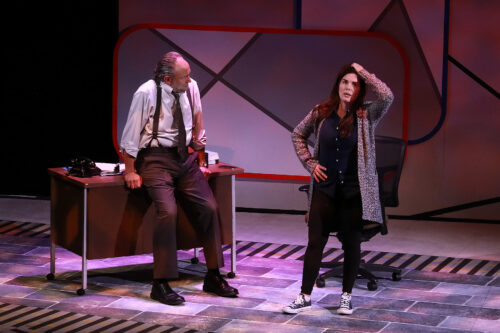
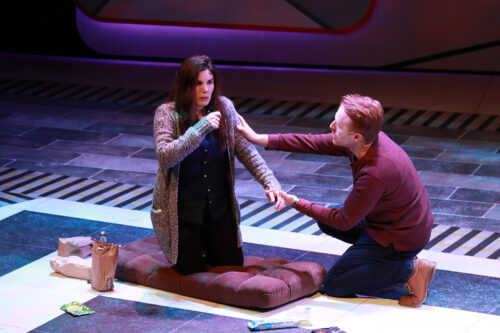
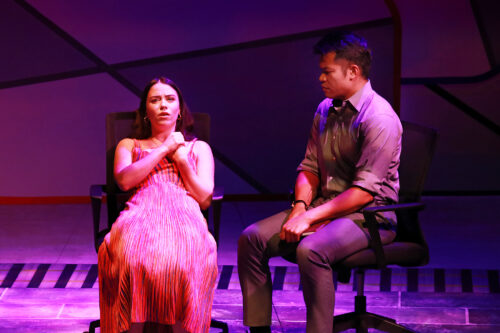
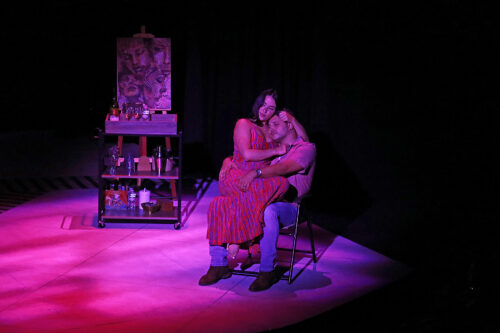
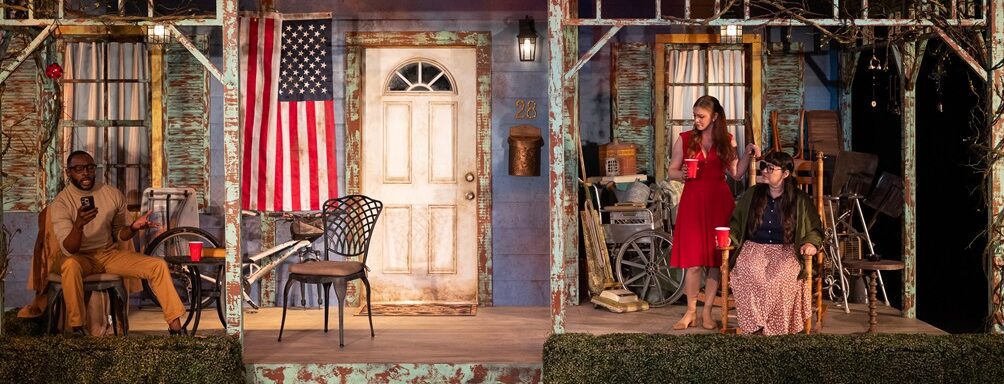


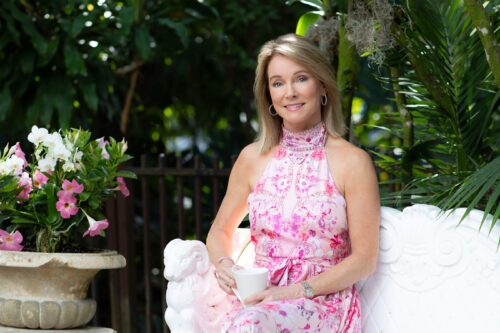

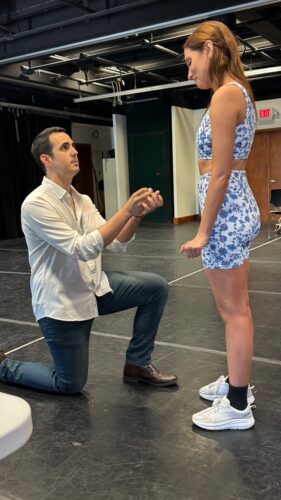
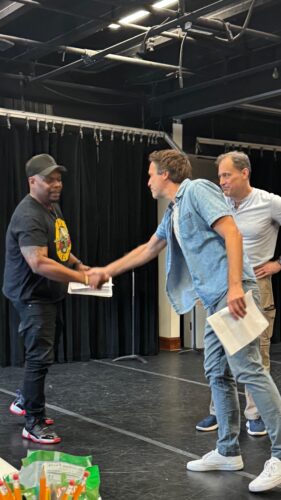
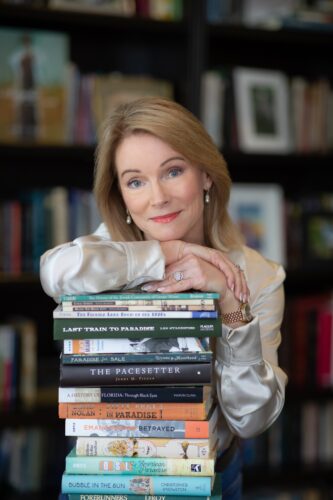


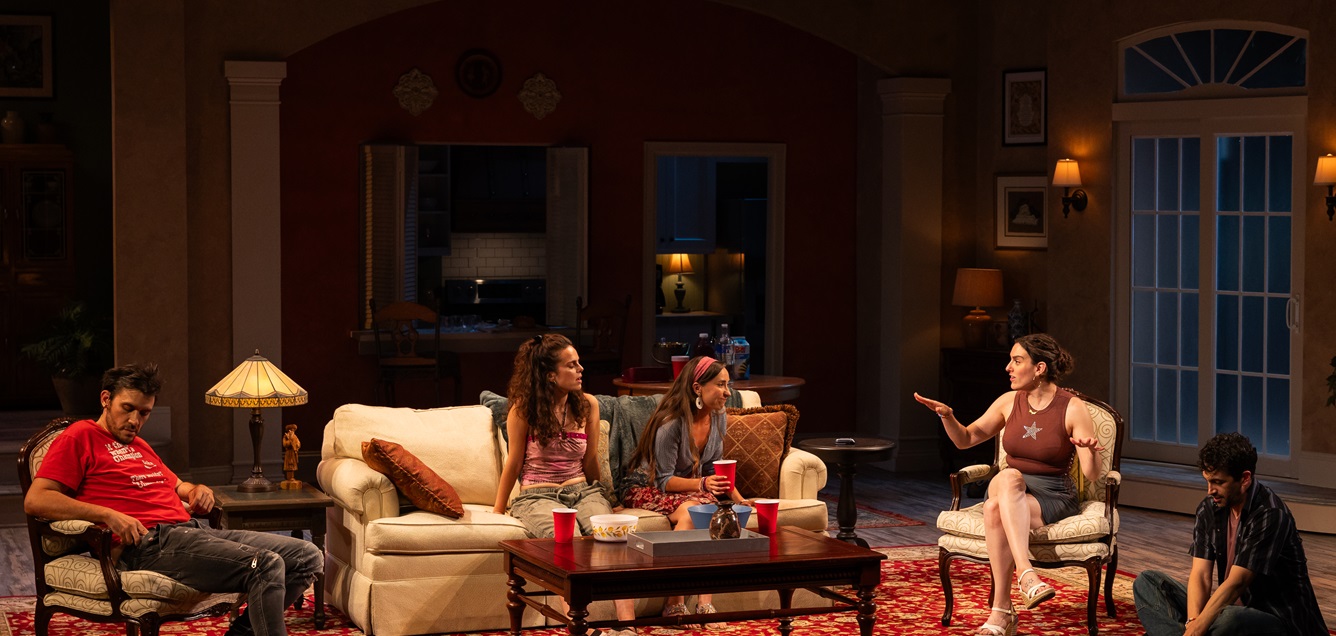

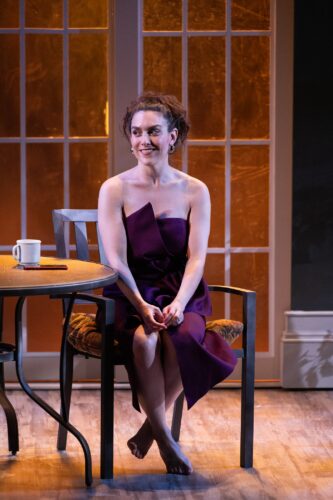


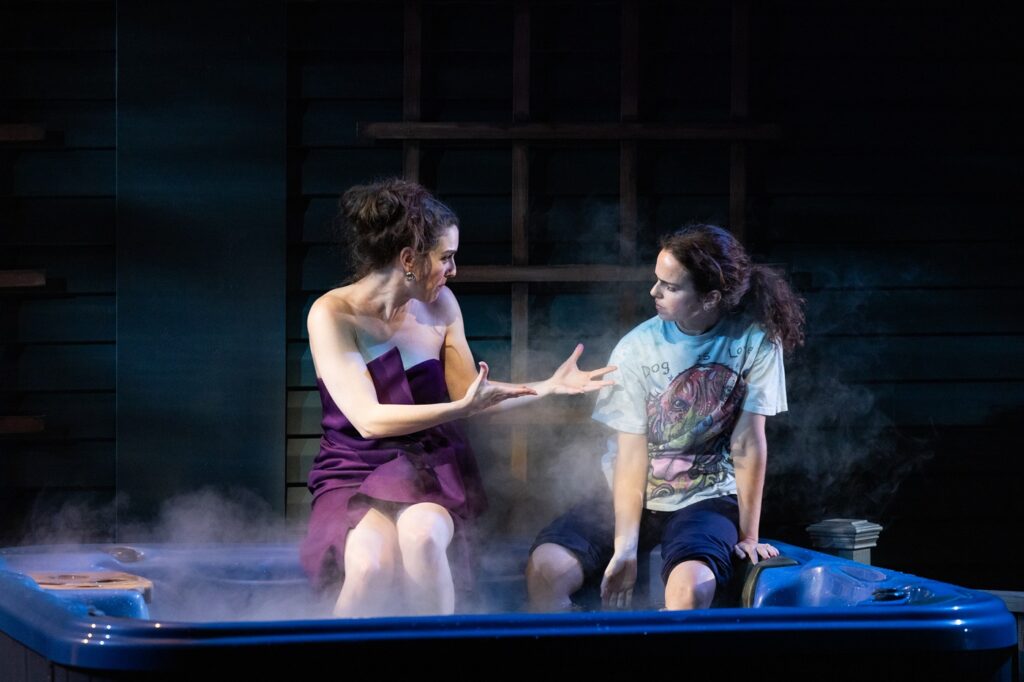





Recent Comments