Blog Article Category: Theater / Film
Review: LakehouseRanchDotPNG Dives Deep Into Political Theater With ‘Trotskyist’
Written By Michelle F. Solomon
August 14, 2025 at 2:59 PM
Samuel Krogh as Lev and Garrett Colon as the younger Daniel in Alex Boyd’s “Three Scenes in the Life of a Trotskyist” now at LakehouseRanchDotPNG at Main Street Playhouse, Miami Lakes, through Sunday, Aug. 17.
They debate ideologies with deep-dive dialogue. Andy Boyd’s “Three Scenes in the Life of a Trotskyist” is a lesson in high stakes for its characters, both personal and political.
It’s also a way for the start-up experimental and absurdist theater, LakehouseRanchDotPNG, now going into its fourth season, to begin its foray into political theater, something the company’s artistic director Brandon Urrutia, and the director of “Trotskyist” mentioned before curtain. The play runs through Sunday, Aug. 17 at the Main Street Playhouse in Miami Lakes.
It’s wise to read the linear notes in the back of the program before the play begins for a brush up or an education. What is a Trotskyist? What is the Permanent Revolution?, and to find out if those in this particular theater company are communists, just in case you were wondering . . .”We’re just a theater company doing cool stuff.”
Cool stuff and a lofty play selection to boot.
The 90-minute play, in three scenes, is marked by historical turning points across four decades. The protagonist is Lev Trachtenberg (an engaging and superbly nuanced Samuel Krogh), who we first meet as a City College student, a Trotskyist, in 1939.
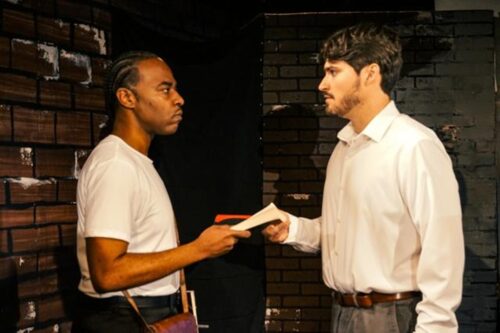
Lev (Samuel Krogh), right, gives one of his students, Curtis (Warren Welds) some literature to read in “Three Scenes in the Life of a Trotskyist” by Andy Boyd at LakehouseRanchDotPNG. (Photo by Richard Lewis)
The playwright instructs in the script: “This play should move at the speed of the city. The characters, Lev especially, revel in the skilled use of language in the way a box might revel in his technique.”
Let the fight begin. It’s Scene 1. Lev enters the college cafeteria late at night carrying a bag of deli sandwiches, pastrami and Swiss on rye. Daniel Kaplan (Garrett Colon), a stout impressionable lad wearing suspenders is sleeping. They are the City College Cafeteria Pugilists – The CCCP, which translates to Union of Soviet Socialist Republics. Maybe not the best acronym.
Daniel wants to be a lawyer. He thought joining the Pugilists would look good on his resume. He’s in awe of Lev. “Every Trotskyist at City College. They follow you like you were – “ Lev reacts: “Trotsky himself?” Daniel: “I was gonna say Max Schactman . . .”
If this reference goes over some audience member’s heads, yes, indeed. A good asked for ChatGPT: Who is Max Schactman? A major figure in the Trotskyist movement beginning in the 1930s.”
And that’s the trouble with “Trotskyists” – interest in the characters and in their struggles is overshadowed by trying to figure out just what everything means. Daniel wants to be a lawyer so he can help Jews. Help them immigrate – but we never learn much more of the depth of his compassion. Ben Roth (Richard K. Weber) enters to complicate things further. He’s a Communist. He accuses Daniel of running with the Troskyites, derogatorily referencing them as such throughout. Daniel is undecided which side he wants to be on. Lev lectures some more. Stalin has lost the support of the Russian people. Ben counters back, with a left hook. “It shows your true aim is not to fight for justice.”
The pace moves at a clip under the nimble direction of Urratia. Just as Boyd suggests, it’s a runaway train.
In the 1960s, Lev is teaching, a professor of Modernist Literature at Columbia University. He’s confronted by a Curtis, (Warren Welds) who is looking for an extension for an assignment. He’s also prepared to spar with the prof who is quick to tell the Black student that he “marched with Dr. King in ’63, that he lobbied hard to get the scholarship program started for the minority students, and that he was the one who “told the President that if we really cared about racial justice we had to open our doors to the black proletariat.”
Curtis tells the professor: “The writers in your course. It almost feels like they are making it purposely difficult to understand what they are saying.” Sometimes it feels like Boyd is, too.
The fact that Lev is teaching at Columbia isn’t lost on the modern audience since the current headlines surrounding Columbia today and the most recent news that the university settled a $221 million lawsuit with the Trump administration so that they get $1.3 billion in federal funding restored – with the stipulation from the federal government that they take steps to curb antisemitism on campus.
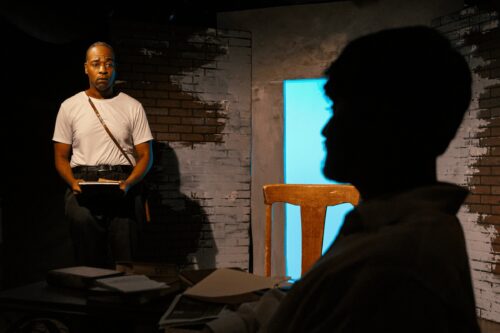
Curtis (Warren Welds), a student at Columbia University, asks for an extension on his assignment in LakehouseRanchDotPNG’s production of Alan Boyd’s “Three Scenes in the Life of a Trotkyist.” (Photo by Richard Lewis)
And there’s more relevance to today’s events, particularly in the U.S. and politics – people on one side, people on the other, both convinced they are right in their own convictions.
Scene 3, we find Lev in the 1980s. He’s a conservative think tank leader in the Reagan years. He has a 25th-floor penthouse overlooking Central Park. But is it enough? Has he sold out?
Daniel enters and they haven’t spoken in 20 years. He’s played by the actor we saw as the janitor cleaning up the City College cafeteria in Scene 1. Pete Rogan as the older Daniel, with his bushy beard and glasses, is dressed in the same suspenders the younger Daniel wore. Perhaps because of Rogan and Krogh’s wonderful chemistry, or maybe because Boyd has toned down the non-stop rhetoric, this is where we clearly see characters, humans steeped in some nostalgia with and without regrets.
Daniel, now 57, has published a bestseller, a memoir, that one book reviewer called “The Jewish ‘Roots.’ “ He never did become a lawyer, he became a writer, then a professor, now is doing the book tour circuit. (Does Boyd tell us why he didn’t become a lawyer?)
Then they launch into the playwright’s verbal boxing match. About Stalinism, Vietnam, Lev peaking out against the anti-war Left. And Daniel asking how someone so determined to a conviction has become a champion of the political right?
We never really get the answer to that question, either. No, Lev has called Daniel to his office after two decades for a reason and it isn’t just to wax nostalgia.
He has a secret and he needs Daniel’s help. To reveal the spoiler would be, well, to reveal the spoiler. But, he wants Daniel to write his memoir. “Start at the beginning. 1939. When we first met,” he tells Daniel.
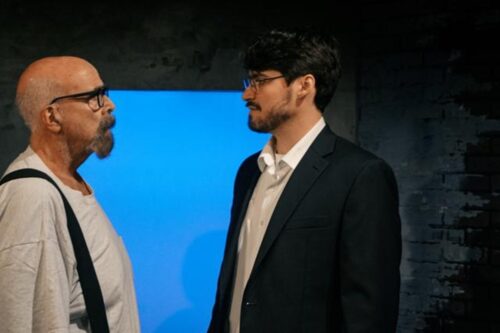
An older Daniel (Pete Rogan) meets Lev (Samuel Krogh) decades later in New York City at a penthouse office overlooking Central Park. (Photo by Richard Lewis)
Tyler Regalado keeps the set sparse. A faux brick wall splashed with gray paint on either side doesn’t attempt to look realistic. It serves as a backdrop for the illusions of the characters. There’s a table with books, a chair. There’s an interesting door-like rectangle that changes color and sometimes casts a shadow of the character thanks to lighting director Leonardo Urbina. Alex Tarradell’s sound design plays a haunting organ soundtrack underneath throughout. It’s subtle and never interruptive. There are also political songs that play at the beginning and the end. Erin Proctor’s costumes are period-appropriate and help define the passage of time.
And it’s a wise choice to not use age make up or any other falsity for Lev’s passage of time. Only glasses and a blazer create the change for the ‘80s.
Urrutia’s commitment to the play is everywhere, including the ensemble he’s chosen who are equally committed to making sense of the verbal acrobatics.
“Three Scenes in the Life of a Trotskyist” isn’t usual fare, precisely what Urrutia and LakehouseRanchDotPNG bring to the South Florida scene.
If you’re looking for an easy, breezy night out to sit back and passively enjoy a play, this isn’t for you. For those willing to be challenged and wanting to support alternative theater, this is it. And, as far as political theater goes, this is the past informing the present.
WHAT: Alex Boyd’s “Three Scenes in the Life of a Trotskyist”
WHERE: LakehouseRanchDotPNG, Main Street Playhouse, 6812 Main St., Miami Lakes
WHEN: 8 p.m., Friday and Saturday, 2 p.m. Sunday through Sunday, Aug. 17
COST: $20.
INFORMATION: 786-427-4721 and lakehouseranchdotpng.com
ArtburstMiami.com is a nonprofit media source for the arts featuring fresh and original stories by writers dedicated to theater, dance, visual arts, film, music and more. Don’t miss a story at www.artburstmiami.com.
No posts found
‘My Mother and Tonton’ At Little Haiti Cultural Complex Drawn From Real Life
Written By Miguel Sirgado
August 5, 2025 at 9:49 PM
Celeste Landeros, Ph.D., wrote “The Last Songs of My Mother and Tonton,” an immersive theater piece about experiences in her own life, which will be performed Thursday, Aug. 7 through Sunday, Aug. 10, at the Little Haiti Cultural Complex. (Photo by Inez Barlatier)
The story of a retired Miami public school teacher and a master Haitian percussionist forms the foundation of a new work. Through music, memory, and intergenerational witnessing, the piece pays tribute to two elder figures who shaped one woman’s life—and left an imprint on the city’s cultural fabric.
Drawing from personal experience, Celeste Landeros, Ph.D., has created what she describes as an immersive piece influenced by opera, carnival traditions, and community storytelling. That convergence of forms and histories is central to “The Last Songs of My Mother and Tonton.”
“The Last Songs of My Mother and Tonton” will be performed Thursday, Aug. 7 through Sunday, Aug. 10, in the Little Haiti Cultural Complex’s theater lobby.
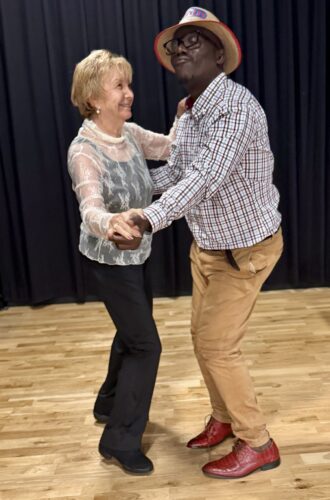
Jean Fraser (Carol Ravich) and Catelus “Tonton” Laguerre (Wesner “Ti Wes” Saint Louis) dance one last time in “The Last Songs of My Mother and Tonton,” a tender ritual of remembrance and reclamation. (Photo by Celeste Landeros)
The production centers on 90-year-old Jean Fraser, a retired educator and Landeros’s mother, and 82-year-old Catelus “Tonton” Laguerre, a revered Haitian percussionist and cultural icon.
Both lived their final months under the same roof, cared for by Landeros and her family. What unfolds onstage is not merely performance—it is a deeply personal ritual of remembrance and cultural care.
Landeros—a classically trained soprano, former Latin music critic and editor at Miami New Times (1999–2005), founding editor of artburstmiami.com, and current member of the Florida Folklife Council—has long channeled her artistry into exploring legacy and identity.
“Having these two elders in the house at the end of their lives—as they became ancestors—was a really powerful experience that I wanted to share,” she says. “It was joyful, painful, surreal. And it changed me forever.”
She doesn’t romanticize the experience but insists on honoring it. “Every work of art I made while I was a caregiver was about—or blocking out—my mother and Tonton. I was living inside a poem I didn’t know how to write yet.”
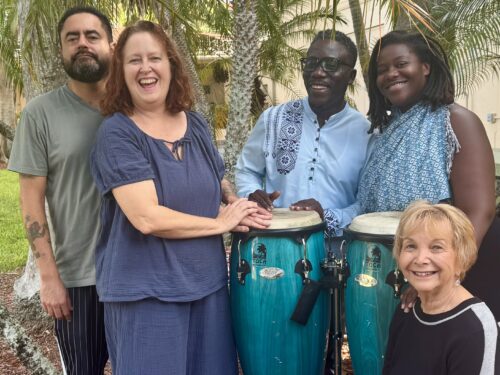
The cast of “The Last Songs of My Mother and Tonton, are, from left, Fernando Landeros, Celeste Landeros, who performs and wrote the script, Wesner “Ti Wes” Saint Louis, Inez Barlatier, and Carol Ravich. (Photo by Janell Campbell)
The work traces the intertwined final year of Fraser and Laguerre’s lives. Fraser, who lived with Alzheimer’s, served Miami-Dade County for more than two decades as a teacher and assistant principal. Laguerre, a founding member of Haiti’s National Folklore Troupe, never secured legal residency in the United States. He was a fixture in Miami’s Haitian community for more than 40 years, known for his mastery of rara, yanvalou, and other sacred and social rhythms.
In the wake of gentrification-fueled housing instability, Laguerre was left without a home, so the Landeros family welcomed him into theirs. Their house became a sanctuary where cultures, memories, and daily rituals coexisted: Irish lullabies, Haitian drums, shared meals, and caregiving routines, all stitched together to form a rare and fragile harmony.
“My mom took care of thousands of children as a public-school teacher,” recalls Landeros. “When she retired, she didn’t have much to do—so she took care of Tonton. That gave her purpose again.”
The cast of “The Last Songs of My Mother and Tonton” brings to life the intergenerational household at the heart of the story. Actress Carol Ravich plays Jean Fraser. Ayisyen-American singer, musician, and actor Inez Barlatier—whose work is featured in the documentaries “Razing Liberty Square” and “Madame Pipi”—portrays Islande, a devoted student of Tonton. Milaimys “Milly” Castellón, a first-generation Cuban-American artist and New World School of the Arts alumna, takes on the role of Belle, Celeste’s daughter. Fernando Landeros, a pianist trained at Juilliard, the Mozarteum, and the University of Miami, who is a Miami-Dade music teacher and a performer, appears as himself.

Catelus “Tonton” Laguerre (Wesner “Ti Wes” Saint Louis), right, gives a drumming lesson in “The Last Songs of My Mother and Tonton” to Milaimys Castellón, left, and Inez Barlatier. (Photo by Celeste Landeros)
Playwright and director Celeste Landeros appears as “Herself,” guiding the piece through scenes that merge narration, music, and lived memory.
Wesner “Ti Wes” Saint Louis steps into the role of Laguerre.
“To portray Tonton is truly an honor,” says Saint Louis. “He wasn’t just a famous drummer—he was someone I knew and respected deeply. He was Haitian like me, and to step into his story onstage feels like paying tribute to a part of myself, too.”
Born in Haiti, Saint Louis is a cultural bridge in his own right—performing in sacred Vodou ceremonies, schools, street festivals, and on international stages. His daily practice and devotion to the drum reflect an ancestral presence, grounding his artistry in both discipline and spiritual tradition.
Much like the man he embodies onstage, Saint Louis carries forward the legacy of Haitian percussion and oral culture. His presence in Miami’s cultural life has made him a living archive of rhythm, resistance, and generational memory.
“I always enjoy sharing my culture and traditions with people from other countries. It’s a two-way street—I learn from them, and they learn from me. I’ve done it many times before, representing Haiti and connecting with other cultures along the way.”

Wesner “Ti Wes” Saint Louis, a Haitian drummer and community elder, brings ancestral rhythm and lived experience to his portrayal of Tonton in “The Last Songs of My Mother and Tonton” by Celeste Landeros. (Photo by Inez Barlatier)
The two even performed together once. “We were in a movie years ago. I don’t remember the title, but I remember how he played—how the drum became his whole body. He was a quiet man, but the rhythms spoke for him.”
Laguerre was a familiar presence in Little Haiti, and Saint Louis often greeted him with a gentle pat on the back. “Since he was blind, I’d say, ‘Hey, it’s Steward!’ He wasn’t always warm to everyone, but with me, he always showed kindness. That meant a lot to me.” When approached by Landeros for the role, he immediately accepted. “This was someone who gave everything to his art, to his people. He put Haiti on the map.”
The show’s design, by Damian Rojo, elevates the domestic to the sacred—transforming everyday objects like chairs, bowls, and laundry lines into votive symbols of remembrance. Throughout his career, Rojo has served as art director and production designer for a range of iconic artists, including neo-soul singer and songwriter Maxwell, genre-defying R&B innovator Erykah Badu (on her “Mama’s Gun ’25: The Return of Automatic Slim” tour), and the legendary Peruvian soprano Yma Sumac, in what Rojo calls one of his most cherished collaborations at the Stephen Talkhouse. He also art-directed episodes of “MTV Unplugged” and designed sets for a Calvin Klein Jeans campaign featuring supermodel Kate Moss, with billboards illuminating Times Square.
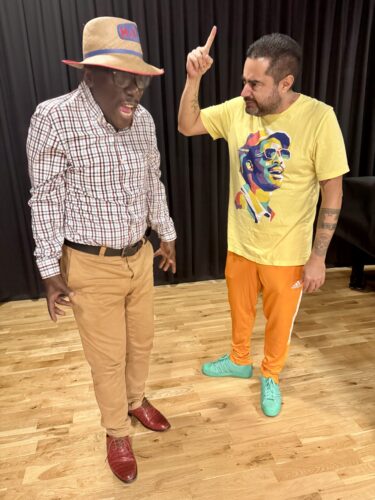
Tonton and Fernando clash over bathroom rights in a scene from “The Last Songs of My Mother and Tonton.” Pictured are actors Wesner “Ti Wes” Saint Louis and Fernando Landeros. (Photo by Celeste Landeros)
Musically, the work draws on Haitian, Scottish, and Irish folk traditions. But in Landeros’s hands, these aren’t mere gestures of nostalgia—they become survival strategies. Audience members are invited to participate through clapping, singing, call-and-response, and simple collective gestures.
“With Tonton, singing the songs he had taught me helped [him] more than the morphine,” says Landeros. “And with my mom, I got her to sing with me with her last breaths.”
What began as an attempt to reconnect with her mother’s Irish roots—through folk songs and a postponed trip to Ireland—soon became a broader act of healing. “I finally was exposed to my own heritage,” she says. “And I realized I couldn’t do the album without inviting my collaborators from Miami. It became a fusion: Haitian and Scottish, Cuban and Irish. That’s who I am.”
For Saint Louis, the project resonates deeply. “I’ve traveled to Japan, Africa, Canada—always as a drummer, sharing the heartbeat of Haiti. But this is different,” he says. “I’ve never acted before. It pushes me to grow, to tell the story not just through rhythm, but through silence and breath, too.”
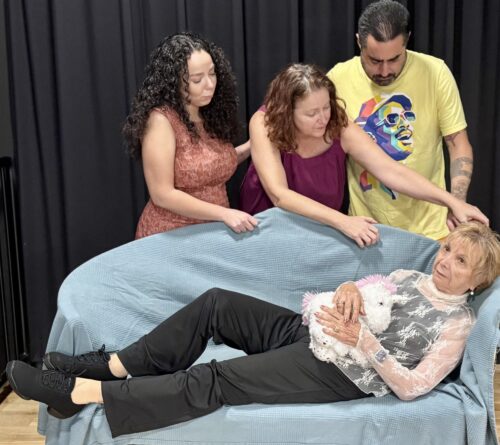
A vigil for Jean Fraser features, from left, actors Milaimys Castellón, Celeste Landeros, and Fernando Landeros, with Carol Ravich on couch, during a rehearsal for “The Last Songs of My Mother and Tonton.” (Photo by Inez Barlatier)
Set against the backdrop of Miami’s vibrant cultural landscape, “The Last Songs of My Mother and Tonton” finds its heartbeat in the voices of elders, the drumlines of Little Haiti, and the homes where multiple generations learn the rhythms of caregiving and coexistence.
“Folklore is participatory,” says Landeros. “You may not be a master percussionist, but you can clap. You can hum. You can show up with your whole self. That’s how we built this show.”
“The Last Songs of My Mother and Tonton” centers on music as a way to preserve memory and endure personal and collective loss. As Landeros reflects, music becomes not only a form of remembrance but also a means of survival—especially in the face of grief, displacement, and change. Rooted in the intimacy of the home and the strength of community bonds, these songs carry what might otherwise be forgotten.
“It’s all about the music,” Landeros says. “That’s how we remember. That’s how we resist.”
WHAT: “The Last Songs of My Mother and Tonton”
WHERE: Little Haiti Cultural Complex theater lobby, 212 NE 59th Terrace, Miami
WHEN: 7 p.m. Thursday, Aug. 7 and Friday, Aug. 8; 2 p.m. Sunday, Aug. 10.
COST: From $24.80 (includes fees). Free for seniors 65 and older.
INFORMATION: 305-960-2969 or www.eventbrite.com/
ArtburstMiami.com is a nonprofit media source for the arts featuring fresh and original stories by writers dedicated to theater, dance, visual arts, film, music, and more. Don’t miss a story at www.artburstmiami.com
No posts found
To Miami from Venezuela, big dreams realized in movie ‘The Shadow of the Sun’
Written By Michelle F. Solomon
August 3, 2025 at 9:23 PM
Anyelo López in his film debut as Alex in Miami native Miguel Angel Ferrer’s feature film “The Shadow of the Sun” (“La Sombra del Sol”), making its U.S. theatrical debut in Miami, Coral Gables and Doral movie theaters starting Friday, Aug. 8. (Photo courtesy of Magic Films)
In Miami native Miguel Angel Ferrer’s feature film “The Shadow of the Sun” (“La Sombra del Sol”), the main character Leo is depicted as being reluctant to step outside of his current familiar situation, despite its dreariness, into the future.
A similar hesitance plagued Ferrer, too, as he describes the aha moment when he decided to make his movie that would go on to win numerous film festival awards and was selected as Venezuela’s official entry for Best International Film in the 2024 Academy Awards. With a distribution deal from Outsider Pictures, “The Shadow of the Sun” (“La Sombra del Sol”) is making its U.S. theatrical debut in Miami movie theaters opening Friday, Aug. 8.
It was the closing night of the Los Angeles Latino International Film Festival (LALIFF) in 2021, recalls Ferrer. After attending films and meeting people at the festival, he says he asked himself, “Why don’t I have a film here?’” And the answer, he says, was always the same.

A scene from the feature film “The Shadow of the Sun” (“La Sombra del Sol”) filmed over 18 days. (Photo courtesy of Magic Films)
“It was because I hadn’t made up my mind to do it. The only obstacle was me.”
The story of two brothers came to mind. Leo (Carlos Manuel González) gave up his dreams, including singing, after his parents died in a fire and he became caregiver to his deaf younger brother, Alex (Anyelo López in his film debut). Alex, a budding songwriter, wants to bring hope back to his brother in the form of the two of them entering a musical contest, which offers a much-needed cash prize.
The theme of perseverance amid adversity was inspired by Ferrer’s 2020 trip to Venezuela and his dream of making a film about his homeland.
Ferrer, a native of Venezuela, moved to Miami in 1996 at the age of twelve with his Cuban mother. His father, who was also born in Venezuela, came to Miami about two years later, he says. They settled in Kendall.
“Since then, I have only been in Venezuela once in 2007 for about 10 days and then, in 2020, (producer) Wil Romero convinced me to go there and do a project,” he says.

University of Miami grad, Kendall native and director Miguel Angel Ferrer behind the camera during shooting of his film “The Shadow of the Sun” (“La Sombra del Sol”). (Photo courtesy of Magic Films)
Ferrer, who lives in Los Angeles, landed his first job as a cameraman for National Geographic. The 2003 graduate of Miami’s Belen Jesuit Preparatory School, Ferrer would go on to study film at the University of Miami, graduating in 2007. He credits mentors in the university’s film department — Jeffrey Stern of the School of Communications, who recently won an Emmy Award for his work on the HBO series “Boardwalk Empire,” and Johnny Calderín, who was part of UM’s film department, and now heads the film program at his alma mater Belen Jesuit.
“There are so many people who have helped me. And it just shows that when you lend someone a hand, it goes a very long way.”
In 2014, Ferrer founded Magic Films, an L.A.-based company that collaborates with major record labels on music videos and produces commercials for brands such as State Farm, Pepsi, Nissan, and Super Bowl Hispanic campaigns.
The trek to Venezuela in 2020 to meet Romero started as an adventure and never let up. “I didn’t have a valid Venezuelan passport. So, I flew into Colombia, crossed the border by foot, and pretty much had to sneak into my own country. He picked me up in his truck and we went on a 16-hour drive through the interior of Venezuela.”
The trip was life changing. “Along that path, I met so many people, I re-encountered my country through the people of the interior.”
The “interior” was Romero’s hometown Acarigua, located in the northwestern state of Portuguesa, Venezuela. “I re-encountered what it was like to be Venezuelan,” says Ferrer. “People that do miracles every single day because they have so many obstacles.”

Anyelo López as Alex in “The Shadow of the Sun” (“La Sombra del Sol”), filmed entirely in Venezuela. (Photo courtesy of Magic Films)
He was determined that the movie would be made entirely in Venezuela. “Yes, there’s the political situation that has been going on for 25 years, and the oppression and all that, yet you still see these people fighting every single day. And I said, ‘Where is this in the movies? Where is this in cinema? And how do I take this to an international audience and show them who the people truly are.’ ”
He also made another discovery, Anyelo López from Caracas, who had never acted before and is the co-star of the film.
Speaking from Spain via an interpreter, the 27-year-old López, born deaf, describes discovering an unexpected destiny.
It was through WhatsApp as part of a small group of deaf people that would meet up in Caracas, where López learned about the casting call. “I received this video about the casting, and I wanted to know about the money. How much would it pay?”
It wasn’t because he had dreams of being in the movies that he auditioned, he admits.
“It’s a really complicated situation in Venezuela, so many, many people have a similar story. They will just try to find work,” says López.
There were eight deaf actors who auditioned for the role. “And then it was down to only three. And then Miguel said to me, ‘It’s you. You are Alex.’ And I was so happy that Miguel chose me. No, I didn’t have this dream, but I thought it would be a great experience.”

Miguel Angel Ferrer and Anyelo López during shooting of the feature film “The Shadow of the Sun” (“La Sombra del Sol”) in Venezuela. (Photo courtesy of Magic Films)
He had never been to Acarigua, more than 100 miles from Caracas, where most of the film was shot. The entire production took just 18 days—16 in Acarigua and two in Caracas.
“It’s really beautiful there. And it would be long days of shooting – like eight hours of filming and it was hard work, but it was amazing,” says López.
Co-star González spent three months learning sign language with two Fundafid foundation members in Caracas before filming began.
For López, working with Ferrer, González, and others involved in the film’s production, the experience changed his life; he is now dedicated to pursuing a career as an actor.
“I’m really proud to be from Venezuela and a deaf actor. It is a good way for me to talk about my experience. I have these options as a deaf person and as an actor, and maybe with a new story.”
The decision to portray the younger brother as deaf in the film originated from the theme Ferrar wanted to have so strongly at the center of “The Shadow of the Sun” (“La Sombra del Sol”).
“There are people who have all these gifts and opportunities, and they waste them for whatever reason, and then there are people who would die to have those chances, and they never will. It comes from my experience. We all do it, maybe because we’re human, so that’s a frustration I had even with myself.”
He relates this to the characters he’s created.

Carlos Manuel Gonzalez as Leo in the feature film “The Shadow of the Sun” (“La Sombra del Sol”). (Photo courtesy of Magic Films)
“There’s Leo, who has this amazing voice and talent, good looks, and everything going for him and wastes it. And on the other side, you have someone with no voice. Even being deaf, Alex has more of a voice than his brother. In the end, he is the one who shows his brother how to use his voice.”
Ferrer notes that although he completed the film nearly three years ago, its current release is more than relevant given current U.S. policies concerning Latin American migrants and asylum seekers.
“It shows you that there are people who just want the chance to have a better life. They just want a shot. I certainly wouldn’t have had all of the opportunities I’ve had throughout my life if my mother hadn’t brought us from Venezuela to here.”
WHAT: Miguel Angel Ferrer’s “The Shadow of the Sun” (“La Sombra del Sol”)
WHERE: Coral Gables Art Cinema, 260 Aragon Ave., Coral Gables; CMX CinéBistro CityPlace Doral, 3450 NW 83rd Ave., Doral; CMX Brickell City Centre, 701 S. Miami Ave., Miami; AMC Aventura 24, 19501 Biscayne Blvd., Aventura.
WHEN: Opens Friday, Aug. 8 with a 7:15 reception at Coral Gables Art Cinema and a Q&A after the film. Starts Thursday, Aug. 14 at Savor Cinema, 503 SE 6th St., Fort Lauderdale
COST: Tickets range from $8 to $20, depending on showtimes and movie theater.
INFORMATION: Showtimes and information at outsiderpictures.us
(In Spanish with English subtitles)
ArtburstMiami.com is a nonprofit media source for the arts featuring fresh and original stories by writers dedicated to theater, dance, visual arts, film, music, and more. Don’t miss a story at www.artburstmiami.com
No posts found
Filmmaker’s ‘Mango Movie’ Deconstructed Into Exhibition At Green Space
Written By Michelle F. Solomon
August 1, 2025 at 1:50 PM
One of the participants in Jayme Kaye Gershen’s “Mango Movie” is shown in the film. Now, a multi-sensory art exhibit at Green Space Miami, “When Mangos Last In My Backyard Bloom’d” through Saturday, Aug. 9, is a deconstruction of the movie. (Photo by Oscar J. Lobo)
What began as a 13-minute short film about South Florida’s beloved mango has evolved into an immersive exhibit at Green Space Miami.
Jayme Kaye Gershen’s “When Mangos Last In My Backyard Bloom’d,” through Saturday, Aug. 9, is a multi-sensory art exhibit – a deconstruction of her original “Mango Movie.”
The film, shot at the Legion Park Farmers Market in the summer of 2023, featured 22 people eating mangoes, highlighting the diverse, and sometimes, emotive reactions of Miamians immersed in the fruit.
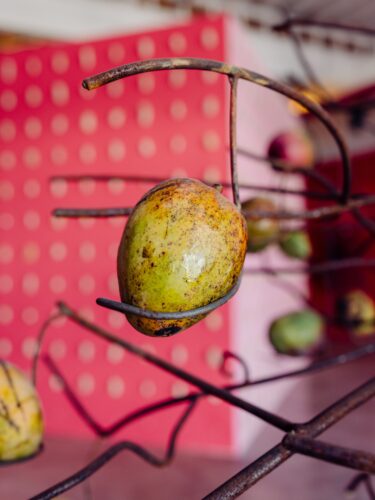
A detail of the mango tree sculpture with the mango seed structure in the background at “When Mangos Last in My Backyard Bloom’d” at Green Space Miami. (Photo by Alfonso Duran)
The exhibit features eight screens with interviews from that day at the farmers market, along with immersive sound design, and a physical installation made from mango seeds.
Visitors are invited to eat mangos, interact with the installation, and contribute their own mango seeds to a growing sculpture, making the experience both personal and communal.
“You walk into the exhibit, you pick your mango from this mango sculpture we’ve built, we cut it for you, and you walk around and eat mangos, smell mangos, hear mangos, taste mangos, feel the mango. It’s a visceral sort of experience,” says Gershen.
And there are more stories to be gathered from the experience, says the filmmaker. “To continue telling the stories, and rather than doing that through film, we’re filling one of the walls on the sculpture where mango seed husks are empty. We’ve been filling it with the mangos that people eat in the gallery.”
She finds that this becomes a physical portrait of the city as visitors leave their own mark on the exhibit.

Young visitors place their mango seeds in the mango tree wishing well at Jayme Kaye Gershen’s exhibit, “When Mangos Last in My Backyard Bloom’d” at Green Space Miami. (Photo by Carolina Mendendez)
“After you’ve enjoyed your mango, there’s a sink, and you dig into the seed there, leave your mark, drop it in a wishing well and then we collect that, clean them, seal them and add them to the sculpture.”
This evolution from film to multi-layered exhibition was driven by a desire to connect the community in new ways, moving beyond traditional film screenings to create a shared, physical, and sensorial experience.
The project, she says, demonstrates how film can be taken “off screen” and transformed into an impactful, participatory art experience. The exhibit encourages conversations about memory, climate, and local culture, and has become a community connector, engaging people of all ages and backgrounds.
There have been various participatory events throughout the run, culminating in a three-part workshop series, “Mango Artist Bookmaking.” “Mango Husk Paper Making” on Saturday, Aug. 2, from 2 to 5 p.m., is led by Ọmọlará Williams McCallister, “Mango Leaf Pigment Painting,” on Sunday, Aug. 3, from 3 to 5 p.m., is with Gabriela Serra, and the final workshop, “Mango Book Stab Binding” with Nicole Combeau is on Saturday, Aug. 9, from 3 to 5 p.m.
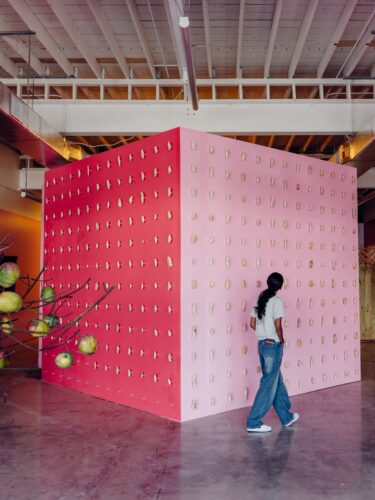
The mango seed husk structure in Jayme Kaye Gershen’s exhibit, “When Mangos Last in My Backyard Bloom’d.” (Photo by Alfonso Duran)
The closing event, from 6 to 8 p.m. on Saturday, August 9, and hosted by the Subtropic Film Festival, is a “Making Of” panel that explores how the short film was transformed into an immersive exhibit.
“Miami has all these disparate parts, but there are some things that bring us together and mangos are one of them,” says the filmmaker and artist.
It was during King Mango season in the summer of 2022 that Gershen started noticing that there were these “endless amounts of mangoes.”
While mangoes are not considered at risk in Florida, Gershen found that she could tie the concept to climate chaos.
“You don’t know what’s going to happen. It’s hard to predict, you know? The thought was about getting us to reminisce about something that’s still here. it gets people talking and thinking about things before we lose them. And, this project has been a community connector.”

Jayme Kaye Gershen in the midst of her mango exhibition at Greenspace Miami. (Photo by Alfonso Duran)
Originally from Springfield, Mass., Gershen moved to Miami in 2007. While cat sitting at a friend’s house where a mango tree bloomed in the backyard, she started collecting mangoes. “I didn’t have a car at the time, and I was biking all over town trying to give them away so they wouldn’t go to waste.”
She noticed that there was a bit of an obsession in South Florida with mangos. “Friends would have mango parties and swaps and someone would want to try a mango from one person’s tree to see if it was different from theirs.”
It became a bit of an obsession for her, too. “There’s 600 varieties of mangos in South Florida. And, it’s said, through some of the farmers I have talked to, that there are 5,000 varieties of mangos in the world.”
She also realized that there was something about how people connected with the edible stone fruit that also related to her artistic practice.
“All of my work is about connection in surprising ways.”
She says the discovery of mangos has been a gift.
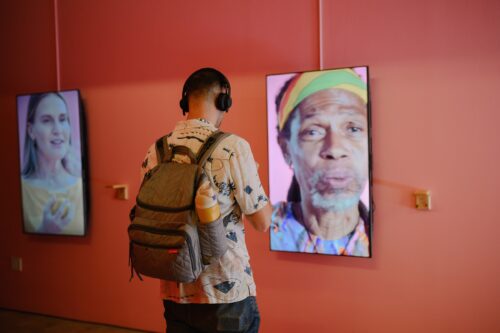
A visitor watches the films at Jayme Kaye Gershen’s exhibit, “When Mangos Last in My Backyard Bloom’d” at Green Space Miami. (Photo by Carolina Mendendez)
“I’ve been in Miami for almost 20 years, applying to grants and being an artist in my way and having all of these big ideas that were sort of hard to realize. This particular project seems like it has unlocked some doors that I had been knocking on for a long time.”
The exhibit has also been a way for the filmmaker to look outside of the traditional ways people experience a movie, and the limits that are placed on the experience.
She’s currently working on a concept of a “choose your own adventure” where the audience becomes the editor.
“Essentially, it would be a physical maze of rooms similar to what we have in this exhibition, but on all sorts of different topics that tie you together to an experience understanding the different ways we all see Miami.”
It’s also brought contemplation on what her place as a filmmaker will be in the future.
“The exhibit has been an interesting experiment about how we can take film outside of the theater and bring it to the people. I am really interested in immersive filmmaking and how we actually move people to feel that they are seen in the films they are engaging with.”
WHAT: “When Mangos Last in My Backyard Bloom’d”
WHEN: Through Sunday, Aug. 9. Workshops: 2 to 5 p.m., Saturday, Aug. 2, Mango Husk Paper Making; 3 to 5 p.m., Sunday, Aug. 3, “Mango Leaf Pigment Painting,” and 3 to 5 p.m., Saturday, Aug. 9, “Mango Book Stab Binding.” 6 to 8 p.m., Saturday, Aug. 9, “Making Of” panel discussion.
Regular hours: noon to 6 p.m., Thursday, through Sunday; Monday through Wednesday, by appointment.
WHERE: Green Space Miami, 7200 Biscayne Boulevard, Miami
COST: Free – Sign up for workshops at Eventbrite
INFORMATION: 786-266-6392 or www.greenspace.org.
ArtburstMiami.com is a nonprofit media source for the arts featuring fresh and original stories by writers dedicated to theater, dance, visual arts, film, music, and more. Don’t miss a story at www.artburstmiami.com.
No posts found
Review: Main Street Players’ ‘The Revolutionists’ Reigns Supreme
Written By Michelle F. Solomon
July 31, 2025 at 1:24 PM
Zoë Darragh Garnett as Olympe de Gouges, Elizabeth Chavez as Marie Antoinette, and Dayana Morales as Charlotte Corday in Main Street Players’ production of “The Revolutionists” at the Main Street Playhouse, Miami Lakes, through Sunday, Aug. 3. (Photo by Sefanja Richard Galon, courtesy of Main Street Players)
Think “Hamilton” without the music and sans a male-dominated cast, and you’ve got Lauren Gunderson’s “The Revolutionists,” a play that imagines the gathering of four historical women. Three are actual figures from the Reign of Terror in 1793, and one is a composite based on revolutionaries in history. A Black woman fighting for freedom from French-controlled Saint Dominque (now Haiti), Gunderson had to compile the character from multiple narratives, as most of the real stories have been erased.
The small, but mighty Main Street Players in Miami Lakes embrace Gunderson’s satire. Even her character descriptions in the script give a hint of how the roles should be played. We first meet Olympe de Gouges (the wonderfully earnest and so convincing Zoë Darragh Garnett), who Gunderson describes as a “badass activist playwright.” An activist for women’s rights, best known for her Declaration for the Rights of Women.
Enter Marianne Angelle (the versatile Cheryl Ross), a fictional character who Gunderson calls a “badass Black woman in Paris.” Wearing a sash emblazoned with the words “Revolution for All,” she symbolizes the Haitian rebels and revolutionaries of the time.

Cheryl Ross as Marianne Angelle and Zoë Darragh Garnett as playwright Olympe de Gouges in “The Revolutionists” at Main Street Players in Miami Lakes. (Photos by Sefanja Richard Galon, courtesy of Main Street Players)
Although they are all strong women, Charlotte Corday (a feisty Dayana Morales riffing a killer French accent), the infamous assassin of revolutionary Jean Paul Marat, comes off as the most determined. Gunderson describes her as a “badass country girl, serious, hardened by righteousness and never been kissed.” A knife tucked in her boot, she’s ready to commit the deed that must be done, which will lead to her death by guillotine.
The most recognizable to audiences is Marie Antoinette (Elizabeth Chavez playing her to the hilt as the original “Influencer”), who shows up for de Gouges to rewrite her history, get her “better press.” Gunderson’s description? “Less badass but fascinating former queen of France . . . unintentionally rude.”
A guillotine stage right – painted on wood hastily to replicate the colors of the French flag is where the action begins. There is no one in the rack for beheading but we hear the blade come crashing down.
de Gouges enters, breaking the fourth wall, and speaking to her audience. “Well, that’s not a way to start a comedy. With an execution?” We learn she’s suffering from writer’s block – afraid to write what she desires about what’s happening around her for fear of consequences. “What if I write a play that is the voice of this revolution, but not the hyperbolic, angry-yelling kind.”
Besides the stage right area for the guillotine, the main action takes place in set designer Jacob Brown’s comfortable representation of de Gouges’ living quarters – the writing desk being an important playing area
The walls are decorated with clotheslines and clips from which hang pages and pages of different writings.
What the company does within the confines of the small theater to bring this play to life is commendable. Part of the difficulty of pulling off Gunderson’s vision is how to seamlessly mix the historical facts with a 21st-century modern language and humor. Marie Antoinette’s struggles as a queen in this version: “I couldn’t even start a youth fitness program at the palace, and don’t get me started on my rebranding ideas.”
The action moves quickly under Danny Nieves skilled direction and his understanding of the different levels in which this dramedy should ebb and flow is the underscore that brings everything together.

Elizabeth Chavez’s Marie Antoinette, right, has plenty to say as Zoë Darragh Garnett and Dayana Morales look on. (Photo by Sefanja Richard Galon, courtesy of Main Street Players)
Angelina Esposito’s costumes are wonderfully period and historically accurate, from the fitted bodice and wide skirt for de Gouges to the elaborate detail of Marie Antoinette’s lace, ruffles and, of course, signature tall wig, here decorated with bows.
The lighting design by Ricky J Martinez bathes the characters in cool light, almost sepia tone, giving the illusion of an antique photo. Caroline Ruiz’s sound design is at its best during scenes where riotous crowds have gathered to witness the public executions. The mob’s chants and cheers envelop the theater, giving the illusion that we’re in the thick of things.
During one scene, some of the women are sent into the audience to deliver pamphlets that carry quotes from strong activist women through history — Sojourner Truth, Harriet Tubman, Angela Davis, well-known names — and those that aren’t particularly household names – Rosa Luxemburg, a Polish-German Marxist revolutionary executed in 1919, and Leila Khaled, a Palestinian liberation fighter, as examples.
It’s one of the moments of impact – there are many – yet there is plenty of comedy to balance the seriousness of the times.
This is a wonderfully balanced production that dives into Gunderson’s way with words – and she gives her characters a lot of them.
“The Revolutionists” is a multi-layered play and Main Street Players delivers on every level.
WHAT: “The Revolutionists”
WHERE: Main Street Players, Main Street Playhouse, 6812 Main St., Miami Lakes
WHEN: 8 p.m. Friday-Saturday, 2 p.m. Sunday, through Sunday, Aug. 3
COST: $30, $25 for students and seniors with ID
INFORMATION: 305-558-3737 or mainstreetplayers.com.
ArtburstMiami.com is a nonprofit media source for the arts featuring fresh and original stories by writers dedicated to theater, dance, visual arts, film, music and more. Don’t miss a story at www.artburstmiami.com
No posts found
Review: ‘Step By Step’ at Actors’ Playhouse Climbs Comedic Emotional Mountains
Written By Michelle F. Solomon
July 22, 2025 at 2:46 PM
Anna Lise Jensen, Kareema Khouri and Elizabeth Price in “Step By Step” at Actors’ Playhouse at the Miracle Theatre in its U.S. premiere through Sunday, Aug. 10. (Photo by Alberto Romeu, courtesy of Actors’ Playhouse)
Three friends take off on a two-day mountain trek in a play that resembles a buddy road trip movie. The reason for their adventure? To travel the same path that their friend Rebeca, who passed away, loved so much. They are there in solidarity and as a tribute.
But the climb up is not without its challenges. Not one of them is a seasoned hiker. Each one carries baggage – more emotional than what they have stuffed in their backpacks. In 90 minutes, Monica (Anna Lise Jensen), Sophie (Elizabeth Price) and Paula (Kareema Khouri), will reveal obsessions, fears, and neuroses, ponder the meaning of life and death, their jobs and marriage, and come clean about their feelings for one another.

Three women head to the top of a mountain to tribute their newly deceased friend in “Step By Step” at Actors’ Playhouse at the Miracle Theatre in Coral Gables. The show stars South Florida professional actors Elizabeth Price, Anna Lise Jensen, and Kareema Khouri. (Photo by Alberto Romeu, courtesy of Actors’ Playhouse)
There are variations of Peter Quilter’s play “Step By Step,” now at Actors’ Playhouse through Aug. 10, playing throughout the world in different languages. At the Coral Gables theater, this is the U.S. premiere of a version that had its world premiere in Barcelona as “Paso a Paso” in 2022. It went on to be performed in Norway, Bulgaria, Croatia, Finland and toured the Netherlands in 2024.
If the U.K. playwright’s name doesn’t ring a bell, two of his more than a dozen plays will. The most acclaimed was “End of the Rainbow” a musical drama about the final months of Judy Garland’s life, which garnered Renee Zellweger the Oscar for the movie version in 2019. Then there was “Glorious!” about the world’s worst opera singer, Florence Foster Jenkins, which became the subject of a film starring Meryl Streep.
Quilter’s plays usually deal with women and grief, loss, growing older and have an arc that helps his characters gain a perspective that emboldens them to start anew.
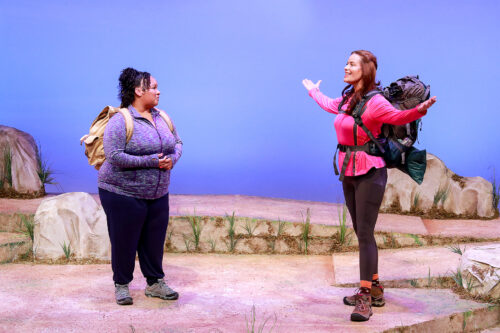
Anna Lise Jensen as Monica talks about the virtues of hiking to Paula played by Kareema Khouri in Actors’ Playhouse’s U.S. premiere of Peter Quilter’s “Step By Step.” (Photo by Alberto Romeu, courtesy of Actors’ Playhouse)
“Step By Step” started as a man’s journey called “The Hill” where Sam, Daniel and Tony join for a climb in a memorial to their friend Gareth. It first opened in Prague in 2020. But during the pandemic, Quilter took “The Hill” and turned it into a female three hander.
Monica, while the daftest of the three, is the most well-rounded character in the comedy and the one that gets the most laughs. Her biggest concern is marrying Graham while her friends – she even does it a few times – keep referring to him as her former love Gary, who ran off with her cousin. Freudian slips abound. It’s Monica’s final week of freedom before her marriage, something she’s hoping the clean mountain air will make her realize that she can “settle down and stop the endless pursuit of sexual conquest.” She doesn’t seem to believe it and she’s hardly convincing. Jensen milks the comic lines for all they’re worth and a scene where she collapses on a tent that is graffitied with all the men she’s had liaisons with inside, like notches on a bedpost, is perfectly over-the-top dramatic.
Sophie, the self-proclaimed White Lesbian in the group, can’t get over a break-up with her ex. At the opening of the play, she’s packed and repacked her backpack. She’s neurotic and having what her friend Paula calls one of her “spectrum” moments to which Sophie replies: “Everybody’s on the spectrum. I’m just on it a little bit extra.”
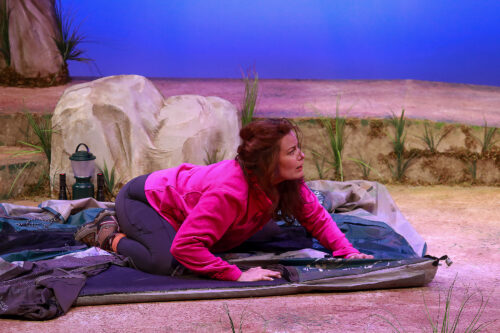
Anna Lise Jensen as Monica has a meltdown on top of a camping tent she’s had since college in a scene from “Step By Step” at Actors’ Playhouse, at the Miracle Theatre through Sunday, Aug. 10. (Photo by Alberto Romeu, courtesy of Actors’ Playhouse)
Her neuroses rage in full force when, out of the blue, her fear of clowns haunts her in the middle of the night on the campsite. Price, who’s a frequent fixture on South Florida stages, manages Sophie with just enough anxiety and compulsion to not have her become an overbearing neurotic caricature.
Khouri, who was so enthralling in Actors’ Playhouse’s “Caroline or Change” last season, stretches her comic chops here as Paula. When she realizes they’ve just hiked up one side of a mountain while a café and car on the other side could have produced the result just as easily, it’s one of the most well-crafted comical deliveries in the show. Unfortunately, the author saddles the character with a joke about two prostitutes that seems left over from his man-comedy “The Hill” but Khouri tackles the challenge with gusto and moves on.
While the 90-minute, no intermission format is enough time for the actual journey, what it doesn’t allow for is a backstory. It’s unclear how the trio met although there is a brief mention of becoming friends in college, How their friendship has endured is never explored. The loss of Rebeca isn’t written in depth enough to anchor the theme of the play.
The author suggests music choices while Actors’ Playhouse’s production tosses in some of their own in between scenes– the requisite “You’ve Got a Friend in Me” and “Get By With A Little Help From My Friends,” and the addition of an arrangement of Leonard Cohen’s “Hallelujah.” These breaks add to director David Arisco’s smart pacing of the show along with his attention to the emotional rollercoaster he’s made sure the ensemble conveys. The trio excels as an ensemble all the while defining their individual characters.

Comrades in arms, from left, Elizabeth Price as Sophie, Anna Lise Jensen as Monica, and Kareema Khouri as Paula in the U.S. premiere of “Step By Step” at Actors’ Playhouse at the Miracle Theatre. (Photo by Alberto Romeu, courtesy of Actors’ Playhouse)
Brandon M. Newton’s set is serviceable with different ramps for the actors to ascend and descend depending on entrances and exits. But the unrealistic depiction of a mountain trail creates a dissonance for the suspension of disbelief that we are accompanying these characters on a real journey. The back screen provides more reality with projections of the sky and clouds and nighttime scenes. Also having scene changes by stagehands, which could have easily been performed by the actors, contributes to the interruption of a seamless flow of buying into the reality.
Eric Nelson’s lighting is bright in all the right places and dark in others and ensures the audience can see what’s happening on stage.
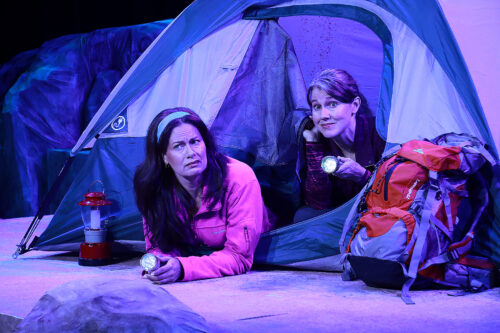
Anna Lise Jensen as Monica and Elizabeth Price as Sophie check out things that go bump in the night on a remote mountain in “Step By Step” at Actors’ Playhouse, Coral Gables. (Photo by Alberto Romeu, courtesy Actors’ Playhouse)
His use of warm lighting reflects the comfort and closeness of the characters and the reason for their journey. Where it could have helped, especially since the stage setting conflicts with the reality, was to be stronger in its indication of time of day – early sunrise, mid-afternoon, dusk.
Reidar Sorensen’s sound design produced the natural woodsy occurrences – birds and nature ambience. Sam Sigler was responsible for set dressing and props design, the graffitied tent and other camping utensils. Ellis Tillman’s costumes helped define each character: Monica’s Lulelemon-esque form-fitting ensemble, Sophie’s sensible and meant-for-hiking boots, and Paula’s heavy on comfort choices.
Like s’mores at a campfire, “Step By Step” is a satisfying treat with indulgent, messy characters and something a little sweet for the inevitable end to summer.
WHAT: U.S. premiere of “Step By Step” by Peter Quilter
WHERE: Actors’ Playhouse at the Miracle Theatre, 280 Miracle Mile, Coral Gables
WHEN: 8 p.m. Wednesday, Thursday, Friday and Saturday; Matinees, 2 p.m., Wednesday, 3 p.m. Sunday through Aug. 10. Check website for pre-show specials.
COST: $50, $60, and $70, weekdays; $65, $75 and $85, weekends.
INFORMATION: 305-444-9293 or actorsplayhouse.org
ArtburstMiami.com is a nonprofit media source for the arts featuring fresh and original stories by writers dedicated to theater, dance, visual arts, film, music and more. Don’t miss a story at www.artburstmiami.com.
No posts found
Creating the Dream that is ‘Disney’s Tarzan’ at Area Stage
Written By Mary Damiano
July 16, 2025 at 9:22 PM
Siena Worland as Jane and Coby Oram as Tarzan in Area Stage’s “Disney’s Tarzan” opening in previews July 17 through Aug. 10 at the company’s performance space in the Shops at Sunset, South Miami. (Photo by Chase Wells, courtesy of Area Stage)
Tarzan, Lord of the Apes, is singing and swinging his way into South Miami.
The character has been a staple of pop culture since 1914, when Edgar Rice Burroughs published the first of 24 novels about an orphaned British boy raised by apes in the jungles of Africa. Many movies about Tarzan followed, including a 1999 animated feature from Disney, which became the basis of a Broadway musical with a book by David Henry Hwang and music and lyrics by Phil Collins.
Area Stage, located in the Shops at Sunset, has had great success with its productions of other Disney musicals, including “The Little Mermaid” and “Beauty and the Beast.” Much of the inventiveness is through the vision of director Giancarlo Rodaz.

Coby Oram plays Tarzan and Katie Duerr plays his ape mother, Kala, in “Disney’s Tarzan” at Area Stage. (Photo by Chase Wells, courtesy of Area Stage)
Rodaz pushes the boundaries of how musicals have traditionally been staged. For “The Little Mermaid,” audiences sat on benches, immersed in the under-the-sea realm of Ariel, while the story sprung to life around them. For “Beauty and the Beast,” the company’s black box space was transformed into the Beast’s castle, and the audience sat at long banquet tables as the characters sang and danced in the aisles and on tabletops.
The director’s cohesive, immersive experience extends to every detail, including the show’s program. A scroll unfurled to reveal a treasure map for “The Little Mermaid” and for “Beauty and the Beast,” the playbill was fashioned as an elegant, oversized menu reminiscent of one presented at a fancy restaurant.
Rodaz says he’s received feedback from audiences who have been entranced by their immersion in the musicals.
“It makes them very happy to escape the world for a little bit and be able to go out . . . with the whole family,” says Rodaz. “And then there are adults that come and step back into their childhoods.”
Not A Theater Kid
Despite growing up in a theater family, Rodaz was not a theater kid.
“I’m the biggest tale of ‘force your kids to do things they don’t want to do’ because I wanted to stay home with my video games when I was a kid.”

Giancarlo Rodaz directing a scene from “Disney’s Tarzan” at Area Stage. (Photo by Jennifer Gomez/courtesy of Area Stage)
He says when his parents, John Rodaz and Maria Banda-Rodaz, launched the theater and a theater school, their coaxing led him to discover theater.
“Like all the best things, the conservatory comes from a place of, what would I do for my own child? What would be the thing that I would make for my child? And my dad said, ‘This is what you’re doing this summer. We’re opening this conservatory and you’re going to be part of it.’ I think arts programs like the conservatory genuinely wake up something in kids.”
A summer at the conservatory at Area Stage changed everything for Rodaz, who was 13 years old and caught the theater bug. He played Motel Kamzoil, the tailor, in “Fiddler on the Roof,” but decided he’d rather use his talents behind the scenes and direct. He helped out at the theater, taking time to learn all the jobs needed to produce a show.
“I always tell people who want to start directing that you should at least have done every job once to fully understand the scope of what you’re asking the people to do,” he advises.

Giancarlo Rodaz became the artistic director of Area Stage in 2023. (Photo courtesy of Area Stage)
Rodaz directed his first show when he was 15, a production of “Winnie the Pooh Jr.,” which he said he took very seriously. Years later, his focus is still on family entertainment, which has become his oeuvre.
“I really love doing those types of stories,” says Rodaz. “I feel like not many people take those stories super seriously or try to do what Walt Disney himself tried to do, which is not make stories for children, but make stories for everybody. That’s very valuable, and that’s something that fuels a lot of what I do.”
Rodaz grew up watching the animated film “Disney’s Tarzan” and has wanted to produce the musical for some time.
“It’s such a fun Disney story to do because it’s not a fairy tale,” says the director. “It’s got fairy-tale elements, but it’s really rooted in the old kind of pulp, serialized fiction of Edgar Rice Burroughs stories. I really love that aesthetic and I haven’t done anything like that before.”
He says that his production of “Disney’s Tarzan” is a bit more “intimate” than the last two immersive musicals he’s helmed for Area Stage.
“It’s very up close and personal. “For ‘The Little Mermaid’ and other Disney shows, we always aimed for this massive scale of things. But we have a small cast to make the show very intimate and brought the story back to a more personal place, so it’s a good fit.”
Rodaz, a big Disney fan, says he used the Disney World theme parks as part of his inspiration for the current summer show.
“This show is fun because it’s digging into that Adventureland aesthetic,” he says. “We have all the expedition equipment. It’s very inspired by Jungle Cruise and the Tiki Room. That’s a lot of the stuff that we looked at for the show.”
‘Tarzan’ Dreams
For Coby Oram, playing Tarzan is a dream come true.
“Tarzan has been a dream role of mine for a while,” said Oram. “I saw it when I was a kid at Tuacahn Center for the Arts in Utah, which is a beautiful, gorgeous, gigantic, outdoor theater space. I saw the regional debut of ‘Tarzan’ with a great family friend playing the titular role. I thought it was amazing. I’ve been keeping an eye out for it ever since I was 12.”
The actor who played Tarzan in the production that captivated Oram was James Royce Edwards, who encouraged Oram toward his theater dreams. When Oram booked the lead at Area Stage, he texted his old friend.

Coby Oram says playing Tarzan is his dream role. (Photo by Chase Wells, courtesy of Area Stage)
“The first thing he said was, ‘Man, I’m so proud of you. You’re going to crush it and you’re going to sing it better than I ever did.’ I don’t know if that’s true, but it was nice of him to say,” said Oram.
Oram was in Kansas City, alternating the lead role of Frankie Valli in “Jersey Boys” with his twin brother, Chris, when he was cast in Area Stage’s production of “Disney’s Tarzan.” Oram never auditioned for Rodaz in person; he was cast through video auditions and callbacks. Oram performed his final show as Frankie Valli and 90 minutes later he was on a plane headed for Miami. He joined the “Disney’s Tarzan” cast, who had already been rehearsing for a week, at 10 a.m. the next morning.
Much like Rodaz, Oram grew up immersed in the arts. He loved theater and performing but was dissuaded from making it his career. He studied engineering in college but dropped out because his true passion was for the arts. He and his brother moved to New York from their native Utah in 2022 and he soon booked his “Jersey Boys” contract.
Before rehearsals, Oram knew Area Stage by their reputation only and had heard about the immersive stagings of other Disney shows.
“When I started seeing the word ‘immersive’ thrown around, I wasn’t quite sure what to expect,” says the actor. “I was very intrigued. And since I’ve gotten here, it’s been such a privilege to see what that all means. The audience is up close. They’re just as up close as we are on stage because they’re sharing space with us.”
Oram says he’s drawn to challenging roles, and Tarzan presents unique role requirements.
“It’s very physically demanding. Rolling all over the floor, jumping up and down, climbing up and down steps, swinging, and doing all that in a loincloth,” he admits.
Rodaz and Oram each have ideas about what they would like audiences to take away from “Disney’s Tarzan.”

Katie Duerr as Tarzan’s ape mother, Kala, and Coby Oram as Tarzan in “Disney’s Tarzan” at Area Stage. (Photo by Giancarlo Rodaz, courtesy of Area Stage)
“Tarzan’ is a beautiful show that has a beautiful message,” says Oram. “Sometimes people are different. Sometimes people look different, or they act different, or their brains seem to develop in different ways, like a human growing up in a jungle. And the beautiful thing to me in this script is that regardless of how different Tarzan is, he’s family. He’s not just accepted, but he’s loved he’s given a place, and he’s allowed to grow into the person he is rather than forced to become someone who fits.”
Rodaz sees “Disney’s Tarzan” as the next step in his journey of getting people excited about theater and entertaining them for a while.
“Kids come up to me, and they tell me it was their first show ever. They’re like, ‘I didn’t know it was gonna be this cool.’ And that’s what makes me want to keep doing it.”
WHAT: “Disney’s Tarzan”
WHERE: Area Stage at Sunset Place, 5701 Sunset Dr., Suite 286, South Miami
WHEN: 7 p.m. Thursday, Friday, Saturday, and Sunday, 2 p.m. Saturday and Sunday. Previews, July 17 and 18, then July 19 through Aug. 10.
COST: $88.75, general admission; $124.75, premium seating. $52.75, general admission for children and students with ID, $83.75. premium seating. Lap seating permitted for children under 3.
INFORMATION: 305-666-2078 or areastage.org
ArtburstMiami.com is a nonprofit media source for the arts featuring fresh and original stories by writers dedicated to theater, dance, visual arts, film, music and more. Don’t miss a story at www.artburstmiami.com.
No posts found
Music, stories and a shared soup the recipe for Miami New Drama’s “¡Viva La Parranda!”
Written By Fernando Gonzalez
July 6, 2025 at 4:14 PM
Singer Betsayda Machado is a commanding presence in “¡Viva La Parranda!” The musical transports the audience to El Clavo and is staged as a backyard get together. Produced by Miami New Drama, the show opens Thursday, July 10 and runs through Sunday, July 27. (Photo by Xavier Lujan, courtesy of Miami New Drama)
“Paint your village and you will paint the whole world” is advice attributed to Nobel Prize winner Leo Tolstoy. Few theatrical experiences in recent memory make the point as vividly or successfully as the immersive music-driven production, “¡Viva La Parranda!”
The musical, commissioned by Venezuelan-born theater director, writer, and producer Michel Hausmann, co-founder and artistic director of Miami New Drama, and produced by Miami New Drama, returns to the Colony Theatre featuring the original ensemble, a revisiting of its premiere in 2019. The show opens Thursday, July 10 and runs through Sunday, July 27.
Staged as a backyard get-together around a typical sancocho, a traditional stew that cooks (for real) throughout the show in a large pot, “¡Viva La Parranda!” transports the audience to El Clavo, a small town in Barlovento, a region in the center north of Venezuela. With an approximate population of 1,500, El Clavo “is not in Wikipedia,” deadpans lead singer Betsayda Machado in one of the on-stage moments.
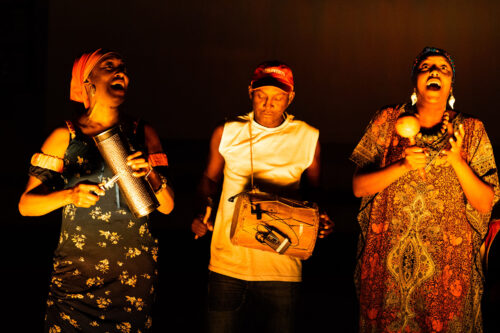
Nereida Machado, Oscar Ruiz, and Betsayda Machado performing in “¡Viva La Parranda!” (Photo by Xavier Lujan, courtesy of Miami New Drama)
Barlovento has deep, centuries-old African roots, and the ensemble plays its music on ancestral instruments such as the mina (a large drum with roots in what is now Benin), the culo’e puya (small drums of Kongo origin), and the quitiplás (bamboo drums). In between songs, there are moving personal stories told by the performers, all neighbors of El Clavo. They aren’t professional actors but their grace and emotion come from authenticity.
Born in Caracas but raised in El Clavo, where her mother still lives, Machado was already a leading voice in Afro-Venezuelan music when an inquiry by producer Juan Souki led to the idea of capturing the experience of la parranda, a genre of Afro-Venezuelan music, but also the name of the ensemble that plays it and the party around the music.
Souki was an admirer of Machado well before he met her.
“I just knew her voice from a recording. It was a large vocal ensemble, so I didn’t even know her name, but I recognized her voice. Betsayda has such a universal voice that it feels like she can sing to you about the pulse of the earth,” he says.
Souki had collaborated with Machado on a bolero project and wanted to do more with her, so he asked her to show him something of interest from her hometown.
“And I told him, ‘Well, from my house, for as long as I can remember, there is a parranda every January first.’ The parranda in the pueblo de El Clavo is older than me, and I’ll be 52 in August,” says Machado in Spanish, during a telephone interview.
“So I took him to the town one weekend,” she says. “I brought all the parranderos up to date; they prepared as if Juan were a visiting mayor, and he was welcomed with a sancocho.”

Nereida Machado, Betsayda Machado, Carlos Fabián Medina, and Blanca Castillo in “¡Viva La Parranda!” The presentation includes English supertitles on the back wall. (Photo by Xavier Lujan, courtesy of Miami New Drama)
The encounter, and hearing Machado perform in place with the group, led to a recording featuring her with La Parranda El Clavo: “Loé Loá (Rural Recordings Under the Mango Tree).” The title was no marketing cutesy.
“No sir. It was recorded under a mango tree,” says Machado. “And we invited the whole town so that they could experience what it was like to record an album. Because this was the first time that the group was called to do a recording.”
It was also Souki’s first recording. “And my last,” he quickly adds. “It’s not what I do. But that album ended up on the New York Times’ list of the best albums of 2017.”
The reception of their recording opened the world to Machado and La Parranda El Clavo and led to international touring and appearances at events such as WOMEX and Global Fest, leading World Music gatherings, and venues such as the Kennedy Center in Washington, D.C.
“The farthest the group had gone was the town of El Guapo. Our first trip [after the album] was to Canada,” says Machado, adding that “of course” the group on stage is only a small representation of the actual parranda. “The parranda is the whole town,” she says. “But I couldn’t bring the whole town onto the stage.”
Hausmann and Souki have known each other since they were teenagers in Caracas, and, as Hausmann puts it, “precocious theater directors.” However, at some point, Souki transitioned to music production and world music, recalled Hausmann. When Hausmann learned about the Parranda El Clavo project, he was moved. “Juan was posting videos about it, and I called him and told him, ‘We got to do a play with them . . . So we spoke about the idea of a documentary play.”
The result is a one-of-a-kind, profoundly moving theatrical documentary.
The backyard staging allows for the personal storytelling and the music to unfold naturally. “I remember that I said that we were going to prepare a sancocho,” says Machado. “And that’s how we have it in the play. Our first experiences as parranderos were born with a sancocho.” Naturally, at the end of the performance, the audience is invited onstage to share the experience and taste the food. That is no showbiz, that is the way of El Clavo.
In addition to Machado, members of the ensemble are Blanca Castillo, a retired nurse; Youse Cardozo, a firefighter; a founding member of the parranda, Asterio Betancourt, is a former basketball player and a drummer; and Nereida Machado, Betsayda’s sister, is a singer, dancer, and insurance analyst.
The stories they tell speak of family and community but also violence, death, single parenthood, drug use, and the back-breaking work in cocoa fields.
“They tell their stories in anecdotes,” says Souki. “At the end of the day, it’s soup, a beer, rice, and telling stories. The text is the literal anecdotes from them and their experiences as they were told to me in a very informal context, not from interviews, but long days of conversation.”
In 2019, when Hausmann first introduced “¡Viva La Parranda!”, he had yet to cultivate an audience that included mainstays, Miami’s predominant Venezuelan community.

From left, Jose Gregorio Gomez, Asterio Betancourt, one of the founders of La Parranda El Clavo, and Youse Cardozo. Barlovento, Venezuela, has deep African roots and the ensemble’s music is a showcase of Afro-Venezuelan rhythms on ancestral drums. (Photo by Xavier Lujan, courtesy of Miami New Drama)
“. . . Part of the reason we are bringing it back is because we might have done that show a little too early in our company’s career. . . This is our way of reminding this community that there is something intrinsic in the Venezuelan spirit that allows for […] continuing at it in the face of adversity.”
The foundation of the musical also brings something to the stage that resonates.
“The emotions are so powerful because they are raw and they are real. It is impossible not to connect with what they feel because we all recognize those emotions. And I think that that is the power of theater: to remind us that we are all made of the same emotional DNA and to some degree, every story is a universal story,” says Hausmann.
WHAT: “¡Viva La Parranda!”
WHERE: Miami New Drama at the Colony Theatre, 1040 Lincoln Road, Miami Beach.
WHEN: 8 p.m. Thursday, Friday and Saturday; 5 p.m. Sunday, from July 10, previews, opening night, Saturday, July 12. Through July 27.
COST: $46.50, $66.50, $76.50
INFORMATION: (305) 674-1040 and miaminewdrama.org
ArtburstMiami.com is a nonprofit media source for the arts featuring fresh and original stories by writers dedicated to theater, dance, visual arts, film, music, and more. Don’t miss a story at www.artburstmiami.com.
No posts found
Spanish Language Theater Company Presents Powerful ‘The Passage’
Written By Maité Hernández-Lorenzo
July 2, 2025 at 5:44 PM
Guillermo Cabré , Caleb Casas, Elba Escobar, Juan David Ferrer, Rachel Pastor star in Josep María Miró’s “The Passage” (“La Travesía”) opening Friday, July 11 at the Westchester Cultural Arts Center. The play is in Spanish with simultaneous English translation. (Photo courtesy of Arca Images)
There’s a reason Catalan author Josep María Miró’s “The Passage” (in Spanish, “La Travesía”) has been translated into more than five languages.
The play, with its universal message, deals with the origins of human actions and why we do what we do.
Arca Images is presenting the Miami premiere of “The Passage” directed by Carlos Celdrán and, for the fourth time, the return of a work by the multi-award-winning Miró to the Miami stage.
In collaboration with Ajedrez Eventos de México, Roxy Theater Group, and the Miami-Dade County Auditorium, performances are at the Westchester Cultural Arts Center from Friday, July 11 to Sunday, July 20. The play will be presented in Spanish with simultaneous English translation.
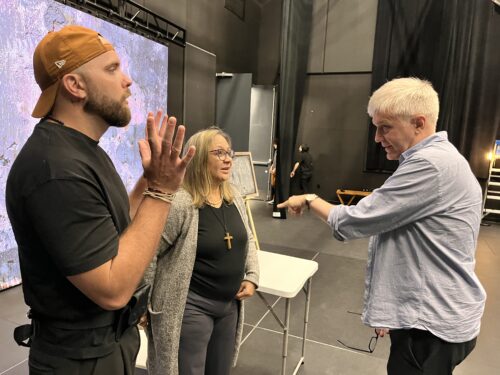
Actors Guillermo Cabré as Isaac and Elba Escobar as Sister Cecilia in rehearsal with director Carlos Celdraěn for “The Passage” (“La Travesia”) for Arca Images. (Photo courtesy of Arca Images)
“I was interested in talking about a conflict that takes place in ‘no man’s land’, where the protagonists go to help and realize there are also flaws in their work,” says Miró, about the work written in 2015.
In the plot, Sister Cecilia, the main character played by Elba Escobar, undertakes an ethical journey after a girl dies in her arms as a result of being brutally assaulted. The event forces her to reflect her work with a humanitarian project located in a war zone.
For Celdrán, resident director of Arca Images, Miró’s work “delves into a complex and unprecedented landscape.” He was seduced by the story, Celdrán emphasizes, because it is “material that allows us to think about the present, the current situation, the dilemmas of contemporary beings from a very personal perspective.”
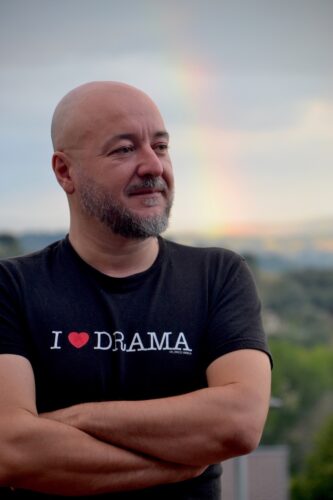
Catalan author Josep María Miró’’s “The Passage” (in Spanish, “La Travesía”) is getting its Miami premiere by Arca Images (Photo by Ramona Coromina, courtesy of Arca Images)
Miró observes the strength of the piece in its discourse and its characters, who likes his writing to be a challenge for the actors on stage as well as the audience. “It’s a work,” he says, “above all, of actors, which is very attractive because of what it presents in terms of acting and theatricality.”
Escobar is joined by Arca Images’ actors Juan David Ferrer (Rai), Caleb Casas (Oscar), Guillermo Cabré (Isaac), and Rachel Pastor (Sister Isabel).
Celdrán emphasizes that “unraveling the keys to the text is a fundamental exercise. He is an essential author who meticulously focuses on every word, every detail, and every pause. His text is a living, breathing, and complementary organism. It is a form of writing of the utmost rigor that forces you to pay attention, to listen to the silences, the smallest hints.”
Connoisseurs and admirers of their respective works, the creative exchange has been a “different journey” for both artists, in which Miró’s theatrical language and Celdrán’s theatrical vision intersect.
Actor Caleb Casa plays Oscar in “The Passages” (“La Travasia”) (Photo courtesy of Arca Images)
“It’s a dialogue born of admiration, respect, and friendship. I find Celdrán to be a highly stimulating person. If we shared the same geography, I would surely have sneaked into a rehearsal to see the process, to see how the actors make the journey, but always from a place of respect,” says Miró.
Miró will attend performances of “The Passage” in Miami after the Barcelona premiere of his most recent work, “The Monster” (“El Monstruo”), in early July.
“What do I expect from the Miami audience? I like to see how they breathe, what questions they have, and how they read it. It’s exciting to come back and see how the audience receives it,” says the playwright.
Alexa Kuve is the founder and executive producing director of Arca Images. (Photo by Justin Macala, courtesy of Arca Images)
Alexa Kuve’s company, Arca Images, receives a nod from Celdrán regarding the types of work selected to bring to Miami audiences. In response to Miró’s play, Celdrán comments, “It’s always worth investing in the theater that speaks to the present.”
Following the Miami performances, “The Passage” will travel to the El Círculo Teatral in Mexico City for a show at 6 p.m. on Sunday, July 27.
WHAT: Premiere of “La travesía” by Josep María Miró (in Spanish with simultaneous translation into English).
WHEN: 8 p.m., Friday, July 11 and 18, and Saturday, July 12 and 19; 5 p.m., Sundays July 13 and 20.
WHERE: Westchester Cultural Arts Center, 7930 SW 40th St., Miami
COST: $30 general admission, $25 for seniors and students with valid ID.
INFORMATION: www.arcaimages.org
ArtburstMiami.com is a nonprofit media source for the arts featuring fresh and original stories by writers dedicated to theater, dance, visual arts, film, music, and more. Don’t miss a story at www.artburstmiami.com.
No posts found
City Theatre makes a move, changes format for annual ‘Summer Shorts,’ here’s why
Written By Michelle F. Solomon
June 24, 2025 at 5:57 PM
City Theatre will present a four-show event, script-in hand readings of 20 short plays from Thursday, June 26 through Sunday, June 29 at the Sandrell Rivers Theatre, Miami. Four of the original plays are from writers who are part of City Theatre’s “Homegrown” Playwright Development Program; some members of the group are pictured above. (Photo by Morgan Sophia Photography, courtesy of City Theatre)
It was 29 years ago when City Theatre premiered its first edition of “Summer Shorts,” which has become a staple of summer theater in South Florida.
The short play festival started at the University of Miami’s Ring Theatre in June 1996 with eighteen plays in two programs.
“Shorts” moved to the Carnival Center in 2007 (now the Arsht Center), where it has played ever since in the smaller black box Carnival Studio Theatre.
Now facing a financial shortfall after losing $50,000 as one of the casualties of Florida Gov. Ron DeSantis’ vetoing of more than $32 million in state arts grants for 2024-25, City Theatre’s “Summer Shorts” producers say they had to get creative in how to present its annual short play festival. Canceling it wasn’t an option.
“The cost of producing theater has gone up over the years, especially since the pandemic,” says Gladys Ramirez, City Theatre’s executive director. “And then, last year, when the state of Florida cut funding to hundreds of organizations, including ours for general operating support, one of the realizations was that we could no longer afford to present ‘Summer Shorts’ at the Arsht Center. So, we needed to pivot.”

Actors Daniel Llaca and Catherine Verblud in the Homegrown playwrights developmental workshop reading. (Photo by Morgan Sophia Photography, courtesy of City Theatre)
And along with the cuts from the state of Florida, Ramirez says there was a reduction in funding from Miami-Dade County as well as funding from the National Endowment for the Arts. “We were just getting hit from all directions, so looking at the budget, we couldn’t afford six-week contracts with artists to do a full production.”
The pivot was a new venue, the Sandrell Rivers Theater in Liberty City, and a new format: A four-show event, script-in-hand readings of 20 short plays. “So right now we’re still working with 30 actors, nine directors, and 20 playwrights, and we still have new works by local playwrights as part of the lineup,” says Ramirez. Different than in past years, each show will have a different mix of five ten-minute plays.
Four of the plays are from writers who are part of City Theatre’s “Homegrown” Playwright Development Program: Bianca Utset, Nick Valdes, Cristina Marie Pla-Guzman and JC Gutierrez. Other plays in the festival were selected from the Susan J. Westfall National Short Playwriting Contest, which is a nationwide call for playwrights to submit short scripts of any style or genre.
Pla-Guzman, whose play “I. You,” will be performed at 3 p.m. on Sunday, June 29, says that when she first met with the Homegrown group, she knew the directive was to work on a short play for the festival.
“A lot of things in my life personally were happening at the same time. I had just lost my grandmother whom I loved very much, and I was dealing with my oldest daughter’s autism diagnosis. You know, they say writers should write what they know, so I started capturing moments in my life.”
She says the play is very closely autobiographical about a mother and her two daughters dealing with an autism diagnosis and being “pushed and pulled to grow through love, and under that, unconditional love is there all the time.”

Homegrown Playwrights Cristina Marie Pla-Guzman and JC Gutierrez have their short plays debuting in City Theatre’s “Summer Shorts Festival” at Sandrell Rivers Theatre. (Photo by Morgan Sophia Photography, courtesy of City Theatre)
Pla-Guzman brought in a prop for her reading, yellow roses. “My grandmother loved yellow roses.”
She says in her short play, yellow roses fall from the sky as a symbol to the mother signaling that her grandmother is always with her, guiding her.
An educator and an actor, Pla-Guzman says she’s accustomed to performing her own work, so this will be the first time she’ll be seeing someone else’s interpretation of what she’s created.
“I’m excited about that and nervous,” she admits. Next up for the Homegrown playwright is the directive to write a full-length script. “I already have an idea,” she says.
JC Gutierrez’s short “Burn Book” takes on banned books. He’s also directing two of the short plays in the festival.
“I feel like City Theatre is always good at coming up with stuff that’s funny, relevant, and topical, and it hasn’t lost that part of its charm,” he says about the new format.
Gutierrez, who majored in theater performance at FIU, and is now the artistic director at JCAT, a theater at the JCC in North Miami, and an arts educator, says getting into the Homegrown program was a way for him to get more serious about playwrighting.
“I had always written but never really received guidance and structure. It’s the one thing in my theater wheelhouse that I hadn’t developed as much, so I wanted to take the opportunity to work alongside other developing playwrights.”

Adding a throughline to festival is actress/comedian Jannelys Santos who will be the emcee. She’s the chief operating officer of Little Haiti’s Villian Theater and has been performing with Villain since 2015. (Photo courtesy of Villain Theater)
The idea for his short, performed at 7:30 p.m. on Saturday, June 28, came from his background of teaching ancient studies and world history to middle and high schoolers. “It’s essentially about the last literate man on Earth who is a former professor. He’s been hired, well, forced, to burn books and only keep the ones that are safe for consumption, according to the government. He’s taking too long to do it, so they enlist a ‘dreg,’ an illiterate person and the lowest member of the social class in this dystopian world. Together, they discover a book of all of the sacred texts of humanity and they have to decide whether they need to burn it or not. That’s where the conflict happens.”
Adding a throughline to festival is actress/comedian Jannelys Santos who will be the emcee, an original character Santos created for the production. She’s the chief operating officer of Little Haiti’s Villian Theater and has been performing with Villain since 2015. “Summer Shorts” is a co-production with Villain Theater this year. Additionally, Peter Mir of Villain is the partner in crime to Santo’s Sanchez as the bandleader in an original role he created.
“We definitely wanted to give this more of a production value than a reading series,” says Margaret Ledford, City Theatre’s artistic director. “Villain Theater are experts in the short form, such as improv and stand-up comedy. So when we put our heads together we thought that they would be the perfect partner.”
Santos will play an original character created for the festival, emcee Rhonda Sanchez (say the name aloud for the riff on Florida’s governor).
“The show is fully produced in the sense that we’ve created this fictional character as a host and we’ll have live music with a few musical numbers, and a projection component. So it will feel more elevated than a staged reading in black box,” says Ramirez.
Continuing “Summer Shorts” at a different venue and using the staged reading format took some consideration before it was finally settled on, reveals Ramirez.

City Theatre’s “Summer Shorts Festival” is hosted by Rhonda Sanchez, an original character created for the production. (Photo courtesy of Villain Theater)
“People were like, ‘Why are you doing this?’ It was a very difficult decision that took a lot of conversation between Margaret and I and our board. We have this duty as a nonprofit and as artists to be creative and continue creating opportunities for our community, and to laugh. Because what else can we do, you know? And so that’s why the device of using Rhonda to create this awareness in a parody format is really what we’re going for,” says Ramirez.
There’s a bit of a comfort level, too, for Ramirez and Ledford working at the Sandrell Rivers Theatre. Fantasy Theatre Factory, who mostly perform, and tour works for young audiences, is the company that manages and operates the theater.
“Both Gladys and I cut our teeth with Fantasy Theatre Factory. We were both actors, at different times, with FTF. I think this is a great move for us,” says Ledford.
WHAT: City Theatre’s Summer Shorts Festival
WHERE: Sandrell Rivers Theatre, 6103 NW 7th Ave., Miami
WHEN: 7:30 p.m., Thursday, June 26, Friday, June 27, Saturday, June 28 and 3 p.m., June 29
COST: $25, general admission, $40 VIP tickets include up-front cabaret-style seating and a signature cocktail. Tickets at ftfshows.thundertix.com/events. Free parking.
INFORMATION: (305) 284-8872 and www.citytheatre.com/summershorts
ArtburstMiami.com is a nonprofit media source for the arts featuring fresh and original stories by writers dedicated to theater, dance, visual arts, film, music and more. Don’t miss a story at www.artburstmiami.com.
No posts found
Miami Workshop Seeks To Answer The Question ‘What’s Really Immersive’?
Written By Michelle F. Solomon
June 24, 2025 at 1:14 PM
Juggerknot Theatre Company and Live Arts Miami are hosting the first annual “Miami Immersive Intensive (MMI)” Thursday, June 26 through Sunday, June 29. Pictured is “La Medea” by Yara Travieso presented by Live Arts Miami. (Photo by Darren Philip Hoffman, courtesy of Live Arts Miami)
Projected renderings of the works of Van Gogh, Monet, and Michelangelo surround the museumgoer. Bubbles release cloud forms covering participants at another museum. A theater performance in a motel brings the audience in as part of the play’s world putting them in active role that furthers the story. Dancers create choreography in step with the ocean communing with the environment.
These are the new wave of arts experiences and the buzzword is everywhere — “immersive.” Some are true to form while others merely borrow elements from the immersive playbook but don’t fully deliver.
Tanya Bravo, who began Juggerknot Theatre Company in 1999 in Miami, has been focused entirely on producing immersive theater for the past 10 years. Now she’s hoping to make Miami a center of learning for the future of the arts genre.
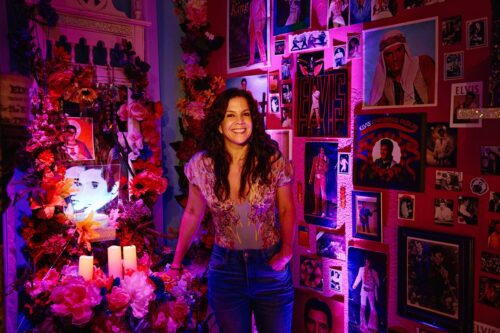
Tanya Bravo, co-founder of the Miami Immersive Intensive and artistic director of Juggerknot Theatre Company. will lead a case study on “Miami Motel Stories” during the Miami Immersive Intensive. (Photo by Scott McIntyre, courtesy of Juggerknot Theatre Company)
From Thursday, June 26 through Sunday, June 29, Juggerknot Theatre Company and MDC’s Live Arts Miami will co-produce the first annual “Miami Immersive Intensive (MMI)” with most programming taking place at The Idea Center on Miami Dade College’s Wolfson Campus.
“We want to position Miami as a global hub for immersive training,” says Bravo. “That’s not happening anywhere else. We have the people here who want to learn it, but you also have the people here who want to teach it.”
While workshops and speakers are mostly relegated to those participating in the MMI conference, there are some opportunities for the public to get a feel for what true immersion is about.
On opening night, Thursday, June 26, a multimedia experience, created by the French transmedia collective Le Clair Obscur, places the audience in a suspended space-time at the Frost Museum of Science in collaboration with another “putting Miami on the map” organization, FilmGate, who each year produces a convergence of the latest happening in film and technology during Miami Art Week.
Other open-to-the-public activities are a virtual workshop from 2:30 to 3:30 p.m. on Friday, June 27, with Lauren Storr, senior producer at Punchdrunk, the creators of the groundbreaking “Sleep No More.” The reimagining of Shakespeare’s “Macbeth” invited audiences to explore a story at their own pace wandering throughout New York’s McKittrick Hotel. After a 14 year run, “Sleep No More” closed in January but it is legendary for how it attracted return audiences in a true-form immersion experience where no two experiences were alike.

The National Water Dance performance on Key Biscayne, presented by Live Arts Miami, is a catalyst that encourages ongoing engagement between artists and the environment. (Photo by MagicalPhotos.com / Mitchell Zachs, courtesy of Live Arts Miami)
At 6:30 p.m., Saturday, June 28, in The Art Lab at MDC Wolfson Campus is a screening of the documentary “Meow Wolf: Origin Story,” about the mind-bending art collective that has become a phenomenon. With its flagship installation “House of Eternal Return” in Santa Fe, which combined art, technology and storytelling, they’ve now expanded to Las Vegas, Houston, and Denver, with more exhibition spaces on the way. Alexandro Renzo, “Meow Wolf’s” creative director will be part of a question-and-answer session.
“They were a group of scrappy visual artists in Santa Fe who were creating these immersive walk-through visual experiences that have completely blown up. This is the story of how the collective started,” says Bravo.
It was from her own experience in New York participating in the late Phillip Seymour Hoffman’s LAByrinth Theater Company’s week-and-a-half-long workshop that the idea of an intensive such as MMI brewed for years.
Bravo had taken a break from theater, working in corporate America, when she attended LAByrinth’s intensive. She ended up being in a show produced by PopUp Theatrics, run by the now Yale School of Drama program chair Tamilla Woodard.
“It was this one-person-at-a-time immersive show that took place in the Lower East Side in Manhattan, and you would go through retail locations and different spaces and learn about them. And when I experienced that, I was like, this is what I want to do. This is the future of theater. This is what we need right now.”
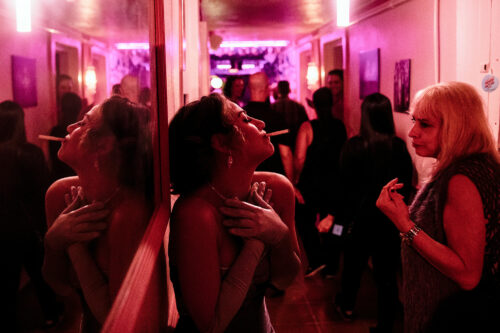
The power of immersive theater and the intimacy between audience and performing will be discussed throughout the Miami Immersive Intensive. Photo is from “Miami Motel Stories: North Beach” by Juggerknot Theatre Company.
(Photo by Scott McIntyre, courtesy of Juggerknot Theatre Company)
She returned to Miami, connected with an old friend Juan C. Sanchez, who had written a play called “Paradise Motel” and they turned it into the immersive real-time theater experience, “Miami Motel Stories.” Woodard was enlisted to direct.
“It was the first immersive piece that we did and then after that it was five years of non-stop Miami motel stories,” says Bravo.
She believes that now is the time to present a deep dive for presenters to get to the core of what constitutes an immersive production.
“We are at a point where everyone wants to create ‘immersive.’ So, then there’s a responsibility, as an organization, to train (them), we need to understand what immersive really is,” says Bravo.
While there are events open to the public, the intensive is focused on those who are interested or working in the field of immersive work.
“I’m hoping that we take that buzzword and we make it a little bit more concrete for creators on how they actually do immersive,” says Bravo.
For the first MMI, Bravo says about 85 percent of participants are local but they’ve already started planning for next year.
Plans are for the MII to be held each summer to grow it into a training ground for those who want to work, or who are already working, in the immersive space.
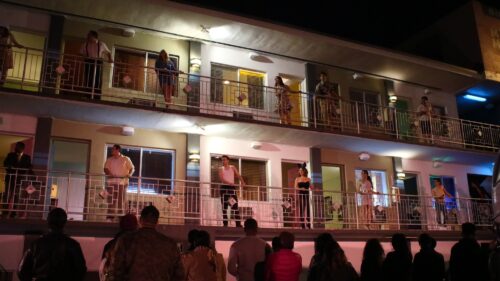
Juggerknot Theatre Company’s “Miami Motel Stories” reimagined storytelling through an immersive production by Juan C. Sanchez (Photo courtesy of Juggerknot Theatre Company)
“We are hoping it can be a magnet for people to come to Miami from everywhere,” says Kathryn Garcia, executive director of Live Arts Miami, who is co-producing the MMI with Juggerknot. “We want to create that next level for people who are working in this field, who are trying new things and deepen their skill sets.”
In additional to national speakers including keynote speaker and workshop leader MiKhael Tara Garver, founder of Culture House Immersive and director of Disney’s groundbreaking “Star Wars: Galactic Starcruiser” experience, local “experts” including Octavio Campos, choreographer and director of intermedia performance, Pioneer Winter, artistic director of Pioneer Winter Collective, France-Luce Benson, playwright, “Miami Bus Stop Stories,” Natasha Tsakos, known for live performance in microgravity and Bravo, will be presenting workshops.
Garcia stresses that with the breadth of speakers and presenters they’ve enlisted, there’s an opportunity for variety.
“That’s intentional because there’s something great that happens when you let go of the borders of discipline and just bring artists together for a common purpose. Everyone who will be involved is interested in this particular way of storytelling, whatever the form may be,” says Garcia. “But I also think that this genre is still growing and defining itself and maybe that’s what we learn, which ultimately keeps things exciting for audiences.”
WHAT: Miami Immersive Intensive: MMI
WHERE: Miami Dade College Wolfson Campus, 315 NE 2nd Ave., Building 8, Miami
WHEN: Begins at 2 p.m., Thursday, June 26 through 5 p.m., Sunday, June 29.
COST: $350, MII four-day pass, $40, Punchdrunk Live Stream, $10, “Meow Wolf Film Screening and Q&A. Does not include fees.
INFO: Complete program guide at www.miamiimmersiveintensive.com/program; tickets at https://www.squadup.com/events
ArtburstMiami.com is a nonprofit media source for the arts featuring fresh and original stories by writers dedicated to theater, dance, visual arts, film, music and more. Don’t miss a story at www.artburstmiami.com.
No posts found
Musical ‘Chicago’ In Its 50th Anniversary at the Arsht has Miami stories
Written By Michelle F. Solomon
June 12, 2025 at 1:56 PM
The cast of the national touring company of “Chicago” coming to the Adrienne Arsht Center opening on Tuesday, June 17 through Sunday, June 22. It’s the final stop for the current tour. (Photo by Jeremy Daniel)
Michael Vita remembers when the musical “Chicago” opened on Broadway in 1975. He remembers because he was there as part of the dance ensemble.
The former Miami Beach resident was on stage with Gwen Verdon as Roxie Hart and Chita Rivera as Velma Kelly.
He was there when it premiered at the 42nd Street Theater.
He was there when they cut a number from the production, one that would have given him a speaking part. “I was to play the prosecutor and it was a nice scene with Gwen. It introduced a song that was cut called ‘Ten Percent.’ It was superfluous so they cut that and they cut my lines going into it.”
Needless to say, he was disappointed.

Michael Vita, right, with Gwen Verdon and dancers from “Sweet Charity” performing on the “Ed Sullivan Show” in 1966. (Photo courtesy of Michael Vita)
Vita was also there in August of 1975 when leading lady Verdon left the show for five weeks for throat surgery and Liza Minnelli became her understudy.
“They announced at the beginning of the show that Gwen Verdon would not be in the performance and the audience did a disappointing ‘ooooh.’ And then it was announced that the role of Roxy would be played by Liza Minnelli and when the audience heard that they went wild,” he said.
There are 50 years of history in the Broadway musical “Chicago” and with the Broadway national touring production coming to Miami’s Arsht Center, the musical’s history, past and present, has Miami connections.
Vita, now 84 and a South Floridian who lives at the Court of Palm Aire in Pompano Beach is proud to have been a part of Broadway history.
“The theater never leaves you,” he said.
But “Chicago” wasn’t his first Broadway show.

“Bye Bye Birdie” with Dick van Dyke, Michael Vita, and Chita Rivera. (Photo courtesy of Michael Vita)
Growing up in the Bronx, he began performing while attending the High School of Performing Arts in New York. “I was 17 years old, and a friend called to tell me they were auditioning for a new show ‘Bye Bye Birdie.’ “
‘Birdie’ opened on Broadway in 1960 and starred Dick Van Dyke and Rivera, who he would work with again in “Chicago.”
And almost a decade before he’d dance with Verdon in “Chicago,” he’d be cast in the ensemble of “Sweet Charity” in 1966, where she was the lead.
Vita says in all of his time as a Broadway performer he was a feature player. “I never wanted to be a star; that was too much pressure.”
He left Broadway and the theater at age 50 to “try something else,” moving to San Francisco to work with AIDS organizations.
While in New York, he helped in the creation of the Equity Fights Aids Committee to “assist and support [Actors’ Equity Association] members afflicted with AIDS.” This then became Broadway Cares/Equity Fights AIDS.

The Michael Vita archive at the Stonewall National Museum, Archives and Library in Fort Lauderdale from Vita’s collection. (Photo/Stonewall Museum/Instagram)
He’s never given up the urge or the love to entertain.
“I do two performances a year in the Fall and in the Spring here at the Court of Palm Aire. I don’t sing Broadway showtunes, though, I sing songs that have meaning to me. There are about 125 people that come and it’s amazing.”
The Miami connection for the original “Chicago” starts with Vita and comes full circle with Christopher Cline as the final performances of the current national Broadway touring production concludes at the Adrienne Arsht Center The show opens on Tuesday, June 17 and runs through Sunday, June 22.
Cline, a University of Miami graduate, has been with the production for its 2024-25 season of the 50th anniversary tour of the show.
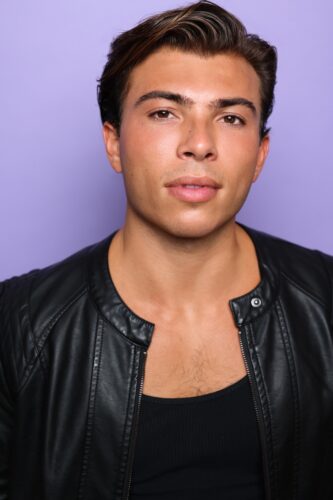
Christopher Cline is in his first national Broadway tour, “Chicago,” and is a graduate of University of Miami. (Photo courtesy of the Adrienne Arsht Center)
Originally from New Jersey, he graduated from University of Miami “exactly two years ago” with a BFA in musical theater.
“I’m in the ensemble and I also play Sergeant Fogarty and this is my national tour debut.”
Just after graduation from UM, he joined the cast of “Mamma Mia!” on the Royal Caribbean Cruise Line. “I was on the ship about seven or eight months but worked for Royal Caribbean for a year on land,” he says, adding that Royal Caribbean’s studios for rehearsals are on the campus of Florida International University.
“I was happy to be in Miami. There are people from all over the world in those studios. I have friends I’ve made from just about every country,” says Cline.
Being a part of the “Chicago” tour has been an experience for the performer, he says, on many levels.

Christopher Cline as Sergeant Fogarty, center, with Andrew Metzger as Amos and Ellie Roddy as Roxie Hart in the national touring company of “Chicago” coming to the Adrienne Arsht Center. (Photo by Jeremy Daniel)
“There’s maybe an additional responsibility and a bit of pressure to really honor the show, but I also remember that I am just a small piece in this large puzzle that was created much before I was even here.”
Cline believes that the show is still playing on Broadway because it’s “timeless.”
“There’s one moment I hear every night in the show that always kind of makes me chuckle to myself and it’s when Roxy and Velma sing, ‘In 50 years or so, it’s going to change, you know.’ And the irony of it is that it’s been 50 years and ‘Chicago’ hasn’t’ changed. And I think that it will be around for another 50 years; it will resonate with a whole different generation.”
WHAT: “Chicago”
WHEN: 8 p.m., Tuesday, June 17 through Saturday, June 21. 2 p.m. Saturday, June 21 and 1 and 7 p.m. Sunday, June 22.
WHERE: Ziff Ballet Opera House at the Adrienne Arsht Center for the Performing Arts, 1300 Biscayne Blvd., Miami
COST: $41 to $182 (includes fees)
INFORMATION: (305) 949-6722 and arshtcenter.org
ArtburstMiami.com is a nonprofit media source for the arts featuring fresh and original stories by writers dedicated to theater, dance, visual arts, film, music and more. Don’t miss a story at www.artburstmiami.com.
No posts found

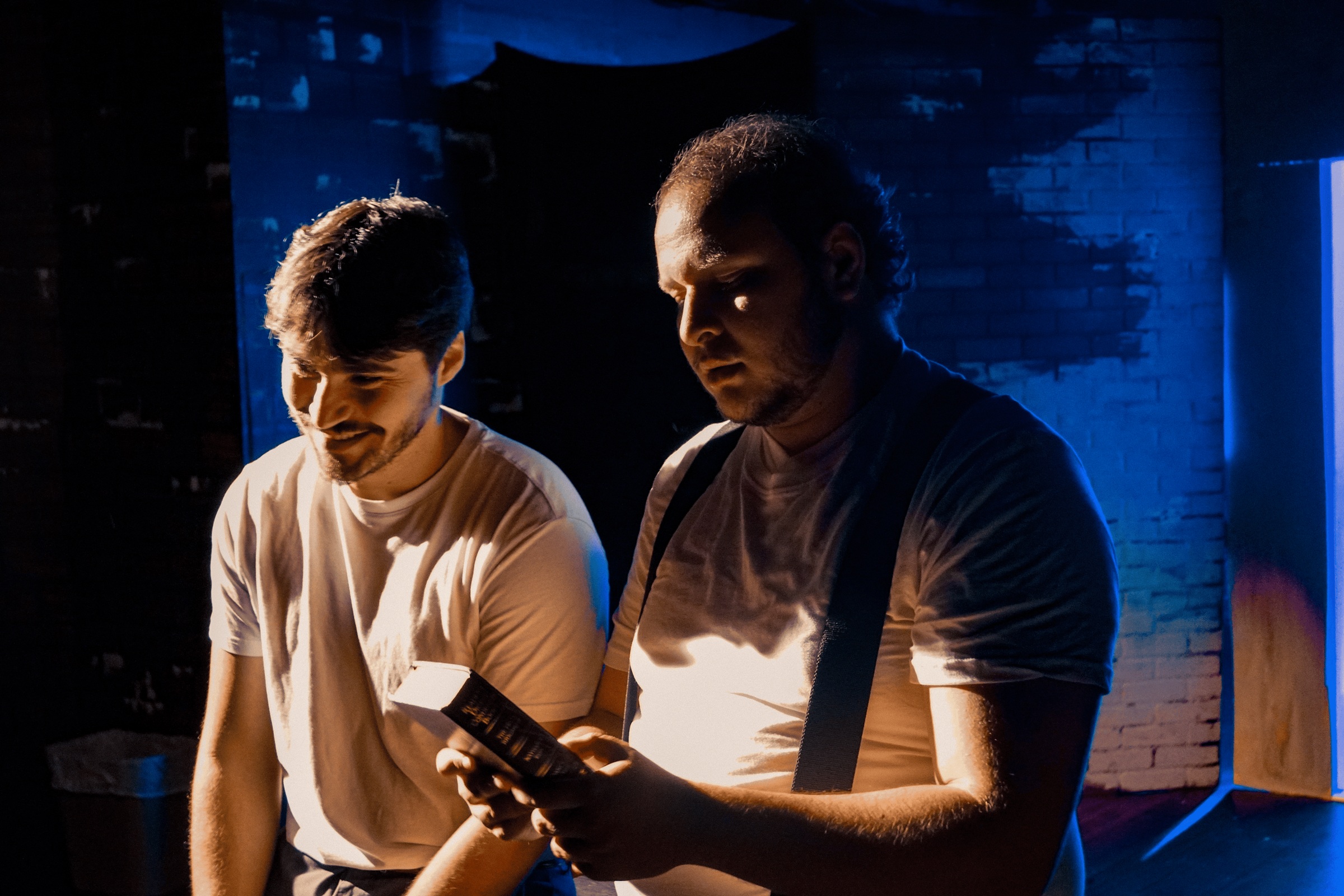
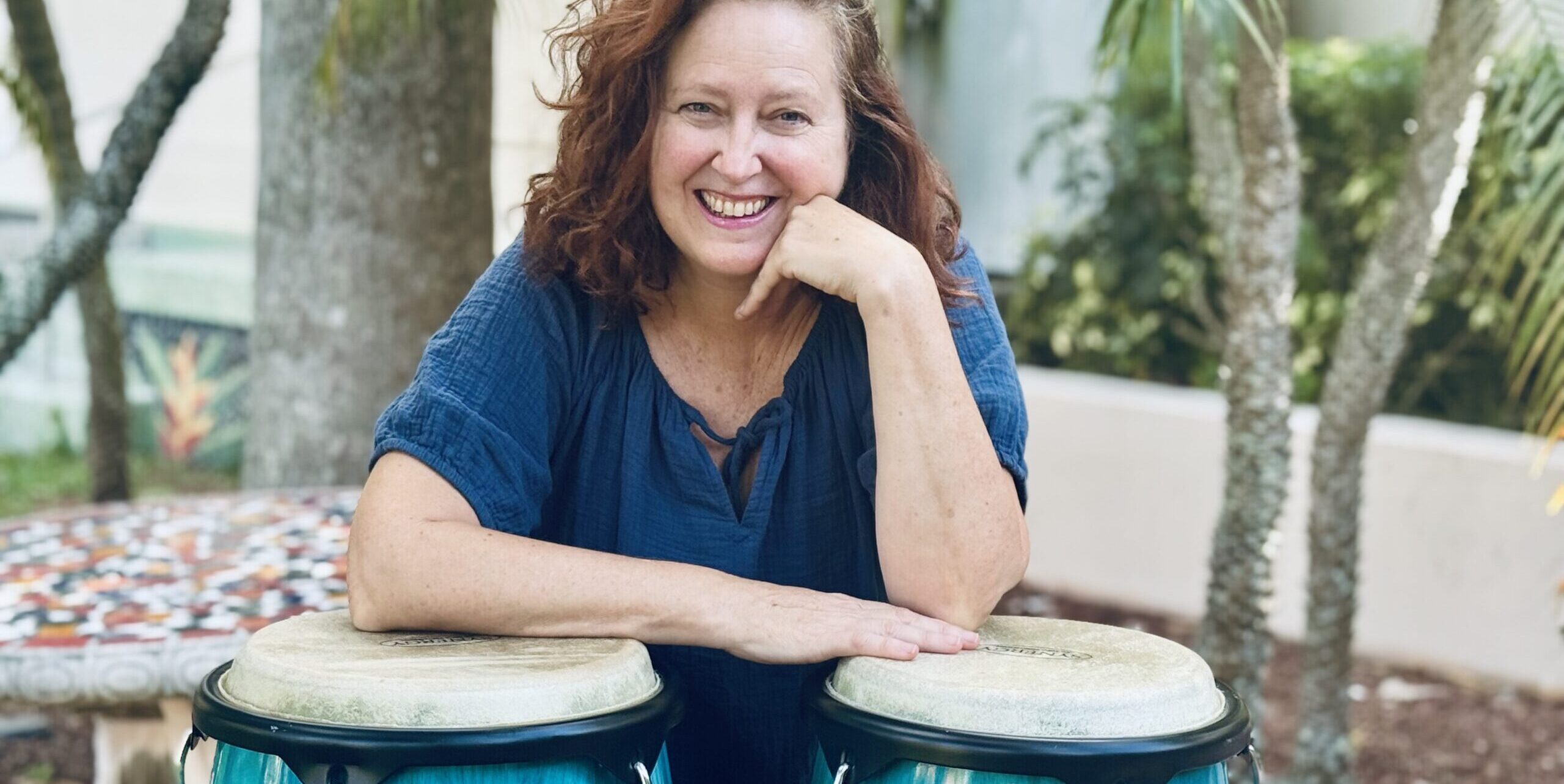

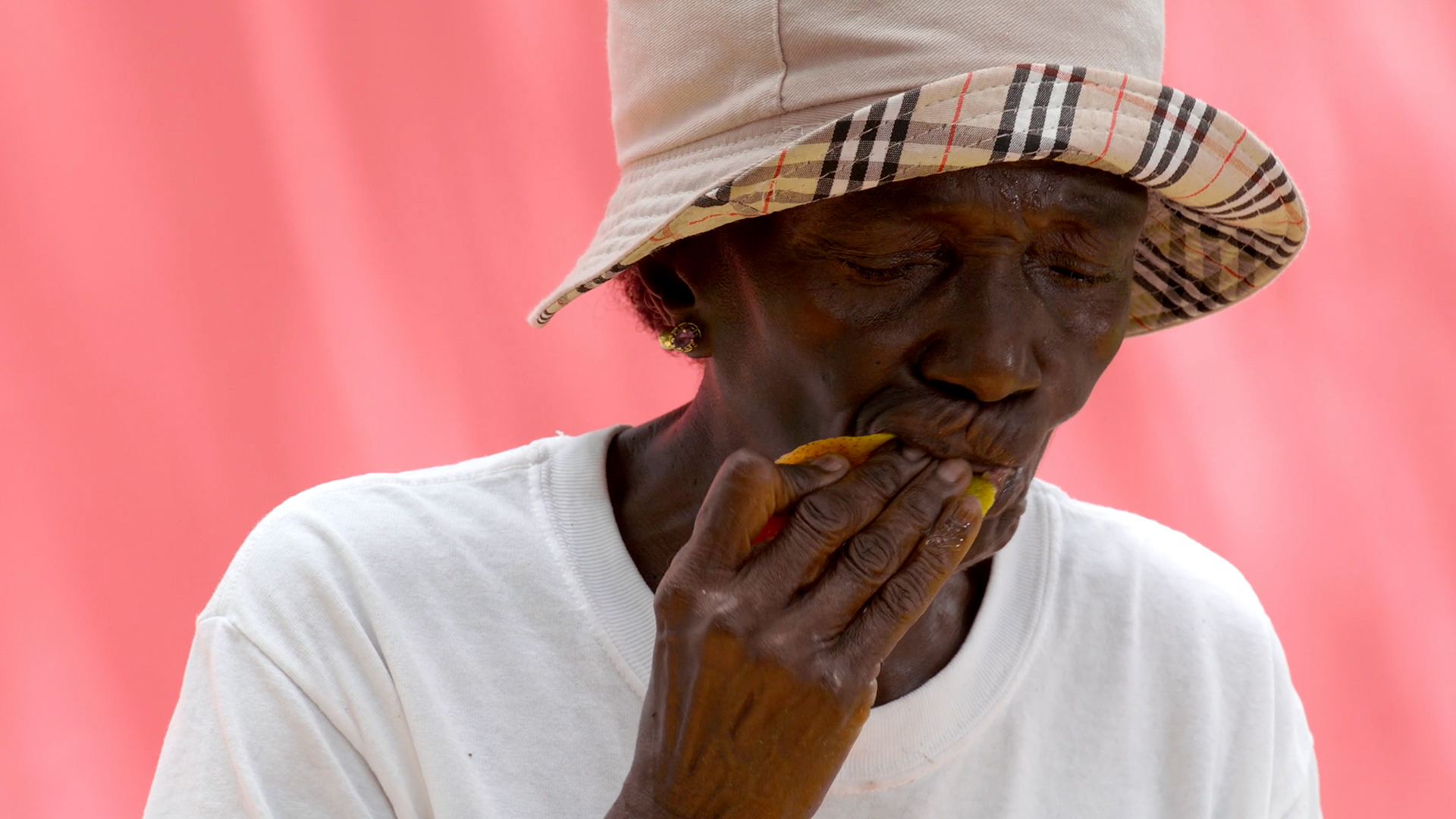
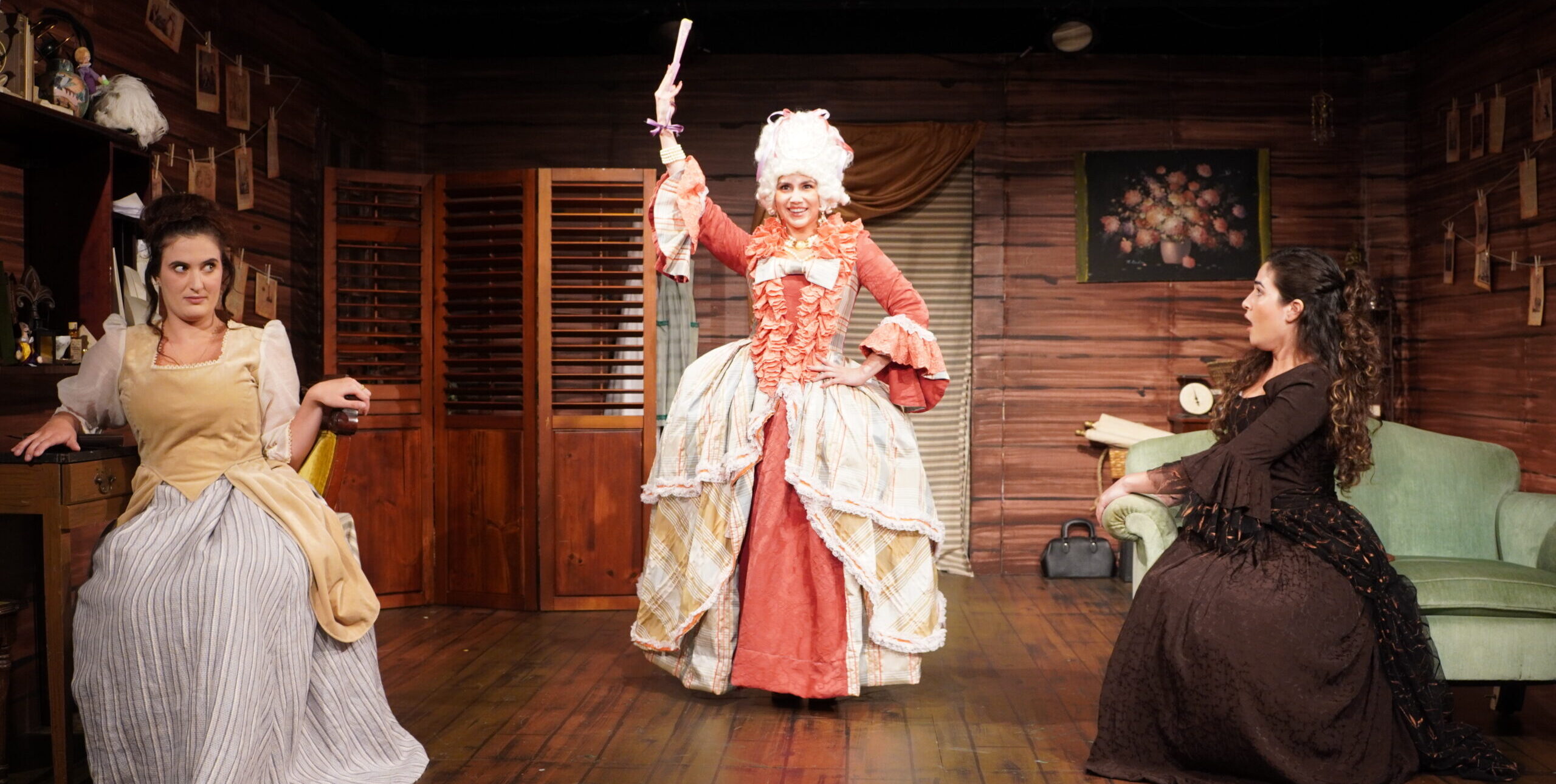


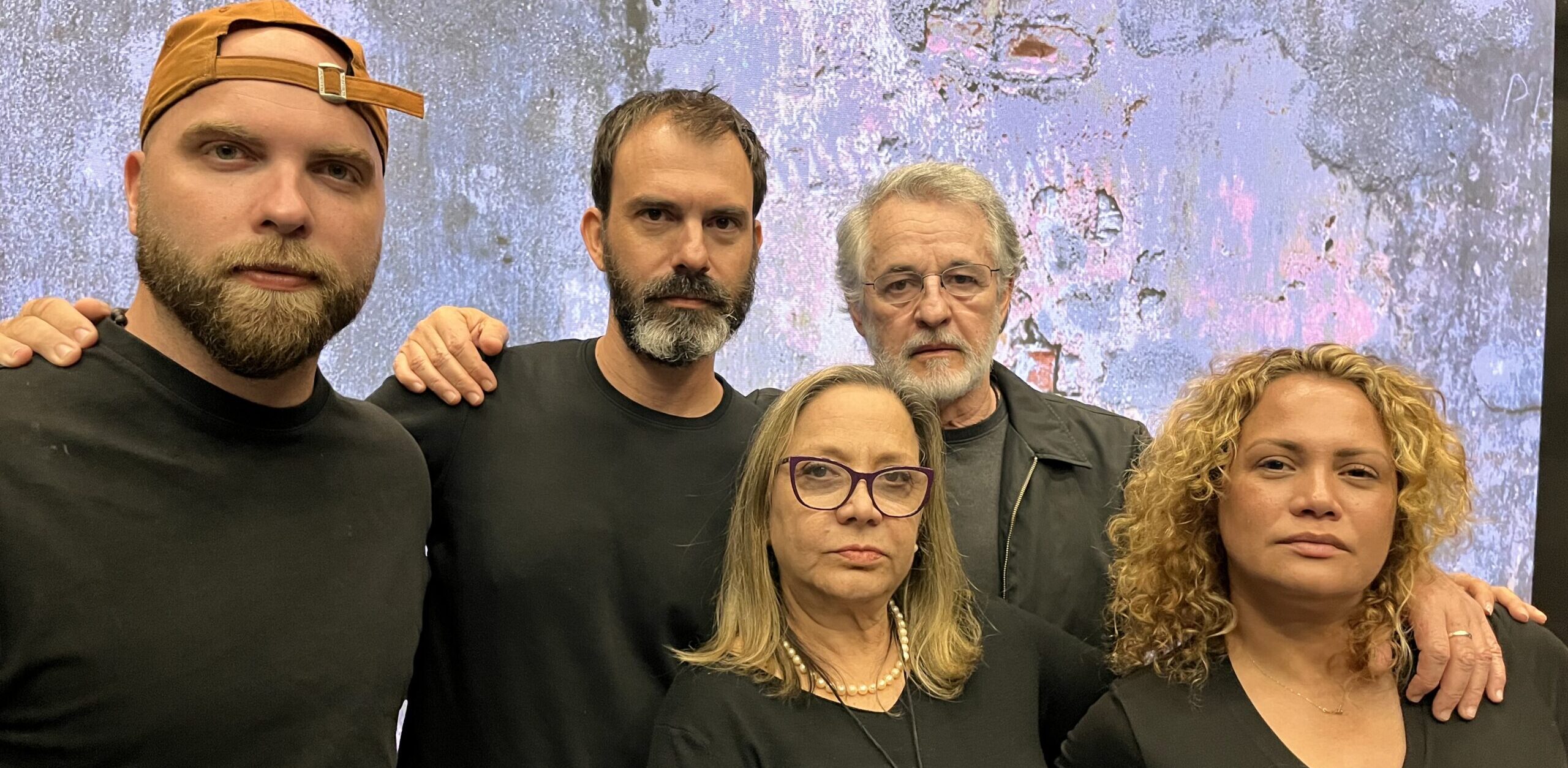



Recent Comments