Blog Article Category: Theater / Film
Inside ‘The Zionists’ And The Voices Shaping Miami New Drama’s Bold New Premiere
Written By Michelle F. Solomon
April 9, 2026 at 9:48 PM
Miami New Drama presents “The Zionists: A Family Storm,” a world premiere by S. Asher Gelman through Sunday, May 3 at the Colony Theatre, Lincoln Road, Miami Beach. (Photo by Morgan Sophia Photography, courtesy Miami New Drama)
At a moment when difficult conversations are often avoided, Miami New Drama’s latest premiere, “The Zionists: A Family Storm,” is leaning into one.
Three people at the center of the new play by S. Asher Gelman came to it from different perspectives. The playwright was driven to get his story out. The artistic director saw something urgent in bringing it to the stage. And the actor at its center found a role that feels unusually close to the moment.

Left, Chloe Treat, director, and S. Asher Gelman, playwright, of “The Zionists.” (Photo by Varner Creative)
Gelman believes that learning to tolerate discomfort is now a radical act. “Being able to learn how to be uncomfortable and sit in discomfort is a skill we’ve lost,” Gelman says.
“The Zionists” follows a well-to-do Jewish family who are on a reunion at a luxury Caribbean resort. Outside a hurricane is brewing while inside tensions are rising over different points of view.
“This play forces its characters to be very uncomfortable and still stay in the room and still engage with each other. And I just want to bring us back to that. I want to bring us back to discourse,” Gelman says.

Miami New Drama Artistic Director Michel Hausmann at a table reading of the new play “The Zionists.” (Photo by Varner Creative)
For Miami New Drama’s artistic director Michel Hausmann, the play is in keeping with the company’s focus on developing new work while also taking on difficult material. Where, as he says, “most theaters stay away from the third rail,” Miami New Drama runs toward it. The company didn’t simply pick up the play once it was finished. Hausmann says they stepped in “right after conception,” after general manager Evan Bernandin brought Gelman’s script to his attention while Hausmann was developing another play, “Birthright.”
In March of 2025, Gelman’s company Midnight Theatricals, along with Bernandin’s production company, presented a private industry New York City presentation with Chloe Treat, who is directing the MiND production.
Hausmann says he read the script, loved it, and committed early to producing it, helping to shepherd its development over roughly a year and a half.
He compares it to the two intense television cable hits “White Lotus” and “Succession” mixed into one. But although the play is a satire-tinged, high-stakes family drama, he emphasizes that at its core, it’s about something deeper: how families stay together when their beliefs are worlds apart.

Avi Hoffman, right, plays the patriarch trying to keep his family together in “The Zionists: A Family Storm,” a world premiere play at Miami New Drama. At left, is Dani Stoller as Bex. (Photo by Morgan Sophia Photography, courtesy of Miami New Drama)
Actor Avi Hoffmann, who plays the patriarch, has spent a lifetime immersed in Jewish stories. He’s lived in Israel, performed on stages across the world, and devoted a career to giving voices to characters wrestling with faith, identity, and history. But even for him, “The Zionists” feels different.
“We are living in a world right now that is upside down. The United States is in the news every single day, all day, for everything that’s happening in the world, and here comes a play called ‘The Zionists,’ which actually isn’t afraid to open up a discussion about it all.”
The emotional engine of “The Zionists” is rooted in Gelman’s experience as an Israeli who grew up in Chevy Chase, Maryland, lived in Tel Aviv from 2006 to 2016, and was living in New York when the attacks of Oct. 7, 2023 occurred. That’s when Palestinian terrorist group Hamas launched a coordinated attack on Israel.

Coby Getzug and Gregg Weiner_in “The Zionists” at Miami New Drama through Sunday, May 3. (Photo by Morgan Sophia Photography, courtesy of Miami New Drama)
“As an Israeli who was living in New York, October 7 really shook me—not just the attack, but also the way the world received it,” Gelman says. “My peers, particularly my collaborators and even friendly partners in the arts, just almost rushed to contextualize and explain and excuse why this happened to my people. And it felt really lonely. I lost many friends.”
That sense of fracture extended into his family.
“There were also tensions that brewed within my own family. And then it became clear that I was like, ‘Oh, this is, this is—I need a home for all of this, this frustration and this pain,’ and I threw it into a play.”
For Gelman, who shifted to playwriting after a career as an actor and choreographer, playwriting is a way for him to put “different truths in the mouths of different characters.”
“Live theater truly becomes like the last bastion when it comes to being able to sit in a room and experience a thing, and not have the ability to press pause or go into your device or get distracted. The audience is there and present.”

S. Asher Gelman wrote the play “The Zionists: A Family Storm” based on his lived experience. (Photo courtesy of Miami New Drama)
Hoffmann believes that “The Zionists” does something rare in today’s polarized climate: it allows every side to see itself represented.
“The beauty of this show is that every side of this conversation is well and honestly and fairly represented… There are characters that will reinforce your thoughts on the subject, but you’re going to have to hear what the other side has to say.”
At the heart of the story, Hoffmann says, is the father trying to hold his family together.
“It’s basically the story of a very wealthy, incredibly wealthy Jewish family who has given millions, tens of millions of dollars to Israel and Zionist causes. There are three children, each having a massive trust fund, which they control,” Hoffmann says.
The rupture comes when one of the younger siblings quietly redirects funds to support the pro-Palestinian encampment at Columbia University.
The patriarch attempts to repair the damage in dramatic fashion by renting a giant villa in Turks and Caicos.
“There’s a hurricane and we get to fight it out, physically, emotionally, spiritually. My job as the father is to desperately try to keep the family together even if we disagree. You can disagree with your brother or sister… but you can still be a family.”

Gregg Weiner and Dani Stoller in the family drama “The Zionists” at Miami New Drama. (Photo by Morgan Sophia Photography, courtesy of Miami New Drama)
For Gelman, the title itself carries an intentional irony. “I do think that the play is called ‘The Zionists’ because of the irony of it all,” he says. “The play itself asks us not to reduce people to a single position, but that is what is going on. So, the idea is, ‘Oh, these are actually fully fledged humans. They’re not just a single position.’”
“The Zionists” was born in a moment of crisis.
“Look, he basically wrote this in response to October 7,” Hoffmann says. Since then, the world has become even more charged. “It’s more relevant now than it was even two months ago.”
In Miami, Hausmann says part of his theater’s success with new plays is knowing and meeting his audience where they are.
“We know exactly who we are. We represent our community. We know who our audience is, and we are a fair representation of our community.”
That clarity is part of why he believes “The Zionists” will resonate so strongly in Miami and why it’s already gaining momentum beyond it.
Already, Barrington Stage Company in the Berkshires in Massachusetts is going to be producing the play.
“We are transferring our production, and they open it in June. It is built to travel, so hopefully it’ll find a space in New York.”

Dani Stoller as Bex and Shira Alon as Dana in “The Zionists” (Photo by Morgan Sophia Photography, Miami New Drama)
It is the second production of Miami New Drama’s Y6K Project, launched in partnership with Wasserman Projects to amplify Jewish narratives and address the rise in antisemitism.
In June, another play from Miami New Drama’s Y6K Project is premiering in New York. Jonathan Spector’s “Birthright” opens June 5 at MCC Theater off Broadway.
That is the radical promise of “The Zionists” for Hausmann—that it refuses to offer simple answers or handy slogans. Instead, it locks a family in a room while a hurricane batters the world outside.
“I don’t think that this is a play that’s going to try to change your mind, but it’s a play about listening to one another and how families remain together when what certain members of the family believe might be in complete opposition to what others feel is completely sacred.”
WHAT: “The Zionists: A Family Storm”
WHERE: Miami New Drama, The Colony Theatre, 1040 Lincoln Road, Miami Beach
WHEN: 8 p.m. Thursday through Saturday; 3 p.m. Sunday. Through May 3.
COST: $40, $70, and $85 Thursday and Friday; $45, $75, and $90 Saturday and Sunday, including fees
INFORMATION: 305-674-1040 and miaminewdrama.org
ArtburstMiami.com is a nonprofit media source for the arts featuring fresh and original stories by writers dedicated to theater, dance, visual arts, film, music and more. Don’t miss a story at www.artburstmiami.com.
No posts found
In Overtown, On the B Side Poetry Slam Creates Space for Expression
Written By Miguel Sirgado
April 9, 2026 at 9:12 AM
“On the B Side” returns to Red Rooster in Overtown on Sunday, April 12 with its signature poetry slam. (Photo courtesy of Ingrid Bazin/On the B Side)
In Historic Overtown, poetry won’t be scattered across the city. It will take a more direct form: a microphone, a room, and the willingness to speak.
On Sunday, April 12, “On the B Side” returns to Red Rooster with its signature poetry slam, drawing writers from across the region for an evening of live performance. The evening is part of National Poetry Month, but this specific event has been building for more than two decades.
Founded in 2001 by cultural curator Ingrid “Ingrid B” Bazin, “On the B Side” has become one of South Florida’s longest-running spoken-word platforms, a place where poets return not just to perform, but to connect.
“It is my passion,” Bazin said. “I thoroughly enjoy doing the events, so it serves me as well as serving the poets and the community. And I just, I don’t stop. I’ve never stopped.”
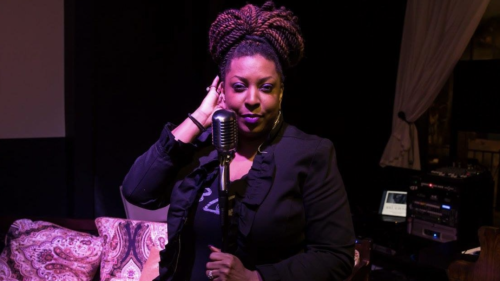
Founded in 2001 by cultural curator Ingrid “Ingrid B” Bazin, “On the B Side” has become one of South Florida’s longest-running spoken-word platforms, according to Bazin. (Photo courtesy of Ingrid Bazin/On the B Side)
For Arnetta “Taboo” Bullard, a Miami-born spoken word artist who has been part of the scene for more than 20 years, that consistency is exactly what keeps her coming back.
“It’s like a family setting,” she said. “Everybody is accepted there. It’s a comfortable space. We laugh a lot. It’s just a good time to break away from everything.”
But once she steps on stage, the tone shifts.
“It’s like going to the altar,” she said. “You’re able to just let everything out. I can bear parts of my soul that I wouldn’t talk about in a regular setting.”
That sense of release is central to how “On the B Side” functions. Unlike more formal readings, the slam format creates a space where emotion, performance and audience response unfold in real time.
“It’s freeing,” Taboo said. “You’re able to go up there and just bare your soul. It’s therapeutic. Poetry literally saved my life.”
She began writing at 12, after a close friend was murdered, a moment that shaped not only her voice, but her understanding of what poetry could do.
“Writing was how I got through it,” she said. “It became my way of expressing myself.”
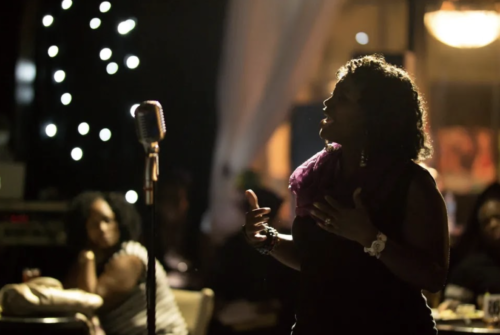
Poet Pianir performs at “On the B Side,” where artists across generations share the stage under a simple principle: respect the mic.”On the B Side” returns to Red Rooster on Sunday, April 12 with its signature poetry slam. (Photo courtesy of Ingrid Bazin/On the B Side)
Today, her work often explores grief, healing and resilience, themes that resonate deeply with audiences, sometimes in ways she doesn’t fully anticipate.
“I have a poem that’s probably the hardest one for me to perform,” she said. “It’s about how I would feel if I lost one of my children.”
Each time she performs it, she still cries.
“But people come up to me after and say, ‘That’s exactly how I feel.’ They thank me for putting it into words.”
Those moments, she said, are what matter.
“Sometimes you go through things and you feel like you’re alone,” she said. “But when you hear your words out loud, you realize you’re not.”
For her, that connection can be more than emotional; it can be urgent.
“If you know that you’re not the only one going through something, maybe you won’t give up,” she said. “Maybe you keep going.”
That exchange between vulnerability and recognition is what Bazin has spent more than two decades cultivating.
“It really is a family affair,” Bazin said. “I’m the auntie on the poetry scene.”
At “On the B Side,” that family spans generations, backgrounds and experiences, but shares a common understanding of the space.
“There’s a rule,” Taboo said. “Respect the mic.”
That means no interruptions, no judgment, just listening.

“On the B Side” returns to Red Rooster on Sunday, April 12 with its signature poetry slam, part of National Poetry Month and a platform built over more than two decades. (Photo courtesy of Ingrid Bazin/On the B Side)
Even when the work is uncomfortable.
“People might not agree with what you’re saying,” she said. “But they’re still going to hear you.”
Held in Historic Overtown, a neighborhood long tied to Miami’s cultural and musical history, the event carries an added sense of continuity.
“It is a landmark,” Bazin said. “When we’re there, we’re kind of standing on sacred ground.”
Again this year, that ground will once again fill with voices, some seasoned, others new, each stepping forward with something to say.
For Taboo, the goal is simple.
“I want people to leave knowing they’re not alone,” she said. “That whatever they’re going through, it doesn’t last forever.”
She paused, then added: “You can go through something and still come out on the other side. You don’t have to look like what you’ve been through.”
WHAT: “The B Side Slam,” a live spoken-word competition featuring South Florida poets, presented by On The B Side.
WHEN: 5 to 9 p.m. Sunday, April 12
WHERE: Red Rooster Overtown, 920 NW 2nd Ave., Miami
COST: $20
INFORMATION: getonthebside.com
ArtburstMiami.com is a nonprofit media source for the arts featuring fresh and original stories by writers dedicated to theater, dance, visual arts, film, music and more. Don’t miss a story at www.artburstmiami.com.
No posts found
Made In Miami: ‘Forge,’ ‘Poetry City,’ and ‘An Instrumental Start’ at the 2026 Miami Film Festival
Written By Michelle F. Solomon
April 7, 2026 at 2:41 AM
Oscar Fuentes, The Biscayne Poet, is featured in Aaron Glickman’s “Poetry City” getting its premiere at the 43rd Annual Miami Film Festival. The film screens on at 5:30 p.m., Saturday, April 18 at the Koubek Center. (Photo courtesy of the Miami Film Festival)
Three distinct Miami stories, each revealing the city through its people and culture, are part of this year’s Miami Film Festival. The 43rd Annual Miami Film Festival — taking place Thursday, April 9 through Sunday, 19, 2026 — will screen over 160 films from around the world, including features, documentaries, and shorts, at seven key venues in Miami-Dade County.
While two are documentaries featuring notable Miamians and the third a feature-film caper about art, they share a common thread: these are Miami stories.
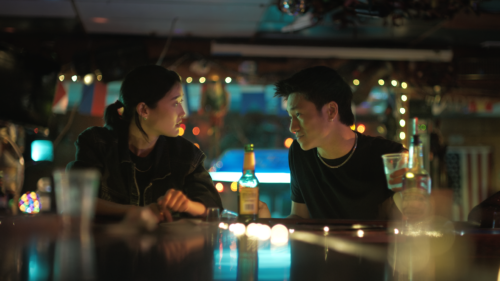
Andie Ju as Coco Zhang and Brandon Soo Hoo as Raymond Chang in the Miami-set art caper from Jing Ai Ng, “Forge,” which has a screening on Saturday, April 18 at noon at The Bill Cosford Cinema. (Photo courtesy of the Miami Film Festival)
From the neighborhoods and skyline shots that make Jing Ai Ng’s art-themed caper “Forge” glisten, to the city’s literary landscape explored in Aaron Glickman’s “Poetry City,” and Brian Bayerl and Mike Huter’s three-year journey across America for “An Instrumental Start – A Model for the Nation,” the filmmakers make clear that these works could only have been set here.
Bayerl and Huter’s film features interviews with well-known figures nationwide. It returns to Liberty City to tell the story of Marshall L. Davis Sr. and the African Heritage Cultural Arts Center.
In each case, the city becomes a character, shaping the story as much as the people in it.
“I wanted the city to feel alive, like every street and skyline shot was part of the story itself,” says Ng, whose experience growing up between Miami and Malaysia formed the basis for her film.
“It’s home and where many of my formative childhood memories were made.”
While so many Miami movies focus on the Latin American story, Ng centered on a segment of the population that is less represented. “The Asian population in Miami is less than 2 percent. Growing up, it was a bit jarring to go from Asia to a place where, especially as my first reference to America, was Miami.”
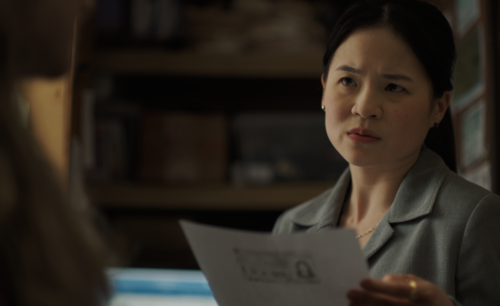
Kelly Marie Tran as Emily Lee, an FBI agent who shows up in Miami to investigate a string of art forgeries. (Photo courtesy of Miami Film Festival)
“Forge” (noon, Saturday, April 18, Bill Cosford Cinema), which made its debut at 2025’s South by Southwest, is a fiction film about a brother and sister who have an underground operation selling forged paintings. With sister Coco a gifted painter and her brother, Raymond, a master counterfeiter, the two end up in the middle of a scheme with a down-on-his-luck millionaire.
Miami’s art scene, “exploding” ever since Art Basel Miami Beach, has influenced Ng’s themes in the film.
“It’s not that the quality of anything has changed. Every winter, so many people come into town, exposing us to maybe the cutting edge of the art world at all times. It goes back to the eternal debate of what is art and how do we value art. That fits completely with the themes of ‘Forge.’ How do you tell if something is worth a million dollars or if it isn’t? I remember the year at Art Basel when there was an ATM machine and another year a banana.”
In her film, Ng has a Chinese cook making dumplings refer to the infamous Basel banana.
Now based in Los Angeles, Ng, 32, wanted the scenes authentic for her first feature film. Everything was done on location — at the Perez Art Museum Miami, the city’s most famous dance club, Club Space, Coral Gables and Brickell, plus the personal and notable Tropical Chinese Restaurant on Bird Road.
“I think part of what came to be with ‘Forge’ is that my family was always on the eternal search in Miami for Chinese food, and especially growing up in the ’90s, it was Tropical Chinese. It was part of my childhood, us going there almost every weekend.”
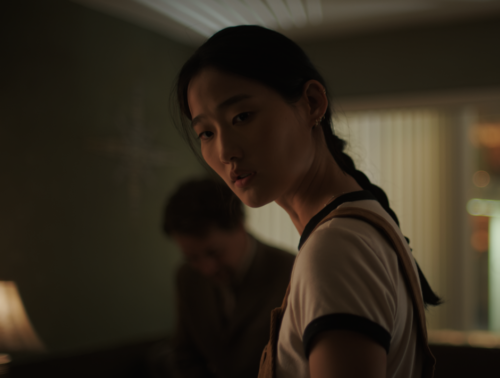
Andie Jue as Coco Zhang in “Forge” by Miamian Jing Ai Ng, which was recently picked up by distributor Utopia. (Photo courtesy of the filmmaker)
Gregory (who co-owns the restaurant with sister Mei Yu), let her film there and use the restaurant’s name.
“It’s a small part of Miami life and underrepresented. For me, watching a lot of Asian American film set in Los Angeles or New York or on the coast, it’s not something I can actually relate to.”
Filming in Miami had its challenges. The city is more accustomed to commercial shoots and larger productions. “Because of that, you get priced out of locations, so we were constantly playing the game of trying to do the most with what we had. But we had such support. The silver lining of filming in Miami is that you have a really passionate community around you that is going to help you get your movie made.”
While the movie is making its Florida premiere at the festival, it will be opening in major theaters in May. Utopia’s Circle Collective has acquired the North American rights for the film, something Ng couldn’t be happier about. It will be released in Miami theaters on May 30, she confides.
She is already working on her second feature, which is shooting in Asia. Not willing to reveal too much because it is in development, she does share that it is “a coming-of-age story set in Malaysia and England.”
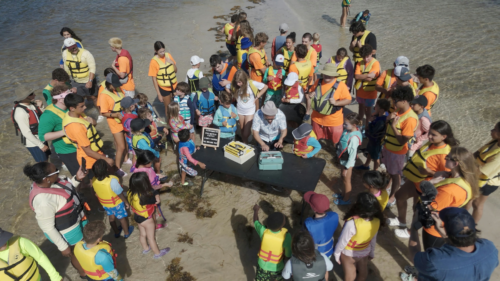
Poet Oscar Fuentes surrounded by kids from Shake-A-Leg Miami in a scene from “Poetry City.” (Photo courtesy of Miami Film Festival)
For Glickman, it was about putting the city’s literary arts front and center. “They tend to get overshadowed by the visual arts, so I’m proud that we were able to highlight something that doesn’t get the same attention.”
The journey of “Poetry City” began with Oscar Fuentes, known as The Biscayne Poet. “I’ve known Oscar since about 2015, maybe even longer.” Glickman remembers Fuentes and his typewriter at Wood Tavern in Wynwood. That was where he would start what’s become one of his signatures — people would give him one word, and he would write a poem for them, gifting it to them as their own.
“He would be in the middle of the place and people all around him. I would just be observing. I always thought he was a unique person.”
A decade later, he ran into Fuentes at the main branch of the Miami-Dade Public Library System, where he manages the library’s public art collection.
Glickman was between film projects, having just finished “Miami Schmatta,” which premiered at the Miami Jewish Film Festival last year and later aired on South Florida PBS about the history of Miami’s Garment District.
“I ran into Oscar and we chatted for a while, and I said to him, ‘We should do a documentary on you.’ At that time it was going to focus on Oscar, but then he brought on Nicole Tallman.” Tallman is the official Poetry Ambassador and this year’s poet laureate for Miami-Dade County Mayor Daniella Levine Cava.
“It started to take on a different tone and we started to figure out some strategies.”
The result is “Poetry City,” (5:30 p.m., Saturday, April 18, Koubek Center) an ode to Miami’s poetry scene, featuring interviews, readings, and performances by several of Miami’s poets. They include Caridad Moro-Gronlier, the 2024–25 Miami-Dade County Poet Laureate; Richard Blanco, the county’s first Poet Laureate and Presidential Inaugural Poet; Mitchell Kaplan, owner of Books & Books and co-founder of the Miami Book Fair; Campbell McGrath, a Pulitzer Prize finalist and MacArthur Fellow; and performance and spoken word artists Arsimmer McCoy and Darius Daughtry.
The film also captures a community-wide photoshoot of poets with Miami photographer Manny Hernandez. In one scene, people who have known Fuentes throughout the years gather at the library to read their poems.
Glickman’s brother also participated in the film. “My brother had a key role — Alec Jerome Kreisberg. He did the animation, shot some of the film, and handled all the drone work.”
For Glickman, the close-knit group of poets and the spotlight on the literary arts scene were the catalysts that propelled the documentary. “The whole experience was organic; it just grew.”
The community that Marshall Davis Sr. built didn’t hesitate when Bayerl reached out to notable names who said that Davis’ visionary arts program — which grew into one of the most innovative arts education models in the United States — was a primary driver in their success.
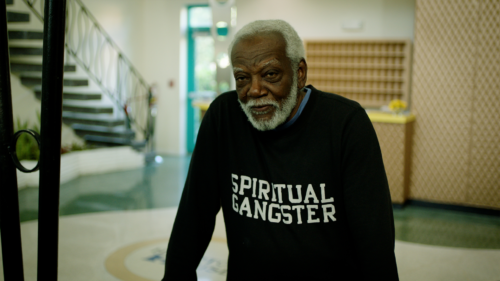
Visionary educator Marshall L. Davis Sr.’s story of the African Heritage Cultural Arts Center and its influence is at the center of “An Instrumental Start — A Model for the Nation” getting its world premiere at the 42nd Annual Miami Film Festival on Friday, April 10 at the Olympia Theater. (Photo courtesy of the Miami Film Festival)
“People were happy to do it. No one said no,” said Bayerl, co-director of “An Instrumental Start – A Model for the Nation,” (8 p.m., Friday, April 10, Olympia Theater). He recalls Davis phoning Oscar-winning “Moonlight” creator Tarell Alvin McCraney. “And he picks up the phone and says, ‘Hi, Mr. Davis. Yeah, no problem.’”
“If you watch his film and listen to his story about meeting Mr. Davis, it’s the same story. It’s this kid running from bullies — and then he gets saved by Mahershala Ali. In real life, Tarell ran into the Cultural Arts Center and that’s when he met Mr. Davis, and he said it changed his life.”
In the film, McCraney says, “I’ve always thought of that moment as the time people who didn’t know me gave me the tools to save my life. When I came back to say, ‘I want to make this film that is about Miami and about some tough issues,’ it was only African Heritage that said this is important. Your voice is important.”
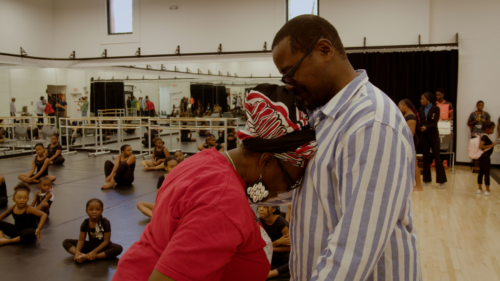
In a scene from “An Instrumental Start,” Robert Battle, then director of the Alvin Ailey American Dance Theater, returns to the African Heritage Cultural Arts Center to visit his first dance teacher Eulyce Eason. The two hadn’t seen each other in over 15 years. (Photo courtesy of Miami Film Festival)
Savion Glover appears in the film — he’s best friends with Marshall Davis Jr., Bayerl points out. “There’s a great scene where Savion, who mentors at the center, is teaching kids, and it’s a really fun piece in the film.” Along with countless other appearances, including actress Phylicia Rashad and former director of the Alvin Ailey American Dance Theater, Robert Battle.
The film makes its premiere at the Miami Film Festival.
“Marshall’s story is at the center, but it also reflects the heartbeat of the city’s arts — how personal ambition and community intersect. It brings home the point that one person’s creativity can resonate across a wider cultural landscape,” says Bayerl.
Together, “Poetry City,” “Forge,” and “An Instrumental Start” reveal a Miami shaped by the people who move through it. The city emerges not just as a backdrop, but as a force in the stories it tells.
Other Don’t Miss Made In Miami Films

Director Nicanson Guerrier’s “The Mecca: Legends of Traz Powell Stadium” premieres on Sunday, April 12 at the Olympia Theater. (Photo courtesy of Miami Film Festival)
“The Mecca: Legends of Traz Powell Stadium” (documentary feature): The story of the legendary Traz Powell Stadium and its deep roots in the Miami community directed by Nicanson Guerrier. From the big plays on the field, to the historic segregation-era coach that it’s named after, the stadium is a vital part of South Florida culture. The film brings together a roster of NFL players from South Florida, including Teddy Bridgewater, Lavonte David, Kenny Phillips, Sean Spence and Nat Moore. It also features local icons Luther “Uncle Luke” Campbell and Rick Ross, record-breaking coaches and many community members whose lives have been shaped by the place that has produced more NFL players than any other venue in the country. 12:30 p.m., Sunday, April 12, Olympia Theater.
“When Men Dance” (documentary feature): Filmed in Miami and featuring a mix of local and international dancers, finds director Abbas A. Motlagh following young men for whom dance is more than expression — it’s a lifeline. Against a backdrop of racism, isolation, financial strain, and rising anti-LGBTQ+ and anti-immigrant sentiment, the film pairs urgency with lush cinematography. 6:15 p.m., Sunday, April 12, Bill Cosford Cinema.

“Rope/Tide” was made by University of Miami students and their professor. (Photo courtesy of Miami Film Festival)
“Rope/Tide” (feature:) Made by University of Miami students and shot by professor Ed Talavera, this offbeat, avant-garde film follows an artist and his muse who bind themselves together, turning their relationship into an ongoing test of intimacy and endurance. 2:45 p.m., Saturday, April 18, Bill Cosford Cinema.
Three winners of the Miami Film Festival Louies Awards from 2025 will premiere their films at the festival:
“Dual Citizen” (documentary feature): Director Rachelle Salnave films her journey to obtain Haitian citizenship and the emotional legacy it carries for her father. 7:30 p.m., Tuesday, April 14, Little Haiti Cultural Complex, 212 NE 59th Terrace, Miami.
The two films below are screening as part of Welcome to Miami: Florida Doc Shorts at 9 p.m., Thursday, April 16 at The Bill Cosford Cinema.
“Under the Mango Tree”: Director Symone Titania Major’s documentary traces the rise and fall of a once‑prosperous African American agricultural community in Goulds.
“The Floor Remembers”: Director Jayme Kaye Gershen’s short documentary revisits a historic Miami roller rink, where skaters return to a neon‑lit floor that holds the memories of a city in constant reinvention.
WHAT: 43rd Annual Miami Film Festival presented by Miami Dade College
WHEN: Thursday, April 9 through Sunday, April 19. Click here for complete program guide
WHERE: Silverspot Cinema, 300 SE 3rd St., Miami; Olympia,Theatre,174 E Flagler St., Miami; Coral Gables Art Cinema, 260 Aragon Ave., Coral Gables; The Bil Cosford Cinema, 5030 Brunson Drive, University of Miami, Coral Gables; Koubek Center, 2705 SW 3rd St., Miami, O Cinema South Beach, 1130 Washington Ave., Miami; Tower Theater, 1508 SW 8th St., Miami; MDC Wolfson Campus, 300 NE 2nd Ave., Miami.
COST: $16.50 for general admission; $14.50, Miami Film Society Members Some events are higher costs..
INFORMATION: 305-237-FILM (3456) or miamifilmfestival.com
ArtburstMiami.com is a nonprofit source of theater, dance, visual arts, music and performing arts news. Sign up for our newsletter and never miss a story.
No posts found
For Nearly Three Decades, Miami Light Project ‘Here and Now’ Keeps Spotlight on Miami Creatives
Written By Carolina del Busto
February 21, 2026 at 6:37 PM
Nicole Pedraza and Diego León Lang will present original short-form works as part of Miami Light Project’s “Here and Now” at Miami Theater Center, Miami Shores. (Photo by Kevin Alvarez Cordova, courtesy of Miami Light Project)
When Beth Boone became artistic and executive director of Miami Light Project in 1998, she wanted to reimagine a collaborative project that had had been started years earlier entitled “Here and Now.” She wanted to move it forward and create a program that would commission new work and offer ways to nurture emerging artists with a supportive space to create and thrive. “And I thought the name just fit, so I kept ‘Here and Now.’ ”
Now a signature initiative of Miami Light Project, the latest iteration of “Here and Now” features original short-form works by commissioned local artists Clinton T. Harris, Diego Melgar, Nicole Pedraza, Diago León Lang, and Nina Osoria Ahmadi.

The microphone amplifies Nicole Pedraza’s emotions as she rehearses for her piece, “Palitroque.” (Photo by Kevin Alvarez Cordova, courtesy of Miami Light Project)
Miami Light Project’s “Here and Now” is 8 p.m., Thursday, Feb. 26 to Saturday, Feb. 28 at Miami Theater Center, Miami Shores.
“I knew that I wanted to invest in Miami-based artists the way that nationally recognized artists get invested in their home communities,” says Boone. Over the program’s nearly three decades, she has witnessed the evolution of Miami’s art community. “Over the years and through this program, I feel like I’ve had the benefit and the pleasure of observing the growth of the artist scene in Miami.”
She believes that “Here and Now” has “played a very big part” in the progression “because you give people time, space, some resources, some connections, and some knowledge, and they do remarkable things.”

The staff of Miami Light Project, from left, Eventz Paul, Beth Boone, Terrence Brunn,
and Regina Moore. (Photo by Kevin Alvarez Cordova, courtesy of Miami Light Project)
The program gives artists, selected through a curated commissioning process, space to develop their work and connects them with mentors in the field. Often, the cohorts build strong relationships with one another, too. In this year’s group, many of the artists are collaborating across projects and contributing to each other’s pieces in addition to developing their own 20-minute works.
“I really feel like there’s this whole new generation of Miami artists that are coming of age together,” says Boone. “From going to school together to growing up in similar neighborhoods, they’re deeply connected and very collaborative.”

Visual artist Diago León Lang maps out what he wants the stage to look like for
“Palitroque.” (Photo by Kevin Alvarez Cordova, courtesy of Miami Light Project)
One such example of this collaboration is the work of choreographer and dancer Nicole Pedraza and musician Diego Melgar. Pedraza is choreographing her own piece and also dancing in Melgar’s ballet; Melgar is co-composing the score for Pedraza’s dance.
“We’re like a little circus troupe of friends all backing each other up and helping each other out on multiple projects,” says Melgar. “I couldn’t ask for a more amazing group of friends.”
Melgar, a musician by trade, composed a 20-minute ballet titled “Swamp Lily,” starring Pedraza as a young swamp creature. As she explores the world around her, the creature encounters two opposing city spirits, portrayed by Melgar and 2025 “Here and Now “ cohort member Junior Domingos.

Dancers Nicole Pedraza and Junior Domingos rehearse for their roles in “Swamp Lily.” (Photo by Dani Amaro, courtesy of Miami Light Project)
“It’s a sort of abstract meditation on life in Miami,” explains Melgar. “There are so many weird tensions you find living here; one moment Miami feels futuristic and the next day downtown is flooded and we’re dealing with these archaic problems.”
The Miami native found his inspiration for “Swamp Lily” from a recent project he premiered at the Miami Beach Bandshell last year. The young artist wants all of his works to bleed into each other, almost like chapters in one larger storybook. “I want my body of work to feel a little bit like it’s all in a shared universe . . . This piece for ‘Here and Now’ is just one story within this bigger universe that includes concert performances, theater pieces, albums, music videos, and all future pieces.”
For her piece, “Palitroque,” Pedraza worked with longtime partner and visual artist Diago León Lang. “Even though we always inform each other’s work, for this piece specifically, I wanted to apply with both of our names since a lot of the initial idea was his and he’s had such a big say in the development,” says Pedraza.
León Lang helped design the set and worked on projections that will be part of the performance. Pedraza will be one of the four dancers on stage and choreographed the 20-minute work.

Choreographer and dancer Nicole Pedraza and her artistic partner, Diego León Lang, two of the “Here and Now” artists. (Photo by Trish Gutierrez courtesy of Miami Light Project)
“Palitroque” tells a story of memory and nostalgia through the lens of the immigrant experience — particularly an immigrant’s penchant for hoarding objects. Pedraza’s family is from Nicaragua; Lang’s family is from Cuba.
The set will be filled with props and objects that are being contributed by Pedraza and her fellow dancers. It’ll give the appearance of an old, overflowing garage. “In the performance,” explains Pedraza, “we’re basically going through all of these boxes and we’ll have visceral reactions to some of the items . . . the choreography is meant to emote memories in a physical and exaggerative way.”
Pedraza admits that even though she’s been dancing for years, “Palitroque” is her most nuanced work. Thanks to her participation in “Here and Now,” she says she can solely focus on being a creative. “I’m used to producing my own performances and being in charge of everything, from getting the venue to everything technical. It’s nice to just focus on being an artist.”
WHAT: Miami Light Project Presents “Here and Now”
WHERE: Miami Theater Center, 9806 NE 2nd Ave., Miami Shores.
WHEN: 8 p.m. Thursday, Feb. 26, Friday, Feb. 27, and Saturday, Feb. 28
COST: $33.37, general admission, $22.92, seniors and students
INFORMATION: (305) 576-4350 or miamilightproject.com
ArtburstMiami.com is a nonprofit media source for the arts featuring fresh and original stories by writers dedicated to theater, dance, visual arts, film, music and more. Don’t miss a story at www.artburstmiami.com.
No posts found
Review: M Ensemble Revives A Comedy Icon With ‘Jackie Moms Mabley’
Written By J.J. Colagrande
February 17, 2026 at 9:08 PM
M Ensemble Company opens its 2026 season with “Jackie Moms Mabley: Live at the Apollo,” an original show by T.G. Cooper, founder of the company. The show is at the Sandrell Rivers Theatre, Miami, through Sunday, Feb. 22. (Photo by Seven Fleurimond, Studio 7 Miami)
Reviving a legend is risky business, but M Ensemble Company opens its 2026 season by stepping into the spotlight with “Jackie Moms Mabley: Live at the Apollo,” a reenactment of a 1962 comedy show by a classic American figure. The play, written by the late T.G. Cooper, founder of M Ensemble, was first performed in 1995 when M Ensemble performed it in a two-week stint in Miami Shores at the Shores Performing Arts Theatre after a run in North Miami.
Stepping into the role of Mabley is Barbie Lazaro, directed by local actor and FIU professor Melvin Huffnagle.
The company chose this production wisely: it’s a comedy providing laughs in serious times, it’s Black History Month and it profiles an iconic African-American woman.
With roots going back to Black vaudeville, also known as the Chitlin’ Circuit, Jackie “Moms” Mabley was a trailblazing, queer Black woman who inspired comedy legends like Redd Foxx, Joan Rivers, Richard Pryor, Eddie Murphy, Wanda Sykes and Whoopi Goldberg.
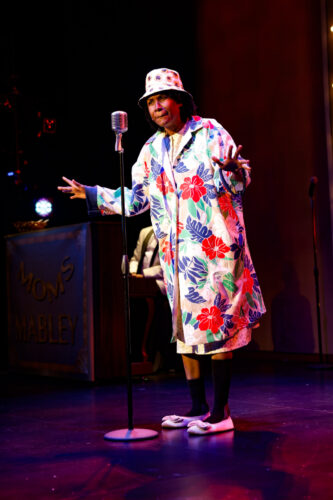
Barbie Lazaro as Moms Mabley in M Ensemble’s “Jackie Moms Mabley: Live at the Apollo.” (Photo by Seven Fleurimond, Studio 7 Miami)
Her “Moms” character, a toothless, poorly dressed, floppy-hat-wearing, easy-going maternal persona, allowed her to lambast audiences with racy, edgy, intense topics, such as sexuality, race and politics. And she did so with old vaudeville flair, confidence and pitch perfect timing.
She was a pro’s pro and crossed-over to mainstream white America. Mabley once famously said “there’s not a comedian in show business that hasn’t stole material from Moms.”
Lazaro, a relatively new, but on-the-rise comedian, is a Miami Beach resident. She started performing stand-up in 2023 and has played at festivals such as Edinburgh Fringe and the New York City Comedy Festival.
She makes her theatrical debut as Mabley and does so superbly. Lazaro is nuanced, confident, able to improvise well, and truly embodies the swagger of Mabley. She is worth the price of admission, has good comic timing, and delivers plenty of belly laughs.
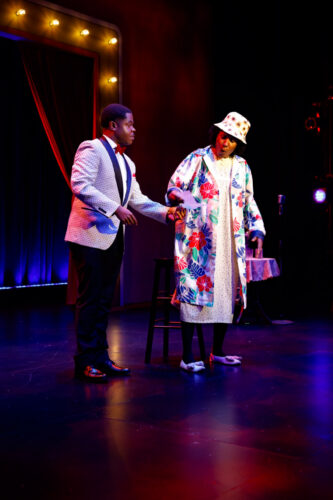
Elijah Thomas is Moms Mabley’s (Barbie Lazaro) onstage sidekick. (Photo by Seven Fleurimond, Studio 7 Miami)
When this play works, it’s entertaining, risky, brave, shocking and completely nostalgic.
Under Huffnagle’s direction, it’s 1962 inside the Sandrell Rivers Theatre. It is the Apollo Theatre in Harlem.
And Lazaro bringing Mabley’s raunchy style to light. Cooper uses some of Mabley’s original material verbatim and it lands.
“I call myself a lucky ole lady. I got myself a cigarette lighter and a man …and both of them work”
Or crass: “My brother’s wife was so ugly he used to take her to work to keep from kissin’ her goodbye.”
Or race: “I was on my way down to Miami…I mean theyami.”
Nostalgia and homage are wonderful devices to engage an audience and “Jackie Moms Mabley: Live at the Apollo” succeeds at immersing the crowd in the comedian and her surroundings. But
Cooper’s script isn’t so much a biography of Mabley, which would bring some depth to the play, but a transcription of a Mabley performance. Jokes hit, and there’s plenty of material, but it’s not much to work with.
Huffnagle adds a few components to make the show more expansive, such as two opening acts, a piano player and a feature warm-up comedian., which helps to add a variety show element to the night.
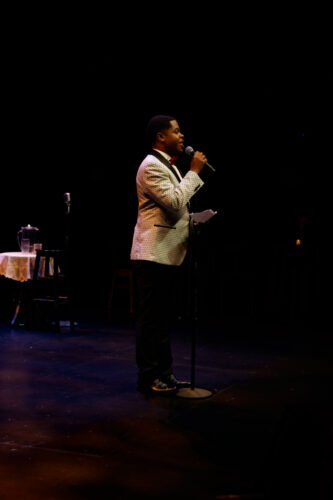
Elijah Thomas plays the master of ceremonies in M Ensemble’s “Jackie Moms Mabley: Live at the Apollo.” (Photo by Seven Fleurimond, Studio 7 Miami)
Actor Elijah Thomas, a recent graduate of FIU’s theater department, was brought onto the production by Huffnagle. He holds his own playing the master of ceremonies, Mabley’s onstage sidekick, and his role was developed from the original script to provide more improvisation, some of which breaks the nostalgic Fourth Wall but it still isn’t enough to create a well-rounded story.
Working on a shoestring and one of the casualties of so many budget cuts, M Ensemble revives the production as its opening, no doubt, to keep things lean.
There isn’t much of a set , just a piano with the words Moms Mabley painted onto it, a red curtain, and a couple of tables onstage for audience members to sit at as if at a dinner show and three actors.
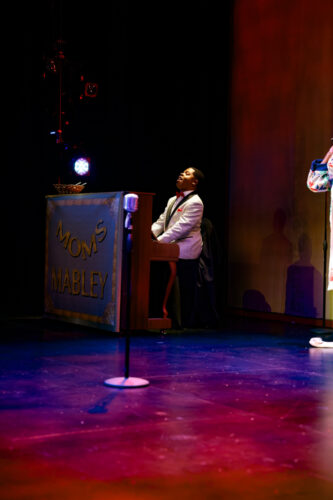
Under Melvin Huffnagle’s direction, it’s 1962 inside the Sandrell Rivers Theatre. It is the Apollo Theatre in Harlem. (Photo by Seven Fleurimond, Studio 7 Miami)
The talent is there. The history is rich. The venue is great, laughs land often, and it’san enjoyable 90 minutes at the theater. But without a dramatic spine, this revival is a tribute act rather than the full theatrical event it could have been. It would have been nice to get to know Moms a better beyond her one-liners.
WHAT: “Jackie Moms Mable: Live at the Apollo” by T.G. Cooper
WHERE: Sandrell Rivers Theatre at Audrey M. Edmonson Transit Village, 6103 NW 7th Ave., Miami.
WHEN: 8 p.m. Friday and Saturday; 3 p.m. Saturday and Sunday. Through Sunday, Feb. 22.
COST: $36, general admission, $26 students and seniors
INFORMATION: 305-705-3218 or mensemble.org
ArtburstMiami.com is a nonprofit media source for the arts featuring fresh and original stories by writers dedicated to theater, dance, visual arts, film, music and more. Don’t miss a story at www.artburstmiami.com.
No posts found
At Actors’ Playhouse, Broadway’s Evan Hansen Returns This Time as Director
Written By Michelle F. Solomon
February 12, 2026 at 1:26 PM
The cast of “Dear Evan Hansen” at Actors’ Playhouse at the Miracle Theatre in Coral Gables. The show runs through Sunday, March 8 and is directed by South Florida native Stephen Christopher Anthony who played Evan Hansen on Broadway and in the national touring company. (Photo by Alberto Romeu, courtesy of Actors’ Playhouse)
Before he ever stepped into the title role of “Dear Evan Hansen” on Broadway, Kendall and Palmetto Bay native Stephen Christopher Anthony sat in the audience at the Music Box Theatre and was spellbound.
“I was a fan of the show before I was even a part of it,” says Anthony. “Everybody in that audience was having such a profound experience. To sit in a room of 1,000 people and go through the journey that these eight characters take — it moved me hugely.”
Now, after playing the title role on Broadway and in the company’s first national tour, he has returned to Actors’ Playhouse in Coral Gables to direct the musical and on the stage where he began his theater journey. And last year, he was musical director for Actors’ Playhouse’s “Waitress.”

Kendall and Palmetto Bay native Stephen Christopher Anthony as Evan Hansen in the Broadway national tour of the show. (Photo by Matthew Murphy and Evan Zimmerman, MurphyMade)
He remembers performing in Actors’ Playhouse’s production of “The Secret Garden” when he was 10 years old.
“I went to Howard Drive Elementary, Southwood Middle School and the New World School of the Arts. During all that time, I was performing at Actors’ Playhouse.”
It was trips to the Coral Gables theater that sparked something.
“My parents would take me, the schools would take us to see shows there, and I was in awe of the energy — the lights, the colors, the music,” says Anthony, revealing it was his parents who encouraged him to audition.
“I was terrified. I had terrible stage fright. But the moment I stepped onto the stage for the first time, I fell in love. I was obsessed with the immediacy of the connection.”
While being part of the production of “Waitress” was rewarding, returning to helm “Dear Evan Hansen” feels like a very special moment.

South Florida’s Jeni Hacker with Logan Clinger in “Dear Evan Hansen” at Actors’ Playhouse at the Miracle Theatre. (Photo by Alberto Romeu, courtesy of Actors’ Playhouse)
“To apply everything I’ve learned over the last couple decades about detailed, thrilling storytelling and watch it come together on this stage — audiences are in for something spectacular.”
Anthony is also proud of what he’s accomplished with the show. Rather than preserving what he learned from performing in the Broadway and touring productions, he has focused on creating space for the cast to claim the material as their own.
“What was so cool about being inside the show was seeing how fluid it could be from night to night. No two performances were the same because of how intimate and personal it is. There has to be room to breathe.”
Anthony has brought some of his own touches to the musical about Evan Hansen, a 17-year-old introvert who finds unexpected popularity after creating a lie about being best friends with a classmate who suddenly dies. “I wanted to honor the original production while exploring our own version. There are moments I’ve completely reimagined. When I watch them now, I think, ‘That’s what it felt like to be in that scene.’ I’ve tried to make the visual match the emotional experience,” says the director.
The choreography honors the original Broadway show — what Anthony calls a “thrilling win.”
“We signed an agreement to use the original Broadway choreography for the musical numbers.”

Orlando native Logan Clinger as Evan Hansen in “Dear Evan Hansen” at Actors’ Playhouse at the Miracle Theatre. (Photo by Alberto Romeu, courtesy of Actors’ Playhouse)
However, because Actors’ Playhouse has a completely different set design, some adjustments had to be made. “We’ve honored it, adapted it and created some new things out of it.”
Finding the right ensemble to bring his vision to life took time.
“We spent about six months casting. It was difficult because these characters are not prescriptive. It’s much more about their emotional life than finding a ‘type.'”
He found his Evan in Logan Clinger, originally from Orlando, who just finished a national tour playing Pugsley in “The Addams Family.”
Clinger recalls that Anthony came to a tour stop to meet him in person before casting him, something unusual since the director had to go out of his way to make the meeting happen.
“I sent in a tape after my agent told me about the role. Then we had a Zoom call.”
He was surprised when Anthony wanted to meet face-to-face. Anthony explains: “We contacted Logan’s agents and asked if he’d be willing to meet at the theater where he was on tour. I brought a pianist, and we spent about a half hour working on the material together.” Anthony knew he had found his Evan.
Clinger is making his Actors’ Playhouse debut in a role that he says “just fits.”
“I wasn’t really into musicals, but I remember when I first heard the album for ‘Dear Evan Hansen,’ I was about 12 and it had a profound impact on me,” says Clinger. He says the character highlights parts of his own personality. “I have my own anxieties, and I talk a lot with my hands. That will come through in the character.”
For Heidi Hansen, Evan’s mother, they chose Stacie Bono, who has her own Florida connections. She last appeared in “White Christmas” at Gulfshore Playhouse in Naples and recently had a stint on Broadway in the musical “Parade.”

Logan Clinger and Stacie Bono in “Dear Evan Hansen” at Actors’ Playhouse at the Miracle Theatre. (Photo by Alberto Romeu, courtesy of Actors’ Playhouse)
“I was raised in Sarasota,” she says. “We moved to Florida when I was two, and until I left for college at 18, I was a Sarasota girl.”
Her path to the stage started early, too.
“I came out of the womb singing, my mother would say — much to the dismay of my siblings, because I was off pitch a lot when I was younger. But I always had a love of singing.”
Even with its serious subject matter, Bono insists that “Dear Evan Hansen” is far from unrelentingly dark.
“It’s actually a very funny show. There’s a lot of humor and a lot of love in it,” she says.
Working with Anthony has been a way for Bono to flex her emotional acting muscles as Heidi Hansen, Evan’s single mother who is loving but imperfect in raising her socially anxious son.
“(Stephen) knows the show inside and out because of all his time with it and his in-depth acting work on it,” she says. “It’s such a joy to work with a director who wants to get into the nitty-gritty.”
For Anthony, all of these details are what will make Actors’ Playhouse’s production of “Dear Evan Hansen” a memorable night of theater.
“When we were rehearsing with eight actors in a room with fluorescent lights, it was already magical. Now, with this team of designers and a live orchestra of eight stellar musicians, audiences are in for a visual feast. They’ll have a great time and walk away having important conversations. I’m really proud of what we’ve done here.”
WHAT: “Dear Evan Hansen”
WHERE: Actors’ Playhouse at The Miracle Theatre, 280 Miracle Mile, Coral Gables
WHEN: 8 p.m. Wednesday, Thursday, Friday and Saturday; 3 p.m. Sunday. Matinee also 2 p.m., Feb. 18. Through Sunday, March 8.
COST: $50, $60, and $70, weekdays; $65, $75, and $85, weekends.
INFORMATION: 305-444-9293 or actorsplayhouse.org.
ArtburstMiami.com is a nonprofit media source for the arts featuring fresh and original stories by writers dedicated to theater, dance, visual arts, film, music and more. Don’t miss a story at www.artburstmiami.com.
No posts found
Review: Miami New Drama’s Riveting ‘English Only’ Takes Place in the Past but Feels Uncomfortably Current
Written By Mary Damiano
February 3, 2026 at 11:54 AM
Andhy Mendez plays future politician Manny Diaz in “English Only,” a world premiere of Nicholas Griffin’s play at Miami New Drama at the Colony Theatre, Miami Beach, through Sunday, Feb. 22. (Photo by Morgan Sophia Photography)
On Friday, Feb. 6, a new Florida law goes into effect, mandating that tests to obtain a drivers’ license must be written in English only.
So, while “English Only,” the latest world premiere at Miami New Drama, feels ripped from the headlines, it’s actually part of the company’s History Series of plays about past events in Miami, in this case, the fight to ban other languages from government documents and civic life, and strip Dade County, as it was called then, of its bilingualism.
The events depicted in “English Only” take place in 1980 during the Mariel boat lifts, in which Fidel Castro sent 125,000 Cubans to Miami. While the local Cuban community scrambled to find sponsors for the immigrants and take care of them, a wave of anti-immigration rose and threatened the vibrant thread Cubans brought to the tapestry of Miami.
The play focuses of Manny Diaz, then a young lawyer working at the Spanish American League Against Discrimination (SALAD). At the SALAD office, Manny and his co-worker, Lucy, listen to right-wing shock jock Stan Rogers, to keep tabs on his remarks on Cubans and the boat lifts. One day, a woman named Emmy Shafer calls into Rogers’ show, voicing her anger at how she couldn’t buy a dress at a local mall because no one who worked there spoke English. Rogers tells her to do something about it, and poof — Emmy forms Citizens of Dade United, and works to get the needed 25,000 signatures to put an English only ordinance on the ballot for the November election.

Linda Mugleston and Linda Laura Faye Smith play anti bilingualists in “English Only,” the new world premiere at Miami New Drama through Sunday, Feb. 22. (Photo by Morgan Sophia Photography)
Playwright Nicholas Griffin, who also wrote “Dangerous Days,” a Miami New Drama world premiere from 2024, has created a comical, thrill ride of a show. “English Only” is a fast-paced 90 minutes, and features, along with the comedy, an even-handed look at the politics involved.
Director Margot Bordelon keeps the action moving, and keeps the energy high and the audience pumped with the music that transitions the scenes.
[RELATED: The beginnings of ‘English Only’]
Andhy Mendez plays Manny Diaz with youthful fervor in a role that is essentially an origin story of the future mayor of Miami and chair of the Florida Democratic Party. Mendez brings poignancy to Manny’s recollections of emigrating to Miami and what it means to become part of a new community while cherishing and keeping alive cultural traditions. He balances his earnestness with a refreshing awkwardness that gives his character dimension.
Rene Granado excels at each of the characters he plays — shock jock Stan Rogers, a Spanish radio broadcaster, the boss at SALAD, a debate moderator, and a slick writer. Granado creates distinct voices and character traits for each character and seamlessly switches from one to the other in a mere second. His standout is his main character, Stan, which he plays with cigar-chomping menace and a dash of swagger reminiscent of Ron Swanson from the sitcom “Parks and Rec.” It’s a delightful, what-will-he-do-next performance.

Rene Granado plays a rightwing shock jock against immigration in “English Only,” the new world premiere at Miami New Drama through Feb. 22. (Photo by Morgan Sophia Photography)
Carmen Palaez delivers a warm, comedic turn as Lucy, who works at SALAD alongside Manny. Lucy is the grounding force in “English Only,” with a personal stake in the boat lifts. Lucy and Manny have great chemistry and make the perfect work husband-work wife dynamic.
Laura Faye Smith portrays Emmy with steely determination. Nothing flusters her except dogs barking, and as the story unfolds the reason is easily surmised. Her nuanced no-nonsense performance is outstanding.
Linda Mugleston is Barbara Simmons, who seeks out Emmy and works side by side with her to pass the anti-bilingualism ordinance. Barbara, however, is playing a long game, and Mugleston’s performance gives Almira Gulch in “The Wizard of Oz” vibes, just without the bicycle.

Carmen Palaez plays Lucy, a community activist with a personal stake in the Mariel boat lifts, in “English Only,” the new world premiere at Miami New Drama through Sunday, Feb. 22 at the Colony Theatre. (Photo by Morgan Sophia Photography)
The scenic design by Christopher Swader and Justin Swader consists of Emmy’s sunny living room on the right and the workaday SALAD office on the left. The two locales are connected by a large radio broadcast booth window and, overhead, a sweeping curve of airy, decorative bricks, the kind that were once standard in Florida homes and buildings, a nice throwback to the past. It’s an impressive set, with depth and cohesion that ties the story together.
Beth Goldenberg’s costume design plays up the early 1980s and helps to define each character, such as the loud, pushy prints that Barbara wears. Solomon Weisbard’s lighting complements each location, while neon details scream Miami. Salomon Lerner’s sound design is crisp, clear, and vibrant.
“English Only” is another world premiere feather in Miami New Drama’s cap. The sad thing about this vivid play is that if the mentions of the Mariel boat lifts and the Carter/Reagan presidential election were deleted, one would think the events were taking place today, not 55 years ago. It’s a stark reminder that the same battles are still being fought and, in more than five decades, no one has come up with a fair, safe, solution to the broken immigration system.
WHAT: World Premiere of Nicholas Griffin’s “English Only”
WHERE: Miami New Drama, The Colony Theatre, 1040 Lincoln Road, Miami Beach
WHEN: 8 p.m. Thursday through Saturday; 3 p.m. Sunday. Through Feb. 22.
COST: $40, $70, and $85 Thursday and Friday; $45, $75, and $90 Saturday and
Sunday, including fees
INFORMATION: 305-674-1040 and miaminewdrama.org
ArtburstMiami.com is a nonprofit media source for the arts featuring fresh and original stories by writers dedicated to theater, dance, visual arts, film, music and more. Don’t miss a story at www.artburstmiami.com.
No posts found
‘How to Break in a Glove’ Gets Its Premiere by City Theatre at the Arsht
Written By Carolina del Busto
February 2, 2026 at 2:29 PM
The cast of “How to Break in a Glove,” from left, Randy Garcia, Kaelyn A.
Gonzalez, Franco Kiglies, Barbara Bonilla, and Andy Quiroga. City Theatre premieres Chris Anthony Ferrer’s play on Friday, Feb. 6 in the Adrienne Arsht Center’s Carnival Studio Theatre. (Photo by Passion Ward/courtesy of City Theatre)
Picture this: 1999 Hialeah, Florida. In a single house, there’s a set of Cuban-born grandparents who were forced to flee their country; their daughter and her ex-husband; and their 11-year-old, Miami-born, very Americanized grandson. It’s three very different generations with three very different life experiences.
This is the setting for playwright Chris Anthony Ferrer’s “How to Break in a Glove,” receiving its premiere from City Theatre in the Arsht Center’s Carnival Studio Theater on Friday, Feb. 6.
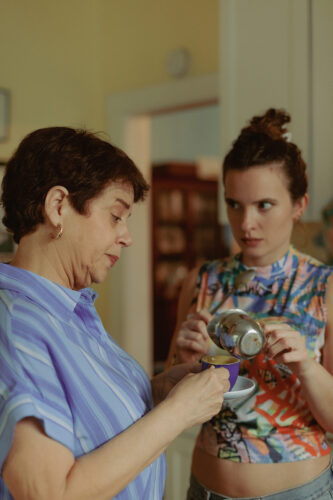
Barbara Bonilla, left, and Kaelyn A Gonzalez explore their unique mother-daughter dynamic in City Theatre’s “How To Break In A Glove” written during the company’s Homegrown playwrights development program. (Photo by Passion Ward, courtesy of City Theatre)
“The best way to describe the play is that it’s about people who want to love, but don’t know how,” says Ferrer. “They love each other, but they were never taught how to be anything but tough and have self-preservation.”
Ferrer, 37, pulls from his own childhood for his second-ever full-length play. Much like his youngest character on stage, Ferrer was also in little league. “That is the only real way that I was able to connect with my grandfather was through baseball,” he recounts.
The 90-minute play follows a young Tony trying to navigate the awkward time between being a kid and being a teenager all while growing up surrounded different ideologies. In one night, everything changes. Buried tensions arise and a family must learn to come together in a time of crisis.
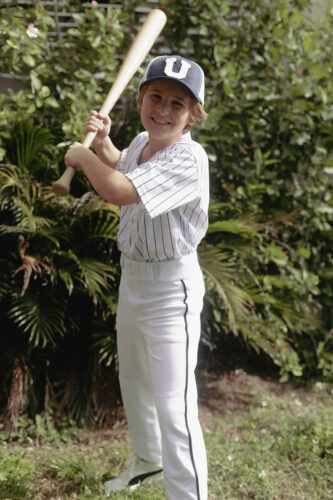
Being 11 years old in 1999 Hialeah is tough, just as Tony, played by actor Franco Kiglies, finds out in “How to Break in a Glove.” (Photo by Passion Ward/courtesy of City Theatre)
While the storyline is not autobiographical, Ferrer believes the character and the situations are relatable — especially if you happen to be Cuban-American. “The Cuban culture is very passionate in an angry, declarative way. Love is expressed in how much it upsets you, in how much the passion rises within you,” explains Ferrer.
When he first began working on the play in 2022, he says he was reflecting on his childhood and his relationship with his grandfather. “I saw a lot of similarities between the process of breaking in a glove and a relationship,” says Ferrer. Both require work, commitment, dedication, and a daily choice.
“It takes patience, it takes effort,” says the playwright.
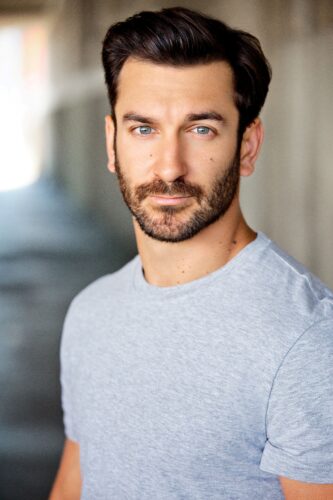
Playwright Chris Anthony Ferrer pulls from his own upbringing in Hialeah in “How to Break in a Glove,” getting its premiere by City Theatre. (Photo by Michael Roud Photography)
The same can be said of the writing process. Ferrer worked on “How to Break in a Glove” with City Theatre’s artistic director Margaret Ledford, dramaturg Karina Batchelor-Gómez, and executive director Gladys Ramírez. The foursome first started back in 2022 when Ferrer was part of the first-ever cohort of the theater company’s Homegrown playwright development program.
“In this collaborative process, the show has evolved in such a way that feels real. I couldn’t be happier,” says Ferrer.
As part of the Homegrown program, writers work on a short play — what City Theatre is known for producing — and also begin work on a full-length show. The purpose of the program, says Ledford, “is to develop traditionally marginalized voices that don’t get that mainstream opportunity.”
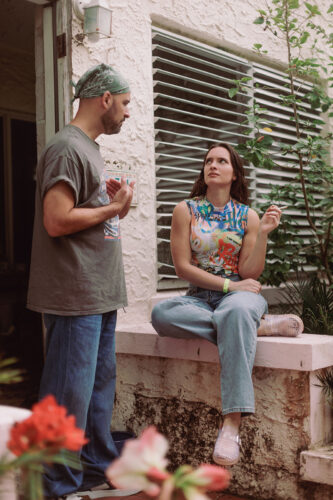
Kaelyn A. Gonzalez and Randy Garcia play Carmen and Carlos, parents to 11-year-old Tony. (Photo by Passion Ward, courtesy of City Theatre)
Once Ferrer finished the program in 2023, he continued to work on “How to Break in a Glove” and eventually invited Ledford and Ramírez to a reading. It was that night that the two creatives were hooked.
“We got very excited that we could mentor Chris and work on the world premiere with him,” says Ledford. She adds that City Theatre hopes to continue this new tradition and develop other full length plays from past — and future — Homegrown cohorts.
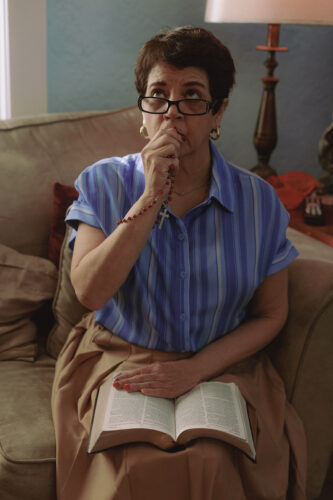
Barbara Bonilla plays a traditional Cuban grandmother, Aleida in City Theatre’s “How to Break in a Glove.” (Photo by Passion Ward/courtesy of City Theatre)
“Our unsaid motto is always ‘put the city in City Theatre,’” says Ramírez. “We can’t expect these kinds of stories to come without building the infrastructure, adding that “How to Break in a Glove” isn’t just a play from its Homegrown series, but “it’s a homegrown company and we’re very excited to share this with our community.”
In addition to her work as executive director of the theater company, Ramírez steps behind the curtain to direct “How to Break in a Glove.”
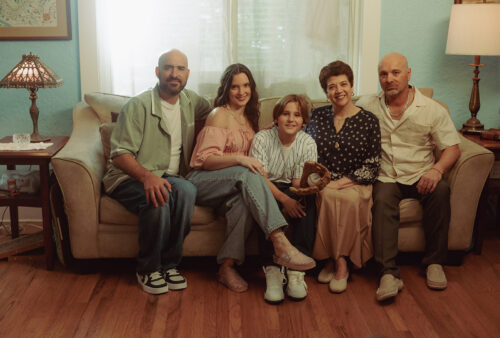
The cast of “How to Break in a Glove,” from left to right: Randy Garcia, Kaelyn A.
Gonzalez, Franco Kiglies, Barbara Bonilla, and Andy Quiroga. (Photo by Passion Ward, City Theatre)
“I’m very grateful that Margaret asked me to direct, because even though I’m not Cuban, I was in Hialeah in the ‘90s and I understand the culture,” says Ramírez. “People might not recognize the title, but they’ll recognize the characters. They’ll recognize the story.”
The play features an all-Hispanic cast from Miami, which includes Barbara Bonilla as Aleida, Andy Quiroga as Francisco, Randy Garcia as Carlos, Kaelyn A. Gonzalez as Carmen, and Franco Kiglies as Tony.
“If somebody leaves the theater and wants to call their mom, then I did my job,” says Ferrer.
WHAT: “How to Break in a Glove” by Chris Ferrer
WHERE: Carnival Studio Theater at the Adrienne Arsht Center for the Performing Arts, 1300 Biscayne Blvd., Miami.
WHEN: Opens Friday, Feb. 6 through Sunday, Feb. 22. Performances 7:30 p.m. Wednesday, Thursday, Friday, and Saturday; 2:30 p.m. Sunday. 2:30 p.m., Saturday, Feb. 7 and Feb. 21.
COST: $66.69 and $72.54 (includes fees)
INFORMATION: (305) 949-6722 or arshtcenter.org
ArtburstMiami.com is a nonprofit media source for the arts featuring fresh and original stories by writers dedicated to theater, dance, visual arts, film, music and more. Don’t miss a story at www.artburstmiami.com.
No posts found
Review: Poetry Resounds in Nilo Cruz’s ‘Sotto Voce’ at GableStage
Written By Mary Damiano
January 30, 2026 at 1:34 PM
Sara Morsey, Claudia Tomas, and Gabriell Salgado in Nilo Cruz’s “Sotto Voce” at GableStage through Feb. 15 (Photo by Magnus Stark, courtesy of GableStage)
Nilo Cruz is, first and foremost, a poet. Though he rose to prominence as a playwright when he won the Pulitzer Prize for drama for his play “Anna in the Tropics,” a play commissioned by Miami’s now-defunct New Theatre, poetry permeates everything Cruz writes, including “Sotto Voce” now at GableStage in Coral Gables through Sunday, Feb. 15.
The GableStage production, lovingly directed by Cruz, begins with a full moon casting its light on a shimmering, undulating ocean, the first of many breathtaking projections by Jamie Godwin. The main setting is the apartment of Bemadette Kahn, an 80-year-old writer in New York City in 2000. Bemadette is haunted by her lost love, Ariel Strauss, who, along with his sister, Nina, boarded the doomed M.S. St. Louis in Germany in 1939.
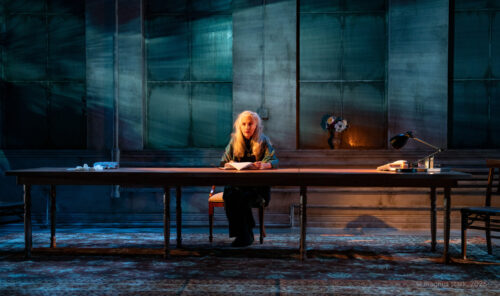
Sara Morsey as Bemadette Kahn in GableStage’s production of Nilo Cruz’s”Sotto Voce.” (Photo courtesy of GableStage)
The ship set sail carrying Jewish refugees seeking safety in Cuba from Nazi persecution. When Cuba denied them entry—followed by the United States and Canada—the vessel was turned back to Europe. There, an estimated quarter of the passengers were killed in concentration camps or by other Nazi methods.
Bemadette is contacted by a young Jewish-Cuban researcher, Saquiel, who wants to speak with her about Ariel. Saquiel has his own connection to the doomed voyage, which has left him with a collection of love letters from Bemadette to Ariel. He travels to New York to meet her, but she refuses, and will only speak to him by phone and through email, where they address each other as Writer and Student.
The term “Sotto Voce” means to speak in a hushed tone so as not to be overheard, and it’s a fitting title for a play in which the central relationship is played out mostly through telephone conversations.
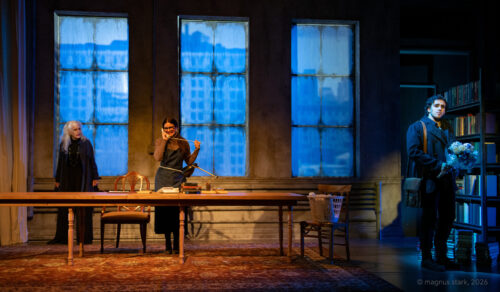
Sara Morsey, Claudia Tomas, and Gabriell Salgado in Nilo Cruz’s “Sotto Voce” at GableStage through Feb. 15 (Photo by Magnus Stark, courtesy of GableStage)
Though “Sotto Voce” premiered in 2014, its exploration of immigration remains strikingly current. The failures of a broken system feel as real today as they did in 1939 and in 2014. When Saquiel encounters visa trouble, Bernadette exclaims, “I can’t believe this is happening all over again,” a line that feels ripped from the headlines yet proves, unfortunately, to be timeless.
Sara Morsey, who appeared in GableStage’s production of “Summer, 1976” last year, plays Bemadette. Morsey beautifully portrays Bemadette’s passion, longing, and loss in a visceral way. She moves about the stage with a dance-like grace and poise as the decades-long grief and despair rise within her and explode onto the stage and into the audience, raw emotion everywhere.
Gabriell Salgado portrays Saquiel with a sweet, earnest quality. While he’s flustered by Bemadette’s reclusiveness, his persistence – and voice – endears him to her as their unusual relationship deepens. It’s a challenging role, but Salgado wisely portrays Saquiel as a young man with an old soul, which is key to making the story work.
Claudia Tomas portrays Lucila, Bemadette’s personal assistant. Throughout much of the play, Lucila hides her insecurities with conservative clothing and a mousey demeanor. But over the course of the story, Lucila blossoms, like a caterpillar to a butterfly. Tomas delivers a quiet, nuanced performance that evolves as her character grows, and is key to one of the best scenes in the play, when Lucila invites Saquiel to Bemadette’s apartment when the writer is not home. While it’s a tense, playful, intimate scene between two people with chemistry, Tomas, with her funny, tender, awkwardly sexy performance, is especially memorable.
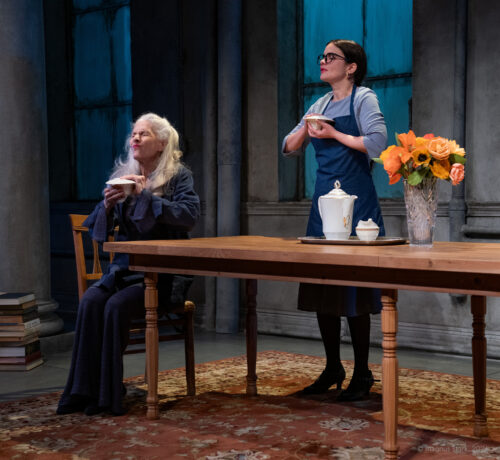
Sara Morsey as Bernadette Kahn and Claudia Tomas as Lucila Pulpo share a cup of tea in a scene from “Sotto Voce” on stage at GableStage through Sunday, Feb. 15. (Photo by Magnus Stark, courtesy of GableStage)
Cruz directs “Sotto Voce” with a sure hand and a tenderness toward the material, never slipping into the cloying sentimentality that can plague playwrights staging their own work. His sense of visual poetry echoes throughout the way the production is staged. Every element provides cohesiveness to that theme. Tony Galaska’s moody lighting design enhances the warmth of the story. Erik T. Lawson’s sound adds to the depth and emotion of the play. Frank J. Oliva’s scenic design is deceptively simple but sets the stage for surprises.
“Sotto Voce” has a palpable feeling of loss and longing, but also of new love that rekindles old flames. It is ultimately a play filled with hope, and the joy of understanding that love, even if only for a short time, is worth it.
WHAT: “Sotto Voce” by Nilo Cruz
WHERE: GableStage, 1200 Anastasia Ave., Coral Gables
WHEN: 7:30 Wednesday, Thursday, Friday, and Saturday; 2 p.m. Wednesday and Sunday through Feb. 15.
COST: $40, $60, $70 with additional $10 fee.
INFORMATION: 305-445-1119 or gablestage.org
ArtburstMiami.com is a nonprofit media source for the arts featuring fresh and original stories by writers dedicated to theater, dance, visual arts, film, music and more. Don’t miss a story at www.artburstmiami.com.
No posts found
Miami New Drama Revisits Miami’s ‘English Only’ Fight Over Spanish
Written By Michelle F. Solomon
January 29, 2026 at 2:07 AM
René Granado in a scene from Miami New Drama’s “English Only,” an original play having its world premiere at at the Colony Theatre, Miami Beach.(Photo by Morgan Sophia Photography)
Miami New Drama will premiere its second collaboration with journalist-author-turned playwright Nicholas Griffin with “English Only.” Directed by New York–based director Margot Bordelon, the production takes on one of Miami’s most fraught political battles — the fight over language and power that followed the Mariel Boatlift.
“English Only” runs Thursday, Jan 29 through Sunday, Feb. 22 at the Colony Theatre in Miami Beach.
Set in 1980, the play is rooted in the turbulent months after more than 125,000 Cuban refugees arrived in South Florida. Pushes for the Spanish speakers to adopt English only as their language gained traction nationwide. Citizens of Dade soon followed, organizing an English-only campaign aimed at dismantling Miami-Dade’s bilingual policies.
The proposed changes called for eliminating Spanish from government documents, public communications, and civic life threatening to redraw who held power in a city shaped by immigration. Opposing the effort was Manny Diaz, then a young attorney with the Spanish American League Against Discrimination (SALAD) who framed the language fight as a civil rights issue with lasting consequences for Miami’s identity.
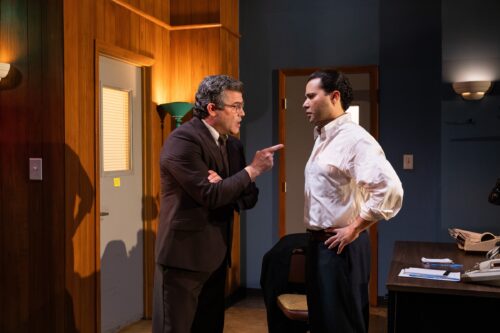
Andhy Mendez as Manny Diaz, left, has words with René Granado,in Nicholas Griffin’s world premiere of “English Only” (Photo by Morgan Sophia Photography)
For Griffin, the writing of “English Only” began soon after his first partnership with Miami New Drama Artistic Director Michel Hausmann. Griffin’s book, “The Year of Dangerous Day: Riots, Refugees, and Cocaine” about Miami in 1980 seemed ripe for a stage adaption.
Griffin arrived in Miami to research the book with his Venezuelan-born wife, Adriana, and their two children, 11 years before it was published in 2020. He sold the screen and television rights, unaware that stage rights had also been included. So when Hausmann first approached him about adapting “Dangerous Days,” Griffin declined. Once he realized the stage rights were available, he quickly changed his mind. The result was the world premiere of “Dangerous Days,” drawn from the book’s deep dive into Miami’s McDuffie riots, which opened at Miami New Drama in April 2024.
“I guess towards the end of ‘Dangerous Days’ Michel said he wanted to do something together again, and he pointed towards a paragraph in the book, recalls Griffin.“It was a paragraph about Emmy Schaefer and the English only campaign. It was merely a paragraph in the book; Griffin said that he had more material that got left on the cutting room floor.
“The editor had whittled that down and there had been many more pages, so I knew quite a bit about it. We started talking about it, and Michel was adamant that he thought there was a play there.”
Hausmann saw not just a historical episode, but a way to talk about the present. “We’re really telling the story of 1980 with the mirror to 2026,” he says. “It’s impossible not to. Maybe had we done this play in 2015 it would have read completely different. Hopefully in 10 years, this is not an issue we have anymore, but it sure as hell is an issue we have right now.”
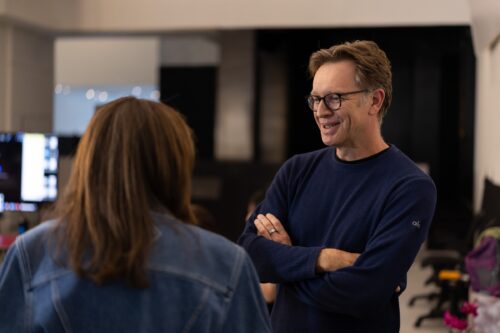
Playwright Nicolas Griffin with Stacey Mindich, co-chair of the Miami New Drama board talk during “English Only’s” first rehearsal. (Photo by Morgan Sophia Photography)
Griffin had originally met and interviewed Diaz for the book. “And so I went back to him again and Michel joined me the second time around and we had a long lunch digging up stories about him and Emmy Schaefer,” he says, “and how virulent things had been during those months between the two communities”
He did not have a chance to speak with Schaefer. “From what I could gather she is in a memory care facility in Central Florida and is 98 years old.”
Hausmann says talks went on about the play. “This all began before Trump won again,” he says. But then there was the timeliness of it, the urgency. “It became more evident in this anti immigration, this sort of nativism that we’ve had for the past year. I pushed faster its development.”
The play is anchored in a city whose past is often quickly forgotten and Hausmann says that’s why these stories belong onstage. He points to Miami New Drama’s Miami History series, which includes projects like “Elián,” “Dangerous Days,” and “Confessions of a Cocaine Cowboy.”
“Even when we were doing ‘Dangerous Days’ about the McDuffie riot, which was sort of like the event of the decade, very few people had any idea what all that was. We’d go to schools, or we’d go to the teachers — they had no idea. Even Elián, which I think was such a pivotal moment in American history, many people didn’t know about Elián González. We have that extra responsibility in a city, in a community that has very little institutional memory, that we have to be the ones to bring it, to help craft that community collective memory.”
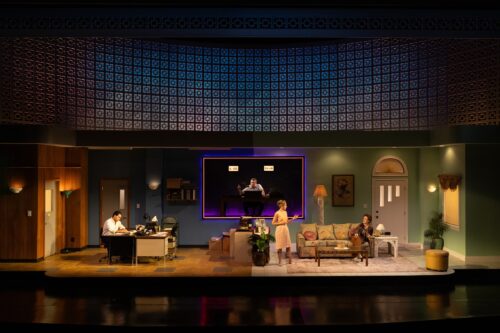
The cast of Miami New Drama’s world premiere of Nicholas Griffin’s “English Only.” (Photo by Morgan Sophia Photography)
In “English Only,” that memory takes the form of a political battle with real stakes. “Within the play, it’s basically the battle of whether she can or can’t raise her 25,000 signatures to get the English only ordinance on the ballot,” explains Griffin. “She does it. She actually gets, I think, 147,000, so it was remarkably oversubscribed. She just tapped into something no one even knew existed in America at that point, this huge resentment against an immigrant community.”
That November, when it goes on the ballot, Schaefer wins easily.
“Emmy Schaefer gets almost 60 percent of the vote, and that means that the original ordinance for Miami-Dade being a bilingual county is rescinded, and for 13 years we are not a bilingual county. It’s not until 1993 that we flip back again,” says Griffin.
Griffin also draws a through-line from Schaefer’s campaign to later efforts to defend bilingualism. “That was interesting later on,” he says. “SALAD, who are represented in the play as, you know, the sort of flip side of Emmy Schaefer’s Citizens of Dade United, they then come up later on with, instead of English only, they come up with English plus, which was the defense of bilingualism. But obviously, you know, we’re in this unique spot in America here, where the argument, one of the arguments, was: if any city could build its fortune on being bilingual, it should be Miami. And that’s kind of the way things have gone.”
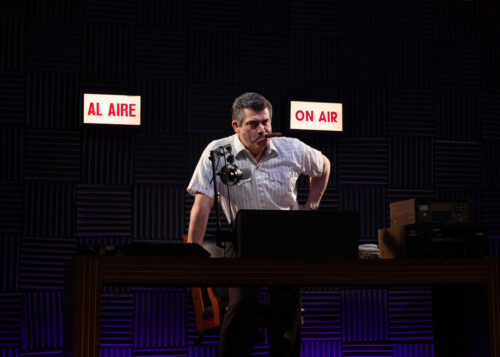
René Granado in a scene from Miami New Drama’s world premiere of “English Only.” (Photo by Morgan Sophia Photography)
For Hausmann, what matters is that the play makes room for those arguments without lecturing the audience. “We’re very careful not to be preachy,” he says. “Both sides of the argument have intellectual merit. Nick allows Emmy Schaefer to give her point of view — ‘I’m an immigrant, I came to this country not knowing English, it was important for me to become part of this country, so I learned English. If I could do it, why can’t you?’ And then you have Manny saying, we’re a nation of immigrants, and Miami was transformed because of bilingualism, not in spite of it. I want the audience to be presented with those arguments and to decide where they stand.”
“English Only” also continues Miami New Drama’s broader commitment to creating new work rather than importing established titles. Over the past decade, the company has developed original plays that have moved to larger stages, including “It’s a Wonderful Life,” which transferred to Broadway and another, “Birthright,” which is headed to MCC Theater in New York with an eye toward a future Broadway run. The company’s trilingual version of “Our Town” is now published and produced nationwide, and “The Cubans” and “7 Deadly Sins” have drawn national attention.
Hausmann says he has little interest in simply remounting proven hits. He sees Miami New Drama as the place where major works begin. “I wouldn’t want a more relaxed life doing repertory of shows that have already been figured out on Broadway,” he says.. “What excites me is that Miami New Drama is the first draft of the next major American work. I like us to be the first, and I think, the most important step in the creation of new work.”
WHAT: World Premiere of Nicholas Griffin’s “English Only”
WHERE: Miami New Drama, The Colony Theatre, 1040 Lincoln Road, Miami Beach
WHEN: 8 p.m. Thursday through Saturday; 3 p.m. Sunday. Through Feb. 22.
COST: $40-$90
INFORMATION: 305-674-1040 and miaminewdrama.org
ArtburstMiami.com is a nonprofit media source for the arts featuring fresh and original stories by writers dedicated to theater, dance, visual arts, film, music and more. Don’t miss a story at www.artburstmiami.com.
No posts found
Key Biscayne’s Film Festival Expands With a New Cinema on the Island
Written By Michelle F. Solomon
January 27, 2026 at 11:19 AM
Key Biscayne’s new arthouse-like cinema, Paradise Cinema, is one of the main venues for the Key Biscayne Film Festival, which enters its third year with a full program starting Thursday, Jan. 29 through Sunday, Feb. 1. (Photo courtesy of Village of Key Biscayne)
The Key Biscayne Film Festival was an idea that emerged during the planning of what would probably have been a hit with television audiences — a reality show about life on Key Biscayne. Isabel Custer and Maite Garrido wanted to make a documentary reality series starring the characters that live on the island.
“Maite was a producer for news for many years, and we wanted to do a documentary style, reality series of what it’s like to live on Key Biscayne,” says Custer, a filmmaker and producer.
As they were in the midst of casting calls and production meetings, Garrido mentioned that the island should have its own film festival.
The reality series never materialized – the production company “felt it needed more star power to carry the show,” says Custer. So the pair dropped the idea and became fully immersed in creating the Key Biscayne Film Festival.
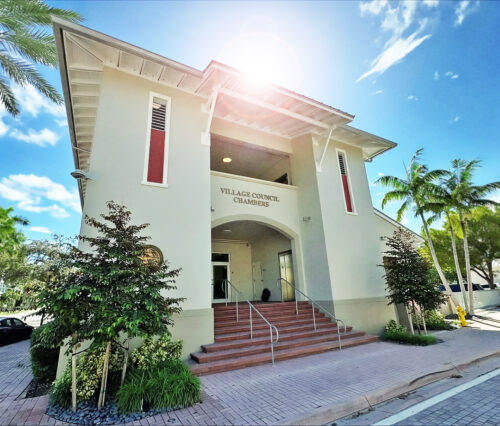
The Village Chambers has been transformed into a dual-use space spurred by the popularity of the Key Biscayne Film Festival. (Photo courtesy of Village of Key Biscayne)
The Key Biscayne Film Festival (KBFF) opens Thursday, Jan. 29, with Peruvian feature film “Mistura” directed by Ricardo de Montreuil. Custer, who is Peruvian, says that the movie seems like something that would resonate with a lot of Key Biscayne’s Latin American community. “I thought it would be nice to include a feature film along with our documentaries. It’s from Latin America and so much of Key Biscayne is Latin American.”
Released in Peru in 2025, the story is set in 1960s Peru and stars Bárbara Mori as a wealthy French-Peruvian woman whose life falls apart after her husband leaves her for another woman. She embarks on a culinary journey that transforms her life.
“It is a beautiful film,” says Custer.
In this, its third year, the festival has a new addition. Screenings will be shown in the newly transformed Paradise Cinema inside the Village Council Chambers. In the past two years, Custer says, films were shown in one of the rooms of The Community Center – not the best setting for a movie theater experience.
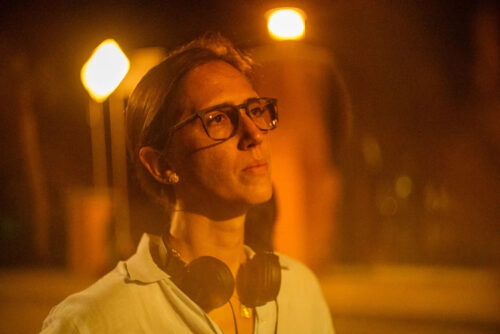
Isabel Custer, co-founder, festival director and programmer of the Key Biscayne Film Festival, taken on the set of her movie “As You Like It – Like That!” (Photo by Debbie Gold, courtesy of Isabel Custer)
“We’re lucky enough that the village council set aside a budget to create the mini cinema, sort of the size of an art house cinema,” says Custer, the festival’s director and programmer. “Now we have ideal surroundings, at least, and it’s growing in the sense that we also have more directors or filmmakers coming than ever, which is extremely exciting; producers and directors and actors coming to talk about their films.”
For the first time, the festival is crossing the causeway to UM’s Rosenstiel School of Marine, Atmospheric, and Earth Science (RSMAS) .including a Friday screening of films with an environmental focus. The headlining film is Sasha Wortzel’s “River of Grass.”
In the documentary, Wortzel in voiceover says, “Marjory came to me in a dream,” speaking about Marjory Stoneman Douglas. “I knew she was a celebrated environmentalist, but I wanted to know more, so I went looking for her.”
The film takes its title from Douglas’s 1947 book “The Everglades: River of Grass” and is guided through the writings of Douglas and looks at the people who live in and protect the region today.
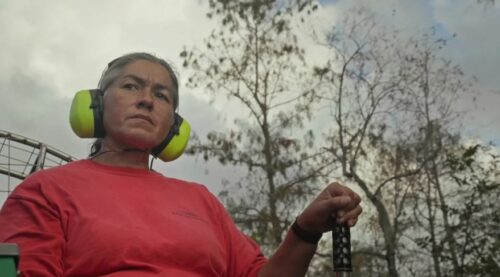
Miccosukee educator Betty Osceola on her airboat in the documentary “River of Grass.” The Key Biscayne Film Festival will show the film at UM’s RSMAS on Friday, Jan 30. (Photo courtesy of Sasha Wortzel and Walking Productions)
“Sasha’s film is very important and very beautifully executed,” says Custer, adding that the auditorium at the RSMAS can accommodate a few hundred filmgoers.
“We thought that it would draw a crowd and well deserved… we’re opening it up to not just Key Biscayne residents, but also university students or grad students that are already interested in marine biology and nature and the environment.”
“River of Grass” has earned awards in Florida and across the country including the Florida Filmmaker Award at the Tallahassee Film Festival and the Florida Film Critics Circle’s Golden Orange Award as well as winner of the International Documentary Association’s IDA Award.
On Saturday, Jan. 31, the festival heads outdoors to Paradise Park for its awards ceremony and a screening of Herschel Faber’s “Ethan Bloom.”
While Faber’s comedy feature has some casting choices out of Hollywood –Mindy Sterling who played Frau Farbissina in the “Austin Powers” movie series, Joshua Melina known for his role as Will Bailey on “The West Wing” and Hank Greenspan from the television series “The Neighborhood” as Ethan Bloom – the film is set in Coconut Grove and Coral Gables. The director says he got his first job as a production assistant when Mike Nichols was filming “The Birdcage” in Miami Beach. “This is where I got my start. My roots are here.” He also made his first movie in Miami, “Chasing Pavarotti,” a short film shot in Miami Beach.
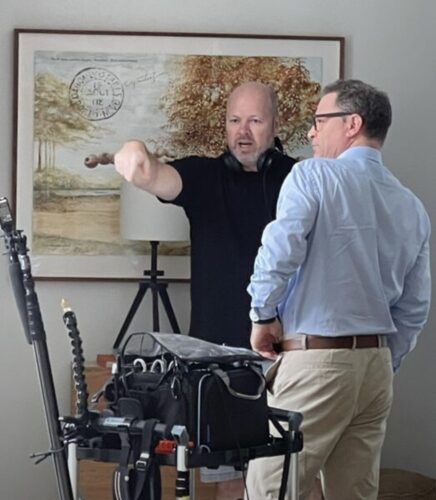
Herschel Faber directs Joshua Melina on the set of his made in Miami film “Ethan Bloom.” (Photo courtesy of the filmmaker)
“Ethan Bloom” is about a 13-year-old Jewish kid who secretly wants to become a Catholic. Although he spent his growing years in New Smyrna Beach, Fla., Farber says his childhood was spent in Miami Beach where his father grew up. “I had a real nostalgia for the Grove and the Gables,” he says. “This is a uniquely Miami movie.”
At the beginning of the year, distributor Menemsha Films acquired the rights to Faber’s film, and it is expected to launch it in movie theaters across North America.
Faber will be at the screening to discuss his film on the festival’s closing night.
Other films showing at the festival include documentaries “Blue Zeus,” about a wild horse and the fight to save him and his family from a flawed government system, “News without a Newsroom,” which explores journalism’s uncertain future, “Marlee Maitlin: Not Alone Anymore,” about the Oscar winners breakthrough in Hollywood as a deaf actress, and local filmmakers Dennis Scholl and Kareem Tabsch’s documentary “Naked Ambition” about Miami Beach-based model-turned photographer Bunny Yeager. Scholl will lead a question and answer after the screening for the festival’s final day on Sunday, Feb. 1.

Miami Beach artist, model, photographer, feminist pioneer and icon Bunny Yeager is the subject of Dennis Scholl and Kareem Tabsch’s movie “Naked Ambition” showing at the Key Biscayne Film Festival’s final day on Sunday, Feb. 1. (Photo courtesy of Music Box Films)
There are plenty of other films showing throughout the weekend.
See the complete program here.
But the festival isn’t only about watching films—it’s about nurturing the next generation of storytellers, according to Custer. “One of the other important pillars for us is education. Every fall, I organize a workshop called the Youth Filmmakers Workshop to make sure that students, mostly middle and high school, learn the craft of storytelling through film,” says Custer. Young filmmakers from Key Biscayne’s “It Takes a Village” will show their films in the “Spotlight on Youth Showcase” on Sunday, Feb. 1 along with those from Custer’s workshop. “Its an important part of this youth film roster to have those with learning disabilities or on the spectrum – those with different abilities making films and having them seen.”
Custer doesn’t want film in Key Biscayne to be relegated to once a year. With the new Paradise Cinema, she says there are opportunities to show more movies throughout the year — and to keep the festival’s momentum beyond a single weekend.
“Maybe not every single week, but at least once or twice a month — get screenings like a movie theater would and grow our film festival audience that way. That’s how we’re going to find the people who really love film, who are going to come to the festival.”
WHAT: The Third Annual Key Biscayne Film Festival
WHERE: Paradise Cinema, 560 Crandon Boulevard, Key Biscayne; Paradise Park, 530 Crandon Boulevard, Key Biscayne; UM RSMAS, 4600 Rickenbacker Causeway, Virginia Key.
WHEN: Thursday, Jan. 29 through Sunday, Feb. 1.
COST: Costs vary from free admission to $20 general admission and $50 reception and cocktail party tickets.
INFORMATION: kbfilmfestival.org/
ArtburstMiami.com is a nonprofit media source for the arts featuring fresh and original stories by writers dedicated to theater, dance, visual arts, film, music and more. Don’t miss a story at www.artburstmiami.com
No posts found
Review: Powerful Gay Drama ‘The Inheritance’ at Zoetic Stage Is Everybody’s Story
Written By Michelle F. Solomon
January 16, 2026 at 8:48 AM
The cast of Zoetic Stage’s production of Matthew López’s “The Inheritance, Part 1,” playing at the Adrienne Arsht Center in the Carnival Studio Theatre, Miami, through Sunday, Jan. 25. (Photo by Morgan Sophia Photography, courtesy of the Adrienne Arsht Center)
Pay attention to “The Inheritance” and don’t judge a book by its cover. While at the center of this sprawling play is about the lives of 12 gay men, it doesn’t harp on identity or representation.
Under Stuart Meltzer’s smart direction, Zoetic Stage’s production conveys the deeper meaning of Matthew López’s title, revealing its full weight. “The Inheritance” is less literal than it may appear on the surface — there is an emphasis on acquisitions like money, houses, rent-controlled New York apartments—but the layers underneath are a message of insecurity, mortality, grief, and history in peril of being forgotten. Also, what comes through clearly in López’s text and Meltzer’s choices is that inheritance is not only what we are born into, but also the family we create for ourselves.

“The Inheritance, Part 1” at Zoetic Stage with Anthony Michael Martinez, Alex Weisman and the ensemble. (Photo by Morgan Sophia Photography, courtesy of the Adrienne Arsht Center)
Zoetic Stage at the Carnival Studio Theatre in the Adrienne Arsht Center is staging the first part of the two-part epic, “The Inheritance, Part 1,” through Sunday, Jan. 25.
López openly borrows its DNA from E.M. Forster’s “Howards End,” even building Forster into the play as a guiding presence, both for the characters and the audience.
There are shades of Armistead Maupin’s “Tales of the City”—the communal characters, the entwined relationships—here trading San Francisco for New York. It’s the mid-2010s and decades after the height of the AIDS epidemic.
At its center is Eric Glass, played by Alex Weisman, who fully engulfs the character with a mix of emotion and quiet intensity. He’s social but awkward and lives in a rent-controlled apartment surrounded by friends who he frequently invites over for dinners and parties. His grandfather was a veteran, helping to liberate Dachau; his grandmother a refugee from Germany. The three-bedroom apartment, bought in 1947, “was the first place Eric’s grandmother felt safe in the world.”
Now, he lives there, protecting it as part of his identity.
Eric’s boyfriend is Toby Darling, played by Anthony Michael Martinez. He’s immediately compelling—good-looking, charismatic, and brooding. Martinez imbues Toby with energetic charm and ambition, making him magnetic and complex. But underneath, he’s wounded from a difficult childhood.

Alex Weisman as Eric Glass in Zoetic Stage’s production of “The Inheritance, Part 1.” (Photo by Morgan Sophia Photography, courtesy of the Adrienne Arsht Center)
Their lives intersect with an older couple Walter Poole (McKeever, who doubles as Forster) and the astute businessman Henry Wilcox (played with just the right amount of confidence by Tom Wahl). Poole describes their relationship as a “succession of dinners.” Eric befriends Walter while Toby is in Chicago preparing his book-turned-play for Broadway. Toby begins pursuing the younger Adam, played brilliantly by Aidan Paul, whose cast as the star of his play. Young Adam comes from a wealthy family and lives in his parents’ palatial New York apartment. Later in the play, Paul appears as Leo, a male escort, showing a very different side of life in New York. In both roles, Paul captures the contrast between privilege and vulnerability, making each character fully realized and multi-faceted.
In one of the play’s most gripping moments, McKeever, with the utmost care and emotion, delivers a long, revealing monologue as Walter – it is truly captivating. He lets out a deeply held story about a longstanding rift with Henry over the years he took in friends dying of AIDS and cared for them in their final hours in the couple’s upstate New York house. Meltzer stages the moment so that the rest of the cast is in low light, watching silently along with the audience as the story unfolds. Weisman as Eric is tuned in to every word, his quiet reactions carrying the weight of the stories he had only heard about but didn’t live through.

Michael McKeever as Walter Poole talks about his past while Eric Glass (Alex Weisman) listens. (Photo by Morgan Sophia Photography, courtesy of the Adrienne Arsht Center)
The strong ensemble in “The Inheritance” brings López’s intricate text to life with precision and energy, each fully engaged in both intimate and tense moments. Angel Dominguez and Imran Hylton are the Jasons, Sam Lantz is Young Man 5/Charles Wilcox, Randall Swinton is Tristan, Larry Toyter is Jasper/Paul Wilcox, Alberto Blanco is Young Man 3, and Caio Fereira Santos is Young Man 4.
The staging is sparse giving way to the characters and their dynamics. Michael McLain’s set is a single block with three levels, used dynamically to convey perspective and power, with a chandelier looming overhead throughout and acting as a visual anchor. Props—champagne bottles, jackets, cheese plates—are not simply sitting on the stage; actors enter from offstage carrying them, handing them to the character who needs them in the moment. This small, deliberate choreography keeps the action fluid, making each gesture feel purposeful.
Lighting designer Becky Montero enhances the storytelling with subtle cues: a rich blue wash evokes the energy of a club scene, while delicate shifts mark the change in geography to three hours north of New York. Dario Almiron’s costume design and Bailey Hacker’s sound design round out a production in which every element serves the narrative, deepening both character and environment.

Aidan Paul and the cast of Zoetic Stage’s “The Inheritance.” (Photo by Morgan Sophia Photography, courtesy of the Adrienne Arsht Center)
Everyone in the ensemble is barefoot except Forster, Walter, and Henry, a staging device that underscores the older characters’ grounded presence and authority, contrasting with the naivete of the younger men as the narrative unfolds.
The three-hour running time (with two 10-minute intermissions) moves briskly—a pace López insists on in his script. He writes that “The Inheritance, Part 1, is written for speed and has got to go faster than you think it should,” explaining that the play’s momentum is essential to how the story unfolds: “It’s how the machine works.” Meltzer heeds the playwright’s direction, and the cast sustains that energy, keeping scenes moving seamlessly from intimate exchanges to larger ensemble moments.
By the time “The Inheritance” reaches its conclusion, the question is no longer who deserves what, but what anyone truly owns. Houses can be gained and lost, stories can be retold, and love is fleeting. Zoetic Stage’s production leaves a lasting impression especially in today’s atmosphere — that true inheritance lies in preserving the struggles of those who came before and guarding their memories to ensure that the past doesn’t suffer erasure.
WHAT: Zoetic Stage’s “The Inheritance, Part 1”
WHERE: Carnival Studio Theater at the Adrienne Arsht Center for the Performing Arts, 1300 Biscayne Blvd., Miami
WHEN: Performances 7:30 p.m., Wednesday, Thursday, Friday and Saturday, 2:30 p.m. Sunday. Through Sunday, Jan. 25.
COST: $72.54, $66.69 (includes fees). Ages 18+. Patrons under 18 will not be admitted.
INFORMATION: (305) 949-6722 or arshtcenter.org
ArtburstMiami.com is a nonprofit media source for the arts featuring fresh and original stories by writers dedicated to theater, dance, visual arts, film, music and more. Don’t miss a story at www.artburstmiami.com
No posts found


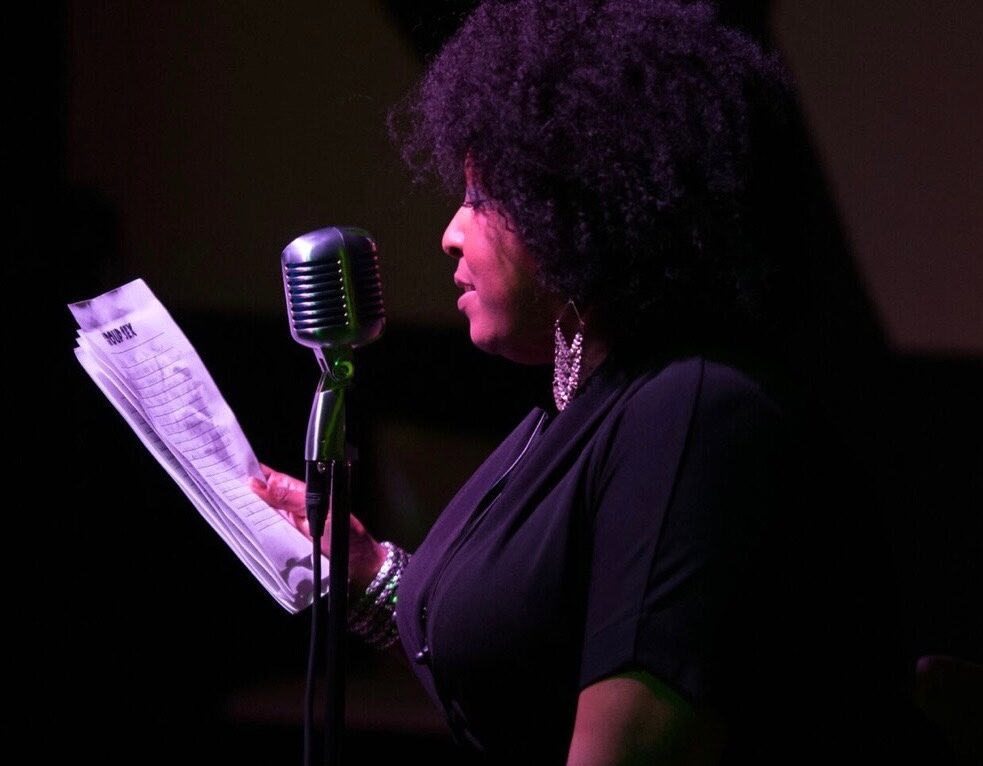
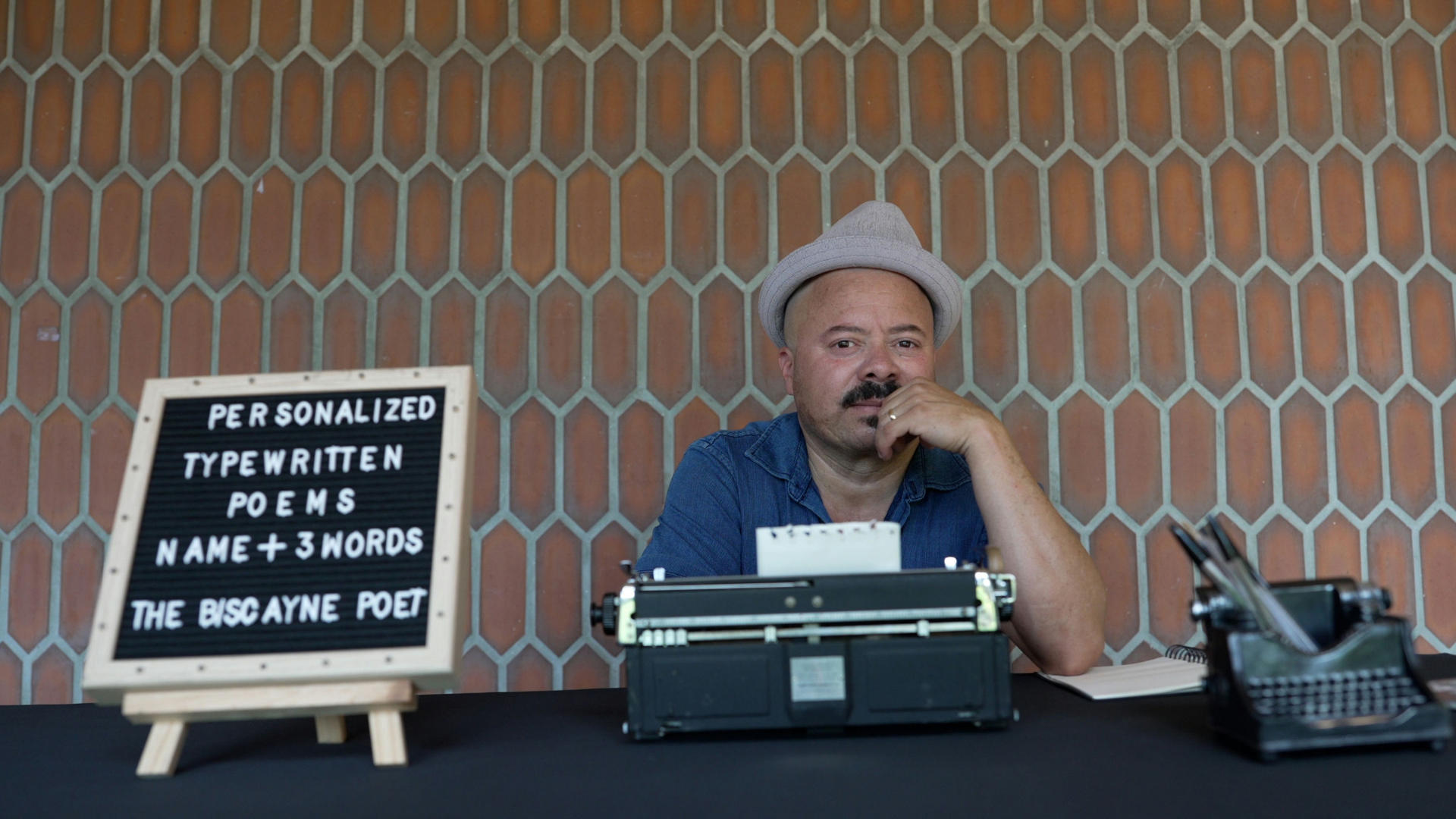


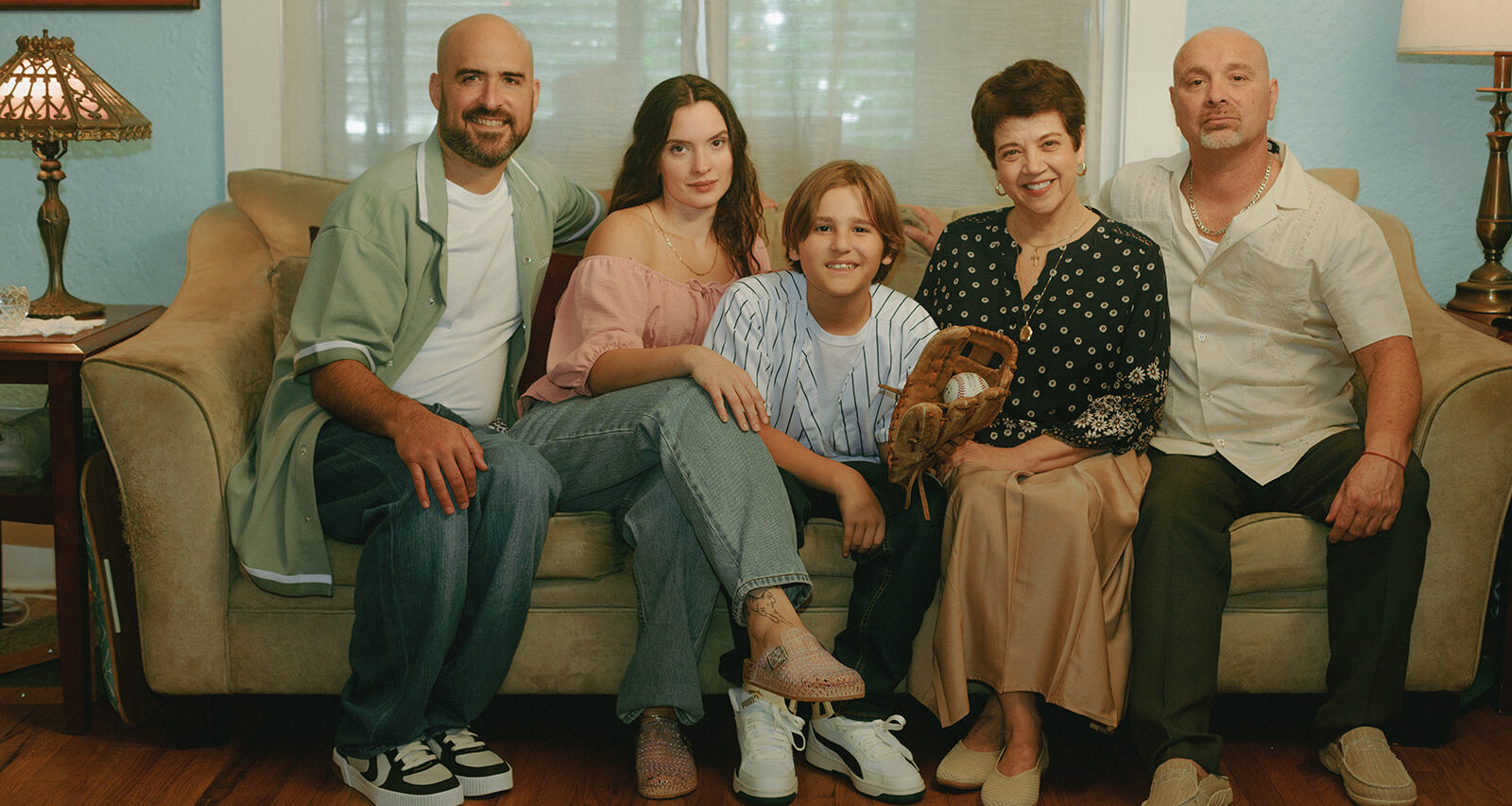
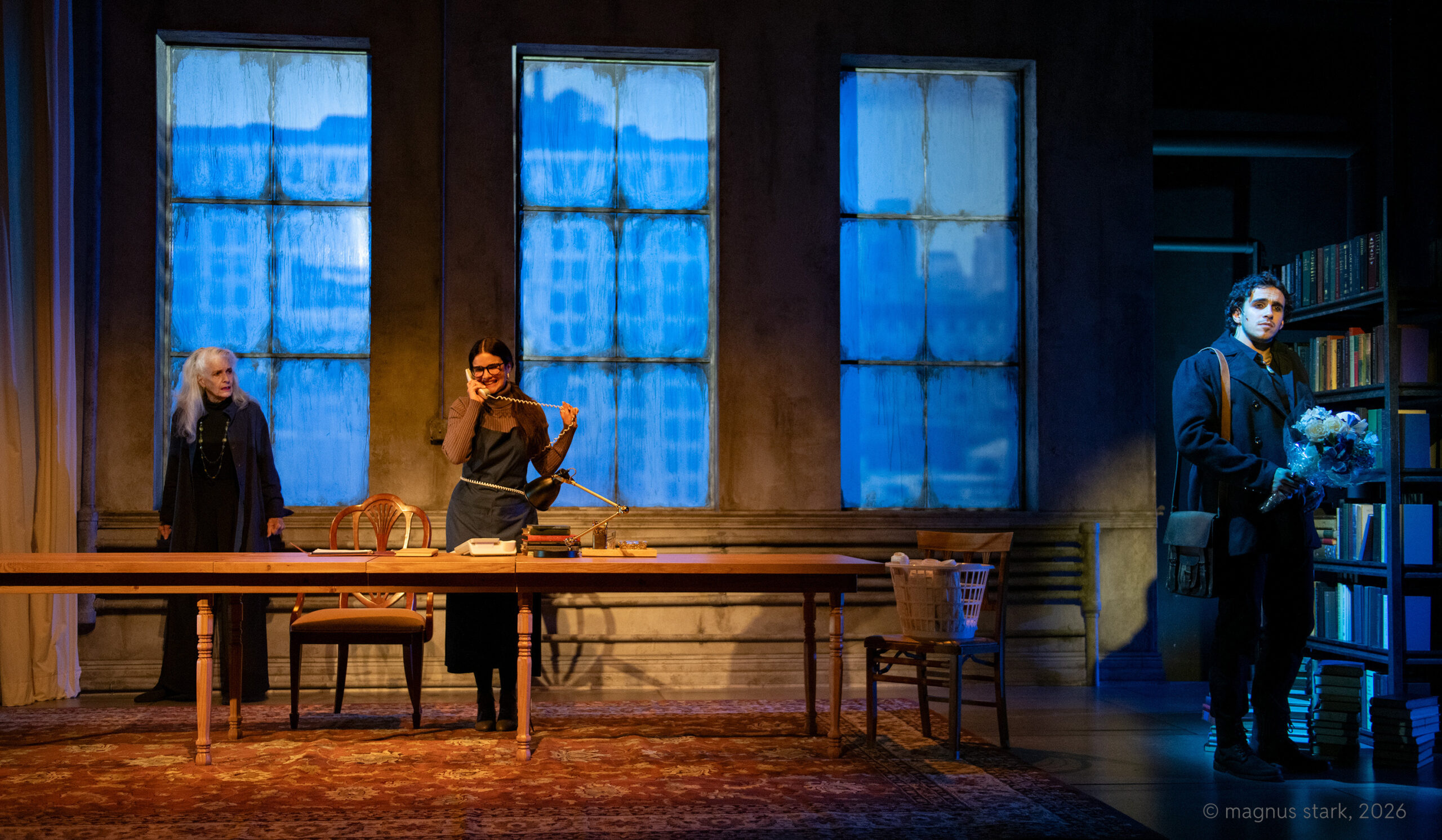



Recent Comments