Blog Article Category: Theater / Film
Review: GableStage’s ‘How I Learned’ may feature only one actor, but collaboration shows
Written By Christine Dolen
October 2, 2023 at 7:58 PM
Actor Melvin Huffnagle is August Wilson in the playwright’s “How I Learned What I Learned” now at GableStage through Sunday, Oct. 22 at the theater in the Biltmore Hotel, Coral Gables. (Photo courtesy of Magnus Stark)
August Wilson (well, the actor playing him) moves through his autobiographical solo show like a colossus, navigating a scaled-down version of Pittsburgh’s Hill District.
“How I Learned What I Learned” is the story of how a mixed-race kid who dropped out of high school at 15 became one of the country’s greatest playwrights. It’s the dramatic rendering of the societal, political, cultural and artistic forces that shaped him, particularly during the 1950s and ‘60s. It grants insight into how a creative giant’s mind works, because of what he learned and how he learned it.

Melvin Huffnagle as August Wilson stands amid the buildings of Pittsburgh’s Hill District, with set design by Frank J Oliva in “How I Learned What I Learned” at GableStage. (Photo courtesy of Magnus Stark)
Conceived in 2003 by Wilson and director Todd Kreidler, performed by Wilson at Seattle Repertory Theatre two years before he passed away in 2005, “How I Learned What I Learned” is launching GableStage’s 25th anniversary season at its home in the historic Biltmore Hotel in Coral Gables.
Just one man, actor Melvin Huffnagle, appears onstage. But make no mistake: this “How I Learned What I Learned” is the result of an immensely creative collaboration.
Director/sound designer Carey Brianna Hart, set designer Frank J Oliva, lighting designer Ernesto Pinto, projection designer Joel Zishuk, stage manager/costume coordinator Marialexia Hernandez, dramaturg Karina Batchelor and Huffnagle all played their parts in the end result. GableStage’s singular take on what is now a theatrical legend’s farewell proves yet again that a solo show is the result of creative alchemy.

Actor Melvin Huffnagle closes out GableStage’s “How I Learned What I Learned” by contemplating August Wilson’s legacy. (Photo courtesy of Magnus Stark)
On its surface, Huffnagle’s task is simple: Playing the two-time Pulitzer Prize winner (for “Fences” and “The Piano Lesson”), he explains how an often-angry young man became the acclaimed artist who wrote the Pittsburgh Cycle, 10 deep, rich, poetic plays about Black life in each decade of the 20th century.
Truth be told, “How I Learned What I Learned” isn’t simple. The script is a 47-page mountain beckoning Huffnagle to the top, and though the rehearsal period was abbreviated, he makes the ascent. Sure, on opening night you could feel his focus as he moved from anecdote to connective moment to tonal shift. But Huffnagle is often a magnetic interpreter of Wilson’s work – and the playwright’s moods.
“How I Learned What I Learned” asks the actor to summon charm, outrage, passion, the dangers that can accompany a younger man’s romantic game. From the jump, Wilson makes it clear that he’s going to be wry and real.

As playwright August Wilson, actor Melvin Huffnagle speaks of the
difficulties of being ‘African in America.’ (Photo courtesy of Magnus Stark)
“My ancestors have been in America since the early 17th century. And for the first 244 years we never had trouble finding a job. But since 1863 it’s been hell,” he begins. “It’s been hell because the ideas and attitudes that America had toward slaves followed them out of slavery and became entrenched in the nation’s psyche.”
Wilson, the son of a Black mother and a white father, fully embraced his Black identity. The stories he tells in “How I Learned What I Learned” illustrate that the lessons he absorbed – about creativity, life, strength, values – were taught by his Black friends and family. The creative spark that drove him to write the Pittsburgh Cycle, conveying the reality and complexities of being Black in America, was fashioned in the Hill District.
With Hart as his guide, Huffnagle uses the impressive tools in his actor’s arsenal – vocal and physical – to vary the segments in a piece that has him talking for almost two hours straight.
He becomes Wilson’s poet-junkie friend Chawley Williams, transforms into the troubled Cy Morocco, carries on both sides of a conversation between his mother Daisy and her friend Julie, who urged her to accept a used washing machine instead of the new Speed Queen she won in a radio station contest (the station, discovering Daisy was Black, wanted to give her a Salvation Army coupon for a used washer).

As August Wilson, Melvin Huffnagle listens to the beauty and power of music in “How I Learned What I Learned” at GableStage. (Photo courtesy of Magnus Stark)
The actor is especially fierce when he relates the stories of Wilson walking away from different jobs – in a toy store, mowing suburban lawns, washing dishes. Sure, the young writer who aspired to be a poet needed the money for the $25 rent he had to pay for his basement apartment every other week.
But principle – not accepting the implication that he might be a thief, that he shouldn’t be mowing a white person’s lawn, that he spent too much time poring over books at the Carnegie Library – mattered more.
Thanks in large part to Huffnagle’s creative collaborators, “How I Learned What I Learned” at GableStage becomes an other-worldly memory play, one grounded in clarity yet infused with delight.

Gablestage’s “How I Learned What I Learned” is mined by creative collaborators. (Photo courtesy of Magnus Stark)
Oliva’s sprawling set features scale models of Pittsburgh buildings, bridges, the Hill District. Crafted mostly via laser printer, the buildings light up in different ways thanks to Pinto, whose work also varies the color of the plain horizontal backdrop.
Zishuk’s projections of words and imagery add immeasurably to the storytelling, particularly in the moment where the clearly brilliant Wilson is excitedly explaining how one fascinating book leads to another and another and so on.
Hart’s sound design varies from the subtle “tink” of a dime falling into a Mason jar to an effect that helps to convey an overarching theme: During some of the projections, you hear a crackling fire as you watch subtle floating embers move over the images. The message? Wilson’s creative spark was forged in the Hill District.

Melvin Huffnagle as August Wilson explains the playwright’s early influences in Pittsburgh’s Hill District. (Photo courtesy of Magnus Stark)
A new Wilson biography – “August Wilson: A Life” by former Boston Globe critic Patti Hartigan (531 pages, Simon & Schuster) – was published recently, painting a lengthy and detailed portrait of a great artist.
But “How I Learned What I Learned” makes you feel Wilson’s presence, his drive, his humor, his rage, his passion. That’s the power of theater.
WHAT: “How I Learned What I Learned” by August Wilson
WHERE: GableStage in the Biltmore Hotel, 1200 Anastasia Ave., Coral Gables
WHEN: 2 and 7 p.m. Wednesday, 8 p.m. Thursday-Saturday, 2 p.m. Sunday (no performance Oct. 14, additional matinee Oct. 21), through Oct. 22; understudy Robert Strain will play Wilson Oct. 4, Oct. 11 and Oct. 18 at 2 p.m. and Oct. 12 at 10:30 a.m.
COST: $35-$65 (plus $10 in fees per ticket)
ArtburstMiami.com is a nonprofit media source for the arts featuring fresh and original stories by writers dedicated to theater, dance, visual arts, film, music and more. Don’t miss a story at www.artburstmiami.com.
No posts found
GableStage’s August Wilson solo show details how a writer found his voice
Written By Christine Dolen
September 27, 2023 at 11:50 AM
Actor Melvin Huffnagle portrays playwright August Wilson in “How I Learned What I Learned” at GableStage running through Oct. 22 at the theater in the Biltmore Hotel, Coral Gables. (Photo courtesy of Magnus Stark)
Few people – maybe least of all the late and indisputably great August Wilson – could have foreseen the future he built for himself, word by word.
A 10th-grade high school dropout, he was a brilliant and bullied mixed-race kid who grew up in Pittsburgh’s Hill District, an area with a mostly Black population. Keeping his dropout status secret from his mother who had such faith in him, he became an autodidact, leaving home during school hours to devour hundreds of books at the city’s majestic Carnegie Library.
The fourth of six children born to Daisy Wilson, an African-American North Carolina native whose family was part of the Great Migration from south to north, and Frederick August Kittel Sr., a white German immigrant baker, the budding writer absorbed the sights and sounds of the Hill District, where family, neighbors, friends and the artists created a rich cultural stew in the mid-20th century.
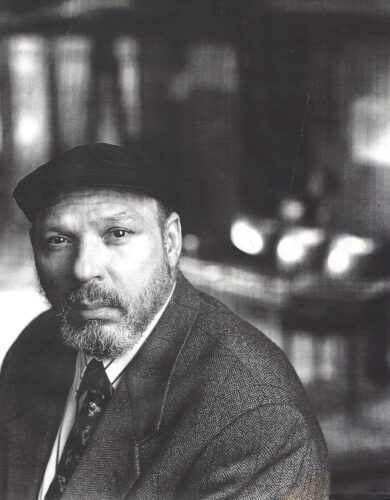
Pulitzer Prize-winning playwright August Wilson wrote and performed “How I Learned What I Learned” two years before his death. (Photo courtesy of August Wilson Legacy LLC)
The environment, the people and the Carnegie Library became his university. And from that creative crucible, a world-class playwright emerged.
Born Frederick August Kittel Jr., he wrote as August Wilson, honoring his adoring mother and distancing himself from his mostly absent father, a heavy drinker with an explosive temper.
Wilson, who died of liver cancer at 60 in 2005, poured his immense creativity, vivid memory and peerless ear for the vernacular of the Hill District into a towering achievement: 10 plays about the lives of African Americans, each set in a different decade of the 20th century. First called the Century Cycle, now known as the Pittsburgh Cycle, all 10 were produced on Broadway. Two of them – “Fences” and “The Piano Lesson” – won a Pulitzer Prize for drama.
In 2003, one of the country’s greatest playwrights pulled back the curtain on his formative years in the solo show “How I Learned What I Learned.” It was co-conceived by Wilson and director Todd Kreidler, written by Wilson and performed by him in its world premiere at Seattle Repertory Theatre.

Actor Melvin Huffnagle as August Wilson sits atop a scale model off Pittsburgh in “How I Learned What I Learned” at GableStage. (Photo courtesy of Magnus Stark)
The play has been performed in regional theaters around the country, often by actors like Ruben Santiago-Hudson and Eugene Lee, performers who had a history with Wilson’s work. Now, following a Sept. 29 preview, GableStage will start its 2023-2024 season Sept. 30-Oct. 22 with a new production of “How I Learned What I Learned” starring Melvin Huffnagle as Wilson.
In this personal piece, Wilson’s voice – the way he expressed wisdom, tradition, spirit, history, outrage, joy, humor – shows clearly from whom the characters in the Pittsburgh Cycle got their mojo. If you know the plays, you’ll gain an understanding of what shaped the man who created them.
But even if you’ve never seen “Gem of the Ocean,” “Joe Turner’s Come and Gone,” “Ma Rainey’s Black Bottom,” “The Piano Lesson,” “Seven Guitars,” “Fences,” “Two Trains Running,” “Jitney,” “King Hedley II” or “Radio Golf,” “How I Learned What I Learned” provides an irresistible peek into the forging of an artist.
“I’ve loved this show for a very long time, then discovered it had never been done in Miami,” says Bari Newport, GableStage’s producing artistic director. “It celebrates the creative spirit we all have inside of us: The act of creation is godly. This has interesting metaphorical elements and autobiographical information. I’m interested in plays that celebrate Black joy and being a Black artist.”
Newport is directing two of her company’s plays this season: Larissa FastHorse’s comedy “The Thanksgiving Play” Nov. 17-Dec. 19 (“Four well-meaning people are trying to tell an authentic version of the Thanksgiving story, which is hard without an indigenous person involved,” Newport says) and Ben Power’s adaptation of Stefano Massini’s “The Lehman Trilogy” March 15-April 14 (“It’s actually a very simple piece, but the story is epic,” she says of the three-actor, three-hour-plus play spanning 164 years).
To stage “How I Learned What I Learned,” Newport hired Carey Brianna Hart, a Miami actor, director, playwright, teacher, stage manager and radio host who does a weekly show on the arts at 9:30 a.m. Saturdays on WMBM-AM 1490. Hart has worked at numerous South Florida companies, including M Ensemble, a Black company that is the region’s oldest continuously producing professional theater.

Melvin Huffnagle and director Carey Brianna Hart in a rehearsal for August Wilson’s “How I Learned What I Learned” at GableStage. (Photo courtesy of Magus Stark)
There, Hart worked onstage and behind the scenes on a number of the Pittsburgh Cycle plays; M Ensemble is the only local company to have produced all 10, some more than once (a new production of “Joe Turner’s Come and Gone” will play at Miami’s Sandrell Rivers Theater April 11-28).
Hart remembers her ninth-grade class reading “Ma Rainey’s Black Bottom,” about temperamental real-life blues singer Gertrude “Ma” Rainey. Set in a Chicago recording studio in 1927, it’s the only play in Wilson’s cycle that doesn’t take place in Pittsburgh. The director particularly recalls the productions of “Joe Turner’s Come and Gone” and “The Piano Lesson” that she saw at Chicago’s Goodman Theatre when she was a student at DePaul University.
“Just seeing people like the ones I know represented onstage in such a wonderful manner, knowing those idiosyncrasies – it was tremendous,” she recalls.
Her subsequent work on multiple Wilson plays allowed her to appreciate the insight “How I Learned What I Learned” provides into the shaping of a masterful storyteller.
“It has a lot of concepts from his life that he used in all of his plays – him experiencing these circumstances, these people, how they resonated and caused him to create art. This background could have caused him to lash out. But it created a lexicon for his plays,” says Hart.
Huffnagle, whose most recent performance in a Wilson play was as the fiery diner owner Memphis in M Ensemble’s “Two Trains Running” in May, moved to Miami from New York two years ago to become an assistant professor of acting in Florida International University’s Department of Theatre.
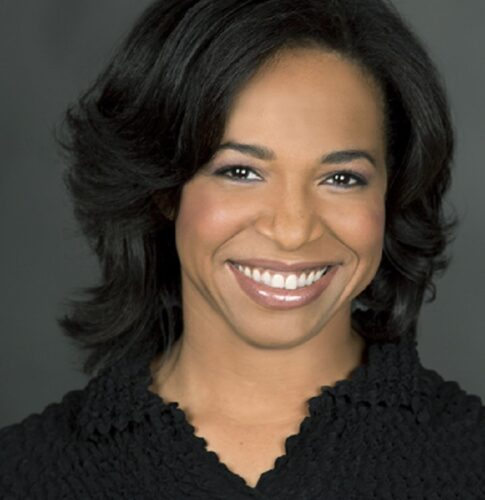
Carey Brianna Hart is making her GableStage directing debut with August Wilson’s “How I Learned What I Learned.” (Photo courtesy of Bob Lasky)
In New York, he appeared in numerous plays by Layon Gray, another M Ensemble favorite, whose work brings stories from black history to vibrant life (this season, Gray will stage the Feb. 8-25 regional premiere of “The Girls of Summer,” his play about a Black all-female baseball team in 1945).
Regarding Wilson, Huffnagle’s knowledge of and appreciation for the revered playwright’s work runs deep.
“I went to grad school at the University of Florida and played Herald Loomis in ‘Joe Turner’s Come and Gone’ – my favorite August Wilson play. I did my Master of Fine Arts dissertation on it,” Huffnagle says of the play, which is set in 1911, as Black men and women struggled to forge new lives in a nation forever stained by slavery.
Beyond Wilson’s ingenious notion of crafting 10 related plays that delve so deeply into a century of Black life in America, his distinctive writing and storytelling are what propelled him into the company of the country’s most revered playwrights, including Eugene O’Neill, Tennessee Williams and Arthur Miller – whose work he hadn’t read or seen at the time he began his devoting himself to writing plays.
Wilson, whose first dream was to become a poet, writes in a style that is naturalistic yet poetic, almost musical. The monologues he gives his characters may be meaty, but they soar like arias.
“He put real Black people, Black lives and their circumstances onstage. How he created these characters and their stories is poignant, important and necessary. As an artist, you crave and look for that,” says Huffnagle.
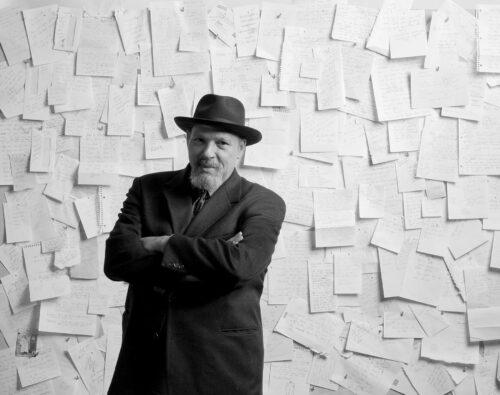
Playwright August Wilson wrote 10 plays about Black life in 20th-century America — and one about himself. (Photo courtesy of August Wilson Legacy LLC)
Huffnagle says he is not trying to imitate Wilson’s voice, though he has watched videos of the late playwright.
“The trap could be if you weren’t very good at it. His spirit is in the words – you don’t have to embody him,” says the actor.
Huffnagle has been working with Hart at a frenzied pace since he and actor Robert Strain swapped performer and understudy roles (after a recent family loss, Strain will now perform at select matinees).
Beyond learning all the words in a 47-page script, Huffnagle has to navigate the production’s unusual, evocative set: Designer Frank J Oliva, lighting designer Ernesto Pinto, projection designer Joel Zishuk have brought the Hill District of Wilson’s youth back to life, with scale-model buildings and bridges that light up when he’s talking about something that happened in a particular place.
Threading through those small streets might give some actors pause. Not Huffnagle.
“The set actually helps me remember my lines,” he says. “August is revisiting this place where he lived. And he’s the giant now.”
WHAT: “How I Learned What I Learned” by August Wilson
WHERE: GableStage in the Biltmore Hotel, 1200 Anastasia Ave., Coral Gables
WHEN: Preview 8 p.m. Friday, Sept. 29, opening 8 p.m. Saturday, Sept. 30; regular performances 2 and 7 p.m. Wednesday, 8 p.m. Thursday-Saturday, 2 p.m. Sunday (no performance Oct. 14, additional matinee Oct. 21), through Oct. 22; understudy Robert Strain will play Wilson Oct. 4, Oct. 11 and Oct. 18 at 2 p.m. and Oct. 12 at 10:30 a.m.
COST: $35-$65 (plus $10 in fees per ticket)
INFORMATION: 305-445-1119 or gablestage.org
ArtburstMiami.com is a nonprofit media source for the arts featuring fresh and original stories by writers dedicated to theater, dance, visual arts, film, music and more. Don’t miss a story at www.artburstmiami.com.
No posts found
New (and new to Miami) plays are just the ticket for the 2023-2024 theater season
Written By Christine Dolen
September 25, 2023 at 4:46 PM
Lindsey Corey will play the alluring Sally Bowles with Elijah Word as the provocative Emcee in Zoetic Stage’s immersive production of “Cabaret.” It’s part of a lively 2023-24 South Florida theater season. (Photo courtesy of Chris Headshots)
For anyone who savors the magic and power of theater, the start of a new season can be a lot like the approach of a favorite holiday. Fueled by excitement and curiosity, we look at season preview stories and theater websites as we try to figure out which plays and musicals will speak to us, move us, entertain us or even slightly shift the way we see the world.
These are hard times for regional theaters, with many in COVID-weary (and COVID-wary) audiences deciding to buy tickets on a show-by-show basis instead of committing to a season subscription. Subscriptions have, for decades, been the financial backbone of America’s regional theater movement.
Layoffs and postponed seasons, some at major companies – Center Theatre Group’s Mark Taper Forum in Los Angeles, for instance, won’t present a 2023-2024 season – have happened throughout the country, though South Florida theaters seem to have weathered the artistic downturn so far. Still, you’d think the impulse for artistic directors might be to do what touring Broadway does: program popular titles that can help provide a box office cushion.
What isn’t safe – and now feels downright daring –is an artistic director’s decision to produce world premieres and new-to-the-region works.
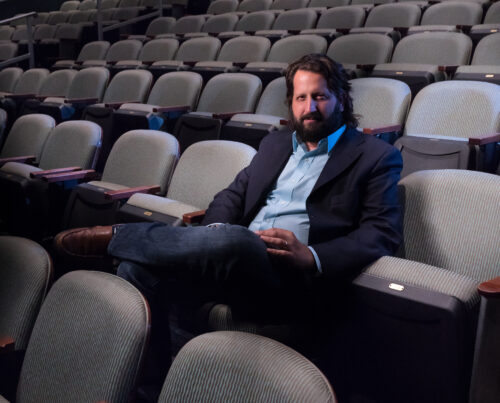
Miami New Drama co-founder and artistic director Michel Hausmann commissioned and will direct the six short plays that will make up “The Museum Plays” at Miami’s Rubell Museum alongside the art that inspired them. ((Photo courtesy of Juancho Hernández Husband)
Brand-new or lesser-known plays and musicals ask a ticket buyer to roll the dice and have faith that trusted artists are going to present something startling or thought-provoking or entertaining. Homegrown playwrights can build careers, and audiences aren’t being asked to watch different productions of the same shows over and over again.
So, in that spirit, here’s a select look at some of the many premieres worth seeking out this season. ArtburstMiami.com is dedicated to covering the arts in Miami-Dade, so most are at theaters in Miami, Miami Beach, Coral Gables and so on, but we’ve also highlighted a few in Broward and Palm Beach that are worth a drive. The shows are grouped thematically, though many fit into more than one category.
IDENTITY EXPLORATION
In Miami-Dade, myriad cultures mix, blend and clash, drawing from the past while fashioning a future. The exploration of identity has provided thematic fuel for several plays premiering in South Florida this season.
Poet Richard Blanco (who read his “One Morning” at President Barack Obama’s second inauguration) and playwright Vanessa Garcia (who wrote the immersive hit “The Amparo Experience”), are Cuban-Americans who grew up in Miami. The two collaborated on the commissioned “Sweet Goats and Blueberry Señoritas,” which had its world premiere at Maine’s Portland Stage last January. Actors’ Playhouse at the Miracle Theatre in Coral Gables will begin its new season Nov. 8-Dec. 3 with the regional premiere of Blanco and Garcia’s play about a Cuban-American baker torn between remaining in Maine or returning to Miami to deal with her estranged mother.

Miami playwright Vanessa Garcia co-authors “Sweet Goats and Blueberry Señoritas” with Cuban-American poet to be presented in a regional premiere at Actors’ Playhouse. (Garcia photo courtesy of Chris Headshots, Blanco photo courtesy of Timothy Greenfield-Sanders/HarperCollins)
Garcia will also have a world premiere this season when New City Players, performing at Island City Stage in Wilton Manors, presents “1,000 Miles” in collaboration with Miami’s Abre Camino Collective March 7-24. In the play about “survival, surveillance, nationalism and the nature of opportunity,” a woman tries to make a new life after she emigrates to a changing city in another country.
Carmen Rivera’s Obie Award-winning “La Gringa,” Off-Broadway’s longest-running Spanish-language play, will make its bilingual Miami debut Nov. 30-Dec. 17 in a City Theatre production at the Arsht Center’s Carnival Studio Theater in Miami. A young woman whose extended family is from Puerto Rico makes her first visit to the island over the Christmas holidays, seeking connection with a culture she treasures, only to realize she’s regarded as a gringa, an “other” very different from her Puerto Rican relatives.
Another aspect of identity comes into play in the world premiere of David Rosenberg’s “Wicked Child” Jan. 11-28. The Zoetic Stage production at the Arsht Center’s Carnival Studio Theater focuses on a New York attorney who leaves his successful career behind to join the Israeli Defense Force, a decision that has repercussions within his secular Jewish family.

Linda Parris-Bailey uses music, dance and text to explore a couple’s return to Barbados in “Yankee Bajan,” which will have its United States premiere Nov. 3-4 for Live Arts Miami. (Photo courtesy of Samiyyah Bailey)
Linda Parris-Bailey’s “Yankee Bajan” Nov. 3-4 uses drama and music to explore a couple’s journey away from American violence and injustice back to Barbados, where they embrace their homeland and its legacy. Live Arts Miami is presenting the piece in the Lehman Theater at Miami Dade College’s North Campus.
Kazakh-American opera singer Timor Bekbosunov will perform the world premiere of his dark musical comedy “The Great Soviet Bucket” Feb. 23-24 in the Miami Light Project’s new home, the Light Box at Miami Theater Center in Miami Shores. Comrade Bucket, a puppet representing Russia in the disintegrating Soviet Union, ignites questions of identity and politics in an artist confronting a changing future.
SIT UP, TAKE NOTICE
When acclaimed playwrights like Moisés Kaufman (“The Laramie Project,” “Gross Indecency: The Three Trials of Oscar Wilde”) and Nilo Cruz (the Pulitzer Prize-winning author of “Anna in the Tropics”) debut new work in your region, just go. And though he’s not as widely known, the same holds true for Christopher Demos-Brown, a cofounder of Miami’s Zoetic Stage, whose play “American Son” ran on Broadway in 2018-2019.
The New York-based Kaufman, who cofounded Miami New Drama with artistic director (and fellow Venezuelan) Michel Hausmann, has transformed Jonathan Jakubowicz’s bestseller “Las Aventuras de Juan Planchard” into a vivid theatrical exploration of the excesses and corruption that helped destroy Venezuela’s democracy. Running Oct. 17-Dec. 17, “Juan Planchard” will be directed by Kaufman; his first play to be written and performed in Spanish will also feature English supertitles.
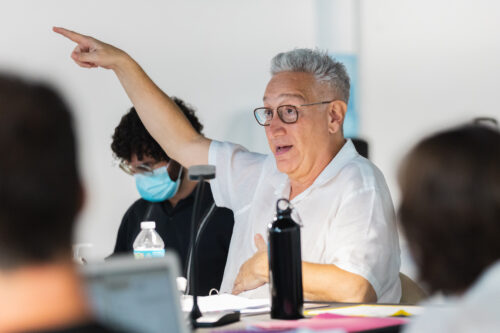
Miami New Drama co-founder and artistic director Michel Hausmann commissioned and will direct the six short plays that will make up “The Museum Plays” at Miami’s Rubell Museum alongside the art that inspired them. (Photo courtesy of Juancho Hernández Husband)
As playwright and director, Cruz crafted a stunning production of “Anna in the Tropics” for Miami New Drama last season. He’ll return to the company in early 2024 to direct his play “Two Sisters and a Piano,” which runs Jan. 18-Feb. 11. This version of the piece about sisters under house arrest in 1991 Havana will be performed in its original English version, though in 2019 Cruz directed a Spanish-language production for Miami’s Arca Images.
That smaller company, which performs at Miami-Dade County Auditorium’s On.Stage Black Box, will be doing not one but two Cruz plays this season, both directed by the playwright: 1995’s poetic “A Park in Our House” Nov. 9-12 and the world premiere of “The Night That Degas Visited Miami” March 14-17.
Demos-Brown hasn’t had a South Florida world premiere since 2018’s “Wrongful Death and Other Circus Acts” at Zoetic, which also did the regional premiere of “American Son” in 2020. His newest work, “The Cancellation of Lauren Fein,” will take on cancel culture in its world premiere at Palm Beach Dramaworks Feb. 2-18.
In the play, Fein and her wife Paula Muñoz, professors at a prestigious university and parents to a 16-year-old black foster son, face losing everything when Fein’s actions and the school’s diversity, equity and inclusion policies come into conflict. Demos-Brown’s plays are timely, topical, steeped in questions of justice. His day job is as an attorney, but trust this: He’s an excellent, engaging playwright.
THAT’S SO MIAMI
As Miami’s community of playwrights grows, so does the body of work inspired by or reflective of the city.
Actor-professor-playwright Elena Maria Garcia and Zoetic Stage artistic director Stuart Meltzer found themselves with a resonant hit when they debuted “¡FUÁCATA! A Latina’s Guide to Surviving the Universe” at Zoetic in 2017 (it had a second Arsht Center run and another at Actors’ Playhouse after that). “Cuban Chicken Soup When There’s No More Café,” Garcia and Meltzer’s follow-up to their earlier multi-character solo show, will get its world premiere in the Adrienne Arsht Center’s Carnival Studio Theater May 2-19.

“Laughs in Spanish,” a play about the craziness in a Wynwood Gallery during Art Basel by former Miamian Alexis Scheer, will make its Miami debut at GableStage this season. (Photo courtesy of Magnus Stark)
Former Miamian Alexis Scheer, whose “Laughs in Spanish” had its world premiere at the Denver Center Theatre in January, will get a regional production of the play in Coral Gables May 17-June 9 at GableStage in the Biltmore Hotel. Victoria Collado, who staged “The Amparo Experience,” will direct the wild comedy set in a Wynwood gallery during Art Basel.
IMMERSIVE THEATER
Miami’s Area Stage Company has helped ignite a new love for immersive theater experiences thanks to the boundless creativity of its young artistic director, Giancarlo Rodaz. After a buzz-worthy “Annie” in its South Miami space and successful productions of Disney’s “Beauty and the Beast” and “The Little Mermaid” at the Arsht’s Carnival Studio Theater, Rodaz will immerse actors and audiences in the world of “The Addams Family” with Area’s production of the musical Feb. 7-25.
Zoetic Stage will also be entering the immersive realm with its production of the uber-popular musical “Cabaret” in the Carnival Studio Theater March 14-April 7. Artistic director Meltzer will evoke the show’s decadent Kit Kat Klub in 1929-1930 Berlin, with Lindsey Corey starring as self-deluding chanteuse Sally Bowles and lanky Elijah Word as the always-provocative Emcee.
Thanks in part to a Knight Foundation New Work grant, Miami playwright William Hector’s long-brewing “G7: 2070” will get its world premiere Oct. 19-21 in the buildings and beautiful nine-acre botanical gardens of The Kampong in Coconut Grove. The 70 people who attend each performance will find themselves at an urgent climate summit, aligning themselves with representatives from seven nations vastly altered by sea level rise 50 years in the future. Victoria Collado, who staged the immersive “Amparo Experience,” will direct.
EXAMINING ISSUES
Racism, a police coverup and world-class journalism collide in the Miami New Drama world premiere of “Dangerous Days,” the Nicholas Griffin play that will debut at Miami Beach’s Colony Theatre April 4-28. Drawing from his book “The Year of Dangerous Days,” Griffin sets the play in Miami in wild 1980s and centers it around the Miami Herald’s Pulitzer Prize-winning police reporter, the legendary Edna Buchanan.
Hands down one of the most challenging and potentially dazzling productions of the season is GableStage’s regional premiere of “The Lehman Trilogy” March 15-April 14. Artistic director Bari Newport will stage Ben Power’s adaptation of Stefano Massini’s play about the rise and fall of the global investment firm Lehman Brothers. A trio of actors plays all the parts in the illuminating, cautionary American Dream saga that covers more than a century and a half. An epic takes time – this one runs three hours, 15 minutes – but Newport believes this particular American Dream (and nightmare) story flies by.

GableStage will explore the founding, rise and fall of the Lehman Brothers global investment firm in the Stefano Massini/Ben Power hit “The Lehman Trilogy.” (Photo courtesy of Magnus Stark)
Dominique Morisseau’s “Pipeline” will make its regional debut in an M Ensemble production at the Sandrell Rivers Theater June 6-23. One of the country’s hottest playwrights focuses on a Black inner city high school teacher who tries to build a better future for her only son by sending him off to prep school, only to have him return to an environment rife with risk.
Dedicated to new work, the professional Theatre Lab on the campus of Florida Atlantic University in Boca Raton has a couldn’t-be-timelier world premiere in Idris Goodwin’s “What’s Best for the Children” April 10-28. The comedy about the first Black chairman of a state school board committee pits wildly different interest groups against one another as they vie to swing his support their way.
PUSHING BOUNDARIES
As he demonstrated during the pandemic with “Seven Deadly Sins” – which put actors in Lincoln Road storefronts and audiences in small, safe, socially distanced groups outside – Miami New Drama’s Hausmann is an outside-the-box thinker. In collaboration with Miami’s Rubell Museum, Hausmann has commissioned six writers – Edwidge Danticat, Marco Ramirez, Carmen Pelaez, Aurin Squire, Rogelio Martinez and Christopher Peña – to write short plays inspired by pieces of art that will be on display as the plays are performed. “The Museum Plays” begins an open-ended run at the Rubell, 1100 NW 23rd St., Miami, starting Jan. 11.

Miami New Drama will travel to the Rubell Museum of Miami for the world premiere of “The Museum Plays,” six new short plays inspired by works of art. (Photo courtesy of Manuel González Ruiz/Mago Atelier)
In addition to its unusual name, LakehouseRanchDotPNG is devoting its second season of experimental and absurdist theater at Kendall’s Artistic Vibes exclusively to world premieres by women. Rachel Greene’s “XOXOLOLA,” about classics-loving students brought together by “Titus Andronicus” and something kinkier, runs through Oct. 1. Riley Elton McCarthy’s “rabbit” involves a runaway, a pack of rabbits and danger in the woods Nov. 10-19.
Running Dec. 1-10, Charisma Jolly’s “Grapefruit,” inspired by the life of the late Gilda Radner, looks at a comedian struggling to get back into the limelight as she battles illness and self-doubt. Mackenzie Raine’s “push”, playing Jan. 12-21, imagines a divorcing couple in mediation with a special asset: Whenever one pushes a button, the other has to tell the truth. For the March 1-10 slot, the entire company is devising a piece that asks, “Is the blue-collar worker the key to society?”
Fort Lauderdale’s bold Thinking Cap Theatre has a new home in the Broward Center’s Abdo New River Room for the season, where founding artistic director Nicole Stodard plans to continue the company’s dedication to theatrical experimentation, equity and diversity. In addition to the pieces onstage, the company intends to immerse audiences in free additional programming that will allow them a deeper dive into the material.
First up Oct. 27-Nov. 3 is the early ‘60s “Tango Palace” by María Irene Fornés, a vastly influential, Obie Award-winning Cuban-American playwright who was also a mentor and teacher to other great playwrights, including Nilo Cruz. William Shakespeare’s “The Taming of the Shrew,” the comedic battle of the sexes as directed and reimagined by Stodard, will allow audiences and actors to chime in as the play is performed March 22-April 3.
BROADWAY COMES TO TOWN
For theater fans drawn to spectacle and recognizable titles, nothing beats touring Broadway shows. In addition to the return of such past hit shows as “Hamilton” (March 13-24 at the Arsht, April 10-21 at the Kravis in West Palm Beach), “Les Misérables” (June 18-23 at the Arsht), plus “Annie” (Oct. 10-22) and “The Book of Mormon” (Dec. 12-17) at the Broward Center in Fort Lauderdale, several new-to-the-region shows are headed our way.

Izaiah Harris and Miamian Katerina McCrimmon are bringing the classic “Funny Girl” to the Broward Center. (Photo courtesy of Evan Zimmerman/ MurphyMade)
At the Arsht, catch “The Cher Show” (Jan. 2-7) to experience a dazzling tribute to the ultimate timeless pop diva. Also making its regional debut: a new treatment of “Peter Pan” (May 7-12) adapted by Native American playwright Larissa FastHorse and directed by Lonny Price.
The Broward Center has four South Florida premieres: “Funny Girl” (Nov. 14-26) starring Cuban-American Katerina McCrimmon, originally from Miami, the visually spectacular “Moulin Rouge! The Musical” (March 5-17), “Mrs. Doubtfire” (April 9-21) and “Clue” (June 11-16).
And if you’re an Alanis Morissette fan, you’ll have to travel to West Palm Beach to see the regional debut of “Jagged Little Pill” (Feb. 20-25) at the Kravis Center.
ECLECTIC CHOICES
This last category serves as a heads-up about additional world and regional premieres – this season is rich with them.
Zoetic Stage is kicking off its season with the regional premiere of Lynn Nottage’s “Clyde’s” Nov. 2-19 in the Arsht’s Carnival Studio Theater. The dark comedy by the double Pulitzer winner features a group of ex-prisoners trying to restart their lives working in a truck stop diner run by the manipulative owner-manager from hell (to be played by Karen Stephens).
Another double Pulitzer winner, August Wilson, is the subject of the one-man show “How I Learned What I Learned.” Opening the season at GableStage at the Biltmore Sept. 22-Oct. 29, the play stars Melvin Huffnagle as Wilson, illuminating the people, experiences and inner drive that made him one of the country’s greatest playwrights with a 10-play cycle about Black Americans in each decade of the 20th century. (And a side note: Miami’s M Ensemble will present the play Wilson said was his favorite, “Joe Turner’s Come and Gone,” April 11-28.)

Actor Melvin Huffnagle portrays double Pulitzer Prize-winning playwright August Wilson with direction by Carey Brianna Hart in “How I Learned What I Learned” at GableStage. (Photo courtesy of Magnus Stark)
Both True Mirage Theater and Main Street Players will stage world premieres this season. True Mirage begins with Armando Santana’s tragicomedy “Hoo Hah!” Nov. 3-12 at Main Street Playhouse in Miami Lakes, then travels to Artefactus in south Miami Feb. 16-25 for Luis Roberto Herrera’s “SAA (not that one),” a dark comedy about a guy in an alien abduction support group. Main Street Players debuts Vinecia Coleman’s “Christiana Lysistrata” Feb. 16-March 3, with the playwright bringing a modern sensibility to the story of women claiming their power, ala the Greek classic “Lysistrata.”
And a couple more for the road: Slow Burn Theatre at the Broward Center’s Amaturo Theater will stage the regional premiere of “The SpongeBob Musical” June 7-23.
In Wilton Manors, neighboring theater companies Island City Stage and Ronnie Larsen’s Plays of Wilton (POW) at The Foundry have plenty of new-to-the-region shows mainly aimed at the companies’ LGBTQ+ theatergoers: Island City’s offerings include “Which Way to the Stage” Jan. 18-Feb. 21, “Pulp” April 11-May 5 and “Skintight” May 30-June 23; POW is doing the Florida premiere of the Dan Clancy-Lynn Portas musical “108 Waverly.”
MORE INFORMATION
Actors’ Playhouse: “Sweet Goats and Blueberry Señoritas” (Nov. 8-Dec. 3), Vanessa Garcia and Richard Blanco regional premiere; “A Rock Sails By” (May 15-June 9), Sean Grennan regional premiere. www.actorsplayhouse.org
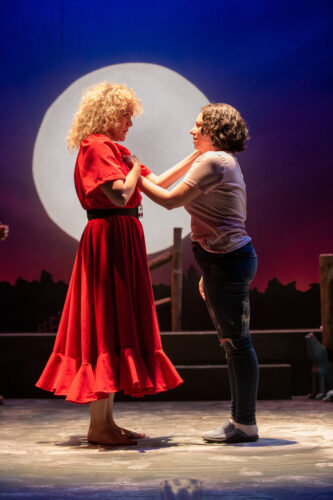
Jezabel Montero and former Miamian Ashley Alvarez played mother and daughter in the Portland Stage world premiere of “Sweet Goats and Blueberry Señoritas,” which will get its regional premiere at Actors’ Playhouse. (Photo courtesy of No Umbrella Media LLC)
Adrienne Arsht Center: “The Cher Show” (Jan.2-7), South Florida premiere; “Peter Pan” (May 7-12), South Florida premiere. www.arshtcenter.org
Arca Images: “The Night that Degas Visited Miami” (March 14-17), Nilo Cruz world premiere; Carlos Celdrán untitled work-in-progress (July 18-28) at Miami-Dade County Auditorium On.Stage Black Box. www.arcaimages.org
Area Stage Company: “The Addams Family Musical” (Feb. 7-25), immersive regional premiere at Arsht Center. www.areastage.org
City Theatre: “La Gringa” (Nov. 30-Dec. 17), Carmen Rivera regional premiere; Summer Shorts (June 6-23), world and regional premieres by multiple playwrights, at Arsht Center. www.citytheatre.org
GableStage: “How I Learned What I Learned” (Sept. 29-Oct. 22), August Wilson Miami premiere; “The Thanksgiving Play” (Nov. 17-Dec. 19), Larissa FastHorse regional premiere; “Old Wicked Songs” (Jan. 12-Feb. 4), Jon Marans regional premiere; “The Lehman Trilogy” (March 15-April 14), Stefano Massini/Ben Power regional premiere; “Laughs in Spanish” (May 17-June 9), Alexis Scheer Miami premiere. www.gablestage.org
The Kampong: “G7: 2070” (Oct. 19-21), William Hector world premiere. www.g72070.com
LakehouseRanchDotPNG: “XOXOLOLA” (through Oct. 1), Rachel Greene world premiere; “rabbit” (Nov. 10-19), Riley Elton McCarthy world premiere; “Enter, Grapefruit” (Dec. 1-10), Charisma Jolly world premiere; “push” (Jan. 12-21), Mackenzie Raine world premiere; “The Table” (March 1-10), Lakehouse company world premiere at Artistic Vibes in Kendall. https://Lakehouseranch-png.webnode.page
Live Arts Miami: “Yankee Bajan” (Nov. 3-4), Linda Parris-Bailey United States premiere at Miami Dade College’s North Campus Lehman Theater. www.liveartsmiami.org
M Ensemble Company: “The Girls of Summer” (Feb. 8-25), Layon Gray regional premiere; “Pipeline” (June 6-23), Dominique Morisseau regional premiere at Sandrell Rivers Theater. www.themensemble.com
Main Street Players: “Dr. Seward’s Dracula” (Oct. 20-29), Joseph Zettelmaier regional premiere; “Christiana Lysistrata” (Feb. 16-March 3), Vinecia Coleman world premiere. www.mainstreetplayers.com
Miami Light Project: “The Great Soviet Bucket” (Feb. 23-24), Timur Bekbosunov world premiere at the Light Box at Miami Theater Center. www.miamilightproject.com
Miami New Drama: “Las Aventuras de Juan Planchard” (Oct. 17-Dec. 17), Moisés Kaufman world premiere in Spanish with English supertitles; “The Museum Plays” (open-ended run begins Jan. 11), world premiere short plays by Edwidge Danticat, Marco Ramirez, Aurin Squire, Rogelio Martinez, Carmen Pelaez, Christopher Peña at Rubell Museum in Miami; “Two Sisters and a Piano” (Jan. 18-Feb. 11); “Dangerous Days” (April 4-28), Nicholas Griffin world premiere. www.miaminewdrama.org
True Mirage Theater: “Hoo Hah!” (Nov. 3-12), Armando Santana world premiere at Main Street Playhouse; “SAA (not that one)” (Feb. 16-25), Luis Roberto Herrera world premiere at Artefactus. www.truemiragetheater.com

Zoetic Stage’s world premiere of David Rosenberg’s “Wicked Child” examines the repercussions in a secular Jewish family when their son joins the Israeli Defense Force. (Photo courtesy of Michael McKeever)
Zoetic Stage: “Clyde’s” (Nov. 2-19), Lynn Nottage South Florida premiere at Arsht Center; “Wicked Child” (Jan.11-28), David Rosenberg world premiere at Arsht Center; “Cabaret” (Jan. 11-28), immersive regional premiere at Arsht Center; “Cuban Chicken Soup When There’s No More Café” (May 2-19), Elena Maria Garcia and Stuart Meltzer world premiere at Arsht Center. www.zoeticstage.org
TO THE NORTH
Broward Center for the Performing Arts: “Funny Girl” (Nov. 14-26), South Florida premiere starring Miamian Katerina McCrimmon as Fanny Brice; and “Moulin Rouge! The Musical” (March 5-17), “Mrs. Doubtfire” (April 9-21) and “Clue” (June 11-16), all South Florida premieres. www.browardcenter.org
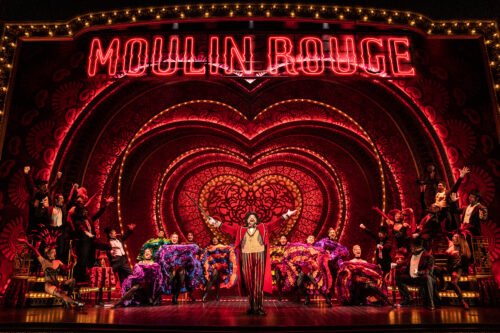
The touring cast of the lavish “Moulin Rouge! The Musical” will play the Broward Center this season. (Photo courtesy of Evan Zimmerman/ MurphyMade)
Island City Stage: “Which Way to the Stage (Jan. 18-Feb. 21), Ana Nogueira regional premiere; “Pulp” (April 11-May 5), Patricia Kane regional premiere musical; “Skintight” (May 30-June 23), Joshua Harmon regional premiere. www.islandcitystage.org
Kravis Center: “Jagged Little Pill” (Feb. 20-25). www.kravis.org
New City Players: “1,000 Miles” (March 7-24), Vanessa Garcia world premiere at Island City Stage in Wilton Manors. www.newcityplayers.org
Palm Beach Dramaworks: “The Messenger” (Dec. 8-24), Jenny Connell Davis world premiere; “The Cancellation of Lauren Fein” (Feb. 2-18), Christopher Demos-Brown world premiere. www.palmbeachdramaworks.org
Plays of Wilton: “108 Waverly” (Nov. 2-Dec. 10), Dan Clancy-Lynn Portas Florida premiere musical at the Foundry. www.ronnielarsen.com
Slow Burn Theatre: “The SpongeBob Musical” (June 7-23), regional premiere. www.slowburntheatre.org
Theatre Lab: “The Many Wonders of Jasmine Starr-Kidd” (through Oct. 8), Stephen Brown Florida premiere; “The Berlin Diaries” (Nov. 18-Dec. 10), Andrea Stolowitz United States premiere; “Rooted” (Feb. 3-18), Deborah Zoe Laufer Florida premiere; “What’s Best for the Children” (April 13-28), Idris Goodwin world premiere. www.fauevents.com
Thinking Cap Theatre: “Tango Palace” (Oct. 27-Nov. 3) and interactive adaptation of “The Taming of the Shrew” (March 22-April 3) in the Abdo New River Room at the Broward Center for the Performing Arts. www.thinkingcaptheatre.org
ArtburstMiami.com is a nonprofit media source for the arts featuring fresh and original stories by writers dedicated to theater, dance, visual arts, film, music and more. Don’t miss a story at www.artburstmiami.com.
No posts found
Expect the Unexpected with Lucky Bruno and his new show ‘Black Popcorn’
Written By Jordan Levin
September 13, 2023 at 3:23 PM
Luckner Bruno as Cab Calloway at the Eden Roc Hotel in 2023. His original creation, “Black Popcorn,” is at the Sandrell Rivers Theater in Miami for two performances on Saturday, Sept. 16 and Sunday, Sept. 17. (Photo courtesy of Les Annees Folles by French and Famous)
Miami-bred Luckner “Lucky” Bruno is a big man and larger-than-life character who’s always been at his best confounding expectations, usually in dazzling ways. Dancing exuberantly on stilts while extravagantly costumed as Marie Antoinette or Celia Cruz. Moving with a bold, liquid grace startling in such an unabashedly round and substantial figure. Switching effortlessly from belting Cab Calloway tunes in glitzy corporate cabarets to commanding, charismatic actor in Miami Motel Stories to entrancing countless children as teacher and performer.
“Me and physics have a healthy disagreement,” says Bruno. “I fought this for a long time. But it is about falling into the magic of what happens onstage, and you transcend. I found things I could do that other people can’t. I can breakdance on three-foot stilts. I can sing opera on silks 30 feet in the air because I have a huge lung capacity.
“If someone says ‘we want Lucky’ and Lucky’s not available, they can’t say they want someone like Lucky. Cause there’s no one else like him.”
Certainly, no one else could have created “Black Popcorn,” a wild amalgamation of live singing, brash social satire, dance from Afro-Cuban to classical ballet, circus acrobatics, poetic theatrical fantasy, raw comedy and more that is Bruno’s most ambitious project yet. But the show, which runs Saturday, Sept. 16 and Sunday, Sept. 17 at the Sandrell Rivers Theater in Liberty City, aims to do much more than entertain and startle.

Vanya Allen as an angel in Luckner Bruno’s “Black Popcorn.” (Photo courtesy of Luckner Bruno)
“Black Popcorn” celebrates Black musical giants like Robert Johnson and Tina Turner and the powerful legacy of Black music. It is also a fierce indictment of racism, the co-optation of Black culture, and a passionate tribute to Black resilience and empowerment at a fraught moment for both in Florida.
“Black people took the trauma of what was done to them and used music to filter that,” says Bruno. “Black stories are not only being denied and devalued, they’re being demonized. Another love of mine is history. And history says when there’s a denial of one people and pushing the triumph of one class over another, the next chapter is horrific.”
Bruno’s dizzying range was on display at a recent “Black Popcorn” rehearsal at the theater. He led several of the nine performers in a song to the Afro-Cuban Santeria deity Yemaya, which shifts to a rapid-fire rap solo, music he composed with Vinny Hamilton. He partnered his little sister Keiana Bruno, 16, in a ballet solo, coaxing and praising her. He directed Mikhael Mendoza, playing Blues legend Robert Johnson facing off with the Devil, played by a smarmily malevolent Zack Marquez on springy jump stilts.
Vanya Allen, an accomplished singer, actress and dancer, belts the gospel-rock Tina Turner classic “Nutbush City Limits” upside down, splayed in a giant hoop wheeled by two other performers.
“I never imagined I’d be doing half the things I’m doing in this production,” Allen says during a break. She spent months in a tiny park with Bruno coaching her in aerial silks, learning to gracefully pretzel her body around long hanging banners. (Allen documented the process on her Instagram, writing in May “Lucky saying, “You can let go.” And me thinking, “Ain’t no damn way.’”)
“It’s a lot of fun once you get past ‘I could break things’,” she says.

Zack Marquez and Luckner Bruno at the Sandrell Rivers Theater rehearsing “Black Popcorn.” (Photo courtesy of Jordan Levin)
Allen’s faith in Bruno stems from 2017, when both performed in the first, Little Havana iteration of the immersive, site-specific theater project Miami Motel Stories, with Allen as Billie Holiday and Bruno as a mystical Afro-Cuban guide leading the audience through a rundown hotel. “He created this magical environment where people instantly believed and trusted him,” Allen says. “It is his sense of command and magic. He tells you something, you’re gonna believe it.”
“I’ve been trying to cast her forever,” says Bruno. “The stars finally aligned and now she’s eating it up. It’s like go mama, go!”
He fills his younger sister Keiana — a dance student at New World School of the Arts — performing solos in “Popcorn,” with the same kind of faith. “I saw him as brave,” she says. “I feel really honored he trusts me enough to put me in a spotlight.”
Bruno, 45, grew up in Miami Shores with a Haitian father and an African-American mother. Overflowing with energy, he and his younger sister Latrice used to put on shows for their parents. He spent years studying Tae Kwon Do, earning a black belt, and sang with a children’s choir, Children of the World, which performed for President Ronald Reagan’s National Prayer Breakfast in 1986. “All of us ethnic children in our ethnic garb,” remembers Bruno, who wore a straw hat and strummed madly on a straw guitar embroidered with the word “Haiti.”
“He was always full of ideas, always wanted to be the leader,” says Latrice Bruno, 43, an actress/dancer/singer and teaching artist, who is also in “Black Popcorn.” “He created a space for himself that gives him the freedom to use everything he’s passionate about.”

Keina Bruno, a dance student at New World School of the Arts and Luckner’s young sister, performs in “Black Popcorn.” (Photo courtesy of Luckner Bruno)
Bruno began finding that freedom in high school, getting up before dawn to take a bus to G. Holmes Braddock Senior on the western edge of Miami-Dade, as the county worked to desegregate schools with magnet programs. There he fell in love with the affirmation and liberation of performing. “Growing up chubby, Black, teased – and now being able to be what I want, I was like ‘Yes,’ ” he says. “It was the freedom of being who you are behind the mask. It doesn’t matter how big you are if you can make it intriguing and magical.”
Graduating with a BFA in musical theater at the University of Miami in 1999, he was the first man in his family to complete both high school and college. He added circus skills working with Fantasy Theater Factory (FTF), the longtime children’s theater group presenting “Popcorn,” and Caravan Stage Company, which stages shows on a tall sailing ship, performing on the Great Lakes and the Mississippi. He learned clowning, applying the same exacting approach he uses in every aspect of his art. “Comedy timing for clowns is like music,” he says. “You can hear when something is not funny.”
Bruno found a home for his unique mix of talents in the 2000s on Miami Beach with Circ X, a groundbreaking troupe using a provocative mix of cabaret, vaudeville, acrobatics, and surreal costuming for shows at clubs, corporate parties and events. Founded and directed by Diana Lozano, Circ X has been a profitable side gig for multitudes of Miami artists, including choreographer Rosie Herrera and playwright Rudi Goblen. Bruno and Natasha Tsakos, the brilliant multi-media performance artist, were longtime Circ X regulars and partners, continually inventing numbers that played her fierce, elfin presence against his powerful, comic one.
“Anything you gave him he could do – and he works fast,” says Lozano, who plays a cartoonish but viciously racist villain in “Black Popcorn.” Rehearsing, Bruno urged Lozano to make her character more extreme. “The bigger you are, the more grotesque, the funnier it’ll be,” he tells her. They share an instinctive understanding from years of collaboration, as well as a love of using comedy and satire to subvert theatrical and political expectations.
“Lucky really has a talent for making work that’s entertaining but subversive,” says Lozano. “I’m passionate about doing theater that provokes you and makes you think. That’s why I love this piece.”

Luckner Bruno performing in “Miami Motel Stories” at the Perez Art Museum Miami in 2019. (Photo by Pedro Portal, courtesy of Juggerknot Theater Company)
But Bruno’s performances on the Beach also brought him a bitter experience with racism. In 2012, he was in costume and unloading his props for a regular gig at the Clevelander Hotel on Ocean Drive when someone called police complaining about a scary masked Black man. Bruno recalled how five cops suddenly descended, punching and handcuffing him, as he protested loudly, gathering a crowd before they released him, he says.
The experience gave him what he calls “Miami Beach PTSD,” and led him to stop performing on there for a decade. It also intensified his passion at injustice and racism; subjects on which he comments frequently on social media and in his art.
“As a Black artist with funding, I feel it is beyond paramount to say something,” says Bruno.
Bruno’s enthusiastically unbounded personality – coupled with his natural authority and deep knowledge of theatrical craft – have made him a popular teacher for children’s theater programs for more than 20 years, notably with FTF and Miami Theater Center, and, more recently, at New World School of the Arts and The Mandelstam School.
“Whenever I see the babies at MTC or New World it fills my heart,” says Bruno. “I love the aha moment, when the kid or adult gets it. When you see commonality and connection. When everyone in the room sees everyone else in the room.”
He’s created two children’s shows using entertaining spectacle imbued with serious messages. “The Legend of the Pink Elephant” for MTC in 2016 was inspired by his own experience with bullying and finding his place as an artist. It tells of a bright-colored, outcast baby pachyderm. Magical creatures teach him to value his uniqueness, and he returns to save the herd. “Pink Elephant” played for two runs at MTC with packed houses of Miami-Dade students, traveled to the Atlanta Fringe Festival, and became a children’s book.

Luckner Bruno, center, as the title character in his children’s show “The Legend of the Pink Elephant” in 2016 at Miami Theater Center. (Photo by Andy Clarke, courtesy of Miami Theater Center)
In 2022, he followed with “Heroes in My House,” a Black History children’s show featuring figures such as Haitian-American Miami leader Viter Juste and Queer Black disco icon Sylvester. Produced and presented by FTF, “Heroes” played to 15,000 students at schools in Miami-Dade and Florida in 2022, and continues to tour with FTF.
In some ways “Black Popcorn” is an adult version of “Heroes.” With, Bruno explains, “more magic, more sugar. Just talking about history has become political, has caused a divide. So as an artist, you have to say something, because doing what you’ve always done is not possible anymore.”
Not that Bruno has ever made theater the way it’s always been done.
“Do something,” he says, “and be spectacular about it.”
WHAT: Luckner Bruno’s “Black Popcorn”
WHEN: 7:30 p.m. Saturday, Sept. 16 and 2 p.m., Sunday Sept. 17
WHERE: Sandrell Rivers Theater, 6103 NW 7th Ave., Miami
COST: $20
INFORMATION: 305-284-8872 or sandrellriverstheater.com
ArtburstMiami.com is a nonprofit media source for the arts featuring fresh and original stories by writers dedicated to theater, dance, visual arts, film, music and more. Don’t miss a story at www.artburstmiami.com.
No posts found
Young, theatrically different Miami company, presents world premiere of ‘Plague Play’
Written By Christine Dolen
August 22, 2023 at 9:44 AM
Ruki Etti and Lucy Lopez play the supportive women in the LakehouseRanch world premiere of Erin Proctor’s “Plague Play” running through Sunday, Aug. 27. (Photo courtesy of Juan Gamero)
Though the world is constantly evolving, the lessons of the past can have deep relevance to life as we live it today – if only we pay heed.
Listen carefully to the words in Erin Proctor’s world premiere “Plague Play,” and you’ll discover in her take on the 10 Biblical plagues of Egypt more than just a stinging examination of violence begetting violence. It is also a resonant contemplation of envy, love, family, fear, longing, PTSD and the piling on of disasters.
“Plague Play” opens the second season – all world premieres – for LakehouseRanchDotPNG. The company’s name may be a little unwieldy (it evolved from a road trip artistic director Brandon Urrutia and set designer Indy Sulliero once took), but its purpose is clearly defined and something scarce in South Florida theater: producing absurdist and experimental works.
LakehouseRanch presents its plays in the intimate Artistic Vibes space at 8846 SW 129th Terrace, Suite B, Miami (located in an area full of warehouses and offices, Artistic Vibes is on the second floor of a two-story office building). Proctor is one of the company’s three resident playwrights; the others are Riley Elton McCarthy, whose “rabbit” will premiere Nov. 10-19, and MacKenzie Raine, whose play “push.” premieres Jan. 12-21.

Jedi Weir’s Aaron gets a ribbing from Kyran Wright’s Moses and Ruki Etti’s Miriam in “Plague Play.” (Photo courtesy of Juan Gamero)
Staged by Urrutia, a Florida International University grad like most others in the company, “Plague Play” is Proctor’s retelling/interpretation of Chapters 7 to 11 in the Biblical Book of Exodus.
The New York-based playwright uses plenty of contemporary language (including f-bombs), particularly in scenes involving the shifting relationship of brothers Moses (Kyran Wright) and Aaron (Jedhi Weir). But she also summons beautiful imagery in the affectionate exchanges between Moses’s wife Tzipporah (Lucy Marie Lopez) and Aaron’s twin Miriam (Ruki Etti), and the loving memories shared by Moses and Tzipporah. There are laughs, too, as improbable as that may seem in a play about plagues.
For anyone interested in “Plague Play,” it is helpful to do an internet refresher on the story of Moses and Aaron trying to convince the Pharoah, King Ramses II, to free the enslaved Israelites. Prophet Moses predicts the increasingly horrific plagues visited on the hard-hearted Pharoah and his people, while God works through the increasingly agitated Aaron to deliver them one by one. Having the basic storyline, characters and place names in mind enables a deeper dive into Proctor’s play.
Urrutia and company meet the script’s creative demands in simple ways. Turning water into blood is accomplished by Leonardo Urbina’s lighting. Little plastic frogs emerge from Sulliero’s set; ditto, the later plague of locusts. Irritating gnats are evoked by the buzzing cast. As Aaron, Weir delivers a vividly disturbing speech about the wild beasts emerging from his body. Plagues of boils, fiery hail, darkness and the death of first-born children follow.

Ruki Etti, Jedhi Weir, Kyran Wright and Lucy Lopez are plunged into darkness in the world premiere of Erin Proctor’s “Plague Play.” (Photo courtesy of Juan Gamero)
Running about 80 minutes, “Plague Play” is captivating throughout, even though you realize (thanks to projected words in Hebrew and English) that you’re going through a kind of countdown of the plagues. Urrutia’s staging in the small space and the performances of the four actors take the audience on a journey that, against all odds, remains suspenseful.
Wright plays Moses as a man conflicted by his love for his seven-years-older siblings Aaron and Miriam, and his loyalty to Pharoah, with whom he was raised as a brother. His sibling rivalry scenes with Weir’s Aaron and his tender ones with Lopez’s Tzipporah are among the most effective in the play.
Weir conveys many of the most intense emotional moments in “Plague Play,” and at times you can feel his Aaron is on the verge of imploding. His speech about the horrors of war as he refuses to celebrate victory over Pharoah is shattering.
The play’s women are different too.

Kyran Wright’s Moses and Lucy Lopez’s Tzipporah share a tender moment in Erin Proctor’s “Plague Play.” (Photo courtesy of Juan Gamero)
Lopez’s Tzipporah is a loving, worried stranger in a strange land who expresses her concerns but inevitably follows the lead of her beloved Moses. Etti’s Miriam is more a salt of the earth type, a solid and sacrificing woman who is quietly vital to the other three. Underlining their distinctiveness, costume (and sound) designer Maleeha Naseer clothes them in different styles and contrasting shades of orange and turquoise (the men wear simple red or yellow shirts, loose pants and sandals).
LakehouseRanch is a young company limited in budget (hence its two-weekend runs) but long on imagination. The talent involved is obvious, and the kind of work Urrutia and his colleagues want to create can add to the rich mosaic of theater in South Florida.
WHAT: World premiere of “Plague Play” by Erin Proctor
WHERE: LakehouseRanchDotPNG production at Artistic Vibes, 8846 SW 129th Terrace, Suite B (second floor), Miami
WHEN: 8 p.m. Friday-Saturday, 2 p.m. Sunday, through Aug. 27
COST: $15 (discounts for students and artists)
INFORMATION: 786-427-4721 or lakehouseranchdotpng.com
ArtburstMiami.com is a nonprofit media source for the arts featuring fresh and original stories by writers dedicated to theater, dance, visual arts, film, music and more. Don’t miss a story at www.artburstmiami.com.
No posts found
Review: Giancarlo Rodaz and Area Stage immerse audiences in the world of ‘The Little Mermaid’
Written By Christine Dolen
August 14, 2023 at 2:11 PM
Josslyn Shaw’s Ariel falls for Henry Thrasher’s Prince Eric in Area Stage Company’s “The Little Mermaid” at the Arsht Center through Aug. 27. (Photo courtesy of Giancarlo Rodaz)
Among the many takeaways from Area Stage Company’s enchanting immersive production of Disney’s “The Little Mermaid” are these two points: You can tell a familiar story in wonderful new ways, and you don’t need a drop of real water to create an undersea world.
Playing at the Adrienne Arsht Center’s Carnival Studio Theater through Aug. 27 – and the brevity of that run is truly a shame – the production devised by newly named artistic director Giancarlo Rodaz and executed with help from his many collaborators is every bit as enthralling as the Carbonell Award-winning “Beauty and the Beast” the company presented a year ago.
As with that earlier show, just walking into the transformed space is a jaw-dropping experience.

Aaron Hagos as Sebastian chats with theatergoers at Area Stage Company’s “The Little Mermaid” at the Arsht Center. (Photo courtesy of Giancarlo Rodaz)
Frank Oliva, who got his start with Area Stage and is now designing for theaters all over the country (Broadway included), has outdone himself. A central grotto, a ship for the show’s restless prince, a crow’s nest, a special spot for the delicious villain of the piece are among Oliva’s handiwork.
An upside-down rowboat holds some of Joe Naftal’s place-shifting lighting instruments, which bathe undersea scenes in blues and greens, then turn sunny or stormy for events in the human world.
Actors in dozens of lavish costumes by Maria Banda-Rodaz and Sofia Ortega dot the space, singing, playing instruments, handing out map-like programs and showing the all-age theatergoers to seats and benches that dot the room.
Then the storytelling, familiar yet fresh, begins.
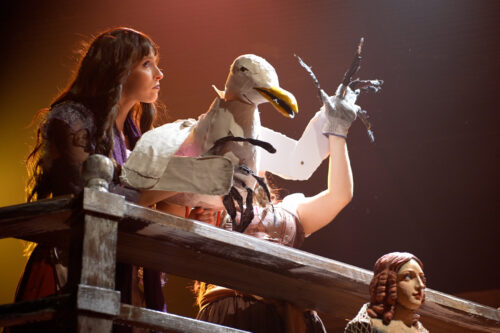
Katie Duerr and Annette Rodriguez (hidden) operate the seagull puppet Scuttle in Area Stage’s “The Little Mermaid” at the Arsht Center. (Photo courtesy of Giancarlo Rodaz)
Based on the smash hit 1989 animated Disney movie (which was inspired by a far darker Hans Christian Andersen fairy tale), this 2007 Broadway version of “The Little Mermaid” has a score by Oscar and Tony Award winner Alan Menken, lyrics by Oscar winner Howard Ashman and Glenn Slater, and a book by Pulitzer Prize winner Doug Wright.
It’s a star-crossed tale of a red-haired mermaid named Ariel (Josslyn Shaw), daughter of the stern King Triton (Frank Montoto), and a dashing seafaring prince named Eric (Henry Thrasher), who has no interest in ascending to his father’s throne.
The two meet when she saves him after he’s tossed overboard during a storm. Though the prospect of a life together seems very dim indeed, Ariel’s scheming sorceress aunt Ursula (Jonathan Chisolm) coaxes her into signing a clause-filled contract almost as long as one of the ropes surrounding the set. Ariel trades her beautiful voice for a set of legs, but unless she can get Prince Eric to kiss her within three days, it’s back to the depths to live out her life as Ursula’s slave.
That’s the plot in a nutshell. Or maybe a conch shell. “The Little Mermaid” follows the classic Disney formula – imperiled beauty and a prince fall for each other, true love’s path is blocked by a villain, then the enemy is vanquished in time for a wedding – but the specifics of each story are what captivate audiences for generations.
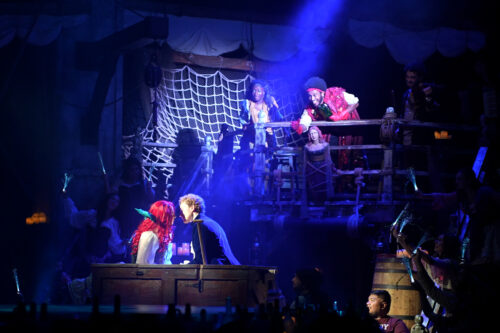
Josslyn Shaw’s Ariel and Henry Thrasher’s Prince Eric circle the set as Aaron Hagos’s Sebastian urges him to “Kiss the Girl.” (Photo courtesy of Giancarlo Rodaz)
Rodaz utilizes a combination of young and more seasoned talent, veterans of Area Stage’s conservatory program, and several frequent collaborators in his immersive take on “The Little Mermaid.” The production’s style is more reminiscent of the director’s deservedly lauded 2021 take on “Annie,” a show that kicked the buzz about Rodaz’s talent into high gear.
The emphasis this time is largely on playful fun –well, maybe not so much with Chisolm’s stunning, conniving Ursula. But as an audience member, you never know when a cast member will leap onto your table to sing.
Or if you’re in the priciest VIP seats, the ones surrounding the grotto, you’ll get an up-close view of the dancers’ thundering feet as they perform choreographer Irma Becker’s work, an exuberant tap number to “Positoovity”[cq].
You’ll hear the crab court composer Sebastian (Aaron Hagos) crooning a dreamy “Kiss the Girl” while Ariel and Prince Eric circle the grotto in a “boat” pushed by their castmates. Will the prince finally go for it and plant true love’s kiss on the adoring Ariel? Whether or not you know the answer, the moment is full of tender hope.
Menken’s score for the animated “Little Mermaid” won the Oscar, and under the music direction of Michael Day and Rick Kaydas, the large cast impressively delivers the stage version of these oh-so-familiar songs – not a simple task when actors are placed in multiple spots within the space. Kudos to sound designer Eric Green, who also invisibly whips up a storm and supplies the whoosh of ocean waves, and to Day, who plays piano and leads the small hidden orchestra.
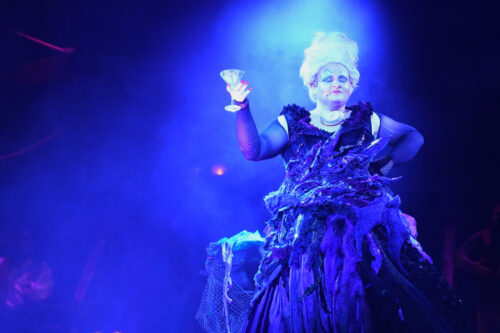
Jonathan Chisolm’s fabulous Ursula cooks up evil plots under the sea in Area Stage Company’s “The Little Mermaid.” (Photo courtesy of Ariany Cespedes)
Stars Shaw and Thrasher check all the boxes for Disney musical leads. They’re attractive young talents with fine voices and enthusiasm to burn. Shaw artfully conveys Ariel’s adventurous longing as she sings “Part of Your World” and joins in the wistful quartet “If Only” with Prince Eric, Sebastian and King Triton. Though Thrasher’s voice gets a tad thin at the top of his register, he sings “Her Voice” with passion and embodies the conflicting emotions of the handsome prince.
A cleverly conceived villain played by the right actor can walk away with many a musical (or in this case, swim away with it), and Chisolm (who uses the pronouns they/them) does exactly that with Ursula. Sporting a shock of white hair and a gorgeous purple gown, Chisolm demonstrates that they’ll take no prisoners (Ariel excepted) as they belt “I Want the Good Times Back” with their chortling henchmen Flotsam (Tico Chiriboga) and Jetsam (Luke Surretsky). Chisholm is sensational.
Likewise, Montoto’s King Triton is a commanding presence with a powerful voice. The actor is a veteran of many an Area Stage production and is among the company’s strongest performing assets. When Ursula and King Triton face off near the end of the show, the explosive confrontation is enough to whip up a tsunami.
Hagos exudes frustration, playfulness and compassion as Sebastian, and though his Jamaican accent could be a bit stronger, he makes the Oscar-winning “Under the Sea” the special experience it should be.
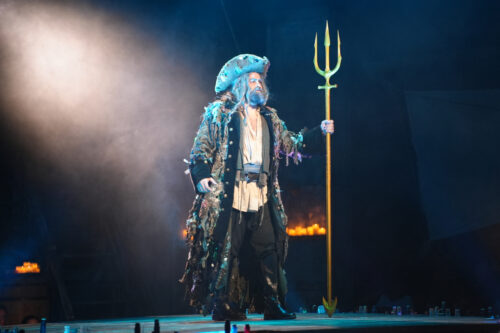
Frank Montoto is a stern King Triton in Area Stage Company’s production of “The Little Mermaid” at the Arsht Center. (Photo courtesy of Giancarlo Rodaz)
Hallie Walker as Ariel’s sidekick Flounder, John Luis as Prince Eric’s servant and friend Grimsby, Annette Rodriguez and Katie Duerr operating the opinionated seagull puppet Scuttle (designed by Erik Sanko), Nelson Rodriguez as the pilot of the prince’s ship and other performers who take on multiple roles (Brette Raia Curah, Karina Fernandez, Isis Palma, Carlos Bravo, Isabella Arza, Caila Katz, Michelle Gordon, Ava Bean) make the audience feel as though the world of “The Little Mermaid” is populated by multitudes.
Movement directors Luciano Cortés and Lauren Gaspard make a critical contribution to the underwater scenes, more significant in this production since costume creators Banda-Rodaz and Ortega opted not to go with mermaid tails. When they’re under the sea, the actors undulate, sometimes gently holding their forearms out as if they’re being moved by currents. The illusion of bodies in water is yet another example of Rodaz’s attention to detail.
Go to Area Stage’s lively “The Little Mermaid” during the remaining two weeks of its run and you’ll experience a world full of glitter, bubbles and a whole lot of talent. Not the least of which is the achievement of Rodaz, whose imagination and love of immersive theater very much justify the buzz about his work.
WHAT: Disney’s “The Little Mermaid”
WHERE: Area Stage Company production in the Carnival Studio Theater at the Adrienne Arsht Center for the Performing Arts, 1300 Biscayne Blvd., Miami
WHEN: 7:30 p.m. Wednesday-Sunday, 1 p.m. Saturday-Sunday, through Aug. 27
COST: $110 VIP (with immersive seating), $83.50 general admission, $52 students 3-22 (must show student ID), $31 lap seating (day of show only at box office)
INFORMATION: 305-949-6722 or www.arshtcenter.org
ArtburstMiami.com is a nonprofit media source for the arts featuring fresh and original stories by writers dedicated to theater, dance, visual arts, film, music and more. Don’t miss a story at www.artburstmiami.com.
No posts found
Giancarlo Rodaz leads an immersive ‘Little Mermaid’ and Area Stage Co. into the future
Written By Christine Dolen
August 7, 2023 at 2:51 PM
(Josslyn Shaw plays the adventurous, lovelorn Ariel in Disney’s “The Little Mermaid,” an immersive Area Stage production inside the Adrienne Arsht Center’s Carnival Studio Theater opening in previews Wednesday, Aug. 9. (Photo courtesy of Giancarlo Rodaz)
As South Florida’s scorching summer rolls on and even a dip in the ocean leaves us feeling hot hot hot, Miami’s Area Stage Company has devised a refreshing escape.
Following last summer’s acclaim for Area Stage’s Carbonell Award-winning “Beauty and the Beast,” newly named artistic director Giancarlo Rodaz has turned to another beloved Disney title in his ongoing exploration of immersive theater: “The Little Mermaid.”
The imaginative plunge under the sea gets its debut inside the Carnival Studio Theater at the Adrienne Arsht on Wednesday, Aug. 9. It runs through Sunday, Aug. 27.

Josslyn Shaw as Ariel and Aaron Hagos as Sebastian during a “Little Mermaid” rehearsal. (Photos courtesy of Giancarlo Rodaz)
“I’ve just been enjoying immersive theater as its own medium,” says Rodaz, 27, who has done nearly every job at the company founded by his parents, John Rodaz and Maria Banda-Rodaz, in 1989. “I like mixing things up and breaking all the rules.”
To that end, Rodaz reached out directly to Disney’s head of theatrical licensing, seeking permission to do the version of the script that ran on Broadway from 2007 to 2009. Some changes were made when the show debuted in the Netherlands in 2012, and the second version is the one produced by regional theaters such as Fort Lauderdale’s Slow Burn Theatre Company, which will present its own “Little Mermaid” at the Broward Center beginning Friday, Dec. 15 and running through the month of December.
After a week of waiting, Rodaz got the go-ahead to produce the original Broadway version, which features music by Alan Menken, lyrics by Howard Ashman and Glenn Slater, and a book by Pulitzer Prize-winning playwright Doug Wright.
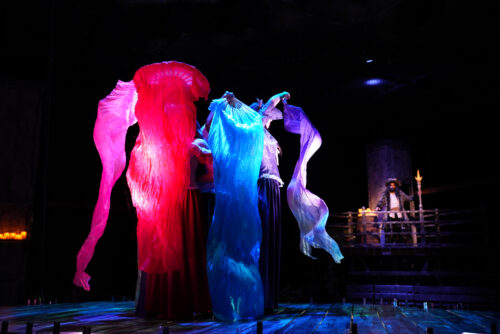
Light and airy fabric helps create the magical, mysterious undersea world of Area Stage Company’s “The Little Mermaid” getting an immersive treatment at the Arsht Center. (Photo courtesy of Giancarlo Rodaz)
Truth be told, in 1989 the animated version of “The Little Mermaid” launched a new era in Disney musicals, its success igniting an era dubbed “the Disney Renaissance” with such subsequent animated musical hits as “The Lion King,” “Beauty and the Beast,” “Aladdin,” “Frozen” – well, it’s a long list.
Based on the disturbingly dark 1837 fairy tale by Hans Christian Andersen, the Disney movie was written (and made sunnier) by John Musker and Ron Clements (for Broadway the two got a “based on” credit, along with Andersen), and it won Oscars for Menken’s score and the song “Under the Sea.”
The movie’s success led to a prequel, a sequel, a television series, the Broadway show, numerous productions in countries around the world and cities all over the United States, two celebrity-filled live-in-concert events at the Hollywood Bowl, a live television special and this year’s live action movie starring Halle Bailey as Ariel and Melissa McCarthy as the villainously scheming Ursula.
Not to mention all the books, toys, theme park tie-ins with an actress playing Ariel, Mermaid merchandise and Halloween costumes. For more than three decades now, things have gone swimmingly for Disney’s “The Little Mermaid.”
Rodaz is thrilled to be exploring and presenting a version of the story he finds to be “so close to the original movie.”
He adds: “We are digging into the show as if it’s a brand-new musical. That has carried over into rehearsals. We’re getting rid of all the ideas used to portray the mermaids underwater – the costume pieces with tails, the wigs with hair in the air. This is a ‘Romeo and Juliet’ story that gets the audience really hooked.”
Should you have somehow avoided any exposure to “The Little Mermaid,” these are the story’s basics.
Ariel (played in the Area production by Josslyn Shaw) is a spirited, curious teen mermaid and youngest daughter of the undersea ruler King Triton (Frank Montoto). Obsessed with exploring the human world above, she encounters the dashing Prince Eric (Henry Thrasher) and saves his life when he’s washed overboard in a storm. Just like Romeo and Juliet, the two fall in love.

Josslyn Shaw as Ariel is surrounded by actors creating waves around her during a rehearsal for Area Stage Company’s “Little Mermaid. (Photos courtesy of Giancarlo Rodaz)
The impediments to their romance are many: King Triton loathes humans. Neither Ariel nor Eric could survive in the other’s world – unless she could somehow become human, which she’s determined to do. The devious sea witch Ursula (Jonathan Chisolm) offers to transform her for three days, changing her tail into legs but taking away her beautiful voice, holding it in a magical nautilus shell and leaving Ariel mute. As for details and the resolution? Audiences should experience those firsthand.
“Every Disney protagonist feels like a dreamer,” says Rodaz. “Everyone feels like an outsider, misunderstood, not seen in a way. That’s the magic that’s inherent in Disney.”
To prep his cast for a show requiring most of the actors to navigate an underwater world, Rodaz invited the performers to his family’s home to go swimming as a start to building a vocabulary of movement.
Everyone did except for Chisolm, who notes, “I can’t swim.”
The show’s romantic leads are young performers in the early stages of building their post-university careers.
“It’s really cool to be doing the original Broadway script. And who doesn’t want to work in Florida?” says Shaw, who says she loves singing Ariel’s “Part of Your World” most. “Giancarlo gave us time to have a discovery process. Everyone was willing to dive in. He created a safe, fun environment.”
Thrasher, a 2018 theater winner in the Miami-based National YoungArts Foundation competition, has sung Eric’s “Her Voice” for years and says the prince’s expression of love for Ariel often brings him to the verge of tears. He also is moved by the quartet “If Only,” sung by Ariel, Triton, Eric and Ariel’s protector/sidekick Sebastian (Aaron Hagos).
“I love Alan Menken’s work, and this is one of my favorite scores. It has such a variety of styles – it’s truly gorgeous,” says the actor.

Henry Thrasher plays Eric, the prince in love with Ariel, in Area Stage Company’s immersive production of “The Little Mermaid.” (Photo courtesy of Giancarlo Rodaz)
Chisolm, who uses the pronouns they/them, says, “I’m 31, and I have loved the ‘Little Mermaid’ movie for 20 years. Ursula is the one I always respond to. (She was) banished for killing and maiming people. It’s high melodrama and very operatic storytelling.”
In the animated original, Ursula’s look and affect were inspired in large part by Divine, the curvaceous and uncensored character played by Harris Glenn Milstead in famous/infamous John Waters movies. Ursula, Chisolm says, “is definitely a woman. But as a non-binary and queer person myself, I have a strong sense of obligation to the way I play her.”
Unlike Area Stage newcomers Shaw, Thrasher and Chisolm, Hagos and Montoto have appeared in a number of the company’s productions. Montoto was in the immersive versions of “Annie” and “Beauty and the Beast,” and both actors admire Rodaz’s approach to well-known musicals.
“It’s surreal to take a story everyone knows and do it a new way,” says Hagos.
Adds Montoto of his frequent director: “He always provides new challenges . . . He loves to bounce ideas off everybody.”
Disney’s “The Little Mermaid” will be Rodaz’s first as Area Stage’s second artistic director. Banda-Rodaz estimates the production’s cost as “in the neighborhood of $400,000;” creating theater at the Arsht Center is always costlier than producing at the company’s space in South Miami’s Shops at Sunset Place, home to Area Stage’s extensive conservatory program.
“I feel so proud to see the company continue under Giancarlo’s stewardship. He has been preparing for the role all his life,” says Banda-Rodaz, who is creating the “Little Mermaid” costumes along with Sofia Ortega. “Productions like ‘Annie’ and ‘Beauty and the Beast’ gave John the impetus to hand over the position, and we cannot wait to see what new artistic challenges Giancarlo will conquer.”
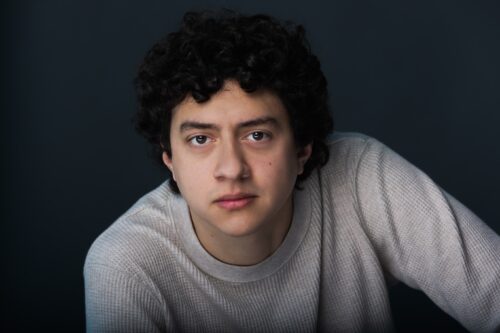
At 27, Giancarlo Rodaz is the second artistic director at Area Stage Company. His mother says he has been preparing for the role “his whole life.” (Photo courtesy of Morgan Sophia Photography)
Founding artistic director John Rodaz says of his son, “Giancarlo has been steeped in the world of performing arts since he was a child, and his journey has been nothing short of remarkable. From his early days performing on our stage to working behind the scenes and eventually directing his own productions, his commitment to artistic excellence and storytelling has shone through. I have watched him grow as an artist and a leader, and I have faith in his ability to take Area Stage Company to even greater heights.”
Giancarlo Rodaz – called “John-John” by close friends, colleagues and family – remembers his journey vividly.
“I started by sweeping the theater and cleaning up after shows. It’s been inch by inch, moving forward,” he says. “When my dad started Area Stage, the focus was on Harold Pinter and David Mamet and so on. When we moved to Riviera Plaza (the site has become the future home of a two-story Publix on South Dixie Highway across from the University of Miami), we switched the focus to education. Now I want to find equilibrium between the mainstage and conservatory programs, so they can feed off each other.”
Following “The Little Mermaid,” Rodaz plans to produce an immersive version of “The Addams Family Musical” in the Arsht’s Carnival Studio Theater Feb. 7-25. And though he’s the one in charge, he’s glad his parents aren’t going anywhere.
“I’m lucky to have them around, guiding and advising me,” he says.
WHAT: Disney’s “The Little Mermaid”
WHERE: Area Stage Company production in the Carnival Studio Theater at the Adrienne Arsht Center for the Performing Arts, 1300 Biscayne Blvd., Miami
WHEN: Previews 7:30 p.m. Aug. 9-10, opens 7:30 p.m. Aug. 11; regular performances 7:30 p.m. Wednesday-Sunday, 1 p.m. Saturday-Sunday, through Aug. 27
COST: $110 VIP (with immersive seating), $83.50 general admission, $52 students 3-22 (must show student ID), $31 lap seating (day of show only at box office)
INFORMATION: 305-949-6722 or arshtcenter.org
ArtburstMiami.com is a nonprofit media source for the arts featuring fresh and original stories by writers dedicated to theater, dance, visual arts, film, music and more. Don’t miss a story at artburstmiami.com.
No posts found
Review: ‘Defending the Cavewoman’ makes aspirational debut at Actors’ Playhouse
Written By Christine Dolen
July 24, 2023 at 5:54 PM
The taking of wedding vows is one of the many topics with a sardonic tone in “Defending the Cavewoman” getting its U.S. premiere at Actors’ Playhouse at the Miracle Theatre in Coral Gables through Aug. 6. (Photo courtesy of Alberto Romeu)
Since time immemorial – way, way back when cavemen went out hunting and cavewomen did the gathering, or so we’re told – the differences between men and women have inspired a certain kind of theatrical fare.
John Gray’s monster best seller “Men Are from Mars, Women Are from Venus” was adapted by Eric Coble into a solo show. Rob Becker’s one-person “Defending the Caveman” took its laughs and gender observations to Broadway. The musical “I Love You, You’re Perfect, Now Change” by Joe DiPietro and Jimmy Roberts had an Off-Broadway run of more than 5,000 performances and has been done all over the country – Actors’ Playhouse at the Miracle Theatre in Coral Gables has produced that show four times.
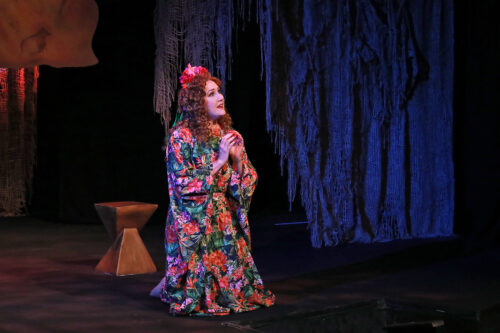
Lindsey Corey as Eve asks God to give her a companion in “Defending the Cavewoman.” (Photo courtesy of Alberto Romeu)
Now the company is aiming to add to the genre with “Defending the Cavewoman,” a solo show starring Carbonell Award winner Lindsey Corey.
Running in the Balcony Theatre at the Miracle through Sunday, Aug. 6, the 2000 comedy by South African playwright Emma Peirson has had a little work done (theatrical Botox?) for its United States premiere, with the hope that this piece might become another much-produced success like the ones referenced above.
At this point, it’s not clear how aspirations for the show might play out (the producers who licensed it to Actors’ Playhouse are Theater Mogul and GFour Productions).
Theater fans who like their entertainment light and relatable go for shows like “Defending the Cavewoman” because men and women often do see things differently. We are all individuals, of course, and behavior isn’t clearly tied to gender or hormones.
But that hunter-gatherer stuff seems pretty hardwired.
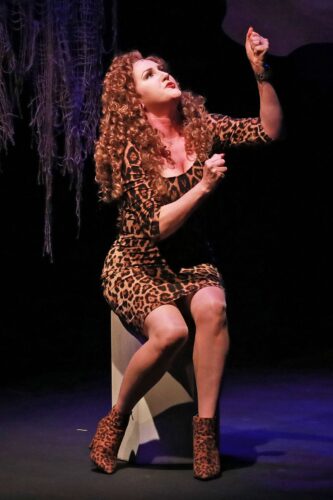
“Defending the Cavewoman” at Actors’ Playhouse features Lindsey Corey in a solo show serving up a contemporary woman’s point of view. (Photo courtesy of Alberto Romeu)
“Defending the Cavewoman,” which was created by Peirson and Vanessa Frost, runs a brisk 85 minutes, with the script incorporating myriad influences. Nature documentaries, bombastic Oprah Winfrey-style TV, scenes of 10th anniversary domestic discord and the rhythms of standup comedy are all folded into “Cavewoman,” though they don’t always coexist smoothly, despite the imaginative efforts of director David Arisco, the design team and the abundantly impressive, irresistible Corey.
The play’s prologue flips the script on the Adam and Eve story. God (voiced Oprah-style by Kareema Khouri who, along with Carlos Alayeto and Laura Turnbull, supplies brief interludes of recorded lines) creates Eve first, only to leave her feeling lonely in the lush Garden of Eden.
She asks for a companion and God complies, but as it turns out, this sequence is a setup for the play’s first big woman-to-man shot. Revealing that here would be a spoiler, and spoilers are bad.
Then “Defending the Cavewoman” gets down to contemporary business.
Corey, who flips into and out of more than a dozen characters, chiefly plays Evelyn, a wife and mother who the day before celebrated her 10th anniversary with her husband Chris. The special day, she notes, was marked by one crisis after another as she frenetically tried to rally her troops – Chris and the kids – to get the house ready for a celebratory family brunch.
Among the crises: She forgot to order food from the caterers (yes, she says defensively, she can cook – well, maybe that’s not quite true).

Lindsey Corey as Evelyn takes a dig at the male of the species (any species) in “Defending the Cavewoman” getting its U.S. premiere at Actors’ Playhouse. (Photo courtesy of Alberto Romeu)
The family dog with an amusing name (not spoiling that one either) has to be rushed to the hunky fantasy-stirring vet after vomiting all over Evelyn, who can’t change her curve-hugging leopard print party dress because the zipper is immovably stuck.
After the brunch and a whole lot of snark from her mother-in-law Hillary, Evelyn realizes the youngest kid has a karate class that afternoon. The family rushes to the mall to get his gear (Chris’s only assignment while Evelyn gathers many other items), but Daddy gets distracted by the sounds and myriad screens in the electronics section.
And so it goes in “Defending the Cavewoman” and Evelyn’s world.
The play is full of pointed observations twisted for comic effect, such as: Maybe serial killers are really normal people on low-carb diets. Maybe Evelyn can tell Chris (from memory) exactly where his favorite cheese is in the fridge, even though he has “looked” and can’t find it.
Maybe the anniversary dress Chris ordered for Evelyn looked different in the photo because the Amazonian model was wearing a size 0, while Evelyn (with the help of Spanx so tight her internal organs are screaming) is squeezed into a size 8.
Corey, it must be noted, is so slender and fit that the model would likely envy her. The actor is a deft comedienne, a killer singer, a talent who can make dancing funny. At this point early in the run, she has fleeting moments in which she smiles but looks just a tad uncomfortable – maybe because the script occasionally still vacillates between theater and standup.
If plays were rated like movies, “Defending the Cavewoman” would probably get an NC-17, not for anything that takes place onstage but for language (the script is loaded with f-bombs) and verbal sexual content (among Evelyn’s anniversary gifts is a special set of balls that embarrassingly chime when she walks).
As with any solo show, it took a village to bring “Defending the Cavewoman” to life.

Lindsey Corey lets out her inner leopard in the Actors’ Playhouse American premiere of “Defending the Cavewoman.” (Photo courtesy of Alberto Romeu)
Arisco helped the actor hone her performance, with additional feedback from stage manager Amanda Corbin. Jodi Dellaventura created and dressed the set, co-designing projections that vitally enhance the storytelling with Natalie Taveras. Eric Nelson’s lighting helps transport Corey’s Evelyn and the audience from place to place.
Matt Corey, the star’s husband, uses his perfectly detailed soundscape to further bring Evelyn’s world and memories to life. Costume designer Ellis Tillman first puts Corey-as-Eve in a riotously colorful floor-length dress that makes her look like Mother Nature, then gets her into the curve-hugging leopard-print dress that (despite dialogue to the contrary) allows her to move so easily she can practically do contortions.
Sporting a dated long, big, curly wig, Corey must deliver certain lines that come off as more mean-spirited than funny – the fault of the script, not the actor. When Evelyn is imitating Chris, she sounds none too bright, and she’s only too happy to complain about his willingness to wear dirty clothes, his lack of effectiveness when it comes to cleaning, his flaws as an information gatherer when their friends are having marital woes.
Does “Defending the Cavewoman” resonate with an audience of men and women who know only too well the situations Evelyn describes? Yes, and at the end, Evelyn concedes that Chris is “one of the good ones.” But like our ancestors, the script needs to evolve if it is to join that list of hit battle-of-the-sexes shows.
WHAT: “Defending the Cavewoman” by Emma Peirson
WHERE: Actors’ Playhouse at the Miracle Theatre’s Balcony Theatre, 280 Miracle Mile, Coral Gables
WHEN: 8 p.m. Wednesday-Saturday, 3 p.m. Sunday, through Aug. 6
TICKETS: $40 to $125 (seniors 65 and older get 10 percent off weekdays only; students with valid student ID pay $15 for a rush ticket available 15 minutes before a weekday performance)
INFO: 305-444-9293 or actorsplayhouse.org
ArtburstMiami.com is a nonprofit media source for the arts featuring fresh and original stories by writers dedicated to theater, dance, visual arts, film, music and more. Don’t miss a story at www.artburstmiami.com.
No posts found
Cuban play ‘Hierro’ gets simultaneous translation at Miami-Dade County Auditorium
Written By Michelle F. Solomon
July 20, 2023 at 4:55 PM
At left, Caleb Casas as José Martí and Claudia Valdes as Carmen Zayas Bazán in “Hierro” (“Iron”), by Cuban-Spanish playwright Carlos Celdrán, which opens on Thursday, July 27 at the Miami-Dade County Auditorium. (Photo courtesy of Arca Images)
Spanish-language theater, produced locally and by companies outside Miami-Dade County, is not rare in an area where only 27 percent of residents are English-only speakers.
While productions in Spanish have always been part of Miami-Dade’s theater scene — Mario Ernesto Sánchez’s Teatro Avante and the yearly International Hispanic Theatre Festival have long led the way, for example — Alexa Kuve, the executive and producing artistic director of Arca Images, agrees there are barriers for non-Spanish speaking theatergoers who might want to attend a performance in its original language.
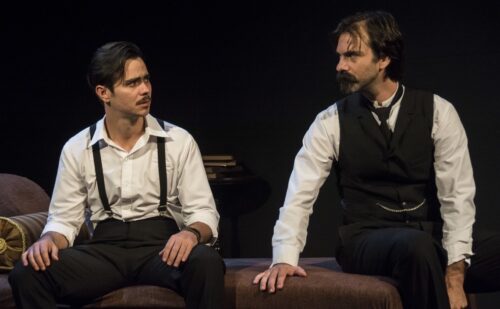
Daniel Romero as Hombre, left, and Caleb Casas as José Martí. (Photo courtesy of Sonia Almaguer)
Many companies now offer supertitles, much like opera, with the English translation appearing in text – but even that creates a barrier. Theater creates and requires an intimacy between actors and audiences, and that can become a battle for attention if the theatergoer is watching what’s going on onstage and following the words in captions.
Kuve says that especially for its upcoming production of “Hierro” (“Iron”), by Cuban-Spanish playwright Carlos Celdrán, it is important to draw in English and Spanish speakers.
“Carlos tells a very different story about José Martí who is a near mythological figure for Latin Americans. This play is an eloquent re-examination of his life,” says Kuve.
“Hierro” will open on Thursday, July 27, and run through Sunday, Aug. 6 at the Miami Dade County Auditorium in its original Spanish but with a simultaneous English translation. A translator, in another room of the theater, watches what is happening on stage through a video connection and translates in real time, she explains. Audiences can listen to the English version through wireless headphones that are provided. Although not the first time Arca has offered the simultaneous translation, Kuve is hoping the word gets out about “Hierro.”

Claudia Valdes, left, in rehearsal with writer-director Carlos Celdrán for his play “Hierro” (“Iron”) at the Miami- Dade County Auditorium. (Photo courtesy of Arca Images)
“This is a play that has only been performed live before in Cuba,” says Kuve. Celdrán, who lives in Madrid, is directing the play and is in Miami working with actors, many of whom now live here but performed in the original production in Havana.
The play had its world premiere in November 2019 at Celdrán’s company, Argos Teatro.
“It had a good run there just before the pandemic hit,” he says. “It caused an impact.”
He says his work demystifies the image of the National Hero of Cuba and of the man who became a symbol of Cuba’s bid for independence from Spain in the 19th century; many view Martí as the apostle of Cuban independence.
“This is not an official version of him,” Celdrán says in Spanish, with Kuve translating to English. “His image has been manipulated to the Cuban people.” He calls it “Martianism,” which has detracted from Cubans learning about his human side.
“Martí was an epic figure, but he was also human,” says the playwright. Kuve adds: “Through his research, Carlos discovered this person that was not in any history books.”
Celdrán says his purpose in writing the play was a mix of his own fascination with the Cuban nationalist, poet, and essayist, which began when Celdrán was a boy in Cuba and a desire to “start a dialogue about this figure that is so important for Cubans in and out of Cuba.”
The playwright says his story is a reinterpretation that returns to the beginning of Martí’s story.
“I wanted to unfold his personal life, his private life,” says Celdrán, who has included material centered on Martí’s exile in New York City, where he lived for 15 years after the Spanish deported him from Cuba for his radical ideas.

Caleb Casas as José Martí and Claudia Valdes as Carmen Zayas Bazán in “Hierro” (“Iron”), by Cuban-Spanish playwright Carlos Celdrán. (Photo courtesy of Arca Images)
Celdrán’s approach was revered by many in his homeland of Cuba although he confides that people who had officially worked with research and history about Martí found some of the subjects the playwright chose to tackle problematic.
One sticking point: his infidelity. “Some of them do not accept that he was unfaithful to his wife and that he had an illegitimate daughter with the wife of a friend. They find that inappropriate.”
He says that there was only a small faction of naysayers when the play opened in Cuba. “It didn’t bubble up. It didn’t escalate.”
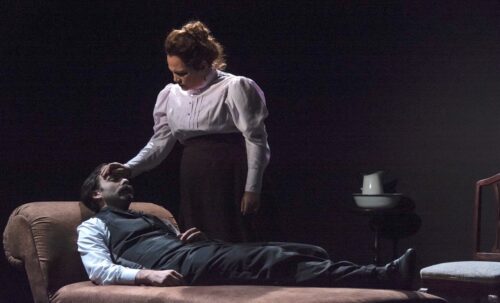
Rachel Pastor as Carmen Miyares soothes Caleb Casas as José Martí in “Hierro” (“Iron”), by Cuban-Spanish playwright Carlos Celdrán. (Photo courtesy of Sonia Almaguer)
It was through Martí’s poetry that the playwright was able to “feel” the character he created, a man who had “a personal life filled with contradictions, agonies, problems, and suffering.”
Kuve says Celdrán brings out, too, “his sensitivity.” Her eyes well up as she talks about a part of Celdrán’s play that she says brings her to tears every time.
“There’s my favorite scene where Martí confronts the man who tried to poison and kill him. He tells him, ‘I need to forgive you. I need to understand you because I need to forgive you not for you but for myself,’ ” she says.
For Celdrán, the scene is the pinnacle. “It is a small passage of his life that is almost forgotten but it is a metaphor for the entire show. That we all need to overcome our hatreds.”
WHAT: U.S. premiere of Carlos Celdrán’s “Hierro” in Spanish with simultaneous English translation.
WHEN: Opens 8:30 p.m. Thursday, July 27. Performances are Thursday, Friday and Saturday, 5 p.m. Sunday. Through Aug. 6.
WHERE: Miami Dade County Auditorium On.Stage Black Box Theater, 2901 W. Flagler St., Miami, FL
COST: $30, general admission, $25 seniors and students with valid ID.
INFO: Call Miami-Dade Auditorium at 305.547.5414 or arcaimages.org
ArtburstMiami.com is a nonprofit media source for the arts featuring fresh and original stories by writers dedicated to theater, dance, visual arts, film, music and more. Don’t miss a story at www.artburstmiami.com.
No posts found
In-demand actress, Lindsey Corey, takes on solo role for Actors’ Playhouse’s ‘Defending the Cavewoman’
Written By Christine Dolen
July 17, 2023 at 2:43 PM
Lindsey Corey is a comedic everywoman in the Actors’ Playhouse premiere of the one-woman show “Defending the Cavewoman” opening Friday, July 21 and running through Sunday, Aug. 6. (Photo courtesy of Alberto Romeu)
When Lindsey Corey graduated from Miami’s New World School of the Arts with a musical theater degree in 2008, she thought she would pursue a classic actor’s dream: go to New York and try to forge a career in the Big Apple.
But fate, in the form of small decisions and growing opportunities, had other ideas. Encouraged by director Stuart Meltzer, one of her New World teachers who was the artistic director of City Theatre at the time, the actor then known as Lindsey Forgey got her first professional gig in the 2008 edition of City’s popular Summer Shorts.
As Meltzer puts it, “The job opened up a different perspective and opportunity for her” in a kind of theatrical boot camp where she worked alongside seasoned professionals and got to create multiple characters in an evening of short plays.
Says Corey, “I ended up staying because I saw it was possible to create a life here.”
Has she ever.

Lindsey Corey plays more than 15 characters in the one-woman show in “Defending the Cavewoman” at Actors’ Playhouse. (Photo courtesy of Alberto Romeu)
Today, 44 shows later (54 if you count repeats, like the half-dozen times she appeared in “Rock Odyssey” at Miami’s Arsht Center), the Carbonell Award-winning Corey is among the most in-demand actors throughout South Florida.
Now she’s taking on a fresh challenge, the Actors’ Playhouse United States premiere of South African playwright Emma Peirson’s 2001 solo show “Defending the Cavewoman.” The play was devised by Peirson and Vanessa Frost, then written by Peirson in response to Rob Becker’s wildly successful one-man show “Defending the Caveman.” Becker’s show ran on Broadway from 1995 to 1997 and made tour stops all over the United States, including South Florida.
Previewing Wednesday and Thursday, July 19 and 20, opening Friday, July 21 and running through Sunday, Aug. 6 in the upstairs Balcony Theatre at Coral Gables’ Miracle Theatre, “Defending the Cavewoman” is a truth-laced comedy about how very different women, men and their foibles can be. It is Corey’s first professional one-woman show, though she wrote and performed a shorter student piece 15 years ago as a New World graduation requirement.
The production will be the 10th in which Corey has worked with David Arisco, artistic director of Actors’ Playhouse for nearly all of the company’s 35-season history.

Andy Christopher and Lindsey Corey belt out a classic in “Hank Williams: Lost Highway” at Actors’ Playhouse in 2022. (Photo courtesy of Alberto Romeu)
In the summer, Arisco generally favors lighter, funny or musical fare. He was working on the Actors’ production of “Hank Williams: Lost Highway” a year ago when his longtime friend, Seth Greenleaf of GFour Productions, brought the “Cavewoman” script to him. Arisco said yes – and thought of Corey, who was then playing the country legend’s ferociously ambitious but less-than-talented wife Audrey in “Hank Williams.”
“This was handed to me. I got lucky,” says Arisco, who has been working with Greenleaf on tweaking and shaping the script for an American audience (Greenleaf gets Peirson’s permission for any changes). “This is definitely different. We have taken what was kind of a standup act and given it a theatrical structure.”
Arisco chose Corey, he says, because “she’s a pretty exceptional talent. She’s capable of playing just about anything.”

Lindsey Corey (second from right) prepares to dispatch a vampire in Zoetic Stage’s “Dracula” in 2018. (Photo courtesy of Justin Namon)
Corey has been committed to “Defending the Cavewoman” since last summer. She plays more than 15 characters, though most often she’s speaking as a woman named Evelyn or her husband Chris on the day after the couple’s crisis-filled 10th anniversary.
Actors Laura Turnbull, Kareema Khouri and Carlos Alayeto have recorded the voices of several other characters, but Corey is well aware she’ll be the only artist literally in the spotlight.
In a one-person show, she says, “Once the train has left the station, you are the train.”
Corey knows that her challenges in “Defending the Cavewoman” will include physical, mental and emotional stamina. Fitness and healthy eating have been part of her professional strategy since before the pandemic because, she says, “being conscious of what I’m putting in my body is reflected in my instrument.”
For “Defending the Cavewoman,” she has to remember a huge number of lines in a piece that has changed from two acts to an 80-minute show with no intermission.
“It is a very wordy script. It’s big,” Corey observes. “Dave (Arisco) and I have a shorthand . . . I came to the first day of rehearsals having memorized as much as I could, and we blocked the first quarter of the script.”
As prepared as Arisco is from the get-go, Corey says he’s open to collaborative input (“he gives you the freedom to bring whatever you’ve got”). The two have had workable sound cues throughout rehearsals thanks to Corey’s husband, Matt, an eight-time Carbonell Award winner. Says Arisco, “This requires a sound designer who can make a real soundscape.”
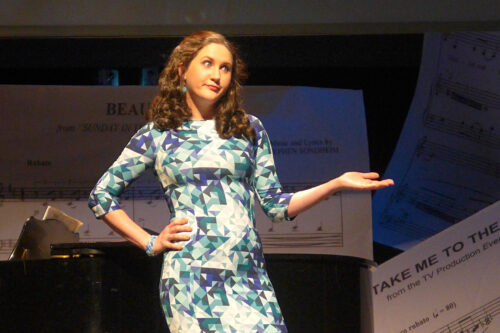
Lindsey Corey in another Actors’ Playhouse production in 2016, “Sondheim on Sondheim.” (Photo courtesy of Brooke Noble)
He says that much depends upon the leading lady and only live performer in the premiere: “A lot of this is more about guiding a really good actor.”
Over the decade and a half since her days at New World, Corey’s professional resume has taken off like a bullet train.
In the upcoming 2023-2024 season, for example, she has been cast in the pre-Broadway tryout of the Louis Armstrong bio musical “A Wonderful World” (the show had its world premiere in late 2021 at Miami New Drama after shutting down during previews in 2020 due to the pandemic). The new production plays the Saenger Theatre in New Orleans Oct. 1-8, then heads to Chicago’s Cadillac Palace Theatre Oct. 11-29, and Corey is again cast as Rachel the Reporter/Ensemble, as she was at Miami New Drama.
Corey will also appear in “A Christmas Carol” in November-December at the Maltz Jupiter Theater in Palm Beach County, where she earned raves as the tragic Nancy in “Oliver!” this past March.
In the new year, she’ll head to Palm Beach Dramaworks to appear in the February world premiere of Christopher Demos-Brown’s “The Cancellation of Lauren Fein.” And in March-April 2024, she’ll star as Sally Bowles in Zoetic Stage’s immersive production of “Cabaret,” with Meltzer directing.
In 2015, Corey got a breakout part when she originated the role of Masha, an exotic dancer from Belarus fighting for custody of her little girl, in the Zoetic Stage world premiere of Demos-Brown’s “Stripped.” Her performance won her the best actress in a play Carbonell Award. Corey says Masha is her favorite role so far. Not that it was easy: In addition to the play’s dramatic demands, the part required her to master pole dancing and learn the character’s Russian dialect.

Next spring, Lindsey Corey plays Sally Bowles with Elijah Word as the Emcee in Zoetic Stage’s immersive “Cabaret.” (Photo courtesy of Chris Headshots)
Demos-Brown counts himself among the South Florida-based theater artists who believes Corey is headed for a stellar future.
“I didn’t write the role of Masha for anyone in particular. But Stuart [Meltzer] immediately saw Lindsey in the role and, of course, once we got into rehearsals, I couldn’t picture anyone else doing it,” Demos-Brown notes. “…There are two actors for whom I try to create a role every time I write a play. Lindsey’s one of them. She’s one of a kind. A combination of Jennifer Lawrence and Meryl Streep. She’s that talented, that smart, that charming, that funny, that wonderful to work with. She’s a break or two from being a huge star.”
This moment is one Corey, 37, has been working toward for most of her life. Raised in smalltown Harrison, Tenn., 20 miles outside Chattanooga, she started singing karaoke in bars when she was only five or so.
“My mom never had a drink in her life, but she knew I wasn’t afraid to get up and sing in front of people,” says Corey of her early start in showbiz.

Lindsey Corey as Elizabeth is terrorized by Gabriell Salgado as the Creature in Zoetic Stage’s “Frankenstein” in 2021. (Photo courtesy of Justin Namon)
“Her friend mentioned there was a magnet arts high school in Chattanooga, and I went there . . . I got into New World, and after graduating met (actor) Laura Turnbull doing Summer Shorts. Then her husband Avi Hoffman cast me in ‘Enter Laughing’ at the New Vista Theatre in Boca Raton. So moving to New York got farther away.”
Corey has created the life she envisioned in South Florida, both professionally and personally.
She met her husband when she was dating someone else, as was he, so for the first few years of their relationship they were theater friends and colleagues at Fort Lauderdale’s Insight for the Blind, where she still works as a digital magazine producer.
Matt Corey, whose father is actor and radio personality Dave Corey, is an accomplished creative force to be reckoned with. He’s president and CEO of Insight for the Blind, which supplies recordings of books and magazines to the Library of Congress, visually impaired clients and other libraries; a University of Miami-trained composer and bassoonist; and one of South Florida theater’s most in-demand sound designers.

Lindsey Corey created the role of Masha in the Zoetic Stage world premiere of Christopher Demos-Brown’s “Stripped” in 2015. (Photo courtesy of Chris Headshots)
The decade-long marriage in “Defending the Cavewoman” is meant to make us laugh as it highlights differences between men (hunters going all the way back to caveman days) and women (forever gatherers). Evelyn and Chris love each other but come off as comedic combatants. She complains about his snoring, flatulence, the necessity of re-cleaning after he has “cleaned,” sending him to the grocery store with a detailed and descriptive list only to discover he left his wallet at home. He complains that “someone” is always moving his things, and he asks her where the cheese he’s seeking is located in the fridge since he didn’t spot it first thing when he opened the door.
The Coreys, on the other hand, have now been married for nine happy years.
“I love that man, I love that I can collaborate with him in life and artistically,” says Corey. “We talk about the show at home; we’re each other’s support system. It’s a lot for me and a big sound show for him. Even though he’s done more than 100 shows at GableStage, this is his first time working at Actors’ Playhouse because mostly they do big musicals. But Matt wants to stretch himself.”
He’s also supportive of Corey’s upcoming out-of-town runs in “A Wonderful World,” and he’s planning to see the show in both tryout cities.
Arisco observes that Corey “loves South Florida and loves working here. She’s a lovely person who has her world together, which allows her to dig deep and feel confident.”
As glimmering as Corey’s future looks right now, it also contains unknowns. Will “A Wonderful World” move to Broadway, and if so, when? How might that affect her other commitments? If New York beckons with other opportunities, will she stay or go?
“It’s not lost on me what I have here,” Corey says of her longtime home base – her own wonderful world.
WHAT: “Defending the Cavewoman” by Emma Peirson
WHERE: Actors Playhouse at the Miracle Theatre’s Balcony Theatre, 280 Miracle Mile, Coral Gables
WHEN: Previews 8 p.m. Wednesday and Thursday, July 19 and 20, opens 8 p.m. Friday, July 21; regular performances 8 p.m. Wednesday-Saturday, 3 p.m. Sunday, through Aug. 6
COST: $40 to $125 (seniors 65 and over get 10 percent off weekdays only; students with valid student ID pay $15 for a rush ticket available 15 minutes before a weekday performance)
INFO: 305-444-9293 or actorsplayhouse.org
ArtburstMiami.com is a nonprofit source of dance, visual arts, music and performing arts news. Sign up for our newsletter and never miss a story,
No posts found
Festival gives young filmmakers chance to learn about craft, show skills
Written By Sergy Odiduro
July 17, 2023 at 11:03 AM
Deondre Marshall hones his filmmaking skills as part of URGENT, Inc.’s Film Arts Culture Entrepreneurship Program (FACE). He’ll be one of the participants in the Miami 4 Social Change Youth Film Festival on Thursday, July 20 and Friday, July 21 at Miami Dade College, North Campus. (Photo courtesy of Deion Mendez)
Don’t you just hate it when someone steals your lunch?
This common conundrum is the subject of “Dan’s Lunch,” one of 50 short films that will be screened at this year’s eighth annual Miami 4 Social Change Youth Film Festival.
The film, directed by Charmiana Delphonse, was plucked from over 600 submissions and will be shown during a two-day event that begins on Thursday, July 20 and Friday, July 21 at Miami Dade College, North Campus, Conference Center.
Saliha Nelson, Ed.D., and CEO of URGENT, Inc., a youth development program in Miami, is the festival’s producer, and says that the screening puts young filmmakers like Delphonse center stage.

A scene from “Dan’s Lunch,” a short film directed by Charmiana Delphonse, which will screen at this year’s eighth annual Miami 4 Social Change Youth Film Festival. (Photo courtesy of URGENT, Inc.)
“The festival is a way for them to show their films and compete against international storytellers in the same age range,” says Nelson. “This is a great platform not only to celebrate our students and the work that they created to compete, but it is also an opportunity for them to network with their peers . . .”
Presented by URGENT, Inc., in collaboration with Miami Dade College North Campus and the School of Entertainment and Design Technology, Nelson says the group of filmmakers is diverse and the genres run the gamut from music videos, public service announcements, animations, live-action shorts to documentaries.
Submission requirements were that films needed to be eight minutes or less, the content needed to focus on a social change theme, and filmmakers needed to be 24 years old or younger. Only original works were accepted.
In addition to getting their films screened, there’s a learning initiative included, too. The “Shoot Your Shot!” pitch competition gives young filmmakers a chance to introduce their film proposals. “Content creators between the ages of 15 and 17 will have 90 seconds to pitch their film ideas to prospective judges who will see if they have the presentation, the ideas, and innovation . . .”
Charmiana Delphonse directing one of her films that will be screened at the 2023 Miami 4 Social Change Youth Film Festival. Working with her is Clifford Charles. Her three films are “Loosen Up,” “Sock,” and “Dan’s Lunch.” (Photo courtesy of Saliha Crespo)
There will also be panel discussions, which Nelson says will be facilitated by local industry professionals.
“We’ll have a Media Empowerment Industry panel so they can learn about different careers in the industry.”
Actor, model and motivational speaker Sergio Delavicci returns for the third year as the festival’s special guest along with hip hop artist Damon “Kool Rock-Ski” Wimbley, formerly of the Fat Boys.
“Because this is the 50-year anniversary of hip hop and its influence in film and soundtrack, we’re going to have old school hip hop artist (Damon) and he’ll be coming to share about how (the Fat Boys) got started with hip hop in the film industry when they were young, so the kids will have some history as well,” says Nelson.
Educating participants about the entertainment industry is one of the festival’s primary goals and it is also an offshoot of Urgent, Inc.’s annual Film Arts Culture Entrepreneurship Program (FACE).
Saliha Nelson, Ed.D., CEO at URGENT, Inc., and producer of Miami 4 Social Change Youth Film Festival with Marco Giron, chief of film and entertainment for Miami-Dade County, at the 2022 festival. (Photo courtesy of Deon Gedeon)
Nelson encourages those who are interested to apply. Additional information is available on the website.
“The Film Festival is an opportunity that we’ve developed because we run our own film program,” says Nelson. “We hire high school students who are interested in film, and they work with us as interns year ’round. And so, not only do they learn how to be storytellers and learn the technical aspects of camerawork and storytelling, but they also get professional development and mentorship with a series of industry professionals.”
Delphonse admits that when she first began in the program in 2022 she really wasn’t invested in the craft of moviemaking.
“I was always interested in film. I watched a lot of movies and TV shows but I didn’t have much knowledge about film. I wasn’t that type of person who watched the credits at the end,” says Delphonse.
But as a pre-apprentice, her interest has grown.

Another short film directed by Charmiana Delphonse is “Loosen Up,” which will be screened at the festival. (Photo courtesy of URGENT, Inc.)
In addition to her being a director in “Dan’s Lunch,” she is also the assistant director in “Loosen Up,” as well as an editor and actress in “Sock,” all of which will be screened at the festival.
Delphonse says that her time with FACE and her participation in the three short films has been an eye-opening experience. She says the program and the film festival have challenged her to face her fears and how to work hard to achieve her goals.
“They taught me a lot about film in a short period of time. . . .They also taught me about real-world etiquette,” she says. “I wasn’t used to the discipline that I was given. The real film industry, you know, it’s hard. It’s not easy. You have to have tough skin. It’s not about what you’re comfortable with. It’s about breaking that bubble.”

Film, television actor and model Sergio Delavicci returns as a special guest for Miami 4 Social Change Youth Film Festival. Delavicci is pictured speaking during the 2022 event. (Photo courtesy of Saliha Crespo)
She is planning to attend Valencia Community College in Orlando this fall; her focus will be to get training in the film and entertainment industry, says Delphonse.
Nelson hopes that others will attend the festival and ultimately gain a positive experience.
“We want young people to come out and see other young filmmakers who’ve submitted their ideas. And also to learn about issues that they may not be aware of. It’s going to be a fun time. It’s going to be engaging. It’s going to be entertaining, but it’s also going to be really educational.”
WHAT: Miami 4 Social Change Youth Film Festival
WHERE: Miami Dade College, North Campus, Conference Center, Bldg. 3, 11380 NW 27th Ave.,
WHEN: Thursday, July 20 and Friday, July 21.
COST: $20 adults, those up to 21 years of age are free.
INFORMATION: urgentinc.org/youth-film-festival
ArtburstMiami.com is a nonprofit source of dance, visual arts, music, and performing arts news. Sign up for our newsletter and never miss a story.
No posts found
Review: Inventive ‘Native Gardens’ seeds summer laughs at GableStage
Written By Christine Dolen
June 14, 2023 at 4:05 PM
Kevin Cruz as Pablo Del Valle and Diana Garle as his wife Tania make a surprising discovery about their property line in GableStage’s “Native Gardens” on stage through Sunday, July 16. (Photo courtesy of Magnus Stark)
Making an inference from the new show at GableStage, playwright Karen Zacarías must know what it’s like to have challenging neighbors.
Her “Native Gardens” touches on a multiplicity of subjects, including the work-life challenges women face, acceptance of an offspring’s sexual orientation, prejudice both subconscious and overt. But Zacarías absolutely nails what happens when the heretofore pleasant folks next door turn nasty.
Closing out producing artistic director Bari Newport’s second season at GableStage in Coral Gables’ Biltmore Hotel, “Native Gardens” is just what the theater doctor ordered as an antidote to the flow of apocalyptic news. The play isn’t theater of the absurd, but it’s absurdly hilarious.
Thanks to the inventive, joyful touch of director Victoria Collado and a killer cast of four, “Native Gardens” is a finely calibrated romp through the fast-disintegrating relationship of two couples who call an historic Washington D.C. neighborhood home.
The longtime residents are baby boomers Frank Butley (David Kwiat) and his wife Virginia (Barbara Sloan). He works for the government, mysteriously calling his employer “the agency,” while she’s an engineer at Lockheed Martin and an all-around dynamo. Frank’s true passion is his lovingly tended, flower-filled garden, and he’s intently focused on beating the neighbor who always defeats him in the Potomac Horticultural Society’s yearly competition.
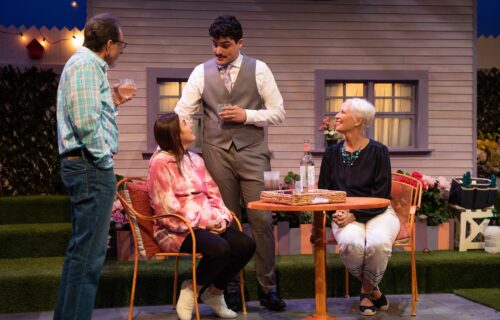
From left, David Kwiat, Diana Garle, Kevin Cruz and Barbara Sloan share a friendly moment before going to war in GableStage’s “Native Gardens.” (Photo courtesy of Magnus Stark)
New to the house next door are millennials Pablo Del Valle (Kevin Cruz), an attorney who grew up in a wealthy Chilean family, and his wife Tania (Diana Garle), a New Mexico-born Ph.D. candidate whose first baby is due in a mere five weeks. Their home is in obvious need of TLC, their “garden” – currently home to an old oak tree, scattered leaves and acorns, a few paltry plants and a sad little gnome statue – even more so.
Pretty quickly (the play is only 90 minutes, sans intermission), the Butleys and Del Valles find themselves in a pickle.
Pablo – well aware of his status as the only Latinx attorney at what he calls an “intensely American” law firm, ambitiously aspiring to a future partnership – winds up inviting the entire office over for a Saturday get-together. In a mere six days. Disbelieving Tania, who is preparing to defend her doctoral dissertation, needing to get the new place in order and (oh yes) have a baby, nonetheless rallies and suggests a backyard barbecue.
Frank’s competition, as it turns out, is the day after the barbecue. Tania believes she can quickly create a starter version of her dream garden, one filled with native plants and maintained without the use of pesticides. But she’d really love to replace the pitiful chain-link fence between the two backyards with a more private wooden one.
Over getting-to-know-you drinks, the younger couple floats the fence idea, and Frank loves it – until Tania examines the plat map of her backyard and discovers that the Del Valles’ property actually extends two feet beyond the chain link fence.
Thus begins the next-door neighbor equivalent of World War III, with a lot more laughs.
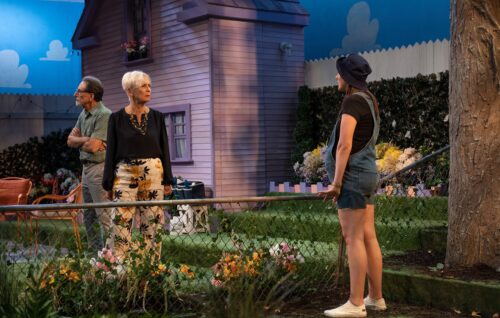
David Kwiat, Barbara Sloan and Diana Garle find things are turning ugly in GableStage’s “Native Gardens.” (Photo courtesy of Magnus Stark)
Zacarías’s script is funny throughout, interspersing quirky silent vignettes between the scenes and growing ever more (amusingly) ridiculous.
As director, Collado is extravagantly imaginative and surgically precise. Working with the ever-wonderful sound designer Matt Corey, she gets extra laughs with bridging music – the deceptively innocent “It’s a Beautiful Day in the Neighborhood” from “Sesame Street,” the theme song from “Jaws” when a miniature piece of wood fencing bobs up and down between the two houses.
Collado and the cast make key lines sting, as ugly biases surface in casual conversation. Her comedic touch collaborating with her actors is priceless too, as when Frank, alone in his yard, does a bit of ballet as he dispenses pesticide in precisely timed squirts.

David Kwiat as Frank in GableStage’s “Native Gardens” prepares to blast his garden with pesticide. (Photo courtesy of Magnus Stark)
Kwiat and Sloan, a real-life couple, are an acting dream team as the Butleys. His Frank is a man of unbridled enthusiasms and a quicksilver temper; when a remark hits him especially hard, he makes a sound that’s a cross between a roar and a moan, as if he’d been gutted. Sloan is masterful at playing sociability with a strong undercurrent of brittleness. Her Virginia can be manically ruthless, too: When she goes for her chainsaw, watch out.
Cruz, who has been building his professional career since graduating from Miami’s New World School of the Arts just over a year ago, is a tall, striking leading man who persuasively conveys Pablo’s insecurities as well as his ambitions.
Increasingly active in film and television in both Miami and Los Angeles, Garle has come back to the theater and GableStage without missing a beat. Though she wears a faux pregnancy belly as Tania, Garle’s glow comes from within (well, maybe with a little assist from lighting designer Tony Galaska). She’s an adroit comedienne who flawlessly navigates Tania’s wide-ranging emotions. Whether acting or reacting, Garle is a magnetic performer.
The look of GableStage’s “Native Gardens” is deliberately and delightfully cartoonish, featuring a pair of similar small-scale houses, two vastly different backyards and a sky dotted with puffy painted clouds. Frank J. Oliva, the season’s set designer, has delivered a playful environment in synch with the script’s style and Collado’s approach.

David Kwiat and Diana Garle discuss their differing garden philosophies in GableStage’s “Native Gardens.” (Photo courtesy of Magnus Stark)
Plant designer/set dresser Victoria Murawski has surrounded the Butleys’ backyard with an abundance of colorful flowers (silk would have been better than plastic, though), and prop designer/set dresser Katie Ellison has effectively underscored the status of the two couples (the Butleys have been around forever and have money; the Del Valles don’t). Likewise, costume designer Camilla Haith says plenty about Virginia (chic attire and glittering necklaces) and Tania (a still-stylish millennial in comfortable pregnant-lady clothes).
“Native Gardens” has plenty of serious content threaded throughout, little issue-oriented land mines about racism, classicism, ageism and more. Yet because those topics are so expertly woven into a disarming piece that keeps the audience laughing, it may just be that theatergoers will take inventory of their own prejudices. As Virginia says in the play, “Just because you don’t like what you hear doesn’t mean you shouldn’t listen!”
WHAT: “Native Gardens” by Karen Zacarías
WHERE: GableStage in the Biltmore Hotel, 1200 Anastasia Ave., Coral Gables
WHEN: 2 and 7 p.m. Wednesday, 8 p.m. Thursday-Saturday, 2 p.m. Sunday (additional matinees July 7 and July 15), through July 16 (streaming version available during regular performances June 16-July 16)
COST: $40-$70 (streaming ticket $27)
INFORMATION: 305-445-1119 or gablestage.org.
ArtburstMiami.com is a nonprofit source of dance, visual arts, music, and performing arts news. Sign up for our newsletter and never miss a story.
No posts found


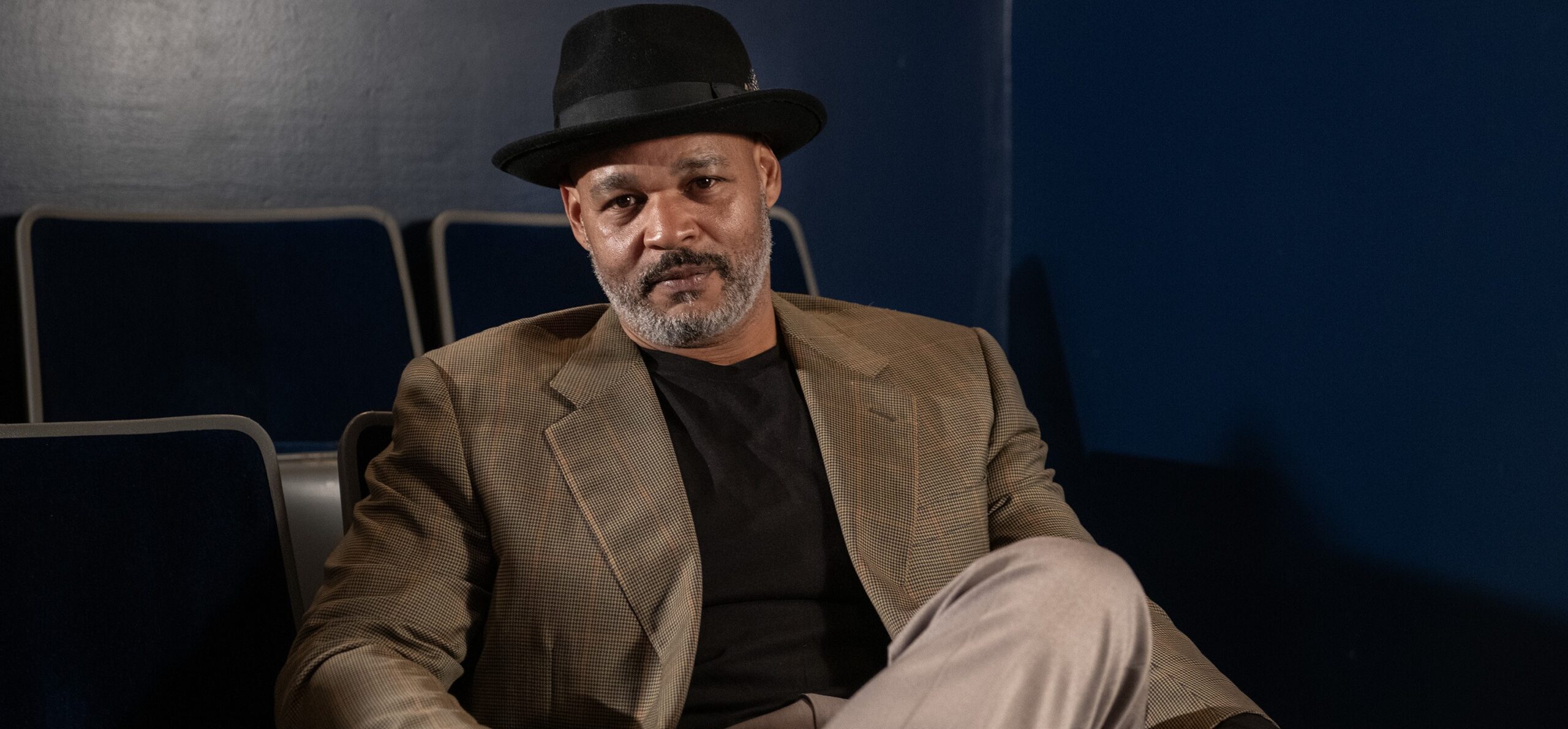



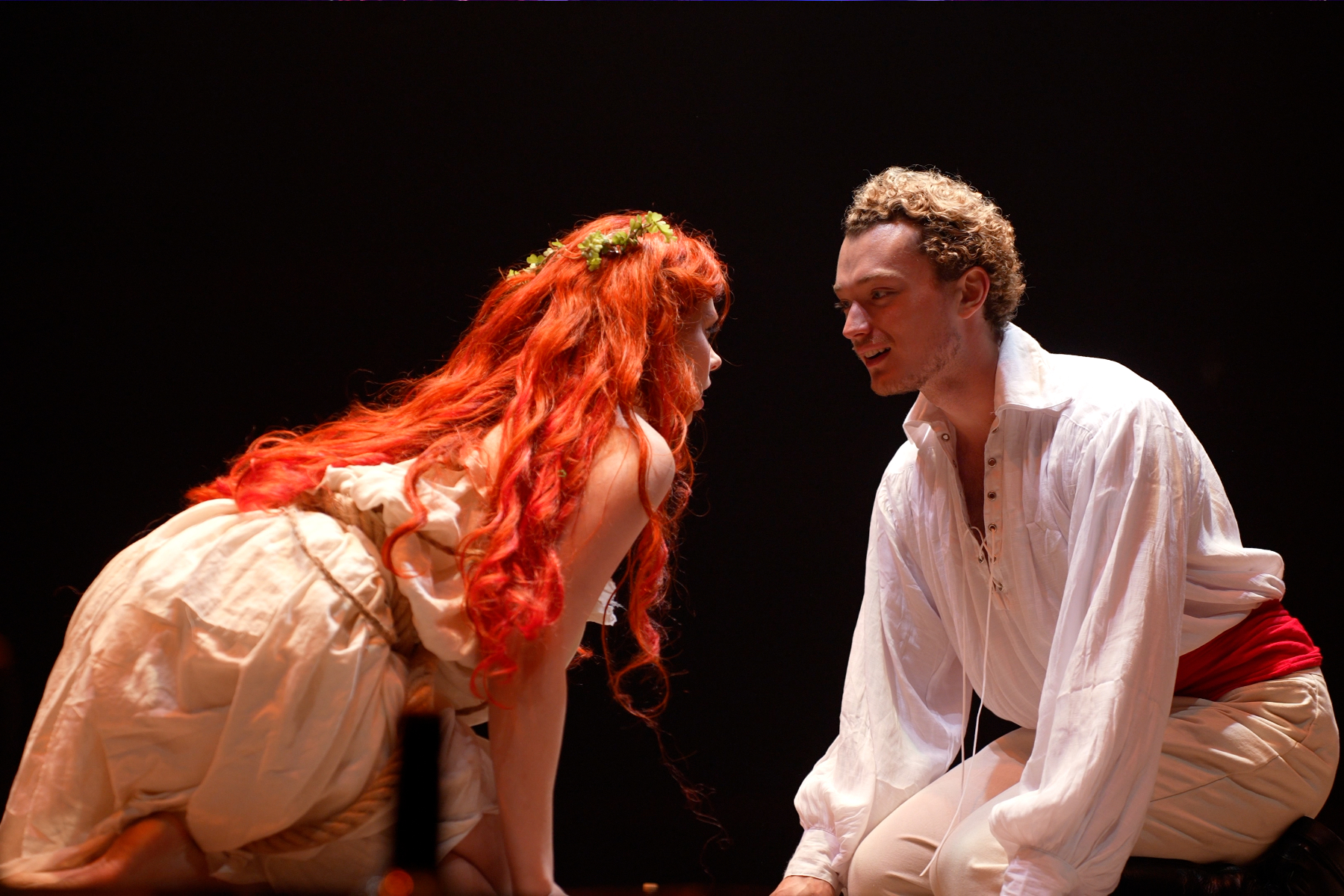

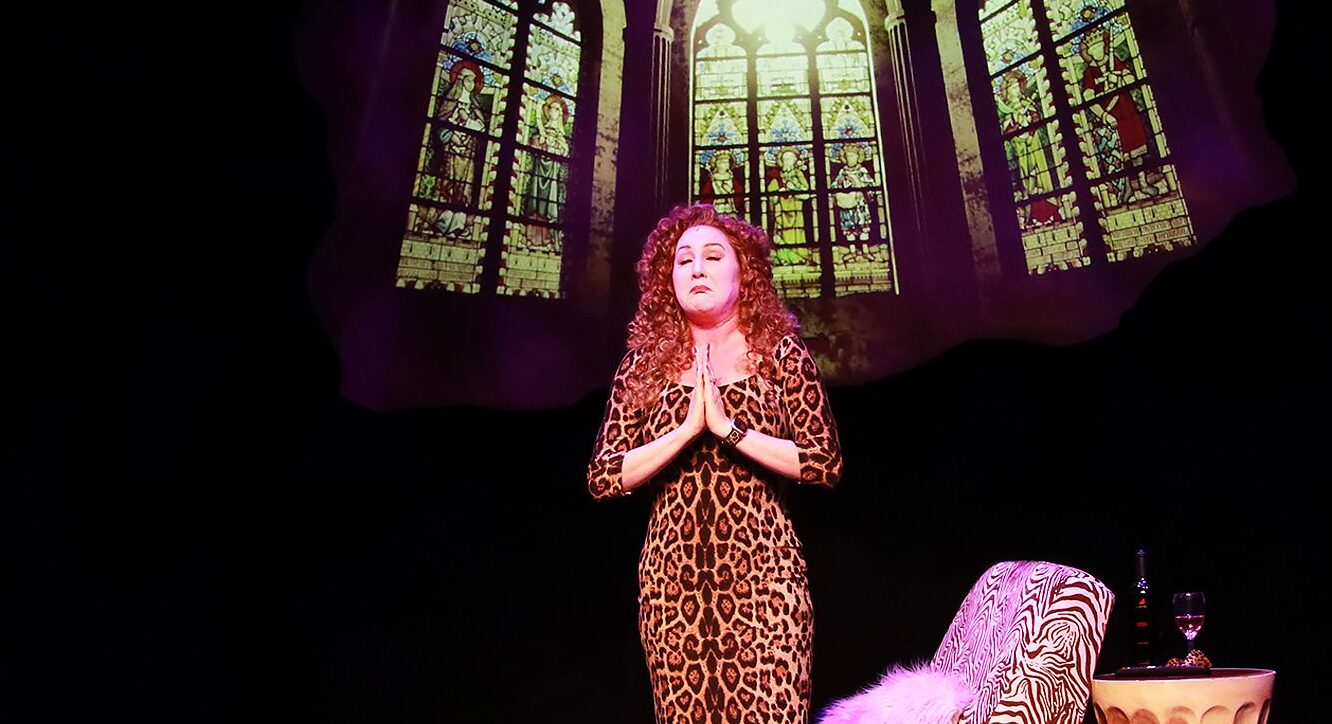
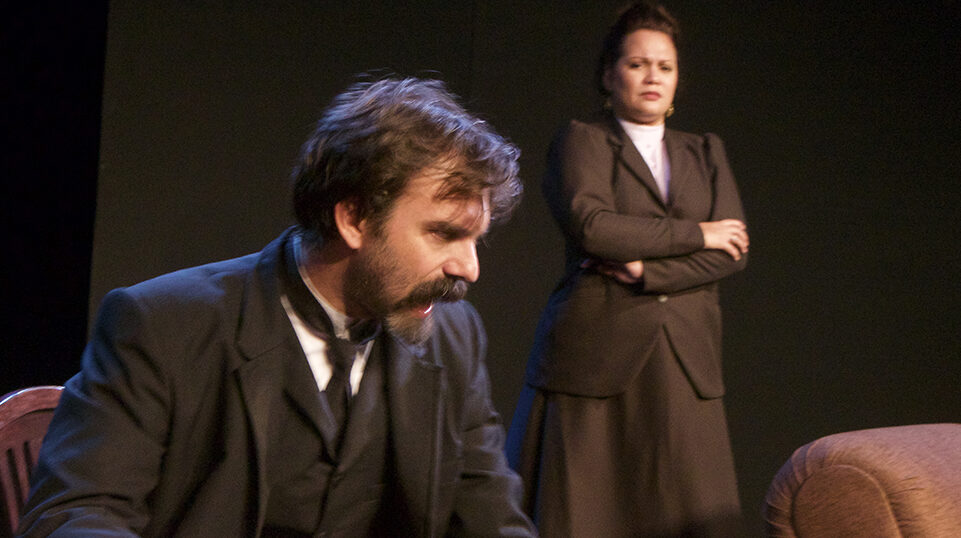


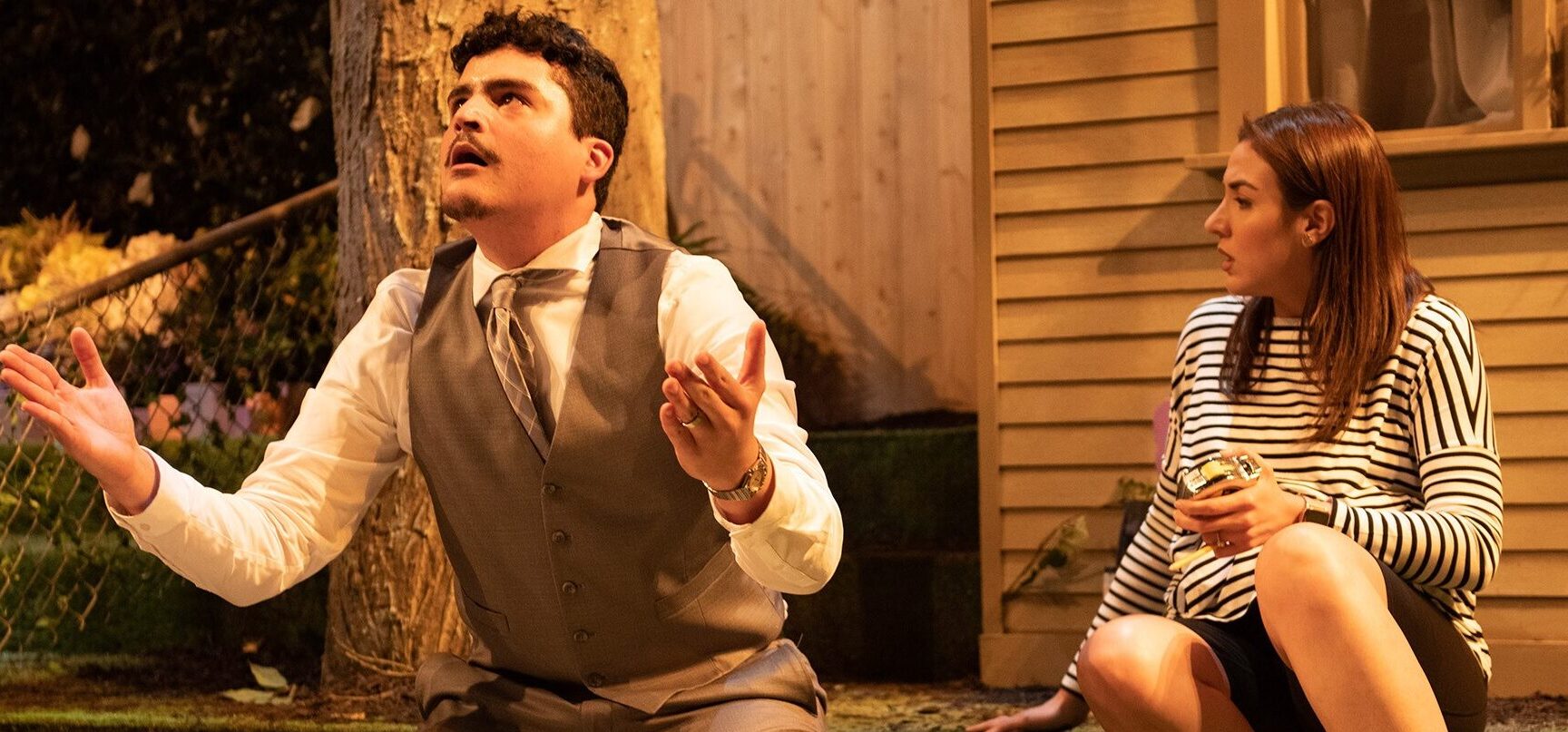
Recent Comments