Blog Article Category: Dance
A symposium on racial and cultural issues in 21st-century ballet arrives in Miami
Written By Orlando Taquechel
August 3, 2022 at 7:27 PM
Kareen Pauld Camargo of Miami City Ballet School, shown teaching a class, attended the first MoBBallet symposium in Philadelphia. (Photography by Alexander Iziliaev courtesy of Miami City Ballet)
Theresa Ruth Howard founded the digital platform MoBBallet (Memories of Blacks in Ballet) in 2015. The former dancer with an impressive resume is today an advocate and a diversity strategist. Her project is dedicated to telling the stories of Black ballet performers in the United States and worldwide.
Beginning Sunday, Aug. 7, Howard heads the fourth edition of the MoBBallet symposium, this year entitled: Symposium M.I.A.: Motivation, Innovation, Activation, and M.I.A. no doubt referencing Miami, too. It will take place at the Sanctuary of the Arts, Coral Gables, through Saturday, Aug. 13.
While there are no official public performances, on Saturday, Aug. 13 from 10:30 to 11:30 a.m., there will be a free “sharing,” where anyone interested can see what students and choreographers had created during the almost weeklong event. At noon, a town hall follows in a discussion about what is being done to improve the status of Blacks in ballet.

Theresa Ruth Howard, founder of MoBBallet. (Photography by Eva Harris courtesy of Sanctuary of the Arts)
The art of ballet was born aristocratic, European, and white. The academic ballet was established in France during the reign of Louis XIV, and the highly influential classical style was created in Russia at the end of the 19th century, producing most of the great works that have remained in the repertoire until today.
A repertoire igniting debate today on the inclusion in the casting of dancers very different from those who premiered the works. Different in their physical constitution, culture, and, above all, skin color.
In the 20th century, the United States dance establishment believed it had solved the problem of using black dancers by establishing a segregated model that Katherine Dunham exemplified in the 1940s, Alvin Ailey in the 1960s, and the Dance Theater of Harlem in the 1970s.
Eventually, the outstanding performance of black artists -and other minority groups- in several large companies established according to the European model showed the limitations of that approach. As a result, their presence was no longer considered the exception that confirmed the rule and ended up being recognized as the exception that tests the rule.
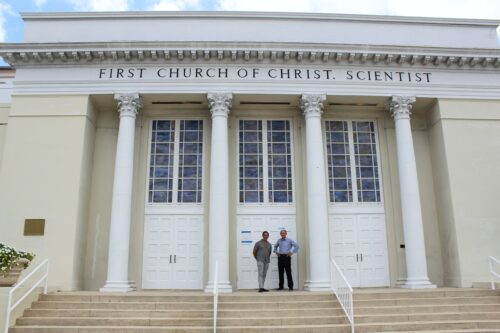
At the entrance of the Sanctuary of the Arts headquarters in Coral Gables are Rafi Maldonado-López, principal managing director with Mike Eidson, CEO and founder). Photography by Gaby Yero courtesy of Sanctuary of the Arts)
According to a news release promoting the event, that’s the primary motivation behind the annual symposium — an event that focuses “on supporting and advocating for Black ballet dancers and choreographers, examining dance education practices, and creating meaningful conversations with dance academics, along with engaging ballet leadership to address the racial and cultural issues in ballet.”
The first MoBBallet symposium was presented by the Pennsylvania Ballet in October 2019 in Philadelphia. For the Miami edition, Miami City Ballet is involved as a sponsor. Also significant in MoBBallet’s symposium coming to Miami is its presence at the Sanctuary of the Arts, according to Lourdes López, artistic director of Miami City Ballet.
“It’s an honor to support and be part of programming at Sanctuary of the Arts. A new convening center for the performing arts right here in the heart of Miami, where artists from different disciplines come together to showcase and discuss their art forms. Their founders, Margaret and Mike Eidson, have been invaluable supporters of Miami City Ballet and strong leaders for arts philanthropy in South Florida,” says López.
And she adds, “. . . it’s important for Miami City Ballet to be inextricably linked to the Sanctuary for the Arts and support Mike and Margaret’s ideals. Such as bringing together these artists and conversations and leading important discussions to show that while ballet as an art form is steeped in tradition, tradition is not limiting but rather a limitless point of departure. Along with Mike and Margaret, we intend to lend our voices to demonstrate what the future of ballet can look like, right here in Miami.”
Monica Stephenson, MCB’s director of community engagement, will facilitate the course for educators along with Margaret Tracey (former director of the Boston Ballet School), Marion Tonner (former director of the Oregon Ballet Theater School), and Ayisha McMillan Cravotta (director of the Charlotte Ballet Academy).

Monica Stephenson of Miami City Ballet will facilitate a course for educators at Symposium M.I.A. (Photography by Mena Brunette courtesy of Miami City Ballet)
“I feel it is critical to participate in the Memoirs of Blacks in Ballet Conference to create space for addressing the needs of a diverse faculty and student body in 21st Century Dance Education. In addition, it is important to recognize the shifts in ballet pedagogy and methodology necessary to increase accessibility and belonging for all. Quite significantly, the symposium builds a network of teachers, dancers, and scholars that will have lasting relationships and support amongst one another as they continue to serve in the art form,” says Stephenson.
Kareen Pauld Camargo, a faculty member at Miami City Ballet School, comments that she feels honored to have been invited to the symposium for the second time. “For me, it is important to be there to show, as Theresa Ruth Howard says, that ‘we are not unicorns.’ Representation matters, and it is important to show these young dancers that there is a space for them, that they are seen and valued. I look forward to sharing my love of dance and knowledge with them again. MCB sponsored me to attend the original event . . . and I am thrilled that they are supporting the symposium again.”
WHAT: MoBBallet Symposium M.I.A.
WHERE: Sanctuary of the Arts, 410 Andalusia Ave., Coral Gables.
WHEN: Sunday, Aug. 7 through Saturday, Aug. 13. On Saturday, Aug. 13 from 10:30 to 11:30 a.m., “sharing” performance, followed by town hall discussion.
COST: Public “sharing” is free.
INFORMATION: mobballet.org.
ArtburstMiami.com is a nonprofit source of dance, visual arts, music, and performing arts news. Sign up for our newsletter and never miss a story.
No posts found
Stilt walkers elevate this year’s DanceAfrica Miami festival
Written By Fernando Gonzalez
August 3, 2022 at 11:23 AM
The Mocko Jumbie stilt dancers from the United States Virgin Islands (USVI) will perform at DanceAfrica Miami’s “Rise Above.” (Photo courtesy of USVI Mocko Jumbie)
As distinctions between communities living side by side blur, the extraordinary diversity of the African Diaspora in South Florida is often hidden in plain sight.
The DanceAfrica Miami festival will celebrate the richness and depth of African culture and its many reinterpretations throughout the Americas and the Caribbean from Friday, Aug. 5, through Sunday, Aug. 7, at the Lou Rawls Center for the Performing Arts at Florida Memorial University in Miami Gardens.
The three-day family-friendly event includes morning dance workshops with instructors from Congo, Cuba, Guinea, Mali, and Senegal. Afternoon drumming sessions explore the instruments and traditions of Guinea, Ivory Coast, Mali, and Senegal.
The theme of this year’s DanceAfrica Miami is “Rise Above,” a nod to the participation of two Stilt Mask Guilds that are prominent performers of the African-derived traditional and acrobatic ballet style of stilt walking: the Nanfoule Folklore Ensemble of Washington, D.C., and The Mocko Jumbie Stilt Dancers from the United States Virgin Islands (USVI).
Both groups perform at Florida Memorial University’s Lou Rawls Center Saturday at 8 p.m. The Mocko Jumbie stilt dancers will also appear at the Broward Center for the Performing Art’s Amaturo Theater on Monday, August 8, at 8 p.m.
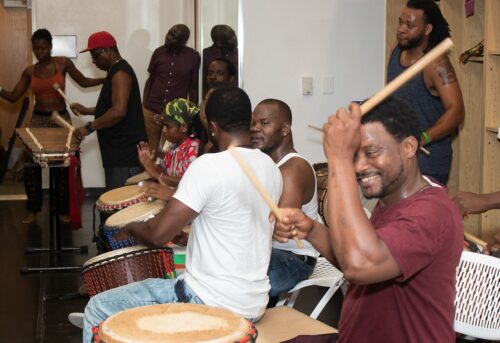
Afternoon drumming sessions explore the instruments and traditions of Guinea, Ivory Coast, Mali, and Senegal at the annual DanceAfrica Miami festival. (Photo courtesy of Innovative Arts Photography)
This year’s festival marks the continuing evolution and rebranding of the African Diaspora Dance and Drum Festival of Florida, founded by the Miami-based Delou Africa Dance Ensemble in 2010. After receiving a Knight Arts Challenge and with the support of the late Charles” Baba Chuck” Davis, a founder of DanceAfrica Network, Delou Africa launched “DanceAfrica Miami” in 2016. Miami is now one of five cities recognized under the DanceAfrica Network, which bills itself as “Africa’s largest growing Dance Network.” More than 20 musicians and 13 dancers across the DanceAfrica Network will teach and perform at DanceAfrica Miami.
After moving from Brooklyn to Miami in 1981, Njeri Plato, executive director and founder of Delou Africa, felt a void in the city’s cultural scene. After visits to Senegal and Gambia in 1985 and 1987, she created the organization as a platform to learn about and experience African traditions. “Delou” is a Wolof word from Senegal, West Africa, that means “back to” or “return to,” she explains.
“Having classes to engage the community in West African folklore, dance and music, and culture, we have a lot of people coming and saying to us that the culture (they experienced) is more the same than different.”
Underscoring the connection, several local groups, such as the West African Music & Dance Collective, Sikan Afro-Cuban Project, and the Haitian-inspired TLL Dance Ensemble, will be part of the festival.

Delou Africa, presenters of DanceAfrica Miami, bridge gaps to preserve African culture with presentations of traditional African dance, drum, music, art, and history. (Photo courtesy of Innovative Arts Photography)
Meanwhile, the Nanfoule Folklore Ensemble is based in Washington, D.C., and features members from various heritage societies across the country, notes Papa Aziz, who is the oldest living member of the group. The stilt dancers, who wear masks to hide their identities as they represent the spirit of the ancestors, are accompanied by drumming and folk storytelling.
The stilt tradition “is from parts of Guinea, Liberia and Ivory Coast . . . and goes back centuries,” explains Aziz. “But there’s symbolism in the mask performances that changed in the diaspora. West Africans went to many different places and took some of these traditions. But of course, these traditions initially were stripped away, just like our name, especially anything that dealt with spiritual references.”
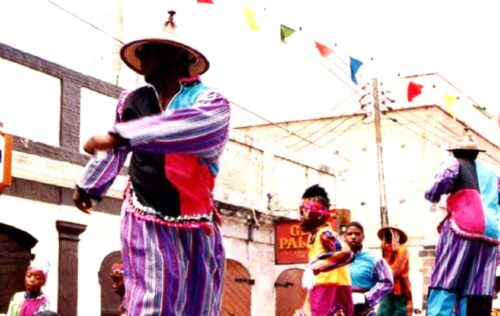
Moko Jumbies have been in the Virgin Island’s cultural heritage for over 200 years and are viewed as symbols of history, culture, and heritage. (Photo courtesy of USVI Mocko Jumbies)
For “Tall Spirit – Stilt Artistry of Black Immigrants,” the Mocko Jumbie Stilt Dancers (“Moko Jumbie” means good god, good spirit), were commissioned to portray the story of the Moko Jumbie in the Virgin Islands, tracing its beginnings to today.
“. . . It’s going to be very beautiful,” says Aziz. “It’s an offshoot from the African tradition in the islands. I hope people see the differences and the connections between how it was practiced at home and in the diaspora and the coming together of those ways.”
Plato explains that the festival is for everyone.
“You don’t have to understand any African language to listen and enjoy. It moves your soul, and that’s what music does. So, we learn the culture as we go along, and we learn to respect each other’s culture while coming together for one common goal: to unite and have fun,” says Plato.
WHAT: DanceAfrica Miami: “Rise Above”
WHERE: Lou Rawls Center for the Performing Arts, Florida Memorial University, 15800 N.W. 42nd Ave., Miami Gardens
WHEN: 9 a.m. to 6 p.m., Friday, Aug. 5 through Sunday, Aug. 7. Dance and drum workshops daily. Concert 8 p.m. Saturday, Aug. 6. (Note: Monday, Aug. 8, concert is at Broward Center for the Performing Arts, 201 S.W. 5th Ave., Fort Lauderdale.)
COST: $35, seniors and students, $25, Children (7 and younger), $15; Broward Center tickets, $21.50, $37, $48; classes and workshop prices from $10 and up.
INFORMATION: danceafricamiami.org
ArtburstMiami.com is a nonprofit source of dance, visual arts, music and performing arts news. Sign up for our newsletter and never miss a story.
No posts found
International Ballet Festival of Miami returns with Étoiles Classical Gala at the Arsht
Written By Orlando Taquechel
July 18, 2022 at 11:00 AM
Katherine Barkman and Gian Carlo Pérez (Washington Ballet) in “Diana y Acteón” during IBFM 2021. The 2022 edition begins on Saturday, July 23. (Photo courtesy of Miami Hispanic Ballet / IBFM)
The International Ballet Festival of Miami (IBFM) was transformed into a summer event in 2018 to avoid the height of the hurricane season that disrupted its performance in September. Now, the event is back, ready to continue its successful trajectory – which not even COVID could derail – and consolidate its convening power.
“This is going to be the 27th edition of the festival and starting on Saturday, July 23, with the unveiling of the official festival poster, which this year is by the Cuban artist Edel Álvarez Galbán. The festival will be offering performances and collateral activities until Sunday, Aug. 14, when it will end with the customary Closing Gala,” says its director, Eriberto Jiménez, who added that the festival includes an art exhibition dedicated this year to Galbán.
What’s new in the festival program we ask during a conversation at the Miami Hispanic Cultural Arts Center (MHCAC)?
“Last year, we started with the Dance Marathon,” explains Jiménez, who adds that this year it is “much more organized. He says that 10 local dance studios will participate, presenting Miami’s young talent at the Miami Beach Bandshell.
But the great news of this edition has to do with what is always the most anticipated night of the event: the Étoiles Classical Grand Gala.
This year, the gala on Saturday, Aug. 13 we will be at the Adrienne Arsht Center, Jimenez announces. “Unfortunately, the Fillmore Miami Beach, where we originally planned to do it, will be closed for two years because they are building a hotel next door.”
He added that the Miami-Dade County Auditorium, where they had originally scheduled the closing gala on Sunday, Aug. 14, did not have the previous day available.
Some ballet lovers may agree this is a fortunate happenstance. The Étoiles Classical Grand Gala of the IBFM and the Arsht Center seems to be a match made in heaven. After all, we are talking about the dance night in Miami with the most outstanding international projection.
In addition, this is not the first time IBFM has presented its classic gala at the Arsht Center. The most recent was in September 2015, during the event’s 20th-anniversary celebration, then under the general direction of its founder, Pedro Pablo Peña (1944-2018).
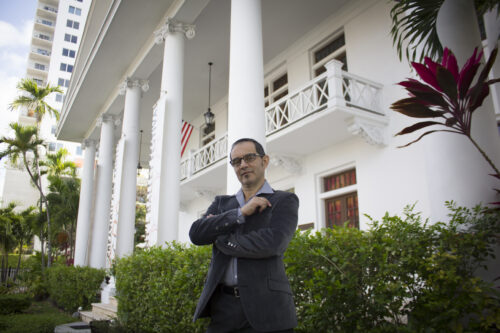
Eriberto Jiménez, director of the IBFM, at the entrance of the Miami Hispanic Cultural Arts Center (MHCAC). (Photo courtesy of Miami Hispanic Ballet/IBFM)
Next, Jiménez explains that the restrictions established for international travel since the pandemic make it impossible to confirm at this time the names of the artists who will perform at the function. But, of course, it is not an unprecedented development in the event’s history, especially in recent years. Some countries and companies always participate. In addition, some individual artists return to Miami again and again. But last-minute changes are also frequent.
In the beginning, the festival’s main attraction was the arrival in Miami of well-known figures announced in advance. The great stars of the ballet world of the 20th century were figures with some mystery, and the expectation was enormous. Then, Twitter and Facebook appeared in 2006, and Instagram in 2010. So many things have changed, and familiarity has replaced mystery in the second decade of the 21st century. However, IBFM is still a magnificent occasion to see great artists for the first time. This year is no exception.
Dancers from Brazil, Colombia, France, Japan, Italy, Mexico, Portugal, the Dominican Republic, Slovenia, Switzerland, and, of course, also from other parts of the United States will perform in Miami.
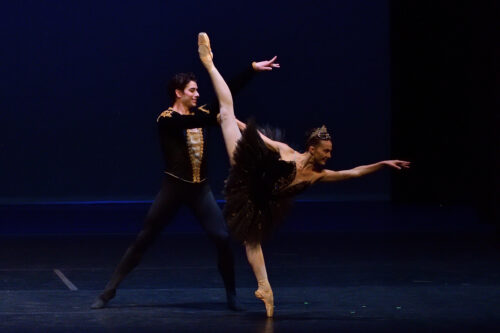
Sydney Dolan and Sterling Baca (Philadelphia Ballet) in “Black Swan” during IBFM 2021. (Photo courtesy of Miami Hispanic Ballet/IBFM)
During the Étoiles Classical Grand Gala, IBFM will deliver the “A Life for Dance” award, instituted in 1998, to Colombian teacher Gloria Castro Martínez, founder of the Colombian Institute of Classical Ballet INCOLBALLET and the International Ballet Festival of Cali, for 13 years. INCOLBALLET is the only other school in Latin America that teaches the Cuban methodology whose origins are mainly in the Russian Vaganova method, which emphasizes dancing with the entire body.
For its part, the “Criticism and Culture of Ballet” award, established in 2007, will go to the Mexican teacher and cultural promoter Rocío Barraza Rivacoba, founder of DanzadanceOrg, a renowned international multicultural and multilingual network and non-profit with thousands of online followers, dedicated to the promotion and dissemination of dance and performing arts.
Regarding the participation of local groups, Jiménez comments that it is always limited “because the event takes place when dancers are on vacation or are engaged in events and summer courses in other parts of the world. But we are already assured of the participation of Arts Ballet Theater of Florida, Dimensions Dance Theater of Miami, and, of course, the Cuban Classical Ballet of Miami.”
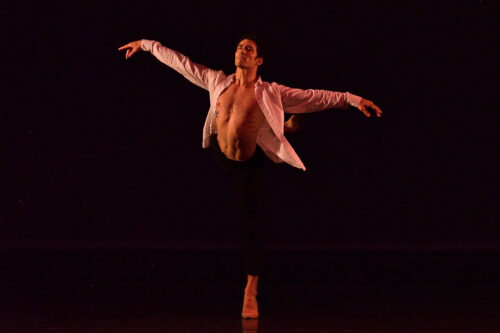
Petar Dorčevski (SNG Opera in balet Ljubljana) in “Voyage” by Renato Zanella. Photo courtesy of Miami Hispanic Ballet/ IBFM)
Last year, IBFM began offering a summer course with the festival. Always scheduled in June, Jimenez now believes “it is much better than the boys and girls who come to the summer course could take advantage of the opportunity to see the festival performances. Also, to dance at the medalist’s gala or the other two smaller galas we will have this year. So now we have it scheduled to cover the three weeks of the festival.”
As usual, among the collateral activities are the screening of films and the presentation of books with the authors present.
Finally, let’s not forget about the performances dedicated to contemporary dance, which this year will be four. “There is a free one outdoors on Lincoln Road,” Jiménez points out. “And as we continue to try to build an audience in the Homestead area, we’re bringing the festival to the Seminole Theatre. Here, we’ll be at the Miami Theater Center, and on Sunday, Aug. 7, we will perform at the Amaturo Theater of the Broward Center”.
To learn more about each of the scheduled activities and purchase tickets for the performances, visit internationalballetfestival.org for links to the websites of the participating theaters.
ArtburstMiami.com is a nonprofit source of theater, dance, visual arts, music and performing arts news. Sign up for our newsletter and never miss a story.
No posts found
Dimensions Dance Theatre Puts Works of ‘Modern Masters’ Center Stage
Written By Guillermo Perez
July 10, 2022 at 4:03 PM
Meisy Laffitte in a leap in YanisPikieris’s and David Palmer’s “Adiemus” part of Dimension Dance Theatre of Miami’s “Modern Masters” at the South Miami-Dade Cultural Arts Center on Saturday, July 16 and Sunday, July 17. (Photo courtesy of Simon Soong)
Dimensions Dance Theatre of Miami knows how to put audiences in a friendly zone. Often sunny and sonorous, the troupe’s repertory has plenty of game drawing us in with big, brisk movement, stirring music, and eye-catching designs that foster a good feeling.
Naturally, there’ll be no shortage of those high, bright notes when the company returns to South Miami-Dade Cultural Arts Center on Saturday, July 16 and Sunday, July 17, with its “Modern Masters” program, which features new and recently adapted works by in-house artists, including the beatific “Adiemus” by choreographer-in-residence Yanis Pikeiris and his longtime associate David Palmer. Yet, for intriguing balance, it’s the intimate voice of French-Canadian choreographer Helen Simoneau that will lead into more shaded, circumscribed territory.
In “Smallest Orbits,” her first stage work for DDTM, Simoneau references the setbacks of confinement and strides toward reconnection amid the pandemic. The springboard was a brief dance the often-commissioned choreographer—who also heads Helen Simoneau Danse—set virtually on members of Philadelphia’s Ballet X sheltered in their respective pods. Thus, while our COVID battles will continue to reverberate in the arts for a long time, “Smallest Orbits” arrives like a dispatch from the trenches.
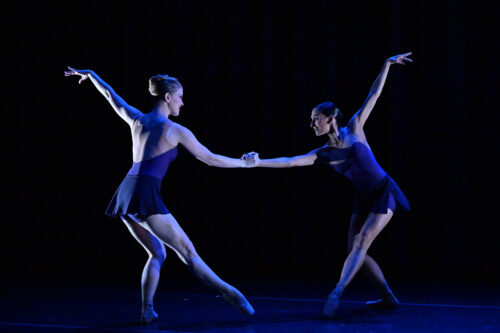
Chloe Freytag and Melissa Verdecia in Helen Simoneau’s “Smallest Orbits,” a world premiere with Dimensions Dance Theatre of Miami. (Photo courtesy of Simon Soong)
“My focus was on isolation and how our worlds had shrunk,” says Simoneau, pointing out how lives that would have intersected became only parallel. “Just saying hello, checking in with people, seemed so precious.”
But limitations turned into lessons. “We realized how much joy starts in these smaller orbits of our lives,” underscores the choreographer.
In fact, the course from distanced coping mechanisms to in-person contact determined how Simoneau’s premiere came to fruition at Dimensions. Among five regional dance creators chosen by Atlanta’s South Arts for Momentum, a project to facilitate touring opportunities and networking, Simoneau and DDTM co-artistic director Jennifer Kronenberg connected at a cohort meeting in the fall of 2019. Rapport between the then North Carolina-based choreographer—a Guggenheim Fellow and American Dance Festival favorite—and the up-and-coming Miami group augured easeful cooperation during the three-year duration of the initiative.
Then the virus hit. “It felt like the rug had been pulled out from under us,” recalls Kronenberg. The supporting organization and Momentum participants scrambled to jump over the hurdles of a new reality.
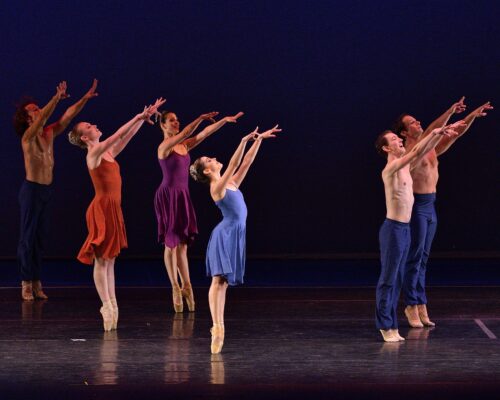
Dancers in “Adiemus” in Dimensions Dance Theatre of Miami’s “Modern Masters’ program. (Photo by Simon Soong)
“We started talking about the redefinition of touring, how to go on with the mission of engaging with new communities,” says Kronenberg. “With mandates being so different in each state, we still had to find ways of helping each other. At least we got a lifeline in funding to keep dancing through the pandemic.”
Forging ahead, Kronenberg’s husband and company co-director Carlos Guerra helped Simoneau mount one of her duets on Dimensions using Zoom, confirming their partnership was a great fit. By the start of this year, the choreographer was finally able to visit DDTMstudios to set the opening section of “Smaller Orbits” for a works-in-progress showing last March.
“Helen came in like a breath of fresh air, with a calm mindset and inclusive approach,” says Melissa Verdecia, who is dancing in “Smallest Orbits” along with her husband Lyvan, Chloe Freytag, and Daniel White. “She has created a magical union in the way we circle around each other in the dance — like every planet unique, but sharing a common human force.”
As another choreographer on the program, Lyvan Verdecia is also re-staging his percussion-driven duet “Sobre un Hilo” (“On a Thread”), which denotes the tightrope of uncertainty he tread on having left Ballet Nacional de Cuba during a 2014 Canadian tour to seek asylum in the United States. He feels that now performing in Simoneau’s work has amplified his knowledge of the dance-making process.
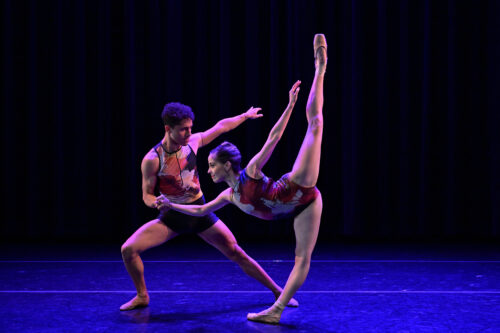
Kevin Hernandez and Meisy Laffitte in “Sobre un Hilo,” part of Dimensions Dance Theatre of Miami’s “Modern Masters” program (Photo courtesy of Simon Soong)
“At first she drew figures on paper, color-coded to each dancer, so we could see the movement patterns better,” he relates, impressed by her methods of exploration and openness to collaboration. “Her different way to do things helped us think and understand better.”
The Verdecias agree Simoneau’s modern dance sensibility applied to ballet technique calls for a flexible but transformative stance. And the visiting choreographer recognizes there are challenges in her style, where moves—say, a turn on pointe propelling a ballerina to curve downward—flower with a hybrid vigor.
But Simoneau found her DDTM cast to be “committed and present, their sociability very productive. Whether for modern dance or ballet, it’s always when dancers show me their own curiosity, their desires, that I come to realize how they look best.”
This helped her develop the original concept of “Smallest Orbits” into a deeper exploration of the role the individual plays in a group, a constant concern in her oeuvre. Perhaps having grown up in a small village and a large family in Quebec alerted her from an early age to the complexities of interpersonal dynamics.
“As I’ve taken my path in life,” admits this artist, “I think a lot about belonging—about coming into community.” This is no abstraction for someone who, venturing out from a rural environment, plunged into her art form at seventeen enrolling in the University of North Carolina School of the Arts, her first English-language academic setting.
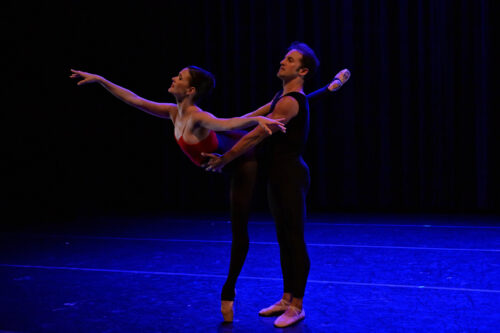
Mayrel Martinez and Maikel Hernandez in “No. 5,” Yanis Eric Pikieris’s fifth work for the company. (Photo courtesy of Simon Soong)
While her choreography for “Smallest Orbits” grew, Simoneau relied on contemporary American composer Michael Wall, whose career has been closely tied to dance accompaniment, to add more of his music to the score. From this long-established collaborator, the measures on the piano—with the insistence of ranging thoughts—provide both an overarching atmosphere and a path-blazing pulse underfoot.
For company dancer and emerging choreographer Yanis Eric Pikieris (whose father Yanis choreographed “Adiemus”), watching how Simoneau works has been revelatory. “I’m amazed at how fast she’s able to put things together. She knows what she wants, but when adjustments are needed, she’s also great at problem-solving.”
In part to celebrate the expansive spirit of DDTM, with its embrace of choreographers such as Simoneau, the young Pikieris is contributing a premiere of his own to the upcoming lineup. “No.5” is his fifth work for the company and is intended as a bow to his artistic home on its fifth-anniversary season. From sweeping ensembles to zestful duets, there is an exult in his passion for Bach using movements from the “Keyboard Concertos” and selections of Peter Gregson’s inventive re-compositions of the “Cello Suites.”
“I hope this program shows how far we’ve come,” says Pikieris. “We’re taking on very different pieces. But in each one every dancer has risen to the occasion.”
WHAT: Dimensions Dance Theatre of Miami: Modern Masters
WHERE: South Miami-Dade Cultural Arts Center, 10950 SW 211 St., Cutler Bay
WHEN: 8 p.m. Saturday, July 16, and 3 p.m. Sunday, July 17
COST: $25-45
INFORMATION: smdcac.org, dimensionsdancemia.com, or 786-573-5300
ArtburstMiami.com is a nonprofit source of dance, visual arts, music and performing arts news. Sign up for our newsletter and never miss a story.
No posts found
Site-specific dance takes root at Aspen Ideas: Climate in Miami Beach
Written By Taima Hervas
June 18, 2022 at 2:08 PM
Dancers Meredith Barton, Isaiah Gonzalez, Amy Trieger and Arielle Francois in “Numinous Land” by choreographer Brigid Baker at the Miami Beach Botanical Garden as part of Aspen Ideas: Climate. ( Photo courtesy of Rod Deal)
The inaugural Aspen Ideas: Climate in Miami Beach incorporated visual and performing arts as part of the conversation. Miami Dade County Department of Cultural Affairs’ Arts Resilient 305 Initiative and the City of Miami Beach mobilized Miami’s arts community to create site specific art experiences for attendees and featured three Miami choreographers and their dance collectives performing work focused on nature, humanity, place and issues of climate change.
The activations were presented outdoors at the Miami Beach Botanical Garden and at Collins Canal Park. The conference took place May 9 through 12 and is expected to become an annual event.
Brigid Baker, choreographer, dancer, educator, and director of the 6th Street Dance Studio in Little Havana launched the Aspen dance performance series on the lawn of the Botanical Garden on May 9 with a site-specific reworking of Part 3 of her “Return of the Birds” trilogy, “Numinous Land.”
Dancers from the Brigid Baker Whole Project appeared, one at a time from behind trees, each carrying large, eye-catching, often bizarre, hand-constructed props, repurposed here from different Baker productions. Before the performance began, Baker shared, “Many hands have touched these pieces.” She described herself as blue-collar, and said her performances are in part about hard, manual work, about people working together to build community with dignity and in stewardship of the earth.

The grass of the Miami Beach Bontanical Garden draped with a large woven net in Brigid Baker’s “Numinous Land” at the Aspen dance performance series. (Photo courtesy of Rod Deal)
On the grass was a large net woven from countless pantyhose, rolled and tied together. Hand constructed, it appeared intimately feminine and introduced another central theme of Baker’s blue-collar work: the idea of women crafting as their art form. Decoratively placed on top of the net were cutout ceremonial bird shields, each adorned with a painted feather and felt beads. The shields, Baker explained, honored the nearly 3 billion birds that have disappeared across the United States and Canada since 1971, due in part to climate change.
The dancers wore grayed-from-use black A-line sleeveless sack dresses. Revealed at each of the hemlines were differing flashes of brilliantly colored tulle. Conical princess party hats with a twirling windmill sat atop each dancer’s head, creating the illusion that all four were powered to float above the stage by renewable wind energy.
Dancer Meredith Barton appeared first, holding a long broomstick with a stuffed black raven creation which flew ahead as a harbinger of what was to come. Next, a colorful soft fabric human heart was walked onto the lawn by dancer Amy Trieger. Arielle Francois, carried above her a stiffened, heavily painted golden dress. Following closely was Isaiah Gonzales, holding a stuffed, thick, pink, hand-knitted sweater jacket.
The dancers then appeared as if struggling to move an enormous gold crown, part of the “Return of the Birds” trilogy, which had to be carried in by all four with Baker assisting.
As one, the workers went from hauling into dancing, extending themselves into a graceful and painfully emotive performance accompanied by the evocative, icebreaking, journey music of Gavin Bryars’ “Trip to Archangel.” Their movements were precisely, intricately choreographed, great control of movement and an absolute of breathing which showcased what Baker calls Lightbody, which she developed, a technical movement practice which consists of breathwork, motion and discipline.
The four returned to work as they floated onto the grass. Together, they pushed and pulled until they raised an almost 12-foot cardboard tree covered in an odd assortment of written words: “Dandelion, beaver, heather, cheetah, poppy.” The referenced words are ones that had been removed from the Oxford Junior Dictionary in 2009 to make way, as Oxford stated, for more modern terms.
On stage again, the dancers moved seamlessly as one. They spun around, huddled close, unified, separated, paired, regrouped, they hunkered deep into the ground, then stretched upwards as if they were reaching far into the sky.
Following the performance, Gonzalez explained how deeply he had felt the difference of creating the piece outdoors. “I’ve never done this outside before. It was a bit frightening, looking up reminds you how small you are.”
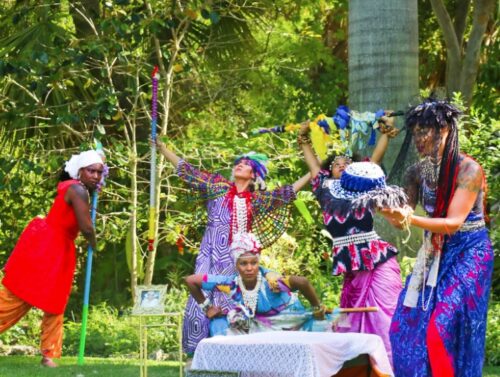
Shanna Woods, Erika Loyola, Melissa Cobblah Guiterrez, A’Keitha Carey, and, in front, choreographer Michelle Grant-Murray in “RoseWater” at the Miami Beach Botanical Garden. (Photo courtesy of Raul Franco)
On May 10 at 4:30 p.m., again at the garden, “RoseWater” by Michelle Grant-Murray was performed. She is the choreographer, educator, author, performer, and the artistic director of The Olujimi Dance Collective. Grant-Murray describes “RoseWater” as a dance ritual piece that talks about climate change, environmental racism, generational gentrification, carbon footprint, and water ethics. The work, she said, is designed to give reverence to the earth, offer it a prayer and activate ancestral memory.
Behind the powerful climate justice activism that Grant-Murray embodies in her performance storytelling, lies something much more personal in “RoseWater,” she explained. “The work of ‘RoseWater’ is a recipe that my grandmother, Elma Julius Newton-Henry, made, water that she would put on my body every night after she would bathe me. And I remember asking her one night, “How, why are you doing this? And she said, ‘It is going to sustain you,’ she said.”
Before the performers arrived and already on grass performance space were small, individualized altars, with photographs of older women and personal mementos of hats, teacups, candles, flowers, and bottles or bowls filled with water. Each altar was personalized, decorated by the dancers to honor their grandmothers.
The female dancers entered in a procession of contained movements to strong rhythmic beats. They wore dizzying colors and styles, personalized ancestral costumes of faith, memory and identity. Arriving on the meadow of grassy altars, their movements were ritualistic and slow, then increased in pace. Finally, they grew to a crescendo of color, light, motion and music as the procession became dance.
Throughout the performance the music changed constantly, from the repeated moments of all important water sounds to the familiar, with Aretha Franklin and Kere Kay, to AfroBeat funk and fusion, interrupted by a strong female voice in spoken word, “Some women don’t give a damn if you don’t like our hair, we are out here holding our signs, reading signs, redesigning how we’ve been defined, and we are bad, we fly.”
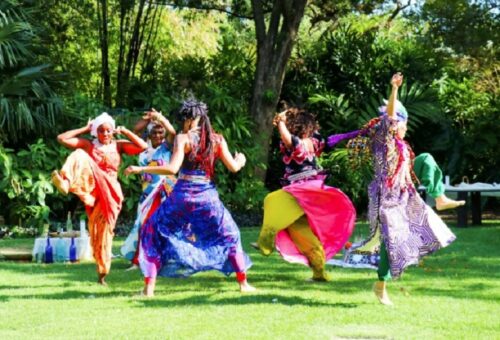
Dancers in Michelle Grant-Murray’s “RoseWater” as part of Aspen Ideas: Climate. (Photo courtesy of Raul Franco)
Dancer A‘Keitha Carey, veiled and dressed in long layers of electric blue and silver sequins, began a highly focused performance at the center lawn. In a dance of sorrow and loss, she cleared the surface of her altar then draped a white cloth on the empty table, placed flower bouquets then climbed onto the table and ultimately curled into a fetal position. The other dancers stood back, but in solidarity with her pounded a beat with their staff, then headed to their altars, to seek their grandmothers in photos, in worship, and in the case of Grant-Murray to make rosewater.
Across the lawn, Shanna Wood was wearing her Auntie Audrey’s 1970s bright orange afternoon tea dress. Shanna explained a few days after the performance, “I love the dress. I love what it represents for me. My family. We come from Black church experiences. It made me imagine what my great-grandmother was like. I believe that it is through dance, through the stories that we tell, we’re not only acknowledging our lineage, but we’re honoring the lineage of the people who originated here.”
“Such Rooted Things,” by Dale Andree, choreographer, dance artist, filmmaker and educator, presented the final performance day on May 11 at the Collins Canal Park. Andree is the founder and director of the National Water Dance (NWD), an expansive state and nationwide collaborative dance project which connects nature, dancers, and audiences simultaneously through water and dance.
Originally created by Andree for the mangroves of Miami’s Matheson Hammock Park, “Such Rooted Things” was adapted to the site of the Collins Canal Park, a long narrow park designed to adapt to climate change and sea-level rise.

Dancers Sunyoung Park, Deja Darbonne, Diane Cano and Stephanie Franco in Dale Andree’s “Such Rooted Things” at Collins Canal Park as part of Aspen Ideas: Climate in Miami Beach. (Photo courtesy of: Mateo Serna Zapata)
On Andree’s canal pathway stage, birds both real and created opened the performance. A group of three performance artists Kael Baez, Luciano Cortes, and Jacabel Guerra became wholly birdlike as they emulated, wielded, and propelled their paper-mâché birds made by local sixth-graders from Carver Middle School. The bird-dancers moved together harmoniously with their birds, they lifted, arched, spun, glided and dropped their arms, and they gave the students’ creations the power to fly virtually unfettered, and occasionally they even flushed out a real bird which took flight up into the sky.
National Water Dance Project dancers Sunyoung Park, Deja Darbonne, Dianne Cano, Stephanie Franco, Flavie Audibert and Mary Spring, all costumed in hand painted natural tones rooted themselves in the living beauty of the oaks, scrub palms, ferns, mangrove trees, birds and butterflies. They moved together down the path to the live music of Miami’s AfroBeta lyricist/vocalist Cuci Amador and synth-centric producer/arranger Tony “Smurphio.”
As dancer Park crawled close to the ground on all fours, she dug into the dirt with hands and fingers and reached out towards dancer Franco, who in turn crawled toward Park in the same way. They reached toward each other and the space between them closed in as they formed a visceral connection to each other through the earth. In this way, dirtied but determined they connected through an impactful, improvised, and emotive dance movement.
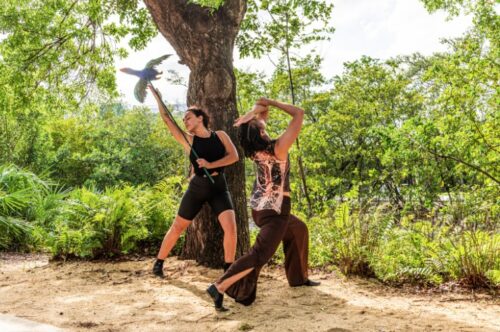
Jacabel Guerra and Flavie Audibert in Dale Andree’s “Such Rooted Things,” a site-specific performance in Collins Canal Park, Miami Beach. (Photo courtesy of Mateo Serna Zapata)
Nearby, in another space in the park, next to one of the huge aluminum sculptures from Dutch artist Joep van Lieshout’s “Humanoids,” dancer Spring unrolled herself upwards, from bent to standing she unfurled her body upwards through the air and unraveled.
With her fingers bent inwards like claws, her arms circled each other one over the next, she grasped at the thin air between herself and the tree as if there was something there that she had to find even though it was invisible. Her progress was less beautiful than painful, her face determined, her movements relentless to reach out and find something tangible in the air.
Spring has been with Andree for 30 years and after the performance said, “For me, it’s really about imagining or envisioning myself as an element in nature, as a human being in nature, not outside of it. And I think that is part of Dale’s message, that we have to remind ourselves to remember that we are a part of nature. We don’t stand outside of it.”
No posts found
Flamenco Artist Siudy Garrido Reflects On Career, COVID As She Gets Ready for Gala
Written By Sean Erwin
June 4, 2022 at 1:37 PM
Siudy Garrido at the Querétaro Ibérica Contemporánea in México in 2021. (Photo courtesy of Siudy Flamenco Dance Theater)
Siudy Garrido says she arrived to flamenco as part of the family business.
“My mom dedicated her life to promoting flamenco in Venezuela as a producer and dancer for 25 years in her country. She found the love of flamenco very, very young. She created a company and toured with it. I felt like the company’s mascot. I very much enjoyed that touring life and the life of flamenco,” says Garrido.
Garrido will present highlights from her shows spanning two decades in Gala Flamenca at the Adrienne Arsht Center for the Performing Arts on Saturday, June 11. She’ll commemorate 10 years of performances at the Arsht.
She says her mother, Siudy Quintero, introduced flamenco to Venezuela and that her contribution to the artform shifted the country’s perception of flamenco, upgrading its status and putting it on the same level as artforms such as opera and ballet.
“Spain had a dictatorship so some of the Spanish flamenco dancers came to Venezuela to escape that. But before my mother’s work, flamenco was seen as more of a cabaret-style of dance,” says Garrido. “So my mother put flamenco on the best TV shows and in the best theaters to elevate its status. She put it where it deserved to be,” she says”
Her mother’s work also created connections with flamenco dancers in Spain who came to regard both mother and daughter as true artists. When Garrido set out to create and tour with her own company she encountered a wealth of acceptance and support from the community of Spanish flamenco dancers and musicians, she says.
However, flamenco producers and promoters thought the idea of a Venezuelan flamenco dancer would be hard to sell to audiences
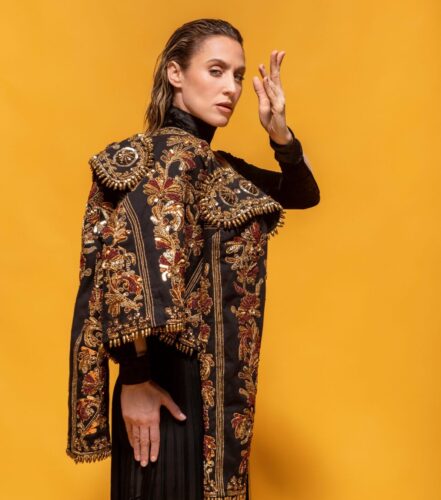
Flamenco artist Siudy Garrido performs at the Knight Concert Hall inside the Arsht Center on Saturday, June 11. (Photo courtesy of Kike San Martin)
“All my life has been about demonstrating why I love that art form,” says Garrido. “I feel that my work has opened doors for new generations. I think that flamenco is a universal art. With maturity, everything has changed, and now I feel so blessed that what I do is thanks to who I am and where I was born. I grew up with flamenco but also musicals, ballet, opera, and I created my aesthetic from all these influences.”
However, Garrido still sees flamenco to be about family. Her husband, film director Pablo Croce, performs the role of Artistic Director and manager of the company. The couple met in 2005 when Garrido’s agency hired him to create a music video for her. The two were married in 2012.
Recently Croce created – “Siudy Between Worlds: 50 Performances of the American Dream” – a documentary of Garrido’s life and career as a performer released in 2020.
“He is an amazing director and I loved his work as a film director,” says Garrido. “I had a very flamenco perspective, and he had done films everywhere and so he had a worldwide perspective. For instance, he made music videos and I learned from him how young people could see my work. He showed me how to make flamenco available to everyone and not just for flamenco lovers.”
Croce recognizes the role he plays with the company but is quick to point out that the company’s driving vision is due to Garrido.
“It is an interesting dynamic that we have going but the only way to do what she does is with her,” says Croce. “I became part of her nonprofit in Miami as a member of her board. However, she is the one running the race. It can be easy to collaborate with someone when the artist has the strength of vision that she does. You can take me out of the picture, but if you take her out of it there is nothing.”
The Gala at the Arsht contains snapshots from Garrido’s shows since 2004.
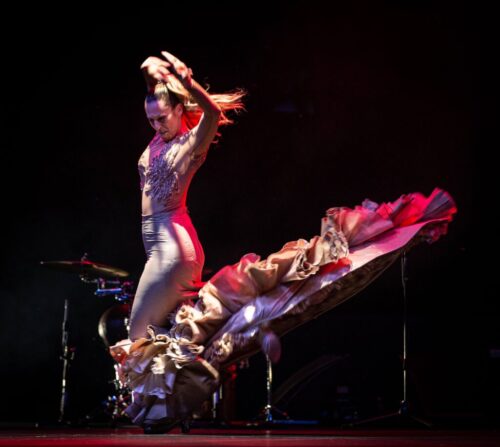
The Arsht Center 10th anniversary Gala contains snapshots from decades of Siudy Garrido’s shows. (Photo courtesy of Siudy Flamenco Dance Theater)
“We have put together the best musicians and my co-directors – guitarist José Luis de la Paz and flutist Juan Fernandez “Parrilla” – are in the same show,” explains Garrido. “José Luis directs the first act and Juan Fernandez directs the second. We selected my favorite pieces from different shows, and it includes both traditional pieces and new, experimental ones.”
de la Paz has long collaborated with Garrido and identifies with her approach to the music.
“In her way of working, Siudy maintains some old parameters, like working hand in hand with the music,” he explains. “(This is) something that I love because I come from the same school. Sharing ideas and creating a kind of musical/choreographic scheme is very rewarding for me. It’s putting together a puzzle that guides everything and you can have a complete idea of a show in a few days, although obviously everything is going to change with daily work.”
Parrilla says working with Garrido is exciting because of her willingness to test boundaries and innovate.
“My collaboration with Siudy has been very special,” explains Parrilla. “I’ve been wanting to do something new for a long time, something different more current to the times we live in, something more evolutionary, with new sounds, different instrumentation, telling a unique story.”
For Garrido – who suffered a bout with Long COVID – the pandemic interruption has transformed her dancing.
“Everything changed after that experience with COVID. I felt so vulnerable and I learned a lot about how fragile I can be and I feel that in my dancing now,” she says. “I feel I have more extremes, the powerful and the soft. I feel I can express more vulnerability because I felt those extremes and that vulnerability with my experience of COVID. The first number of the show is like a rebirth and was inspired by the return to the theaters, and I wanted to return with something from the inside – because having gone inside you can fly back to normality.”
WHAT: Siudy Garrido Gala Flamenca
WHEN: 8 p.m., Saturday, June 11
WHERE: Adrienne Arsht Center for the Performing Arts, Knight Concert Hall, 1300 Biscayne Boulevard, Miami
TICKETS: $35-$250.
INFORMATION: 305-949-6722 (Monday through Thursday) or arshtcenter.org.
ArtburstMiami.com is a nonprofit source of dance, visual arts, music and performing arts news. Sign up for our newsletter and never miss a story.
No posts found
Review: Miami City Ballet’s season closer features world premiere amid thought-provoking program
Written By Sean Erwin
May 17, 2022 at 12:14 AM
Miami City Ballet dancers in Claudia Schreier’s world premiere of “The Source,” one of the works featured in the company’s season closer, “Prodigal Son.” (Photo courtesy of Alexander Iziliaev)
Miami City Ballet’s season closer “Prodigal Son” featured a program of four works: “The Source,” a world premiere by Claudia Schreier and director Adam Barish, followed by Christopher Wheeldon’s 2005 “After the Rain pas de deux,” along with a company premiere of William Forsythe’s 1992 “Herman Schmerman Duet” before closing with George Balanchine’s 1929 story ballet, “Prodigal Son.”
The program paired two notably different narrative ballets and two duets for a thoughtful program that packed emotional depth.
MCB performed “Prodigal Son” in West Palm Beach at the end of April and in Miami, Friday, May 6 through Sunday, May 8. The final performances are in Fort Lauderdale at the Broward Center for the Performing Arts Center on Saturday, May 21 and Sunday, May 22.
The program opened with the world premiere of Atlanta Ballet resident choreographer Claudia Schreier’s “The Source,” a multi-media fable for sixteen dancers told through dance, theater and strikingly produced digital effects.
Film plays a key role in “The Source.” Schreier’s partner and filmmaker, Adam Barish, as well as projection effects designer, Alex Basco Koch, deserve credit for the seamless way the visual effects and dance sequences combined to narrate a story of healing.
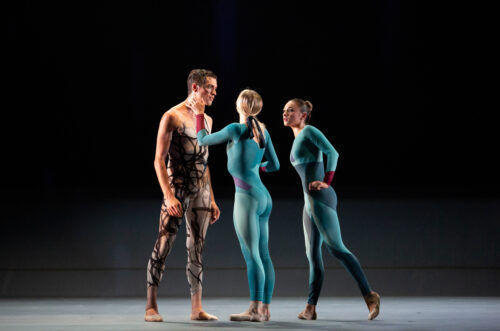
Miami City Ballet dancers Stephen Loch, Ellen Grocki and Juliet Hay in Claudia Schreier’s world premiere of “The Source.” (Photo courtesy of Alexander Iziliaev)
The action started with an oppressing scene of a port at sunrise. Dancers in oversized shirts and pants in shades of gray plodded across the stage, heads down, occasionally stumbling or erupting in fights. Occasionally, a viral-like streak streamed down the front scrim. Many dancers held hands or fists on their chests as if in pain.
The narrative then transitioned from the oppressive opening to an encounter with a group of beings in white that revitalized them. The piece ended back at the port with dancers interacting in an atmosphere of warmth and hope.
Applause from the Miami audience on both Friday and Sunday indicated that the work’s message of grief and healing came through across the stage.
However, “The Source” suffered some weaknesses. These included an overly simplified dance vocabulary and the randomness of some scenic and video elements. For instance, it wasn’t clear why the action opened and closed at a port, or the significance of the repeated sun images. Ambiguities such as these distracted from the work’s straight-forward message of healing and hope.
Next up was Christopher Wheeldon’s enchanting “After the Rain pas de deux.” Originally a two-part ballet performed by New York City Ballet’s Jack Soto and Wendy Whelan at NYCB’s annual New Combinations Evening in 2005, MCB performed the work’s second half pas de deux.
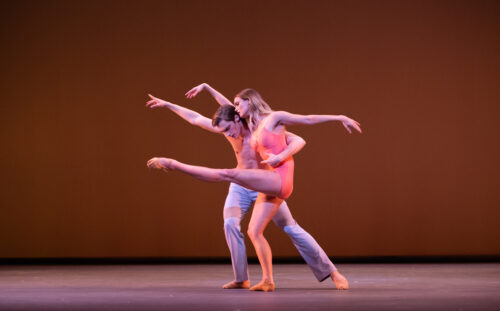
Cameron Catazaro and Hannah Fischer in Miami City Ballet’s “After the Rain,” choreography by Christopher Wheeldon. (Photo courtesy of Alexander Iziliaev)
Pianist Francisco Rennó and violinst Mei Mei Luo hauntingly played Estonian composer Arvo Pärt’s 1978 composition, “Spiegel im Spiegel” (“mirror(s) in the mirror”). Both Hannah Fischer and Cameron Catazaro on Friday and Katia Carranza and Chase Swatosh on Sunday danced this tenderness-drenched duet memorably.
The work’s gorgeous lifts and quirky contortions communicate emotional intimacy through physical vulnerability as when the woman holds a full backbend as her partner rotates her or when she stands on his bent leg, leaning forward, sweeping her arms as if flying.
Opposite in mood and approach was the company premiere of William Forsyth’s, “Herman Schmerman.” With a title borrowed from the 1982 Steve Martin comedy, “Dead Men Don’t Wear Plaid,” Forsyth famously stated the ballet “meant nothing,”
The ballet may “mean nothing” but what’s important is what it “does.” It mocks gender distinctions in ballet mercilessly. It gestures to how ballet as an artform is a training for gender, where differently trained male and female bodies are disciplined to fulfill expectations audiences have around gender stereotypes.
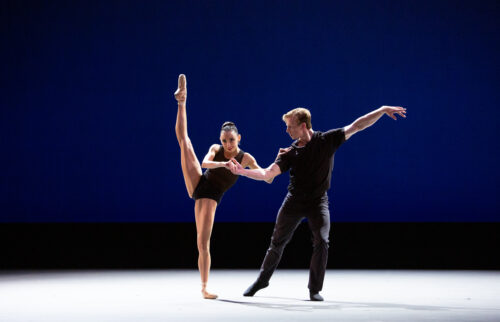
Nathalia Arja and Chase Swatosh in “Herman Schmerman Duet,” one of four pieces in Miami City Ballet’s “Prodigal Son” season closer. (Photo courtesy of Alexander Iziliaev)
To a Thom Willems’ electro-funk score with a distinctly “Blade Runner” vibe, the two couples –Nathalia Arja and Chase Swatosh on Friday and Adrienne Carter (just promoted to soloist) and Steven Loch on Sunday – performed their roles powerfully with Swatosh turning in a stand-out performance.
The pas de deux begins with the male dancer struggling to support his haughty partner whose classical sequences demand his entire investment, blocking him from dancing. The frustration communicated by both Swatosh and Loch was tangible.
Both female and male dancers executed a quick costume change and returned sporting yellow pleated Versace skirts. The male dancer executed wild sequences and the rawness of his movements noticeably distracted his partner from her sequences.
When he again agreed to support her, he no longer offered the sculpted expertise expected from a classical male lead. She had to work within the forms of support he was willing to offer.
The program’s finale was George Balanchine’s 1929, “Prodigal Son.” Set to composer Sergei Prokofiev’s, Le Fils Prodigue, the piece is one of two still performed works the choreographer created for Sergei Diaghilev’s company, Ballet Russes.
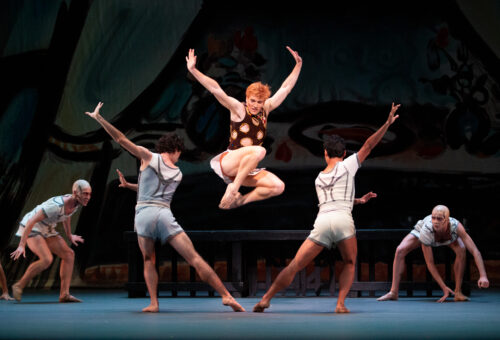
Alexander Peters and Miami City Ballet dancers in George Balanchine’s “Prodigal Son.” (Photo courtesy of Alexander Iziliaev)
The ballet opened in a Georges Rouault designed Middle Eastern landscape with servants collecting the son’s inheritance. The Prodigal – danced on Friday by Alexander Peters and Shimon Ito on Sunday – entered the scene ready to bolt, beating his knees, lunging to all sides with a great mimed yell before abandoning home despite the entreaties of sisters and father (performed by Cameron Catazaro).
The scene shifted to the tent of the Siren where ape-like servants, costumed in white with skeletal accents, paraded across the stage.
Their antics set up the entrance of the Siren – performed on Friday by Dawn Atkins (just promoted to principal soloist) and on Sunday by Adrienne Carter.
MCB’s season finale was worth seeing twice just to take in two very different takes on the Siren role with Atkins imperiously dominating Peters and Carter emphasizing the role’s carnality in her seduction of Ito.
If “The Source” suffered at points from narrative ambiguity, “Prodigal Son” presented few interpretive options. Still, the dancers generated dramatic tension so skillfully that we were left in suspense to the ballet’s final moment whether the father would, in fact, take his errant son back.
WHAT: Miami City Ballet’s “Prodigal Son”
WHEN: 7:30 p.m., Saturday, May 21 and 2 p.m., Sunday, May 22.
WHERE: Broward Center for the Performing Arts, 201 SW 5th Ave, Fort Lauderdale.
TICKETS: $30-$148
INFO: miamicityballet.org/prodigal
ArtburstMiami.com is a nonprofit source of theater, dance, visual arts, music and performing arts news. Sign up for our newsletter and never miss a story.
No posts found
Dance NOW! Miami and Limón Dance Company together in historic collaboration
Written By Sean Erwin
May 9, 2022 at 1:28 PM
Dance NOW! Miami in “Anusim, What is Hidden is Never Lost…”, a work by Hanna Baumgarten and Diego Salterini will be performed in Program III, which also features New York’s Limón Dance Company. (Photo courtesy of Simon Soong)
The Limón Dance Company celebrates its 75th season and returns to live performances in a historic team-up with Dance NOW! Miami.
Born in México, José Limón was the only major Hispanic choreographer to co-found and lead an American dance company during the formative years of Modern Dance. Limón died in 1972 but his works thrive 50 years after his death.
Dante Puleio is a former Limón dancer and has been the company’s artistic director since 2020. He identifies Limón’s continued influence as a key to understanding 20th-century dance.
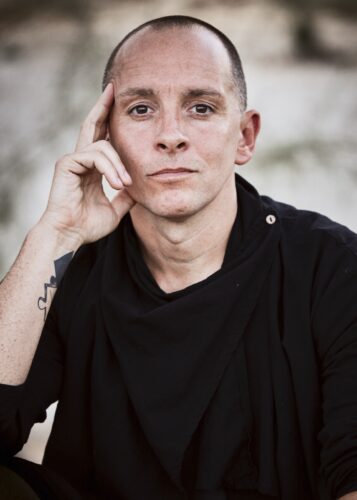
Dante Puleio is a former Limón Company dancer and has been the company’s Artistic Director since 2020. (Photo courtesy of Kelly Puleio)
“There are legacy companies in New York City like Martha Graham and Paul Taylor whose founders died and yet their works continue to live,” says Puleio. “We were the first Modern Dance company to survive the death of its founder.”
Puleio continues: “People like Danny proved that a dance company founded by a charismatic founder could survive.” He’s referring to former Limón dancer and founding dean of dance at New World School of the Arts Daniel Lewis who plays a key role in the upcoming team-up between the two companies.
In three South Florida performances on Thursday, May 12, Friday, May 13, and Saturday, May 14, Limón Dance Company will perform, “Waldstein Sonata,” a work for eight dancers based on Beethoven’s Piano Sonata No. 21 in C Major. Jeffrey Hodgson, provost at New World School of the Arts, will play the live piano accompaniment.
Although other dance companies have performed “Waldstein,” the Limón Company premiered the work for the first time on April 26 at its Joyce Theater season opener.
Limón originally intended to create dances to all of Beethoven’s piano sonatas but his death from cancer left the work unfinished. Three years later, Lewis took on the task of completing the work.
Lewis’ dance career is closely connected with that of the Mexican choreographer. He was already dancing with Limón Dance when he graduated from The Julliard School in 1967. Within a year, he began teaching dance at Julliard, taking over Limón’s introductory dance classes and serving as the Limón Company’s Artistic Director until 1975.
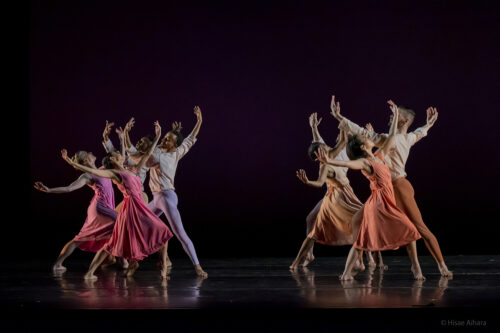
Limón Dance Company in “Waldstein Sonata.” The company will perform the piece as part of Dance NOW Miami!’s Program III. (Photo courtesy of Hisae Aihara)
“It was Martha Hill, and the President of Juilliard, Peter Mennin, who commissioned me to complete “Waldstein Sonata” at Juilliard in 1975,” explains Lewis by phone. “Although the work has been performed all around the world, this is the first time the Limón Company has performed it,” he adds.
After the follow-up performances with Dance NOW! Miami in May, Lewis intends to donate the performance rights of the work to the Limón Company.
For Dance NOW! Miami Founding Artistic Directors Diego Salterini and Hannah Baumgarten, Program III culminates years of company training and preparation in the Limón technique. Four DNM and four LDC dancers will perform “Waldstein Sonatas.”
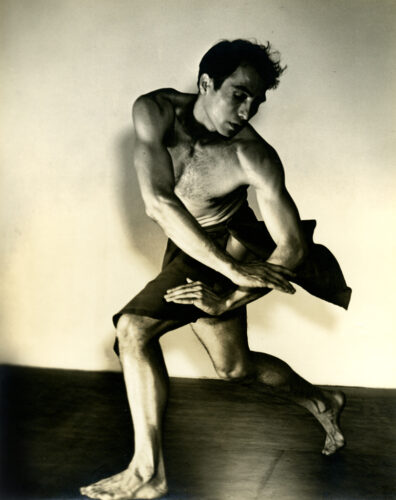
José Limón in “Danzas Mexicanas,” which he created in 1939. (Photo courtesy of the José Limón Dance Foundation)
“There are many styles of Modern Dance, and you have to be trained to express them properly,” explained Baumgarten. “Danny has been coming to teach DNM’s dancers. After all, he did write the book on the José Limón technique. Over the last five years, our dancers have become steeped in it.”
DNM will also reprise Limón’s 1947 “La Malinche” or “The Traitor” last performed by the company in 2019. A work for three dancers, it tells the story of a young Indian woman, Malintzin, given to Cortez when he arrived in Mexico.
“The two fell madly in love,” explains Baumgarten, “and she revealed all the secrets of the Mexican people – one of the dancers performs the role of ‘El Indio’ who represents the people of Mexico, and another role is performed by ‘La Malinche’, which means – ‘ The Traitor’ – in Mexican Spanish.”
The collaborative program will also include Limón Dance performing the choreographer’s 1967 work, “Psalm.” Originally inspired by Andre Schwarz-Bart’s 1959 novel, “The Last of the Just,” the dance is based on the ancient Jewish tradition that all the sorrows of the world rest within thirty-six Just Men, the Lamed-Vav.
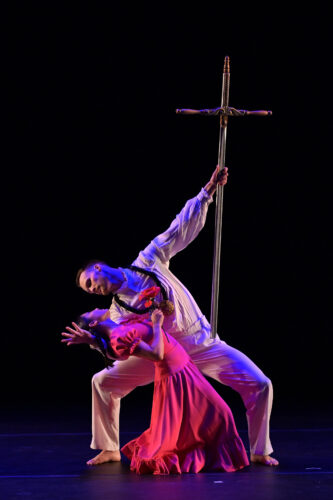
Allyn Ginns Ayers and Matthew Huefner of Dance NOW Miami!’ in “La Malinche.” (Photo courtesy of Simon Soong)
“It is about these men who uphold the world and its suffering without even anyone knowing that they are even doing it,” explains Puleio. “It feels like his spirit triumphing over death.”
Program III concludes with a DNM original “Anusim, What is Hidden is Never Lost…”, a work by Baumgarten and Salterini. “Anusim” depicts a rarely told story in Jewish history about the 1497 decree in Portugal forcing all Jews to be baptized as “New Christians.”
For Baumgarten, Program III captures DNM’s mission both to entertain and educate audiences.
“I think that the work of Jose Limón is essential to understanding modern dance. He’s not Isadora Duncan or Doris Humphrey, who of course later became his artistic director and mentor and created many works with the company,” says Baumgarten. “But Limón was one of those choreographers who established that dance could speak to the real living conditions of people.”
WHAT: Dance NOW! Miami’s Program III with Limón Dance Company
WHEN: 8 p.m., Thursday, May 12, 7:30 p.m., Friday, May 13, and 8 p.m. Saturday, May 14.
WHERE: Thursday, May 12, Duncan Theatre, 4200 S. Congress Ave., Lake Worth; Friday, May 13, Broward Center for the Performing Arts, 201 SW 5th Ave., Fort Lauderdale, and Saturday, May 14, Aventura Arts and Cultural Center, 3385 NE 188th St., Aventura.
TICKETS: $50 for reserved seating and $20 for students with ID.
INFO: 305.975.8489 or dancenowmiami.org
ArtburstMiami.com is a nonprofit source of theater, dance, visual arts, music and performing arts news. Sign up for our newsletter and never miss a story.
No posts found
In conversation with choreographer Claudia Schreier about her new work for Miami City Ballet
Written By Orlando Taquechel
May 5, 2022 at 7:43 PM
Claudia Schreier is the choreographer of “The Source,” which will be the main attraction of the last program of the Miami City Ballet season. (Photo courtesy of Alexander Iziliaev)
Choreographer Claudia Schreier occupies a special place among the artists who accompanied us during the most devastating period of the Covid-19 pandemic. Getting up early on Thursday, November 19, 2020, to enjoy the online premiere of “Places” – her first commissioned work for the Miami City Ballet (MCB)– was one of those memorable experiences that, under challenging times, lifts your spirits and makes you appreciate the role of art in our lives.
Schreier is returning now to present “The Source” (El Origen, in Spanish), her second work for the company directed by Lourdes López. It will be the main attraction of the last program of the MCB season, including the revival of “Prodigal Son” by George Balanchine. Also, the addition to the repertoire of “Herman Schmerman Duet” (choreography by William Forsythe and music by Thom Willems) and “After the Rain Pas de Deux,” by Christopher Wheeldon, with music by Arvo Pärt.
We visited the MCB headquarters to see a rehearsal of “The Source” and speak with Schreier for the first time in person (when we interviewed her for “Places,” we did so via email).
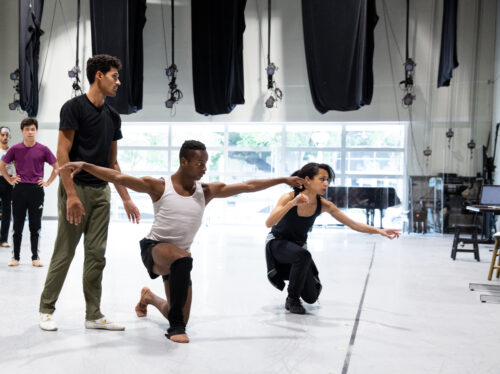
Claudia Schreier, teaching the intention of a movement during a rehearsal of “The Source.” (Photo courtesy of Alexander Iziliaev)
Almost two years have passed, and she wants to clarify that “The Source” “isn’t a ballet that comes out of the pandemic. It’s not in response to the pandemic, and it has nothing to do with that whatsoever. It’s just about talking about a relatable human experience, and it’s an adventure story because we didn’t want to make something that made the audience feel downtrodden and depressed. So, it’s not about that at all,” Schreier says.
The program notes begin: “On a foggy, cold morning in a remote harbor, eight strangers burdened by grief seek to rid themselves of their pain. Holding their anguish in the palms of their hands, they launch it into the distance — and the world suddenly rips in two…”
“And they find themselves in this new universe where they’re trying to pull out the roots of the pain but find they’ve gone to a world where it grows,” adds Schreier . “It’s kind of a source, and that’s what ‘The Source’ means. It’s the source of their pain. The allegorical structure allows us to tell the story without being too didactic. None of us (“The Source” creative team) is the kind of people who want a piece of art to tell us what the lesson is. We know we can let our audience draw their own conclusions.”
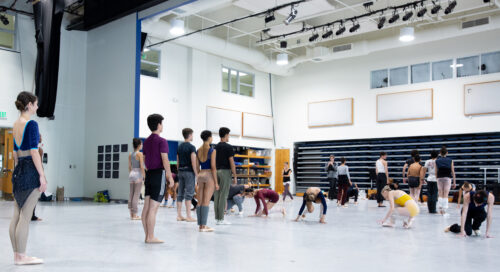
Sixteen dancers take part in “The Source.” (Photo courtesy of Alexander Iziliaev)
The first thing that strikes us when entering the rehearsal room is the number of people present. Nine in total, plus the choreographer and her husband, Adam Barish, who appears in the credits as the director of “The Source,” plus the 16 dancers participating in the work, which lasts half an hour.
“They were all there today,” says Barish, “because we started the technical week.” And he adds amusedly, “You came on a busy day.”
They are Jason Ardizonne-West (Scenic Designer), Abigail Dupree-Polston (Costume Designer), Mark Stanley (Lighting Designer), Alex Basco Koch (Projection Designer), and Stephanie Beattie (Associate Projection Designer).
It is clear that “The Source” is a multidisciplinary project, and Barish comments that the plan is to make the ballet and a film with the same material. “When we’re making the movie, we’ll take the play out of the theatrical environment and make it for a movie audience,” he says.
Schreier points out that their roles overlap, “basically because of how we designed this project.” Barish states that his job is not to tell the choreographer what she should do but to “build her a playground.”
When we ask Schreier what her most significant influence has been, she doesn’t hesitate, smiles and points to her husband. “I have learned a lot about myself as an artist and person through my relationship with Adam. Adam is very musical, and thanks to him, I have started to internalize music differently. I have even started to see movement differently thanks to him.”
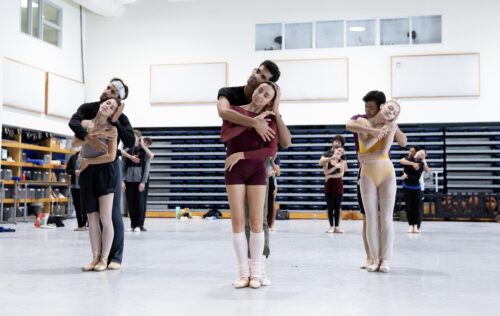
“Sometimes it’s just a gesture,” Claudia Schreier says. Here, with MCB dancers during a rehearsal of “The Source.” (Photo courtesy of Alexander Iziliaev)
The sound universe of “The Source” opens with “A Nearer Sun” by Riley Mulherkar, advances with “Outrage at Valdez” by Frank Zappa, “Summerland” by William Grant Still, and a piano quintet by Canadian composer Alexina Louie. It closes with a custom suite based on Julius Eastman’s “Femenine,” arranged by Gary Sheldon.
She confesses she’s arrived at rehearsals with “a 50-page Google document with each grade counted” but acknowledges that “you have to leave room for adjustments” and adds, “sometimes it’s just a gesture.” In this case, she thought it was beautiful how someone was hugging someone in the back of the room during one of the rehearsals. Then she did her own version of it, which was incorporated into the piece.
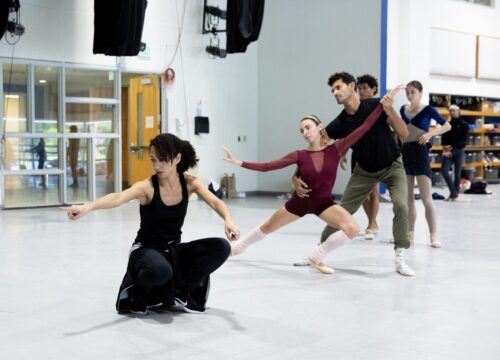
Claudia Schreier, rehearsing with Nathalia Arja and Renan Cerdeiro. According to the choreographer, “it was intentional to keep them together for quite a while throughout the ballet.” (Photo courtesy of Alexander Iziliaev)
Regarding the work with Nathalia Arja and Renan Cerdeiro, who give the impression of being the protagonists of “The Source,” Schreier explains that “to a large extent, this is an ensemble ballet, but I think we needed a team leader. We also wanted a narrative anchor to begin and end the work. So, it was intentional to keep them together for quite a while throughout the ballet.”
Schreier believes that “Miami dancers can just do everything, which is amazing.” Moreover, she points out, “they are very special and take my work to another level. I love that.”
Finally, we ask what choreography is for her. “It’s joy,” she exclaims. “It’s all I know, and I’ve ever known. It sounds a bit cheesy, but I can’t imagine doing anything else, and I’ve been creating dances since I was a kid.”
Definitely, the artist’s enjoyment must be contagious. When we say goodbye to her and Barish, we leave with the impression of having spent a fun afternoon with a couple of friends that we already want to see again. It’s a joyous feeling of openness and familiarity that we suspect “The Source” will manage to convey to the public.
WHAT: Miami City Ballet
WHEN: Friday, May 6, Saturday, May 7 and Sunday, May 8 in Miami. Saturday, May 21 and Sunday, May 22 in Fort Lauderdale.
WHERE: Adrienne Arsht Center for the Performing Arts, 1300 Biscayne Blvd, Miami; Broward Center for the Performing Arts, 201 SW 5th Ave, Fort Lauderdale.
COST: Tickets start at $30.
INFORMATION: miamicityballet.org/prodigal
ArtburstMiami.com is a nonprofit source of theater, dance, visual arts, music and performing arts news. Sign up for our newsletter and never miss a story.
No posts found
Long live ¡VIVA!, Manuel Liñán’s love letter to flamenco, to women and to life
Written By Helena Alonso Paisley
May 5, 2022 at 5:11 AM
Compañía Manuel Liñán in ¡VIVA! wowed a nearly full house at the Adrienne Arsht Center. (Photo courtesy of Daniel Azoulay)
The men of Manuel Liñán’s wildly celebrated and charmingly transgressive ¡VIVA! wowed a nearly full house Saturday night at the Adrienne Arsht Center’s Ziff Ballet Opera House by portraying a ragtag cast of “ladies” in a Spanish dance review from another, less subtle era. The silver lamé curtain across the back of the stage signaled that if the troupe were playing Las Vegas, they wouldn’t be booked at the swankiest spot on the Strip.
Over the course of two hours, the audience came to know a well-defined group of characters, warts and all. Beyond their outsized egos, petty jealousies, anger issues, even their sadness, all seemed animated by a love for the limelight, for flamenco and for living life to its fullest.
Similar to the all-male Les Ballets Trockadero de Monte Carlo, who mold their feet to the satin-wrapped trials of dancing en pointe, members of Liñán’s company have more to tangle with: taming the trailing dresses called batas de cola, mastering intricate shawl work, and meeting the challenge of embodying female dancers from the inside out. Being a woman, this troupe has no doubt found out, is hard work.
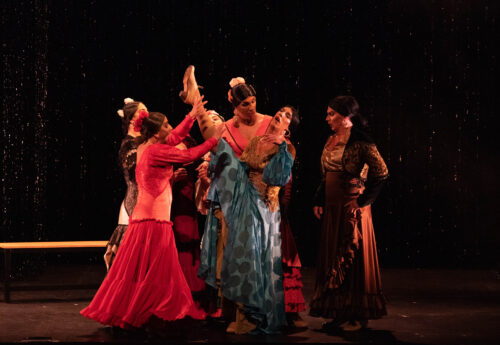
The performance is executed entirely in drag, by Liñán and six male dancers. (Photo courtesy of Daniel Azoulay)
Alongside the virtuosity of these dancers, a brilliant group of musicians served as the glue that held the show together. Singer/dancer Miguel Heredia was like a housemother from the New York ballroom scene, egging her charges on with songs and jaleos, flamenco’s version of cheerleading, only with catchier rhymes. Guitarist Francisco Vinuesa, percussionist Francisco Javier Teruel, and violinist Victor Guadiana accompanied powerful singers David Carpio and Antonio Campos, who hardly came up for air, propelled the show with forceful, driving rhythms, graceful melodies and artfully chosen lyrics. “Libre, somos libres, libres como el viento, como las estrellas en el firmamento” (“Free, we are free, like the wind and the stars in the firmament”), the performers sang in unison. And free, indeed, they were.
Jonatan Miró was inspired by the iconic Carmen Amaya in his solo. Instead of the signature white pantsuit Amaya used to transgress gender norms herself in the 1940s, Miró wore a brown satin dress and bolero jacket. Yet he mastered the tightly wound energy and lightning vueltas quebradas Amaya made famous as well as her demonically fast footwork.
Hugo López, an ingenue in a lacy turquoise gown, looked youthfully over-confident. At one point his feet—like those of the ballet dancer in the movie “The Red Shoes” —refused to stop dancing. Feigning exhaustion, he lay down on a bench. But with legs up, his footwork continued as fellow dancers put up a bench beneath it for him to keep tapping out rhythms. He piled on laughs when, still horizontal and framed by four benches, he swung his legs over his head to stomp on the bench behind him.
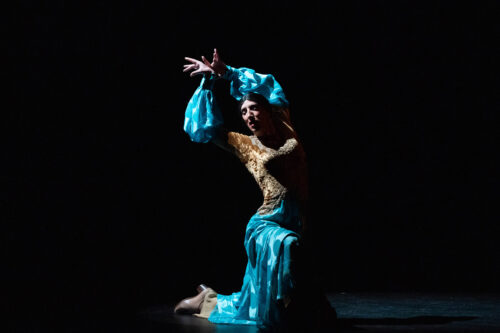
A soloist in Compañía Manuel Liñán. (Photo courtesy of Daniel Azoulay)
The more compact and earthy Manuel Betanzos channeled a randy housewife at some all-night fiesta flamenca dancing por tangos in a polka-dot skirt and an apron. This tongue-in-cheek vulgarity makes rhythms like tangos, bulerías and rumbas as much fun to dance as they are to watch. But if one pelvic thrust might have been enough for that Andalusian señora, Betanzos added three or more for mirthful measure. ¡Ole!
In the bygone era, this piece reflects dancers had to be proficient not just in flamenco but also in folk dances and the Spanish classical style, escuela bolera. In the latter Daniel Ramos, gorgeous in a short red dress and ballet slippers, danced out his rivalry with Victor Martín, hilariously upping his adversary with grand jetés, precise turns, and out-flung extensions. Even while funny, he really meant business.
Indeed, what made ¡VIVA! so extraordinary was this kind of prowess. The footwork was as strong and accurate as it was swift. And while many have remarked on the freedom of movement in hands and wrists women but not men enjoy in traditional flamenco, it was interesting to observe how much technique for legs and feet also changes when a fellow dons a skirt.
After so much slapstick, the show became contemplative in its next-to-last section. In an old-fashioned green dress, plainer than any other, Liñán joined guitarist Francisco Vinuesa on a bench on the otherwise empty stage and poured pathos into a song. As the 2019 film “Flamenco Queer” has revealed, it was Liñán’s childhood memory of such a dress from his mother’s closet that inspired ¡VIVA!. Wearing it he’d dance around his room, kitchen towels pinned to his head like long hair, while his mother kept a lookout to warn him when his father was about to get home.
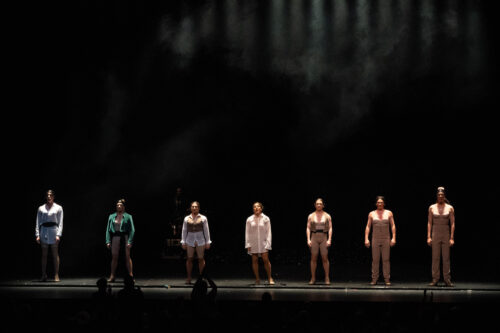
For the finale, the dancers leave their female attire behind and reveal themselves to the audience as men. (Photo courtesy of Daniel Azoulay)
For the finish, the entire company donned the green and white of flamenco’s birthplace, Andalucía, to dance joyful alegrías maneuvering shawls and the ruffled trains on their dresses. One by one the dancers exited, each by turn to reappear, his dress off. Their ensuing sequence as men—albeit in brassieres and wigs—was oddly jarring after their displays in feminine attire. Liñán’s initial point — that we invest pieces of cloth with incalculable power —was driven home as he danced in a man’s white shirt, wielding his flamenco dress now as a prop.
Center stage, the guitarist strummed a final chord, and Liñán ripped off his wig. When he dropped to his knees, the audience sprang up and went on clapping for a long time, until the curtain came down.
ArtburstMiami.com is a nonprofit source of theater, dance, visual arts, music and performing arts news. Sign up for our newsletter and never miss a story.
No posts found
Art meets environmental action in Dale Andree’s National Water Dance
Written By Helena Alonso Paisley
April 15, 2022 at 8:18 PM
The National Water Dance performance in 2018 took place on Key Biscayne at the beach near the Biscayne Nature Center. (Photo/Mitchell Zachs)
Nature abhors a vacuum; so, too, does Dale Andree.
When the Earth advocate, dancer and pioneering Miami choreographer created the National Water Dance in 2011, she saw the project as a way to build community. Her work hints that movement, with its physical and metaphorical power, can be the seed for a movement in the political sense.
Over the past decade of her impressive career, Andree has made a deep dive into the creative and connective possibilities of water as a vital and imperiled element. Starting at 3 p.m. Saturday, April 23, audiences may join National Water Dance’s dialogue around water during a presentation titled “Dancing Out of Time!” at the South Miami-Dade Art and Culture Center.
This year’s theme centers around the Everglades, where Andree had an AIRIE arts fellowship in 2018. The afternoon of this multifaceted presentation will begin with guides showing participants to an onsite art gallery featuring the Glades-inspired works of Seminole painter Wilson Bowers and Canadian-born conservationist and mixed-media artist Deborah Mitchell. Or guides will lead them to tents where they can learn about the wetlands’ challenges from members of the Love the Everglades Movement.
For the performance sequence later in the afternoon, the Brazilian sounds of Miamibloco’s percussionists will usher audiences, samba-style, to an outdoor space decorated with papier-mâché birds created by student sculptors from George Washington Carver Middle School in Coral Gables.
Seminole Tribe member Samuel Tommie’s haunting flute music will begin an invocation acknowledging the spiritual significance of the land. There will be music from the Miami Sound Choir and from the Cuban-American duo Afrobeta, all accompanying an equally diverse array of dance companies.
The 4 p.m. dance performance is expected to start with a “movement choir.” Developed in the early 20th century by modern dance revolutionary Rudolf Laban, this practice involves mounting a simple choreographic sequence through a large group of people so that, together, they can experience the healing power of movement.
But with National Water Dance, said Andree, the sequence of “shared gestures” will happen across the entire United States as member groups from Connecticut to California connect via live stream, uniting in a simultaneous, nationwide performance.
“This is about constructing community,” said Andree, and about “creating awareness centered around the joy of these dancers.”
The large group of dancers here includes the Afro-Cuban ensemble IFE-ILE; Karen Peterson and Dancers; Olujimi Dance Theatre; Dimensions Dance; NWD Projects, Miami Dade College’s Jubilation Dance Ensemble; Andree’s own troupe; and young performers from the Arthur and Polly Mays Conservatory of the Arts.
Following the movement choir, dancers from the different troupes will be highlighted, with the groups “constantly threading through to make the performance one woven fabric of movement,” Andree said.
“What this is all about is not only attention to the environment, but also attention to ourselves as part of the environment,” she added. “Our only way forward is to work as one.”
WHAT: National Water Dance 2022 — “Dancing Out of Time!”
WHEN: 3 p.m. Saturday, April 23, 2022
WHERE: South Miami-Dade Cultural Arts Center, 10950 SW 211th St., Cutler Bay; plus online access at nwdprojects.org/national-water-dance
COST: Free with ticket; available at SMDCAC.org
INFORMATION: nwdprojects.org
ArtburstMiami.com is a nonprofit source of theater, dance, visual arts, music and performing arts news. Sign up for our newsletter and never miss a story.
No posts found
After COVID pause, Flamenco Festival Miami promises star performances – and a sense of renewal
Written By Sean Erwin
March 25, 2022 at 9:46 PM
“Compañía Mañuel Liñán: ¡VIVA!” is set for Saturday, April 23. (Photo/Marcos G. Punto)
For lovers of flamenco, having “duende” (or having soul) signals that moment when the artform becomes a way of life.
The singer and the dancer shed for a moment any sadness, melancholy and drama of the human existence and, in the experience, feel renewed.
When the Flamenco Festival Miami returns to the Adrienne Arsht Center for the Performing Arts in April, it will bring with it a chance for audiences to immerse themselves in this “duende flamenco” — and to appreciate flamenco as a spectrum flowing from the deeply traditional to the avant-garde.
“Flamenco has different ways of expressing itself depending on the performer. It is not a closed art,” said dancer, choreographer and festival artistic director Manuel Liñán, replying in Spanish. “It is an art in constant evolution, and it is important that people see and know the different profiles and, above all, that they know that it grows every day. It is a living, traditional, current, modern and avant-garde art.”
Miami figures as one of the world centers for top-flight flamenco performance. But for the past two years, the COVID-19 pandemic put all performances on hold. Now that it’s back, the 13th edition of the festival will span three nights: April 10, April 21 and April 23.

“Miguel Poveda in Concert” will take place Sunday, April 10. (Photo/artist management)
On Sunday, April 10, at the Arsht’s Knight Concert Hall, the focus will be on flamenco as song. The vocal styles of Spanish star Miguel Poveda will be on full display, ranging from “malagueñas” and “alegrías” to “seguirillas” and “soleás.” The evening is also expected to include selections from his 2021 album, “Diverso,” in which Poveda steps outside flamenco to tackle musical forms ranging from a bolero to an Argentine tango.
The second evening, on Thursday, April 21, is titled “Stars of Flamenco,” highlighting flamenco as a dance form, with three leading performers: Mercedes Ruíz, Eduardo Guerrero and María Moreno. And the final evening, on Saturday, April 23, presents the avant-garde with the all-male troupe “Compañía Manuel Liñán: ¡VIVA!”
Liñán’s passion for flamenco started early, absorbed from childhood experiences of the dance.
“I got caught up and started dancing and at first I didn’t know why. Later, I understood that it was the way I wanted to choose to express myself,” Liñán said. “In the dance, I find the freedom to express myself. For me, it is life.”
In Compañía Mañuel Liñán, the male dancers shed the traditional tight-fitting trousers, short black jackets and brimmed hats. They instead adopt the traditional costumes of flamenco female dancers, wearing “trajes de flamenca” — brightly colored dresses trimmed with ruffles, plus shawls loosely arranged over their shoulders. They snap out flamenco’s iconic rhythms sporting black strapped flamenco shoes with 3-inch heels embedded with nails.
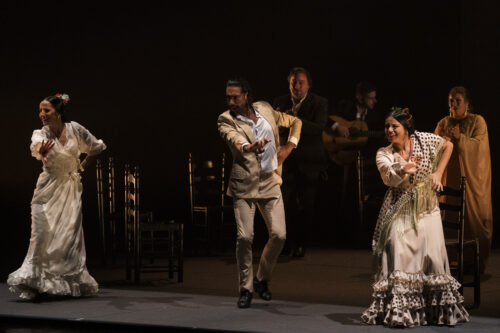
The “Stars of Flamenco” show will be on the second evening. (Photo/David Ruano)
In the process, they appear to toss flamenco convention out the window. But, Liñán explains: “Nothing has changed. The only thing is the perspective with which each one sees it.
“What we do is dance, with dresses that are associated with the female gender, but now I consider that they belong to me. I do not abandon my identity to become a character. I am Manuel dressed in a red dress with a lot of flow, a wig and a lot of makeup because I like it, but I am still Manuel.”
The company has often been associated with queer identity. Liñán recognizes the significance of the term.
“I think it is important that this label exists to defend freedom of expression without having to be judged,” he said.
“Since I was little, I was taught that there were different ways of dancing for men and women, something that I could not understand, nor do I understand,” Liñán continued. “I believe that everyone should dance and dress as they want, regardless of their sex. This caused me trauma for many years, until I was able to dance and dress as I wanted.”
WHAT: Flamenco Festival Miami XIII
WHEN: The festival will take place over three nights.
7:30 p.m. Sunday, April 10 — “Miguel Poveda in Concert”
8 p.m. Thursday, April 21 — “Stars of Flamenco”
8 p.m. Saturday, April 23 — “Compañía Mañuel Liñán’s ¡VIVA!”
WHERE: Adrienne Arsht Center for the Performing Arts of Miami-Dade County, 1300 Biscayne Blvd., Miami
COST: $25-$125
INFORMATION: 305-949-6722; arshtcenter.org
ArtburstMiami.com is a nonprofit source of theater, dance, visual arts, music and performing arts news. Sign up for our newsletter and never miss a story.
No posts found

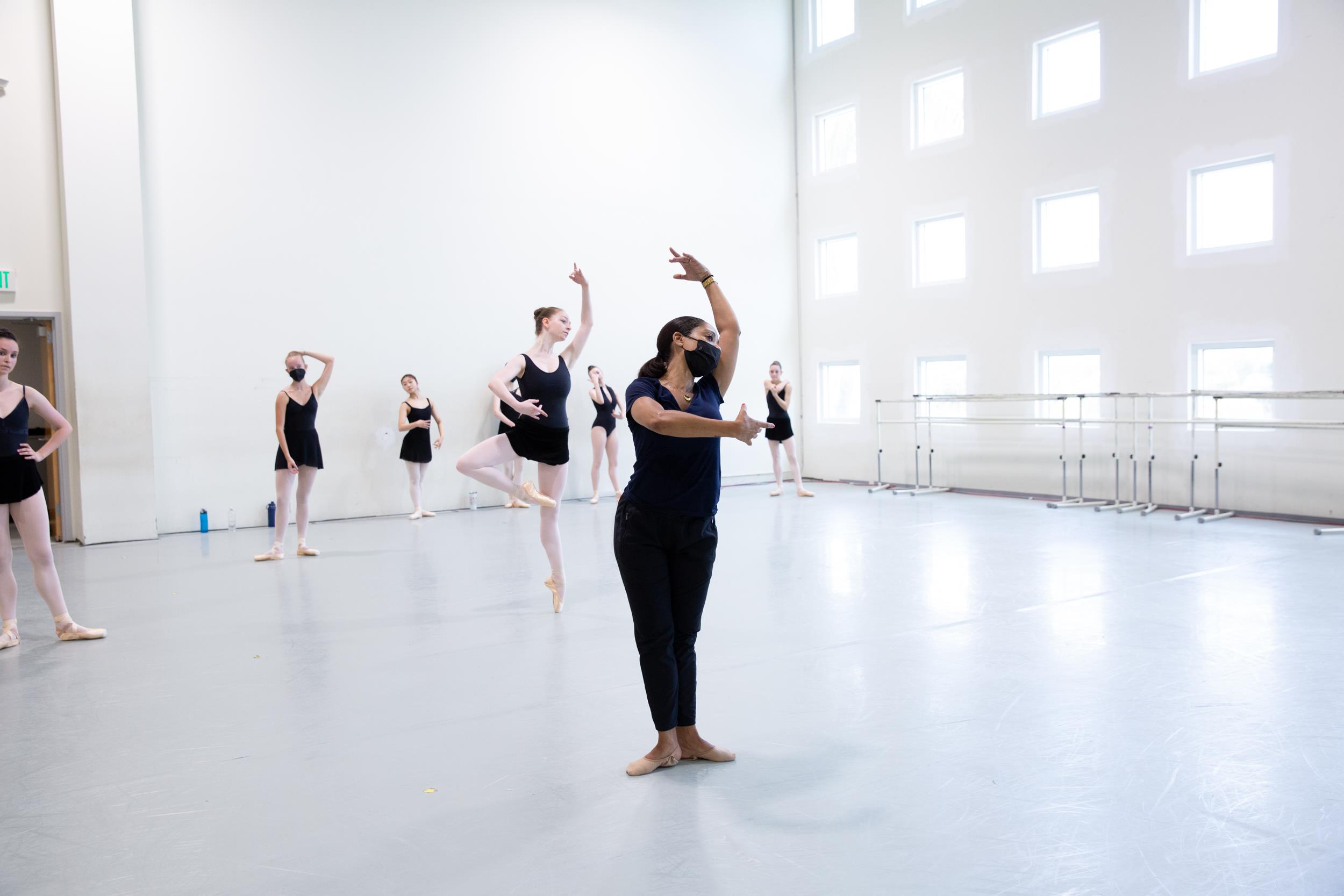
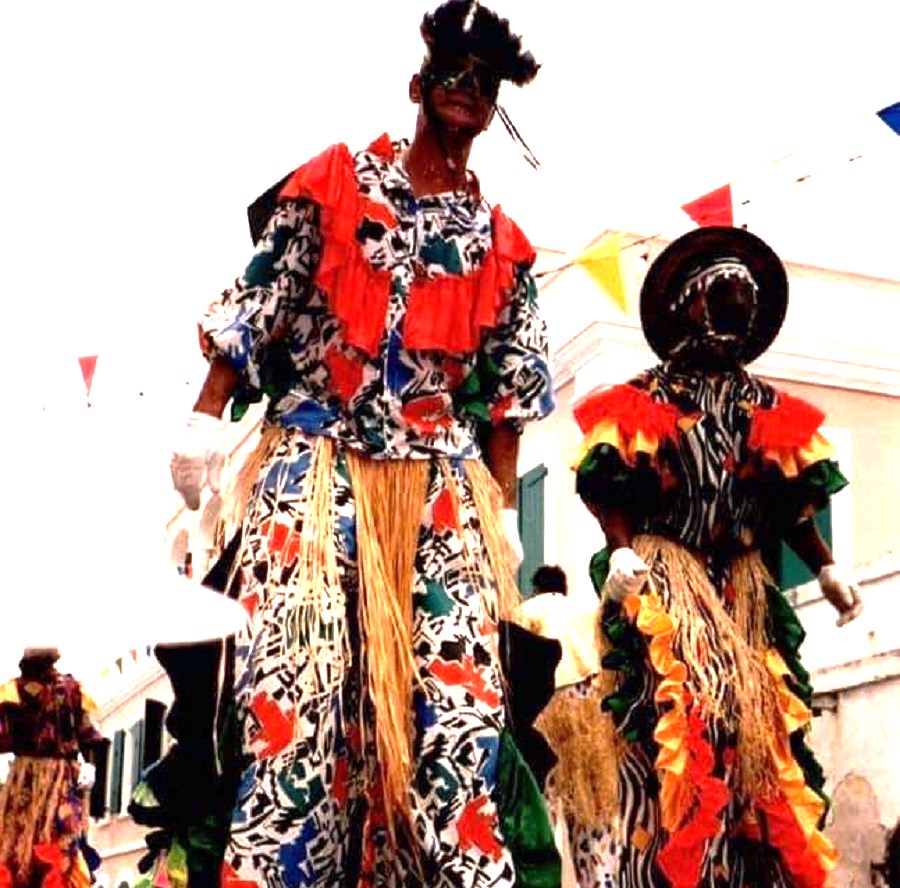
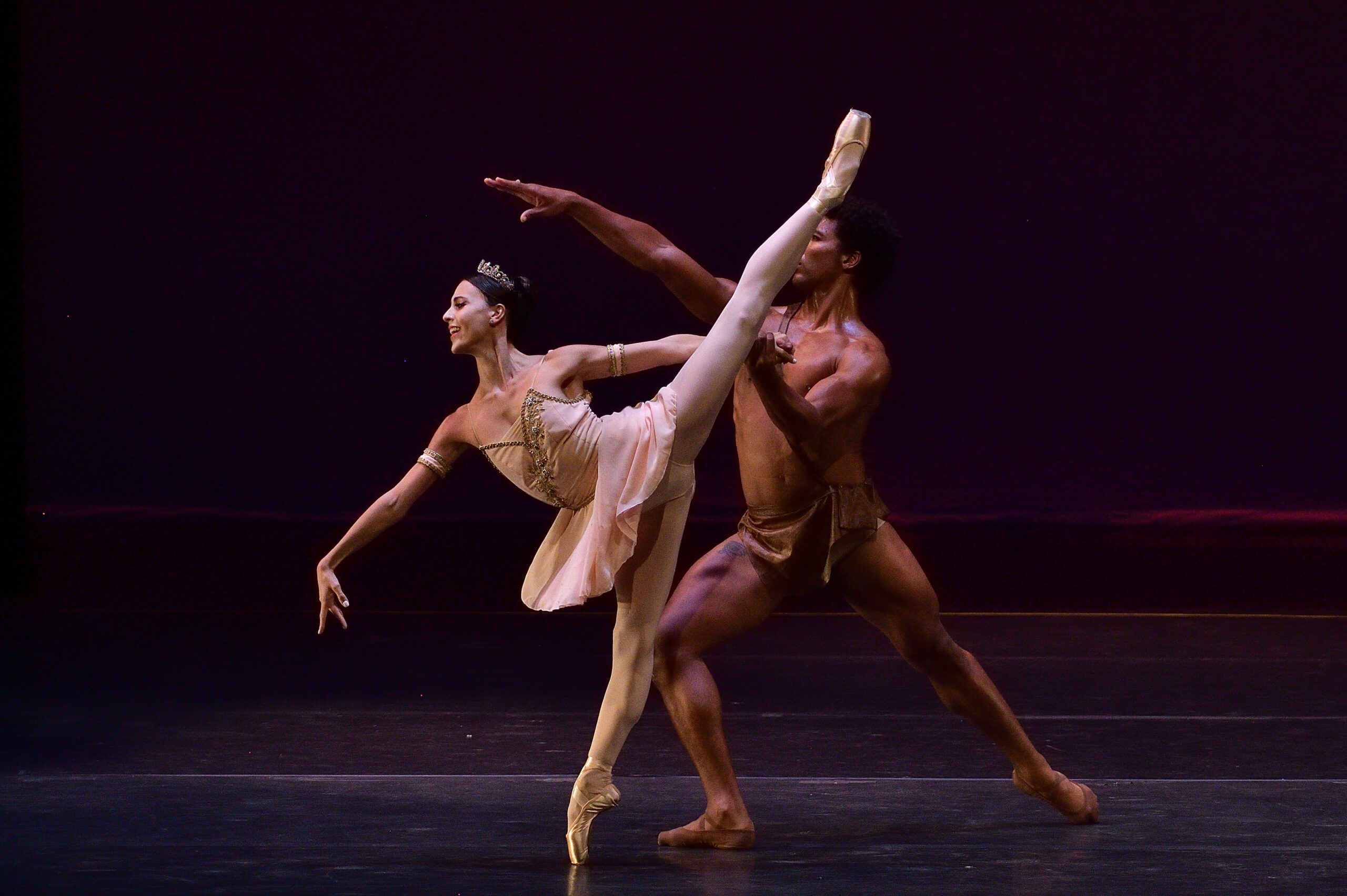
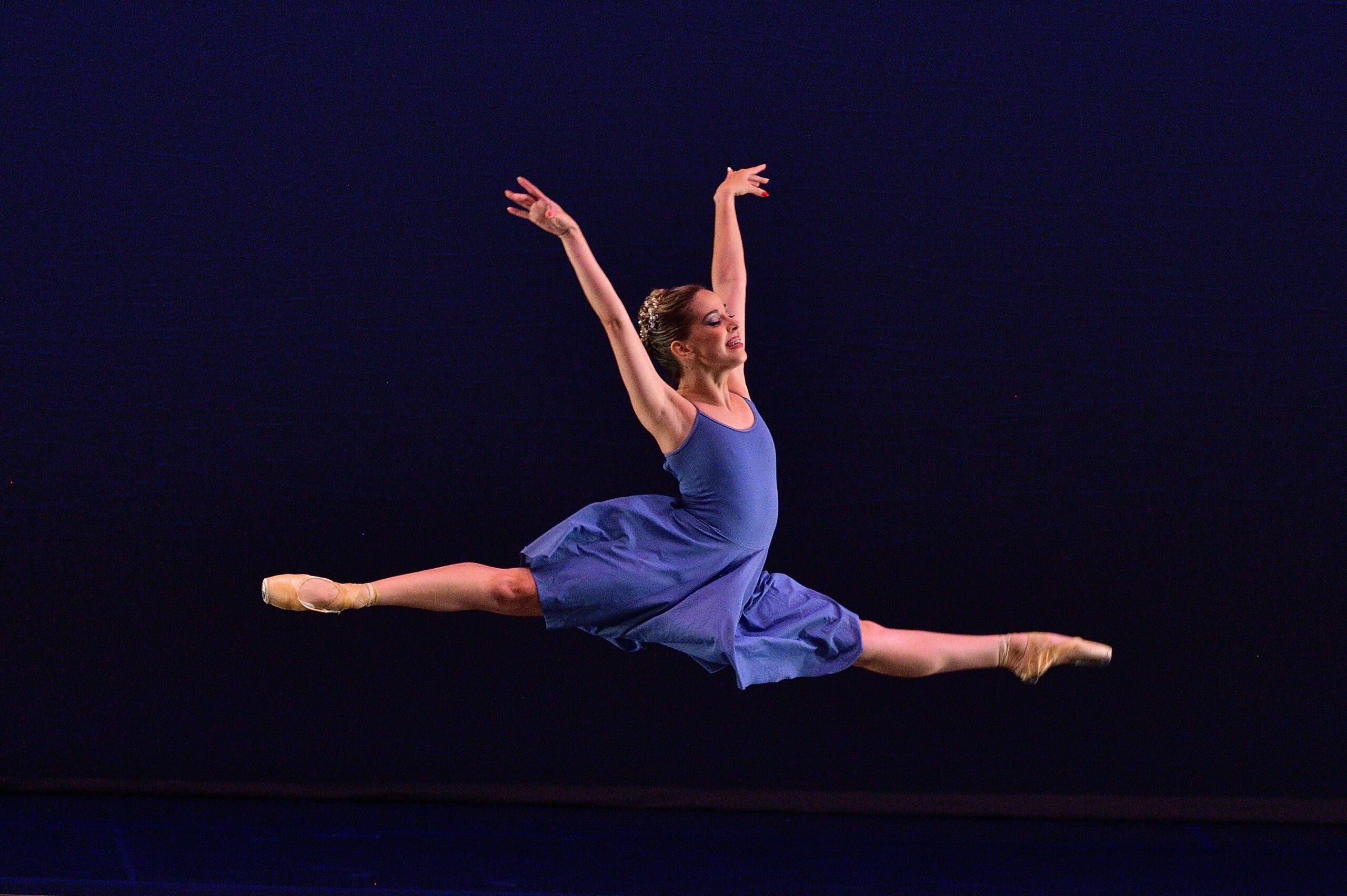
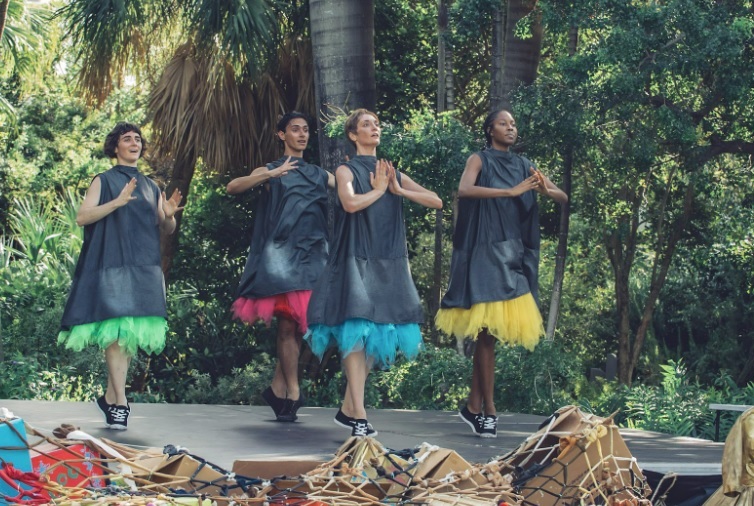
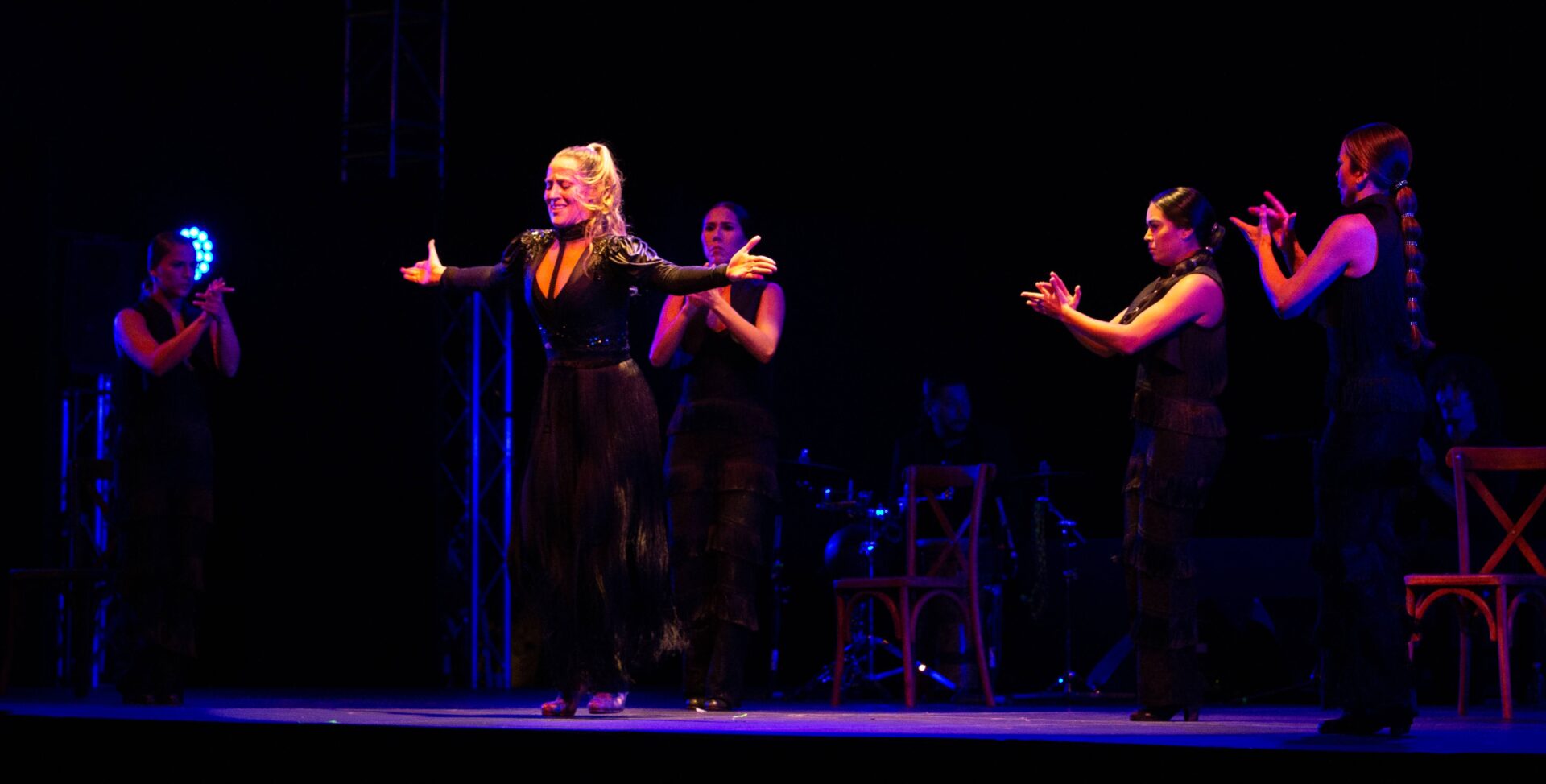
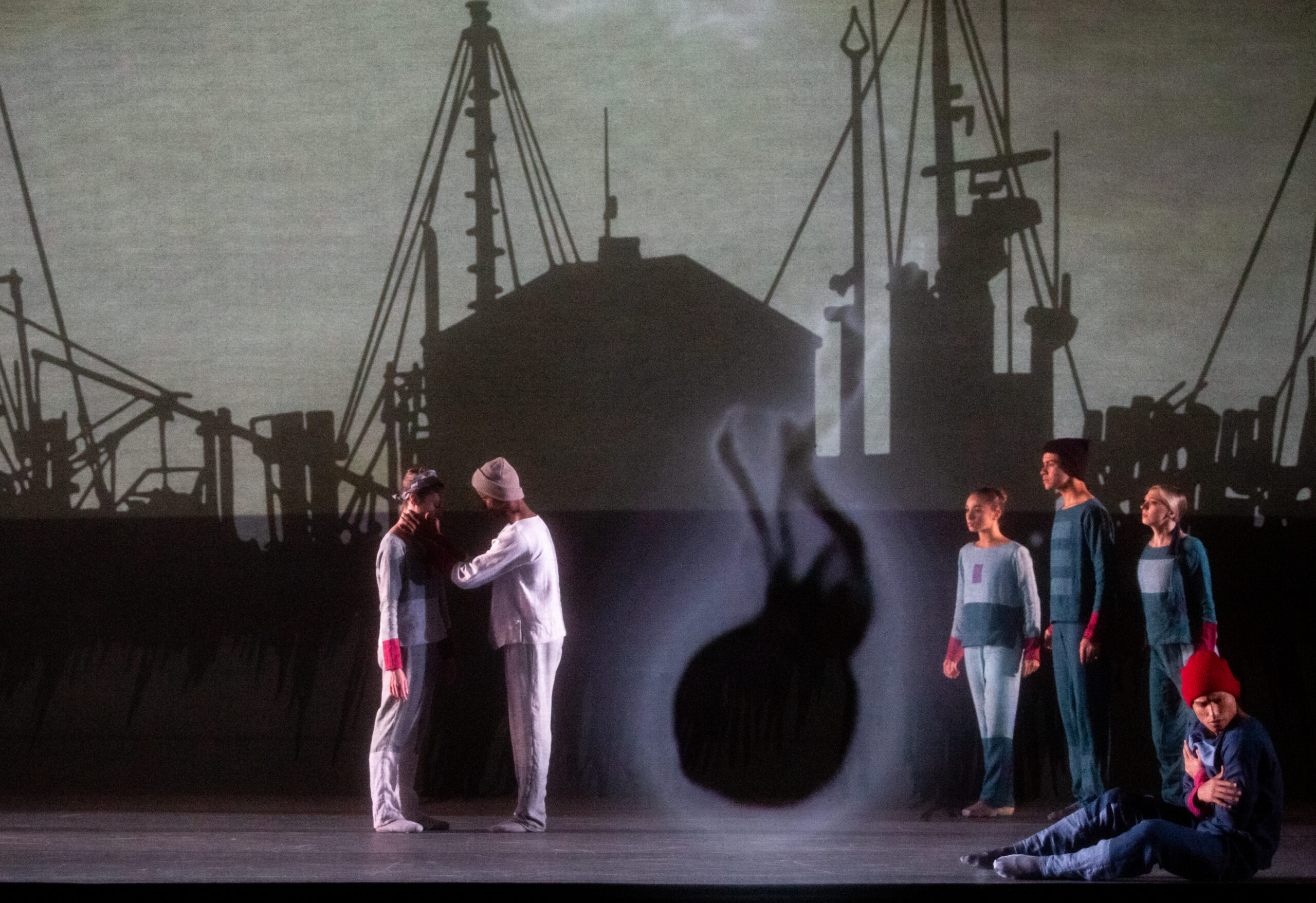
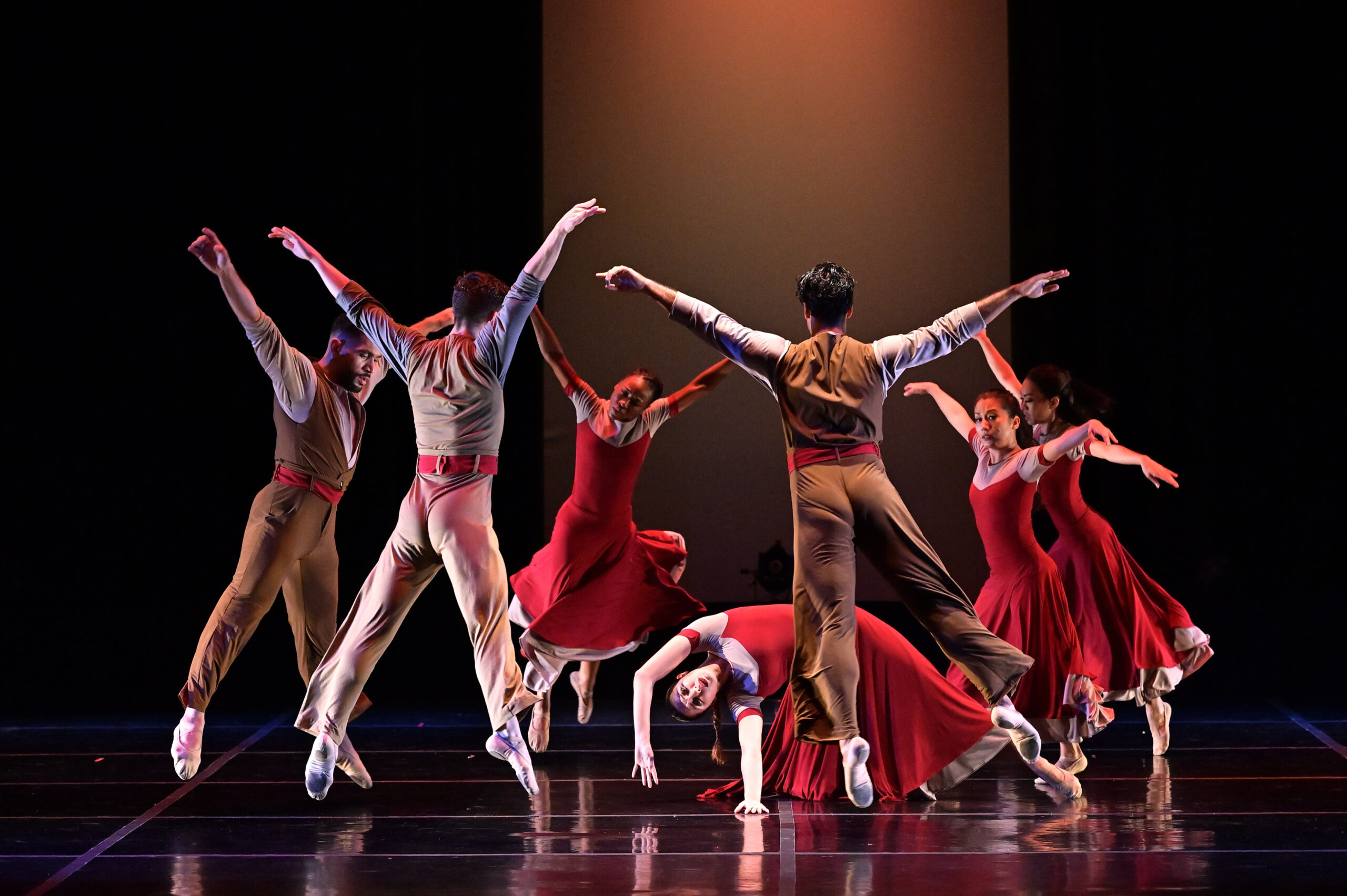
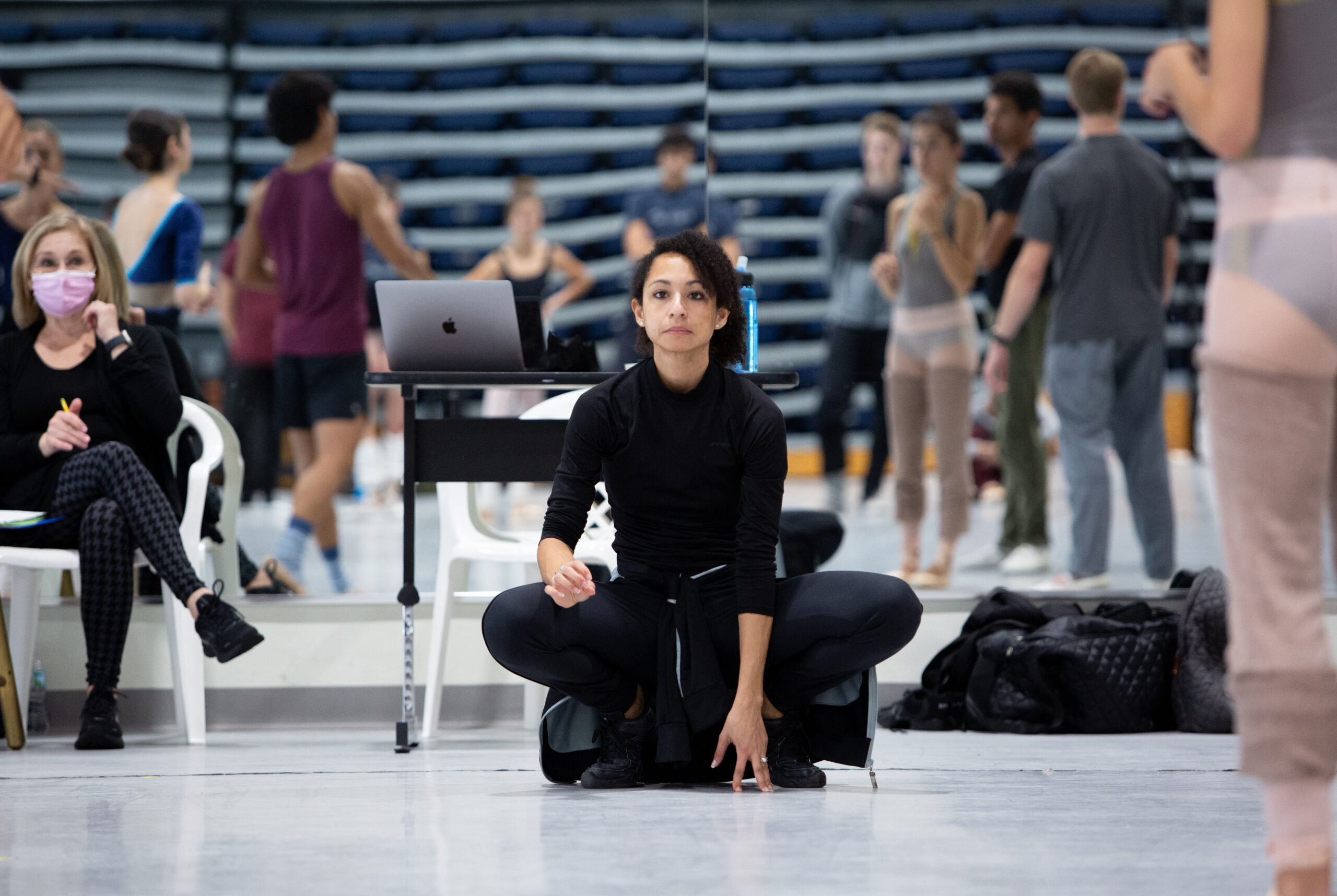
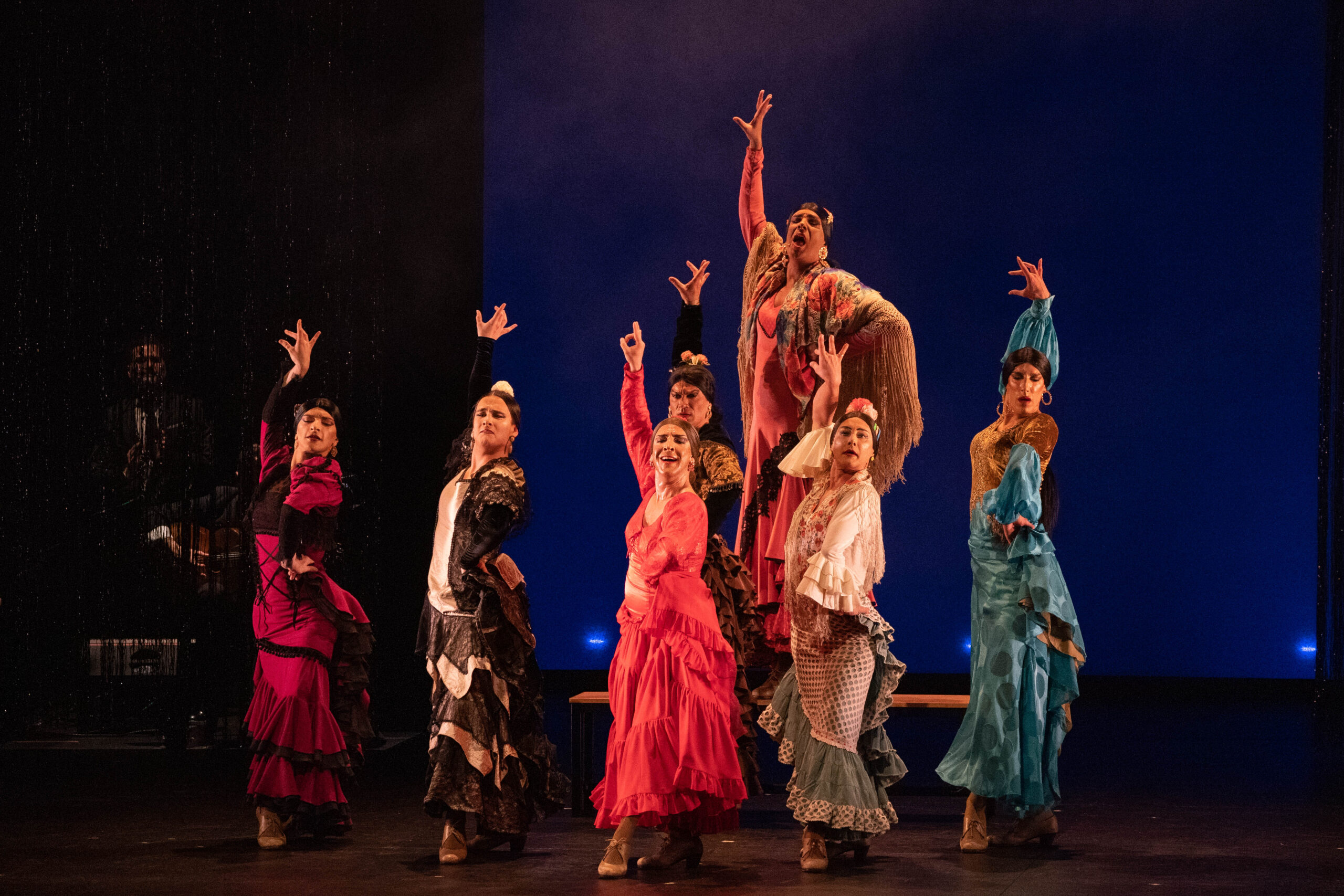
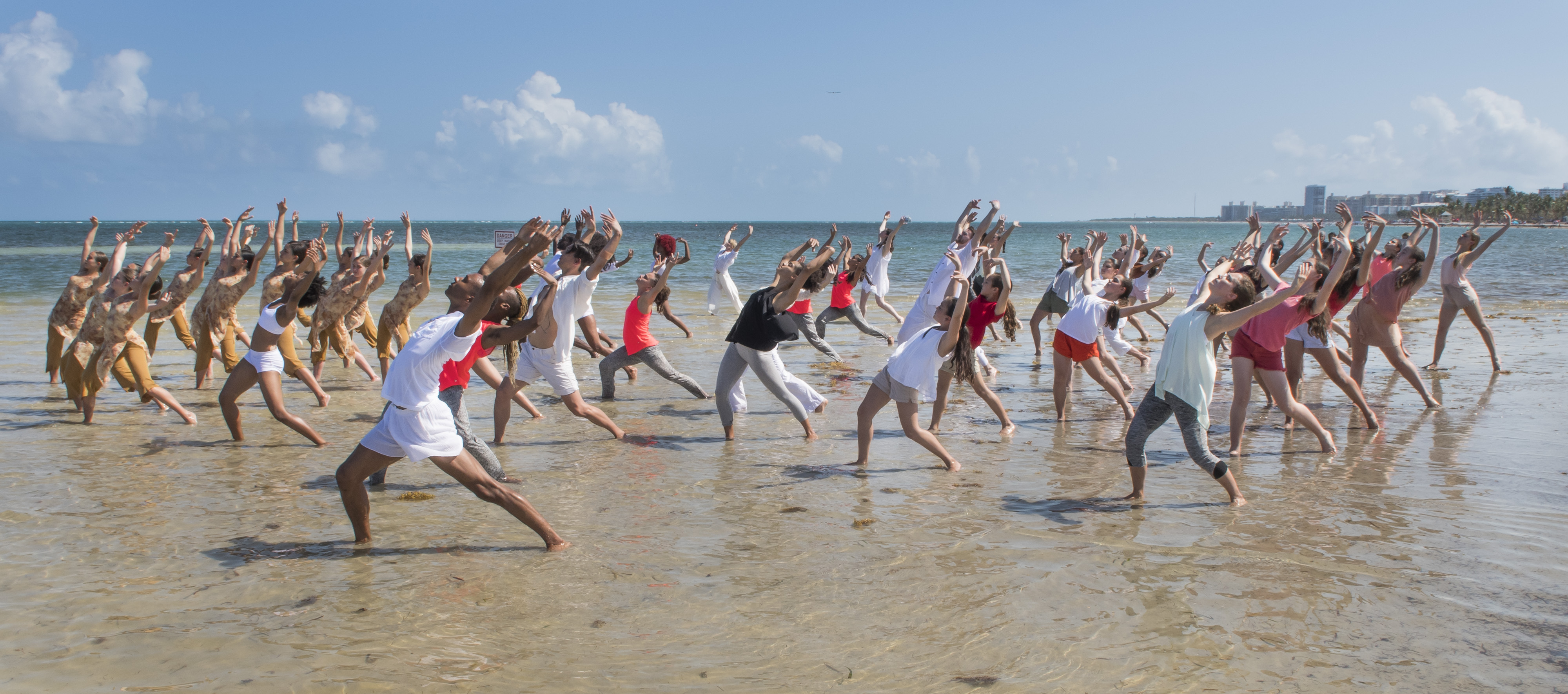
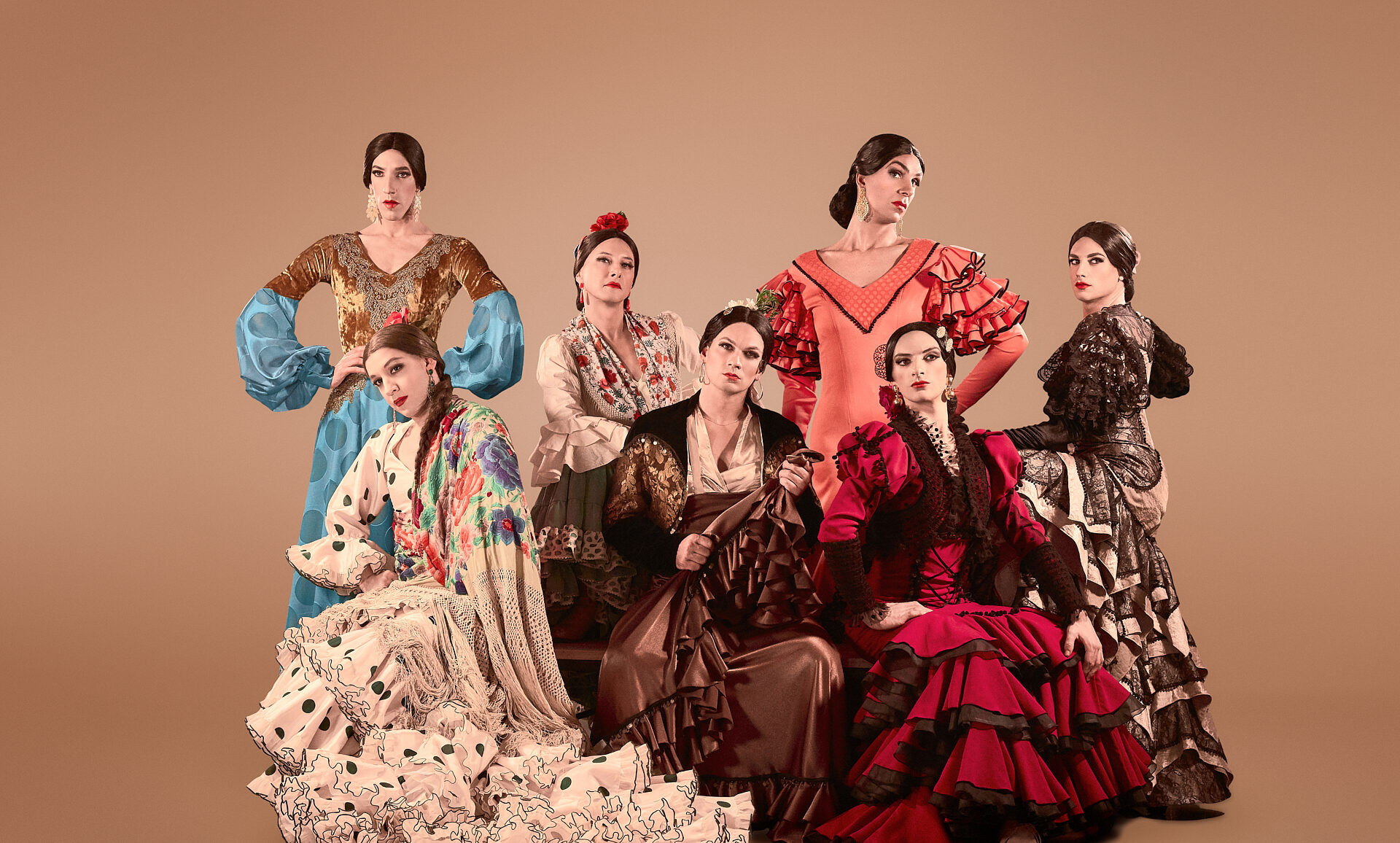
Recent Comments