Blog Article Category: Dance
Randolph Ward Gets Personal in ‘The Gray’
Written By Guillermo Perez
October 20, 2026 at 11:15 AM
South Florida dancer and choreographer Randolph Ward explores his many selves in “The Gray: A Celebration of Human Complexity,” his upcoming solo work. at Sandrell Rivers Theater on Saturday, Oct. 24. (Photo by Varvara Kandaurova)
In his solo show, South Florida dancer/choreographer Randolph Ward is ready to bare it all—his art, his many selves, and, at one point, his body as testimony. “The Gray” will flash layers of his personal experience and then strip them away at Sandrell Rivers Theater on Saturday, Oct. 24.
Ward, an African American artist in his mid-40s, has reached a new point in his creative life. It’s not that his steps along the way haven’t already demanded truthful recognition and gutsy action. But his current work reveals Ward at a crucial point. After a long career with major ballet companies and years of international travel, the Miami native has returned home, not to rest, but to continue to push his work in new directions.
“The idea behind ‘The Gray’ comes from my journey as a ballet dancer of color,” says Ward. “In this world, I’m always perceived as ‘the other’ or as a representation for an entire race.”
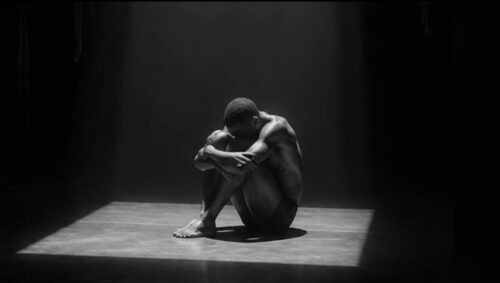
With “The Gray,” Randolph Ward hopes to create empathy by encouraging audiences to recognize their own pain and see it in others. (Photo by Varvara Kandaurova)
In response to that taxing reductiveness and onerous expectation, he wants to facilitate better understanding by opening his embrace, blending black-or-white demarcations into a more authentic shading. “I’m trying to create empathy among humans through my art. We live in a society where we often don’t want to express our pain or recognize it in others.”
Ward identifies as an empath, with a level of sensitivity to detect risk or safety even in the most mundane situations. In the artistic sphere he has fine-tuned that spiritual radar.
“Since I was a child, though intuitive then, this has been a constant in my life,” he says. “I navigate towards what gives off a good vibe and flee from what doesn’t.”
[FROM THE ARCHIVES: Randolph Ward’s “Boys Will Be Boys” Examines Toxic Masculinity]
Ward began dance training at the age of 10 at Liberty City’s Charles R. Drew K-8 Center. It was a rare opportunity, he emphasizes, and progressed as a teen into conservatory classes at South Miami’s Thomas Armour Youth Ballet (now Armour Dance Theatre), a precious cocoon for him that nurtured not just dance fundamentals but also self-worth.
“The feeling of otherness was simply not there,” Ward recalls, singling out academy director Ruth Wiesen as his mentor. “She is an anomaly, opening the door to so many students of African descent and making us feel at home.”
That sense of welcome was unusual in the ballet world, says Weisen.
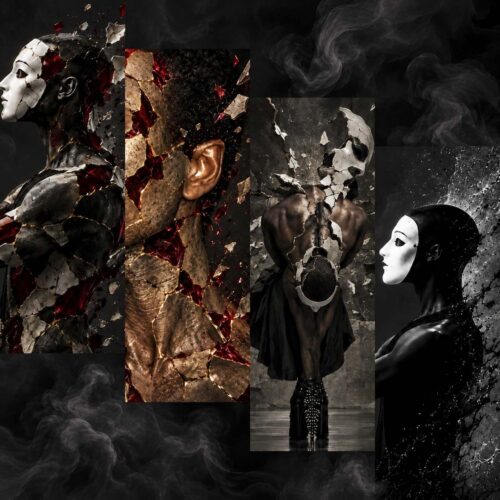
Randolph Ward draws on his experiences as a Black ballet dancer in “The Gray,” a dance-theater work about the many selves people carry. (Photo by Varvara Kandaurova)
“Randolph’s story illustrates exactly why we started our scholarship program at a time when the ballet world and most classes did not reflect the diverse city we live in. He had ability, drive, and a family that believed in him. We could provide the opportunity to develop his potential.”
Ward’s awareness expanded at a Dance Theater of Harlem summer program. “There I gained a larger experience of Black lives, of how we have to be so much better to succeed. I also recognized the privilege of having ancestors in the art form like Arthur Mitchell (the company director and once a New York City Ballet star), who helped set us up.”
At 16, before his senior year at New World School of the Arts, he entered San Francisco Ballet’s year-round school program. One of only three career-aspirants of color there, he sharpened his skills and feasted on world-caliber performances. “For two years I attended every company show,” he remembers.
Ward went on to join Ohio’s BalletMet and North Carolina Dance Theatre, mastering classical and neoclassical styles until his heart demanded a move beyond those orthodoxies. Dancing in Germany at Saarländisches Staatstheater, Ward says, “I went contemporary all the way. I’d gotten bored with the idea of expressing masculinity, its bravery and strength, and claimed a feminine aspect for my dancing.”
The artist stood up as a gay man—so tall and thin, he notes—balking at losing opportunities due to being perceived as a type.
“Deeper ideas started coming to me,” he says. “Generally, American dance is outward whereas European dance is self-contained, changing the atmosphere from within.” Repertory from innovators such as Israeli-American Ohad Naharin and Sweden’s Mats Ek left a lasting impact.
“I got to see how a Black dancer in Germany could be a superstar,” adds Ward. “Outside the United States I discovered that African-American culture is American culture.”
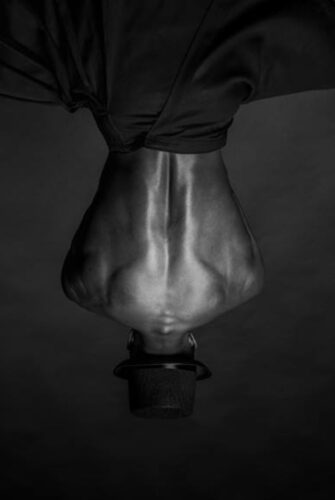
Randolph Ward’s solo work brings together dance, theater and personal reflection in an exploration of vulnerability. (Photo by Varvara Kandaurova)
Ward’s interest in making his own dances came as a practical necessity. “I started choreographing to become a better interpreter,” he says. “My first opportunity was back with BalletMet for a competition I won.”
Then the call to create became inescapable. In 2017 he premiered “A Vogue Extravaganza” in Germany as a tribute to the ballroom scene that flourished among African-American and Latin gay youth in New York. Two years later Ward reset this in Miami, which marked him locally as someone to take note of.
And Dimensions Dance Theatre of Miami did. Company co-artistic director Jennifer Kronenberg calls Ward’s 2019 premiere “What Makes a Man?”—a male duet dealing with gendered constraints—a perfect fit for their exploratory Lab Series.
“The work challenged our dancers and audiences, pushing physical and social boundaries,” she says—and, aligning herself and co-director Carlos Guerra to those who found beauty in its confrontation, adds, “Through Randolph’s courage and emotional intelligence, our dance ecosystem received a gift.”
With his own RTWDANCE, Ward has brought daring dance-theater works to South Florida stages. In that vein, “The Gray,” gathers some former material, puts it in new context, and expands his elaboration of long-held concerns and the craft of dance-theater.
“The show is centered around masks,” explains Ward, whose costumes—including a studded face covering, latex and high heels—draw inspiration from the late performance artist and designer Leigh Bowery, known for his extravagant costumes and elaborate transformations of the body. “Through this I examine what shapes, challenges, and constantly rebuilds the self.”
The show opens with a recording of Leontyne Price singing “Pace, pace, mio Dio” from Verdi’s “La forza del destino.” Other sections include “The Big Dig,” accompanied by a short film about Ward’s coping with angst, and “The Dance of the Ego,” which references 1970s Black cinema, “when everything was loud and brash,” he says.
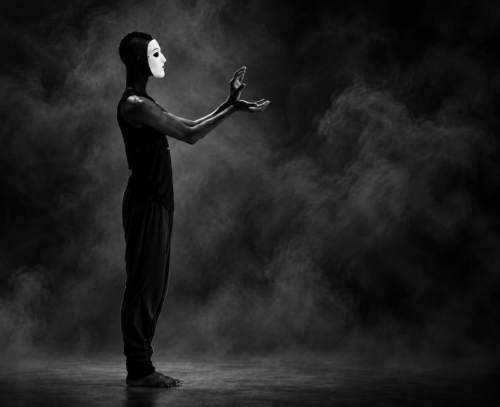
In “The Gray,” Randolph Ward examines how identity is shaped, challenged and continually rebuilt. (Photo by Varvara Kandaurova)
“Steeped in contradictions, this gets into my mastering the ego not to let it consume me.”
In “The Cement Block of Stagnation,” Ward considers unrealized potential. The section becomes “very dark, with hard guitar chords, twisting and turning, and strongman poses,” he says.
But “The Monster I Keep,” in which he performs nude while wearing a veil, has made him most nervous because of the vulnerability it demands. “It confronts the contradiction of being seen but not seeing ourselves,” he says.
A poetry recitation brings the focus back to accepting his many selves. For Ward, the dream is no longer about chasing achievement but “in reckoning with the many selves within me—impatient and contradictory… gorgeous and intense … longing to be held.”
“However people label me, I hope they can find a connecting factor in all this.”
WHAT: “The Gray: A Celebration of Human Complexity”
WHEN: 3 and 7 p.m. Saturday, Oct. 24
WHERE: Sandrell Rivers Theater, 6103 NW 7 Ave., Miami
COST: $35 general admission; $20 students, seniors and veterans. Only ages 18 and older admitted.
INFORMATION: (305) 284-8872; https://www.rtwdance.net/
ArtburstMiami.com is a nonprofit media source for the arts featuring fresh and original stories by writers dedicated to theater, dance, visual arts, film, music and more. Don’t miss a story at www.artburstmiami.com
No posts found
Patricia Delgado and Emily Estefan Combine Creativity for Miami City Ballet Premiere
Written By Guillermo Perez
October 13, 2026 at 2:21 PM
Former Miami City Ballet principal Patricia Delgado rehearses her “Push the Buttons of the Civilized” with dancers from Miami City Ballet. Delgado and composer, musician, performer Emily Estefan collaborated on the premiere, which opens the company’s season as part of “American Rhythms” at the Arsht Center on Friday, Oct. 16. (Photo by Ari Feldmiller, courtesy of Miami City Ballet)
At a Miami City Ballet studio in August, a ballerina reaches up as if switching on a light. Around her, a dozen dancers rehearse “Push the Buttons of the Civilized,” a new ballet bringing together choreographer Patricia Delgado and musician Emily Estefan.
For Delgado, a former Miami City Ballet principal, the work marks a return to familiar studios for her first ballet commission. For Estefan, daughter of Gloria and Emilio Estefan, it is her first venture into ballet. Both Cuban-American artists grew up in the Miami area, but their collaboration began with another stage project: the musical “Basura.”
Now their partnership draws on shared family histories, their connections to the women who raised them and the trust they developed working together.
Alongside George Balanchine’s “Allegro Brillante”—a repertory gem from 1956, set to Tchaikovsky—and the company premiere of Jerome Robbins’ 1958 “N.Y. Export: Opus Jazz,” with new costumes by Zac Posen of GapStudio, Delgado’s ballet opens MCB’s season with a program that brings together tradition and new work.
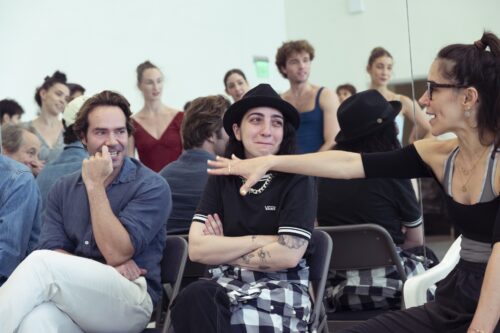
Miami City Ballet artistic director Gonzalo Garcia, composer/musician/performer Emily Estefan and choreographer Patricia Delgado during a rehearsal for the new premiere of “Push the Buttons of the Civilized.” (Photo by Lex Barberio, courtesy of Miami City Ballet)
Past its 40th anniversary, MCB is striding forward to the beats of a classical concerto, jazz and current pop in “American Rhythms,” coming to Miami’s Adrienne Arsht Center Friday through Sunday, Oct. 16 through 18, and Broward Center in Fort Lauderdale Saturday and Sunday, Oct. 24 and 25.
Now in his second season as MCB artistic director, Gonzalo Garcia presents the first season he has fully programmed.
“When I took this job, I was adamant about staging new work as well as revivals that are part of our history,” he says. “And if I can make a point about the value of ballets made in Miami, I want to go for it. This city contains so many flavors, and we’re lucky to let audiences taste those in a show.”
Cue Delgado and Estefan, who embody the made-in-Miami appeal Garcia is looking for. Born and raised here, they also share a spirit that makes them a perfect match for the premiere.
“They are wonderfully collaborative and offer a double-sided advantage,” says Garcia. “Their foundation is here, but they also bring a personal voice from all sides of the dance and music worlds.”
Until 2017, from apprentice and corps member to principal ballerina, Delgado enjoyed a 17-year career at MCB, often sharing programs with sister Jeanette. She excelled in Balanchine but also prized Robbins, as she says, “enthused by his humanity.” Returning to MCB studios as a choreographer, with so many companionable memories, makes her feel like “the luckiest person in the world.”
After moving to New York City to join Justin Peck, now her husband and New York City Ballet’s resident choreographer, Delgado expanded her work beyond ballet to Broadway. She and Peck won the 2025 Tony Award for choreography for “Buena Vista Social Club.”
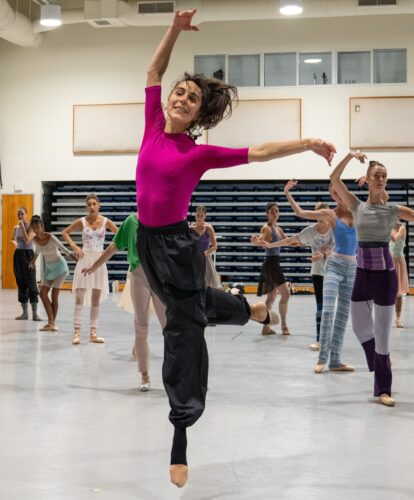
Returning home to Miami City Ballet, Patricia Delgado rehearses her “Push the Buttons of the Civilized.” (Photo by Ari Feldmiller, courtesy of Miami City Ballet)
“Creating with Justin and staging his ballets has given me great perspective,” says Delgado, who adds that her recent teaching at Juilliard has opened her eyes to collaboration among “a beautiful community of dancers, singers, actors.”
Those experiences have led Delgado to find her own voice as a choreographer.
“When I was dancing, I was so focused on honoring the vision of each choreographer I didn’t especially entertain making my own dances. . . One also has to be generous and let the dancers enter the conversation.”
Delgado took on her first independent stage assignment choreographing the musical “Basura,” which premiered at Atlanta’s Alliance Theatre in May. With a score by Gloria and Emily Estefan and a book based on the documentary “Landfill Harmonic,” the musical celebrates young Paraguayans who fashion musical instruments from trash-heap discards.
Delgado and Emily Estefan met in a “Basura” workshop, which sparked their camaraderie.
“In this musical,” the choreographer says, “I was stimulated having such beautiful colors to paint with and drive the bodies before me.”
For Estefan, the occasion proved equally auspicious. “That’s been an amazing whirlwind of a project,” she says, “with a lot of love and Latino pride. Unlike the music world, where you write a song married into the concept, in a stage work everything changes every day — much like an experiment. To go there, you need an immense amount of trust. With it, some really cool art happens. Patricia and I feel this, and we’re ready to explore. That’s why I’m excited about the ballet, something I’ve never done before.”
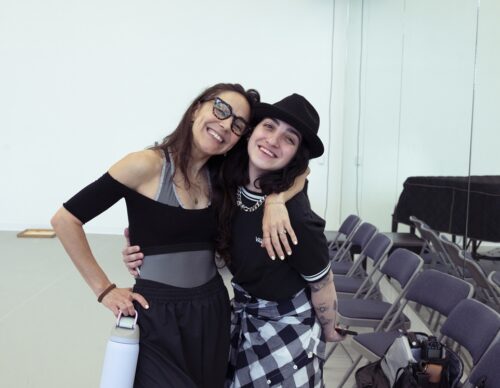
Choreographer Patricia Delgado and composer/musician/performer Emily Estefan share Latina pride in their made-in-Miami collaboration for a dance premiere for Miami City Ballet’s season opener. (Photo by Lex Barberio, courtesy of Miami City Ballet)
Garcia proposed the ballet collaboration at the start of his MCB tenure. In accepting, Delgado says she wondered, “What have I just put out into the universe?”
Now she describes the ballet as “a very purposeful project. When I listened to her music warming up every day, I started seeing things.” The title, “Push the Buttons of the Civilized,” comes from lyrics on Estefan’s 2017 debut album, “Take Whatever You Want.”
Estefan’s songs, from silky jazz to bouncy pop, dug into the choreographer’s imagination and flowered into steps, which Delgado has braided like a wreath in recognition of the artists’ common background and motion forward.
The ballet links generations, beginning with a parental pas de deux. “I connected not just to myself as a mom (to five-year-old Lucia),” Delgado says, “but also to my own mother, wondering what it must’ve been like for anyone to leave Cuba, especially with a child, in tumultuous times.” The ballet then follows a member of the next generation on her own journey beyond established expectations.
“Emily’s music helped me understand how to handle the chaos and light in all this,” Delgado says.
Their connection deepened when Estefan shared a recording of a lullaby sung by her grandmother.
“I was very close to my mom’s mom,” Estefan says, referring to Gloria Fajardo. “I’m excited she’ll be up there with me in this piece, her voice in a recording. That’s also special since Patricia and I often talk about our connection to ancestors as Latinas.”
Estefan appreciates how MCB music director Gary Sheldon’s orchestration of her songs anchors this ballet.
“I wrote my debut album when I was 18, and I’m about to turn 32,” she says. “Patricia’s affinity for this music has let me see how it can still represent me where I am in my life, and what Gary has done is amazing—an incredible fusion of sounds. I’m even including pieces I haven’t released yet.”

Emily Estefan will perform live on stage with Miami City Ballet for the world premiere of “Push the Buttons of the Civilized.” (Photo by Danielle Levitt, courtesy of Miami City Ballet)
She recalls moments during the process —“like the other day,” she says, “when Patricia was trying out moves and Gary, who’d come in with a huge stack of charts, was erasing a tempo or adding notes, all of us by the computer, pulling up vocal samples and soundbites. I love that kind of mix.”
The composer and musician, who will sing and play drums and guitar upstage from the dancers while her combo performs in the orchestra pit, looks forward to other projects with Delgado, especially as “Basura” heads for Broadway with a possible opening in 2027.
For Delgado, the premiere is also an opportunity to consider her own direction: “What kind of artist do I want to be? Now I feel more patient with myself and want to stay truthful in the moment, creating balance in my life. Maybe that’s maturity.”
WHAT: Miami City Ballet’s “American Rhythms”
WHEN: 7:30 p.m. Friday and Saturday, Oct. 16 and 17; 1 p.m. Sunday, Oct. 18.
WHERE: Adrienne Arsht Center for the Performing Arts, 1300 Biscayne Blvd., Miami
ADDITIONAL PERFORMANCES: Broward Center for the Performing Arts, 201 SW Fifth Ave., Fort Lauderdale, 7:30 p.m. Saturday, Oct. 24; 1 and 6:30 p.m., Sunday, Oct. 25
COST: $45-$257, depending on showtime and venue.
INFORMATION: 305-929-7010 or miamicityballet.org
ArtburstMiami.com is a nonprofit media source for the arts featuring fresh and original stories by writers dedicated to theater, dance, visual arts, film, music and more. Don’t miss a story at www.artburstmiami.com
No posts found
Syncopate Collective Dances From the Zeitgeist to the Psyche
Written By Guillermo Perez
August 9, 2026 at 7:44 PM
Syncopate Collective dancers Luiza Lamoglia (in green), Victoria Mora (in blue), and Maria Burt (in orange) interconnect through immigration issues in Cecilia Benitez’s “Asimilado” to be performed at the Moss Center’s Salon Series in three performances beginning Friday, Aug. 14. (Photo by Julieta Rakover, courtesy of Syncopate Collective)
It sometimes takes, if not a village, a collective to nurture art. And that’s what South Florida’s Syncopate Collective has been doing for dance since 2021, with its presence growing more vigorous and visible in recent years.
Now Syncopate members Cecilia Benitez and Deja Darbonne, two very different yet equally engaging artists who take up themes ranging from the zeitgeist to the psyche, will present new works — “Asimilado” and “Metamorphosis,” respectively — as part of the Dennis C. Moss Cultural Arts Center’s Salon Series Friday, Aug. 14, through Sunday, Aug. 16.
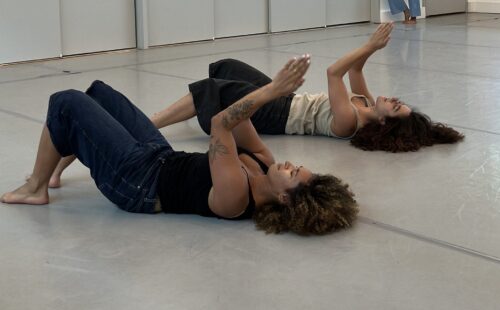
Rehearsing Cecilia Benitez’s “Asimilado” to be performed at the Moss Center. (Photo courtesy of Syncopate Collective)
“Syncopate Collective functions as an incubator for both dancers and choreographers,” says Benitez, a 28-year-old Miami native who earned a BFA in Dance from Point Park University in Pittsburgh and studied at Madrid’s Conservatorio de Danza Superior María de Ávila. Like Darbonne, she has been part of the group since its inception. “It’s been incredible to witness how much we’ve evolved.”
Benitez emphasizes the importance of artists supporting one another. “The collective provides a place where we experiment, take risks, and build community while navigating the complexities and joys of making art. This uplifts the next generation of movers and makers. As a choreographer, it has allowed me to develop my voice, openly and judgement-free.”
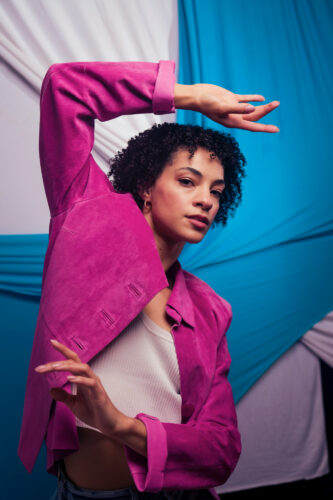
Syncopate Collective member and “Metamorphosis” choreographer Deja Darbonne (Photo by Mateo Seza, courtesy of Syncopate Collective)
Darbonne agrees. Born in Fairfield, California, and trained early in her mother’s ballet studio, Darbonne is a longtime South Florida resident and New World School of the Arts (NWSA) graduate. She had been living in New York City for a couple of years when she returned to Miami at a personally trying time.
“Like many artists during the COVID pandemic,” she says, “I was searching for community and opportunities to dance. I found that through the collective. Over time, I stepped into more of a leadership role, helping the organization become more grounded while staying true to its collaborative spirit.”
Springing out of its first incarnation, called Miami Movement Collective, Syncopate found a surer stride thanks in part to Darbonne, a 31-year-old ballerina with far-ranging artistic tastes. “Ingrained in my body, ballet has given me a deep appreciation for elegance, softness, musicality,” she says. “But I also love challenging its expectations, executing a clean pirouette then collapsing to the floor—a contrast between refinement and release which feels deeply human.”
Her stance aligns with the multifaceted initiatives of other Syncopate co-founders Enrique Villacreses, Rafael Ruiz-Del-Vizo, Brooke Logan and Maya Billig. “We envisioned a space where Miami dance artists could train in contemporary dance, collaborate, and create performance opportunities for emerging professionals,” says Darbonne.
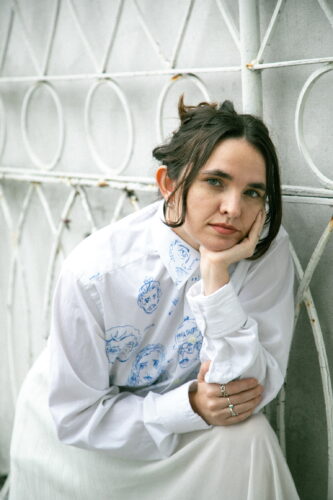
Syncopate Collective member and “Asimilado” choreographer Cecilia Benitez. (Photo by Julieta Rakover, courtesy of Syncopate Collective)
Benitez explains how duties are distributed among Syncopate’s current 11 members. “Nicole Pedraza and I handle grant writing, Enrique does videography and archiving, Estefania Delgado takes care of social media and marketing, and so forth. We all use our various skills to bring organization and functionality to the collective.” Another significant step forward this year, Benitez says, was receiving 501(c)(3) nonprofit status, with the tax-exemption and tax-deductible donation advantages that come with it.
The environment already built by Syncopate has fostered an eclectic set of arresting works presented at individual concerts, often as part of yearly dance-anthology shows such as Miami Dances. A residency at Coral Gables’ Sanctuary of the Arts has facilitated the group’s teaching, rehearsals and performances there. And the upcoming engagement at the Moss Center continues to elevate Syncopate’s profile.
“This is a unique opportunity where we as a collective — entrusted with full artistic freedom — have been commissioned for an original program,” says Benitez, who is presenting work on a split bill with Darbonne for the first time. “Within Syncopate, programming is typically decided through voting. Deja and I expressed interest in the current project, and the collective supported us. She and I have distinct voices, but our choreography works well together creating varied perspectives and styles.”
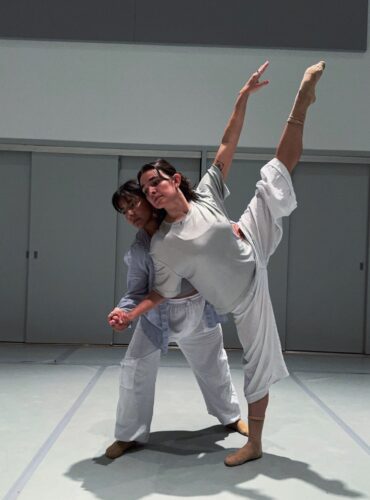
Nicole Pedraza and Cecilia Benitez in rehearsal for Deja Darbonne’s exploration of mindset transformation “Metamorphosis” (Photo courtesy of Syncopate Collective)
“Asimilado”—which Benitez calls “deeply rooted in the community that shaped me”—arose from this Cuban-American’s disquiet. “I am interested in the emotional and cultural costs of assimilation—what’s sacrificed in order to belong,” she says. “This work was sparked by an accumulation of experiences and conversations over many years, alongside broader social and political shifts taking hold in Miami. I’m compelled to ask how a community with the highest percentage of immigrants in the country has come to support rhetoric and policies at odds with its history and capacity to thrive. This led me into the themes of belonging, identity, and collective responsibility.”
Benitez underscores how much care was required to do her subject justice. She has relied on a diligent creative process and a close-knit cast. Victoria Mora, her former Rosie Herrera Dance Theatre colleague, danced in an earlier Benitez duet; Luiza Lamoglia’s friendship with the choreographer dates back to their NWSA High School days; and Maria Burt, another NWSA graduate, has recently performed with Benitez in Adele Myers and Dancers.
“They never shy away from a challenge,” emphasizes the choreographer, identifying motifs—U.S. border issues, labor, ancestral storytelling—which arose in solidarity. “Because each dancer comes from a different cultural background, I give them space to connect with the material in a way that feels authentic.” For that, Benitez also singles out costume co-designer Jorge Fernandez and composer/music director Dylan Kersten.
Whereas “Asimilado” interrogates humanity with an approach akin to social science, “Metamorphosis” plugs into psychology.
“Both as a curse and a gift, I’ve always been an over-thinker,” says Darbonne. “Yoga introduced me to philosophies of mind and the possibility of finding peace amid the constant fluctuations of thought. I became fascinated by how experiences remain with us physically, how our bodies carry not only our own emotions but also those imprinted from the people around us.”
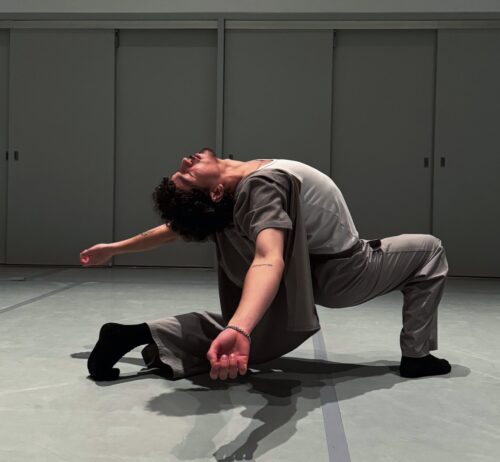
Syncopate Collective dancer Jesus Sandoval opens his body driven by mental energy in Deja Darbonne’s “Metamorphosis” (Photo courtesy of Syncopate Collective)
That laid the foundation for “Metamorphosis,” with its choreography, Darbonne says, serving as “a way of making inner experiences visible.” The work probes how mental energy undulates through the spine, precipitating “unpredictable shifts of weight, sudden changes in direction, and emotional currents that ripple from one dancer to another.”
Spurred by music and deliberate about structure, Darbonne traces “a journey of transformation,” with each section of her dance representing psychological stages—the onset of consciousness, memory, fear, resilience, and equanimity through self-acceptance and love. Solos, duets and ensembles crop up among five dancers (Benitez among them) responding to an equal number of musical selections.
She says her final section is set to “Agape” by Nicholas Britell, the ethereal song from the award-winning composer’s “If Beale Street Could Talk.”
“To me, this feels like a phoenix rising from the ashes,” says Darbonne.
In resonance with their shared artistic journey, here Syncopate dancers connect through movement that’s softer yet more expansive. For the choreographer, it’s a projection—relevant to the whole collective—of how “transformation isn’t about erasing pain but allowing it to become a source of growth.”
WHAT: Syncopate Collective
WHERE: The Dennis C. Moss Cultural Arts Center, 10950 SW 211 St., Miami
WHEN: 7:30 p.m. Friday, Aug. 14, and Saturday, Aug. 15; 3:30 p.m. Sunday, Aug. 16
COST: $35
INFORMATION: 786-573-5300 or www.mosscenter.org
ArtburstMiami.com is a nonprofit media source for the arts featuring fresh and original stories by writers dedicated to theater, dance, visual arts, film, music and more. Don’t miss a story at www.artburstmiami.com
No posts found
As International Ballet Festival of Miami Unfolds, Dancers Reflect on Milestones
Written By Orlando Taquechel
August 4, 2026 at 12:03 PM
Mayuko Nihei and Erick Rodríguez—principal dancers with Mexico’s National Dance Company, the foreign troupe that has performed at the festival more times than any other and is returning this year—participated in the 2023 IBFM. (Photo by Simon Soong, courtesy of Miami Hispanic Ballet/International Ballet Festival of Miami).
The 31st International Ballet Festival of Miami (IBFM) is in full swing on stages across South Florida. The festival, now a summer tradition that culminates in its Grand Classical Gala and Closing Gala at the Fillmore Miami Beach, offers audiences a chance to see dancers and companies that rarely perform in South Florida.
For many of the performers, it has meant sharing in experiences, a launching pad for careers, a place where artistic connections are made and lasting memories linger.
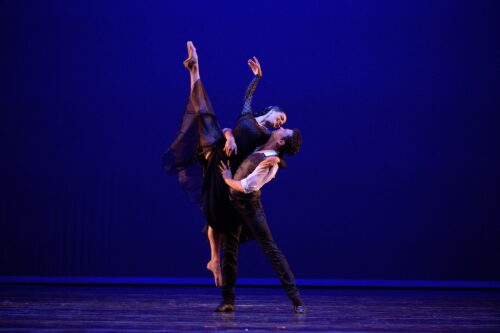
Marize Fumero and Arionel Vargas, dancers with the Milwaukee Ballet—one of the companies participating in the 31st International Ballet Festival of Miami 2026. (Photo by Simon Soong, courtesy of Miami Hispanic Ballet/International Ballet Festival of Miami).
Dance NOW! Miami co-founder and co-director Hannah Baumgarten remembers waiting backstage before a 1998 performance with Momentum Dance Company when she watched a young Tamara Rojo dance with the English National Ballet.
“The young woman performing was spectacular and had a special spark in her eyes,” Baumgarten recalled.
Rojo is now artistic director of San Francisco Ballet.
“It is those moments,” Baumgarten said, “that make international festivals so valuable: sharing with immense talents, feeling the respect shown for our work around the world and following the paths of those who are headed toward magnificent lives and careers.”
For Colombian principal dancer José Manuel Ghiso and his wife, Chilean principal dancer Natalia Berrios, the festival became an important part of their international careers. Ghiso first performed at the festival in 1999; Berrios made her debut in 2001. They returned together in 2011 and 2016 as a partnership from the Ballet de Santiago before dancing the “Onegin” pas de deux as their farewell festival performance in 2019.
“As performers, the festival was a vitally important international platform for our professional careers, as it allowed us to remain relevant and hold our own alongside the invited international stars.”
Jennifer Kronenberg and Carlos Guerra also credit the festival with helping strengthen artistic relationships. The pair debuted at the festival in 2004 as principal dancers with Miami City Ballet and later returned to represent their own company, Dimensions Dance Theatre of Miami, which they founded in 2016.
“Participating in the IBFM has been an immense honor for DDTM,” Kronenberg said, adding that the opportunities to connect with artistic directors, choreographers and dancers from around the world have been invaluable.
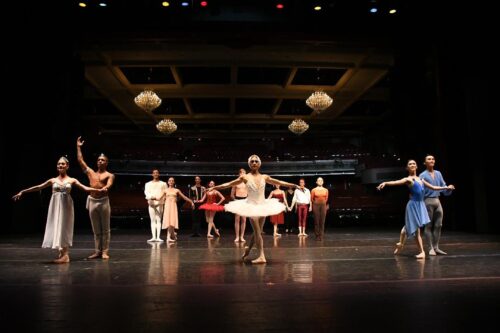
Dancers in the Stars Gala of the 25th IBFM (2020), held without an audience due to restrictions imposed by the COVID-19 pandemic. (Photo by @patriciasphotography)
Since moving to the United States in 2016, Cuban dancer Mayrel Martínez said she has performed at the festival on several occasions: first with the Cuban Classical Ballet of Miami and later representing DDTM.
While there were career milestones, one experience she said was memorable because of the extraordinary circumstances.
“During the COVID-19 pandemic, the entire festival was livestreamed—with no audience in the theater—and the feeling was very strange. Performing in an empty theater served as a reminder of just how much the audience is part of every performance, and that we dance not only to execute choreography but also to communicate and connect with others,” Martínez said.
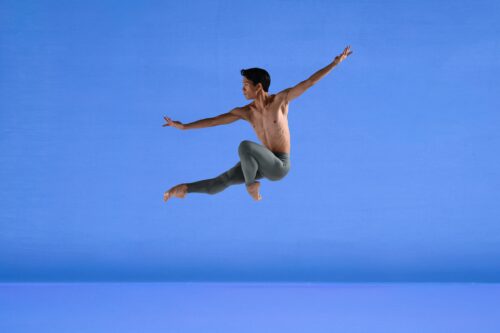
Remina Tanaka made his debut with the IBFM before officially beginning his first season with the Arts Ballet Theatre of Florida (ABTF). (Photo by @patriciasphotography)
For Japanese dancer Remina Tanaka of the Arts Ballet Theatre of Florida (ABTF), participating in his first festival was especially unforgettable. “It took place in August 2021, just weeks before I officially began my first season with ABTF, so it was my first performance in Miami.”
A year later, he found himself sharing the program with dancers he had admired since he was a teen.
“In 2022, I had the honor of meeting Martina Arduino and Marco Agostino, principal dancers with the Teatro alla Scala Ballet. They were two dancers I had admired since my teenage years—watching their performances on YouTube and later on Instagram while dreaming of becoming a professional ballet dancer myself. Sharing the bill with them was an almost surreal experience.”
The IBFM also marked the first opportunity for freelance Cuban dancers Beatriz García and Armando Bryson to perform in the United States after they emigrated in 2022; both say they are “immensely grateful” to IBFM director Eriberto Jiménez for what they describe as “a genuine welcoming embrace.”
Among their favorite memories was dancing during a free performance on Lincoln Road, where passersby stopped to watch and later attended one of the festival’s theater performances.
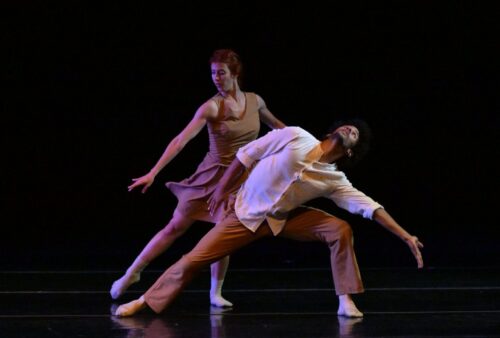
Beatriz García and Armando Brydson in “To Zero Point” during the Contemporary Performance II show at the 27th IBFM, on Saturday, Aug. 6, 2022, at the Miami Theater Center. (Photo by Simon Soong)
“After one of the main theater performances, a group of people waited for us to say they had decided to come see the show after having watched us dance on the street.”
The festival has also created lasting memories for Venezuelan dancer Mary Carmen Catoya, who in 2023 both performed Vladimir Issaev’s “Vertigo” and accepted the festival’s “A Life for Dance” award on behalf of the Arts Ballet Theatre of Florida founder while he recovered from COVID-19 in Hong Kong.
“The wonderful thing about a festival like this is that every company, choreographer and dancer brings a part of themselves to the stage,” Catoya said.
While dancers remain at the heart of the festival, an IBFM initiative also recognizes those who document and preserve the art form.
Since 2007, the festival has presented its “Criticism & Culture of Ballet” Award to journalists and scholars whose work has advanced dance criticism and education. This year’s recipient is Christine Jowers, founder and editor of the digital magazine “The Dance Enthusiast.”
“At a time when serious journalism faces enormous challenges,” explains Jiménez, “the immediacy of social media has transformed how information is consumed, making it more important than ever to recognize professionals committed to rigor, research, and quality in their work,” festival founder and director Eriberto Jiménez said.
Previous recipients say the honor has helped raise their international profile.
Perfecto Uriel, director of La Casa de la Danza in Logroño, La Rioja (Spain), who received the honor in 2024, said it has been a significant boost to outreach efforts.
“This award is a tremendous tribute to the effort, perseverance, and love with which we at La Casa de la Danza in Logroño work every day to preserve, promote, and elevate the art of dance.”
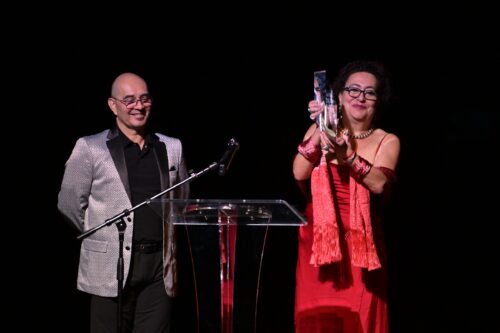
Eriberto Jiménez presents the “Criticism and Culture of Ballet” award to Rosario Manzanos at the Stars Closing Gala of the 28th International Ballet Festival of Miami on August 13, 2023. (Photograph by Simon Soong, courtesy of Miami Hispanic Ballet/International Ballet Festival of Miami).
Mexican journalist Rosario Manzanos—a columnist for the newspaper Excélsior and a 2023 award recipient — said the award connected her with a lineage of respected dance critics she has long admired.
“It still amazes me to have met the learned (New York Times critic) Clive Barnes and to have interviewed my friend Anna Kisselgoff (New York Times dance critic). So, it was with great joy that I reunited with my mentor Orlando Taquechel. It is deeply significant that, just like Clive and Anna, we have both received the same distinction from the IBFM,” concludes Manzanos.
Jiménez believes those connections remain one of the festival’s defining strengths.
“After 31 years, we continue to believe that dance is a universal language capable of uniting cultures, inspiring new generations and enriching the lives of our community,” he said.
WHAT: The 31st International Ballet Festival of Miami
WHEN and WHERE: Contemporary Performances: 8 p.m. Thursday, Aug. 6, Euclid Oval, Lincoln Road, 660 Lincoln Rd., Miami Beach (free); 8 p.m. Friday, Aug. 7, Manuel Artime Theater, 900 SW 1st St., Miami; 8 p.m. Saturday, Aug. 8, Dennis C. Moss Cultural Arts Center, 10950 SW 211 St., Cutler Bay; 5 p.m. Sunday, Aug. 9, Amaturo Theater, Broward Center for the Performing Arts, 201 SW 5th Ave., Fort Lauderdale.
Classical Ballet Performances: 8 p.m. Saturday, Aug. 15, Grand Classical Gala, The Fillmore Miami Beach at the Jackie Gleason Theater, 1700 Washington Ave., Miami Beach; 5 p.m. Sunday, Aug. 16, Closing Gala of the Stars, The Fillmore Miami Beach at the Jackie Gleason Theater, 1700 Washington Ave., Miami Beach.
COST: Lincoln Road (free). $45, contemporary performances. $40 to $70, classical performances.
INFORMATION: (786) 747-1877 and internationalballetfestival.org
ArtburstMiami.com is a nonprofit media source for the arts featuring fresh and original stories by writers dedicated to theater, dance, visual arts, film, music and more. Don’t miss a story at www.artburstmiami.com
No posts found
Carne Viva’s Collaborative Festival Debuts at Sandrell Rivers Theatre
Written By Josie Gulliksen
August 4, 2026 at 10:12 AM
Carne Viva Dance Theatre’s VIDA Festival brings together dancers, musicians and multidisciplinary artists for workshops, choreographic labs and performances at the Sandrell Rivers Theater.(Photo by Sergio Escorcia, courtesy of CVDT)
Carne Viva Dance Theatre founders Chachi Perez and David Velazco wanted to create more than another performance. They envisioned a space where dancers, musicians and multidisciplinary artists could learn from one another, experiment and build lasting creative relationships.
That idea became VIDA Festival, a four-day event, beginning Thursday, Aug. 6 and running through Sunday, Aug. 9 at Sandrell Rivers Theater featuring workshops, choreographic labs and performances, all culminating in a finale performance.

Directors Chachi Perez and David Velazco. (Photo by Benny Valencia, courtesy of CVDT)
“David and I always make time to discuss things,” Perez said. “As two multidisciplinary artists, we knew presenting a cross-disciplinary event would be beautiful for people in Miami and align with our goal to build community.”
The idea for the festival began taking shape in 2024 over lunch in Hialeah after the pair had been shopping for props for their show “Dame La Receta (Give me the Recipe)” a show the duo developed that’s laced with humor but also seriousness about the rituals of passing on culinary (and other) practices among families. Around the same time, Carne Viva received a MAP Fund grant supporting artists creating new experimental work.
Their journey to this point was years in the making, starting with education and mentorship from Michelle Grant-Murray, coordinator of dance at Miami-Dade College Kendall Campus who provided the building blocks and support for Perez and Velazco, according to the duo.
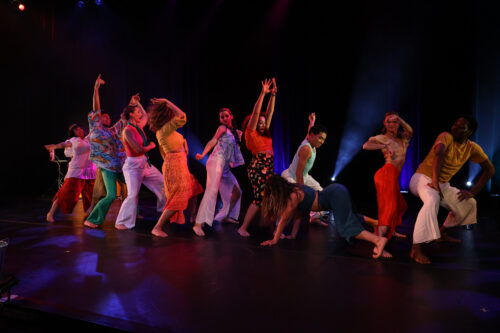
Carne Viva Dance Theatre and Miami Dade College’s Jubilation Dance Ensemble. (Photo by MDC Photography Department)
“I’ve known Chachi and David for a long time, they were constantly in the studio creating something and it’s what they’re doing to this day.”
As the concept developed, Perez and Velazco looked to the relationships they had built while performing and attending festivals around the country, including festivals in New York and North Carolina. While attending the 2025 Philadelphia Fringe Festival, where Perez was living at the time, the pair began seriously discussing the idea of creating a festival in Miami. Talking with artists they met there reinforced their belief that South Florida needed something similarly collaborative.
“We kept meeting people who encouraged us to stay in that world,” Velazco said. “At the same time, we were meeting a lot of artists and creatives in Miami who needed that space here at home, so we wanted to create a platform for them.”
The project began to take shape after Carne Viva was accepted into the Cultural Arts Partnership residency at Sandrell Rivers Theater, giving the company a venue and production support to develop the inaugural festival.
“Their application was amazing,” said Rommel Arellan-Marinas, associate artistic director at Sandrell Rivers Theater. “We felt it aligned perfectly with the community we want to create at the theater.”
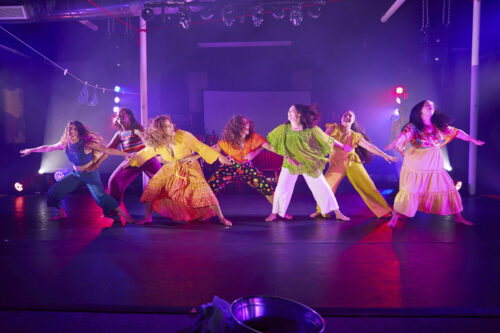
Carne Vida Dance Theatre premiere of “Dame La Receta.” (Photo by Sergio Escorcia, courtesy of CVDT)
Velazco and Perez invited their friends and partners in the arts world to teach the classes and workshops.
Over four days, participants can take workshops in Afro-Cuban dance, reggaeton, movement, music and choreography led by local artists and guest instructors. Choreographic labs will give artists an opportunity to develop new work before the festival concludes with “Noche de VIDA,” featuring works created during the labs and a community Cuban rumba jam session.
The lineup features local performers and instructors, including Carne Viva company members Fernanda Romero and Nicole Machado, who will lead reggaeton and introductory Cuban dance classes. Adriel Martinez and Malena Mieri of Bombe Dance Academy will offer an Afro-Cuban dance workshop, while singer and dancer Gaiya will lead a meditative movement class. Cuban singer Daymé Arocena, for whom Velazco serves as co-band director and drummer, will present a dance, movement and vocal workshop. Irvin and Fonzy of Primera Generación will lead a class and participate in the choreographic labs.
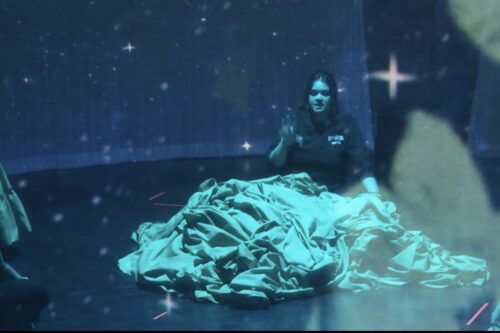
Chachi Pérez, co founder of Carne Viva Dance Theatre participates in “Pachanga e Poder,” a Latinx, Latin American, and Caribbean social dance incubator hosted by Ohio State’s Department of Dance in March 2025. (Photo by Kym McDaniel)
After the three days of workshops and labs, the four-day festival culminates with Noche de Vida where they will present works in progress during the Choreo Labs and finish the night with a full-on jam session of Cuban rumba with the Cuban group Clave y Cuba.
Creating and fostering an intergenerational/intercultural atmosphere over the next few years is the goal, said Perez.
“That is our mission and my hope and dream is to have people build meaningful relationships. I would love for that to flourish throughout the festival and for our guest artists to have our participants eventually work with them,” said Perez.
WHAT: VIDA Festival, presented by Carne Viva Dance Theatre, featuring workshops, choreographic labs and the closing performance, “Noche de VIDA.”
WHEN: Workshops and Choreo Labs, 10 a.m. to 5 p.m., Thursday through Saturday, Aug. 6-8; “Noche de VIDA,” 6:30 p.m., Sunday, Aug. 9.
WHERE: Sandrell Rivers Theater, 6103 NW 7 Ave., Miami
COST: Single class $29.50; daily pass $73.50; student/industry four-day festival pass $167; general admission four-day festival pass $249.50. Final event open to public on Sunday, $18.75.
INFORMATION: carnevivadancetheatre.com
ArtburstMiami.com is a nonprofit media source for the arts featuring fresh and original stories by writers dedicated to theater, dance, visual arts, film, music and more. Don’t miss a story at www.artburstmiami.com.
No posts found
Dance Meets Two Pianos in a New DDTM-Dranoff Collaboration
Written By Elisabeth Campbell
July 7, 2026 at 9:41 PM
Jennifer Kronenberg and Carlos Guerra in the DDTM 2016 premiere of “Ante El
Escorial” by Yanis Pikieris, which is featured on the “Summer Dances & 2 Pianos program at the Moss Center on Saturday, July 11. (Photo by Simon Soong, courtesy of Dimension Dance Theatre of Miami)
A partnership between two performing arts groups has a double-edged component. The goal of the collaboration between Dimensions Dance Theatre of Miami (DDTM) and Dranoff 2 Piano Fusion is to not only present something new from each organization but to introduce new audiences to both organizations.
“Summer Dances & 2 Pianos” at the Dennis C. Moss Cultural Arts Center on Saturday, July 11, features DDTM company premieres by choreographer DaYoung Jung of the Oklahoma City Ballet and DDTM artist-in-residence Yanis Eric Pikieris with DDTM dancers Selah Jane Oliver and Rafael Ruiz-del-Vizo. Music will be performed by New York-based piano duo Stephanie & Saar, Stephanie Ho and Saar Ahuvia.
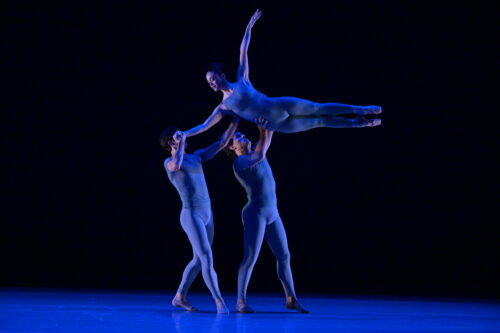
Ariel Morilla, Paulina Zambrana, and Rafael Ruiz del Vizo in “Summer Dances & 2 Pianos.” (Photo by Simon Soong, courtesy of Dimension Dance Theatre of Miami)
“Music and dance lend (themselves) very naturally to collaboration,” said Emily Cardenas, executive director of Dranoff.
Having spent the bulk of their careers with Miami City Ballet, DDTM co-founding Artistic Directors Jennifer Kronenberg and Carlos Guerra have a special connection to performing with live music.
“We’re used to that element of live music,” said Kronenberg. “It keeps you literally on your toes.”
She calls the give and take between live music and dance a “partnership, a joint effort that brings the performance to life in a different way than when you’re just dancing to a recording.”
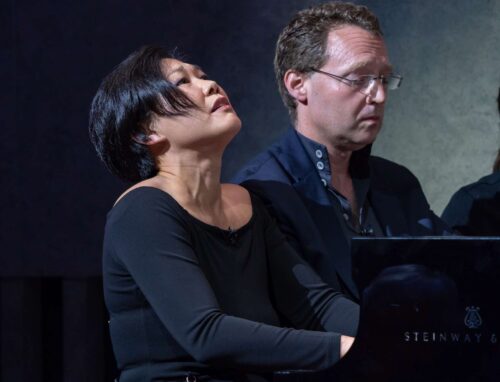
Piano duo Stephanie & Saar performing a piano four-hands composition in concert. (Photo courtesy of the artist)
Ho and Ahuvia have accompanied dancers before in Dranoff programs, including its annual multidisciplinary Piano Slam that brings together live music, dance and spoken-word poetry.
“. . . When we get on stage and perform, it’s never going to be the same,” said Ahuvia. “There is going to be a real excitement there because we are going to be in conversation with each other… It’s dangerous, it’s unpredictable, but it has that flair that we look for in a live performance: that element of surprise.”
DDTM will present the company premiere of DaYoung Jung’s “There, Never There,” set to music by composer Alfonso Peduto. Originally created for Oklahoma City Ballet in 2023, Jung expanded the work for DDTM with a new pas de deux.
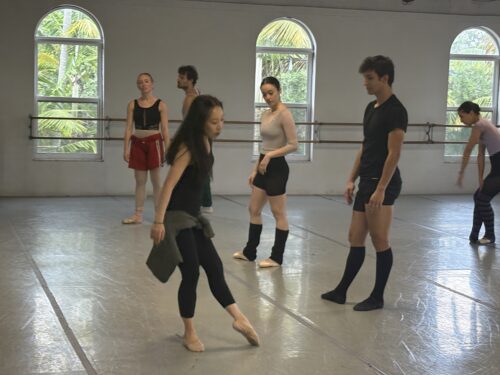
Choreographer DaYoung Jung in rehearsal staging “There, Never There” on DDTM
dancers. (Photo by Simon Soong, courtesy of Dimension Dance Theatre of Miami)
Kronenberg describes the choreography style as “contemporary ballet.”
“It is definitely rooted in a classical ballet vernacular, but fuses classicism with fresh contemporary and modern movement, exploring different levels, and a deeper movement range and fluidity,” said Kronenberg.
“Fantasia de Tres Mundos,” a 2014 Dranoff commission composed by Martin Bejerano, accompanies a piece by Pikieris.
“We were the first team to premiere it, and since then we’ve played it many times,” said Ho.
Ho and Ahuvia consider it to be a “great performer’s piece” representative of Miami’s multicultural spirit.
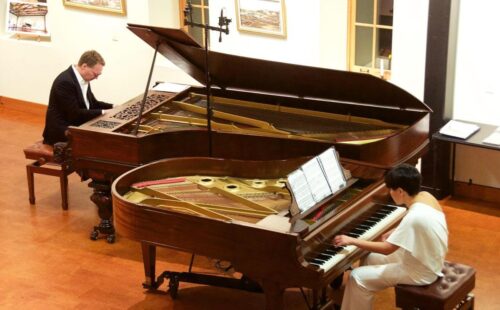
Pianists Stephanie Ho and Saar Ahuvia, who perform as piano duo Stephanie and Saar, are featured in “Summer Dances & 2 Pianos” at The Moss Center on Saturday, July 11. (Photo courtesy of the artists)
“It’s hidden in the music,” said Ahuvia. “The three worlds, or ‘Tres Mundos,’ are actually the classical world, the jazz world, and the Afro-Cuban world. These three worlds kind of come together and become one entity in this piece.”
The duo are frequent performers with Dranoff and find the collaboration between Dranoff and DDTM to be a “natural progression” of the creative projects that the music organization has been pursuing for its programming.
Both “Fantasia de Tres Mundos” and “Pastorale: River of Grass”—co-choreographed by Oliver and Ruiz, a ballet inspired by the Florida Everglades, and set to Beethoven’s Symphony No. 6 —are company premieres for DDTM. Cuban composer Ernesto Lecuona’s work, which accompanies “Ante El Escorial,” also choreographed by Pikieris, was somewhat familiar to Dranoff, but Peduto’s blend of classical traditions with American popular genres is a new approach.
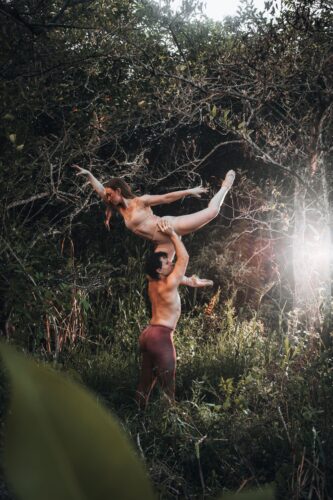
Dancers Selah Jane Oliver and Rafael Ruiz del Vizo, in a pose from their new work, “Pastorale: River of Grass,” inspired by The Everglades. (Photo by Yanni De Melo, courtesy of Dimensions Dance Theatre of Miami)
The two companies seek to create a bridge between their audiences, making the event simultaneously affordable and accessible.
“Hopefully (our audience) will go see Dranoff when they’re performing on their own, and hopefully their audience will fall in love with (DDTM) and with our work,” said Guerra.
Dranoff has been around since 1987 while DDTM is just nearing its 10th anniversary in 2027. As they grow, Kronenberg and Guerra hope to see more collaborations like this in the future.
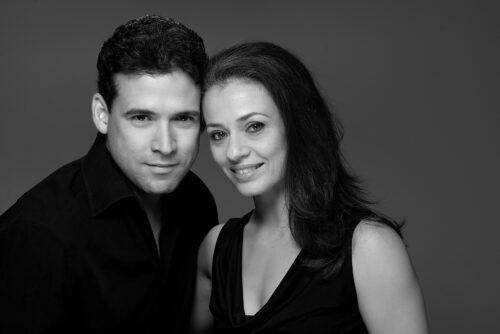
Having spent the bulk of their careers with Miami City Ballet, DDTM co-founding Artistic Directors Carlos Guerra and Jennifer Kronenberg have a special connection to performing with live music. (Photo by Simon Soong, courtesy of Dimension Dance Theatre of Miami)
“The past few years, we’ve been pretty strategic about shaping where the company was going,” said Kronenberg. “We’re ready to navigate additional (budget) challenges. We don’t know until it’s in front of us, so we’re ready for when that happens because we don’t want to be hit in the face like we were that first year when the state funding disappeared.”
With the partnership, Cardenas hopes to create more exposure for both organizations.
“We have so much choice in Miami-Dade County,” said Cardenas. “There’s a lot of culture out there that people are just missing. I think that by fusing our two art forms, not only do we make it easier for the public, but I think it’s more enticing.”
WHAT: Summer Dances & 2 Pianos: Dimensions Dance Theatre of Miami in collaboration with Dranoff 2 Piano Fusion, featuring Stephanie & Saar
WHERE: Dennis C. Moss Cultural Arts Center, 10950 SW 211th St., Cutler Bay
WHEN: 8 p.m. Saturday, July 11
COST: $45, $35, $25
INFORMATION: (786) 573-5300 or www.mosscenter.org
ArtburstMiami.com is a nonprofit media source for the arts featuring fresh and original stories by writers dedicated to theater, dance, visual arts, film, music and more. Don’t miss a story at www.artburstmiami.com.
No posts found
Miami City Ballet Orchestra Gets a Star Turn at Sanctuary
Written By Guillermo Perez
May 26, 2026 at 5:23 PM
Gary Sheldon, Miami City Ballet orchestra’s music director leads an evening of “Ballet Classics Under the Stars” at the Sanctuary of the Arts—a rare performance showcasing the musicians of the ballet orchestra. (Photo courtesy of Gary Sheldon)
While the title of Miami City Ballet’s upcoming concert, “Ballet Classics Under the Stars,” may suggest an outdoor performance beneath the night sky, the star power will come from the stage at the Sanctuary of the Arts in Coral Gables, where the musicians of the Miami City Ballet orchestra will be in the spotlight.
Organized by longtime Miami City Ballet music director Gary Sheldon, the concert offers audiences a rare chance to focus on the orchestra as featured performers rather than accompanists to dance. While ballet remains woven throughout the evening, Sheldon says the program is equally about showcasing the musicians’ artistry.
“There will be ballet selections, of course, but this is really an opportunity for audiences to hear the orchestra live in a different way,” Sheldon says.
The concert will include several dance-centered works, including the balcony scene from “Romeo and Juliet,” featuring music by Sergei Prokofiev and choreography by Rafi Maldonado-Lopez and Alice Arja for the young dancers of the Sanctuary of the Arts Choreographic Ensemble. Miami City Ballet dancers Nathalia Arja and Rui Cruz will also perform Pontus Lidberg’s “Daybreak” with the music of “Adagio for Strings” by Samuel Barber.
“Dancers who have made their careers at MCB,” Sheldon notes.

Miami City Ballet principal dancer Nathalia Arja takes the stage as a guest artist for the upcoming performance, “Ballet Classics Under the Stars,” at the Sanctuary of the Arts. (Photo courtesy of Miami City Ballet)
But the evening’s primary focus is on the orchestra itself — something Sheldon says he has wanted audiences to experience more directly for years.
Throughout his 16 seasons conducting for Miami City Ballet, Sheldon has developed a musical approach rooted in collaboration with choreographers and dancers. Conducting for ballet, he explains, differs greatly from leading a symphony orchestra because the music must respond to movement as much as to the score.
“For a dance performance, I have to study and honor not only the composer, but also the choreographer, the dancers and the company’s artistic director,” Sheldon says. “It’s a shared experience.”
Sheldon says he regularly attends rehearsals and ballet classes to better understand how movement affects musical interpretation.
“I need to understand what the body can do in motion . . . and the most important thing is timing. Sometimes, being sensitive to the dancers’ moods, it’s helpful to give them a moment to breathe, because this is a living, breathing art,” he says.
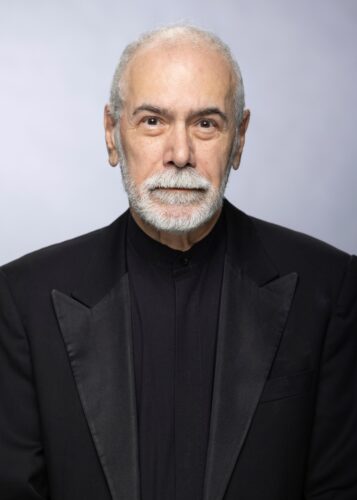
Company rehearsal pianist since 1999, Francisco Rennó takes the stage to perform Tchaikovsky’s “Piano Concerto No. 3” during the Miami City Ballet orchestra’s “Ballet Classics Under the Stars” at the Sanctuary of the Arts.
Sheldon’s understanding of the music is essential to the productions. Sheldon recalls working with acclaimed choreographer Alexei Ratmansky during Miami City Ballet’s “Swan Lake.” In one scene involving Odette pleading with hunters not to shoot the swans, Sheldon noticed a musical passage by Tchaikovsky had been removed.
After playing the passage on piano for Ratmansky, the choreographer decided to restore it.
“It is a truly extraordinary melodic modulation, the kind only Tchaikovsky could have composed,” Sheldon says, adding that the restored section gave greater emotional authority to the ballerina.
Sheldon’s path to ballet conducting began at The Juilliard School in New York, where he studied orchestral conducting and percussion before focusing on entirely conducting at the Institut de Hautes Études Musicales (Institute for Advanced Musical Studies) in Montreux, Switzerland. One of Sheldon’s first ballet conducting jobs came at age 20 with the St. Louis Civic Ballet.
Before arriving in Miami in 2010 at the invitation of then-artistic director Edward Villella, Sheldon spent six seasons as principal guest conductor with the San Francisco Ballet.
His debut season with Miami City Ballet carried a personal resonance. Villella programmed Jerome Robbins’s ballet “Fanfare,” set to Benjamin Britten’s “The Young Person’s Guide to the Orchestra,” a piece Sheldon had conducted years earlier during his St. Louis debut.
Now, Sheldon sees “Ballet Classics Under the Stars” as another milestone.
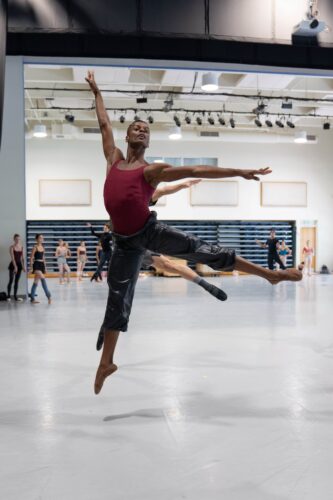
Rui Cruz rehearsing at Miami City Ballet studios for George Balanchine’s “Jewels.” The MCB dancer will perform in “Ballet Classics Under the Stars,” at the Sanctuary of the Arts. (Photo by REN Media, courtesy of Miami City Ballet)
He credits Mike Eidson, former president of Miami City Ballet’s board and current president of the Sanctuary of the Arts board, for helping create the opportunity.
“One extraordinary aspect of our orchestra is its profound commitment to the highest values of musical performance,” Sheldon says. “So dedicated to the ballet company’s repertoire, the musicians never cease to strive for excellence, even when they are not the center of attention. But the time has now come for the public to enjoy their talents live.”
The concert repertoire reflects Miami City Ballet’s history while also going beyond it. Among the featured works is Tchaikovsky’s “Piano Concerto No. 3,” famously choreographed by George Balanchine as “Allegro Brillante.” Brazilian pianist Francisco Rennó, who has served as the company pianist for the Miami City Ballet since 1999, will perform the piece.
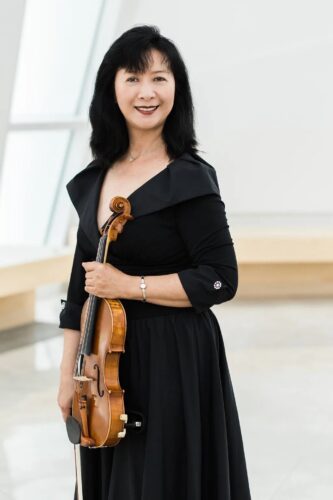
Concertmaster and violinist Mei Mei Luo steps into the solo spotlight on violin for Pablo Sarasate’s “Fantasy on Carmen” during the Miami City Ballet orchestra’s upcoming performance, “Ballet Classics Under the Stars,” at the Sanctuary of the Arts. (Photo courtesy of Delray String Quartet)
Concertmaster Mei Mei Luo will be featured in Pablo Sarasate’s “Fantasy on Carmen,” inspired by Bizet’s opera and a new reinterpretation of the classic story by choreographer Annabelle Lopez Ochoa, which had its world premiere last season.
Additional selections include a polonaise from Tchaikovsky’s “The Sleeping Beauty” and Borodin’s “Polovtsian Dances” from “Prince Igor.”
Sheldon says education and accessibility are also central to the evening. Throughout the concert, he plans to speak directly to audiences about the music and its connection to ballet.
“I always try to build bridges,” Sheldon says. “People who may not know ballet very well can discover Miami City Ballet through the music. And ballet lovers can hear the orchestra in a completely different and perhaps enlightening way.”
WHAT: “Ballet Classics Under the Stars” featuring the Miami City Ballet orchestra
WHERE: Sanctuary of the Arts, 410 Andalusia Ave., Coral Gables
WHEN: 7:30 p.m., Friday, May 29 and Saturday, May 30; 4 p.m. Sunday, May 31
COST: $58 and $73
INFORMATION: (786) 362-5132 and Sanctuary of the Arts
ArtburstMiami.com is a nonprofit source of theater, dance, visual arts, music and performing arts news. Sign up for our newsletter and never miss a story.
No posts found
Ballet Flamenco La Rosa brings ‘Miss Julie’ back
Written By Orlando Taquechel
May 21, 2026 at 10:42 AM
Guest artists Antonio Aguilar and Nella Madarro—pictured here alongside the dancers of Ballet Flamenco La Rosa—starred in the 2014 world premiere of the flamenco ballet “Miss Julie,” a production that now returns to the stage for two performances at the Colony Theatre in Miami Beach. (Photograph by Jenny Abreu, courtesy of Ballet Flamenco La Rosa.)
Ballet Flamenco La Rosa (BFLR) debuted its flamenco dance-theater adaptation titled “Miss Julie” (“Señorita Julia”) —a production staged by Ilisa Rosal in 2014. Now, Rosal brings the piece back saying that “the emotional and theatrical essence of the piece remains intact, while continuing to evolve artistically through new interpretations.”
Inspired by the play “Miss Julie” — written in 1888 by Swedish playwright August Strindberg (1849–1912), the production will be on stage at the Colony Theatre on Lincoln Road in Miami Beach, for two performances on Saturday, May 23 and Sunday, May 24.
The revival will feature guest artists from Spain alongside the company’s dancers and musicians.
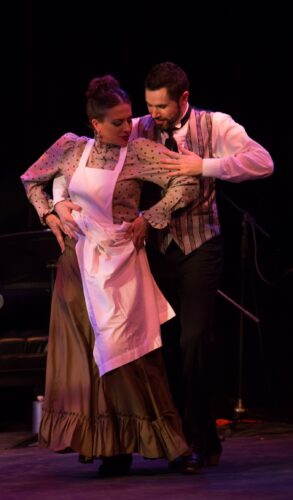
Flamenco dancers Antonio Aguilar (Jean) and Mayelu Pérez (Christine) at the world premiere of the flamenco ballet “Miss Julie” in 2014. (Photograph by Jenny Abreu, courtesy of Ballet Flamenco La Rosa).
“Each artist brings their own personality, experience, and emotional perspective to the production, allowing the work to feel fresh, alive, and deeply relevant to today’s audiences,” remarks Rosal.
Since 1990—when she premiered “The Trojan Women,” based on Euripides’ tragedy—Rosal has been presenting flamenco adaptations of renowned theatrical pieces and literary works.
“Expressing a literary work in this manner entails seeking out the “duende” within the text. It is about finding those moments in which a character’s experiences and emotions become universal,” she explains in the press notes promoting these two performances.
‘Duende” is a Spanish term that describes the achievement of a magical state in a flamenco performance.
To date, Rosal has created 18 flamenco dance-theater adaptations. The most recent of these was “The Virgin and the Gypsy” (2025), inspired by the D. H. Lawrence novel of the same name. Two of her works have been based on plays by Strindberg: “Miss Julie” (2014) and “The Father” (2015).
Strindberg’s play features only three characters: Julie, Jean, and Christine. Julie is a young aristocrat, Jean is the household servant, and Christine is the cook and Jean’s fiancée.
“On this occasion, Miss Julie will be portrayed by the dancer and choreographer La Emi—one of the most respected and accomplished flamenco artists on the international stage today,” says Rosal. “Her artistic intensity, emotional depth, and commanding stage presence make her the ideal choice for this psychologically complex role.”
American flamenco dancer Emmy Grimm, professionally known as La Emi, was born in New Mexico. She began studying flamenco at the age of four and, at ten, joined María Benítez’s prestigious youth flamenco company. In 2014, she founded her own company, and in 2018, she established her academy, where she serves as both a teacher and a director.
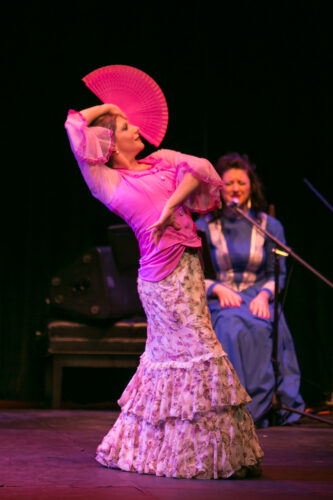
Flamenco dancer Nella Madarro, as a guest artist, starred in “Miss Julie” in 2014. (Photograph by Jenny Abreu, courtesy of Ballet Flamenco La Rosa)
For the role of Jean, BFLR has invited Pepe Flores—a Barcelona-born flamenco dancer with a large following in Miami—who, in 2023, starred as the male lead in “Desire,” Rosal’s adaptation of Tennessee Williams’ “A Streetcar Named Desire”.
Flores previously starred as the male lead in “The Seagull” (2016) and “Count Dracula” (2018). He was also a member of the cast of “Flamenco Force” in 2017, as part of a “Pure Flamenco” performance.
La Emi and Pepe Flores have shared the stage before, in Rosal’s “Count Dracula.”
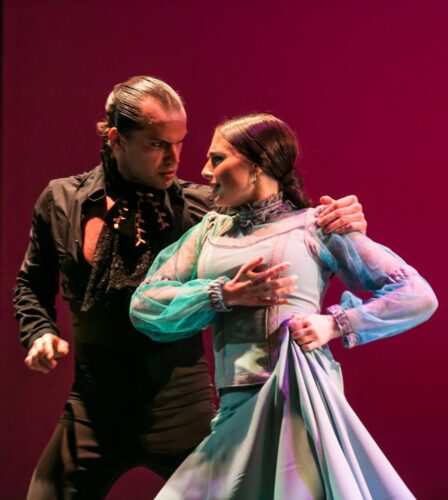
Flamenco dancers La Emi and Pepe Flores in “Count Dracula,” premiered in 2018. (Photograph by Jenny Abreu, courtesy of Ballet Flamenco La Rosa).
Cuban flamenco dancer Mayelu Pérez—now in her eleventh season with BFLR—will take on the role of Christine.
In addition to being one of Strindberg’s most frequently performed works—with numerous adaptations for film, television, opera, and dance— “Miss Julie” is one of Rosal’s most successful productions.
At the 2022 Daniel Lewis Dance Series, BFLR made a standout appearance with a “farruca” excerpted from the 2014 staging.
“This is one of the productions that audiences have requested from us most frequently. So, when the opportunity arose to present it at the Colony Theatre bringing it to fruition became the next logical step,” says the artistic director and choreographer.
Rosal says that there is a reason to bring “Miss Julie” back in addition to it being an audience favorite.
“We hope that this production proves to be a deeply moving artistic experience for the audience while simultaneously reaffirming BFLR’s commitment to original flamenco theater works that fuse powerful storytelling with the emotional intensity and versatility of flamenco music and dance.”
WHAT: “Miss Julie,” a flamenco ballet by Ilisa Rosal, based on the play by August Strindberg.
WHEN: 8 p.m, Saturday, May 23 and 3 p.m., Sunday, May 24
WHERE: Colony Theatre, 1040 Lincoln Road, Miami Beach
COST: $45–$60
INFORMATION: (786) 320-6982 or www.balletflamencolarosa.com
ArtburstMiami.com is a nonprofit media source for the arts featuring fresh and original stories by writers dedicated to theater, dance, visual arts, film, music and more. Don’t miss a story atwww.artburstmiami.com
No posts found
Forward Motion Festival Celebrates the Power of Inclusive Dance
Written By Guillermo Perez
May 11, 2026 at 5:32 PM
Karen Peterson and Dancers host the seventh edition of the Forward Motion Festival on Saturday, May 16 at the Sandrell Rivers, 6103 NW 7th Ave., Miami. (Photo by Lisa Nalven)
Bodies tell stories in myriad ways, and dancers with disabilities turn these into distinctive art. For many of her 35 years among South Florida dance notables, Karen Peterson, a non-disabled choreographer and director of her own company, has added to the quality and spread of physically-integrated dance, which brings together creators and performers exhibiting a range of mobility.
A primary endeavor for Peterson has been the Forward Motion Festival, now in its seventh year. The event, which has gained international attention, brings together established and emerging mixed-abilities dance artists, offering a snapshot of how the form has evolved over the past five decades.
Performances are Saturday, May 16, at Miami’s Sandrell Rivers Theater. Workshops and a roundtable discussion led by Silva Laukkanen, director of integrated dance at Art Spark Texas, follow on Sunday. Also at the conference is Joel Brown, former artist from London’s Candoco Dance Company
“(It’s) a huge undertaking even for someone who’s been at it for so long,” says Peterson, noting that producing this seventh edition involves logistical as well as artistic challenges. Because of the uncertain funding climate, she chose not to invite participants from abroad this year. She says, however, the National Endowment for the Arts ultimately awarded support for the festival.
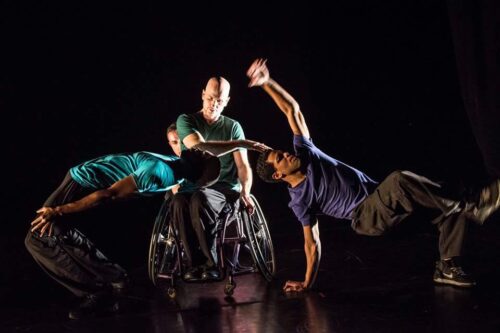
With artistic director Dwayne Scheuneman, center, the men of REVolutions Dance bring power to the network of moves in “Propel.” (Photo by Cliff Roles)
“We may have a smaller audience but do significant work with a loyal following,” emphasizes Peterson.
In addition to Karen Peterson and Dancers, the lineup brings three premieres from Tampa’s REVolutions Dance, founded in 2005 by artistic director and wheelchair dancer Dwayne Scheuneman, a frequent festival participant.
Forward Motion Festival first-timer Marisa Hamamoto, founding artistic director of Los Angeles-based Infinite Flow Dance Company, choreographed and will dance with collaborator Travis Ammann in “Metamorphosis,” an exploration of their identity as differently-abled Asian-Americans. She will also be part of the conference.
For Hamamoto, born in Japan and California-raised, settling on a cultural and an artistic identity has been complicated. “I’ve often felt my only true home is dance,” she says.
But even that has tested her. While held under the spell of ballet, she admits, “More than my ethnicity, physicality impeded my dream to be a professional ballerina.”
Still, she persisted in training — something Hamamoto partly attributes to what she describes as a Japanese work ethic and the “tunnel vision” she associates with her autism, which was diagnosed later in life.
In 2006, she collapsed during a dance class and was paralyzed by a spinal cord stroke.
“I thought this was a curse,” she says, “for continuing to dance in a world telling me to stop.”
In time she regained most of her mobility but remained unable to shake her fear of dancing. Then one day at a Japanese corporate party, where a salsa instructor animated the crowd, Hamamoto was amazed that “in this five-minute activation, my body just came alive. I realized I had purpose—a life worth living.”
Having founded Infinite Flow in 2015, the artist upholds cross-disability representations with eclectic productions true to her hard-earned vision. “Our body language not only speaks to others but also to ourselves,” she says. “When you move with joy, that external vibration also travels inward.”
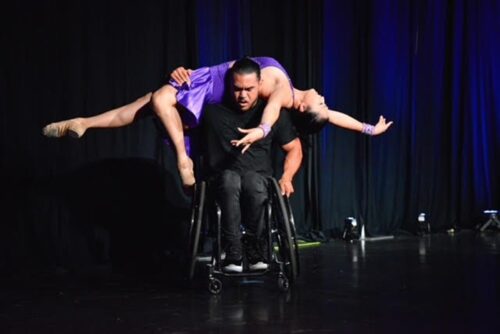
Marisa Hamamoto and Adelfo Cerame Jr putting the daring glow of mixed-abilities dance on Infinite Flow Dance’s “Rise Up.” (Photo by Marisa Hamamoto)
Peterson values a festival newcomer such as Hamamoto, whose resumé includes Latin styles and commercial work. “There’s a wide range in our kind of dance,” says the organizer. “The audience loves to see different groups each year.”
Yet REVolution’s Scheuneman is an artistic anchor. “We have a lot of mutual trust,” says Peterson. “He’s a Gulf War veteran and athlete who, ironically, was injured in a diving accident. A long while back, he contacted me to set a piece on him in Tampa. I nudged him to audition for San Francisco’s Axis Dance—this country’s most venerable physically-integrated company—where he ended up dancing. Directing his own company, he’s engaged an interesting roster of choreographers.”
Scheuneman—who’s performed in FM with both Axis and REVolutions—stresses that such deeply personal relationships have fortified his artistic undertakings.
“Touring to events like Karen’s is an important component of our mission,” he says. “Performers from outside help build local audiences. And the time we spend together lets us learn about our mutual concerns.”
Dancers with different disabilities, by watching each other, discover variant pathways to performance. “In our company we have two dancers who have spinal cord injuries and one leg-amputee,” says Scheuneman. “Going to festivals has helped them develop as artists.”
At this year’s festival, REVolutions will premiere “Adhesion,” choreographed by Merry Lynn Morris, a non-disabled University of South Florida professor long associated with REVolutions.
“This duet shows how being stuck in place, then getting unstuck, is all part of moving onward,” says Morris.
“Propel,” is a quartet by Cuban-American Leymis Bolaños Wilmott, who founded and leads Sarasota Contemporary Dance. Starting at Miami’s New World School of the Arts, the choreographer has been an ally of dancers with disabilities who here examines mutual support among men.
“Love Yourself As You Are” marks dance veteran Frank Chaves’s first work created for dancers with disabilities.
A Miami native of Cuban heritage, Chaves built an award-winning career as choreographer and artistic director of River North Dance Chicago. He recently moved to Sarasota and is living with syringomyelia, a degenerative spinal cord condition.
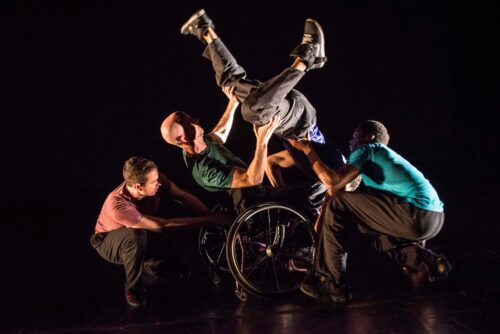
“Propel,” a REVolutions Dance quartet, balances on poses sculpted from the support of differently-abled men. (Photo by Cliff Roles)
A long dinner conversation with Scheuneman about the twists and turns of life and dance inspired Chaves to create this duet for Scheuneman and company dancer Sam Kedziora.
“Since I started out in this,” says Peterson, “there’s been more choreographers working with mixed-ability groups.”
Their works confront such questions as how mobility aids like wheelchairs contribute to artful movement. And Peterson’s own group provides answers with decisive attitude and skills.
“Duets 4 Six,” set to an original score by violinist Polina Mahova and Benjamin Lazarus, returns in an expanded and reimagined version after a preview last October.
“Now there are background dancers who reflect off the original duets,” says Peterson. “They create a sort of mystery.”
The work explores contrasts and parallels within what Peterson describes as “a conversational architecture.”
An expanded version of “In the Blink of an Eye,” set to music by Polina Mahova, continues to explore perseverance in the face of existential blows.
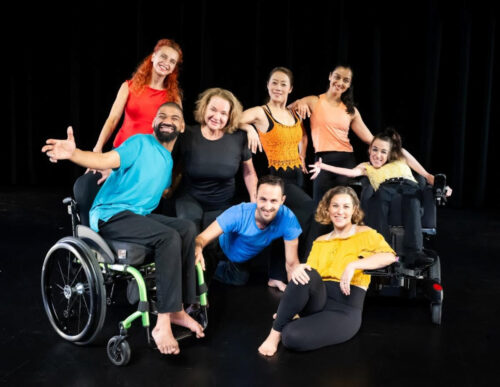
Karen Peterson, center, with the Karen Peterson Dancers, a group of mixed-ability performers. (Photo by Lisa Nalven)
By adding new dancers, Peterson says the work “has gained relevance considering the current dangers of being gunned down or pulled off the street.”
Supporting this dance genre, Peterson wants to create this kind of solid content and craft.
Scheuneman agrees. “I don’t want audiences to just feel inspired by our stories. I hope they’re more impacted not by the challenges of our disabilities but by the quality of our art.”
WHAT: Seventh edition of Forward Motion Dance Festival
WHERE: Sandrell Rivers Theater, 6103 NW 7th Ave., Miami
WHEN: 2 and 7 p.m. Saturday, May 16. FM7 Conference, 2 to 6 p.m. Sunday, May 17
COST: $20 and 25 for shows; free for conference
INFORMATION: (305) 298-5879 or karenpetersondancers.org.
ArtburstMiami.com is a nonprofit media source for the arts featuring fresh and original stories by writers dedicated to theater, dance, visual arts, film, music, and more. Don’t miss a story at www.artburstmiami.com.
No posts found
Dramatic Carnival Parade Photos On View in Little Haiti
Written By Douglas Markowitz
May 8, 2026 at 3:37 PM
Christopher Mitchell’s J’Ouvert photos were shelved for years and now see the light of day in “Daybreak” on view at P71 Gallery in Little Haiti. (Photo courtesy of the artist)
In 2004, Haitian-American photographer Christopher Mitchell went to work on Labor Day. Living in Brooklyn at the time, he decided to take photos during the New York borough’s famous West Indian Day Parade held every first Monday of September. But he didn’t shoot the main parade – instead, he got up before the crack of dawn and joined a procession for J’ouvert, a Carnival celebration celebrated in several Caribbean countries including Haiti.
“I would always document Carnival in Haiti, and when I was in New York, I would also document American parades and types of festivals (including Carnival),” says the artist, now based in Miami at Bakehouse Studios. “But you have to get up very early to catch the J’ouvert element.”
J’ouvert originates from colonial-era protests by enslaved Africans: Barred from celebrating Carnival, they would vandalize the costumes of white colonial citizens with tar or oil in the early hours of the morning. Mitchell took a similarly radical approach to his own project. He shot from within the crowd rather than inside it, entirely on film and mostly in predawn darkness, experimenting with film stocks that would allow him to work in very low light. A malfunctioning flash meant that the only source of light came from overhead streetlamps.
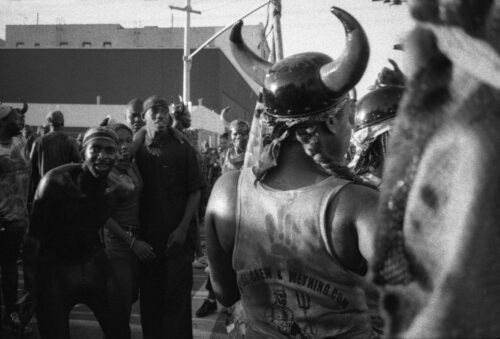
Christopher Mitchell Mitchell shot the photos within the crowd, capturing the dynamic celebration of J’Ouvert. (Photo courtesy of the artist)
“These images are very much like a time capsule of how things were,” he says. “It was a beautiful challenge for me, to be able to shoot during that time when it was mostly film that was available. And I got to try it out in a way that maybe, if I was hired, I doubt a client would want me to do that. But that’s the beauty of being free – I wasn’t hired for this. This is a passion project, so I got to shoot it the way I wanted to see it done.”
The photos mostly went shelved for years, existing only as a single, self-printed volume in Mitchell’s studio. It took a visit from Yessica Gispert, an artist, curator and Visiting Assistant Professor of Photography at Florida International University, for them to see the light of day. A show of the photos, titled “Daybreak” is now on view at P71 Gallery in Little Haiti.
“This whole project that he put together is in real time. It’s him walking through the crowd, and when it starts, it’s at night, and when it ends, it’s daytime.” Gispert, the show’s curator, says. “And I was really drawn to that perspective of him being within the crowd versus on the outside, him being a Haitian photographer, being among his community, him being shoulder to shoulder with everyone and enjoying and observing, not in this kind of outsider view, but very much an insider view. It made me think of Gordon Parks, it made me think of also a lot of SNCC photographers who documented the Civil Rights Movement.”
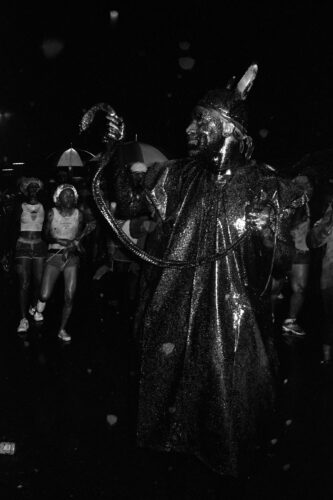
Curator Yessica Gispert compares Christopher Mitchell’s work to social photographers such as Gordon Parks. (Photo courtesy of Christopher Mitchell)
Certainly, the images themselves are striking and dramatic, defined by strong shadows and a dynamic sensibility, with bodies constantly in motion. Light shines off black-painted limbs covered in slick, glossy liquid, a reminder of the celebration’s origins. The graininess of the photos also confers an appropriately gritty quality.
But there’s more to the photos than their aesthetics. Time has given Mitchell’s work an additional resonance: This is, after all, a time before smartphones and omnipresent cameras, and it shows in the faces and movements of the paradegoers.
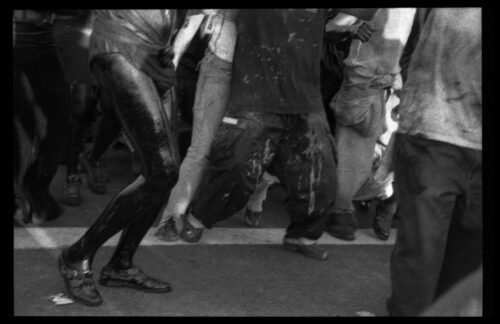
The photographer experimented with film stocks to allow him to shoot in the pre-dawn darkness. (Photo courtesy of the artist)
“People don’t think the way they used to, they don’t carry themselves the way they used to,” Mitchell says. “Like as we’re editing, we’re going through 100-plus images and just watching people in the crowd, just being totally lost in the moment, really immersed. Watching people’s eyes being almost in a trance, like being somewhere else.”
Mitchell points to something that’s commonly expressed in 2026, that people are so hyperaware of smartphones and potentially being posted on social media that they refuse to express themselves in public. His photos show what the world could be like without this state of mass surveillance: More fun, less inhibited, not afraid.
As the artist says: “This is before people even cared about social media.”
WHAT: “Christopher Mitchell: Daybreak”
WHERE: P71 Gallery, 230 NW 71 St., Miami
WHEN: Opening reception, 6 to 9 p.m., Saturday, May 9. Through Thursday, May 28
COST: Free
INFORMATION: instagram.com/p71.art
ArtburstMiami.com is a nonprofit media source for the arts featuring fresh and original stories by writers dedicated to theater, dance, visual arts, film, music and more. Don’t miss a story at www.artburstmiami.com
No posts found
An Outdoor Stage, Premieres and Past Favorites Shape Spring for Dance Companies
Written By Guillermo Perez
May 3, 2026 at 8:45 PM
An excerpt from last year’s “Blue Pencil,” a resonant indictment of censorship featuring dancer David Harris, is part of Dance NOW! Miami’s shows on Friday, May 8 in Lauderhill and Saturday, May 9 in Aventura. (Photo by Simon Soong, courtesy of Dance NOW! Miami)
Staging new works or expanding into a new venue can bring a fresh view of a performing arts company and, with this, a confirmation of continuing vigor. For two of South Florida’s steadfast dance organizations these signs of one more forward-moving spring are about to brighten the calendar.
Dimensions Dance Theatre of Miami will be at Pinecrest Gardens’ geodesic-dome amphitheater for the first time on Saturday, May 9, reviving favorites that fit, as if made for it, the natural setting. And Dance NOW! Miami will unveil co-artistic director Hannah Baumgarten’s “Love-less: Dance of the Last Moho Braccatus,” alongside repertory standards and “Traces,” a world premiere by company co-director Diego Salterini, on Friday, May 8 at Lauderhill Performing Arts Center and on Saturday, May 9 at Aventura Arts & Cultural Center.
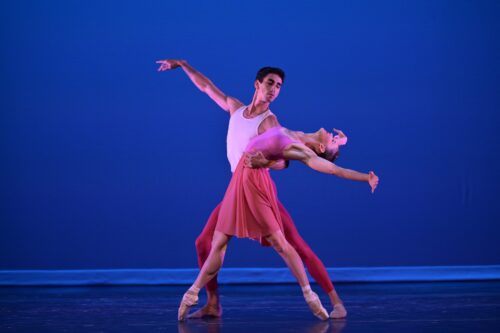
Emily Bromberg and Eric Paz in Dimensions Dance Theatre of Miami’s “In Bloom,” choreography by Yanis Eric Pikieris. (Photo by Simon Soong, courtesy of DDTM)
“Performing at Pinecrest Gardens’ Banyan Bowl feels incredibly meaningful for us,” says Jennifer Kronenberg, projecting a vision she and Carlos Guerra hold as DDTM co-artistic directors. “Our company is always looking for ways to make ballet accessible. We aim to meet audiences where they are. With this show we go further letting the environment become part of an overall experience.”
Although the DDTM offerings are not site-specific, the dancers will still stake their art on the surroundings. “There’s something very special about stepping outside of a traditional theater to perform in tandem with nature,” says Kronenberg. “Here the lush greenery allows each ballet to breathe in a different way and transcend boundaries.”
It’s an additional asset that DDTM has ballets at hand which, developed throughout a decade, reveal reverence for the natural world through inspiration, mood, and imagery.
“This bouquet of works visually and emotionally resonates with the site’s openness and botanical backdrop,” explains Kronenberg.
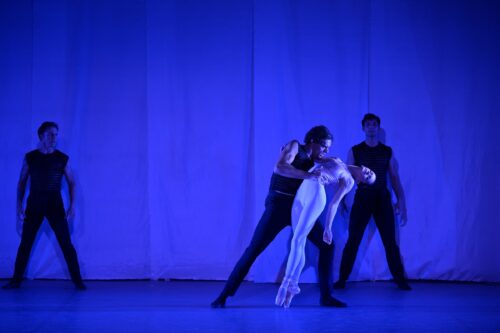
Emily Bromberg with Alex Sokolov, Ariel Morill and Maikel Hernandez in DDTM’s “Phases.” (Photo by Simon Soong, courtesy of DDTM)
Excerpts from company artist-in-residence Yanis Pikieris’s “Four Seasons,” first restaged for Dimensions in 2021, move—with the changing color of phrases, the temperature of emotions rise and fall—to Antonio Vivaldi’s same-named, weather-wise set of violin concertos.
Pikieris’s son Yanis Eric, the company’s other artist-in-residence, contributes “In Bloom,” an ensemble work from 2025. His selections from Oliver Davis’s album “Dance” pulse with enough vitality to keep contemporary classicism in the pink.
When DDTM performed Ariel Rose’s “Vow” outdoors at Jacob’s Pillow Dance Festival in 2018, this duet’s intimacies—searching to clinging, to Icelandic composer Ólafur Arnalds’s “1953”—grew in proportion to a view of Jacob’s Pillow’s home in the Berkshire Hills of Massachusetts. Now it trades that woodland for a hovering subtropical verdure letting the dancers reinvigorate their ardor.
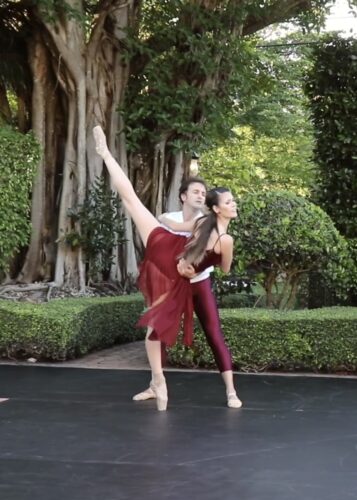
Harmonizing with nature, each pose is part of a pact between dancers true to their hearts in Dimensions Dance Theatre of Miami’s “Vow.” Pictured, dancers Mayrel Martinez and Maikel Hernandez. (Photo by Jennifer Kronenberg, courtesy of DDTM)
Frequent performances of Ben Needham-Wood’s “Apollo and Daphne,” with a score by Arvo Pärt, have become a DDTM calling card. At Pinecrest Gardens every vine and curve of bark will seem to conspire with this myth of a nymph who, resisting the god’s advances, turns into a laurel tree.
Rafael Ruiz del Vizo, a DDTM company dancer, presents his “Phases,” to Beethoven’s “Moonlight Sonata,” telescoping into lunar cycles for Emily Bromberg—alongside Maikel Hernandez, Alexander Sokolov, and Ariel Morilla—to orbit through glow and shadows.
“We’re fortunate to have close relationships with these choreographers,” says Kronenberg. “Trust and understanding allow us to transfer their works to a new space while honoring their original intent. That said, performing outdoors requires adjusting to unique parameters. This isn’t a bad thing. Details barely noticed on a traditional stage may look more pronounced, and dancers can connect un-hemmed.”

Dancers’ lines and design find parallels in the style of Art Deco in Dance NOW! Miami’s “Deco-De.” (Photo by Simon Soong, courtesy of Dance NOW! Miami)
Dance NOW! Miami’s third program this season, “Love, Lost & Found,” will also reference nature and what’s natural to the human heart. “The evening’s pieces complement each other reflecting that theme,” says DNM’s co-artistic director Hannah Baumgarten, who points out how premieres and significant re-stagings have bolstered the company into its third decade.
“Forest Dreams” is by Tandy Beal, a West Coast wonder-wooing choreographer whose roots reach back to the ’70’s and the incomparable productions of Alwin Nikolais Dance Theatre. “From the 1980s, this is a beautifully crafted abstract-dance journey through the California redwoods,” says Baumgarten. “We first presented it in 2011 in our ‘Masterpiece in Motion’ series.”
An excerpt from last year’s “Blue Pencil,” a resonant indictment of censorship during Portugal’s Salazar regime, also returns. “This solo—danced with passion by David Harris—depicts someone being stripped of their identity yet struggling to regain agency,” says Baumgarten, who hopes it elicits timely reflection.
Commissioned by Miami Design Preservation League for Art Deco Weekend 2026, Salterini’s “Deco-de”—to George Gershwin’s “Lullaby”—is a trio that extols the sleek geometries of a style the choreographer admires.
His premiere, “Traces,” brings a more intimate tribute. This came about, according to Baumgarten, when Julia Faris, long a pillar of the company, announced her retirement. “Diego threads together works she’s danced in to create a loose narrative about her journey—from uncertainty to connection through the love that’ll take her to the next chapter.”
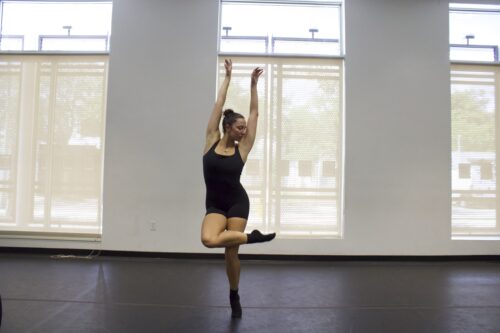
Julia Faris tall at the center of her own journey in rehearsal for “Traces.” (Photo by Sophia Pfitzenmaier, courtesy of Dance NOW! Miami)
Baumgarten, too, had specific dancers in mind—lanky and fleet Austin Duclos and Kirsten Velasco—when she turned to choreographing “Love-less . . . ,“ a duet, based on an environmental calamity, which had been stirring in her since she came upon Sam Green’s documentary “32 Sounds,” a Live Arts Miami/Miami Film Festival event at the Perez Art Museum.
“The director referred to a library of recordings in London where a librarian confessed her favorite sound was the last-known recording of the Hawaiian songbird Moho braccatus. I whipped out my notebook and hurriedly jot down the story.”
Already reduced to one breeding pair by climate change and other threats, the birds became extinct after a hurricane killed the female, leaving the male to call out—“a haunting, hollow sound,” says Baumgarten—for his mate. The choreographer seized upon this “for an allegory of our frailty and unpreparedness for the loss of those we’re bound to.”
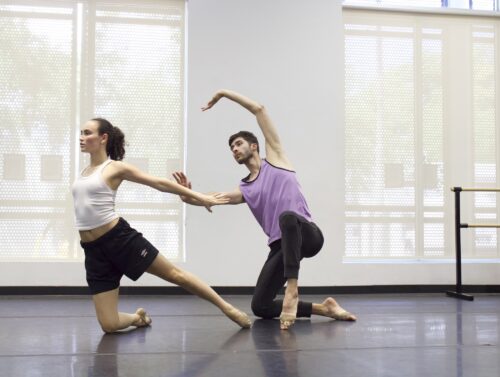
Kirsten Velasco and Austin Duclos striking avian poses in rehearsal for Dance NOW! Miam’s “Love-less.” (Photo by Sophia Pfitzenmaier, courtesy of Dance NOW! Miami)
The scenario in four movements avoids strict literalness, its more subtle esthetic upheld in the costumes by Haydée and Maria Morales and the lighting and set design by Bruce F. Brown. Federico Bonacossa, whose score Baumgarten considers “paramount,” uses birdsong as a springboard for his eclectic musical progressions.
For Baumgarten, all these creations reveal DNM’s sustaining love for their artistic species. Kronenberg shares that sentiment regarding DDTM, saying, “Carlos and I adore revisiting the gifts of dancers and choreographers. They keep our art not just alive but evolving.”
WHAT: Dimensions Dance Theatre of Miami, Ballet in the Gardens
WHEN: 8 p.m., Saturday, May 9
WHERE: Banyan Bowl, Pinecrest Gardens, 11000 Red Road, Pinecrest
COST: $34.50, $42.50
INFORMATION: (305) 669-6990 and dimensionsdancemia.com/
WHAT: Dance NOW! Miami Program III: “Love, Lost & Found”
WHEN: 8 p.m., Saturday, May 9
WHERE: Aventura Arts & Cultural Center, 3385 NE 188th St., Aventura
ADDITIONAL PERFORMANCE: 8 p.m., Friday, May 8, Lauderhill Performing Arts Center, 3800 NW 11th Place, Lauderhill
COST: $25.96, $37.76, $49.56 at Aventura; $20, $30, $40 at Lauderhill.
INFORMATION: (305) 975-8489 and at dancenowmiami.org/
ArtburstMiami.com is a nonprofit media source for the arts featuring fresh and original stories by writers dedicated to theater, dance, visual arts, film, music, and more. Don’t miss a story at www.artburstmiami.com.
No posts found
From Kitchen-Table Origins to New Leadership: Miami City Ballet Enters a New Era
Written By Michelle F. Solomon
April 30, 2026 at 11:51 AM
The 2026-27 season for Miami City Ballet marks the first season programmed by new artistic director Gonzalo Garica. Picture is Miami City Ballet Principal Dancer Hannah Fischer. Celebrated photographer Pari Dukovic shot a series of images of Miami City Ballet dancers that were revealed at the 40th Anniversary Gala. (Photo by Pari Dukovic, courtesy of Miami City Ballet)
Miami City Ballet is completing its 40th anniversary season and is now undergoing a rare dual transition in leadership, with Gonzalo Garcia, only the third artistic director in the company’s history, preparing to launch his first fully programmed season.
At the same time, MCB has hired a new executive director. Scott Altman who was appointed in mid-April, arrives to MCB with a background as president and CEO of the Cincinnati Ballet and most recently president and CEO of Los Angeles Master Chorale.
Inside the Miami Beach studios where the company’s identity has been shaped and molded for decades, Toby Lerner Ansin, founder of the Miami City Ballet, longtime dancer Ashley Knox, and newer arrival Hannah Fischer represent different points along the timeline as the organization adjusts to change at both the artistic and administrative level.
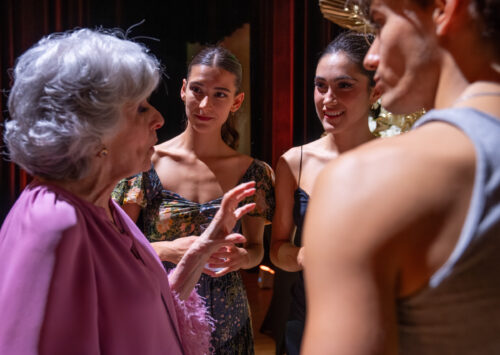
Toby Lerner Ansin with MCB Dancers Kaelah Poulos-Hopkins, Ilona Halloran-Rojas, and Andrew Larose at a post-performance 85th birthday celebration following the premiere of an original work created for her by choreographer Alexei Ratmansky in February. (Photo courtesy of Miami City Ballet)
Garcia says one of the things that has stayed with him most since arriving is Ansin’s account of the company’s earliest days.
“She shared how everything started, and how in her kitchen, she was with some of her friends, and they were like, ‘Let’s call this person, and let’s call her, and let’s call him…’ and then a year later, you know, the curtain went up… They had 17 dancers, and then 21 at the end of the season,” he says, recalling how quickly the idea turned into an institution.
Ansin situates the origin story in personal terms.
“I’m the longest person there in the building. I’m the abuela that’s been there since the very beginning. There’s some people that have been there 30 years, but I’m the only one that’s been there for all 40 years, plus the year before it started,” she says.
For Garcia, that sense of something built by instinct and fortitude is part of what makes the next chapter feel so charged.
“This is a transitional moment for the institution,” he says.
Garcia has a five-year contract as artistic director with MCB, which began on Aug. 11, 2025. When asked, the company would not disclose salary terms at this time.
For the new artistic director, the central tension is how to move forward without losing what already defines the company.
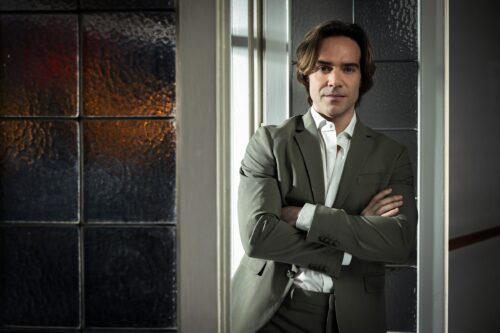
The 2026-27 season for Miami City Ballet will be Gonzalo Garcia’s first fully programmed season since his appointment as artistic director on Aug. 11, 2025. (Photo by Rodrigo Díaz Wichman, courtesy of Miami City Ballet )
“How do we not throw any of the good stuff away that has been built here,” he says, “and completely pay homage to the past and understand it, but then completely move forward?”
It is a question that lands differently depending on where someone stands in the company’s legacy.
Knox, a dancer with 25-plus years with MCB, describes those shifts as an internal continuity rather than a disruption—each artistic director adding another layer rather than replacing what preceded it.
“From Edward, I feel I gained an understanding of musicality and attack. With Lourdes, it was technique and intention, and now with Gonzalo, I’m excited to see what he brings for me to explore.”
Fischer, a dancer hired in the final phase of Lourdes López’s tenure, is stepping into Garcia’s programming as something lived in real time rather than remembered history. Much of her familiarity with the repertory already aligns with what is now coming to the stage under his direction, including Christopher Wheeldon’s “Alice’s Adventures in Wonderland,” which she says she is keenly familiar with from her time performing the co-production with The Royal Ballet and National Ballet of Canada.
“I’ve done almost every role in that ballet,” she says.
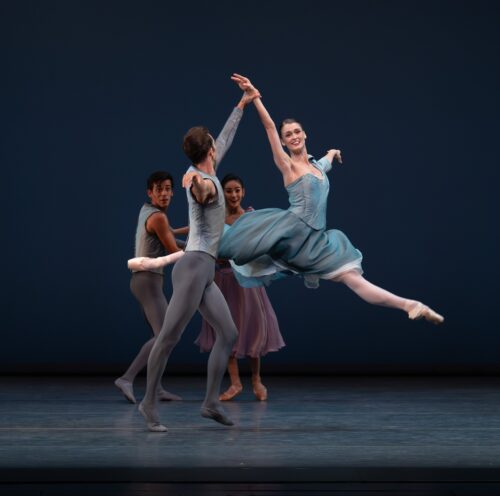
Hannah Fischer in “Roses from the South, Three Waltzes for Toby,” choreographed by Alexei Ratmansky to celebrate Toby Lerner Ansin. (Photo by REN Media, courtesy of Miami City Ballet)
She also danced the role of Odette in the MCB premiere of Alexei Ratmansky’s version of “Swan Lake,” which Garcia is bringing to his season, the third time the company will perform the contemporary interpretation.
Gonzalo’s arrival isn’t just a change in leadership; it’s the right move in many ways.
“I think it’s the right time in his life for this position,” says Ansin. “If you look at where he started in Spain, and how his career has grown, it’s the right step.” Garcia trained in Spain and joined the Zurich Ballet before joining San Francisco ballet in 1998 and becoming a principal dancer in 2022. After performing as a guest artist in the 2004 Centennial Celebration at New York City Ballet, he joined the company in 2007 as a principal dancer.
New executive director Altman says he’s joining at a time when MCB is “on a trajectory of growth and new artistic heights” and that there’s an “opportunity to build on MCB’s legacy.”

Scott Altman is Miami City Ballet’s new executive director. (Photo by Aaron M. Conway)
After 40 years, Ansin is deeply aware that the company’s future depends not only on artistic excellence, but on building and sustaining audiences in a rapidly changing and growing city.
“We have to thank the community for supporting the ballet over 40 years, and we’re now a major institution, and we just have to keep on expanding and getting people, more people in the door. And because when you look at all the condominiums going up, you could fill the Arsht a million times. We need to figure out how to get more people in,” she says, adding ‘You’d be surprised how many people don’t even know we exist.”
Fischer, 31, comes from a ballet family—both of her parents danced with and later taught at the National Ballet of Canada, which she joined in 2015 before leaving to dance with Miami City Ballet. She notes that MCB isn’t a company with a centuries-old European tradition or the automatic cultural recognition of the New York City Ballet.
“I think Miami gets kind of a rap for being a party town, and perhaps a little bit uncultured. And I think it is difficult because it’s not like New York or European (cities) where dance is government funded or it’s been in their history for so many years and everyone goes to the ballet. Not everyone goes to the ballet in Miami.”
That reality, she believes, has made the company both “scrappy” and inventive —qualities shared by Garcia and Ansin.
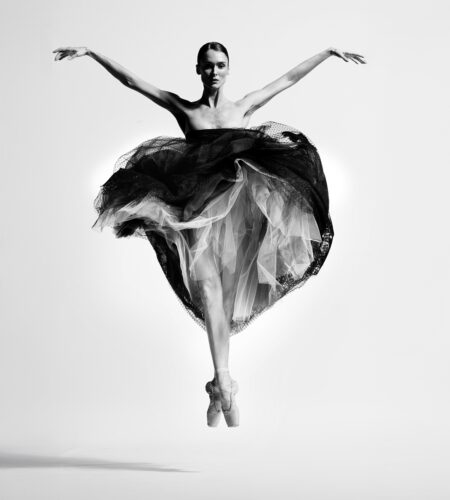
Miami City Ballet Principal Dancer Hannah Fischer. Celebrated photographer Pari Dukovic shot a series of images of Miami City Ballet dancers that were revealed at the 40th Anniversary Gala. (Photo by Pari Dukovic)
“They both have that mindset where they’re like, ‘Okay, this is a different kind of culture here. How can we tap into what they need, what they want to see, while still honoring, you know, Balanchine roots, Jerome Robbins roots. I think they have tapped into ‘Miami, what makes us special’ and so they’re finding really interesting ways to get that attention.”
Garcia is opening the season in October with a mixed repertory program that includes a world premiere by Tony Award-winner Patricia Delgado, a former Miami City Ballet principal dancer, in collaboration with composer, producer, musician, and songwriter, Emily Estefan, the daughter of Gloria and Emilio Estefan.
“Patricia is developing a voice in the dance world and this is her home. This is her artistic home, for sure, and she grew up in Miami. “ Delgado is working with Gloria and Emily Estefan on their new production of “Basura,” which is making its debut at the end of May at Atlanta’s Alliance Theatre with plans for it to play Broadway.
Garcia adds that the programming reflects the kind of artistry he wants to bring to the company. “I told Patricia, this is what I want the beginning of my chapter to be: I want it to be jazz and I want it to be Tchaikovsky. I think these types of collaborations can go a long way.”
Knox, who joined Miami City Ballet under founding artistic director Edward Villella, says she has seen the company evolve through every leadership era.
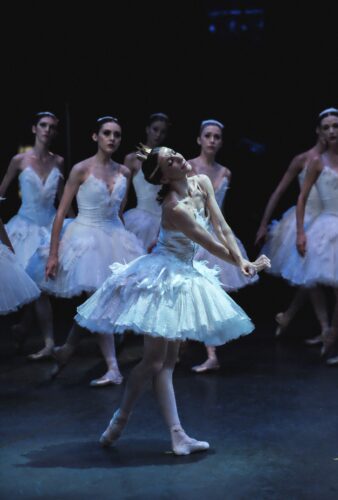
Ashley Knox in Miami City Ballet’s “Swan Lake,” choreographed by Alexei Ratmansky. (Photo by Juliet Hay, courtesy of Miami City Ballet)
“The first 10 years of my career were with Edward,” says the now 42-year-old dancer, who joined the company in 2002 as an apprentice and has been a principal dancer since 2021. She says by the time she arrived, MCB was “pretty well established and had a reputation of being a strong Balanchine ballet company. . . I feel like he was at a time where he felt he had finally built a company that he wanted.”
With López, she found a mentorship. “She had a focus on technique and how you approach a role, like the intention behind it, whether it was a story ballet or not. That really helped me grow through those years.”
She sees Garcia’s leadership as continuing the throughline. “He creates a positive environment to work, and he has such a passion for ballet as an art form. I’m happy that I’m able to be a part of this transition for the company, because . . . I am seeing already the direction it is going in and know that it’s in good hands.”
Garcia is looking beyond what’s presented on stage and has ideas for bringing MCB into the future. Renovations were already planned for the Miami Beach studios, which are a few blocks north of Lincoln Road.
“The building is going to be more practical.” He wants to utilize the black box theater and create livestreaming events that are performed in front of a Miami audience. “It will be free. People can sign up and watch a preview rehearsal of ‘Alice in Wonderland’ or of Emily and Patricia’s piece.”
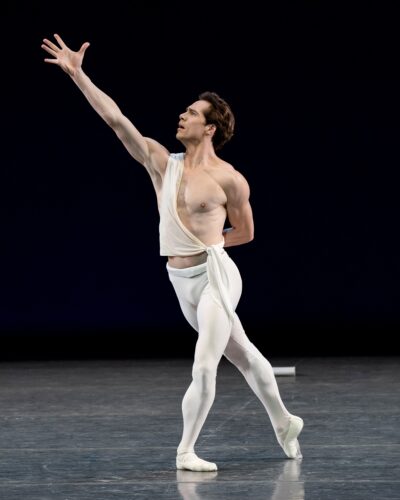
As principal dancer at New York City Ballet, Gonzalo Garcia in George Balanchine’s “Apollo.” © The George Balanchine Trust. (Photo by Paul Kolnick, courtesy New York City Ballet )
Another source of excitement for Garcia is having the ability to reposition the visual and cultural footprint. “One of the things I’m passionate about is changing a bit of the way visually we think of Miami City Ballet and for people in Miami for how they see us. We have more freedom than many other companies do because of where we are. You can be sexy, you can be elegant, you can be glamorous, you can be beachy. We represent literally so much and that’s visually exciting – that’s cool.”
WHAT : Miami City Ballet in “¡Vamos! to the Beach”
WHEN: 7:30 pm on Friday, May 1, 2 pm and 7:30 p.m. Saturday, May 2, and 2 p.m., Sunday, May 3.
WHERE: Adrienne Arsht Center for the Performing Arts (1300 Biscayne Blvd., Miami).
ADDITIONAL PERFORMANCES: 7:30 p.m., Saturday, May 9 and 1 and 6:30 p.m., Sunday, May 10, Broward Center for the Performing Arts, 201 SW Fifth Ave., Fort Lauderdale
PRICE : $45-$265
FOR MORE INFORMATION: (305) 929-7010 and www.miamicityballet.org
For the complete schedule of MCB’s upcoming season, click here.
ArtburstMiami.com is a nonprofit media source for the arts featuring fresh and original stories by writers dedicated to theater, dance, visual arts, film, music, and more. Don’t miss a story at www.artburstmiami.com.
No posts found

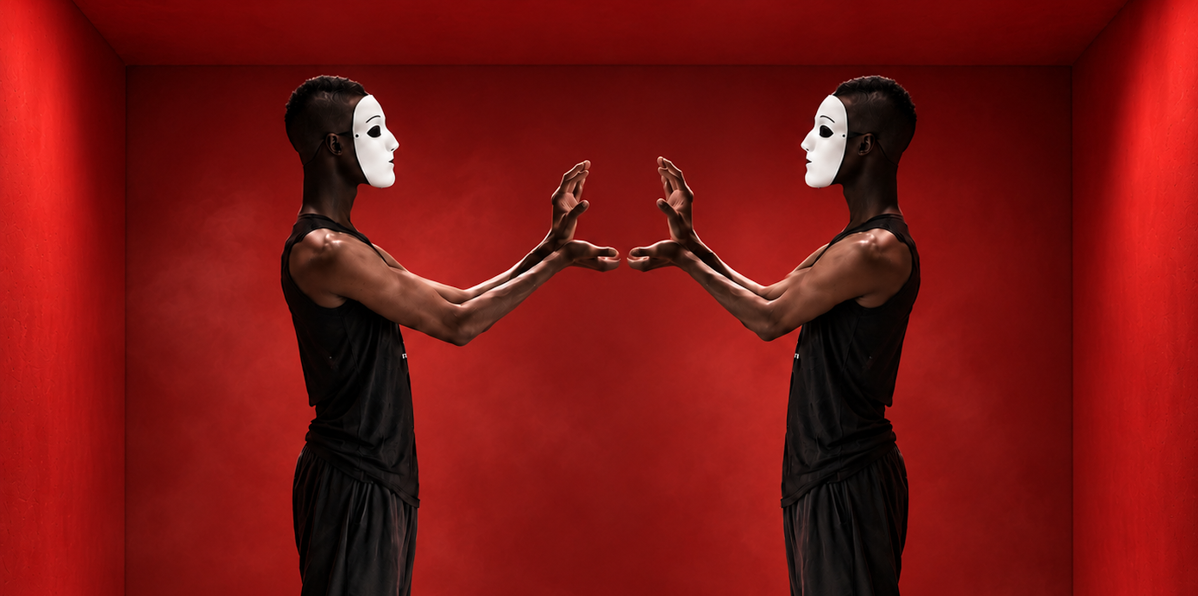
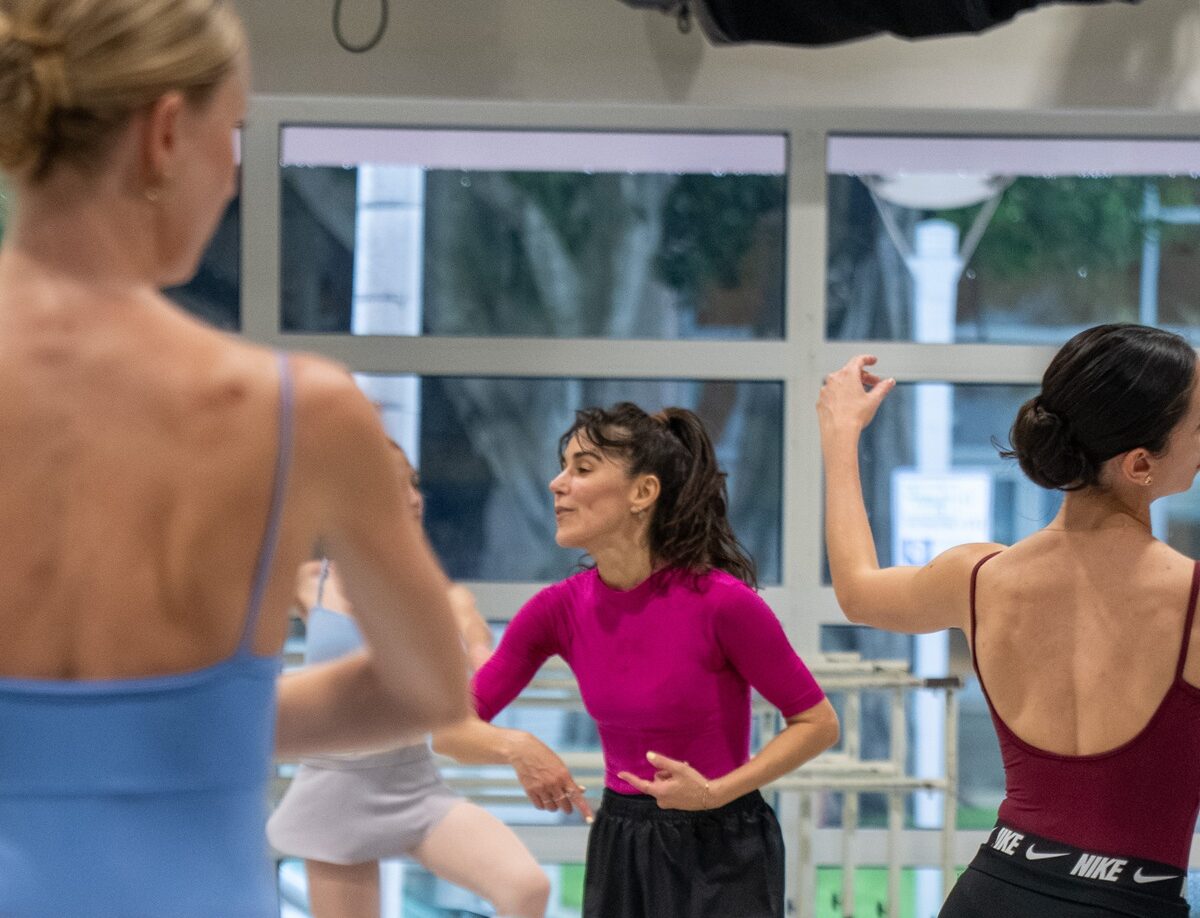
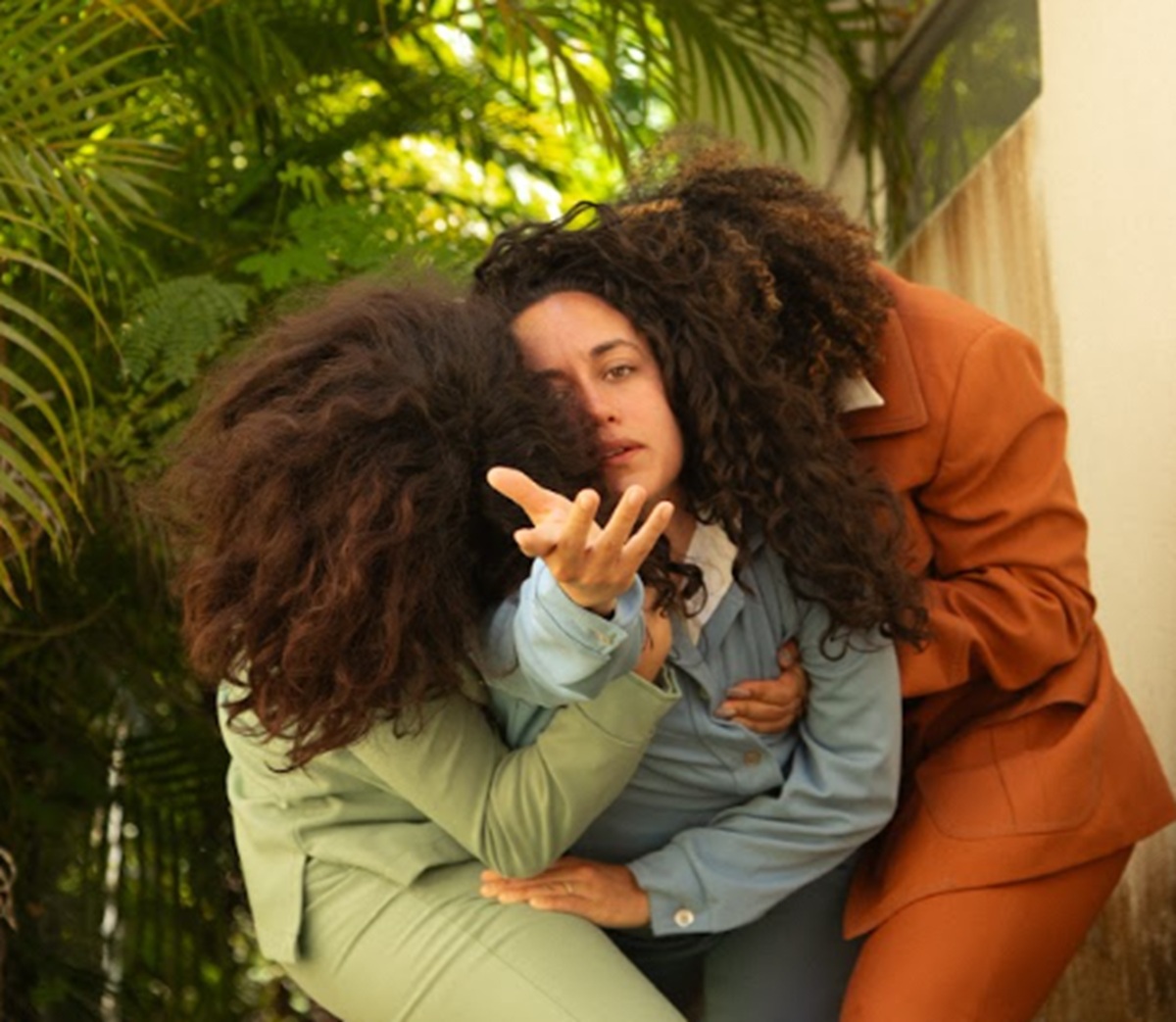
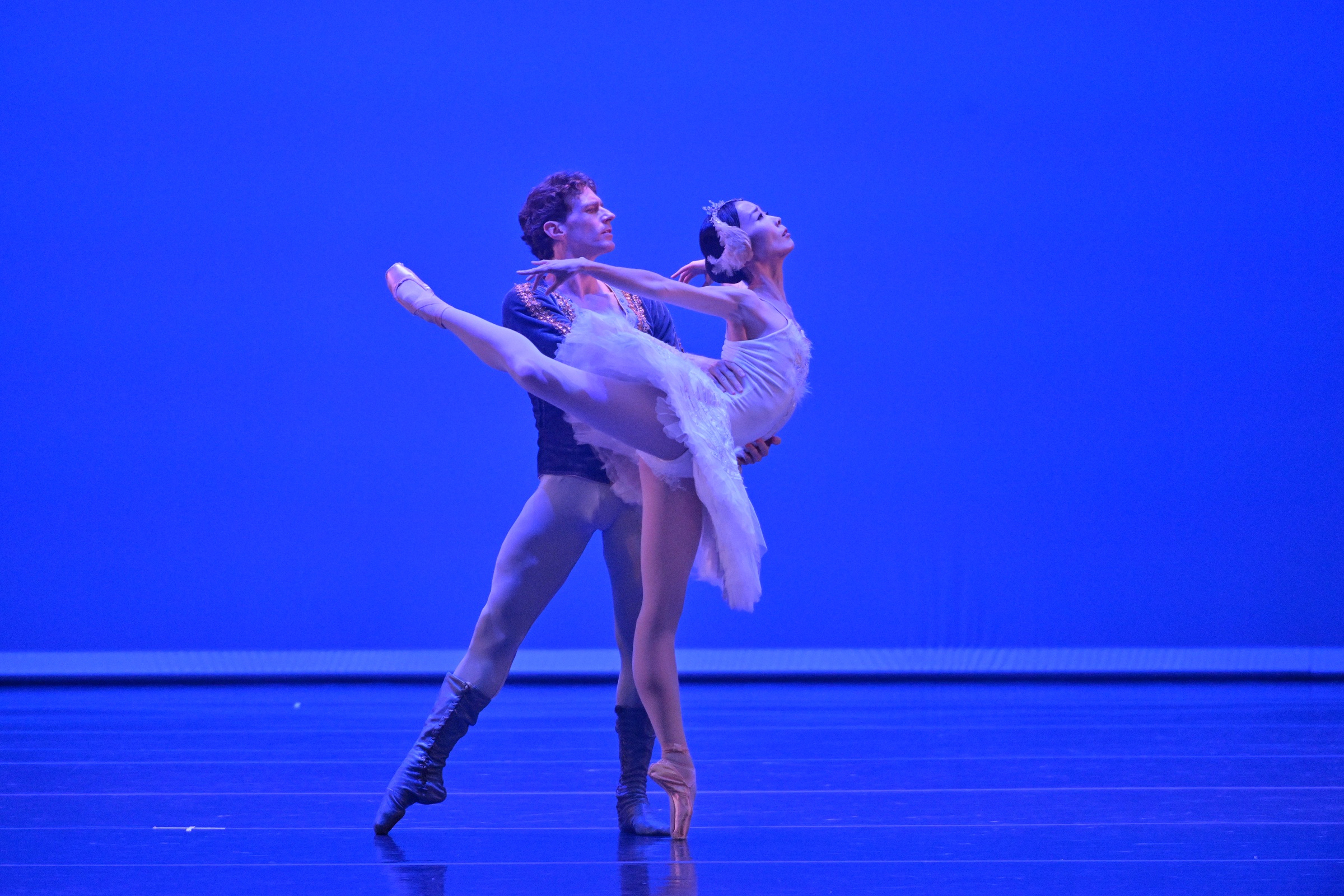
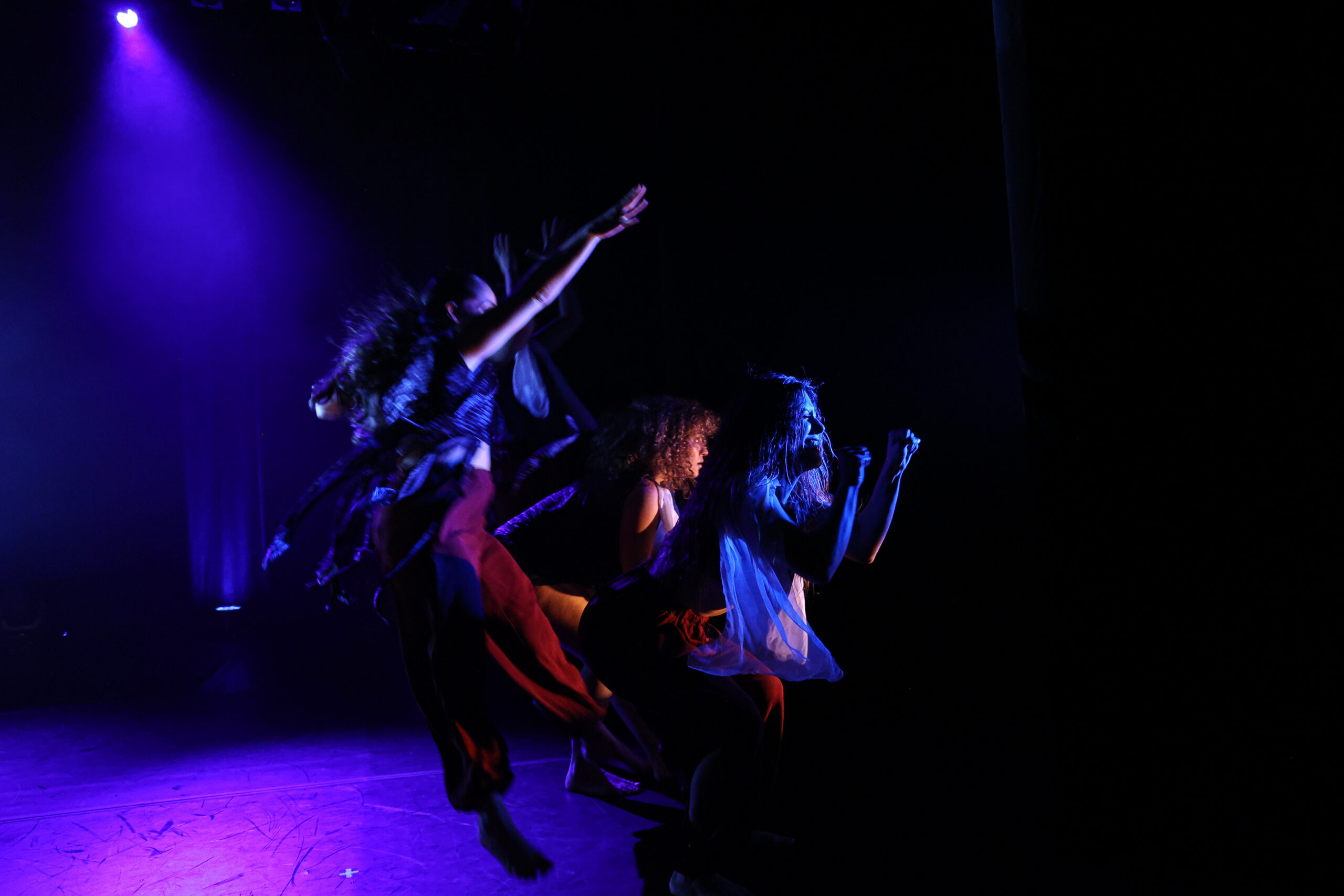
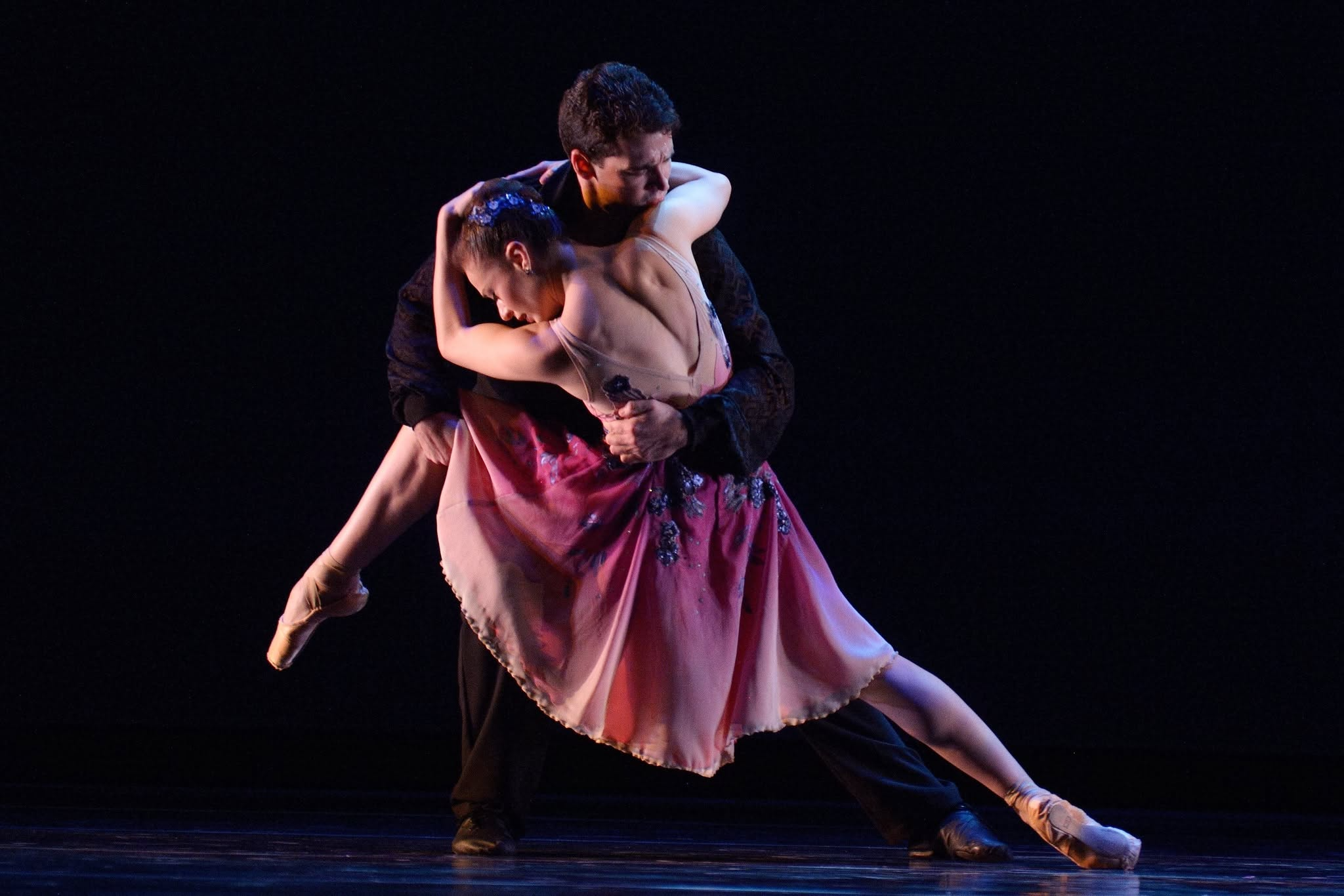
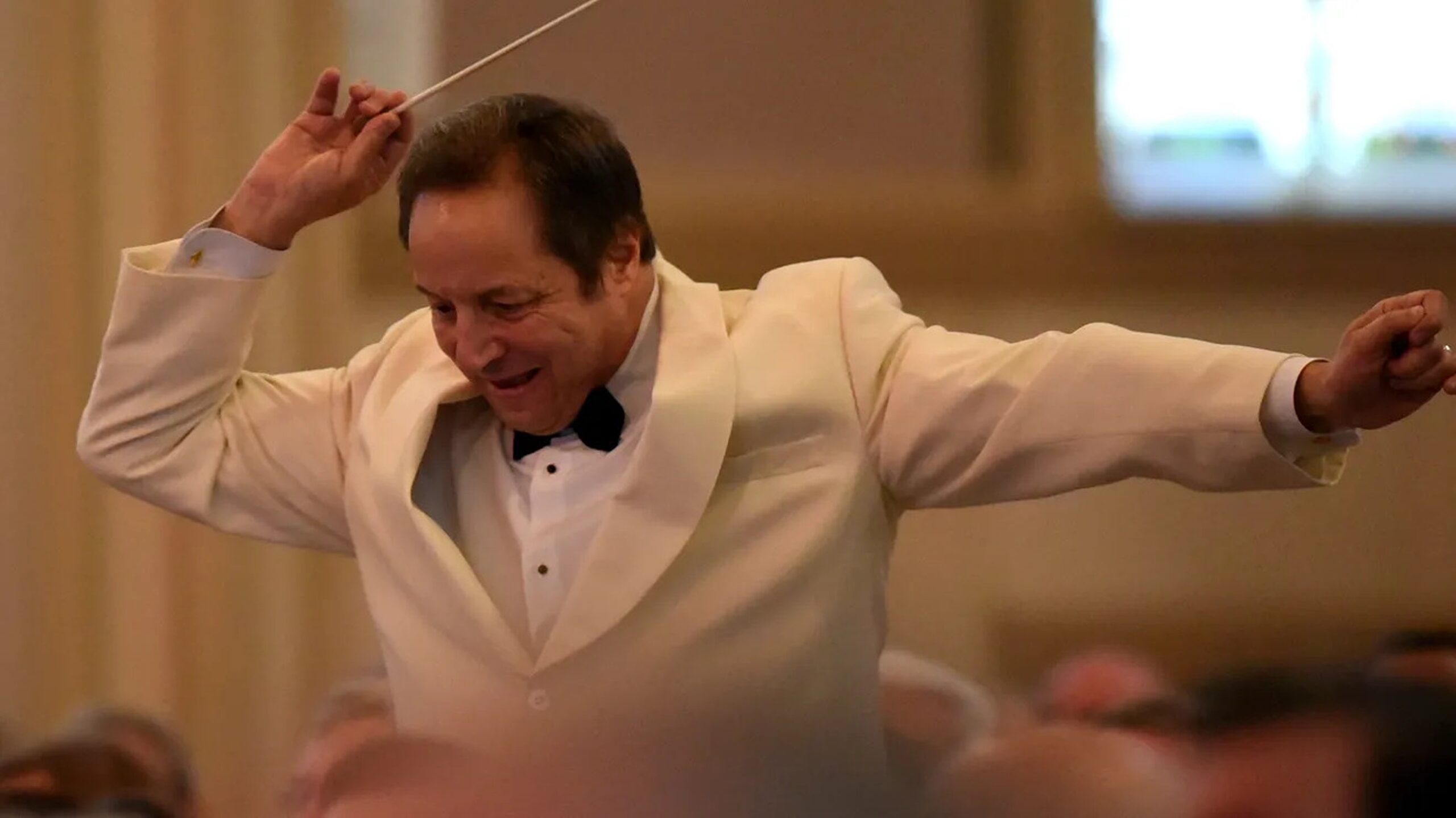
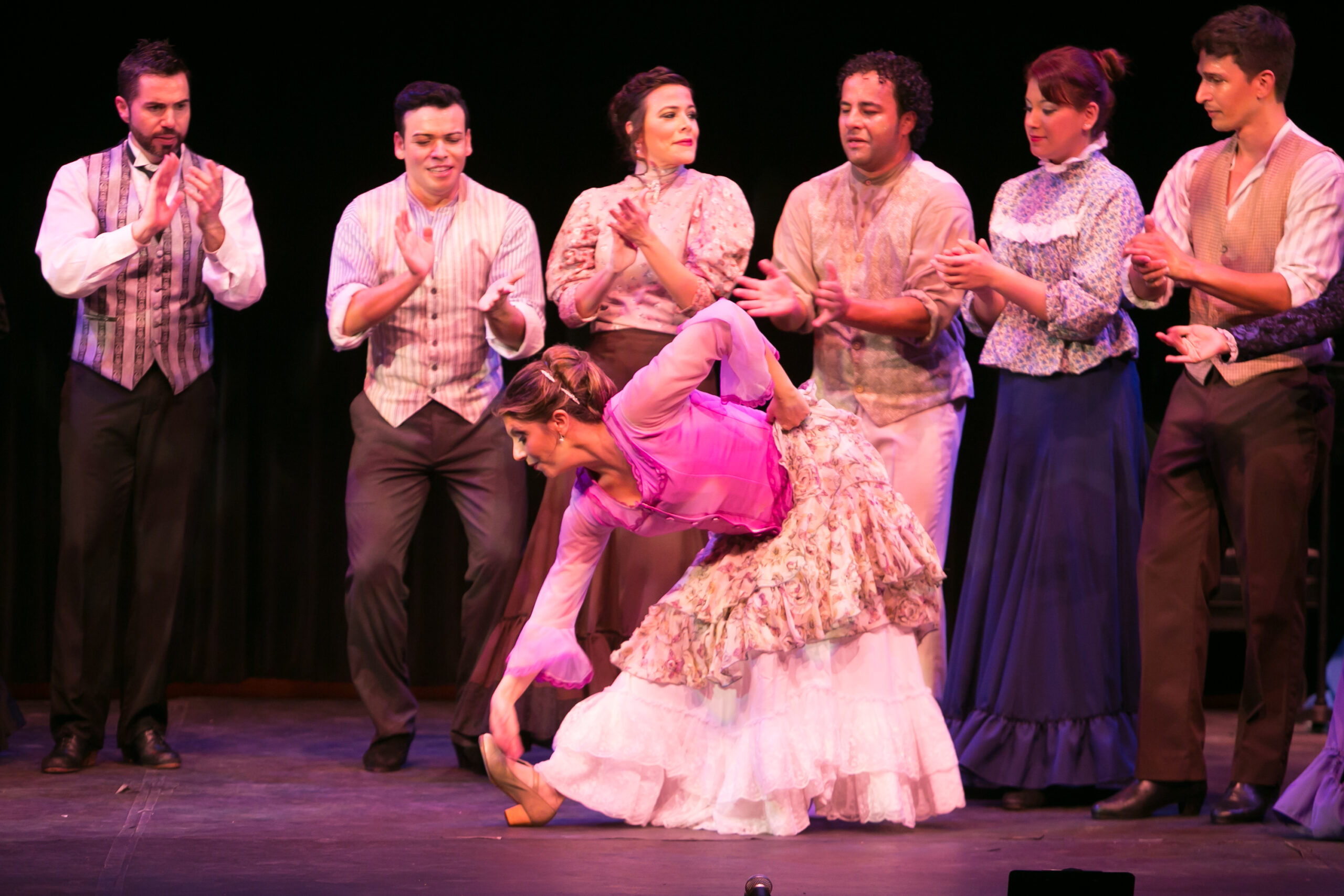
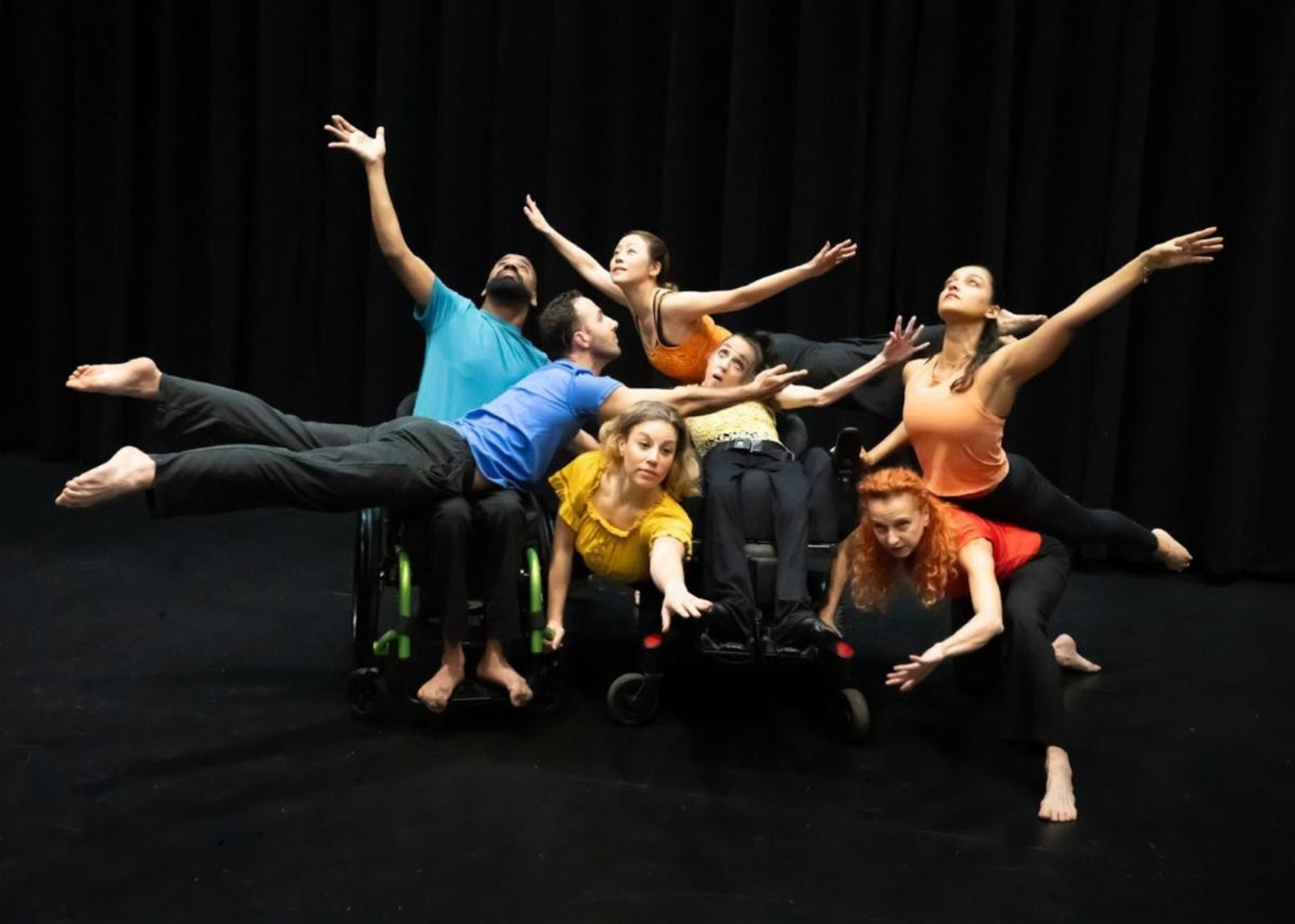
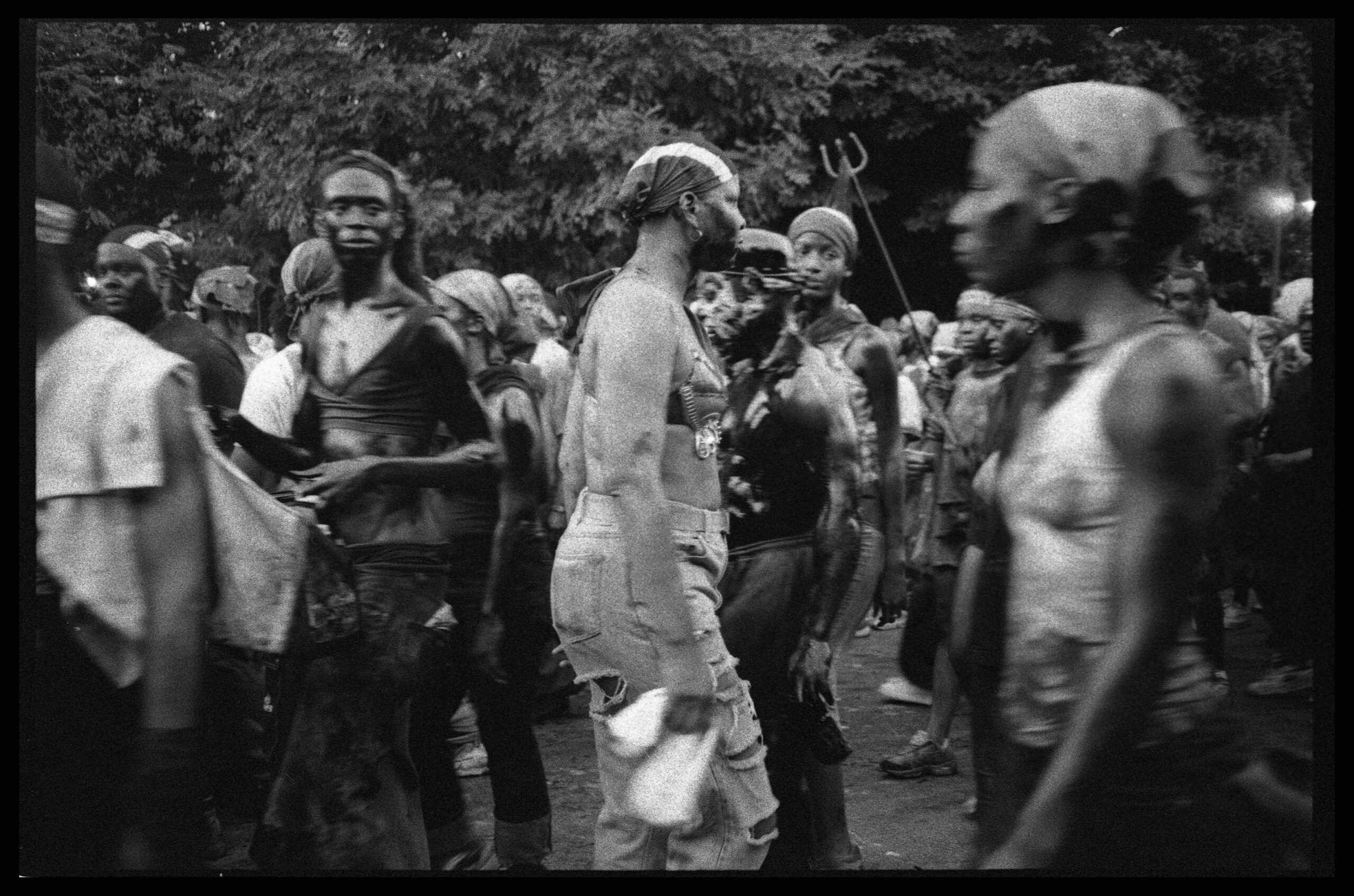
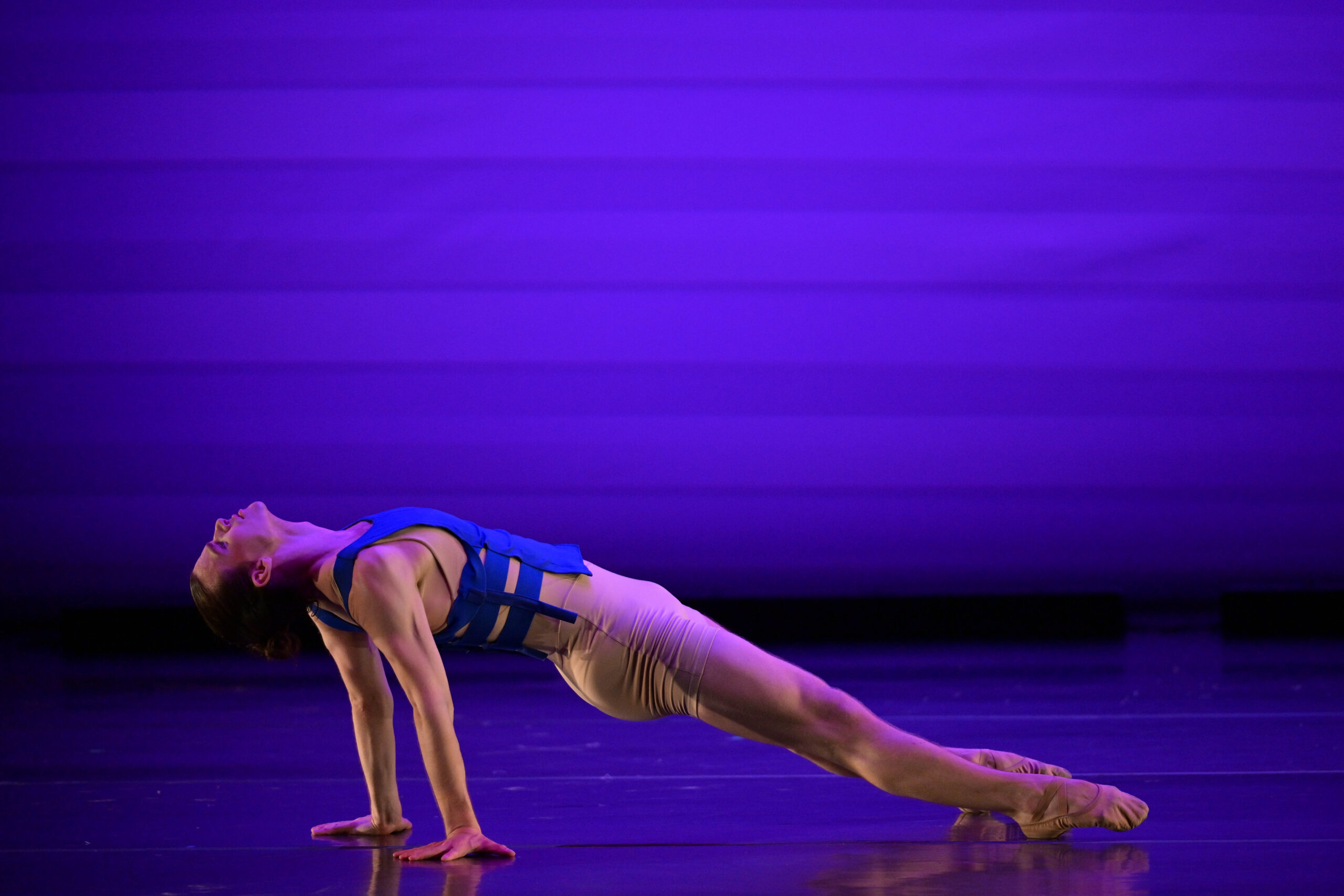
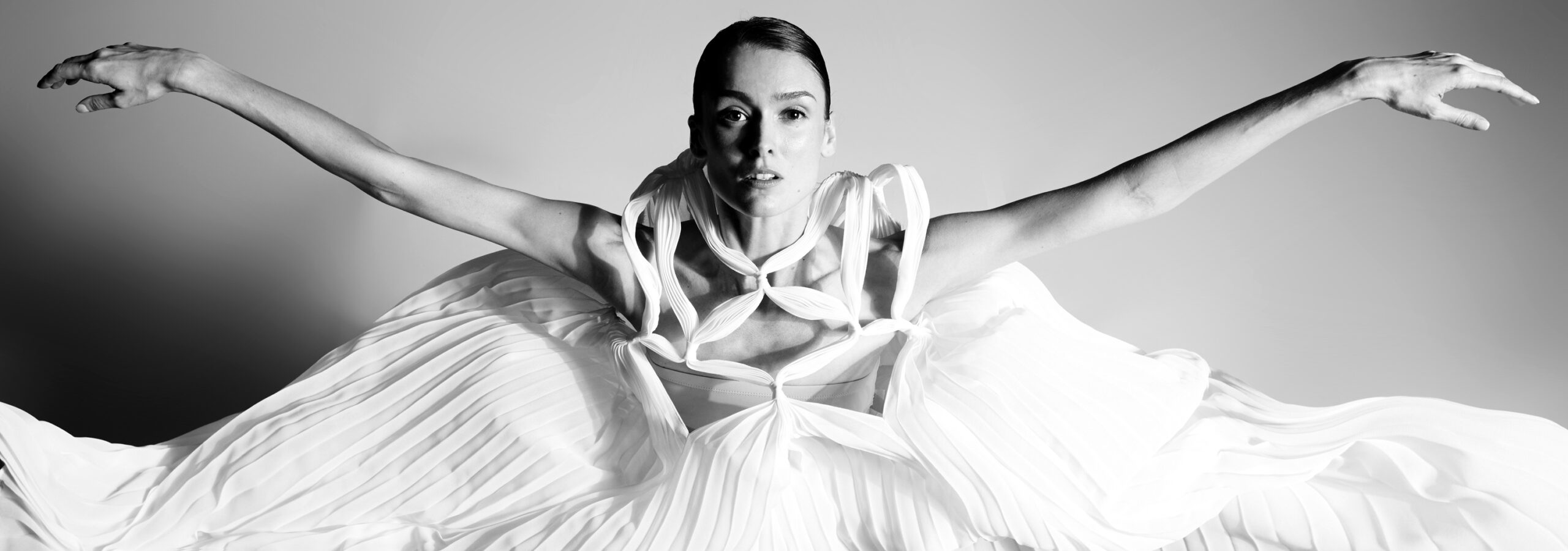
Recent Comments