Little Haiti Cultural Complex: The center of artistic life in historic Miami neighborhood
Written By Jonel Juste August 17, 2020 at 5:07 PM
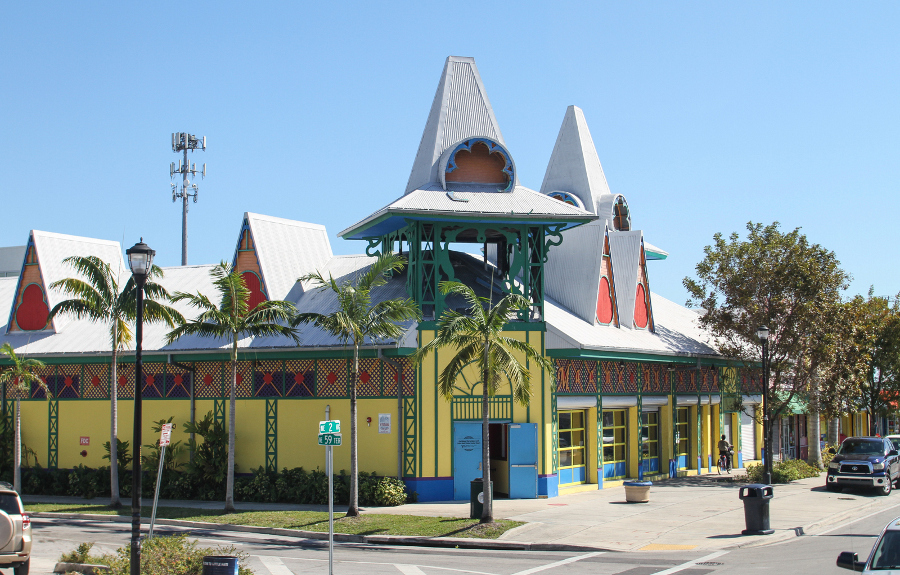
The Caribbean Marketplace, also called “Mache Ayisyen,” or Haitian market, is a landmark building modeled after Port-au-Prince’s famous Iron Market. (Photo courtesy of LHCC)
You know you’ve reached Little Haiti when you see the bright-yellow facade of the impressive, gingerbread-style Caribbean Marketplace building at the corner of Northeast Second Avenue and 59th Terrace.
The Marketplace is part of the Little Haiti Cultural Complex, the center of artistic life in this historic Miami neighborhood. Typically a vibrant and energetic space, it is a place to experience Haitian culture, art, language and cuisine – where people meet and mingle while enjoying concerts, shows and other events.
Though live activities are at a standstill due to the COVID-19 pandemic, the space continues to serve the community – as a spot where city staffers can conduct outreach such as food distributions, says Sandy Dorsainvil, manager of the complex.
It has also, like many institutions, moved some of its offerings online, available through the website: Littlehaiticulturalcenter.com.
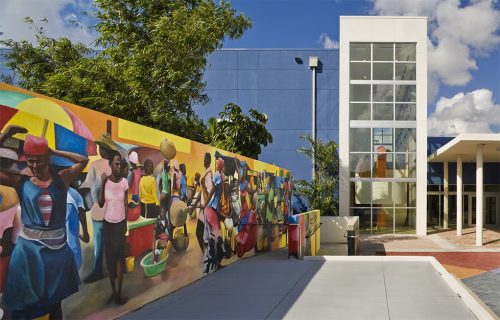
The Little Haiti Cultural Complex boasts this mural by accomplished Haitian artist Ralph Allen. (Photo courtesy of Zyscovich Architects)
“People can have a virtual tour of our current art exhibit,” Dorsainvil says. “A virtual tour of Little Haiti is also offered, and we are looking to … host live online concerts.”
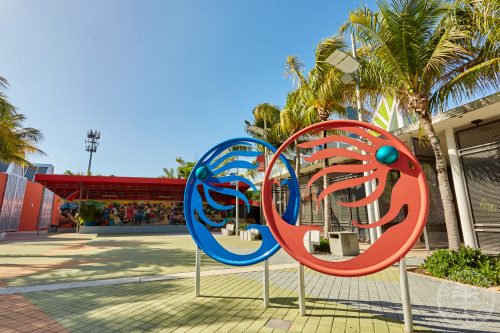
The complex was the brainchild of the late Miami Commissioner Arthur E. Teele, “who had the vision of creating a cultural haven in Little Haiti,” she says. It opened in 2006 with a theater, art gallery, courtyard and the Caribbean Marketplace.
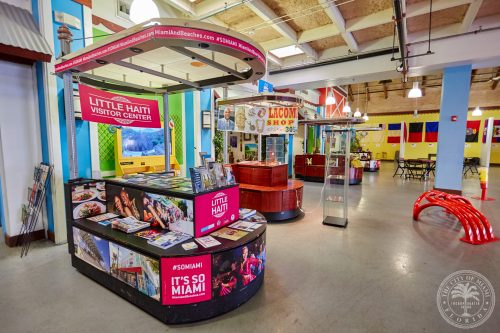
Also called “Mache Ayisyen,” or Haitian market, the marketplace is a landmark building modeled after Port-au-Prince’s famous Iron Market. In pre-pandemic times, the marketplace was mostly busy on Saturdays, when it hosted vendors selling Caribbean food, fashions, arts and crafts, while live music played in the background.
“The community was happy to have a place dedicated to its culture and the preservation of its art forms,” Dorsainvil says.
Exhibits, theater, dance & more
The LHCC has several programs that promote Haitian culture in Miami. From art exhibits to live concerts to dance rehearsals, there has always been something happening at the complex.
The 2,150 square feet gallery – with its open space, climate control and museum-quality lighting – facilitates up to seven professionally curated art exhibits per year.
“Our more popular exhibits happen during Haitian Heritage Month [in May] and during Art Basel [in December],” says Dorsainvil, who is an expert at creating programs and events that capture the artistic contributions of the people of the African Diaspora in a way that appeals to the global community.
The LHCC opened in 2006 with this courtyard, as well as a theater. (Photo courtesy of LHCC)
The LHCC is the site of dance practice for groups such as Delou Africa, Tradisyon Lakou Lakay, and Nancy St Leger NSL Danse Ensemble; and it offers traditional drums and horns classes by well-known Haitian street music band Rara-Lakay Nurednet. There are also art and language classes (Creole and French).
“Little Haiti Cultural Complex is a second home to me. It’s a meeting place for the Haitian community,” says dance instructor Nancy St. Leger, who since the pandemic teaches her classes online.
The complex’s Proscenium Theatre has 300 auditorium-style seats with six wheelchair-accessible spaces, two balconies with an additional 40 seats, a 1,370-square-foot stage, and a state-of-the-art control booth. Recent events held in the theater include February’s Haitian American Community Agenda Conference 2020, which united community members, organizations and leaders to create strategies for the advancement of South Florida’s Haitian-American community.
“Several local and national organizations hold annual events there,” Dorsainvil says. “Several Haitian presidents met the Haitian-American community in the Proscenium.”
Little Haiti on the map
In fact, the complex long has attracted Haitian dignitaries and other high-profile figures in the political and entertainment industries. Then-Vice President (and current presidential candidate) Joe Biden visited to discuss the situation in Haiti following the earthquake that hit the island nation in January 2010. President Donald Trump also visited Little Haiti in September 2016 and stopped by the Marketplace as part of his campaign run.
Inside the Caribbean Marketplace. (Photo courtesy of LHCC)
Actress Gabrielle Union had a photoshoot here in June for her New York & Co. clothing line; and famed artists such as Rihanna and DJ Khaled have shot music videos amid the complex’s exuberant murals. Grammy Award-winning musician Wyclef Jean, considered a pride of Haiti, has performed at the complex multiple times.
Annually, the complex sees more than 100,000 visitors, according to the Greater Miami Convention & Visitors Bureau website, Miamiandbeaches.com.
“We can definitely say that this center put Little Haiti on the map,” Dorsainvil says. “This facility gives tourists a reason to come in the community.”
Adds St. Leger: “Some people drive all the way from West Palm Beach to come to the cultural center … The complex changed the face of the historic Haitian neighborhood. It removed some misconceptions about the area. Now people know it’s a safe place to enjoy art, music and Haitian culture.”
Miami-based artist Edouard Duval-Carrié's work, currently in the 61st Venice Biennale, echoes the Italian exhibition in “From Venice with Love” in Miami Beach at The Betsy Hotel.
“The Science Behind Pixar” at Frost Science takes visitors behind the scenes of Pixar films with more than 50 interactive experiences exploring animation, engineering, math and technology.
In Miami Corona Project, artist Xavier Cortada creates daily journal of city’s plague year
Written By Elisa Turner August 12, 2020 at 7:09 PM
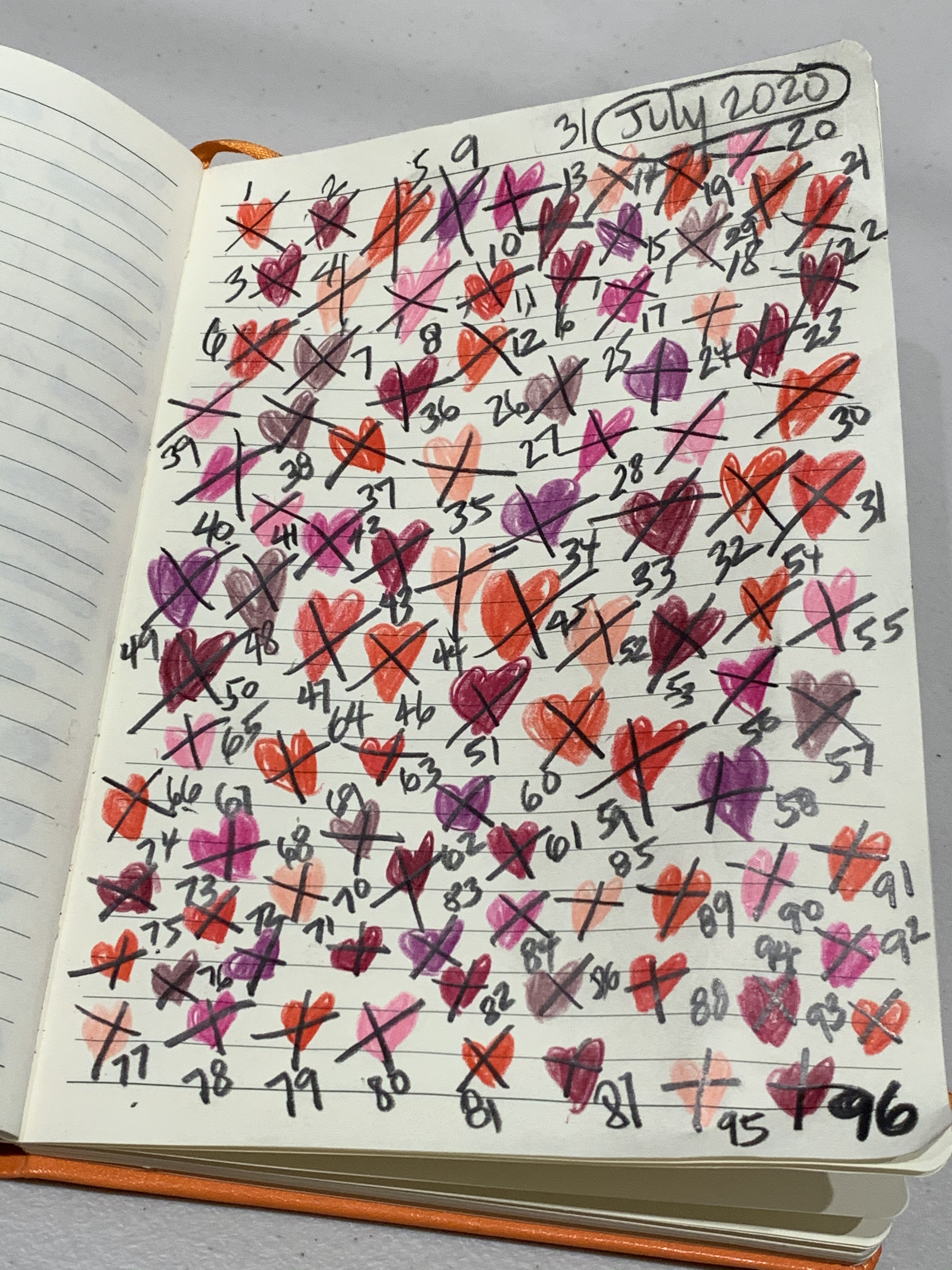
Xavier Cortada’s daily journal entries are titled, “Miami Pronouncement,” and they record the number of deaths that day – grim snapshots of an unfolding history. This one is “Miami Pronouncement (July 31, 2020): 96 Dead.” (Photo courtesy of Xavier Cortada)
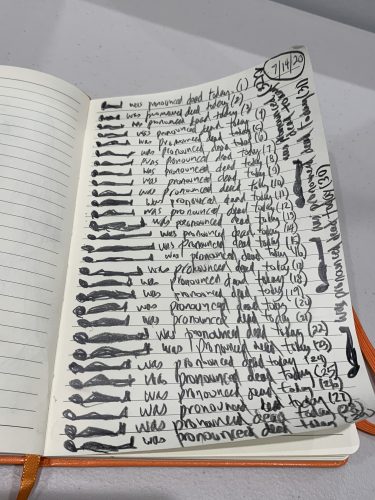
In a video posted on his Miami Corona Project, artist and University of Miami professor Xavier Cortada draws one corpse after another on lined paper. They are lumpy stick figures, achingly childlike and blunt. Their heads and feet are doodled knobs.
As he draws, you hear the whispery sounds of his pencil brushing back and forth on the paper. The sounds could be fading gasps for air. Cortada is making a journal entry for July 30, 2020. There were 60 Coronavirus-related deaths reported in Miami-Dade County that day.
Although the short video may be hard if not tedious to watch, it is an insistent, even meditative, testament to the devastating crisis we are experiencing.
“We have yet to see 100 people die in a day, but that is coming,” Cortada said in a recent interview. “When I created this project, I wanted to mark this moment in history. I wanted to document what was happening in Miami and create a place, just like I did with my other social practice projects, where the community could come together to mourn, to learn, and to express themselves.”
For years, Cortada has created socially engaged, collaborative art. Miami Corona Project is very much consistent with his activist, community-based practice.
Cortada attended International AIDS conferences in Switzerland and South Africa in 1998 and 2000, respectively, to create collaborative murals with conference participants. More recently, Cortada has created numerous community art projects to promote awareness of Miami’s vulnerability to rising seas and climate change.
“I understand how people can be in denial about sea-level rise,” he said. “They can also be in denial about this particular virus and the pandemic in general.”
Cortada aims to show connections between climate change and the pandemic. “Our climate emergency exacerbates the pandemic,” he said.
“Miami Pronouncement (July 14, 2020): 32 Dead,” by Xavier Cortada, 2020. (Photo courtesy of Xavier Cortada)
Rising temperatures make it more likely that other diseases can come to Miami, he added, “whether it’s through mosquitoes or animal transmissions.”
For the Miami Corona Project, available at Cortadaprojects.org/projects/corona, Cortada has been creating a daily journal of Miami’s plague year in 2020. The project may well extend into 2021.
“I’m committed to doing this every single day until there’s a vaccine,” he said, “or until there’s some natural organic way that tells me it’s OK to stop.”
Since beginning the project on March 13, he has invited the community to join with him by searching the site for information and solace. It is presented in conjunction with the University of Miami’s COVID-19 Rapid Response effort.
Cortada’s online platform is composed of three main sections.
His daily journal entries in the section titled, “Miami Pronouncement,” record the number of deaths that day – grim snapshots of an unfolding history. These entries began on March 27, when the first death in Miami-Dade County was reported. Israel Carrera, 40, died of COVID-19 on March 26.
“I did not want us to forget them,” he said of those who have died. “I did not want their loss to be in vain.”
A “Conversations” section presents his talks with local leaders about the ongoing impact of the COVID-19 pandemic and asks for messages of hope. They discuss how some are dealing or not dealing with the global catastrophe as it hits home.
The interactive section titled “Share Your Voice” is exactly what it says, a place where community members can write about their experiences in dealing with loneliness, grief, anger, frustration and unemployment brought on by the virus. One comment simply pummels the site with words including “isolation, alone, stressed, rage, reset.”
Other snippets, or voices, from the section:
“Coronavirus has impacted my daily … life and has made me fear for my life every time I walk out the door.”
“It’s helped me focus on what matters most. Family, friends, food, nature. I don’t plan to go back to the old normal. I realize I am blessed to have everything I need. My heart breaks for the many who do not.”
“Coronavirus, moreso than anything, has been mentally exhausting. I feel as though it’s illuminated parts of our culture that have been toxic but somehow hidden – up until this pandemic, they’ve slipped between the cracks as people haven’t wanted to acknowledge them. However, now it’s as though we’ve put a magnifying glass to them and we are forced to stare at the ugliness that we as humans put other humans through.”
On the main page of the project website is an unflinching image, a piece of digital art identified as: “Miami Pronouncements (March 26-June 15, 2020): 826 Deaths in Miami-Dade,” by Xavier Cortada, 2020. Against a background representing pages of journal entries documenting multiple days of death, there’s an athletic, muscular man taking a knee. In these days of Black Lives Matter protests, that’s a pose redolent of defiance and sacrifice.
What could be seen as suffocating swirls of arms belonging to an octopus coiled on the man’s back are actually embellished wings, Cortada explained. They imply that the man is a cautionary figure, an angel of death. The man wears a mask recalling those worn in Venice during the plague. As if bearing a gift, this eerie “angel” holds out with one hand a dazzling hot pink sphere, the artist’s stylized symbol for the virus itself.
We know from countless images in the media that this sphere signifies the novel coronavirus. But if we weren’t so awash in that grim collective awareness, Cortada’s symbol would not necessarily reek of fatal peril. It could look almost frilly and cute.
In this context, call it forbidden fruit. That pink sphere is oddly seductive but ominous, offered by a compromised, masked figure. In one fell swoop, in this image, Cortada evokes the very human, natural temptation to gather and touch, a universal longing in our desperate time – but one strictly forbidden by public health experts.
“I’m painting an angel of death telling you that I’ve got this in my hand and it could come to you, too,” he said. He wants more people to understand that the pandemic is “not just about [somebody else’s] suffering, it’s about a communal suffering.”
Miami-based artist Edouard Duval-Carrié's work, currently in the 61st Venice Biennale, echoes the Italian exhibition in “From Venice with Love” in Miami Beach at The Betsy Hotel.
“The Science Behind Pixar” at Frost Science takes visitors behind the scenes of Pixar films with more than 50 interactive experiences exploring animation, engineering, math and technology.
‘Fabric of America: Artists in Protest’ exhibition addresses troubled times
Written By Jonel Juste July 31, 2020 at 7:14 PM
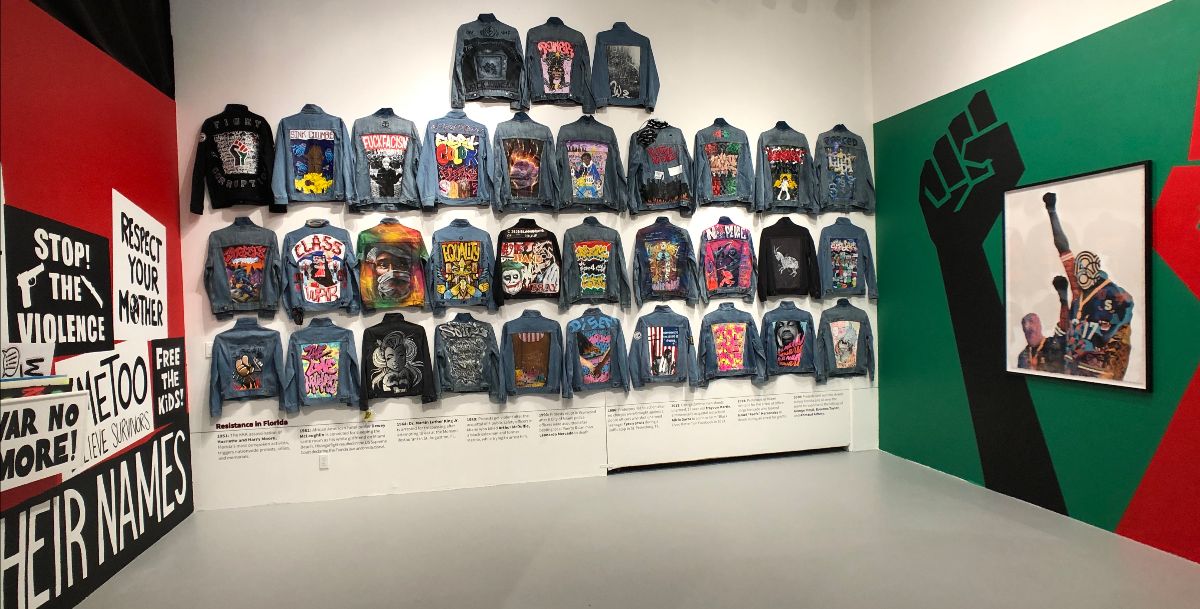
“The Fabric of America: Artists in Protest” features denim jackets bedecked in messages and symbols that take a stand and speak loudly of these troubled times. (Photo courtesy of Museum of Graffiti)
A crisis is the best time for artistic creation. So, creating is exactly what artists are doing today.
Some are creating murals, others wearables.
More than 30 South Florida graffiti artists and illustrators were invited to create protest-themed art on denim jackets for “The Fabric of America: Artists in Protest,” an exhibition launched July 18 by the Museum of Graffiti in solidarity with the Black Lives Matter movement.
“Artists typically inspire people,” said Alan Ket,museum cofounder and curator. “Artists have a way of presenting topics [and] ideas in a way that really reaches to the core of our beings and to our hearts.”
The exhibition, on view in person until Aug. 31, features denim jackets bedecked in messages and symbols that take a stand and speak loudly of these troubled times. With the momentum right now around the themes of racial inequality and police brutality – sparked by the death of George Floyd on May 25 – the museum provided this platform so artists could contribute to the national discussion, Ket said.
Alan Ket, museum cofounder and curator, said the exhibition includes diversity of topics and of media. (Photo courtesy of Museum of Graffiti)
“In order to bring change in society, that momentum has to grow and continue to push forward – and we wanted to be part of the change that this world needs,” he said.
For organizers and artists, the mission of the exhibition is multifaceted: “The idea of wearable art is not only to provide the artist with a platform to communicate and to share their ideas but also to be able to sell that work,” Ket added. “So that particular exhibition … allows people to own a piece of protest art to wear in public and to sort of show their position in the world as far as protesting.”
Added museum cofounder Allison Freidin: “In this particular time, it’s very clear that all of the artists that are in the show have a very similar message that they want to convey, which is their dissatisfaction with the current state of affairs and the need for equality and to eliminate the racism in our country.”
The main theme of the exhibit is protest. Some jackets make political statements (one portrays President Trump as the DC Comics character “The Joker”); others show the Black Lives Matter clenched fist symbol. One of the artists, known professionally as Cyst, painted an image of Malcolm X pulling back curtains to peer out of a window while holding a rifle.
All the participating artists are either from South Florida or currently work in South Florida, Freidin said. They include Chillski, Crome, Tackz, Disem, Ahol Sniffs Glue, Cash4, RasTerms, Klass, Cyst, Grab, Tragek, Delvs, Quake, Ticoe, View2, Chnk, Jel Martinez, Etone, Rage, Daniel Fila, June, Keds, Junk, Meta4, Drums Brown, Santiago Rubino, Cale K2S, Ruth, Faves, Blackbrain, Echo, and Tierra Armstrong.
The artists tackled a variety of hot-button issues.
“The main topic is police brutality and racial injustice, but other topics come into play in the exhibition such as equal rights, feminism, gender issues, politics and the presidency, immigration, human rights, migrant workers, capitalism, corruption, the history of resistance, even COVID,” Ket said. “It was an open platform. That’s why we have such a diversity of themes.”
The exhibition features a poster by internationally recognized artist Futura 2000. (Photo courtesy of Museum of Graffiti)
The exhibit also embraces diverse forms of expression. There are posters by internationally recognized artists Futura 2000, Tristan Eaton and Cey Adams, as well as an audio/visual installation by Ket and fellow artist Chintz that counts down the reported time a Minneapolis police officer had his knee on George Floyd’s neck.
Rounding out the exhibition are photographs by Pablo Allison, a human rights worker and documentarian. According to the museum, Allison has been following the migrant trail from Central America to the United States since 2017, and his images captured powerful instances of protest graffiti.
A portion of the proceeds from the exhibition will be donated to Empowered Youth, an organization that aims to improve the lives of inner-city young men in the Miami area, Freidin said.
The Museum of Graffiti, situated in the Wynwood District, is enforcing safety procedures including an admission system that allows six people to enter the premises every 15 minutes.
What: “The Fabric of America: Artists in Protest”
When: On view in person until Aug. 31 and online indefinitely
Miami-based artist Edouard Duval-Carrié's work, currently in the 61st Venice Biennale, echoes the Italian exhibition in “From Venice with Love” in Miami Beach at The Betsy Hotel.
“The Science Behind Pixar” at Frost Science takes visitors behind the scenes of Pixar films with more than 50 interactive experiences exploring animation, engineering, math and technology.
‘FloodZone’ on view at Little River’s Dot Fiftyone gallery
Written By Nicole Martinez July 16, 2020 at 3:15 PM
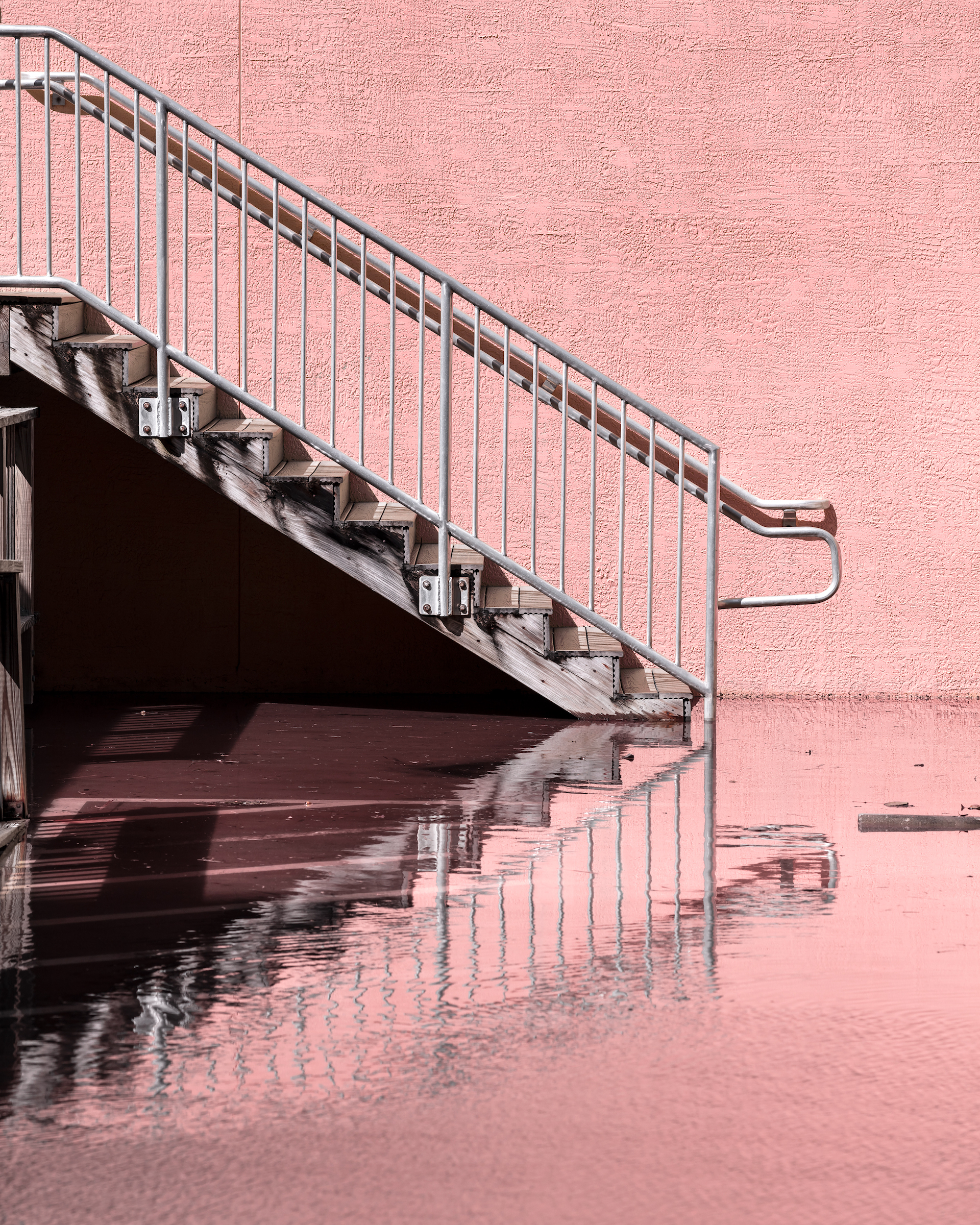
“Staircase at King Tide (2019);” archival pigment print; 40 x 32 inches. (Photo courtesy of artist)
Anastasia Samoylova phones into this interview from her balcony in Miami Beach, a frequent perch since it’s the only vantage point from which she can spot a glistening sliver of ocean.
“I’m almost always sitting in this spot, because it’s what I’ve always dreamed about and was never accessible to me,” she says.
Born in Moscow, Samoylova settled in Miami four years ago, after moving to the United States in 2008 to pursue her Master of Fine Arts degree. She had been working as an academic and freelance photographer in the Midwest, but Miami’s vibrancy resonated with her after a stint in the Fountainhead Residency.
The wide, blue horizons of her newly adopted home contrasted sharply with her formerly landlocked surroundings, and Samoylova was acutely drawn to the fact that the urban and organic intertwined cacophonously in Miami: She observed how wild, moldy overgrowth sprouted from swollen concrete; how water seeped out from sewer drains on a sunny day, eventually soaking it up like a sponge; how billboards and magazine ads displayed a sublime pastel luxury and failed to register the murky toll of overdevelopment. These images jarred Samoylova, but she noted that no one around her seemed to pay it much mind.
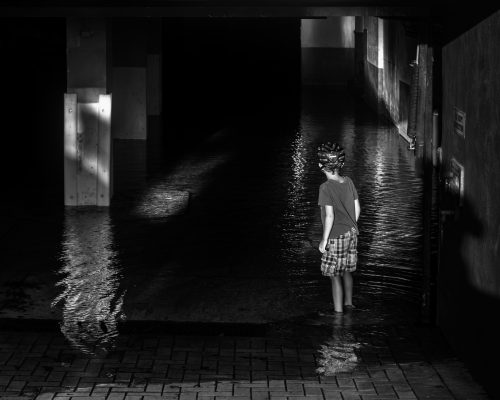
“Flooded Garage (2017);” dye-sublimation print on aluminum; 40 x 50 inches. (Photo courtesy of the artist)
“Realizing that climate change was a major threat to Florida was very experiential for me,” she says. “It seems like for Floridians that grew up here, it wasn’t such an obvious thing – or at least, there were things that were happening that were too subtle for them to notice.”
As such, her arrival to Miami represented a radical shift in her practice, as she turned away from studio-based work and toward something that was purely observational. Amassing images collected from sojourns into local neighborhoods over the course of a year and a half, Samoylova created “FloodZone,” a photo book that has since morphed into a solo exhibition at the University of South Florida in Tampa. A capsule exhibition, also entitled “FloodZone,” is currently on view at Little River’s Dot Fiftyone gallery, which predominantly showcases contemporary artists working across Latin America.
The exhibition, which opened on June 18, can be viewed through Sept. 14 both in person and online on the gallery’s website at Dotfiftyone.com. Because the gallery is employing social distancing measures – such as limiting the number of people in the space – organizers recommend making an appointment. Visitors are required to wear masks, and hand sanitizer is provided at the front desk.
In “FloodZone,” Samoylova’s documentary images capture a slice of Floridian allegory both physical and metaphorical, alluding as much to the marked dissonance of its environment as they do to the psyche of the people who inhabit its terrain. Her photos construct a mirage in which the future is imminent and yet doesn’t represent an immediate threat, where humans keep moving, building and boating without ever reckoning with their paradise’s impending demise. They display a tug of war between man-made construction and the natural world – the former’s persistent intervention and the latter’s re-emergence in the most unlikely places.
Atypical of her practice, Samoylova’s observational approach was predicated on preliminary research about Miami’s most at-risk communities, examining both the threat of climate change and climate gentrification as critical issues affecting the region’s societal framework. From there, she shot what stood out.
“I only shoot what draws my attention,” she says. “I like to keep things really open and layered to where this quality of surface and content is translated into the work.”
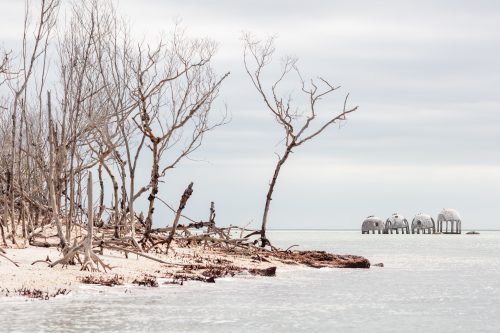
“Dome House (2018)” is part of Anastasia Samoylova’s “FloodZone,” which is on view through Sept. 14 both in person and online. (Photo courtesy of the artist)
Images like “Roots (2018)” – exposing a tree’s underground maze after it was ripped out by gale-force winds – demonstrate the push-and-pull fragility of our ecosystem. “Concrete Erosion (2019)” and “Painted Roots (2017)” similarly allude to the power struggle that exists between man and nature, with plant matter emerging out of concrete. Others, like “Flooded Garage (2017)” and “Staircase at King Tide (2019)” depict inundations alarming to most, yet commonplace for the average Floridian.
In “FloodZone,” Samoylova draws a parallel between the capitalist nature of photography and that of the landscape in which she works: “Photography has very much to do with the conquest of environment. You’re always creating an imagined reality, and that’s how Florida was developed,” she says.
Her perspective presents the complexity of the issues at play – the communities that stand to be displaced; the nature that constantly faces destruction and abuse; and a way of life that is slowly being lost.
What: Anastasia Samoylova’s “FloodZone”
When/where: On view through Sept. 14 at Dot Fiftyone, 7275 NE Fourth Ave., #101, Miami; or dotfiftyone.com. Due to social distancing measures, making an appointment is recommended.
Cost: Free
More information: Call the gallery at 305-573-9994 or email dot@dotfiftyone.com
Miami-based artist Edouard Duval-Carrié's work, currently in the 61st Venice Biennale, echoes the Italian exhibition in “From Venice with Love” in Miami Beach at The Betsy Hotel.
“The Science Behind Pixar” at Frost Science takes visitors behind the scenes of Pixar films with more than 50 interactive experiences exploring animation, engineering, math and technology.
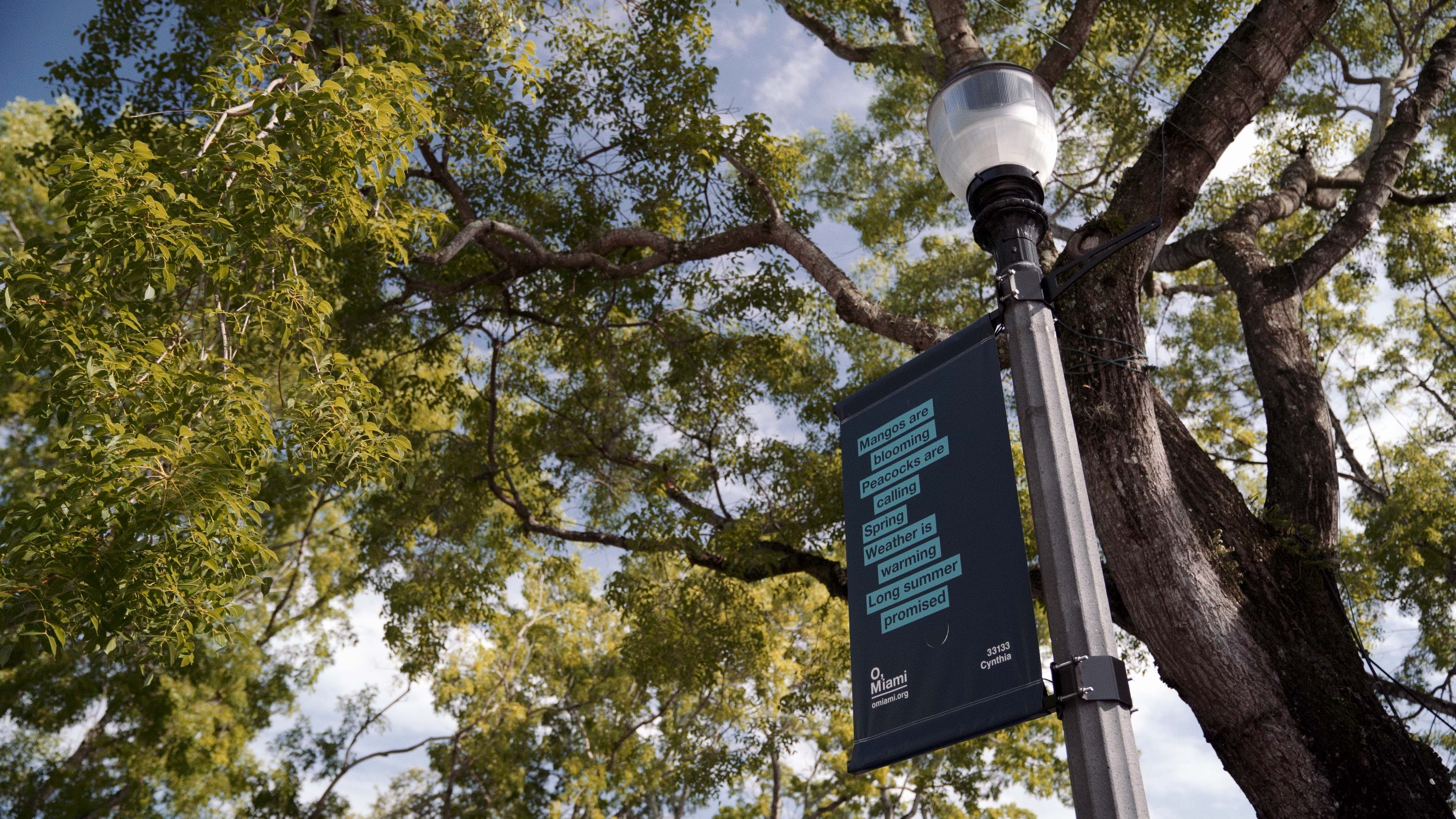
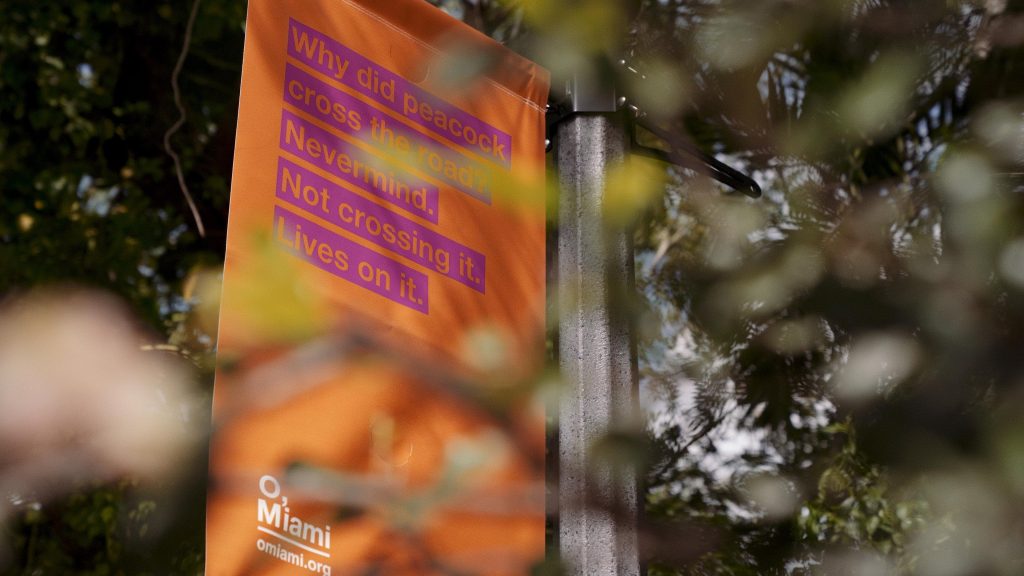
The poems placed throughout Coconut Grove are written in a format referred to as a “Zip Ode,” a five-line work where the numbers of the Zip code determine the number of words on each line. (Photo courtesy of O, Miami)
Poetry is blooming in Coconut Grove.
Miami’s original arts district is exhibiting 100 Zip code-inspired poems, printed on banners placed on streetlight posts throughout the neighborhood.
The Coconut Grove Business Improvement District (BID) partnered with the literary arts organization O, Miami for the exhibit, which was designed to welcome residents back outdoors while inviting nonresidents to discover the area through poetry.
At a time when the COVID-19 pandemic has shuttered galleries, museums and performance venues, these poems are providing passers-by with a safe way to enjoy public art in a scenic, outdoor setting, according to the exhibition’s organizers. Visitors can wander through the area wearing a mask, social distancing and observing art – finding a new poem every couple hundred feet as if participating in a treasure hunt.
“This is a unique and special and local art and literature experience that people can experience in a very safe manner,” says Abigael Mahony, executive director of the Coconut Grove BID. “It’s specific to the fact that we are in a new normal and we are adjusting to that as well.”
Written by residents of the neighborhood, the banners pay homage to the area’s rich history and eclectic culture. Coconut Grove touts itself as Miami’s original art district.
“This neighborhood has always had a bit of an irreverent vibe compared to other neighborhoods in Miami,” says Miami City Commissioner Ken Russell, who is also chairman of the Coconut Grove BID. “It never really conformed to authority, and that comes from its roots in the art culture.
More than 1,000 works were submitted, and 100 were chosen for the banners. (Photo courtesy of O, Miami)
“In the ’60s and ’70s, a lot of artists and musicians settled in Coconut Grove and that became part of the personality of the neighborhood. People would have studios in their homes and apartments where they’d produce art, sculpture, music,” he adds. “Coconut Grove also started one of the country’s best art festivals, the annual Coconut Grove Arts Festival, where people from all over the country come to enjoy and buy art.”
The poetic initiative stemmed from a contest organized by O, Miami and local radio station WLRN, which invited people on the air to submit poems about their Zip code. For the contest, the two created an original, poetic format referred to as a “Zip Ode,” a five-line poem where the numbers of the Zip code determine the number of words on each line.
So, for example:
Mangos are blooming (3)
Peacocks are calling (3)
Spring (1)
Weather is warming (3)
Long summer promised (3)
“Every poem is much like a Japanese haiku in a 33133 format. This is our first exercise in written art, and it’s very unique,” says Russell. “It generated so much participation from the public that we thought [the exhibit] would be a great way for people to finally see their poems.”
More than 1,000 works were submitted, and 100 were chosen for the banners, which have been up since June 9. The exhibit features poems from residents of all ages, including third- and fourth-graders from Coconut Grove Elementary School.
“Those poems really highlighted the unique and diverse aspect of the Grove,” Mahony says. “Coconut Grove is naturally poetic. We have a hub of artists and musicians. We are in an area filled with innovative and creative people.
“Moreover, as a place, Coconut Grove has the water, the bay, the lush green trees, the amazing peacocks, and wildlife. It is a beautiful, fascinating and ever-changing place that lends itself to a description of poetry.”
Miami-based artist Edouard Duval-Carrié's work, currently in the 61st Venice Biennale, echoes the Italian exhibition in “From Venice with Love” in Miami Beach at The Betsy Hotel.
“The Science Behind Pixar” at Frost Science takes visitors behind the scenes of Pixar films with more than 50 interactive experiences exploring animation, engineering, math and technology.
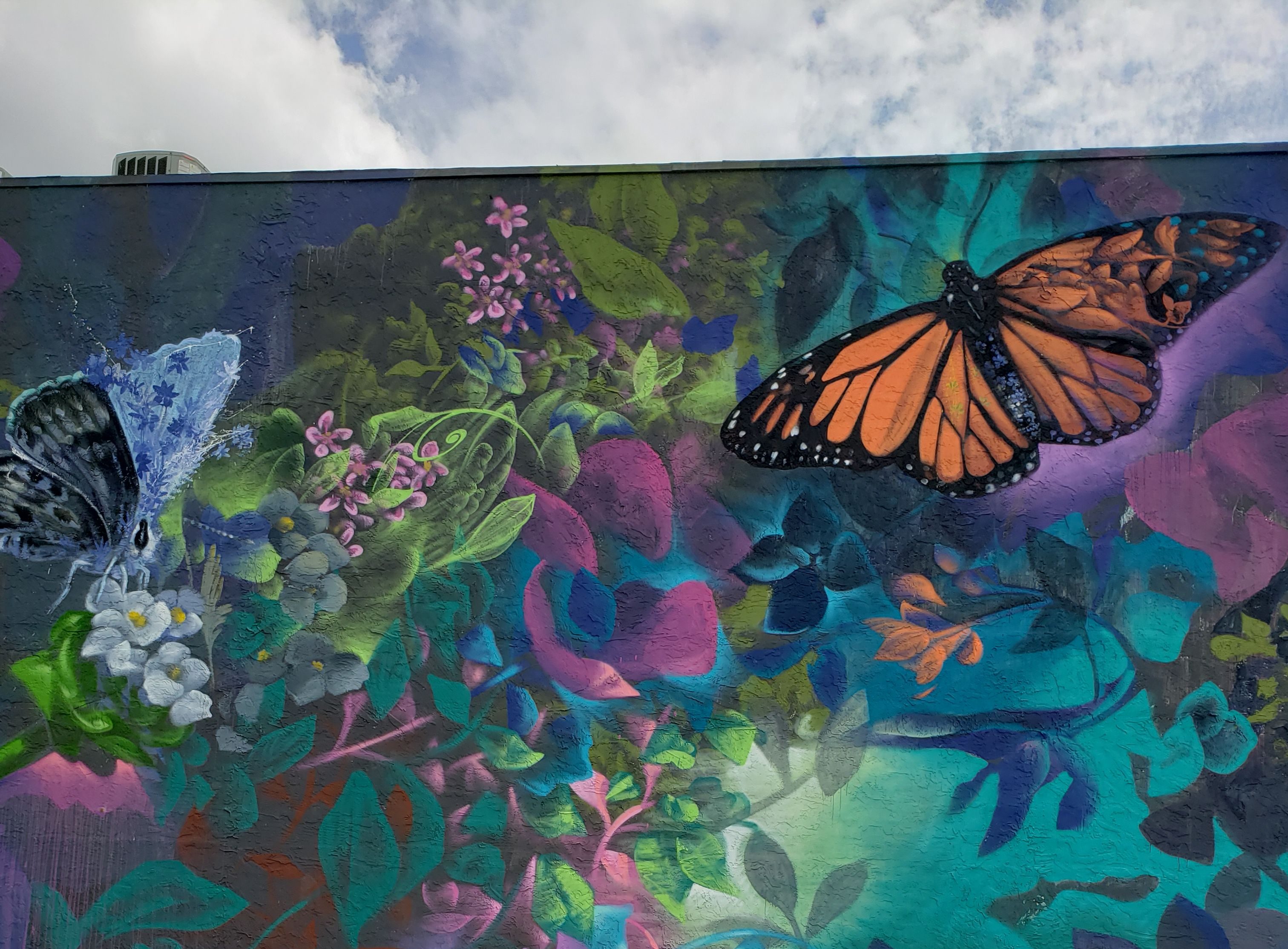
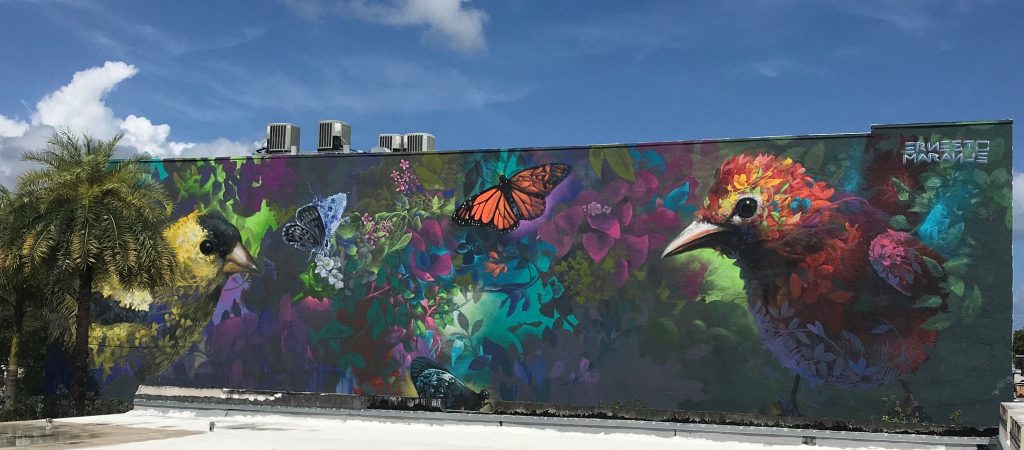
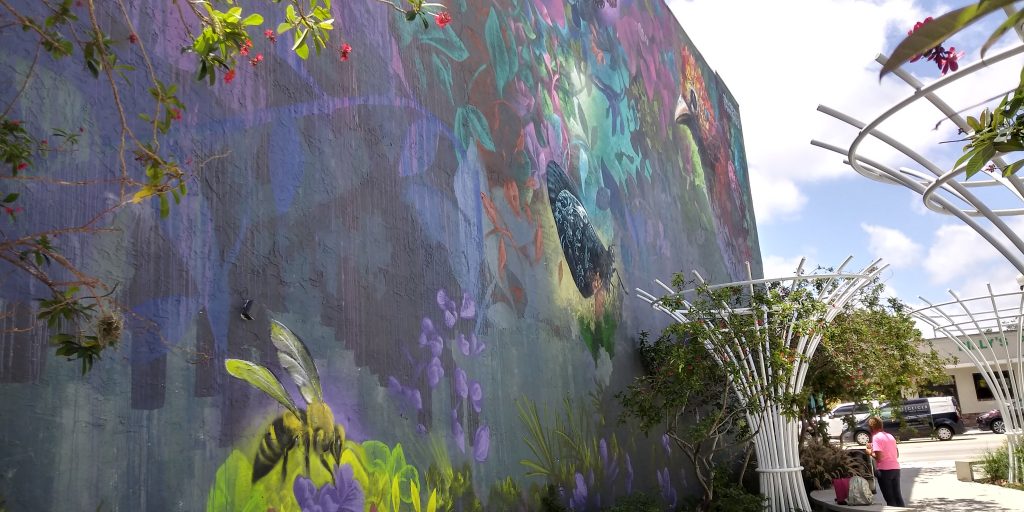
The new Liberty Gardens Park mural, by Miami-based artist Ernesto Maranje, touches on themes of restoring the native tree and plant habitats that nurture and allow birds, butterflies, bees, bats and other wildlife to thrive. (Photo courtesy of North Miami Community Redevelopment Agency)
North Miami is rapidly changing. One of the visible signs of these changes is the renovation and beautification project at Liberty Gardens Park, nestled in the heart of the city.
This novel pocket park is easy to spot, noticeable from a distance thanks to a huge, new, augmented-reality mural overlooking 125th Street, North Miami’s main thoroughfare.
For months, a segment of the 125th Street sidewalk was blocked and hidden to the public, piquing the curiosity of passersby. Once completed in March, North Miamians discovered a 2,700-square-foot public green space with the stunning mural, plus an expansive green wall, Florida-inspired landscape and decorative trellis with seating. The project was financed through Miami-Dade County’s Art in Public Places program and a beautification grant from the North Miami Community Redevelopment Agency (NMCRA).
“Liberty Gardens Park is a direct result of North Miami’s larger efforts to enhance the redevelopment of our ever-growing downtown corridor,” said North Miami Mayor Philippe Bien-Aime. “As part of the city’s cultural enhancement initiatives, Liberty Gardens Park will hopefully be a place where people can peacefully stroll through the garden or enjoy the vibrant music, art, food and entertainment showcased throughout our diverse neighborhood.”
The mural, a collaboration between the NMCRA and the nonprofit arts group, Before It’s Too Late, measures 95 feet wide x 45 feet high. (Photo courtesy of North Miami Community Redevelopment Agency)
Located at 715 NE 125th St., at the site of a former shotgun-style building, Liberty Gardens Park neighbors North Miami landmarks such as City Hall and the Museum of Contemporary Art North Miami. The novelty of this public square is the possibility for the visitor to navigate between virtual and reality.
First, there’s the mural canvas on the east wall, measuring 95 feet wide x 45 feet high. A collaboration between the NMCRA and the nonprofit arts group, Before It’s Too Late, the mural touches on themes of restoring the native tree and plant habitats that nurture and allow birds, butterflies, bees, bats and other wildlife to thrive.
Miami-based artist Ernesto Maranje, known for his environmental paintings, designed a site-specific mural that incorporates an augmented reality (AR) experience accessible to the public via mobile app.
After exploring the physical space, gazing at the mural and the green walls, visitors can enhance their experience with the free “Liberty Gardens AR” app (available for Android and iPhone), which literally brings the place and the mural to life. They will also be able to learn more about the artwork and discover a whole new world beyond the park itself.
The park is now “a space where technology meets art,” said Rasha Cameau, the NMCRA’s executive director. “As part of its ongoing neighborhood improvement efforts, the NMCRA converted the previously underutilized breezeway into a passive, outdoor garden space the entire community can enjoy. This also plays into a larger plan by the city of North Miami and NMCRA to beautify the entire downtown corridor and eliminate urban blight to improve quality of life.”
In addition to the stunning mural, the 2,700-square-foot public green space features expansive green wall, Florida-inspired landscape and decorative trellis with seating. (Photo courtesy of Jonel Juste)
Added North Miami Councilwoman Carol Keys: “It was an absolute honor to work on the Liberty Gardens Park project and bring a gorgeous green retreat to North Miami’s urban core … we are always exploring ways to improve the sustainability of our city. This type of mindful development remains a key priority for us in the years ahead.”
With the city’s emergency declaration now lifted, and more people seeking activities in the great outdoors after months of quarantine, now might be a good time to explore Liberty Gardens Park.
“We want residents and visitors alike to come together, enjoy the park’s lush landscaping, and experience a connection to art, nature and to one another,” Cameau said.
Miami-based artist Edouard Duval-Carrié's work, currently in the 61st Venice Biennale, echoes the Italian exhibition in “From Venice with Love” in Miami Beach at The Betsy Hotel.
“The Science Behind Pixar” at Frost Science takes visitors behind the scenes of Pixar films with more than 50 interactive experiences exploring animation, engineering, math and technology.
Written By Michelle F. Solomon June 9, 2020 at 4:15 PM
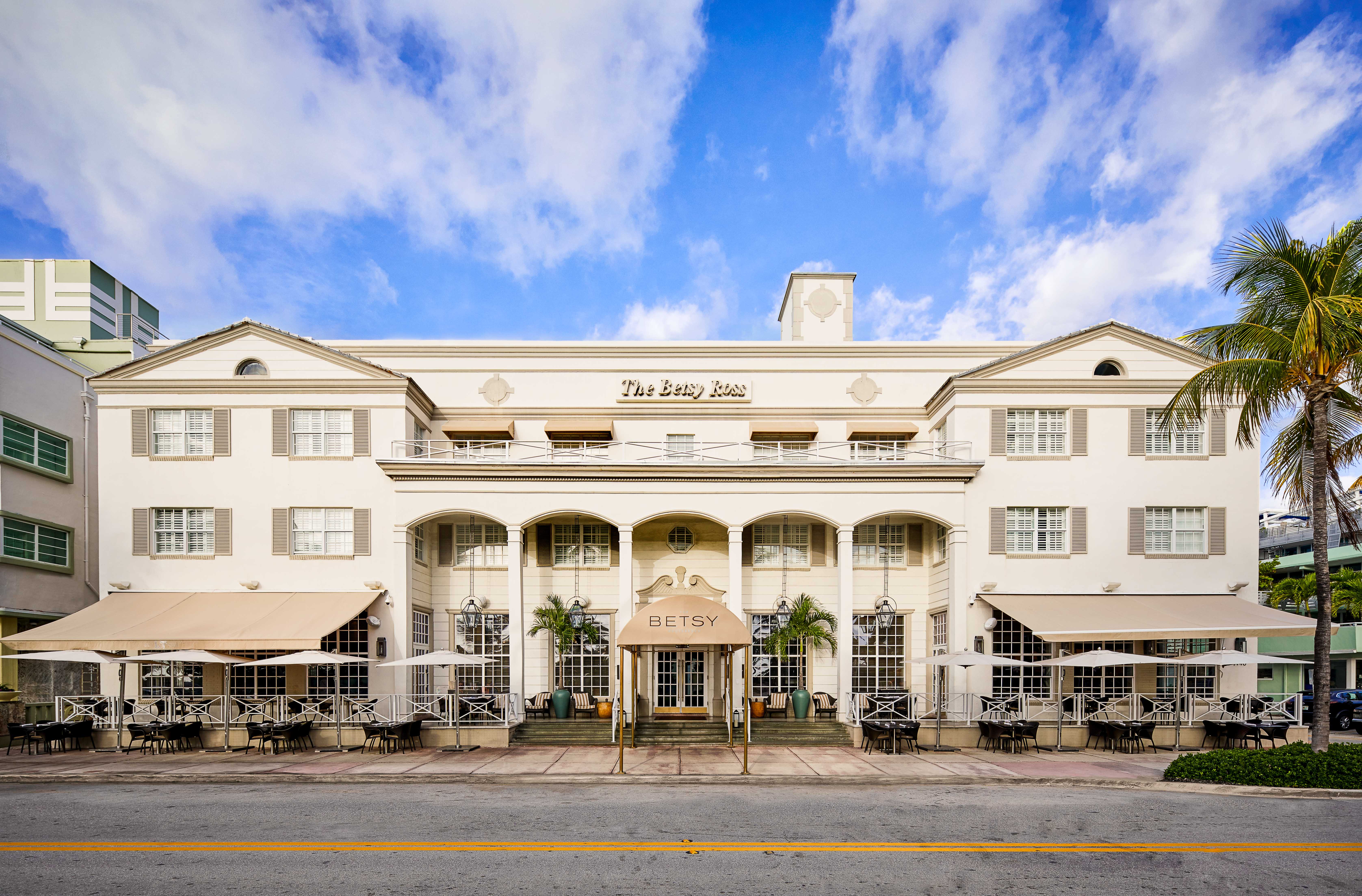
The team behind The Betsy-South Beach see the hotel as a beacon for art partnerships and a space that gives groups a home in the greater Miami area. (Photo courtesy of The Betsy-South Beach)
The Betsy-South Beach has been closed ever since the coronavirus shut down tourism in South Florida. A gradual reopening is expected on July 1, but live jazz music in the lobby and the ever-present buzz of arts and cultural programming won’t be back in full swing.
That doesn’t mean that The Betsy’s “PACE model” of philanthropy, arts, culture and education is on hold. Rather than hosting salons in the hotel, The Betsy moved them to a virtual space – creating online salons where artists and authors present live from their homes to yours.
At the end of March, just weeks after everything came to a halt, The Betsy began its virtual artists’ series titled, “Zen and the Art of Architecture, Music, Poetry, and Photography,” each Monday at 7 p.m. via Zoom. The weekly “community gatherings” kicked off with architect Chad Oppenheim broadcasting live on March 30.
“We’re now living in a world where on the other side of the screen or the telephone are people yearning for cultural and artistic interaction,” says Jonathan Plutzik, chairman and principal owner of The Betsy. “This virtual connection is profoundly important.”
The next incarnation of the “Zen” series started June 1 with a focus on contemporary writers creating in a multicultural world. “Zen and the Art of Writing in America” will continue each Monday through July 13. Then comes “Zen and the Art of Writing and Making,” which will close out the series on July 20, July 27 and Aug. 3.
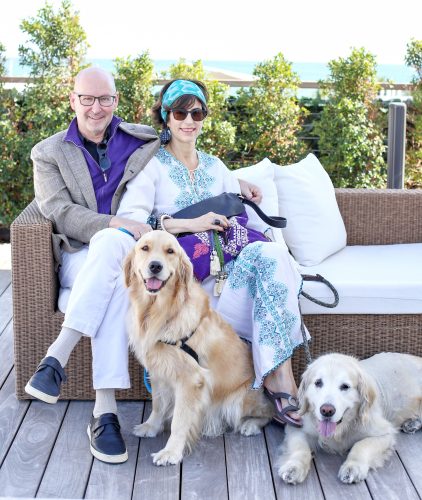
Plutzik, who co-owns the hotel with wife Lesley Goldwasser, says it is vital for The Betsy to be a space for comfort and healing through the arts. It’s a message he remembers a restaurateur friend telling him back in 2001, about places like restaurants and hotels playing an important role after the Sept. 11 terrorist attacks.
Husband-and-wife owners Jonathan Plutzik and Lesley Goldwasser. (Photo courtesy of The Betsy-South Beach)
“They became places of healing in a communal space, he told me. I carry that with me today,” Plutzik says.
The arts are a family affair for Plutzik. His sister, Deborah Plutzik-Briggs, is a professional opera singer-turned-doctorate-in-arts-education-turned-arts-development-expert. She serves as the hotel’s vice president of arts and as director of The Betsy Community Fund, which programs its arts and culture.
Their father is the late poet and three-time Pulitzer Prize finalist Hyam Plutzik.
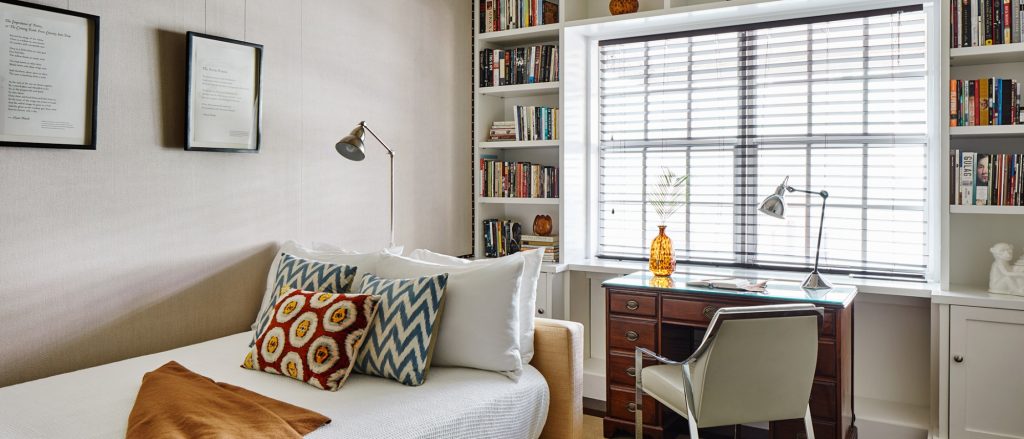
The Betsy has a Writer’s Room that is a legacy to him – and that features his desk as well as inspirational wall hangings in the form of Hyam Plutzik’s work, “The Importance of Poetry.” Writers selected for the hotel’s weeklong residencies in the creative studio space are meant to get inspiration from the surroundings.
“Many Miami pre-war hotels had ‘writing rooms’ for travelers and guests,” Plutzik-Briggs says.
The room opened in 2012, and the pandemic marks the first time the room closed and the residency was put on hold.
While the Ocean Drive hotel hosts everything from music to its own curated exhibition spaces, writing is the “most natural commitment to The Betsy,” Plutzik says. “We know about the immortality of creating things and of words and of poetry in particular.”
In May, The Betsy offered “Zen and the Art of Poetry By Women.” This month, “Zen and the Art of Writing in America” launched with Pablo Cartaya, who is the co-founder and former director of the Escribe Aqui/Write Here program at The Betsy. He also established its bilingual, LGBTQ and Young Adult Writers initiatives.
“When Pablo started as the first author on June 1, it confirmed to me that what we are doing is something important, giving artists the chance to talk about their work in the context of what is happening now in the world, and how, in spite of it all, they still find their Zen,” Plutzik-Briggs says.
She remembers getting Cartaya initially involved at The Betsy thanks to a Knight Foundation challenge grant designed to help further the writers program.
“I wanted to hire a writer from the community to work with me,” she says. “With that grant, I hired Pablo Cartaya. Having a partner like him made all the difference in the world. We created together Escribe Aqui/Write Here, and then we developed the residency program with Escribe Aqui for regional writers.”
Like everything The Betsy does with its programming, it was one of their community-built partnerships that became the link for the Zen series to get off the ground so quickly in March. Plutzik-Briggs called up John Stuart, executive director at FIU Miami Beach Urban Studios, to help The Betsy create the series.
“Jonathan was on board with the idea from the beginning,” she says.
Both brother and sister express great pride in The Betsy’s role as a beacon for art partnerships and a space that gives groups a home in the greater Miami area.
The Writer’s Room at The Betsy hotel on Ocean Drive. (Photo courtesy of The Betsy-South Beach)
This commitment to the arts is visible down to the details. Everything in each room is curated, from the art on the walls to the book selection. Goldwasser has put together a formidable art collection with museum-quality exhibition space throughout the property.
“We don’t want to have decorator books in our rooms, and we don’t want to have decorator art on our walls,” Plutzik says. “We focus only on great photography, and we think of ourselves as having nine galleries, six of which are in rotation and three of which are permanent.”
Goldwasser curates many of the exhibits, often inviting guest curators to mount shows. Because of their dedication to the fine art of photography, they have partnerships with some of the greatest galleries in the world.
Just before COVID-19 temporarily closed the hotel’s doors, the hotel was exhibiting “The Art of Andy Sweet.” Sweet was the young photographer who chronicled 1970s Miami Beach and was murdered in 1982.
“The exhibit moved people,” Plutzik says.
The Betsy also acquired an exclusive collection of Muhammad Ali photographs for an exhibit overseen by Goldwasser and curated by Andrew Kaufman. The exhibit offers a rare glimpse into the champ’s time spent in Miami Beach.
“There are some very famous shots in that exhibit and a set of 20 smaller ones all taken in Miami Beach,” Plutzik says.
Sitting out and looking at an empty Ocean Drive make Plutzik appreciate his connection to Miami even more, he says. He recalls when he and Goldwasser first laid eyes on the hotel. When they purchased The Betsy in a bankruptcy auction in 2005, “it was closed, the door was locked, and it had a skeleton staff of three,” says Plutzik. “But it wasn’t in bad shape.”
The couple did some renovations and opened it in 2006 as a luxury boutique hotel.
Deborah Plutzik-Briggs holding a copy of “The Betsy” by Harold Robbins. (Photo courtesy of Shams Ahmed)
“I can’t say that the moment we purchased it that we knew exactly what direction we would take, but we knew it would be to create a hotel that we thought South Beach needed,” he says. “We ran it for a while, then we shut it and renovated it completely. It took us a while to figure out what we wanted to do.”
The Betsy Hotel closed in 2007 and reopened in 2009 after a multimillion-dollar restoration.
“Perhaps except for now, spring of 2009 was probably the worst time in economic history to open a luxury hotel,” he says.
All these years later, The Betsy has developed more than 200 partnerships with its PACE model and the philanthropy of The Plutzik Goldwasser Family Foundation, which was created by Plutzik and Goldwasser. Plutzik-Briggs serves as the foundation’s executive director.
Not only has the Zen series helped The Betsy stay connected with the community, but it has served as a way to help keep arts brands alive, too.
“This is a very important time for us and all presenting organizations to have a chance to reassess what we do, to think about what you do well even better, or maybe to say, ‘You know that one thing we do? We’re going to leave that to someone else,’” Plutzik-Briggs says. “I am hoping to take with me these quiet moments and try to figure out how to do what I do and what we do better for the next phase.”
“Zen and the Art of Writing In America” continues each Monday. The July 13 closing of that series will feature the screening of the documentary, “Hyam Plutzik: American Poet,” in partnership with the Miami Jewish Film Festival. “Zen and the Art of Writing and Making” will begin July 20 with entrepreneur Gidi Grinstein and continue through Aug. 3. To RSVP for the free salons or to see the list of authors and guests, go to thebetsyhotel.com/calendar.
Jonathan Plutzik: With the help of family and friends, Plutzik has created a cultural Mecca in the heart of South Beach – offering chamber music, opera, jazz, poetry in many forms, writers’ breakfast salons, a writer-in-residency program, art exhibitions, a cappella festivals, and much more – all free of charge to the public. Find more video interviews of Plutzik at Inspicio.fiu.edu. (Video courtesy of Inspicio)
Video Credits: Drone video: Zachary Plutzik. Music: The (New) Beethoven Quartets. The 32 Piano Sonatas Reimagined. By Jeffery Briggs. Piano Sonata in C-minor, op. 13. Performed by the Amernet String Quartet. Photo & Design: Raymond Elman.
Miami-based artist Edouard Duval-Carrié's work, currently in the 61st Venice Biennale, echoes the Italian exhibition in “From Venice with Love” in Miami Beach at The Betsy Hotel.
“The Science Behind Pixar” at Frost Science takes visitors behind the scenes of Pixar films with more than 50 interactive experiences exploring animation, engineering, math and technology.
‘I Remember Miami’ to use residents’ voices, photos for installation of memories
Written By Michelle F. Solomon May 29, 2020 at 6:33 PM
Dora Garcia’s “I Remember Miami” is a participatory work that will create a collective time capsule, documenting a unique time in Miami’s history before and after the COVID-19 pandemic. (Photo courtesy of Massimiliano Minocri)
“Think about a single place in Miami, where you have been in the past.”
With these instructions, artist Dora Garcia aims to unite Miamians and create a time capsule that will cement in time the recollections and the sense of place of a pre-pandemic city.
That is the idea behind Garcia’s “I Remember Miami,” a participatory and collective art-and-audio installation commissioned by Miami Dade College’s Museum of Art and Design (MOAD) as part of its “A City of the People” series.
“Overnight, restaurants, bars, concerts, theater, so many things quickly became outdated,” says Garcia, referring to when Miami and the rest of the country came to a standstill in March. “Even though it has only been a few months, it all feels like it happened a long time ago.”
Garcia believes and hopes that, in time, the collective voices of “I Remember Miami” will define a moment in culture and society.
Once completed, the online archive will live on the websites of the artist, MOAD and the Miami Book Fair. Residents have until June 30 to submit their memories.
“Through her art, Garcia creates the conditions to keep us connected and collectively involved in visualizing Miami’s past, present and future,” says Rina Carvajal, MOAD’s executive director and chief curator. “‘I Remember Miami’ is a beautifully fitting culmination to ‘A City of the People,’ which encourages Miamians to become active participants in the life of the place that we love.”
So, how do you become part of this collaborative time capsule?
First, pick a Miami spot that has personal significance, like a bustling Wynwood coffeeshop, a special museum, a symphony concert at New World, a crowded cocktail lounge in Miami Beach.
“Something that made a special impression,” Garcia says.
If several people select the same place to describe, which is bound to happen, Garcia would consider it one of the unexpected journeys of the project. “Then we understand what subjectivity does to a place, in the way each person remembers it,” she says.
Garcia says recording on an iPhone or other mobile device is fine: “The Voice Memo app on iPhone is great for this.”
Garcia wants you to be as specific as possible about the place.
“It is important for those who hear the recording to get an idea of the place you remember,” she says. “You can speak to how it felt for you, but it is very important to describe what kind of place it is.”
Be sure to stand next to a window or on a balcony in what have been your quarantine quarters and first observe what is outside. Start the recording, then close your eyes, she instructs.
“In your mind, start walking around in it. Describe the place as it was the day or days you were there,” she says. “It is important to the piece to order your memories according to your path through the space. You walk into the space, you look to your right, to your left.”
“Think about a single place in Miami, where you have been in the past,” says Dora Garcia to collaborators who want to become part of her collective audio installation, “I Remember Miami.” (Photo courtesy of Angela Valella)
The length of the recording can be from a few minutes up to 15 minutes, but make it enough that the listener can reconstruct your impressions of the space.
Pictures are another crucial element of the installation.
Garcia suggests photographing the space around you right after you’ve finished the recording. Then add a photo of the place you described – an image of the site, a selfie taken with friends there, or a picture of an object that connects you to that place.
You can submit only one recording but send up to three photographs to accompany the narrative.
“I Remember Miami” is a companion piece to Garcia’s current collaborative with MOAD, “Rezos/Prayers,” which she first enacted in her native Spain in 2007. The artist splits her time between Norway and Spain.
For the Miami project in 2019, 11 people recorded narrations of their observations in various locations or on public transport, noting everyday (and sometimes) unexpected details.
“‘Prayers’ was about perception, ‘Remember Miami’ is about memory,” Garcia says. “The process of memory is made at the moment. It’s not something that pre-exists.”
Listeners also become part of the collective installation.
“The moment you describe [a memory] to someone, it is also forming an image for the person who is listening. This is what is exciting about this process,” she says.
After all, we don’t really know how life will look once we’re completely past the pandemic.
“As long as you remember a place, you are keeping it alive,” she says. “In this case, you are remembering Miami” – for yourself and for others.
Submissions will be accepted until June 30 for inclusion into a growing online archive. Once completed, the archive will be accessible on the websites for the artist, the museum and the Miami Book Fair. Submit photographs and audio recordings, in any language, as digital files at mdcmoad.org/iremember.
The Museum of Art and Design at MDC is inside Miami’s historic Freedom Tower, 600 Biscayne Blvd. For more information, visit mdcmoad.org or 305-237-7700. The museum is temporarily closed due to the COVID-19 pandemic.
Miami-based artist Edouard Duval-Carrié's work, currently in the 61st Venice Biennale, echoes the Italian exhibition in “From Venice with Love” in Miami Beach at The Betsy Hotel.
“The Science Behind Pixar” at Frost Science takes visitors behind the scenes of Pixar films with more than 50 interactive experiences exploring animation, engineering, math and technology.
‘By & For’ online art auction to benefit Miami artists
Written By Rebekah Lanae Lengel May 26, 2020 at 6:06 PM
Among the pieces for auction in “By & For Ed. 2 | MIAMI” will be Philip Lique’s “Segment study based on cathedral ceiling,” 2020. (Photo courtesy of Philip Lique)
When curators and friends Luna Goldberg and Laura Novoa saw the havoc that the COVID-19-related shutdown was causing within the arts community, they had to take action.
Inspired by the efforts of fellow curator Pia Singh in Chicago, who created the “By & For” online art auction to benefit artists, the two teamed up to co-curate their very own Miami edition.
Known as “By & For Ed. 2 | MIAMI,” the local auction will take place on the Instagram social media platform, running from 5 p.m. May 29 through 5 p.m. May 31.
“It was conceived of as an artist relief fundraiser to help support artists who have lost opportunities because of the pandemic,” says Goldberg, who also works as education manager at the Jewish Museum of Florida-FIU. “The concept behind it is that in bringing different artists together, coming from different backgrounds, both emerging and recognized, resources can be pooled to really support the entire arts community.”
“Both of us are really trying to support the community that we work with and deal with every day,” adds Novoa, who is the curatorial and public programs associate at Miami’s Bakehouse Art Complex. “Some of us can feel a little bit like we’re not doing enough during this time, so this was a great opportunity for us to work together and do our part in supporting artists.”
Mateo Nava’s “Hasta que nos alcance,” 2019. (Photo courtesy of Mateo Nava)
Here’s how it will work: Bids must be placed in increments of $50, and be made either through the comment section of each post or via direct message on the social media platform. Funds raised will be split equally between participating artists.
With opening bids as low as $150, it’s an opportunity for art-lovers to build their collections while also supporting a community of artists.
“Instagram is a very democratic platform,” Novoa says. “Anyone can bid on an artwork and participate in this event, and in a process that’s usually unreachable and unattainable if you’re not of a certain social economic standing. I think that’s an exciting part of it – making this more democratic, and making this a collective shared experience that is meant to be a fun way of supporting local artists.”
The auction will feature the works of 16 Miami-based artists, including Jen Lynn Clay, Lucia Del Sanchez, Philip Lique and Mateo Nava.
To create the “By & For Ed.2 | MIAMI” auction, the two curators reached out to their networks, looking for a diverse group of artists who worked across mediums.
“We’ve gotten such positive responses from the artists themselves,” Goldberg says. “You can really see this camaraderie around the community and this excitement around supporting one another, and that’s been really lovely.
“Many of the participating artists have works and practices that are in conversation with one another,” she adds. “They contribute to the city’s local arts scene and practice alongside one another in institutions like the Bakehouse Art Complex, Oolite Arts, the Deering Estate, among others.”
Jen Lynn Clay’s “Fruiting Bodies,” 2020. (Photo courtesy of Jen Lynn Clay)
The Miami edition of “By & For” will include works in a variety of mediums such as painting, printmaking, ceramic and soft sculpture textile works, Goldberg says.
“We are hopeful that by providing such a diverse grouping of artworks, individuals with different aesthetic tastes will be able to connect to one or multiple works,” she says. “We hope that it’ll be something that people respond to, and that we will have multiple people over the weekend interested in pieces, placing bids.”
As curators and educators, Goldberg and Novoa see the auction as an opportunity to amplify the community of artists in South Florida and to recognize the role art plays in our daily lives, particularly during the pandemic.
“Artists usually bring with them more than just their artwork or their creativity,” Novoa says. “They really do think in very creative ways about the ‘we.’ The socially engaged nature of artists and artwork is so important, and not only in times like this, but all the time.
“Having the ability to think creatively is what’s going to get us through many crises, not just COVID-19, but also the climate change crisis and beyond. Artists and creative, in general, are the ones that really bring change to our world, so for us it’s important to give them this platform.”
What: “By & For Ed. 2 | MIAMI,” an Instagram-mediated artist relief auction featuring work by John William Bailly, Thomas Bils, Liene Bosquê, Jen Lynn Clay, Lucia Del Sanchez, Diego Gutierrez, Rhea Leonard, Philip Lique, Nick Mahshie, Laura Marsh, Mateo Nava, Alex Nuñez, William Osorio, Jennifer Printz, Nicole Salcedo, and Lauren Shapiro.
Miami-based artist Edouard Duval-Carrié's work, currently in the 61st Venice Biennale, echoes the Italian exhibition in “From Venice with Love” in Miami Beach at The Betsy Hotel.
“The Science Behind Pixar” at Frost Science takes visitors behind the scenes of Pixar films with more than 50 interactive experiences exploring animation, engineering, math and technology.
‘Imagine Visions of Hope’ encourages photojournalists to combat grief and fear
Written By Elisa Turner May 21, 2020 at 2:32 PM
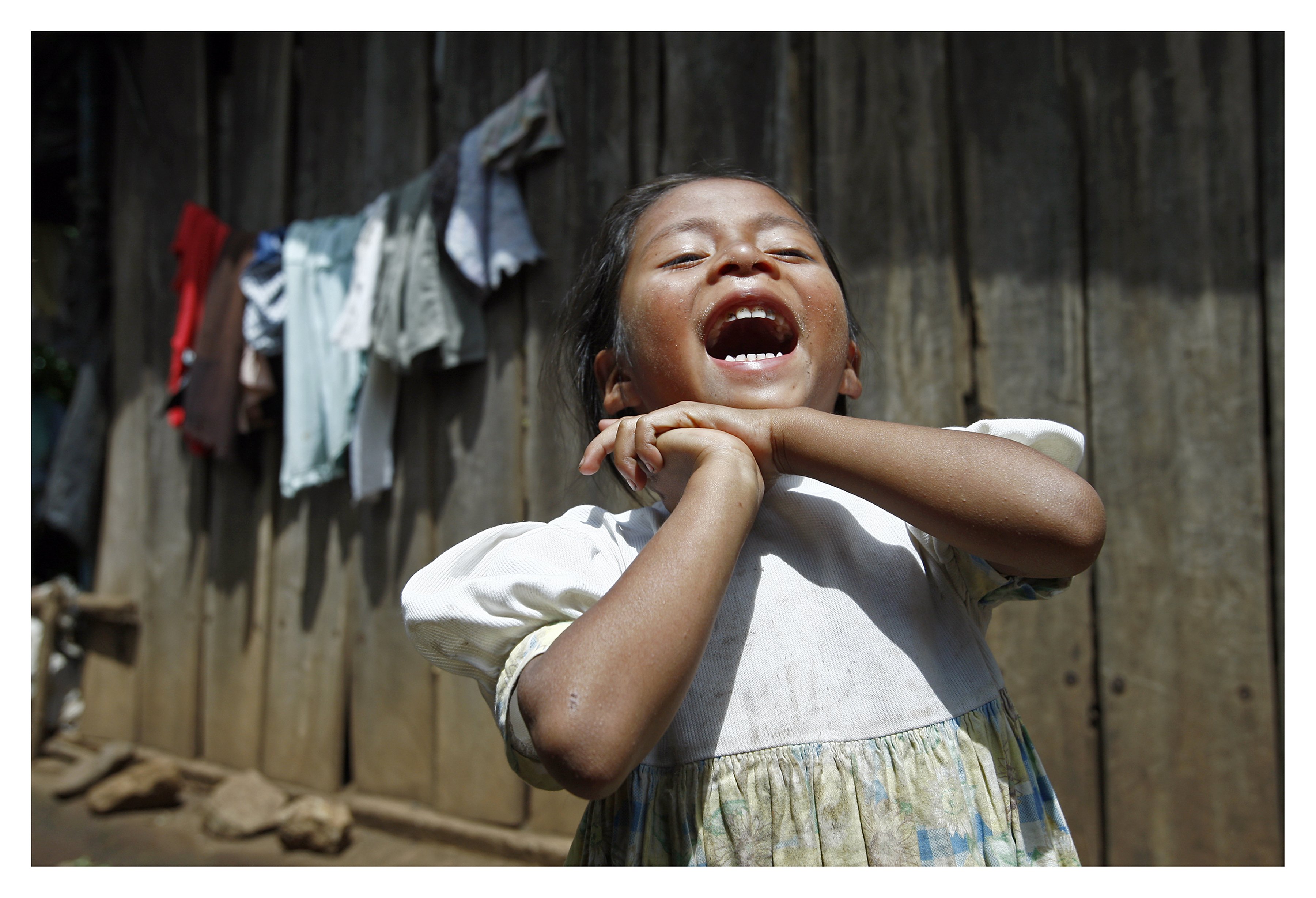
“Smile,” taken Sept. 26, 2008, features Carla Gonzalez, 5, from Jalapa, Guatemala. Carla suffers from chronic malnutrition. Many of the children living in the small villages surrounding Jalapa suffer from some type of malnutrition. Due to the lack of sufficient nutrition, children are short for their age and have skin ailments. (Photo courtesy of Carl-Philippe Juste)
Prize-winning photojournalist Carl-Philippe Juste knows when it’s time for heavy lifting.
As the pandemic devastated Italy in February, Juste initiated the heavy lifting for a bold project — “Imagine Visions of Hope,” an online photo gallery that will eventually become traveling exhibits around the world.
Its mission: to encourage photojournalists to capture powerful scenes of hope as a way to counter the mounting tides of grief and fear inundating the globe.
It’s vital to pay witness to hope amid adversity, Juste insisted. “We have to give ourselves self-assurance. Because the quickest way you can manipulate people is if you make them fearful, if you rob them of their power.”
Fear stunts action and hope. As a Miami Herald photojournalist who’s covered wars in Iraq and Afghanistan, he said, “I’ve done a lot of hard stories, and one thing I’ve learned is that you can’t live in fear.”
The project’s website, Imaginevisionsofhope.org, went up online in early March. It announces an open call for both professional and amateur images to be featured in the gallery and to be considered for an exhibition series projected to travel from Miami to Washington, D.C., or New York City, as well as to South America, Europe, Africa, and Asia. Plans are to launch the series in Miami in 2021.
The barely 2-month-old project is a collective effort, combining the rich photojournalist talents of Iris PhotoCollective in Miami, which Juste founded, and Focus on the Story in Washington, D.C.
It has an estimated budget of $200,000, he said, not including various programs for each show at six locations. It also will award $500 to one photographer for “Best of Show,” according to the website.
Juste enlisted the partnership of Focus on the Story executive director Joe Newman, an award-winning reporter and editor who founded the Focus on the Story International Photo Festival to support visual storytelling that has a social impact.
“When I come to lift something really heavy, I bring people to help me carry it,” he said.
Juste also assembled a curatorial team to jury submissions for the online gallery and planned exhibits.
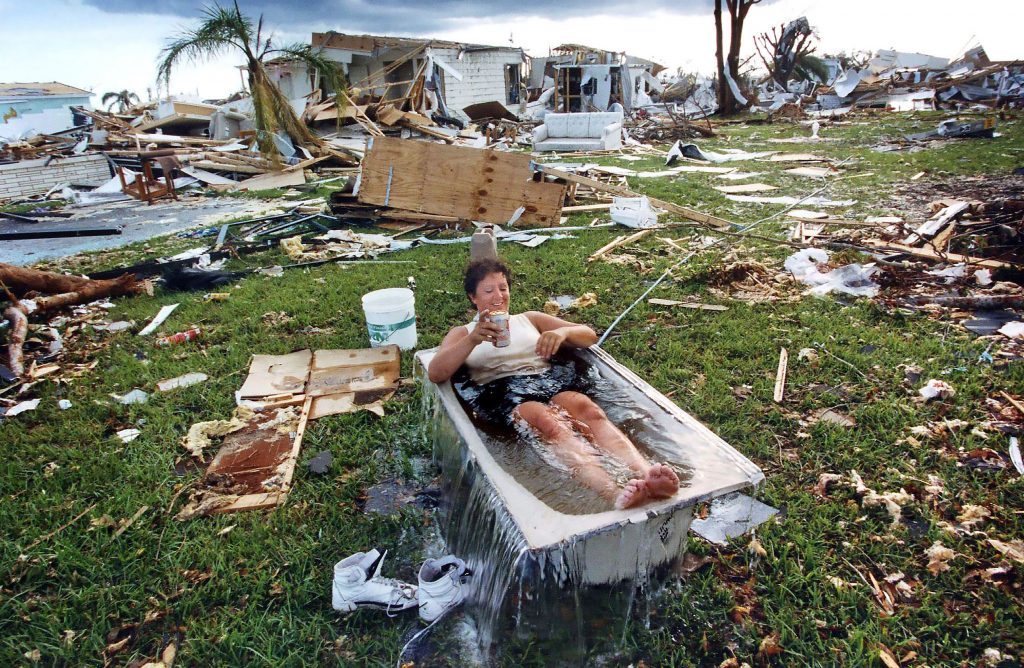
In “Untitled,” shot in 1992, Marjorie Conklin cools off in a tub of water filled with a hose, surrounded by what’s left of her south Miami-Dade County home several days after the destruction of Hurricane Andrew. (Photo courtesy of C.W. Griffin)
In addition to Newman, Juste’s team includes documentary photographer Maria Daniel Balcazar, San Antonio News-Express photo editor Luis Rios, and Newseum director of photography Indira Williams Babic, a frequent speaker on issues in photojournalism, including women covering conflict from the front lines.
“We’re not looking at pictures because they’re pretty,” said Juste, of the jurying process. “We’re looking at pictures because they’re poignant.”
All images must be grounded in fact, abiding by principles of photojournalism.
The website currently features 50 images from Miami, Guatemala, Honduras, Haiti, Sudan, India and other locations. Many show children playing in countries beset with desperate poverty or reminders of armed conflict. There’s an image from photographer Colin Finlay, for example, of children in Cambodia playing in a field that had recently cleared of landmines.
“We always seem to personify hope in terms of children, because the gravity of their life does not hold them down. No matter where you go around the world, kids still play. And they play with a sense of wonder,” Juste said.
Others evoke dramatic images of resilience in seriously degraded landscapes. Jeffrey A. Salter’s close-up of two gnarled, bare feet shows a green sprout pushing up between them, a small but vivid sign of efforts to counter deforestation in Haiti. In C.W. Griffin’s photo, a woman lounges in a water-filled tub, surrounded by remnants of her home a few days after 1992’s Hurricane Andrew destroyed it.
“The project speaks to the human condition at its worst and how we are able to sustain some level of humanity,” he said.
Juste spoke urgently about the still-nascent project, expressing his passionate belief in the visual language of photography to effect change: “Everyone has courage. It’s up to us, as artists, as communicators, to touch that courage and ignite it.”
To submit an image, and read the submission rules, go to Imaginevisionsofhope.org. The deadline to enter is July 15.
Miami-based artist Edouard Duval-Carrié's work, currently in the 61st Venice Biennale, echoes the Italian exhibition in “From Venice with Love” in Miami Beach at The Betsy Hotel.
“The Science Behind Pixar” at Frost Science takes visitors behind the scenes of Pixar films with more than 50 interactive experiences exploring animation, engineering, math and technology.
Art curator Rosie Gordon-Wallace stays on mission, with hope & the will to help
Written By Rebekah Lanae Lengel May 19, 2020 at 4:43 PM
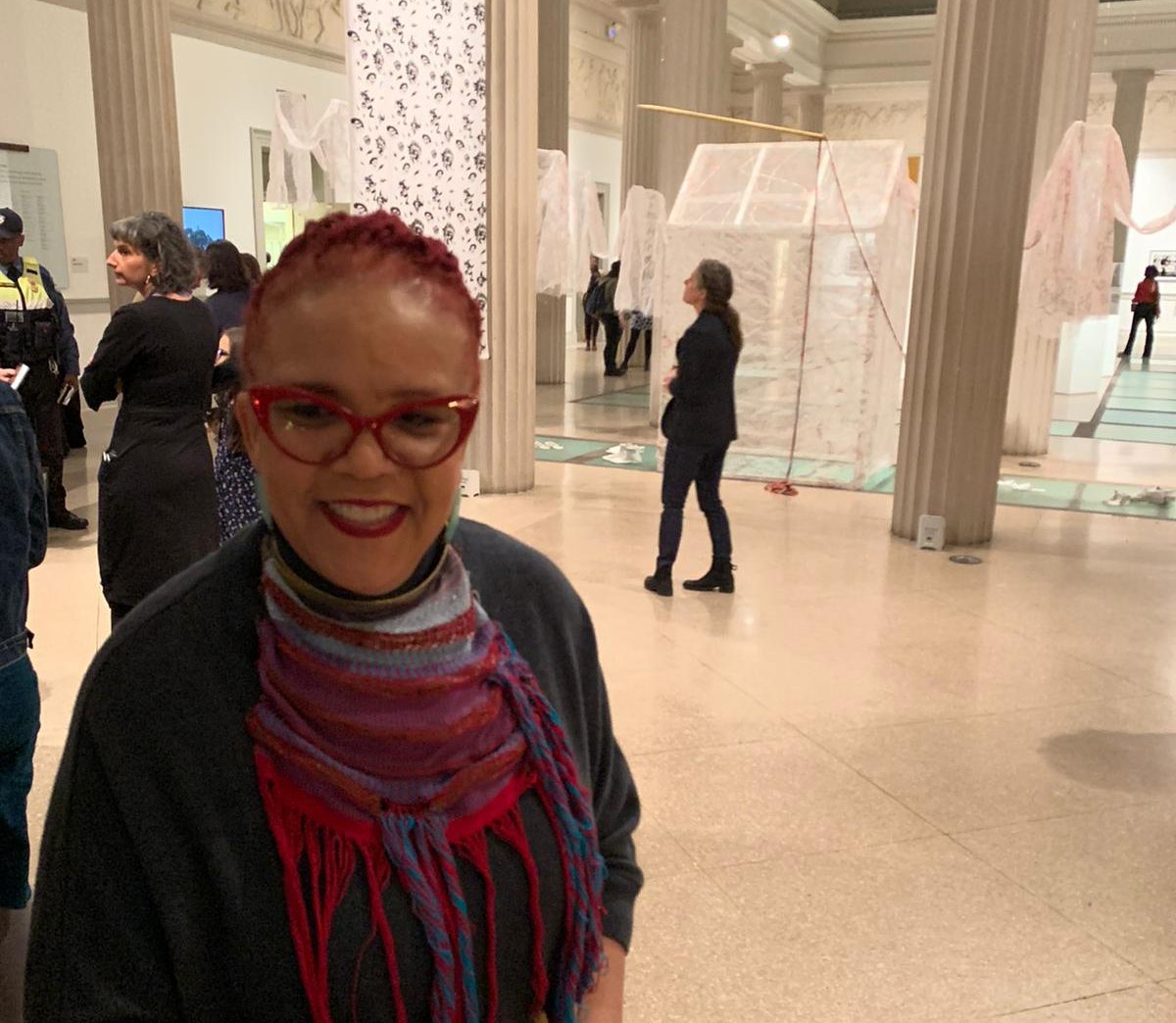
Rosie Gordon-Wallace co-curated last year’s Miami-focused exhibition, “Inter | Sectionality: Diaspora Art from The Creole City,” at the Corcoran School of the Arts and Design at George Washington University in Washington, D.C. (Photo courtesy of Roy Wallace)
Rosie Gordon-Wallace has been a doyenne of the Miami arts community since the founding of Diaspora Vibe Cultural Arts Incubator in 1996. Originally trained as a microbiologist, the Jamaica native’s passion has always been for art.
She has supported the development of artists from the Caribbean diaspora through residencies and exhibitions and been a tireless mentor to all who cross her path.
It is no wonder that in the face of a global pandemic, her focus immediately turned toward the needs of the artistic community. On May 9, she launched a food distribution program that helps artists facing financial and food vulnerability, as well as Homestead farmers.
“It was a kneejerk gestation, overnight,” Gordon-Wallace says. “I wanted to do something to support the small farmers and to support artists, just in getting food on the table.”
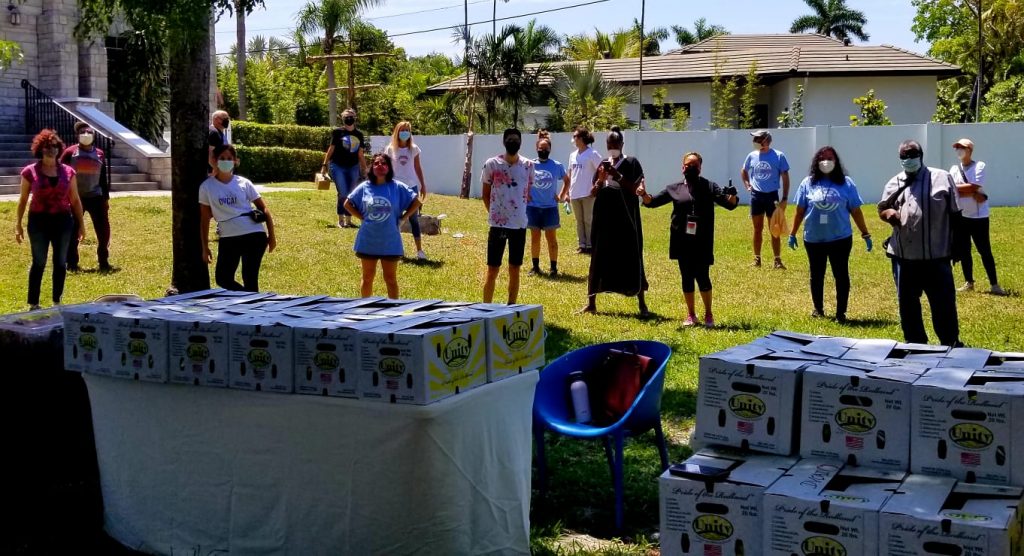
Throughout the next three months, the Farms to Studios project will distribute boxes with $25 worth of fresh fruits and vegetables from Homestead’s Redland Community Farm and Market (along with recipes contributed by her sister who is a nutritionist) to 40 South Florida-based artists.
The distributions take place every two weeks on the lawn of Bay Shore Lutheran Church in Miami.
“When you’re doing this, you realize that you can’t do everything for everybody, and it’s a very humbling thought,” she says. “So at least, if someone is really in need, then … they can come and get a box of vegetables and food, and we can at least take away the insecurity and anxiety around food.”
Artists must register online for each cycle of distribution, and boxes are limited to 40 each cycle due to fundraising capacity.
In her words, there are “no guidelines. However, the artists’ word of mouth is fierce. Each week, we have a waiting list.”
(Courtesy of y Izia Lindsay, MFA)
The impetus for the program came from conversations with artist colleagues, who discussed the economic and psychological impact of the COVID-19 shutdown on the community.
“We talked about shame, that people feel it because their careers are on a pause,” she says. “They were doing major projects internationally and locally – and the shame [can come] around thinking: How can I be successful internationally, and I’m unable to keep my apartment, or put food on the table, put gas in my car?”
Gordon-Wallace understands that the path out of this pandemic will be fraught with challenges for all, not the least of which will be those working in the cultural sector.
“I’m hoping that as we face the pressures, that we will be able to push through. It’s going to require faith. It’s going to require a kind optimistic mindfulness, a deep belief in practice, faith in the tomorrow – that the sun sets every evening and rises in the morning,” she says. “I am hoping that this artist community does not lose faith.”
She would like to see the artist community come out of this pandemic and organize.
“I would like to see some leadership come out of this hardship, and [for the artist community to] come together and ask the tough questions of what we need. How can we organize as a group? It doesn’t have to be large, it can be locally, then nationally, then globally,” she says. “But a coming-together around an agreement around how contracts are formed is critical. What would you pay an artist to do an installation? What is the norm that you would pay an artist to fabricate? What are the standards for our industry?
“This work requires muscle. It requires sacrifice for you to focus, and to develop deep thinking and deep ideas,” she adds. “It requires sacrifice, but it doesn’t mean that you have to suffer.”
In the face of our new reality of isolation, Gordon-Wallace finds comfort in routine, connections and faith.
Volunteers at the first Farms to Studios food distribution on May 9. (Photo courtesy of Roy Wallace)
“I’m a firm believer in ritual. When I open my eyes in the morning, I’m privileged enough to see a canopy of green and flowers.And I am great for that at my age, that I can open my eyes and get up,” she says, with a laugh. “So the simple gratitude of just being able to get up and move, and the rituals of simplicity, and really keeping in touch with friends and family.”
She also continues to find inspiration in art. She references a painting by artist Jared McGriff titled “Alone Together,” which was included in a recent exhibition she co-curated at the Corcoran School of the Arts and Design at George Washington University in Washington, D.C.
“I thought of how both of those words are so powerful, because we are alone, but we are together in this. We’re alone together, and that has not happened for the American family in a long time,” she says.
These are also times that reinforce her steadfast commitment to artists and the importance of making art.
“I have my mission statement taped to my computer, and there are days when I literally read it aloud. It is to nurture and promote and exhibit the work of Latin and Caribbean artists, black and brown artists,” she states emphatically. “This is not work for the faint of heart. No one chooses this pathway just because, because you’re certainly not earning enough. So the question becomes why, right? Why do this?
“[It’s] the immeasurable joy that it brings to me – not joy in the way that you think I’m happy running in the streets leaping, not that kind of joy – but rather a deep-seated sense of contentment. I feel worthy, I feel worthwhile, that when I die, even if everybody that we have served does not appreciate it, that if we can in this work change the artistic mind of one human being from that region, to have a dedicated life in this, then it would have been enough. If we can stay on mission, regardless of how rocky the future is, I will find peace and joy and contentment.”
If you would like to sign up for a box, or underwrite a box for an artist in need, visit dvcai.org.
Miami-based artist Edouard Duval-Carrié's work, currently in the 61st Venice Biennale, echoes the Italian exhibition in “From Venice with Love” in Miami Beach at The Betsy Hotel.
“The Science Behind Pixar” at Frost Science takes visitors behind the scenes of Pixar films with more than 50 interactive experiences exploring animation, engineering, math and technology.
ICA Miami’s ‘Digital Commissions’ showcases new works every week
Written By Rebekah Lanae Lengel May 14, 2020 at 2:01 PM
Faren Humes’ “MLK” is part of ICA Miami’s “Digital Commissions” project. (Video still courtesy of Faren Humes)
As stay-at-home orders stretch into the third month, cultural institutions are looking at how to present artistic offerings to the public in safe and digitally accessible ways.
The Institute of Contemporary Art, Miami (ICA Miami) has long focused on expanding its online platforms, so it was uniquely positioned to quickly launch a commissioning project featuring seven Miami artists and an artist collective.
“Since we launched, we have worked on ensuring that, as a new and cutting-edge museum, everything we were doing was thinking innovatively about technology and media,” says Alex Gartenfeld, ICA Miami’s artistic director. “So there is a giant section of our website entitled ‘Research,’ and a big part of it is our Channel, which is a program dedicated to creating new narratives in contemporary art.”
Titled “Digital Commissions,” the project premieres new works weekly and keeps them live on ICA Miami’s channel for a year. Its aim is not only to expand the institution’s digital reach but to develop and support artists, who are among the hardest hit by the COVID-19 economic shutdown.
“Obviously, this is an unprecedented time for people working in all sectors of the economy, but artists and art educators are no less impacted, and this is one of a number of gestures that the ICA has undertaken in order to give back to our community,” Gartenfeld says. “It’s a tribute to the Knight Foundation and our partnership with them on this new program … which speaks to our foundation leaders in this community, who are thinking long term and short term about sustainability in Miami.”
The project – organized by ICA Miami’s director of the Knight Foundation Art + Research Center, Gean Moreno, and museum curator Stephanie Seidel – originally focused on four artists but soon expanded to eight participants. They are: Cristine Brache, Domingo Castillo, Faren Humes, Terence Price II, The Institute of Queer Ecology, Aramis Gutierrez II, Tara Long, GeoVanna Gonzalez.
Video still of Terence Price II’s work, titled “2017, 18, 19, 20 & So On.” (Courtesy of Terence Price II)
The artists were given a short turnaround period but much freedom to create.
“We gave artists a pretty blank slate. We said to them: Thinking about your practice recently, create a new work that will function innovatively on our website ad social media,” Gartenfeld says.
“We said: What can we do to support artists in our community? We have taken this time to also analyze all of our digital offerings and ensure that we’re engaging the public in new ways, so this is perhaps a marquee program in that initiative. This was a way of working with artists to continue to move their vision forward, and invest in them as well.”
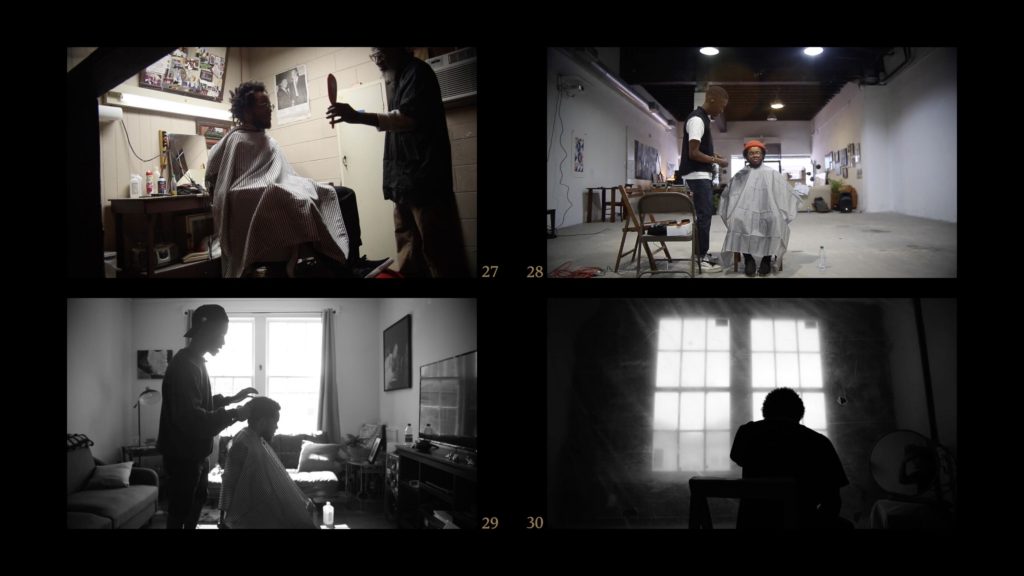
For Price II, a Miami-based photographer, this was an opportunity to realize a work he has been developing since 2017. Originally focused on street photography and documenting the Miami communities where he grew up, his “Digital Commissions” work includes a series of four videos documenting his own haircuts – from a cut during a 2017 visit to Eatonville, Fla., to the most recent performed by himself during COVID-19 enforced isolation.
“In 2017, I decided to record my uncle, who was a barber, cutting my hair, and from there it has been like once every year I recorded myself cutting my hair and shedding and starting fresh from whatever experiences that led up to that moment,” he says.
The end result, titled “2017, 18, 19, 20 & So On,” was the second commission to premiere on ICA Miami’s Channel.
The museum and artists are excited about the possibilities of a digital exhibition space, which allows works to be seen and experienced by viewers without the limitations of geography.
“Since people are able to watch it on their phones, or at home, I think that’s pretty cool that you can reach a lot more people,” Price says. “Now that it’s on this platform, everybody can travel through the web and then watch it and sit with it and have their own personal connections to it.”
Adds Gartenfeld: “We have had to think about how every program not only translates to web but engages audiences of all types, so this raises really complex questions about how we work with partners, how education functions, and how we continue to ensure accessibility.
“So this particular project is just a narrow glimpse into the deep consideration we have had around be goal of digital in our lives.”
What: “Digital Commissions,” presented by the Institute of Contemporary Art, Miami
When: Ongoing, with new works premiering each Wednesday
Miami-based artist Edouard Duval-Carrié's work, currently in the 61st Venice Biennale, echoes the Italian exhibition in “From Venice with Love” in Miami Beach at The Betsy Hotel.
“The Science Behind Pixar” at Frost Science takes visitors behind the scenes of Pixar films with more than 50 interactive experiences exploring animation, engineering, math and technology.




Recent Comments