
Visual Art
Kit Pancoast Nagamura returns with her family legacy at The Kampong
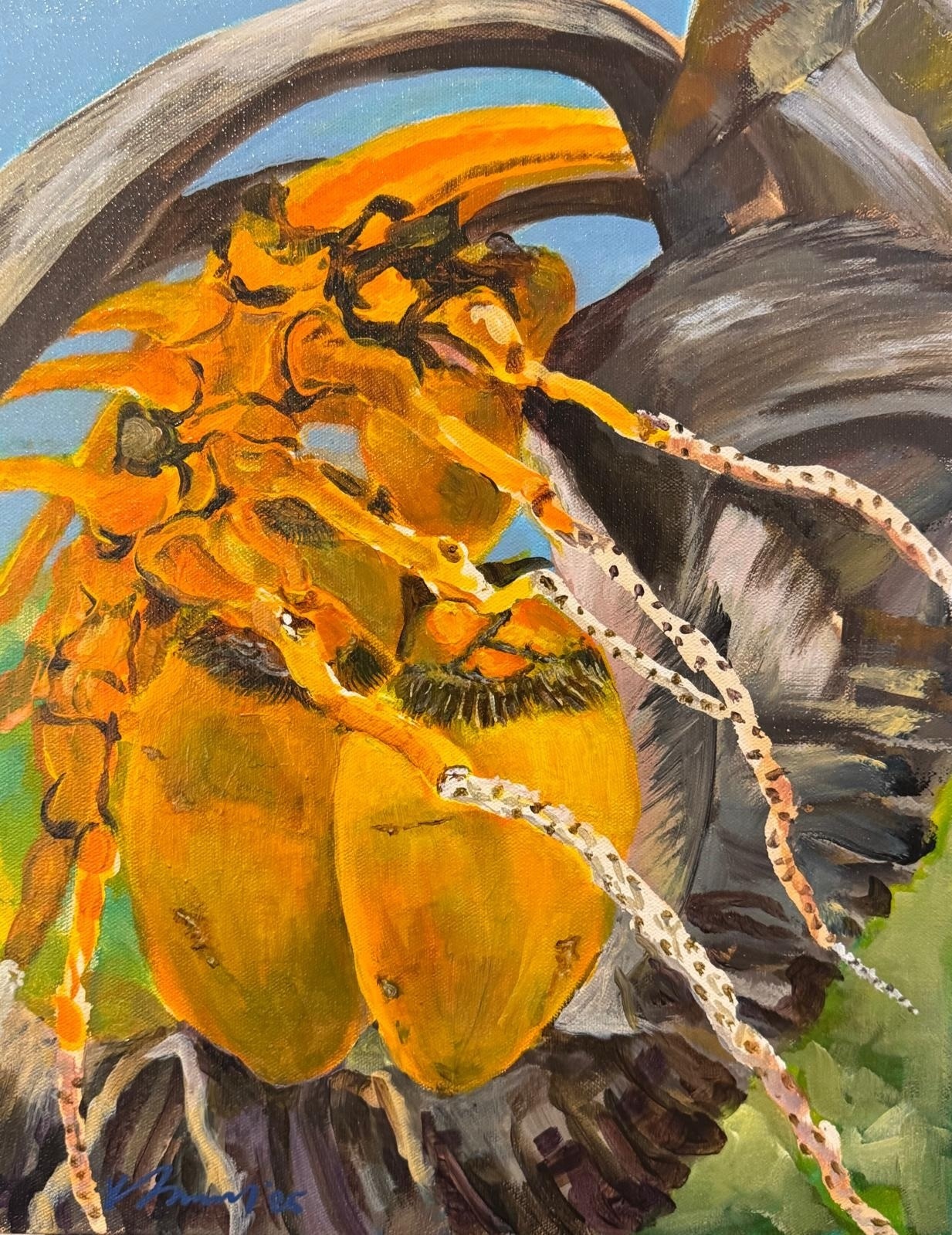
“Backbone,” acrylic on canvas, is featured in Kit Pancoast Nagamura’s “When We Come to Paint,” an exhibition of works by the great-granddaughter of botanist and plant explorer David Fairchild, and selected works of her parents. On view through Saturday, Aug. 15 at The Kampong in Coconut Grove. (Photo courtesy of the artist)
Whenever Kit Pancoast Nagamura returns to The Kampong, she’s greeted by a scent that has stayed with her since childhood.
“When I go back to The Kampong, the first thing I notice is the smell of the mangoes,” says the native Miamian visual artist. “I think our first memories as human beings are olfactory.”
That memory inspired “When We Come to Paint,” on view through Saturday, Aug. 15 at the National Tropical Botanical Garden’s nine-acre garden in Miami. The exhibition features 26 large- and medium-scale paintings by Nagamura, approximately 40 mixed-media works she calls “Afterworks,” selected works by her parents and original haiku accompanying many of the pieces.
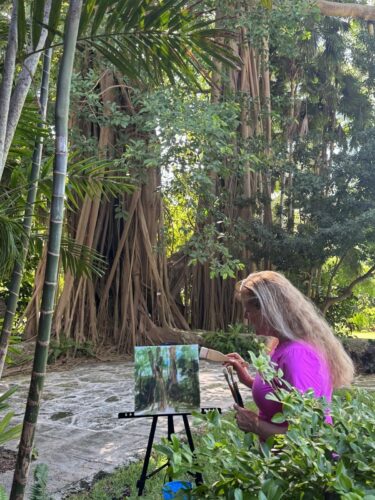
Kit Pancoast Nagamura works on “Where We Connect” (2026) at The Kampong. It is one of the paintings created for “When We Come to Paint.” (Photo courtesy of the artist)
Nagamura, who spent the first four years of her life at the garden, sees the exhibition as both a homecoming and a reflection on the people and places that shaped her artistic voice.
Her connection to the property runs deep. Nagamura is the great-granddaughter of botanist and plant explorer David Fairchild, whose Coconut Grove estate became The Kampong, now part of the National Tropical Botanical Garden. Her father, Lester Collins Pancoast, was an architect and watercolorist; her mother, Hélène Muller Pancoast, was a Japanese-style woodblock print artist and co-founder of Miami’s Bakehouse Art Complex.
Yet growing up surrounded by accomplished artists came with unexpected advice.
“My parents always said, ‘Don’t talk about your family,'” Nagamura recalls. “What they meant was, ‘Don’t boast about it. You have to make your own life.'”
A family legacy returns home
Only now does Nagamura feel she is ready to bring those generations into the same conversation.
“My family legacy is pretty heavy duty,” she says with a laugh. “I’m old enough now. I can bring them to the table.”
Visitors first encounter works by Lester and Hélène Pancoast before arriving at galleries devoted to Nagamura’s paintings, allowing connections and departures to emerge organically.
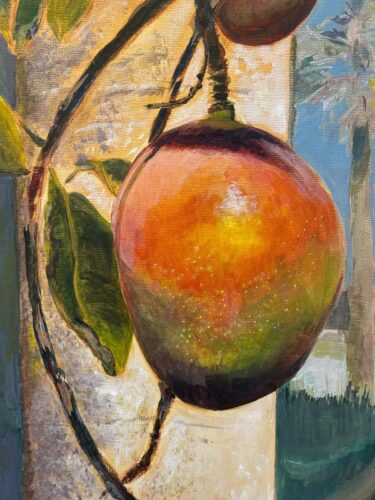
“In Stillness Fruit,” acrylic on wood panel, reflects the childhood memory that inspired “When We Come to Paint.” For Kit Pancoast Nagamura, the scent of mangoes is the first thing she notices whenever she returns to The Kampong. (Photo courtesy of the artist)
“I wanted people to see where some things came from and where I diverged,” she says. “When you spend enough time with the work, you begin to see the echoes, the similarities, the reverberations that we share.”
Brian Sidoti, director of The Kampong, says that connection made the exhibition feel almost inevitable.
“When we finally sat down together,” he says, “it was one of those conversations where you think, ‘Well, of course you’re going to have an exhibition here.'”
Sidoti believes Nagamura’s work belongs at the garden not simply because of her family history, but because of the way she understands the landscape itself.
“She has such a deep understanding of the collections here,” he says. “She could highlight that through her work.”
Sidoti looks for artists whose work grows naturally from the garden’s landscape, history and collections.
“We’re a small garden,” he says. “That allows us to create exhibitions that feel intimate and connected to our mission.”
Artmaking as Life
Rather than presenting a traditional solo exhibition, Sidoti embraced the idea of pairing Nagamura’s paintings with selected works by her parents, creating what he describes as a “living lineage of creativity.”
“We wanted to give Kit a strong platform for her own voice while also celebrating her parents’ remarkable work,” Sidoti says. “The conversations around how much of their artwork to include were a delicate balancing act. We wanted every voice to resonate.”
The exhibition also marks a return to the place where making art first became part of everyday life.
Her mother often worked on Japanese-style woodblock prints while the children created artwork nearby.
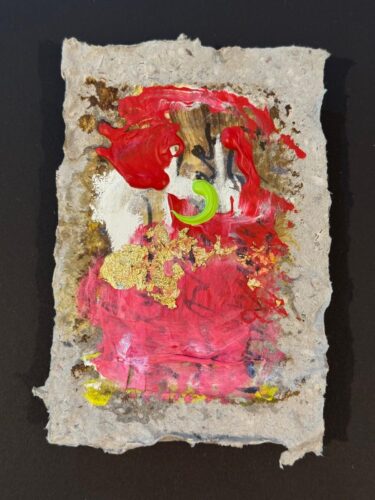
Part of Kit Pancoast Nagamura’s “Afterworks” series, this mixed-media work is created on recycled Sarasota Herald-Tribune newsprint using acrylic, handmade Japanese washi paper, ink and natural and collage elements. (Photo courtesy of the artist)
“For me, that meant freedom time and quiet focus time,” Nagamura recalls. “I loved the smell of the inks. Even today, if I open a box of crayons, everything comes back.”
Art, she learned early, was inseparable from observation, patience and daily practice.
“People think you just sit down with a paintbrush and become free,” she says with a laugh. “Not at all.”
A fellowship after college took Nagamura to a country that would shape both her artistic practice and the way she observes the natural world.
After graduating from Brown University with an independent concentration in studio art and literature—while also studying at the Rhode Island School of Design—Nagamura received an IBM-funded fellowship in Japan.
Initially, she imagined herself pursuing journalism rather than painting.
For more than 25 years, she wrote “The Backstreet Stories,” a monthly column for The Japan Times that took her through Tokyo’s neighborhoods in search of the histories hidden behind everyday streets.
“I was basically a flâneur,” she says. “A professional stroller.”
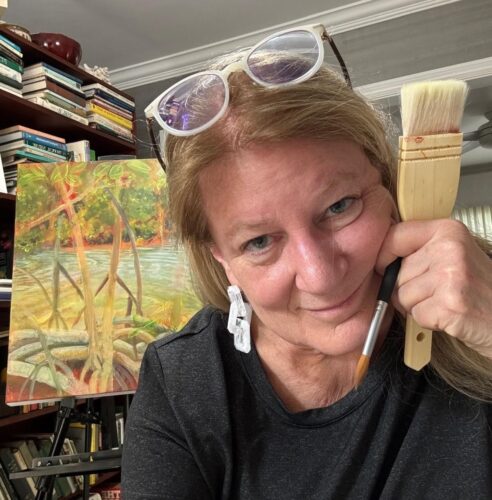
Living in Japan influenced Kit Pancoast Nagamura’s artistic language. The techniques and materials she embraced there—including handmade washi paper, mineral pigments and calligraphy—continue to shape the work featured in “When We Come to Paint.” (Photo courtesy of the artist)
Walking through historic neighborhoods, she often navigated the terrain as much by trees as by streets. Old maps revealed layers of history beneath ordinary places.
Without realizing it, those same ideas gradually found their way into her paintings.
“I realized the maps in my artwork come from this searching for meaning and development and history,” she says.
Throughout “When We Come to Paint,” maps reappear layered with handmade Japanese washi paper, mineral pigments and fragments of calligraphy. Many works are accompanied by original haiku.
“I’ve always resisted the idea that you’re either a writer or a painter,” Nagamura says. “To me, it’s all part of the same artistic practice.”
Nature became the thread connecting those disciplines.
Painting the Natural World
Rather than treating plants simply as botanical subjects, Nagamura paints them as living presences.
“I think plants communicate,” she says. “Science is finally beginning to recognize that, but in Japan that idea has existed for centuries.”
Mangrove roots, banyan trees, coconut palms and shifting light appear throughout the exhibition—not simply as botanical studies, but as reminders of humanity’s relationship with the natural world.
One recurring idea comes from the Japanese word komorebi, the shifting sunlight that filters through the leaves of trees.
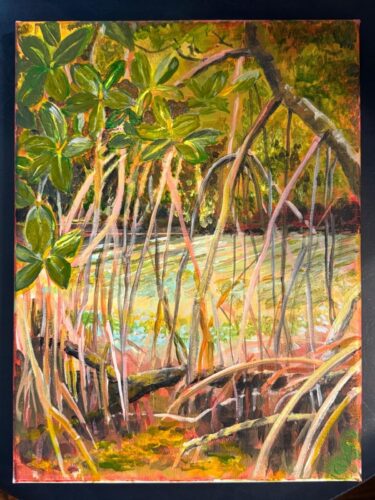
“Mangrove Inlet,” acrylic on canvas, reflects the landscape that surrounded the artist during her earliest years at The Kampong. (Photo courtesy of the artist)
“Those things are worthy of worship to me,” Nagamura says. “I hope people feel connected to plants in a new way. I hope they fall in love with them—love-affair level.”
That relationship with nature extends beyond the paintings themselves.
Among the exhibition’s most distinctive works are Nagamura’s “Afterworks,” intimate mixed-media pieces created from recycled studio materials. For Sidoti, the series reflects the same spirit of stewardship that defines the garden’s approach to conservation.
One of the larger paintings, “Aubade,” holds particular significance for the artist. The luminous five-foot-square canvas celebrating the first light of dawn represents a turning point in her creative process.
“It spoke to me about translucency,” she says. “Every time I thought I should add another layer, the painting itself seemed to say, ‘I’m perfect the way I am.’ So I listened.”
Another painting, “Road Home,” was inspired by the entrance to The Kampong and Nagamura’s reflections on what the idea of home had come to mean after decades abroad.
“If I had not been obsessing about the meaning of home,” she says, “that painting would not have appeared.”
WHAT: “When We Come to Paint,” an exhibition by Kit Pancoast Nagamura
WHERE: The Kampong, National Tropical Botanical Garden, 4013 S. Douglas Rd., Miami
WHEN: 9 a.m. to 4:30 p.m. Tuesday through Saturday. Last admission at 3 p.m. Through Saturday, Aug. 15.
COST: $17 for self-guided admission. $2 discount for visitors arriving by foot, bicycle, Uber or Lyft; EASY Perks Transit Card holders; guests of members (unless a greater discount applies); PreK-12 teachers; and residents of zip code 33133 with ID. Admission includes gardens and exhibition.
INFORMATION: 305-442-7169 or ntbg.org/gardens/kampong
ArtburstMiami.com is a nonprofit media source for the arts featuring fresh and original stories by writers dedicated to theater, dance, visual arts, film, music and more. Don’t miss a story at www.artburstmiami.com