
Visual Art
Long-time Critic Elisa Turner And The Untold Story of ‘Miami’s Art Boom ‘
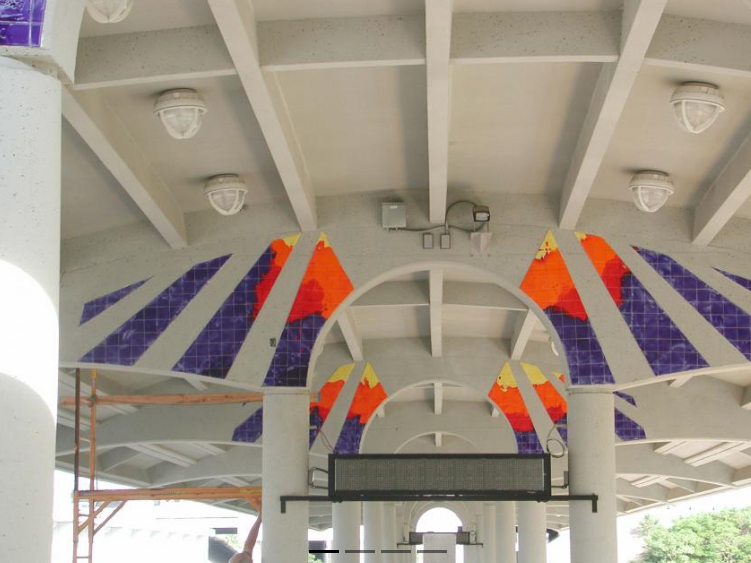
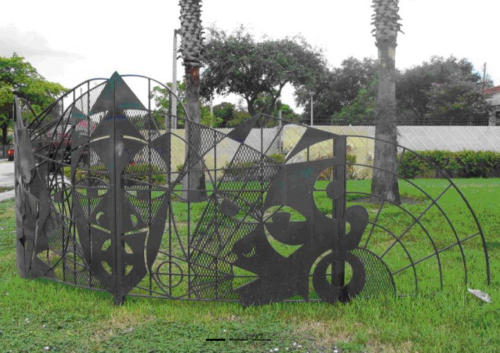
Robert Huff’s “East West” (2003) at the Palmetto Metrorail Station, part of the collection of the Miami-Dade County Art in Public Places program, is featured in Elisa Turner’s book “Miami’s Art Boom: From Local Vision to International Presence” published by University Press of Florida. (Photo by Robin Hill, Miami-Dade County Department of Cultural Affairs, Art in Public Places Trust)
When Miami visual arts critic and journalist Elisa Turner began seeing national coverage as Art Basel Miami Beach was getting ready to mark its two decades in 2022, the narrative caught her attention.
“The national press was saying, ‘Who ever thought Miami could have something like this?’ referencing the beginnings of Art Basel Miami Beach in 2002. ‘There had been nothing in Miami before,’ Turner recalls outsiders concluding.
“I thought, ‘this is not right,’ ” she says. For someone who covered Miami’s art scene as a freelance critic for the Miami Herald from 1986 to 2007, she felt that she knew the real art history of Miami.
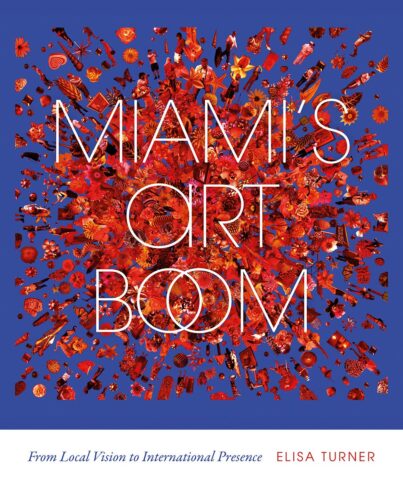
Elisa Turner’s “Miami’s Art Boom” was selected as a Gold medal winner in the 2025 Florida Book Awards Visual Arts category. (Book cover artwork by Carlos Betancourt, courtesy of University Press of Florida)
Turner began going back through archives of her writing. “I found stories that indicated how the art community was active, and how the community was doing things to put itself on the map, and it had been recognized internationally,” she says, and years before Art Basel Miami Beach put down stakes in South Florida.
The result of wanting to set the record straight and of digging through profiles and reviews resulted in “Miami’s Art Boom: From Local Vision to International Presence,” published Oct. 28, 2025, by University Press of Florida.
This month, Turner was notified that the book was selected as a Gold medal winner in the 2025 Florida Book Awards Visual Arts category. Established in 2006, The Florida Book Awards (FBA) celebrates the best works published each year by Florida authors or about the state.
Along with the award and other recognition, “Miami’s Art Boom” will be placed in Florida State University’s permanent collection.
“You spend so much time on something, and you don’t really know how it is going to be received, but I have had so much of a positive reaction.”
The writer says it was a three-year, more-than-full-time endeavor. For one thing, the Miami Herald owned the rights to the work, since publications retain ownership of what is written for them. Getting access to the articles she wanted to include required persistence and legal help.
“I had a lawyer, a really dear friend, and he helped me,” Turner says. “He wrote several letters to the publisher at the time and the executive editor… And so finally, I was given permission to go down to the old Herald building and download everything on my flash drive. It was kind of a surreal experience, because I found things that I had forgotten.”
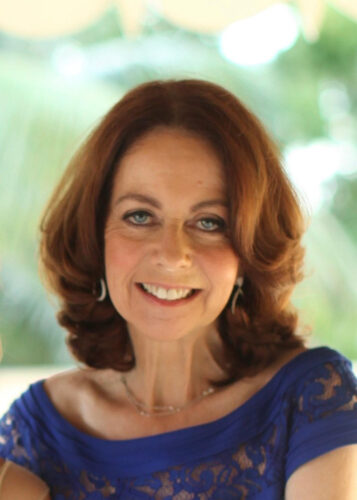
Elisa Turner is the author of “Miami’s Art Boom: From Local Vision to International Presence” published by the University Press of Florida. (Photo courtesy of Elisa Turner)
The book gathers more than 100 of Turner’s writings spanning the years before and after the first Art Basel Miami Beach. Her introduction begins with what she refers to as “an astounding sensation” that was brought to Miami. In 1983, New York City-based artists Christo and Jeanne-Claude, known for creating massive, temporary environmental installations around the world, wrapped 11 islands in Biscayne Bay in bright pink fabric and called it “Surrounded Islands.”
Today, the project’s archive—drawings, photographs, and materials—is housed at the NSU Art Museum Fort Lauderdale.
In the introduction, Turner writes that three years later, she began writing for the Miami Herald in what would be “pivotal years in Miami’s evolution . . . foreshadowed by the daring vision of Christo and Jeanne-Claude.”
The book’s structure, she explains, was carefully considered. Turner didn’t want just a greatest-hits compilation. “I wanted there to be a narrative, progressing, moving forward and sometimes faltering, as I have said, you know, it wasn’t like a constant rise forward,” she says. “I wanted to pick articles that really showed that there was this special thing happening here, outside of the fun and fun image that Miami had.”
The process was emotionally demanding. Turner, who is a contributor to ArtburstMiami, notes that creating the book “took a lot” out of her, particularly as she confronted the passage of time. One of the most poignant elements is a recurring feature she added at the end of each section. “It’s an in-memoriam, which I have the dates of people who have passed,” she says. “I wanted to recognize them so that even though they’re not here anymore, their contributions are visible. “
The book also covers communities whose contributions, Turner believes, have too often been overlooked. She points to the conclusion of “Miami’s Art Boom.” “I wanted this to move forward. I didn’t want it to be stuck in the past.”
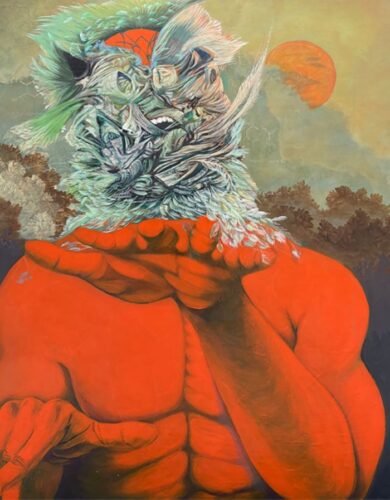
Elisa Turner’s enchantment with Haitian art and culture long predates the book. She mentions Haitin-born artist Asser Saint-Val whose 2019 work MSLITHP NGODA, is featured. (Photo courtesy of the artist, Miami-Dade County Department of Cultural Affairs, Art in Public Places Trust)
A key part of that, she explains, is tracing the influence of Miami’s immigrant communities. “Miami has the country’s largest Haitian immigrant population. Our arts community has been really enhanced by the immigrant population from all over, but especially from the Caribbean and Latin America. And I’m really proud of the fact that my book could show how the Afro Caribbean and Black Heritage artists — Black artists have shaped our community.”
Her enchantment with Haitian art and culture long predates the book. “I was always fascinated by Haitian art and culture,” Turner says.
Looking back, she recognizes that the daily pressure of newspaper deadlines once kept her from seeing the bigger picture her work was creating. “I was just trying to keep up with covering as much as I could,” she says.
Only later, as she revisited decades of coverage, did the pattern emerge: “When you step back, people were working hard to make this art community more proactive,” Turner says. “And that’s when I realized the pattern. When I started looking at these articles, they were saying, ‘Well, why don’t the museums pay more attention to us?’ And then finally, that started to happen.”
Gene Tinnie’s “A Gathering of Spirits,” (1996) at the West Little River Fire Station. (Image, Yusimy Lara, courtesy of Miami-Dade County Department of Cultural Affairs, Art in Public Places Trust)
The book reads like a Who’s Who of Miami’s visual arts culture. Turner points out that the years that are covered in the book – “(those) recounted here, national and international recognition – came to art bearing a Miami postmark.” In 1987, the painting Exiliados by Arturo Rodriguez was presented to Pope John Paull II on the occasion of his visit to Florida International University. Art by Maria Brito traveled to Seoul, South Korea. In the 1990s, the National Conference of Artists, a national organization of visual artists of African descent, included art by Charles Humes Jr. and Dinizulu Gene Tinnie . . . ” She mentions a 1987 review included in the book about Miami painter Robert Huff, “who played a widely respected role in Miami’s art community” and a mentor to many.
Looking back at decades of coverage, Turner sees the threads connecting it all—the artists, the neighborhoods, gallerists, curators, collectors, and projects pushing Miami’s art scene forward.
“I feel that all of this is important art history and it shouldn’t be swept under the rug. It should not be forgotten,” Turner says. “And while it wasn’t a constant rise forward, what the articles I selected for ‘Miami’s Art Boom’ were substantial and stand the test of time.”
Find out more information about “Miami’s Art Boom” from University Press of Florida.
ArtburstMiami.com , a nonprofit media source for the arts featuring fresh and original stories by writers dedicated to theater, dance, visual arts, film, music, and more. Don’t miss a story at www.artburstmiami.com