
Visual Art
Between Image and Memory: Alejandro Piñeiro Bello’s ‘ECOS’
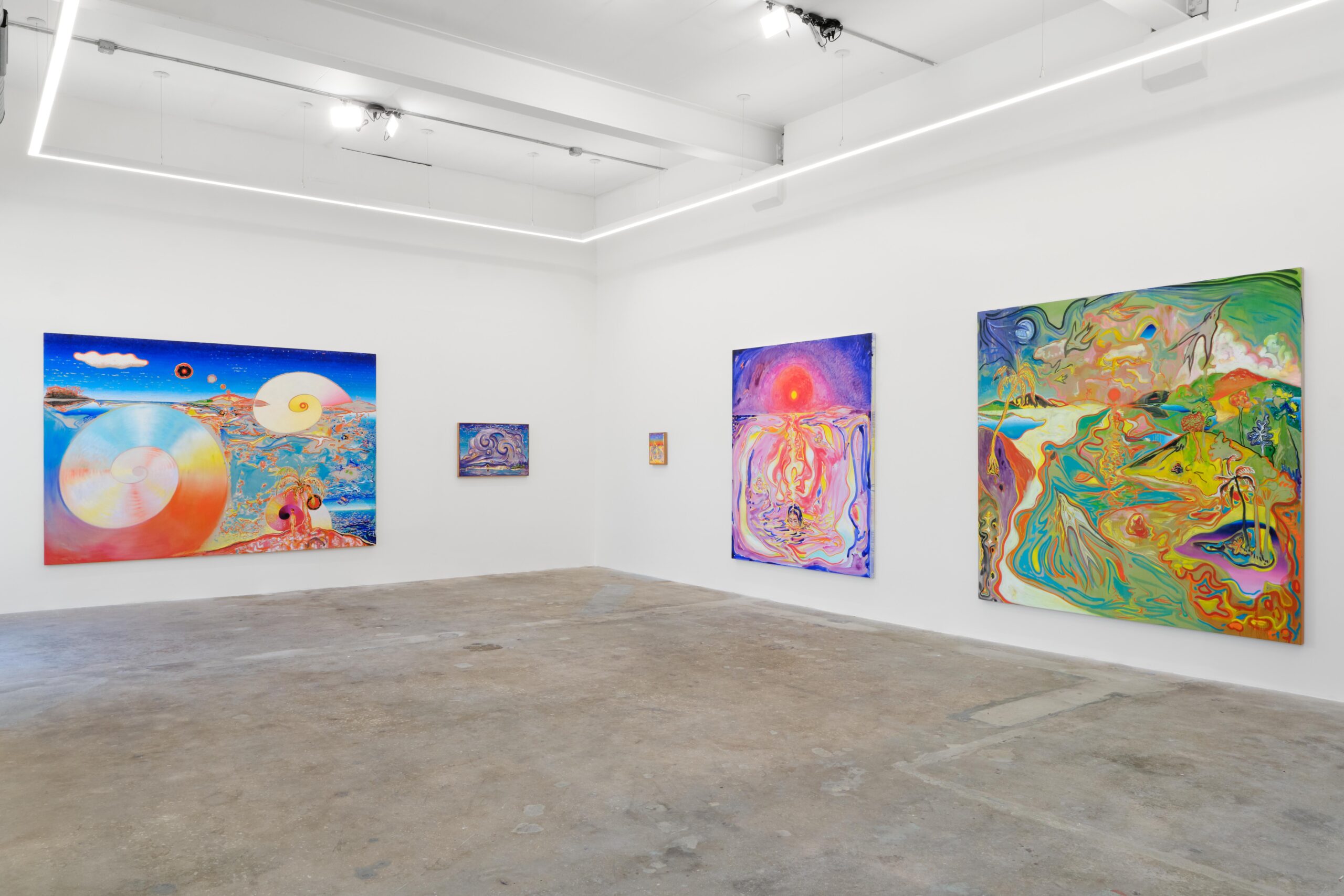
Installation view of “ECOS” by Alejandro Piñeiro Bello at KDR, Miami. (Photo by Rodrigo Gaya, courtesy of KDR, Miami)
In Alejandro Piñeiro Bello’s Little Haiti studio, the horizon is the only straight line.
It cuts across several of the canvases leaning against the walls—sometimes steady, sometimes dissolving into color—but always there, a point of orientation in paintings that otherwise refuse to settle. Around the room, forms emerge and dissolve: spirals, birds, clouds, fleeting figures. The space feels in motion, as if each painting were still in the process of becoming.
He is tall, with a focused, attentive energy; his movements are deliberate. In the studio, that attention informs how he sees. He speaks of clouds not as images to reproduce, but as edges to follow: a contour shifts, stretches, becomes a line. In his work, what begins as observation loosens into gesture, into something less fixed. A cloud becomes a curve; a curve turns into rhythm, and the paintings move between abstraction and figuration without fully belonging to either.
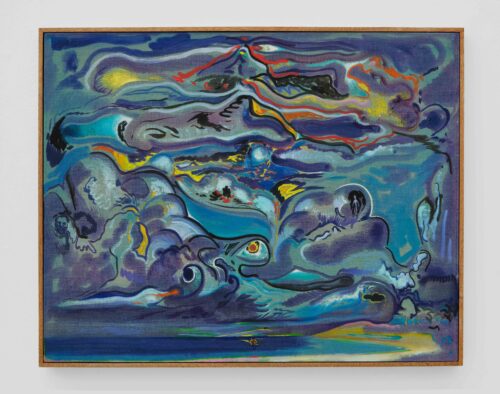
Alejandro Piñeiro Bello, “La Tormenta,:” 2026, Oil on linen, 23 x 29 in.
(Photo by Rodrigo Gaya, courtesy of KDR, Miami)
“ECOS,” Piñeiro Bello’s current exhibition at KDR in Miami, on view through Saturday, May 23, presents a body of work from the past year that expands this approach. Rather than building a single narrative, the show develops as a system of echoes: ideas, images, and sensations that return across the canvases, altered. This openness extends to the material. Drawing from watercolor, Piñeiro Bello applies oil in thin, wash-like layers, so the surface holds color without weight: fluid and open. Forms gather and dissolve: an eye might emerge from a field of blue only to fold back into it.
In “La Tormenta (The Storm),” the surface thickens into a dense field of blues and violets, where forms surface and submerge at once. An eye appears near the center, suspended within a shifting mass that could be water or sky. Around it, fragments of bodies—limbs, profiles—emerge only to dissolve again. Nothing holds for long; the painting resists a fixed image, gathering sensations that move between recognition and dissolution.
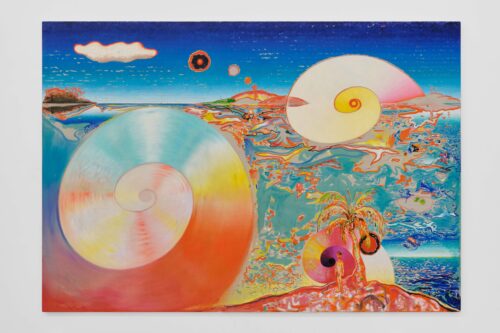
Alejandro Piñeiro Bello, “Tres Lindas Cubanas,” 2026, Oil on linen, 82 x 118 in.
(Photo by Rodrigo Gaya, courtesy of KDR, Miami)
For Katia Rosenthal, director of KDR, the exhibition unfolds less as a sequence than as a shift in feeling. “There’s a progression through the space from canvas to canvas,” she says, “not linear, but more emotional. As you move through the exhibition, something opens up; by the time you reach the larger paintings, you feel like you’ve traveled somewhere.” That movement is built through repetition. “A color or symbol in one painting reappears in another across the room, shifted in temperature or saturation,” she notes. “That repetition with variation is the architecture of the show—you’re moving through something that rhymes with itself.”
Language sits at the origin of this process. Piñeiro Bello keeps notebooks filled with phrases drawn from literature, music, and conversation that he later returns to. Books remain close to the canvases—spines worn, marked, returned to—so that reading and painting stay intertwined. He speaks of returning to writers such as Fernando Ortiz and Alejo Carpentier, not as references but as points of departure. These phrases are not captions added after the fact, but starting points. “They are like sketches,” he says. “I collect them, and then I organize a set of ideas.” Music is never far from that process.
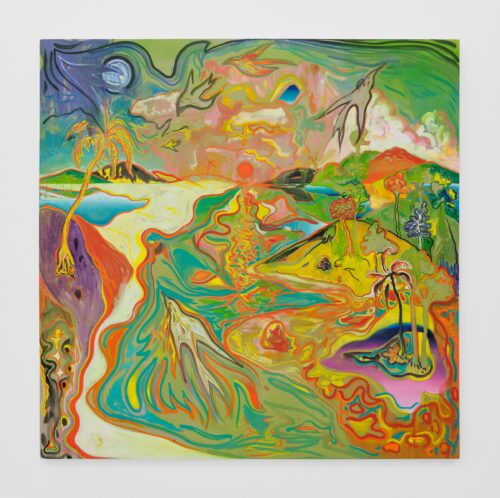
Alejandro Piñeiro Bello, “Adios A Cuba,” 2026, Oil on linen, 90 x 90 in.
(Photo by Rodrigo Gaya, courtesy of KDR, Miami)
Nearby, a turntable sits beside a keyboard on a table, surrounded by small photographs, postcards, and scattered objects. Music moves through the studio.
In “Adiós a Cuba” (Farewell to Cuba), a horizon stretches across the canvas beneath a luminous sky, while color moves restlessly below it, folding and drifting out of form. Birds cross the surface—elongated, almost weightless—their bodies suspended between flight and transformation.
The title refers to a piano composition by Ignacio Cervantes (1847-1905), written in 1875 during his exile from Cuba, a detail Piñeiro Bello kept returning to as he worked.
The painting does not mourn the island; it holds the difficulty of leaving it—how something can remain vivid, even radiant, while no longer remaining inhabitable. The birds read as figures in passage, carrying both departure and what cannot be fully left behind. Their elongated forms recall the hybrid figures of Wifredo Lam, whom Piñeiro Bello invoked in the studio not as citation, but as a presence that continues to emerge.
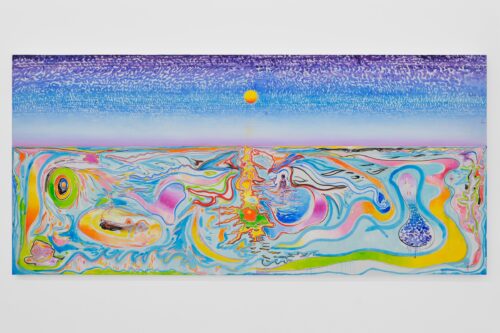
Alejandro Piñeiro Bello, “El Abrazo Del Mar,” 2025, Oil on linen, 65 x 140 in.
(Photo by Rodrigo Gaya, courtesy of KDR, Miami)
If “Adiós a Cuba” moves through departure, “El abrazo del mar” (“The Embrace of the Sea”) holds the opposite tension. A vast horizon divides sea and sky with unusual clarity. Yet beneath it, color refuses to settle. Lines ripple, expand, and collapse into one another, as if the painting were holding together multiple states at once: stillness and movement, surface and depth.
The horizon here is not only spatial, but temporal. It marks a threshold between what lies behind and what lies ahead. For those who have left the island, it is both limit and possibility, a line that separates while also suggesting passage. In the artist’s work, that ambiguity remains unresolved.
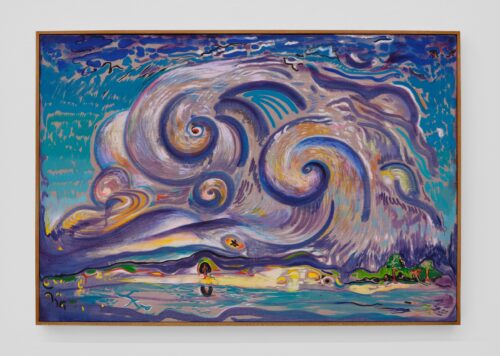
Alejandro Piñeiro Bello, “Espirales De Nubes,” 2026, Oil on linen, 24 x 35 in. (Photo by Rodrigo Gaya, courtesy of KDR, Miami)
If these images feel expansive, even dreamlike, they are not nostalgic. Piñeiro Bello is clear about that. His relationship to Cuba is shaped by distance—eight years now—and by the impossibility of return. “The farther I go from Cuba,” he says, “the more Cuban I become.” Memory, in his work, is not a return to what was, but something constructed in the present: layered, reworked, carried forward.
The horizon remains, but nothing else settles. Across “ECOS,” forms resist becoming fixed—color continues to shift, images return only to dissolve again. The paintings do not fix memory into image; they keep it in motion, shifting, returning, continually reworked.
WHAT: “Ecos”
WHERE: KDR, 790 NW 22nd Street, Miami
WHEN: 11 a.m. to 5 p.m. Tuesday through Saturday. Through Saturday, May 23
INFORMATION: (305) 392.0416 and KDR
ArtburstMiami.com is a nonprofit media source for the arts featuring fresh and original stories by writers dedicated to theater, dance, visual arts, film, music and more. Don’t miss a story at www.artburstmiami.com.