Blog Article Category: Visual Arts
‘Under Pressure” at Tomás Redrado Art Explores Material and Memory
Written By Olga Garcia-Mayoral
July 14, 2026 at 9:26 PM
Installation view of “Under Pressure,” curated by Tomás Redrado, featuring works by Guadalupe Reyna, Kristin Reger, and Tali Halpern at Tomás Redrado Art in Miami. The exhibition is on view through Wednesday, Aug. 5. (Photo by Evelyn Sosa, courtesy of Tomás Redrado Art)
The first impression of “Under Pressure” at Tomás Redrado Art is not one of visual excess but of restraint. The gallery is remarkably spare, allowing each work by Guadalupe Reyna, Tali Halpern, and Kristin Reger to occupy its own physical and emotional space. Rather than competing for attention, the three artists establish distinct rhythms that gradually begin to converse with one another.
Although they work in very different media—encaustic painting, textile, and sculpture—the exhibition finds common ground in the way each artist transforms everyday materials into something contemplative. Wax, thread, fabric, wire and stretched forms all become vehicles for exploring memory, resilience and personal experience.
Reyna’s encaustic paintings possess an unusual luminosity. Built through repeated applications of beeswax and pigment, the surfaces appear to glow from within, revealing evidence of the artist’s hand beneath translucent layers. Rather than depicting literal narratives, the paintings suggest cycles of preservation and change, where each layer simultaneously conceals and reveals those beneath it. The rich reds and earthy tones evoke organic forms without becoming descriptive, their shifting textures unfolding over time.
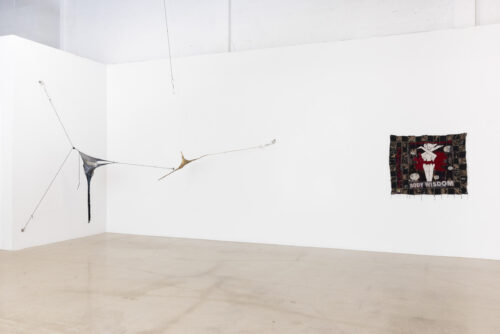
A suspended sculptural installation by Kristin Reger shares gallery space with a textile work by Tali Halpern in “Under Pressure,” an exhibition exploring transformation through sculpture, fiber and encaustic painting. (Photo by Evelyn Sosa, courtesy of Tomás Redrado Art)
Across the gallery, Halpern’s textile works introduce a very different tempo. Dense with embroidery, beadwork and stitched fragments, the compositions reward close viewing. Bits of language, images and decorative elements emerge gradually from the fabric, creating visual diaries assembled through countless hours of handwork. While some references draw from contemporary culture and personal identity, the works never feel illustrative. Instead, they communicate through accumulation, allowing meaning to emerge slowly through repeated looking.
Reger’s suspended sculptures activate the gallery in an entirely different way. Thin cables stretch across corners and walls, supporting delicate biomorphic forms that appear almost weightless. Their balance feels precarious without becoming unstable, creating a dynamic relationship between the sculptures and the surrounding space. Empty space becomes an active component of the exhibition, with distance, gravity and tension shaping the installation.
One of the exhibition’s strengths is its pacing. Redrado resists overcrowding the gallery, allowing generous intervals between works. That openness gives each artist room to establish an independent voice while revealing subtle connections across the exhibition. Themes of transformation, vulnerability and endurance emerge naturally through the materials rather than being explicitly stated.
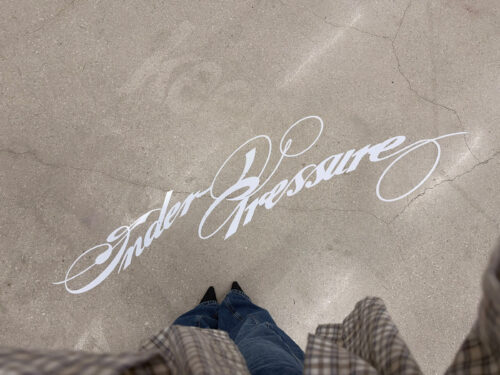
“Under Pressure” greets visitors at the entrance to Tomás Redrado Art, setting the tone for an exhibition centered on material transformation, resilience, and the physical traces of lived experience. (Photo by Evelyn Sosa, courtesy of Tomás Redrado Art)
Despite the exhibition’s title, “Under Pressure” does not dwell on anxiety. Instead, it considers pressure as a creative force—one capable of altering wax through heat, tightening thread through repeated stitching, or pulling sculptural forms into delicate balance. The works suggest that change is rarely effortless, yet they also demonstrate the surprising resilience of materials subjected to sustained care and attention.
The result is a thoughtful group exhibition that rewards patience. Rather than delivering immediate answers, “Under Pressure” unfolds gradually, finding extraordinary emotional weight in ordinary materials.
WHAT: “Under Pressure”
WHERE: Tomás Redrado Art, 1015 NW 23rd St., Unit 2, Miami
WHEN: 2 to 6 p.m. Tuesday through Saturday and by appointment. Through Wednesday, Aug. 5, 2026.
COST: Free
INFORMATION: (305) 774-7740 and tomasredradoart.com
RECENT ART REVIEWS ON ARTBURST:
Elisa Turner: Leyden Rodriguez-Casanova State of Transition at Dimensions Variable
Olga Garcia-Mayoral: The Geometry of Silence at Durban Segnini Gallery
ArtburstMiami.com is a nonprofit media source for the arts featuring fresh and original stories by writers dedicated to theater, dance, visual arts, film, music, and more. Don’t miss a story at www.artburstmiami.com.
No posts found
The Geometry of Silence: Medina and Tagliafico in Coral Gables
Written By Olga Garcia-Mayoral
July 14, 2026 at 8:03 PM
Installation view of “The Silent Paths: Medina & Tagliafico,” featuring works by Carlos Medina and Pedro Tagliafico at the Durban Segnini Gallery in Coral Gables. The exhibition is on view through Aug. 7, 2026. (Photo by Pavel Acosta, courtesy of Durban Segnini Gallery)
“The Silent Paths” at Durban Segnini Gallery in Coral Gables unfolds less as a dialogue between two Venezuelan artists than as an invitation to slow down. Sculptures and installations by Carlos Medina are paired with paintings and mixed-media works by the late Pedro Tagliafico in an exhibition where abstraction communicates through restraint rather than spectacle.
In a city where exhibitions often compete for attention through scale and sensory overload, “The Silent Paths” offers something increasingly rare: space for contemplation. Silence is not presented as emptiness but as an active condition—one that asks visitors to notice subtle shifts of light, material and perception.
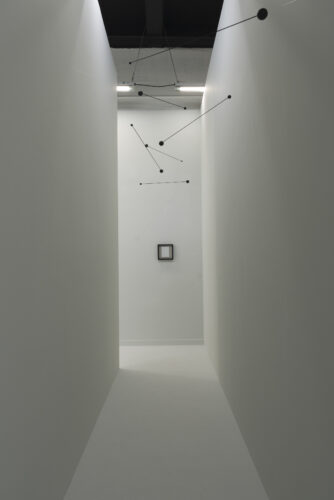
Carlos Medina’s suspended sculptural installation transforms geometric lines into an immersive spatial experience in “The Silent Paths: Medina & Tagliafico” at Durban Segnini Gallery. (Photo by Pavel Acosta, courtesy of Durban Segnini Gallery)
Although Medina and Tagliafico worked independently across different generations and mediums, their works meet through a shared commitment to economy of form. Neither artist pursues abstraction as decoration. Instead, each reduces visual language to its essentials, allowing line, geometry and repetition to become vehicles for reflection.
Medina’s sculptures establish the exhibition’s most immediate physical presence. Delicate metal rods extend into space with remarkable precision, appearing almost weightless as they trace geometric forms in midair. Their shadows become as important as the objects themselves, constantly changing as visitors move through the gallery. Rather than occupying space, the sculptures seem to reveal it.
One of the exhibition’s greatest strengths is Medina’s ability to make viewers conscious of their own movement. Walking around his suspended constructions, perspectives continually shift; lines align, separate and overlap, transforming simple structures into changing spatial experiences. The work rewards patience rather than immediate recognition.
Equally compelling are his transparent installations, where slender acrylic elements evoke atmospheric phenomena without literally depicting them. Instead of representing clouds or rain, they suggest fleeting natural events through lightness, rhythm and nearly invisible material. The gallery itself becomes part of the work as reflections and shadows activate the surrounding architecture.
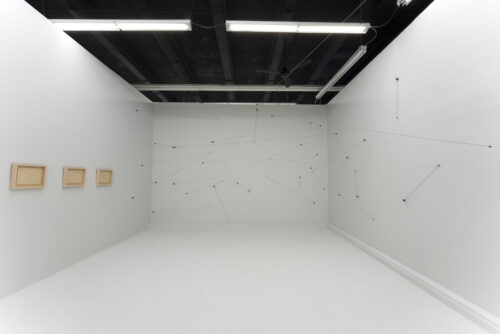
Installation view highlighting Carlos Medina’s delicate linear sculptures and wall-mounted works in “The Silent Paths: Medina & Tagliafico,” on view through Aug. 7 at Durban Segnini Gallery. (Photo by Pavel Acosta, courtesy of Durban Segnini Gallery)
If Medina’s contribution explores space, Tagliafico turns inward toward time.
His paintings and mixed-media works are built through repeated linear gestures that gradually accumulate into delicate grids. At first glance they appear almost monochromatic, but sustained viewing reveals subtle variations in texture, density and tone. The surfaces carry evidence of countless measured decisions, transforming repetition into meditation.
Unlike the rigid geometry associated with much 20th-century abstraction, Tagliafico’s grids never feel mechanical. They breathe. Small irregularities interrupt their apparent order, reminding viewers that these structures emerge through the artist’s hand rather than mathematical perfection. The result is work that feels simultaneously disciplined and deeply human.
Several pieces reveal an extraordinary sensitivity to material. Linen, graphite, oil, acrylic and wood become active participants in the image rather than passive supports. Time is allowed to remain visible through slight chromatic shifts and accumulated surfaces, giving the work a quiet physical presence that resists reproduction.
What makes “The Silent Paths” particularly successful is that neither artist overshadows the other. Rather than establishing a hierarchy, the installation allows their distinct practices to resonate across the gallery. Medina’s suspended linear structures echo Tagliafico’s drawn grids, while Tagliafico’s restrained surfaces provide a contemplative counterpoint to Medina’s spatial interventions. This creates unexpected visual conversations unfolding across rooms.
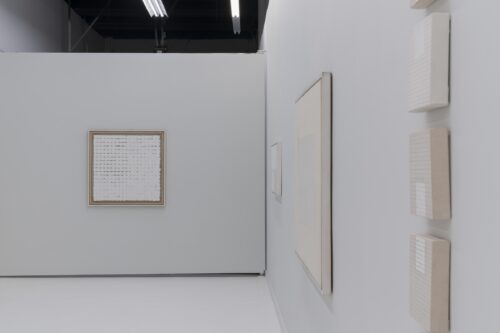
Pedro Tagliafico’s minimalist mixed-media works reveal subtle rhythms of line, repetition, and material in “The Silent Paths: Medina & Tagliafico” at Durban Segnini Gallery. (Photo by Pavel Acosta, courtesy of Durban Segnini Gallery)
The exhibition also reflects Durban Segnini Gallery’s commitment to Latin American abstraction while expanding beyond familiar narratives of geometric modernism. Instead of emphasizing historical movements, the presentation focuses on ideas that remain remarkably contemporary: perception, presence, materiality and the act of seeing.
Perhaps the exhibition’s greatest achievement lies in its confidence. It never demands attention through dramatic gestures or elaborate interpretation. Instead, it trusts viewers to slow their pace, allowing meaning to emerge gradually through observation. That confidence feels refreshing in today’s accelerated visual culture.
“The Silent Paths” demonstrates that abstraction can still surprise, not through complexity alone, but through clarity. Medina and Tagliafico show how the simplest line, carefully placed, can reshape the perception of space and time. Their works linger beyond the gallery, inviting sustained reflection on the expressive possibilities of restraint.
WHAT: “The Silent Paths: Medina & Tagliafico”
WHERE: Durban Segnini Gallery, 3072 SW 38th Ave., Coral Gables
WHEN: 10 a.m. to 5 p.m., Monday through Friday; 11 a.m. to 3 p.m. Saturday. Through Friday, Aug. 7.
COST: Free
INFORMATION: (305) 774-7740 and durbansegnini.com
ArtburstMiami.com is a nonprofit media source for the arts featuring fresh and original stories by writers dedicated to theater, dance, visual arts, film, music, and more. Don’t miss a story at www.artburstmiami.com.
No posts found
Leyden Rodriguez-Casanova Explores Barriers and Migration at Dimensions Variable
Written By Elisa Turner
July 9, 2026 at 8:12 PM
At Dimensions Variable, co-founder Leyden Rodriguez-Casanova draws inspiration from objects evoking immigrant travel across hostile boundaries in “State of Transition.” (Photo by Francesco Casale)
Cuban-born artist Leyden Rodriguez-Casanova is a seeker. He mines mundane remnants of immigrants’ uncertain travel. He seeks out their unsettling and imperfect beauty. A cotton tank top discarded as temperatures soar. A plastic bag could double as a flimsy, unlikely suitcase.
In his solo show “State of Transition,” Dimensions Variable co-founder Rodriguez-Casanova draws inspiration from objects evoking immigrant travel across hostile boundaries.
Materials comprising the five sculptures here are reminders of such travel. His art often incorporates objects that could have been left behind.
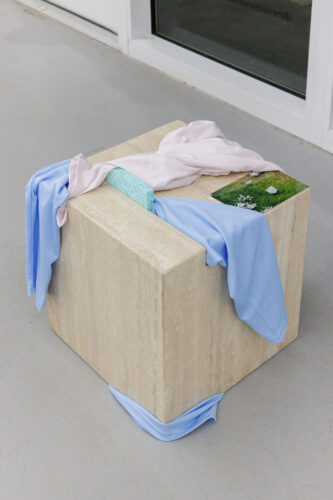
A travertine cube is draped with pieces of fabric and transformed from a discarded building material to a poetic reminder of its earth-bound origins. (Photo by Francesco Casale)
Indistinct found photos integrated collage-like into his sculpture may stand for memories of places abandoned or encountered during hard-to-forget moments. The photos seem to show a rocky beach, a river skirting mountains, a chain-link fence enclosing an empty lot, an idyllic grassy field.
Rodriguez-Casanova endows his art with reminders of his own past, asserting that one of his biggest influences was his own immigration to Miami in 1980 as a child during the Mariel boatlift from Cuba.
A longtime Miami-based sculptor whose resume cites exhibits in New York, Cuba, Colombia as well as Miami, he has shaped these various remnants into precarious structures for “State of Transition.” They inhabit ghosts of architectural stability. They resist a readily mapped sense of place. Those indistinct photos are gleaned from his family archive. Combined with objects like fences and fabric in his art, they poignantly evoke urban migrations, travel to uncertain destinations.
“I’ve been doing a lot of research of the migration routes,” he says, mentioning studies conducted by anthropologist Jason De León. “Most of his research is happening on the border of Mexico and Arizona. . .Fences are being built where it is so desolate.” They are far from towns where immigrants might easily be spotted. Still, those fences along desolate borders are “incredibly difficult” to cross. “So this in the broadest sense is about barriers that we’re constructing in this country,” he says of his current exhibit.
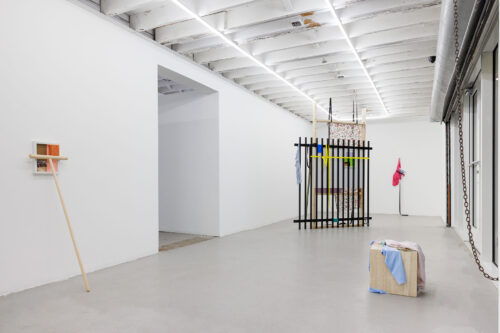
Installation view of “State of Transition” at Dimensions Variable. (Photo by Francesco Casale)
Educated at New World School of the Arts and Ringling College of Art and Design, he has a notable history with boundaries and barriers from early in his career. They’ve intrigued the artist as a reminder of the working-class life he shared with his family in Miami. Growing up, he helped his electrician father on home-improvement projects, kindling his interest in making sculpture with sly architectural references.
In 2007, Rodriguez-Casanova created “A Fence Obstructing Space” for the VIP lounge at the Scope Miami art fair. He installed a black aluminum fence with faux Rococo flourishes across the lounge entrance, leaving visitors only a 32-inch opening through which to enter. The deliberately obstructive work commented on gated communities and the exclusivity of the art world. He ensured the opening was ADA compliant.
“Inaccessible Gazebo” in 2008 was installed for six months at Socrates Sculpture Park in Queens, N.Y. Railings completely encircled the Victorian-styled white vinyl structure, allowing no point of entry. It implied an overtly picturesque challenge to the appearance of security and shelter in suburban gazebos.
And yet, in this more recent iteration of his perennial interest in boundaries and barriers, his art seeks a nuanced reinvention of what it means to face up to fences. “I’ve been exploring them as a lattice or receptacle for catching things. They’re holding on to remnants. . .keepsakes or artifacts, if you will,” he says.
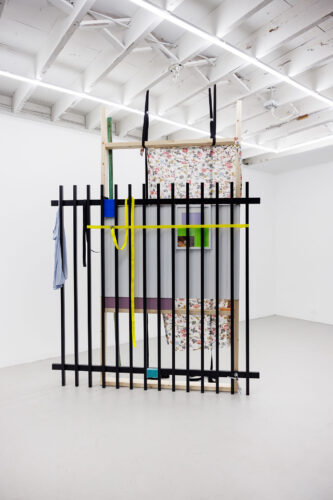
Rose-printed fabric is suspended behind a black metal fence, which is bound tightly to remnants that seem scavenged from a modest home. (Photo by Francesco Casale)
Elements in the largest sculpture here, “Gate Composition (Insulated),” can be read almost like lines in a poem. Rose-printed fabric is suspended behind a black metal fence. Does it signify a curtain veiling a window for privacy? A sheet for much-needed bedrest? The answer is at least both. Packing straps in an incongruously peppy shade of yellow suggest unwanted restraint, even a kind of prison. They tightly bind the fence to what could be a white painted rectangle of wood scavenged from a modest bungalow.
Trapped within this sculpture is a pink panel of insulation. It defies its conventional purpose to protect home dwellers from extreme temperatures. Pressed close to the fence, raw lumber is neatly constructed to evoke an empty picture frame or a window lacking any view to the outside. The claustrophobic, layered composition itself seems to narrate disjointed attempts to reinvent home during a taxing journey.
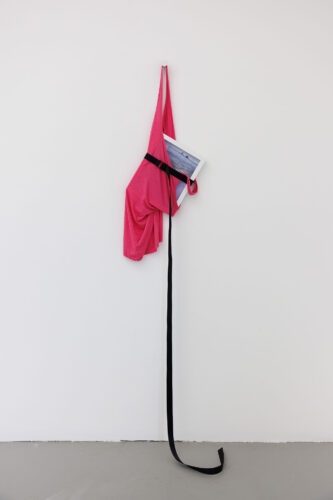
“State of Transition” grew out of Leyden Rodríguez-Casanova’s sustained investigation into the material systems that shape daily life at the margins. (Photo by Francesco Casale)
In the four smaller pieces, the artist’s signature minimalist sense of metaphor is not always successful. These works tend to possess a barren simplicity. They are composed of sparsely assembled ordinary objects, like a wooden mop handle, that do not resonate with broader significance. Instead, the smaller pieces function to some extent as call-and-response chants, reiterating imagery and themes more fully developed in “Gate Composition (Insulated).”
An exception is the smaller, but still poetically complex, “Composition (Earth).” It’s chiefly composed of a found travertine cube. Attached to the cube’s surface is a photo of a grassy field, alluding not to sleek architecture where one would expect to find this building material, but to its earth-bound origins. The cube is scarred by a peculiar indentation. “Probably it was considered damaged in some way. Maybe it was a mistake,” the artist says.
For him, that “mistake” resembles a crack in the earth. Folds of fabric partly cover the cube, as if, he adds “leaking” from the earth. A sponge rests near the fabric. At first glance the sponge is breathtakingly, absurdly banal.
Surely one implication is that the damaged earth, undergoing its own state of transition, may be cleaned by this vivid emblem of domestic immigrant labor.
WHAT: “State of Transition—Leyden Rodriguez-Casanova”
WHEN: 1 to 5 p.m. Thursday and Friday or by appointment only. Through Friday, Aug. 21, 2026.
WHERE: Dimensions Variable (DV), 101 NW 79th St., Miami
COST: Free
INFORMATION: 305-606-0058 and dimensionsvariable.net
ArtburstMiami.com is a nonprofit media source for the arts, featuring fresh and original stories by writers dedicated to theater, dance, visual arts, film, music and more. Don’t miss a story at www.artburstmiami.com
No posts found
Fountainhead Artist Residency Leaving Morningside for Bigger Home
Written By Michelle F. Solomon
July 9, 2026 at 7:05 PM
An AI-assisted image shows the front of Fountainhead Arts’ new artist residency. AI was used to change the building’s paint color and add the striped awnings; the structure is unchanged. (Courtesy of Fountainhead Arts)
Fountainhead Arts is leaving the Morningside house that has defined its artist residency for 18 years. The move will, for the first time, separate studios from artists’ living quarters and give the organization twice the space of its previous location.
The Miami nonprofit runs a year-round residency program that brings three artists at a time from across the country and internationally to live and work in Miami for a month.
The new property is located in what Fountainhead Arts founder and executive director Kathryn Mikesell described as “a tucked-away spot just west of Midtown and just north of Wynwood.” She did not want to disclose the exact address because, she said, the space is still being prepared for its public debut.
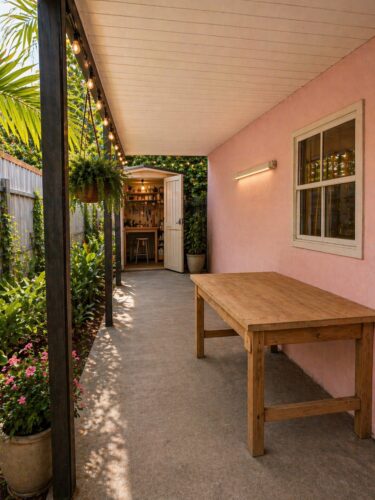
An AI-assisted image shows what an outdoor work area at Fountainhead’s new space. AI was used to change the building’s paint color and decorative elements; the structure and spaces remain unchanged. (Courtesy of Fountainhead Arts)
Mikesell sees the expansion as a way to do more than improve the residency: It will allow Fountainhead to develop residencies for curators and art writers, revive a program that connected Miami artists with one another and expand its public programming.
“Fountainhead is all about connections . . . connections between the artists, the artists and the community, but it’s also about connecting with Miami and people in the community,” she said.
At roughly 4,000 square feet, the new location is about twice the size of Fountainhead’s 2,000-square-foot, three-bedroom, two-bathroom residence in Miami’s Morningside neighborhood. It includes a two-story 1950s duplex and a separate one-story building.
“The big difference is that the artist studios are private and located steps from the home where they’ll be living,” Mikesell said. “Their living space will be separate from their studios and connected by a beautiful courtyard.”
At the current house, artists have lived and worked in the same space.
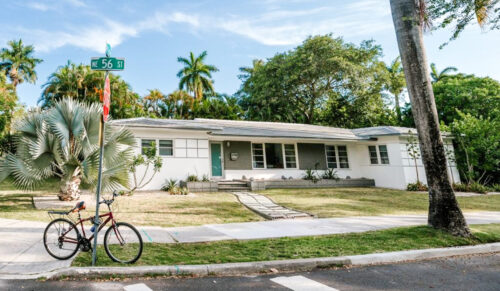
The Morningside home has hosted The Fountainhead Arts residency for the past 18 years. (Photo courtesy of Fountainhead Arts)
“We’re still keeping the home aspect of it, because that’s a very important part of Fountainhead,” Mikesell said. “A home is welcoming, and that’s one of the most important aspects to Fountainhead, is that it be welcoming to all.”
Fountainhead will take over the new location in September but continue operating its residency at the Morningside home through the end of the year. Mikesell said the organization did not want to disrupt the experience of artists who had been selected and were expecting to live and work at the longtime residency.
Mikesell expects the new space to be introduced during Miami Art Week in December and officially start operations there in January. The Morningside home will be sold.
The ground floor of the two-story residence has four bedrooms and three bathrooms. A separate two-bedroom apartment upstairs initially will allow Fountainhead alumni to return to Miami for visits.
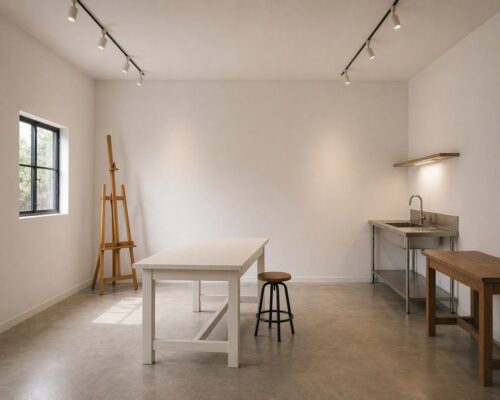
An AI-assisted image shows what one of the artist’s studios will look like when completed at Fountainhead’s new space. AI was used to show the furniture, paint and elements.; the structure and spaces remain unchanged. (Courtesy of Fountainhead Arts)
The second building will contain private studios for the three visiting artists who participate in each residency cycle. Once Fountainhead has settled into the new location, Mikesell also plans to launch residencies for curators and art writers.
Fountainhead will rent the property for what Mikesell expects to be five to 10 years, using that time to test new programs and determine what the organization needs before eventually buying or building a permanent home.
Fountainhead is now in fundraising mode for the move, including the cost of rent, renovations and furnishings.
“We want to grow, but I’m very conservative in my approach to growth,” Mikesell said. “I think it’s very important to try things first, kind of work out the kinks, see what works, see what doesn’t work, reevaluate and then move forward.”
The move comes as Fountainhead is changing how it selects artists for its residency. For 2027, the organization has replaced its limited open call with a full nomination process. Artists will be nominated by a group of curators hand-selected by Fountainhead, along with alumni artists from the program.
“We have curators spread around the world, so that will ensure that we are truly reaching globally for the artists that we are bringing to Fountainhead,” Mikesell said.
Fountainhead’s leadership team will make the final selections in October.
What won’t change is the residency’s makeup: only three artists will participate in each cycle. Mikesell said the small group is central to a program in which artists who often have never met live together and become immersed in Miami’s arts community.
The move also will allow Fountainhead to revive MEET, a pre-pandemic program that brought Miami artists together over a meal with no formal agenda. Mikesell said connections made through the gatherings led artists to find roommates, studio space and collaborators, and sometimes even life partners.
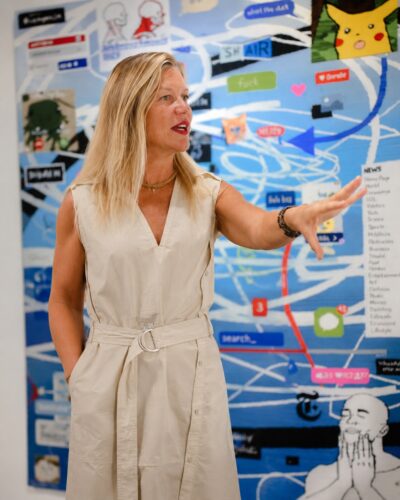
Fountainhead Arts founder and executive director Kathryn Mikesell at an Open House at the Morningside residence. (Photo courtesy of Fountainhead Arts)
The program ended during the pandemic and did not return, in part because of the cost of hosting it in restaurants. With its own courtyard and gathering spaces, Fountainhead expects to bring it back next year.
The new location also will allow for more public programs, including artist-led dinners and talks, while continuing the monthly Open Houses that invite the public into the residency.
Founded in 2008, Fountainhead has hosted more than 600 artists. Its earlier footprint also included a complex in Little Haiti with about 30 artist studios that Fountainhead operated for nearly 15 years before the property was sold.
Mikesell said the cost of Miami real estate makes recreating that studio complex unrealistic now. With the new space, Mikesell said Fountainhead’s focus will remain on building relationships: among visiting and Miami artists, and with the curators, writers, collectors and institutions that can bring their work to a broader audience.
The new location came about through one of those relationships. Alex Degwitz, the son of arts leader and collector Milagros Maldonado and a close friend of Mikesell’s, knew she had begun looking for a new home for Fountainhead and told her he might have the right place. Maldonado owns the property, according to Mikesell.
Mikesell and the Fountainhead team visited and immediately saw its potential.
“Relationships are everything,” Mikesell said. “If you can create an environment that fosters that, it can be a game changer.”
ArtburstMiami.com is a nonprofit media source for the arts featuring fresh and original stories by writers dedicated to theater, dance, visual arts, film, music and more. Don’t miss a story at www.artburst.com.
No posts found
Wolfsonian Goes Shoe Crazy with ‘Foot Notes’ Exhibition
Written By Douglas Markowitz
July 8, 2026 at 7:52 PM
Shoe displays from the Bullock’s Wilshire department store, Los Angeles, are part of The Wolfsonian-Florida International University Mitchell Wolfson, Jr. Collection and are one of the design objects on display as part of the Miami Beach museum’s latest exhibition “Foot Notes: Shoes, Symbolism & Society.” (Courtesy of The Wolfsonian –Florida International University, Miami Beach, The Mitchell Wolfson, Jr. Collection)
Could anyone go without shoes for even a day? Footwear is one of those important things most of us take for granted, an everyday object that we nevertheless can’t live without. Now a new exhibition open at The Wolfsonian–FIU uses the museum’s extensive collection of 19th- and early 20th-century design objects to adjust our perceptions of the things we put on our feet.
Far from a mere collection of footwear through the ages, “Foot Notes: Shoes, Symbolism & Society,” which is on display through Feb. 28, 2027, defies expectations from the very start. In the first room, a hulking pair of Nazi overboots, used by German infantry to guard against frigid Russian winters during World War II, serves as the centerpiece of a display on the symbolism of footwear.
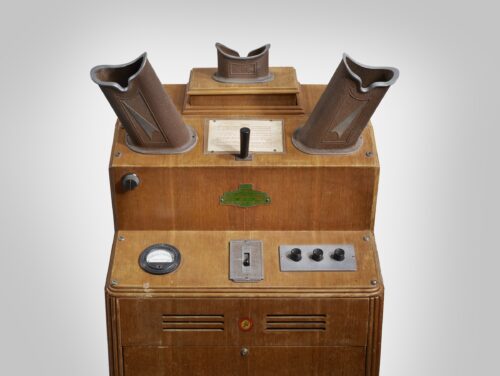
It was the X-ray Shoe Sizer, circa 1946, that inspired curator Danielle Charlap to create an exhibition about shoes. Simplex for X-Ray Shoe Fitter, Inc., Milwaukee, Wisconsin, manufacturer. Wood, glass, metal. 48 x 24 x 36 inches
(Courtesy of The Wolfsonian–Florida International University, Miami Beach, The Mitchell Wolfson, Jr. Collection)
Propaganda posters from the era from both the democratic United States and the Axis powers surround the imposing, heavy-duty boots, covered in animal hair and insulation. If one were to imagine a real-life version of Orwell’s vision of “a boot stamping on a human face,” this would be it.
“Foot Notes” is the first show at the Wolfsonian by Danielle Charlap, who joined the museum as curator in November 2025 and describes working at the museum as “a dream job.” Charlap got the idea for the show not from a shoe, but from a bizarre machine she found in the Wolfsonian’s collection catalog: a shoe sizer that beams X-rays at people’s feet. The dangerous-in-hindsight 1940s contraption inspired the curator to dig deeper into the museum’s holdings, uncovering everything from propaganda and advertising artifacts to “random recreational footwear” like ice skates and bouncing toy “rocket shoes” with springs attached to the soles.
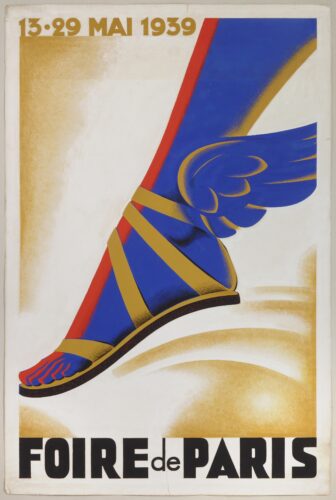
Design drawing, “Foire de Paris Mai 1939 (Fair of Paris, May 1939),” c. 1939, France. Gouache and graphite on paper. 48 x 32 in. (Courtesy of The Wolfsonian–Florida International University, Miami Beach, The Mitchell Wolfson, Jr. Collection)
“We are not a fashion museum, but it turns out we had so many materials related to shoes,” Charlap says. “It really just became a lens into the collection, and I remember in the beginning we were thinking, was there enough material? And it turns out there was way too much.”
While most of the show is sourced from the Wolfsonian’s holdings, a few key works were secured through loans. The Ferragamo shoes came from the company’s museum in Florence, for instance. Though the show is light on sneakers due to the collection’s focus on objects from before 1950, they did manage to secure a gaudy “Solid Gold” Adidas sneaker from the Miami Shoe Museum designed by Jeremy Scott. The shoe ties together a section on the theme of Mercury, the Greco-Roman messenger god who wore winged sandals. Posters for Goodyear Tires and the 1939 Foire de Paris retail expo flank the flamboyant shoe.
Elsewhere, the show features extensive discussion of the materials used to make shoes and how industrial processes and design innovations changed the nature of our everyday footwear. Two sections profiling famous designers highlight this ingenuity.
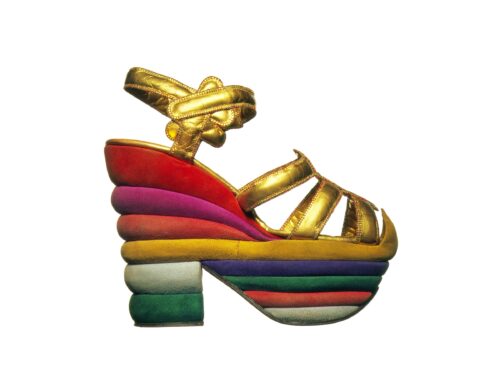
Salvatore Ferragamo’s “Rainbow” (1938) was designed by Salvatore Ferragamo for Judy Garland. Suede, gilded leather, leather and cork
(Photo courtesy Museo Ferragamo, Florence)
A display of vintage shoes by Salvatore Ferragamo details both the Italian designer’s reputation as “shoemaker to the stars” and the constraints he faced during his career. One rainbow-colored shoe with a bulky heel, created for singer Judy Garland in 1938, uses lightweight cork, while other models repurpose cellophane and rattan, a result of creativity enforced by the economic and political environment of fascist Italy.
A set of different imperatives motivated the work of Beth Levine, the pioneering designer behind the Herbert Levine brand. Though the sexism of the times forced Beth to take a back seat to her husband as the face of the company, her work dominated the mid-20th century American shoe market and brought avant-garde ideas into shoe design. Most famously, Levine pioneered the fashion boot, giving the utilitarian footwear a sleek, feminine form that sparked a craze after Nancy Sinatra wore the boots to promote her hit song “These Boots Are Made for Walkin’.”
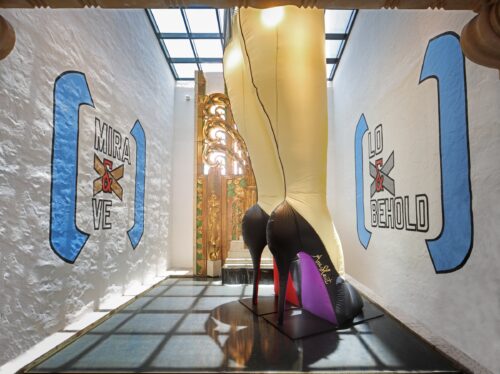
One of the most unique artworks welcomes visitors in the museum’s Art Deco lobby: A giant inflatable pair of legs wearing stiletto heels by artist Ann Slavit. “Della (Waiting),” 20-foot, inflatable sculpture, 1978. (Photo courtesy of the Wolfsonian-FIU, Copyright Ann Slavit)
Other innovations include the “no-shoe,” a heel secured to stockings via adhesive that serves as a precursor to more contemporary designs such as Demna Gvasalia’s “Speed Trainer” sneaker-socks for Balenciaga.
One of the most unique artworks welcomes visitors in the museum’s Art Deco lobby: A giant inflatable pair of legs wearing stiletto heels. The sculpture by artist Ann Slavit, titled “Della (Waiting),” serves as a commentary on the degradation of women in the media. Slavit designed and named the artwork after Della Street, played by Barbara Hale, the secretary to lawyer Perry Mason on the 1950s and ’60s legal drama of the same name. While Street is depicted as a staunch professional in the show itself, Slavit observed that the camera consistently cut to her legs, servicing the male gaze and objectifying the character.
“I was thinking about, as I was growing up in the ‘50s, how crazy it was that the moms around us were literally wearing high heels all day long just to take care of the kids, cook, do laundry. Because there were less and less women working at that time, at least in my memory,” Slavit recalls. “I was also aware of billboards where they were using women to sell cars, or objectifying women by body parts, and that memory kind of stayed with me.”
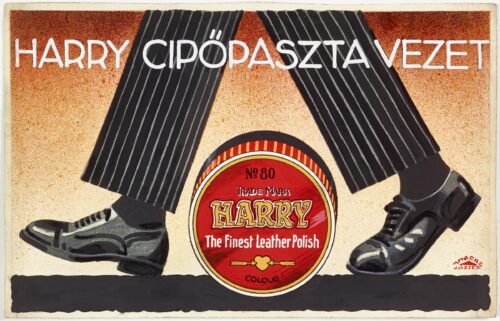
Design drawing, Harry cipöpaszta vezet (Harry Shoe Polish is in the Lead), c. 1925; Hungary, Budapest Gouache, watercolor, ink, and graphite on paper, 8 7/8 x 13 7/8 in. (Courtesy of The Wolfsonian–Florida International University, Miami Beach, The Mitchell Wolfson, Jr. Collection)
As well as being a collision between feminism and pop art, two of the dominant movements at the time, “Della (Waiting)” also serves as an early example of inflatable art, a medium made famous in recent times by the likes of KAWS and Cyril Lancelin. Slavit decided to allow the piece to be used in the show after some discussion with Charlap about the show’s concept, and the idea of exploring history and changing social trends through common objects. In the process, the artist herself ended up connecting the same childhood experiences she’d used in her art with some of the objects in the show.
“She was talking about the X-ray machine, and I had forgotten all about it, but I actually remember that from getting shoes,” Slavit says. “I think it takes a kind of awareness to point these things out, because we take them for granted. Like now, people are okay about wearing sneakers…When I was growing up, you never wore sneakers unless you were playing a sport. I mean, you put them on to play basketball, but you didn’t walk around in sneakers. No one walked around in sneakers.”
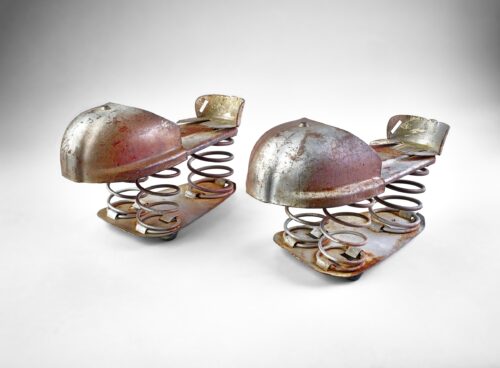
Toy, “Rocket Shoes,” c. 1953, United States. Metal, paint, 6½ x 5 x 10½ inches. (Courtesy of The Wolfsonian–Florida International University, Miami Beach, Florida, The Mitchell Wolfson, Jr. Collection)
It’s a powerful observation: Few things change more quickly and dramatically than fashion.
“We’re moving so fast that, in a way, slowing down to think about what we’re wearing means a lot,” Slavit says. “Where is it made? Who made it? All those kinds of questions.”
WHAT: “Foot Notes: Shoes, Symbolism & Society”
WHEN: 10 a.m. to 6 p.m. Wednesday, Thursday, Saturday and Sunday; 10 a.m. to 9 p.m. Friday. Through Feb. 28, 2027.
WHERE: The Wolfsonian –FIU, 1001 Washington Ave., Miami Beach
COST: $12 for adults, $8 for seniors, students with ID, and children ages 6 to 18; free for Florida residents, children under 6, state university system students, faculty and staff, and active U.S. military and veterans with ID.
INFORMATION: 305-531-1001 or wolfsonian.org.
ArtburstMiami.com is a nonprofit media source for the arts featuring fresh and original stories by writers dedicated to theater, dance, visual arts, film, music and more. Don’t miss a story at www.artburstmiami.com
No posts found
How Studio Vizcaya turned artmaking into a Miami summer tradition
Written By Miguel Sirgado
June 30, 2026 at 4:20 PM
Participants parade sections of a deconstructed dragon lantern across Vizcaya’s East Terrace during the 2019 finale of “Weave.” This year, Studio Vizcaya is inviting the public to help create—and bring to life— “The Fruit We Bear.” (Photo by Ben Thacker, courtesy of Vizcaya Museum & Gardens)
For nearly a decade, Vizcaya Museum & Gardens has invited Miamians to do something unusual each summer: come together to create art.
This year, participants are building giant papier-mâché fruit lanterns as part of “The Fruit We Bear,” the latest edition of Studio Vizcaya. Led by artist Shawna Moulton, the free weekend workshops will culminate Saturday, July 25 with an illuminated twilight procession through Vizcaya’s waterfront gardens, where more than 1,000 participants are expected to carry their creations through the historic estate.
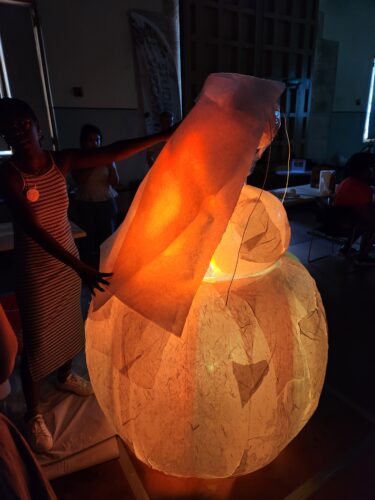
Layers of white, orange and yellow paper begin to take shape as workshop participants learn the techniques behind this summer’s fruit-inspired lanterns. (Photo by Mateo SeZa, courtesy of Vizcaya Museum & Gardens)
The event also marks a return to one of the program’s earliest traditions. After suspending the event in 2020 due to the pandemic, Vizcaya is bringing back its illuminated procession for the first time since 2019.
“The feedback we’ve been getting is that people want to come back to Vizcaya and be part of this immersive experience again,” says Gabriella Roman, Vizcaya’s community programs manager. “So, this year we’re returning to some of the program’s early roots.”
Participation is designed to be as welcoming as possible.
“We’re intentionally trying to create a third space where adults can engage their creative side,” Roman says. “Maybe it’s an experience you normally would have had at summer camp or art camp, but now you get to experience it later in life.”
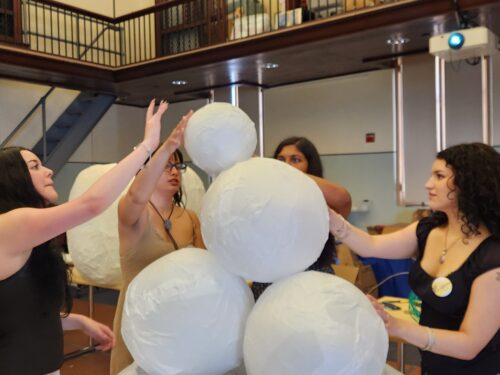
Participants working on lanterns for a former workshop at Vizcaya Museum & Gardens. This year’s “The Fruit We Bear” marks the return of the museum’s signature illuminated procession for the first time since 2019. (Photo courtesy of Vizcaya Museum & Gardens)
Participants range from families with children to people arriving alone, looking for a chance to unplug and connect with others through artmaking. Nearly half are first-time visitors, while others return every year. One couple even met while participating in a previous edition and now comes back each summer as a tradition.
Keeping the program free is part of that philosophy.
“We want to make the program as accessible as possible and remove any barriers someone might have to participating,” Roman says. “The final artwork is supposed to reflect many different voices, stories and backgrounds, so it was essential to keep it free and not limit participation with a paywall.”

Gabriella Roman, community programs manager at Vizcaya Museum & Gardens, works with young participants during a Studio Vizcaya workshop. (Photo by Manuela Delgado/Beyond Creative Productions, courtesy of Vizcaya Museum & Gardens)
Some people commit to multiple weekends, while others stop by for a single afternoon. All materials are provided, and no artistic experience is required.
Roman says the approach shifted after the pandemic, when smaller groups created opportunities for deeper interaction.
“We wanted the experience to be more intentional,” she says. “We built in more time for talking, more time for people to get to know their neighbors and more opportunities to exchange ideas.”
For Moulton, the project began with a walk through Vizcaya.
Born in the Bahamas and raised in Jamaica, Moulton lives in Plantation, in Broward County, and maintains her art practice and studio in Miami. She studied sculpture at the Pennsylvania Academy of the Fine Arts in Philadelphia. While visiting Vizcaya with a group from the Norton Museum of Art, she was drawn to one of the four herms —sculptural figures—that flank the entrance to The Barge, the estate’s monumental stone breakwater overlooking Biscayne Bay. The figure carries a basket of fruit on its head, immediately transporting her back to childhood memories in Jamaica.
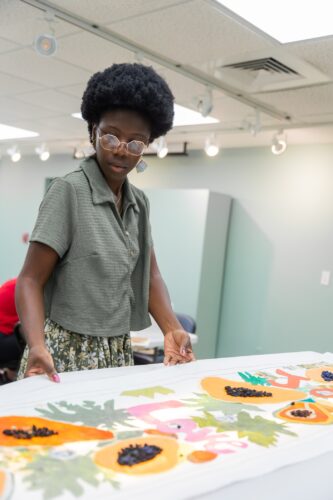
Lead artist Shawna Moulton reviews participants’ work during a Studio Vizcaya workshop at Vizcaya Museum & Gardens. Her project, “The Fruit We Bear,” uses fruit-inspired lanterns to spark conversations about shared values and community. (Photo by Manuela Delgado/Beyond Creative Productions, courtesy of Vizcaya Museum & Gardens)
“Fruit immediately made me think about community,” Moulton says. “In Jamaica, if you came to my house during the summer, you weren’t going to be hungry. My family was going to feed you mangoes, bananas and whatever had grown nearby. We all have a story of somebody giving us a piece of fruit, and that felt like a beautiful place to start.”
Florida’s landscape offered another layer of inspiration.
“One of my favorite things about South Florida is that it reminds me of Jamaica,” she says. “There are mango trees, papayas and all kinds of fruit growing here, so I was also inspired by the land itself and what a fruitful place Florida can be.”
The lanterns are tied to values such as joy, kindness, peace and patience. Throughout the summer, participants are encouraged to talk about those ideas and what they mean in their own lives.
“I didn’t want the sculptures to simply be fruits,” Moulton says. “I wanted them to be connected to something we could have conversations about.”
Gathering around food, Moulton says, has always been one of the simplest ways to bring people together.
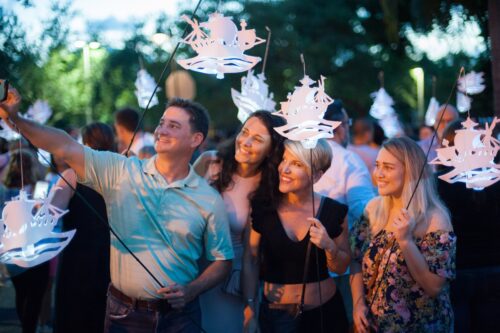
Families gather at Vizcaya Village carrying handmade lanterns before the start of the 2018 “Float” procession. (Photo by Ben Thacker, courtesy of Vizcaya Museum & Gardens)
“My philosophy is that you can never be angry when food is being served,” she says.
She has already watched new relationships emerge.
“There were a group of women who had never met before, and by the end of the afternoon they were like best friends,” she says. “They came up with a design together, executed it together and were proud to share it with everybody else.”
Others have described the experience as a form of wellness.
“People have told me this feels like healing,” Moulton says. “They’re grateful for having a space like this.”
Those interactions, Roman says, have become part of the estate’s identity.
“Vizcaya is a museum and a historic estate, but we also think of it as a home for the community,” she says. “Over the past decade, Studio Vizcaya has become one of those places people now associate with the summer art experiences they return to year after year.”
That sense of belonging often spreads quickly.
During a recent gathering, Moulton recalls a retired teacher who was having such a good time that she called her daughter and asked her to come join.
“An hour later, her daughter was there,” Moulton says.
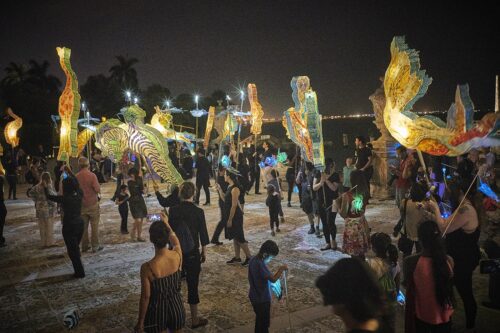
Community members parade illuminated lanterns through Vizcaya’s Upper East Terrace during the finale of “Whirl,” the museum’s first illuminated procession in 2016. This summer’s finale revives one Studio Vizcaya’s lantern building community tradition. (Photo courtesy of Vizcaya Museum & Gardens)
On July 25, participants will gather at Vizcaya Village before crossing South Miami Avenue at twilight and entering the gardens, where nine large-scale lanterns will be illuminated. Five will be fruit-shaped sculptures, while four will be collage-inspired lanterns created throughout the summer.
Roman hopes participants leave with something deeper than a finished artwork.
“I hope people feel excitement, wonder and a connection to everyone around them,” she says. “That procession across South Miami Avenue is such an important part of the program, and I hope participants understand the role they play in making the experience possible.”
WHAT: Studio Vizcaya: The Fruit We Bear
WHEN AND WHERE: Free workshops: 3 p.m. to 5 p.m., Saturday, July 11, Miami Beach Regional Library, 227 22nd St., Miami Beach. 11 a.m. to 2 p.m., Sunday, July 12, Vizcaya Village, 3250 S. Miami Ave., Miami. Finale performance: 7 to 9:30 p.m., Saturday, July 25, Vizcaya Museum and Gardens, 3251 S. Miami Ave., Miami.
COST: Workshops: Free with online registration. Finale: $15, $10 for children, 6 to 12, free admission for children under 5.
INFORMATION: 305-250-9133 and vizcaya.org/studio
ArtburstMiami.com is a nonprofit media source for the arts featuring fresh and original stories by writers dedicated to theater, dance, visual arts, film, music, and more. Don’t miss a story at www.artburstmiami.com.
No posts found
Arts News in Short: Jaguar Parade, Underline Shortlist, WDNA Vinyl and More
Written By Michelle F. Solomon, Artburst Editor
June 29, 2026 at 5:02 PM
“Ecosystem” by Busy, Pinecrest Gardens, 11000 Red Road, is part of the Jaguar Parade at locations across Miami-Dade County. (Photo courtesy of the Jaguar Parade)
From a public art project arriving with the FIFA World Cup to new museum initiatives, and music programming, here’s what’s making news across South Florida’s arts community.
Jaguar Parade brings Brazilian public art to Miami
As Miami welcomes visitors for the FIFA World Cup, another international attraction is dotting the streets of the city: 11 monumental jaguar sculptures created by Brazilian artists.
Painted sculptures at locations throughout Miami, named “The Jaguar Parade Miami 2026,” transforming public spaces into an open-air exhibition while raising awareness about jaguar conservation. After the exhibition concludes, the sculptures will be auctioned, with proceeds benefiting Onçafari, a nonprofit organization dedicated to protecting jaguars in Brazil.
The project officially launched with a June 22 reception at Emporium B Gallery in Little River featuring participating artists, representatives from the Brazilian Consulate and two full-size jaguar sculptures that are now on display.
Where to See the Sculptures
Miami Beach
“Oblivion” by Gus Attab, Miami Beach Bandshell, 7275 Collins Ave.
“Pantera Fractalis” by Laila Mackenzie, in front of the Cavalier Hotel, 1320 Ocean Drive
“Neon Botanica” by Lettice, in front of the Avalon Hotel, 700 Ocean Drive
“Forest Guardians” by Sophie Reiterman, In front of Sephora, 818 Lincoln Road
Sunny Isles Beach
“Inu Keneya” by Kassia Borges, 16690 Collins Ave.
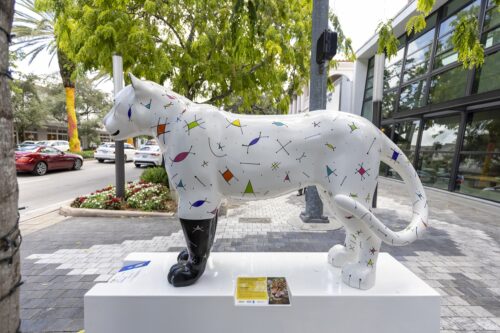
“Happy Soul,” by Cintia Abravenel is in Coral Gables. (Photo courtesy of Jaguar Parade)
Coral Gables
“Preserving is Necessary” by Livia Mourao and Rui Machado, 150 Miracle Mile
“Happy Soul” by Cintia Abravanel, 150 Miracle Mile
Miami Gardens
“Full Amazon” by Vinicius Zoia, 18605 NW 27th Ave.
Pinecrest
“Ecosystem” by Busy, Pinecrest Gardens, 11000 Red Road
Wynwood
“Coexistence” by Guilherme Kramer, Casa Ronaldo, Wynwood Marketplace, 2250 NW Second Ave.
See photos and descriptions of all the jaguars here.
Costumed reading explores aftermath of Peru mining disaster
“What If Works” presents a costumed reading of “The Weight of Dust,” an original play inspired by the 1983 San Gerónimo mining disaster in Peru, at 7 p.m. on July 31 at the Westchester Cultural Arts Center.
The drama follows a company owner’s daughter and a journalist as they investigate the decades-old catastrophe, uncovering concealed safety failures, fabricated reports and the lasting impact of silence and inherited trauma. Admission is free. More information at www.whatifworks.com
The Underline’s Finalists for New Public Art Commission
Four finalists have been selected by Friends of the Underline for the inaugural Underline Plinth project, a new biennial public art initiative that will commission rotating sculptures for The Underline’s Inter Grove Gallery in Coconut Grove.
Created as part of the America250 commemoration marking the nation’s 250th anniversary, the project asked artists to respond to the question: “What does it mean to be an American today?” The shortlisted proposals are “A Forest for Many” by Carlos Betancourt and Alberto Latorre, “Growth Rings” by Robert Chambers, “A Seat at The Table” by Morel Doucet and “Still Becoming” by Kennedy Yanko.
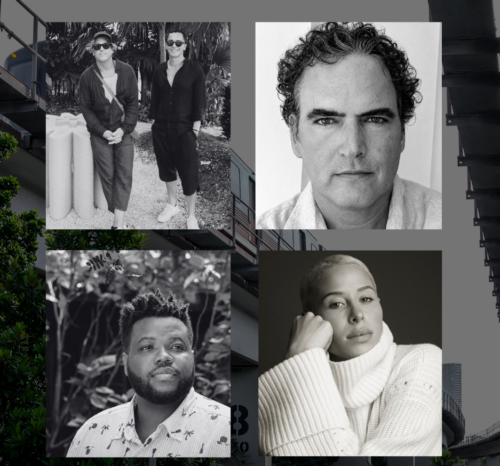
Clockwise from left, the shortlisted artists for The Underline project are Carlos Betancourt and Alberto Latorre, Robert Chambers, Kennedy Yanko and Morel Doucet. (Photo courtesy of The Underline)
The proposals will be shared with the public later this year for community feedback before The Underline Art Advisory Council selects the winning artist. The selected work is expected to be installed in spring 2027.
Located in The Underline’s Inter Grove Gallery at 2771 SW 27th Ave., Miami, the Underline Plinth project will feature a newly commissioned sculpture by an American artist whose work reinterprets history and heritage in honor of America250.
The Underline is a 10-mile linear park, urban trail, and living art destination transforming the land beneath Miami’s Metrorail into a public space. When complete, it will span from the Miami River in Brickell to the Dadeland South Metrorail Station in Kendall. Learn more at www.theunderline.org.
PAMM’s first digital art commissions draw global response
More than 750 artists from 50 countries applied to Pérez Art Museum Miami’s inaugural open call for digital art commissions, but only 21 projects will receive funding and production support through 2027. The initiative reflects the museum’s growing investment in artists working with emerging technologies while strengthening connections between South Florida, Latin America, the Caribbean and the African Diaspora.
The selected projects span video games, CGI films, AI-driven animation, virtual reality, immersive installations and other digital formats exploring identity, migration, memory and technology.
Two Miami artists are among the recipients: Unkle Luc, whose “MIAMI 2006” combines archival footage and AI animation to examine the city’s cultural landscape, and Sofia Valiente. Awards range from $2,500 to $15,000, with production support for works scheduled for completion by 2027.
More information and the complete list of commissioned artists at pamm.org
WDNA gives Miami’s vinyl community a weekly platform
On Friday, June 26, Miami’s WDNA-FM launched “Selector Sessions with DJ Le Spam.”
Recorded live at Reserved Hifi in Little River, the weekly program pairs selections from DJ Le Spam’s collection of Latin, funk, Miami bass, Haitian, Brazilian and jazz recordings with guest sets from local vinyl DJs and collectors. Scheduled guests include Mr Brown, Lula Rios, Ack Daddy, Djinji Brown and RicoSon.
Hosted by Spam Allstars founder Andrew “DJ Le Spam” Yeomanson, the program will air Fridays on WDNA 88.9 FM and stream worldwide.
More information at WDNAradio.org
Grammy Camp in Miami
Nearly 40 South Florida high school students spent a week immersed in the music industry when Grammy Camp Miami settled in at Art House Studios from Tuesday, June 23 and ended on Saturday, June 27.
Selected through a competitive application process, participants explored songwriting, music production, music business and performance while working alongside industry professionals. This year’s mentors included multi-platinum songwriter and producer Poo Bear, Grammy-winning singer-songwriter Richard Marx and Latin Grammy-winning artist Joaquina. More information at grammymuseum.org
ProjectArt Resident Artists at Locust Projects Exhibit ‘The Places We Make’
An exhibition at Locust Projects, “The Places We Make,” brings together the work of ProjectArt’s 2025–26 Miami Resident Artists alongside artwork created by students participating in free after-school arts programs at Miami-Dade public libraries.
ProjectArt is a paid teaching artist residency that partners with public libraries to provide free arts education while supporting the professional development and artistic practices of working artists.
“The Places We Make” brings together work by 2025–26 ProjectArt resident teaching artists Nina Osoria Ahmadi, Luz Estrella Cruz, Niko Devera, Estrella Dominguez and Sofia Villalonga alongside artwork created by students during a nine-month residency in Miami-Dade public libraries.
The exhibition, on view at Locust Projects, through Saturday, July 18, reflects the collaborations that grew out of free after-school arts classes, with artists and students exploring identity, memory, community and place through a range of media.
A reception will be held at the art space from 6 to 8 p.m., on Thursday, July 9.
Also, upcoming at Locust Projects, is the LAB (Locust Art Builders) Mentor Meet and Greet.
Artists, educators, arts and business leaders and mentors are invited to meet the LAB teen cohort, preview works-in-progress, and share insights over coffee and light bites from 10 a.m. to noon on Tuesday, July 14 as they finalize their collaborative exhibition opening Saturday, July 18.
Locust Projects is located at 297 NE 67 St., Miami.
Information at www.locustprojects.org.
ArtburstMiami.com is a nonprofit media source for the arts featuring fresh and original stories by writers dedicated to theater, dance, visual arts, film, music and more. Don’t miss a story at www.artburst.com.
No posts found
Beyond the Masterpieces: Bonnier Gallery Explores the Artist Behind Basquiat
Written By Michelle F. Solomon
June 25, 2026 at 1:54 PM
In The Bonnier Gallery’s “Jean-Michel Baquiat: Selected Works, 1978-1988, there are approximately 100 works from early collages and postcards made while the artist was still a teenager in downtown New York through canvases completed in 1987, the year before his death. (Photo courtesy of The Bonnier Gallery)
When Grant Bonnier learned that Pérez Art Museum Miami would be presenting 10 landmark Jean-Michel Basquiat works from the Kenneth C. Griffin Collection, he saw an opportunity to tell a different side of the artist’s story.
“I found out maybe six months ago that Ken’s collection was going on view,” Bonnier said. “I started organizing this back then to try and coincide with the PAMM show.”
The result is “Jean-Michel Basquiat: Selected Works, 1978–1988,” on view through Saturday, July 18, at The Bonnier Gallery in Miami’s Little River neighborhood. While the focus of PAMM’s “Basquiat: Figures, Signs, Symbols” is on 10 museum-quality paintings from a single private collection, Bonnier’s exhibition offers a broader look at Basquiat’s life, influences and artistic evolution, said the gallery owner.
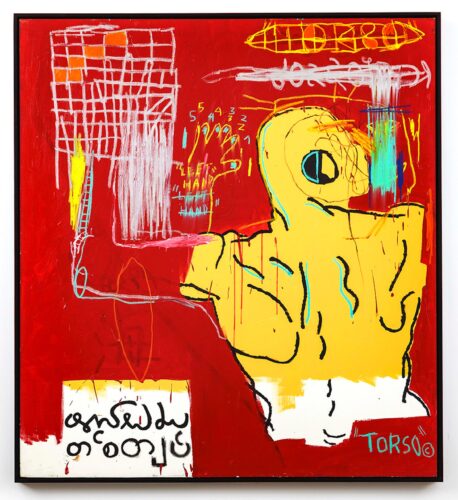
Among the exhibition’s centerpiece paintings is “Krong Thip (Torso), 1983, a large-scale acrylic rooted in a lifelong obsession with Gray’s Anatomy — a book given to Basquiat by his mother. (Photo courtesy of The Bonnier Gallery)
The exhibition brings together approximately 100 works spanning Basquiat’s career, from postcards and collages he created as a teenager to paintings, sculpture, photographs by Andy Warhol and personal ephemera gathered, all gathered from private collections.
“We have everything from postcards that he made when he was 18, 19, before he really entered the gallery scene, and he would sell those on the street for like $1 to $5,” Bonnier said.
From there, the exhibition follows Basquiat’s artistic evolution through early collages, works on paper, anatomical prints, hand-painted Xerox works and paintings that reflect recurring themes of his career.
“Any significant motif that really has come up in Basquiat’s career, we’ve got something here touching on it,” Bonnier said. “There’s figurative work, text work, social commentary, the dichotomy of wealth versus poverty, the human body, animals.”
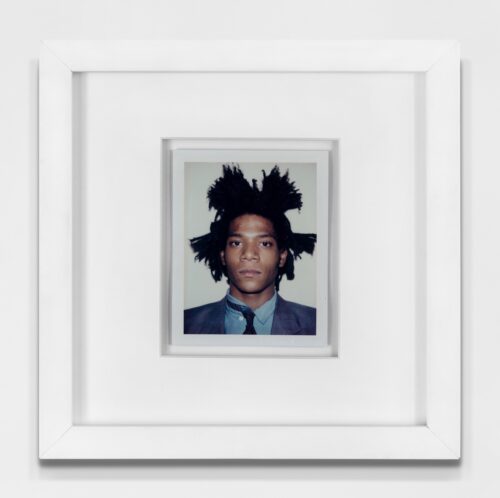
Andy Warhol, “Jean-Michel Basquiat,” 1982, Polaroid. (Photo courtesy of The Bonnier Gallery)
Bonnier also wanted visitors to better understand the influences behind Basquiat’s imagery. Copies of the medical textbook “Gray’s Anatomy,” which Basquiat’s mother gave to him after he was struck by a car when he was 7, are displayed alongside anatomical works that reference the book.
“If you’ve ever seen anatomical work by him, that tends to be the big reference point for him,” Bonnier said. “There were a handful of books that were really important. That’s one of them.”
The exhibition also includes photographs and personal ephemera from people close to the artist, including his last girlfriend, Kelle Inman.
“Andy (Warhol) used to run around with a 35-millimeter camera and take pictures of everything, so there’s a good chunk of photos that Andy took of Basquiat, including some really significant Polaroids,” Bonnier said.
Among the exhibition’s highlights is “Boone” (1983), a collage and oilstick work that reimagines Basquiat’s influential art dealer, Mary Boone.
” ‘Boone’ renders Basquiat’s dealer Mary Boone as the Mona Lisa—or dresses the Mona Lisa in the dealer’s identity,” Bonnier said.
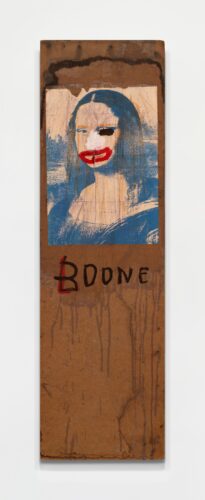
“Boone,” 1983, renders Jean-Michele Basquiat’s dealer Mary Boone as the Mona Lisa, executed in paper collage, marker, and oilstick on a narrow vertical masonite panel. (Photo courtesy of The Bonnier Gallery)
Another standout is “Brain” (1985), a three-dimensional sculpture assembled from individually painted wooden blocks. The work was on display at PAMM in the museum’s 2020-21 exhibition, “Writing the Future: Basquiat and the Hip-Hop Generation.”
In an unexpected pairing, a 1979 Basquiat painting is displayed beside dresses created through a licensed collaboration between the Basquiat estate and fashion label Alice + Olivia.
Bonnier hopes the exhibition brings people in who have been intimidated by stepping inside a commercial gallery.
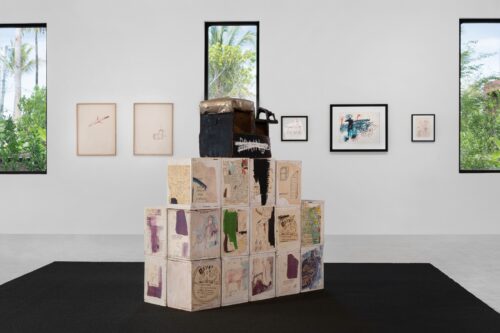
“Brain,” 1985, is among the most structurally inventive works in the exhibition: a three-dimensional sculpture assembling Xerox paper collage, acrylic, and oilstick across 27 individually painted wood blocks mounted on a bootblack stand (Photo courtesy of The Bonnier Gallery)
“People tend to think we’re a museum,” he said. “The number of people who have reached out and asked what the tickets cost, we have to be like, ‘No, we’re a gallery. We’re a real gallery. We don’t charge for entry.'”
The distinction for the gallery owner isn’t about competing with museums but about making art accessible in a different setting. While commercial galleries also sell art, unlike museum, which are intended primarily for viewing, Bonnier wants people to know that they are welcome to experience the exhibition; they don’t need to spend money—they can simply spend time discovering the artist’s life. But if someone wants to buy, there’s the opportunity.
“What you get to experience here is the life behind the work … the person behind it,” Bonnier said.
WHAT: “Jean-Michel Basquiat: Selected Works, 1978–1988”
WHERE: The Bonnier Gallery, 7275 NW 1st Court, Miami
WHEN: 11 a.m. to 6 p.m. Wednesday through Saturday. Through Saturday, July 18.
COST: Free
INFORMATION: 786-543-9161 or thebonniergallery.com.
ArtburstMiami.com is a nonprofit media source for the arts featuring fresh and original stories by writers dedicated to theater, dance, visual arts, film, music, and more. Don’t miss a story at www.artburstmiami.com.
No posts found
Why Ken Griffin’s First Basquiat Exhibition Was Always Meant For PAMM
Written By Michelle F. Solomon
June 25, 2026 at 10:15 AM
Jean-Michel Basquiat, “Untitled (Yellow Tar and Feathers),” 1982, is one of 10 works in “Basquiat: Figures, Signs, Symbols” from the Kenneth C. Griffin Collection opening Thursday, June 25 at Pérez Art Museum Miami and on view for nearly a year. (Kenneth C. Griffin Collection. Artwork © Estate of Jean-Michel Basquiat. Licensed by Artestar, New York.)
A new exhibition at Pérez Art Museum Miami didn’t begin with the idea of a collector lending paintings to a museum. It began with a realization.
Megan Kincaid, curator of the Kenneth C. Griffin Collection, recalled that shortly after joining the team, she was looking at the collection with its owner when she saw more than a remarkable group of paintings. Something stood out.
“You have a Basquiat show on your hands. This is ready to go. This is museum quality.”
That realization became “Basquiat: Figures, Signs, Symbols,” which opened Thursday, June 25, and will be on view for nearly a year through Sunday, June 6, 2027.
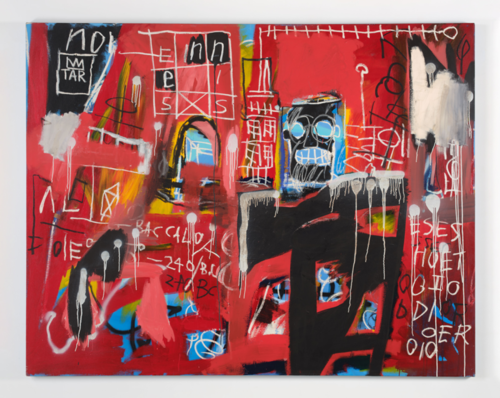
Jean-Michel Basquiat, “Untitled,” 1982. (Kenneth C. Griffin Collection. Artwork © Estate of Jean-Michel Basquiat. Licensed by Artestar, New York.)
The exhibition brings together 10 works by Jean-Michel Basquiat from the Kenneth C. Griffin Collection in the first public exhibition drawn from the collection. Spanning works created between 1982 and 1985, Kincaid said the exhibition functions as “a kind of retrospective” of Basquiat’s most significant period.
[RELATED: More Basquiat at The Bonnier Gallery]
For both the collector and the curator, there was never any doubt where that exhibition belonged.
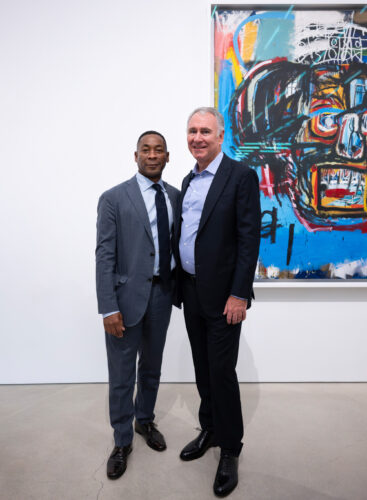
Collector Kenneth C. Griffin, right, and Pérez Art Museum Miami Director Franklin Sirmans stand in front of Jean-Michel Basquiat’s “Untitled” (1982), one of the centerpiece works in “Basquiat: Figures, Signs, Symbols,” the first public exhibition drom the Kenneth C. Griffin Collection now at PAMM. (Photo by World Red Eye)
“Without question, it was always going to happen for Ken at the Pérez,” said Kincaid, who is co-curator of “Basquiat: Figures, Signs, Symbols.” “It was the right venue, and Miami was where he wanted to stage an exhibition of this kind. It’s important to remember that this is the first time Ken’s ever presenting a section of his collection as a show with his name on it, and it was decisive and important that the show take place in Miami.”
The Right Place at the Right Time
The decision reflected more than geography. It reflected a relationship that had been taking shape since Griffin moved Citadel’s headquarters from Chicago to Miami in 2022. The move returned the Florida native—born in Daytona Beach and raised in Boca Raton—to his home state. Two years later, his $10 million gift to PAMM established the Kenneth C. Griffin Gallery, which now hosts the first public exhibition drawn from his collection.
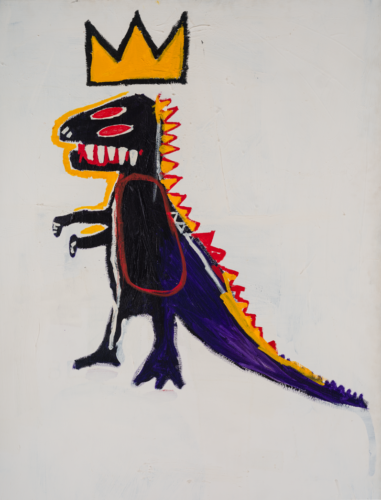
Jean-Michel Basquiat, “Pez Dispenser,” 1984. (Kenneth C. Griffin Collection. Artwork © Estate of Jean-Michel Basquiat. Licensed by Artestar, New York.)
“Basquiat: Figures, Signs, Symbols” represents a watershed moment for Miami’s cultural landscape. It is the first public exhibition drawn from one of the world’s premier private Basquiat collections, presented at a museum whose director, Franklin Sirmans, has spent more than three decades studying the artist, and it arrives as Miami continues to establish itself as an international art destination.
For Sirmans, PAMM’s director and co-curator of the exhibition, the moment is about more than one collector or one museum. It’s another chapter in Miami’s cultural evolution.
“We’re incredibly fortunate,” Sirmans said. “This is a really fascinating moment to think about how the landscape is being enriched by new people coming in.”
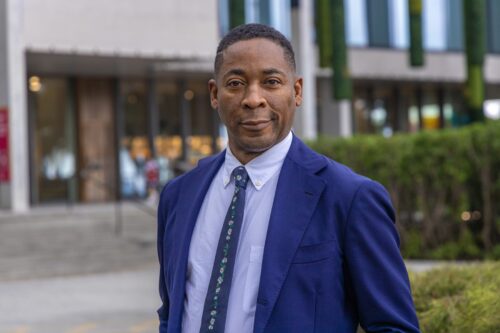
Franklin Sirmans, director of Pérez Art Museum Miami and co-curator of “Basquiat: Figures, Signs, Symbols,” has spent more than three decades studying Jean-Michel Basquiat. (Photo by Lazaro Llanes, courtesy of Pérez Art Museum Miami)
There was another draw that made PAMM the perfect fit. Sirmans has spent more than three decades studying Basquiat, beginning with his undergraduate thesis while at Wesleyan University and continuing through major exhibitions that have shaped scholarship on the artist, including co-curating the 2005 landmark show “Basquiat” at the Brooklyn Museum, which traveled to the Museum of Contemporary Art, Los Angeles and the Museum of Fine Arts, Houston.
“If you could pick a museum director in the country to curate a Basquiat show, it would be Franklin,” Kincaid remarked.
Why Basquiat Endures
Sirmans said there are many reasons why more than three decades after his untimely death from a drug overdose in 1988 at the age of 27, Basquiat remains one of the defining artists of the late 20th century.
“The work at its core is about humanity,” Sirmans said. “It’s about people and times and eras of human beings.”
Born in Brooklyn to a Haitian father and a Puerto Rican mother, Basquiat drew on a wide range of cultural references that shaped both his life and his work. For Sirmans, those influences give the exhibition a particular resonance in Miami.
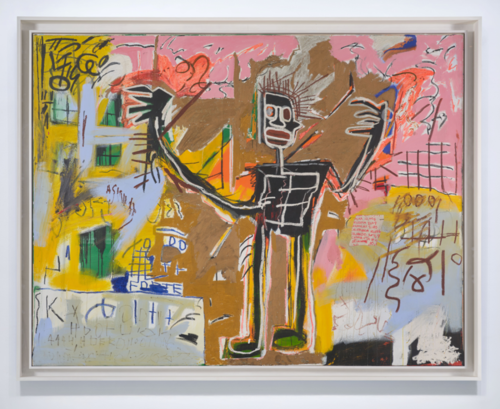
Jean-Michel Basquiat, “Untitled (Tenant),” 1982. (Kenneth C. Griffin Collection. Artwork © Estate of Jean-Michel Basquiat. Licensed by Artestar, New York.)
“We have three different languages in the gallery alone… Creole, Spanish and English… there aren’t that many American cities where you think about language in the same way that you do here.”
While the artist’s work resonates with audiences around the world, Miami’s deep Caribbean and Latin American cultures, central to the city’s identity, may allow many visitors to connect in a deeper way.
“I think it can sound trite sometimes when you say, ‘Yes, he is a Black person, his father was from Haiti, his mother was from Puerto Rico.’ All those aspects are part of it. They’re not the end-all and be-all, but I think they are something that makes the presence of not only the artist, but the work speak to that kind of heritage, that kind of upbringing,” Sirmans explained.
One notable omission among the works is “Boy and Dog in a Johnnypump,” considered one of the crown jewels of Griffin’s collection. Kincaid calls the 1982 work a tour de force of the collection, and of Basquiat’s entire career. “The only reason it is not in the show here is because it is in another exhibition that Ken has supported at the Hirshhorn Museum (in Washington, D.C.).” The private sale made headlines when Griffin acquired the painting for more than $100 million in 2020, making it one of the most valuable Basquiat works in any private collection.
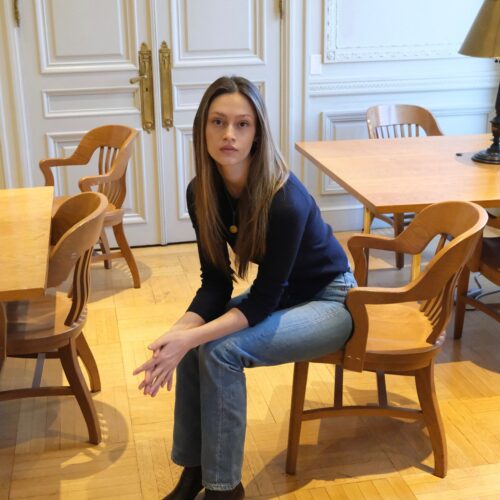
Megan Kincaid, curator of the Kenneth C. Griffin Collection and co-curator of “Basquiat: Figures, Signs, Symbols,” while looking at the collection with its owner said, “You have a Basquiat show on your hands.” (Photo courtesy of Megan Kincaid)
But rather than keeping it tucked away, Kincaid said this reinforces Griffin’s philosophy of making the collection accessible.
“I’m very lucky to work for a collector who has the vision to share his collection with the public,” she said. “There was the exhibition in terms of content, and there was this vision to make this work accessible. There’s the vision as a collector and the vision as one of civic responsibility.”
That same philosophy shaped the exhibition itself.
“It was absolutely a decision to present as much as we could, and we want people to feel empowered to make their own personal choice about what they like best,” Kincaid said. “To over-curate the exhibition would have been a bit of a disservice.”
Looking Closely
Along with the nine works, the exhibition includes a sculpture known as “Untitled (Box)” — though Kincaid noted that “crate” is probably a more accurate term. The piece revealed a surprise when it was brought to PAMM.
“This was one work we acquired with this show in mind when we were offered it and it came to our attention, and it’s centered in the gallery,” Kincaid said, noting that it highlights another aspect of Basquiat’s artistic practice through his use of found and assemblage materials. “We were able to open it for the first time here.”
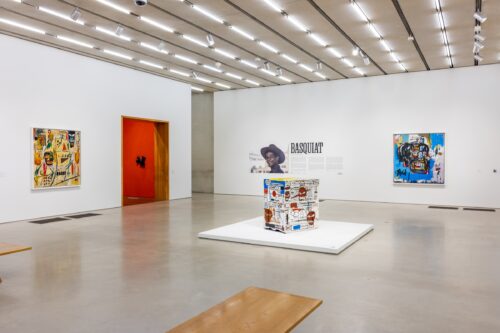
“Untitled (Box),” 1985, is in the center of the gallery, and was acquired with the PAMM exhibition in mind. Shown on the wall behind the crate is “Untitled (“Skull”), painted in 1982 and regarded as Basquait’s breakthrough year. (Photo by Lazaro Llanes, courtesy of Pérez Art Museum Miami)
The work first debuted publicly in 1985 in a highly unusual setting: the legendary Area nightclub in New York City, where a famous photograph captured Basquiat himself sitting atop the crate.
In a previous life, the wooden crate had been used by artist Robert Rauschenberg, widely regarded as the father of assemblage art in the United States, to house and transport his paintings before Basquiat incorporated it into his own work.
“It is an art historical object where Basquiat is commenting on his own lineage and place within the canon of American art,” Kincaid said. “It is a super special object in that it has so many layers of meaning and significance.”
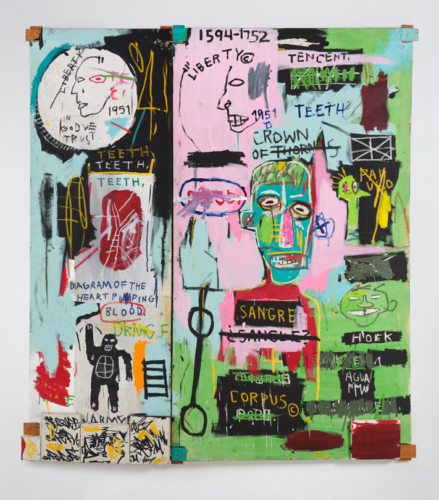
Jean-Michel Basquiat, “In Italian,” 1983. (Kenneth C. Griffin Collection. Artwork © Estate of Jean-Michel Basquiat. Licensed by Artestar, New York.)
Sirmans said it is that kind of layering that will be eye-opening for visitors when they are face to face with the works.
“It’s the awe of standing in front of great paintings and I think that is what’s going to be revelatory for a lot of people who only know (Basquiat) from reproductions. What it is to be standing in real time and be among others in the space of the gallery who are all contemplating the work for a moment in time. These paintings demand that kind of slow experience.”
WHAT: “Basquiat: Figures, Signs, Symbols” from the Kenneth C. Griffin Collection
WHEN: Opens Thursday, June 25 through Sunday, June 6, 2027. 11 a.m. to 6 p.m., Monday, Friday, Saturday and Sunday. Thursday, 11 a.m. to 9 p.m. Closed Tuesday and Wednesday.
WHERE: Pérez Art Museum Miami, 1103 Biscayne Blvd., Miami.
COST: $18, $14 for seniors 62 and older, students, and children 7 to 18; children under 6, free admission. Other free admission for military, healthcare, first responders, Florida educators, and disabled visitors and an accompanying caregiver. Admission is free from 5 to 9 p.m. every Thursday.
INFORMATION: 305-375-3000 and pamm.org.
ArtburstMiami.com is a nonprofit media source for the arts featuring fresh and original stories by writers dedicated to theater, dance, visual arts, film, music, and more. Don’t miss a story at www.artburstmiami.com.
No posts found
Three Painters, Three Perspectives: ‘In Three Movements’ at Opa Projects
Written By Erin Parish
June 24, 2026 at 5:34 PM
Emma Johnson Stone, “The light doesn’t just touch one area of the field,” 2024. Ink, pigment and acrylic on canvas, 70.8 x 70.8 in. (Photo by Erin Parish)
In music, a movement is a distinct section within a larger composition, carrying its own atmosphere and rhythm while contributing to the overall progression. The exhibition “In Three Movements” at Opa Projects is structured in much the same way. Bringing together Douglas Kneese, Murray Clarke, and Emma Stone Johnson, it unfolds as a sequence of distinct presentations, each maintaining its own identity while contributing to a larger curatorial investigation.
Located in Miami’s Little River district, Opa Projects was founded in 2025 by art advisor and historian Billy Tartour. The gallery, with its high ceilings and generous natural light, has established itself in Miami through exhibitions that prioritize material inquiry and artists at various career stages. It maintains a broad international perspective, rather than a regional one. “In Three Movements” exemplifies this commitment through a presentation devoted to painting as an international language with continued vitality.
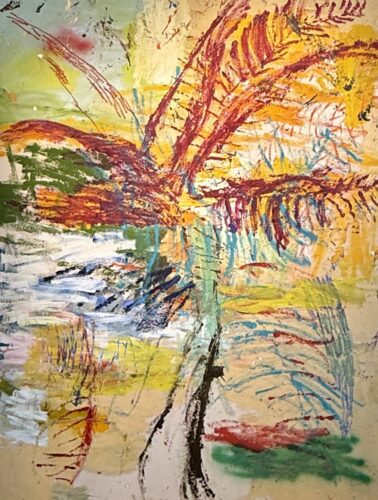
Douglas Kneese, “Palmeira no final de tarde I,” 2026 Oil stick, acrylic and spray on canvas 190 x 145 cm, 190 x 150 cm, 74.8 x 57 in. (Photo credit by Erin Parish)
The exhibition brings together three painters from different geographic and generational backgrounds: Douglas Kneese (b. 1996, Brazil), Murray Clarke (b. 1992, United Kingdom), and Emma Stone-Johnson (b. 1982, United Kingdom). Despite these differences, the exhibition reveals universal affinities in their treatment of color and commitment to painting as a material practice.
Group exhibitions, by default, present a shared theme or curatorial argument. This exhibition functions through pacing and placement, like a symphony. Each artist occupies a distinct register while contributing to the structure of the whole.
Douglas Kneese establishes the exhibition’s opening movement through a vigorous physicality visible from the start, placed to be seen from the gallery entrance. His paintings read well from a distance while rewarding close inspection and maintaining integrity, a hallmark of successful painting and an issue perhaps absent in reproductive media.
Suggestions of boats, water, vegetation, or a palm tree provide an armature upon which Kneese builds his compositions. These references surface briefly before returning to the broader activity of the paint itself. Layers accumulate, and gestures echo each other. Surfaces are revised, scraped back, and rebuilt. Kneese shifts freely between abstraction and representation, treating both as available strategies rather than opposing categories. Paint handling drives the work. One can see that they were made on the floor, unstretched, with evidence of boot prints derailing the idea of preciousness. These traces of the artist’s feet, and hands, come as a surprise, carrying evidence of the dialogue between the artist and the painting.
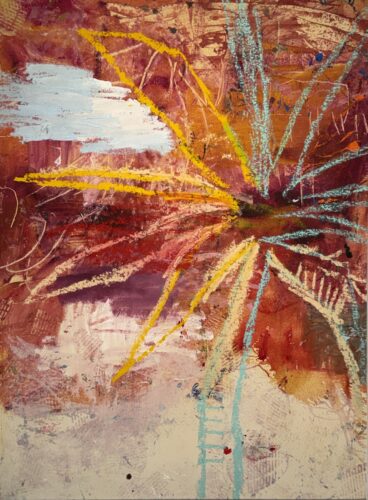
Douglas Kneese, “O Coquiero na boca da noite,” 2026. Oil stick, acrylic and spray on canvas 140 x 110 cm, 55.11 x 43.3 in. (Photo by Erin Parish)
Kneese displays the literal qualities of the medium through rough, hand-hewn applications of paint. Any illusionistic tendencies are interrupted by the insistence of the painted surface itself. Rhythms established by tree forms determine the course of mark-making, often creating the effect of a “visual echo” or afterimage, a visual phenomenon in which the eye temporarily perceives the inverse of a color after prolonged exposure. These effects cause certain forms within the paintings to linger momentarily in the mind, extending their presence beyond the initial act of looking.
If Kneese’s paintings have a location, they inhabit a tropical environment shaped by wind and shifting weather. Yet these references remain subordinate to the paint itself. They exist first as a material construct and second as an image.
Murray Clarke’s paintings shift the tone. Where Kneese emphasizes gesture and reworking, Clarke is devoted to concentration and precision. His hyperreal paintings of domestic textiles are meditations on the visual richness within one’s immediate surroundings. They contemplate a personal space close to the body but not of the body. They are as close as the arm on one’s sweater or one’s blanket. From a distance, these read as solid surfaces. Upon closer inspection, they unravel into networks of carefully modulated color. Light appears to emanate from within.
By isolating garments from their wearers, Clarke redirects attention toward the objects themselves. The paintings are intimate without relying on a storyline about unseen events. Areas of woven texture become rivers of color. Jewel-like tones develop through accumulation, creating the impression that light emanates from within the painting.
A magnified mohair sweater becomes something to consider as a visual nest of textures. Rugs, blankets, and folded textiles become opportunities to notice relationships of color and texture that ordinarily pass unnoticed. The work never flexes into a mere display of virtuosity.
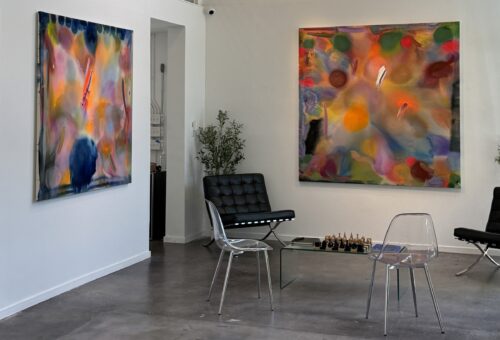
Emma Johnson Stone, “Pre-dawn shapes,” 2026. Pigment, ink and acrylic 150 x 150 cm, 59 x 59 in., “Inner Bloom,” 2026, pigment, ink, acrylic and liquid aluminum 180 x 180 cm, 70.8 x 70.8 in. (Photo credit Erin Parish)
A sweater suggests a shifting vista. A blanket evokes the movement of water. Familiar objects reveal unexpected complexity through attention. Clarke’s paintings encourage sustained observation without demanding explanation. Their strength lies in their quiet insistence that ordinary material experience is worthy of prolonged contemplation, as well as the richness of quietude.
Emma Stone Johnson’s use of atmospheric abstraction forms the exhibition’s third movement. Through staining, pouring, layering, and interruption, she creates paintings that construct spaces untethered to gravity, evoking luminous afterimages expanded into immersive fields of color.
Spare foreground elements move at times across fields of color, activating depth and establishing shifting relationships within the artwork. Spatial conditions remain unfixed while areas of luminosity emerge through successive washes and glazes, creating the sensation that light originates from within the painting itself, echoing Clarke’s work.
Johnson frequently darkens the edges of her paintings. This vignette effect intensifies the sensation of internal illumination. Transparent layers build gradually upon one another, creating a stained-glass-like quality that elevates the work toward the sublime. The paintings suggest environments governed by sensation rather than geography.
Some moments recall Helen Frankenthaler’s groundbreaking pouring of paint or Ross Bleckner’s atmospheric intensity, particularly in his color-driven works. These references never reign over her efforts. Johnson has a visual vocabulary distinctly her own.
The artists’ paintings occupy visual spaces unconstrained by physical laws. Color establishes space and expands and contracts. Foreground forms interrupt otherwise broad passages, preventing the compositions from settling into pure atmosphere. The work demonstrates how structure and openness can coexist within the same painted field.
What ultimately unites these three artists is their use of color and commitment to abstraction, creating a visual field. Despite their distinct approaches to paint handling, Kneese, Clarke, and Johnson each work from remarkably similar palettes. The careful jewel-like tones of Clarke and Johnson modulate chromatically across their surfaces, while Kneese is an intentional bull in a china shop. His color sensibility is similar, yet he uses those colors to tint his whites. This dramatically shifts the register away from preciousness.
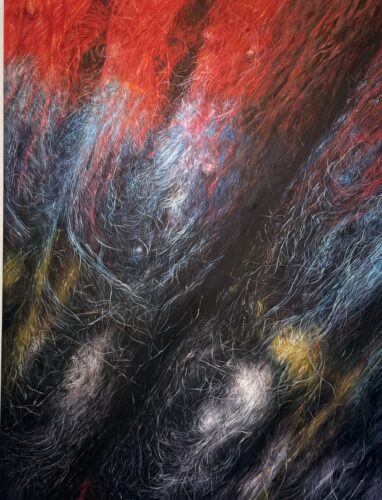
Murray Clarke, “Blossom,” 2026. Oil on canvas, 170 x 130 cm, 70 x 51 in. (Photos by Erin Parish)
The paintings inhabit different environments. Clarke’s works belong to interiors shaped by domestic experience; Kneese’s paintings evoke tropical landscapes animated by weather and movement. Johnson’s paintings occupy sky-like psychological spaces. Together, they encompass interior, exterior, and imaginative realms while remaining grounded in the language of painting.
“In Three Movements” demonstrates that pace and placement are effective curatorial tools. Through three distinct artistic voices, Opa Projects has assembled an exhibition that demonstrates the continued vitality of painting as a medium capable of sustaining different approaches within a serious context.
Paul Delaroche is famously credited with declaring in 1839 that “painting is dead.” Today, the statement reads more as a historical curiosity than a prophecy.
Opa Projects affirms its commitment to artists making rigorous and compelling work, while Kneese, Clarke, and Johnson demonstrate that painting remains capable of reinvention without abandoning its fundamental concerns.
Kneese builds through friction, gesture, and revision. His marks remain rough and direct, continually reinforcing the literal presence of the painted surface. Clarke accumulates through transparency and precision. Color gathers incrementally until it achieves the appearance of solidity while retaining its underlying complexity. Johnson constructs through stain, glaze, interruption, and luminosity. Her surfaces suggest light emerging from within through carefully orchestrated layers of paint.
Painting is alive and well, and these artists show exactly why.
WHAT: “In Three Movements”
WHEN: 11 a.m. to 6 p.m., Tuesday through Friday, 11 a.m. to 5 p.m., Saturday. Closed Sunday and Monday. Through Saturday, July 25.
WHERE: Opa Projects, 7622 NE 4th Court, Miami
COST: Free
INFORMATION: 516-807-5419 and opaprojects.com
ArtburstMiami.com is a nonprofit media source for the arts featuring fresh and original stories by writers dedicated to theater, dance, visual arts, film, music and more. Don’t miss a story at www.artburst.com.
No posts found
‘Ode to the 305’ On View at Newly Opened University of Miami gallery
Written By Olga Garcia-Mayoral
June 22, 2026 at 10:21 AM
The newly renovated University of Miami Art Gallery @ The Chapel provides the setting for “Ode to the 305: A Love Letter to Miami,” an exhibition curated by Ronald Sánchez that explores the city’s overlooked histories, working-class neighborhoods, and everyday realities beyond the tourist gaze. (Photo by Ronald Sánchez)
For decades, Miami has sold itself through a carefully curated fantasy. Palm trees sway against pastel Art Deco facades. Luxury towers rise beside turquoise water. Nightlife stretches until dawn. The city appears polished, glamorous, and perpetually on vacation.
Yet for those who call Miami home, another city exists beneath the postcards.
It is a city of working-class neighborhoods, crowded highways, corner stores, backyard gatherings, immigrant communities, and fading storefronts. It is a city where memory resides in familiar fences, old apartment blocks, neighborhood landmarks, and family photographs. It is this Miami—raw, imperfect, and deeply human—that curator Ronald Sánchez explores in “Ode to the 305: A Love Letter to Miami,” on view at the newly opened University of Miami Art Gallery @ The Chapel through Friday, June 26.
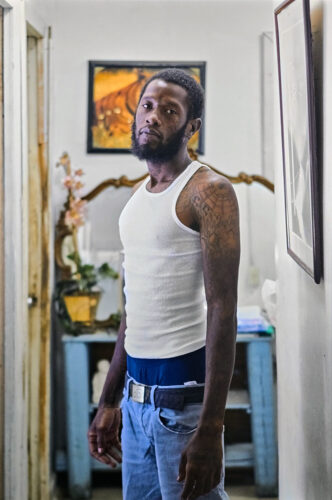
Roscoe B. Thicke III’s photographic portraits draw from personal and family histories rooted in Miami’s Pork ‘n’ Beans community, honoring place, memory, and the generations that shaped the city’s cultural fabric. (Photo by Ronald Sánchez)
Rather than celebrating Miami’s polished exterior, the exhibition embraces its contradictions.
“I feel like it reflects authenticity,” says Sánchez. “The Miami we know. Tourists won’t understand what Flanigan’s is. They won’t understand taking the green cup home. Going to a Hurricanes game. Being stuck on US-1 or I-95 during rush hour. The heat when you get into your car. Those are the things that make Miami what it is.”
Featuring works by Valerie Catalan, Mark Herrera, Katelyn Kopenhaver, Isabella Rodriguez, Richard Rodriguez, Roscoe B. Thicke III, and Julia Zurilla, the exhibition presents a collective portrait of a city rarely depicted in tourism campaigns.
Instead, viewers encounter stories rooted in migration, family histories, labor, resilience, and belonging.
A New Home for Miami Stories
The exhibition also arrives during a significant moment for the University of Miami’s art program.
Located inside a historic 1948 chapel, the gallery recently completed an extensive renovation after relocating from Wynwood, where it had spent more than a decade. Gallery Manager and Curator Milly Cardoso describe the move as transformative.
“We really needed something on campus,” Cardoso says. “It makes the gallery accessible to students and the university community in a completely different way.”
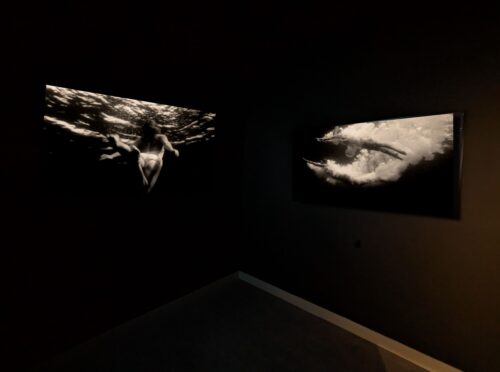
Julia Zurilla’s multichannel video installation, “Portrait of a Bather in Three Movements,” uses water as both subject and metaphor, reflecting on adaptation, memory, and survival in a city shaped by the sea. (Photo by Ronald Sánchez)
Rather than erasing the building’s past, the renovation carefully preserved many of its architectural features, including portions of the original stained-glass windows and vaulted wooden ceiling.
“It’s a landmark building,” Cardoso explains. “We were very careful with the renovation. The stained glass couldn’t be altered, and the ceiling couldn’t be disturbed. We wanted to respect the history while creating a space that could serve contemporary art.”
The result is a venue uniquely suited for an exhibition concerned with memory and transformation.
Beyond the Miami Myth
Sánchez originally developed many of the ideas behind “Ode to the 305 “through an earlier exhibition, “Magic City: Contemporary Visions of Miami,” presented at the Doral Contemporary Art Museum. That project even earned recognition at the Telly Awards through an accompanying documentary. But this new iteration feels more focused, more intimate, and more rooted in everyday experience.
“I wanted to steer away from the title ‘Magic City,’” Sánchez says. “This show is a little different.”
The difference is immediately apparent.
In Roscoe B. Thicke III’s photographs, family members from the Pork ‘n’ Beans housing projects become living archives of Miami history. The images honor a neighborhood often omitted from mainstream narratives while emphasizing the role of memory in shaping identity.
“People who don’t know Miami don’t know Pork ‘n’ Beans,” Sánchez notes. “That’s where the love letter comes in.”
Nearby, Valerie Catalan’s photographs capture landscapes that feel simultaneously specific and universal. During the walkthrough, viewers repeatedly tried to identify the locations depicted.
“People kept saying, ‘I know a place exactly like that,'” Sánchez recalls. “It could be Hialeah. It could be Little Havana. It could be Westchester.”
Katelyn Kopenhaver’s text-based work offers a satirical inventory of things Miami does not need more of, blending humor and critique to examine the city’s culture of excess, development, and performance. (Photo by Ronald Sánchez)
The photographs evoke the textures of everyday Miami—the hum of air-conditioning units, chain-link fences, overgrown yards, and the warm light that settles over residential neighborhoods in the late afternoon.
For many Miamians, the images feel less like documentation than recognition.
Migration, Identity, and Resistance
The exhibition’s emotional center emerges through works addressing migration and belonging.
Mark Herrera, himself a Coast Guard officer, transforms firsthand encounters with migrants into haunting drawings that depict journeys across the Florida Straits and beyond. Technical boat schematics become visual frameworks for stories of displacement, survival, and hope.
“He has witnessed these moments firsthand,” Sánchez explains. “People use anything that floats.”
A sculptural life vest fabricated from found materials reinforces the precarious reality behind migration statistics.
Nearby, Richard Rodriguez’s provocative print work confronts immigration enforcement directly. Featuring an altered Department of Homeland Security seal alongside the phrase “Los pendejos de Homeland Security” and the declaration against ICE, the piece refuses neutrality.
Its placement within a university gallery feels especially significant.
“I really appreciate the art department letting me show this piece,” Sánchez says. “Other institutions might not.”
The work’s unapologetic stance reflects broader conversations happening across Miami’s immigrant communities while underscoring the exhibition’s commitment to authenticity over comfort.
Familiar Places, Shared Memories
Other works approach Miami through quieter observations.
Isabella Rodriguez’s paintings transform ordinary architectural details into moments of contemplation. Louvered windows, metal fences, tropical vegetation, and pastel facades become visual markers of collective memory.
“We all know buildings like that,” Sánchez says while pointing to one painting. “I have that exact fence at my house.”
The recognition is immediate.
Likewise, Katelyn Kopenhaver’s humorous text-based work offers a satirical inventory of things Miami does not need more of, poking fun at luxury culture, traffic, and the city’s endless cycles of reinvention.
Together, these works reveal a Miami that is simultaneously frustrating and beloved.
Learning to Stay Afloat
The exhibition concludes with Julia Zurilla’s multichannel video installation, “Portrait of a Bather in Three Movements.”
Presented within the gallery’s dedicated video room, the work examines swimming as both a literal and metaphorical act of survival. Water becomes a recurring symbol throughout the piece—sometimes nurturing, sometimes threatening.
Sánchez describes the installation as “poetic.”
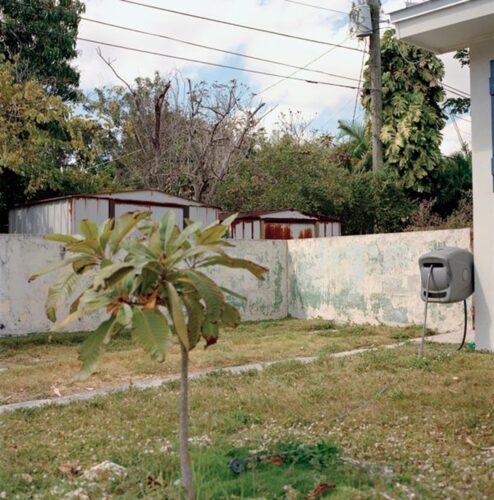
In Valerie Catalan’s photographs, familiar South Florida landscapes become sites of emotional reflection, where beauty, uncertainty, and the quiet rhythms of everyday life coexist. (Photo by Ronald Sánchez)
Projected imagery of swimmers, ocean currents, and shifting rock formations creates an immersive environment that feels deeply connected to Miami’s relationship with the sea.
In a city defined by water, the work becomes a meditation on adaptation itself.
A Love Letter Without Nostalgia
What makes “Ode to the 305” successful is its refusal to romanticize Miami.
The exhibition does not ignore the city’s inequalities, its displacement, its political tensions, or its rapid transformation. Instead, it embraces these realities as essential parts of the story.
“This is my representation of what real Miami is,” Sánchez says.
That representation feels especially urgent as Miami continues to reinvent itself.
In the renovated chapel gallery, surrounded by works that honor neighborhoods, memories, and often-overlooked communities, viewers encounter a version of Miami that cannot be found in travel brochures.
It is a city of contradictions, but it is also a city worth loving precisely because of them.
WHAT: “Ode to the 305: A Love Letter to Miami”
WHERE: University of Miami Art Gallery at The Chapel, Room 112, 6565 Red Road, Coral Gables
WHEN: 9 a.m. to 3 p.m., Tuesday through Friday. Closed Saturday. Through Friday, June 26, 2026. Private tours available by appointment.
COST: Free
INFORMATION: (305) 284-3161 and https://art.as.miami.edu/
COMING UP: The next exhibition at the museum is “Common Ground” by William Osorio, curated by Milly Cardoso, with an opening reception from 5 to 8 p.m. on Thursday, July 9 and on view from Wednesday, July 8 through Wednesday, Aug. 5.
ArtburstMiami.com is a nonprofit media source for the arts featuring fresh and original stories by writers dedicated to theater, dance, visual arts, film, music, and more. Don’t miss a story at www.artburstmiami.com.
No posts found
NSU Art Museum’s ‘Close to Home’ Finds Common Ground Among Miami Artists
Written By Douglas Markowitz
June 15, 2026 at 6:12 PM
Piero Penizzotto, “Kings of Comedy (Chris, Imani, Bernard, Calvin, Dre)”, 2024, papier-mâché, foam and acrylic, is one of the works in NSU Art Museum Fort Lauderdale’s group exhibition “Close to Home” through Sunday, Oct 4. Collection NSU Art Museum, purchased with funds provided by the Susan S. Miller Acquisition Fund. (Photo by Oriol Tarridas, courtesy NSU Art Museum)
A cross-section of the Miami art scene can be found just north in Fort Lauderdale, where NSU Art Museum’s latest group exhibition, “Close to Home,” brings together nearly two dozen artists with ties to the city.
Community is the central idea of the show, with the three curators – museum director Bonnie Clearwater as well as Ariella Wollens and guest curator Sinaí Rivera – choosing artists that engage with ideas of family, friendship, and togetherness.
Many of the selected works depict the artists’ loved ones or close confidants, with the overall concept of the show arguing that such tight interpersonal bonds are an essential facet of the local art scene.
Roscoè B. Thické III, for example, pays tribute to his deceased grandmother in two works, referencing the diamond-shaped anti-theft shutters that cover the windows of her house in urban Miami. In one photo, an empty chair has been placed between the two shuttered windows.
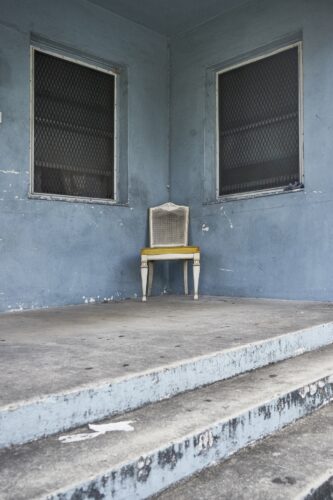
Roscoè B. Thické III pays tribute to his deceased grandmother referencing the diamond-shaped anti-theft shutters that cover the windows of her house in urban Miami. “Missing Matriarch,” 2020. Archival Fine Art Print Hahnemühle Baryta Satin
300gsm. (Photo courtesy of The Guzman Duran Art Trust)
Another work, “Redeemer,” splits a portrait of Thické’s son in the Everglades, standing in a crucifix pose modeled after the famous statue in Rio de Janeiro. The diamond grid of the shutters serves as the frame, splitting the photo itself into parts, while tiny cymbals have been placed underneath the wood, turning the work into a massive tambourine. Both works in tandem poetically evoke the passing of an older generation’s spirit into their descendants.
“There were so many ways that we could have gone about (the theme of) friends and family, but I think overall it’s just spending time together and just quality time and mundane moments – I think this is what these artists are trying to highlight,” Rivera says. “And then I think there is this diversity that very much represents what Miami feels like to me, just different communities all in one space.”
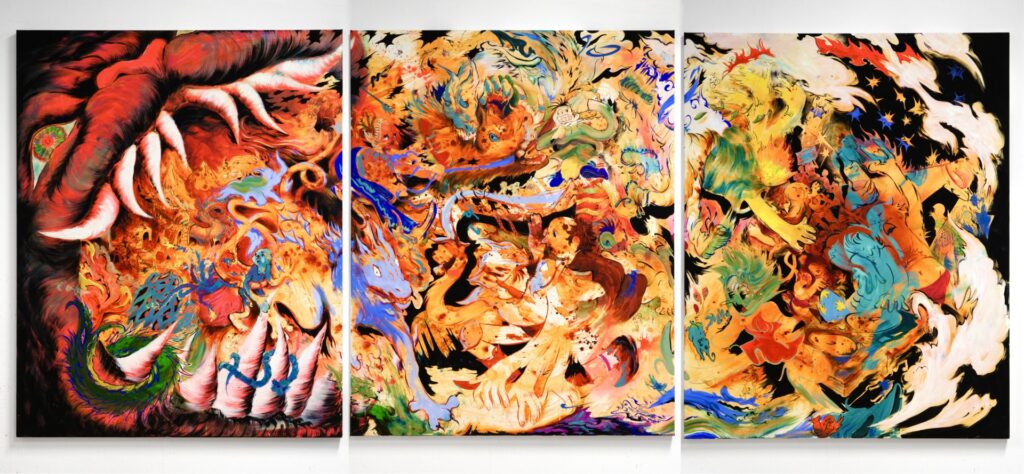
Susan Kim Alvarez’s Bosch-esque triptych of South Florida chaos, “Mouth of Miami,” 2025. Acrylic, ink, and gouache on canvas. 60 in x 144 in (152.4 cm x 365.76 cm)
NSU Art Museum Fort Lauderdale; Purchased with funds provided by Curator Circle. (Photo courtesy of NSU Art Museum)
That diversity is reflected in the various mediums seen throughout the show, from painting and photography to three-dimensional artworks. Josh Aronson’s work “The Cabin Mirror” serves as a visual archive of his “Florida Boys” photo series, featuring preparatory documents and photos hung against a four-pane mirror.
Aronson developed the “Florida Boys” project, which places young South Floridians in pastoral settings, based on the idea that many local urban residents, often first-generation immigrants, are unable to engage in certain rites of passage.
“They don’t have access to that kind of quintessential boyhood experience of climbing trees, swimming in springs, so on and so forth, and so we use photography as a way to kind of write ourselves into that narrative,” Aronson says.
Richard Moreno’s “…and From This Wretched Form I Absolve Thee (Purifying Thy Form for the Continuation of my Spirit”), 2024, created with mummified iguana found in the historic grounds of Vizcaya. The artist’s sculptures feature gothic and esoteric aesthetics. (Photo courtesy of the artist)
Meanwhile, Richard Moreno’s work spotlights a very different facet of the wider South Florida community, its punk and metal scene. The artist’s sculptures feature gothic and esoteric aesthetics, with some even incorporating decaying animal parts à la Damien Hirst. One piece uses an iguana carcass the artist scavenged while working as an art handler at the Vizcaya Museum and Gardens, placing the body in a coffinlike reliquary. Others have participatory aspects: During the show’s opening event on Sunday, June 7, a noise musician played an improvised set with one of the sculptures, which has a built-in amplifier in its base.
In recent years NSU Art Museum has become something of a champion of the local scene. Most notably, in 2023 Clearwater and Wollens curated “Future Past Perfect,” a uniquely-formatted show which gave seven individual local artists their own solo presentation.
Several artists from that exhibition reappear in “Close to Home,” allowing visitors to check their progression: Zoe Schweiger has moved on to painting sweltering nightlife scenes in her fluid style of monochromatic warm-color canvases, while Susan Kim Alvarez has illustrated a Bosch-esque triptych of South Florida chaos in her painting “Mouth of Miami.” Both have benefitted from the exposure; Schweiger will begin a master’s program at the Yale University School of Art later this year, while Alvarez and fellow artist Cici McMonagle, who also had a solo show at NSU, will stage a museum exhibition in their hometown of Lakeland next year.
Zoe Schweiger paints sweltering nightlife scenes in her fluid style of monochromatic warm-color canvases. “Cici at Floyd 1:09 AM,” 2025. Acrylic and ink on canvas, 40 in x 50 in (101.6 cm x 127 cm). (Photo courtesy of the artist and Mindy Solomon Gallery)
“We want to be an institution that doesn’t just debut artists or sort of pick up on people, but has a consistency in supporting them,” Wollens says. “(We want to) continue to have some sort of infrastructure with artists and follow them through these points in their careers, especially the artists who are in our community.”
Bringing on Rivera as co-curator is a part of that vision. A Miami native and a student at NSU studying business, the 26-year-old had worked in the curatorial department at the museum and was approached by Clearwater to help program the show based on her extensive participation in the local scene.
“Bonnie personally reached out to me. She was inspired by how I’m active in the community, and she saw potential in me that I had yet seen for myself,” Rivera says. “When I started going to school, (the idea of) being a curator still wasn’t at the top of my mind. I came to work at the museum for fun because I like museums, and I wanted to gain some kind of insight. But this truly is my passion, and it’s just kind of evolved from that.”
Papou, “Tropical Violence,” 2026, Oil, acrylic, spray paint, sand, latex on unstretched canvas, 72 in x 96 in (182.88 cm x 243.84 cm) (Photo courtesy of Spinello Projects)
The continued investment in these artists reflects a sustained interest in building an arts ecosystem that spans, and even surpasses the entire South Florida region. At the opening, many in attendance remarked that they rarely visited Fort Lauderdale. Time will tell whether artists will feel more comfortable claiming South Florida over Miami as their home base, but “Close to Home” is a good place to start.
WHAT: NSU Art Museum’s “Close to Home”
WHEN: 11 a.m. to 5 p.m., Tuesday through Saturday, noon to 5 p.m., Sunday; closed Monday. Through Sunday, Oct. 4.
WHERE: NSU Art Museum Fort Lauderdale, 1 E. Las Olas Blvd., Fort Lauderdale
COST: Admission is $16 for adults; $10 for seniors; $8 for military; $5 for college students; and free for students age 13-17, U.S. military veterans and dependents, museum members, NSU and Broward College students, faculty, and staff, and children 12 and under.
INFORMATION: 954-525-5500 or nsuartmuseum.org
ArtburstMiami.com is a nonprofit media source for the arts featuring fresh and original stories by writers dedicated to theater, dance, visual arts, film, music and more. Don’t miss a story at www.artburst.com.
No posts found

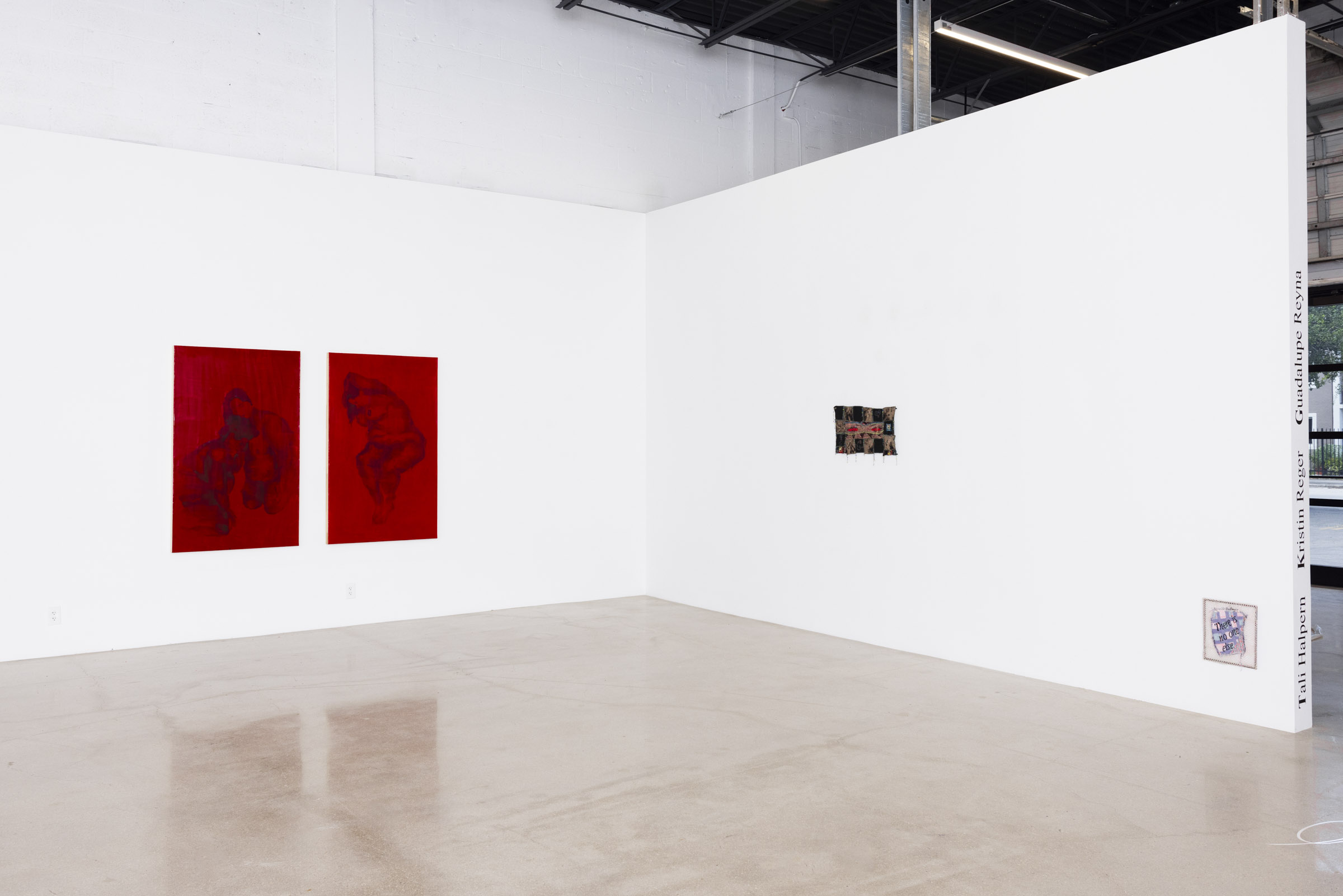
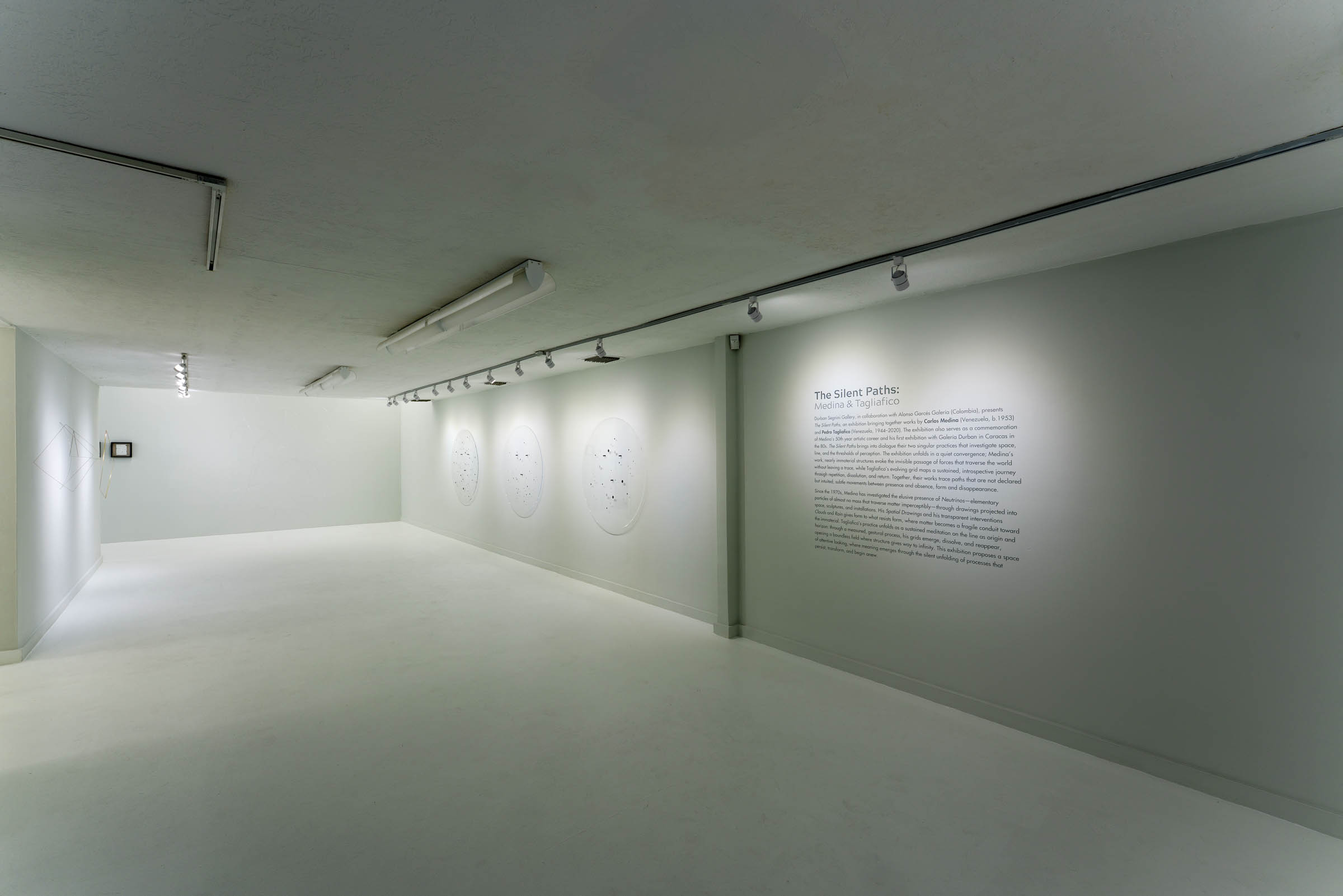
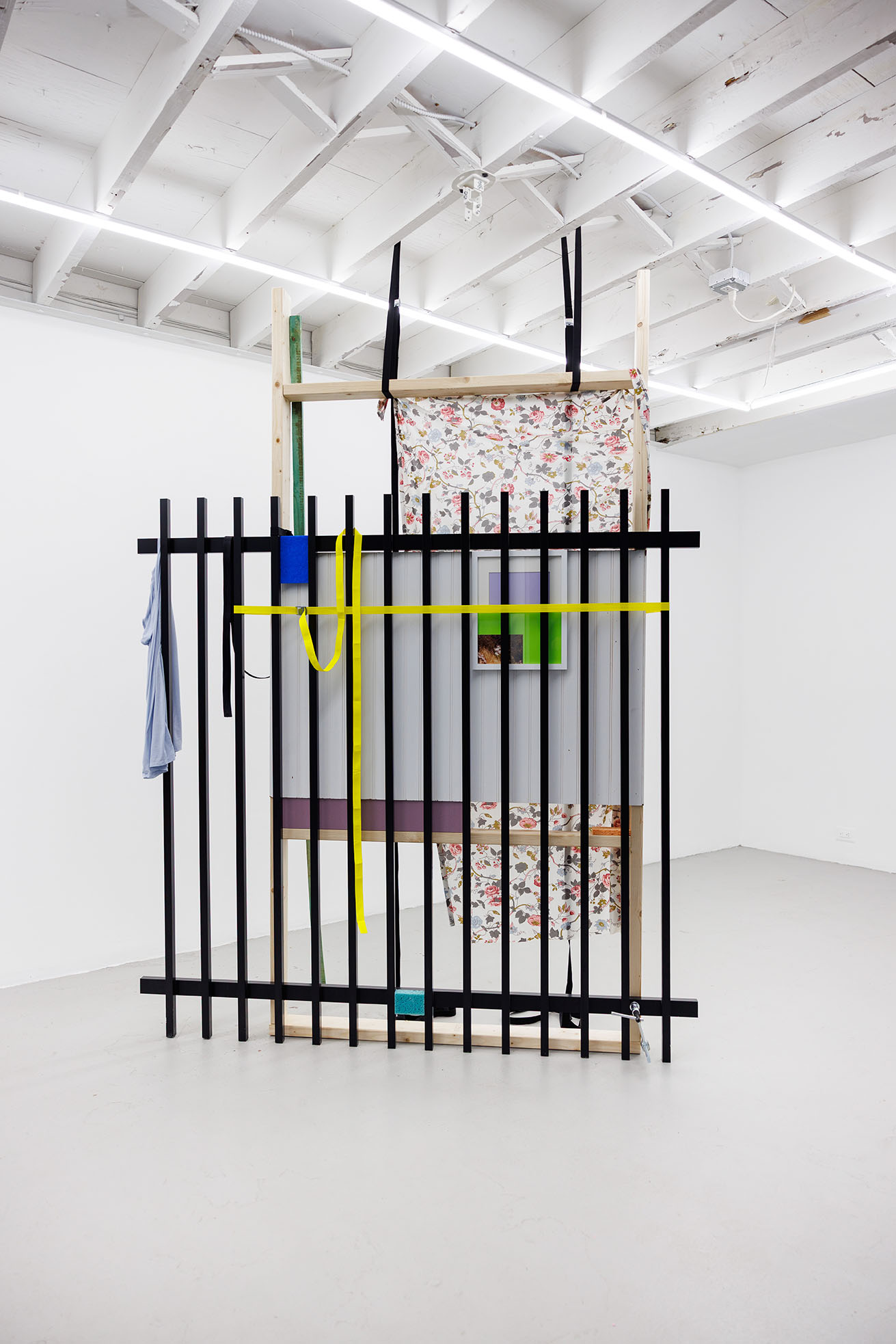
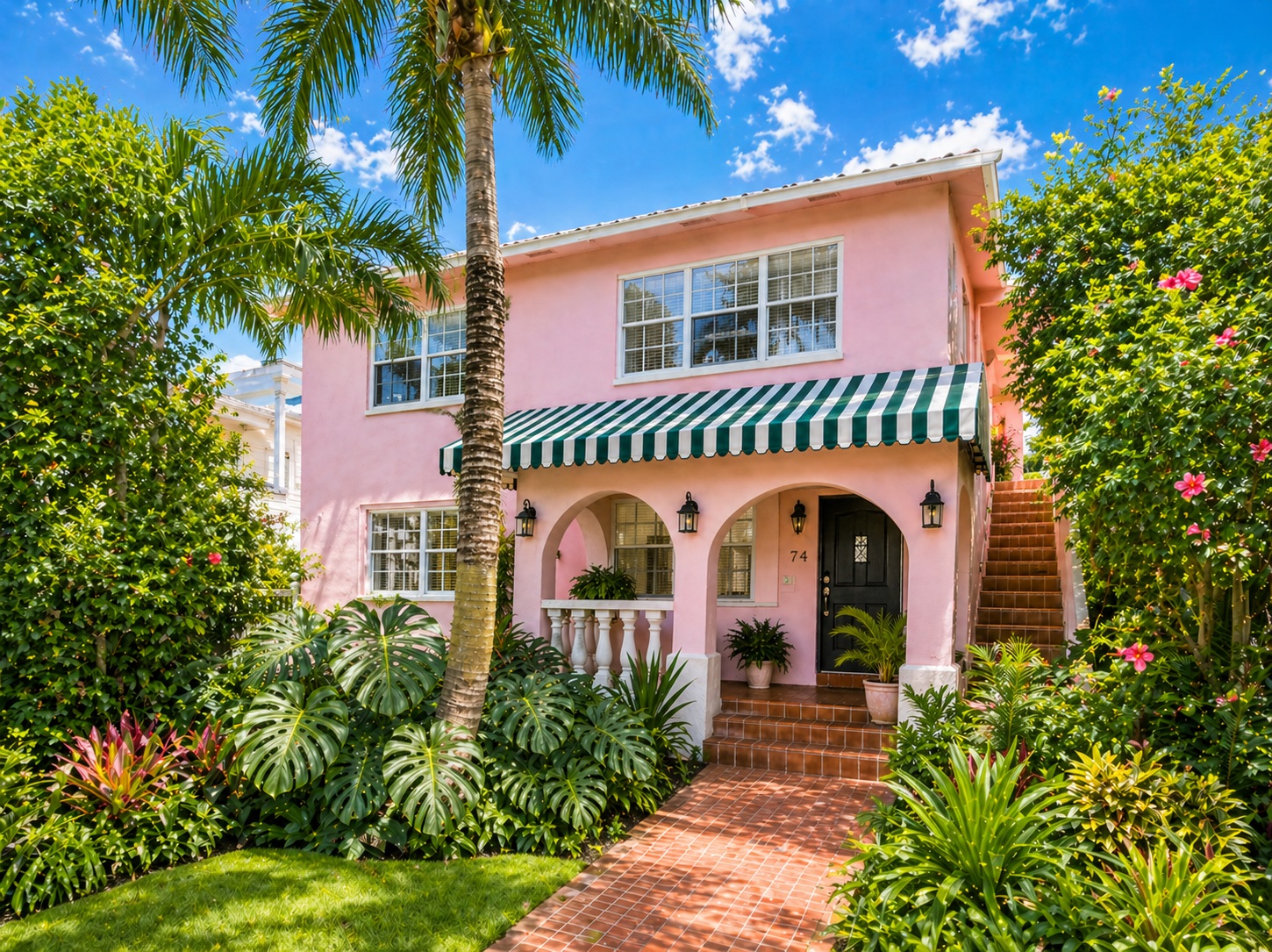
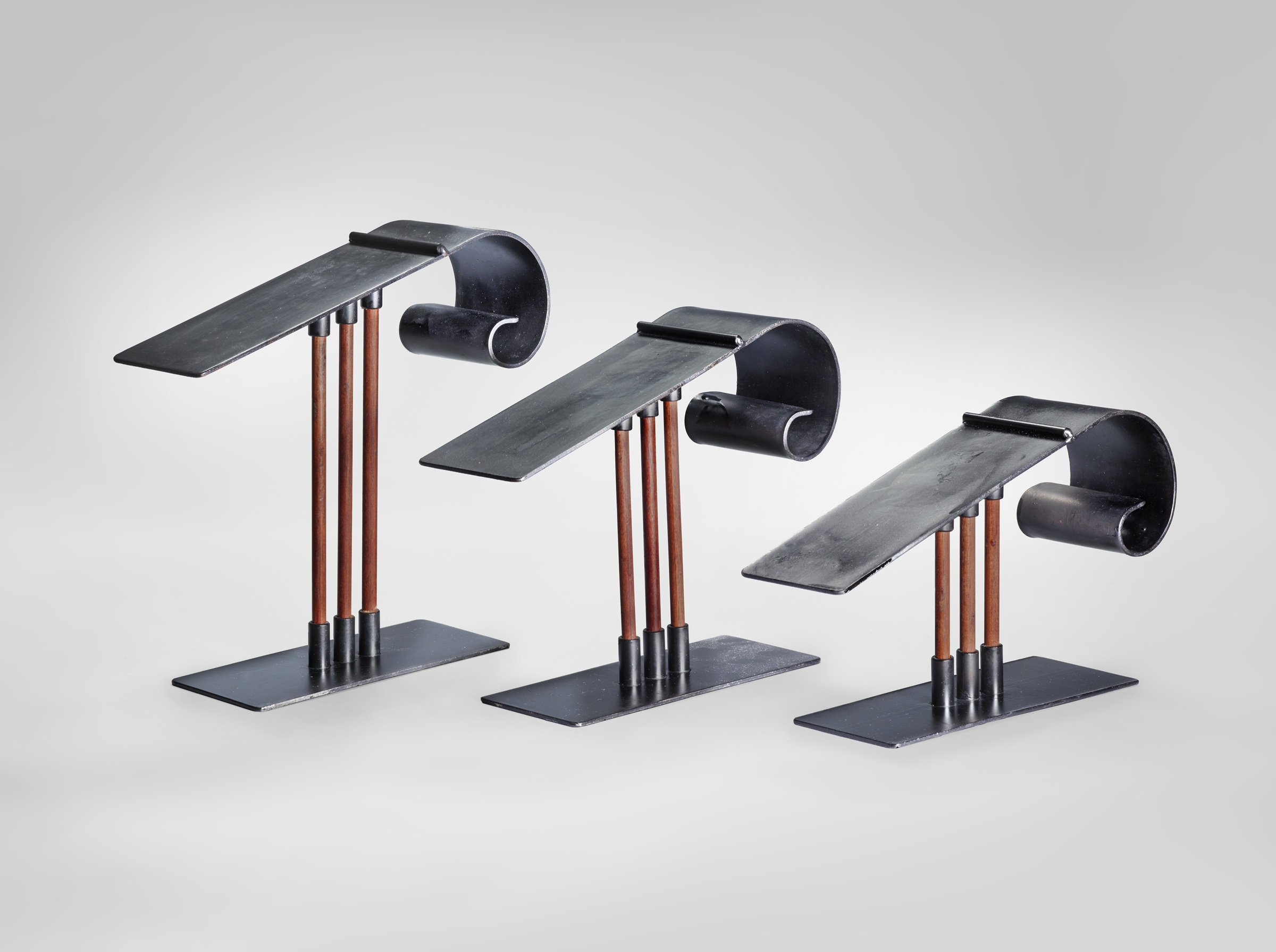
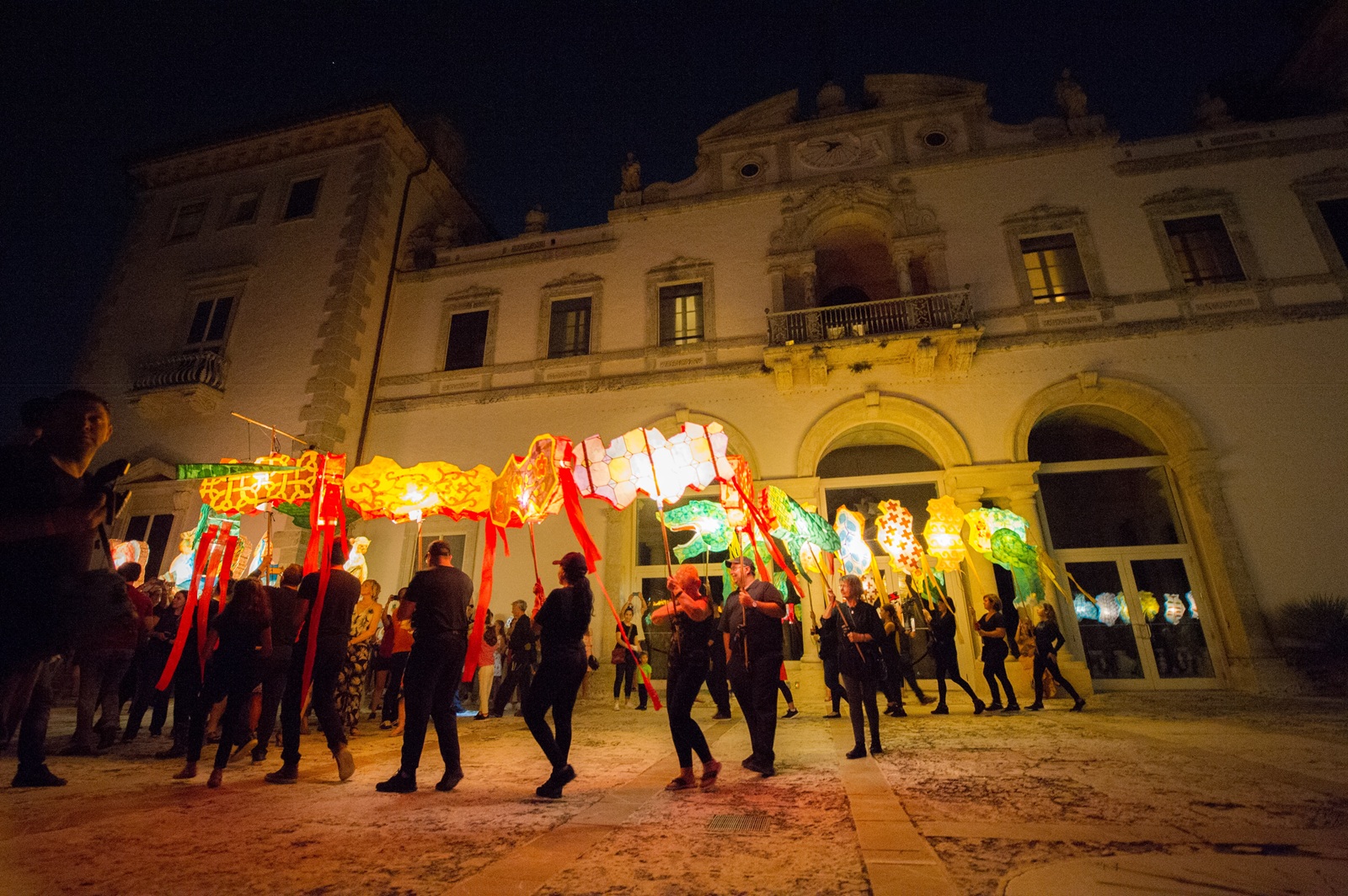
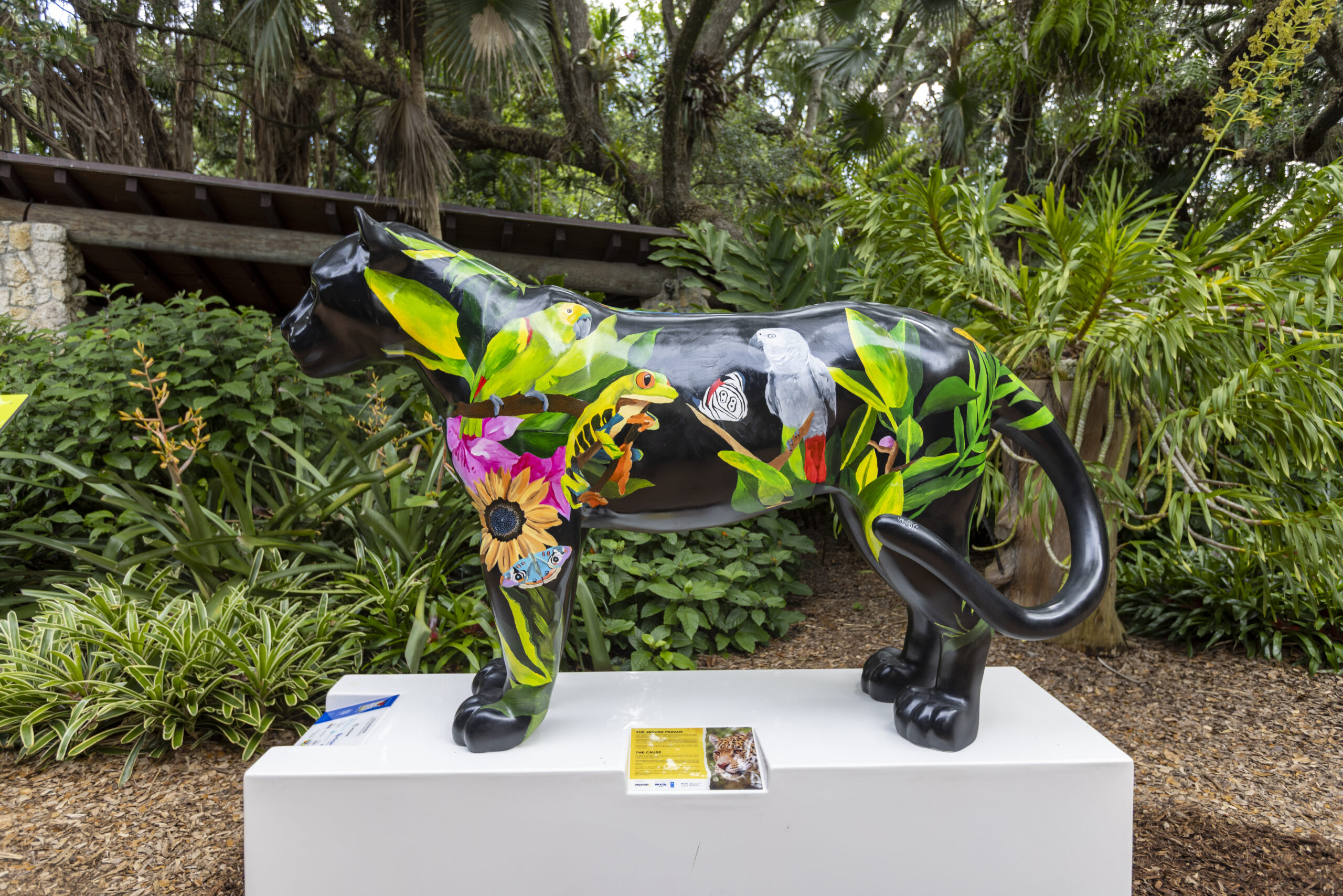
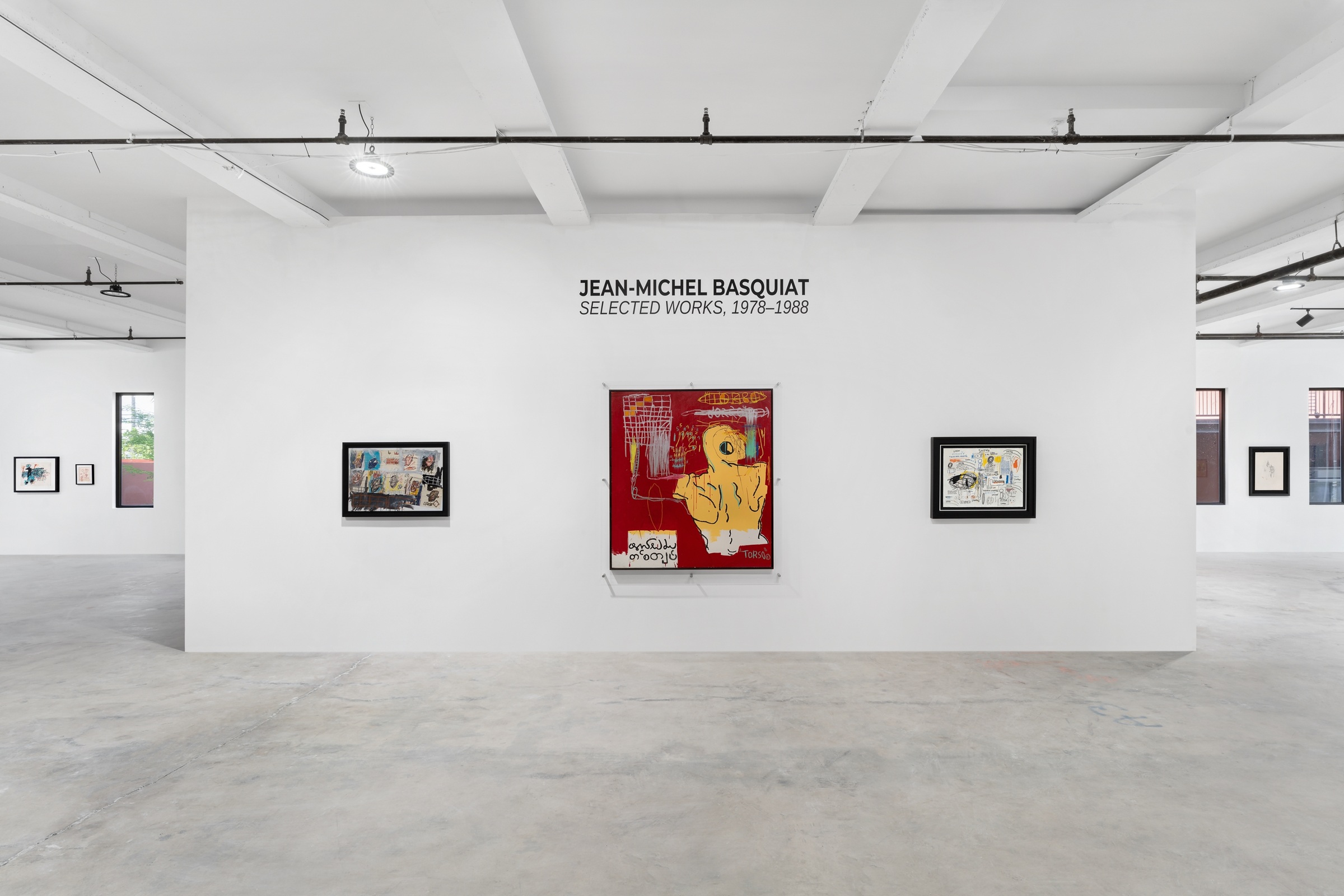
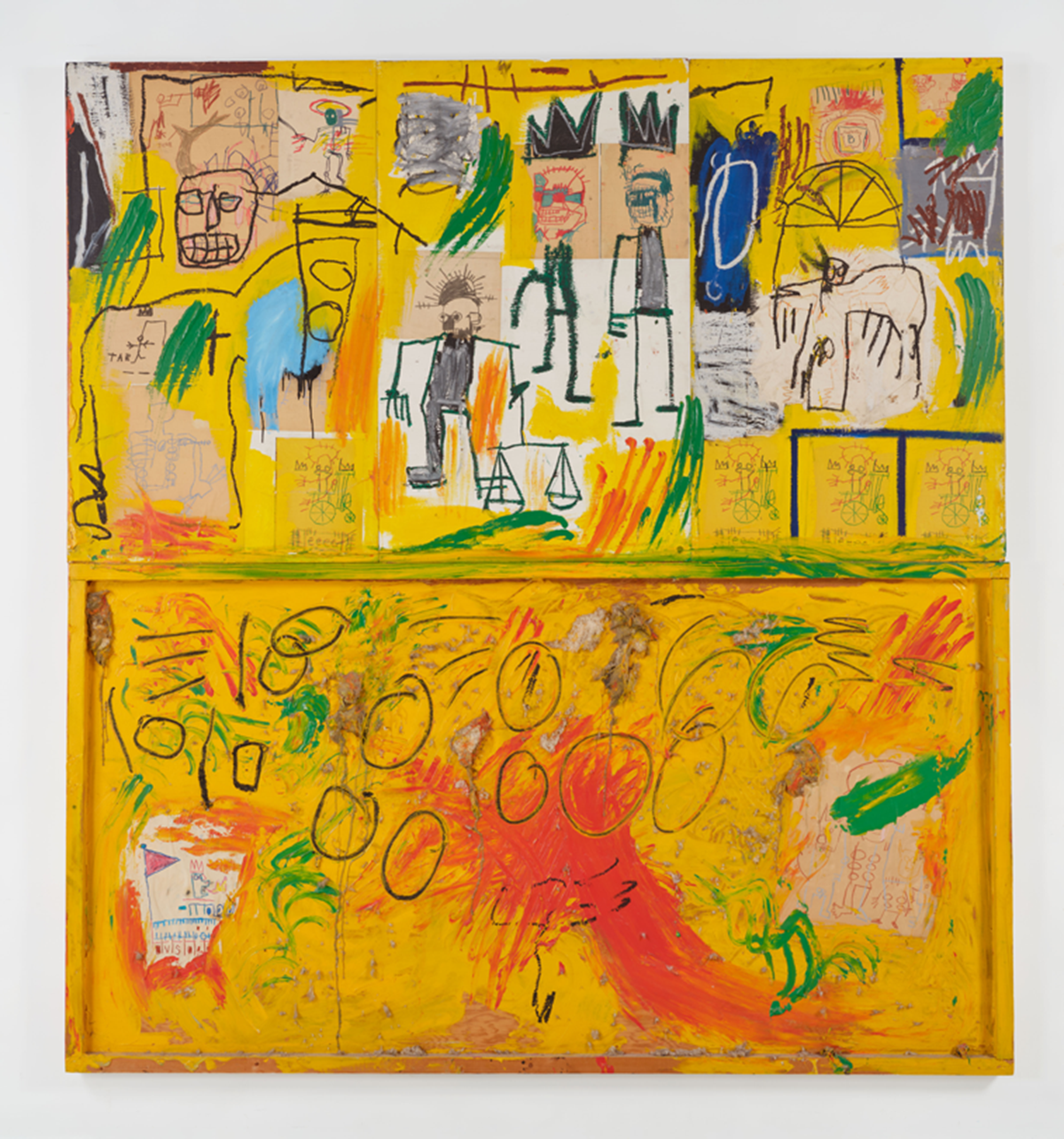
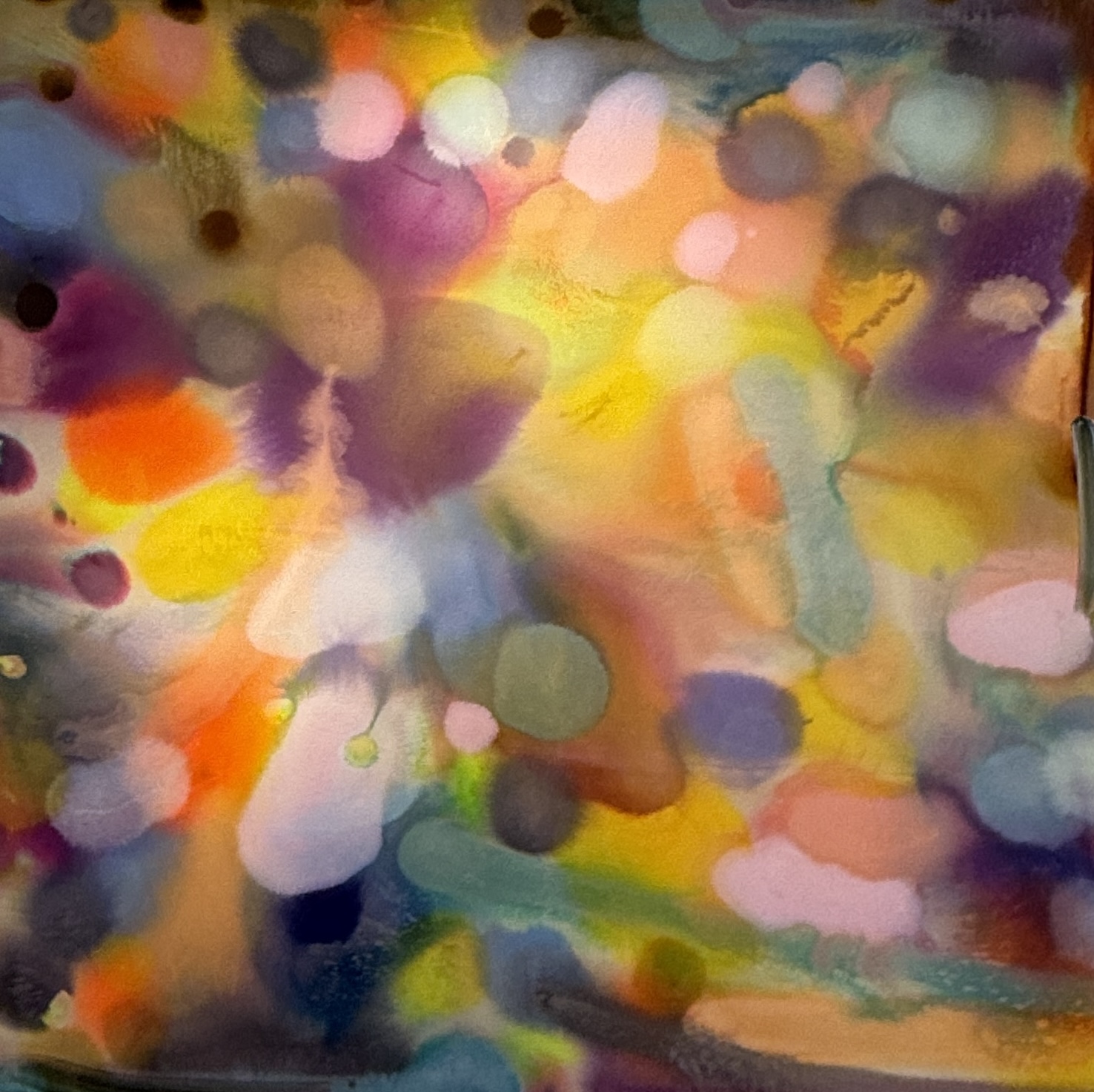
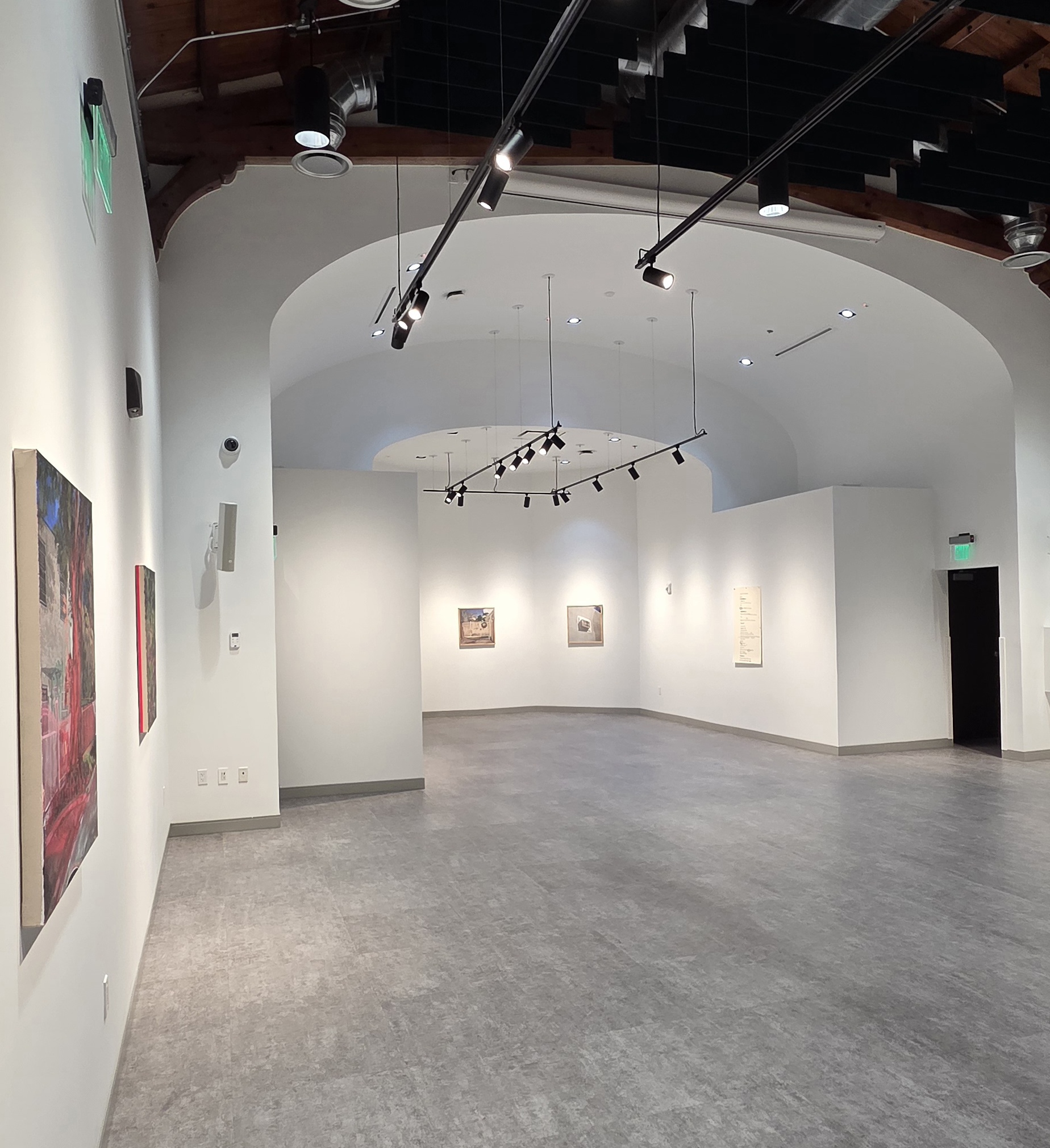
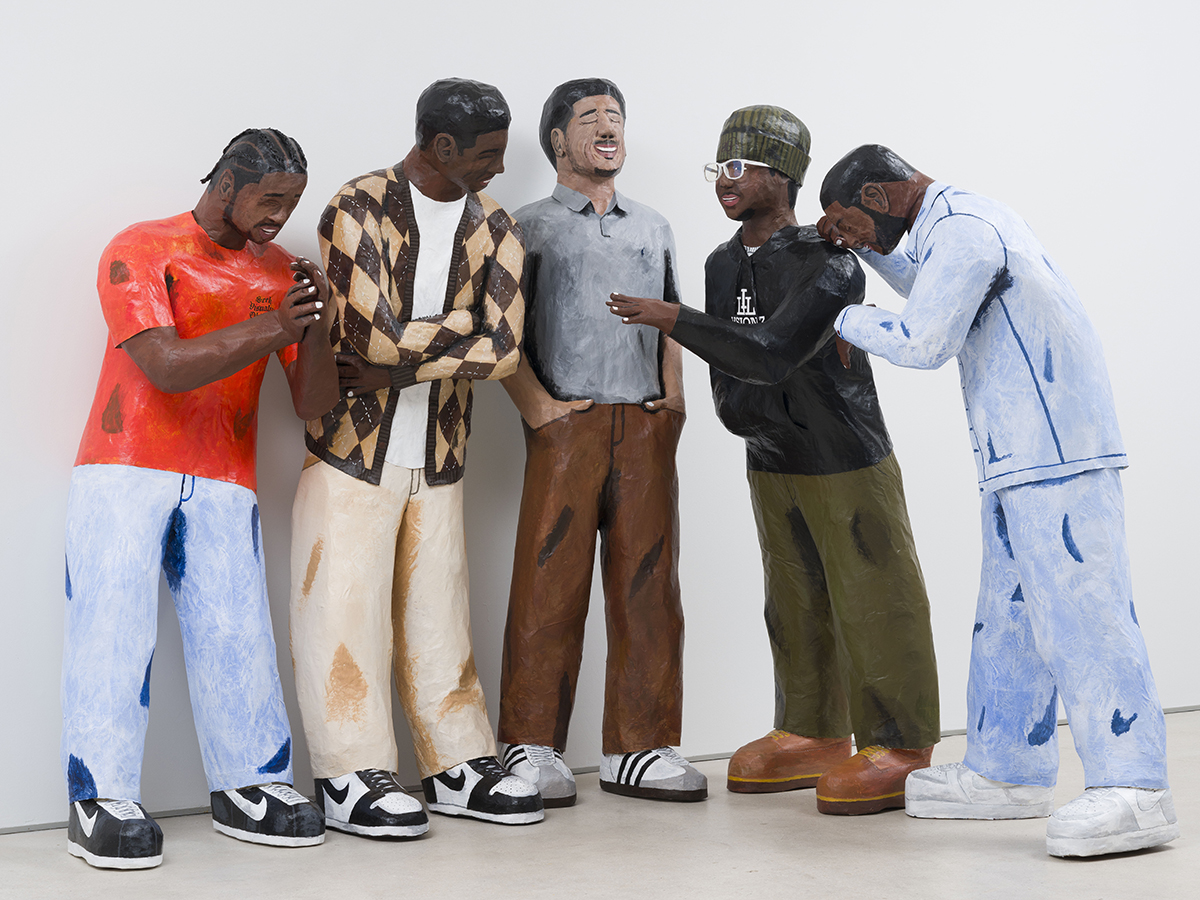
Recent Comments