Miami New Drama Takes To The Streets With ‘Lincoln Road Hustle’
Written By Michelle F. Solomon December 10, 2024 at 12:41 PM
Carlos Fabian is a young ambitious entrepreneur learning the ropes with Robert Deleon played by Stephen Anthony, right, in Miami New Drama’s “Lincoln Road Hustle,” which takes place along two blocks of Miami Beach’s Lincoln Road through Feb. 16. (Photo courtesy of Morgan Sophia Photography)
When Miami New Drama staged its original interactive production “Seven Deadly Sins” with actors performing in empty storefronts along Lincoln Road, it was in the midst of the pandemic. Small groups watched from seats outside each space while there was only a smattering of people walking around Lincoln Road.
Miami New Drama (MiND) then staged its next immersive production, “The Museum Plays,” in February of 2024 where guides would lead five groups of 30 people from one play to the next to watch original art-inspired short plays inside The Rubell Museum, a somewhat easily contained environment although not without its challenges.
Marcela Paguaga as a savvy social media influencer and Carmen Pelaez as Chef Luna in Miami New Drama’s “Lincoln Road Hustle.” (Photo courtesy of Morgan Sophia Photography)
For its third production, the regional theater company, based at the Colony Theatre on Lincoln Road, is “pushing the boundaries,” as Michel Hausmann, founder and artistic director of MiND puts it about its “Lincoln Road Hustle,” now playing along Lincoln Road through Sunday, Feb. 16. Hausmann commissioned Miami-based documentary filmmaker and playwright Billy Corben and New York-based playwright Harley Elias (who had worked with MiND on one of “The Museum Plays”) to imagine a story that takes place throughout Lincoln Road.
Miami-based documentary filmmaker Billy Corben co-wrote Miami New Drama’s “Lincoln Road Hustle.” (Photo courtesy of Miami New Drama)
Corben says that “Lincoln Road Hustle” is site specific and inspired by the Miami Beach location, albeit a fictional story. “Everyone has gathered at the 1100 block of Lincoln Road for a ceremonial groundbreaking,” says Corben describing the premise.
Robert Deleon, a Miami developer and Medicare fraudster, is going to be demolishing the entire block to build a 75-story luxury hotel condo – “starting at the reasonable price of $3 million,” adds Corben. It isn’t the first time Corben’s created an original script with MiND. In 2019, Hausmann teamed playwright Aurin Squire (who also penned MiND’s “Wonderful World” which is now playing on Broadway) to work on turning Corben’s mega successful “Cocaine Cowboys” documentary into a play, “Confessions of a Cocaine Cowboy.”
Audiences watch a scene featuring Carlos Fabian Medina and Steve Anthony in Miami New Drama’s “Lincoln Road Hustle.” (Photo courtesy of Morgan Sophia Photography)
Add to the intrigue that Deleon is also building a multi-level Vegas style casino, Miami Beach’s first ever. It’s not too far-fetched from Miami’s real world as new development continues to take hold around every corner and Jeffrey Soffer, the billionaire owner of the Fontainebleau Miami Beach, is in a constant rally to open a casino inside the iconic hotel.
“There’s a lot of what I call Miami fan service in ‘Hustle,’ ” says Corben, a term originating in Japanese anime but fits the bill here, delivering archetypes of Miami characters. “Like a Miami Only Fans model. A Miami Instagram food influencer. Or a Miami mama’s boy that still lives with his mother well into adulthood.”
And then there’s the plot twist, Corben says, that could “thwart this multi-billion-dollar development.”
At least that’s where the script was a week before opening. “We have been writing it for some months and, to be honest, it’s still ongoing,” admits Corben.
Harley Elias co-wrote Miami New Drama’s “Lincoln Road Hustle.” (Photo courtesy of Furiosa Productions)
The logistics of having a live performance along a busy pedestrian stretch of Miami Beach are a challenge. “It’s as if you were juggling a bowling ball, a flaming torch and a machete, and then someone tossed you a chainsaw,” says Corben. With that said, Corben promises that it’s a fun, full night of theater.
“We spent a lot of time on the 1100 block of Lincoln Road (the play takes place along two of the pedestrian walkways blocks),” says co-playwright Elias. “We would walk the streets to look at different times of day from different angles. Inevitably someone would say, ‘Wait, did you see this . . .?”
“Lincoln Road Hustle” is the brainchild of Hausmann, who put Corben and Elias together. “I wanted a story that took place on Lincoln Road and boy, did they deliver.” Notwithstanding it is a bigger undertaking than the last two interactive productions. “It’s an experiment, right? But we use the abundance of people on Lincoln Road in our favor.”
Krystal Millie Valdez and Irene Adjan in a scene at Issabella’s on Lincoln Road in Miami New Drama’s “Lincoln Road Hustle.” (Photo courtesy of Morgan Sophia Photography)
In one scene, audience members eavesdrop on a conversation between two actors, Irene Adjan and Krystal Millie Valdez, who are seated at an outdoor table at Issabella’s restaurant as regular diners are around them.
The experience is made accessible, according to Hausmann, by a reliance on audio technology. Members of the audience are each given a set of headphones to wear and can hear the dialogue and the actors. “We can’t really control lighting outdoors but what we can control is the sound doing it this way.”
Audience members wear headphones to hear the action while watching “Lincoln Road Hustle” by Miami New Drama, which takes place along Lincoln Road. (Photo courtesy of Morgan Sophia Photography)
Hausmann says the use of the sound devices was made possible by a Knight Foundation grant which was used to develop, purchase and design the audio.
Here’s how “Hustle” works: Five groups of about 40 people are outfitted with headphones to navigate through each scene. For the first scene, the prologue starts with everyone at one spot – the Colony Theatre location. Then using a color-coded system, groups are divided into sets of five where they are guided through five 12 to 14 minute scenes. Unlike the past two original interactive plays, Hausmann wanted more than a thematic relationship but a script that was “complete, a whole” and together with a beginning, middle and end.
For the finale, all audience members come back together for the end scene.
Some of the action takes place in the middle of the street, some inside storefronts, and, says Hausmann, it is definitely an evolution in how the company began with “Seven Deadly Sins,” then “The Museum Plays” and now this third installment.
Gregg Weiner in Miami New Drama’s “Lincoln Road Hustle.” (Photo courtesy of Furiosa Productions)
There have been what Hausmann calls “accidental triumphs.” For instance, a scene that was to take place inside a store was so fraught with difficulties that it was pulled out of the location and restaged to take place on the street. “It actually works much better now,” says Hausmann who is directing the production. Would he have preferred having someone else wearing the director’s hat? “Yes, but the learning curve is too steep.”
Corben confides more than once during the interview that it isn’t a secret that almost daily, he’s half-jokingly said to Hausmann, “Why don’t we just stage this on the proscenium in the Colony Theatre?’ ”
And Hausmann’s answer is the same. “Anyone can pick out a play from a catalogue. We do world premieres that are about our community and that’s what excites you, right? And this is a hyper-local play, Lincoln Road – it’s isn’t just about Florida, it’s about Miami.”
He adds: “I think there is a responsibility when it comes to theater companies and nonprofits,” he says during an interview. “There is a big crisis around the country for regional theaters. Many are closing, many are having a hard time. (Theater companies) need to constantly expand the base to keep afloat. The traditional theater audience is not enough to sustain regional theaters today,” says Hausmann.
Guides assign color-coded headphones to audience members outside the Colony Theatre for Miami New Drama’s “Lincoln Road Hustle.” (Photo courtesy of Morgan Sophia Photography)
The outdoor interactive experiment “Seven Deadly Sins” produced its “youngest and most diverse audience that we’ve ever had,” says Hausmann. He’s honest in the fact that he believes theater needs to meet people where they are, but he states emphatically while not “talking down to them.”
There’s also the commitment of time on the part of an audience.
“We have to come to terms that people’s attention span has dramatically decreased. To ask for two or two and a half hours to sit inside a theater, that’s a tough sell,” says Hausmann. “There are hundreds and thousands of people who will spend money to see a sporting event, to go out to a restaurant, but they don’t go to see a play. This experience is a ‘night out’ and with this, we can get those ‘night out’ people in.”
Founder and artistic director of Miami New Drama, Michel Hausmann, directs “Lincoln Road Hustle.” (Photo courtesy of Juancho Hernández Husband)
For playwright Elias, he wanted to capture the essence of what he loves about theater and to find a way to have something intriguing and exciting enough to pull people away from the television and streaming services.
He says the answer for him as a co-creator of “Lincoln Road Hustle” is this. “Let me tell you a story in a way that you haven’t heard and that you haven’t seen and that we haven’t had the opportunity to tell before in some kind of new and exciting way. . . . that will make you laugh and put you on the edge of your seat.”
WHAT: Miami New Drama’s “Lincoln Road Hustle” by Billy Corben and Harley Elias
WHERE: Starts at the Colony Theatre, 1040 Lincoln Road, Miami Beach
WHEN: 7:30 p.m. Thursday, Friday and Saturday, 7 p.m. Sundays through Sunday, Feb. 16.
COST: $85 or $95 for premium seating; $49 for standing room.
ArtburstMiami.com is a nonprofit media source for the arts featuring fresh and original stories by writers dedicated to theater, dance, visual arts, film, music and more. Don’t miss a story at www.artburstmiami.com.
No posts found
The Ultimate StorySLAM Is The Grand Finale Of Miami Storytelling
Written By Carolina del Busto December 6, 2024 at 3:20 PM
Moth StorySLAM Host Gabriela Fernandez and the GrandSLAM storytellers at last year’s “Fight or Flight” competition. This year, the GrandSLAM is on Friday, Dec. 13 at The Black Archives Historic Lyric Theater. (Photo by Pati Laylle)
A storyteller lives in everyone. At least that is the philosophy behind The Moth, a nonprofit that is all about bringing the community together over a microphone to share stories.
How it works is the team, based out of New York, organizes a theme for the monthly events, called StorySLAM. The community gathers and some attendees sign up to share a tale. Ten participants are selected and given five minutes to tell a totally true and totally personal story that is aligned with that evening’s theme.
While the headquarters are in New York, the organization has local producers who handle the monthly shows. Virginia Lora, who lives in Miami, has been producing shows for The Moth in Miami since 2016.
At last year’s The Moth GrandSLAM, Trace Jackson shares her story with the theme “Fight or Flight.” (Photo courtesy of Pati Laylle)
“It feels like a well-oiled machine,” she says. “The events are once a month and they always follow the same format.” Guests come in, sign up, names are pulled from the proverbial hat, stories are shared, the judges in the audience give their rating, and a winner is selected at the end of the night. Simple enough.
“However, it feels like every night is different and you never know what could happen,” says the producer as she clutches her large clipboard. She goes on to say how there are guests who come prepared and it’s clear they have been rehearsing their story for days, and then there are storytellers who get inspired by the evening and sign up to share on the spot.
“This is such a great concept, to create a safe space where the community can come together and share a personal story is a beautiful thing,” says Lora.
The Moth organizes three types of events in their participating cities: The MainStage, which consists of two acts and five storytellers; the StorySLAM, which is a monthly community open-mic night; and the GrandSLAM, the end-of-the-year event where winners from monthly StorySLAMs compete. This year it’s on Friday, Dec. 13 at The Black Archives Historic Lyric Theater.
Storyteller Doug Hales during last year’s The Moth Miami GrandSLAM event. (Photo by Pati Laylle)
The not-for-profit’s Miami chapter took up residence at the Sandrell Rivers Theater in 2019 for their StorySLAMs. Evelyn Sullivan, the theater’s manager, admits she is an avid listener of The Moth podcast. She relates listening to The Moth to therapy. The stories would make her laugh, cry, and think. A few years ago, she decided to reach out to their corporate offices about hosting their events at her theater.
“And that was the start of a beautiful relationship,” says Sullivan. “After all, storytelling is what theater is, that’s what theater is all about.”
In November, the theme was “Yes, Chef!,” “Strange Encounters” in October, and, in September it was “Elbow Grease.”
Christine Anglin, a local writer and Moth supporter, was in attendance that night in September and was selected to share. “I love stories,” she says of what drew her to attend Moth events. For her five minutes, Anglin shared an experience she had being a single woman at her local church. She realized that there were plenty of resources for couples or married people, but opportunities were scarce if you didn’t have a partner. So, she decided to be the change she needed and start groups and build resources for single people at her church.
Jared Bistrong competed in last year’s “Fight or Flight” Miami GrandSLAM event.(Photo by Pati Laylle)
Other stories during the “Elbow Grease” night ranged from a former lawyer who uprooted his life in Miami to move to upstate New York for a teaching job (and then eventually moved back home). Another storyteller shared how he suffered from “pretty privilege” and decided to enroll in a challenging college course to prove he was more than just a pretty face.
Every story told on a Moth stage is recorded and has the potential to end up on the widely popular The Moth podcast. According to an associate producer for the organization, Gabriel Szajnert, a Miami native who has been living in New York and working for The Moth for the past two years, the program is on over 560 radio stations and their podcast is downloaded more than one hundred million times a year.
“We have a team of directors that curate each radio hour,” says Szajnert. “They choose the themes, they choose the topics, and they put things together. It could be stories as recent as a couple of weeks ago, or it could be something that was in our system a decade ago.”
Szajnert picks the monthly theme for StorySLAM. He’s currently in the process of selecting for Spring 2025. “We have a giant database of all these themes that we’ve come up with,” says the producer about the process. “We’ll kind of sift through that and also take learnings from popular themes from the year.”
One theme that consistently draws a large crowd is the annual Love Hurts night that takes place in February. “That is always a really popular StorySLAM that we do every year,” says Szajnert.
Whereas The Moth needs its storytellers, the audience is an equally important piece of the puzzle. (Photo by Pati Laylle
The Moth was founded by novelist George Dawes Green in 1997 and currently hosts events in 29 cities across the world. Over the years, The Moth has inspired over 60,000 people to share their stories live.
Green first had the idea for The Moth because he would invite friends to come over and they’d share their stories on the porch. “While he was telling stories, it’s said that moths would gather around the lights. They were always surrounding and listening to the stories as well,” says Szajnert of the origin.
As for being a performer, Anglin says it’s a double-edged sword.
“You’ve the lights on your face and people are staring at you, so it’s very nerve-wracking,” says Anglin. “But it’s always nice to get up there and say what you have to say. There’s a healing, powerful act in getting up and stating how you feel about something.”
WHAT: The Moth GrandSLAM Championship
WHERE: The Black Archives – Historic Lyric Theater, 819 NW Second Ave., Miami
WHEN: 7:30 p.m., Friday, Dec. 13; doors open at 6:30 p.m.
ArtburstMiami.com is a nonprofit media source for the arts featuring fresh and original stories by writers dedicated to theater, dance, visual arts, film, music and more. Don’t miss a story at www.artburstmiami.com.
No posts found
City Theatre’s ‘Black Santa’ A Lesson in Christmas Tradition
Written By Michelle F. Solomon December 3, 2024 at 1:13 PM
Rita Cole as Patrice Patterson and Niki Fridh as Principal Ward in City Theater’s premiere of Aaron Mays’ “Black Santa” opening Thursday, Dec. 5 through Sunday, Dec. 22 in the Carnival Studio Theater at the Adrienne Arsht Center, Miami. (Photo courtesy of Morgan Sophia Photography)
Playwright Aaron Mays offers insight to those directing and acting in his play “Black Santa.”
He writes in the beginning of the script:
For the actors: “…Push too hard and the play falls apart so find the heart of the play, not the joke.”
For the director: “The tone of this play is not total hysteria or complete absurdity. There is almost always a sense of plausibility in each statement.”
The time period of “Black Santa,” which is getting its southeastern premiere by City Theatre at Miami’s Adrienne Arsht Center, opening Thursday, Dec. 5 and running through Sunday, Dec. 22, is revealed to the audience immediately. We hear a portion of President Barack Obama’s victory speech in 2008.
Rita Cole plays Patrice Patterson in City Theatre’s “Black Santa” opening on Thursday, Dec. 5 through Sunday, Dec. 22 at the Carnival Studio Theater in the Adrienne Arsht Center, Miami. (Photo courtesy of Morgan Sophia Photography)
Lights up and Patrice Patterson is reading to her students from the traditional Christmas tale ” ‘Twas the Night Before Christmas.” When she’s finished, she asks her students to share “one thing you want people to know for this holiday season?”
The lights go down, and we’re not sure what those answers were. That is until the principal calls a meeting with teachers at Dartmouth Day School in Buffalo, N.Y., to alert them that there is a “serious matter” and that, although it is a small fire, it must be taken care of before it turns into a “full-fledged inferno.”
A flash mob in the lunchroom? More fallout about the kid who brought a plastic blowup pool to school, filled it with milk, took a bath in it, and then posted it to YouTube? No. It’s a more “pressing event,” says Principal Ward. Sharifa, a third grader, proclaimed that the one thing she wanted people to know for the holiday season was that Santa Claus is a Black man and he is from Detroit.
The principal tells those in the faculty lounge that it took 30 minutes to stop the children in the class from crying and screaming and a teacher’s aide fainted.
“In the play, there are many touch points within the story that are from real life or inspired by my life,” says Mays. “My parents were teachers. I went to a private school and some of the names in the script are actual friends of mine. There is a real Sharifa in the world,” he says.
Chicago playwright Aaron Mays wrote the comedy “Black Santa” somewhat based on an interaction he had with a friend in high school. (Photo courtesy of Mark Duggan/Nickel City Headshot)
The Chicago playwright grew up in Buffalo, which he says is a “steel mill town” and racially segregated. “I grew up on the east side of Buffalo, a predominantly Black neighborhood.”
There was an impetus for the play, he explains. “My mother had a tradition of giving out Christmas cards. I followed suit in high school, and I gave a card to a friend of mine. When she opened it, she just looked at it. I have yet to find the word to define or describe her expression – a sneer, a smirk. Anyway, it seemed as if she was uncomfortable with the image,” says Mays. The image was of a Black angel. And the friend was not Black.
Years later when Mays started thinking about the play he wanted to write, he recalled the incident.
He says the fact that his show is now getting its second production – it has had workshops and readings, but was never fully staged until this June at the Obsidian Theatre Festival – is important to him.
“The play is more relevant now.” He recalls that at the first rehearsal in Miami, he had a different reaction than in the past. “We played the opening, Obama’s speech, and I got emotional hearing it now because there’s a contrast. What we have now is not the idea of hoping for a post-racial society . . . of that we are moving forward . . . but now, at least politically, we have now gone so far back.”
It isn’t lost on him nor should it be on the audience, he says, that the setting is a school . . . “What could be at stake, like cutting the U.S. Department of Education,” says Mays.
When a third grader tells her teacher played by Rita Cole, right, that Santa is a Black man, the school’s principal, played by Niki Fridh, wants to set things right in City Theatre’s “Black Santa” opening at the Carnival Studio Theater in the Adrienne Arsht Center, Miami. (Photo courtesy of Morgan Sophia Photography)
The playwright doesn’t want to give the idea that his play is political or preachy. He says he’s accustomed to writing drama — “that’s usually where I land.” But he discovered that with comedy he could still tackle tough topics. “You know, with satire, it softens the blow of those realities when we can look at them through the lens of something that may be satirical. I’m hoping and believe that people will walk out of the play laughing.”
Margaret M. Ledford, City Theatre’s artistic director and the director of the play, says “Black Santa” is a “heartwarming story that embraces the idea of pluralism in America . .. that we can still be the great American melting pot. And it does embody the true mean of Christmas in terms of compassion – empathy and goodwill to all.”
She says what the audience will see in her direction and in the cast is that everyone has been given “the license to have fun.” She did, however, take her job seriously: A white woman directing a primarily Black story.
Ledford explains: “In our first day of rehearsal we addressed that ‘elephant in the room,’ so to speak. We had very candid conversations and workshops about how I may ‘present in the world’ is not how everyone else in my cast does. So, there were agreements made – how to approach misunderstandings that inevitably happen, and how, for all of us to grant everyone grace.”
The main character, Patrice, the school’s only Black teacher, is asked to create an ad campaign within the school to make Santa white again; at the same time, she’s hoping to get an assistant principal job that’s open at the school. “So how much does she need to assume code-switching to be in that white space?,” says Ledford. Code-switching is changing behaviors or presenting yourself to fit in and often used to play down racial differences to be accepted in a certain space.
Rita Cole, who plays Patrice, says everyone at different points in their life code switches. “For instance, how you speak on the job versus how you speak with your kids or your spouse or your partner. And I am not sure if people realize that they do it but when they watch this play, it is my hope that they do see that — that they see that a little bit in themselves.”
The battle over Santa’s race is a touchpoint in the play “Black Santa” with Rita Cole, left, as Patrice Patterson and Niki Fridh as Principal Ward in City Theatre’s production. (Photo courtesy of Morgan Sophia Photography)
Cole says that she’s been working on the struggle within her character – the complexity that Patrice has from being “super professional and putting on a smile even when her core values are being challenged. How do I bring that onto the stage – her having to navigate both of those worlds?”
Joining Cole in the cast are Niki Fridh, Jeff Burleson, Robert L. Strain, Kimmie Harvey, and Phillip Andrew Santiago.
City Theatre is known for its short play festivals and Ledford says there’s an advantage to the shorts – to be able to tell so many stories in one night, but she welcomes the opportunity to present full plays like “Black Santa.” “There are topics that just take longer to talk about.”
Ledford says this is also the chance to give South Florida audiences a different Christmas play.
“Christmas Carol has been done. We know Scrooge’s heart can change but how about other people’s hearts?,” says Ledford.
WHAT: “Black Santa” by Aaron Mays
WHERE:Carnival Studio Theater in the Ziff Ballet Opera House at the Adrienne Arsht Center for the Performing Arts, 1300 Biscayne Blvd., Miami
WHEN: Opens Thursday, Dec. 5. 7:30 p.m. Thursday, Friday and Saturday; 2:30 p.m. Saturday and Sunday. Through Sunday, Dec. 22.
COST: $56 and $61; VIP experience for an additional $30 includes a drink, up-front seating and a gift bag; a portion of the proceeds benefit City Theatre’s arts education initiatives.
ArtburstMiami.com is a nonprofit media source for the arts featuring fresh and original stories by writers dedicated to theater, dance, visual arts, film, music and more. Don’t miss a story at www.artburstmiami.com.
No posts found
FilmGate Fest Brings the Best of Global Immersive Storytelling to Miami
Written By Gina Margillo December 1, 2024 at 2:26 PM
Attendees at FilmGate 2023 enjoy the dome experience at the Frost Museum of Science. This year’s FilmGate Interactive Festival opens once again at the Frost. (Photo courtesy of FilmGate Miami)
A planetarium experience that reimagines the 1982 film “Koyaanisqatsi,” a work by an artificial intelligence architect and comedian that’s a nod to soul and hip hop musicians, and another that explores the destructive nature of desire. And that’s just the opening night offerings of FilmGate Interactive Festival XI.
The festival has established itself as a cornerstone of South Florida’s film ecosystem, empowering filmmakers and media artists while helping to elevate the region’s reputation as a dynamic filmmaking destination.
This year’s festival, during Miami Art Week, begins Wednesday, Dec. 4 through Sunday, Dec. 8 with programming that includes screenings, creative labs, installations, speakers, and live events.
Opening night at the Frost Science Museum in downtown Miami, sonically and visually stunning experiences will play off the expansive planetarium dome: “The Vivid Unknown,” by John Fitzgerald, “BBL Drizzy, The Musical,” by AI architect and comedian, King Willonious, and “Earths to Come,” by Rose Bond.
The event will also feature a live musical performance by the Colombian duo, 89 Birds, in collaboration with VJ Felipe Aguilar, who has designed the visuals specifically for the dome. Their work pays tribute to the biodiversity of Colombia.
Diliana Alexander, co-founder, executive director of FilmGate Miami (Photo courtesy of Filmgate Miami)
Diliana Alexander, FilmGate founder and festival curator, says she has spent the last twelve months attending global festivals in order to bring a subsection of multifarious, immersive projects to Miami. “One of the main questions we ask ourselves during programming is, who are the people, and what is the technology that’s creating the most interesting storytelling experiences,” says Alexander.
This year, the FGI IX’s selected projects will participate in the first ever North American Immersive Market that matches each invited creator with potential funders, partners, and distributors. The projects hail from France, Canada, Germany, Brazil, Colombia, the United States, the United Kingdom, and the Netherlands, and address everything from sex work and intimacy to well-being and the reconnection to nature.
The projects include a 15-minute, virtual reality (VR) installation, “Duchampiana,” from France and Germany, in which creator Lillian Hess reinterprets Marcel Duchamp’s famous painting “Nude Descending A Staircase No. 2” and challenges viewers to engage with the social constructs around gender roles.
French creator, Ugo Arsac presents, “Girlfriend Experience,” an interactive video documentary that looks at the actual Girlfriend Experience sex service, in which sex workers offer tenderness and intimacy along with physical pleasure.
“Habub,” by Colombian creator Carmen Gil Vrolijk consists of immersive polyphonies that explore the large clouds of Saharan sand that travel and eventually mix with the soil of the Amazon.
“Soul Paint,” by Sarah Ticho and Niki Smit, representing the UK and Netherlands, respectively, uses body mapping, 3D drawing, and movement to express human emotions. Narrated by actress Rosario Dawson, participants are invited to reveal their inner reality and then observe the creations of others to encourage new forms of embodied knowledge.
The festival will also host the first indigenous delegation, connecting First Nations people from Canada with the Miccosukee Community of South Florida.
Additionally, there are over 15 exhibition projects that will participate in their own competition. Included in the exhibition are “Mammary Mountain,” by Camille Baker, Tara Baoth Mooney, and Maf’j Alvarez that addresses breast cancer, and “Ancestors,” an interactive segment that creates an AI generated offspring from participant selfies that results in the creation of a family tree.
A visitor takes part in the virtual reality programming at FilmGate 2023. (Photo courtesy of FilmGate Miami)
The FGI IX speaker list is a “who’s who” of digital leaders. Among these are Alain C. Brusch, global head of Digital Platforms at Art Basel; Savannah Niles, designer, and technologist working in XR at Meta; Bianca Shonee Arroyo-Kreimes, a Costa Rican-Canadian digital media artist; Corbin Graves, the manager of Interpretive Media and Gallery Programing at the Pérez Museum of Art; David Sinopoli is producer of III Points Festival, and Nonny de la Peña is a journalist and VR pioneer.
There will be a competition for Best Market, Best of Tech, and Best of Fest, guided by a panel of eight jurors including Liz Rosenthal, who is the curator of the Biennale’s Venice International Film Festival’s Immersive Content Official Selection and Competition; Lindsay Grace Knight Chair in Interactive Media and Graduate Program Director of the MFA in Interactive Media at the University of Miami; Jeanne Marchalot, Director of France TV Story Lab, and others.
Winners will be announced on the closing night sunset yacht cruise.
Alexander and the FilmGate Miami team have programmed the festival with the goal of getting attendees out and about in Miami. In addition to events at the Frost Museum of Science, the Paramount Miami World Center, and the boat cruise, there is an event at the Bass Museum, as well as planned excursions to immersive art experience Superblue in Allapattah, Scope and Nada Art Fairs. Creators and industry professionals will be on hand to mix and mingle during a series of cocktail hours and breaks designed for networking and knowledge sharing.
WHAT: FilmGate Interactive Media Festival
WHERE: Phillip and Patricia Frost Museum of Science, 1101 Biscayne Blvd., Miami; Paramount Miami World Center, 851 NE 1st. Ave., Miami; Bass Museum of Art, 2100 Collins Ave., Miami Beach.
WHEN: 6:30 p.m., Wednesday, Dec. 4, Frost Museum opening night; 6 to 9 p.m., Sunset cruise and award ceremony, Bayside Marina, 401 Biscayne Blvd., Sunday, Dec. 8, various times for other events. Download the complete schedule here.
COST: $60, opening night; $30, day pass; $220-$305, VIP Pass, $150 sunset cruise and award ceremony. Purchase tickets at www.filmgate.miami/event-details
ArtburstMiami.com is a nonprofit media source for the arts featuring fresh and original stories by writers dedicated to theater, dance, visual arts, film, music and more. Don’t miss a story at www.artburstmiami.com.
No posts found
At The Arsht, William Kentridge Converges Visual Arts, Music and Theater For Miami Art Week
Written By Helena Alonso Paisley November 25, 2024 at 10:55 AM
William Kentridge’s “The Great Yes, The Great No” is a visual arts-musical-theatrical spectacle at the Arsht Center programmed during Miami Art Week from Thursday, Dec. 5 through Saturday, Dec. 7. (Photo by Monika Rittershaus/courtesy of the Arsht Center)
It was 2022 when South African artist William Kentridge brought his monumental “The Head and the Load” as part of an epic pageant during Miami Art Week.
The production required that the spacious backstage of the Ziff Ballet Opera House inside the Adrienne Arsht Center for the Performing Arts be splayed open to accommodate the plethora of performers, projections, and props. The work was a sometimes dizzying, ultimately stunning choral, dance, and multimedia collage.
The subject matter brought into sharp relief the African theater of World War I and the ill-compensated, nearly forgotten Black conscripts who kept the absurd but implacable war machine moving, hauling impossible loads on their backs across the continent in service of their white colonial officers.
Kentridge returns for Miami Art Week 2024 and the Arsht Center along with a brilliant cadre of collaborators from The Centre for the Less Good Idea” “The Great Yes, The Great No” from Thursday, Dec. 5 through Saturday, Dec. 7. It too, he says, examines the “paradoxes and questions of colonialism.”
Costumes and sets are “big meaning makers” in the piece, according to dramaturg Mwenya Kawbe. Pictured: Hamilton Dhlamini. (Photo by Monika Rittershaus/courtesy of the Arsht Center)
As with “The Head and the Load,” Kentridge collaborator and dramaturg Mwenya Kabwe explains that in this piece “set and costume really do some big meaning making in a big way.” Great projected images play across the screen at the back of the stage—images of archival photographs, altered maps, typewritten lines of text, and of course, Kentridge’s hand-drawn charcoal animations. Kentridge, she reminds us, “is a visual artist at the end of the day, so this work led with the visual.”
The piece treats another historical event, this time a 1941 boat journey which departed Marseilles bound for the Caribbean island of Martinique. Fleeing the authoritarian, Nazi-adjacent Vichy regime, the ship’s passenger list included such luminaries as poet and writer André Breton, who penned the 1924 “Manifesto of Surrealism,” Cuban painter and Picasso protégé Wilfredo Lam, and the anthropologist and philosopher Claude Lévi Strauss.
To fictionalize the journey, Kentridge adds other passengers to the ship’s manifest. Frida Kahlo, Josephine Baker and Frantz Fanon, among others. Death himself, in the form of Charon, the mythical ferryman of the River Styx, captains the boat. Most importantly, Kentridge gives berths on the ship to two of the Caribbean’s influential 20th century thinkers, the writers Aimé Césaire and his wife, Suzanne.
As a young intellectual in 1930s Paris, Suzanne Césaire (played here by Nancy Nkusi) helped usher the philosophy of Négritude onto the world stage, but later in life destroyed much of her own writing. (Photo by Monika Rittershaus/courtesy of the Arsht Center)
The fertile soil of tiny Martinique was a fecund birthplace for poets and philosophers. Some of them, like Aimé Césaire and Suzanne Roussi, would find their way to Paris, a city whose art world was abuzz with a revolutionary creative fervor. There Aimé and Suzanne would meet, marry and lay the foundation for the Négritude movement of the 1930s. Inspired by the Harlem Renaissance, Négritude called for Black artists and thinkers to embrace an aesthetic centered on the cultures of Africa rather than those of Europe. It was Aimé Césaire who declared that we must “decolonize our mind, our inner life, at the same time we decolonize society.”
The two writers also embraced Surrealism, which Suzanne Césaire would call “a permanent readiness for the Marvelous.” Kentridge has long had an affinity for the Surrealists’ style of art making, says Kabwe. He found its embrace of freedom, chance, collage and the world of dreams seductive, and this show incorporates their methods as much as it does their aesthetic.
Kentridge explains that, although he and his collaborators don’t use chance in precisely the same way the Surrealists did, they do rely on “the category of recognition, being aware of something that you hadn’t expected and holding onto that.”
“Collage,” he says, “is also an important way of working in ‘The Great Yes, The Great No,’ taking fragments and seeing if those fragments add up to more than simply a catalogue of items . . . whether one just has a number of different ingredients separate one after another or if they cook into more than that.”
At Kentridge’s Johannesburg Centre for the Less Good Idea, performers play a critical role as co-creators of the work in progress. Pictured left to right are Khokho Madlala, Nomathamsanqa Ngoma, Asanda Hanabe, Nokuthula Magubane, Anathi Conjwa, Mapule Moloi, Zandile Hlatshwayo. (Photo by Monika Rittershaus/courtesy of the Arsht Center)
Kabwe emphasizes that Kentridge’s performance work “tends to evade easy definition by design,” so it was her task as dramaturg to help him find a path of congruity in this decidedly non-linear piece. “In spite of not following a narrative, there is still coherence to be made. And a question is, ‘What is the structure of that coherence?’” This presents a particular challenge when the work in question treats a group who completely radicalized the way the Western world would look at art.
There is an emotional core, however, in “The Great Yes, The Great No,” says Kabwe. That throughline can be found in the human voice, through seven female singers “who really sit at the center of the show and who … hold the emotional heartbeat of the work.”
Kentridge, too, points to the centrality of these women, not just to the performance itself but also to the creation of the work:
“They come together in a remarkable way, and they’re not simply performing music that’s been given to them, that’s been done, but are very much active in the construction of the different choral pieces, writing different lines, translating texts, working with each other to find how harmonies and rhythms work together.”
Surrealism’s intersections with the Négritude movement are brought into sharp focus in “The Great Yes, The Great No.” From left are Nancy Nkusi, playing writer Suzanne Césaire and Xolisile Bongwana as her husband, poet and politician Aimé Césaire. Above, on platform: William Harding; Nancy Nkusi on film. (Photo by Monika Rittershaus/courtesy of the Arsht Center)
In the end, Kentridge asks that the audience simply give itself over to the too-muchness of the piece, to the “drowning excess” onstage that will be plenty to take in all at once. “Take it in,” he says, “the way a child would take it in.” Relax, and follow wherever your eyes and ears take you. The show that you see will be different than the one the person sitting next to you sees, but that is the nature of the work, and the nature of the world.
Finally, Kentridge is grateful for the support that the Arsht and Miami has afforded his recent performance work. “I think that Miami—and Florida—contains different worlds within it,” says Kentridge. “We’re looking forward very much to coming back to the audience and the world that we met two years ago.”
WHAT: “The Great Yes, The Great No” by Willliam Kentridge and associate directors Phala O. Phala and Nhlanhla Mahlangu
WHERE: Knight Concert Hall at the Adrienne Arsht Center for the Performing Arts, 1300 Biscayne Blvd., Miami
WHEN: 8 p.m. Thursday, Friday and Saturday, Dec. 5-7
ArtburstMiami.com is a nonprofit media source for the arts featuring fresh and original stories by writers dedicated to theater, dance, visual arts, film, music and more. Don’t miss a story at www.artburstmiami.com.
No posts found
Actors’ Playhouse’s ‘tick, tick . . . BOOM! Has Local Ties To Its Famous Composer
Written By Michelle F. Solomon November 12, 2024 at 10:46 AM
Adam Kantor (Jon), María Bilbao (Susan), Director Andy Señor Jr. and Nate Promkul (Michael) in rehearsals for “tick, tick . . . BOOM!” at Actors’ Playhouse at the Miracle Theatre. It runs from Friday, Nov. 15 through Sunday, Dec. 8. (Photo by Alberto Romeu)
When Actors’ Playhouse opens the curtain on its production of “tick, tick . . BOOM!” there are many behind-the-scenes stories about close degrees of separation. The musical by Jonathan Larson, famously known for the Broadway hit “Rent,” is a semi-autobiographical story about the late composer.
But so many involved in the Playhouse’s production have up close and personal stories about Larson, which brings an interesting context to the Miami production. “tick, tick . . . BOOM” is in previews at the Miracle Theatre in Coral Gables for two shows Wednesday, Nov. 13 and Thursday, Nov. 14; the official opening is on Friday, Nov. 15 and it runs through Sunday, Dec. 8.
Native Miamian Andy Señor Jr. directs Actors’ Playhouse’s “tick, tick . . . BOOM! (Photo courtesy of @ la_costas)
Director of the production is Andy Señor Jr., a Miami native, who made his professional debut on Broadway in Larson’s “Rent” playing one of the main characters, Angel Dummott Schunard, a percussionist drag queen. He imbued his character with Miami, “tropical vibe,” a Cuban immigrant backstory. Señor later joined the London cast in the same role and then embarked on an international tour. He turned to directing working with “Rent’s” original director Michel Greif, then he re-staged the musical in Japan and Korea. His journey of developing a production of “Rent” in Havana, Cuba, is the subject of a 2019 HBO Original Documentary. In 2022, for Actors’ Playhouse, he directed Gloria and Emilio Estefan’s musical “On Your Feet!” and also associate directed the Broadway production of the show.
This will be Señor’s second time directing “tick, tick . . . BOOM!”, which he first helmed in Japan. “I proposed it to Actors’ Playhouse. I told them I was doing the show in Japan and I’d love to bring it to South Florida.”
Larson created the musical as a solo show in the 1990s. A few years after the composer died, suddenly at the age of 35 and just a day before “Rent’s” first preview, “tick, tick . . .BOOM!” was reconfigured into a three-person off-Broadway musical in 2001.
The show centers around a composer named Jonathan and his creative struggle. As the clock ticks closer to his 30th birthday, he feels like he’s running out of time to write a hit musical, comparing himself to his idol. Composer Stephen Sondheim had written the lyrics for Broadway’s “West Side Story” when he was only 25 years old.
“I’ve always known the show and I’ve always loved the music, but I was never really connected to this as much as ‘Rent,’ ” says Señor. Then, the creator of the hit musical “Hamilton,” Lin-Manuel Miranda sent him a preview of the film he was making of “tick, tick . . . BOOM!” that would be released in 2021.
“He said to me, ‘Hey, I would love your thoughts on this. It was before he finished the final cut.”
Señor recalls that he had a pen and pad and was ready to take notes to offer director-type insights. But what he hadn’t expected was how he became overwhelmed with emotion. “I was saying to myself, ‘This is the story of how Jonathan struggled. And now how my dreams – like everything I’ve dreamed of in my life, I’ve been able to create and it has been so sourced by Jonathan just showing up at that piano.”
It was also showing up at Actors’ Playhouse as a kid that had an influence on the now 50-year-old’s career choice. It was on a field trip to the original Actors’ Playhouse location in Kendall where he saw a production of the musical “Godspell.”
“It changed my life,” he says.
Adam Kantor stars as Jonathan Larson in “tick, tick . . . BOOM!” at Actors’ Playhouse at the Miracle Theatre. (Photo by Alberto Romeu)
Playing the lead character, Jon, is Adam Kantor, who also has ties to “Rent” and to Miami. He made his Broadway debut in “Rent” starring as Mark Cohen, an aspiring filmmaker. Kantor was in the last cast on Broadway in “Rent” and appeared in Sony Pictures’ “Rent: Filmed Live on Broadway,” which captured the final performances.
While he’s never worked at Actors’ Playhouse before, he says he feels like he’s “known about it his entire life.”
His grandmother, Barbara Sussman, still lives in South Beach and Kantor says he’s spent time in South Florida visiting her and his aunt and uncle who live in North Miami. “So, Miami has always been my second home and when I was growing up, often my grandparents would take me to the theater, so I’m sure we saw something at Actors’ Playhouse.”
His aunt, Marcia Sussman Frantz, is well known in Miami arts circles having worked with Edward Villella as a prima ballerina in the 1990s with the Miami City Ballet. “She still lives in Miami with her husband, Jeff,” says Kantor.
Kantor says he and Señor have a long and rich history, too. “Because we were both part of the ‘Rent’ family.’ ” He says it has been thrilling to work with Señor on tick, tick . . . BOOM!”
“He is just an expert on the world of Jonathan Larson.”
Ironically, there’s another connection to Miami, the world of Larson and to “tick, tick . . . BOOM!” The character, Michael, is inspired by Larson’s childhood best friend Matthew O’Grady. The two grew up in White Plains, N.Y., and met in third grade. “He lived four blocks away. We just always knew each other. I didn’t have a brother, I had four sisters, and he didn’t have a brother, just a sister, so we just became brothers.”
To add to the local connections, O’Grady lives in New York but also has a place in South Florida. “I’m a snowbird. I fly my mother and her little dog down to her apartment.” O’Grady has his own apartment in Belle Isle in Miami Beach. Ironically, it’s Kantor’s grandmother, Barbara, who lives in the apartment next door.
The character Michael in “tick, tick . . . BOOM!” is based on Jonathan Larson’s best friend Matthew O’Grady. (Photo courtesy of Matthew O’Grady)
In “tick, tick . . . BOOM!”, the character of Michael is Jonathan’s best friend since childhood, just like Matt. There are some differences, O’Grady points out. “Michael is an actor. I’ve never been an actor, but Jon told me he took some artistic liberties,” says O’Grady, who runs a retail analytics firm.
What he didn’t take liberties with, says O’Grady, is the character’s health status. “I’ve been HIV positive since I was 26 years old. I’m 64 now. They call me a long-term non-progressor. I’m healthy. It’s just painfully ironic that the first person I tell in my life about being HIV positive is Jon and he ends up dying nine years later. And I’m still alive today.”
O’Grady says he wouldn’t miss the opening night at Actors’ Playhouse. “The show still gets me. I always cry. Who wouldn’t cry? You’d have to be a cold fish not to be moved in some way by the relationships – the friendship between Jonathan and Michael. Jon was a witness. He observed everyone and he was curious. Quite honestly, I didn’t expect, no one expected this fame and the success of ‘Rent’ or ‘tick, tick . . .’ But Jon’s stories and music just strike a chord.”
When O’Grady sits in the balcony theater of Actors’ Playhouse and the lights go down and he’s ready to watch his friend’s production once again come to life, he says he’ll remember what he always does when he sees the show.
“Jon told me when he wrote it that ‘this is your 30th birthday present because I can’t afford anything.’ And so I’m so humbled and honored by all of it.”
WHAT: “tick, tick . . . BOOM!” by Jonathan Larson
WHERE: Actors’ Playhouse at the Miracle Theater, 280 Miracle Mile, Coral Gables
WHEN: Previews Wednesday, Nov. 13 and Thursday, Nov. 14. Opens Friday, Nov. 15 through Sunday, Dec. 8; 8 p.m., Wednesday through Saturday, 3 p.m. Sunday. Special weekday matinee 2 p.m., Wednesday, Nov. 20.
COST: $40 for preview performances, $45, $55, and $65 weekdays, $55 , $75, and $85 on weekends (seniors 65 and older, 10 percent off weekdays), $15 for students with valid ID for rush tickets available 15 minutes before weekday performances.
ArtburstMiami.com is a nonprofit media source for the arts featuring fresh and original stories by writers dedicated to theater, dance, visual arts, film, music and more. Don’t miss a story at www.artburstmiami.com.
No posts found
Review: At GableStage, ‘King James’ Reigns In Endearing Buddy Story
Written By Michelle F. Solomon November 5, 2024 at 1:09 PM
At left, Shawn (Melvin Huffnagle) and Matt (Gregg Weiner) form a friendship over their love of basketball and LeBron James in “King James” at GableStage, Coral Gables, through Sunday, Nov. 24. (Photo courtesy of Magnus Stark)
You know you’re in for a treat when three-time NBA champion and Miami Heat’s all-time leading rebounder Udonis Haslem does the opening speech to welcome the audience to GableStage via video for its latest production of “King James.” It sets the stage for the two-person play by Pulitzer-prize nominated Rajiv Joseph about a pair of Cleveland Cavaliers fans who form a bond over their love of basketball and their love-hate obsession with NBA star and basketball icon LeBron James, the King in “King James.”
However, knowing basketball or sports isn’t a requisite to enjoy this wonderfully emotive buddy-bonding play. Most everyone can relate to being fixated on a celebrity. Joseph uses the sport as a frame on which he creates a relationship story that takes place using highlights of James’ career as the scaffolding. In a creative twist, Joseph breaks his play into quarters like a basketball game.
Gregg Weiner as Matt and Melvin Huffnagle as Shawn at a Cleveland wine bar in a scene from GableStage’s “King James.” (Photo courtesy of Magnus Stark)
The first quarter is February 2004; James is named NBA’s Rookie of the Year.
The second quarter is 2010, when the now established veteran leaves the Cavs landing a devastating blow to fans to join the Miami Heat, then 2014, when the star player makes a return and in 2016 with the team’s first championship win in more than 50 years.
As we relive James’ milestones so are there highlights and lowlights in the two characters’ lives.
The bro-ship between Matt (Gregg Weiner) and Shawn (Melvin Huffnagle) begins when Shawn shows up interested in buying Matt’s season tickets to Cavs games: Section C-126 midcourt.
“They were my dad’s. He’s had them since I was six. We went to basically every game together. They’re mine now,” Matt tells Shawn.
Shawn has arrived at the east side Cleveland wine bar La Cave du Vin, where Matt’s working. He’s just finished a solo game of trashcan b-ball and he’s got the television tuned to, what else? A basketball game.
Melvin Huffnagle as Shawn in GableStage’s production of Rajiv Joseph’s “King James” about two buddies who bond over LeBron James. (Photo courtesy of Magnus Stark)
The price Matt wants for the season is too steep, which leads to a conversation on why Shawn wants to buy the tickets in the first place. He’s sold his first short story, which fascinates Matt, but not enough for him to, at first, relinquish his tickets for a much lesser price than his original $6,500.
They eventually come to an agreement, but before that happens the two find a common ground in name-dropping players and a word scuffle over the rookie – we see a foreshadow how these two will meet in the middle but sometimes can be as far apart as two people can be. Will James ever be as good as the legendary Michael Jordan?
“LeBron has already eclipsed Jordan,” posits Matt. “He’s a rookie, what are you talking about?,” counters Shawn.
The strength of the play lies in Joseph’s dialogue, which is realistic, punchy, emotional and so believably delivered by Weiner and Huffnagle, who almost lend shades of Felix and Oscar in “The Odd Couple.” Weiner as the scrappy Matt and Huffnagle as the loner Shawn bring out the best and the worst in each other.
At one point, the issue of race bubbles up as Matt makes the statement that James shouldn’t have left Cleveland because he should “have known his place.” Shawn, who is Black, believes he’s seen a side of his once newfound friend that hasn’t come to the surface. But Joseph merely creates this as a growth point for the two pals not fixating on race. Overall, the play is energetic, enjoyable, and a nice way to escape a divisive world.
In Act Two of “King James” Matt (Gregg Weiner) and Shawn (Melvin Huffnagle) inside the bric-a-brac shop in Armand’s. (Photo courtesy of Magnus Stark)
The second half of the play is stronger than the first as Joseph spends most of the beginning establishing the characters. Now that we know them in the second act, he brings us into the world of their dreams: Matt who wants to own a successful sports bar, and does, for a while anyway, and Shawn who leaves for Hollywood where he gets a writing job on a television show, but finds out that the grass isn’t always greener on the other side of the country. Weiner and Huffnagle move through the emotional rollercoasters separately and together with a bond that’s believable to the core and are invested in the lives and outcomes of these characters bringing the audience along with them on the journey.
Director Ruben Carrazana, originally from Miami, who is now working in Chicago, provides the dialogue-heavy play with plenty of action. He moves the characters around the space and the pace, while not hurried, glides along with the momentum of a nail-biter of a game.
In its four quarters, “King James” has two sets – first the wine bar, which in dialogue, Matt says was a former church; Shawn remembers it as a Baskin Robbins. The second act is set in the bric-a-brac shop, filled in every crevice and corner with something, owned by Matt’s parents called Armand’s — a stuffed armadillo as the mascot.
At left, Matt (Gregg Weiner) and Shawn (Melvin Huffnagle) raise a glass to Matt’s new business in “King James” at GableStage through Nov. 24. (Photo courtesy of Magnus Stark)
Frank J. Oliva’s scenic design captures the essence of both locations. A large shot clock above the stage demands attention counting down to the time the next scene begins. Marcela Paguaga and Emily K. Perdomo get dual credit as set dressers and properties designers, adding plenty to look at, especially in Armand’s with a store stuffed with everything from an antique adding machine to a large globe that opens into a bar service area. And, of course, the stuffed Armand. A set change in the second act is seamless with its inventiveness, too, as two stagehands in Cavs and Heat jerseys quickly shuttle pieces off the stage to create the next segment and set the stage for a move forward in time.
Lorena Lopez’s costume designs follow the two men’s careers from Matt’s bartender look to bar owner – cool sunglasses to boot, and lively bowling-styled shirts as they both staff Armand’s, which add to the comedic tone. No surprise that the guys have more than a few pairs of basketball shoes to wear throughout the play.
LeBron doesn’t appear as a character but he comes to life in brilliant projection designs by Steven Covey from different phases of the NBA star’s career. Much of the game-day video captures a sports fan’s excitement. Sean McGinley’s sound design serves the atmosphere, from realistic street sounds outside the bar to the basketball buzzer that sounds as each scene begins. Tony Galaska’s lighting design reinforces each setting, from the cool shades of the wine bar to the other choices throughout that serve the emotional world of the two friends.
In “King James,” two newfound friends with a love of basketball share the ups and downs of life. (Photo courtesy of Magnus Stark)
While LeBron may make scoring a three pointer look easy, what goes into it is hard work. The same can be said for GableStage’s production: the talented actors who carry the show, the director’s deep understanding of Joseph’s play, and the brilliantly precise production aspects.
GableStage’s “King James” shoots and scores.
WHAT: “King James” by Rajiv Joseph
WHERE: GableStage in the Biltmore Hotel, 1200 Anastasia Ave., Coral Gables
WHEN: 2 and 7:30 p.m., Wednesday; 7:30 p.m., Thursday, Friday, and Saturday, 2 p.m. Sunday through Sunday, Nov. 24.
COST: $40, $45, $50, $55, $65, $75, all with additional $10 service fee (discounts for students, teachers, artists, military and groups). Special event: Talkback following Sunday, Nov. 24 matinee with Pauline Winick, the Miami Heat’s first executive vice president, on what it took to create Miami’s legendary team.
ArtburstMiami.com is a nonprofit media source for the arts featuring fresh and original stories by writers dedicated to theater, dance, visual arts, film, music and more. Don’t miss a story at www.artburstmiami.com.
No posts found
‘I Elect’ Short Film, Showing At FLIFF, Remains Relevant, North Miami Filmmaker Says
Written By Jonel Juste November 1, 2024 at 12:50 PM
“I Elect: Power Every Four Years,” a short film by North Miami playwright Bill Spring, follows Bella, portrayed by Carey Brianna Hart, as she finds renewed purpose through voting. The short will be shown at the Fort Lauderdale International Film Festival on Sunday, Nov. 10. (Photo courtesy of News Travels Fast)
In this election year, “I Elect: Power Every Four Years,” a 26-minute film on voting rights, urges viewers to reflect on the impact of civic engagement and the power of their vote. Created to encourage young voters in the 2020 election, the film’s themes resonate in today’s political landscape.
Originally a theatrical work written by playwright, actor, and North Miami resident Bill Spring, “I Elect: Power Every Four Years” was inspired by the 2018 Parkland high school shooting and the students who became activists for societal change. The play took on a new relevance when adapted into a film during the pandemic.
Set in Miami in September 2020, the voting rights film follows a woman confronting disillusionment and despair amid the height of the COVID-19 pandemic.
Miami theater veteran Carey Brianna Hart portrays an isolated and hopeless Bella who records a farewell message in her apartment while contemplating suicide after losing her husband and her job due to the pandemic. Yet, as she reflects on the courage shown by the survivors of the Parkland shooting, Bella discovers that her vote could make a difference, ultimately finding a renewed sense of purpose and empowerment.
For Hart, Bella’s story resonated on a deeply personal level. She grew up hearing about her mother’s involvement in the civil rights movement during the 1960s. Her mother’s activism and the legacy it left in Hart’s life heavily influenced her performance in “I Elect.”
For Miami theater veteran Brianna Hart, Bella’s story resonated on a deeply personal level, as she grew up learning about her mother’s involvement in the civil rights movement. (Photo courtesy of News Travels Fast)
“My mother always championed voting in our household. We attended rallies, marches, and other political activities as a family,” says Hart. “I often heard, outside of my household, about how people had fought and died for the right to vote. My mother felt the saliva of the vicious German Shepherds (that) policemen allowed to charge at her while walking picket lines, ready to tear into her flesh and maul her. Firefighters hosed her and her college schoolmates during peaceful demonstrations. Her actions have always filled me with personal pride.”
Hart shares that portraying Bella’s frustration with the political system did not require extensive emotional preparation since her feelings were aligned with the character’s.
“It was not difficult to prepare to display Bella’s frustration. The frustration was real and heightened,” she said. “Working on this project gave me hope and reminded me that even during such a polarized time when we were distancing ourselves from each other, we still have to come together. As Americans, we depend upon each other.”
Playwright, actor, and Miami-resident Bill Spring wrote “I Elect” inspired by the activism of high school students Parkland students following the 2018 mass shooting. (Photo courtesy David Vance)
Filming took place in the fall of 2020, at the height of a particularly polarizing election year.
“I Elect: Power Every Four Years ” will be shown on Sunday, Nov. 10, as part of the 39th Annual Fort Lauderdale International Film Festival (FLIFF) at the Gateway Cinema in Fort Lauderdale. FLIFF first screened the film in 2021.
“Although the film was shot in 2020, the issues the film addresses have become exacerbated today. In a way, the film feels even more relevant today . . . because the themes about voting are so critical now,” says Spring, acknowledging that the showing will be after this year’s historical election is over.
“What’s critical to acknowledge is that many of the issues we are presently grappling with as a country will not go away after the conclusion of the 2024 election. History does repeat itself. We, as Americans, must choose; that is, vote, who and what we wish to be as a country. Each individual has the power to make those decisions for themselves. Our power to vote is enormous,” adds Spring.
The theme of civic engagement is central to the film, and Hart noted how the message of “I Elect” could be transformative for younger generations who might view voting as inconsequential.
“So many younger Americans have been told that their vote doesn’t count and chose not to get involved or learn about political processes,” says Hart. “They need to know that their apathy trickles down to leaving them with fewer choices within their own communities. Grassroots political action can make big changes possible.”
Spring also emphasized that the power of voting represented a personal empowerment for Bella, comparing it to “ruby slippers” that could not be taken away. “Voting is really the power we have,” he says. “Don’t let anybody take away your ruby slippers. If we want a say in what goes on in our lives, we need to get off our tails and vote.”
Carey Brianna Hart finds her zen as Bella in the one-woman film “I ELECT: Power Every Four Years.” (Photo courtesy of News Travels Fast)
Hart echoes these sentiments, stressing that the film draws on real-world issues that impact all Americans. She believes the story holds a message about resilience and determination that is relevant for audiences across generations.
“I feel that the film drawing inspiration from real-life events such as the Parkland incident makes it very real and relevant to individuals who may think that this is not important or doesn’t affect them,” says the actress. “The socio-political climate affects all Americans. We may think we are isolated from disaster, but incidents like Parkland show the country being off the rails. It’s a wake-up call.”
As the only character in the film, the solo nature of Hart’s performance brought unique challenges and rewards. Playing Bella required her to engage with challenging emotional material in a highly intimate setting, pushing her to fully immerse herself in the character’s journey, she says.
“It takes a great deal of vulnerability to remain truthful to the emotions and the content and meld them together as one. It also takes a great deal of letting go of the tension and emotion to get back to my personal stasis.”
“I Elect” has won awards at film festivals in New York, Los Angeles, Atlanta, and Washington, D.C. Director Ricky J. Martinez, cinematographer Dennise Perez, and producer Jose Lima collaborated closely with Spring to bring the story to life amid the logistical challenges of the pandemic. Rehearsals were conducted over Zoom and the film was completed within three weeks in time for the 2020 election season.
(Watch the trailer for “I Elect: Power Every Four Years”)
Reflecting on his hopes for the film’s impact, Spring shared that he wants audiences to recognize their power and the importance of active participation in democracy.
“I hope people will realize that they do have personal power,” he says. “Like the film’s character Bella, to never be intimidated by anything or anyone. I would like the audience that watches this film to look at what they think is important in their lives. Is it all self-centered or does the collective whole also come into play? Democracy is fragile, and this is the time to give a hard look at, evaluate, where one really stands in regard to the importance of democracy.”
WHAT: “I Elect: Power Every Four Years”
WHERE: FLIFF: Gateway Cinema, 503 SE 6th Street, Fort Lauderdale
WHEN: 4:45 p.m., Sunday, Nov. 10
COST: $13 general admission; $10, seniors, students, military
ArtburstMiami.com is a nonprofit media source for the arts featuring fresh and original stories by writers dedicated to theater, dance, visual arts, film, music and more. Don’t miss a story at www.artburstmiami.com.
No posts found
Review: Zoetic Stage’s ‘The Pillowman’ Shockingly Good
Written By Michelle F. Solomon October 28, 2024 at 1:31 PM
Ryan Didato as Katurian and Seth Trucks as his mentally challenged brother, Michal, in Zoetic State’s “The Pillowman” by Martin McDonagh at the Carnival Studio Theater in the Adrienne Arsht Center, Miami, through Sunday, Nov. 10.
Remember sitting around a campfire listening to ghost stories? For me, it was the pitch black of the forest of the Pocono mountains, each storyteller trying to top the one before them with a yarn even more horrific. Zoetic Stage’s season opener provokes a similar feeling with its in-the-round production of British playwright Martin McDonagh’s “The Pillowman” running through Sunday, Nov. 10 at the Carnival Studio in the Adrienne Arsht Center for the Performing Arts, Miami.
Director Stuart Meltzer leads a first-rate South Florida cast of four main players in the dark horror comedy that follows in the genre’s footsteps of previous Zoetic offerings, “Frankenstein” in 2021 and “Dracula” in 2018. “The Pillowman” is a harder pill to swallow but once the medicine goes down, the play and the production is so shockingly good it’s worth every spine-tingling, devil-may-care unbridled moment. It may not be to everyone’s taste but for those willing to get out of their theater comfort zone, it’s worth the ride.
Michael McKeever, Ryan Didato, and Gabriell Salgado in a scene from Zoetic Stage’s “The Pillowman.” (Photo by Justin Namon/courtesy of Zoetic Stage)
The playwright, whose “The Pillowman” was nominated for a Tony Award when it was produced on Broadway in 2005 and winner of Best New Play in London’s 2004 Olivier Awards, takes gleeful pleasure in goading his audience with ghastly stories. There’s the tale of “The Little Jesus,” for instance, which describes the torment of a child forced by sadistic foster parents because of her love for Jesus to wear a crown of thorns and carry a heavy cross until her legs break. There’s the yarn of “The Pillowman,” about a mythical pillowy creature who visits children a la the Tooth Fairy but there’s no comparison to the pixie. The pillowman convinces children to kill themselves, to get life over with early instead of ending up with the same fate later after they’ll be forced to lead dreadful unhappy adult lives.
In the play, the stories are mostly told by the person who has concocted them — a writer named Katurian K. Katurian (“My parents were funny,” he says, referring to his repeated name; we find out later his parents were also cruel), many of them unpublished except for one in a newspaper called The Libertad, despised by officials of the totalitarian state. The writer, played sincerely and deftly by Ryan Didato, has been brought in for questioning by police about the recent maiming and murder of children, many committed in an eerily similar style to Katurian’s twisted tales.
Ryan Didato as Katurian gets grilled by Gabriell Salgado as Ariel in Zoetic Stage’s “The Pillowman” at the Arsht Center through Nov. 10. (Photo by Justin Namon/courtesy of Zoetic Stage)
Is he under arrest because he’s offended the government or are they tying him to the crimes? “It isn’t a crime to write a story,” he tells the police.
Setting the dark action on a stark white circular stage with set design by B.J. Duncan and Rebecca Montero’s mood-inducing lighting, Meltzer captures the same juxtaposition that McDonagh achieves – a brilliant balance of disturbing stories with wry humor. In fact, Zoetic’s director instructs the audience before the play starts that there will be dialogue that will compel laughter and laugh you should – and will.
Two comically cruel cops, lead detective Tupolski (played by Michael McKeever) and his No. 2 Ariel (played by Gabriell Salgado, whose first professional role was as the creature in Zoetic’s “Frankenstein”) have brought the writer in for questioning.
Seth Trucks as Michal in Zoetic Stage’s “The Pillowman.” (Photo by Justin Namon/courtesy of Zoetic Stage)
There’s also Katurian’s mentally challenged brother Michal (a captivating performance by Seth Trucks), who is being held in another room. Michal loves his brother’s stories, growing up listening to them and, as an adult, still can’t get enough of them. We learn through the plot that dastardly deeds by the boys’ parents are what have caused Michel’s handicap and inspired Katurian’s stories.
At the core of the drama, as well, is how far will you go to protect your art. Katurian, at one point, confesses to murders and tells the police he will endure execution as long as his stories are preserved. The stories are his children, his babies, and he doesn’t want them to suffer the same cruel fate that the Pillowman” has instilled in others.
“It’s not about being dead,” he says, “it’s about what you leave behind.”
Michael McKeever plays good cop Tupolski. McKeever also created the projection illustrations for “The Pillowman” at Zoetic Stage. (Photo by Justin Namon/courtesy of Zoetic Stage)
McDonagh, who may be more known to mainstream audiences for his 2022 film “The Banshees of Inisherin” starring Colin Farrell, evokes shades of Tom Stoppard with his brilliance in tragicomedy both in complex dialogue and wit and humor.
Both Meltzer and his cast adeptly handle the task, the actors playing off each other and Meltzer using his in-the-round staging to add tension.
Gabriell Salgado plays cruel cop Ariel who has his own haunting past in “The Pillowman” at Zoetic Stage. (Photo by Justin Namon/courtesy of Zoetic Stage)
Scenes between Katurian (Didato) and his brother, Michal (Trucks) are some of the most rewarding – the two actors convincingly revealing what has bound them to each other. Trucks brings originality to the role, where someone of lesser skill could have reverted to a send up of “Rain Man.”
Didato as the tortured writer brings a honest naivete to a demanding role – he’s given long monologues and, in another memorable scene, Meltzer has Katurian relaying one of his stories as he moves from one to the other of three circular landings effectively engaging the audience seated on four sides.
McKeever and Salgado play cat and mouse effectively as good cop and bad cop, although both are equally sinister. McKeever the older wiser sage to Salgado’s impulsive and sadistic younger apprentice – they excel at showing the struggle of the power play.
Ryan Didato as Katurian with the backdrop of Michael McKeever’s projected illustrations in Zoetic Stage’s “The Pillowman.” (Photo by Justin Namon/courtesy of Zoetic Stage)
The playwright in his script offers a blank slate for the production – no instructions on what the setting should entail. This is where creativity soars yet again, as is many times the case at Zoetic. With projections on large canvas-like backdrops, the audience enters to see words, lines culled from stories, written as if by chalk on all four sides. The projections then are used throughout the show to accompany the tales – splendid illustratations by McKeever, who has a background as an art director. The illustrations are meant to look like a child’s drawings made with chalk on a blackboard. These also serve to add to the dichotomy of the horrific made humorous. Matt Corey’s sound design, especially some haunting screams, provides more atmosphere.
While in these strange times in which we live, there’s another eerie message that comes through in this play that takes place in a totalitarian state – how words can have serious implications and how the past can shape our views.
WHAT: “The Pillowman” by Martin McDonagh
WHERE: Zoetic Stage in the Carnival Studio Theater at the Adrienne Arsht Center for the Performing Arts, 1300 Biscayne Blvd., Miami
ArtburstMiami.com is a nonprofit media source for the arts featuring fresh and original stories by writers dedicated to theater, dance, visual arts, film, music and more. Don’t miss a story at www.artburstmiami.com.
No posts found
Miami Film Festival’s GEMS Features Buzzworthy Movies In Its 11th Edition
Written By Jesús Vega October 22, 2024 at 4:44 PM
“María,” by director Pablo Larraín, is a psychological, biographical drama inspired by the last days in Paris of Maria Callas stars Angelina Jolie as the legendary opera diva. It shows as part of the Miami Film Festival’s GEMS opening on Wednesday, Oct. 30 and continuing through Sunday, Nov. 3. (Photo courtesy of MDC-Miami Film Festival)
Every year, lovers of the seventh art eagerly await the GEMS Festival, Miami Film Festival’s fall midseason event, organized by the Film Society of Miami and Miami Dade College.
“GEMS is the prelude to the Miami Film Festival’s awards season, presenting more than 25 of the season’s top contenders and prestige films,” says James Woolley, executive director of the Festival. “These films are some of the biggest titles traveling the world right now, not to mention the most acclaimed. Many of the films in the GEMS program will receive an Oscar nomination in March of next year. It is a fantastic opportunity for the public to see these films before the awards rush.”
This year’s GEMS will take place in several venues in Miami beginning Wednesday, Oct. 30 through Sunday, Nov. 3, featuring 30 films from more than fifteen countries.
GEMS will open at the Koubek Center on Wednesday, Oct. 30 with “The Room Next Door,” the first film shot in English by Spanish director Pedro Almodóvar and starring Julianne Moore and Tilda Swinton. (Photo courtesy of MDC-Miami Film Festival)
GEMS opens at the Koubek Center on Wednesday, Oct. 30 with “The Room Next Door,” which is already sold out, is Spanish director Pedro Almodóvar’s first English-language full-length feature and stars Julianne Moore and Tilda Swinton. The film recently received the prestigious Golden Lion award for best film at the Venice Film Festival. Written and directed by Almodóvar and based on the novel “What Are You Going Through,” is about tells two professionals who were great friends in their youth, separated by life circumstances, who, after years without contact, meet again in an extreme situation.
Following Almodóvar’s film, GEMS will present a diverse range of screenings, such as “Emilia Pérez” (at 7 p.m. on Thursday, Oct. 31 at the Silverspot Cinema Downtown Miami). In Spanish by French director Jacques Audiard, it won two awards at the Cannes Film Festival. The movie is described as a French musical crime comedy-drama.
France will also submit it to the next edition of the Oscars. With a cast headed by Karla Sofía Gascón, Zoé Saldaña, Selena Gómez, and Adriana Paz, Audiard’s film tells the story of four extraordinary women in Mexico. It mixes themes of transsexuality and organized crime and has been recognized for its narrative and unique approach.
Another of the featured screenings (at 7:30 p.m., Friday, Nov. 1 at the Silverspot Cinema Downtown Miami) is “María,” by director Pablo Larraín, a psychological, biographical drama inspired by the last days in Paris of Maria Callas, the legendary opera diva (born in New York to Greek parents), at the end of a glamorous and tumultuous career. The performance of the no less legendary Angelina Jolie is synonymous with extraordinary triumph and brings the promise of an Oscar.
The documentary “Men of War” by Miami filmmaker Billy Corben and New York-based Canadian co-director Jen Gatien screens on Friday, Nov. 1. (Photo courtesy of MDC-Miami Film Festival)
The film, also distributed by Netflix with a premiere in movie theaters Wednesday, Nov. 27 and streaming on Netflix on Wednesday, Dec. 11, is the third and the last of a trilogy that the Chilean filmmaker has dedicated to iconic women of the 20th century, also made up of “Jackie” (2016) and “Spencer” (2021).
Miami filmmaker Billy Corben, alongside his co-director Jen Gatien, will screen their documentary, “Men of War,” at 7 p.m. on Friday, Nov. 1. The tragicomedy follows American-trained mercenaries attempting to overthrow the Venezuelan government – an incredibly timely story for the local Venezuelan community given recent political events.
Another title worth highlighting is “The Brutalist,” an epic historical drama written and directed by Brady Corbet in an Anglo-American and Hungarian co-production. The film narrates 30 years in the life of László Tóth (Adrien Brody), a Hungarian-born Jewish architect and Holocaust survivor. At the end of World War II, he emigrated to the United States with his wife, Erszebét (Felicity Jones), in search of the “American Dream.”
At first, László faces a time of poverty and misery but soon secures a contract with a mysterious and wealthy client, Harrison Lee Van Buren, who will completely change the course of his life. The film, winner of the Best Director Award at the 2024 Venice Film Festival, will be screened in its original 70mm format at 6 p.m. Saturday, Nov. 2 at 6 p.m. at the Coral Gables Art Cinema.
“The Brutalist” narrates 30 years in the life of László Tóth (Adrien Brody), a Hungarian-born Jewish architect and Holocaust survivor. Shown here with Felicity Jones. (Photo courtesy of MDC-Miami Film Festival)
The 2024 GEMS Festival will close with “A Real Pain” after five days of special screenings and presentations of films by prestigious filmmakers such as Andrea Arnold, Mike Leigh, Walter Salles, and Gabriella A. Moses, among others who make up an extensive list.
“A Real Pain,” written, directed, and starring Jesse Eisenberg, will be screened at 8 p.m., Sunday, Nov. 3, at 8 pm at Regal Lincoln Road. The comedy about two incompatible cousins who travel through Poland to honor their grandmother in a trip complicated by the resurgence of old family tensions co-stars Kieran Culkin of the HBO hit “Succession.”
Following the closing night, GEMS will host a day-long marathon dedicated to “Disclaimer,” Alfonso Cuarón’s new Apple TV+ series. Following the screenings, there will be a discussion with the filmmaker, and he will be presented with the Precious Gem Award. “Disclaimer” follows the story of acclaimed journalist Catherine Ravenscroft (Cate Blanchett), who built her reputation by revealing the misdeeds and transgressions of others.
Kieran Culkin, left, co-stars in “A Real Pain,” written, directed, and starring Jesse Eisenberg, right. The film screens at 8 p.m. Sunday, Nov. 3, at Regal Cinemas South Beach on Lincoln Road, Miami Beach. (Photo courtesy of MDC-Miami Film Festival)
But GEMS goes far beyond screenings, discussions, and the long-awaited presentation of the Precious Gem Award to Cuarón, costume designer Arianne Phillips and Romanian American actor Sebastian Stan.
This year sees the launch of The Louies. This initiative will benefit local filmmakers with funding, a new initiative the film festival is launching in partnership with the Lynn and Louis Wolfson II Family Foundation.
“It is about supporting local filmmakers by providing $100,000 in funding for six documentary projects. The funding will be split into different categories: one filmmaker will receive $50,000 for a feature-length documentary, three filmmakers will receive $10,000 each for short documentaries, and two will receive $10,000 in completion funds to help them complete a project already in post-production,” says Wooley.
James Woolley is the executive director of the Miami Film Festival. (Photo courtesy of MDC-Miami Film Festival)
According to Wooley, the new program aligns with the Miami Film Festival mission of supporting local talent and giving filmmakers the resources they need to tell South Florida stories.
“We are very excited that ‘The Louies’ will help bring these stories to life and contribute to the films we can present at our festivals. It’s about creating a true pipeline of local content that reflects the rich and diverse culture of the region.”
WHAT: 11th Annual GEMS 2024 Miami Film Festival
WHERE: Silverspot Cinema Miami, 300 S.E. 3rd St., Miami; MDC’s Koubek Center, 275 SW 3rd St., Miami; Coral Gables Art Cinema, 260 Aragon Ave., Coral Gables; Regal Cinemas South Beach, 1120 Lincoln Road, and MDC’s Wolfson Campus, 300 NE Second Ave., Miami.
WHEN: Various times beginning Wednesday, Oct. 30 through Sunday, Nov. 3.
COST: Prices vary from $15.50 to $50 ($50 ticket is for opening night screening and party, prices vary for films and events).
ArtburstMiami.com is a nonprofit media source for the arts featuring fresh and original stories by writers dedicated to theater, dance, visual arts, film, music and more. Don’t miss a story at www.artburstmiami.com.
No posts found
Live Arts Miami Kicks Off Season with Original Musical That Ponders a Post-Human World
Written By Carolina del Busto October 14, 2024 at 8:01 AM
“Morning/Mourning” creator Gelsey Bell brings her modern opera that premiered at New York’s Prototype Festival to Live Arts Miami for a three-day run Thursday through Saturday, Oct. 17 to 19, at The Art Lab on Miami Dade College’s Wolfson Campus. In back is cast member Paul Pinto. (Photo courtesy of Maria Baranova)
It’s the first time “Morning/Mourning” is playing outside New York after it first premiered at the Prototype Festival in January 2023 on Sixth Avenue.
Miami Dade College’s Live Arts Miami kicks off its 35th season with the production of the opera musical that takes place in the future. The three-day run is from Thursday through Saturday, Oct. 17 to 19, at The Art Lab on Miami Dade College’s Wolfson Campus.
From left, Justin Hicks, Ashley Pérez Flanagan, Gelsey Bell, Aviva Jaye, and Paul Pinto, the original cast of “Morning/Mourning” wondering where all the humans have gone. (Photo byMaria Baranova
Live Arts Miami Executive Director Kathryn Garcia was in the audience during that initial run. She left the theater completely in awe of the production. Instantly she knew she wanted to bring the show to Miami and began conversations with playwright, musician, and lead actor Gelsey Bell to make it happen.
“It really is one of those things that you have to see to truly understand,” says Garcia. “I had no idea what I was walking into or what to expect when I got my ticket for the show. I only heard great things. I went in with an open mind and from the minute it started I knew I was in for something amazing.”
Bell says she was first inspired to write the musical after reading the book “The World Without Us” by Alan Weisman. “It first started out as a thought experiment,” she says.
Bell asked herself the simple question: What would happen on Earth after humans disappear?
Actor Gelsey Bell performing in the modern opera she created during the original New York production as actor Aviva Jaye looks on. (Photo courtesy of Maria Baranova)
“How long would certain aspects of our technology stick around? How long would it take for cities to become forests again? How long would certain buildings last? All of that kind of stuff (inspired the work),” says the New York-based artist.
A self-proclaimed sci-fi fan, Bell then began to dabble in the genre and ended up with a 90-minute operatic musical that takes audiences on a ride 1.6 billion years into the future.
“Morning/Mourning” is performed in a traditional storytelling format where five actors on stage are telling the audience a story rather than performing it. The cast consists of three original members with two new actors joining the Miami production; all are New York-based performers.
The stage is simple and bare; instruments are spread about. The actors roam around the small space plucking at their instruments and singing as they take the audience on a journey that spans hundreds of years.
The original cast of “Morning/Mourning,” from left, Justin Hicks, Ashley Pérez Flanagan, Gelsey Bell, Paul Pinto, and Aviva Jaye. (Photo courtesy of Maria Baranova)
As with many sci-fi, dystopian future-type tales, some of the onus is placed on the audience to visualize the setting as the story unfolds. The format of the musical was done purposefully as Bell says she wanted to leave plenty of space for individual interpretation. Each viewer can pull from their own unique life experiences, which will influence how they see the show and what they take away from it.
“Often, when we have art about nature or the climate it’s put in these kind of message oriented tones,” says Bell. “And it doesn’t really leave space for us to actually explore the depth of our emotions about these issues. So, I really tried to create something that leaves space for people to sit with.”
The show begins at a moment in time when all the humans disappear. Poof, gone.
“We don’t linger on the question of why humans left or what that means,” says Bell, explaining the storyline. “Every audience member makes their own assumptions.”
The first third of the show talks about the first 100 years after humans disappear. There are references to nuclear power plants, exploding cockroaches, and extreme weather. “And then we start to move on larger time scales. And so, time moves exponentially into the future,” says Bell.
Playwright and performer Gelsey Bell holds two sound jars in her hand in her original modern opera “Morning/Mourning.” (Photo courtesy of Maria Baranova)
While the show deals with the themes of climate change and how humans treat Mother Earth, the takeaway runs much deeper.
“My hope is that while people are taking in the story that the performers are telling, they’re also imagining things. The design of the show, the lighting of the show, it’s all meant to invoke emotions but not to paint a clear picture,” explains the playwright.
Garcia gushes about how “Morning/Mourning” drew her in from the beginning and kept her attention throughout the duration. “I wasn’t distracted for one single second,” she says about seeing it at the annual Prototype Festival, which is known for showcasing visionary opera-theater and music-theater works. The next Prototype Festival in New York is upcoming in January.
Akin to a good book you can’t put down, Garcia describes Bell’s work as a page-turner.
“The show just ignites the audience’s imagination with all of these crazy descriptions and ideas about what might happen in the future that you’re stuck in a fantasy land for about 90 minutes, and it’s a beautiful thing,” says Garcia.
Paul Pinto, with, from left Justin Hicks, Aviva Jaye, Gelsey Bell, and Ashley Pérez Flanagan in “Morning/Mourning” a modern opera set in a future where humans no longer exist, (Photo courtesy of Maria Baranova)
Whereas a story about humans disappearing and the planet being left desolate might cause some theater-goers anxiety, Garcia says the musical put her nerves at ease. “It leaves you with this amazing wonder about the planet and about nature. It actually kind of soothed my anxiety (about climate change) and I left feeling like it’s all going to be okay.”
“Morning/Mourning” will embark on a national four-city tour after the performances at The Art Lab.
“My experience of touring other works is that wherever you take a piece there’s something that we learn from that space,” says Bell. “I’m really excited to see what we learn from Miami.”
WHAT: “Morning/Mourning”
WHERE: The Art Lab, Miami Dade College’s Wolfson Campus, 300 NE Second Ave., Miami
WHEN: 7 p.m., Thursday, Friday and Saturday, Oct. 17, 18 and 19
ArtburstMiami.com is a nonprofit media source for the arts featuring fresh and original stories by writers dedicated to theater, dance, visual arts, film, music and more. Don’t miss a story at www.artburstmiami.com
No posts found
Review: Apocalyptic ‘Ragweeds’ at LakehouseRanch Is Oddly Intriguing
Written By Michelle F. Solomon October 8, 2024 at 3:51 PM
Jessica Calle as Ivy and Sara Jarrell as Hazel in Riley Elton McCarthy’s “Ragweeds”getting its premiere by LakehouseRanchDotPNG at Main Street Playhouse in Miami Lakes through Sunday, Oct. 13. (Photo by Juan Gamero)
A golden stag shirtless in gold boxer shorts. A female Mothman pauses at one point because she needs to pick her kids up for soccer practice. A doctoral student from Yale in search of the folklorish Mothman in the mountains of West Virginia, and a woman who has never left the bunker she shared with her father before his death. Looming just outside her door is a creeper vine, where human contact with it leads to certain death.
This is the world of “Ragweeds,” Riley Elton McCarthy’s doomsday dramedy making its world premiere at LakehouseRanchDotPNG at Main Street Playhouse through Sunday, Oct. 12.
Mothman (Mairi Chanel) and the Stag (Richard Lewis) in “Ragweeds” at LakehouseRanchDotPNG. (Photo by Juan Gamero)
The New York-based McCarthy is one of four resident playwrights at LakehouseRanch. Last season, their play “rabbit” made its premiere at LakehouseRanchDotPNG, which shared some of the same themes of “Ragweeds”: People and other things living in an apocalyptic world and questioning their existence.
McCarthy first introduces the audience to the Stag (riotously played with complete abandon by Richard Lewis). He instructs everyone to “buck on up and settle down, because we’re in the Appalachians, part’ners.” The Stag is on the verge of discoveries since it reveals it is a newborn. Pondering the meaning of it all, the Stag questions gender – it may want to be a stag today but tomorrow it may feel like it wants to be a doe. Maybe the stag was reincarnated, he thinks aloud. “Have I experienced love? Loss? Life?
The questions set the tone for what’s to come, a variety of ponderous notions from each character in “Ragweeds.”
Enter Ivy (Jessica Calle) filled with naivete and a single purpose: To find Mothman to show her parents that she is somehow worthy of praise. Cryptozoology, you see, is proving that entities that have existed as legends really do exist. She’ll be the first Ph.D. cryptozoologist ever. Mothman, by the way, is a real folklore legend. So much so that there is a statue in Point Pleasant, West Virginia, of the creature that was supposedly spotted by multiple residents, described as 7 feet tall with a human body and a 10-foot-wide wingspan. The character Ivy tells the story of the gravediggers who first saw Mothman, so the audience is filled in on the real lore. “It was 1966. . . All of a sudden, they see something on the hill, looming next to a tall gravestone with beady red eyes. . . “
Ivy (Jessica Calle) and Hazel (Sara Jarrell) start to have feelings for each other in Riley Elton McCarthy’s “Ragweeds.” (Photo by Juan Gamero)
Hazel (Sara Jarrell) whose lived on the mountain her entire life, says she’s never heard of Mothman, but she does have her own deity that she’s created a shrine for in a corner of the bunker home. Everyone in the story is trying to believe in something.
Then there’s Mothman (played by Mairi Chanel) who takes a shine to the Stag.
While it all sounds confusing, it makes for an entertaining and certainly original 90 minutes.
First-time director Emalie Belokon helps everyone make sense of it all and with the Stag’s many interjecting monologues McCarthy has assigned to the character and the revealing of the other two main characters’ wishes and desires, the absurdist play does come together realistically.
Hazel says she likes rules and structure; Ivy likes “a little rebellion.”
Richard Lewis as the Stag ponders questions his existence as Mothman listens in Riley Elton McCarthy’s “Ragweeds,” getting its world premiere at LakehouseRanchDotPNG. (Photo by Juan Gamero)
Jarrell as the jaded and angry Hazel plays a wonderful counter to Calle’s chirpy and inquisitive Ivy. The two take advantage of McCarthy’s dialogue that allows the audience to get to know them as they introduce themselves to one another; with their realizations of how they’ve arrived where they are now, both in the physical space and in this time in their lives.
Hazel preserves everything in the space just as her father left it. Books on shelves with dried ragweed in between the pages aren’t to be touched.
Jarrell, who just came off directing Main Street Players “Ms. Homes and Ms. Watson Apt 2B,” brings out the loneliness and hurt in the character. “Why is every song about love? Or drinking?,” the character asks. Hazel has lost everyone she loves, she says, and now she’s waiting for the end of the world her father predicted – a sunset – a big burning ball of brilliance and the creepers who will take over.
As for Calle, the recent grad of Barry University’s theater program could have fallen into a trap of playing Ivy as a Pollyanna – the positive yin to Jarrell’s negative yang, but the actress finds depth as the play unravels when she talks about the loneliness she felt growing up with parents who, while they provided for her physically, were emotionally absent.
The script calls for the two women to become attracted to each other sexually and while they have symbiosis as friends, the budding love seems less believable. There wasn’t much of a buildup and the moment of realization happened quickly. With more exploration by the actors and their director into why the two find themselves drawn to each other, it would make for more poignancy when it matters at the play’s end.
Belokon in her direction is able, to her credit, to keep two different stories afloat – the giddy stag with his wants and wishes and the elusive Mothman that appears and disappears. Chanel has little to say as the Mothman but her body language speaks volumes.
At times, it is hard to decipher when the girls have ventured out as there isn’t a clear demarcation from the inside of the bunker and into the woods. It is a small stage, so perhaps this is a difficulty with space and the set design. Artistic Director Brandon Urrutia created the set, which captures the essence of an Appalachian cabin – knickknacks on shelves, a worn couch, a portrait covered in a sheet, which is unveiled toward the end of the play.
The Stag stands on a patch of green turf downstage. With such a wild personality, it would have been better if the director gave him more movement rather than delivering speeches mostly planted in one spot.
Mothman (Mairi Chanel) takes a shine to the Stag (Richard Lewis) in “Ragweeds” at LakehouseRanchDotPNG in Miami Lakes. (Photo by Juan Gamero)
The Stag, with his moments of self-deprecating humor and Lewis reveling in them is comic gold. “Hi, it’s me, the golden stag, I don’t really feel like monologuing. . I know you were looking forward to a monologue from me, so this comes as big bummer.” He describes symptoms of COVID-19, while never really saying that’s what he’s suffering from.
Costumes by Erin Proctor are perfectly executed and have plenty of range from the Mothman’s tight black dominatrix leotard and the Stag’s glittery face and shorts to mountain wear that suits the girls’ personalities – Ivy in a jean vest at one point with flowers; Hazel always in earthy colors.
Charisma Jolly’s lighting design goes from bright for the newborn stag to brown hues for the bunker and the forest, a golden glow for the stag and then the realistic tones for the mountain indoors and out.
The author of “Ragweed” knew what they were going for with this play and LakeHouseRanchDotPNG gets it. McCarthy says in their author’s note at the beginning of the script: “there is something weirdly comforting at the end of it all.”
That’s how it feels at the end of the production.
One side note, however. As soon as the lights go out, it’s lights up, and the actors are already taking bows. How about some time to digest everything that we’ve just consumed? Lights down for a beat or two or three – let the audience digest it all; stew for a minute.
Yes, this would be the polished finish to the rest of McCarthy’s author’s note: “beautiful things grow out of loss here” — that we could just ponder the existentialist meanings of the play for a moment had we been left in the dark just a little bit longer.
WHAT: Riley Elton McCarthy’s “Ragweeds”
WHERE: Main Street Playhouse, 6812 Main St., Miami Lakes
WHEN: 8 p.m., Friday and Saturday, 2 p.m. Sunday through Sunday, Oct. 13.
ArtburstMiami.com is a nonprofit media source for the arts featuring fresh and original stories by writers dedicated to theater, dance, visual arts, film, music and more. Don’t miss a story at www.artburstmiami.com.



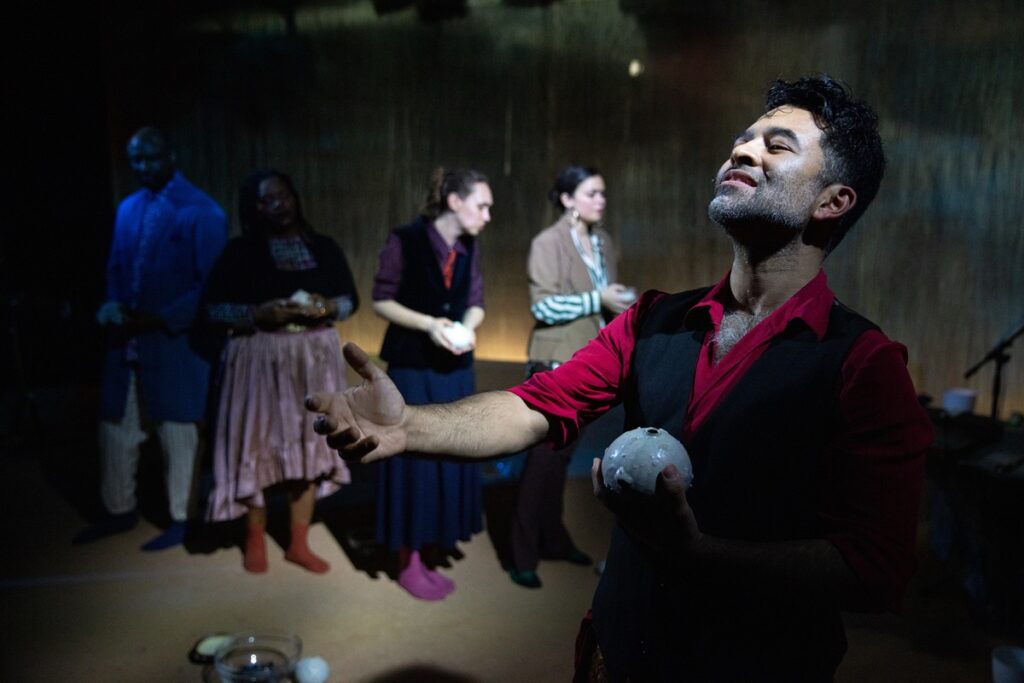


Recent Comments