Blog Article Category: Theater / Film
Revenge and dinner are served in Faena Theater’s Immersive ‘The Cook, The Thief, His Wife & Her Lover’
Written By Christine Dolen
December 17, 2019 at 3:38 PM
Immersive theater is having way more than a moment in Miami, thanks to the ongoing success of Juggerknot Theatre Co.’s original “Miami Motel Stories” productions and “Amparo,” which closed last month after multiple extensions.
Now the Faena Theater at Miami Beach’s Faena Hotel is adding to the immersive trend with a lavish production of “The Cook, The Thief, His Wife & Her Lover,” adapted by playwright Scott Gilmour from the 1989 Peter Greenaway film.
If you know the movie – a work of cinematic art that was also intensely sexual and graphically violent (Miramax released it unrated rather than go with an X rating) – you may well wonder just how such a story could be turned into a piece of musical theater with a running time of under two hours and a three-course, Michelle Bernstein-devised dinner included. After all, the show’s promotional pitch sells it this way: “Revenge is a dish best served cold. Do you have the stomach for it?”
The short answer to the how-is-this-possible question is that Faena’s “The Cook, The Thief, His Wife & Her Lover,” created in collaboration with Unigram Theatrical, carefully walks a line between paying tribute to the original and nearly (but not quite) sending it up.
Thus, you don’t get full nudity in the athletically sensuous love scenes between the Wife (Kristin Guerin) and the Lover (Parker Murphy), nor are you forced to endure believably horrific violence as the Thief (Donal Brophy) and his thugs execute Leonardo Soroko’s fight choreography to exact deadly revenge on the Lover.

Parker Murphy and Kristin Guerin perform a sensuous dance amid the diners of Le Hollandais in “The Cook, The Thief, His Wife & Her Lover.” (Photo courtesy of Faena Hotel Miami Beach)
So you can safely savor both the show and Bernstein’s menu: deconstructed ceviche to start; Wagyu Short Rib Beef Wellington as the main course; and a chocolate sphere dessert that you smash open with a small wooden mallet to reveal an oozing bloody berry filling. A vegan menu is available.
The action takes place on the evening of Oct. 13, 1989, a nod to the Greenaway movie’s London release.
Set designer Kenneth MacLeod has transformed the Faena Theater into the utterly opulent Le Hollandais Restaurant, whose new owner, Albert Spica (aka the Thief) is about to pay a visit with his chic, much-abused wife Georgina in tow. Spica’s “goons” and the actor-singer-dancers who play the restaurant’s uniformed staff circulate before their boss arrives, advising diners that Spica is a very private guy, so no photos or filming, or else.
And once he’s seated with Georgina and another couple at an elevated table – under a massive chandelier that lighting designer Grant Anderson often bathes in red – you understand the need for wariness in dealing with Spica.
Dublin native Brophy, a handsome actor whose credits include Manhattan’s immersive “Sleep No More,” Off-Broadway classics, TV and film (and who is a real-life Greenwich Village restaurateur), plays Spica as a cockney lout, loudly sharing details of his sexual history with the wife he calls “Georgie,” toggling between crude charm and rude abuse.
The whippet-thin Georgina, dressed in a white fascinator and revealing white dress over black lingerie (Anna Bingemann and MacLeod are both credited with costume design) keeps catching the eye of a guy seated alone next to the stage, a man seemingly absorbed in reading a book. Wearing glasses, his hair pulled back into a man bun, the Lover soon sheds his specs and his caution, taking Georgina into an onstage “restroom” behind a see-through curtain; the audience sees their encounters, though Brophy’s Spica must pretend he does not.
Georgina has an ally in the Cook (Thiana Berrick), gender-reversed from the movie so that the story’s gruesome finale comes across as self-empowered women giving an abusive monster his just desserts. Or a gag-inducing main course, if you will.
Structurally, Faena’s immersive experience is timed to intersperse interludes of dining and theatrical action. Musical director/pianist Paul Tine, playing with cellist Madalina Macovei and violinist Liubov Ohrimenco, guides seven talented young performers through a score of ’80s hits, songs that come across as pointed or ironic, given the context. Consider the titles.
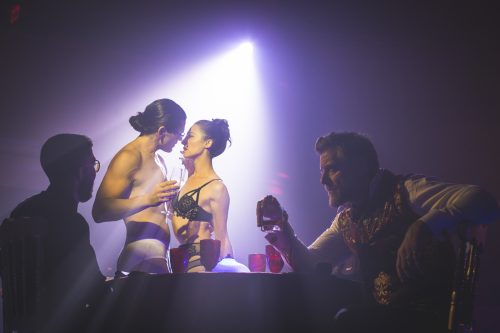
Parker Murphy and Kristin Guerin express their desire in “The Cook, The Thief, His Wife & Her Lover,” adapted by playwright Scott Gilmour from the 1989 Peter Greenaway film. (Photo courtesy of Faena Hotel Miami Beach)
Lily Ockwell, for example, sings “I Think We’re Alone Now,” then Amanda Lynn Williams adds Christine McVie’s “Everywhere” as a song for the roaming lovers. Bruno Faria performs Robert Palmer’s “Addicted to Love,” followed by Nate Promkul’s plaintive rendition of “Broken Wings.” Bianca DiSarro performs “(I Just) Died in Your Arms Tonight” and “Girls Just Wanna Have Fun.” Ori David Meyer and Evelyn Robaina join their castmates in singing and performing EJ Boyle’s movement and choreography. And after the bows, as you exit the theater, you hear a new title song written and recorded by Boy George.
Director Andrew Panton keeps the storytelling flowing with perfect precision. He does not, however, have a theatrically powerful script to work with. Gilmour’s script necessarily gives short shrift to the principals’ stories, and it jams the affair into brief scenes. The tale goes from passion to revenge served roasted in the blink of an eye. Actors Guerin and Murphy, who remain dressed in their underwear, are more reminiscent of dazzling Cirque du Soleil performers than actors playing characters engaged in a passionate doomed relationship.
“The Cook, The Thief, His Wife & Her Lover” is high-end theater (dining/show tickets are $230 and $280, with show-only tickets priced at $95), which the audience seems to enjoy immensely. The collaboration of international and Miami talent, plus the quality of Bernstein’s menu, turn what could have been a shocking evening into a palatable immersive experience for artistic adventurers.
What: “The Cook, The Thief, His Wife & Her Lover” by Scott Gilmour, based on the film by Peter Greenaway
Where: Faena and Unigram Theatrical production at the Faena Theater, 3201 Collins Ave., Miami Beach
When: 8 p.m. Thursdays-Saturdays, 7 p.m. Sundays (doors open 45 minutes in advance), through late April
Cost: $95-$280
More information: 786-655-5741; faenatheater.com
ArtburstMiami.com is a nonprofit source of theater, dance, visual arts, music and performing arts news. Sign up for our newsletter and never miss a story.
No posts found
City Theatre folds humor, conflict and compassion into ‘The Cake’
Written By Christine Dolen
December 9, 2019 at 6:19 PM
America’s culture wars get an illuminating skirmish in “The Cake,” Bekah Brunstetter’s play about a North Carolina woman named Jen, who returns to her hometown from Brooklyn to plan the traditional wedding of her dreams.
In her case, the other figure atop the spectacular cake will be a second bride. And that’s a hurdle that Della, a Christian baker whose best friend was Jen’s late mother, can’t – or won’t – scale.
Initially thrilled when she thinks Jen has a groom waiting in the wings, Della pleads a packed schedule when it becomes clear that Macy, the inquisitive young, black woman who has come into Della’s bakery, is Jen’s intended.
“The Cake” asks of both the baker and the bride: What do you do when someone you love does something you can’t accept?
City Theatre has just opened in the Carnival Studio Theater of Miami’s Arsht Center an insightful, bittersweet, tenderly wrought version of Brunstetter’s much-produced play.
Like the playwright, director Margaret M. Ledford gives weight and respect to the conflicting beliefs and emotions in the script. “The Cake” aims to dig deeper than the us vs. them positions that fuel so much ugliness in discourse. It wants us to listen, to think, to consider different perspectives. And, as an audience, we do.
When first we meet Della (Irene Adjan), she’s in her shop preparing to compete on “The Big American Bake-Off,” a reality TV show modeled on “The Great British Baking Show.”
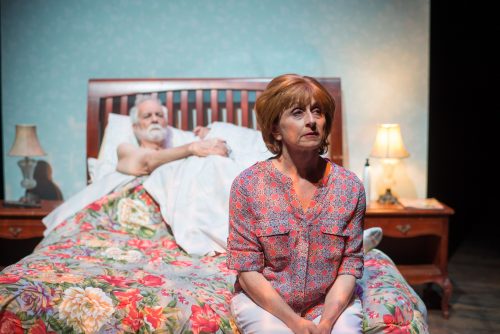
Michael Gioia’s Tim listens as Irene Adjan’s Della expresses her feelings in Bekah Brunstetter’s “The Cake” at the Arsht Center. (Photo courtesy of Justin Namon)
As she talks about her faith in full-fat baking and following a recipe with scientific precision, a sensuousness sneaks into her often funny commentary. Later, as she imagines the voice of the hot British host of “Bake-Off” (Daniel Llaca) getting way too personal with her, it becomes clear that there’s a lot of sublimation going on in Della’s life. That’s underscored by the lack of passion in her companionable relationship with her plumber hubby Tim (Michael Gioia), who unquestioningly accepts the Bible as the guidebook to living.
But with the arrival of Jen (Lexi Langs) and Macy (Stephon Duncan), Della begins to ponder her settled life and beliefs, and to long for more. Going home again also makes Jen think about the ideas that shaped her, about the push toward the traditional, about the unexpected joy of finding the love she’d always dreamed of with an out-and-proud black lesbian. For her part, Macy is dismayed that the rocky homecoming and Della’s awkward excuse about the wedding cake have amped up Jen’s pre-wedding jitters.
Brunstetter packs a lot, and plenty of frank sexual talk, into a 90-minute play that was inspired in part by what became the Supreme Court case Masterpiece Cakeshop vs. the Colorado Civil Rights Commission, in which a baker refused to make a wedding cake for a gay couple.
In creating her rich characters, the former “This Is Us” writer-producer sometimes resorts to provocative shorthand in defining them. Jen, for example, uses the “c” word with Della as she describes her anguish at being torn between her past and present.
Although Adjan’s Della displays a reflexive narrow-mindedness, the actor infuses her character with warmth and complexity. It would also be easy to view Tim as a traditional Southern guy who views himself as the leader of his two-person family, but Gioia’s aura of fondness for Della and, finally, his playfulness make Tim more than an archetype.
If Langs’ Jen and Duncan’s Macy aren’t an obvious match, that’s more in the writing than in the actors’ performances. Jen is a skittish beauty who has yet to emotionally meld the Southern traditions that shaped her with her hip life in Brooklyn. As Macy, Duncan is adept at conveying both frankness and a simmering pain.
Creatively, costume designer Ellis Tillman has done beautifully expressive and character-underscoring work, outfitting the petite Adjan in cheerful prints and a drop-dead gorgeous emerald green cocktail dress; drawing the contrast between Jen’s traditional look and Macy’s free-spirited one, even in their striking wedding attire; putting Tim in work clothes and PJs.
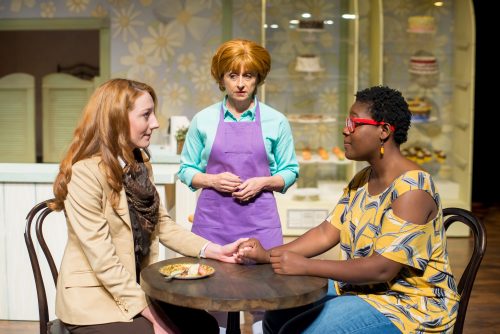
Irene Adjan as Della (center) takes in the unexpected news of wedding plans between Lexi Langs’ Jen (left) and Stephon Duncan’s Macy. (Photo courtesy of Justin Namon)
Eric Nelson’s lighting helps shift the action on Joe Rawda’s segmented set: from Della’s shop, with its display cases of baked goods; to her homey bedroom; to the bedroom at Jen’s cousin’s house, where she and Macy have just made love; and to the burnished place where Della’s fantasies and worries play out.
That little jingling bell that sounds whenever someone enters through the unseen door to Della’s shop? That’s the work of sound designer Matt Corey.
Can “The Cake” shift entrenched beliefs? Maybe not. But City Theatre’s production accomplishes what the playwright, Ledford, the actors and the creative team intended. Theatergoers think and feel, talk and debate, as love and understanding rise to the top.
What: “The Cake” by Bekah Brunstetter
Where: City Theatre production in the Carnival Studio Theater at the Adrienne Arsht Center for the Performing Arts of Miami-Dade County, 1300 Biscayne Blvd., Miami
When: 7:30 p.m. Wednesdays, 3 p.m. Sundays, through Dec. 22
Cost: $45, $50
More information: 305-949-6722 or www.arshtcenter.org
ArtburstMiami.com is a nonprofit source of theater, dance, visual arts, music and performing arts news. Sign up for our newsletter and never miss a story.
Top photo: Brides Jen (Lexi Langs, left) and Macy (Stephon Duncan) share a tender moment on their wedding day in City Theatre’s “The Cake.”
No posts found
‘Ordinary Americans’ focuses on woman who’s been ‘so forgotten in our society’
Written By Christine Dolen
December 3, 2019 at 5:45 PM
Playwright Joseph McDonough, artistic director William Hayes and actor David Kwiat had something in common when they began working on “Ordinary Americans,” the already-extended play that will get its world premiere at Palm Beach Dramaworks this week before moving on to a run at GableStage in mid-January.
Not one of the seasoned theater artists was familiar with the multitalented woman at the heart of the show, Gertrude Berg.
Berg – who created a 15-minute radio comedy titled “The Rise of the Goldbergs” in 1929 and later took the retitled “The Goldbergs” to CBS television in 1949 –wrote more than 12,000 scripts while playing Molly Goldberg, the matriarch of a Jewish family living in a Bronx tenement.
“She acted, wrote and produced,” says Carbonell Award-winning actor Elizabeth Dimon, who portrays Goldberg in “Ordinary Americans” and who had the idea for the play. “Today, she would be Oprah Winfrey.”
Originally, Dimon intended to write the play herself. Hayes told her about a Theatre Communications Grant for “mature” artists, but that didn’t come through, and Dimon thinks that’s just as well.
“I’m not a writer. My strong suit is bringing your words to life,” she says.
By then, Hayes was hooked on the idea, so he commissioned Cincinnati-based playwright McDonough, whose play “Edgar and Emily” (a fantasy about a meeting between poet Emily Dickinson and the long-dead writer Edgar Allan Poe) was developed at Dramaworks’ Dramaworkshop and subsequently got a main stage premiere in 2018.
The men have spent about 2 1/2 years working together on “Ordinary Americans,” with McDonough writing and Hayes serving as director and dramaturg. They have developed the script in person and over the phone, doing workshops with Dimon and most of the actors now involved in the show.
During the play’s evolution, a key tragedy was moved from the middle of the play to the end, a character was eliminated, and the script was tightened to about 90 minutes. Thematically, “Ordinary Americans” grew from a portrait of Berg to an examination of the way McCarthyism and the blacklist of the early 1950s affected Berg, her fellow cast members and her show.
Kwiat, a Carbonell-winning actor who retired after a long teaching career at Miami’s New World School of the Arts, plays Philip Loeb in “Ordinary Americans.” Loeb played Molly’s husband, Jake, on “The Goldbergs,” and as an activist with many organizations, he helped Actors’ Equity secure rehearsal pay for actors.
Loeb, who was the sole support of an adult son with schizophrenia, wound up in the infamous “Red Channels” report on alleged Communist influence in radio and television. CBS demanded that Berg fire Loeb, which she initially refused to do. “The Goldbergs” was yanked off the air for more than a year, putting everyone out of work, though it returned after Loeb agreed to accept a settlement from Berg and leave the show.
That decision, however, was the beginning of the end for Loeb.
Although “Ordinary Americans” contains some funny scenes showcasing the comedy of “The Goldbergs,” Kwiat says that the play “is pretty dark, since it involves McCarthyism and blacklisting. The majority of it is dealing with the painful struggle of the politics of that day … I don’t think the audience knows what it will be seeing. Bill and Joe wanted to write a tragedy.”
Researching Loeb through extensive reading and watching clips on YouTube, Kwiat observes, “He was a total minimalist. It was Gertrude Berg’s show, and he deferred to her.”
Dimon, who had a deep interest in the blacklist, felt she could play Berg, “a woman of a certain age, a certain size … People connected with her because of her warmth. She would say, ‘Greetings from our family to your family.’ The first time I did it, I almost choked up.”
Berg, called “Tillie” by her friends and family, was a sophisticated New Yorker who would win the first Emmy Award given to best lead actress in a comedy in 1951 and a best actress Tony Award in 1959 for her performance in the Broadway production of “A Majority of One.”
On “The Goldbergs,” the characters spoke in a dialect – Molly would be beckoned to her window by a neighbor calling, “Yoo-hoo, Mrs. Goldberg!” – and when the series returned to the air, the appetite for a comedy about a Jewish family had waned.
“The culture had changed. Nobody wanted to see ethnicity anymore,” Dimon says. “When I first thought of this play, I wanted it to be about her. But it was very important that it be focused on the time period and the blacklist. I’m so afraid it will repeat.”
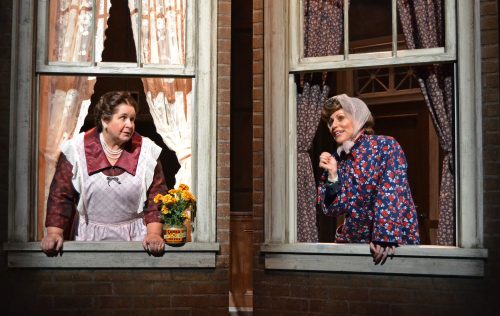
Elizabeth Dimon’s Molly Goldberg listens to Margery Lowe as her neighbor. (Photo courtesy of Samantha Mighdoll)
Hayes dreams of a larger future for “Ordinary Americans,” and the first step was partnering with Joseph Adler and GableStage to co-produce the world premiere. Dimon, Kwiat, Rob Donohoe and Tom Wahl will do the play at both theaters; Margery Lowe will appear in the Dramaworks version but has another commitment next month, so Patti Gardner will step into the role of Berg’s business manager and best friend when the show moves to GableStage.
“I believe theaters need to find opportunities to partner and not be competitive,” Hayes says. “We’re stronger together. A lot of excitement and momentum happens when you do such things. It keeps the momentum going for the play, and exposure to each other’s audiences helps Joe and me and all the artists involved.”
The director, playwright and actors all feel the contemporary resonance of “Ordinary Americans.”
“There’s fear and paranoia in our society. People are as politically divided as they were in the ’50s,” McDonough says. “I’ve tried not to be heavy-handed. I’m trying to be truthful to their story and not drop in external things. But the parallels write themselves.”
Research is a process McDonough enjoys when he’s writing plays involving historical figures. He read a biography as well as Berg’s autobiography and watched a documentary on her. But he didn’t find a great deal of additional source material.
“She’s been so forgotten in our society,” he says.
As for Loeb, McDonough found something deeply moving at the New York Public Library.
“I discovered his personal papers, his handwritten notes as he prepared to testify … ” the playwright says. Loeb went before the Senate Internal Security Subcommittee in 1952. “That was very awe-inspiring. It felt like a sacred calling to reflect his thoughts.”
“Ordinary Americans” previews Dec. 4-5, then runs Dec. 6-Jan. 5 at Palm Beach Dramaworks, 201 Clematis St., West Palm Beach. The play moves to GableStage, 1200 Anastasia Ave., Coral Gables, from Jan. 18-Feb. 16.
Dramaworks show times are 7:30 p.m. Wednesdays-Thursdays and some Sundays, 8 p.m. Fridays-Saturdays, 2 p.m. Wednesdays and Saturdays-Sundays (additional matinee 2 p.m. Dec. 26). Tickets cost $77 (previews $57; students $15; Pay Your Age tickets for theatergoers 18-40). To order, call 561-514-4042 or go to palmbeachdramaworks.org.
GableStage showtimes are 8 p.m. Thursdays-Saturdays, 2 and 7 p.m. Sundays (no 7 p.m. show Jan. 19). Prices are $50-$65 (students pay $15 on Thursdays). For more information, call 305-445-1119 or go to gablestage.org.
ArtburstMiami.com is a nonprofit source of theater, dance, visual arts, music and performing arts news. Sign up for our newsletter and never miss a story.
Top photo: Elizabeth Dimon plays writer-producer-actor Gertrude Berg in the world premiere of “Ordinary Americans.” (Photo courtesy of Samantha Mighdoll)
No posts found
City Theatre Miami’s ‘The Cake’ serves up resonant, touching comedy
Written By Christine Dolen
December 2, 2019 at 4:57 PM
The loveliest and most expensive cake most of us will ever buy is, without doubt, a wedding cake. A focus on one of the most special days in a couple’s life, the cake is a sweet, beautifully decorated symbol of good fortune and marital happiness.
But in recent years, as some bakers have refused to make cakes for same-sex couples, a cherished tradition has become one more focus of America’s culture wars.
Playwright and former “This Is Us” writer-producer Bekah Brunstetter has responded with “The Cake,” a play about a pair of brides-to-be and the Christian bake-shop owner who feels she just can’t go against her beliefs to make the women a wedding cake.
City Theatre Miami, best known for more than two decades of championing short plays and musicals via its Summer Shorts festivals, is making “The Cake” one of its rare full-length productions. The play previews on Dec. 5-6 and opens Dec. 7 for a run through Dec. 22, as part of the Theater Up Close series in the Carnival Studio Theater at the Adrienne Arsht Center for the Performing Arts of Miami-Dade County.
Brunstetter says she was inspired in part by what became the 2018 U.S. Supreme Court case Masterpiece Cakeshop v. Colorado Civil Rights Commission. In that case, the court overturned on narrow grounds a lower court decision stating that a baker in Lakewood, Colo., was within his rights to refuse to make a wedding cake for a gay couple.
“I thought it was a great jumping-off place for a play,” Brunstetter says. “But I’m not into docudrama.”
Instead, the playwright used her imagination and folded in bits of her background. She grew up in Winston-Salem, N.C., where her family’s conservative Baptist faith was a big part of her childhood. When Brunstetter was in college, her father, former state Sen. Peter S. Brunstetter, “put forth legislation that would ban gay marriage in North Carolina.”
Though she is straight, married to actor Morrison Keddie, Brunstetter has many gay and lesbian friends, and her father’s bill didn’t sit well.
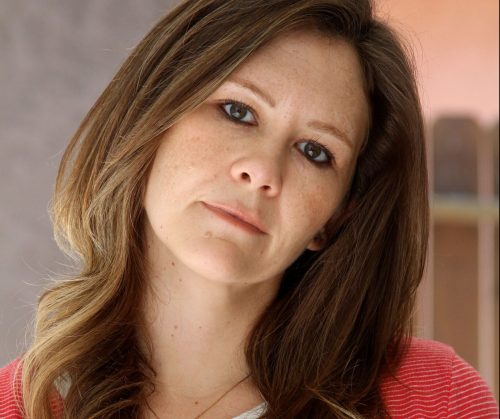
“The Cake” playwright Bekah Brunstetter is juggling plays, movies and screenwriting. (Photo courtesy of Alison Yates)
“I would make my opposition clear, but then back away. My mom and I are peacemakers. We try to consider other points of view,” she says. “The play itself is my attempt to make my argument.”
Flipping the gender of the focal couple came about, she says, “because there’s less light shone on gay women, and I’m a woman. What if I’d brought a woman home?”
“The Cake,” which has had about 70 productions since its 2017 Los Angeles premiere, is set in North Carolina. Della Brady, the owner of Della’s Sweets, is getting ready to compete on the reality TV show, “The Big American Bake-Off,” when an attractive black New Yorker named Macy enters her shop and starts quizzing her, jotting down notes.
Della soon learns that Macy is about to marry Jen, the daughter of Della’s late best friend. Jen wants Della to make the wedding cake, but Della awkwardly begs off, claiming she’s already overbooked for October. That night at bedtime, the baker shares her anguished feelings with her good ol’ boy husband Tim, who cites the Bible as he assures her that saying no was her only choice. Yet as the play goes on, Brunstetter explores the virtues and flaws of all four characters and their arguments.
Staged by Artistic Director Margaret M. Ledford, City Theatre’s production features three-time Carbonell Award winner Irene Adjan as Della, Lexi Langs as Jen, Stephon Duncan as Macy, and Michael Gioia as Tim.
“I fell in love with the play for so many reasons,” says Ledford, who grew up in Tennessee and enjoys baking. “Not only because of how current the topic is, but also because both sides of the coin are so fleshed out, so deep. In our polarizing world, we have to be able to look at someone in their totality. Nobody’s right here. Nobody’s wrong.”
As for Adjan, she did something she rarely does, lobbying Ledford to consider her for the role of Della.
“I read about this play before City announced it,” she says. “I have a degree in international baking and pastries from the Florida Culinary Institute. And I tend to get offered the same type of roles as [original ‘Cake’ star] Debra Jo Rupp.”
Adjan welcomes the chance to advocate for understanding through a resonant, touching, observant comedy.
“Like many people, I have fatigue with political disagreements. So many people are busy arguing and yelling and not talking to each other. People think, ‘If you disagree with me, you’re my enemy,’” she says.

(Photo courtesy of George Schiavone)
“Della is very religious, but she did go to college. As she says, ‘I have a brain and a heart at war.’ I think a lot of people are going to feel understood when they see this play … People are not as black and white as we make them. As long as people are trying, that’s all we can ask of them.”
Born and raised in Miami, Gioia played lots of Southern men when he was in grad school at the University of Florida. He sees Tim, whose intimate relationship with Della has diminished over the years, as an alpha male “whose doctrine tells him that he’s right, that you don’t have to talk about things, because they’re already decided … But Tim eventually does try. He literally says that. They take their first steps – but it’s not going to be easy.”
The New York-based Langs has been steeped in the world of weddings, having married husband Ian Aric just a few weeks ago.
“I read a lot of interviews with Bekah, and I see a lot of her in Jen,” Langs says. “She’s hopeful, optimistic, full of joy. She looks for the good in people … In the play, everyone is able to find a sense of empathy for another person. It is possible to talk with one another and treat each other with respect.”
Duncan, who says one of her goals has been to work in a show at the Arsht Center, sees Macy as “a firecracker. She’s unapologetic about who she is. She’s different from me in the way she moves. The way she owns her space is so forward … In the first scene, she’s playing with making Della uncomfortable, with figuring Della out. She’s in the South, where the mentality is that being gay is wrong.”
Brunstetter, whose career is flourishing with projects such as making a movie of “The Cake,” writing a pilot for Hulu and developing a contemporary TV remake of “Oklahoma!,” continues to write plays. Her parents first saw a North Carolina production of “The Cake” two years ago – then, she says, “it was a lot for them to take in” – but then they traveled to New York to see it Off-Broadway.
“They’re wonderful, supportive and proud of me. We don’t always agree. Certainly, we make each other mad. But we try to support each other,” Brunstetter says.
Ledford, who used intimacy choreography to stage certain moments between Della and Tim and between Jen and Macy, emphasizes that even though the subject matter in “The Cake” is deeply important, Brunstetter’s approach makes for an enjoyable experience.
“’The Cake’ is filled with love and humor,” she says. “It doesn’t feel like a heavy night. What better gift for the holidays?”
What: “The Cake” by Bekah Brunstetter
Where: City Theatre production in the Carnival Studio Theater at the Adrienne Arsht Center for the Performing Arts of Miami-Dade County, 1300 Biscayne Blvd., Miami
When: Previews 7:30 p.m. Dec. 5-6, opens 7:30 p.m. Dec. 7; regular performances 7:30 p.m. Wednesdays, 3 p.m. Sundays (additional matinee 3 p.m. Dec. 7), through Dec. 22
Cost: $45, $50
More information: 305-949-6722 or www.arshtcenter.org
ArtburstMiami.com is a nonprofit source of theater, dance, visual arts, music and performing arts news. Sign up for our newsletter and never miss a story.
Top photo: Irene Adjan as Della offers a slice of red velvet cake to a reluctant Stephon Duncan as Macy in City Theatre’s “The Cake” at the Arsht Center. (Photo courtesy of George Schiavone)
No posts found
GableStage’s ‘Watson’ cast shines, but play needs some work
Written By Christine Dolen
November 25, 2019 at 9:17 PM
Thomas J. Watson Sr., the founding chairman and CEO of International Business Machines (IBM), was a brilliantly successful salesman and celebrated businessman for the vast majority of his life.
But as James Grippando’s new play, “Watson,” would have it, the one person Watson could never seem to sell on his vision of himself was the man who would become his successor: Thomas J. Watson Jr.
Now getting its world premiere at GableStage – where it was developed from an idea suggested to Grippando by its artistic director, Joseph Adler – the 90-minute “Watson” is a dense and at times intense examination of the industrialist’s life and values, particularly just before, during and after World War II.
At issue: IBM’s punch card tabulating machines were used by the company’s German subsidiary Dehomag to speed up the processing of census data, which became information utilized to deadly efficiency in the Holocaust.
The play points out that, as incoming president of the International Chamber of Commerce at a 1937 conference in Berlin, Watson took tea with Adolf Hitler and was awarded Nazi Germany’s Merit Cross of the German Eagle with Star, which he didn’t return until 1940, despite widespread criticism. And although he initially denied a demand to ship IBM’s state-of-the-art Model 405 Alphabetizers to Dehomag in 1939, Watson caved under pressure and came up with a loophole to make the machines available.
Involving capitalism and conscience, the story told in “Watson” could have been – should have been – both fascinating and deeply disturbing. Intermittently, director Adler and his fine cast hit those levels. But fashioning a compelling new play is an always-challenging collaborative process, and if “Watson” is to have an ongoing life, the script would benefit from further revisions.

Diana Garle, Peter Wayne Galman and Barry Tarallo play Nazi-era Germans in the GableStage world premiere of James Grippando’s “Watson.” (Photo courtesy of George Schiavone)
Though Grippando is a prolific and award-winning novelist, this is his first produced play, and the author’s deep narrative roots are evident.
Playing Thomas J. Watson Sr., engaging actor Stephen G. Anthony serves as a charming if unreliable narrator and as the character most in the spotlight. Although the narration serves up myriad facts and offers a perspective on the way Watson saw himself, it comes at the expense of drama. At times, “Watson” feels like a lecture illustrated with scenes that range from compelling and moving to extraneous and dull.
Understand, the cast is really, really good, and what the actors bring to their roles is vital to engaging the audience.
Anthony, the only cast member who plays a single role, smoothly conveys Watson’s contradictions, his unblinking drive, his flaws and virtues. As Thomas Watson Jr., Iain Batchelor is given one note to play – his father’s chief critic – but he does so with fierce focus.
The wonderful Margot Moreland as Jeanette Watson is relegated to wife-and-mother caught between her demanding husband and angry son, though she and Diana Garle bring their strong musical theater pipes to the singing of customized IBM songs, familiar tunes with lyrics altered to extoll the virtues of the company and Watson Sr. However, although the songs make a statement about Watson’s ego and IBM’s corporate culture, they come across as silly speed bumps in the plot.
The luminous Garle shows compelling versatility as Shayna Fein, an American immigrant and Jewish widow; Miss Fuchs, secretary to the head of Dehomag; and Sarah Plonski, a resident of the Warsaw Ghetto whose father is being forced to supply the names of non-practicing Jews to the Nazis.
Peter Wayne Galman conveys the utter loathing that Dehomag head Willy Heidinger felt for Watson, the man who bought out Dehomag’s debt in 1922 and thereafter retained 90 percent control of the business.
As Hjalmar Schacht, Hitler’s minister of economics, Barry Tarallo charms Watson even as he explains the Nazis’ need for Hollerith machines and a vast number of punch cards. Peter Haig is the picture of loyalty, discretion and efficiency as Edward Burns, an amalgam of Watson’s many male secretaries.
Lyle Baskin’s set, centrally dominated by the IBM motto “THINK” in huge letters, provides offices for Watson and Heidinger on either side, as well as screens onto which Alejandro Martin’s videos of Nazi-era scenes and IBM song lyrics are projected.

Iain Batchelor as Thomas J. Watson Jr. is angrily confronted by Stephen G. Anthony as Thomas J. Watson Sr. in the GableStage world premiere of James Grippando’s “Watson.” (Photo courtesy of George Schiavone)
Steve Welsh’s lighting palette includes IBM blue, and sound/music designer Matt Corey’s work includes one particularly wry touch, a bit of “Ride of the Valkyries” by Richard Wagner, Hitler’s favorite composer. Costume designer Emil White, supplying the clothing for about two dozen characters, has come up with suits, uniforms and dresses. But given that the play’s time period runs from 1890 to 1952, some of the looks are era-neutral – an odd effect.
Although GableStage hasn’t done much new play work, the reason “Watson” appealed to Adler is obvious, amid the recent resurgence in anti-Semitism and the way wildly wealthy Americans – people in the mold of Watson – dominate the economy. Certainly, a lesser-known story grounded in historical fact can be transformed into a powerful script. In the case of “Watson,” though, the drama still needs to be punched up.
What: “Watson” by James Grippando
When: 8 p.m. Thursdays-Saturdays, 2 and 7 p.m. Sundays, through Dec. 22 (no Thanksgiving Day performance)
Where: GableStage at the Biltmore, 1200 Anastasia Ave., Coral Gables.
Cost: $50-$65 (students $15 Thursdays)
More information: 305-445-1119; gablestage.org
ArtburstMiami.com is a nonprofit source of theater, dance, visual arts, music and performing arts news. Sign up for our newsletter and never miss a story.
No posts found
Novelist James Grippando’s ‘Watson’ to premiere at GableStage
Written By Christine Dolen
November 18, 2019 at 7:59 PM
Here’s a bit of history that you may – or, more likely, may not – know.
When Thomas J. Watson Sr., the chairman and CEO of International Business Machines (IBM), traveled to Berlin in 1937 as president of the International Chamber of Commerce for the group’s biennial gathering, he gave a keynote speech advocating world peace through world trade.
At the meeting, he was presented with Nazi Germany’s Order of the German Eagle, making Watson one of only a few Americans to receive the regime’s medal.
And what was behind the dubious “honor”? IBM’s German subsidiary Deutsche Hollerith-Maschinen Gesellschaft (known as Dehomag) used the company’s punch card machines to tabulate census data that revealed the location and ethnicity of respondents – thus contributing to the deadly efficiency of the Holocaust.
Watson, who opposed Germany’s brutal treatment of its Jewish citizens, returned the medal in mid-1940, before the country’s declaration of war against the United States. But that asterisk in his biography would always remain.
The story of the complicated, wildly successful industrialist has been dramatized in “Watson,” a play by lawyer-turned-novelist James Grippando that will have its world premiere at GableStage on Nov. 23.
Grippando, a prolific award-winning author who has written 15 novels built around fictitious Miami criminal defense lawyer Jack Swyteck, points out that Watson is chillingly relevant to the contemporary dangers of data breaches that put personal information in the hands of corporations, governments and cyber criminals.
“This really [was] the world’s first personal information catastrophe,” Grippando says. “People who didn’t even know they were Jewish ended up in concentration camps.”
Grippando wrote “Watson” at the request of GableStage Artistic Director Joseph Adler, who had the idea for the play. The two collaborated over a period of a year and a half, with Grippando doing multiple rewrites as they refined the play’s focus and content.
“We finally focused on Watson himself, beyond the narrow focus of the Holocaust,” the playwright says. “He’s a character and a narrator, but he’s an unreliable narrator.”
Adler, who points out that one element of the play is making business decisions at the expense of moral ones, observes, “Watson is fascinating but very enigmatic. You can’t just flat-out condemn him. The reason Jews aren’t as aware of this story is that he wasn’t an anti-Semite.”
To cast this rare world premiere, Adler reached out largely to GableStage veterans before a working script was finished. All said yes, and when they sat together in mid-October to read the play aloud, it was the first time they had seen the script.
Iain Batchelor as Thomas J. Watson Jr. is angrily confronted by Stephen G. Anthony as Thomas J. Watson Sr. in the GableStage world premiere of James Grippando’s “Watson.” (Photo courtesy of George Schiavone)
Stephen G. Anthony, the only cast member to play a single role, is portraying Thomas Watson Sr. Iain Batchelor, a British actor who now lives in South Florida, makes his U.S. debut as Thomas J. Watson Jr., the son who took over IBM shortly before his father’s death in 1956. Margot Moreland plays Jeanette Watson, wife to Thomas Sr. and mother of Thomas Jr. Actors Peter Galman, Diana Garle, Peter Haig and Barry Tarallo play multiple roles.
During a recent conversation, Anthony was reluctant to speak about his still-in-process portrayal of Watson, saying, “When you’re in the midst of something, you almost don’t want to name it.”
But he adds, “I’m really looking forward to hearing what people have to say about what they’ve experienced.”
Grippando says of Anthony, “With Steve’s ability to move from narrative to dialogue seamlessly, I’m awestruck by the craft.”
For Moreland, whose character is caught between her husband and son, “Steve is just perfect as Watson. He’s not only a commanding presence, but he also has heart. So you think, ‘Do I like him? Don’t I like him?’”
Though the play unfolds in a brisk, intermission-free 90 minutes, it follows Watson Sr.’s life from 1890 to 1952, which Batchelor sees as vital to understanding the character.
“It’s important that it starts where it does,” he says. “You see that he has to constantly change and evolve and grind in order to survive. I spend a lot of the play cross-examining him. He’s right to be concerned with legacy, because it could all come tumbling down.”
Extensive research material – books, articles, biographies and autobiographies – has fed into the work Adler, the playwright and the actors are doing on “Watson.”
But ultimately, everyone has to make Grippando’s play work.
“All these different sources and perspectives make it hard when you’re trying to stay true to the facts,” the playwright says. “You have to distill what this person was really like.”
“There is no one truth,” Adler says. “There is this one’s truth, and that one’s truth.”
The collaborative process in theater – so different from Grippando’s solitary process as a novelist – has worked well, in part because of his willingness to make changes large and small.
“I haven’t had this experience in a long time, where an editor digs in and makes me reevaluate scenes, lines, word choices,” he says. “And I feed off the energy of these actors.”
Adler adds that “there were several rewrites from the ground up. We’d have a couple of hours of conversation about why something wasn’t working, then he’d send me a whole new script. It was only when we were willing to take a stand regarding Watson that we got a script that really propelled the play forward.”
Adler realizes presenting an untested play involves risk, but say it’s something he wishes he’d done more often through the years.
“When I got the last draft, I thought, ‘This is what we’ve been trying to do for a year and a half.’ I thought it was ready. I didn’t want to have to wait until next season to do it,” he says. “This is an unconventional play. It’s very dense. If you tune out, you’re lost. I’d liken it to [Michael Frayn’s] ‘Copenhagen.’ It’s very thought-provoking.”
Says Galman, who plays Dehomag head Willy Heidinger and others, “James put a lot of meat on the table.”
“In the best sense, people will leave with a lot of questions,” Batchelor says. “History is a conversation that is ongoing.”
What: “Watson” by James Grippando
When: Nov. 23 through Dec. 22; 8 p.m. Thursdays-Saturdays, 2 and 7 p.m. Sundays, (no Thanksgiving performance)
Where: GableStage at the Biltmore, 1200 Anastasia Ave., Coral Gables.
Cost: $50-$65 (students $15 Thursdays)
More information: 305-445-1119; gablestage.org
ArtburstMiami.com is a nonprofit source of theater, dance, visual arts, music and performing arts news. Sign up for our newsletter and never miss a story.
Top photo: Diana Garle, Peter Wayne Galman and Barry Tarallo play Nazi-era Germans in the GableStage world premiere of James Grippando’s “Watson.” (Photo courtesy of George Schiavone)
No posts found
Nilo Cruz’s ‘Two Sisters and a Piano’ is now a story told in Spanish
Written By Christine Dolen
November 18, 2019 at 7:05 PM
A play by Miamian Nilo Cruz, the first Latino playwright to win the Pulitzer Prize for drama, will take the stage at Miami-Dade County Auditorium’s intimate On.Stage Black Box for a brief run from Nov. 21 to 24.
“Dos Hermanas y un Piano” (“Two Sisters and a Piano”) is being presented in Spanish with simultaneous English translation by Arca Images. Its director is someone who knows the play inside out: the Cuba-born Cruz himself, who calls the piece “a play about two artists who have been hunted down and imprisoned for their political views.”
The play was written before Cruz’s Pulitzer-winning “Anna in the Tropics.”
Indeed, Cruz says he regards “Two Sisters” as “a preamble to ‘Anna in the Tropics,’ which is also a play about the transformative power of literature.”
Commissioned by the McCarter Theatre Center in Princeton, N.J., “Two Sisters” was written in English in 1996 and premiered at the McCarter in 1999. The English-language version was later produced by the now-defunct Promethean Theatre in Davie in 2008.
Set in a spacious colonial house in Cuba in 1991, the play focuses on a pair of sisters, María Celia and Sofia Obispo, who are under house arrest after serving two years in prison. The elder sister, 36-year-old María Celia, is a writer whose work landed the sisters in prison. Having fled Cuba, her husband is working to get both sisters out of the country, but the government is intercepting coded letters between husband and wife.
Sofia, 24, is a romance-starved young woman who beautifully plays the heirloom piano that graces the living room of their family home.
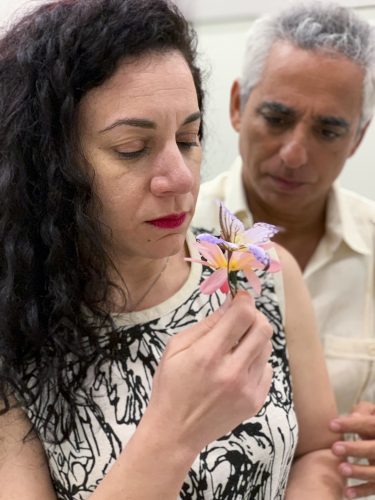
Ysmercy Salomón and Raúl Durán forge a relationship under unusual circumstances in Cuba in Nilo Cruz’s “Two Sisters and a Piano.” (Photo courtesy of Alexa Kuve)
When two men, a piano tuner named Victor Manuel and the inquisitive Lt. Portuondo, enter the picture, things get complicated.
Cruz, who was recently named the Hearst Theater Lab Initiative Distinguished Visiting Playwright-in-Residence at the University of California, Los Angeles (UCLA) School of Theater, Film and Television, has assembled a topnotch cast of Cuban-born actors for the production. Laura Alemán plays Sofia; Raúl Durán is Lt. Portuondo; Ysmercy Salomón plays María Celia; and Andy Barbosa is Victor Manuel.
Though the world has changed in the more than two decades since he wrote “Two Sisters and a Piano,” Cruz notes that the persecution of artists continues.
“Many artists, especially writers, are still persecuted and censored in different parts of the world for their need to communicate and to commune with others, for their necessity to denounce injustice or to simply shed light on those things that give them pain or cause for sorrow,” he writes in an email. “One writes against the disarming unevenness of the world. One writes to feel less lonely, less helpless, with the hope that others will feel less lonely when they read us. One writes to fill the empty woman and man. One writes to invoke freedom, to rescue what has been suffocated in the blood and fires of history. One writes to stop the killing of imagination.”
Inspired by “Shéhérazade,” “Two Sisters” provides a kind of escape through art.
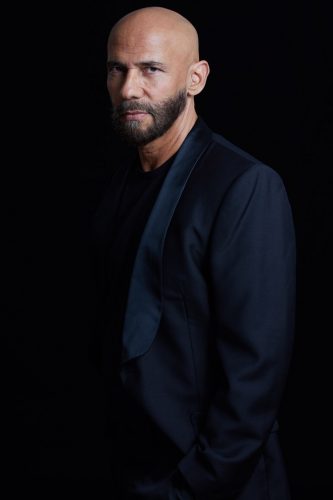
Pulitzer Prize winner Nilo Cruz is directing his play, “Two Sisters and a Piano,” in Spanish for Arca Images. (Photo courtesy of Marc Richard Tousignant)
“In my play, it is the music of a pianist and the words of a novelist that offer momentary escape from the machinery of oppression, and a lieutenant falls under the spell and enchantment of literature, which causes him to view the world in a different way,” Cruz says.
He thinks producing the play in Spanish makes a difference.
“Although I originally wrote this play in English, I wanted to capture the musicality of the Spanish language through the rhythms of the dialogue. Now that the language is being spoken in Spanish, the play has found the natural fluidity of its music,” he says. “But whether this play is enacted in English or Spanish, or in other existing translations such as Greek, Turkish and German, my quest as a writer was always to explore the unspoken language of two resilient women in the face of tyranny and the celebration of the liberating power of art.”
Cruz, who came to Miami from Cuba at age 10, also thinks his homeland isn’t so different from the time when the play takes place.
“In terms of the politics that frame ‘Two Sisters and a Piano,’ Cuba is still as isolated as it was when I originally wrote the play,” he observes. “For the two sisters and many other people living on the island, communism is not a dream to be pursued but a nightmare that has taken possession of the island and will continue to haunt their wakeful and dormant reality.”
What: “Dos Hermanas y un Piano” (“Two Sisters and a Piano”)
When: 8 p.m. Nov. 21-23, 2 p.m. Nov. 24
Where: On.Stage Black Box at Miami-Dade County Auditorium, 2901 W. Flagler St., Miami
Cost: $28; $23 for seniors, students and groups
More information: 786-327-4539; arcaimages.org
ArtburstMiami.com is a nonprofit source of theater, dance, visual arts, music and performing arts news. Sign up for our newsletter and never miss a story.
Top photo: Andy Barbosa plays a piano tuner, Laura Alemán a woman under house arrest in Nilo Cruz’s “Two Sisters and a Piano.” (Photo courtesy of Alexa Kuve)
No posts found
Florida Man (and Woman) get their due in ‘Worst Place on Earth’ monologues
Written By Christine Dolen
November 12, 2019 at 2:34 PM
The list of famous Floridians is a lengthy one. Think Henry Flagler, Burt Reynolds, Ariana Grande, Oscar Isaac, Angela Bassett, Raul Esparza, Nilo Cruz, Tarell Alvin McCraney, Zora Neale Hurston, Johnny Depp, Chris Evert – well, you get the idea. Whether these celebs were born here or chose Florida as home, notables in every profession have brought honor to the Sunshine State.
Then, there are the infamous Floridians, hundreds of them. Their moments in the spotlight are fleeting, hilarious, horrifying, unfathomable. And though they have names, of course, in headlines they’re invariably called “Florida Man” or “Florida Woman.”
Floridians on the bizarre end of the scale are the subject of a new podcast, “Worst Place on Earth,” created by playwright/actors Jessica Farr and Caleb Scott. The podcast will launch Nov. 19 with a free event in the Lobby Lounge at Miami’s Olympia Theater, 174 E. Flagler St. Doors open at 6 p.m. for a Happy Hour and open bar, with the launch festivities set to begin at 7 p.m.

Miami band Afrobeta will provide the live musical scoring for the monologues. (Photo courtesy of Afrobeta)
Farr, Scott and actors Noah Levine and Bianca Garcia will perform “Worst Place on Earth” monologues inspired by Florida Man/Florida Woman stories. In Farr’s “Angelyne,” for example, a man and woman high on drugs, and each other, steal a motorized cart from Walmart to go on a drinking binge. In Scott’s “Doug,” an introverted museum security guard begins recording the varying sounds of himself passing gas, then uploading the videos to YouTube. Ah, Floridian ingenuity!
Miami band Afrobeta will perform at the event, providing live musical scoring for the monologues.
Farr says she and Scott have written eight episodes of the podcast and will release the first two on the launch date, making them available on any podcast source.
They plan to release a new episode every two weeks, and they’re open to public submissions at worstplaceonearthpodcast@gmail.com.
What: “Worst Place on Earth” podcast kickoff event
When: 7 p.m. Nov. 19; doors open 6 p.m. with Happy Hour and two open bars
Where: Lobby Lounge at the Olympia Theater, 174 E. Flagler St., Miami
Cost: Free
More information: Call Olympia Theater at 305-374-2444, or email worstplaceonearthpodcast@gmail.com
ArtburstMiami.com is a nonprofit source of theater, dance, visual arts, music and performing arts news. Sign up for our newsletter and never miss a story.
No posts found
Catch Miami short Film Festival this week only
Written By Mike Hamersly
November 5, 2019 at 4:15 PM
For movie fans who love to get to the point, short films are often more compelling than feature-length works. And many people would argue that they can be more difficult to make.
“To be able to tell a complete story in a short amount of time takes a lot of skill and talent,” says Krystle Carrara, director of marketing and development for the Miami short Film Festival, which runs through Nov. 9 at the Regal South Beach. “You don’t have that two hours of character development and being able to really elaborate on a story line or script – you’ve really got to be able to get your message out quickly, and I think that poses a lot of difficulty.”
Financial concerns frequently come into play for the directors as well.
“Typically, people making short films are on a tight budget,” Carrara says. “So they really have to be creative with their filmmaking, with scouting locations, with casting and all of those things. It’s really interesting the way they can weave a story together in 20 minutes.”
The festival, stylized as #MIAMIsFF, was started in 2002 by William Vela as a way for him and his friends to show their own films outside of their homes. It takes place every November and presents dozens of films from all over the world, chosen throughout the course of the year.
“Every year we probably get between 1,000 and 1,200 submissions,” Carrara says. “Vela and the team usually cull it down to about 50 to 100 short films, depending on the quality of the films and our limitations with the number of nights and screenings we’re doing.
“We get a lot of great submissions – we’ve had so many films that have gone on to be nominated and/or won the Academy Award for live action and animated short film.”
The final selections are grouped into themed nights, which tend to reveal themselves based on the content of the films.
“The festival becomes a reflection of what’s going on politically and culturally, because that’s what comes out from the films that are submitted,” she says. “So every year, the programming blocks will be different. We don’t try to confine ourselves to, ‘OK, we need to have a comedy night and a thriller night and a drama night.’ And we try to keep the blocks tight, to about an hour and 30 minutes, because we usually have a Q&A session afterward, which will last about 30 to 45 minutes.”
One film that’s heavily influenced by the current political zeitgeist is “Eat the Rainbow” by Brian Benson, which will be shown on Nov. 9, the festival’s final night. It’s an over-the-top, campy work that uses absurdity to convey the message of racial intolerance.
Fans of cult-filmmaking legend John Waters won’t be able to help but notice certain similarities between “Eat the Rainbow” and the infamous “Polyester” and “Pink Flamingos” director’s raunchy, subversive style, right down to a character who closely resembles Waters’ favorite drag-queen actor, Divine.
“I get that a lot,” says Benson, with a laugh. “I’ve met John a couple times and had dinner with him. My sense is he wouldn’t like the comparison, but I do get that every now and again. I feel like Amy Sedaris and her ‘Strangers with Candy’ [spoof of ‘70s and ‘80s after-school specials] is more of an influence.”
The premise of “Eat the Rainbow” is simple: A “person of color” – in this case, a man who has bright blue skin – moves into a conservative neighborhood and is rejected by its residents for “ruining property values.”
“This film is largely influenced by the current political situation,” Benson says. “I was feeling very aware of skin color and how superficial that is, to be such a dividing thing, and our administration makes such a big deal out of it. To think about it in super-simplistic terms: It’s pigment. Literally basing your opinions on someone based on the pigment of their skin. So I was like, ‘I’m gonna take that idea and just make it dumb. Really dumb.’ And to have a blue person move into a neighborhood – by doing that, it points out how dumb it is.”
Of course, Benson’s film is anything but dumb.
“I personally love ‘Eat the Rainbow,’” Carrara says. “I think it’s really fun and campy, a musical fable, and when you look at it, it seems silly, but it’s telling a very serious story, in a silly way. There are so many different elements to it that make it smart. I don’t want to give too much away, but it’s great, and it has a really great message behind it.”
Each year, when the festival ends, there’s a feeling of accomplishment and satisfaction for those behind the scenes. But that doesn’t mean the work is over.
“Submissions will open for next year almost immediately after the festival ends,” Carrara says. “So we just start the process all over again.”
What: Miami short Film Festival
When: Runs nightly through Nov. 9
Where: Regal South Beach, 1120 Lincoln Road Mall, Miami Beach
Cost: $15 per nightly programming block; $12 for students and seniors; packages available
More information: miamishortfilmfestival.com
ArtburstMiami.com is a nonprofit source of theater, dance, visual arts, music and performing arts news. Sign up for our newsletter and never miss a story.
Top photo: Actors H.P. Mendoza, left, and Cousin Wonderlette in the short film, “Eat the Rainbow.” (Photo courtesy of Meg Allen)
No posts found
Zoetic Stage’s ‘The Wolves’ is exhilarating and worth experiencing
Written By Christine Dolen
November 4, 2019 at 9:26 PM
Excellent plays steeped in the masculine world of sports are not a rarity.
Think Jason Miller’s Pulitzer Prize-winning “That Championship Season” about the incendiary reunion of a high school basketball team. Or Richard Greenberg’s Pulitzer finalist “Take Me Out,” about racism and homophobia in baseball. Or Layon Gray’s Carbonell Award-winning “Kings of Harlem,” about a groundbreaking black basketball team.
Powerful plays about women in sports, though, are harder to find. Zoetic Stage artistic director Stuart Meltzer is kicking off the company’s 2019-2020 season at Miami’s Arsht Center with one of them, Sarah DeLappe’s 2016 play “The Wolves,” which was a finalist for the 2017 drama Pulitzer.
Nine of the 10 characters are members of an indoor high school girls’ soccer team somewhere in middle American suburbia. Their sport brings these different players together, and all share an athlete’s competitive passion. But what DeLappe accomplishes (like Miller and Greenberg and Gray) is the illumination of distinct lives within a larger context. These girls are concerned about the world, their pressured classes, their families, their college prospects.

From left, Lisa Naso, Katherine Burns, Cynthia Bonacum and Paloma Leite feel the tensions of the game in Zoetic Stage’s “The Wolves.” (Photo courtesy of Justin Namon)
They are funny, driven, sometimes nasty in their rivalries on and off the field.
“Locker room” plays have given outsiders a look into a hyper-masculine hothouse. “The Wolves” lets the audience eavesdrop as these 16- and 17-year-olds stretch on a strip of artificial turf, problem solving and gossiping and pushing each other.
Like the playwright herself, the actors are in their 20s, not so far from the making of their own high school memories. Physically and vocally, they’re convincing as girls whose emotions can go from zero to 60 in the blink of an eye.
Largely, the Wolves aren’t assigned names; same goes for the soccer mom (Elena Maria Garcia) who appears memorably in a brief, devastatingly emotional scene at the end of the play. We start to sort the players out by jersey number, and then each talented actor shapes a memorable character.
The team captain, No. 25 (Laura Plyler), is a motivator as well as a stickler for discipline and decorum. The goalie, No. 00 (Tuesline Jean-Baptiste), is a perfectionistic overachiever whose nerves cause her to vomit before every game. Defense player No. 2 (Lisa Naso) is a tiny thing whose multiple concussions have led
another player to dub her “Queen of the CAT Scan.” That teammate, midfielder No. 13 (Paloma Leite), is a cheerful, playful stoner. Midfielder No. 11 (Cynthia Bonacum) is the overanalyzed daughter of two shrinks.
The slightly goofy defense player No. 8 (Katherine Burns) has her heart set on nationals being in Miami so she can make a side trip to Disney World, and her reaction to different news makes it sound as though someone has stabbed her. Striker No. 7 (Harley DelCogliano) is an alpha chick with an older boyfriend and a potty mouth, tossing f-bombs and calling her teammates “bitches.” Her sidekick, midfielder No. 14 (Rachel O’Hara), follows in her footsteps until a setup gone wrong causes their friendship to turn toxic. The new girl, striker No. 46 (Caitlyn Meagher), is the odd young woman out, a home-schooled world traveler who can’t quite master her teammates’ language.
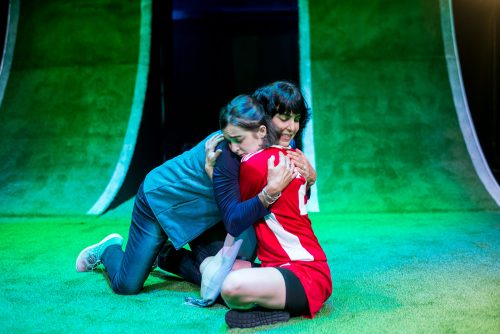
Elena Maria Garcia and Lisa Naso come together in grief in “The Wolves” at the Arsht Center. (Photo courtesy of Justin Namon)
Scenic designer Natalie Taveras’ soccer practice pitch, with high curved panels containing a doorway at each end, seems to be cradling the actors in an embrace. Costume designer Marina Pareja has dressed the Wolves (except for No. 00’s black-and-pale chartreuse goalie outfit) in striking red uniforms, which makes the
performers almost glow against the green of the artificial turf and the black shadows hovering over the audience on either side of the stage.
Lighting designer Rebecca Montero bathes giddy emotions in bright lights, while grief expresses itself in colors; and sound designer Matt Corey artfully supplies the sounds of games as well as mood-stirring music.
Although “The Wolves” contains several sections of overlapping dialogue, Meltzer and the actors keep the balance clear enough so that necessary information and references get through. One image at the very end of the play doesn’t have the overwhelming impact that it could, though a slight adjustment in lighting may be
all that’s needed.
For the young women in “The Wolves,” soccer is both a passion and the means to an end, a steppingstone toward their future selves. DeLappe’s story is insightful, exhilarating, tragically sobering. And very much worth experiencing.
What: “The Wolves” by Sarah DeLappe, a Zoetic Stage production
Where: Zoetic Stage production in the Carnival Studio Theater at Adrienne Arsht Center for the Performing Arts of Miami-Dade County, 1300 Biscayne Blvd., Miami
When: 7:30 p.m. Wednesdays-Saturdays, 3 p.m. Sundays, through Nov. 17
Cost: $50 and $55
Information: 305-949-6722; arshtcenter.org
ArtburstMiami.com is a nonprofit source of theater, dance, visual arts, music and performing arts news. Sign up for our newsletter and never miss a story.
No posts found
Actors’ Playhouse starts season with the music of Johnny Cash
Written By Christine Dolen
November 4, 2019 at 9:17 PM
He was known as “The Man in Black,” not because he was a bad boy but for symbolic and pragmatic reasons: Johnny Cash wore black to represent the downtrodden in America, and in his band’s early days, the only shirts all the musicians had that matched in color were black ones.
The late music legend – a member of the Nashville Songwriters Hall of Fame, Country Music Hall of Fame, Rock and Roll Hall of Fame, Gospel Music Hall of Fame, and Memphis Music Hall of Fame – is the subject of “Ring of Fire,” the biographical show that’s kicking off the 2019-2020 Actors’ Playhouse season.
Conceived by William Meade and created by Richard Maltby Jr., the show had a relatively short Broadway run in 2006 as a large-cast jukebox musical focused on the many songs written by and linked to Cash rather than on the man himself. But Maltby kept revising his show, and the piece that’s running through Dec. 8 in the Miracle Theatre’s upstairs Balcony Theatre is an engaging, joyous gem.
Directed by Ben Hope, who played the starring male role in the Actors’ Playhouse production of “Once” in 2018, “Ring of Fire” is a showcase not just for Cash’s life story and many hits but for the prodigious talents of the five actor-singer-musicians who make up the cast.
Scott Moreau, whose program bio notes that he has played the role of Johnny Cash in “Million Dollar Quartet” more than 1,000 times, also embodies Cash in “Ring of Fire.” His deep voice is tailor-made for “Folsom Prison Blues,” “I Walk the Line,” “I’ve Been Everywhere” – which are just three of the 28 songs contained in the two-act show.
The vivacious, lovely Katie Barton (who happens to be married to the director) plays June Carter Cash, a country superstar in her own right who was Cash’s second wife and clearly the love of his life. Married for 35 years, both died in 2003, with Cash passing just four months after his wife.
Performers Eric Scott Anthony, Marcy McGuigan and Spiff Wiegand all play multiple roles, which include Anthony portraying Cash’s father Ray, Wiegand playing the singer’s brother Jack (who died in an accident), and McGuigan portraying the singer’s mother Carrie, his first wife Vivian and comedian Minnie Pearl.
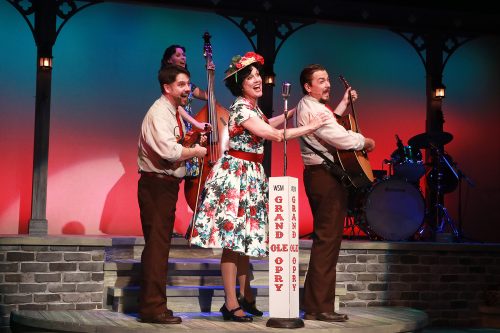
Spiff Wiegand, Katie Barton (on bass), Marcy McGuigan and Eric Scott Anthony evoke the Grand Ole Opry in “Ring of Fire.” (Photo courtesy of Alberto Romeu)
Each of the actors is a versatile instrumentalist, with the five taking turns playing acoustic and electric guitars, an upright bass, drums, an autoharp, a kazoo, a whistle, a washboard, an accordion, a ukulele – you name it, they play it.
With orchestrations by Steven Bishop and Jeff Lisenby, and additional arrangements by David Abbinanti, the performers’ harmonies are glorious.
Director Hope and Jodi Dellaventura are credited with the set design, which looks like a small performance space with faux bricks and different levels. Actor Katie Barton and Debbie Barton created the fine period costumes, Eric Nelson the lighting full of sunsets and stars, Shaun Mitchell the robust sound.
Without harping on Cash’s flaws, the show is honest about them – the womanizing on tour during his first marriage, drinking to excess, relying on amphetamines and barbiturates during multiple periods of his life.
“Ring of Fire” also celebrates his hardscrabble roots in Arkansas; his commitment to entertaining imprisoned men in places like Folsom Prison and San Quentin; his activism on behalf of American Indians; how he inspired an imprisoned Merle Haggard to change his life; Cash’s ABC network music show and more.
Mostly, “Ring of Fire” is about the music, the novelty songs (including “A Boy Named Sue”), the covers (“If I Were a Carpenter,” “Sunday Mornin’ Comin’ Down,” the peppy “Jackson”), the gospel numbers (“Far-Side Banks of Jordan”), and the Cash originals.
Even if Cash and country wouldn’t be your first choice in entertainment, Hope and his talented cast make “Ring of Fire” a special, thoroughly enjoyable experience.
What: “Ring of Fire” by Richard Maltby Jr.
Where: Actors’ Playhouse at the Miracle Theatre, 280 Miracle Mile, Coral Gables
When: Through Dec. 8; 8 p.m. Wednesdays-Saturdays; 3 p.m. Sundays; additional matinee 2 p.m. Nov. 6
Cost: $30 to $75
Information: 305-444-9293; actorsplayhouse.org
ArtburstMiami.com is a nonprofit source of theater, dance, visual arts, music and performing arts news. Sign up for our newsletter and never miss a story.
Top photo: Actor-singers Spiff Wiegand, Katie Barton, Eric Scott Anthony, Scott Moreau and Marcy McGuigan perform the songs of Johnny Cash and others in “Ring of Fire” at Actors’ Playhouse. (Photo courtesy of Alberto Romeu)
No posts found
An arts-supportive county buys into the talent of Miami playwrights
Written By Christine Dolen
October 30, 2019 at 5:42 PM
Imagination, creativity and disciplined work are just three of the elements that feed into the writing of a play. It is a long process that can be as exhilarating as it is deeply frustrating.
The Playwright Development Program (PDP), administered by Adriana Perez of Miami-Dade County’s Department of Cultural Affairs, aims to make that process easier with a supportive, unique two-year workshop series.
“There’s nothing like it. Everyone I know who has been through it has experienced something special and vital,” says Miami playwright Jessica Farr. “It has given me such drive, and an excuse to write at all times.”
Launched as Downstage Miami in 2001 by former Cultural Affairs administrator Rem Cabrera, the program now brings together four selected South Florida playwrights to work with a master playwright throughout a two-year period. The writers get together for periodic weekend workshops at the historic Deering Estate, developing two full-length scripts. Those plays get a public reading in Miami, and the playwrights also get to work with a different group of actors, a director and a dramaturg on each script at the Playwrights’ Center in Minneapolis.
“One’s career doesn’t move forward if you’re not producing new material,” says Sheri Wilner, who just finished her second stint as the program’s master playwright. “They work so intensely and hard on each play … then they walk out with two solid plays. They can continue working on them or send them out.”
That work has paid off in a big way for some of the program’s past participants.
Christopher Demos-Brown developed the searing, Miami-set “American Son” at PDP. The play ran on Broadway last season, and a Netflix version starring Kerry Washington and the rest of the Broadway cast is set to premiere Nov. 1. The Arsht Center-based Zoetic Stage will produce the play Jan. 9-26; and another PDP-developed play, Hannah Benitez’s “GringoLandia,” will get a Zoetic world premiere on May 7-24.
Vanessa Garcia’s “The Amparo Experience,” a much-extended success that will wrap up its eight-month Miami world premiere run on Nov. 24, was also developed during her PDP participation.
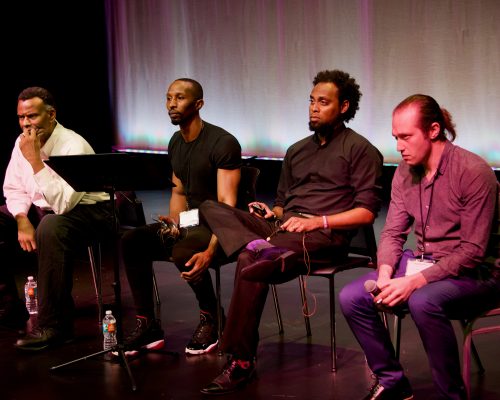
From left, actors James Randolph, Eddie Brown and Troy Davidson, and playwright Ean Miles Kessler listen to questions after a reading of “Frankie Moon’s Long Gone.” (Photo courtesy of Amy Pasquantonio)
Juan C. Sanchez, Andie Arthur, Susan Westfall, William Hector, Stephanie Ansin and Marjorie O’Neill-Butler are among other successful South Florida playwrights who have developed scripts through PDP.
Israel Garcia, Jessica Farr, Ean Miles Kessler and Gina Montet are wrapping up their two years with PDP. They staged readings of four plays – Garcia’s “The Words of Dead Men,” Farr’s “The Gulf,” Kessler’s “Frankie Moon’s Long Gone” and Montet’s “Overactive Letdown” – from Oct. 19 to 20 at Miami’s Sandrell Rivers Theater as part of a festival dubbed From Scratch.
Actors, directors, American Sign Language interpreters and audiences became part of the process. And since the playwrights had developed their scripts with input only from each other and Wilner, the readings provided a first chance to gauge how others would react to the work.
“I was elated after the readings. The audience reactions to all four were so, so strong,” says Wilner, whose plays have been produced worldwide and at major regional theaters. “The playwrights were delighted and surprised that what we thought in the [writing] room was right. Each reading had a talkback, and each audience gave such thoughtful responses. Every writer hit their target. That response from the audience is really what you’re writing the play for – to get these conversations started.”
The county’s investment in the program pays all expenses for the master playwright and participants, including the trips to the Playwrights’ Center for a fresh look at the scripts. Deadlines set by the master playwright require each participant to come up with new material or revisions – something that, outside of such a program, is easy to put off.
“Unless commissioned, a playwright isn’t on a deadline. The author writes because there’s an intrinsic need,” says Garcia, a Florida International University professor whose play “The Words of Dead Men” is about brothers who find the last words written by their deadbeat dad. “But then life happens and you put your play on the back burner … Here, you’ve made a commitment to do it. So you schedule yourself out, which is hard. You won’t sleep for a month, but you’ll do it, damn it!”
Kessler, whose writing has drawn comparisons to the work of Sam Shepard, tried something different with “Frankie Moon’s Long Gone.” In the play, the ailing Frank has decided to stop chemotherapy and just chain-smoke until it’s lights out. His son hires a born-again hospice aide but agrees to fire the guy if Dad will resume chemo. It’s a comedy.
“The play started out as one scene and about a dozen pages of jokes and moments. PDP lit a fire under my feet to get this piece finished, and to close in on a final draft. The main trajectory of my journey with this play has been my process of whittling it down and finding the heart of the story,” says Kessler, who will take “Frankie Moon’s Long Gone” to the Playwrights’ Center in November and Chicago Dramatists in December.
“But first, I needed to write with abandon. PDP allowed me to pour everything out, then wade back in and cut through the bramble … [The play] wouldn’t have happened without this process.”

Playwright Israel Garcia, second from left, responds to a question about his play, “The Words of Dead Men,” after a staged reading at the Sandrell Rivers Theater. (Photo courtesy of Ryan Arnst)
Farr developed her plays “Cassie” and “The Gulf” (the latter about post-nuclear survivors in South Florida) during her time in PDP, and she’s now thinking the two scripts may become part of a trilogy (the third involves megachurches and a moon colony). From participating in the program, she says, “I’m less quick to make significant cuts early on until portions of the script have become erroneous. I let my characters surprise me.”
Montet’s play, about a first-time mother who escapes into a troubling fantasy world after giving birth, had been evolving over eight years before PDP brought it to fruition. It will get another major reading at 3:30 p.m. Jan. 4 during Theatre Lab’s New Play Festival on the campus of Florida Atlantic University in Boca Raton.
“’Overactive Letdown’ was nothing more than a few disconnected scenes and rough outlines when we began this PDP cycle. In addition, I crafted a second full-length script and six short plays, and completed two commissioned educational plays. It was, by far, the most productive two years I have had as a playwright, attributable to the support and encouragement of the PDP and its members,” Montet says. “The opportunity to participate in such a dynamic, well-established program has opened up numerous opportunities for me as an artist and creator.”
The next group of four playwrights, to be announced in mid-November, will work with award-winning playwright Kia Corthron to bring eight more full-length plays into the world.
Of her group, Wilner says: “All four came in with distinct voices. But they became bolder, sharper versions of themselves.”
For more information on the Playwright Development Program, visit miamidadearts.org/playwright-development-program-pdp.
ArtburstMiami.com is a nonprofit source of theater, dance, visual arts, music and performing arts news. Sign up for our newsletter and never miss a story.
No posts found







Recent Comments