Blog Article Category: Music
Davóne Tines Reimagines the National Anthem at New World Symphony Festival
Written By Sergy Odiduro
February 15, 2026 at 8:46 PM
The 5th annual “I Dream a World: Lift Every Voice and Sing” Festival will be held from Wednesday, Feb. 18 through Sunday, Feb. 22 in Overtown and Miami Beach and features bass-baritone Davóne Tines. (Photo courtesy of New World Symphony)
For Davóne Tines, the fifth annual “I Dream a World Festival” with New World Symphony is more than just a performance — it is a chance to wield his voice as an instrument of change.
“Instead of flatly entertaining, I want to use the concert stage as a forum for exploring questions and that work has continued with New World Symphony,” says the internationally renowned bass-baritone.
“Lift Every Voice and Sing,” the symphony’s four-day tribute to Black composers from the Civil Rights era to the present day, provides that opportunity.

Internationally renowned bass-baritone Davóne Tines, will perform in the New World Symphony’s 5th annual “I Dream a World: Lift Every Voice and Sing” Festival. (Photo courtesy of New World Symphony)
Produced in partnership with Tammy Kernodle, Ph.D., University Distinguished Professor in the Department of Music at Ohio’s Miami University, the event will be featured on two stages: one in Overtown and the other in Miami Beach.
The festival premieres Wednesday, Feb. 18, at the New World Center in Miami Beach. Tines, along with soprano Kristin Renee Young and the Fellows of the New World Symphony, will bring the musical friendship between Harlem Renaissance poet Langston Hughes and composer and pianist Margaret Bonds to life onstage.
“Salon: I, Too, Sing America” promises an elegant celebration of Hughes, the literary parties he frequented and his subsequent musical collaboration with Bonds.
The program will also be presented Thursday, Feb. 19, at the Black Archives Historic Lyric Theater in Overtown. Tickets are pay-what-you-wish, with suggestions starting at $10.
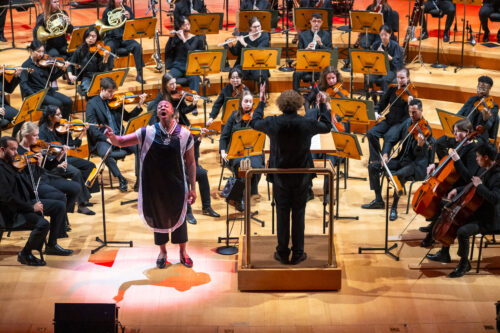
The event will be featured on two stages: one at the Black Archives Historic Lyric Theater in Overtown and the other at the New World Center on Miami Beach.
(Photo courtesy of New World Symphony)
The remaining two performances return to the New World Center stage, where Panamanian-American conductor Kalena Bovell leads NWS.
In a blockbuster rendition, Tines is slated to present “Concerto No. 2: ANTHEM,” a provocative piece in which he wonders aloud whether the “Star Spangled Banner” is truly an inspirational and unifying battle cry for patriotic Americans.
Spoiler alert: It isn’t.
“I don’t think the ‘Star Spangled Banner’ has been a good part of the DNA of this country because it suggests that our country is founded on ideals of conquering others and oppression,” says Tines, adding that it is important to reconsider symbols that have been chosen to represent America.

In “Concerto No. 2: ANTHEM” Davóne Tines challenges whether the Star Spangled Banner is an inspirational battle cry for patriotic Americans.
(Photo courtesy of New World Symphony)
“… Make sure that they’re in line with what we as a society are deeming the most positive reflection of where we’re trying to go.”
Self-written and performed, Tines calls his piece an educational tool that uses a “magic trick” to transform the “Star Spangled Banner” into “The Black National Anthem.”
“I really wanted to show to audiences in full orchestral glory, what this alternative option for a national anthem could be,” he says.
This anthem, believes Tines, has better values for a “country to be built on.” His piece begins with a bang.
“The first movement is the ‘Star Spangled Banner’ starting in a very, like MGM musical, Whitney Houston at the Super Bowl. It’s like the Fourth of July on steroids,” he explains.
Then the tone and messaging shift.
“The subsequent verses become darker or more menacing as the text of the song becomes darker and more menacing.”
But Tines’ concerto isn’t the only work drawing from Francis Scott Key’s 1814 composition, which became the country’s official anthem in 1931.
Jessie Montgomery’s “Banner,” composed in 2014, offers a multicultural response marking the national anthem’s 200th anniversary and will be led by first-year Conducting NWS Fellow Ziwei Ma.

The Florida Memorial University Ambassador Chorale returns to the New World Symphony’s 5th annual I Dream a World Festival. (Photo courtesy of New World Symphony)
Also on the program is Bonds’ “The Montgomery Variations.” Based on “I Want Jesus to Walk with Me,” the 25-minute orchestral work serves as a homage to Martin Luther King Jr. and the Montgomery Bus Boycott.
The Florida Memorial University Ambassador Chorale rounds out the event with a performance of “Lift Every Voice and Sing,” known universally as the “Black National Anthem.”
Argarita Johnson-Palavicini, Ph.D., chair of the Department of Arts and Humanities at Florida Memorial University and director of the Ambassador Chorale, looks forward to another year of collaboration between FMU and the New World Symphony.
“We’re just really happy to be a part of this I have a dream journey that New World Symphony embarks upon every year,” she says.

Davóne Tines, along with soprano Kristin Renee Young and the Fellows of the New World Symphony, will bring the musical friendship between Harlem Renaissance poet Langston Hughes and composer and pianist Margaret Bonds onstage. (Photo courtesy of New World Symphony)
Johnson-Palavicini notes that their participation is heightened by working with Tines and says she is particularly pleased that the festival will showcase the music of Margaret Bonds.
“Dr. Kernodle does a great job of picking or choosing pieces that most people don’t know of, so to highlight the music of a female composer during this time is really what makes it special,” she says.
“So we just want to continue to make great music together and to encourage and to educate the world about all of the wonderful historical Black music that people may not know about.”
WHAT: New World Symphony’s “I Dream a World Festival”: “Lift Every Voice and Sing,”
WHEN: 7:30 p.m. Wednesday, Feb. 18, 7:30 p.m. Thursday, Feb. 19, 7.30 p.m. Saturday, Feb. 21, 2 p.m., Sunday, Feb. 22
WHERE: New World Center, 500 17th St, Miami Beach and Black Archives Historic Lyric Theater, 819 NW 2nd Ave, Miami. The Feb.21 performance will be livestreamed online with an NWS Inside paid subscription.
COST: Varies depending on performance. Pay what you wish tickets starting at $10 at the Black Archives Historic Lyric Theater ,$25 to $140 at the New World Center.
INFORMATION: 305-673-3331 or nws.edu/sing
ArtburstMiami.com is a nonprofit media source for the arts featuring fresh and original stories by writers dedicated to theater, dance, visual arts, film, music and more. Don’t miss a story at www.artburstmiami.com.
No posts found
Faith, Music, and Community Take Center Stage at the Arsht Gospel Choir Invitational
Written By Jonel Juste
February 10, 2026 at 1:47 PM
The Arsht Gospel Choir Invitational will return on Saturday, Feb. 14 for its second year to Knight Concert Hall bringing together choirs from across Florida. (Photo by Taylor Brown, courtesy of Adrienne Arsht Center)
Beyond the structure of a competition, the Arsht Gospel Choir Invitational is rooted in something deeper. It emerges from a long tradition of gospel music as a communal language in South Florida, one that binds churches, schools, families, and generations.
For the Adrienne Arsht Center, the event extends a gospel programming that began with 15 years of Free Gospel Sundays, evolving into a broader vision.
Jenita Nakamura, senior director of education and community engagement at the Adrienne Arsht Center, says that the move to creating an invitational competition was a way to “reimagine our gospel programming” while continuing to work with gospel groups.
On Saturday, Feb. 14, the Arsht Gospel Choir Invitational returns for its second edition to Knight Concert Hall, bringing together five choirs from across South Florida.
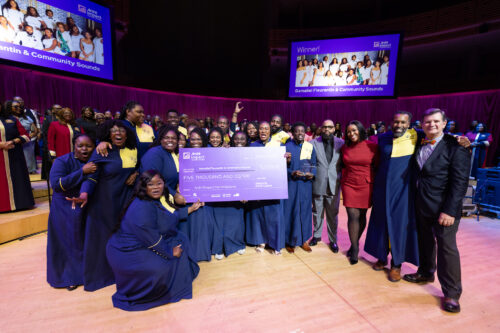
The winners of the 2025 Arsht Gospel Choir Invitational, Gamaliel Fleurantin & Community Sounds, with Arsht President and CEO Johann Zietsman, right. (Photo by Taylor Brown, courtesy of Adrienne Arsht Center)
The event will feature the Florida A&M University Gospel Choir, Florida Memorial University Ambassador Chorale, Holy Cross Lutheran Praise Choir, Mt. Pisgah Mass Choir, and Renewed Choir. Audience members help choose which choir wins a $5,000 cash prize. The winning choir also gets to perform in June at the Arsht’s Gospel Fest Miami.
What began as a local initiative has drawn interest from beyond Miami-Dade County, signaling the reach of gospel as both music and movement. “Enthusiasm about the Invitational has grown since the first year,” according to Nakamura. “Not only are people in our local community excited about it, but we have also received submissions from choirs further away that want to compete.”
In South Florida, gospel music has long served as a gathering point. It carries memory, faith, and resilience across decades. The Invitational sits alongside other Arsht initiatives, including “Gospel On The Road” pop-up concerts and Gospel Fest Miami Weekend, offering multiple points of connection throughout the year.
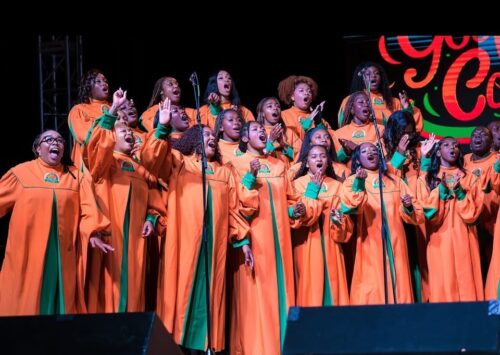
The Florida A&M University Gospel Choir will travel from Tallahassee to take part in the invitational. (Photo courtesy of the artist management)
This year’s lineup reflects that breadth. Two university choirs perform alongside three church and school-based ensembles, creating an intentionally intergenerational stage. According to Nakamura, in the invitational’s grand finale all of the choirs in competition come together. “So we’ll see children as young as 10 share the stage with the elders in our community,” says Nakamura.
For the Florida A&M University (FAMU) Gospel Choir based in Tallahassee, the stage represents both opportunity and responsibility. Tahj Merriex, the choir’s president and a graduating senior, describes participation as an act of representation. “For our students, it is both an artistic milestone and a duty to serve as ambassadors.”
Preparation, he explains, was intentional rather than performative. Under the direction of Malachi Gibbs, the choir selected music that honors traditional gospel while allowing room for musical range and innovation.
At Miami Gardens’ Florida Memorial University, the Ambassador Chorale approaches the Invitational with a similar sense of purpose. Directed by Argarita Johnson-Palavicini, D.M.A., the ensemble serves as the university’s premier vocal group and the Arsht stage offers a rare moment of visibility. “As a small, private HBCU, chances like this let us be seen and heard on a larger stage,” says Palavicini. “It gives us the chance to share not just our sound, but our story.”
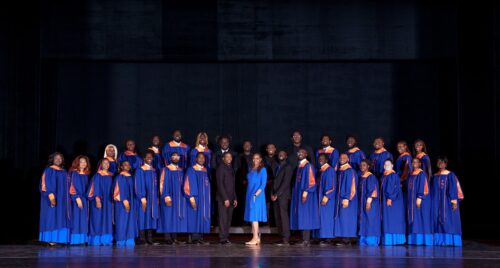
The Florida Memorial University Ambassador Chorale’s sound blends Black and Hispanic gospel traditions, reflecting the heritages of its singers. (Photo courtesy of the artists)
She described the chorale’s preparation as both spiritual and musical. “Our choir has prepared for this invitational first through prayer and guidance from the Holy Spirit,” she says. The group’s sound blends Black and Hispanic gospel traditions, reflecting the backgrounds of its singers.
Church-based choirs bring yet another dimension to the competition. The Mt. Pisgah Mass Choir, formed in 2024 at Mt. Pisgah Seventh-day Adventist Church in Miami Gardens, includes singers ranging in age from 10 to over 70. “The Mt. Pisgah Mass Choir bridges a gap of over 60 years,” says Nathan Drew, the choir’s minister of music and head director. “Our choir ministry shows how people from different backgrounds can unite in ministry to one great God.”
The youngest voices of the evening will come from Miami’s Holy Cross Lutheran Praise Choir, made up of students in grades three through eight. “Participating in the Gospel Choir Invitational at the Adrienne Arsht Center is an incredible honor,” choir director Matthew Harden says. “It is a chance to represent our faith, our school, and our community on a larger stage and show what young people can do when they sing with purpose and heart.”
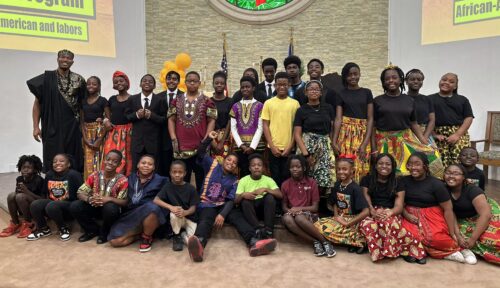
The youngest voices of the event will come from the Holy Cross Lutheran Praise Choir, made up of students in grades three through eight. (Photo courtesy of the artists)
Harden said the choir approaches the event with a ministry-first mindset. “We remind our students that we are there to worship first,” he says. “The judging is secondary.”
Renewed Choir, based at Abundant Live Christian Academy in Margate, is made up of high school students. Director Shivonne Pinder said the ensemble was formed as the program expanded to distinguish older singers from the middle school choir.
“This will be their first competition outside of those walls,” says Pinder. “It’s encouraging, it’s empowering, a little overwhelming, but a good challenge.”
Pinder described the choir’s sound as modern gospel with influences from contemporary Christian music and Caribbean traditions. “Gospel CCM meets youth,” she said. “That’s the best way for me to describe it.”
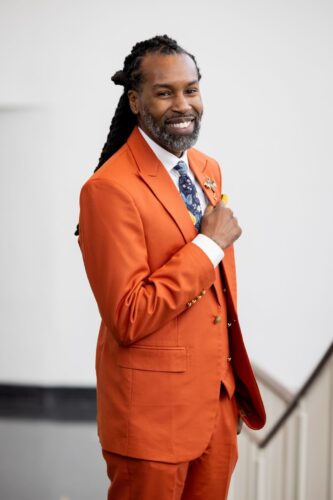
Returning this year as a guest judge is Gamaliel Fleurantin, director of Community Sounds, last year’s winning choir. (Photo courtesy of artist management)
Returning this year as a guest judge is Gamaliel Fleurantin, director of Community Sounds, last year’s winning choir. He remembers the announcement vividly. “When our name was finally announced as the first-place winner, the emotion was overwhelming,” recalls Fleurantin. “It was joy, humility, gratitude, and affirmation all at once. That moment wasn’t just a win, it was a testimony.”
Since that victory, Community Sounds has expanded its reach, performing original music, collaborating with churches such as VOUS, and working toward its first official single. Fleurantin says the invitational reinforced lessons about preparation and purpose. “Technique matters, but transformation matters more,” he says.
Although one choir will be crowned the winner, Fleurantin says the competition is about more than technical polish. “Authenticity is essential,” he said. “This is a gospel competition, and I expect performances that unmistakably reflect the genre — powerful vocals, commanding stage presence, and a clear ‘wow’ factor.”
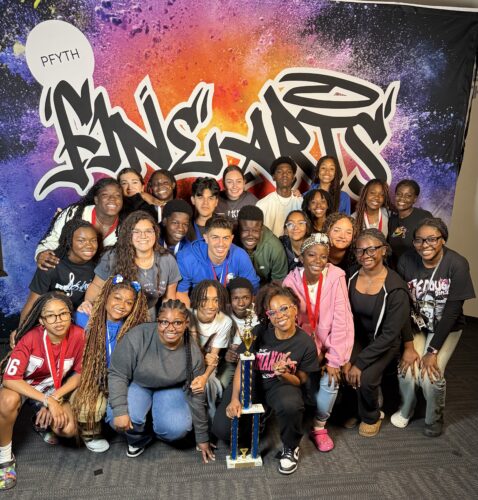
Composed of young singers, Renewed Choir’s repertoire is modern gospel with influences from contemporary Christian music and Caribbean traditions. (Photo courtesy of the artists)
Audience participation remains a defining feature too, and voting reinforces the idea that the evening belongs as much to the community as to the performers. For Nakamura, that shared energy is the point. “Community engagement is central to our work, and an event like this strengthens our relationships with local faith, academic, and community organizations,” she says.
The Invitational is part of a larger gospel initiative that reaches beyond the Arsht Center. From February to April, the Arsht will also present Gospel On The Road, a series of free pop-up performances aimed at bringing gospel music to neighborhoods throughout Miami-Dade County.
The series kicks off on Saturday, Feb. 21 at 4 p.m. at Loren Roberts Park in Florida City. There will be another performance on Sunday, March 29 at 5 p.m. at the Betty T. Ferguson Recreational Complex in Miami Gardens.
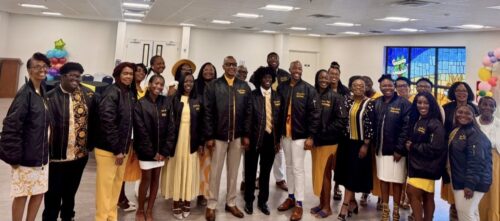
The Mt. Pisgah Mass Choir, formed in 2024 at Mt. Pisgah Seventh-day Adventist Church in Miami Gardens, includes singers ranging in age from 10 to over 70. (Photo courtesy of the artists.)
The final event is set for Sunday, April 19 at 5 p.m. at Domino Park in Miami’s Little Havana neighborhood. Each performance showcases local gospel artists and is open to the public. The series of events will conclude with the Gospel Fest Miami Weekend on Saturday, June 20 and Sunday, June 21.
As a former winner and now a judge, Fleurantin advises that the invitational ultimately asks choirs to think beyond results. “Come prepared to compete, because this is a competition,” he says. “But remain humble throughout the process. Work relentlessly and be strategic.”
WHAT: Second Annual Arsht Gospel Choir Invitational
WHERE: Adrienne Arsht Center’s Knight Concert Hall, 1300 Biscayne Blvd., Miami
WHEN: 6 p.m., Saturday, Feb. 14
COST: Tickets are free with RSVP, however guests are invited to contribute the suggested ticket price of $20 (or more) to help sustain live arts experiences for the people of Miami.
INFORMATION: (305) 949-6722 or arshtcenter.org
ArtburstMiami.com is a nonprofit media source for the arts featuring fresh and original stories by writers dedicated to theater, dance, visual arts, film, music, and more. Don’t miss a story at www.artburstmiami.com
No posts found
Samara Joy and Catherine Russell, Two of Jazz’s Great Voices, Grace Miami Stages
Written By Helena Alonso Paisley
January 30, 2026 at 4:25 PM
Two great ladies of jazz come to Miami for performances including Catherine Russell, above, and Samara Joy. Russell kicks of the Faena Jazz Series on Wednesday, Feb. 4 in Miami Beach (Photo by Gilberto Tadday, courtesy of Jazz at Lincoln Center)
To hear Samara Joy sing, you would think she had been raised in a jazz club, clambering up on a bar stool in pigtails and sipping Shirley Temples while serenaded with standards from the stage. Truth be told, she comes from a family of gospel singers and didn’t set foot into a jazz establishment until she left home for college.
To hear Catherine Russell sing, you would think she had been raised in a jazz club…and you wouldn’t be far from the mark. With a composer father who led Louis Armstrong’s orchestra and a mother who had toured the country playing with the all-female Sweethearts of Rhythm, her parents’ music was the soundtrack of her earliest childhood. But Russell took another path, opting instead for a rewarding career as a back-up singer for the likes of Cyndi Lauper, Steely Dan, and David Bowie.
While reaching jazz through different paths and separated by a generation—Samara Joy is 26 and Catherine Russell is 69—both Grammy-winning artists sing mid-twentieth century music like it was what they were put on this earth to do. Russell opens this year’s Faena Jazz Series at the Faena Theater on Wednesday, Feb. 4; Samara Joy will play the Adrienne Arsht Center’s Knight Concert Hall on Thursday, Feb. 12 as part of the Jazz Roots series.

Like Ella Fitzgerald and Sarah Vaughan, who were “foundational” to her development as a singer, Samara Joy exudes elegance and sophistication. And like another of her favorites, Carmen McCrae, Joy really knows how to tell a story through song. (Photo by Csibi Szilvia Mupa, courtesy artist management)
Joy first embraced jazz as her calling as a music student at State University of New York (SUNY) at Purchase.
“I spent a lot of time sort of just immersing myself in the sound and listening to albums, listening to not only vocalists, but musicians as well to sort of figure out what this style of music, what characterizes this style of music,” says Joy, who recorded her debut album before she had even graduated college.
Shelly Berg, Jazz Roots director and dean of the University of Miami’s Frost School of Music, remembers meeting Joy when she was a teenager.
“She had this timeless voice that, you know, was hearkening back very much to Sarah Vaughn in a way that I hadn’t heard from anybody in a very long time,” he says. Her maturity as an artist, he notes, belies her youth.
“There’s a depth to what Samara does, both in the way she sounds and just in the way she phrases and her musical sensibilities. It’s really quite something,” he says. Berg is astounded at her vocal range, too.
“She’s got those naturally low notes in her,” Berg says, adding that, while high notes can be learned, “You can’t fake low notes. You either have them or you don’t.”

While her signature move is to bring back the great songs of the 1920s —especially the saucy ones—the audience at the Faena Theater will also hear Catherine Russell and her stellar four-piece band play jazz standards, the blues and upbeat swing. (Photo by Sandrine Lee, courtesy of Lydia Liebman Promotions)
Russell, for her part, returned to her jazz roots only after Bowie stopped touring. With a nudge from her manager (now husband) Paul Kahn, she released her first recording as a solo artist in 2006 and came to see that a career singing jazz and the blues might be an itch she still needed to scratch. Last year, she recorded her 10th album, “Cat and the Hounds,” with Colin Hancock’s Jazz Hounds, and she shows no signs of slowing down.
Like Bowie, who, she recalls, “worked as if he were a band member,” Russell doesn’t see herself as separate from the artists who accompany her. “Being the center of attention isn’t why I got into this business. It was music,” she says.
Accompanying her at her Miami Beach concert will be longtime bandmates Matt Munisteri (guitar and musical direction), Tal Ronen (double bass), Domo Branch (drums) and Ben Paterson (piano).
“I enjoy working with the best players and people who like ensemble work, you know, so we all figure things out together,” she says.
Russell has ardent followers among audiences and fellow musicians alike. Pianist Marcus Roberts, who recently performed “Rhapsody in Blue” with the New World Symphony, counts himself a fan.
“I gotta tell you, I haven’t seen a singer who’s as professional and as warm. She’s really just a beautiful human being, on top of being just a top-level singer,” he says, putting her in a class with the late, great Shirley Horn, another of his favorites.

Catherine Russell with her longtime guitarist and musical director Matt Munisteri performs at the Appel Room, on Friday, March 29, 2024 foir Jazz at Lincoln Center. She comes to Miami Beach Wednesday, Feb. 4 to kick off the Faena Jazz Series. (Photo by Gilberto Tadday/Jazz at Lincoln Center)
Berg sees similarities between Joy and Russell, and he has performed with each.
“They both have great respect for the tradition. They both come from musical families, so there’s a grounding there that comes out in their music, and I think that’s where you hear similarities.”
In terms of differences, Berg notes that Russell is “quite a student of earlier, more obscure pieces of the repertoire.” Listening to radio stations like WWOZ of New Orleans and even using contacts at the Library of Congress, Russell loves to unearth musical gems from as far back as the 1920s and before, dust them off, and breathe new life into these forgotten treasures.
In her choice of material to revive—like “Kitchen Man,” made famous by Bessie Smith in 1929 and 1923’s “He May Be Your Dog, But He’s Wearing my Collar”—Russell shows off the saucy side of early jazz as well as her own playful sense of humor. Roberts says that “Catherine, she just brings the history, but she brings it up to date, you know what I mean? She gives it a twist like only she can do.”
Joy, conversely, has a knack for new media. She has come to be seen in the jazz world as something of a missionary, bringing thousands of young people into the fold with her viral videos on TikTok and Instagram—avenues that, if she has anything to do with it, could become fertile ground for a whole new generation of jazz lovers. And with appearances on programs as diverse as “The Terrell Show” (on YouTube) and “The Today Show” (on the regular tube), her audience reach is about as broad as her three-octave vocal range.

Samara Joy may be a star onstage, but her social media presence is more that of an unretouched downhome girl from the Bronx than a diva. At 26, she only recently moved from her family’s home (where she stores her five Grammys) to her own apartment in Harlem. (Photo by Gus Black, courtesy artist management)
What seems extraordinary even to Joy herself is that she has never had to stray from her artistic ideals to find a public for her work. “My place and my purpose as an artist right now—or forever,” she says, is “to make the music and the art that is most authentic to me. Things that satisfy my curiosity and creativity and also allow me to collaborate with people and musicians who inspire and who introduce me to new things.” Beyond that, she asks, “How do I use music to be a balm and a blessing to others?”
For touring artists like Joy and Russell, to continue making their music night after night in city after city is what Joy calls “a lesson in stamina and endurance.” Russell credits her training as an actor and her daily yoga practice with helping her to be ready for the “marathon,” so that she can be fully present—physically, mentally and emotionally—when she is onstage.

Catherine Russell performs at the Appel Room, in this photo from Friday, March 29, 2024, at Jazz at Lincoln Center. Drummer Domo Branch is behind her. (Photo: by Gilberto Tadday, courtesy of Jazz at Lincoln Center)
“I think part of our job is to remain receptive to what can happen to you in the moment,” she says. Everyone, from your fellow musicians to the audience has a part to play, believes Russell.
“If you’re not open to being receptive, then the energy doesn’t move. I want the energy to flow freely so that things can happen,” says Russell. “If we’re all open in the moment then we can raise each other’s awareness and inspire each other.”
WHAT: “Faena Jazz Series with Catherine Russell,” opening concert of the 2026 Faena Jazz Series and “An Evening with Samara Joy,” second concert of Jazz Roots 2025-2026
WHEN: 8 p.m. Wednesday, Feb. 4 and 8 p.m. Thursday, Feb. 12.
WHERE: Faena Theater, 3201 Collins Ave., Miami Beach, and Knight Center Hall, Adrienne Arsht Center for the Performing Arts, 1300 Biscayne Blvd., Miami
COST: Catherine Russell, $70 – $225; Samara Joy, $52.65 – $152.10, inclusive of fees
INFORMATION: For Catherine Russell, 786-655-5742 or www.faenatheater.com; For Samara Joy, 305-949-6722 or arshtcenter.org/jazz
ArtburstMiami.com is a nonprofit media source for the arts featuring fresh and original stories by writers dedicated to theater, dance, visual arts, film, music, and more. Don’t miss a story at www.artburstmiami.com
No posts found
After 19 Seasons, Miami Remains a Second Home for The Cleveland Orchestra
Written By Miguel Sirgado
January 19, 2026 at 7:27 PM
Franz Welser-Möst leads The Cleveland Orchestra during rehearsals for Verdi’s “Requiem,” with soprano Asmik Grigorian, mezzo-soprano Deniz Uzun, tenor Joshua Guerrero and bass Tareq Nazmi. The production comes to the Arsht Center as the orchestra celebrates its 19th season. (Photo by Yevhen Gulenko/Human Artist Photography and Cinema/courtesy of The Cleveland Orchestra)
For nearly two decades, The Cleveland Orchestra has maintained a presence in Miami that extends well beyond the idea of a touring engagement. Since 2007, the orchestra’s residency at the Adrienne Arsht Center for the Performing Arts has developed into a sustained artistic relationship with the city—one that returns in early 2026 for its 19th season.
“We don’t treat Miami as a tour destination,” says Ilya Gidalevich, vice president of artistic planning for The Cleveland Orchestra. “We really see it as a second home.”
Over time, he explains, the residency has expanded beyond performances. Educational programs, artistic collaborations and repeat appearances have allowed the orchestra to build relationships with South Florida audiences over multiple seasons, shaping Miami into a place where listeners return year after year rather than encountering the orchestra just once.
That distinction shapes how The Cleveland Orchestra approaches Miami. Unlike traditional tour stops that are programmed independently, the residency allows for long-range planning and reflection.
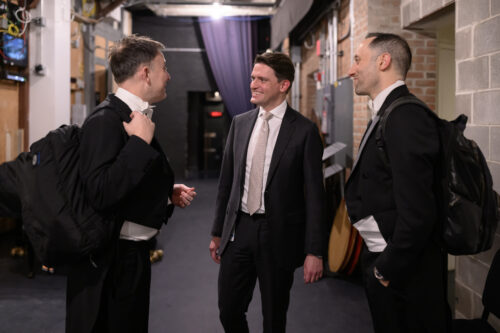
“We don’t treat Miami as a tour destination,” says Ilya Gidalevich, vice president of artistic planning for The Cleveland Orchestra. shown at center. “We really see it as a second home.” Clarinetist Robert Woolfrey is at left, and principal oboist Frank Rosenwein, right, during rehearsals for Verdi’s “Requiem.” (Photo by Yevhen Gulenko/Human Artist Photography and Cinema, courtesy of The Cleveland Orchestra)
“We ask ourselves what we did last year, what we’re doing this year, and what comes next,” says Gidalevich. “How do we create a sense of continuity across multiple seasons in Miami?”
The aim, he adds, is to build an ongoing relationship with audiences who come back to the hall repeatedly, rather than engaging with the orchestra only once as they would on a tour stop.
The 2026 residency reflects that long view. Conducted by Franz Welser-Möst, the orchestra’s longtime music director, the season opens Friday, Jan. 23 and Saturday, Jan. 24 at Knight Concert Hall with Verdi’s “Requiem,” featuring The Cleveland Orchestra Chorus and an international roster of soloists led by soprano Asmik Grigorian, alongside mezzo-soprano Deniz Uzun, tenor Joshua Guerrero and bass Tareq Nazmi.
Programming a work of this scale in Miami is a deliberate choice. Gidalevich describes the process as a balance between institutional identity and local engagement.
“There are two essential questions we always ask,” he says. “How do we stay true to who we are as an orchestra, and how do we present ourselves in the best possible way for the audience we’re engaging?”
In Miami, that balance often means pairing major repertoire with artists and programs to engage both longtime classical listeners and newer audiences.
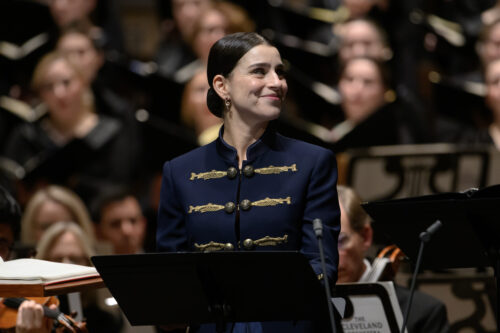
Soprano Asmik Grigorian will have performed Verdi’s Requiem with The Cleveland Orchestra in Cleveland and at Carnegie Hall. South Florida audiences will hear the same production at the Arsht Center in January. (Photo by Yevhen Gulenko/Human Artist Photography and Cinema., courtesy of The Cleveland Orchestra)
The Miami performances of Verdi’s “Requiem” follow closely on appearances in Cleveland and at Carnegie Hall, allowing South Florida audiences to hear the same large-scale production presented in New York. For Grigorian, the performances also mark her debut with The Cleveland Orchestra.
Born in Lithuania and raised in an operatic family, the soprano has established an international career that includes appearances at major opera houses and festivals across Europe and the United States. Her work spans traditional and contemporary repertoire, and she is equally active in opera houses and concert halls.
Verdi’s “Requiem” occupies a distinctive space between sacred music and opera, demanding both technical control and emotional range from its performers. Grigorian believes the work’s expressive breadth is central to its impact.
“It requires a lot of colors,” she says. “There’s such a wide dynamic scale—from very quiet, delicate moments to extremely powerful ones. That range demands experience and technique, but also a willingness to be emotionally open inside the music.”
Rather than directing listeners toward a single interpretation, Grigorian emphasizes the personal nature of the experience.
“Art is about feeling,” she says. “Every person will take from this music what they need at that moment. I don’t want to tell the audience what to feel—I want them to listen and discover their own connection.”
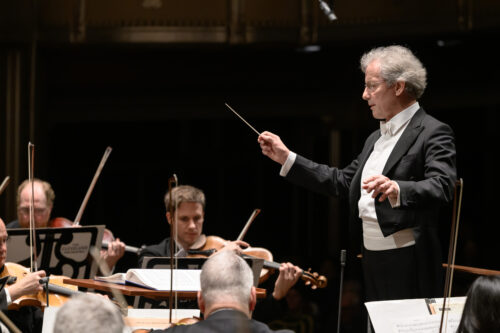
Music director Franz Welser-Möst conducts The Cleveland Orchestra in Mozart’s “Jupiter” Symphony. He will lead the ensemble’s 19th Miami residency in January, opening with Verdi’s “Requiem” at Knight Concert Hall. (Photo courtesy of The Cleveland Orchestra)
Gidalevich says that bringing the orchestra’s chorus back to Miami was a key factor in shaping the opening of the season.
“It was important for us to feature a major choral work with vocal soloists,” he says. “That’s something we’re very proud of.”
Known for its dramatic intensity—particularly the thunderous “Dies Irae”—Verdi’s “Requiem” anchors the residency with one of its most expansive offerings.
The weeks that follow highlight the breadth of the orchestra’s Miami programming. On Wednesday, Jan. 28, celebrated violinist Itzhak Perlman will join the ensemble for “Cinema Serenade,” a program devoted to iconic film scores. Pianist Yefim Bronfman appears Friday, Jan. 30 and Saturday, Jan. 31 in Beethoven’s Piano Concerto No. 5, “Emperor,” paired with Mozart’s Symphony No. 41, “Jupiter.”
Together, the programs reflect the orchestra’s effort to present a wide range of repertoire within a single residency, from sacred choral works to symphonic classics and film-inspired music.
The residency continues into March with performances of Stravinsky’s “The Rite of Spring,” conducted by Rafael Payare, in side-by-side concerts with Fellows from the New World Symphony. That collaboration reflects an educational mission that has become central to the orchestra’s Miami presence.
“Many Cleveland Orchestra musicians were once New World Symphony Fellows themselves,” notes Gidalevich. “They know how meaningful that experience can be.”
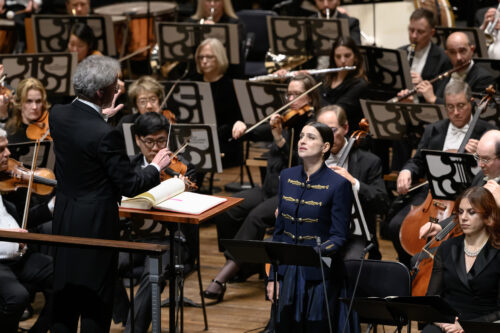
Soprano Asmik Grigorian rehearses Verdi’s “Requiem” with conductor Franz Welser-Möst and The Cleveland Orchestra. (Photo by Yevhen Gulenko/Human Artist Photography and Cinema, courtesy of The Cleveland Orchestra)
The partnership, he adds, offers emerging musicians an opportunity to perform alongside a major American orchestra while reinforcing the residency’s role as more than a performance series.
As The Cleveland Orchestra approaches its third decade in Miami, the residency remains a work in progress—shaped by continuity, experimentation and an ongoing dialogue with the city it returns to year after year.
“Our hope,” says Gidalevich, “is to keep strengthening the audience base here and to serve Miami’s classical music community with performances that feel vital and engaging.”
The Cleveland Orchestra in Miami
VERDI’S “REQUIEM”
WHEN: 8 p.m., Friday, Jan. 23, Saturday, Jan. 24, 2026
WHERE: Knight Concert Hall, Adrienne Arsht Center for the Performing Arts, 1300 Biscayne Blvd., Miami.
COST: $35 to $175.
ITZHAK PERLMAN: “CINEMA SERENADE”
WHEN: 8 p.m., Wednesday, Jan. 28.
WHERE: Knight Concert Hall, Adrienne Arsht Center
COST: $69 to $290.
BRONFMAN PLAYS BEETHOVEN
WHEN: 8 p.m., Friday, Jan. 30, Saturday, Jan. 31
WHERE: Knight Concert Hall, Adrienne Arsht Center.
COST: $35 to $175.
INFORMATION: 305-949-6722 or arshtcenter.org
ArtburstMiami.com is a nonprofit media source for the arts featuring fresh and original stories by writers dedicated to theater, dance, visual arts, film, music and more. Don’t miss a story at www.artburstmiami.com.
No posts found
Why the Moss Center Is the Right Fit for Canadian Laila Biali’s Miami Debut
Written By Miguel Sirgado
January 12, 2026 at 9:43 AM
Canadian jazz vocalist and pianist Laila Biali performs Saturday, Jan. 17 at the Dennis C. Moss Cultural Arts Center, Cutler Bay, bringing her Joni Mitchell–inspired Canadian Songbook to the Miami area. (Photo by Edith Maybin, courtesy of the artist)
For nearly two decades, the Dennis C. Moss Cultural Arts Center has played a visible role in Miami’s artistic landscape, presenting performances that extend beyond the city’s traditional arts corridors. The Cutler Bay venue has built its identity around consistent programming and cultivating audiences, and this approach continues with Canadian jazz vocalist and pianist Laila Biali, who makes her Miami-area debut at the Moss Center on Saturday, Jan. 17.
The concert will focus on the music of Joni Mitchell and the broader Canadian Songbook, marking the culmination of a Florida mini-tour and a booking that has been several years in the making.
For the Moss’s Managing Director Eric Fliss, the timing reflects persistence rather than coincidence. “Anytime is the right time to bring a great artist — someone of her caliber — to the center,” said Fliss. “We had her scheduled around 2020, but the pandemic hit. So, we’re just really happy to finally have her here.”
Fliss describes Biali as an artist who approaches performance collaboratively, a quality that influenced how the concert ultimately took shape.
A Natural Fit
“What’s wonderful about Laila is that she’s the kind of artist who wants to be invested in the success of her show,” he said. “You don’t always get that opportunity to actually talk with the artist and shape something together.”

Laila Biali describes her concerts as built on connection.“The audience becomes a member of the band — we’re all in the same living room together.” (Photo courtesy of the artist)
Those conversations led to a program that blends familiarity with discovery.
“When we started talking about the Canadian Songbook — Joni Mitchell, Leonard Cohen, Neil Young, k.d. lang — it just felt like a natural fit for our audience,” said Fliss. “Especially for people who might not know her name yet, but absolutely know this music.”
That balance between recognizable material and new interpretive voices is central to Fliss’ curatorial philosophy.
“Curating a cultural center is not a sprint, it’s a marathon,” he said. “It’s our job not only to present artists audiences already know, but to lead them into a place they may not have entered before, and allow us all to discover that artist together, in community.”
Since opening, the Moss Center has introduced South Florida audiences to artists who were appearing in Miami for the first time. For Fliss, however, the emphasis remains on cultivating trust rather than predicting careers — trust in artists, and trust in audiences willing to listen.

For Managing Director Eric Fliss, presenting familiar artists alongside new voices is central to the Moss Center’s mission. “Curating a cultural center is not a sprint — it’s a marathon.” (Photo by Joshua Prezant, courtesy of the Dennis C. Moss Cultural Center)
Performing at the Moss Center carries both personal and professional significance for Biali. “To make my Miami debut at a beautiful performing arts center like the Moss Center, with Eric — who I’ve been in touch with for more than 10 years — is really the fulfillment of a dream,” she said. “It’s such a wonderful way to present my music to audiences in the Miami area.”
Grammy Award Nominations and More Awards
Biali arrives in Cutler Bay during a period of heightened visibility. A JUNO Award–winning artist and longtime CBC Radio host, she recently received her first Grammy nomination for “Wintersongs,” earning a spot in the best traditional pop vocal album category alongside artists such as Elton John, Lady Gaga and Barbra Streisand. While those accolades form part of her current profile, the Moss Center performance centers on interpretation rather than recognition.
The program draws from the work of Canadian composers including Leonard Cohen, Neil Young, and lang reframed through Biali’s background in jazz and song-based performance.
“I’m fascinated by Canadian artists like Joni Mitchell who are from Canada originally, but in many ways belong equally to the United States and the rest of the world,” she said. “They represent a blending of the Canadian and U.S. scenes, and that feels more relevant than ever.”

Laila Biali says performing at the Moss Center marks a long-anticipated milestone. “It’s the fulfillment of a dream and a wonderful way to present my music to Miami audiences.” (Photo by Edith Maybin, courtesy of the artist)
That cross-border sensibility is personal for Biali, a dual citizen who has spent much of her career moving between Canada and the United States.
“I belong to both countries myself,” she added, “so coming into U.S. cities with this music feels wonderfully symbolic.”
At the core of her approach is an emphasis on narrative. “The thread that links all of these Canadian artists together is the way they tell stories through their music,” said Biali. “For me, the lyrics are everything. That’s where I start — because that’s where the story is.”
Intimate Musical Experience
The Moss Center’s physical space plays a role in how those stories are delivered. “The audience comes to listen,” noted Fliss. “There isn’t really a fourth wall here. The relationship between the artist and the audience is very direct.”
From the stage, Biali framed that experience in similar terms. “Everything we do centers on connection,” she said. “I like to say the audience becomes a member of the band. They have a seat at the table — and we’re hoping to turn the Moss Center into something that feels almost like we’re all in the same living room together.”
Biali will be joined by Florida-based bassist Brandon Robertson and drummer Paul Gavin, along with guest horn player John D’Aversa of the Frost School of Music at the University of Miami.

Eric Fliss has been the managing director of the Dennis C. Moss Cultural Arts Center, formerly the South Miami-Dade Cultural Arts Center, since 2008. (Photo by Joshua Prezant, courtesy of the Dennis C. Moss Cultural Center)
“It was Laila who said she wanted to bring a local musician into the program — not as an opening act, but as part of the arrangements,” said Fliss. “When an artist has that kind of openness, it’s phenomenal.”
For Fliss, collaborations like this contribute to the Moss Center’s broader role within Miami’s cultural ecosystem. “It’s important that artists walk away saying, ‘Miami really does have a music scene,’” he said. “We’re not just a pop or Latin pop city. We’re a place where people can have rich, accessible musical experiences, and where audiences support the work.”
WHAT: Laila Biali Plays Joni Mitchell and The Canadian Songbook.
WHERE: Dennis C. Moss Cultural Arts Center, 10950 S.W. 211 St., Cutler Bay
WHEN: 8 p.m., Saturday, Jan. 17
COST: $40 and $55, $65 VIP includes table seating and a complimentary beverage.
INFORMATION: (786) 573-5300 orMossCenter.org
ArtburstMiami.com is a nonprofit media source for the arts featuring fresh and original stories by writers dedicated to theater, dance, visual arts, film, music and more. Don’t miss a story at www.artburstmiami.com.
No posts found
New World Symphony Swings into Jazz with Marcus Roberts Trio at Arsht
Written By Helena Alonso Paisley
January 4, 2026 at 8:57 PM
Marcus Roberts and his trio join New World Symphony with guest conductor Andrew Grams in “Rhapsody in Blue” at the Adrienne Arsht Center’s Knight Concert Hall at 8 p.m. on Saturday, Jan. 10. (Photo courtesy of New World Symphony)
Jazz, that most American of idioms, has a cozy winter home in Miami, with festivals, series and individual concerts showcasing the expansiveness of a form that is arguably our country’s greatest calling card to the musical world.
Not to be left out of the celebration, on Friday, Jan. 10, the musicians of the New World Symphony will perform at the Adrienne Arsht Center in a program highlighting jazz greats George Gershwin, Duke Ellington and Billy Strayhorn.
Andrew Grams, a dynamic and generous conductor who has led orchestras throughout the United States and who has a penchant for working with young musicians, leaves snowy Cleveland to lead the NWS Fellows in the Strayhorn/Ellington take on Tchaikovsky’s “Nutcracker Suite,” Ellington’s “Black, Brown and Beige Suite,” Darius Milhaud’s “La Création du Monde,” James P. Johnson’s “Victory Slide” and Gershwin’s “Rhapsody in Blue.”

The dynamic American conductor Andrew Grams will lead New World Symphony in “Rhapsody in Blue,” a concert exploring the intersections of jazz and classical music in the works of composers like George Gershwin, Duke Ellington and Billy Strayhorn. (Photo courtesy of New World Symphony)
Grams’ highlights that his visits to Miami in previous NWS performances have all been between the months of November and February.
“All I can say is that New World symphony has treated me very well,” he says, noting that the temperature in Cleveland at that moment: 27 degrees.
NWS kicks off the evening with the most wintery piece on the program, Strayhorn and Ellington’s reimagined “Nutcracker. And if, as we slouch towards the tail-end of the holiday season, you stand convinced that you would rather eat the last dried-out piece of Aunt Bertha’s fruitcake than partake of yet another “Nutcracker,” you should really give the Strayhorn/Ellington version a taste. With sections like “Toot Toot Tootie Toot” and “The Peanut Brittle Brigade,” it has considerably more rum—and fun—in it than the candied classical version piped through the aisles of shopping malls from Thanksgiving through December. “Sugar Rum Cherry?” Coming right up.
Strayhorn, the Duke’s closest collaborator, once said that “Ellington plays the piano, but his real instrument is his band.” Under Grams’ baton, will NWS’s Fellows attempt to produce what Strayhorn called “the Ellington Effect”? That was where, with Duke at the helm, his group of highly distinctive, iconoclastic players would blend together to create an utterly original sound, without losing an iota of their individuality. How does Grams go about getting players schooled in the classical tradition to swing?

New World Symphony offers its Fellows an opportunity to play different styles of music that they may not have experienced in their classical studies, and to perform with a variety of conductors. (Photo by Alex Markow, courtesy of New World Symphony)
Grams says he reminds orchestras that playing jazz “does require the precision and care that we give the canonical music that we go to school to learn…it just requires us to care about things that are almost opposite to what we give a great deal of care to in our normal repertoire.” As Ellington’s band of brilliant oddballs exemplified, the spirit of jazz can never be fully captured by just notes on the page.
According to Grams, the real test of the NWS players’ embrace of the jazz genre will be the “Black, Brown and Beige Suite,” which Ellington wrote in 1941. Its three sections, he said, were meant as “a parallel” to the history of Blacks in America.
“That’s a whole different can of worms,” Grams says, “because it is entirely Ellington using the jazz language by itself,” and it has sent him down various research rabbit holes to suss out the secrets of the precise sound Ellington was aiming for in this ambitious work. Details, for example, such as the type of cymbal legendary drummer Sonny Greer used on the original recordings.
“What size cymbal do they use in order to make that kind of sound, so that it doesn’t just sound like a Pops Orchestra trap set? I mean, it’s a different sound,” he says. “I’m having to research all of these things that I would never have necessarily thought of before. It’s going to be quite interesting to say, ‘Okay, well it’s written this way, but it’s performed by Ellington and his crew this way.’”

The Marcus Roberts Trio, with virtuoso jazz pianist Marcus Roberts, drummer Jason Marsalis and bassist Rodney Jordan, will showcase their improvisational chops when they join NWS for an inventive interpretation of George Gershwin’s
“Rhapsody in Blue.” (Photo courtesy of New World Symphony)
Gershwin’s wildly popular “Rhapsody in Blue” will present the orchestra with other challenges and opportunities when pianist Marcus Roberts, drummer Jason Marsalis (the younger brother of Wynton Marsalis) and bassist Rodney Jordan take the stage. Roberts, who hails from Jacksonville, got his start working with Wynton Marsalis and has figured prominently in the jazz world for over three decades. He promises that this will be a “Rhapsody” as audiences have never heard it before. It’s a piece he featured on his first major recording, and one he says he never plays the same way twice. Only a boy when he first heard the piece, he still remembers his reaction.
“I was maybe 12 or 13 and didn’t know what it was, but I really liked it,” he says. “The theme spoke to me. It just sounded American to me.”
Grams agrees.
“I find it to be a masterpiece, but I also feel that it is a piece that is sort of embedded in the wide idea of America,” he says.
Roberts’ 1994 recording of “Rhapsody” with Columbia Records was a singular take on a work that had been sanctified in the minds of listeners. The improvisational energy and the individual stamp that he offered was, for some, a shock to the system.
“I caught hell for daring to do the things I chose to do. I’d do interviews and everybody’s like, ‘How dare you? How can you?’”
Grams, for one, is excited to be able to do this iconic work of the American canon with Roberts, “just to see what he and his crew are going to come up with when we rehearse it. And who knows what’s going to happen in the concert?” After all, Gershwin himself was improvising the piano cadenzas at the work’s 1924 Aeolian Hall debut.

Andrew Grams, who began his career as a violinist in the pit at the New York City Ballet, relishes the opportunity
to work with young people like the NWS fellows. “I try to give them a lot of things that I wish I had gotten before,”
he says. (Photo courtesy of New World Symphony)
With Rhapsody, Roberts says, “I make sure that the thematic material of the piece is protected, but I do take it through its paces with true jazz improvisation, which means I let the themes come to me subconsciously.”
A lot of what happens in the hall, says Roberts, is dependent on the alchemy between musicians and audience.
“I want people to know that when they hear ‘Rhapsody in Blue,’ it is going to be a 2026 version of it. It will be created, like, spur of the moment, like I said, for them, with them,” says Roberts, “and it’s going to be based on our spiritual interaction in the hall.”
Works like Gershwin’s, performed by artists as different as the New World players and the Marcus Roberts Trio, speak to an optimistic vision of a nation that Roberts embraces.
“We’re able to present this music collaboratively, we’re able to have a great American composer’s music being played by an orchestra by a very, you know, a bunch of different types of folks who have different backgrounds and we walk onstage and then here’s this wonderful audience who’s out there,” says Roberts.

Marcus Roberts, who lost his sight at the age of five, began learning piano from his mother. She told him, “The most important thing about music is that you move people when you play.” (Photo by Rob Macintosh, courtesy of New World Symphony)
“All of these things symbolize the greatness of America,” he says, “what it really can be, what we can do in this country.”
And Roberts, who is blind, will be listening to the reactions of his audience.
“I know in classical music, everybody has to be quiet through all the movements,” he says. “Jazz, it ain’t like that. So, if you feel moved to move your feet or clap your hands, whatever you need to do, we welcome that…Have that dance feeling in the hall. That’s what we want.”
WHAT: New World Symphony, “Rhapsody in Blue,” with Andrew Grams, conductor, and the Marcus Roberts Trio
WHEN: 8 p.m., Saturday, Jan. 10
WHERE: Knight Concert Hall at the Adrienne Arsht Center for the Performing Arts, 1300 Biscayne Blvd., Miami
COST: $35 to $225
INFORMATION: 305-673-3331 or www.nws.edu
ArtburstMiami.com is a nonprofit media source for the arts featuring fresh and original stories by writers dedicated to theater, dance, visual arts, film, music and more. Don’t miss a story at www.artburstmiami.com.
No posts found
A Decade of the South Beach Jazz Festival with Miami Beach as Its Stage
Written By Miguel Sirgado
December 27, 2025 at 2:04 PM
Oscar Hernández, Grammy Award–winning pianist and arranger, leads the Spanish Harlem Orchestra, when it performs at the South Beach Jazz Festival on Saturday, Jan. 10, at the Miami Beach Bandshell. (Photo courtesy of the artist)
The South Beach Jazz Festival has evolved over its ten years in Miami Beach as a cultural event that hasn’t just survived the city’s constant reinvention—it has grown along with it, inviting audiences to encounter jazz not as a venue-specific experience, but woven into the everyday rhythm of Miami Beach.
The four-day festival, opening Thursday, Jan. 8 and running through Sunday, Jan. 11, unfolds across the city’s plazas, museums, parks, and open-air stages. Free and ticketed events feature performers ranging from local acts with staying power to up-and-coming student musicians and big-name headliners.
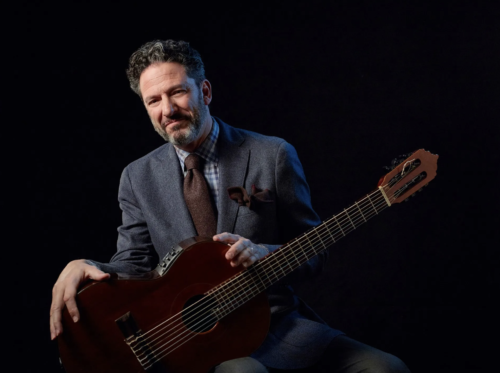
Kicking off the 10th Annual South Beach Jazz Festival is Grammy Award–winning guitarist, vocalist, and producer John Pizzarelli in a heartfelt salute to the legendary Tony Bennett at Faena Theater in two shows on Thursday, Jan. 8. (Photo courtesy of the artist)
The opening night feature on Thursday, Jan. 8, is “John Pizzarelli Presents ‘Dear Mr. Bennett.’ ” The Grammy Award–winning guitarist, vocalist, and producer presents two shows in a salute to the legendary Tony Bennett.
At The Bass Museum of Art on Friday, Jan. 9, Ricky Riccardi, director of Research Collections at the Louis Armstrong House Museum, two-time Grammy Award winner, and author of “Stomp Off, Let’s Go: The Early Years of Louis Armstrong” gives insight into the trumpeter’s artistry. Additional performances take place at the Miami Beach Bandshell, Collins Park and on Lincoln Road.
[See the full schedule here]
Founded by Power Access, a local nonprofit headed by R. David New and dedicated to disability awareness and providing opportunities for people with disabilities, the South Beach Jazz festival grew out of a desire to create a signature event rooted in quality and public engagement. “We’re a tiny organization that always wanted to do something very special, but has really kept it focused on the quality,” says Lori Bakkum, executive director of Power Access and the South Beach Jazz Festival.
That focus, paired with long-standing community partnerships, has allowed the festival not only to last, but to expand. “We’ve had support from the community, the business community and the municipality,” she says, “and those collaborations have made the difference.”
About five years ago, as the festival expanded, Power Access partnered with the Rhythm Foundation on music curation, aligning with another nonprofit deeply rooted in live music and public programming across Miami Beach.
In a city where cultural initiatives often appear and disappear with the seasons, reaching a ten-year milestone carries particular weight. It suggests a festival that both understands its environment and has earned its place within it.
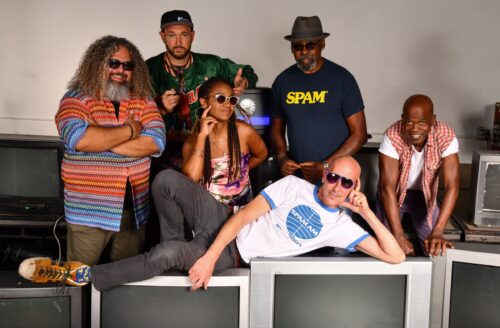
From left, Jose Elías, Chad Bernstein, Magela Herrera, Tomás Díaz, Andrew Yeomanson and AJ Hill of Spam Allstars. A longtime fixture of Miami’s music scene, the band brings its improvisational, genre-blending sound to this year’s South Beach Jazz Festival. (Photo by Jill Kahn)
That kind of longevity is not abstract in Miami Beach. Andrew Yeomanson, leader of the long-running local band Spam Allstars— the band will perform Sunday, Jan. 11 at 5:30 p.m. in a free concert on Lincoln Road —has watched entire neighborhoods transform in the span of a few years. “To last even five years in Miami as a band or an artist, that’s the first big hurdle,” he says. “There are so few institutions here that have truly stood the test of time.”
For Yeomanson, survival in Miami has required a particular posture toward change. “You have to dig your heels in and be really stubborn,” he says. He reaches for an image that feels both playful and precise. “You kind of have to be like Bugs Bunny: they’re building this big skyscraper, and he will not move his little rabbit hole. They just have to build around him.”
That stubborn persistence—refusing to disappear even as the city shifts—is one of the unspoken qualities the festival shares with many of the artists it presents.
One of the defining characteristics of the South Beach Jazz Festival is the way it is built into the city itself. Rather than confining performances to a single venue, the festival stretches across Miami Beach, activating some of its most recognizable public and cultural spaces. Lincoln Road, the Miami Beach Bandshell, The Bass Museum of Art and Collins Park each become part of the festival’s architecture, shaping how audiences experience the music.
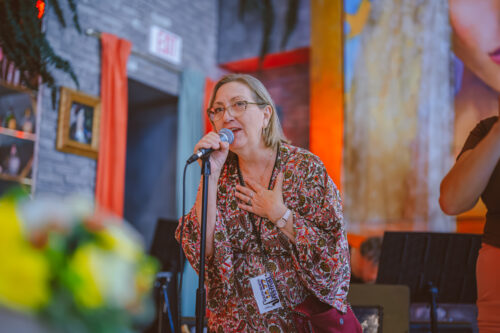
Lori Bakkum, executive director of Power Access and the South Beach Jazz Festival, speaks at a recent festival event. Founded by Power Access, the festival marks its 10th anniversary (Photo by MasterWing Creative Agency. courtesy of Lori Bakkum)
“Our venues are very specific and chosen,” explains Bakkum. “Lincoln Road, for those of us that have lived in Miami for years, really is the heart.” While student ensembles and emerging musicians take over nearby spaces the day before, the festival’s closing day transforms the Lincoln Road plaza into an all-day main stage.
At the other end of the city, the Miami Beach Bandshell hosts the festival’s marquee performances. “We’re very lucky to have our big headliner concert at the Bandshell,” says Bakkum. “Being under the stars—but covered—right there on the beach, it’s just a wonderful space to perform in.”
The Bass Museum of Art has also become a key partner, serving as both setting and collaborator turning the concert into a visual and cultural experience that feels uniquely Miami Beach.
For Yeomanson, that kind of use of public space is essential. “If you go to any world-class city, you’ll see the plazas activated,” he says. “It’s what makes cities human. It’s what makes a city a community.”
In Miami, he adds, that visibility matters even more. “We have this incredible tropical landscape, but it’s marred by traffic, cost of living—all of it. Culture is the release. It’s what makes a city livable. Even people who don’t realize they need it… they need it.”
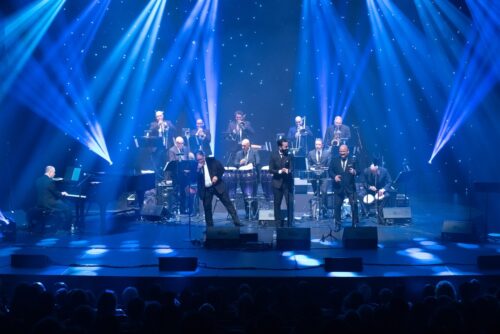
Three-time Grammy Award-winning Spanish Harlem Orchestra lights up the Miami Beach Bandshell for the 10th Annual South Beach Jazz Festival—joined by acclaimed trumpeter and Caribbean jazz master Etienne Charles on Saturday, Jan. 10. (Photo by George Pruitt, courtesy of South Beach Jazz Festival)
That openness would mean little without substance behind it. From its earliest editions, the South Beach Jazz Festival has emphasized curation over spectacle, assembling lineups that balance international recognition with local continuity. According to Bakkum, there will be “about a hundred artists performing in the 10th annual South Beach Jazz Festival from student bands to emerging artists to local legends to international and national stars and Grammy winners.”
Among those international figures is Spanish Harlem Orchestra, led by Grammy Award–winning pianist and arranger Oscar Hernández. Founded in 2001, the ensemble has earned global recognition for its commitment to classic salsa and Latin jazz traditions, shaped by Hernández’s decades-long career alongside figures such as Celia Cruz, Tito Puente, Rubén Blades and Johnny Pacheco.
“I was lucky to learn directly from so many of the musicians who shaped this music when I was coming up in New York,” says Hernández. “Their legacy lives on through my own music and performances.”
For Hernández, performing in this festival carries special resonance. “With the cultural diversity in Miami, that aspect of who we are and what we represent has an even more special meaning here.”
While select ticketed performances anchor the program, much of the festival has free admission— an increasingly rare model for an event of this scale. That approach has reshaped how audiences encounter jazz. Many experience it unexpectedly, stumbling upon performances while walking through Lincoln Road or spending an afternoon in Collins Park. “We have people that perhaps were visiting the city three years ago and happened upon our Lincoln Road stage and now they plan their vacations to come back for it,” says Bakkum.
Beyond the January dates, the festival’s reach now extends year-round. Through summer concert series and pop-up performances across Miami Beach, Power Access has created a sustained platform for live jazz, offering visibility to local musicians who often tour nationally but remain underheard at home.
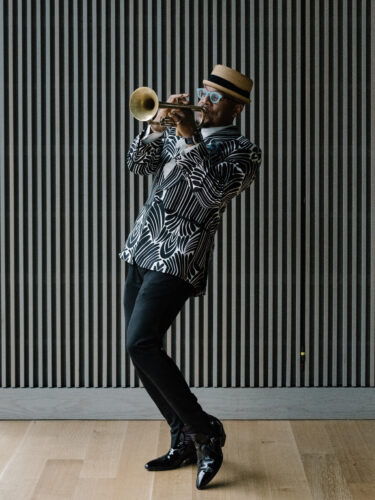
Trumpeter and Caribbean jazz master Etienne joins the Spanish Harlem Orchestra at the Miami Beach Bandshell for the 10th Annual South Beach Jazz Festival. (Photo by Jason Henry)
Recent years have not been easy for arts organizations, particularly small nonprofits. “It’s been quite a two years for cultural arts spending,” Bakkum says referring to the changing landscape in national, state and local government arts funding. Yet she also sees opportunity in the collective response. “What we saw was collaborations between arts groups and the community really recognizing how important the cultural arts are—not just culturally, but economically.”
For Yeomanson, the stakes are personal. He now sees second generations showing up at shows—children of people who once met at Spam Allstars gigs, or danced at weddings the band played years ago. “Your voice still has a place in your community,” he says. “That’s why these chances matter.”
After ten years, the South Beach Jazz Festival reflects that same belief. It survives not by resisting change, but by making room for connection—by trusting that what holds a city together is not only what gets built, but what endures.
“You can never have too much live local music,” says Bakkum.
In Miami Beach, that may be the most durable structure of all.
WHAT: South Beach Jazz Festival
WHEN: Opening night 8 p.m. Thursday, Jan. 8, at Faena Theater. 5:30 p.m., Friday, Jan. 9 at The Bass Museum of Art ; 8 p.m. Friday, Jan. 9 in Collins Park. Events 10 a.m. to 5 p.m. Saturday, Jan. 10, on Lincoln Road, with headliner performance 8 p.m. at the Miami Beach Bandshell. Events 11 a.m. to 9 p.m. Sunday, Jan. 11, on Lincoln Road.
WHERE: Various locations throughout Miami Beach, including Faena Theater at Faena Forum, 3300 Collins Ave.; The Bass Museum of Art, 2100 Collins Ave.; Collins Park, 2100 Collins Ave.; Lincoln Road and Euclid Avenue, including the plaza at 1100–1111 Lincoln Road and the Miami Beach Bandshell, 7275 Collins Ave., Miami Beach.
COST: Free to $275. Individual tickets start at $42.50. VIP Reception $75. All-Access Pass $275. Miami Beach residents receive a 20% discount on select ticketed events with code MB20. Many free events require RSVP.
INFORMATION: SoBeJazzFestival.com and (305) 322-6385.
ArtburstMiami.com is a nonprofit media source for the arts featuring fresh and original stories by writers dedicated to theater, dance, visual arts, film, music and more. Don’t miss a story at www.artburstmiami.com.
No posts found
An In-House Orchestra and Art Deco Vision Shape Florida Grand Opera’s ‘Die Fledermaus’
Written By Michelle F. Solomon
December 19, 2025 at 5:04 PM
Johann Strauss’s 1890s comedy of errors about love and hidden identities has been given a distinctly local twist in Florida Grand Opera’s production of “Die Fledermaus,” which has three performances at the Adrienne Arsht Center in Miami opening Saturday, Jan. 24, with shows Sunday, Jan. 25, and Tuesday, Jan. 27. (Photo courtesy of Florida Grand Opera)
For Florida Grand Opera, a new era is underway as artistic director Maria Todaro vows to keep her promise that she’s not presenting “your grandmother’s opera” with the upcoming reimagining of “Die Fledermaus.”
It’s what she said about her staging of FGO’s “Carmen” last season, which she conceived to be accessible to everyone. She brought in a new crowd who were drawn to a familiar name—a star attraction cameo, Julia Lemigova, “The Real Housewives of Miami” and married to tennis star Martina Navratilova, for which Todaro wrote in a part for the reality television show personality.
“We want to keep opera relevant and exciting – to draw young and more diverse audiences,” said Todaro, the daughter of Italian opera singer Jose Todaro and Brazilian mezzo-soprano Maria Helenda de Oliveira, who was named interim director of FGO in 2023. In May 2024, the board announced her as general director and CEO.
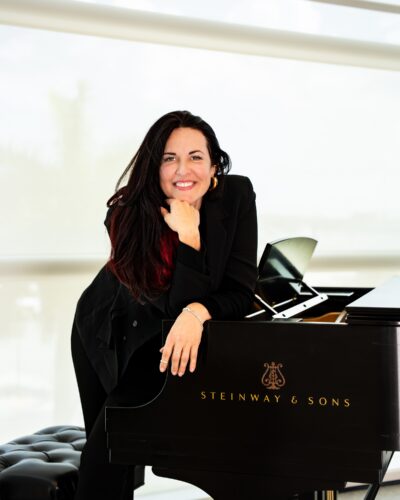
Maria Todaro was named interim director of FGO in 2023. In May 2024, the board announced her as general director and CEO. (Photo by Lewis Valdes)
It is her European pedigree and her own professional life in opera as a mezzo-soprano that is part of what drives her desire to have FGO—recognized as one of the oldest opera companies in the United States, continuously operating since 1941—to become what she calls a “true opera company, an international House.”
Part of what Todaro believes gives stature to the company is having its own resident orchestra. In May, Todaro announced Pablo Mielgo as its music director. Currently living in Majorca, he has been artistic and musical director of the Orquesta Sinfónica Islas Baleares since 2014.
Mielgo explained that the players in the pit for previous FGO shows were contracted. “It was an external orchestra and when I became director, we decided, with the board, to have our own orchestra. When the musicians are hired by the company, they are involved in the life of the opera company. They feel the growing, they feel the compromise, and they get close to the artistic side. Being involved in the life of the opera company, everyone knows that success depends on everyone’s work.”
Todaro agreed with Mielgo’s assessment of the orchestra’s buy-in and how the sense of ownership will add to fueling a great ambition: to make Florida Grand Opera a true international company.
A large part of that is building the in-house orchestra, which is integral to FGO’s latest and newest production of “Die Fledermaus,” which has three performances at the Adrienne Arsht Center, opening Saturday, Jan. 24, with shows Sunday, Jan. 25, and Tuesday, Jan. 27.
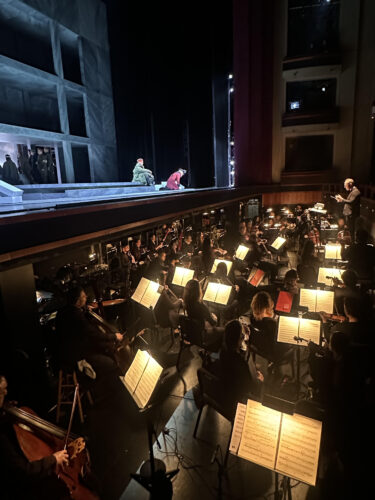
The in-house orchestra made its debut with the company’s most recent production, “Silent Night,” but “Die Fledermaus” will be the first time Pablo Mielgo and the FGO Orchestra perform together. (Photo courtesy of Florida Grand Opera)
The in-house orchestra made its debut with the company’s most recent production, “Silent Night,” but “Die Fledermaus” will be the first time Mielgo and his musicians will be together.
For Mielgo, born in Madrid, he said his connection to Miami is one “from many, many years ago. I have someone there who is a second mother to me,” he said of Tanya Capriles Brillembourg, the founder of SaludeArte Foundation, of which Mielgo has been the musical and artistic director since 2005. In 2011, when SaludeArte Foundation co-produced the zarzuela “Luisa Fernanda” with Florida Grand Opera, it was Mielgo’s first time leading the orchestra for FGO. The production featured legendary tenor Plácido Domingo, who sang the lead role for a special gala performance, with Mielgo conducting.
“The home base of SaludeArte Foundation is Miami, so I was traveling quite often to Miami to do music projects. I’d say it’s been about 22 years, so I know the city quite well, and I think Miami is a city that is changing all the time.”
He agrees that FGO should be the world-class opera company of a destination that, he said, is attracting so many international residents—many from Europe—who bring with them opera and classical music traditions that shape expectations for what is offered here.
Those expectations are exactly what the company is embracing in its upcoming production of “Die Fledermaus,” approaching the classic operetta with a fresh sense of creativity that reflects both its European roots and Miami’s contemporary, international character.
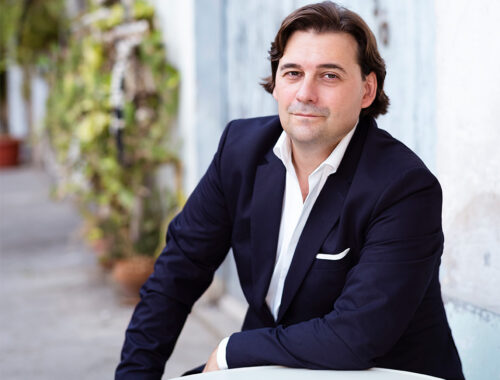
Pablo Mielgo was appointed music director for Florida Grand Opera as it introduces its own resident orchestra. (Photo by Lewis Valdes)
Johann Strauss’s 1890s comedy of errors about love and hidden identities has been given a distinctly local twist, revealed Todaro.
“There’s a lot of tradition in Viennese operetta, but we are changing that,” revealed Todaro. “In the place of the role of the Italian tenor, it is a Latino tenor. Everything that has foreign illusion is going to be Hispanic or Latino. That is a big wink to our population here,” she said.
The operetta’s success rests equally on the wit of its spoken dialogue as well as bringing out the brilliance of the music.
“We have completely rewritten the text,” said Todaro of the dialogue work she and stage director Conor Hanratty partnered on. “So it’s completely owned by us.”
The dialogue is in English while the sung part of the opera will remain in German with English and Spanish supertitles. “We wanted to be authentic and respect the German language. With the English dialogue, audiences can laugh at the jokes, so we have a little bit of both worlds,” explained Todaro.
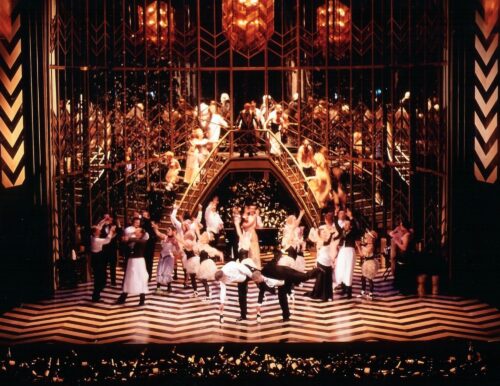
Designed by Belgian set designer Benoît Dugardyn, he created the Art Deco-inspired set for “Die Fledermaus” for the Glyndebourne Festival Opera in England. (Photo courtesy of Florida Grand Opera)
Another tip to Miami is an Art Deco set that the company recently acquired and now owns. “The set has a beautiful pedigree behind it,” said Todaro.
Designed by Belgian set designer Benoît Dugardyn, he created the Art Deco-inspired set for “Die Fledermaus” for the Glyndebourne Festival Opera in England. Todaro said it has “traveled all over the world,” making its debut in 2003 at Glyndebourne, performed by the Grand Théâtre de Genève.
FGO acquired it from the Washington National Opera at the Kennedy Center, whose production in 2003 featured celebrity cameos including then-Supreme Court Justices Stephen Breyer, Ruth Bader Ginsburg, and Anthony Kennedy.
Costumes, inspired by Austrian painter Gustav Klimt and designed by German costume designer Ingeborg Bernerth, were also acquired from Washington National Opera’s artistic director Francesca Zambello. “She was very generous with us. We are being faithful to the styles, but we are kind of readapting them.” Todaro describes the costumes for her “Die Fledermaus” as cool, bubbly, and accessible.
“And this is part of, as you know, our desire to not be your grandmother’s opera, to keep our promises and to keep us relevant.”
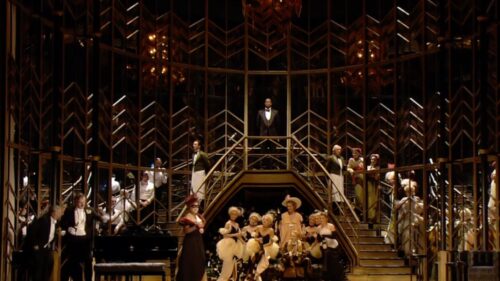
FGO acquired the set for “Die Fledermaus” from the Washington National Opera at the Kennedy Center. The production shown is the original production of
Glyndebourne Festival, performed by the Grand Théâtre de Genève in German and French. (Photo courtesy of Florida Grand Opera)
The Art Deco theme will carry through to a gala that FGO will host on opening night on the stage of the Arsht, with its “Die Fledermaus” set as the backdrop, where it will present its first Global Elevare Awards.
“We created this to recognize leaders whose work elevates communities,” said Todaro, adding that one of the recipients is the grandson of Nelson Mandela, Prince Ndaba Mandela, co-Founder and chairman, Africa Rising Foundation; co-Founder and chairman, Mandela Institute for Humanity. Other awardees include Joseph Fowler, head of arts and culture, World Economic Forum; Leigh Gilmore, global head, Bloomberg Live Experiences (Bloomberg Media); Afo Verde, chairman and CEO, Sony Music Latin Iberia; along with four others. Designing the award is Romero Britto, the Brazilian-born, Miami-based contemporary artist, adding to the Miami-influenced style of the event, said Todaro.
For Todaro, FGO’s transformation is more than just a new production or a new orchestra; it’s the foundation for the company to become a true international House. “More and more people are now becoming aware that we are here. We see there’s definitely a momentum. We still have much work and so much is happening in a good way… It’s good work . . . It’s great work,” she said.
WHAT: Florida Grand Opera’s “Die Fledermaus”
WHEN: 6:30 p.m., Saturday, Jan. 24, 3 p.m., Sunday, Jan. 25 and 8 p.m., Tuesday, Jan. 27.
WHERE: Adrienne Arsht Center for the Performing Arts, 1300 Biscayne Blvd., Miami
COST: $28- $306 includes all fees.
INFORMATION: 800-741-1010 or fgo.org
ArtburstMiami.com is a nonprofit media source for the arts featuring fresh and original stories by writers dedicated to theater, dance, visual arts, film, music and more. Don’t miss a story at www.artburstmiami.com.
No posts found
Bayfront Jazz Heads To Miami Beach with an All-Female Powerhouse Lineup
Written By Carolina del Busto
November 18, 2025 at 2:31 PM
Eve Blanche is one of the performers in Bayfront Jazz Days, a new national music series kicking off in Miami with an all-star “Women in Jazz” concert on Saturday, November 22, at the Miami Beach Bandshell. (Photo copyright Paramax Films, courtesy of Melrose Media)
Say the word “jazz,” and many instantly think of legends like Miles Davis, Duke Ellington, or Herbie Hancock. But over the years, jazz has evolved and grown into a much larger phenomenon.
“There are a lot of jazz performers in your face that you don’t even know are jazz musicians,” says saxophonist Lakecia Benjamin. “You don’t know that the best new artist Samara Joy is jazz. You don’t know that Robert Glasper is jazz, even though he’s playing all hip-hop stuff. You don’t know John Baptiste is jazz.” Even Beyonce’s entire band is made up of jazz musicians.
Benjamin will be in Miami on Saturday, Nov. 22 as part of the Bayfront Jazz Days, and while the Bayfront Jazz Festival was previously held at Bayfront Park, this edition is at the Miami Beach Bandshell. It’s an all-female lineup that includes bassist Nik West, Steinway artist Connie Han, and Taishogoto musician Eva Blanche.

The headliner of Bayfront Jazz Days Nik West knows how to bring the funk to jazz. (Photo by Natalia)
“I think people like jazz more than they know,” adds the musician speaking to ArtBurst via Zoom.
Organizers are hoping to put a spotlight on top female talent in the jazz genre with a specific focus on bringing new performers to Miami. In fact, one of the requirements for Amos Rozenberg and Manuel Molina of Melrose Media, the production house behind the festival, was that the musicians hadn’t played Miami.
“We wanted to feature masters of different instruments and each of these performers are leaders in their different fields of jazz,” says Rozenberg. “None of these four artists have ever performed in Miami before and that’s part of why we chose them, because we want to bring new energy to Miami. It’s going to be a great night full of energy, culture, and a lot of discovery.”
While saxophonist Benjamin might be new to playing in Miami, she’s a heavyweight in the jazz scene. A five-time Grammy award nominee, Benjamin has been playing the sax since fifth grade. She stepped into the music room and was in awe of the power of the woodwind instrument.
“I saw the saxophone up on the wall and at that moment, I was like, oh yeah, I’m totally gonna, play that,” recalls Benjamin.
The 32-year-old saxophonist grew up in the predominantly Hispanic neighborhood of Washington Heights in New York City. She credits the soundtrack of her youth to influencing her sound as an adult.

From the moment she first saw the saxophone, musician Lakecia Benjamin was in awe. (Photo by Elizabeth Letizell, courtesy of Melrose Media)
Dominican and Cuban music was “90% of the music I heard non-stop,” she says. “The whole goal was always to keep everyone on the dance floor. And that stayed with me, that music is something for the community, something to have a good time to.”
As part of her set, Benjamin promises the Grammy-nominated hits as well as new music she’s been working on. “Expect lots of high-energy, lots of audience participation, and above all, a kind of healing space for people.”
Another powerhouse performer sharing the stage at the Bandshell is former Prince bassist Nik West. Much like Benjamin, the Los Angeles-based musician attributes her upbringing to influencing her work. “A lot of fans say it’s kind of like funk-soul, but I feel like all my roots lead back to jazz and gospel,” says West.
She calls herself an out-of-the-box artist.
“So you’re going to hear all kinds of things from me that night, from funk to rock to jazz to soul,” continues West. “I like to call it a jambalaya of music. You’re going to get high energy, that’s what you’re going to get from me.”

Steinway piano artist Connie Han is jazz down to her bones with Variety calling her “one of contemporary jazz’s most talented and inventive musicians.
(Photo by Michael R. Pool, courtesy of Melrose Media)
While West is accustomed to performing in Europe and Asia, she’s looking forward to taking the stage in Miami. “I think this is a really good opportunity for all of us to perform in Miami for the first time.”
She hopes this is the first of many Miami appearances. . . “ ‘Wow’ some people, gain more fans, and eventually perform there again in the future. “I’m just excited about being able to have everyone hear and feel all of the things that jazz can be through my soulful, funky music,” adds West.
Jazz-lovers are getting four mini concerts for the price of one. The event starts at 4 p.m. with performances slated to run through 11 p.m.; that’s nearly seven hours of jazz.
The first edition of Bayfront Jazz Festival was in 2021 (at Bayfront Park) and featured major jazz players Roy Ayers, Dee Dee Bridgewater, Gonzalo Rubalcaba and Chucho Valdés. After that event, Rozenberg and Molina took a break from producing events and focused on making movies. Now, they’re back to putting on large-scale music concerts and are already planning next year’s Bayfront Jazz Festival.
Organizer Rozenberg gets animated when speaking about the upcoming event at the Bandshell. “It’s going to be a very exciting night because we’re bringing pure jazz to Miami… jazz is kind of niche, but niche is the new black.”
WHAT: Bayfront Jazz Days
WHERE: Miami Beach Bandshell, 7275 Collins Ave, Miami Beach
WHEN: 4 p.m., Saturday, Nov. 22.
COST: $93.73, $65, $39, for general admission. $29 for students. Tickets via DICE or bayfrontjazz.com.
INFORMATION: melrose.media/festivals or bayfrontjazz.com.
ArtburstMiami.com is a nonprofit media source for the arts featuring fresh and original stories by writers dedicated to theater, dance, visual arts, film, music and more. Don’t miss a story at www.artburstmiami.com.
No posts found
Florida Grand Opera’s ‘Silent Night’ Intersects Music, Memory and Reconciliation
Written By Miguel Sirgado
November 17, 2025 at 12:57 PM
Kevin Puts’ “Silent Night” presented by Florida Grand Opera at the Arsht Center in Miami opening Saturday, Nov. 15 with performances Sunday, Nov. 16 and Tuesday, Nov. 18 and then at the Broward Center in Fort Lauderdale on Thursday, Dec. 4 and Saturday, Dec. 6. (Photo courtesy of Lewis Valdes)
On a frozen battlefield in 1914, the sound of gunfire fell silent. Instead, across the trenches, soldiers began to sing—first in German, then in French, then in English. “Stille Nacht,” the carol we know as “Silent Night,” floated through the cold night air, joined by the drone of Scottish bagpipes. For a few miraculous hours, men who had been fighting one another laid down their weapons to share songs, prayers, and even a game of soccer.
That extraordinary true story of the World War I Christmas truce becomes the heartbeat of Florida Grand Opera’s “Silent Night,” opening Saturday, Nov. 15 with performances Sunday, Nov. 16 and Tuesday, Nov. 18 at the Adrienne Arsht Center in Miami, then at the Broward Center in Fort Lauderdale for two performances on Thursday, Dec. 4 and Saturday, Dec. 6.
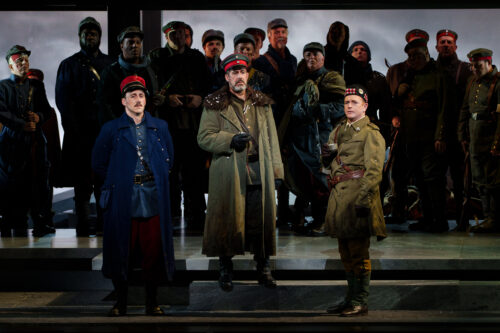
Alex DeSocio, Kyle Albertson, Andrew Garland, and the FGO Chorus in Florida Grand Opera’s “Silent Night” with performances in Miami and Fort Lauderdale. (Photo by Lewis Valdes, courtesy of Florida Grand Opera)
A co-production with Atlanta Opera and Opera Carolina, the sweeping work by composer Kevin Puts and librettist Mark Campbell transforms a fleeting moment of wartime humanity into an opera of intimacy, loss, and reconciliation. Supported by the embassies of England, France, and Germany, the production arrives at a historic moment for Florida Grand Opera: its first performances in 18 years with its own orchestra.
“We’re deeply honored to bring ‘Silent Night’ to South Florida,” says Maria Todaro, FGO’s General Director and CEO, “especially at a time when the message of unity and compassion feels more urgent than ever.”
For Todaro, the establishment of a dedicated orchestra represents both an artistic and institutional milestone. “When you look at major opera houses like Paris, Chicago, or Vienna, none of them operate without their own orchestra,” she says. “Every musician in ours has been hand-picked by our music director, Pablo Mielgo, and our concertmaster, Avi Nagin. Having our own orchestra completes the company and allows us to define our sound, our aesthetic, and our spirit.”
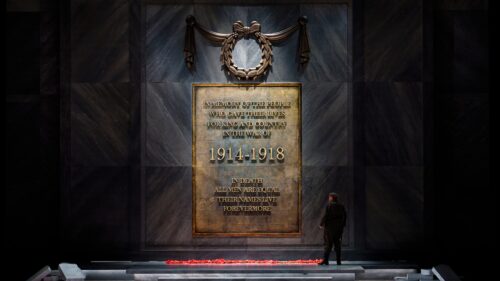
Baritone Joseph Canuto Leon in Florida Grand Opera’s production of “Silent Night.” The set was constructed in Cardiff, U.K., at the same facility that builds for the Metropolitan Opera. (Photo by Lewis Valdes, courtesy of Florida Grand Opera)
Opening during Veterans Month gives “Silent Night” an added dimension of meaning for the company and the community it serves. “This is more than an opera; it’s a tribute,” says Todaro. “The piece itself is phenomenal—uplifting, humane, and profoundly relevant. It also aligns with our new Voices of Wellness and Voices of Our Heroes initiatives, which focus on the mental health and well-being of veterans, first responders, nurses, and their families.”
For Kevin Puts, that sense of connection has always been at the core of “Silent Night.” Born in St. Louis and educated at the Eastman School of Music and Yale University, Puts won a 2012 Pulitzer Prize in Music for “Silent Night,” and a Grammy Award in 2023 for his triple concerto “Contact.”
“(Silent Night”) was my first opera, so I didn’t have any preconceptions,” says Puts. “I was simply looking for the most powerful musical expressions of chaos, peace, hope, and brotherhood. The battle scenes are dark and dissonant, while the moments when the soldiers think of home—their mothers, their sweethearts, the warmth of safety—are tender and intimate. The audience has to experience those contrasts as vividly as the characters do.”
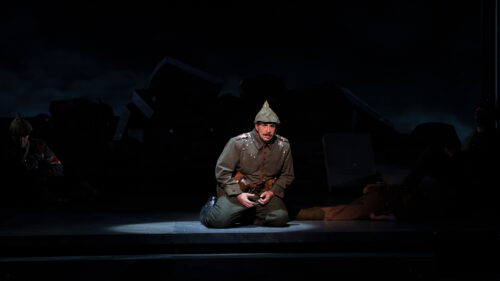
Kameron Lopreore, tenor, makes his house and role debuts with Florida Grand Opera in Tomer Zvulun’s production of Kevin Puts and Mark Campbell’s “Silent Night” as Nikolaus Sprink. (Photo by Lewis Valdes, courtesy of Florida Grand Opera)
That emotional polarity, he says, is what gives the work its enduring resonance. “These soldiers were just human beings caught in circumstances created by others. Once they stepped out of the trenches and met the men they were supposed to kill, they realized how absurd it all was. Once you know your enemy as a human being, it’s almost impossible to see them as inhuman again. That’s the core of the story.”
For stage director Tomer Zvulun, who has guided “Silent Night” through seven productions across two continents, that message of empathy feels as vital as ever. “What’s wonderful about this story is that it tells the human side of war,” he says. “The soldiers, their families, their deepest fears. The greatest fear of any soldier is not seeing the people they love again, and that’s also the greatest fear of those waiting at home. Ultimately, life is about love.”
Zvulun’s vision for this Florida staging draws inspiration from cinema—an homage to the 2006 Oscar-nominated film “Joyeux Noël” on which the opera is based. “To capture that rhythm, we’ve built a vertical set with multiple levels that moves seamlessly from bunker to bunker, trench to trench, across No Man’s Land without traditional scene changes,” he explains. “You follow the action almost like a camera moving through the battlefield.”
The sets, constructed in Cardiff, U.K., at the same facility that builds for the Metropolitan Opera—along with the period-accurate costumes crafted in Europe—give the production historical texture. “Every detail helps transport the audience into that world,” says Zvulun.
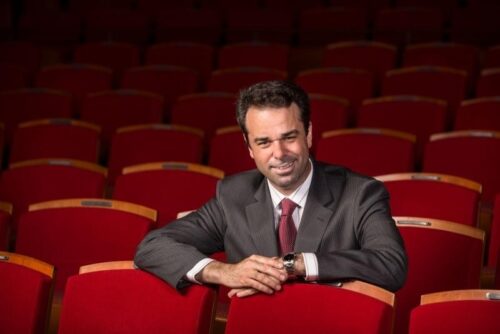
Director Tomer Zvulun leads Florida Grand Opera’s staging of “Silent Night,” composed by Kevin Puts with a libretto by Mark Campbell, performed in Miami and Broward counties. (Photo courtesy of Florida Grand Opera)
The collaboration between Florida Grand Opera, Atlanta Opera, and Opera Carolina deepens that impact. “This partnership reflects our international identity,” says Todaro. “Atlanta and Opera Carolina are our neighbors and wonderful partners. We joined forces to co-produce the work, sharing resources and costs. Other companies will likely rent this production in the future, benefiting all partners involved.”
The opera’s multilingual score—sung in German, French, English, Latin, and Italian—mirrors the cultural and emotional collisions of war. “Opera is already an art form of many languages,” says Zvulun, “but in ‘Silent Night,’ the music layers them like counterpoint. Different characters sing in different tongues, but the meaning converges. The music itself becomes the unifying force.”
Puts credits Campbell for that approach. “Writing in multiple languages makes the story more powerful,” he says. “You feel the separation between these soldiers—the distance created by language and nationality. And when the truce happens, those awkward, beautiful moments of connection become incredibly moving. Audiences respond to that struggle because it feels real. It’s about people trying to connect.”
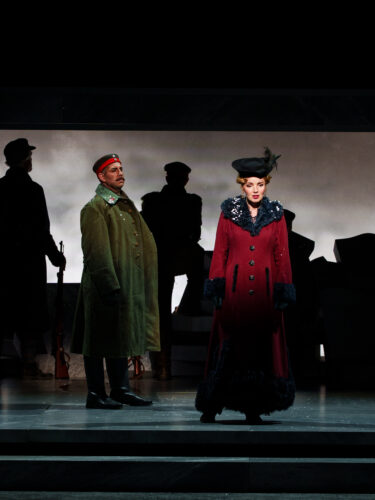
Kameron Lopreore as Nikolaus Sprink and Sarah Joy Miller as Anna Sørenson, in Kevin Puts’ Silent Night. (Photo by Lewis Valdes, courtesy of Florida Grand Opera)
At the opera’s emotional center lies the spontaneous Christmas truce, when soldiers emerge from their trenches to share carols, communion, and a game of soccer under the frozen stars. Zvulun calls it “the poetry of the battlefield.” “We use space, light, and motion to show the shift,” he explains. “You see soldiers move from attacking each other to sharing a cigarette or a piece of chocolate. Cold, harsh light gives way to the warm glow of Christmas. In the ‘Dona Nobis Pacem’ scene, the light itself tells the story.”
For Todaro, that transformation onstage mirrors the company’s own commitment to reconciliation and renewal. “‘Silent Night’ invites reflection,” she says. “It encourages audiences to see others with compassion, civility, and empathy—to rediscover our shared humanity. We’ve cried during rehearsals because it’s so beautiful and human. It’s a piece that heals while it moves.”
That healing, Puts believes, is inseparable from the music itself. “I’ve always thought of music as a place of sanctuary—a way to reach each other on the deepest level possible,” he says. Zvulun adds simply, “Music is medicine for the soul.”
WHAT: Florida Grand Opera presents Ken Puts’ “Silent Night”
WHERE: Miami: Adrienne Arsht Center for the Performing Arts (Ziff Ballet Opera House), 1300 Biscayne Blvd, Miami. Fort Lauderdale: Broward Center for the Performing Arts (Au-Rene Theater), 201 SW 5th Ave, Fort Lauderdale.
WHEN: Miami: 7 p.m., Saturday, Nov 15.; 3 p.m., Sunday Nov 16, 8 p.m., Tuesday, Nov. 18. Fort Lauderdale: 7:30 p.m., Thursday, Dec. 4 and Saturday Dec. 6.
COST: $22-$300.
INFORMATION: 1-800-741-1010 or fgo.org
ArtburstMiami.com is a nonprofit media source for the arts featuring fresh and original stories by writers dedicated to theater, dance, visual arts, film, music and more. Don’t miss a story at www.artburstmiami.com.
No posts found
North Beach Social: Curating Miami’s Global Sound at the Bandshell
Written By Jonel Juste
November 16, 2025 at 9:38 PM
The Miami Beach Bandshell glows with colorful projections as the Afro-Caribbean ensemble Senualo performs during the North Beach Social music series last December. The monthly music series is held each third Thursday of the month with free admission. (Photo by OS Photography Studio)
The North Beach Social, a free monthly music series held each third Thursday at the Miami Beach Bandshell, showcases the city’s rich cultural diversity through its programming. Upcoming dates include Thursday, Nov. 20, and Thursday, Dec. 18.
Organized by the Rhythm Foundation, the series employs a broad curation strategy that consistently features Miami-based artists working across international genres, including Indian fusion, Latin-funk, and Cumbia. By highlighting the array of local talent, North Beach Social positions itself as a venue where the region’s diverse global musical traditions intersect with the local arts scene.
For Laura Quinlan, program director at the Rhythm Foundation, the music series was conceived as “a free monthly meet-up for music-loving neighbors.” North Beach Social began in 2019 as an initiative of the Rhythm Foundation to present Miami artists “who are celebrating a milestone, releasing new music, getting ambitious with stellar new projects or collaborations.”
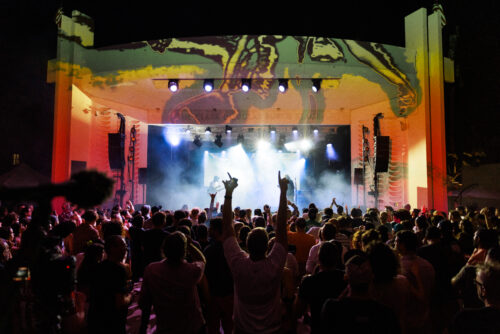
The Miami-based trio Jacuzzi Boys perform their signature blend of garage and surf rock during the North Beach Social music series at the Miami Beach Bandshell last July. (Photo by OS Photography Studio)
The event is part of the City of Miami Beach’s monthly Culture Crawl, a program that opens cultural venues for free on the third Thursday of each month. It encourages residents and visitors to explore the arts citywide. North Beach Social slots into this wider initiative as a regular stop in the cultural circuit.
In 2020, the pandemic intervened, and the series shifted into a livestream concert format, and in the current era it has reverted to a full-scale live event while continuing to support new work.
“The pandemic shutdowns could have easily paused the program,” says Quinlan, “but we wanted to keep it going for both artists and audiences. By moving online, we kept our connection to the neighborhood and gave local musicians a chance to keep performing.”
Since returning to the live format, the series remained centered at the Miami Beach Bandshell. “Through all of the incarnations, it has remained as our calling card to the neighborhood,” says Quinlan. “It’s a way to support the local music ecosystem, showcase Miami excellence, and also create great materials for our media initiatives.”
Quinlan notes that the Bandshell’s size requires artists who can attract sizable audiences and bring strong local followings. “The Bandshell is a pretty big space — we need to attract several hundred people in order to feel a good vibe inside the venue,” she says. While the performers are Miami-based, she adds that the programming is guided by a “world music” sensibility that reflects the Rhythm Foundation’s broader mission. “The Rhythm Foundation focuses on top world music, so I try to keep our programming within that feeling.”
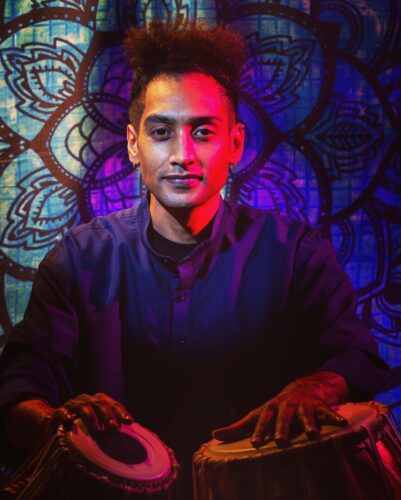
Rajesh Bhandari, bandleader of the Indian-fusion ensemble Navikaran Quartet, explains their concept: “We aim to keep one foot grounded in tradition while remaining flexible to explore new directions and sounds.” The band will perform at North Beach Social on Thursday, Nov. 20. (Photo by Fahad Abdullah)
That intentional curatorial strategy is evident in some of the past acts. “One of the strongest Miami scenes is the Latin-funk fusion. We have had fantastic experiences with bands like Suenalo, Afrobeta, Foom!. I have loved working with some young producers like Paperwater. I also loved recent rock shows, with amazing visuals, by Jacuzzi Boys, Las Nubes,” says Quinlan.
“We have done so much world traveling, without leaving town,” indicates Quinlan mentioning shows by Haitian artists such as Haitian konpa group Gabel and NSL Danse Ensemble, Brazilian nights, Indian music, salsa bands, French chanson, jazz, and so on. The lineup unfolds like a map of multiple diasporic and cross-cultural currents within Miami’s music ecosystem.
The season started with a performance by guitarist Diego Melgar in mid-October. It continues Thursday, Nov. 20, with the Indian-fusion ensemble Navikaran Quartet and in December with the cumbia collective Sonora Tukukuy.
The Navikaran Quartet combines instruments from both North and South Indian traditions (tabla, violin or sarangi, sitar or surbahar, and mridangam) creating a blend of rhythmic and melodic textures that bridge classical and contemporary sounds. They integrate electronic effects and synthesizers alongside classical Indian forms.
Bandleader Rajesh Bhandari explains their concept: “We try to approach this project with an innovative mindset by allowing the development of these compositions to have new avenues of expression through arrangement and collaboration. We aim to keep one foot grounded in tradition while remaining flexible to exploring new directions and sounds.”
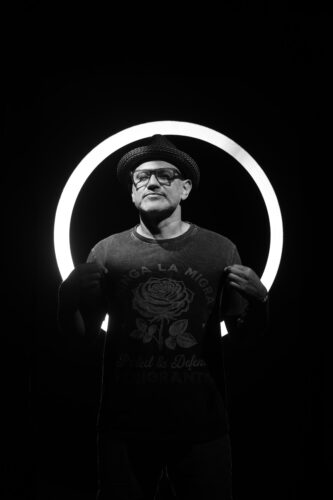
Gabriel Ayala, bandleader of Sonora Tukukuy, a cumbia group deeply rooted in Miami’s Allapattah neighborhood. The band will perform on Thursday, Dec. 18.(Photo by Giano Currie)
For the ensemble, appearing at North Beach Social provides a platform to reach the local South-Asian community while also engaging a broader eclectic audience. “We are committed as musicians to spread the joy of music and to celebrate cultural diversity by connecting with people of all backgrounds as well as with the large and diverse South Asian community in the area,” says Bhandari.
December’s lineup, Sonora Tukukuy, rooted in Miami’s Allapattah neighborhood, exemplifies another strand of the series’ curatorial reach.
“Tukukuy” means “the end” in Quechua, the language of the Incas. Their journey began in-house parties, progressed through clubs and festivals, and now includes national tours. “It sure has been a fast and wild ride,” says, Gabriel Ayala, the bandleader. “But this organic development of the collective has in many ways cemented the core direction we’ve had since the beginning: to celebrate the evolution of cumbia and its cultural impact in Miami, the United States, and the world, proudly made in Allapattah.”
On the broader significance of cumbia in the Miami-area experience, says Ayala, “Cumbia is the people’s music. It is a generous genre that invites people to celebrate and create community.” He continues, “Miami is a city of immigrants, and Cumbia is inherently attached to the immigrant experience. Cumbia is the soundtrack of our American dream.”
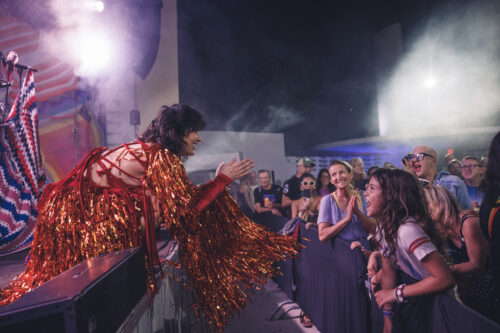
Afrobeta engages with fans during the band’s performance at the Miami Beach Bandshell in 2023, blending electronic beats with Latin-infused rhythms and theatrical flair. (Photo by OS Photography Studio)
Sonora Tukukuy’s December appearance coincides with the release of its new album and its second anniversary as a band.
North Beach Social has developed into a stable fixture within Miami Beach’s cultural calendar, according to Quinlan.
North Beach Social has developed into a stable fixture within Miami Beach’s cultural calendar, according to Quinlan. Its blend of neighborhood-scale accessibility and globally inflected music offers a model for how free public concerts might reflect both place and diversity.
WHAT: North Beach Social
WHEN: 8 p.m., Thursday, Nov. 20; Dec. 18, and every third Thursday of the month
WHERE: Miami Beach Bandshell, 7275 Collins Ave, Miami Beach
COST: Free but RSVP requested.
INFORMATION: (786) 453-2897 or miamibeachbandshell.com
ArtburstMiami.com is a nonprofit media source for the arts featuring fresh and original stories by writers dedicated to theater, dance, visual arts, film, music, and more. Don’t miss a story at www.artburstmiami.com.
No posts found
Kind of Blue: Tribute to Miles Davis Kicks Off Arsht Center’s Jazz Roots Season
Written By Helena Alonso Paisley
October 23, 2025 at 12:03 PM
The University of Miami Frost School of Music’s Henry Mancini Institute Orchestra joins a stellar cadre of solo musicians for “Kind of Blue,” celebrating the music of Miles Davis at the Adrienne Arsht Center on Friday, Nov. 7. (Photo by Daniel Azoulay, courtesy of Adrienne Arsht Center)
Trumpeter Miles Davis was the quintessence of cool. A musical icon as well as a cultural one, Davis took his place in the pantheon by ceaselessly seeking and often ushering in the “next thing” in jazz while steadfastly refusing to be anyone but himself.
Finding his footing in the bebop world in the late 1940s and early 50s, Davis would go on to reinvent his sound many times—to the consternation of many of his followers and the delight of others. To Davis, what the audience might want never seemed to enter into the equation. Throughout his 65 years on the planet, he would set his course of discovery, a renegade in a restless search for new, uncharted places that the music could take him.
With 2026 marking the centennial of Davis’s birth, the Adrienne Arsht Center is set to honor his legacy on Friday, Nov. 7 with “Kind of Blue.” Luminaries including trumpeter Ambrose Akinmusire, saxophonist Ravi Coltrane and vocalist Veronica Swift join Shelly Berg on piano and the University of Miami’s Henry Mancini Institute Orchestra for a tribute designed to kick off the 18th annual Jazz Roots season in true Davis style: innovative, improvisational and unrepeatable. (EDITOR’S NOTE: Days before the concert, artburstmiai.com learned that trumpeter Ambrose Akinmusire is unable to perform in the Nov. 7 concert due to an injury; he will be replaced by Trinidadian trumpeter Etienne Charles.)

It’s fitting that Ambrose Akinmusire would be playing at a tribute to the music of Miles Davis. Shelly Berg calls Akinmusire one of “the most innovative trumpet players in the world.” (NOTE: Due to an injury, Akimusire will be replaced by Etienne Charles for the tribute show,) (Photo courtesy of artist’s management)
Swift says shows like these, with musicians who are all busy soloists in their own right, are once-in-a-lifetime events, “not just for the audience, but for us as the musicians. It’s really just like a shot in time.”
In his nearly 20 years in Miami as dean of the University of Miami’s Frost School of Music and of all things jazz in this town, Berg has proven his knack for bringing unexpected combinations of great artists together under one roof. How does he go about assembling a line-up like the stellar ensemble he has put together for “Kind of Blue”?
“When it comes to a show like this, it’s, you know, how can we create magic? Who would come in and just be so compelling and work so well with the others and just make a great experience for the audience? And then it’s easy.”
Berg, whose talent on the ivories is matched only by his affable generosity of spirit, has 50 years’ worth of relationship-building to fall back on in this endeavor; he could create his own recording label just with his roster of award-winning former students. Players like Akinmusire, whom Berg taught when he was at the University of Southern California, and Swift, who graduated from U.M., would be high on that list.
“They were brilliant to begin with,” says Berg. As a teacher, he claims his job is “pretty simple. My job is to help them discover and realize their best selves.”

Shelly Berg, dean of the University of Miami School of music and all things jazz in Miami, will share the stage with two of his many brilliant former students: He taught Ambrose Akinmusire at the University of Southern California and Veronica Swift at the University of Miami. (Photo by Daniel Azoulay, courtesy of Adrienne Arsht Center)
“A lot of it is just helping them to understand not just the ‘what’ but the ‘why’ in how we perform. Why we play a song, why we play a phrase, why certain notes against certain harmonies create a certain feeling. And so, if I can help students get in touch with the why, which is what I try to do every time I teach, then as they mine that, they will go deeper and deeper into their own artistry.”
He encourages players to be expansive, to try out many styles, tempos and phrasings and, among the keepsakes and the discards, to find their own voice. Davis’s philosophy was not so dissimilar.
“You know, [Miles] was never happy hearing something that sounded like the same solo on a different night,” says Berg.
Davis spent his career sounding the depths of his protean creativity. An artist who once said, “It takes a long time to sound like yourself,” he wasted little energy looking in the rear-view mirror, but always had his eyes focused on the future.
Berg says that Davis also kept reinventing the art form.
“He started with Charlie Parker playing bebop in the 1940s, but by the 50s he was already helping usher in a whole different sound in jazz that was more cool, more modal, taking away the ornamentation and a lot of the virtuosity of bebop. He took that pretty far,” he says.
During this period, “Kind of Blue” was released. That was 66 years ago.
Berg calls it “lightning in a bottle.”

The daughter of bebop artists Stephanie Nakasian and Hod O’Brien, Veronica Swift says, “I grew up on the road with my parents, so like, green rooms and jazz clubs were very much a home and the music was very much a language.” (Photo by Amy Pasquantonino, courtesy of artist’s management)
“You have what was at that time the greatest small jazz group that had ever been assembled, bar none. Miles had a way of inspiring everybody to be their best and most authentic self,” he says. “You don’t find John Coltrane and Cannonball Adderley sounding like each other or Bill Evans. You find each of them contributing to this record as themselves.” In just two sessions, they recorded what is still the highest selling jazz record every year.
But Davis never rested on his laurels.
“From the ‘60s into the ‘70s, he started to usher in jazz fusion, which really hadn’t happened before.” Influenced by players like Jimi Hendrix, he released records like “Bitches Brew,” “bringing in electronics, electric trumpet and wah-wah pedals and effects…Then, you know, he continued on into more world influences with albums like ‘Tutu.’”
Berg promises that “you’ll hear every era of Miles on this concert.”
He is quick to point out, however, that Coltrane, who shares a centenary with Davis next year, will also be celebrated. In the tightknit jazz world of the 1960s, his status, too, was mythic. To saxophone players, it remains so to this day. His son, Ravi Coltrane, points to his father’s legacy as nothing short of transformative.
“He was able to, in a very short span of time…change 20th century music. He died when he was 40 years old.”
From 1955 to his death in 1967, Coltrane changed the course of Western music.
“Not everyone does that,” says Coltrane. “It doesn’t happen every generation.”
It was “the power of his own conviction,” says his son, that gave him his power as an artist and an innovator. And still, he was a regular man:
“You know, he wasn’t from another planet…He was one of us.” “One of us” with an outsized talent and an unwavering faith in his own inner vision.
“That’s what it’s really about in any creative pursuit: to really trust your instincts and have the courage to follow them,” says Coltrane. “That’s the biggest lesson that I think I’ve learned from him.”
When performing a John Coltrane or a Miles Davis invention, “The goal is not to try to recreate something from the past…it’s not about nostalgia,” he says. “It’s about finding a personal way to express the music, something that’s unique to the players that you’ll see today. We are honoring them, but at the same time we have to kind of honor ourselves in the same way they did.”

Ravi Coltrane is a phenomenal and innovative saxophone player in his own right, and as the son of John Coltrane, he provides a symbolic link to his father’s own tremendous musical legacy. (Photo by Erin O’Brian, courtesy of artist’s management)
Instinct, combined with trust, plus a deep well of technique and experience to draw from, will all come into play as this group of performers appears together for the first time on Nov. 7. Having studied the charts and talked about the shape of each piece, the “magic” that Berg mentioned will be in the improvisation, which can sometimes feel telepathic:
“You can’t make it happen; you just have to let it happen.” In that space, Berg maintains, the music “is more received than given.”
For Coltrane, “the real goal is to try find the common ground and really connect as players, you know, and that’s very exciting when that happens.”
Veronica Swift relishes the challenge.
“The essence of jazz, I think, that sets it apart from most other genres is that improvisational nature, which for me stands for freedom,” she says.
WHAT: “Kind of Blue: Celebrating the Music of Miles Davis,” the opening concert of Jazz Roots 2025-2026 featuring Ambrose Akinmusire, Shelly Berg, Ravi Coltrane, Veronica Swift and the Henry Mancini Institute Orchestra.
WHEN: 8 p.m., Friday, Nov. 7.
WHERE: Adrienne Arsht Center for the Performing Arts, 1300 Biscayne Blvd., Miami
COST: $52.65 – $152.10, inclusive of fees
INFORMATION: 305-949-6722 or arshtcenter.org/jazz
ArtburstMiami.com is a nonprofit media source for the arts featuring fresh and original stories by writers dedicated to theater, dance, visual arts, film, music, and more. Don’t miss a story at www.artburstmiami.com
No posts found



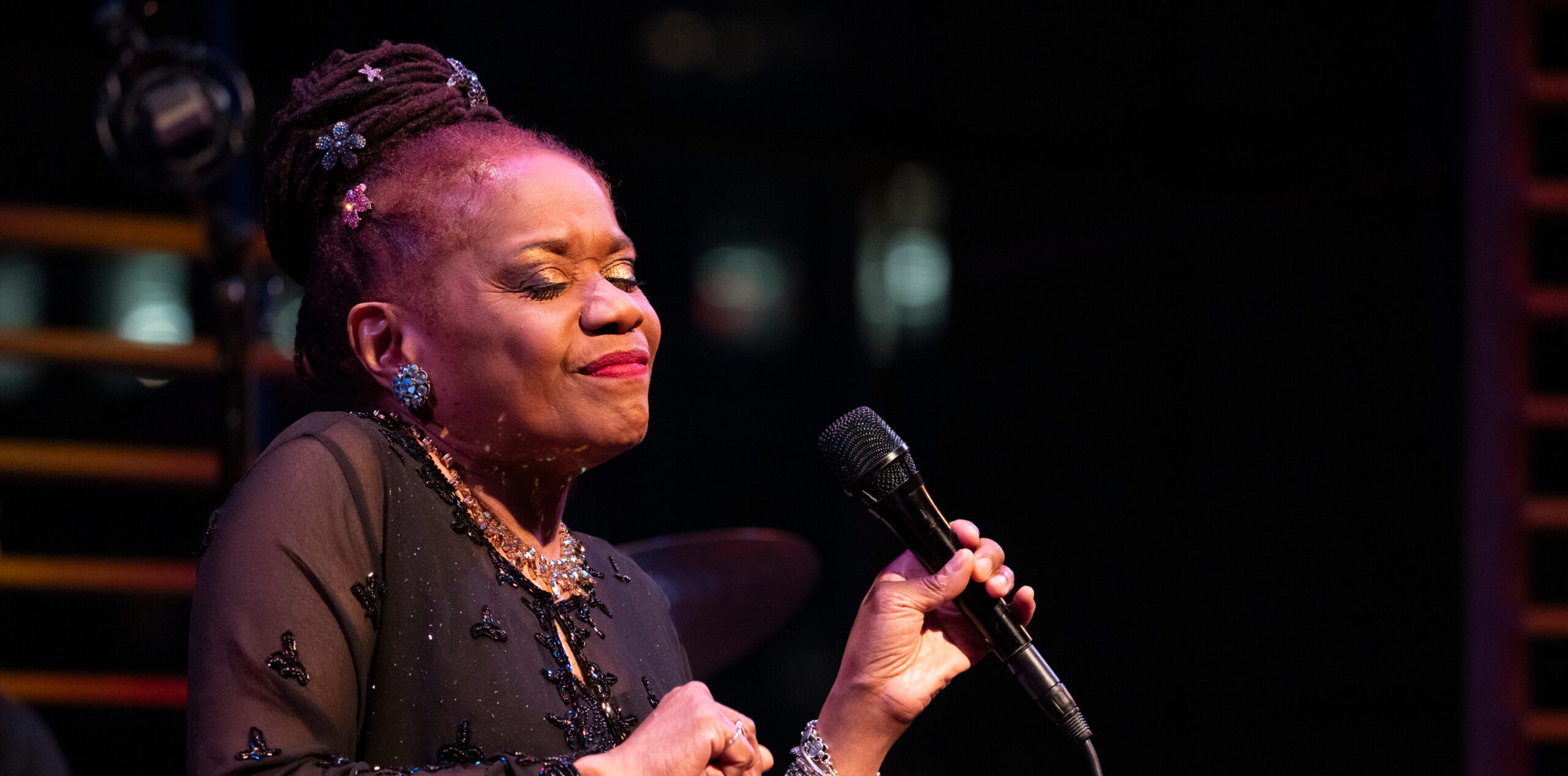


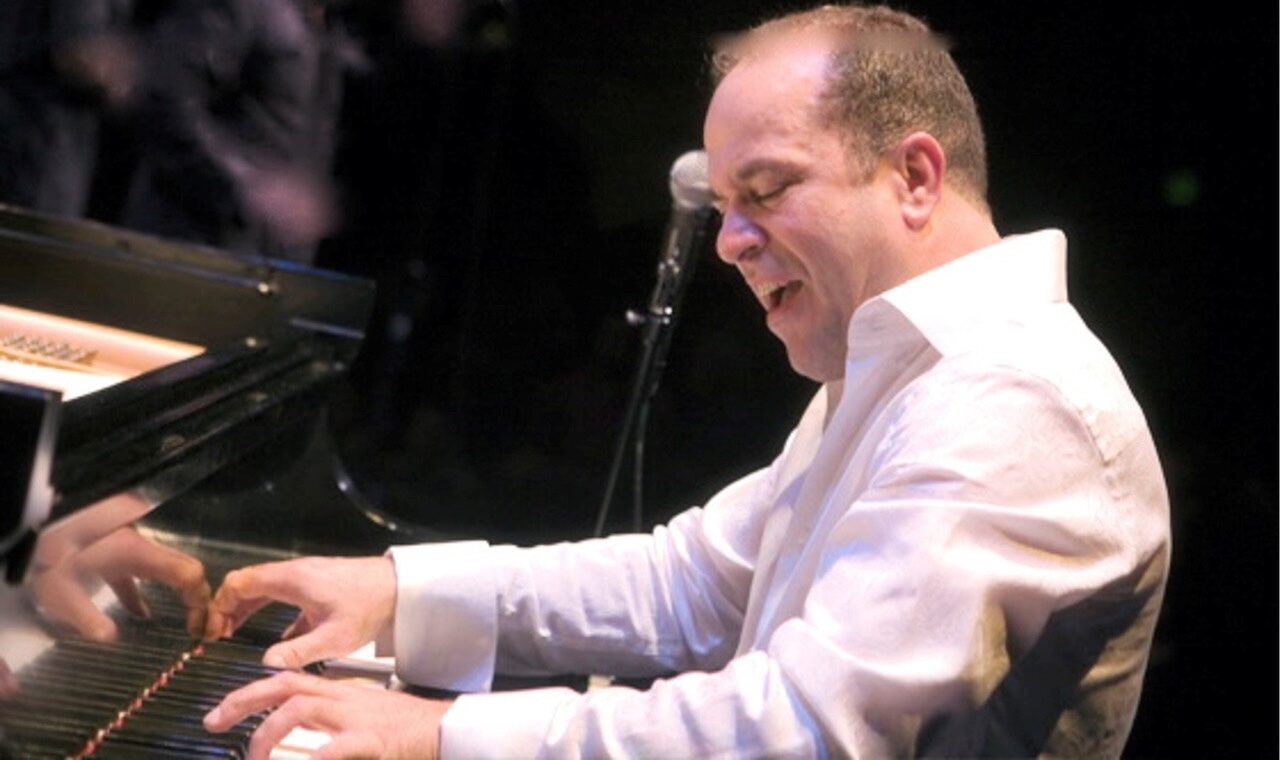


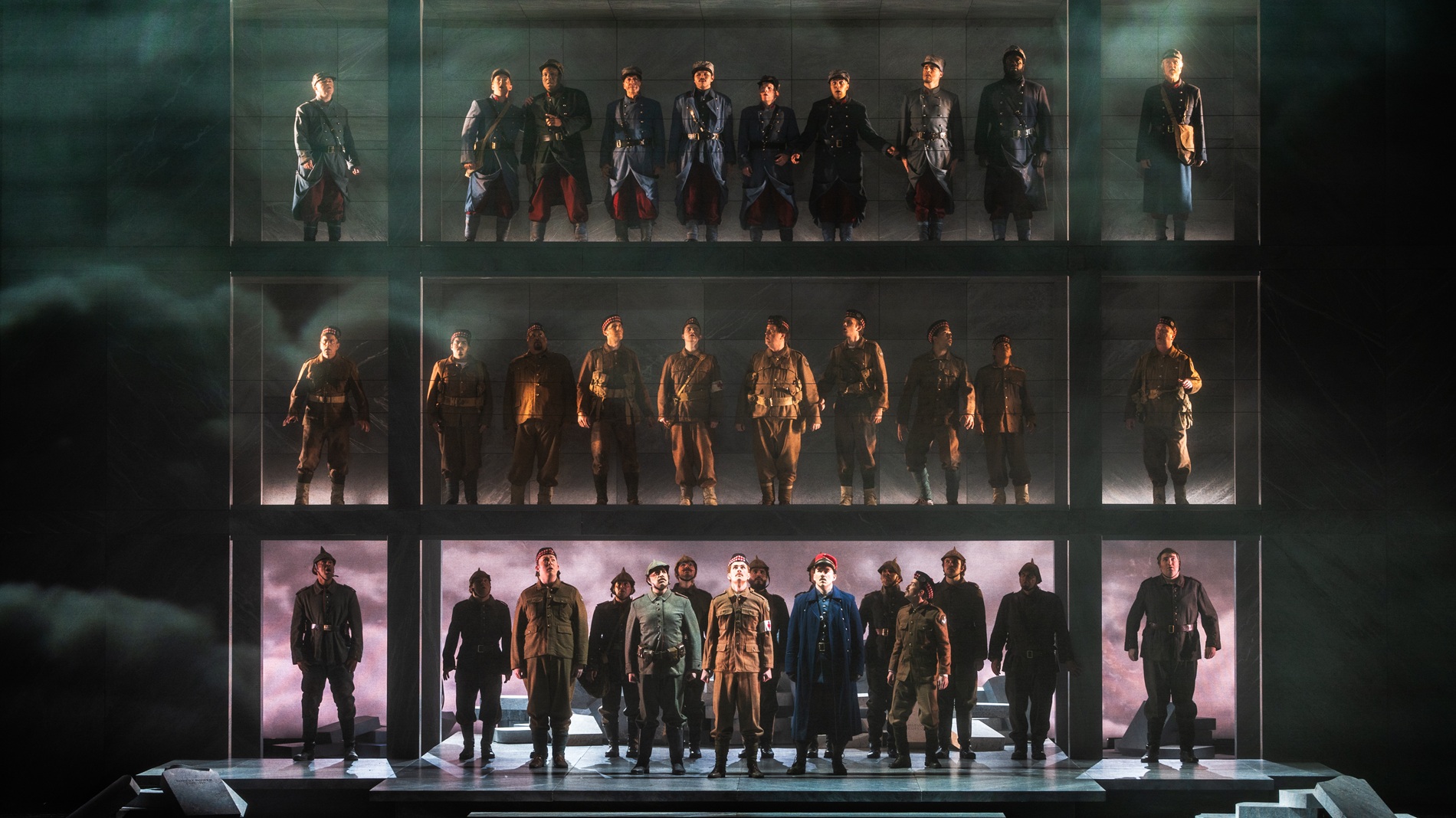
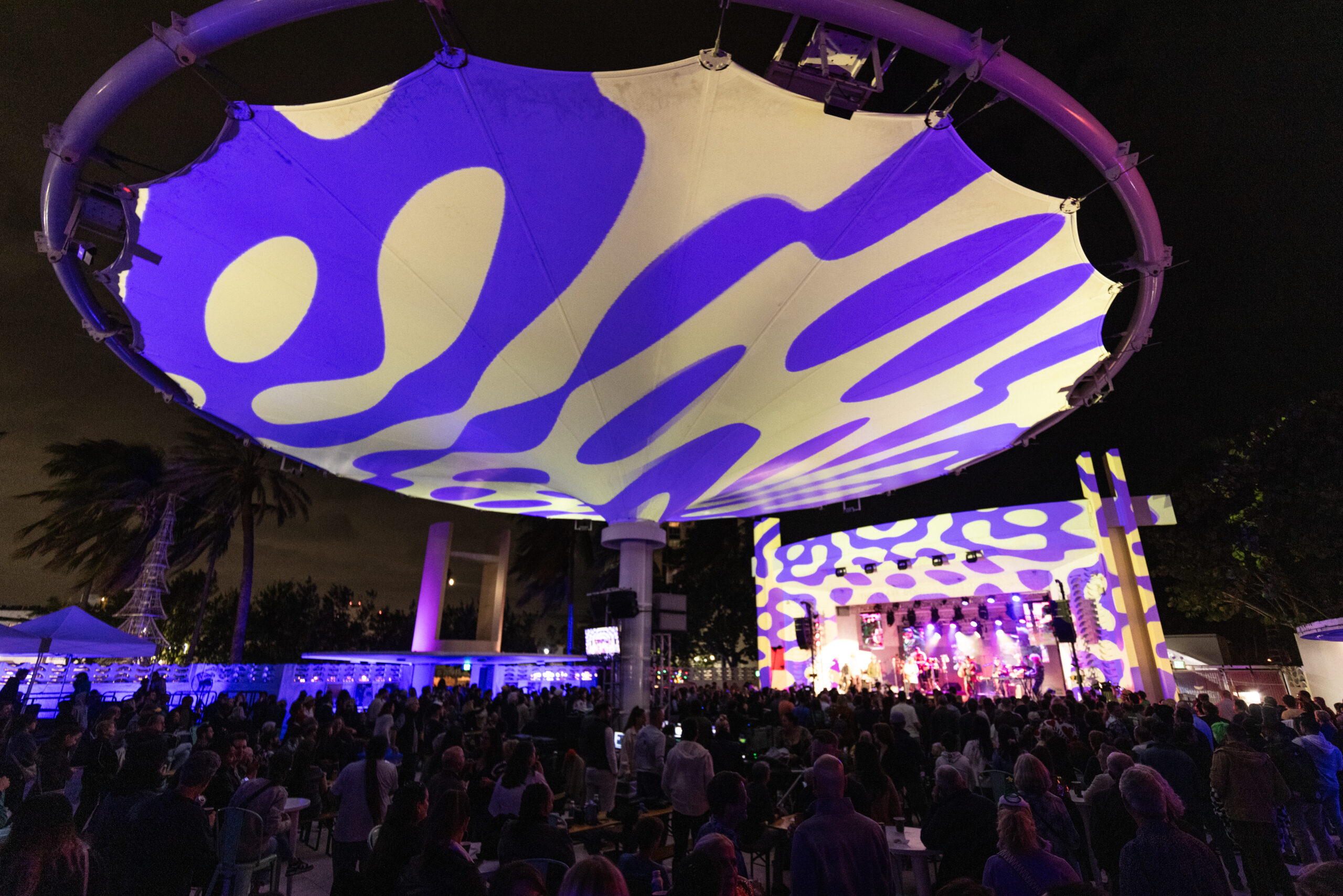

Recent Comments