Blog Article Category: Music
FGO Joins Opera and Pro Sports in a Musical Crossover in Miami
Written By Jocheved Cohen
April 30, 2026 at 12:31 PM
Jazz guitarist and former New York Yankee Bernie Williams and tenor Jonathan Tetelman, shown in photo at Carnegie Hall, are bringing their music to Miami in a collaboration with Florida Grand Opera on Wednesday, May 6. (Photo by Bill Menzel, courtesy of FGO)
Opera lives in formal concert halls steeped in centuries old repertoire, while sports thrives on stadium noise, locker room, and competitive intensity.
On Wednesday, May 6, at the Adrienne Arsht Center in Miami, the two worlds will share a stage.
Florida Grand Opera is partnering with AllStar Encore, a project founded by former baseball player, attorney, and opera singer Adam Unger, for a one-night performance that brings together opera tenor Jonathan Tetelman, former New York Yankee and guitarist Bernie Williams, music icon Willy Chirino, and the Pro Players Group, NFL alumni who traded the locker room for the vocal arena.
Miami audiences will see an extension of what Williams and Tetelman performed together at Carnegie Hall in Ungar’s AllStar Encore this past January. The tested pairing will now be expanded for a Miami audience, blending operatic arias with Williams’ own compositions and guitar work.
The Williams-Teteleman performance is expected to hew closely to the Carnegie Hall selections which include Williams backing up Tetelman on the aria “E lucevan le stelle,” from Giacomo Puccini’s opera “Tosca,” along with “La donna è mobile,” from Guiseppi Verdi’s “Rigoletto.”
Williams, who played 16 seasons with the New York Yankees before turning fully toward music, has built a second career as a guitarist and composer. For him, the connection between disciplines is less surprising than it might appear.
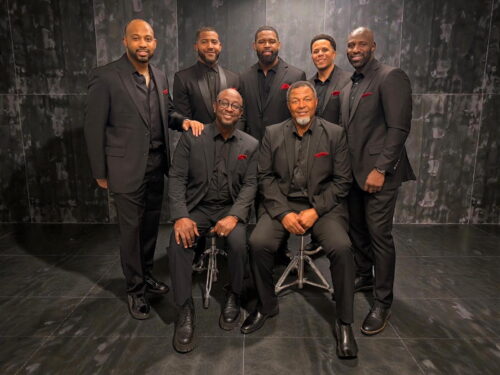
The Pro Players Group members have traded their jerseys for the microphone. From left to right, standing Nathan Palmer, Cam Newton, Keshun Freeman, Olrick Johnson, Bryan Scott. Seated are Demarcus Williams and Stephen Pierce. (Photo by Skyler Pierce, courtesy of FGO)
He learned guitar at 8 years old, attending a performing arts high school in his native Puerto Rico before pursuing baseball. Once retired his efforts focused on serious guitar work, study and performance. He earned a bachelor’s of music degree in 2016 from the Manhattan School of Music. “I always thought of music as an integral part of my life,” he says, noting a step-by-step progression into performance. “It just happened organically.” Williams composes original works, and his 2009 contemporary jazz album “Moving Forward” was nominated for a Latin Grammy.”
When approached by Unger to partner with tenor Tetelman, Williams was in. “I thought it was a great opportunity,” he says. This, despite not intimately knowing the opera repertoire, though his studies gave him a classical music grounding.
“You have the same attitude about both disciplines,” Williams says. The focus must be on hard work, practice, learning the fundamentals and doing the work.
Unger also discovered another partnership based in like mindedness with Maria Todaro, general director of Florida Grand Opera.
“She was the first person in opera who really believed in my idea,” says Ungar, who has been pondering for a decade about matching musically inclined athletes with vocal artists. With Todaro’s enthusiasm and input the idea crystalized. “Now a serious opera company wanted to do it,” Unger says.
Todaro believes the mix of sports and opera makes sense.
“It’s not a very different language,” just a different expression. And both unite people, she says. “We have a similar mission of communication.”
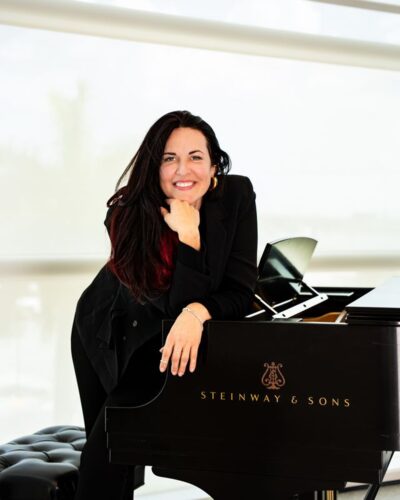
Maria Todaro, Florida Grand Opera General Director, has been at the helm of the organization since 2023. (Photo by
Lewis Valdes, courtesy of FGO)
For Opera & AllStars, Todaro said she seized the chance to build wellness initiatives into the artistic foundation. “There is a second, deeper layer.”
The other draw of the night, is the Pro Players Group, an inspirational choir of former NFL players who perform gospel, soul, Pop, and R&B. They launched in 2024.
“It happened organically, the guys collectively started the group,” says Cam Newton, best known as a safety with the Atlanta Falcons and the Carolina Panthers, and a co-founder of Pro Players. “It is not unheard of for players – many of whom grew up in the church – to sing in the locker room.”
Co-founder Olrick Johnson, a former linebacker with the New York Jets and New England Patriots, says “our main thing is to let people know you can have more than one gift.”
Todaro hopes those who have never been to the opera come away enthused, comparing it to when someone first tastes an unfamiliar dish. “Just have a little bite,” she said. “Then have another.”
WHAT: Opera & AllStars
WHEN: 8 p.m. Wednesday, May 6
WHERE: Knight Concert Hall at the Adrienne Arsht Center for the Performing Arts, 1300 Biscayne Blvd., Miami
COST: $135, $120, $95, $75, $50 and $25
INFORMATION: (800) 741-1010 or https://fgo.org/season25-26/opera-and-all-stars/
ArtburstMiami.com is a nonprofit media source for the arts featuring fresh and original stories by writers dedicated to theater, dance, visual arts, film, music, and more. Don’t miss a story at www.artburstmiami.com.
No posts found
Michael Tilson Thomas, New World Symphony co-founder and a defining force in Miami arts, dies at 81
Written By Michelle F. Solomon
April 23, 2026 at 11:13 AM
Michael Tilson Thomas, the visionary conductor who co-founded the New World Symphony, died April 22, 2026 at the age of 81(Photo by Alex Markow, courtesy of New World Symphony)
Michael Tilson Thomas, the visionary conductor who co-founded the New World Symphony and helped shape Miami Beach into an international center for classical music along with the New World Center as a landmark, died April 22, 2026. He was 81.
Tilson Thomas, widely known as MTT, had been living with glioblastoma, an aggressive form of brain cancer he publicly disclosed in 2021. In the years that followed, he continued to conduct, mentor and return to Miami, even as the illness forced him to scale back his appearances.
In February 2025, he shared that the tumor had returned.
“Three years ago, I wrote to tell you that I’m battling glioblastoma,” he wrote in a letter to supporters. “The three and a half years since the initial diagnosis have been a special time in my life …”
He announced then that he would lead his final performance with the San Francisco Symphony in April 2025, adding, with theatrical aplomb: “At that point, we all get to say the old show business expression, ‘It’s a wrap.’ ”
That sense of a closing chapter was already being felt in Miami.

Michael Tilson Thomas stepped down as artistic director in 2022 after announcing he had undergone treatment for glioblastoma multiforme, an aggressive form of brain cancer. (Photo courtesy of New World Symphony)
Tilson Thomas had been scheduled to conduct two weekends of concerts with the New World Symphony in March and April 2025. He led the first, including Beethoven’s Symphony No. 5 — the same work he conducted at the orchestra’s inaugural concert in 1988 — a full-circle moment that underscored his deep connection to the institution.
But he withdrew from the second weekend.
The concerts went on in his honor.
For more than three decades, Tilson Thomas was the guiding force behind the New World Symphony, the postgraduate orchestral academy he co-founded in 1987 with Ted and Lin Arison. What began as an ambitious training orchestra became a global model — a place where performance, education and innovation were aligned.
Under his leadership, the New World Symphony grew into what he often described as a laboratory for how music is taught, presented and experienced. Its fellows — more than 1,300 alumni — have gone on to major orchestras around the world.
“He has shaped not only this remarkable institution but also the artistic landscape of our city,” Howard Herring, the organization’s president and CEO who is retiring this year, said at the time of Tilson Thomas’ final performances. “His vision, mentorship, and boundless energy have nurtured generations of musicians.”
Tilson Thomas stepped down as artistic director in 2022 following treatment for the disease, taking on the title of artistic director laureate. That same year, Stéphane Denève was named only the second artistic director in the organization’s history.
Still, Tilson Thomas remained closely tied to the place he built.

Michael Tilson Thomas conducting the New World Symphony in his farewell to the 2023-2024 season. (Photo by Alex Markow/courtesy of the New World Symphony)
From its early performances across Miami to the purchase and restoration of the Lincoln Theatre, and later the creation of the Frank Gehry-designed New World Center, which opened in 2011, his imprint on the city remained artistic and physical.
Even the orchestra’s signature WALLCAST® concerts — projections in SoundScape Park that bring performances to the public for free — reflected his belief that classical music should be accessible to all.
Born Dec. 21, 1944, in Los Angeles, Tilson Thomas rose to international prominence as a conductor, serving as music director of the San Francisco Symphony for 25 years and holding titles with major orchestras around the world. But his legacy in Miami remained singular: an institution designed not just to sustain classical music, but to move it forward.
His personal life was closely intertwined with his work. He married his partner, Joshua Robison, in 2014. In his final public letter, he reflected on their life together.
“Our home is filled with memories of a full life,” he wrote.
A year after the letter he shared about his tumor returning, his partner died in his sleep on Feb. 22, 2026 at the age of 75. The two had been together since 1976. According to the San Francisco Chronicle, Robison had been recovering from a fall, which happened in August of 2025.
Tilson Thomas had closed the letter of his tumor returning by explaining the musical idea of a coda — the passage that brings a piece to its end.
“A coda can vary greatly in length,” he wrote. “My life’s coda is generous and rich. Life is precious.”
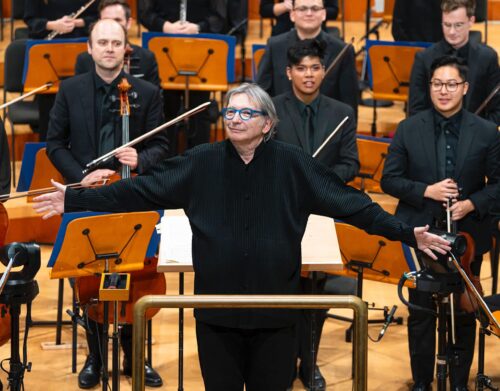
Michael Tilson Thomas and the New World Symphony.( Photo by Alex Markow, courtesy of New World Symphony)
The maestro’s legacy endures beyond the New World Center through the New World Symphony he built and the Fellows it continues to send into orchestras worldwide.
On its website announcing Tilson Thomas’ death, NWS called MTT “a creative risk-taker, powerful communicator and independent thinker.”
Herring stated: “MTT was a master of wrestling a dream into reality. He coached us all in the process. First the dream, then the hard work—of mastering a piece of music, of building a career, of establishing an institution. One of MTT’s most profound ideas was the New World Symphony, where the imagined future meets the hard work, every day. After 38 years, it is clear that MTT’s concept of an orchestral academy is here to stay. We celebrate his artistry and his persistence, personal qualities that have guided us to this moment and will fuel us going forward.”
On Thursday, April 23, from 8 p.m. to midnight, New World Symphony will project a tribute video and photo onto New World Center’s 7,000-square-foot exterior wall at 500 17th St, Miami Beach,
ArtburstMiami.com is a nonprofit media source for the arts featuring fresh and original stories by writers dedicated to theater, dance, visual arts, film, music, and more. Don’t miss a story at www.artburstmiami.com.
No posts found
Live music for a day at the beach: Welcome to the Bandshell BeachClub
Written By Fernando Gonzalez
April 19, 2026 at 9:35 PM
Founded in 1973, the Peruvian group Los Mirlos pioneered the sound of psychedelic Amazonian cumbia. Los Mirlos performs as part of the two-day Bandshell BeachClub on Saturday, April 25, at Miami Beach Bandshell. (Photo by Osmany Torres, courtesy of The Rhythm Foundation)
The beach and live music are a natural combination – especially if it’s Miami Beach and a soundtrack that tickles and soothes with grooves from around the world. Welcome to the Bandshell BeachClub, a two-day festival presented by the Rhythm Foundation and Brazilian producer Henrique Fares Leite, at the Miami Beach Bandshell.
The Bandshell BeachClub is from 3 to 11 p.m., Saturday, April 25 and Sunday, April 26.
“We have a lot of new energy at the Rhythm Foundation, new people, and a lot of new things going on, and we’ve been wanting to launch a signature festival that builds on our history of programming international music, and takes advantage of the things that make the Bandshell so special,” said Laura Quinlan, program director at the Miami Beach-based Rhythm Foundation, which has been managing the Bandshell since 2015.
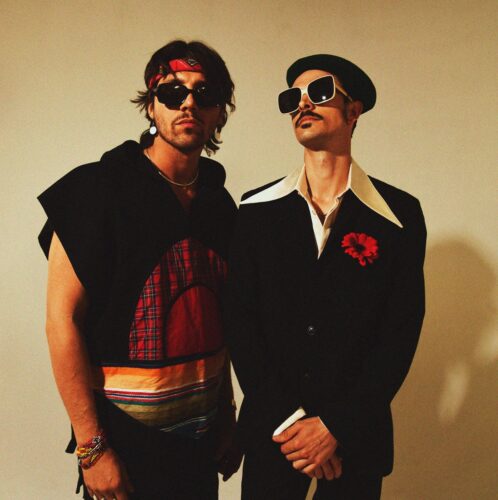
The duo Rio Kostas, multi-instrumentalists Mike Del Rio and Kosta Galanopoulos, draw from Latin music, soul, funk, psychedelic rock, and folk. They will appear at the Bandshell BeachClub on Sunday, April 26. (Photo by Aristotle Galanopoulos courtesy of the artists)
Quinlan says the TransAtlantic Festival, from 2003 to 2018, was a game changer for the organization.
“It was transformational . . . because it really helped define our audience and our curatorial voice in many ways. So, for us, the Bandshell BeachClub is, in some ways, TransAtlantic 2.0. We have a long history of presenting great international music and putting together programs with creative juxtapositions, and a festival is a great platform to do those things.”
For Fares Leite, who for more than 15 years worked in the digital world at places such as ByteDance/TikTok, Deezer Music and Microsoft before refocusing to produce festivals in Brazil, the idea of a Bandshell BeachClub festival started from a personal want.
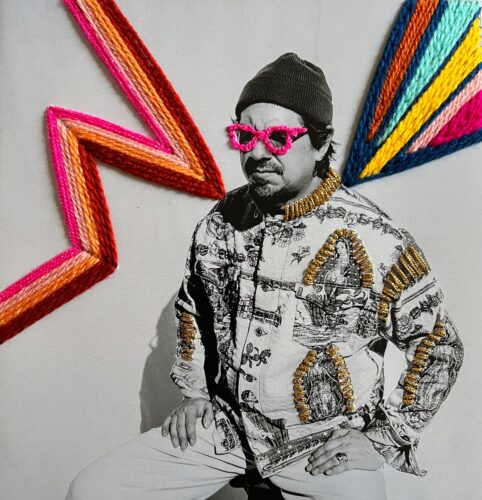
Black Pumas’s founder Adrian Quesada brings his blend of funk, soul, psychedelia, and Latin grooves to the Bandshell BeachClub joining Boogarins on Saturday and performing a DJ set on Sunday. (Photo by Jackie Lee Young, courtesy of the artist)
“A lot of times I’d be in Miami and want to do some cultural musical discovery, but at the same time, the day is beautiful and you want to go to the beach,” he says. Connecting an important cultural space like the Bandshell to the beach culture made sense,” Fares Leite says.
“I’ve heard a lot of great music at the Bandshell. So, this was also a way to highlight the unique position of the Bandshell in Miami Beach’s cultural scene by having something that can’t be reproduced anywhere else.”
What’s different from the TransAtlantic Festival, says Quinlan, is a dedicated beach lounge area that will be included with every ticket and re-entry through 7 p.m.
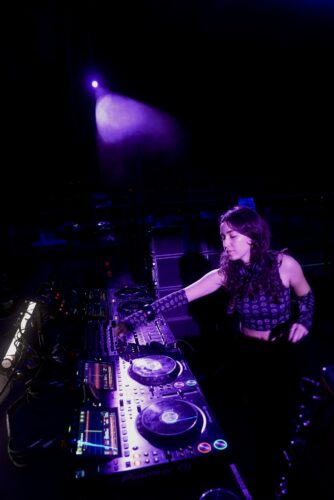
London-born and Miami-raised, Nikita Green, music manager of Miami Beach’s Bey_Bey, blends funk, electro, house, and ’80s/’90s dance hits. The deejay spins at the BeachClub on Sunday. (Photo courtesy of the artist)
“I believe that Miami Beach is the best urban beach in the world,” she says. “And it’s steps away from our venue. So why not create a festival that unites beach culture with great international music? So, you can go out for a little swim and come back,” adding that a partnership with the company who manages beach concessions are providing beach chairs and umbrellas plus beach games for festivalgoers.
The program features Sudan Archives (aka Brittney Parks) a Nu R&B, hip hop, and electronica singer-violinist and songwriter; Los Angeles–based duo Rio Kosta, Peruvian Amazonian cumbia group Los Mirlos; Brazilian psychedelic band Boogarins; Black Pumas’ Adrian Quesada, and English musician and composer Leifur James, who will be making his debut in the United States.
Fittingly for a music festival in Miami Beach, which has long been home to an influential electronic music scene, the event has a strong presence of deejays, including London-born, Miami-raised Nikita Green, Dude Skywalker, DJ Sombra, and DJ Danny Buckwell.
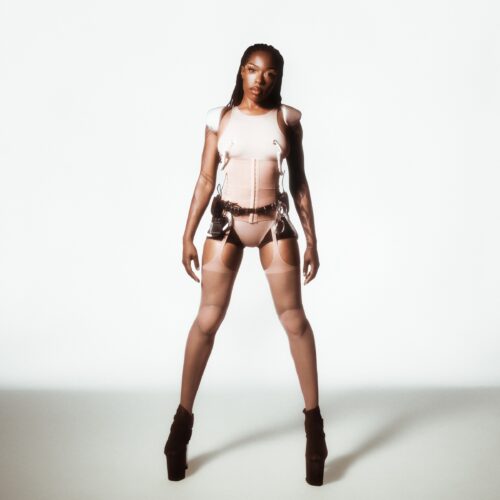
Self-taught violinist, singer, songwriter, and producer Sudan Archives, aka Brittney Parks, brings strains of R&B, hip hop, electronica and the fiddling style of West Africa to Bandshell BeachClub on Saturday. (Photo courtesy of the artist)
Fares Leite calls it “a discovery festival and not a traditional music festival.”
While the accent is in electronica, “one that leans more into a chill beach vibe and less into the club scene,” he notes, the overall program suggests a global vision that stays true to the Rhythm Foundation’s history as it reflects the diversity of South Florida.
“The idea is that we can really tap into different communities in Miami,” Fares Leite says. “We wanted (the program) to be very expansive, with modern electronic music and electronic acts, but also open to composers across different musical genres. That can make your perfect soundtrack for a day at the beach.”
WHAT: Bandshell BeachClub
WHERE: Miami Beach Bandshell, 7275 Collins Avenue, Miami Beach
WHEN: 3 p.m., Saturday April 25, and Sunday, April 26. Saturday program features Sudan Archives, Los Mirlos, Baile Funk Cumbia, DJ Dude Skywalker, The Smoogies, and DJ Danny Buckwell; Sunday program features Rio Kosta, Boogarins with Adrian Quesada, Leifur James, Adrian Quesada DJ set, DJ Nikita Green, and DJ Sombra.
COST: $139.86, two-day general admission (all ages). $91.40, one-day tickets, includes fees. Tickets, click here.
INFORMATION: miamibeachbandshell.com/beachclub/
ArtburstMiami.com is a nonprofit media source for the arts featuring fresh and original stories by writers dedicated to theater, dance, visual arts, film, music, and more. Don’t miss a story at www.artburstmiami.com.
No posts found
Frost Symphony, Jorge Mejia premiere concerto inspired by a Miami Beach apartment
Written By Megan Fitzgerald
April 19, 2026 at 8:49 PM
A 1920s-era apartment building at 221 Collins Ave., Miami Beach, inspired Jorge Mejia’s piano concerto “If These Walls Could Talk,” which will get its U.S. premiere at the Adrienne Arsht Center and will feature the composer and the Frost Symphony Orchestra. (Photo by Sergi Alexander, courtesy of the Arsht Center)
Built in 1922, the Miami Beach apartment building at 221 Collins Ave. had already seen many tenants come and go by the time Jorge Mejia moved in during the early 2000s.
“I would sit there in my apartment, and I would think about the stories of the people who lived here,” he said.
That curiosity became “If These Walls Could Talk,” a piano concerto inspired by the imagined residents of the building.
Joined by the Frost Symphony Orchestra of the University of Miami’s Frost School of Music, the U.S. premiere of “If These Walls Could Talk,” with Mejia at the piano, is Sunday, April 26 at the Adrienne Arsht Center for the Performing Arts as part of “An Evening of Masterpieces and a Piano Concerto.”

Jorge Mejia’s “If These Walls Could Talk” toured Europe and South
America in 2025. It makes its U.S. premiere in Miami with the Frost Symphony Orchestra on Sunday, April 26 (Photo by Artist Management, courtesy of the Arsht Center)
The program, conducted by Gerard Schwarz, music director of the Frost Symphony Orchestra and distinguished professor of music at the University of Miami’s Frost School of Music, also features Maurice Ravel’s “Alborada del gracioso” and Dmitri Shostakovich’s Symphony No. 10.
Mejia’s concerto unfolds across three movements, “First Floor,” “Second Floor” and “Rooftop,” each inspired by an imagined resident of the building. The residents, a 1920s developer, a World War II nurse and a current tenant facing eviction due to redevelopment, are each introduced during the performance through a brief spoken narration and images.
“I hope audiences connect emotionally to both the story and the music,” Mejia said of the concerto that has already been performed in Europe and South America.
Schwarz said that Mejia’s contemporary concerto pairs well with Ravel’s piece, which opens the program.
“The Ravel and Mejia pieces fit wonderfully together, similar sounds, similar harmonic language,” Schwarz said.
Following Mejia’s piece, the program moves to Shostakovich’s Symphony No. 10, first performed after the death of Soviet leader Joseph Stalin.
Schwarz said that the symphony is a “kaleidoscope of emotions from the darkest to the most jubilant.”
For Mejia, having the United States premiere in Miami holds special meaning.
“This is home—very much with a capital H for me,” said Mejia, who has lived in Miami for more than 40 years.
Mejia credits Miami’s cultural diversity with shaping both his music and his career.
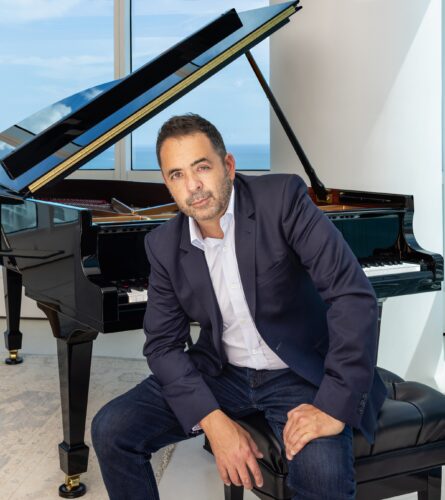
Jorge Mejia, composer and pianist who has lived in Miami for more than
40 years, will perform his concerto “If These Walls Could Talk” with the Frost Symphony Orchestra at the Adrienne Arsht Center. (Photo by Laura Coppelman, courtesy of the Arsht Center)
“His music reflects that combination of backgrounds we have here in South Florida,” Schwarz said of Mejia, who also serves as president and CEO of Sony Music Publishing Latin America and U.S. Latin.
Mejia, who studied piano performance at the Frost School of Music in the ‘90s, calls it a full circle moment to perform his concerto in Miami with the orchestra, which is composed of students in the Frost School.
“It’s going to be fun for me to play with them,” he said. “I can’t wait.”
The performance also comes as Shelly Berg, the dean of the Frost School of Music, prepares to retire in May.
“I think Shelly has been transformational for the school,” Mejia said.
Schwarz said that Berg prioritized giving students opportunities in many different facets of the world of music.
“Shelly is a remarkable leader and a remarkable musician,” he said. “He’s a musician with ideas and a man of great taste, which is very important in our world.”
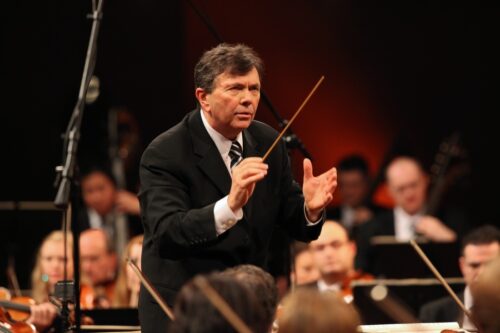
Gerard Schwarz conducts the Frost Symphony Orchestra, a 100-
member ensemble of University of Miami students (Photo by Steven J. Sherman
courtesy of the Arsht Center)
The Arsht performance, planned under Berg’s leadership, will follow the release of Mejia’s new album, also titled “If These Walls Could Talk” on Friday, April 24. The recording, made with the London Symphony Orchestra at Abbey Road Studios, debuts on Apple Music Classical before a wider streaming release on Friday, May 8.
Both the album and the concerto remain rooted in the apartment building that sparked his imagination.
“The building still exists. You can visit it at 221 Collins Ave.,” Mejia said.
WHAT: An Evening of Masterpieces and a Piano Concerto
WHEN: 7 p.m. Sunday, April 26
WHERE: Knight Concert Hall at the Adrienne Arsht Center for the Performing Arts, 1300 Biscayne Blvd., Miami
COST: $29.25, $40.95, $58.50, including fees
INFORMATION: 305-949-6722 or https://www.arshtcenter.org
ArtburstMiami.com is a nonprofit media source for the arts featuring fresh and original stories by writers dedicated to theater, dance, visual arts, film, music, and more. Don’t miss a story at www.artburstmiami.com.
No posts found
The great Mexican songstress Natalia Lafourcade returns to Miami with ‘Cancionera’
Written By Helena Alonso Paisley
April 16, 2026 at 9:56 PM
Natalia Lafourcade returns to Miami after an absence of nearly nine years, bringing “Cancionera”
(“Songstress”), an intimate concert at the Arsht Center’s Knight Concert Hall dedicated to her album of the same name, and songs of albums past. (Photo courtesy of Natalia Lafourcade)
With 25 Grammy and Latin Grammy awards to her name, Natalia Lafourcade has received more golden gramophones than any Latina artist in the history of the award. Her international acclaim is not, however, what makes her a treasure. Rather, it is for the way she communicates—simply and clearly, through the beauty of her voice, her lyrics, and her music—the art and soul of her people, the people of Mexico. Natalia Lafourcade is not merely an icon; she is pure essence.
Lafourcade returns to Miami, to the Adrienne Arsht Center’s Knight Concert Hall, on Saturday, April 24 and Sunday, April 25 in “Cancionera” (“Songstress”), her performances celebrating her album of the same name. It is one of the first stops on the second half of the tour, which was postponed last year as she awaited the arrival of her first child, who was born in late November. She discussed her creative process, the women who have inspired her, her homeland of Veracruz, and her journey into motherhood.
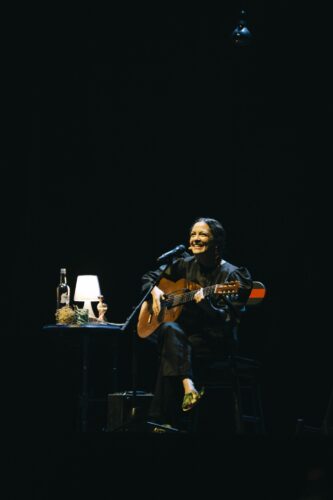
Natalie Lafourcade says that if her music “can bring comfort to a person’s heart, that is what I can
contribute.” (Photo courtesy of Natalia Lafourcade)
The latest experience, she says, “has been truly transformative, revolutionary… Words are not enough to explain—to express—what it means to step into motherhood.”
“While pregnant, I felt like Mother Nature herself,” she says. “I mean, I truly feel: ‘I am nature.’ And nature never fails.”
She is overwhelmed with gratitude at being able to stay home for months alongside her husband, enjoying as a couple the new baby, and she realizes hers is a rare fortune in today’s world.
“My wish,” she says, “is that we, as a world, would learn to value mothers—much, much, much more than they are currently valued. There should be a monument to mothers on every street corner.”
Her own mother, María del Carmen Silva Contreras, was her first music teacher—the one who instilled in her the self-belief she would need to pursue the challenging path of becoming an artist. She is, according to Lafourcade, “the very embodiment of a warrior and a woman of great strength.”
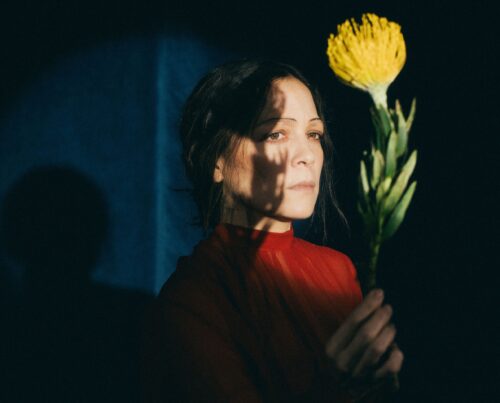
Lafourcade grew up in the town of Coatepec, surrounded by the natural world that has served as such a profound source of inspiration for her art. (Photo by Carlos Manuel, courtesy of Natalia Lafourcade)
“I remember being a terrible student in school,” she recounts. “And she would always say, ‘Well, but what about the music?’ And I would say, ‘Oh, the music? That, I actually like.’” Her mother would then reply, “Then anchor your world there; anchor yourself to your passion, and don’t let anything else matter. Don’t let anyone come along and destroy what you hold inside.”
After those first lessons, the young girl who had sung practically since she could speak went on to attend a renowned music school. But at age fourteen, destiny stepped in in the form of an old guitar she discovered in a closet at her aunt’s apartment. Although it had only three strings, she learned to play it. Later, she realized she should buy the missing three. A friend taught her a few bossa nova chords and thus began her passion for Brazilian music, an influence that can be heard in many of her compositions to this day.
Yet it is her own Veracruz roots that form the foundation of the path she now follows, both in her music and in her life. She lives on the outskirts of the town of Coatepec, far removed from the noise, the hubbub and the demands of fame that once followed her everywhere in the Mexican capital, where she lived for years.
Surrounded by trees, rivers, and mountains, she delights not only in her surroundings but also in the opportunity to attend “fandangos”—communal dances where she is learning the secrets of “son jarocho” at the feet of the masters of this emblematic folk music of her homeland. Much like the now-legendary Chilean singer-songwriter Violeta Parra, one of her greatest artistic inspirations, Lafourcade finds herself increasingly captivated by the lyrics and folkloric rhythms that seem to flow spontaneously from her native soil.
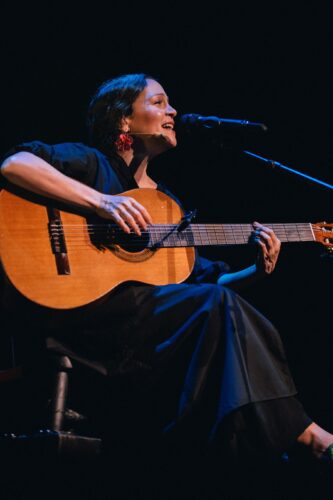
Touring in the United States in these unique times, Lafourcade realizes that people “with different
realities and different types of emotions” will be coming to hear her. “And there I’m going to be, with
my guitar, singing.” (Photo by Carlos Manuel, courtesy of Natalia Lafourcade)
For Lafourcade, Parra is one of many women who “laid the groundwork for so many of us who have followed in their footsteps.” She notes that the composer of the Latin American anthem “Gracias a la vida” possessed the courage to “immerse herself in local communities, to research the music that moved her, the music she loved, and to study a folkloric heritage that, in her view, was in need of rescue.” If, despite enduring countless hardships, Parra was able to revive Chile’s folk music in the 1950s and ‘60s, to dust it off and breathe new life into it, then what was there to keep Lafourcade from doing the same for the folk traditions of her own people?
“Son jarocho” is a musical form that was once clandestine, the song of slaves, at one time even forbidden by the Catholic Church. Through albums such as “Cancionera” and “Un canto por México,” Lafourcade has dedicated herself to repopularizing and rebranding the form and bringing it back to listeners, especially a younger generation. And her donation of sales from “Un canto por México” has been instrumental in the reconstruction of the Centro de Documentación del Son Jarocho (Son Jarocho Documentation Center) in the town of Jáltipan, part of her effort to revive the traditional rhythms she loves so well.
In addition to the constant presence of music in Coatepec, the influence of nature is also omnipresent. Lafourcade’s house is in the jungle. She speaks of how the nature that surrounds her there nourishes her spirit and her art—appearing in her lyrics, in her metaphors, and in her way of understanding the world.
It is “nature itself,” she says, “its cycles, its teachings; so much of Veracruz, so much of my homeland, the mountains, the sea. The sea—I mean, just how ever-present it is.” She remarks that nature always finds its way “in one form or another… birdsong, the birds themselves, the moon, the night, the sun, the cadence—the musical cadence tied to nature. It feels as though that is always at the heart of my creative quests.”
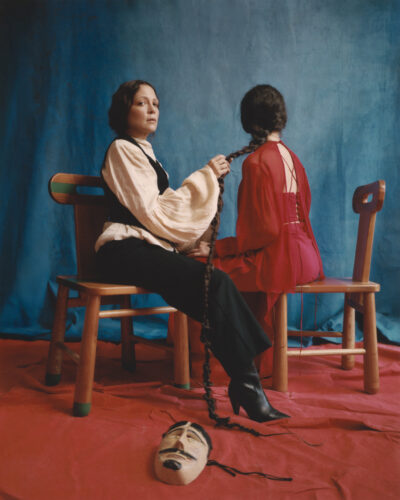
The musician claims to be a person very interested in the mystical, as is evident in songs like “La bruja” (The Witch), from “Cancionera.” In fact, a whole symbolic world accompanies the album’s presentation. (Photo by Silvana Trevale, courtesy of Natalia Lafourcade)
But she doesn’t view the natural world through rose-colored glasses: “I really love that nature is so brutal,” she asserts.
“Nature is creation and construction,” says Lafourcade. “To the extent that I grasp that principle, I understand that I cannot be born without also dying.”
Having no fear of the former, she appears to have no fear of the latter, either. And that reality gives her wings, granting her the freedom to do whatever the universe and her heart ask of her in this life.
Ultimately, Lafourcade is filled with wonder at the abundance of gifts she has been given: “that opportunity to rebuild yourself, to be reborn”—and to feel, as she puts it, like an infant herself, with so many new experiences lying ahead. Those who see her in “Cancionera” will hear Lafourcade, alone with her guitar, singing her truth sincerely, with joy and with grace.
It is, she says, a moment “of receiving so much—of receiving, of completely opening my heart.” What good fortune to be able to witness “la cancionera” at this unique point in her journey as a woman and as an artist.
WHAT: Natalia Lafourcade, “Cancionera” Tour
WHEN: 8 p.m., Friday, April 24 and Saturday, April 25
WHERE: Knight Concert Hall at the Adrienne Arsht Center for the Performing Arts, 1300 Biscayne Blvd., Miami
COST: $69–$351
INFORMATION: (305) 949-6722 or arshtcenter.org
ArtburstMiami.com is a nonprofit media source for the arts featuring fresh and original stories by writers dedicated to theater, dance, visual arts, film, music and more. Don’t miss a story at www.artburstmiami.com.
No posts found
New World Symphony President and CEO Retiring, Search Underway for Replacement
Written By Michelle F. Solomon, Artburst Editor
March 8, 2026 at 2:08 PM
New World Symphony President and Chief Executive Officer Howard Herring will retire on June 30, 2026. Appointed in 2001, Herring will have served in the role for over 25 of the institution’s 38 years. (Photo courtesy of New World Symphony)
Howard Herring was part of the taskforce alongside New World Symphony Co-Founder and Artistic Director Laureate Michael Tilson Thomas to create an orchestral academy program and facility that would end up being one of the most influential programs for classical musicians and a facility that would become a jewel of Miami Beach.
Herring, who was appointed to NWS in 2001, will retire on June 30 after serving as President and CEO for over 25 of the institution’s 38 years. A search is underway for his replacement and is being led by the New World Symphony’s board of trustees.
“Our alumni, numbering 1,330, are making a difference in the orchestras, ensembles, faculties and communities where they live and work,” said Herring in a prepared statement. “We can be proud of our accomplishments as educators and dreamers who have envisioned a world where classical music speaks broadly through exceptional performance and through digital and community initiatives that have democratized our artform.”
The institutional program ultimately inspired and informed Frank Gehry’s design for the New World Center. The campus opened on time in January 2011 and within its original $167 million budget.
“Loving Miami as I do, I am glad we could introduce the New World Center’s architecture of invitation and inclusion through all our work across this community and beyond,” said Herring.
While president and CEO, more than 900 NWS Fellows have been part of the New World Symphony fellowship program and now serve as global ambassadors for the artform.
Additional highlights of Herring’s tenure include the appointment of Stéphane Denève as the organization’s second Artistic Director, the creation of the Knight New Media Center and launch of NWS Media, the development of new concert formats, steady leadership during the global pandemic, and, most recently, the successful completion of a $150 million endowment campaign.
“Since 2001, Howard’s odyssey at the helm of the New World Symphony has produced not only a formidable physical space—our unique New World Center—but also the creative space to permanently reinvent the future of our artform, through a myriad of meaningful performances and initiatives sustained and inspired by his extraordinary leadership,” said Denève.
A native of Oklahoma, Herring was previously the Executive Director of the Caramoor Music Festival for 15 years. A pianist by training, he holds degrees from Southern Methodist University and Manhattan School of Music (MSM). In 2015, MSM awarded Herring an Honorary Doctorate degree.
ArtburstMiami.com is a nonprofit media source for the arts featuring fresh and original stories by writers dedicated to theater, dance, visual arts, film, music and more. Don’t miss a story at www.artburstmiami.com.
No posts found
GroundUP Music Festival Celebrates 10th Anniversary in Miami Beach with Big Names and Up-and-Comers
Written By Fernando Gonzalez
March 8, 2026 at 12:47 PM
The five-time Grammy winning collective Snarky Puppy performs at the Miami Beach Bandshell as part of the GroundUp Music Festival celebrating its 10th anniversary with performances, workshops, and collaborations. (Photo by Osmany Torres, courtesy of GroundUP)
Ten years is a lifetime in the music business. That alone would make the GroundUP Music Festival remarkable. How it got here makes it one of a kind.
“We’re trying to shine a light on great artists who aren’t already very, very well known,” says Michael League, leader of the enterprising 20-member jazz collective Snarky Puppy and co-founder of the event. The 10th anniversary of the festival begins Friday, March 13, at the Miami Beach Bandshell and continues through Sunday, March 15.
“We’ve definitely had some artists on the (GroundUP) label at the festival with slightly bigger names. But for me, the heart of the festival is the artists people haven’t heard of when they come but then can’t stop talking about when they leave. Rather than a place to go to hear the people that you’re already a fan of, we try to make this festival a discovery point for people.”
A five-time Grammy Award-winning multi-instrumentalist, producer, composer, arranger, and songwriter, League started the GroundUP Music label in 2012 as a home for Snarky
Puppy. Five years later, he and Miami Beach native and resident Paul Lehr, founded the annual music festival, and the nonprofit GroundUP Music Foundation.
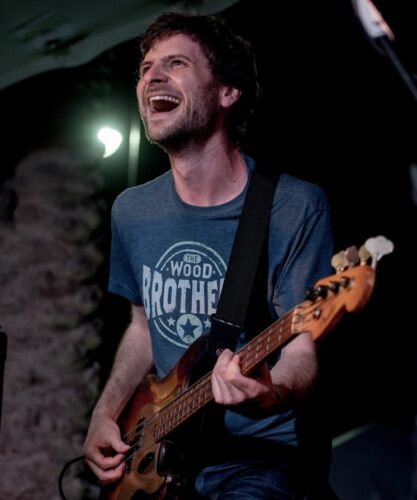
Michael League, co-founder of the GroundUP Music Festival and the leader of Snarky Puppy. (Photo courtesy of the artist)
Headliners this year include League’s Snarky Puppy, which performs every night, including a full “Family Dinner” set in which the band accompanies featured performers.
Also featured in GroundUP is multidisciplinary musician and filmmaker Flying Lotus (aka Steve Ellison); singer and songwriter Rickie Lee Jones; pianist, keyboardist, composer, and producer Patrice Rushen; singer, songwriter, and producer Bilal; guitarist Isaiah Sharkey; vocalist Arooj Aftab; guitarist Julian Lage; multi-instrumentalist and singer Alain Perez; and flutist and vocalist Varijashree Venugopal.
The festival takes place on the main Bandshell stage and in the surrounding park area. The program also includes workshops and encounters such as “Artist to Artist”: Patrice Rushen interviewed by Justin Stanton; “The Legacy of D’Angelo”: Isaiah Sharkey interviewed by Bilal; Rickie Lee Jones on “Creativity in Popular Song”; and “Mind Games: Mentality in Music Production” with League.
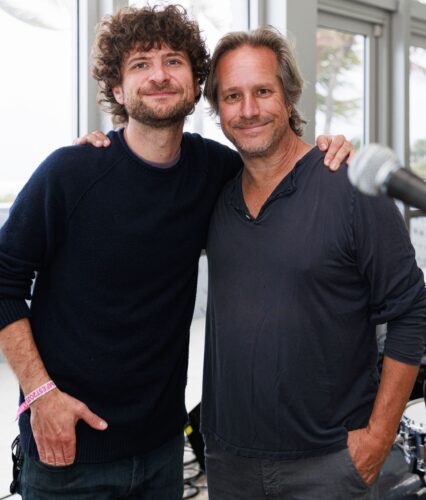
Michael League, left, and Paul Lehr, are the co-founders of GroundUP Music Festival. Lehr was born and raised in Miami Beach and says he wants to do “everything I can to support and expand cultural opportunities here. (Photo courtesy of GroundUp Music Festival)
Paul Lehr, CEO of the GroundUP Music Foundation and co-founder of the festival, recalls when he was CEO of YoungArts, the national art competition in Miami.
“We ran similar programs. That was where I formed the idea of doing small workshops and master classes, keeping things intimate,” says Lehr.
The standard format for large festivals is not one GroundUP tends to emulate. Accessibility to the artists is a plus, notes Lehr.
“Usually, at festivals, artists will come in, go to their trailer, go to the stage, play, go back to their trailer, and be gone. With us, the artist stays the entire weekend,” says Lehr. “That breaks down the barriers between the artists and the audience. You can go up and talk to Isaiah Sharkey or Bilal or Flying Lotus or whoever else because they’re sitting there watching the other shows—and that changes the experience.”
He credits League for the curation.
“He is one of the most phenomenal musicians on the planet, featuring the best artists most people have never heard of. So we have just a different approach from the artist selection standpoint.”

Two-time Grammy winner singer and songwriter Rickie Lee Jones joins Snarky Puppy for Family Dinner on Saturday at the GroundUP Music Festival. (Photo by AstorMorgan, courtesy of GroundUp Music Festival)
The tone of the event was set early on. Memories of the late David Crosby calmly wandering about, checking the performances going on while waiting to play his set, or watching Cuban singer and guitarist Eliades Ochoa, of Buena Vista Social Club fame, enjoying a quiet moment with his family and having an ice cream, come to mind.
But the setting also encourages unplanned musical moments and spontaneous collaborations.
For Rushen, who was intrigued by the ideas and will be appearing for the first time in South Florida with her septet, such an approach “is actually more in keeping with what it was supposed to be: a community of people who share their interest in the music and have an opportunity to spend time in an environment where the focus is the music, whether you’re a player or you are a fan.”
Ten years ago, talk around the GroundUP festival of creating a community around a shared platform—notions of a generous, globally reaching diversity and creative musical ideals—sounded commendably idealistic, but also likely to crash against the bottom line.
Yet a decade later, GroundUP is thriving.
Lehr and League are exploring taking their concept to other locations. Last summer, for the first time, GroundUP Music staged the festival outside Miami Beach, in Italy. A second edition is scheduled in Alberobello, Southern Italy, next June. “Our hope is to very, very slowly consider other places where it makes sense to do this. But,” adds Lehr, “my intention is to make sure that we also always keep it here.”
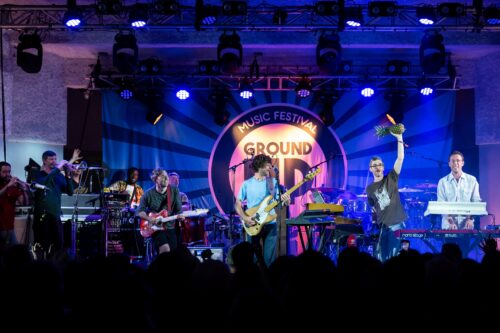
Taking place each year in Spring at the Miami Beach Bandshell, GroundUp was founded in 2017. Snarky Puppy performs full sets each night. (Photo courtesy of GroundUp Music Festival)
As musicians’ livelihoods face brutal challenges ranging from the economics of streaming services to political changes and the threat of AI, developing and nurturing an alternative business model built on higher values, networking, and community might not be so unrealistic.
That said, the attacks against diversity, equity, and inclusion are not parlor discussions but have dire, practical consequences, especially for an event that “over the 10 years, almost 70% of our audience have come from 50 states and 55 countries,” says Lehr.
“We are about community and diversity, and our audience comes from all over the world. Many literally fly in for this,” he notes. “It’s a small, intimate event. But when you turn around, this person is from Spain, this person is South African, this one is from Australia, and this one came from Ohio. It’s a diverse community united by music and camaraderie. I’ve spoken with and heard from many of our Canadian attendees, and almost to a person they told me they’re not coming to the festival because they don’t want to come into the country.”
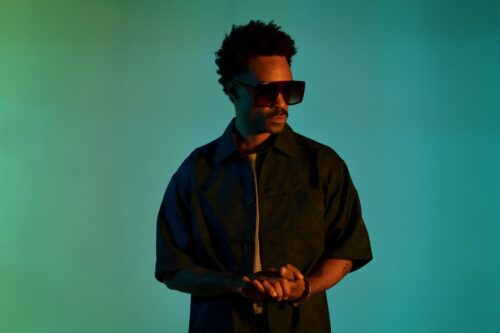
Singer, songwriter and producer Bilal, best known for collaborations with Kendrick Lamar, Jay-Z, Erykah Badu, Clipse and Beyonce, performs Friday and Saturday at this year’s GroundUP Music Festival. (Photo courtesy of GroundUp Musical Festival)
The festival started like a fun proposition, reflects League. “The idea of just calling all of your musician friends and getting them together in the same place is a dream for anyone who plays music. Now, this was before COVID, before all of the political upheaval in the U.S., and before this kind of oligarchical takeover. It started as just a fun thing that we were all interested in doing.”
League says now it’s different.
“It feels a little more vital, especially as the music industry is crumbling in many respects. Live music is emerging as the one pillar, the last thing we’ll have if everything else goes. And so I think the festival sticking around is a statement.”
WHAT: GroundUP Music Festival.
WHERE: Miami Beach Bandshell, 7275 Collins Ave., Miami Beach
WHEN: 3 p.m., Friday, March 13, GroundUP Foundation benefit. 6 to 8 p.m., dinner including performances by Snarky Puppy and Rickie Lee Jones. 2:35 p.m., Saturday, March 14: workshops and master classes; 5:45 p.m. show featuring Alain Perez, Patrice Rushen, Snarky Puppy, Rickie Lee Jones, Bilal, and Vari Venugopal. 1:35 p.m., Sunday, March 15: workshops and master classes. 4:40 p.m. show featuring Isaiah Sharkey, Miami Bloco, Julian Lage, and Snarky Puppy Family Dinner featuring Flying Lotus, Patrice Rushen, Arooj Aftab, and a Snarky Puppy set. Also, late-night jams on Saturday and Sunday at Lakou, 207 NE 59th Street, Miami, beginning at 11 p.m.
COST: $479 Friday GroundUP Foundation benefit; $109 Saturday and Sunday general admission; $179 premium pass; $199 two-day general admission; $319 two-day premium pass; $2,000 private cabana per day. Late-night jams: $39 Saturday and Sunday; $69 two-night late-night pass. $809 all-in premium pass for the weekend; $3,500 two-day private cabana add-on.
SCHEDULE: groundupmusicfestival.com/dailyschedule
INFORMATION: miamibeachbandshell.com/events
ArtburstMiami.com is a nonprofit media source for the arts featuring fresh and original stories by writers dedicated to theater, dance, visual arts, film, music, and more. Don’t miss a story at www.artburstmiami.com.
No posts found
Ángeles Toledano Brings Contemporary Flamenco to Miami Beach Bandshell
Written By Orlando Taquechel
March 5, 2026 at 3:15 PM
Ángeles Toledano, pictured here at the opening of “Suma Flamenca 2025” at the Teatros del Canal (Madrid), will perform at the Miami Beach Bandshell on Thursday, March 5. (Photo by Marina Rodríguez, courtesy of the artist/FUNDarte).
Ángeles Toledano says she started singing when she was six or seven years old.
“I first stepped onto a stage at 8, almost professionally since I was 10. So my whole life,” says Toledano, who was born in Jaén, in the Autonomous Community of Andalusia. Considered one of the most promising performers of contemporary flamenco singing, she was nominated for the 2025 Latin Grammy Awards for “Sangre Sucia” (“Dirty Blood”), her first album.
She will perform at the Miami Beach Bandshell on Thursday, March 5, in a concert programmed by The Rhythm Foundation, FUNDarte, and Live Arts Miami.
Toledano says her singing style reflects the identity of the Andalusian people.
“Cantaora is a very Andalusian word. The word itself is flamenco,” she says. “I think what sets us apart is the music, which is much more classical, with a long history, steeped in centuries of song, guitar playing, dance, and rhythm. And, of course, there’s also the wail, with that broken voice that isn’t allowed in any other genre… not in opera, not in pop, where they look for a beautiful, perfect voice.”

Ángeles Toledano (Spain, 1995) is considered one of the most promising performers of contemporary flamenco singing. (Photo by Mara Alonso, courtesy of Universal Music Spain/artist’s office/FUNDarte).
What has always drawn her to the music is the emotion that goes into the work.
“It’s guided by what you feel. Expression comes first, and I think that’s also what characterizes us and what people can feel, whether they understand the genre or not, because it’s pure expression. It’s also a pure physical expression. It can be a statement or a flirtation. Or it can be many gestures, even exaggerated ones.”
The Bandshell performance is special to Toledano because she says there will be a few surprises and is excited about what she calls an “organic format.”
“This time, I’ll be accompanied by guitarist Benito Bernal. We’ve worked together for many years, and we understand the concept very well, since we know each other with all our musical quirks.”
The program will include a mix of popular flamenco lyrics and styles along with some of Toledano’s original works.
“Live, we do a slightly more pop-oriented song: a version I have of a song titled “Que bonito aquella noche” (“How beautiful that night”) from Las Grecas, a Spanish group with strong ties to flamenco.”

Ángeles Toledano and guitarist Benito Bernal during the opening of “Suma Flamenca 2025” at the Teatros del Canal (Madrid). (Photo by Marina Rodríguez, courtesy of the artist/FUNDarte).
She cites her influences as La Niña de los Peines, Remedios Amaya, La Paquera de Jerez, La Marelu, and El Popito, and she says, “obviously, Camarón de la Isla and Enrique Morente.”
She is looking forward to performing in Miami because of what she says is the difference with flamenco fans in the States rather than in her native country.
“You find a flamenco scene where some people are very, very closed-minded, perhaps out of a desire to maintain the purity of things. I hope (Miami audiences) warmly welcome my fresh, youthful approach. I’m really looking forward to arriving in Miami.”
WHAT: Ángeles Toledano with Benito Bernal, a presentation of The Rhythm Foundation, FUNDarte, and Live Arts Miami
WHEN: 8 p.m., Thursday, March 5
WHERE: Miami Beach Bandshell, 7275 Collins Avenue, Miami Beach
COST: $31.94, general admission, $257.69, club seating, includes fees at https://vor.us/b3990
INFORMATION: miamibeachbandshell.com
ArtburstMiami.com is a nonprofit media source for the arts featuring fresh and original stories by writers dedicated to theater, dance, visual arts, film, music, and more. Don’t miss a story at www.artburstmiami.com
No posts found
Third Time’s a Charm for Jon Batiste’s Montreux Miami, Expansion to Miami Beach and Elena Rose Performance
Written By Michelle F. Solomon
February 24, 2026 at 4:00 PM
Jon Batiste at The Hangar in Coconut Grove at Montreux Jazz Fest Miami. Five days of shows are planned this year at The Hangar and at the Miami Beach Bandshell from Wednesday, Feb. 25 through Sunday, March 1. (Photo by Vee Chaps, courtesy of Montreux Miami)
Jon Batiste remembers when the late Quincy Jones invited him to perform at the legendary Montreux Jazz Festival in Switzerland. Grammy Award winner Batiste, who became known to mainstream audiences as the bandleader of “The Late Show With Stephen Colbert” for seven years from 2015 to 2022, is Montreux Jazz Festival Miami’s artistic director and co-owner, alongside Miami music icon Emilio Estefan.
Now in its third year, Batiste’s Montreux Jazz Festival Miami has expanded venues and lineups with two additional nights at the Miami Beach Bandshell along with its premiere venue at The Hangar in Coconut Grove. Two shows are at the Miami Beach Bandshell, Wednesday, Feb. 25 and Thursday, Feb. 26, with The Hangar shows from Friday, Feb. 27 through Sunday, March 1.

Jon Batiste at last year’s Montreux Miami Jazz Festival. (Photo by Justin Lee Schultz)
Batiste headlines a New Orleans celebration, his hometown, with Trombone Shorty and Orleans Avenue on Friday, Feb. 27.
When the idea was floated to bring a sister Montreux festival to the States, Batiste said New Orleans was on the list. Coming from New Orleans, another global music capital, Batiste says there were a number of places that were considered before settling on Miami. “We thought about places that were hubs of culture and hubs of creativity, and in America, you know, I’m from New Orleans, and there’s already a really great festival there… but Miami is very much a hub of culture, and it’s really untapped. So it felt perfect to bring these worlds together.”
There was more about Miami, too, besides the fact that the name flowed really well: Montreux Miami. “I wanted it to feel like a celebration of the American musical art form that we call jazz, but rooted in the Afro-Latin traditions and Cuban and Caribbean traditions, Brazilian traditions.”
One of the performers who fits the bill is Venezuelan-American singer Elena Rose, who performs on the final day, Sunday, March 1. Her story starts in Venezuela where she finished high school “very young. I think I was like 16 or 17” and then stayed in Caracas where she studied journalism in college and performed in clubs at night.
“I started to sing with live bands in different bars, events, etc. I was still very, very young in comparison to every musician I was around,” she says. “But I always felt very protected and guided. Performing is what comes most natural to me.”

Born in Miami, Elena Rose returned to the city from Caracas when she was 19 because of crises in South America. It was the move that eventually put her on the music map. (Photo by Gustavo Escalona)
The idea of being a journalist gave her another outlet.
“I think at that point I just wanted to have a space where I could speak,” she says. Her family didn’t think that a career in music was a wise choice – “they were freaking out that I only wanted music” – so she thought a college degree in journalism might be a good fit.
Born in Miami, she returned to the city when she was 19 because of crises in South America. It was the move that eventually put her on the music map.
“I sang basically in every corner,” she says. “I became like a street cat, and I loved it. To me, it was what I really connected with.”
She played at Da Silva in Doral and Castro’s jazz bar, and it was one night in a Miami bar when she was approached by Peruvian producer and songwriter Patrick Romantik that changed her life.
Romantik needed someone to record his demos. “He was like, ‘I really like your voice. I write songs, and sometimes I write songs for female artists, and I don’t have a female who can record these songs.’”
She took him up on the offer and started being paid to do studio vocal work, and it became more than a job. She learned what it was like to be in the business and to be in a studio. Rose began writing songs in earnest, working behind the scenes to create songs for Latin superstar Becky G and collaborating with Selena Gomez, Bad Bunny and Marc Anthony. Then, during COVID, she decided it was time for her voice to be heard.
She made her singing debut with the Latin urban song “Sandunga.” She says it was a change to then become the person in the spotlight. “That’s the coolest thing about being a songwriter—that you don’t have to be exposed. But in being exposed, I really take it seriously, bringing something that’s gonna add value to humanity.”

Venezuelan-American singer Elena Rose performs on the final day of Montreux Jazz Festival Miami on Sunday, March 1. (Photo by Gustavo Escalona)
To perform at Montreux, where jazz, blues and salsa are the root genres celebrated, brings meaning to what she wants to give to the audience.
“Being a live performer is the best way to show that you are a professional at this type of craft.”
For her Montreux Miami set, Rose says she’s rethinking everything.
“I want to rearrange my set list,” she says. “I think I have a very intentional, strong-message set list, but I want to definitely play around with sounds and rhythms—so, you know, a little bit more Miami, too.”
She says there’s not much she would change about where she came from and where she is now – preparing for her place at Montreux Miami.
“If I could be born again, I would choose Latina again. I’m proud of where I come from, and of encouraging ourselves to hug that part of us that can’t be lost along the way—and to just make it shine and keep it alive. I am a Miami girl, too. This city built me in many ways.”
New this year for Montreux Miami are two shows at the Miami Beach Bandshell. The ambition extends beyond a single venue or neighborhood as the festival grows, according to Batiste.
“There are more places that we are constantly exploring, so many incredible landscapes and incredible places that we want to explore to share the music. Every year we’re performing and gathering musicians, and when we are there, we are walking around and thinking about where we can do more of it.”

Vince Wilburn Jr. kicks off the Miami Beach Bandshell segment on Wednesday, Feb. 25, with a celebration of his “Uncle Miles” and his Miles Electric Band. (Photo courtesy of Vince Wilburn Jr.)
Vince Wilburn Jr. kicks off the Miami Beach Bandshell segment on Wednesday, Feb. 25, with a celebration of his “Uncle Miles.” Trumpeter Miles Davis would have turned 100 years old on May 26, and the legendary jazz master’s centennial is being celebrated throughout 2026.
Wilburn brings the Miles Electric Band to Montreux Miami.
“You know, Uncle Miles, or the chief as we called him, he loved going to the Montreux Jazz Festival in Switzerland. He was close friends with Claude Nobs (the founder and general manager of the original Montreux festival). That was always a highlight for him, so when they reached out to us about Miami, it was a no-brainer,” says Wilburn, whose mother, Dorothy Wilburn, is Miles’ sister. Wilburn was a drummer in Davis’s band from 1984 to 1987.
He’s quick to say that the Miles Electric Band is not a tribute band.
“No, no, we would never imitate or even try to duplicate those amazing musicians who played the music in Uncle Miles’ career. What we’re doing is giving our interpretation of how the music moved us in a way that we can,” he says.
What audiences in Miami will see is not nostalgia, but evolution and something he traces directly back to Davis himself.

Now in its third year, Batiste’s “Montreux Jazz Festival Miami” has expanded venues and lineups with two additional nights at the Miami Beach Bandshell along with its premiere venue at The Hangar in Coconut Grove. (Photo by Beth Sacca)
“The way we communicate and listen to each other—that’s what Uncle Miles taught us. Don’t look back, evolve, keep the music fresh and take the music seriously, which we do.”
While Wilburn is the one who put MEB together, he emphasizes that each player is a leader, not a sideman, and some originally played with Davis, including Darryl Jones on bass, Robert Irving on keyboard, who was Davis’ longtime musical director, and percussionist Munyungo Jackson, who played on live recordings. Then there is the next generation keeping the music alive, including Greg Spero on keyboards, Keyon Harrold on trumpet, Rasaki Aladokun of Nigeria, a master drummer who played with King Sunny Ade for more than 20 years, and DJ Logic on turntables.
“I just got the all-star team together,” says Wilburn.
It’s that kind of evolution that Batiste sees for his Montreux festival – new performers alongside legends, a living, growing summit of cultures and his promise that “big things will continue to happen with Montreux in Miami.”
WHAT: Montreux Jazz Festival Miami
WHERE: Miami Beach Bandshell, 7275 Collins Ave., Miami Beach, The Hangar at Regatta Grove, 3385 Pan American Drive, Coconut Grove
WHEN: Wednesday, Feb. 25 and Thursday, Feb. 26, Miami Beach Bandshell, Friday, Feb. 27 through Sunday, March 1, The Hangar.
LINEUP: Wednesday, Feb 25: Miles Electric Band and Kind of Blues Acoustic Band; Thursday, Feb. 26, Makaya McKraven; Friday, Feb. 27, Jon Batiste and Trombone Shorty; Saturday, Feb. 28, Nile Rodgers and Chic, Toto, Adi Oasis; Sunday, March 1, Bomba Estereo, Elena Rose, and Pedrito Martinez
COST: $60 and $93, general admission, Miami Beach; Hangar prices vary from $154 to $231 general admission depending on day, along with multi-day packages and VIP available.
INFORMATION: .montreuxjazzfestivalmiami.com
ArtburstMiami.com is a nonprofit media source for the arts featuring fresh and original stories by writers dedicated to theater, dance, visual arts, film, music and more. Don’t miss a story at www.artburstmiami.com.
No posts found
29th Melton Mustafa Jazz Festival Celebrates Legacy and Education
Written By Fernando Gonzalez
February 22, 2026 at 9:38 AM
The 18-piece Melton Mustafa Orchestra conducted by Melton Mustafa Jr, and featuring saxophonist Jesse Jones, headlines the 29th Annual Melton Mustafa Jazz Festival. (Photo by Jerome Louden)
The Annual Melton Mustafa Jazz Festival, celebrating its 29th edition with performances at various locations in South Florida from Thursday, Feb. 26 through Sunday, March 1, is in a class of its own. More than just a sampler of artists and styles, the event is also about “legacy, education, and nurturing future talent,” says festival director Melton Mustafa Jr., a three-times Grammy-nominated musician, educator, and bandleader.
The event includes small-venue shows, workshops, masterclasses, and a closing red-carpet concert at Florida Memorial University’s Lou Rawls Center for the Performing Arts.
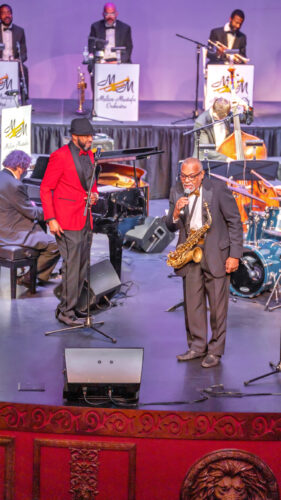
The Melton Mustafa Orchestra conducted by Melton Mustafa Jr, left, and featuring Jesse Jones. (Photo by Jerome Louden)
Headliners include Grammy Award–winning producer and steelpan master Leon “Foster” Thomas, saxophonist Jesse Jones Jr., singer and violinist Nicole Yarling; pianist and organist Doug Carter; James Cotman, the original drummer of the Melton Mustafa Orchestra; vocalist Gia Wyre; pianist and keyboardist George Tandy Sr., bassist Kirk Green, and reedman and Melton Mustafa Jr. conducting the 18-piece Melton Mustafa Orchestra.
This year’s event will honor the memory of Esaa Mustafa, Zakiyyah Mustafa, trumpeter, bandleader, and educator Melton Mustafa Sr., and musician, steel pan scholar, composer, and educator Dawn Batson, PhD. As part of this jazz homecoming weekend at Florida Memorial University, the event will feature performances by the FMU Alumni Steel Pan Ensemble and the FMU Jazz All-Stars.
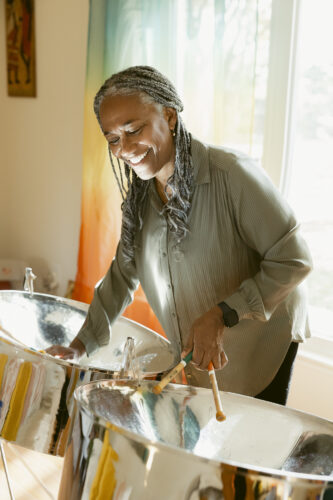
This year’s Annual Melton Mustafa Jazz Festival will honor Dawn K. Batson, PhD., and her remarkable career as a musician, composer, and educator which spans more than 40 years. (Photo courtesy of the artist)
“My dad was a Miami native. He grew up in Liberty City, attended Miami Northwestern, where he participated in the band, and then went on to Florida A&M University to study music,” recalled Mustafa Jr. After college, he notes, his father went on the road, playing with the Count Basie’s, Duke Ellington’s, and Woody Herman’s orchestras, and backing artists such as Frank Sinatra and Ray Charles.
Mustafa, who died of prostate cancer in 2017, went on to build a notable career highlighted by stints with Sam & Dave, Betty Wright, and Latimore, as well as his work with saxophonist Ira Sullivan’s group and bassist and composer Jaco Pastorius’s fabled Word of Mouth large ensemble.
“He was touring all over the world, playing with great jazz musicians, and he wanted to bring them to South Florida,” says Mustafa Jr. “He wanted to bring them to his students at Florida Memorial. I mean, can you imagine being a student and having the best saxophone player in the world giving you a lesson, sitting right next to you? It’s life-changing.”
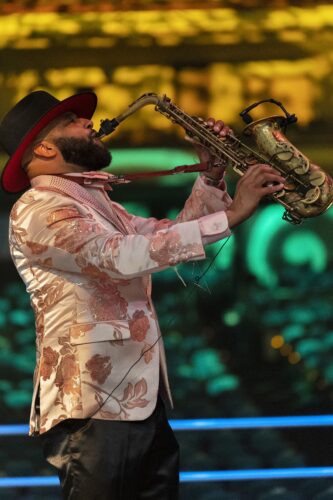
Three-times Grammy-nominated musician, educator, and bandleader Melton Mustafa Jr. has taken the mantle of director of his late father’ Melton Mustafa Jazz Festival, celebrating this year its 29th edition. (Photo by Jerome Louden)
With the support of Albert Smith, PhD, a jazz enthusiast and president of what was then called Florida Memorial College, now Florida Memorial University, and Alfred Pinkston, PhD, former Chairperson of Music at the university, Mustafa Sr. started the festival in 1996 as a fundraiser for college and high school jazz students.
For that first edition festival, Mustafa Jr. recalls luminaries such as saxophonists James Moody and Grover Washington Jr., and bassist Abraham Laboriel. “I remember that the concert was held at the gymnasium of the school (in Miami Gardens), and it was packed to capacity. It was absolutely amazing.” The festival has since featured top jazz artists such as Wallace Roney, Patrice Rushen, Billy Cobham, Herbie Mann, Billy Taylor, Clark Terry, and Randy Brecker.
Still, the Annual Melton Mustafa Jazz Festival has remained a family and community affair with a strong focus on education. That is reflected not only in the programming. A portion of festival proceeds supports MSM Arts United, Inc., the festival’s nonprofit organization dedicated to expanding access to music education in underserved communities. Proceeds help establish an endowed music scholarship for talented, at-risk youth pursuing the arts.

Grammy Award–winning producer and steelpan virtuoso Leon “Foster” Thomas, who has music degree from Florida Memorial University and Florida International University, returns to South Florida to appear at the 29th Annual Melton Mustafa Jazz Festival. (Photo by Leon “Foster” Thomas)
Family was an essential element in the foundation and development of the festival, and the spirit remains. This year’s event honors Mustafa Jr.’s late son, Esaa, a budding musician who also contributed technical support, photography, and videos to the festival, and Mustafa Jr.’s mother, Zakiyyah, “the one who made everything happen.”
“My father would be the creative, come up with an idea, and they would discuss it, and she would figure out how to get it done,” recalls Mustafa Jr. “She dealt with the business part, did the logistics, paid the musicians, booked the hotels. She did all the heavy lifting.”
As for recognizing the work of Batson, “she’s an awesome composer, arranger, and director, and on top of that, she has been a great educator,” notes Mustafa Jr. Among her achievements in a career spanning more than four decades, Batson established the first steel band programs at the University of Miami and Florida Memorial University.
Batson, whose PhD is in music, business, and international affairs from the University of Miami, is currently the executive director of the consulting organization Keep Your Joy and Rise, specializing in national and international music programs. She works with teachers, musicians, and artists in other disciplines, “looking at how they can utilize their gifts, their art, and the talents that they’ve honed over years in many different capacities,” she explains. “Sometimes we don’t realize that the work that artists do can be utilized in other spheres.”
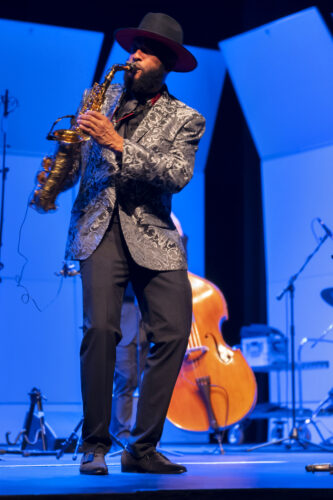
Melton Mustafa Jr. performs. (Photo by Jerome Louden)
“As musicians and artists, your music, your art is your business,” she elaborates. “But for someone playing a drum on an elementary school band, or a student learning for the first time how to play the clarinet, the lasting lessons are the discipline, the resiliency, it’s the working with others, it’s understanding how to communicate with others.” These are not just music lessons, she says, but “life lessons.”
For all the accolades she has earned in her many roles as a player, composer, and scholar, when asked about her favorite work, Batson doesn’t hesitate.
“Teaching is one of the highest disciplines that one can aspire to,” she says. “Because in teaching, you get to touch the future. And that is a gift. That is a gift.”
WHAT: 29th Annual Melton Mustafa Jazz Festival Weekend
WHEN and WHERE: 7 to 9 p.m., Thursday, Feb. 26, Lorna’s Caribbean & American Grill, 19752 NW 27th Ave., Miami Gardens. Kickoff performance featuring the Jesse Jones Jr. Quartet with special guests.
8 to 10 p.m., Friday, Feb. 27, The Gardens Cigar & Whiskey Lounge, 19801 NW 27th Ave., Miami Gardens. Performance by the Funk Jazz All Stars;
8 a.m. to 3 p.m., Saturday, Feb. 28, Marshall L. Davis Sr. African Heritage Cultural Arts Center, 6161 NW 22nd Ave., Miami. Student Workshops and College Jazz All-Star Concert featuring student workshops, band performances, lunch with food trucks, jazz workshops with guest artists, Florida Memorial University Jazz Ensemble (Director: Dr. Zachary Bartholomew), and the Broward College Big Band (Director: Waldron Dunkley). 6 to 9 p.m., Miami Lakes Hotel-Courtyard, 6842 Main St., Miami Lakes. Performances by DEB’I United and Jerald Dorsett & Friends.
5 to 9 p.m., Sunday, March 1, Lou Rawls Performing Arts Center, Florida Memorial University, 15800 NW 42nd Avenue, Miami Gardens. Red carpet and VIP reception with New World SOTA Jazz Ensemble, MMJF Concert Part I featuring FMU Alumni Chorale, FMU Steel Pan Ensemble, and FMU Jazz All-Stars, followed by MMJF Concert Part II concluding with the Melton Mustafa Orchestra and guest artists.
COST: $55.20, red carpet event and concert Sunday, March 1; $87.21, red carpet, VIP reception and concert, Sunday, March 1. Tickets at eventbrite.com/e/29th-annual-melton-mustafa-jazz-festival
INFORMATION: Details on other festival events and information at meltonmustafajazzfestival.com
ArtburstMiami.com is a nonprofit media source for the arts featuring fresh and original stories by writers dedicated to theater, dance, visual arts, film, music, and more. Don’t miss a story at www.artburstmiami.com
No posts found
Latin American Music Reimagined for 2 Pianos in Pinecrest Premiere
Written By Megan Fitzgerald
February 22, 2026 at 8:31 AM
Kristhyan Benítez, left, and Vanessa Perez, right, perform during a
performance of “A Fuego Lento” at the Muzyczny Festiwal in Lancut, Poland, in June. The two take the stage on Sunday, March 1, at Pinecrest Gardens where the piece will make its North American premiere. (Photo courtesy of Muzyczny Festiwal)
As a young pianist growing up in Venezuela, Kristhyan Benítez attended Vanessa Perez’s concerts, admiring her from the audience long before the two would share a stage as collaborators. On Sunday, March 1, the two take the stage together in Miami, where “A Fuego Lento” makes its North American premiere.
“When I was growing up, the piano world in Venezuela was very small. I went to every Vanessa concert—I always wanted to play like her,” says Benítez. “And now we end up being family and playing music together. It’s full circle.”
Though they did not attend school at the same time, both Benítez and Perez, who are now based in New York City, were shaped by Venezuela’s Emil Friedman School, a primary-through-secondary school known for its strong emphasis on music. One of the school’s guiding philosophies, they said, was “there is no culture without musical culture.”
“A Fuego Lento”—meaning a “simmering fire,” was created by Perez, Benítez and Stephen Buck, composer and arranger. The Miami performance at Pinecrest Gardens will mark the first time the composer will hear the program performed live despite being a central figure in its creation. Buck, Perez’s husband, created the two piano arrangements that translate popular and folk songs into the language of classical piano.
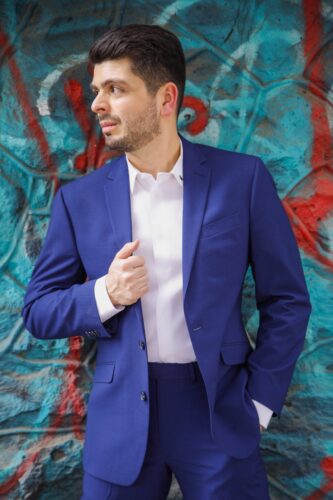
Kristhyan Benítez is a co-creator and performer in “A Fuego Lento,” a program that reimagines Latin American music for classical piano. (Photo courtesy of
Seneidy Davila)
“For this project to work, you need the right people who really understand the idea,” says Benítez. “With Vanessa, Stephen and myself, it feels complete—like a kind of holy trinity.”
Perez says that “A Fuego Lento” grew out of their shared interest in presenting Latin American music in a way that reflects both their classical training and their cultural backgrounds. The program brings together works from the classical tradition, as well as Latin American popular and folk songs, all arranged for the piano. The artists describe the project as a translation, taking music heard in Latin American homes and communities and reimagining it for the classical piano.
Benítez noted that while classical music can feel inaccessible to some audiences, this program is for everyone.
“People can feel a little threatened by classical music, like they need to know everything about its history,” says Benítez. “Classical music is not one thing. It’s a huge universe, with many languages, many traditions and many stories.”
The program is about connection, says Perez.
“If people leave feeling connected to the music in some way, then that’s what matters.”
For Perez, who was born in Miami, the premiere is also a homecoming of sorts.
“A lot of my family and friends will be there,” she says. “Bringing this program here feels very personal.”
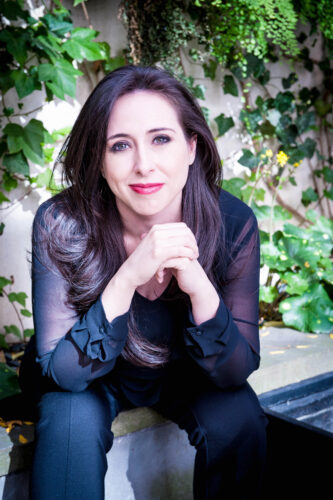
Vanessa Perez, New York City-based Venezuelan pianist, performs “A Fuego Lento” on Sunday, March 1 at Pinecrest Gardens. (Photo courtesy of Maria Grazia Facciola)
The North American premiere also marks the first time the program will be presented before a largely Latin American audience.
“When we premiered the program in Europe, the audience was really listening to how we played classical music,” explains Perez. “That was the test there—whether we were serious classical musicians.”
Benítez says that coming to North America, especially Miami, is a different test.
“It’s about how the Latin American music is received, and whether that connection is really there.”
Executive Director of Dranoff 2 Piano Fusion Emily Cardenas says that the timing of the Miami premiere also carries added weight, as political turmoil in Venezuela and broader immigration debates have weighed heavily on the South Florida community.
“Now with everything that’s going on, politically in Venezuela, and with the unfortunate scenarios that we’re seeing in the news tied to undocumented immigrants, I feel that Latin Americans are feeling a sense of unity,” says Cardenas. “Bringing Vanessa and Kristhyan here, that unity will spill over into the experience. Music is the great unifier—no matter who you are, or what your politics are, or where you come from.”
“A Fuego Lento” was brought to Miami by Dranoff 2 Piano Fusion. Cardenas, who saw the program as a natural fit for Dranoff’s Latin 2 Piano series, was surprised that the program, which premiered in Europe in 2023, had not yet been performed in the Americas.
“This program should be in Latin America, it should be in Miami, and it should be wherever there are large Latin audiences,” says Cardenas. “This is music people may have heard in their homes, from their parents or grandparents. There’s a sense of nostalgia there, and I think audiences are ready to embrace it.”
The concert is presented in partnership with Miami-Dade County Auditorium as part of its Away From Home series, launched while the historic venue undergoes renovations. The series supports programs likely intended for the auditorium but held in alternative spaces throughout the county while the renovations are completed.
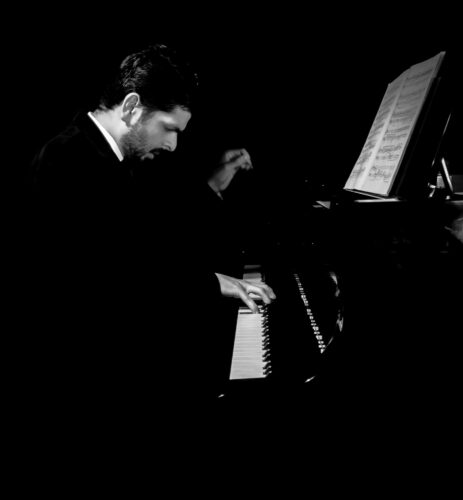
Kristhyan Benítez performs at the piano. Benítez is a co-creator of
“A Fuego Lento,” which makes its North American premiere in Miami. (Photo courtesy of Harold Cuellar)
Cardenas says that Pinecrest Gardens was chosen deliberately. Unlike a traditional concert hall, the outdoor setting encourages a more relaxed experience, one she felt matched the spirit of the music and the personal nature of the program.
“I wanted people to feel at home,” explains Cardenas. “Yes, these are classically trained musicians and it’s a classical program, but I didn’t want a straight-laced format concert experience. Pinecrest Gardens is lush and beautiful, and the music of Latin America deserves to be heard in an environment that feels like the climate and culture where it thrived.”
Cardenas believes that many in the audience will feel a sense of familiarity.
“Whether it reminds them of their childhood, their family, or a place they come from, this is music that lives in people’s memories,” she says.
While the program may create a sense of nostalgia, Benítez would also like the audience to feel a sense of hope afterwards.
“Hope to listen more, hope that things can get better,” Benítez says. “Music can be a vehicle for healing, and that’s very important to us.”
WHAT: Latin 2 Piano: A Fuego Lento
WHEN: 4 p.m. Sunday, March 1
WHERE: Pinecrest Gardens, 11000 SW Red Road, Pinecrest
COST: $65, $45, $5 student tickets.
INFORMATION: 305-572-9900 or www.pinecrestgardens.org
ArtburstMiami.com is a nonprofit media source for the arts featuring fresh and original stories by writers dedicated to theater, dance, visual arts, film, music, and more. Don’t miss a story at www.artburstmiami.com.
No posts found
Mostly Baroque Brings Works of Bach, Pergolesi and Florence Price to Arsht Center
Written By Jocheved Cohen
February 20, 2026 at 1:46 PM
Headlining the second night of the Mostly Baroque festival at the Arsht Center is bass-baritone vocal artist and composer Johan Hartman, pictured above. Mostly Baroque performs in a three concert engagement inside the Carnival Studio Theatre beginning Thursday, Feb. 26. (Photo courtesy of Mostly Baroque)
One pleasure in playing Baroque music, says David Hartman, music director of the Mostly Baroque ensemble is its liveliness. Violins, violas and cellos duel for pride of place with dramatic solos. “Everybody is wanting to say their line, have their comment. Each one has its moment in the sun,” says Hartman, violinist, concert master and leader of the group that he founded in 1997. Still, the audience is the real winner, treated to some of the most exciting and well-loved pieces in the classical repertoire along with others they may not have heard before.
Mostly Baroque performs in a three-concert engagement inside the Carnival Studio Theatre at the Adrienne Arsht Center, Miami, on Thursday, Feb. 26 with shows on Friday, Feb. 27 and Sunday, March 1.
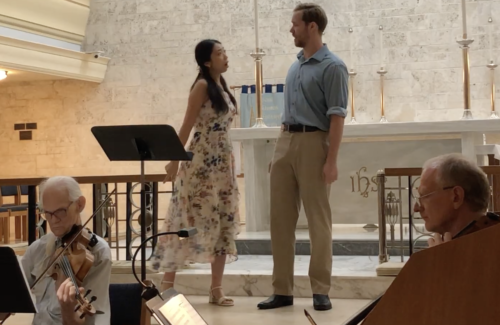
Johan Hartman and Yi-Chun Sarah Tsai in performance. The married, also appear together in “La Serva Padrona,” a comic opera. (Photo courtesy of Mostly Baroque)
The program consists of well-loved compositions with song cycles; work by early 20th century African American composer Florence Price – sung by the Miami Oratorio Society – and Pergolesi’s period opera “La Serva Padrona.” It’s Mostly Baroque’s first appearance at the Arsht and Hartman hopes it becomes a yearly event.
Hartman started Mostly Baroque in South Florida, where he met many of the group’s musicians, and first became friends and colleagues with Gloria Christian, Miami Oratorio Society president. While Hartman and his family later moved to Connecticut, where Mostly Baroque is now based, Florida ties remain strong.
As Hartman tells it, Baroque music’s unique elements set it apart. The period spans from about 1600 to the mid-18th century. Claudio Monteverdi is credited with launching the style, explains Hartman. Monteverdi’s expressive and dramatic music was a radical departure from earlier church-based compositions, while giving players latitude to experiment with trills, ornaments and rhythm variations. “There is a lot of freedom for the performers to do things,” he says, referring to Baroque compositions. By the time you get to Beethoven, he adds, “you have to play exactly what is on the page.”
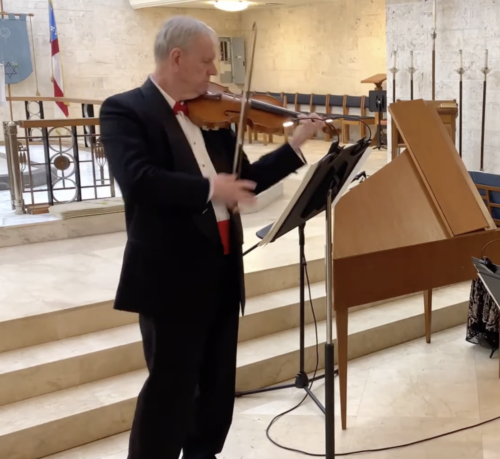
David Hartman, Music Director, in performance. The violinist and founder of Mostly Baroque has a South Florida background and founded the group in 1997. (Photo courtesy of Mostly Baroque)
Opening night of the series will feature Bach Brandenburg concertos, and Georg Philipp Telemann’s Don Quichotte suite. The orchestra – smaller than a grand orchestra at about 13 players and four soloists – includes nine string players, flute, oboe, double bass, harpsichord and trumpet, all performing on period instruments or faithful reproductions.
Headlining the second night on Friday, Feb. 27, is bass-baritone vocal artist and composer Johan Hartman – the son of Hartman and his wife Peggy Hartman (an oboist, who is also part of the ensemble).
Hartman will perform Gerald Finzi’s “Let Us Garlands Bring” (a set of five songs based on Shakespeare), plus the Don Quixote songs of Jacques Ibert (written for the 1933 film), along with works in English, French, German and Italian. Soprano Yi-Chun Sarah Tsai, Johan Hartman’s partner in art and in life will also participate. The pair met in graduate school, recently married and this month held their wedding celebration in Miami.
There will also be original song cycles set to poetry – an approach many composers have taken, including Ralph Vaughan Williams, and Benjamin Britten. Hartman’s piece is composed around “Blood and the Moon” by William Butler Yeats. “There is incredibly rich imagery in his poems,” he says. “There is some really great poetry out there in English.” He will also premier a piece set to the text of Robert Frost’s “Fire and Ice.”
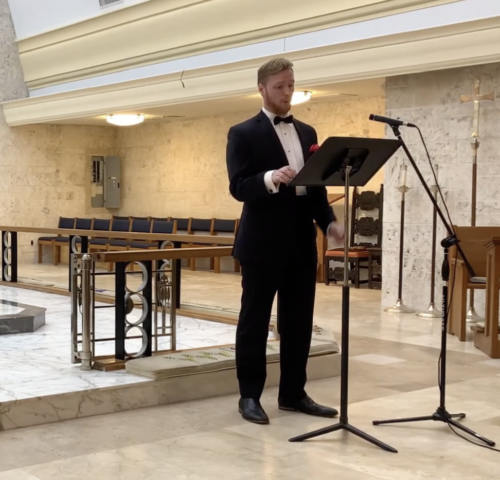
Johan Hartman is also a composer, who, among other compositions, sets music to poetry. (Photo courtesy of Mostly Baroque)
Though not part of this show, Hartman is working on an opera based on “The Signal-Man” a mystery-horror short story by Charles Dickens, published in 1866. It is within an innovative trend of horror and mystery as operatic themes being explored by young classical composers. “At the end of the day, it’s a good, human story that can exist in any genre,” says Hartman.
On Sunday, March 1, Tsai and Hartman play, respectively, scheming maidservant Serpina (the name says it all) and her boss, old bachelor Uberto in “La Serva Padrona,” the 1733 comic opera by Giovanni Battista Pergolesi.
In 2022, she and Hartman performed “La Serva Padrona,” at the Dennis C. Moss Cultural Arts Center – then the South Miami-Dade Cultural Arts Center. “It’s always a lot of fun to revisit a role,” she says. “It’s like an old friend.”
Song cycles have their own charm, says Tsai, yet opera is different in interesting ways. “You need to go into the role: what is the background (of the character), the details, and what lead her into that place?” She compares songs and opera to “a single short story instead of a novel.”
In the opera, Tsai says, “Serpina thinks of herself as the boss of the house,” who incubates her own schemes to reach her goal – namely marrying the well-heeled Uberto. Such characters, are fun, she says. And, she adds, the work includes a lot of interesting details. “Every time you revisit (a piece) you learn something new from the composer and what they are trying to do – that is good music.”
Tsai, who sings both mezzo-soprano and soprano roles, earned her doctorate in vocal performance from the University of Miami this year. She and Hartman met as graduate students at the University of Cincinnati College-Conservatory of Music where both were vocal performance majors. After living for some years in South Florida they moved to New Jersey, in order to be closer to New York and its professional opportunities.
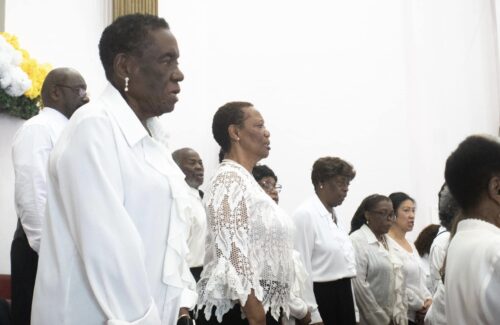
Oratorio Society Member Joyce Thomas, left, performs with the group. (Photo courtesy of Mostly Baroque)
Rounding out the concert while bringing things full circle is an appearance by the Miami Oratorio Society, performing work by Florence Price, the African American classical composer, who in the last several years is finally getting the recognition her works deserve. The group will also perform choruses from George Frideric Handel’s “Messiah,” accompanied by the Mostly Baroque Chamber Orchestra.
Christian, the society’s president, is originally from Jamaica, where she learned and sang classical compositions in the church her family attended. She joined the group – founded in 1974 – around 1992, when she moved to Miami. The society, she explains, was originally formed to bring classical music to underserved communities – which it still does. “We do a lot of Baroque music,” she says. “We do anything you can think of.” Christian, who sings soprano, became president of the group a year or two after joining. She and David Hartman met when he was the orchestra coordinator for the group.
It’s very exciting, she says, to perform the work of Price. “She was a Black lady and you don’t hear about many of the Black composers,” she says. “Moreover, she is a woman and that makes it even better.” They will sing “Praise the Lord,” a church anthem. “It is absolutely beautiful,” she says. The group has previously performed at the Arsht, but not recently, according to Christian. “This is our second time. I’m really looking forward to it.”
WHAT: Mostly Baroque Concert Series
WHERE: Adrienne Arsht Center’s Carnival Studio Theater, 1300 Biscayne Blvd., Miami
WHEN: 7 p.m., Thursday, Feb. 26 and. Friday, Feb. 27; 3 p.m., Sunday, March 1. COST: Varies by date: $70.20, Feb. 26; $46.80, Feb. 27; $87.75, March 1 INFORMATION: (305) 949-6722 or arshtcenter.org
ArtburstMiami.com is a nonprofit media source for the arts featuring fresh and original stories by writers dedicated to theater, dance, visual arts, film, music, and more. Don’t miss a story at www.artburstmiami.com
No posts found

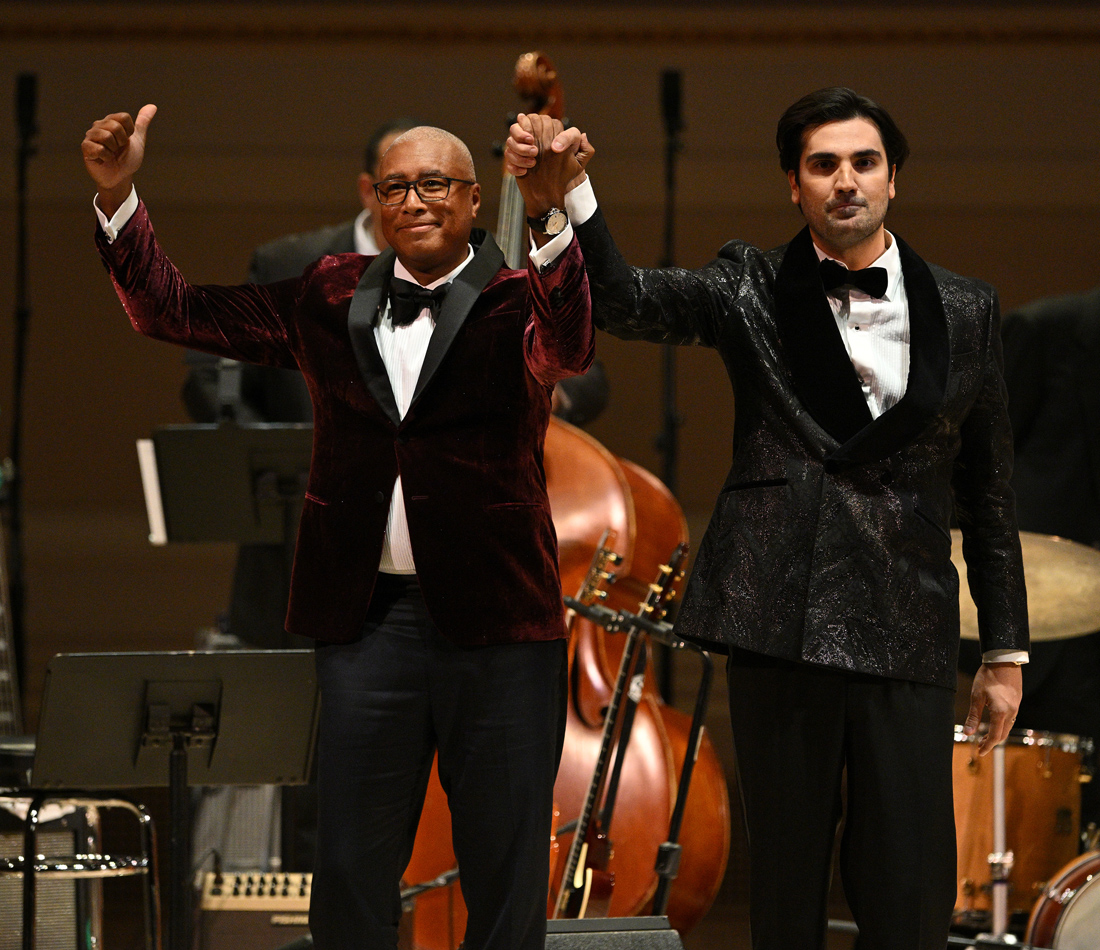

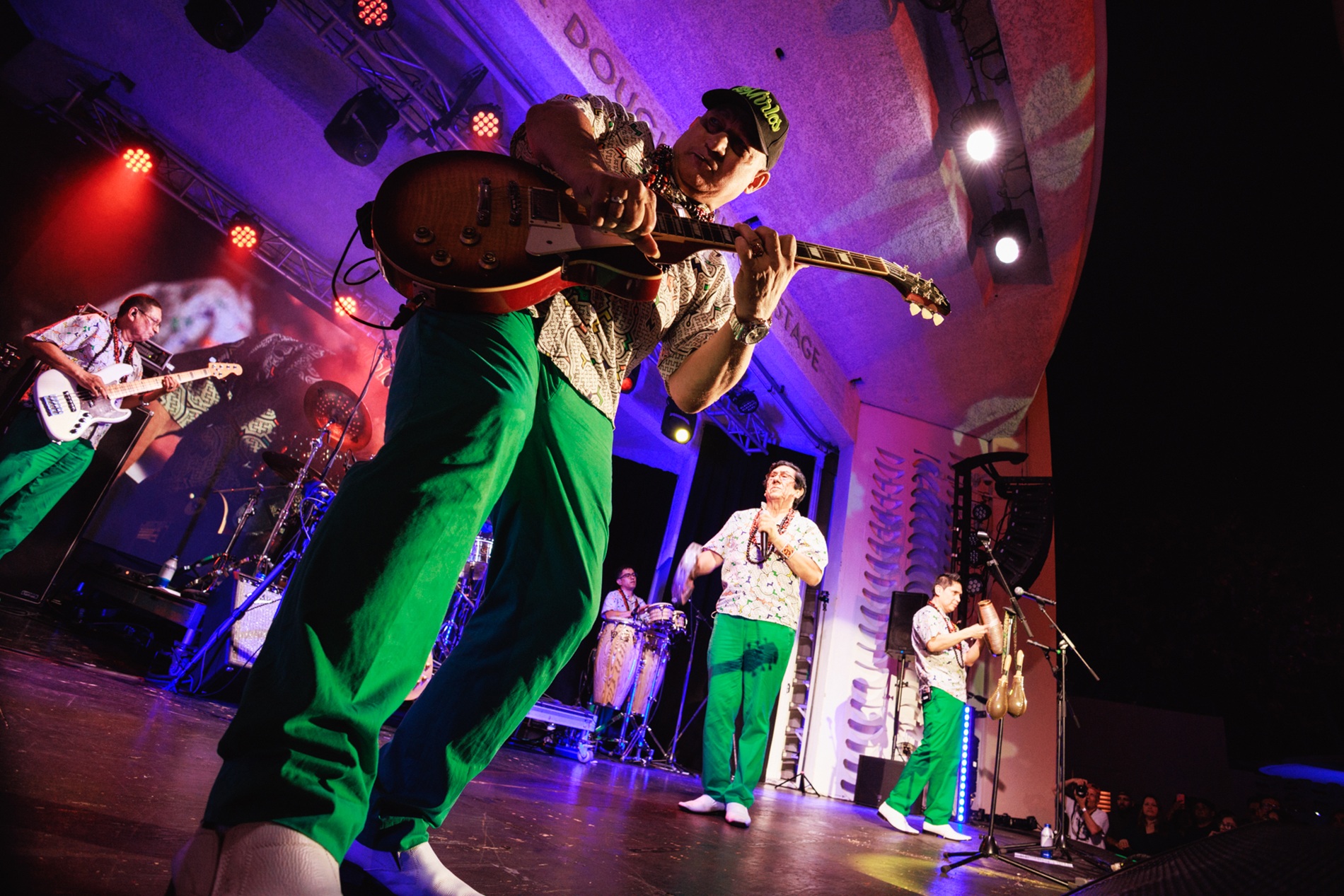
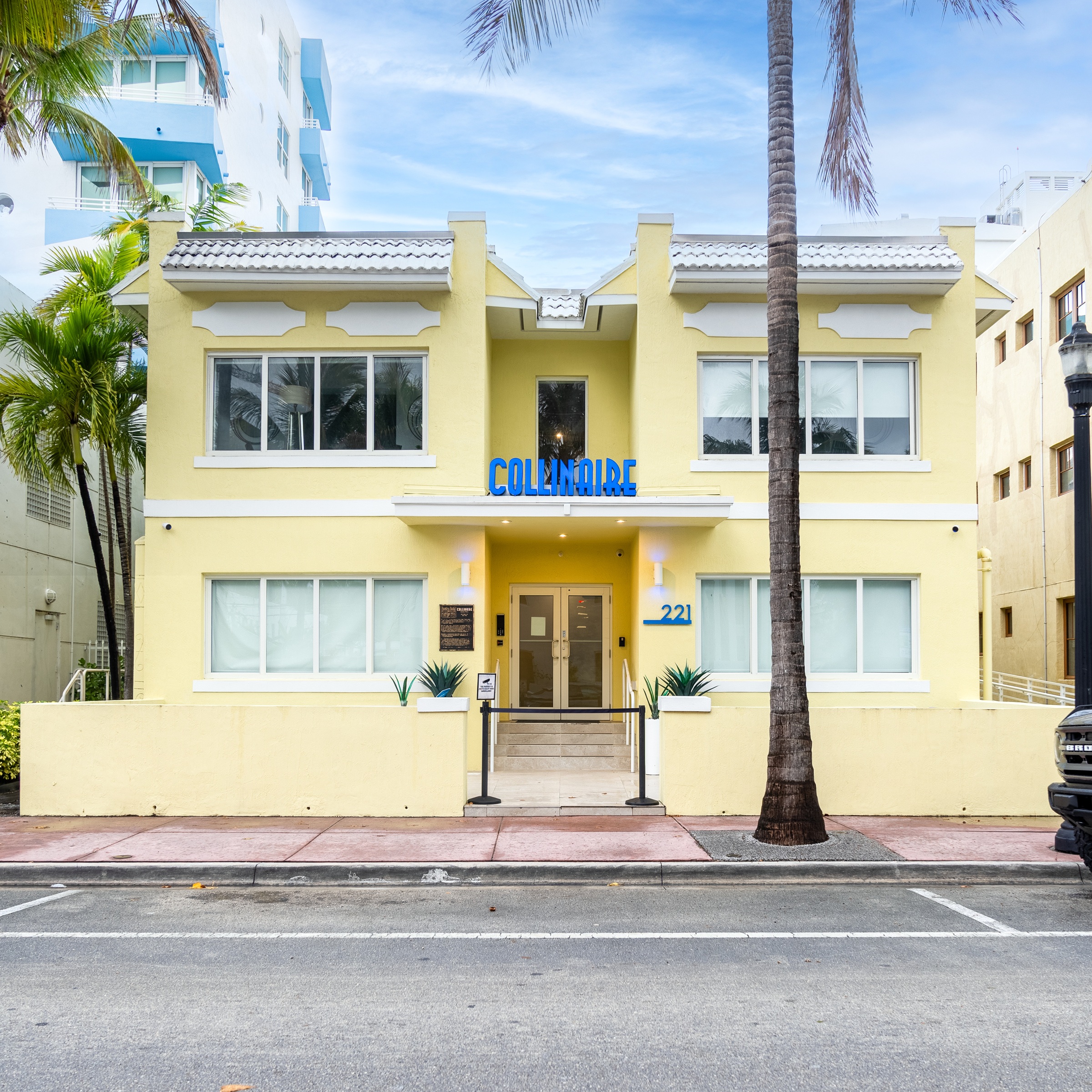
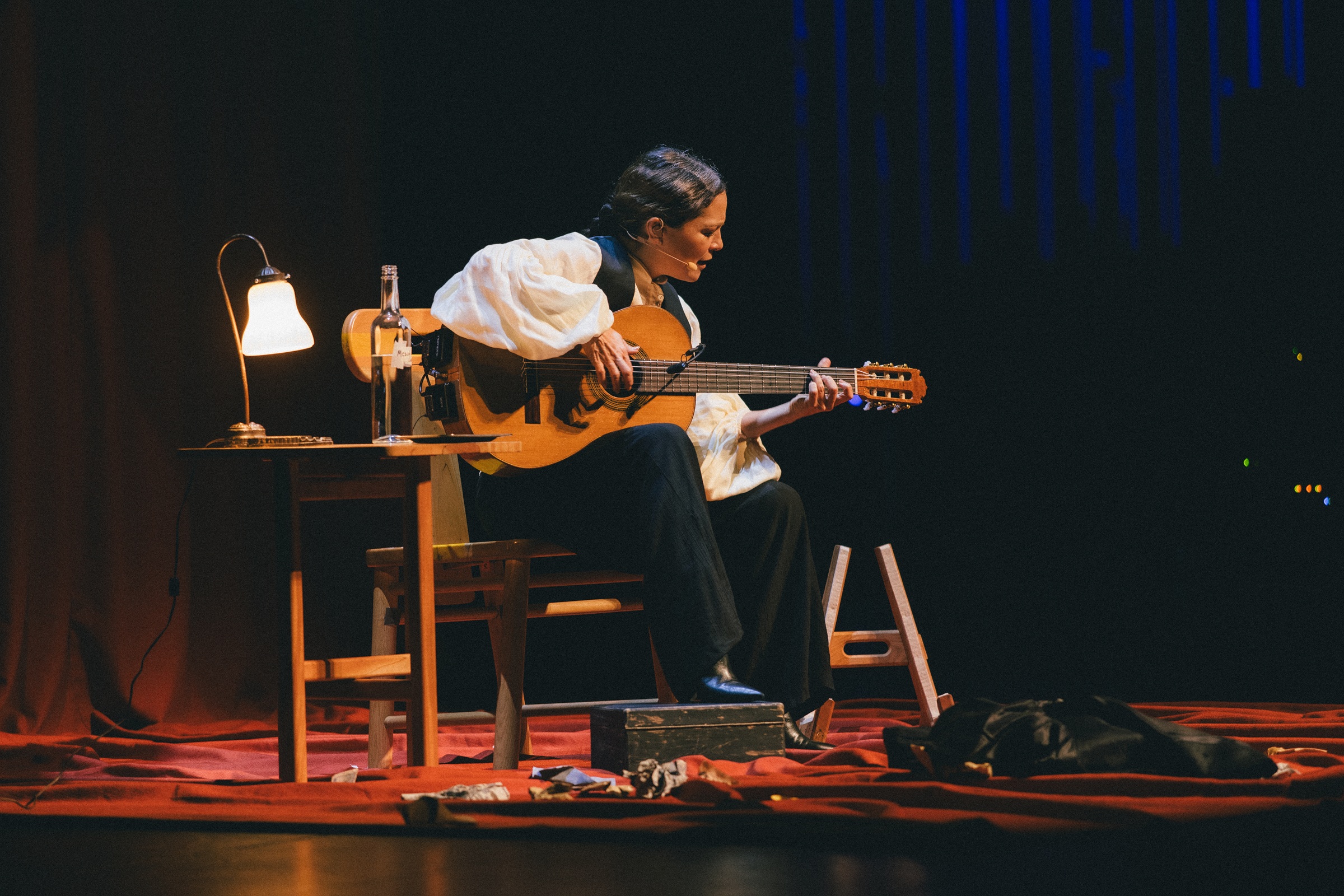

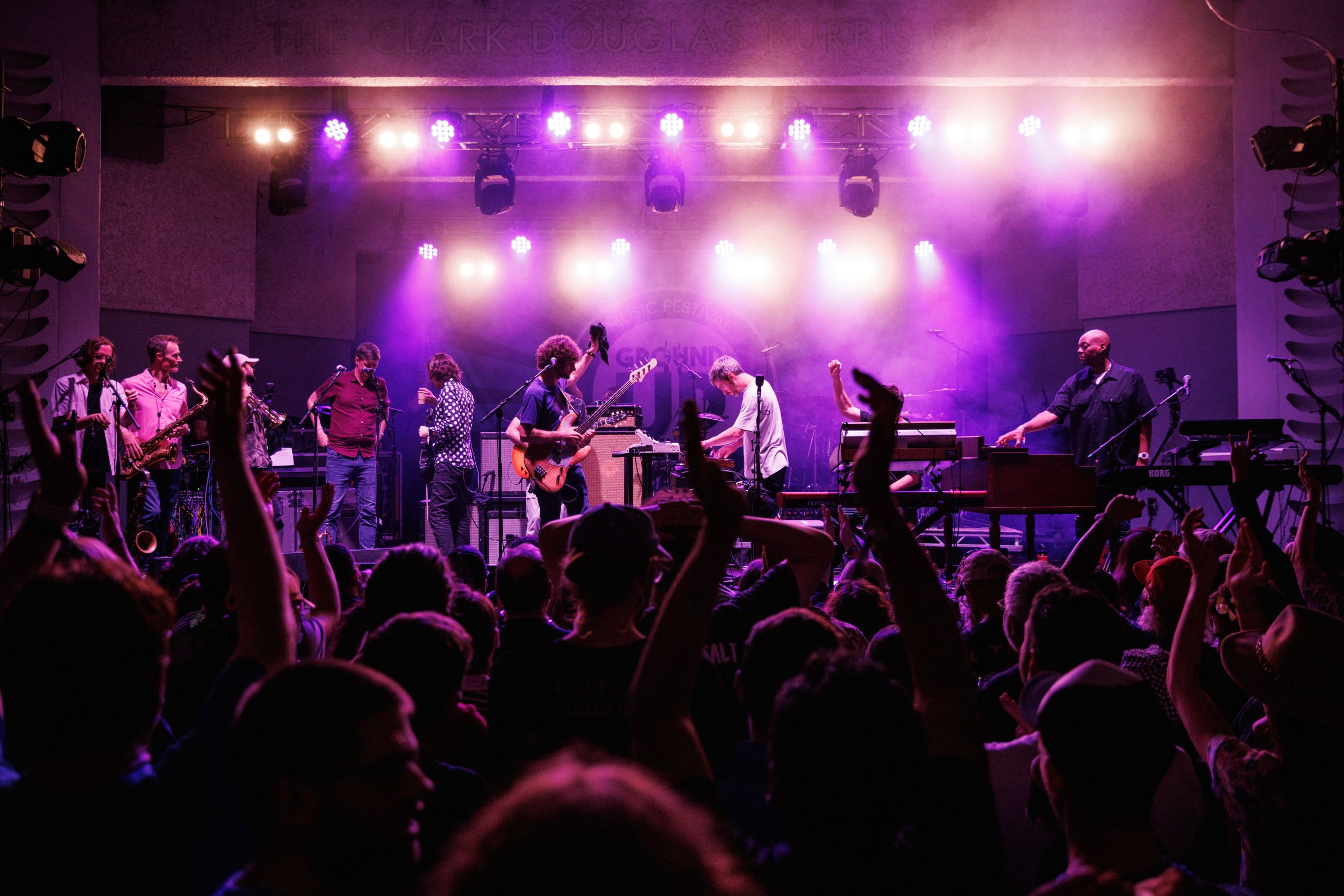

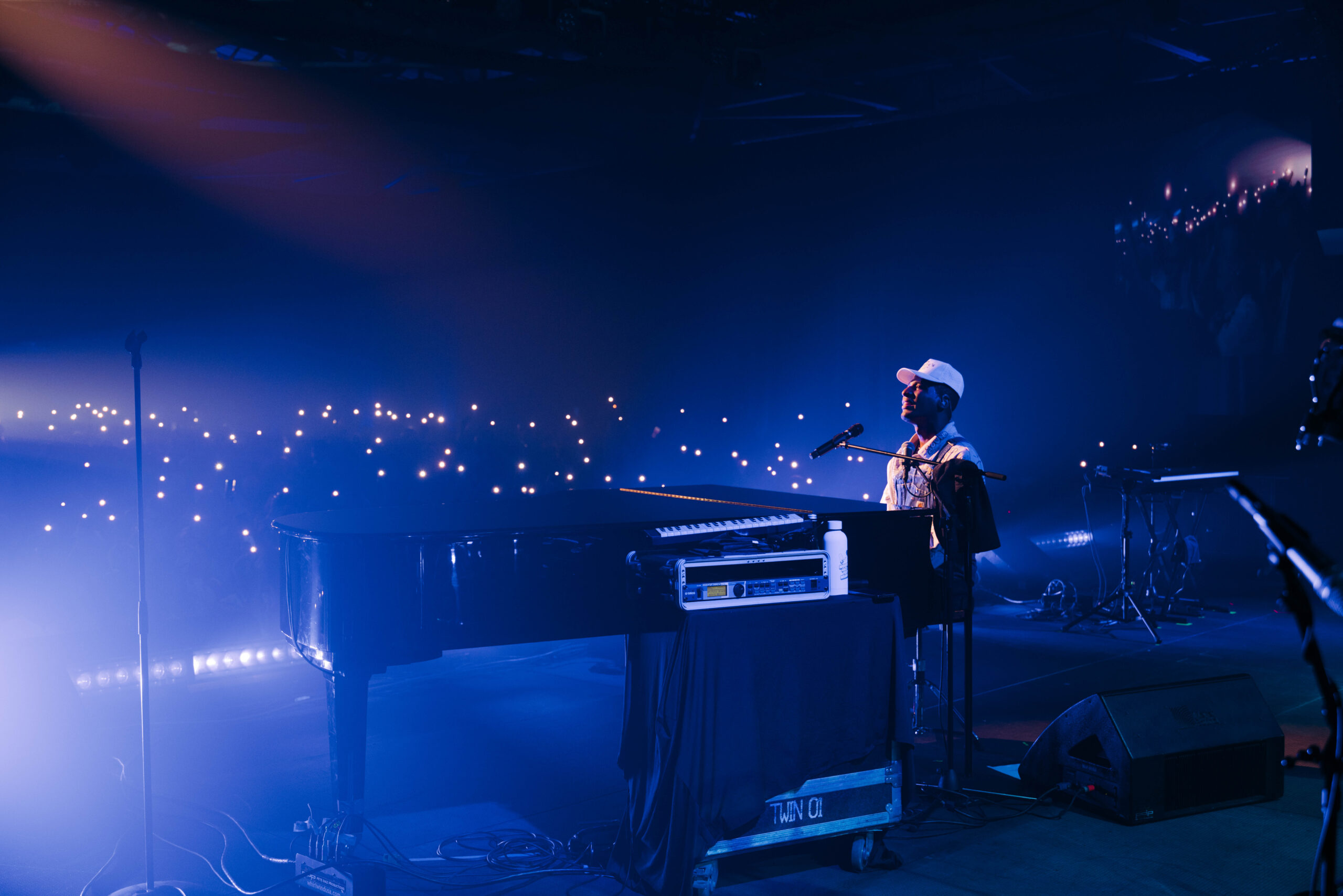
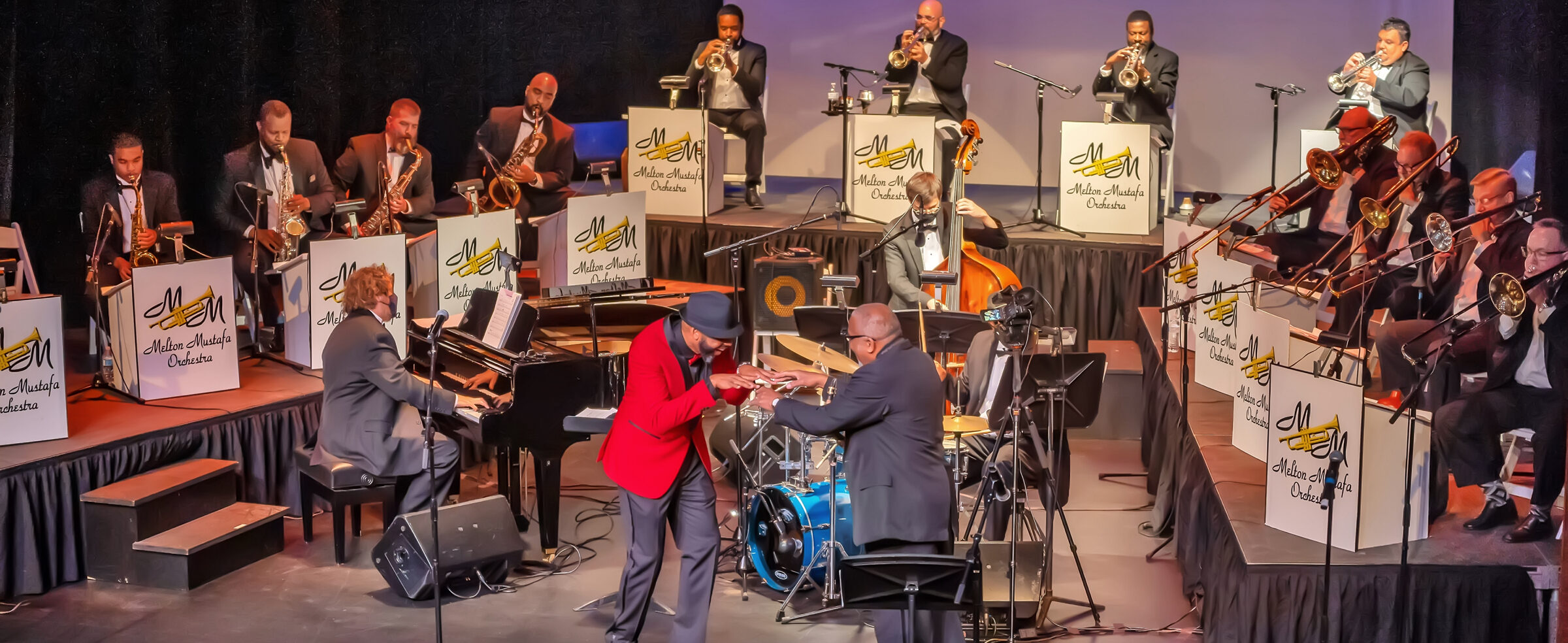
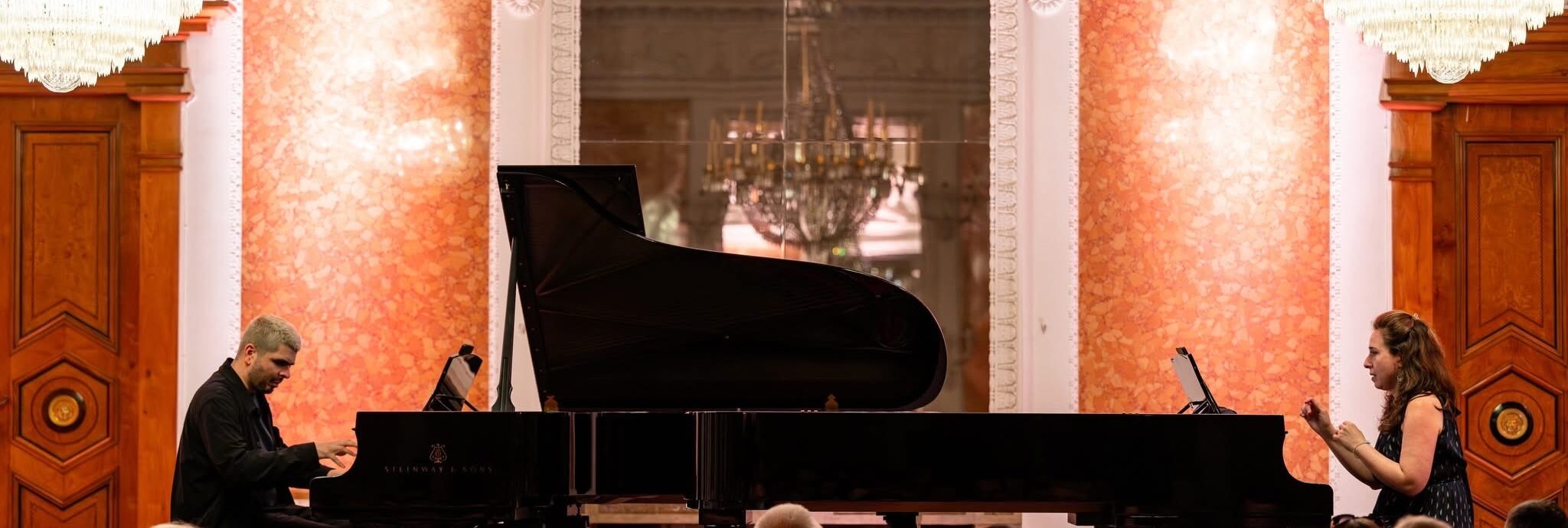
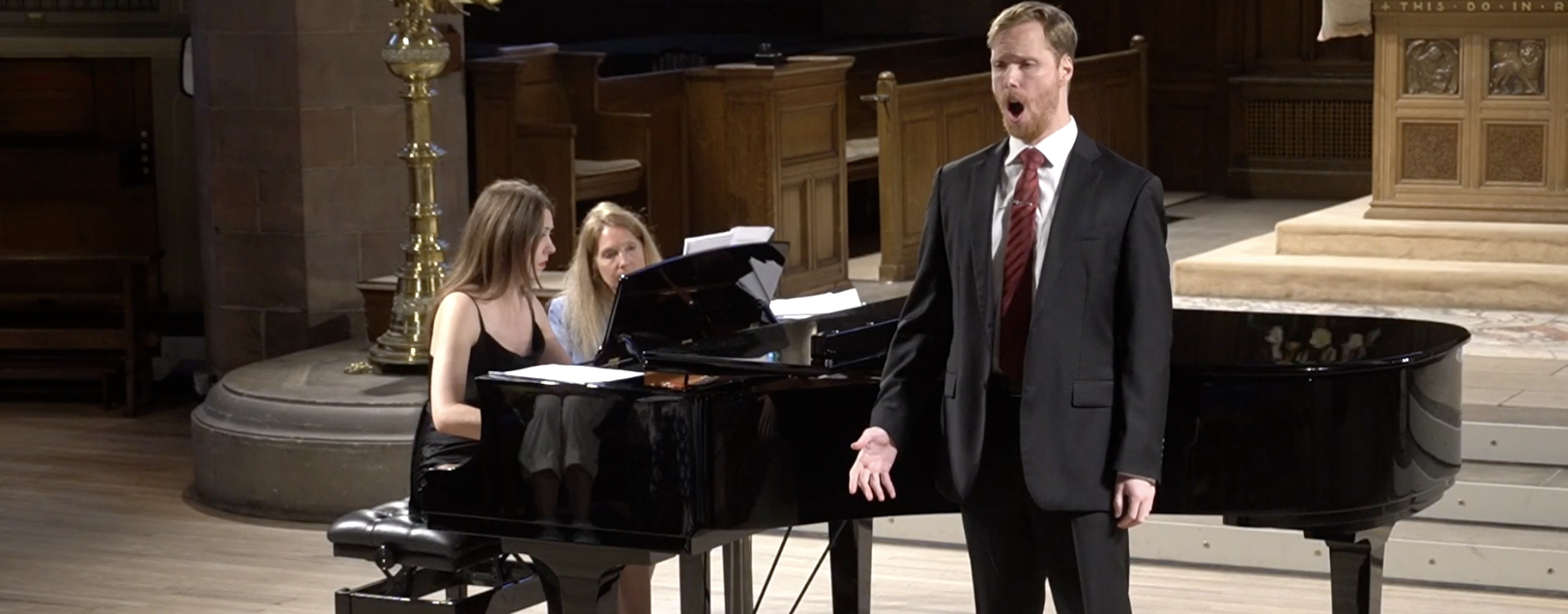
Recent Comments