
Visual Art
Across Centuries and Cultures: ‘The Light of the World’ Traces Images of Christ in Art
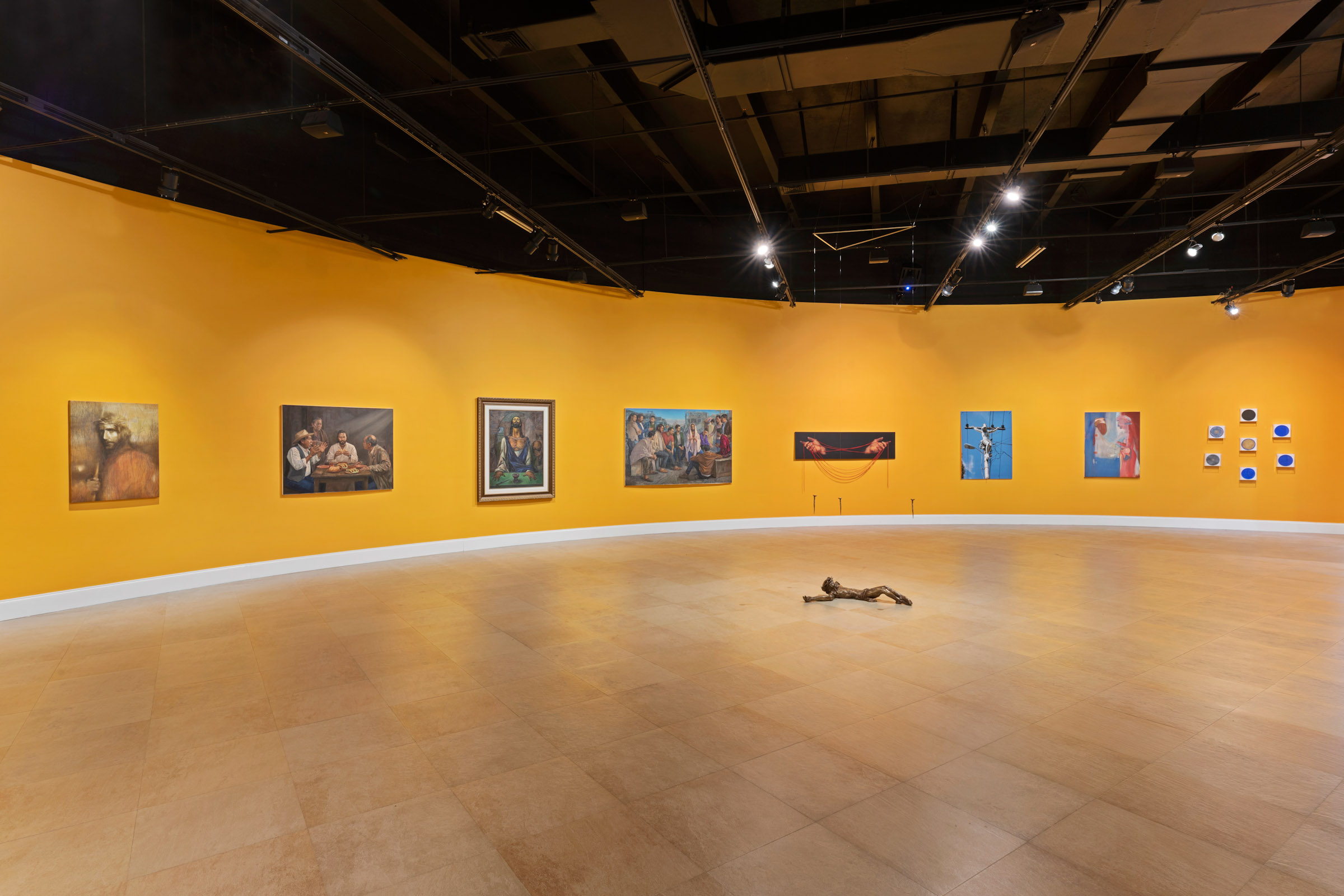
Olga M. and Carlos A. Saladrigas Gallery at Belen Jesuit Preparatory School presents “The Light of the World,” curated by Carol Damian and Adriana Herrera, on view through Wednesday, May 6. (Photo by Phillip Karp, courtesy of Ignacio Font)
At the Olga M. and Carlos A. Saladrigas Gallery at Belen Jesuit Preparatory School, “The Light of the World” bridges historical reverence with contemporary relevance. Curated by Carol Damian, a longtime Miami art historian and former director of FIU’s Patricia & Phillip Frost Art Museum, and Adriana Herrera, an independent curator and writer focused on Latin American art, the exhibition traces artistic interpretations of Jesus Christ across centuries, cultures and media.
Rather than presenting devotion as fixed, the exhibition reveals it as something shaped by culture, memory, and lived experience. Moving through the gallery, viewers encounter a dialogue between past and present—one that reflects both continuity and transformation.
A 17th-century Cuzco School painting of “St. Joseph with the Christ Child” introduces this dialogue with quiet intimacy. The composition is tender and grounded: Joseph cradles the child, both figures haloed and framed by delicate floral motifs. The work carries the visual language of colonial Latin American religious painting, yet its emotional accessibility feels immediate. It sets the tone for the exhibition’s central premise—that sacred imagery, while rooted in tradition, is always evolving in its expression.
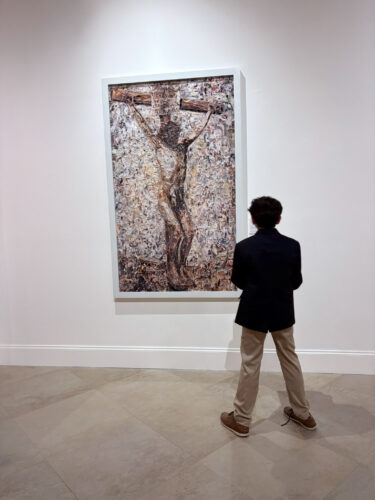
A Belen Jesuit student views Brazilian artist Vik Muniz’s “The Crucifixion, after Thomas Eakins” (2011), collage, in “The Light of the World,” curated by Carol Damian and Adriana Herrera, on view through Wednesday, May 6. (Photo by Suzzane Sardina and Ignacio Font, courtesy of Saladrigas Gallery at Belen Jesuit Preparatory School)
That evolution becomes strikingly apparent in contemporary works that reinterpret canonical imagery through new materials and perspectives. Brazilian artist Vik Muniz’s “The Crucifixion,” after Thomas Eakins (2011), transforms a familiar scene into a densely layered composition constructed from fragments of printed media. From a distance, the crucified figure is clearly legible. Up close, however, it dissolves into a chaotic accumulation of images—faces, textures, and visual debris—suggesting a world overwhelmed by information. In Muniz’s hands, the crucifixion becomes not only a symbol of sacrifice but also a reflection of contemporary visual culture, where meaning is both constructed and obscured.
Material experimentation continues in Stella Bernal de Parra’s “Mi Cristiano” (1973), a suspended textile that evokes the human body through woven wool and elongated strands. The work resists direct representation, instead suggesting presence through form and gravity. Hanging in space, it reads as both garment and relic, its tactile surface emphasizing labor and devotion. The piece invites viewers to consider faith not as an abstract concept, but as something embodied—stitched, woven, and carried over time.
Narrative returns powerfully in Darío Ortiz’s “The Last Supper” (2026), where the biblical scene is relocated to a contemporary environment marked by subtle signs of instability. The figures surrounding Christ wear modern clothing, their gestures subdued and contemplative. Rather than dramatizing the moment, Ortiz renders it as a quiet gathering, emphasizing the story’s human dimension. The work suggests that the sacred does not exist outside of history, but continues to unfold within it.
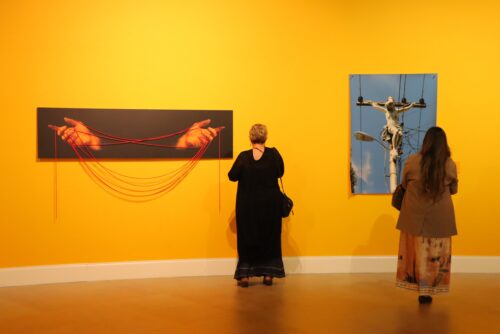
ilvia Dorfsman, local art dealer and appraiser, views Karim Borjas’ “Ecce Homo” (2006), a photographic installation featuring red strings, while Olga Garcia-Mayoral, curator and writer, reflects on Erik Ravelo’s “Señor, Dame Luz” (2009), a C-print in “The Light of the World” at the Olga M. and Carlos A. Saladrigas Gallery at Belen Jesuit Preparatory School. (Photo by Teresa Martinez, courtesy of Ignacio Font)
The exhibition also foregrounds artists who engage sacred imagery through inherited craft traditions. In Jesús Tax’s “Sustained Investigation” (2022), Christ’s face emerges through an intricate network of threads stretched across nails. The technique, rooted in textile, practices passed down through generations, transforms the act of making into a devotional gesture. The tension of the threads creates a dynamic surface, where image and structure are inseparable, reflecting both fragility and resilience.
Elsewhere, Pablo Cano’s “Westinghouse Basilica” (1979) reimagines the icon through found objects. A vintage refrigerator becomes a devotional structure, its doors opening to reveal painted religious imagery. The work carries a subtle humor and a deeper resonance: it collapses the boundary between the sacred and the everyday, suggesting that spirituality can inhabit even the most ordinary spaces.
Drawing plays a quieter yet equally significant role in the exhibition. In works by Fernanda Frangetto, including her “Via Crucis series” and “The Risen Jesus”, the figure of Christ dissolves into fields of color. Rendered in soft charcoal and pastel tones, the images feel ephemeral, as if emerging from light itself. Rather than defining the body, Frangetto allows it to disperse, emphasizing sensation over structure. These works offer a moment of stillness within the exhibition, inviting contemplation through their subtlety.
Throughout the gallery, the curatorial vision becomes increasingly clear: this is not simply an exhibition about representation, but about interpretation. Each artist approaches the figure of Christ from a distinct perspective, shaped by geography, material, and personal experience. Together, the works form a constellation of voices that expand the meaning of sacred art beyond any single tradition.
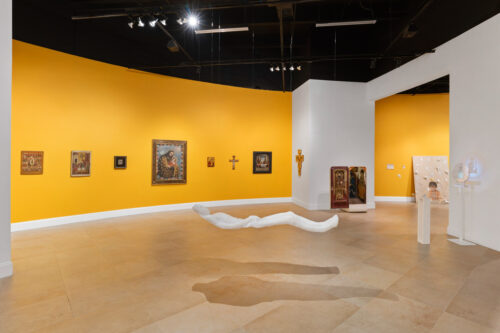
Installation view of “The Light of the World,” curated by Carol Damian and Adriana Herrera, at the Olga M. and Carlos A. Saladrigas Gallery at Belen Jesuit Preparatory School, on view through Wednesday, May 6. (Photo by Phillip Karp, courtesy of Ignacio Font)
What makes “The Light of the World” particularly compelling is its ability to bridge historical reverence with contemporary relevance. The exhibition does not attempt to resolve the tension between past and present; instead, it allows that tension to remain visible. In doing so, it reflects the ongoing role of art in shaping our understanding of spirituality, identity, and community.
In a cultural moment often defined by fragmentation, the exhibition offers something quieter yet enduring: a space for reflection. Through painting, textile, drawing, and assemblage, these artists remind us that the sacred is not static. It is something continually reimagined—held, questioned, and brought into the present through acts of creation.
WHAT: The Light of the World
WHERE: Olga M. and Carlos Saladrigas Art Gallery, Ignatian Center for the Arts, Belen Jesuit Preparatory School, 500 SW 127 Ave., Miami
WHEN: 8 a.m. to 4 p.m., Wednesday and Thursday or by appointment. Through Wednesday, May 6. Closing reception from 7 to 9 p.m., Wednesday, May 6.
COST: Free
INFORMATION: (786) 621-4170 or ifont@belenjesuit.org
ArtburstMiami.com is a nonprofit media source for the arts featuring fresh and original stories by writers dedicated to theater, dance, visual arts, film, music and more. Don’t miss a story at www.artburstmiami.com