
Visual Art
Wolfsonian Goes Shoe Crazy with ‘Foot Notes’ Exhibition
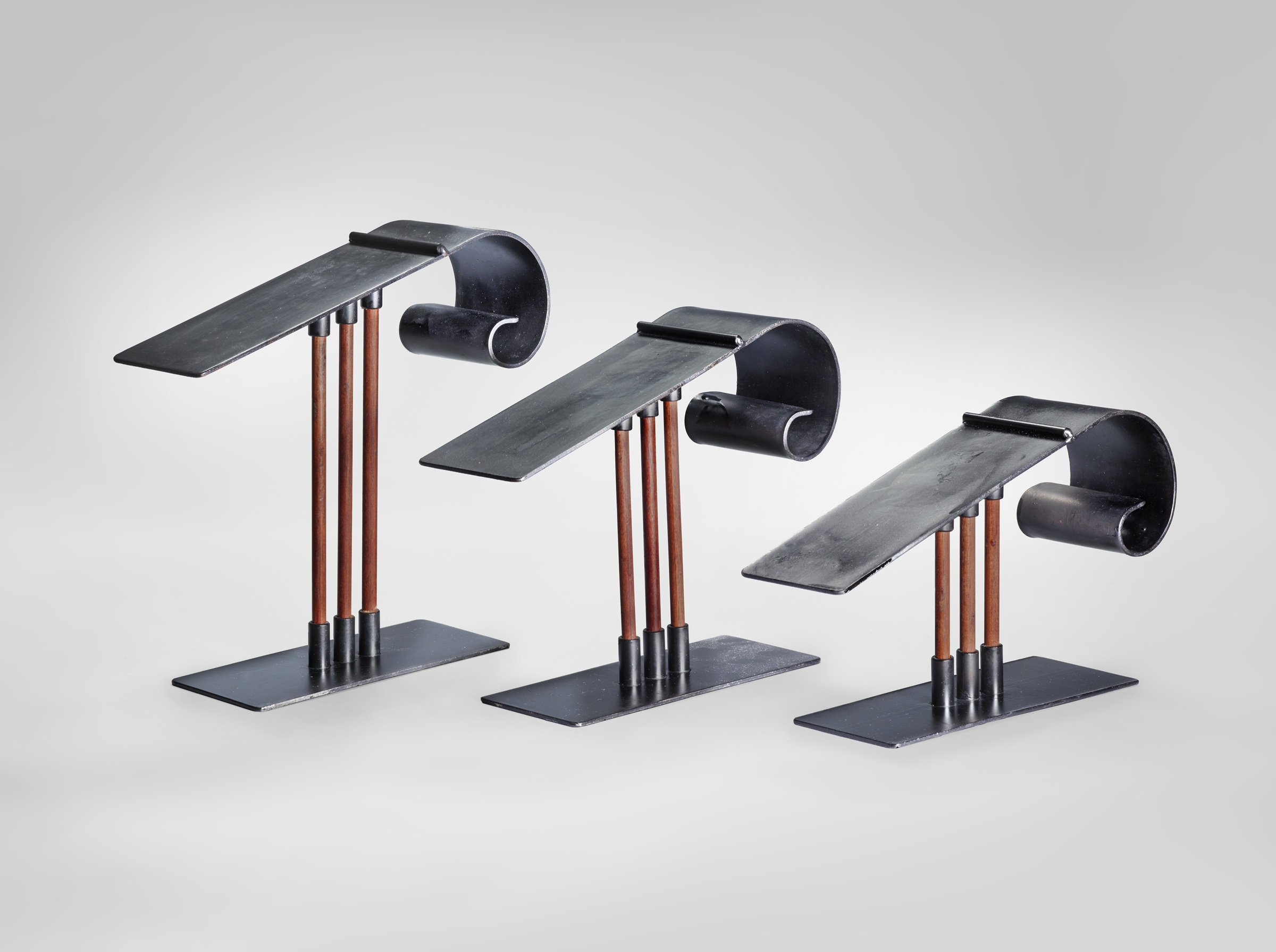
Shoe displays from the Bullock’s Wilshire department store, Los Angeles, are part of The Wolfsonian-Florida International University Mitchell Wolfson, Jr. Collection and are one of the design objects on display as part of the Miami Beach museum’s latest exhibition “Foot Notes: Shoes, Symbolism & Society.” (Courtesy of The Wolfsonian –Florida International University, Miami Beach, The Mitchell Wolfson, Jr. Collection)
Could anyone go without shoes for even a day? Footwear is one of those important things most of us take for granted, an everyday object that we nevertheless can’t live without. Now a new exhibition open at The Wolfsonian–FIU uses the museum’s extensive collection of 19th- and early 20th-century design objects to adjust our perceptions of the things we put on our feet.
Far from a mere collection of footwear through the ages, “Foot Notes: Shoes, Symbolism & Society,” which is on display through Feb. 28, 2027, defies expectations from the very start. In the first room, a hulking pair of Nazi overboots, used by German infantry to guard against frigid Russian winters during World War II, serves as the centerpiece of a display on the symbolism of footwear.
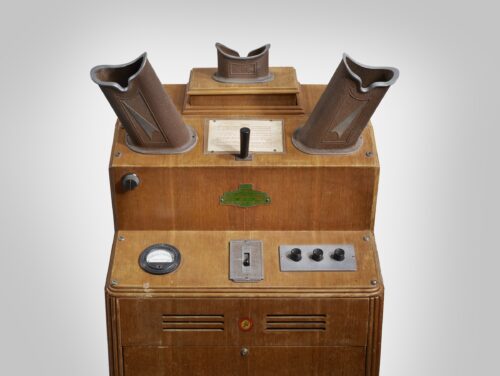
It was the X-ray Shoe Sizer, circa 1946, that inspired curator Danielle Charlap to create an exhibition about shoes. Simplex for X-Ray Shoe Fitter, Inc., Milwaukee, Wisconsin, manufacturer. Wood, glass, metal. 48 x 24 x 36 inches
(Courtesy of The Wolfsonian–Florida International University, Miami Beach, The Mitchell Wolfson, Jr. Collection)
Propaganda posters from the era from both the democratic United States and the Axis powers surround the imposing, heavy-duty boots, covered in animal hair and insulation. If one were to imagine a real-life version of Orwell’s vision of “a boot stamping on a human face,” this would be it.
“Foot Notes” is the first show at the Wolfsonian by Danielle Charlap, who joined the museum as curator in November 2025 and describes working at the museum as “a dream job.” Charlap got the idea for the show not from a shoe, but from a bizarre machine she found in the Wolfsonian’s collection catalog: a shoe sizer that beams X-rays at people’s feet. The dangerous-in-hindsight 1940s contraption inspired the curator to dig deeper into the museum’s holdings, uncovering everything from propaganda and advertising artifacts to “random recreational footwear” like ice skates and bouncing toy “rocket shoes” with springs attached to the soles.
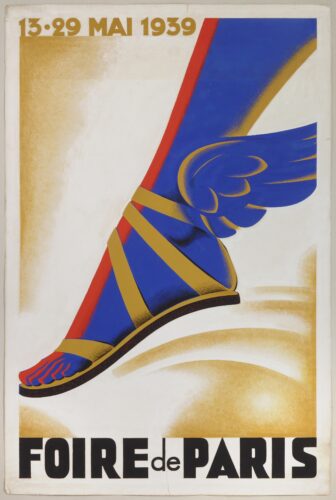
Design drawing, “Foire de Paris Mai 1939 (Fair of Paris, May 1939),” c. 1939, France. Gouache and graphite on paper. 48 x 32 in. (Courtesy of The Wolfsonian–Florida International University, Miami Beach, The Mitchell Wolfson, Jr. Collection)
“We are not a fashion museum, but it turns out we had so many materials related to shoes,” Charlap says. “It really just became a lens into the collection, and I remember in the beginning we were thinking, was there enough material? And it turns out there was way too much.”
While most of the show is sourced from the Wolfsonian’s holdings, a few key works were secured through loans. The Ferragamo shoes came from the company’s museum in Florence, for instance. Though the show is light on sneakers due to the collection’s focus on objects from before 1950, they did manage to secure a gaudy “Solid Gold” Adidas sneaker from the Miami Shoe Museum designed by Jeremy Scott. The shoe ties together a section on the theme of Mercury, the Greco-Roman messenger god who wore winged sandals. Posters for Goodyear Tires and the 1939 Foire de Paris retail expo flank the flamboyant shoe.
Elsewhere, the show features extensive discussion of the materials used to make shoes and how industrial processes and design innovations changed the nature of our everyday footwear. Two sections profiling famous designers highlight this ingenuity.
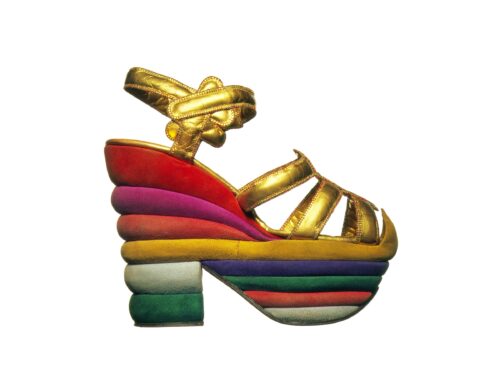
Salvatore Ferragamo’s “Rainbow” (1938) was designed by Salvatore Ferragamo for Judy Garland. Suede, gilded leather, leather and cork
(Photo courtesy Museo Ferragamo, Florence)
A display of vintage shoes by Salvatore Ferragamo details both the Italian designer’s reputation as “shoemaker to the stars” and the constraints he faced during his career. One rainbow-colored shoe with a bulky heel, created for singer Judy Garland in 1938, uses lightweight cork, while other models repurpose cellophane and rattan, a result of creativity enforced by the economic and political environment of fascist Italy.
A set of different imperatives motivated the work of Beth Levine, the pioneering designer behind the Herbert Levine brand. Though the sexism of the times forced Beth to take a back seat to her husband as the face of the company, her work dominated the mid-20th century American shoe market and brought avant-garde ideas into shoe design. Most famously, Levine pioneered the fashion boot, giving the utilitarian footwear a sleek, feminine form that sparked a craze after Nancy Sinatra wore the boots to promote her hit song “These Boots Are Made for Walkin’.”
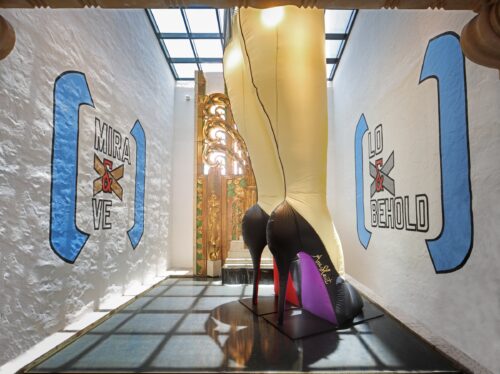
One of the most unique artworks welcomes visitors in the museum’s Art Deco lobby: A giant inflatable pair of legs wearing stiletto heels by artist Ann Slavit. “Della (Waiting),” 20-foot, inflatable sculpture, 1978. (Photo courtesy of the Wolfsonian-FIU, Copyright Ann Slavit)
Other innovations include the “no-shoe,” a heel secured to stockings via adhesive that serves as a precursor to more contemporary designs such as Demna Gvasalia’s “Speed Trainer” sneaker-socks for Balenciaga.
One of the most unique artworks welcomes visitors in the museum’s Art Deco lobby: A giant inflatable pair of legs wearing stiletto heels. The sculpture by artist Ann Slavit, titled “Della (Waiting),” serves as a commentary on the degradation of women in the media. Slavit designed and named the artwork after Della Street, played by Barbara Hale, the secretary to lawyer Perry Mason on the 1950s and ’60s legal drama of the same name. While Street is depicted as a staunch professional in the show itself, Slavit observed that the camera consistently cut to her legs, servicing the male gaze and objectifying the character.
“I was thinking about, as I was growing up in the ‘50s, how crazy it was that the moms around us were literally wearing high heels all day long just to take care of the kids, cook, do laundry. Because there were less and less women working at that time, at least in my memory,” Slavit recalls. “I was also aware of billboards where they were using women to sell cars, or objectifying women by body parts, and that memory kind of stayed with me.”
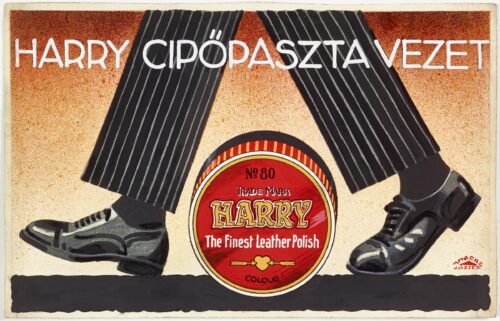
Design drawing, Harry cipöpaszta vezet (Harry Shoe Polish is in the Lead), c. 1925; Hungary, Budapest Gouache, watercolor, ink, and graphite on paper, 8 7/8 x 13 7/8 in. (Courtesy of The Wolfsonian–Florida International University, Miami Beach, The Mitchell Wolfson, Jr. Collection)
As well as being a collision between feminism and pop art, two of the dominant movements at the time, “Della (Waiting)” also serves as an early example of inflatable art, a medium made famous in recent times by the likes of KAWS and Cyril Lancelin. Slavit decided to allow the piece to be used in the show after some discussion with Charlap about the show’s concept, and the idea of exploring history and changing social trends through common objects. In the process, the artist herself ended up connecting the same childhood experiences she’d used in her art with some of the objects in the show.
“She was talking about the X-ray machine, and I had forgotten all about it, but I actually remember that from getting shoes,” Slavit says. “I think it takes a kind of awareness to point these things out, because we take them for granted. Like now, people are okay about wearing sneakers…When I was growing up, you never wore sneakers unless you were playing a sport. I mean, you put them on to play basketball, but you didn’t walk around in sneakers. No one walked around in sneakers.”
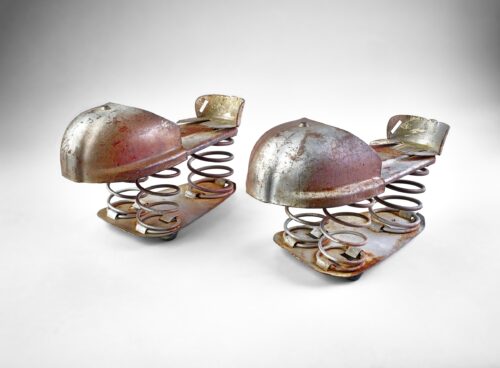
Toy, “Rocket Shoes,” c. 1953, United States. Metal, paint, 6½ x 5 x 10½ inches. (Courtesy of The Wolfsonian–Florida International University, Miami Beach, Florida, The Mitchell Wolfson, Jr. Collection)
It’s a powerful observation: Few things change more quickly and dramatically than fashion.
“We’re moving so fast that, in a way, slowing down to think about what we’re wearing means a lot,” Slavit says. “Where is it made? Who made it? All those kinds of questions.”
WHAT: “Foot Notes: Shoes, Symbolism & Society”
WHEN: 10 a.m. to 6 p.m. Wednesday, Thursday, Saturday and Sunday; 10 a.m. to 9 p.m. Friday. Through Feb. 28, 2027.
WHERE: The Wolfsonian –FIU, 1001 Washington Ave., Miami Beach
COST: $12 for adults, $8 for seniors, students with ID, and children ages 6 to 18; free for Florida residents, children under 6, state university system students, faculty and staff, and active U.S. military and veterans with ID.
INFORMATION: 305-531-1001 or wolfsonian.org.
ArtburstMiami.com is a nonprofit media source for the arts featuring fresh and original stories by writers dedicated to theater, dance, visual arts, film, music and more. Don’t miss a story at www.artburstmiami.com