
Music
A Decade of the South Beach Jazz Festival with Miami Beach as Its Stage
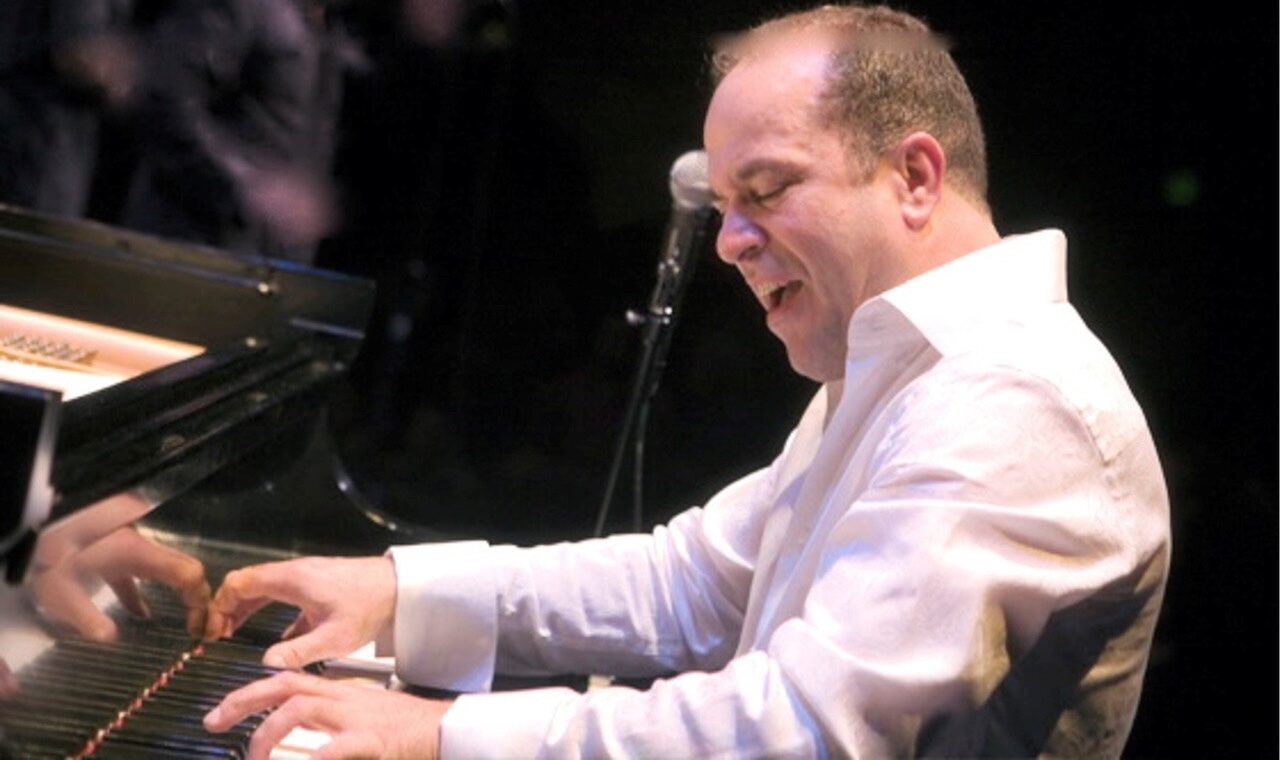
Oscar Hernández, Grammy Award–winning pianist and arranger, leads the Spanish Harlem Orchestra, when it performs at the South Beach Jazz Festival on Saturday, Jan. 10, at the Miami Beach Bandshell. (Photo courtesy of the artist)
The South Beach Jazz Festival has evolved over its ten years in Miami Beach as a cultural event that hasn’t just survived the city’s constant reinvention—it has grown along with it, inviting audiences to encounter jazz not as a venue-specific experience, but woven into the everyday rhythm of Miami Beach.
The four-day festival, opening Thursday, Jan. 8 and running through Sunday, Jan. 11, unfolds across the city’s plazas, museums, parks, and open-air stages. Free and ticketed events feature performers ranging from local acts with staying power to up-and-coming student musicians and big-name headliners.
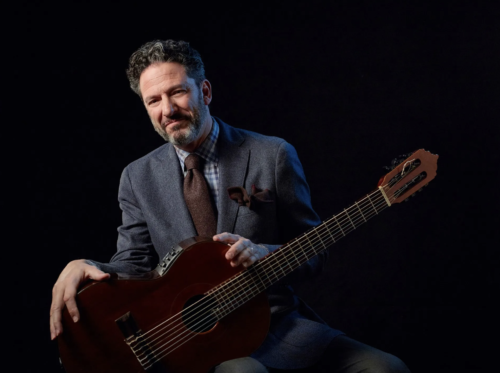
Kicking off the 10th Annual South Beach Jazz Festival is Grammy Award–winning guitarist, vocalist, and producer John Pizzarelli in a heartfelt salute to the legendary Tony Bennett at Faena Theater in two shows on Thursday, Jan. 8. (Photo courtesy of the artist)
The opening night feature on Thursday, Jan. 8, is “John Pizzarelli Presents ‘Dear Mr. Bennett.’ ” The Grammy Award–winning guitarist, vocalist, and producer presents two shows in a salute to the legendary Tony Bennett.
At The Bass Museum of Art on Friday, Jan. 9, Ricky Riccardi, director of Research Collections at the Louis Armstrong House Museum, two-time Grammy Award winner, and author of “Stomp Off, Let’s Go: The Early Years of Louis Armstrong” gives insight into the trumpeter’s artistry. Additional performances take place at the Miami Beach Bandshell, Collins Park and on Lincoln Road.
Founded by Power Access, a local nonprofit headed by R. David New and dedicated to disability awareness and providing opportunities for people with disabilities, the South Beach Jazz festival grew out of a desire to create a signature event rooted in quality and public engagement. “We’re a tiny organization that always wanted to do something very special, but has really kept it focused on the quality,” says Lori Bakkum, executive director of Power Access and the South Beach Jazz Festival.
That focus, paired with long-standing community partnerships, has allowed the festival not only to last, but to expand. “We’ve had support from the community, the business community and the municipality,” she says, “and those collaborations have made the difference.”
About five years ago, as the festival expanded, Power Access partnered with the Rhythm Foundation on music curation, aligning with another nonprofit deeply rooted in live music and public programming across Miami Beach.
In a city where cultural initiatives often appear and disappear with the seasons, reaching a ten-year milestone carries particular weight. It suggests a festival that both understands its environment and has earned its place within it.
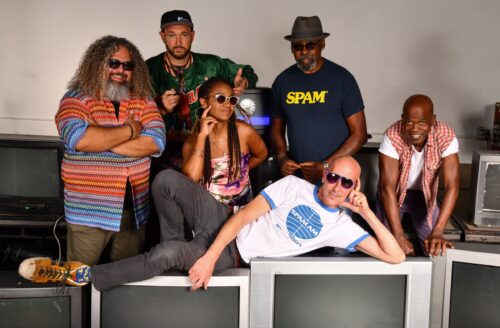
From left, Jose Elías, Chad Bernstein, Magela Herrera, Tomás Díaz, Andrew Yeomanson and AJ Hill of Spam Allstars. A longtime fixture of Miami’s music scene, the band brings its improvisational, genre-blending sound to this year’s South Beach Jazz Festival. (Photo by Jill Kahn)
That kind of longevity is not abstract in Miami Beach. Andrew Yeomanson, leader of the long-running local band Spam Allstars— the band will perform Sunday, Jan. 11 at 5:30 p.m. in a free concert on Lincoln Road —has watched entire neighborhoods transform in the span of a few years. “To last even five years in Miami as a band or an artist, that’s the first big hurdle,” he says. “There are so few institutions here that have truly stood the test of time.”
For Yeomanson, survival in Miami has required a particular posture toward change. “You have to dig your heels in and be really stubborn,” he says. He reaches for an image that feels both playful and precise. “You kind of have to be like Bugs Bunny: they’re building this big skyscraper, and he will not move his little rabbit hole. They just have to build around him.”
That stubborn persistence—refusing to disappear even as the city shifts—is one of the unspoken qualities the festival shares with many of the artists it presents.
One of the defining characteristics of the South Beach Jazz Festival is the way it is built into the city itself. Rather than confining performances to a single venue, the festival stretches across Miami Beach, activating some of its most recognizable public and cultural spaces. Lincoln Road, the Miami Beach Bandshell, The Bass Museum of Art and Collins Park each become part of the festival’s architecture, shaping how audiences experience the music.
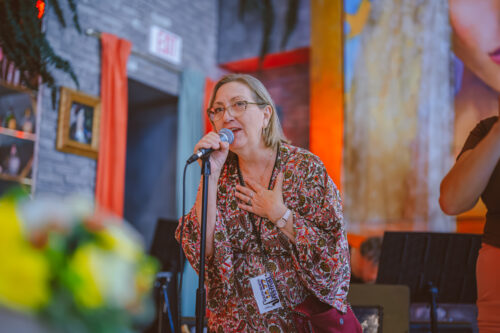
Lori Bakkum, executive director of Power Access and the South Beach Jazz Festival, speaks at a recent festival event. Founded by Power Access, the festival marks its 10th anniversary (Photo by MasterWing Creative Agency. courtesy of Lori Bakkum)
“Our venues are very specific and chosen,” explains Bakkum. “Lincoln Road, for those of us that have lived in Miami for years, really is the heart.” While student ensembles and emerging musicians take over nearby spaces the day before, the festival’s closing day transforms the Lincoln Road plaza into an all-day main stage.
At the other end of the city, the Miami Beach Bandshell hosts the festival’s marquee performances. “We’re very lucky to have our big headliner concert at the Bandshell,” says Bakkum. “Being under the stars—but covered—right there on the beach, it’s just a wonderful space to perform in.”
The Bass Museum of Art has also become a key partner, serving as both setting and collaborator turning the concert into a visual and cultural experience that feels uniquely Miami Beach.
For Yeomanson, that kind of use of public space is essential. “If you go to any world-class city, you’ll see the plazas activated,” he says. “It’s what makes cities human. It’s what makes a city a community.”
In Miami, he adds, that visibility matters even more. “We have this incredible tropical landscape, but it’s marred by traffic, cost of living—all of it. Culture is the release. It’s what makes a city livable. Even people who don’t realize they need it… they need it.”
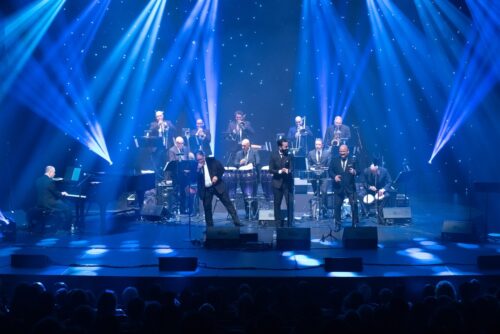
Three-time Grammy Award-winning Spanish Harlem Orchestra lights up the Miami Beach Bandshell for the 10th Annual South Beach Jazz Festival—joined by acclaimed trumpeter and Caribbean jazz master Etienne Charles on Saturday, Jan. 10. (Photo by George Pruitt, courtesy of South Beach Jazz Festival)
That openness would mean little without substance behind it. From its earliest editions, the South Beach Jazz Festival has emphasized curation over spectacle, assembling lineups that balance international recognition with local continuity. According to Bakkum, there will be “about a hundred artists performing in the 10th annual South Beach Jazz Festival from student bands to emerging artists to local legends to international and national stars and Grammy winners.”
Among those international figures is Spanish Harlem Orchestra, led by Grammy Award–winning pianist and arranger Oscar Hernández. Founded in 2001, the ensemble has earned global recognition for its commitment to classic salsa and Latin jazz traditions, shaped by Hernández’s decades-long career alongside figures such as Celia Cruz, Tito Puente, Rubén Blades and Johnny Pacheco.
“I was lucky to learn directly from so many of the musicians who shaped this music when I was coming up in New York,” says Hernández. “Their legacy lives on through my own music and performances.”
For Hernández, performing in this festival carries special resonance. “With the cultural diversity in Miami, that aspect of who we are and what we represent has an even more special meaning here.”
While select ticketed performances anchor the program, much of the festival has free admission— an increasingly rare model for an event of this scale. That approach has reshaped how audiences encounter jazz. Many experience it unexpectedly, stumbling upon performances while walking through Lincoln Road or spending an afternoon in Collins Park. “We have people that perhaps were visiting the city three years ago and happened upon our Lincoln Road stage and now they plan their vacations to come back for it,” says Bakkum.
Beyond the January dates, the festival’s reach now extends year-round. Through summer concert series and pop-up performances across Miami Beach, Power Access has created a sustained platform for live jazz, offering visibility to local musicians who often tour nationally but remain underheard at home.
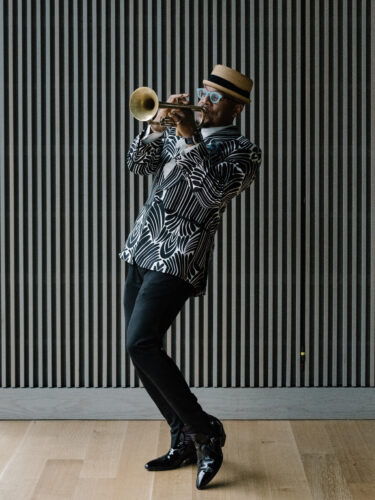
Trumpeter and Caribbean jazz master Etienne joins the Spanish Harlem Orchestra at the Miami Beach Bandshell for the 10th Annual South Beach Jazz Festival. (Photo by Jason Henry)
Recent years have not been easy for arts organizations, particularly small nonprofits. “It’s been quite a two years for cultural arts spending,” Bakkum says referring to the changing landscape in national, state and local government arts funding. Yet she also sees opportunity in the collective response. “What we saw was collaborations between arts groups and the community really recognizing how important the cultural arts are—not just culturally, but economically.”
For Yeomanson, the stakes are personal. He now sees second generations showing up at shows—children of people who once met at Spam Allstars gigs, or danced at weddings the band played years ago. “Your voice still has a place in your community,” he says. “That’s why these chances matter.”
After ten years, the South Beach Jazz Festival reflects that same belief. It survives not by resisting change, but by making room for connection—by trusting that what holds a city together is not only what gets built, but what endures.
“You can never have too much live local music,” says Bakkum.
In Miami Beach, that may be the most durable structure of all.
WHAT: South Beach Jazz Festival
WHEN: Opening night 8 p.m. Thursday, Jan. 8, at Faena Theater. 5:30 p.m., Friday, Jan. 9 at The Bass Museum of Art ; 8 p.m. Friday, Jan. 9 in Collins Park. Events 10 a.m. to 5 p.m. Saturday, Jan. 10, on Lincoln Road, with headliner performance 8 p.m. at the Miami Beach Bandshell. Events 11 a.m. to 9 p.m. Sunday, Jan. 11, on Lincoln Road.
WHERE: Various locations throughout Miami Beach, including Faena Theater at Faena Forum, 3300 Collins Ave.; The Bass Museum of Art, 2100 Collins Ave.; Collins Park, 2100 Collins Ave.; Lincoln Road and Euclid Avenue, including the plaza at 1100–1111 Lincoln Road and the Miami Beach Bandshell, 7275 Collins Ave., Miami Beach.
COST: Free to $275. Individual tickets start at $42.50. VIP Reception $75. All-Access Pass $275. Miami Beach residents receive a 20% discount on select ticketed events with code MB20. Many free events require RSVP.
INFORMATION: SoBeJazzFestival.com and (305) 322-6385.
ArtburstMiami.com is a nonprofit media source for the arts featuring fresh and original stories by writers dedicated to theater, dance, visual arts, film, music and more. Don’t miss a story at www.artburstmiami.com.