
Music
The great Mexican songstress Natalia Lafourcade returns to Miami with ‘Cancionera’
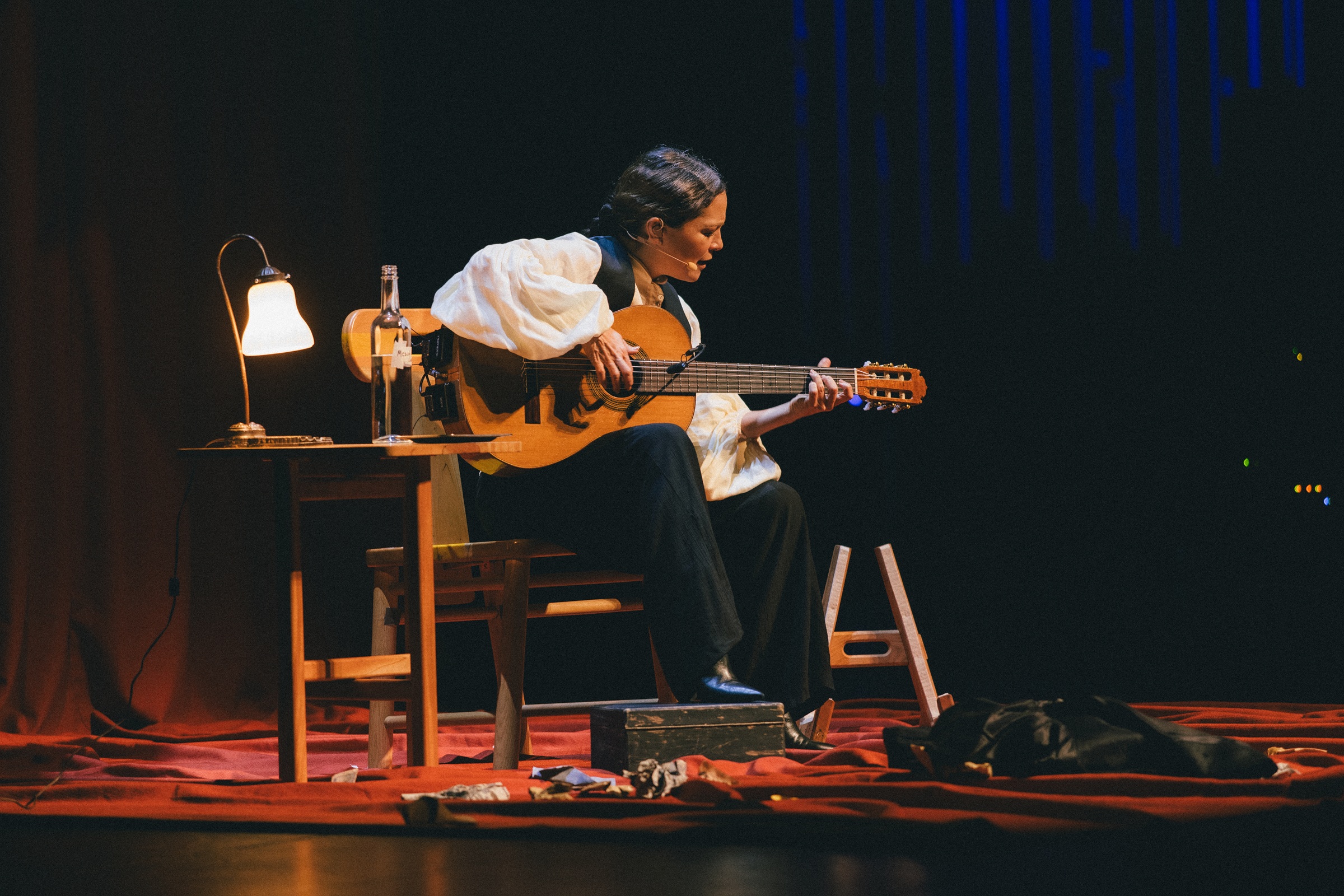
Natalia Lafourcade returns to Miami after an absence of nearly nine years, bringing “Cancionera”
(“Songstress”), an intimate concert at the Arsht Center’s Knight Concert Hall dedicated to her album of the same name, and songs of albums past. (Photo courtesy of Natalia Lafourcade)
With 25 Grammy and Latin Grammy awards to her name, Natalia Lafourcade has received more golden gramophones than any Latina artist in the history of the award. Her international acclaim is not, however, what makes her a treasure. Rather, it is for the way she communicates—simply and clearly, through the beauty of her voice, her lyrics, and her music—the art and soul of her people, the people of Mexico. Natalia Lafourcade is not merely an icon; she is pure essence.
Lafourcade returns to Miami, to the Adrienne Arsht Center’s Knight Concert Hall, on Saturday, April 24 and Sunday, April 25 in “Cancionera” (“Songstress”), her performances celebrating her album of the same name. It is one of the first stops on the second half of the tour, which was postponed last year as she awaited the arrival of her first child, who was born in late November. She discussed her creative process, the women who have inspired her, her homeland of Veracruz, and her journey into motherhood.
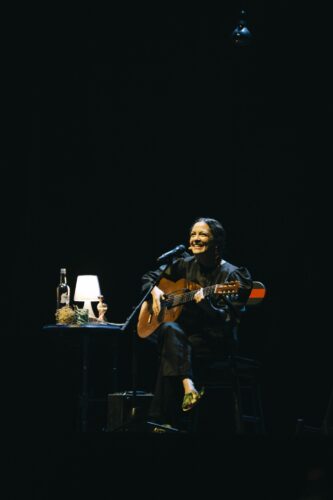
Natalie Lafourcade says that if her music “can bring comfort to a person’s heart, that is what I can
contribute.” (Photo courtesy of Natalia Lafourcade)
The latest experience, she says, “has been truly transformative, revolutionary… Words are not enough to explain—to express—what it means to step into motherhood.”
“While pregnant, I felt like Mother Nature herself,” she says. “I mean, I truly feel: ‘I am nature.’ And nature never fails.”
She is overwhelmed with gratitude at being able to stay home for months alongside her husband, enjoying as a couple the new baby, and she realizes hers is a rare fortune in today’s world.
“My wish,” she says, “is that we, as a world, would learn to value mothers—much, much, much more than they are currently valued. There should be a monument to mothers on every street corner.”
Her own mother, María del Carmen Silva Contreras, was her first music teacher—the one who instilled in her the self-belief she would need to pursue the challenging path of becoming an artist. She is, according to Lafourcade, “the very embodiment of a warrior and a woman of great strength.”
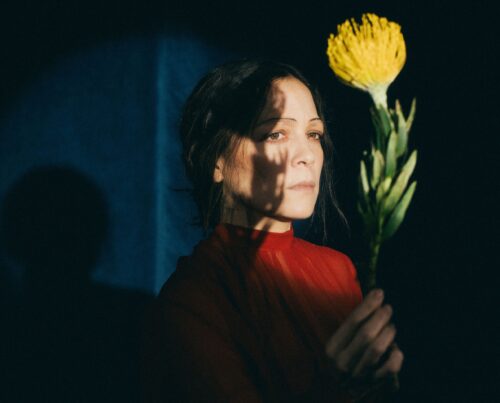
Lafourcade grew up in the town of Coatepec, surrounded by the natural world that has served as such a profound source of inspiration for her art. (Photo by Carlos Manuel, courtesy of Natalia Lafourcade)
“I remember being a terrible student in school,” she recounts. “And she would always say, ‘Well, but what about the music?’ And I would say, ‘Oh, the music? That, I actually like.’” Her mother would then reply, “Then anchor your world there; anchor yourself to your passion, and don’t let anything else matter. Don’t let anyone come along and destroy what you hold inside.”
After those first lessons, the young girl who had sung practically since she could speak went on to attend a renowned music school. But at age fourteen, destiny stepped in in the form of an old guitar she discovered in a closet at her aunt’s apartment. Although it had only three strings, she learned to play it. Later, she realized she should buy the missing three. A friend taught her a few bossa nova chords and thus began her passion for Brazilian music, an influence that can be heard in many of her compositions to this day.
Yet it is her own Veracruz roots that form the foundation of the path she now follows, both in her music and in her life. She lives on the outskirts of the town of Coatepec, far removed from the noise, the hubbub and the demands of fame that once followed her everywhere in the Mexican capital, where she lived for years.
Surrounded by trees, rivers, and mountains, she delights not only in her surroundings but also in the opportunity to attend “fandangos”—communal dances where she is learning the secrets of “son jarocho” at the feet of the masters of this emblematic folk music of her homeland. Much like the now-legendary Chilean singer-songwriter Violeta Parra, one of her greatest artistic inspirations, Lafourcade finds herself increasingly captivated by the lyrics and folkloric rhythms that seem to flow spontaneously from her native soil.
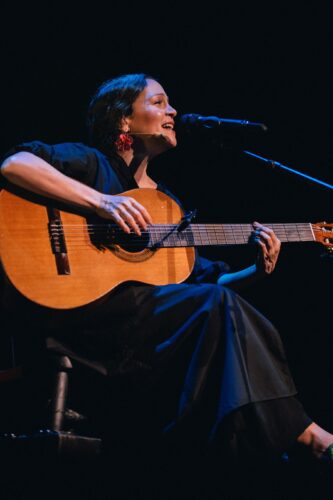
Touring in the United States in these unique times, Lafourcade realizes that people “with different
realities and different types of emotions” will be coming to hear her. “And there I’m going to be, with
my guitar, singing.” (Photo by Carlos Manuel, courtesy of Natalia Lafourcade)
For Lafourcade, Parra is one of many women who “laid the groundwork for so many of us who have followed in their footsteps.” She notes that the composer of the Latin American anthem “Gracias a la vida” possessed the courage to “immerse herself in local communities, to research the music that moved her, the music she loved, and to study a folkloric heritage that, in her view, was in need of rescue.” If, despite enduring countless hardships, Parra was able to revive Chile’s folk music in the 1950s and ‘60s, to dust it off and breathe new life into it, then what was there to keep Lafourcade from doing the same for the folk traditions of her own people?
“Son jarocho” is a musical form that was once clandestine, the song of slaves, at one time even forbidden by the Catholic Church. Through albums such as “Cancionera” and “Un canto por México,” Lafourcade has dedicated herself to repopularizing and rebranding the form and bringing it back to listeners, especially a younger generation. And her donation of sales from “Un canto por México” has been instrumental in the reconstruction of the Centro de Documentación del Son Jarocho (Son Jarocho Documentation Center) in the town of Jáltipan, part of her effort to revive the traditional rhythms she loves so well.
In addition to the constant presence of music in Coatepec, the influence of nature is also omnipresent. Lafourcade’s house is in the jungle. She speaks of how the nature that surrounds her there nourishes her spirit and her art—appearing in her lyrics, in her metaphors, and in her way of understanding the world.
It is “nature itself,” she says, “its cycles, its teachings; so much of Veracruz, so much of my homeland, the mountains, the sea. The sea—I mean, just how ever-present it is.” She remarks that nature always finds its way “in one form or another… birdsong, the birds themselves, the moon, the night, the sun, the cadence—the musical cadence tied to nature. It feels as though that is always at the heart of my creative quests.”
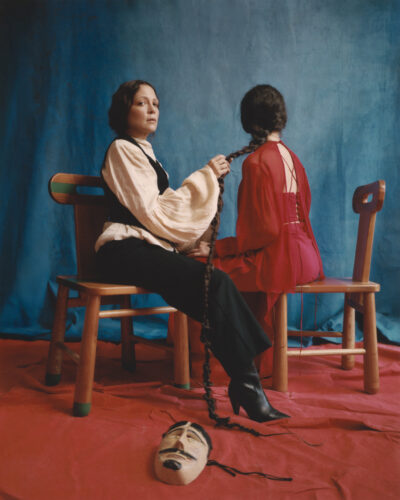
The musician claims to be a person very interested in the mystical, as is evident in songs like “La bruja” (The Witch), from “Cancionera.” In fact, a whole symbolic world accompanies the album’s presentation. (Photo by Silvana Trevale, courtesy of Natalia Lafourcade)
But she doesn’t view the natural world through rose-colored glasses: “I really love that nature is so brutal,” she asserts.
“Nature is creation and construction,” says Lafourcade. “To the extent that I grasp that principle, I understand that I cannot be born without also dying.”
Having no fear of the former, she appears to have no fear of the latter, either. And that reality gives her wings, granting her the freedom to do whatever the universe and her heart ask of her in this life.
Ultimately, Lafourcade is filled with wonder at the abundance of gifts she has been given: “that opportunity to rebuild yourself, to be reborn”—and to feel, as she puts it, like an infant herself, with so many new experiences lying ahead. Those who see her in “Cancionera” will hear Lafourcade, alone with her guitar, singing her truth sincerely, with joy and with grace.
It is, she says, a moment “of receiving so much—of receiving, of completely opening my heart.” What good fortune to be able to witness “la cancionera” at this unique point in her journey as a woman and as an artist.
WHAT: Natalia Lafourcade, “Cancionera” Tour
WHEN: 8 p.m., Friday, April 24 and Saturday, April 25
WHERE: Knight Concert Hall at the Adrienne Arsht Center for the Performing Arts, 1300 Biscayne Blvd., Miami
COST: $69–$351
INFORMATION: (305) 949-6722 or arshtcenter.org
ArtburstMiami.com is a nonprofit media source for the arts featuring fresh and original stories by writers dedicated to theater, dance, visual arts, film, music and more. Don’t miss a story at www.artburstmiami.com.