
Artburst Extras
Art Review: Layering, Repetition, and Process, Salvatore La Rosa at Fredric Snitzer Gallery
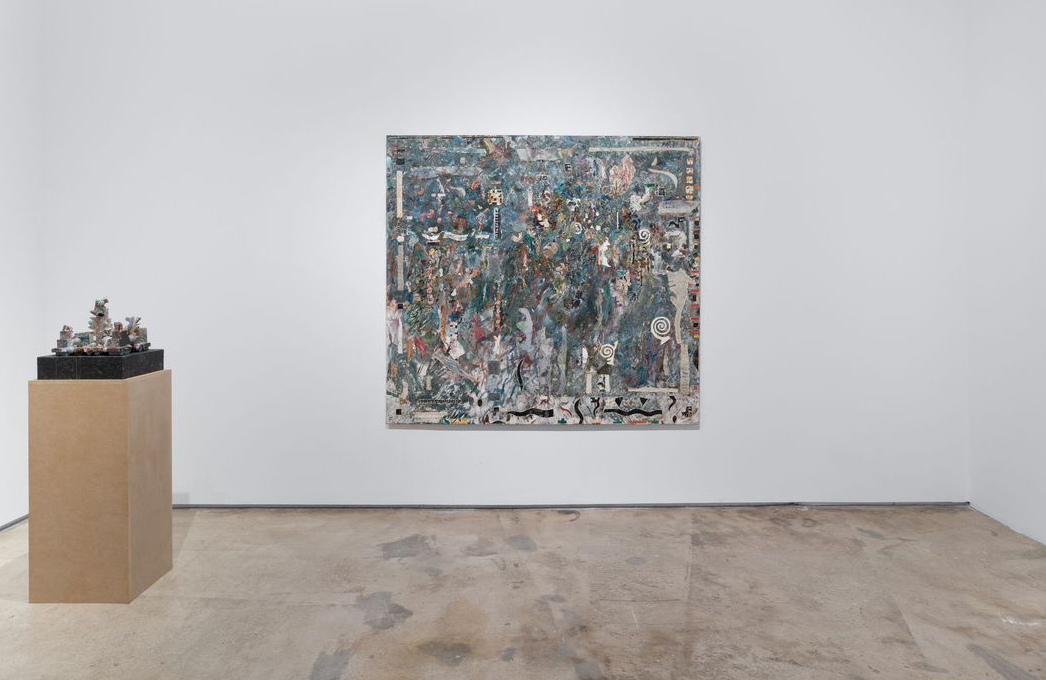
At left, “Untitled, 2025,” oil and mixed media collage on canvas over wood structure, and on wall, “Untitled, 1990,” oil on linen, are part of the exhibition “Salvator La Rosa: “Durational Works” at Fredric Snitzer Gallery. (Photo by Philip Karp)
Now at Fredric Snitzer Gallery, there’s a rare exhibition of work by reclusive Miami-based artist Salvatore La Rosa (b. 1941, Pittsburgh, Pennsylvania). The title of the show, “Durational Works,” indicates the pieces have developed over quite some time, even decades.
They are worked and reworked until all the elements sing in harmony, in the unwritten score artists all have, creating a palimpsest of energy, and the traces of the artist’s hand in dialogic interaction with the object itself. In the context of Miami, a city often defined by novelty and spectacle, La Rosa’s practice occupies a markedly different position. His work advances slowly and deliberately, sometimes over the course of decades. The process resembles a kind of personal alchemy—an unwritten recipe shaped by the influence of Joseph Cornell, Cy Twombly, Robert Rauschenberg, and Jackson Pollock—his four horsemen.
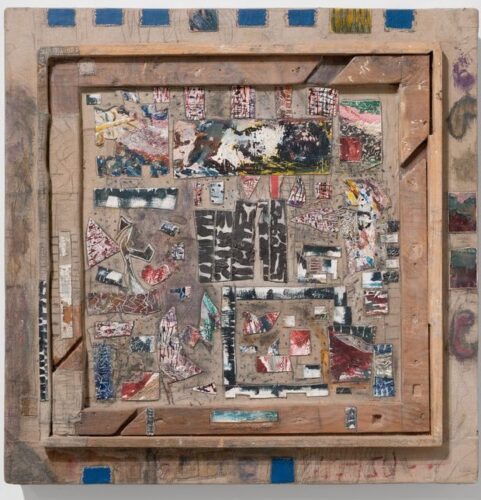
Salvatore La Rosa, “Untitled, n.d.,” mixed media on wood panel. 27 3/4 x 27 3/4 x 4 in (Photo by Philip Karp)
Where much of the cultural energy of the city celebrates immediacy and visibility, La Rosa’s work is indifferent to such pressures. Each painting contains abstract fields of energy. His surface-wide marks are quick and kinetic, and the geometric forms are slow, acting as anchors. He operates between poles: yin/yang, masculine/feminine, black/white. In mixing black and white, his works sit in a middle gray, like the gray of cement buildings, creating a neutral field of color. The surface drawing reads like the traces of layered urban graffiti, unreadable but evidence of the hands of humanity.
Repetition plays a central role for La Rosa. Forms recur across the exhibition: snakelike lines, triangles, circles, and squares interplay with dense networks of pencil marks and brushwork. Loose squiggles drift across the surface with a casual rhythm that at times feels almost doodle-like, a product of the subconscious. These gestures possess the patterned quality of habitual movement, the kind that emerges when the mind loosens its grip and the hand begins to operate through repetition and memory.
La Rosa’s process specifically involves the role of the subconscious, important in the development of Abstraction. From the 1930s onward, artists frequently sought ways to bypass conscious control, developing strategies such as automatism to access deeper psychic structures. The Surrealists drew on the psychological theories of Sigmund Freud as well as Carl Jung, who described the psyche as layered between conscious awareness and a deeper unconscious terrain. La Rosa’s paintings inhabit this territory, constructed in a state that moves between focus and release, where gestures stem from a place disconnected from ordinary language.
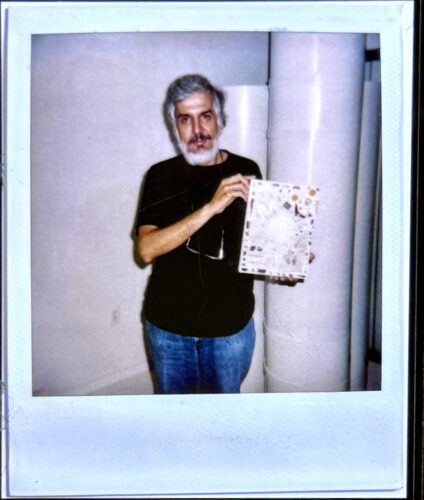
Salvator La Rosa holding “Untitled #, n.d.” Polaroid. (Photo circa 1990 by Rafael Salazar)
Lines and fragments sometimes align with the boundaries of the support, producing a frieze-like rhythm across the surface. Small, collaged geometric shapes are punctuations, creating moments of visual density and color shifts that anchor the surrounding gestures. La Rosa cuts these fragments from earlier works and reincorporates them into new compositions, furthering the significance of the show’s title, “Durational Works.” For La Rosa there is a recycling within the studio, where no mark is ever entirely discarded, it instead becomes part of a larger evolving field.
Among the recurring forms, La Rosa uses the spiral. One of the oldest visual structures in human image making, the spiral appears across cultures long before writing or architecture. It mirrors natural phenomena such as shells, whirlpools, and hurricanes. Occasionally the works incorporate objects.
In one instance the artist has included a snail shell, echoing the spiral forms that appear throughout the paintings. Elsewhere a clean illustration of a screw taken from a mid-century hardware advertisement appears within a work. Nearby another painting includes a screw embedded in the surface, perhaps a small moment of dry humor.
Many of the works are modest in scale, small enough to be hand-held, with the exception of two larger paintings. These works contain expansive fields of gestural marks punctuated by spirals and elongated rectangular forms that recall the proportions of classroom rulers. Although the physical act of making remains understated, the title of the exhibition quietly foregrounds duration as the central condition of the work.
The artist does not rush toward resolution. Surfaces accumulate slowly through revisitation. Impasto passages remain beside fragile pencil lines. There is a directness in the approach as the work honors the behavior of its materials rather than forcing them into illusion.
La Rosa’s paintings and sculptures are less singular statements than fragments of a larger continuum of activity, of being. They rarely individuate themselves. Instead, they appear as moments within a broader sea of making that the artist inhabits. The works described as sculptures do not differ from the painting, not a separate oeuvre with different rules and procedures. Everything in this show is simultaneously related, all at once, in no particular pecking order, including the many drawings held in the flat files in the backroom and may be seen upon request with the help of the gallery staff.
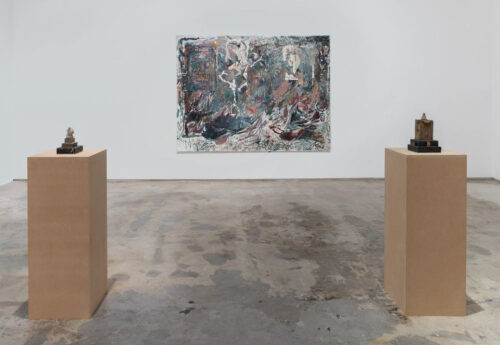
From left, “Untitled, 07/2025.,” mixed media. 7 1/4 x 5 3/4 x 4 7/8 inches; “Untitled, 1988,” oil on linen, 76 1/8 x 101 ½ inches, “Untitled, 07/2025,” mixed media, 10 1/2 x 6 x 6 inches. (Photo by Philip Karp)
Like Pollock’s paintings, La Rosa’s surfaces inhabit a dialogue between intention and improvisation. Each gesture provokes the next, producing the signature logic of an artist’s lifetime of work. each move, gesture or additon feels inevitable even if it resists explanation through its consistency.
“Durational Works” ultimately reveals a practice built through persistence, through the willingness to take the long road of creative journeys and enjoy it, the sight of the end irrelevant. As the paintings accumulate slowly, they relate in a different way to the life of the artist than those that aim towards production and climbing the mountain of success.
This is a lifestyle, a necessary activity to feel satisfied within oneself. The artist is joyfully consumed in the creative process, feeding himself on the delicacies of color, line, and shape the way another may enjoy a habitual evening cocktail. The quiet gallery setting allows these subtle fields of energy to emerge.
WHAT: “Salvatore La Rosa: Durational Works”
WHERE: Fredric Snitzer Gallery, 1540 NE Miami Court, Miami
WHEN: 11 a.m. to 5 p.m., Tuesday through Saturday. Through Saturday, March 28
COST: Free
INFORMATION: 305-448-8976 or www.snitzer.com
ArtburstMiami.com is a nonprofit media source for the arts featuring fresh and original stories by writers dedicated to theater, dance, visual arts, film, music and more. Don’t miss a story at www.artburstmiami.com