Blog Article Category: Music
Latin Grammy winner Nella brings her talents to South Florida
Written By Fernando Gonzalez
November 18, 2019 at 4:18 PM
There is something elusive about the sound of singer-songwriter Nella, the Best New Artist winner at last week’s Latin Grammys. Hers is a sort of world music, sung in Spanish, with an elegant soulfulness that often includes a hint of “quejío” flamenco, a flamenco cry. But the phrasing also suggests something else, layers hidden underneath, organic rather than studied. It all sounds familiar and fresh.
Then you find out that Marianella Rojas, Nella, is a flamenca born in Isla Margarita, an island in the Caribbean Sea off the northeastern coast of Venezuela, and educated at Berklee College of Music in Boston, where she majored in performance, composition and production. It was during that time that she performed folk music from Latin America with jazz and pop influences, “part of the process of rediscovering myself,” she says. “Once you leave your country, your roots start knocking at your door.”
That’s also when she met Spanish Grammy-winning producer, songwriter and guitarist Javier Limón, and discovered the work of Afro-Spanish singer Buika, rooted in “copla” and flamenco.
Limón – who has worked with several major singers including Buika, flamenco star Estrella Morente and Portuguese “fado” diva Mariza – heard Nella sing “La Negra Atilia,” a Venezuelan merengue, a cappella, and was impressed. He ended up writing words and music for all but one song in Nella’s debut recording “Voy” (roughly translated as “On My Way”), which he also produced and released on his label in May.
“I feel these songs as if I had written them myself,” says Nella, about their partnership. She added that she has put her songwriting “on pause.”
Her repertoire now includes songs from her debut recording but also what she calls “Venezuelan jewels” such as “La Negra Atilia,” and classics by the legendary singer and songwriter Simón Díaz, such as “Tonada de Luna Llena” (Song of the Full Moon).
Their collaboration also resulted in Nella’s contributing the title track in “Everybody Knows,” the Asghar Farhadi movie featuring Penelope Cruz, Javier Bardem and Ricardo Darin, which opened the 2018 Cannes Film Festival.
Fresh from her performance with Spanish pop superstar Alejandro Sanz at the Latin Grammy awards show in Las Vegas, Nella is finishing her first major tour of the United States with two performances in South Florida: on Nov. 22 at the Amaturo Theater at the Broward Center for the Performing Arts in Fort Lauderdale; and Nov. 23 at the South Miami-Dade Cultural Arts Center in Cutler Bay.
She is appearing backed by a trio featuring Gilad Barakan, on guitar; Paulo Stagnaro, percussion, and Daniel Torres on bass.
She spoke with Artburst in Spanish from New York earlier this year and, most recently, before a rehearsal for the awards show from Las Vegas. The following responses are compiled from those different conversations.
Q: What has the nomination of a Latin Grammy meant to you?
A: I have dreamt many things, and like any artist, I’ve had dreams of a Latin Grammy. But when it actually happens, it’s hard to believe, especially in an important category like “Best New Artist,” and considering the music I make, it makes me feel very proud.
Q: So, what was your first thought when you got the nomination?
A: To work much, much harder. When I learned about [the nomination], I didn’t go out to celebrate. I thought, ‘I gotta work harder. This music is reaching many people.’
Q: How did you get to your particular style, with such a flamenco influence, growing up in Margarita? Did you hear that at home?
A: Noo (she chuckles) … What I listened to growing up has nothing to do with what I’m doing now. As a kid, I was involved in anything artistic that would come up: singing, acting, dancing, you name it. I took singing lessons, but I was never a great soloist. In my choir, I never got a solo feature even if I asked for it. Then at 13, my voice started to change and, without realizing, by singing in my room to recordings by Christina Aguilera, Celine Dion and Mariah Carey, trying to imitate them, over and over, just for fun, without realizing it I was studying a lot. And those divas are incredible teachers, especially for what I call vocal acrobatics. I was also into the challenges of how high I could go vocally, or how well I could do certain vocal turns, and I believe that helped me develop a vocal flexibility that perhaps I wouldn’t have by just listening to Venezuelan music. Now, even when singing Venezuelan songs I don’t sound like a typical traditional singer.
When I went to Berklee, I sang jazz, pop and especially Latin American folk songs with a trio. In 2012, I met Javier, and he became a mentor for the group. But then one of the members of the group moved away, and the trio dissolved. About that time, I heard Buika, and after all the vocal acrobatics I had learned, I found the importance of interpretation, of how to say a lyric, and I fell in love with flamenco and with that honesty between singer and audience. It is something I had not found in any other genre.
Q: Javier Limón has said that when the movie, “Everybody Knows,” was released, “many people thought she was from Córdoba or Granada.” But it turns out flamenco is relatively new to you.
A: It’s something I have learned. It isn’t as if I grew up listening to this music at home. Thanks to Javier, I’ve been exposed to the best singers and musicians in Spain, and I’ve felt how, without amplification, just with voice and guitar, someone can bring you to tears by the way they say a word. That meant a lot. And then I started to search, going to the roots, and found artists like Paco de Lucía, La Niña de los Peines, Camarón de la Isla.
It’s funny, but for a long time, my parents would ask me to sing something in Spanish, and I didn’t have a Spanish-language repertoire, so I would tell them: “Don’t you want to hear the song from ‘Titanic’? What about the song from ‘The Bodyguard.’” Now, if you ask me to sing something in English, I have to go to my hard drive (she laughs). Everything I do now is in Spanish. I came to find out that music has a lot to do with me.
Q: A very emotional song in your current repertoire is “Volveré A Mi Tierra” (“I Will Return to My Country”). How do you see your role as an artist regarding the political situation in Venezuela?
A: I try to not get into politics. But the fact that I don’t like politics doesn’t mean that I’m not involved in what is going on in my country, which is something that by now transcends politics. I feel that having a microphone in your hand grants you a power that not everybody has, and I feel it’s my responsibility to let people know what is going on and how people are suffering.
IN BROWARD:
What: Nella
When: 7:30 p.m. Nov. 22
Where: Amaturo Theater at the Broward Center for the Performing Arts, 201 SW Fifth Ave., Fort Lauderdale
Cost: $25-$45
More information: 954-462-0222; browardcenter.org; ticketmaster.com
IN MIAMI-DADE:
What: Nella
When: 8 p.m. Nov. 23
Where: South Miami-Dade Cultural Arts Center, 10950 SW 211th St., Cutler Bay
Cost: $37.50-$40; $60 VIP tables
More information: 786-573-5300; smdcac.org
ArtburstMiami.com is a nonprofit source of theater, dance, visual arts, music and performing arts news. Sign up for our newsletter and never miss a story.
No posts found
Carmen Consoli to headline ‘Italian HIT Week’ at North Beach Bandshell
Written By Mike Hamersly
November 14, 2019 at 8:59 PM
American pop-music charts offer an ever-changing glimpse at the country’s cultural landscape, its hits helping to reflect the current lingo, attitude and even political climate. But as compelling as our musical trends can be, it’s refreshing to step back and broaden one’s horizons now and then.
“Italian HIT Week: Unexpected Sounds from Italy,” presented on Nov. 16 by The Rhythm Foundation at the North Beach Bandshell, is the perfect chance to savor the taste of a different culture. The concert is headlined by Sicilian superstar singer-songwriter Carmen Consoli, who will perform material from her 11 studio albums. And it is free with advance registration.
Consoli’s eclectic style ranges from edgy pop-rock to heart-wrenching ballads to the folky traditional sounds of the Sicilian and Mediterranean heritages.
“This is a rock-music show with cello, violin, acoustic guitar and voice, and I will play my songs, my older repertoire,” Consoli says. “I’ll touch different themes, like life, love, loneliness on a digital island, immigration and different alarming themes. We talk about beauty, too, and I’ll try to translate and do little introductions before each song, just to make it clear.”
It can be fascinating to experience the differences between the two countries’ musical styles, but it’s also interesting to note their similarities.
“Of course, Italian music is different from American music,” Consoli says. “For instance, the musical scales used are different – we’ve got Arabic scales, and you’ve got pentatonic scales, major and minor. But there are things in common: passion and the urgency to say things.
“[American] blues music is very close to traditional Sicilian music. You break patterns of hypocritical behavior and society’s blindness, and it’s about suffering. There’s a strong thread that links the two societies, Italian and American,” she continues. “We culturally are very close, because we’ve been immigrants, and we’ve brought back a lot of things from America to Italy. So the American influence is very strong in my music, too. I’m a big fan of Janis Joplin and Jimi Hendrix, and I grew up listening to B.B. King.”
Consoli, who is so beloved in Italy that she was knighted in 2012, is proud to be the artist chosen to headline a concert that showcases her country’s music.
“I feel honored to represent Italy and to find Americans who want to know more about Italy,” she says. “And it’s beautiful how music can go beyond the boundaries of language.”
Her fans in South Florida assuredly have a good idea of what to expect from Consoli’s performance, but she’s approaching it with an open mind as far as what kind of feedback she’ll get from the crowd.
“I don’t want to have expectations,” Consoli says. “I only hope to give my heart to the audience and to receive their happiness. That’s the only aim of music. And you know what? To create sympathy among all people, which is an old-fashioned word now.”
Consoli, now 45, started writing songs at age 9, and knew even back then she wanted to make music as a career.
“My father was a very gifted guitarist, and he started to teach me all the fundamentals of music,” she says. “And I started writing music because I had the urge to express myself. My face has changed over the years, and my spirit and my gaze on the world has also changed. But fortunately, I don’t change my music or change my attitude toward music to become popular. I remain myself, and if it’s commercial, that’s OK, but if not, I’ll remain myself as well.”

Opening act Gio Evan spent eight years touring the world on a bicycle.
Italian HIT Week’s opening act, Gio Evan, is quite a bit different from a typical singer-songwriter. He’s also a writer, poet, philosopher, humorist and street artist – and his show will reflect that.
“This will be my first time bringing to the U.S. the Gio Evan experience,” he says. “It will feature music, poetry, some monologues and pieces of theater – like the 360 artistic experience, the whole cultural package. I’m going to play guitar and piano, and I will have a keyboard player and acoustic bass player. So it will be an intimate version of my music, and I will also talk about my daily life experiences.”
Those experiences go beyond what most people have encountered. Evan spent eight years touring the world on a bicycle, traveling across Europe, India and South America.
“It was a way for me to escape the life that my parents had chosen for me,” he says. “They wanted me to become a doctor or a lawyer, and I don’t fit into that kind of life. So I chose to take my time and take a trip around the world on a bicycle, and come back stronger to tell my parents that I want a life in the artistic way.”
Mission accomplished.
What: The Rhythm Foundation presents “Italian HIT Week: Unexpected Sounds from Italy”
When: 7 p.m. Nov. 16
Where: North Beach Bandshell, 7275 Collins Ave., Miami Beach
Cost: Tickets are free with RSVP at rhythmfoundation.com
ArtburstMiami.com is a nonprofit source of theater, dance, visual arts, music and performing arts news. Sign up for our newsletter and never miss a story.
No posts found
Nu Deco Ensemble to play Saturday at North Beach Bandshell
Written By Mike Hamersly
November 8, 2019 at 3:02 AM
Whenever the Nu Deco Ensemble puts on a show, it’s extraordinary. After all, the genre-busting, hybrid orchestra has collaborated onstage in the past with artists including Wyclef Jean, Ben Folds, Macy Gray and Stephen Marley.
Its latest show is no exception. On Nov. 9, Nu Deco will perform at the North Beach Bandshell with Afro Cuban superstar Cimafunk, named by Billboard as one of “10 Latin Artists to Watch in 2019,” who will bring his dazzling style and high-energy sound to the stage.
“They’re calling Cimafunk the ‘James Brown of Cuba,’” says Sam Hyken, co-founder, composer and artistic director of the ensemble along with partner Jacomo Bairos. “He’s the complete package – amazing dancer, amazing singer, really fun music. Generally, when we’re at the Bandshell, in the spirit of that venue and the fact that the Rhythm Foundation is running it and that they are musical leaders in Miami as far as presenting world music, that’s the vibe we like to go for.”
Cimafunk, who will close the show, is far from the only highlight of the evening. The program also will feature original music by several ensemble members, kicking off with violist Jessica Meyer’s piece “Go Big or Go Home,” followed by works from Miami jazz-rock fusion band Electric Kif and Nu Deco guitarist Aaron Lebos.
“The night’s theme is really a celebration of our ensemble,” Hyken says. “Every single piece we’re performing at the concert is done or rearranged by a member of the ensemble.”
The program also will represent the musical eclecticism that’s inherent in Nu Deco’s mission. After the members’ showcase comes a collection of songs by the Grammy-winning French electronic duo Daft Punk, which is known for the dance hits “One More Time” and “Get Lucky.” The piece is put together by Hyken and is titled “Robots vs. Humans.”
“This particular suite comes from Daft Punk’s latest album, ‘Random Access Memories,’ which used a lot of acoustic instruments, so we’re not using samples or a deejay or anything of that nature in the work,” Hyken says. “We take ‘Get Lucky’ and put it into a solo cello line, and do an orchestrated version of ‘Giorgio by Moroder,’ and that’s really one of the more electronic pieces on that album. And then we do ‘Contact’ from that album.”
Fans of Nu Deco might notice that the next offering, an ode to R&B and soul legend Bill Withers – known for the timeless hits “Use Me,” “Ain’t No Sunshine,” “Lovely Day” and “Lean On Me” – was performed at the Adrienne Arsht Center for the Performing Arts in April.
“At the Bandshell, we like to do some of our hits,” Hyken says. “As an orchestra, we’re always presenting a new program, but when we get to do a venue like the Bandshell in a neighborhood we’re in only once a year, we like to bring back some of the pieces that we play in our other programs. This is called ‘A Bit of Bill,’ and it’s like an overture to Bill Withers. I imagine that’s the piece, if there’s ever a movie about Bill Withers, it’d be the opening overture for.”
Hyken also is excited to present music from the Nu Deco Ensemble’s debut album, which drops the same day as the concert, and whose eight tracks run just under an hour. And, yes, its musical spectrum is quite broad.
“The album is really a great representation of who Nu Deco is,” he says. “It’s got living composers such as Nicholas Omiociolli – we’re doing a work of his that we love to play called ‘Fuse’ – and we’re also doing a work by Andy Akiho on the album called ‘Karakurenai,’ which is more of a chamber work. And then we do collaborations. We have two songs with [the album’s producer] Kishi Bashi, a song with Danay Suarez, and a song with Spam Allstars. And then we have suites of music featuring Outkast and Daft Punk.
“The only aspect that’s not on there are the classical reimaginations that we do,” he continues. “One of our rules, as an ensemble and as an organization, is that if we’re going to perform music that’s from before the 20th century, it’s going to be reimagined. So we do reimaginations of Bach and Bizet and Vivaldi, etc. And later this year at the Arsht Center, we’re doing a reimagination of Tchaikovsky’s ‘Nutcracker.’”
This is Nu Deco Ensemble’s fifth season, but its musical vision has stayed consistent.
“It hasn’t really changed,” Hyken says. “I think it’s evolved in the sense that when Nu Deco started, it was really a group of classical players who were playing multi-genres of music. Now it’s evolved into a hybrid ensemble full of some of the top classical players mixed with some of the top contemporary players. And I think that has given us the most flexibility in the music we make.”
It’s that versatility and commitment to creative inspiration that make top contemporary artists want to work with the ensemble.
“What we try to do is elevate any sort of music,” Hyken says. “So any time we put our show behind someone’s music, we try to make it something that’s a new take, something to make everything feel grander and add a new life to it. We’re really strong about the fact that Nu Deco is a collaborative partner when we work with these artists, not really a backup band. We want to bring a new element, something fresh, something relevant, that the music’s never seen before.”
What: Nu Deco Ensemble featuring Cimafunk
When: 8 p.m. Nov. 9
Where: North Beach Bandshell, 7275 Collins Ave., Miami Beach
Cost: $45
More information: nu-deco.org
ArtburstMiami.com is a nonprofit source of theater, dance, visual arts, music and performing arts news. Sign up for our newsletter and never miss a story.
No posts found
South Beach Chamber Ensemble to present ‘Brilliance of the String Quartet’
Written By Mike Hamersly
November 4, 2019 at 7:47 PM
In the mood to see exceptional classical music performed live, but not up for an intense, thunderous symphony orchestra?
The South Beach Chamber Ensemble’s (SBCE) Music in Beautiful Spaces series may be just the ticket.
The group is presenting a concert titled, “The Brilliance of the String Quartet,” that features works by Haydn, Puccini and Shostakovich, on Nov. 7 at the Ancient Spanish Monastery in North Miami Beach. They performed Nov. 3 at the Miami Beach Botanical Garden.
The SBCE’s mission is at once ambitiously optimistic and refreshingly simple.
“The goal is to surprise people and delight people,” says Michael Andrews, founder, artistic director and cellist for the SBCE, now in its 22nd year. “Our vision is a world where chamber music inspires and energizes all people, creating peace, harmony, joy and unprecedented satisfaction with being alive.”
For these shows, the ensemble consists of Andrews on cello, Eric Eakes on viola, and Tony Seepersad and Ericmar Perez on violin. Its sparse size fits its intended audience.
“We play in intimate, small spaces, because chamber music is for a small group of listeners, up close so they can really see the hair on the strings, the fingers on the fingerboard, and be involved in the dialogue between the musicians and really get in on the action,” Andrews says.
That intimacy is in stark contrast to a symphonic performance.
“The suite of music with an orchestra – with the winds and the brass and the percussion and huge string sections – can wash you away like a wave, in a good way,” he says. “In chamber music, it’s more like being on the beach in Miami. It washes over you gently.”
Andrews says the difference between an orchestra and a chamber ensemble can affect how a performer approaches each from a philosophical perspective.
“Each one is great, but each one has its plusses and minuses. In chamber music, you really get to stand out, because if you’re the violist or the cellist, you’re the only one on the part. And it can be very scary,” he says, with a laugh. “In an orchestra, there may be eight to 12 cellists in a section, and we’re all playing the same line with the same intensity and the same spirit, but we’re not standing out. The point of an orchestra is to blend in.”
Andrews chose the program – featuring Haydn String Quartet #71 in Eb major, Op. 33 No. 2 “Joke” (1781); Puccini’s “Crisantemi” (1890); and Shostakovich String Quartet #3 in F major, Op. 73 (1946) – in part to highlight each piece’s uniqueness.
“It really shows how diverse the string quartet can be,” he says. “Haydn was the inventor of the string quartet and is very formal, except that he also broke the rules. He made the rules and then he broke them, so ‘The Joke’ is very, very cleverly written.
“And then I was looking for something that would really contrast with Haydn, and Shostakovich is one of the monumental composers of the 20th century. His 3rd was written in 1946 right after the war, and he had a tortured life within the Soviet system, and he tried to express himself, and he did the best he could with his music. Some of it was covert and some of it was overt, and so there’s a lot of sarcasm and wit and angst in his music. I thought that would be a really great contrast with Haydn.
“And then Puccini is mainly known as an opera composer,” Andrews continues. “But he wrote this exquisite piece called ‘Crisantemi,’ which means chrysanthemums, in memory of a good friend who had died. And it’s a gorgeous, gorgeous piece, very operatic.”
Like so many others who find great success in their professions, Andrews’ introduction to the cello seems random, almost by happenstance.
“I was in fourth grade … and we lived out in the country in Michigan on 2 acres next to farms,” he recalls. “And at that time you had an aptitude test for music, and I guess I must have done OK. In fourth grade, you could only do strings …
“The options were basically the violin, viola or cello, and my mother had played the violin growing up and she hated it – it was also very loud and noisy and screechy, and she said she didn’t want me to do that. And I had a friend who was going to play the cello, so I thought, ‘Oh, I’ll play the cello.’ I really didn’t know what I was getting into, but by high school, I knew that was what I wanted to do forever.”
What: South Beach Chamber Ensemble presents “The Brilliance of the String Quartet”
When: 8 p.m. Nov. 7
Where: Ancient Spanish Monastery, 16711 W. Dixie Highway, North Miami Beach
Cost: $15 to $25
More information: sobechamberensemble.biz
ArtburstMiami.com is a nonprofit source of theater, dance, visual arts, music and performing arts news. Sign up for our newsletter and never miss a story.
No posts found
A new season of Jazz Roots at Miami’s Arsht Center
Written By Fernando Gonzalez
October 28, 2019 at 5:05 PM
Jazz remains a challenging sale in South Florida. And yet, since an ambitious launching in 2008, the Jazz Roots series at the Adrienne Arsht Center has not only found its audience, but in the process has become one of the centerpieces of Miami’s cultural season.
Co-founded by the Arsht Center and the late musician, producer, record label owner and entrepreneur Larry Rosen, Jazz Roots opens its 12th season on Nov. 1 with “British Invasion – Latin Style.” It features singer and songwriter José Feliciano; trumpeter Arturo Sandoval; pianist, composer and arranger Shelly Berg; saxophonist Tim Ries; singers Lucy Woodward, Kate Reid and Fantine; and the University of Miami’s Henry Mancini Institute Orchestra.
The 2019-2020 season continues with concerts by:
- vocalist Mavis Staples
- pianist and composer Arturo O’Farrill and the Afro Latin Jazz Orchestra
- singer Kurt Elling
- pianist, arranger and composer Dave Grusin (who also co-founded with Rosen the all-digital GRP record label)
- saxophonist Branford Marsalis
But smart programming and marketing is only part of the story. Jazz Roots also opened a space in the community at large by establishing a partnership with Miami-Dade County Public Schools, which has brought thousands of high school students to concerts, soundchecks, and Q&A sessions with artists. This program is the kind of educational initiative that is enriching for students, as well as vital for the future of a demanding music genre with limited exposure on radio and television.
Berg, who is dean of UM’s Frost School of Music, has been the artistic advisor for Jazz Roots since 2016, collaborating with Liz Wallace, vice president of programming for the Arsht Center. Berg recently spoke with Artburst about the art and business of programming Jazz Roots; the uneasy relationship between jazz and entertainment; and the sink-or-swim lessons his UM music students learn on stage.
Q. The opening concert in Jazz Roots is curated and sets up the idea of an only-in-Miami event. How did this “British Invasion – Latin Style” theme come about?
A. Well, we used “British Invasion” in the title, but it’s not limited to British music from the ’60s. The reason that we’re doing it is that we have new underwriters as presenting sponsors of Jazz Roots. It’s EFG Capital, a global private banking group. Their London office has been sponsoring the London Jazz Festival, and their clients love it. They have Latin American clients of clients in Miami, so they thought: “Well, our clients would love if we sponsor something in Miami and jazz.” So I thought that for the first concert it would be fun to do a mashup of music from Britain and Latin America.
In the program, we will have songs by The Beatles, The Stones, Sting, Elton John, and Dusty Springfield. But not every piece of music will be done in some Latin American groove — although we will have things like “Crocodile Rock” as a [Dominican bolero-like] bachata, things that can be great fun. But some of it will be just the fact that it’s a Latin American artist playing British music.

Singer and songwriter José Feliciano is one of the performers opening the Jazz Roots series on Nov. 1. (Photo courtesy of David Bravo)
Q. After three years advising the programming for Jazz Roots, what have you learned that works in jazz for South Florida audiences?
A. That with South Florida audiences, it’s not so much about the music that you play but about the performer and how well they relate to the audience in a 2,000-seat concert hall. I think that we can program just about any kind of music.
Now, does the artist have a way of engaging an audience and making it feel part of the experience? Dizzy Gillespie is a great example. Great artistry, even cutting-edge artistry, is not mutually exclusive with engaging and caring about the audience.
Q. The educational component in Jazz Roots is not limited to listening experiences for high school students but also for college music students participating on-stage performing, for example, as members of the Henry Mancini Institute Orchestra. Can you talk about those two experiences and their goals?
A. Well, we continue to have the students from the various schools attend a master class, watch the soundcheck, then some of the artists speak with them after the soundcheck and do Q&A with them, and later they get to see the concert. Opportunities like that can light a spark in somebody. All of us who do this for a living had, at some point, an experience like that, which got us excited.
As for our [UM] students, they are getting to participate in the most real-world kind of experiences that any student could participate in: Playing in a major performing arts center in front of major audiences with major artists. And they are doing it on the real-life time frame of the professional world: a couple of rehearsals and, bang, you’re on.
Very often, they’re sight-reading while the artist is there in front of them. In this next concert, they may be looking at a chart they’ve never seen before, and there is José Feliciano on-stage or Arturo Sandoval. They don’t get a chance to sound like students. All those things are preparing them for their actual careers.
What: “British Invasion – Latin Style,” the opening concert of Jazz Roots 2019-2020 featuring José Feliciano, Arturo Sandoval, Shelly Berg, Tim Ries, Lucy Woodward, Kate Reid, Fantine, and the Henry Mancini Institute Orchestra.
When: Opens Nov. 1
Where: Adrienne Arsht Center for the Performing Arts of Miami-Dade County, 1300 Biscayne Blvd., Miami
Cost: $45 to $125
More information: arshtcenter.org/jazz; 305-949-6722
ArtburstMiami.com is a nonprofit source of theater, dance, visual arts, music and performing arts news. Sign up for our newsletter and never miss a story.
No posts found
Haitian music, from the roots up
Written By Fernando Gonzalez
October 23, 2019 at 6:19 PM
More often than not, pop music in the Western world is just another product vying for attention and shelf space. It might come in different models and packaging — the too-cool-for-school alt-rock; the bluntly sexual Reggaeton; street-tough rap — but it’s rarely more subversive than a soap commercial.
But in Haiti, as in other developing countries struggling with poverty, corruption, and failing institutions, pop music is not only entertainment and relief but also the language of defiance and change.
In the 1990s the mizik rasin (roots music) movement, blending folk and religious traditions with the tools of rock and funk, emerged as a powerful tool of resistance. The lyrics of the songs, often using oblique references and parables, a common device in the Vodou tradition, became a popular shorthand to comment, protest, and organize. Dictators banned certain songs. But then, the very esthetics of rasin, built on rhythms of Vodou rites or utilizing the vaksen, the metal horns of the rara carnival tradition, were a statement about the richness of Haitian culture.
The 13-piece strong RAM, one of the essential groups of the movement, performs at the North Beach Bandshell, in Miami Beach, Saturday at 8 p.m. The concert is a Fete Gede (or guede), known as the Festival of the Ancestors is the Vodou equivalent of Mardi Gras, the Mexican Day of the Dead, and Halloween, all in one.
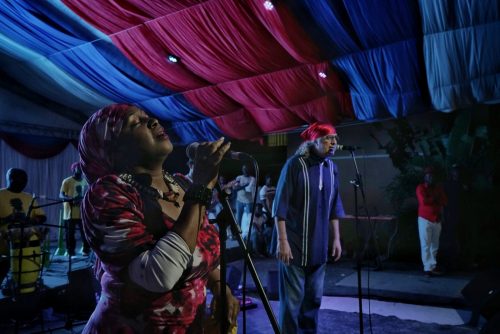
Photo credit Laura Quinlan
RAM was founded in 1990 by Richard Morse, an American musician and hotelier born of a Haitian mother, the singer, dancer, and folklorist Emerante de Pradines, and an American father, Richard M. Morse, a Latin Americanist scholar and writer. Born in Puerto Rico, Richard Morse grew up in Woodbridge, CT. and graduated from Princeton with a degree in Anthropology. But while in New Jersey, Morse was also an active musician, playing in a New Wave band. Pushed out of the group, he moved to New York in 1984 and spent a year working with Steve Rubell of Studio 54 fame. But he wanted to get back to music, and a year later he decided to explore life in Haiti, a place he had visited as a teenager.
He settled in Port Au Prince, and in 1987, after a storybook chance encounter, Morse took over the management of the storied Hotel Oloffson — the inspiration for Graham Greene’s Hotel Trianon in his novel The Comedians — which had fallen in hard times. As part of his restoration efforts, Morse called on local artists, dancers, and musicians to provide entertainment.
The hotel became a music hub, opening its doors to bands such as Boukman Eksperyans and Boukan Ginen, which went on to become prominent in the mizik rasin movement.
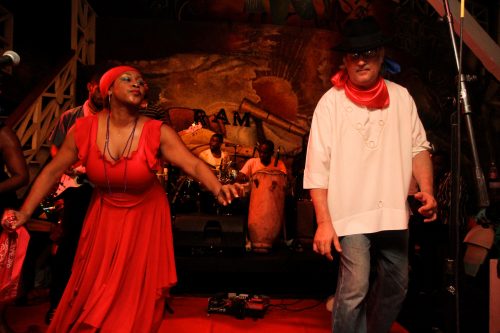
Nadia Todres and RAM, courtesy Laura Quinlan
RAM has recorded seven albums, and, in the process, shed most of its initial rock influences in favor of Haitian roots elements. It still performs at the Oloffson on Thursdays. Artburst spoke with Morse while on the road with his band, driving South after a show in New Jersey, all part of the US tour that will bring them to Miami Beach.
Artburst: What moved you to create RAM?
Richard Morse: There was a movement towards world music in the early 80s, a lot of people were starting to experiment with world rhythms; people like David Byrne, Malcolm McLaren, Peter Gabriel. My mother is from Haiti, so unlike most people who would choose countries that interested them, I chose to go to my mother’s country. I was discovering rhythms that had something to do with me. But it took five years to put the band together and really, what happened was that I met Lunise, now my wife, who is a dancer and a singer, and she had with her the rhythm, the drums, so basically, we added guitar and bass to the Haitian roots and started working from there.
Artburst: It sounds like you plugged right into the family tradition: Your mother was a dancer and a singer; your maternal grandfather was a troubadour.
Richard Morse: Right, and [my mother] was making the same music that we’re doing now. Each generation comes in with their own influences. We are more electric, she was more acoustic. And now my son is in the band, he plays guitar, and my daughter teaches dance workshops while we’re on the road.
Artburst: The title of RAM’s latest album, August 1791, commemorates the beginning of the revolt that resulted in Haiti’s independence. Could you talk about the music in it?
Richard Morse: Yes, we’ve done some videos after August 1791, but that’s the latest album. A lot of the songs [in it] are historical, traditional songs handed down over time. The theme is how the African-born slaves come together with the Creole-born slaves to have a revolution. And the reason behind their successful revolution was their children, the future.
Artburst: Could you talk about the relevance of music in the politics of Haiti? There are many examples, but to name one, you and RAM had problems with the military junta in 1992 because of “Fey,” not a political song but a traditional song you adapted. People embraced it as an anthem for president Jean-Bertrand Aristide, which the military had deposed.
Richard Morse: Usually, dictators try to steer the population away from the music we do because there is truth in it. Military dictators frown upon that. A lot of the songs we sing can be interpreted politically because they are parables, and that’s all good … [but] you have to focus on the musical aspect for the political aspect to remain true. Once you become overtly political, it ruins the music.
Artburst: You did get involved directly in politics as an advisor when singer Michel “Sweet Mickey” Martelly, your cousin, became president. But then you resigned in protest for what you perceived as corruption. Last week we got news of Haitian artists joining in protest to demand the president’s resignation. How do you feel about that?
Richard Morse: I let the Haitian public know my stance against corruption and this political regime back in 2013. The statement had a lot of impact in Haiti. I’m glad that other artists are finally getting on board. I hope they’re not just following a current trend to try to save their reputations. This is a long term struggle for social justice, not this week’s fashion statement.
What: Rhythm Foundation presents Haitian rock/roots music band RAM. Dance performance by Nancy St Leger Dance Ensemble and an opening set by DJ Krazy Mix.
Where: North Beach Bandshell, 7275 Collins Avenue, Miami Beach
When: Saturday, October 26 at 8 p.m.
TICKETS: $25 + fees. For tickets, or Haitian outlets or online at https://www.rhythmfoundation.com/events/ram/
No posts found
New World Symphony’s Viola Visions Festival Spotlights a Neglected Instrument
Written By Sean Erwin
October 18, 2019 at 4:27 PM
Wednesday October 16th at 8pm at the New World Center in Miami Beach opened the first of four nights of the New World Symphony’s” Viola Visions Festival: Three Centuries and Counting.” The program featured viola-centric works spanning three hundred years in an evening that leapt from one surprise to the next while meaningfully integrating community outreach and educational elements.
The evening’s first surprise occurred when sixteen student violists, age twelve to early college, from across South Florida joined NWS artistic director and conductor Michael Tilson Thomas and the NWS fellows onstage. With them were composer and NWS alum Nils Bultmann, Florida International University violist Michael Klotz, and former NWS alums Erik Rynearson (LA Symphony) and Madeline Sharp (Atlanta Symphony).
Scored for over thirty violists, the NWS world premiere of Bultmann’s “Concerto4 for Large Viola Ensemble” could not have been performed without these young musicians.
And “Concerto4” was an extraordinary nine minute work that compressed conflicting themes and techniques around a gorgeous folk melody initiated by Bultmann then passed between the soloists. The younger musicians laid down a sure, constant floor of chords from which intense pizzicato rhythms flashed, dominated, then whispered underneath. The work’s dynamics were elastic, alternately expanding before turning inward, repeatedly pitting the folk theme against constantly changing plucked rhythms. Much happened in this dense, concise, gorgeous piece.

South Florida Student Violists and NWS fellows during Bultmann’s Concerto4. Photo Credit: Rui Dias-Aidos.
Next up was Bach’s three movement Brandenburg Concerto No. 6 in B-flat major (1721) with Cynthia Phelps (New York Philharmonic) and Jonathan Vinocour (San Francisco Symphony) on viola, Michael Beattie on harpsichord, Caroline Nicolas and Arnie Tanimoto on viola da gamba, Alan Ohkubo on cello and Douglas Aliano on bass.
The lead violas announced the fugal phrases with a crisp energy softly accented by the viola da gambas and bass which at times sprang out with rarely heard personality. In the Adagio Phelps laid down the bright, plaintive theme but notable, too, was Ohkubo whose expansive cello line went beyond support and revealed an unexpected dimension within the movement. During the closing Allegro Vinocour and Phelps traded the melody like close, witty friends preferring to bubble with humor than pause for a laugh. The gigue barreled to a close, peppered by accents, controlled but danceable.
The evening’s third work was Garth Knox’s 2007 (revised 2010) “Marin Marais Variations on “Les folies d’Espagne”” for four violas. NWS Fellows Stephanie Block, Jessica Pasternak and Kip Riecken were joined by German soloist, Tabea Zimmerman.
Zimmerman lavished the work with nuance and subtlety presenting jaw-dropping possibilities for the instrument. At times courtly, at others spidery, the eleven minute piece shifted from the third variation’s delicate phrasing where the performers whispered the bow across the strings like fingers on glass to the out of tune and drunken variations where Zimmerman went so far it was hard to know how the other performers kept from cracking a smile.
The evening closed with Andrew Norman’s, “Gran Turismo for Eight Virtuoso Violas”, composed in 2004 for violin but arranged for viola for this festival.
“Gran Turismo” is a compressed eight minute work. In terms of pace it recalls John Adams’ 1986 “Short Ride in a Fast Machine” but instead of the built-in narrative posed by traveling in a real vehicle, “Gran Turismo” reflects the “0 to 200 back to 0 then float left” virtual disconnects contained in a completely digital experience.
Norman acknowledged the video game as partial inspiration for the piece. Assuming he was absorbing the 2000-2001 release of Gran Turismo 3, certainly his work shares its pace with the video game’s soundtrack.
But that was all he took from it, since not only is “Gran Turismo” out of the gate with respect to tempo. It is also out of the box structurally. With tempo markings that read “floor it” recordings of the work often capture the score’s kinetic energy but frequently mash the voices together, all complexity vanishing in the process.
The NWS performance took the tempo back a notch. This revealed “Gran Turismo’s” architecture while dialing down its shrillness. The eight performers hurtled through furious exchanges that suddenly collapsed around a single held note. About a third in, the piece shifted into dreamy and atmospheric before ramping back up. This was definitely a work to hear live, and podcaster and soloist Nadia Sirota and NWS Fellows Sharp, Parce, Rynearson, Qi, Ingersoll, Fellows and Simpson kept it out of the pit.
The Viola Visions Festival continues with Friday and Saturday performances. For schedule and tickets visit https://www.nws.edu/events-tickets/concerts/
ArtburstMiami.com is a nonprofit source of theater, dance, visual arts, music and performing arts news. Sign up for our newsletter and never miss a story.
No posts found





Recent Comments