Blog Article Category: Music
Opera Atelier Shines A Light on Strong Female Leads in Double Feature
Written By Carolina del Busto
September 17, 2026 at 11:17 PM
The cast of “Juana Inés” in a previous production at the Miracle Theatre with Jorge Arcila, far left, Karel Morell, left,
Silvia Ludueňa, center, and Patricia Arcadí, far right. The Opera Atelier will present a double bill of “Juana Inés” and “Frau Haydn in Trouble” on Thursday, Sept. 24 in Miami Beach and Saturday, Sept. 26 in Coral Gables. (Photo by Javier Fontanella)
Composer and lyricist Daniel Daroca of The Opera Atelier company has been writing fiction and opera librettos for years, he said, and has been composing operas since 2019. His two most recent works, “Juana Inés” and “Frau Haydn in Trouble,” are being presented as a double feature on Thursday, Sept. 24 in Miami Beach and Saturday, Sept. 26 in Coral Gables.
Daroca, who wrote the libretto for “Juana Inés” and both the music and lyrics for “Frau Haydn in Trouble,” said he was inspired to shine a light on female stories — especially notable women in history who might have been overlooked and whose stories deserve recognition. “My mother was an artist who put her artistry on the back burner, so I’m very sensitive to the value of women and what they went through,” he said.
The two operas feature strong female leads and are inspired by the real lives of their protagonists.
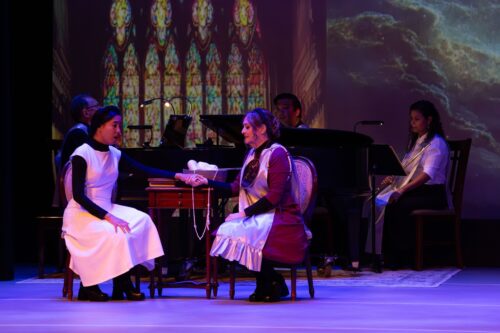
Patricia Arcadí, left, and Silvia Ludueňa share a scene in the opera “Juana Inés.”
(Photo by Javier Fontanella)
“In the case of ‘Juana Inés,’ I wanted to bring her story to life because despite her great intelligence, she was caught up in the rivalry between two bishops and she was outdone by that,” Daroca said.
Sor Juana Inés de la Cruz was a Mexican nun and writer. She was self-taught and chose a life of celibacy in a covent to dedicate her life to education. “The spirit of the opera is kind of dark, because for me, it’s like she’s dreaming of all these things that happen on stage,” Daroca explained. “I imagine that at the end of her life, she contemplated a lot of things and had these visions. It’s very respectful and the words reflect that serious side.”
Daroca added that some of the lyrics in “Juana Inés” come directly from texts written by Sor Juana herself or from letters written between her and the Bishop of Puebla.
“Juana Inés,” which is performed in Spanish, premiered in 2025 and actress and singer Silvia Ludueňa has portrayed the feminist nun three times over the last year. She’s set to reprise her role once again and talked about how she relates to Sor Juana as both a woman and an artist.
“I was very surprised to learn that a lot of Latinos don’t know the story of Juana Ines de la Cruz,” Ludueňa said. “I’ve known her poems since I was a kid, and for me, she’s someone that everyone should know her story.”
While Sor Juana’s story is inspirational in its own right — a self-taught nun poet — Ludueňa found it ironic that Sor Juana found the freedom she sought in a convent, a place known for rules and restrictions.
“I feel that as an opera, ‘Juana Inés’ is very important for today’s times,” Ludueňa said. “We’re living in a society where everything is immediate, but this opera forces you to slow down and stop. To stop and admire the music and listen to the story and reflect.”
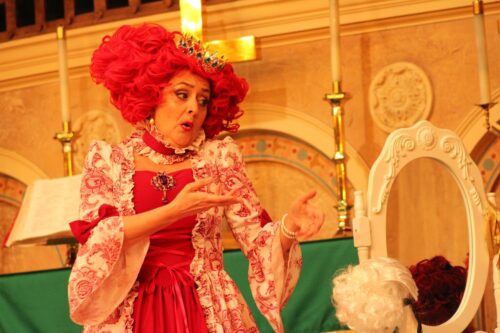
Silvia Ludueňa plays the Empress in a production of “Frau Haydn in Trouble.” (Photo by Xiomara Ponce)
As a contrast to the heaviness in “Juana Inés,” Daroca programmed a more comedic opera for the second half of the night. “Frau Haydn in Trouble” is inspired by the real-life wife of Austrian composer Franz Joseph Haydn, Maria Anna Theresia Keller, and performed in German, Spanish, and English.
“Juana is an absolutely towering figure,” Daroca said. “We can’t even begin to comprehend the breadth of her intellect. She left a huge collection of her literary work behind… In contrast, Frau Haydn couldn’t do that, she was the daughter of a wigmaker and had to get married to survive. She rebelled in the small ways she could, but her life was very domestic.”
“Frau Haydn in Trouble” takes more creative liberties with its storytelling. Daroca admitted that much of it is made up, but the fact that Frau Haydn used her husband’s manuscripts as curlers in her hair is historically accurate.
“I always say that perhaps Haydn’s best compositions were lost from Haydn’s hairdos,” Daroca quipped.
The real-life Frau Haydn was also known as a sharp-tongued woman, a characteristic that is portrayed in the one-act opera.
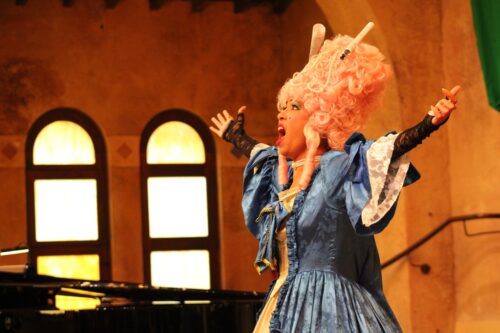
Patricia Arcadí as Frau Haydn dons a wig with a few pieces of musical manuscripts.
(Photo by Xiomara Ponce)
Actress Patricia Arcadí, who plays Frau Haydn on stage, says she pulled from the character’s humanity. “She was human,” Arcadí said. “She had her frustrations in not being able to express herself fully and freely in her lifetime… She was strong-willed and determined, but at the same time was held back by the likes of her husband. And even in today’s times, that still happens.”
Arcadí explained that when she’s on stage, she gives herself permission to be everything she’s ever wanted to be and everything that Frau Haydn might have been. She points to a particular song in the opera where her character sings about wanting to live in a large castle full of servants and grandeur because she was born to live that sort of life.
“She thinks very highly of herself and that she deserves the world,” Arcadí said, adding how the humor in that moment comes from the audience seeing how Frau Haydn very clearly is not the person she thinks herself to be.
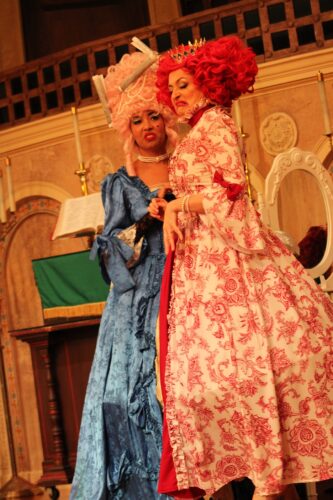
Patricia Arcadí, left, and Silvia Ludueňa, right, in “Frau Haydn in Trouble.” (Photo by Xiomara Ponce)
These two women, Sor Juana and Frau Haydn, lived roughly a century apart and yet shared struggles that women today can still recognize.
Arcadí’s advice? “Learn from Frau Haydn that if you don’t have what you want, create a world in your mind where you do and be happier for it… Be yourself, unapologetically.”
WHAT: Opera Atelier double bill: “Juana Inés” and “Frau Haydn in Trouble”
WHERE: Miami Beach Community Church, 1620 Drexel Avenue, Miami Beach; and Coral Gables Congregational United Church, 3010 De Soto Blvd., Coral Gables
WHEN: 8 p.m. Thursday Sept. 24 and 7 p.m. Saturday Sept. 26
COST: $20
INFORMATION: 786-560-6845 or theoperaatelier.org.
ArtburstMiami.com is a nonprofit media source for the arts featuring fresh and original stories by writers dedicated to theater, dance, visual arts, film, music and more. Don’t miss a story at www.artburstmiami.com.
No posts found
‘La Corte de Faraón’ to Rekindle ‘Faraón Fever’ at Manuel Artime
Written By Miguel Sirgado
September 10, 2026 at 10:52 AM
“La Corte de Faraón” returns to Miami’s Manuel Artime Theater for a one-night performance Sunday, Sept. 20, bringing together more than 40 performers in the century-old zarzuela. (Photo courtesy of Carlos Batista)
Maylú Hernández loves every aspect of building a production—the scenery, the costumes, even deciding which feathers belong on a hat.
But what she looks forward to most comes later.
“The magic begins the moment you step onto the stage, the spotlight finds you and the audience is ready to be transported,” says the Havana-born singer, actress and dancer. “For me, that’s the most beautiful part of it all.”

From left, Alicia Lora Salgado as Reina, Pedro de los Ríos as Casto José, Maylú Hernández as Lota and José Luis Bahamonde as Faraón in “La Corte de Faraón.” (Photo courtesy of Carlos Batista)
Hernández, who previously appeared in “La Corte de Faraón” with National Lyric Theater of Cuba, returns Sunday, Sept. 20. Miami-based production company Caro Events brings the zarzuela back to the Manuel Artime Theater for the one-night-only performance following a previous staging in May.
First performed at Madrid’s Teatro Eslava in 1910, “La Corte de Faraón” is a one-act zarzuela with music by Vicente Lleó and a libretto by Guillermo Perrín and Miguel de Palacios. Often described as a “biblical operetta,” it loosely reimagines the story of Joseph and Potiphar’s wife as a farce set in ancient Egypt, mixing music, romance, double meanings and suggestive humor—with playful nods to Verdi’s “Aida.”
“‘La Corte de Faraón’ is a celebration of mischievous humor, beautiful music and pure entertainment,” Hernández says. “What still surprises me is that it was written in 1910, yet its situations, characters and comedy feel completely alive today.”
Hernández serves as the production’s general director and plays La Lota, the zarzuela’s flirtatious heroine. According to Hernández, the May performance marked Miami’s first major staging of “La Corte de Faraón” in more than two decades.
José Luis Bahamonde knows that history firsthand.

José Luis Bahamonde as Faraón and Alicia Lora Salgado as Reina, surrounded by members of the “Voices of Miami” chorus in “La Corte de Faraón.” “The key is to take the character seriously,” Bahamonde says. “The humor comes from the situation itself.” (Photo courtesy of Carlos Batista)
A Cuban-trained tenor and graduate of Havana’s Instituto Superior de Arte, Bahamonde has spent five decades working in theater, particularly zarzuela and opera. He also served as a producer and director with Pro-Arte Grateli, the company that helped keep zarzuela, opera and operetta on Miami stages for decades. In “La Corte de Faraón,” he plays the Pharaoh.
“We don’t have as much lyric theater as we used to,” Bahamonde says of Miami’s changing theatrical landscape. “It’s become more limited. Keeping a venue going is very difficult because of rents and the costs involved in producing a show.”
Caro Events booked the theater nearly a year in advance, unsure what kind of audience response to expect.
Then the May performance sold out a week before opening.
“What happened in May was something we never expected,” Hernández recalls. “The 800-seat theater was sold out, and people were still calling, trying to find tickets.”
The enthusiasm continued after the curtain came down, with audience members sharing clips and comments online. Hernández jokingly calls it “Faraón fever.”
But the September production won’t simply recreate the earlier staging.

Maylú Hernández as Lota, in white, and Alicia Lora Salgado as Reina, in gold, perform alongside the “Voices of Miami” chorus and Ballet Caro Dance in “La Corte de Faraón,” returning to Miami’s Manuel Artime Theater for a one-night-only performance Sept. 20. (Photo courtesy of Carlos Batista)
“In May we had two banners; now we have four,” Hernández says. “We had 25 chorus costumes; now we have 32. We are making it larger, more colorful and more spectacular.”
The scale is ambitious, with more than 40 performers filling the stage amid elaborate costumes, scenery and props inspired by ancient Egypt.
The company is also revisiting stage movement, pacing and comic timing rather than relying on what was done in May.
Working with Hernández is artistic director Manny Albelo, a longtime Miami director whose work in musical and lyric theater has included productions of “Cecilia Valdés” and “La Viuda Alegre.”
“When I am performing and cannot see the full picture, Manny becomes my eyes,” Hernández says. “He sees what I cannot from inside the scene.”
One of Albelo’s biggest challenges is making a libretto written more than a century ago feel immediate. Much of the text is in verse and packed with double meanings.
“The first thing I wanted was for the verse not to reach the audience as something rigid,” Albelo says. “I wanted it to feel conversational.”
Rather than rewriting the text, the company uses pauses, interaction and natural delivery to preserve its rhythm while making the language accessible.

Members of the “Voices of Miami” chorus and Ballet Caro Dance in “La Corte de Faraón.” At a performance in May , the audience joined the chorus during the “Babylonian Song.” (Photo courtesy of Carlos Batista)
For Bahamonde, the same principle applies to playing the Pharaoh: don’t chase the laugh.
“The key is to take the character seriously,” he says. “The humor comes from the situation itself, not from the actor clowning around.”
His Pharaoh maintains his composure as increasingly absurd situations unfold around him.
Hernández laughs when describing La Lota’s central contradiction.
“She is supposedly a virgin, but she is a virgin who knows absolutely everything,” she says. “That contradiction is what makes her so funny.”
That humor, Hernández says, also serves a purpose.
“Life is very stressful right now, and comedy gives people a chance to step outside their worries for a while.”

Samuel Rodríguez as Soldado Seti, left, Eduardo Arteche as General Putifar, center, and Jorge Carlos Arencibia as Soldado Selhá in “La Corte de Faraón.” (Photo courtesy of Carlos Batista)
One of the strongest connections with the audience comes during the “Babylonian Song,” one of the zarzuela’s liveliest musical numbers. At the May performance, Hernández invited the audience to join the chorus, and hundreds of voices answered.
“That is when the cast and the audience become one voice,” she says. “Hearing 800 people singing together was beautiful.”
Bahamonde measures success more simply: he wants audiences to leave with a big smile—and wanting more.
Hernández wouldn’t mind a little blushing, either.
“I hope they laugh, blush, sing along and leave with their hearts full of music and joy,” she says.
WHAT: “La Corte de Faraón”
WHERE: Manuel Artime Theater, 900 SW 1st St., Miami
WHEN: 5 p.m., Sunday, Sept. 20
COST: $35 to $60
INFORMATION: 305-967-9191 or caroevents.com
ArtburstMiami.com is a nonprofit media source for the arts featuring fresh and original stories by writers dedicated to theater, dance, visual arts, film, music and more. Don’t miss a story at www.artburstmiami.com
No posts found
Jorge Drexler Brings ‘Taracá’ and Candombe Rhythms to Miami Beach
Written By Helena Alonso Paisley
August 30, 2026 at 12:14 PM
Uruguayan singer Jorge Drexler introduces Miami audiences to his latest work at the Fillmore Miami Beach on Wednesday, Sept. 2. (Photo by Manuel Vélez, courtesy of artist management)
An animating force behind Jorge Drexler’s storied career has been the singer-songwriter’s expansive curiosity. At 61, with armloads of Latin Grammys and an Oscar to his name, Drexler has never tired of taking new paths with his music, often following those trod by the industry’s youngest artists.
With his newest album, “Taracá,” Drexler reconnects with his Uruguayan roots and the infectious drumming style that first took hold of his imagination as a teenager. He’ll perform at the Fillmore Miami Beach on Wednesday, Sept. 2.

Jorge Drexler will be accompanied by a band of eight musicians, including three candombe drummers trained by an Uruguayan master percussionist. “I’m really proud of the team we’ve put together,” says Drexler. (Photo by Simón Canedo, courtesy of artist management)
“Candombe is a specific rhythm that was developed by the enslaved people that came from Africa to Uruguay. It’s a gift that we got from Africa,” Drexler explains in a recent telephone interview from his home in Madrid. “Ninety percent of the Uruguayan music scene is developed around candombe,” he says, connecting it even to the origins of tango and milonga.
Candombe’s whole celebratory culture has seen a resurgence in Uruguay, with Sunday drum processions winding through Montevideo neighborhoods like Barrio Sur and people of all ethnicities coming out to learn its traditional rhythms and dances.
During Drexler’s childhood, however, it was a different story. In Uruguay, as in Chile and in neighboring Argentina, the 1970s and early ‘80s were somber, fearful times, marked by state-sponsored violence against any form of dissent. Repressive governments saw artists and intellectuals as threats to be dealt with by the heaviest of hands.

Jorge Drexler says that the Uruguay he grew up in during the dictatorship of the ‘70s and ‘80s was a society without music. It was only after the fall of the country’s repressive government that he first heard candombe, a musical form that has influenced him ever since and that he has made the basis of “Taracá,” his newest album. (Photo by Fabián Urquiza, courtesy of artist management)
“I grew up in a music-less country,” Drexler explains. “Most of the musicians had to flee, had to escape the dictatorship and move to Europe or to the States or to other South American countries,” he says.
Music wasn’t part of his daily environment, he says. He wasn’t surrounded by professional musicians in his family or neighborhood, and communal traditions such as candombe had been suppressed.
“Candombe is part of an expression of a community,” says Drexler. “You play it on the street. Lots of people gather together around the drums and they walk. It’s a parade. You walk with the drums and the whole neighborhood goes behind the drums. And that was forbidden in the dictatorship.”
It was precisely the music’s power to bring people together that the government could not abide.
But dictatorships fall. When Drexler was 18, a percussionist friend began taking him and his brother to “llamadas,” where Afro-Uruguayan candombe musicians could now get together and play their drums in the streets.
“It was a huge influence since the first moment I started writing music,” he says. “I didn’t realize it was such a big influence until I started writing instrumental pieces on guitar, and I understood that they were really marked by that rhythm pattern.”

With 17 Latin Grammys to his name, Jorge Drexler still manages to stay curious; he credits his children with introducing him to some of the music that inspires him today. (Photo by Foca, courtesy of artist management)
The 3-2 beat of the candombe will be recognizable to Cubans as the rhythm of the claves in son cubano. Indeed, it is an integral piece of the musical DNA that enslaved Africans brought to America’s shores and spread far and wide. Its rhythm gets under your skin, practically begging you to get on your feet and move.
As Drexler points out in a clever track on the new album, we are lucky to be able to obey that call. “Ante la dudas, baila” (“When in Doubt, Dance”) lists six historical decrees against music and dance from Spain’s Baroque era prohibition of the sarabanda to a 1995 Puerto Rican law prohibiting the sale of reggaeton recordings. If this seems like an odd premise for a song, it’s catchier than its description would suggest, with an infectious chorus and a beat that could well have landed you in jail in 17th century Madrid.
Drexler says that the repression of these rhythms, all of them of African origin, was at its root a fear of sexual freedom; it is “the fear of the body and of the eros,” he says, “the part that’s related to life, to the life energy, life force, that music brings.” Even Elvis Presley, he notes, couldn’t be filmed from the waist down in 1950s America. But if you really want to make something popular, says Drexler, just try outlawing it: “It never works,” he laughs.
Drexler’s two teenage daughters and a 29-year-old son have helped him appreciate many forms of contemporary music, some of which he counts as influences today.
“I listen very carefully to their advice, and I learn a lot from their musical taste,” he says. On “Taracá,” he sings with 31-year-old Angeles Toledano, flamenco’s latest revelation, and with 28-year-old Puerto Rican rapper Young Miko. One of his producers, Tabu Vásquez, was only 21 when he started working on the record.

Jorge Drexler’s songs are filled with poetry and clever wordplay. They speak of everything from love and forgetting how to love to the hollowness at the heart of AI and the mysteries of the universe.
(Photo by Foca, courtesy of artist management)
When older people say, “‘Oh, this music that the young people have today, I mean, they don’t know what music is,’” Drexler says that it’s “a way of discriminating against the way they think, the way they view the world.”
Whether you are young or old, Black or white, some songs hold a message and a melody that feel essential to our common humanity. When Drexler sings Brazilian legend Gonzaguinha’s song, “O que e? O que e?”, it feels like a hymn to all that is good in the world—and in us. He performs it in Spanish, backed by a candombe rhythm.
“I wanted it to be understood in Buenos Aires, in Santiago de Chile, Mexico and Palermo,” Drexler explains. “‘What is life?’ It’s the hardest question that you can imagine,” he says. “It’s really difficult to write a song about that.”
“It’s a really important moment in the show, I must say,” says Drexler, and one that—if in doubt—a Miami audience just may want to get up and move their hips to.
WHAT: Jorge Drexler in Concert
WHEN: 8 p.m., Wednesday, Sept. 2
WHERE: The Fillmore Miami Beach at Jackie Gleason Theater
COST: $139.50 Pit Center; $75.50 Orchestra; $64 Mezzanine (plus charges)
INFORMATION: (800) 653-8000 or www.livenation.com and www.ticketmaster.com
ArtburstMiami.com is a nonprofit media source for the arts featuring fresh and original stories by writers dedicated to theater, dance, visual arts, film, music, and more. Don’t miss a story at www.artburstmiami.com
No posts found
Gipsy Kings Look Back and Ahead Before Miami Concert
Written By Fernando Gonzalez
August 7, 2026 at 5:22 PM
Gipsy Kings featuring Tonino Baliardo, center, with his sons Mikael Baliardo, first from left, and Benji “Cosso” Baliardo, second from left. Mikael and Cosso Bailardo have been part of the group the past 14 years. The group comes to Miami for a show at the James L. Knight Center on Saturday, Aug. 15. (Photo courtesy of Gipsy Kings featuring Tonino Baliardo)
The title of the Gipsy Kings’ most recent release, “Historia” (“History”), may suggest a retrospective, but the music, mixing the familiar with subtle innovations, sounds like a reaffirmation and a look forward. And why not? They have a distinct sound, built on a joyful, high-energy mix of Catalan rumba, flamenco, and pop, highlighted with brushstrokes of styles from around the world, and simple, direct lyrics sung mostly in Spanish, but also French, Catalan, and languages of southern France. The combination turned a group of Gypsy Romanis, once seemingly destined to scratch a living performing in restaurants, street events or busking on the beaches of Saint Tropez, into a global phenomenon.
But success was never a given. Their first two albums went largely unnoticed. Then their third recording, released in 1987, included the monster hits “Djobi Djoba” and “Bamboleo,” and the Gipsy Kings were on their way. Since then, they have won a Grammy (in 2014 for Best Global Music Album), have been featured in the soundtracks of Hollywood feature films including “Toy Story 3” and “The Big Lebowski,” sold more than 25 million albums, have had in excess of 2 billion streams, and played to full houses all over the world.
They will be performing at the James L. Knight Center on Saturday, Aug. 15, at 8 p.m.
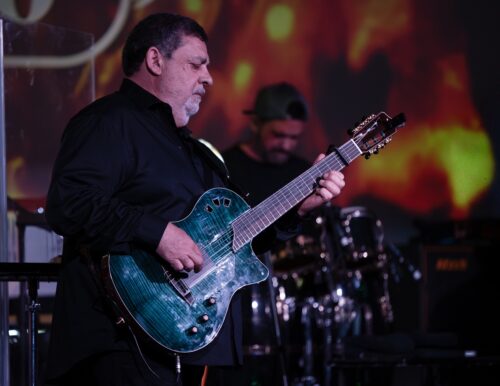
“No, I never imagined this kind of success,” said Gipsy Kings leader, founder and main composer Tonino Baliardo. (Photo courtesy of Tobin Hill)
“No, I never imagined that kind of success,” said Gipsy Kings leader, founder and main composer Tonino Baliardo, speaking in French through a translator from his home in the South of France. “We thought we could make a little living. We were doing private parties, and we did a little bit of work in Saint Tropez, but very little. When it exploded onto the world scene, it was just quite remarkable.”
The group was founded in 1979 in Arles, France, and featured two sets of brothers, the Baliardos (Tonino, Paco, and Diego, nephews of the great flamenco guitarist Ricardo Baliardo, better known as Manitas de Plata) and the Reyes (Nicolas, Canut, Paul, Patchai, and Andre, sons of Manitas’ cousin, flamenco singer José Reyes). Manitas de Plata and Reyes performed as a duo in the 1970s. It’s a story that speaks of a close-knit community, strong family ties, a fierce attachment to their traditions and legacies that must be honored.
Baliardo once called Manitas de Plata “the original Gipsy King.”
Over the years, the group has undergone several personnel changes while remaining a family affair. This iteration of the Gipsy Kings features Baliardo’s sons, Cosso and Mikeal. They have been part of the group since 2014.
Baliardo said “Historia” preserves the group’s sound while introducing new ideas.
“I wanted to make a new album preserving our sound, our gypsy feel, but with new melodies, new energy,” he said. “I love having my sons play with me. They grew up with this music, so they’re rooted in the culture. But they bring a young energy, a young spirit. And I also learn with them because music has evolved so much the past 35, 40 years.”
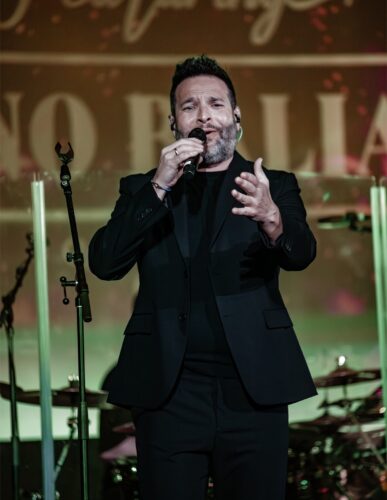
Jean Samuel (“Same”) Ray is the lead singer of Gipsy Kings (Photo courtesy of Tobin Hill)
As for how they describe their music and the blurry line between rumba Catalana, a style that emerged in Barcelona in the 1950s, and rumba flamenca, one of the palos or classic styles in flamenco, Baliardo sounds unconcerned. “At the end of the day, we are originally from Catalonia,” said Baliardo with a shrug. “My parents were born in Barcelona, Catalonia. So, we call it rumba Catalana (Catalan rumba).”
Over the years, the Gipsy Kings have added to it elements drawn from different sources, from Brazilian music and reggae to Algerian rai. “Historia” includes touches such as jazz piano solos, a hint of a montuno, and electric guitar rock solos.
“We kept the rhythms, the sound of the guitars. We call it the compas, and over that, our sound is always evolving,” explained Baliardo. “We always learn something in our world tours, new styles, new things.”
But the overall theme in the album, not surprisingly, remains family and community.
That theme runs through songs such as “El Campo” (“The Countryside”), a snapshot of life among the Romani; “Primavera” (“Spring”), which begins with the line, “I remember the time I spent in this neighborhood where I was born, life was sweeter, more beautiful”; and “La Guerra” (“The War”), an anti-war lament that hints at the impact of war on many Romani families, including the Baliardos, who were once refugees from the Spanish Civil War.
Even the instrumental “Cielo” (“Heaven”) is a deeply personal statement, a tribute to Baliardo’s brother Paco, who died in April 2025.

Since its beginnings in 1979, family has played a central role in the Gipsy Kings and their music. Benji (“Cosso”) Baliardo has been part of the group for 14 years. (Photo courtesy of Tobin Hill)
“In ‘Historia’ I wanted to tell the story of our ancestors, the story of our community,” said Baliardo, the main composer in the group. “It revolves a lot around that, about telling the long history of the Roma people, the Gypsies, and spreading that message throughout the world.”
His favorite song, however, is the title track “because (in it) we welcome the people who come to see us at the concerts and invite them to have a party with us,” explained Baliardo. “We have seen people so happy, partying, dancing in our concerts — and people were crying too, because something in the music touched them. And it’s a public that has been following us for years. Now it’s their children who come to see us because they have listened to our music with their parents. So, the story continues.”
WHAT: Gipsy Kings featuring Tonino Baliardo
WHERE: James L. Knight Center, 400 SE 2nd Ave., Miami
WHEN: 8 p.m., Saturday, Aug. 15
COST: $64.47, $80.75, $105.10, $158.35 and $218.23, including fees before taxes. Ticket information here.
INFORMATION: 305-416-5970; jlkc.com
ArtburstMiami.com is a nonprofit media source for the arts featuring fresh and original stories by writers dedicated to theater, dance, visual arts, film, music, and more. Don’t miss a story at www.artburstmiami.com.
No posts found
Jazz at MOCA makes a museum a home for outdoor live music
Written By Carolina del Busto
July 27, 2026 at 7:19 PM
The open-air plaza lights up on the last Friday of every month for Jazz at MOCA, a free concert series. ((Photo by Leo A Daly Architects, courtesy of MOCA)
Every final Friday of the month, the large open-air plaza of the Museum of Contemporary Art in North Miami (MOCA) turns into a live music venue. Jazz at MOCA has been entertaining the community since 1999. Welcoming local and traveling musicians, it puts a spotlight on a genre that is the cornerstone of all music.
Headlining this month is Cuban flutist Magela Herrera. This will be the second time Herrera takes the stage at MOCA.
“I love MOCA,” says the musician joyfully. “It’s such a great venue and also the museum itself is amazing. It’s a wonderful place to play.”
Part of Herrera’s Friday night set includes a tribute to fellow jazz musician, Chick Corea, as well as some afro sambas and the traditional Cuban dance genre, danzón. “I learned that the audience at MOCA is really open to receiving Latin music, so I want to bring a little more of that and show that side of me,” she says.
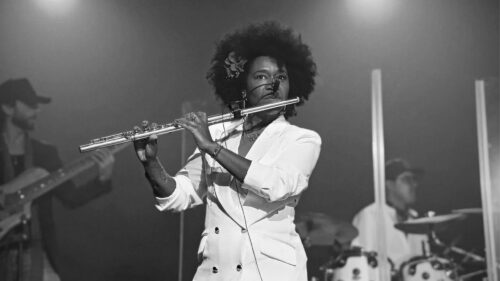
Flutist Magela Herrera takes the stage at MOCA on Friday, July 31. (Photo by Jose M. Alconchel)
Born in Cuba, Herrera trained in Norway before moving to Miami in 2016. “The decision to move to Miami was easy… jazz is happening all over throughout the city. There is space for my art here and to grow as a musician,” says Herrera.
The first time Herrera performed at Jazz at MOCA in 2023, she remembers the warmth of the crowd. As soon as she finished her set, people from the audience approached her to engage in conversation. “(They) come up to you with different questions about your music or why you chose this tune or that song; they’re really involved.”
The venue itself allows for the intimacy between performer and audience. There’s a certain comfort level that’s hard to find anywhere else.
Longtime Jazz at MOCA talent booker, Kimberly Chmura, compares it to a more traditional, indoor jazz club. “It almost feels like a listening room, even though it’s outdoors,” says Chmura. “Everyone is there to just listen to the music, you can hear a pin drop.”
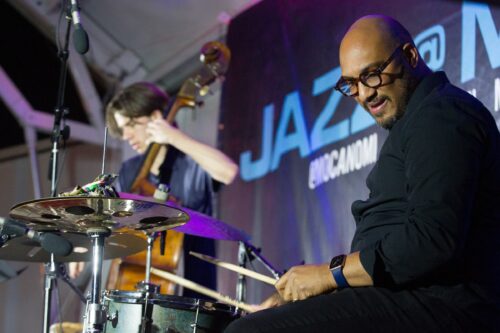
Jazz at MOCA brings local, national and international musicians to the Museum of Contemporary Art North Miami for free monthly performances. (Photo by Daniel Bock, courtesy of MOCA)
Chmura has been booking performers for the monthly concert for the last 18 years. Throughout her nearly two decades with the museum, she says her favorite part of Jazz at MOCA remains the people.
“The audience is just so receptive and it’s a beautiful demographic of young to more mature ages,” Chmura says. “I like watching the people show up and how happy they are after the show to rush to the stage and talk to the artist.”
Chmura works closely with the museum’s Community Programs Manager, Arsimmer McCoy, to pick and plan performances. The pair are hoping to shake up a bit of people’s expectations of jazz with the lineup.
McCoy says, “I’m a huge Alice Coltrane fan, and Alice Coltrane is super experimental, super out-of-the box. So we’re looking to also bring in artists that fit into those dynamics. We have a jazz crowd that is looking for a traditional jazz sound, but I do believe they’re ready to hear some things that might not sound like jazz.”
Coming up at Jazz at MOCA: Kiki Sanchez, Latin pianist in August; musicians David Luca and Los Clasicos in September; Mike Gerber, blind and partially deaf pianist, will be performing in October; experimental jazz musician Christopher Williams will be coming in from New York in November; and closing out the year will be the Miami Big Sound Orchestra in December.
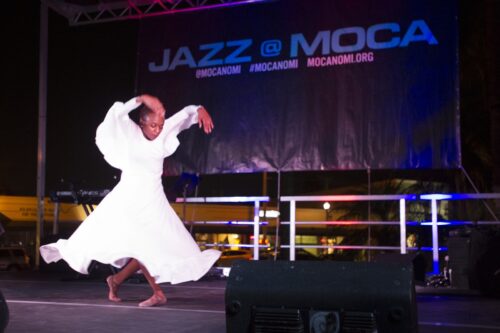
An interpretive dancer entertains during a previous Jazz at MOCA performance. (Photo by Daniel Bock, courtesy of MOCA)
Part of McCoy’s goal with Jazz at MOCA is to ensure it not only celebrates the art form, but it becomes a place where artists are vying to perform. “I want to make sure that jazz musicians in Miami and even those traveling through Miami know that there is a place for them here.”
The monthly concerts are free and open to the public. The museum plans to keep it that way while also working to raise funds to enhance the space for artists. More lights and better sound, says McCoy.
She jokes how her musician parents don’t understand much about what she does at the museum, “but they understand Jazz at MOCA.” Her father comes to every program.
“My favorite part of Jazz at MOCA is the jazz,” says McCoy with a smile. “The fact that I can hear jazz in the city and I get to see people up on that stage that look like me loving what they do and giving their all to the audience. It’s magic.”
WHAT: Jazz at MOCA presents Magela Herrera
WHERE: Museum of Contemporary Art North Miami, 770 NE 125 St., North Miami
WHEN: 8 p.m. Friday, July 31. Additional concerts every final Friday of the month.
COST: Free, RSVP via mocanomi.org encouraged
INFORMATION: (305) 893-6211 or mocanomi.org
ArtburstMiami.com is a nonprofit media source for the arts featuring fresh and original stories by writers dedicated to theater, dance, visual arts, film, music and more. Don’t miss a story at www.artburstmiami.com
No posts found
Subtropics Brings Immersive Sound Art to Deering Estate
Written By Carolina del Busto
July 22, 2026 at 12:08 PM
Collective jamJamStrawberry, made up of artists Sony Mao and Emile Milgrim, perform at
Subtropics 2025. “Subtropics: Audible Fields” takes place at the Deering Estate Theater over five Sundays across July, August, and September. (Photo by Barron Sherer)
Nearly 40 years ago, composer and artist Gustavo Matamoros organized a festival that elevated the then rising art form known as sound art. Subtropics Festival originated in 1989 and 37 years later, Matamoros continues to celebrate the art form.
“Subtropics: Audible Fields” takes place at the Deering Estate over five Sundays across July, August, and September. Audiences can expect work by sound collective jamJamStrawberry, radio artist Gregory Whitehead, musicians Barbara Held and Richard Garet, and composer Julio Roloff. More than 22 artists, both local and international, are participating or contributing work for Subtropics.
Organized and curated by Matamoros, one of Deering Estate’s artists-in-residence, the festival features both new work and historical pieces.
The Evolution
“Subtropics was founded by Gustavo Matamoros as a way to incorporate community-based artists that are exploring with sound, exploring with technology, that engage with visual and audio and photographic practices,” says Amaranta Mattie, the museum’s Cultural Arts Curator.

Composer, sound artist, curator, event organizer — Gustavo Matamoros does it all. (Photo by Claudia Ariano)
Every iteration of Subtropics is an an opportunity for Matamoros to both share his work and invite other sound artists to present, says Mattie, who calls him a “technology-based curator.”
When he started his residency with the Deering in 2021, he discovered a room that had the bones of a theater — it was being used more like a storage room. He asked the museum caretakers if he could turn the space into a proper theater and host a festival there. They said yes.
Matamoros shares how artist duo Richard Garet and Barbara Held reached out to him to ask about presenting some recent work. “I told them, I’ve got a theater,” he says, enthusiastically.
“Richard’s work comes from all sorts of directions. He’s just as good at doing sound as he is painting and visual art… and Barbara is more of a sound artist, like me.”
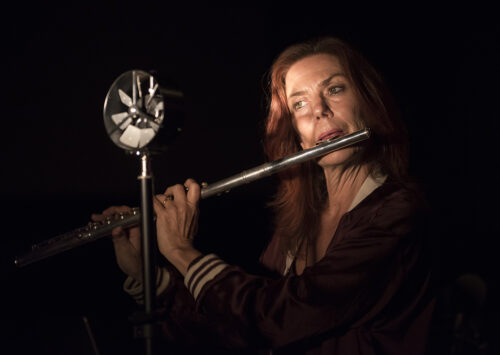
Sound artist/composer Barbara Held, a frequent performer at Subtropics, performs on Sunday, Sept. 13, during the “Audible Systems: Held / Garet + Matamoros” program at the Deering Estate Theater. (Photo by Luis Olazabal)
Garet, who splits his time between South Florida and New York, often collaborates with Barcelona-based Held. “Nine Movements,” which the duo has been performing since 2024, will be presented as part of the “Audible Systems” night on Sunday, Sept. 13. The performance features audiovisual work, flute, and other audio clips that will be paired with moving images.
Matamoros compares his practice to that of a painter who works with paint, or a sculptor who works with clay. As a sound artist, he works with sound. “There’s no mystery to it, it’s art made from sound.”
This will be the fifth year Subtropics has taken place at the museum’s newly renovated theater.
“One of the reasons, I think, that the Deering Estate became interested in my work as an artist was not only because I’m an artist practicing an unusual thing called sound art, but I’m also someone who’s presenting and involved in presenting my work,” says the artist.
Where Sound Meets Visuals
While the festival predominantly celebrates sound and gives a stage to sound artists, it also incorporates other artistic mediums that support each other. Visual art and projection as well as film and radio will all be part of the series.
“When I curate these programs, I’m never curating to try and introduce people to what sound art is. I’m more interested in providing people with experiences,” says Matamoros. He adds, “No one needs an introduction to art in order to be able to appreciate Michelangelo’s David, right?”
Throughout his career as an artist and festival organizer, Matamoros has met and befriended many fellow artists. When it came to curating the lineup for Subtropics, it was an easy feat to tap into existing contacts. In addition to the presenting sound artists, Matamoros has visual and technical support from fellow artists-in-residence Barron Sherer and Freddy Jouwayed.
The artists-in-residence program at the Deering Estate began in 2006. The museum’s cultural arts curator describes it as flexible and adaptable to each artist. They don’t rush the creative process, but rather give the artists all the resources at their disposal to encourage their creativity and creation. “We like to adapt to what the artists’ needs are, what their practice is, and what their process is,” adds Mattie.

Portrait of sound artist Olivia Block, whose work will be featured as part of the Listening Club night on Sunday, Aug. 2. (Photo courtesy of the artist)
At any given time, there can be anywhere from 18 to 23 artists-in-residence at the Deering. Mattie notes there are currently three studio residents, 12 non-studio residences, and five programming partners.
The program is structured as an annual program, with artists encouraged to reapply yearly for up to three years, explains Bailly. However, for certain artists, like Matamoros, his practice extends to production and, therefore, is part of the museum’s programming partners residency. Part of his programming contributions to the museum is the annual Subtropics Festival.
Sound, Image and Collaboration
“I’ve known Gustavo Matamoros much longer than I’ve worked with him,” says Sherer, a visual artist who Matamoros commissioned for a piece for a past Subtropics Festival.
The two have been collaborating in various iterations for the last 15 years. However, Matamoros has been an influence for Sherer for over two decades.
“When I first moved to Miami in the ‘90s, he was bringing these mind-blowing experimental sound artists to Miami and performing on Lincoln Road,” Sherer says.
Whereas in previous Subtropic festivals Sherer has presented his own work, this year, his participation is more of a supportive role. He’ll be collaborating with the sound collective known as jamJam Strawberry and working on visuals to accompany their sound piece.
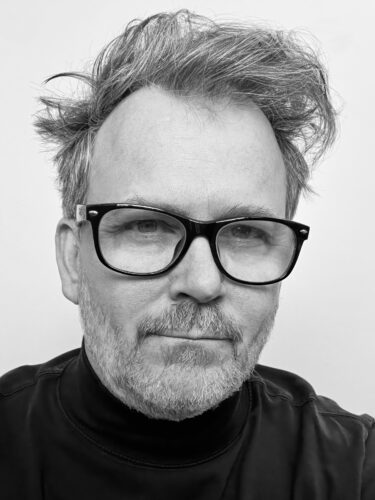
Visual artist Barron Sherer lends his artistic eye to help enhance the work of sound artists as part of his role in Subtropics. (Photo by Barron Sherer)
The sound collective typically performs on a bare stage with just their audio equipment — like a keyboard or a synth — against a screen with trippy projections to match their sound. For Subtropics, jamJamStrawberry will be performing a new piece titled “Strawberry Sweets” with accompanying projections and visual support from Sherer and artist Freddy Jouwayed.
Sherer advises guests to be prepared to be active. “This is not a passive thing,” he says. “There’s this relationship between the performer, creator, and audience. You gotta be open-minded.”
Sound art and sound artists may be new to some, but Sherer reinforces that the active encounter may be the best introduction to the art form.
“It’s just something you need to experience.”
WHAT: “Subtropics: Audible Fields”
WHERE: Deering Estate Theater, 16701 SW 72nd Ave., Palmetto Bay
WHEN: 4 to 8 p.m., Sundays, July 26, Aug. 2 and 16, Sept. 13 and 27.
COST: Free, RSVP via eventbrite.com encouraged
INFORMATION: (305) 235-1668 or deeringestate.org
ArtburstMiami.com is a nonprofit media source for the arts featuring fresh and original stories by writers dedicated to theater, dance, visual arts, film, music and more. Don’t miss a story at www.artburstmiami.com.
No posts found
Lift Every Voice: Gospel Fest Miami Brings National, Local Artists to the Arsht Center
Written By Sergy Odiduro
June 16, 2026 at 2:52 PM
A choir performs at the Arsht Gospel Choir Invitational at the Arsht Center on February 12, 2026 in Miami. Gospel Fest Miami Weekend, featuring national headliners and South Florida performers, on Saturday, June 20 and Sunday, June 21, wraps up the center’s six-month Gospel Choir Invitational. (Photo by Sergi Alexander / Eyeworks Production for Arsht Center)
Nathan Drew spent his formative years immersed in the world of music, but if you ask him today, he’ll say there’s only one genre that he is partial to.
“Gospel choir music is my favorite,” Drew says definitively. “Always will be.”
Today, Drew leads the Miami Gardens-based Mt. Pisgah Mass Choir and will be among the South Florida performers appearing at Gospel Fest Miami Weekend, set for Saturday, June 20 and Sunday, June 21, at the Adrienne Arsht Center.
Drew, a runner-up of the 2026 Arsht Gospel Choir Invitational, will join a crew of other South Florida artists who are hot on the Gospel scene. This includes Corey Patrick Edwards, the director of the Florida Fellowship Super Choir, Rashard Wright and Connect Worship, Sisters United, Deana Butler Rahming and Second Chapter.
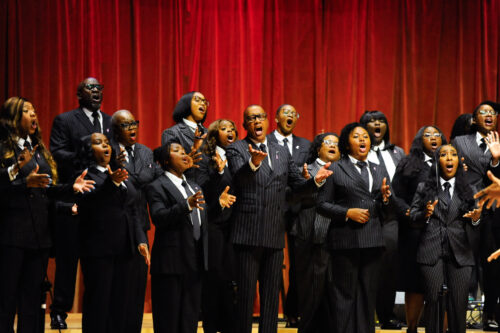
Mt. Pisgah Mass Choir, runners-up to the Gospel Choir Invitational in February, will perform on stage at Gospel Miami Fest Weekend on Sunday. (Photo by Sergi Alexander / Eyeworks Production for Arsht Center)
Headlining concerts by Grammy winner Jekalyn Carr and Grammy-nominated singer Todd Dulaney will take center stage while Fest participants will also have the opportunity to attend free panel discussions. Gospel Fest Miami Weekend ends a six-month series of gospel programming presented by the Arsht Center.
Born into a musical family, Drew joined his church choir at the age of five. His mother, who was a minister of music, had Drew right by her side. Ever the precocious student, he learned his way around the church’s choir by soaking up the spiritual hymns, singing alto beside the adults, and gathering inspiration from gospel greats like Richard Smallwood.
He admits that influences from the legendary gospel singer hold a place near and dear to his heart.
“(He) is literally my idol,” Drew emphasizes.
It’s Smallwood’s style, the passion in his delivery and the parts of sounds, melodies and voices that he works hard to incorporate into his own musical ministry. This is particularly true when songs are up-tempo.
“The fast beat, hand clapping, foot stomping and you get that high-power energy,” remarks Drew.
And whether it is a rousing rendition or a comforting ballad, Drew says Gospel fans should find exactly what they want, and more importantly what they may need, during this year’s Gospel Fest Miami Weekend.
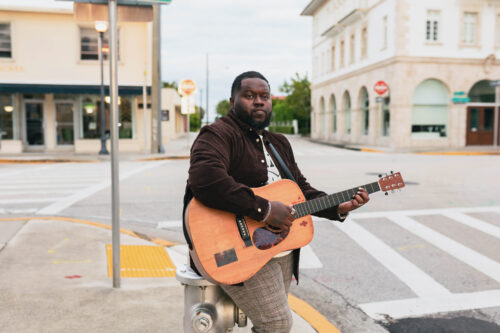
Rashard Wright will be at Gospel Miami Fest Weekend. The event wraps up a six month run of gospel events hosted by The Adrienne Arsht Center for the Performing Arts. (Photo courtesy of Artist Management)
To be sure, Gospel music isn’t only on your grandmother’s playlist. For Wright, founder of Connect Worship and one of the festival’s South Florida performers, younger audiences are helping fuel a renewed interest in the genre.
“I think we went through a season where Christian contemporary music was the main thing for a while, but what I noticed is that people are really starting to get back to gospel music,” says Wright.
Not only is there interest, Wright has seen how these younger listeners are also pushing for change.
“There’s a misconception and I think one of the most misunderstood things sometimes, is that the youth don’t appreciate gospel, but what I’ve found is that for a lot of young people, gospel, they want it to be different. They don’t want it to sound like everything else. They want it to be something that is nostalgic. They want it to be something that they remember. They want it to be something that is soulful.”

The Arsht Center Gospel Fest Weekend features headliner JeKalyn Carr on Saturday, June 20. (Photo by Taylor Brown)
He says what draws everyone in, including a younger audience, is the soul and the passion of gospel music.
“. . .That thing that exists in gospel music that you just can’t put your finger on and replicate. It’s just that when you feel it, you know it. And when you hear it, I think a lot of young people actually enjoy it, contrary to popular belief.”
And no matter the generation or the age group it’s a given that Gospel fans at the fest are in for a good time.
“They can expect a Holy Ghost Party and fun audience involvement,” says singer Butler Rahming who will perform alongside singer Sarah Gracel.
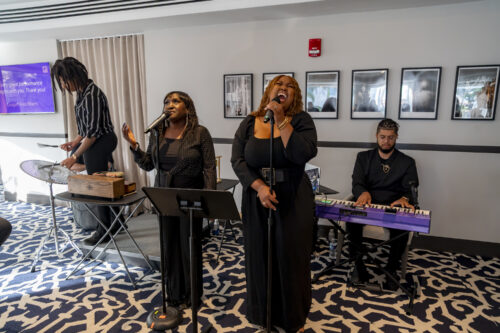
Deana Butler Rahming and Sarah Gracel perform at the Gospel Fest Miami pre-show reception in 2025. (Photo courtesy of World Red Eye)
Butler Rahming also notes how gospel has shifted onto the mainstream stage with appearances on secular stages like Jazz in the Gardens, the annual Miami Gardens music festival. Because of this, she wants to continue to encourage younger listeners.
“The younger generation should understand that it’s okay to be cool and love the Lord.”
Gracel hopes audiences leave with more than memories of the music.
“We’re coming there to bring whatever the Lord has in store, and the main thing is that people don’t leave there the same way that they came,” she says.

Jekalyn Carr performs at the Arsht Center’s Free Gospel Sundays. Carr will headline at Gospel Fest Weekend on Saturday, June 20. (Photo by Taylor Brown, courtesy of the Arsht Center)
In addition to concerts by national and local gospel artists, Gospel Fest Miami Weekend offers free pre-show programs at the Peacock Education Center. Saturday’s “Gospel Trends vs. Tradition” explores how the genre has evolved across generations while remaining rooted in its musical and spiritual traditions. Sunday’s “Worship Music & Wellness” invites participants to experience guided meditation, community singing and a discussion about the connection between gospel music, reflection and well-being.
WHAT: Gospel Fest Miami Weekend
WHEN: 5 p.m., Saturday, pre-show conversation: Gospel Trends vs. Tradition (Peacock Education Center), 7 p.m., main concert featuring Sisters United, Rashard Wright & Connect Worship, and headliner Jekalyn Carr (RSVP required) ; 5 p.m., Saturday, pre-show conversation: Worship Music & Wellness (Peacock Education Center), 7 p.m., main concert featuring Second Chapter, Mt. Pisgah Mass Choir, and headliner Todd Dulaney (RSVP required).
WHERE: Adrienne Arsht Center for the Performing Arts, Knight Concert Hall, 1300 Biscayne Blvd, Miami.
COST: Pay What You Can with a suggested contribution: $25 for one day, $40 for a two-day pass). RSVP required.
INFORMATION: (305) 949-6722 or arshtcenter.org
ArtburstMiami.com is a nonprofit media source for the arts featuring fresh and original stories by writers dedicated to theater, dance, visual arts, film, music and more. Don’t miss a story at www.artburstmiami.com.
No posts found
CAP Concert Series In Coral Gables Keeps The Music Playing All Summer
Written By Miguel Sirgado
June 8, 2026 at 3:08 PM
Pianist Clayton Stephenson performs Aug. 6 as part of the 2026 Community Arts Program (CAP) Summer Concert Series and leads a master class and jam session on Friday, Aug. 7. The series kicks off Thursday, June 11 at the Coral Gables Congregational Church. (Photo courtesy of Community Arts Program)
As much of South Florida’s live music scene slows for the summer, the Community Arts Program Summer Concert Series transforms the sanctuary of a Coral Gables church into an intimate concert hall, welcoming acclaimed musicians from around the world.
Now in its 41st season, the Community Arts Program (CAP) Summer Concert Series has spent more than four decades bringing internationally recognized artists to the Spanish Revival-style sanctuary of Coral Gables Congregational United Church of Christ, making it one of Miami’s longest-running live music traditions.
Founded in 1985, the series returns this summer with a lineup that moves across jazz, classical and crossover music while spotlighting artists at pivotal moments in their careers.
“It’s the presentation of incredible artists at the top of their craft,” says Mark Hart, executive and artistic director of CAP, who has led the organization for the past 24 years.
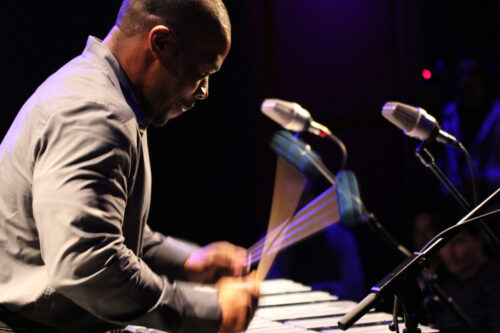
Vibraphonist Warren Wolf performs July 9 as part of the 2026 Community Arts Program (CAP) Summer Concert Series, bringing a program inspired by Americana jazz standards in celebration of America250. (Photo courtesy of Michael Borgida, Community Arts Program)
While the musicians are the draw, the setting is also part of the appeal. “People have an intimate and cozy concert experience,” says Hart.
Built in the 1920s and listed on the National Register of Historic Places, the church’s Spanish Revival architecture creates a warm atmosphere that feels closer to a chamber performance than a large concert hall.
Running every other Thursday from June 11 through Aug. 20, this season features Empire Wild, Langston Hughes II, Warren Wolf, Leonela Alejandro, Clayton Stephenson and Kate Kortum, reflecting the series’ longstanding commitment to emerging talent.
That philosophy is reflected in Empire Wild, the duo of Juilliard-trained cellists Mitchell Lyon and Ken Kubota.
Formed in 2017, New York City-based Empire Wild grew out of collaborations on Kubota’s YouTube channel, JHMJams, where classically trained musicians explored pop arrangements and other musical influences beyond the conservatory. What began as a friendship rooted in musical curiosity evolved into a project that combines original compositions with a genre-spanning repertoire.
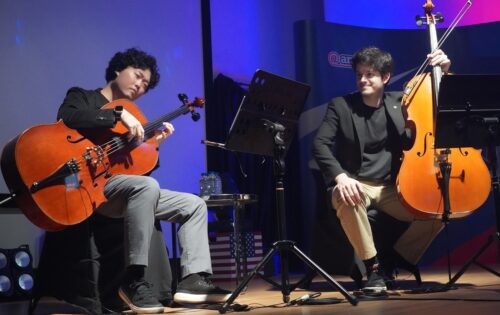
Cellists Ken Kubota, left, and Mitchell Lyon formed Empire Wild from a friendship rooted in musical curiosity, creating a project that blends classical training with original music and influences ranging from Bach to The Beatles. They open the CAP series on Thursday, June 11. (Photo courtesy of Community Arts Program)
“Empire Wild is less about ‘crossover’ as a label and more about creating music that feels honest, human and connected to the full range of musical experiences we grew up with,” says Kubota.
Their programs move easily from Bach and Gershwin to The Beatles and contemporary works, an approach Lyon sees as an invitation rather than a challenge.
“Bach, Gershwin, The Beatles and Mozart are all working with the same 12 notes,” according to Lyon. “Placing those worlds together lets audiences hear things in a new light.”
That openness extends to the concert hall itself.
“It’s very rare that the printed program is exactly what we end up playing,” says Lyon. “Sometimes another piece just feels right for that particular audience or moment.”
One of those instances happened during a tour of Indonesia. About 10 minutes before taking the stage, the duo decided to add a two-cello arrangement of the Indonesian classic “Bengawan Solo” as a tribute to local audiences.
“The response was incredibly moving,” recalls Kubota. “Sometimes the most meaningful experiences happen when you’re willing to respond to the place, the people and the energy in the room.”
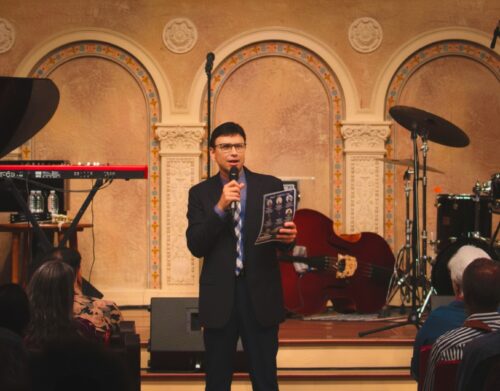
Mark Hart, executive and artistic director of the Community Arts Program (CAP), has led the organization for 24 years and continues to champion emerging artists through its long-running Summer Concert Series. (Photo by Philip Cardella, courtesy of Community Arts Program)
Hart believes that a sense of connection has become increasingly important as audiences navigate a world filled with competing entertainment options.
“Life has become more busy, more complicated and more expensive,” he says.
Affordability remains part of CAP’s approach. Despite rising costs across the arts sector and everywhere else, ticket prices for the Summer Concert Series have remained essentially unchanged for two decades, according to Hart.
“When audiences decide to go somewhere, the destination needs to be welcoming, relaxing and fullfilling,” Hart says.
Beyond showcasing emerging artists, the season also nods to broader cultural themes. Baltimore-born and based vibraphonist Warren Wolf’s Thursday, July 9 concert celebrates America250 through a program of Americana-inspired jazz standards and other musical influences tied to American history.
“Everyone hears and experiences music through the lens of one’s own happy and hurtful happenings,” says Hart. “I believe that’s what I like to call the warm blanket magic of the arts.”
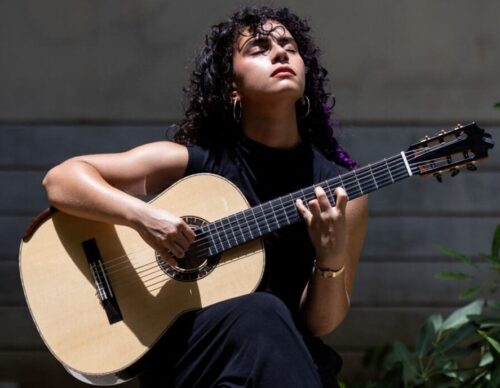
Guitarist Leonela Alejandro, winner of the 2024 Guitar Foundation of America International Concert Artist Competition, performs July 23 as part of the 2026 Community Arts Program (CAP) Summer Concert Series. (Photo courtesy of Community Arts Program)
Puerto-Rican guitarist vocalist Leonela Alejandro, winner of the 2024 Guitar Foundation of America International Concert Artist Competition, brings a program that blends Latin American traditions, jazz and original compositions on Thursday, July 23.
Clayton Stephenson, who became the first Black finalist in the Van Cliburn International Piano Competition in 2022, performs a program showcasing the artistry that has made him one of classical music’s most exciting young talents on Thursday, Aug. 6.
The season closes Thursday, Aug. 20 with vocalist Kate Kortum, a Houston native based in New York, known for her interpretations of jazz standards and contemporary songs. A graduate of the Frost School of Music at the University of Miami in 2023 and Juilliard in 2025, she returns to Miami after a year of remarkable change.
Since winning the 2025 Sarah Vaughan International Jazz Vocal Competition, Kortum has performed in Europe, Canada and Asia. Along the way, she used her passport for the first time.
“The Sarah Vaughan Competition has let me take my music all around the world, which was always a dream that I had but never thought could be realized,” she says.
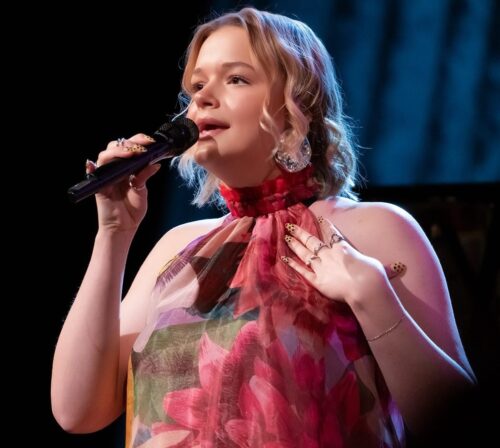
Vocalist Kate Kortum closes CAP’s 2026 Summer Concert Series on Aug. 20. A graduate of the Frost School of Music and Juilliard, she returns to Miami after a breakthrough year that followed her victory in the 2025 Sarah Vaughan International Jazz Vocal Competition. (Photo courtesy of Community Arts Program)
Beyond musical training, she says the friendships and artistic collaborations formed during her Miami years continue to influence her work today.
“Coming back to Miami is really special now because I feel like a different musician and a different person,” says Kortum. “My formative years were spent there.”
Kortum credits both the Frost School of Music and Juilliard with helping shape that transformation.
“Both of those schools flipped me upside down,” she says. “They reflected back to me all these different things that I just had no idea about.”
Kortum traces her love of jazz singing to a chance discovery as a teenager, when she came across Ella Fitzgerald’s recording of “How High the Moon” live in Berlin.
“I realized there was an art form that put storytelling and interpretation at the center,” she says.
The discovery changed the course of her musical life. While she had studied instruments including saxophone and flute, jazz singing offered a direct emotional connection through lyrics and personal interpretation.
“Nothing ever made me feel as free and as grounded as singing jazz.”
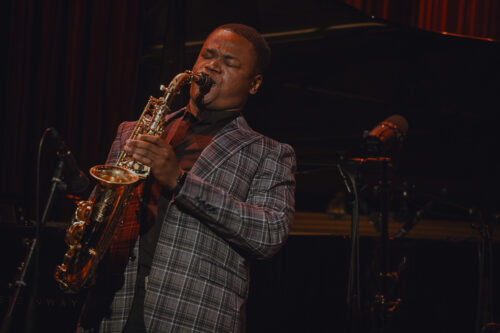
Saxophonist Langston Hughes II is among the artists featured in the 2026 Community Arts Program (CAP) Summer Concert Series, which returns for its 41st season at the historic Coral Gables Congregational United Church of Christ in Coral Gables. Hughes performs June 25. (Photo courtesy of Community Concert Series)
Her CAP appearance will be presented as a duo performance with pianist Joel Wendt, also a Juilliard grad, in a format she believes highlights the immediacy of the music.
“Jazz, in a lot of ways, is made for smaller settings,” says Kortum. “Audiences might be surprised by what they see.”
Education remains central to CAP’s mission. In addition to the concert series, featured artists lead free master classes and jam sessions open to participants and observers of all ages, creating opportunities to perform, learn and interact directly with visiting musicians from 10 a.m. to noon on Fridays following selected concerts. The schedule includes Langston Hughes II on June 26, Warren Wolf on July 10, Leonela Alejandro on July 24, and Clayton Stephenson on Aug. 7.
The programs complement CAP’s educational initiatives, which serve students through the CAP Conservatory for the Arts and the Miami Jazz Institute during the academic year.
“Variety is the spice of life,” says Hart. “Anything done well is worth expanding one’s boundaries.”
Ultimately, his desire is to have audiences leave with more than memories of a good concert.
“I hope people discover something that fills them in a way that brings them back for more,” says Hart.
Kortum sees music as an opportunity to offer audiences an escape from their day-to-day lives. Whether that feeling is joy, sadness, surprise or reflection, she says the aim is simply to move listeners somewhere unexpected.
“I hope I take them on some sort of journey.”
WHAT: Community Arts Program (CAP) Summer Concert Series
WHEN: 7:30 p.m. every other Thursday from June 11 through Aug. 20.
WHERE: Coral Gables Congregational United Church of Christ, 3010 De Soto Boulevard, Coral Gables.
COST: $35 in advance, $40 at the door. Patron tickets, rows 1 through 9, $50 in advance, $55 at the door.
INFORMATION: CommunityArtsProgram.org or 305-448-7421, ext. 120.
ArtburstMiami.com is a nonprofit media source for the arts featuring fresh and original stories by writers dedicated to theater, dance, visual arts, film, music, and more. Don’t miss a story at www.artburstmiami.com.
No posts found
Will Your Vote Decide Miami’s First Official Anthem?
Written By Artburst Editor
June 8, 2026 at 1:16 PM
Elevated Tracks 305 finalists have been announced and public voting runs June 7 through June 14, 2026. (Graphic from Elevate Tracks)
Will Miami’s anthem be “Miami Es Miami,” “Souls Alive in the 305,” “Mayami, My Miami” or “DALE 305”?
Those are among the finalists in Elevated Tracks 305, an independent community-driven competition that aims to create what organizers say could become Miami’s first official anthem.
Public voting is underway through Sunday, June 14, giving listeners a chance to help decide which song best captures the city’s culture, energy and identity.
Presented by Elevate Cities in partnership with Guitars Over Guns, the Frost School of Music at the University of Miami and Young Musicians Unite, the initiative invited musicians to submit original songs inspired by Miami. Entries came from across generations and musical styles, ranging from established performers to middle school students.
The finalists reflect many sides of the city, from bilingual tributes and Latin-infused tracks to songs celebrating Miami’s neighborhoods, nightlife and multicultural character.
Adult finalists include “305” by Adrian Gonzalez of ¡SUÉNALO!, “Miami Es Miami” by Hussein Abdala featuring Carlos Oliva, “Mayami, My Miami” by Richard Bona and Ellene Masri, and “Souls Alive in the 305” by Jose Conde. Other finalists are “Big City Bright Lights,” “Dance in Miami,” “MIAMI,” “Miami,” “My Ami” and “RUMBA.”
The youth category features five finalists ages 11 to 15, including “DALE 305” by 11-year-old Skye Aria, “La Gringa Tiene Tumbao” by Abi-G, “Miami Despierta” by Shantel Ruiz, “Miami On My Tongue” by Soleil River Nation and “Nature of Miami” by Bands.
The competition is supported by a roster of honorary co-chairs that includes Grammy-winning Miami music figures Gloria and Emilio Estefan, Jon Secada, Rico Love, Rudy Pérez and Danny Flores.
Public voting accounts for 50 percent of each finalist’s score, while a panel of judges drawn from Miami’s music, education and nonprofit communities will determine the remaining 50 percent.
Full finalists songs are on dedicated YouTube playlists (Youth Finalists Playlist and Adult Finalist Playlist). Voters are encouraged to listen to the entries before casting one vote in both the adult and youth categories. Votes can be cast at @ElevateMiamiTogether.
Winners are expected to be announced the week of June 22.
ArtburstMiami.com is a nonprofit media source for the arts featuring fresh and original stories by writers dedicated to theater, dance, visual arts, film, music and more. Don’t miss a story at www.artburstmiami.com
No posts found
Jazz @ Koubek Returns With Miami’s Multicultural Sound
Written By Jonel Juste
May 28, 2026 at 8:31 AM
Saturday’s lineup of Jazz @ Koubek opens with The Harden Project, led by vocalist Ja’Nia Harden and keyboardist John Harden II, whose groove-based sound blends jazz and soul. (Photo by Leesa Richards)
Miami’s multicultural influences shape this year’s Jazz @ Koubek, a two-night series on Saturday, May 30 and Sunday, May 31 at the Koubek Center in Little Havana.
Now in its third edition, the lineup features musicians whose work blends jazz with soul, Latin music, R&B and international influences, including The Harden Project, Han Beyli, Victoria Blue and Eric Chacón.
“What makes Miami unique is that its identity is not built from a single tradition, but from the continuous interaction between Caribbean, Latin American, Haitian, American, European and African-American influences,” says Melissa Messulam, director of Koubek Center.
Saturday evening opens with The Harden Project, led by vocalist Ja’Nia Harden and keyboardist John Harden II, whose groove-based sound blends jazz and soul. The evening also features bassist, singer and composer Han Beyli, whose music incorporates jazz, modern R&B and influences from his Ukrainian and Azerbaijani background.
Sunday’s performances continue the global conversation. Miami vocalist Victoria Blue brings a style shaped by her Afro-Cuban and Puerto Rican roots, while Venezuelan instrumentalist Eric Chacón closes the weekend with music influenced by classical training and contemporary jazz.

Miami vocalist Victoria Blue brings a style shaped by her Afro-Cuban and Puerto Rican roots to Jazz @ Koubek (Photo by Vanessa Castillo)
The lineup reflects how Miami’s music scene has evolved in recent years. Once known largely as a stop for touring acts, the city has increasingly become home to musicians developing original work shaped by multiple cultures and musical traditions.
“Miami has evolved into a city with a distinctly original cultural voice,” says Messulam. “Jazz @ Koubek was created from a desire to celebrate jazz not only as a musical genre, but as a conversation between cultures, generations, and artistic traditions,” she says.
She points out that many cities have foundational histories rooted deeply in jazz.
“Miami’s contribution comes from its role as an international crossroads where artists from across Latin America, the Caribbean, Europe, the Middle East, and the United States interact in real time. Jazz @ Koubek was created from a desire to celebrate jazz not only as a musical genre, but as a conversation between cultures, generations, and artistic traditions,” says Messulam. “We hope that each new edition grows more reflective of Miami itself.”
For Blue, music was ever present growing up in a Cuban and Puerto Rican household in Miami.
“Music was never just entertainment — it was part of daily life, family, celebration, heartbreak, faith, and resilience,” says Blue.
She says Miami exposed her to multiple genres simultaneously.
“I grew up hearing boleros, salsa, jazz, soul, gospel, and Latin pop all in the same week, so naturally my sound became a blend of all of those emotions and influences.”
Blue first gained national attention on “The X Factor USA,” but her artistic identity has continued evolving through projects like her 2025 Spanish-language album, “El Arte de Volar.”

Fluidity defines Han Beyli’s approach to music. Raised in Ukraine with Azerbaijani roots, Beyli developed within Kharkiv’s jazz scene while remaining connected to Eastern musical traditions through his family’s heritage (Photo by Priscila Miranda)
“There are certain emotions that I honestly feel more deeply in Spanish,” she says. “The language carries a different kind of poetry and vulnerability for me. I move between languages and genres very naturally because that’s how I grew up communicating and experiencing music.”
Raised in Ukraine with Azerbaijani roots, Beyli developed within Kharkiv’s jazz scene while remaining connected to Eastern musical traditions through his family’s heritage.
“Ukraine gave me a strong foundation in jazz and musical complexity, while my Azerbaijani background gave me a deep emotional and cultural connection to Eastern music,” says Beyli. “Over time, these influences naturally became one language for me.”
Rather than approaching fusion as a concept, Beyli says he focuses on authenticity.
“I just try to be honest with the sounds that shaped me and let them speak together in a way that feels organic,” he says.
That authenticity is part of what defines this year’s lineup.
“Each artist brings not only exceptional musicianship, but also a unique cultural and artistic perspective that reflects the global nature of contemporary jazz,” says Messulam.
The festival takes place in Little Havana, one of Miami’s most historically immigrant neighborhoods where Latin American and Caribbean influences intersect daily.
“Jazz @ Koubek reflects the Miami we know, a place of constant cultural conversation,” says Messulam. “What might seem like separate traditions elsewhere naturally coexist here.”

Eric Chacón closes the weekend with music informed by classical training, education and contemporary performance (Photo by Guillermo Riera)
That coexistence increasingly shapes Miami’s sound.
“Miami taught me that you don’t have to fit into one box creatively,” says Blue. “Here, cultures naturally coexist — English and Spanish, Caribbean rhythms, jazz, R&B, reggaetón, soul, dance music — it all lives side by side.”
The appeal of hybrid music also reflects broader cultural realities, notes Beyli. “I think many people today live between cultures in some way,” he says. “They may speak different languages, come from immigrant families, move between countries, or simply grow up listening to music from all over the world. Hybrid music reflects the world we live in now,” says Beyli. “Even when the language or style is unfamiliar, the emotion can still be understood.”
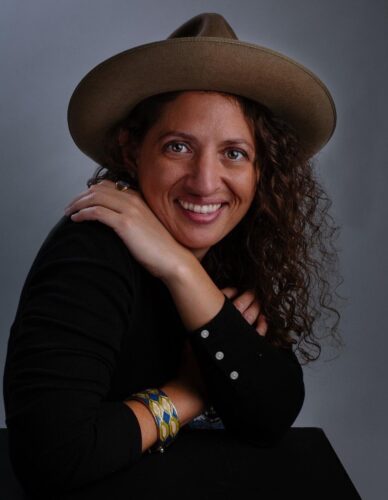
Koubek’s director Melissa Messulam (Photo by Bert Ochoa)
For Messulam, jazz remains “the sound of surprise” because of its ability to create spontaneous moments of connection between artists and audiences.
“At Jazz @ Koubek, that surprise comes through improvisation, through artists blending traditions in new ways, and through audiences encountering sounds and musicians they may not have experienced before,” she says.
WHAT: Jazz @ Koubek
WHERE: Koubek Center, 2705 SW 3rd St., Little Havana, Miami
WHEN: 8 p.m. Saturday, May 30, and 6 p.m. Sunday, May 31.
COST: $15 each night.
INFORMATION: (305) 237- 7750 or koubekcenter.org
ArtburstMiami.com is a nonprofit media source for the arts featuring fresh and original stories by writers dedicated to theater, dance, visual arts, film, music and more. Don’t miss a story at www.artburstmiami.com.
No posts found
‘Ceaseless Beauty’ A Full-Sensory Chamber Music Experience
Written By Gina Margillo
May 13, 2026 at 9:36 AM
Juraj Kojš at The Gates performance for Miami Light Project. The composer performs Wednesday, May 13 in a concert in Coconut Grove. (Photo by Linda Phelps)
Miami-based composer Juraj Kojš has a reputation for pushing musical boundaries with his use of electronics and multimedia. Yet, for his upcoming concert, “Ceaseless Beauty,” he returns to his classical beginnings with original compositions for cello, piano, viola, and piano.
For Kojš, the concert is a deeply personal one, featuring works that explore memory, emotion, and Kojš’s Slovak identity. The music draws on textures inspired by Chopin, Schumann, and Liszt, and blends romantic influences with North American minimalism. Kojš applies recurring melodic gestures that create a meditative atmosphere for what he describes as “music that carries the residue of a 19th-century, suffering artist, deep in a forest.”
Kojš’s formal training in classical piano and composition at the Bratislava State Conservatory became the foundation of his work. Later on, while studying under the influential composer, Judith Shatin, founder of the Computer Music Center at the University of Virginia, and Stafania Serafin, at Florida International University, he expanded into electronic media. Today Kojš is as much at home with the classical chamber music form as he is with a synthesizer and he embraces this plurality without hierarchy.
This concert will not only bridge these different musical structures, it will include new musical formats. Pieces from his album of the same name, “Ceaseless Beauty,” developed during an artist residency at the Deering Estate, return in a new, live context with an ensemble that features violinist Scott Flavin, violist Jodi Levitz, cellist Ross Harbaugh, and pianist Jacob Mason. Each musician brings a wealth of experience and talent to the stage.
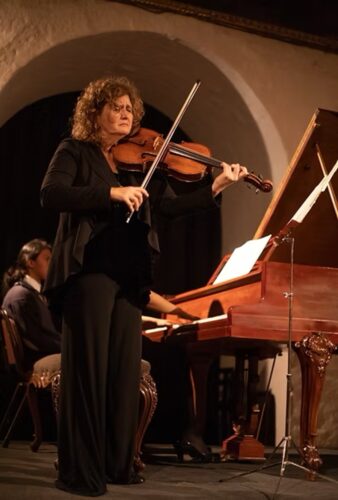
Jodi Levitz is currently Professor of Viola at the Frost School of Music and Artistic Director of the Stamps Ensembles. (Photo courtesy of the artist)
Scott Flavin, a professor of violin and chamber music at the University of Miami’s Frost School of Music, has a multi-faceted violin career as chamber musician, orchestral concertmaster and soloist. He is a member of the Bergonzi Piano Trio and PULSE Trio. He currently is concertmaster of the Symphony of the Americas, and was long-time concertmaster for Florida Grand Opera and Miami City Ballet.
Jodi Levitz is an internationally acclaimed violist, renowned for her advocacy of contemporary viola repertoire and her dynamic career as both performer and educator. A former principal violist and soloist with I Solisti Veneti, she is currently Professor of Viola at the Frost School of Music and Artistic Director of the Stamps Ensembles.
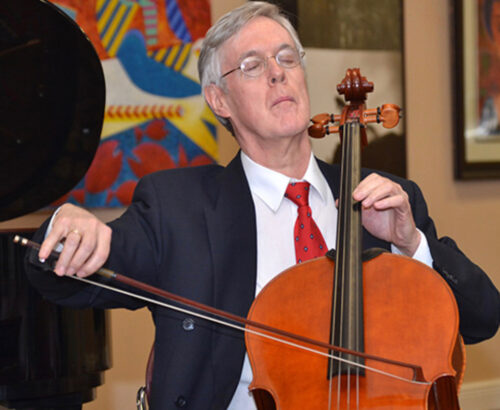
Ross Harbaugh is professor of cello at the Frost School of Music and a member of the Bergonzi String Quartet. (Photo by Scott Flavin)
Ross Harbaugh is professor of cello at the Frost School of Music and a member of the Bergonzi String Quartet with a distinguished career as a soloist, chamber musician, and educator. He is also a founding member of the New World Quartet and winner of the Naumburg Prize.
Jacob Mason is an American pianist known for his virtuosic technique and adventurous repertoire, gained early recognition with Prokofiev’s Piano Concerto No. 1 and the New World Symphony. A graduate of the Frost School of Music and the Hochschule für Musik Basel, he is co-founder of the ensemble Ex-Sentia.
Kojš designed the performance to provide a full sensory experience for audiences. He has enlisted transdisciplinary artist, Dimitry Saïd Chamy, to create video works based on footage captured in his native, mountainous, Liptov region, by Kojš’s sister, Mariana Kojšová. Additionally, each piece of music will be accompanied by Kojš’s original poetry that echoes his Slovakian homeland.
WHAT: “Ceaseless Beauty”
WHERE: St. Stephen’s Episcopal Church 2750 McFarlane Road, Coconut Grove
WHEN: 7:30 p.m., Wednesday, May 13
COST: $10 at www.eventbrite.com
INFORMATION: kojs.net/
ArtburstMiami.com is a nonprofit media source for the arts featuring fresh and original stories by writers dedicated to theater, dance, visual arts, film, music and more. Don’t miss a story at www.artburstmiami.com
No posts found
Miami-born Emmet Cohen brings viral ‘Emmet’s Place’ jazz series to the Arsht Center
Written By Michelle F. Solomon
May 5, 2026 at 4:46 PM
Miami-born pianist Emmet Cohen brings his “Emmet’s Place” jazz series to the Adrienne Arsht Center as part of the Jazz Roots series on Friday, May 8. (Photo courtesy of artist management)
Emmet Cohen’s apartment in Harlem turned into a live jazz club as a way for the musician to keep connected during the pandemic.
Cohen, born in Miami and a Frost School of Music at the University of Miami grad, talks about how his YouTube series “Live from Emmet’s Place,” which now has more than 240,000 subscribers, got its start during the pandemic. It didn’t start with a grand vision; it began with a canceled gig in Kansas.
“When the pandemic happened, all the gigs were canceled. And we were prompted by the people in Kansas—they were like, ‘We want to support the artists. We’ll give you the full fee for the gig. Just do something online.’ ”
He says he wanted to take that offer seriously.
“With my band in Harlem, we were kind of in a bubble at that time and we put on suits and ties and went to my apartment and brought Kyle’s drums over.” Cohen recalls Kyle Poole, his drummer, walking the drums down Edgecombe Avenue and then up the stairs of the fifth-floor walk-up.
“People were so lonely and things were so uncertain. We were able to provide this safe space to come—that you knew the music was going to be good, you knew the people were going to be cool. And I think I learned a lot in that time about consistency and about what’s special about music and community, beyond just the notes and the rhythms.”
As the show grew, so did its reach. The apartment eventually gave way to a legendary studio.
“We moved this year Power Station in New York City, which is the top recording studio in the city. And now it’s a monthly thing. We’ve gotten over 100 million views in the last six years or so.”

Emmet Cohen started his popular YouTube music series during the pandemic out of his Harlem apartment and it quickly gained a following. (Photo courtesy of artist management)
While the living room series was born in New York, Cohen says the foundation was laid in Miami.
“Life definitely keeps leading me back here,” says Cohen, who’ll perform in the touring version of “Live from Emmet’s Place” with his trio and a couple of special guests on Friday, May 8 in the Knight Concert Hall at the Adrienne Arsht Center.
Cohen grew up in Coral Gables and went to Palmetto Elementary School, but his family then moved to New Jersey. The pull to Miami led him back to the University of Miami and now recently retired dean Shelley Berg.
Cohen tells the story of their first meeting. Berg was leading The Jazz Band of America, a group of high school players, for a show in Indianapolis, of which Cohen was a part.
“It was the largest audience I had ever seen in my life. And I was getting to play, warming up and banging on the piano keys.” He remembers Berg putting his hand on his shoulder and saying, ‘If you come study with me at the University of Miami, I’ll teach you how to play the piano without putting it out of tune.”
And then while at UM, he had what he calls a full-circle moment.
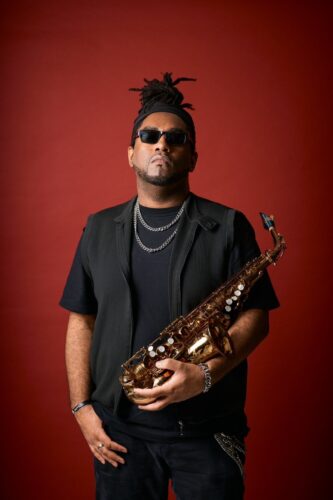
Emmet Cohen’s band will feature Gammy-nominated saxophonist Patrick Bartley, also a Miami native, in a special guest appearance. (Photo courtesy of the artist)
“When I was a kid I used to be in this Saturday music program called Keyboards for Kids when I was in elementary school and it took place at the University of Miami. One day I realized I was taking courses in the same building. There I was in the same building but at a different point in my life.”
The city’s soundscape, he says, also had an influence on this playing.
“I think it’s such a diverse, diverse place… especially Latin culture,” he says. “Hearing those sounds early on definitely gave me kind of a molding that I might not have gotten in other places. There’s always Spanish around. There’s always Latin music… all these little things that happen when you’re from there, I think are definitely part of my being. Every time I come back, I just smell the air, and it just feels like I’m meant to be there.”
And because Miami is so special to him, Cohen says he’s put together “a band with a few of the greatest musicians in the world.”
On saxophone is Patrick Bartley, also from Miami. “He’s highly regarded as one of the greatest saxophone players alive today, and he’s been around the world and I’m bringing him back for the show. One of the most popular YouTube videos that I made was with him.”
There’s Bronx-born trumpeter Bruce Harris. “He was also on that video and they are two of the most dynamic musicians, so we’ll augment the trio, my regular group, with these two special guests.”
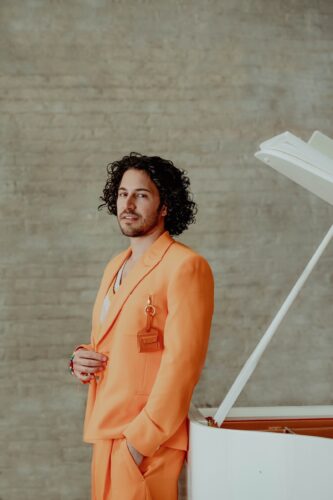
Coral Gables-born and Frost School of Music graduate Emmet Cohen says Miami had a great influence on his music stylings. (Photo courtesy of artist management)
They’ll join Cohen on piano, bassist Russel Hall and drummer Kyle Poole, the guy who dragged his drums down Edgecombe Avenue.
Inside the Knight Concert Hall at the Arsht, audiences will be transported to the living room in Cohen’s Harlem apartment — the comradery and the comfort.
“I think there’s something in the show for everyone—for jazz students, for hip people who love the art scene, or older folks who love the Great American Songbook. I have strong beliefs about music and its capacity to heal and to just provide this blanket of comfort and security in a time when there’s so much in the world that’s going on… to watch people improvise together and try to create something together that’s greater than any of the individuals. Miami is a special place for all of us.”
WHAT: Emmet Cohen’s “Live at Emmet’s Place”
WHEN: 8 p.m., Friday, May 8.
WHERE: Knight Center at the Adrienne Arsht Center for the Performing Arts, 1300 Biscayne Blvd., Miami
COST: $52.65 – $152.10, includes fees
INFORMATION: 305-949-6722 or arshtcenter.org/jazz
ArtburstMiami.com is a nonprofit media source for the arts featuring fresh and original stories by writers dedicated to theater, dance, visual arts, film, music, and more. Don’t miss a story at www.artburstmiami.com
No posts found

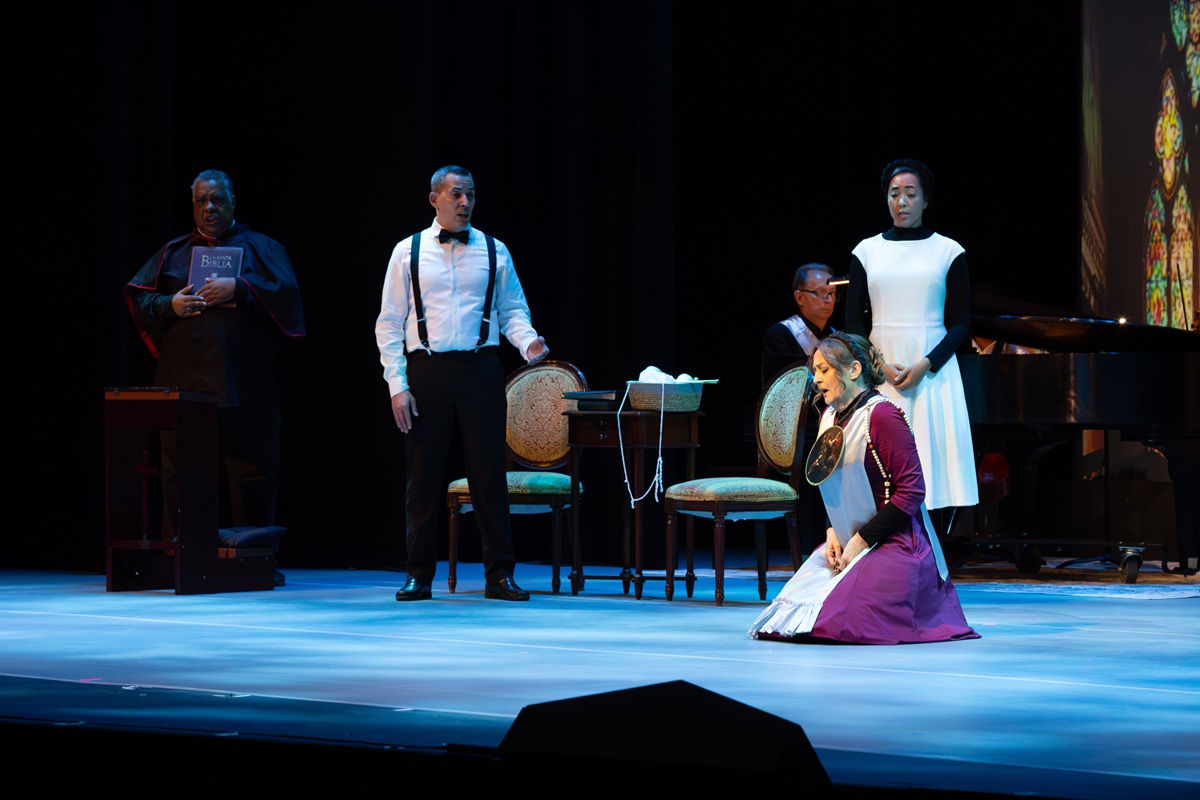

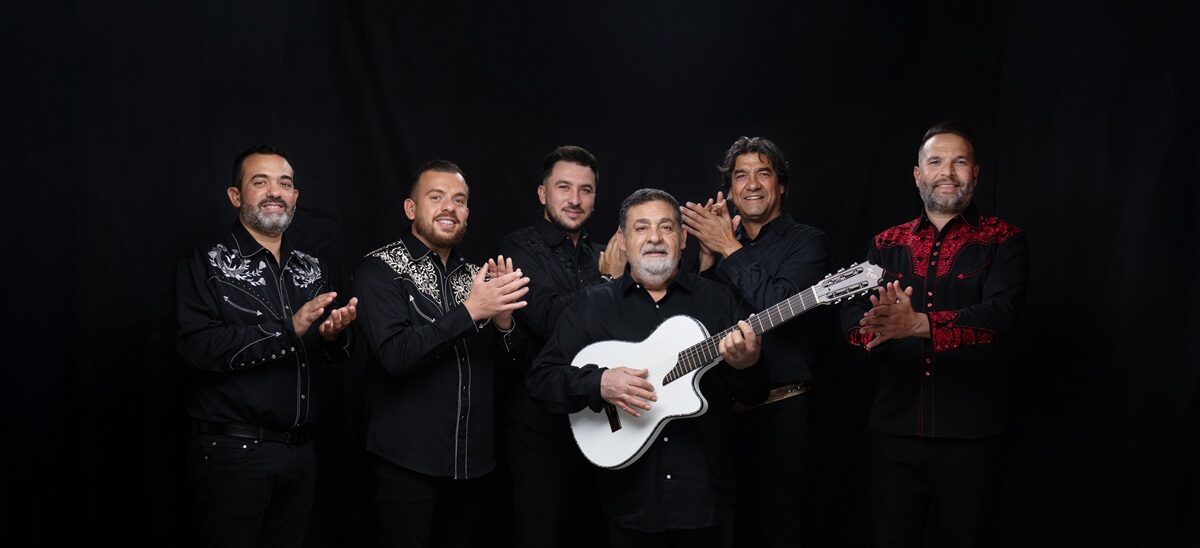
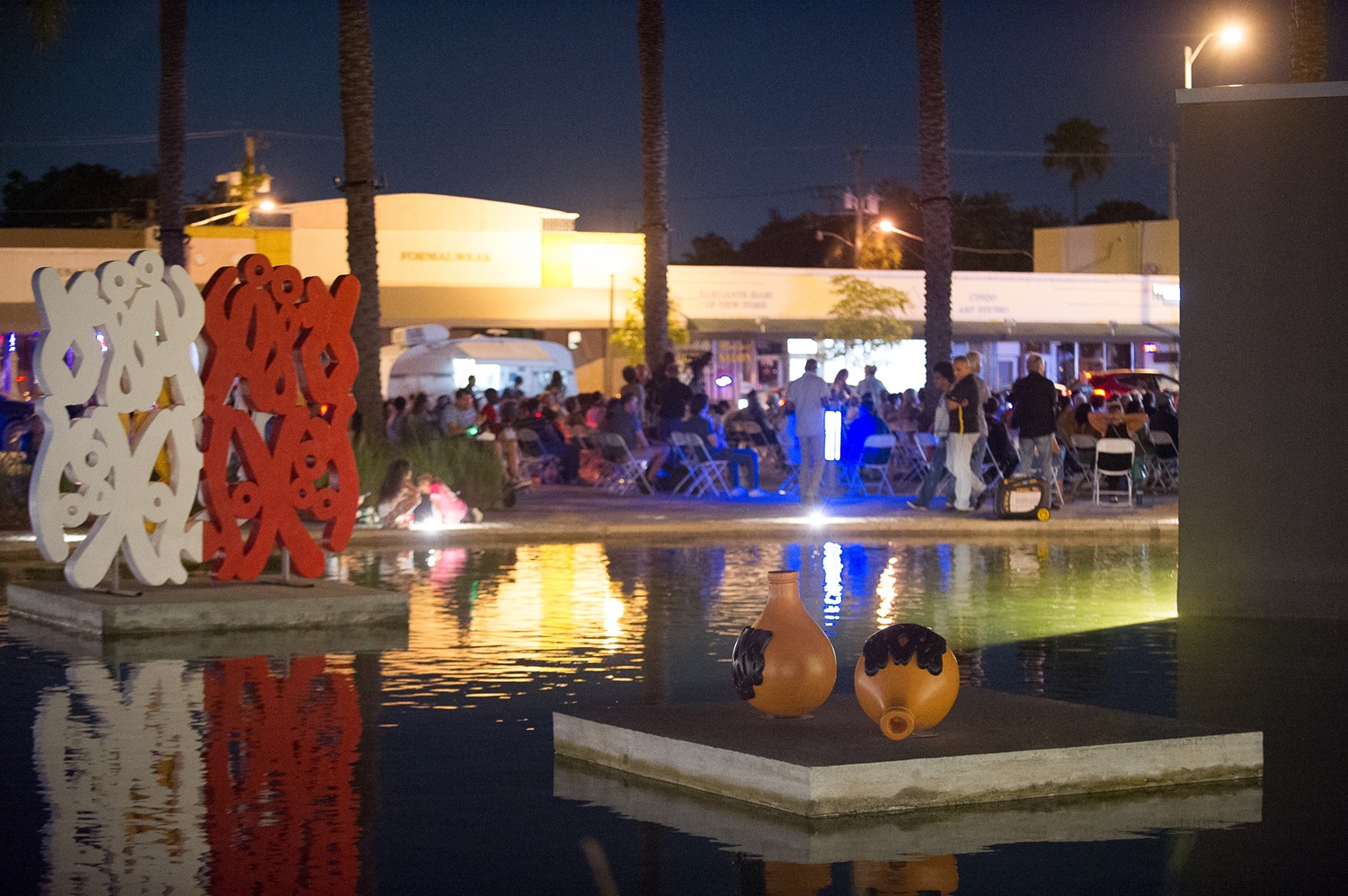
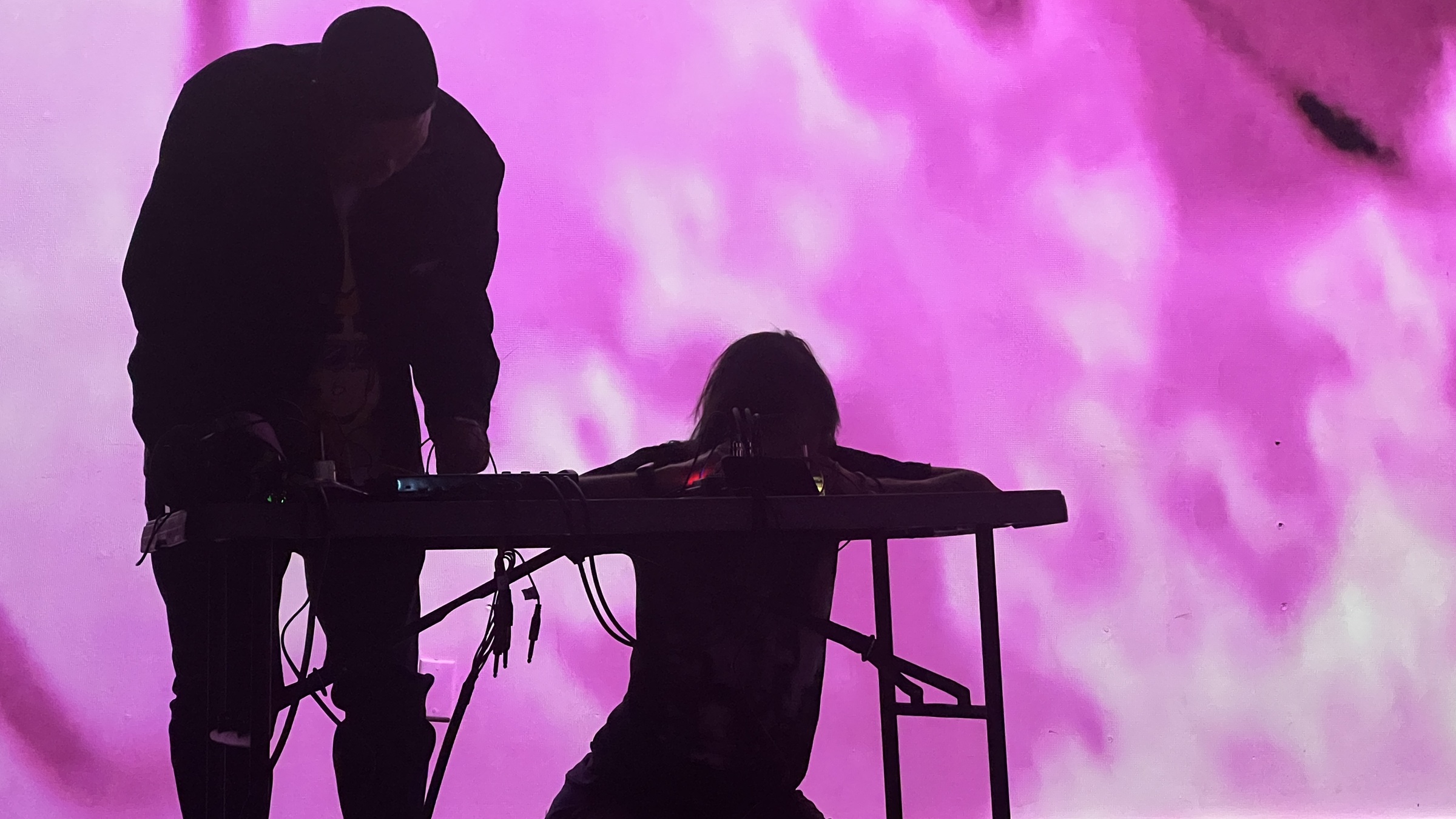
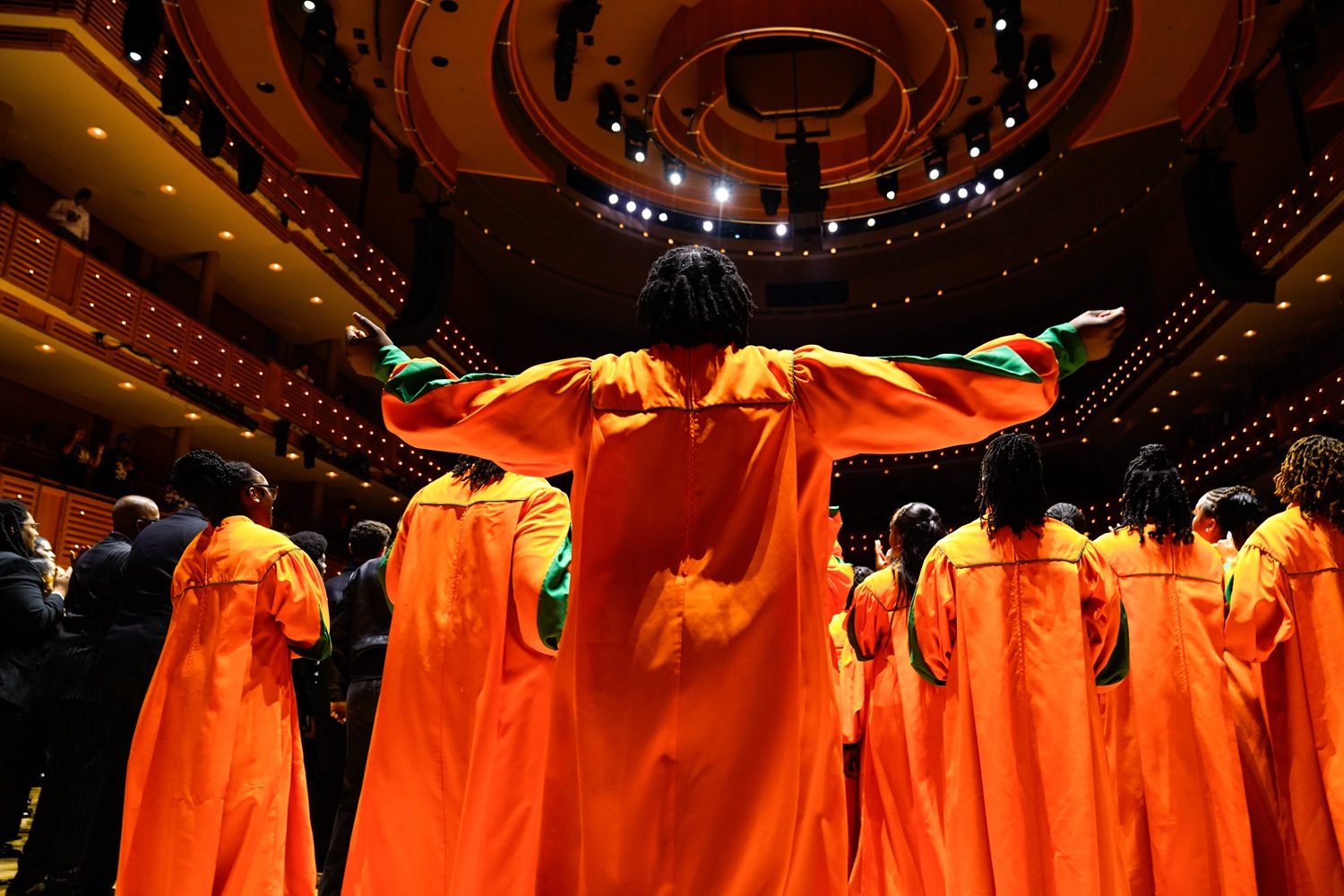
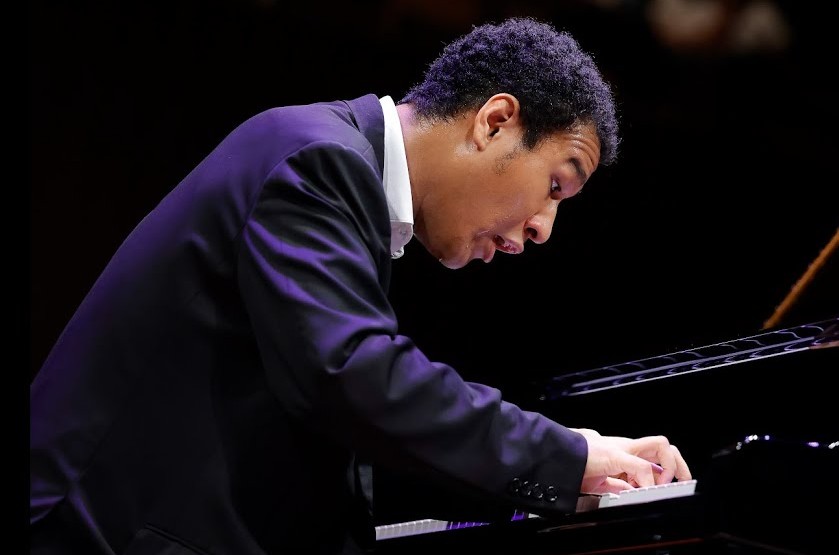


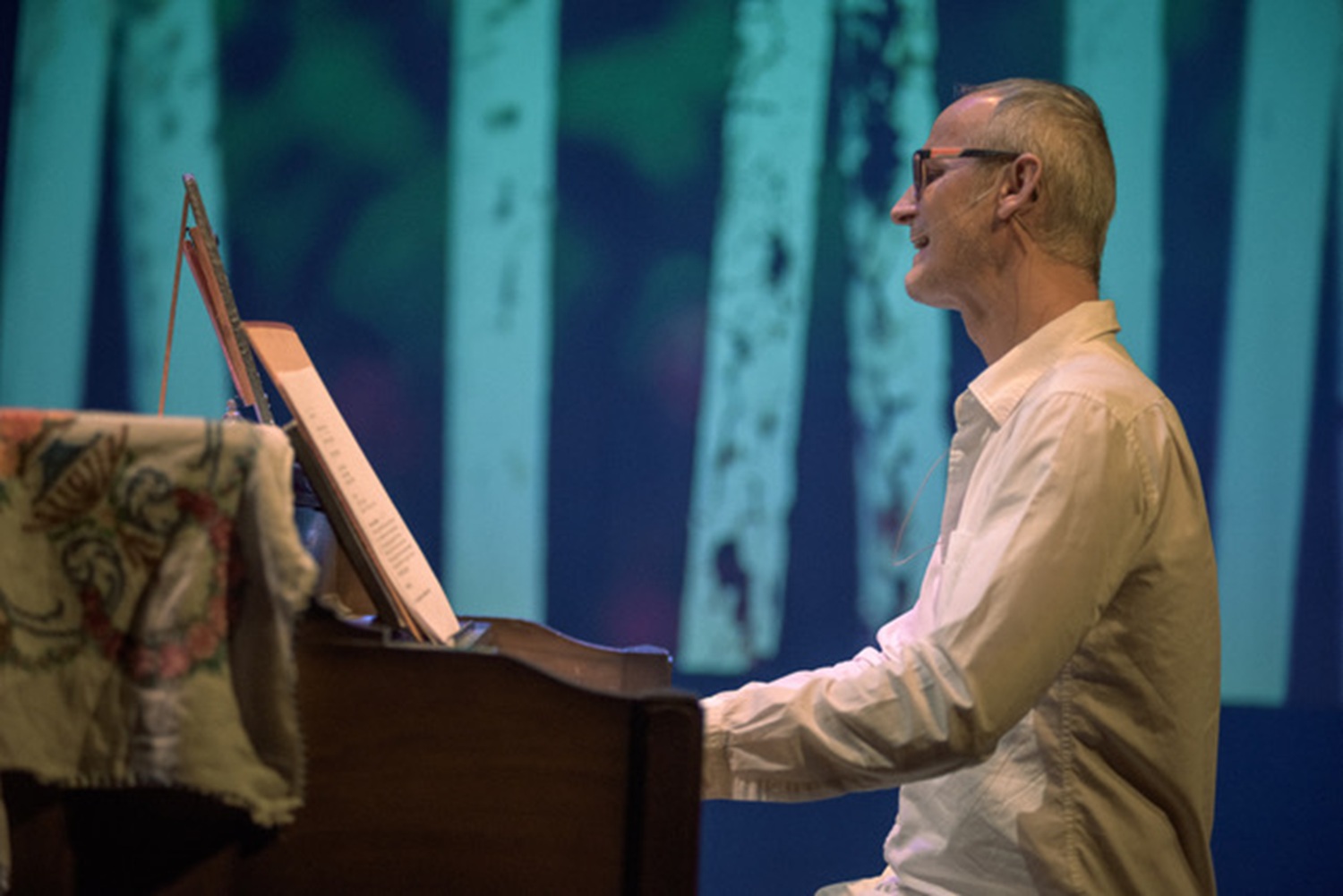

Recent Comments