Blog Article Category: Music
The return of Joe Bataan: King of Latin Soul to headline Miami International Jazz Fest
Written By Deborah Ramirez
February 4, 2020 at 10:10 PM
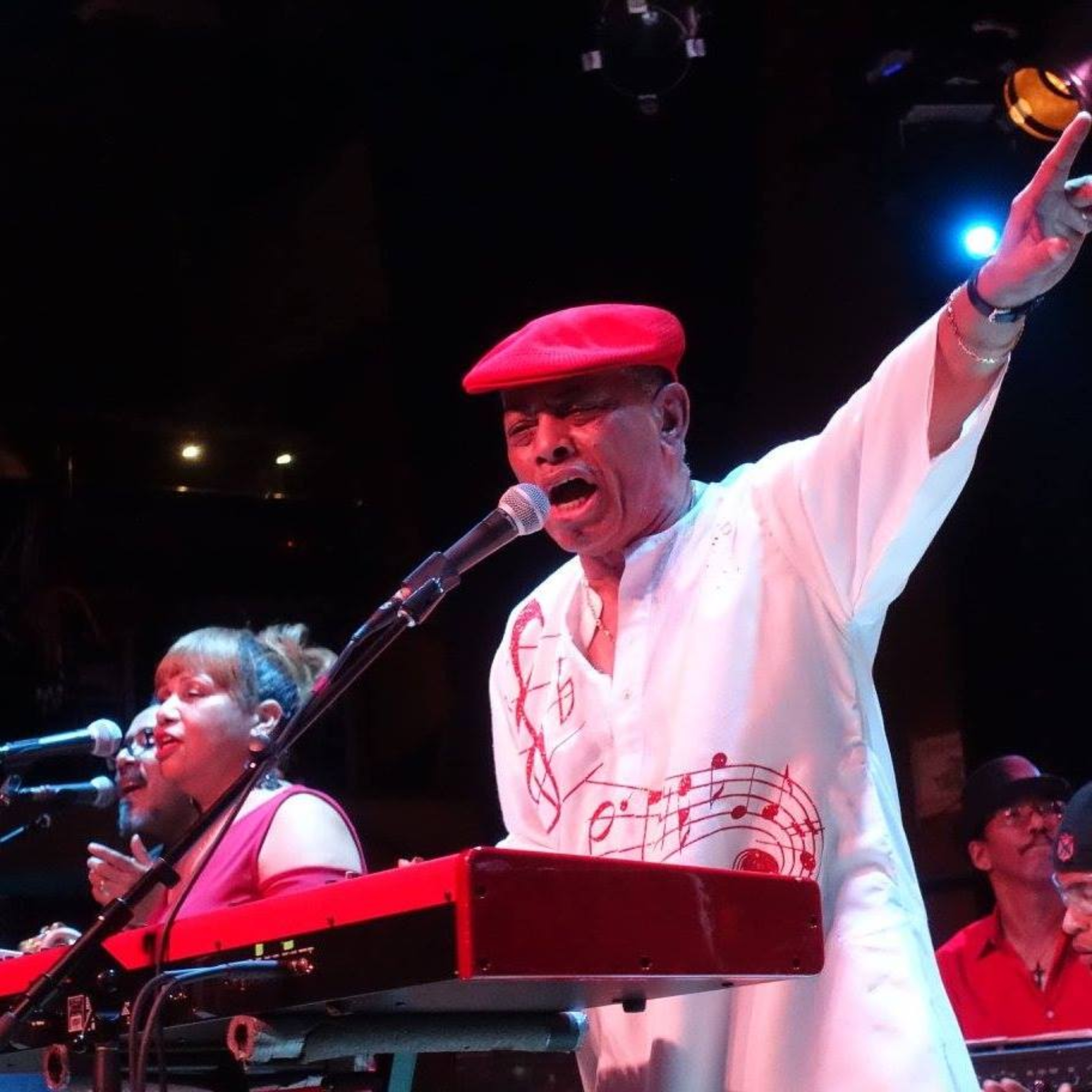
Joe Bataan and his Barrio Boys will perform on Valentine’s Day at the Manuel Artime Theater, as part of the Miami International Jazz Fest. (Photo courtesy of Joe Bataan)
Once upon a time, Joe Bataan reigned as the King of Latin Soul.
Spanish Harlem – also known as “El Barrio” – was his kingdom. It’s where he learned to sing doo-wop harmonies on street corners and play clave, the syncopated beat that forms the base of Afro-Cuban music.
It’s also where the young Bataan got into trouble with the law. By the age of 15, he had joined a gang and spent time in a reformatory. Barely an adult, he was sentenced to five years in prison for stealing a car.
But music was his saving grace.
While serving time, Bataan studied music theory and, after his release, he taught himself to play the piano – often sneaking into a church basement and a community center to practice. He put together a band of junior high school students and started arranging and writing songs.
Bataan would go on to become a top-selling recording artist and a pioneer in boogaloo and urban dance music. Life would show him many setbacks and comebacks.
Now 77, the King of Latin Soul is enjoying yet another chapter. Along with his Barrio Boys, Bataan is headlining the Miami International Jazz Fest on Feb. 14 at Little Havana’s Manuel Artime Theater, where they will share the stage with Ramiro Aguirre y su Charanga. The festival will continue Feb. 15 with the Danilo Perez Trio and Yamit and The Vinyl Blvd.
In the late ’60s, Bataan’s talent for fusing rhythms and bending genres caught the attention of Fania Records, the New York salsa label that signed him in 1966. He compensated for a lack of formal training with nerve and an ear for the new big trend to hit the dance floor.
Over a few years, he recorded eight Fania albums, churning out hits such as “Gypsy Woman,” “Subway Joe” and “Saint Latin’s Day Massacre.” His album “Riot!” turned gold and became Fania’s top seller in 1968. It had a funky party track, “It’s a Good Feeling,” that became especially popular in Colombia, where it was called “El Avion.”
Bataan was riding the boogaloo wave, a fusion of R&B and blues with Afro-Cuban dance rhythms, with songs in both English and Spanish. The ’60s trend had started among young New York Latinos who spoke English but danced Latin. Bataan preferred to call his style “Latin Soul,” singing doo-wop-tinged ballads mostly in English, with a Latin cha-cha beat. His band also performed more traditional salsa, with other vocalists singing in Spanish.
Like his music, Bataan was a hybrid of cultures – and he wasn’t Latin. He was born Bataan Nitollano, the son of a Filipino cook and an African-American housewife, who learned to blend into his surroundings.
“For a long time, I didn’t really know my identity because I grew up with mostly Latinos,” said Bataan, from his home in Upstate New York, where he lives with his Puerto Rican wife, Yvonne Cepeda. “I had to learn the language and the customs. You couldn’t tell the difference if you saw me in the neighborhood.”
In 1973, Bataan left Fania, as boogaloo was in decline and he was having money disputes with the label. He co-founded Salsoul, which became a cult dance label. Bataan later sold his interest in Salsoul, but not before scoring one of his biggest hits, the 1979 “Rap-O, Clap-O.” The title track was one of the first rap records to hit the charts and introduced him to the European market. Always in touch with the club scene, he also recorded an early disco hit, the 1980 “Afrofilipino” (Salsoul-Epic).
Despite his success selling records, fame and fortune were always just beyond his reach. In 1981, as the market was changing and a gambling addiction caught up with him, Bataan found himself without a label or money. Responding to an ad, he found a job as a youth counselor at a Bronx juvenile detention center – the same place he had once spent time in as a youngster. As a civil servant, he rose to supervisor and became a union vice president. He could finally give his family economic security. But his music days were over, or so he thought.
Today, the King of Latin Soul is back. A renewed interest in boogaloo, partly due to DJs and the internet, has revived his career. In 2005, Bataan paired up with producer Daniel Collas to release the well-received “Call My Name” on Spain’s Vampisoul label. He got another boost from the 2016 documentary “We Like It Like That” that featured him as one of boogaloo’s heroes. Suddenly, he was getting multiple calls for interviews, including from The New York Times.
“Anyone who tells you they are not elated by something like this is lying,” said the artist, who enjoys spending time with his seven grandchildren when he’s not performing. “Many people don’t get more than one chance to accomplish what they want to do in life, and I’ve had several chances.
“Looks like God has his hand on me, was waiting for me to straighten up and to fly right before he had a mission for me.”
Bataan talks about finding his mission after a near-death experience 20 years ago, but he’d had a wake-up call years earlier.
In the ’70s, Bataan was managing a hole-in-the-wall Chinese restaurant, working alongside his father. One day, he noticed a Bible on top of a piano in a back rehearsal space. It inspired him to try out an idea: What if he could turn “The Lord’s Prayer” into a Latin Soul ballad?
“The Prayer” became part of his charting album, “Mr. New York And The East Side Kids” (Fania, 1971).
“I was determined to record that song, and everybody looked at me like I was crazy, because of my past,” recalled the Catholic-raised Bataan. “For a long time, I was ashamed to do the song or hold a Bible in my hand, for what people might think.”
The song came back to him after he fell in a coma following a heart attack in 2000. He woke up with his family gathered around his bedside.
“At that moment, I decided that I would try to do something to live a different way of life,” he said. “And I thought about the song, ‘The Prayer,’ and I incorporate it into every place that I have played for the last 10 years.”
What: Miami International Jazz Fest
When: 8 p.m. Feb. 14-15; doors open at 7 p.m.
Where: Manuel Artime Theater, 900 SW First St., Miami
Cost: $30-$35
Contact: miamiinternationaljazzfest.org
ArtburstMiami.com is a nonprofit source of theater, dance, visual arts, music and performing arts news. Sign up for our newsletter and never miss a story.
No posts found
Review: Miami has the contemporary music festival it deserves with New Music Miami ISCM Festival
Written By Nevena Stanić Kovačević
January 29, 2020 at 3:05 PM
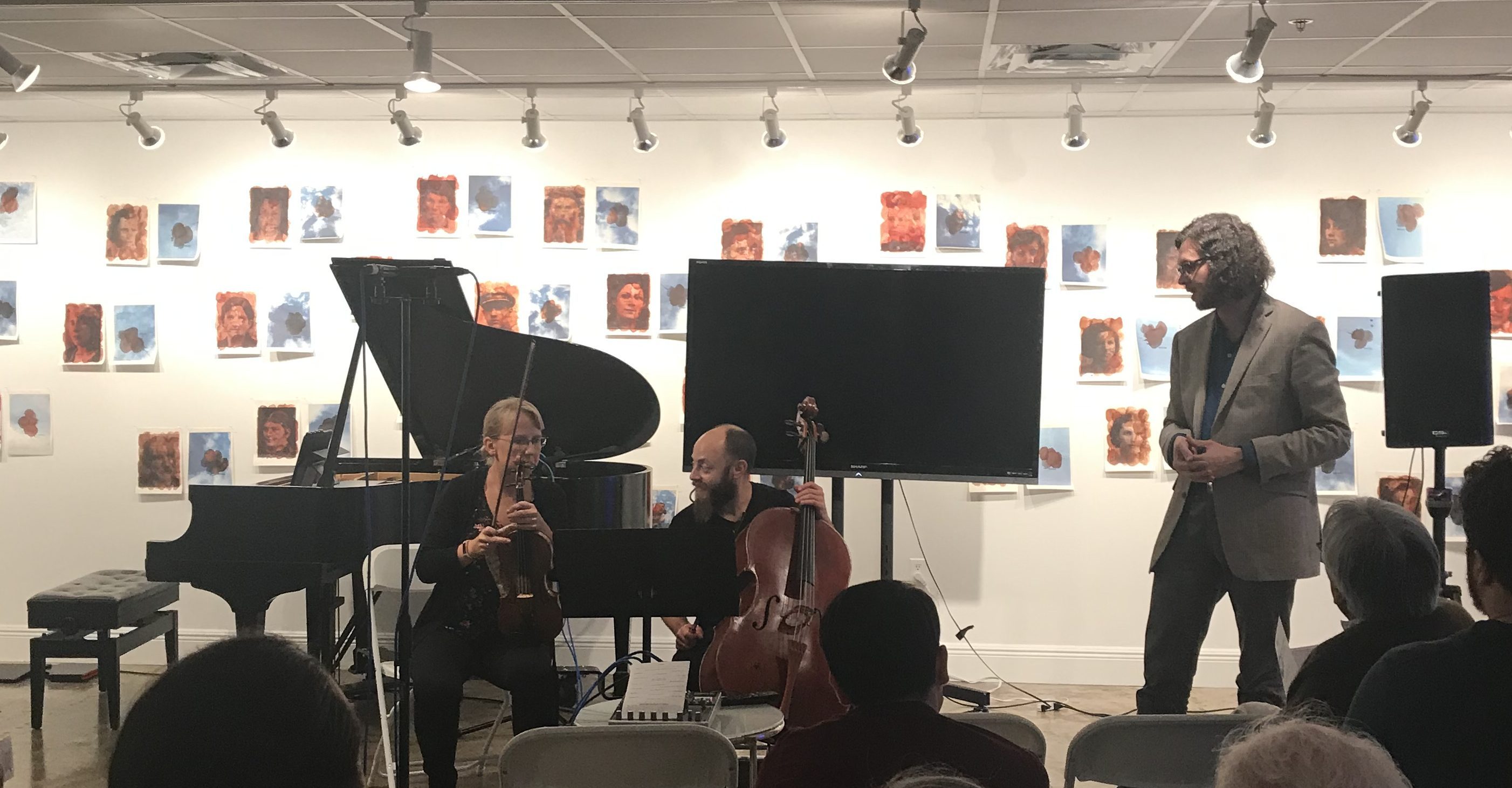
Mari-Liis Pakk (violin), Jason Calloway (cello) and Jacob Sudol (composer) at the first in a series of concerts presented as part of the New Music Miami ISCM Festival (NMMF). (Photo courtesy of Orlando Jacinto Garcia)
Is music really a universal language? Can it really communicate with everybody? Would most musicians in your surroundings agree with your opinion? These questions have been the subject of much discussion in media, academia – and in concert halls.
On Jan. 15, in a small-but-well-visited hall of Florida International University’s Miami Beach Urban Studios, Bolivian guest composer Edgar Alandia led a discussion on the universality of music and the different meanings it can evoke in its listeners.
His conclusion: Music does not communicate, but rather it provokes.
The lecture was an introduction to the first in a series of concerts presented as part of the New Music Miami ISCM Festival (NMMF).
In its third decade of existence, the festival has featured the latest contemporary works to diverse audiences, and it has migrated from the Wertheim Performing Arts Center in FIU’s downtown Miami campus to much smaller spaces. One would think the festival’s turn to alternative venues and galleries happened in reference to American mid-century experimental music that cultivated selected audiences. In any respect, this festival specifically nurtures new music with versatile dynamic nuances that require special acoustic conditions.
The first in the series of concerts presented chamber and solo music from North and South America in collaboration with FIU’s NODUS Ensemble. The concert opener was “Anton” by Chilean composer Boris Alvarado. NODUS violinists Mari-Liis Pakk, Avi Nagin and Misha Vitenson intently performed this piece with sordined dynamics, a warm timbre and a delicate, one-motif conversation between the performers.
“Still Remains” by Alandia followed, with a similar character and the concept of a soft-yet-engaged sound. Jason Calloway on cello emphasized all the important elements of the hidden counterpoint in this piece. Nothing musically provocative about this piece stood out, but it communicated with the audience through diverse intervals and dynamics. As Alandia stated, the title should not suggest any meaning or interpretation. So, let us leave it there.
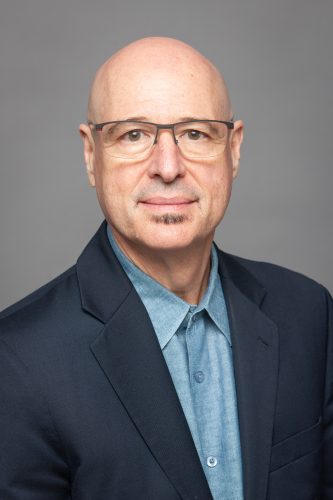
Florida International University composer-in-residence Orlando Jacinto Garcia is also director of the New Music Miami ISCM Festival. (Photo courtesy of FIU School of Music)
Pakk joined Calloway on stage for the performance of “wind in the desert” by FIU’s own, Jacob Sudol. The connections between the lower-case title and the music are, unlike in the previous piece, tightly related. There were no melodic ups and downs but rather steady and long sounds in slow crescendos and decrescendos.
Born and raised in Arizona, Sudol intended to present the communication between wind, space, and the listener. Musicians credibly depicted wind by masterfully controlling their bows on overtones – at first individually, and later in a distinct mutual play of intervals.
With a little less enthusiasm, Calloway performed the next piece, “Pour VC” by Alvarado. Despite its fragmented structure, folk themes and energetic interpretation in the high register, this composition perfectly blended in a meditative atmosphere.
“Multiple Voices” brought a new clarinet timbre but led the audience even deeper into a meditative and fully concentrated state of attention of each tone. With the high focus on the execution of every multiphonic in the piece, clarinetist Jesse Gilday conveyed an excellent command over the many notes of FIU composer-in-residence Orlando Garcia’s collage. In a hall full of incidental sounds and quiet noise, every tone had a sense of exclusiveness.
After the dramaturgical and dynamical decrescendo, Emily Bedard Dierickx’s enticing performance of Mario Lavista’s “Nocturno,” for solo alto flute, engaged the attention of the audience. Every repetitive motif in the Mexican composer’s piece was delivered by Dierickx with accuracy and invention. Along with the seductiveness of alto flute timbre without a twinge of asperity, the audience emerged into a repetitiveness that eventually brought folk elements and familiar harmonies.
The event concluded with Chen-Hui Jen’s piano interpretation of part three of the second volume of “Makrokosmos.” This part consists of four pieces inspired by horoscope. Jen effectively presented these works with high agency and involvement in the meaning of each section. American composer George Crumb completed this volume in 1973, inspired by Bela Bartók’s “Mikrokosmos.” The presented segment of “Makrokosmos” reflects extended piano and vocal techniques and diverse timbres, which are some of the musical elements that inspired Crumb.
In the last 23 years, Miami has grown richer for new music experiences from around the world.
With the institutional support from FIU’s School of Music and government institutions, this festival will have a chance to continue cherishing contemporary, often-provocative sounds, possibly by attracting more audiences.
Miami has the contemporary music festival it deserves.
Future shows
All events are free and open to the public. For more information, go to newmusicmiami.org.
Feb. 5: FIU Alumni Composers Concert, featuring NODUS Ensemble
Feb. 26: Music for Piano and Electronics, featuring Misty Shore Duo
March 4: Music for Solo Percussion, featuring Steve Schick
March 18: Music for Chamber and Solo Works, featuring NODUS Ensemble
April 1: Music for Trumpet and Electronics, featuring Jeff Kaiser
April 8: Music for Solo Violin, featuring Miranda Cuckson
April 15: Music for String Quartet and Piano Quintets, featuring Amernet String Quartet and Michael Linville, with guest composer Chen Yi
ArtburstMiami.com is a nonprofit source of theater, dance, visual arts, music and performing arts news. Sign up for our newsletter and never miss a story.
No posts found
Opera singers to celebrate African-American spirituals
Written By Tracy Fields
January 28, 2020 at 5:07 PM
A Miami Northwestern Senior High graduate, baritone Angel Refusé trained at the Boston Conservatory at Berklee and at the African Heritage Cultural Arts Center.
The African Heritage Cultural Arts Center, one of this area’s premier arts training institutions, will kick off Black History Month with a celebration of African-American spirituals presented by local opera singers.
The “Art of a Spiritual” concert will take place at 7 p.m. Feb. 1 in Miami’s Sandrell Rivers Theater.
Among the singers is baritone Angel Refusé, the Miami Northwestern Senior High graduate who trained at the Boston Conservatory at Berklee and at the African Heritage Cultural Arts Center. This concert was his idea.
“One of the things that is most exciting is exposing people to the art form,” he said.
Though some may think of spirituals as gospel music, spirituals are older by six to eight decades, he said.
And the depth of spirituals may be surprising. The songs, technically complex, are religious on the surface, but they were also used to protest the living conditions of those who first composed them: enslaved people.
Spirituals served as coded messages for those seeking to escape bondage. Notable examples are “Go Down, Moses,” “Wade in the Water,” and “Swing Low, Sweet Chariot.”
But there’s even more to them, Refusé explained. He tells a story of American composer Jester Hairston working with a group of singers on his spiritual, “Amen,” about the life of Jesus Christ. When the singers began to clap on the first measure, Hairston stopped them, according to Refusé, and instructed that they should clap only for the risen Lord, much further down in the song.
“That’s the kind of work the spiritual demands,” Refusé said. “Give it its respect.”
Refusé has long been driven by his passion for music, according to Isis Roberts, director of the music department at the cultural arts center.
Pursuing such a passion is not without challenges, especially for a young Afro-Latinx man in the classical arena, she said.
“However, he never let the naysayers distract him,” said Roberts, adding that he continues to educate himself as well as younger artists while serving as an example of what dedication and hard work can bring.
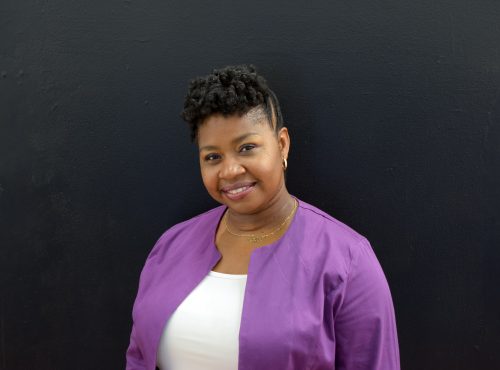
Isis Roberts, director of the music department at the cultural arts center, also will perform in the concert. (Photo courtesy of African Heritage Cultural Arts Center)
Roberts, a mezzo soprano, will perform in the concert as well, in addition to sopranos Erica Williams and Kyaunnee Richardson. Karl Van Richards will accompany them on piano.
Richardson sang for President Barack Obama and others at the funeral of the Rev. Clementa Pinckney, who was killed in the 2015 mass shooting at a church in Charleston, S.C.
Also performing in “Art of a Spiritual” is the center’s Voices of Heritage ensemble, to which Refusé once belonged. This group consists of 9- to 16-year-olds who are studying classical, jazz, R&B, folk and ethnic and gospel music in preparation for becoming professional vocalists.
Refusé said he considers the Black History Month performance a celebration not only of the music but of its composers, those who came before.
In his opinion, “the best reparation we can give our ancestors is to venerate them properly. Give their literature the time of day. Take it seriously and give it everything you’ve got.”
What: “Art of a Spiritual”
When: 7 p.m. Feb. 1
Where: Sandrell Rivers Theater, 6103 NW Seventh Ave., Miami
Cost: $25
More information: ahcacmiami.org
ArtburstMiami.com is a nonprofit source of theater, dance, visual arts, music and performing arts news. Sign up for our newsletter and never miss a story.
No posts found
Review: Something old and something newish from South Beach Chamber Ensemble
Written By Nevena Stanić Kovačević
January 28, 2020 at 2:39 PM
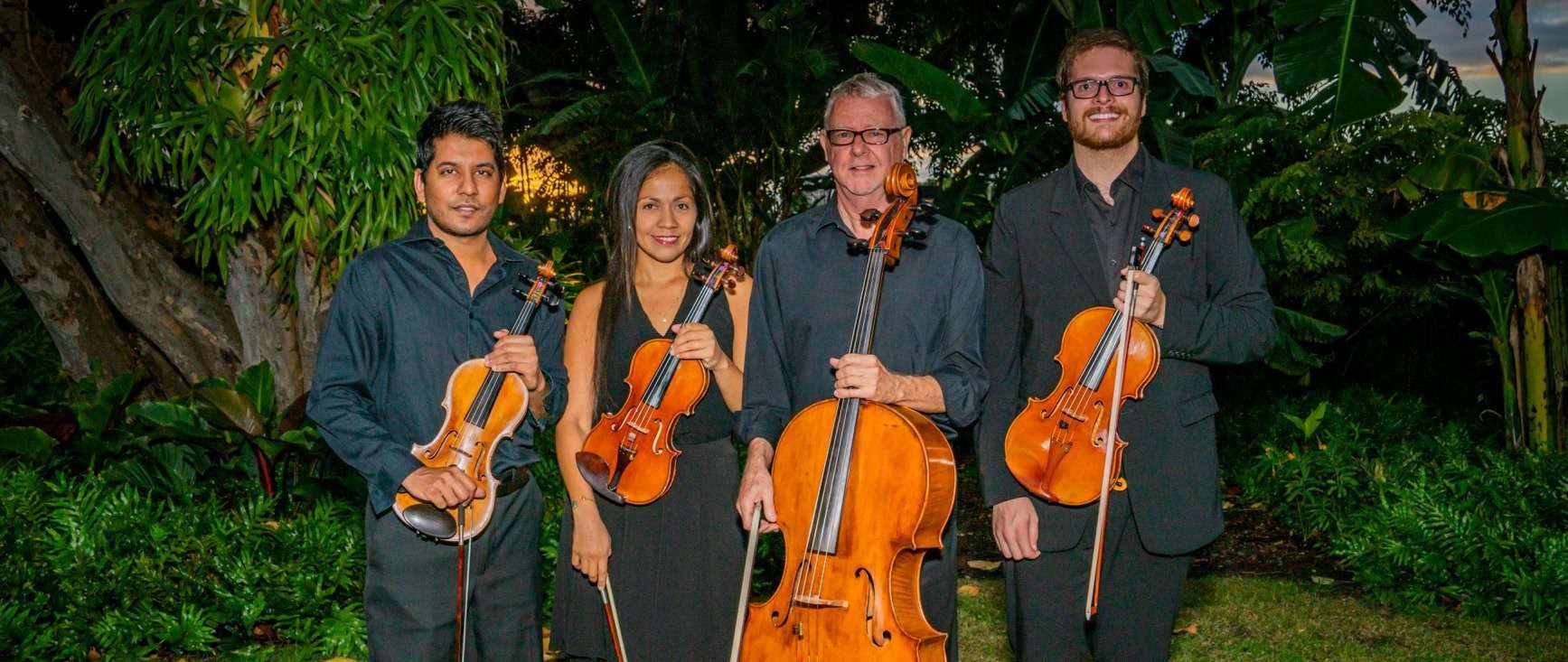
The musicians, from left: Tony Seepersad and Ericmar Perez, violins; Michael Andrews, cello; and Eric Eakes, viola. (Photo courtesy of Michael Todd)
Miami’s music scene is diverse and still expanding. As a cultural center of South Florida, it is of great importance for the city and community to support its musicians – and their multiple and versatile projects – and to enhance future collaborations with guest artists. The South Beach Chamber Ensemble is worth following and encouraging in its endeavors to make Miami’s classical music scene more vibrant.
In January, the string quartet performed two concerts entitled “Something Old, Something New,” featuring the music of Wolfgang Amadeus Mozart (1756-1791) and Benjamin Britten (1913-1976). The ensemble first performed this program at the Miami Beach Woman’s Club on Jan. 12, warming up for its second concert on Jan. 14 at the Coral Gables Museum, which we reviewed.
The concert featured Mozart’s String Quartet No. 15 in D minor K 421/417b (1783) and Britten’s String Quartet No. 1 in D major Op. 25 (1941).
The first notes of Mozart’s piece exhibited the quartet’s coherence and intonational accuracy. The musicians demonstrated their devotion to the piece through bright timbral resonance and precise intonation in homorhythmic parts.
This quartet is one of six that Mozart dedicated to Joseph Haydn, the role model for composers of classicism and of string quartets. Based on its seductive minor melodic qualities, Mozart’s piece was interpreted with romantic sensibilities and impetuous phrasings. However, the ensemble balanced sound well with respect to classical stylistic guidance and expression.
By expounding the character of Allegro Moderato in a faster moderato tempo rather than Allegro tempo, the ensemble showed courage to present Mozart’s piece slightly differently from what is expected.
The blend of stylistic insights was most noticeable in the andante movement. Excellent interaction between performers resulted in the synchronous execution of tutti segments. In Menuetto-Allegretto, Tony Seepersad (violin) performed leading melodies with fine timbre, moderate vibrato, and emotional expression. Somewhat unrestrained movement of the tip of his bow contributed to a slightly divergent timbre at places.
Despite occasional erratic pizzicatos, musicians gave a rousing performance in the final Allegretto Ma Non Troppo, with vigorous rhythmical precision.
Following the Mozart part, Britten’s quartet was conveyed with an alluring and crisp tone. Ericmar Perez (violin) and Eric Eakes (viola) demonstrated agility in their respective parts. The ensemble’s executive artistic director and founder, Michael Andrews (cello), brought a warm low pizzicato to a vigilantly delivered first movement of Britten’s piece.
The meditative beginning of the first movement Andante Sostenuto demonstrated the performers’ finetuned listening in communicating subtle contrasts in structure, dramaturgy, and dynamics.
The ensemble continued this precision in Allegro Con Slancio, a section brimmed with playful character and togetherness. In Andante Calmo, the performers achieved a nice balance between parts with a relatively slower and calmer pace than a busy listener’s imagination would expect. Andrews’ cello delicately led the drive at the beginning of the final Molto. Perez and Eakes stepped out of performing only secondary melodies and showed their playfulness and musicianship in interacting with ensemble members.
In overall harmonious playing at the beginning of each movement, as well as enthralling homogeneous closures, the quartet showed all its performing potential and capacities.
ArtburstMiami.com is a nonprofit source of theater, dance, visual arts, music and performing arts news. Sign up for our newsletter and never miss a story.
No posts found
Maria Schneider to present Donny McCaslin in her debut concert
Written By Fernando Gonzalez
January 20, 2020 at 5:53 PM
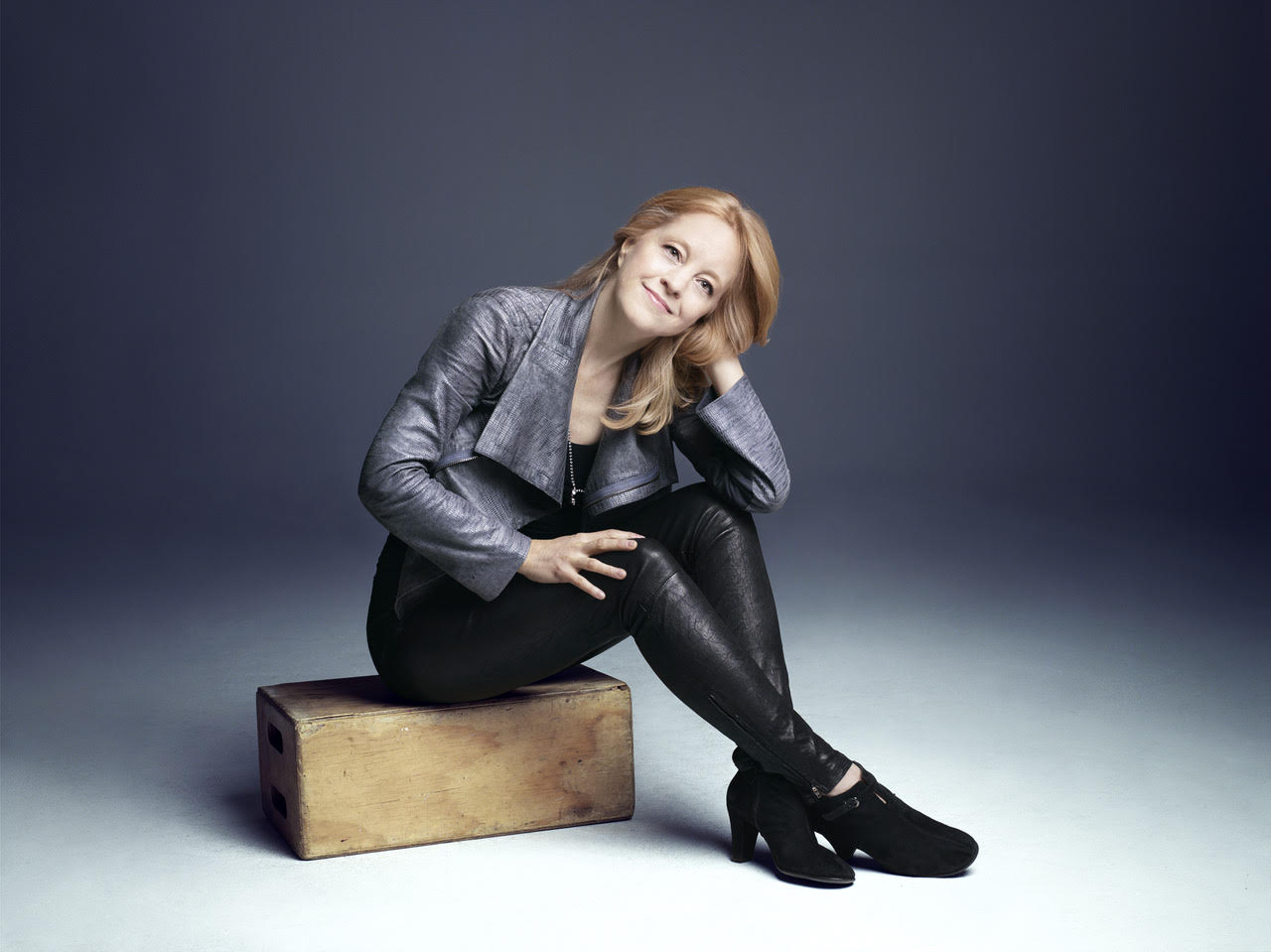
Maria Schneider will be presenting her first concert as artistic director of the University of Miami’s Frost School of Music Henry Mancini Institute. (Photo courtesy of Whit Lane)
There is nothing in jazz like the sound of a big band in full flight. It’s not just the sheer power of a large ensemble, but the palette of colors and rhythmic possibilities it brings to the music, and the variety of settings it opens to improvisers. Few have expanded and updated the sound of a big band over the past several decades like composer and arranger Maria Schneider.
In her work, the lines between musical genres often blur, and she has proven as adept at writing music for The Saint Paul Chamber Orchestra and the adventurous Dutch Metropole Orchestra, as with her Jazz Orchestra. In 2014, underscoring the point, Schneider surprised a few jazz and rock fans collaborating with the late David Bowie on the single “Sue (Or In A Season of Crime).” It earned her a Grammy Award for “Best Arrangement, Instruments and Vocal,” one of five she has won for work in both jazz and classical music.
On Jan. 25, in her first concert as artistic director of the University of Miami’s Frost School of Music Henry Mancini Institute, Schneider will offer a program including some of her works as well as music by special guest, saxophonist and longtime collaborator Donny McCaslin.
“What I’m hoping to do with the orchestra is to bring together different parts of the music school and give them all this experience of this tremendous resource that is the orchestra,” said Schneider, in a recent interview from her home in New York City.
The idea is to feature music “from different kinds of composers, not just studio orchestra jazz composers, but [composers for] classical orchestras, and also giving people that are experimenting with writing a chance to write something for a big orchestra like that,” she said.
“So there are different components to what I’m trying to do, giving players different playing experiences but also inspiring writers. And because Donny’s music is more of rock-pop, it’s a chance for us to bring in students from other programs that maybe don’t integrate with the orchestra, and then for the classical players, playing with a rhythm section and precise time … so it’s a way to broaden the experience of everybody.”
For Schneider, the engagement also marks a return to UM, where she spent a semester of graduate school in 1983.
“I fell in love with a lot of the people there,” she recalled. She especially noted arranger and composer Gary Lindsay and the former chair of the Department of Studio Music and Jazz, Whit Sidener. “They gave me tremendous opportunities for writing, they recorded my music, and I stayed in touch with them.”
“Three Romances,” a piece featured in her Grammy-winning “Concert in the Garden,” was a commission by UM’s Frost School of Music and premiered in 2001 at the same hall where the Jan. 25 concert is taking place.
The first half of the evening will feature three works by Schneider, conducted by the composer: “El Viento,” from her “Coming About” album (1996); “Walking By Flashlight,” recorded on Winter Morning Walks (2013) and updated on “The Thompson Fields” (2015); and “Hang Gliding,” from “Allegresse” (2000). The second half will feature music by McCaslin conducted by the orchestra’s resident conductor, Scott Flavin.
She described the first piece, “El Viento,” as the merging of the music of German composer Paul Hindemith and that of Spanish Flamenco guitarist Paco de Lucia. It’s an eyebrow-raising example of her approach, which she relates to the lessons she received as a 5-year-old growing up in Windom, Minn., from her teacher, Evelyn Butler, a stride, boogie-woogie and classical pianist from Chicago.
“She only ended up in Windom because she had had a horrible family tragedy: her son and husband dying within a month of each other. So she came to Windom to be with her daughter who lived there,” she recalled. “So here’s this extraordinary world-class musician transplanted to this little town and half of every lesson she taught me theory — and with that theory, she taught me to play chord changes and play a little bit of stride and then, half of every lesson, was about classical music. But she didn’t label them. It was just like ‘OK, let’s play this Cole Porter song, and here’s how you dress it up. OK, let’s now work on the Bach Two-Part Invention.’ So I grew up with both things integrated as a part of my own life.”
It’s a sensibility that has served her well when dealing with jazz orchestras. A classically trained composer may expect to hear his or her music played as written, exactly, every time. But the very power of jazz comes from a subtle but constant negotiation, done on the fly, between structure and freedom, detailed instructions in the written page and improvisation.
“That was the thing that attracted me to it,” said Schneider, breaking into a laugh. “The first time I wrote an orchestral piece for The Saint Paul Chamber Orchestra, actually had no improvisation. And I remember conducting several nights in a row and just feeling that, ‘Wow, we’re just trying to do it the same and do it better every night.’
“With my band, at the end of every night, people are recounting little things, creative moments that happened, somebody playing something and somebody else reacting to it, and I realized that that was an aspect of the music that I loved. So I’m putting my music out there, a little bit incomplete, for others to put themselves in it and make it ours. It’s a very tricky business. You have to find the right balance. But for me, on a human, social level, it is so much more — and I need that.”
What: Maria Schneider presents saxophonist Donny McCaslin, with resident conductor Scott Flavin and the Frost School’s Henry Mancini Institute Orchestra
When: 7:30 p.m. Jan. 25
Where: University of Miami Gusman Concert Hall, 1314 Miller Drive, Coral Gables
Cost: $35 for adults; $30 for seniors age 65 and older
More information: frost-music-live.miami.edu; ci.ovationtix.com/1811/performance/10446094
ArtburstMiami.com is a nonprofit source of theater, dance, visual arts, music and performing arts news. Sign up for our newsletter and never miss a story.
No posts found
Miami trumpeter Brian Lynch up for two Grammys
Written By Tracy Fields
January 15, 2020 at 4:33 PM
Brian Lynch is studio instructor of jazz trumpet at the University of Miami’s Frost School of Music. (Photo courtesy of Tomoji Hirakata)
South Florida has a hometown hero to root for when the Grammys are awarded on Jan 26. The latest work by trumpeter, composer and educator Brian Lynch – “The Omni-American Book Club: My Journey Through Literature in Music” – has received a couple of nominations.
The big band project is under consideration for “Best Large Jazz Ensemble Album,” and one of the nine songs written for it by Lynch, “Crucible for Crisis,” is a contender for “Best Instrumental Composition.”
This isn’t the first Grammy experience for Lynch, who serves as studio instructor of jazz trumpet at the University of Miami’s Frost School of Music. He has now been nominated five times and won once: in 2007, when “Simpatico,” by the Brian Lynch/Eddie Palmieri Project, was named “Best Latin Jazz Album.”
Lynch recognizes that what he plays may go by different names, such as jazz or salsa or rhumba or funk, but he understands it as Afro-diasporic.
“To me, it’s all the same music,” he said. “This is music of the new world, and it’s built of this phenomenon of slavery and culture brought captive, unintended consequences of the most incredible sort.”
The idea of that mix is explored in the book from which the album gets its title, Albert Murray’s classic 1970 collection of essays, “The Omni-Americans.” Murray described U.S. culture as a hybrid creation of the many types of people who make up this country.
“American culture, even in its most rigidly segregated precincts, is patently and irrevocably composite,” he wrote. “It is, regardless of all the hysterical protestations of those who would have it otherwise, incontestably mulatto.”
Lynch read it as a teenager. “I’m not sure where I had heard of this work, still fairly new at the time,” he wrote in the album’s liner notes, “but at the time I was devouring everything I could about what was behind the music that I was in the process of pledging myself to.
“Murray’s book, along with other volumes such as “The Autobiography of Malcolm X” and Ralph Ellison’s “Invisible Man” ‘pulled my coat’ to both what America was and what it could be.”
Through the years, Lynch’s reading and music studies have supported each other.
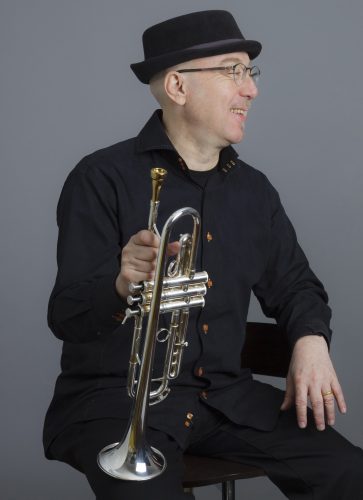
Trumpeter, composer and educator Brian Lynch has now been nominated five times for a Grammy Award and won once. (Photo courtesy of Marla Cohen)
“My teachers doubly impressed on me something that I think I had known already: that jazz is a cultural art form. You can’t play this music without literally seeking to understand the people who made it and the culture that made it,” he said.
Murray’s work was foundational for Lynch. “Kind of in a way I didn’t feel like I had much of a cultural location for myself, until I became aware of these things: ‘Oh, this is what it means to be an American,’” he said.
In addition to Amiri Baraka and A.B. Spellman, who have written about music, other authors whom Lynch salutes on the album include activist writers Naomi Klein and Masha Gessen, novelist Chinua Achebe, social critic Ta-Nehisi Coates, and historian David Levering Lewis.
Along with paying tribute to some of his favorite authors, his first big-band project gave Lynch an opportunity to work with some of his favorite musicians. Longtime colleagues such as saxophonists Donald Harrison and Jim Snidero, drummer and UM professor Dafnis Prieto and flutist Orlando “Maraca” Valle joined esteemed musicians such as violinist Regina Carter and National Endowment for the Arts Jazz Master saxophonist David Liebman to bring Lynch’s music to life.
“Music is also about community and family,” he said. “And I love to document my musical families and friendships.”
The 62nd annual Grammy Awards ceremony takes place Jan. 26 in Los Angeles. It will be televised at 8 p.m. on WFOR-Ch. 4.
ArtburstMiami.com is a nonprofit source of theater, dance, visual arts, music and performing arts news. Sign up for our newsletter and never miss a story.
No posts found
Trumpet master John Daversa to bring his Small Band to S. Miami-Dade Cultural Arts Center
Written By Mike Hamersly
January 14, 2020 at 9:18 PM
When you hear John Daversa perform with his band, the first thing that strikes you is the impeccable musicianship of all the performers.
Then, the playfulness and eclectic influences shine through.
Grammy-winning trumpet master, composer and bandleader Daversa – who is chair of Studio Music and Jazz at UM’s Frost School of Music, and who has worked with a diverse list of artists including Herbie Hancock, Burt Bacharach, Regina Spektor, Fiona Apple, Joe Cocker and Andy Williams – will bring his Small Band to the South Miami-Dade Cultural Arts Center on Jan. 18.
The virtuosic group – also featuring saxophonist Melvin Butler, steel pan artist Leon Foster Thomas, guitarist Zach Larmer, keyboardist Tal Cohen, bassist Koa Ho and drummer David Chiverton – will perform tracks from Daversa’s acclaimed jazz albums “Junk Wagon,” “Artful Joy” and “Wobbly Dance Flower.”
“It’s a collection of really special, high-level musicians from the Miami area who I’ve known for the past seven years since moving to Miami,” says Daversa, a West Coast guy who has degrees from the University of California, Los Angeles and the University of Southern California and taught at California State University, Northridge before being offered the UM gig. “I really had no intention of leaving California, but I came down and visited the school, just to see what was going on, and it just seemed like an incredible opportunity to be in an institution with so much support and such a collegial faculty.
“And the students were playing at such a high level. I could see the infinite possibilities of being in this environment. So I decided to go for it, and I’m so glad I did.”
Daversa is a trumpet player first and foremost, but he’ll break out another, much scarcer, instrument at the show: the odd-looking Electronic Valve Instrument (EVI), which audience members may not recognize.
“It’s a MIDI controller, a synthesizer, basically, that’s controlled like a trumpet,” Daversa says. “A gentleman named Nyle Steiner invented it in the late ’60s, and a company called Akai picked it up in the ’80s, and I’ve been using one from the ’80s for many, many years, and now I’m endorsing this new model that’s made by Nyle’s nephew, Mark Steiner. So Mark has finished modifying it for me, and it’s in the mail now, and I’ll get it before we play on the 18th.”
What was it about the EVI that attracted Daversa?
“I saw Michael Brecker play one in the ’80s,” he says. “And I really identified [with] being able to play like a keyboard or guitar player, being able to play all different kinds of sounds, but controlling it like a horn, with breath control and dynamics and a range of eight octaves. So it just seemed like such a limitless voice, and since then it’s become a voice of mine.”
Daversa’s latest album, 2018’s “American Dreamers: Voices of Hope, Music of Freedom” – which utilized more than 50 musicians and singers who entered the United States as children – won three Grammy Awards, including one for “Best Large Jazz Ensemble Album.”
The record is a great source of pride for Daversa, as it was meant as a message to politicians to protect immigrants.
“The project is a very special one,” he says. “Of course, I was a part of it, but it was really about a lot of people who were involved, and it’s really helped a lot of people immensely, and put a spotlight on the issue of the [Deferred Action for Childhood Arrivals] act.”
All tracks on “American Dreamers” were arranged for and performed by Daversa’s Progressive Big Band, so it’s up in the air whether the Small Band will tackle any of it.
“We may play one or two from that, but it’s difficult,” he says. “Those arrangements are all for a very large ensemble with basically a 40-piece orchestra, so re-orchestrating it down is difficult. But we may find a way to do one or two.”
Since his parents are musicians – his mother is a classical piano player and his father a trumpeter – Daversa was exposed to a wide variety of sounds growing up.
“My mother was always playing Chopin, Beethoven, Rachmaninoff on the piano – Debussy, Ravel,” he says. “But she also brought in that Motown thing, and country music – Willie Nelson, Hank Williams – because she’s from Oklahoma.
“And my dad’s influence was more of the jazz thing, with Miles Davis and Chet Baker and Gerry Mulligan – all of those sounds. I probably listened to more pop than rock – a lot of Earth, Wind & Fire, a lot of Motown, a lot of Stevie Wonder, Smokey Robinson, Aretha Franklin. Kind of R&B, and then pop as a kid in the ’80s. I listened to Top 40 all the time, so I was listening to Dire Straits and Whitney Houston and Michael Jackson. All of the mainstream artists. I loved it.”
There was another huge influence, however. One that has colored Daversa’s experimental side.
“My dad played with Frank Zappa,” Daversa says. “We were friends with his family when I was a kid, when we lived in Los Angeles. Frank Zappa was a creative force, that’s for sure.”
Daversa has performed all over the world, but he says the South Florida music scene compares favorably with other jazz hotspots across the country.
“Miami is a special place,” he says. “You have a lot of elite, high-level quality musicians in the area, like Gonzalo Rubalcaba, Sammy Figueroa – these amazing musicians who are out touring all the time but make their home here in Miami. And the music scene from my perspective seems to have a lot of Frost students and [Florida International University] students involved, so it’s an active and creative scene. And what makes it special is it’s such a melting pot of different cultures coming together, because you have all the islands’ influence here, you have all the South American influence, you have Cuban influence, plus the American influence of jazz, and quite a bit of European influence. So it’s like a miniature New Orleans in that regard – this big melting pot of cultures and ideas coming together.”
What: John Daversa Small Band
When: 8:30 p.m. Jan. 18
Where: South Miami-Dade Cultural Arts Center, Black Box Theater, 10950 SW 211th St., Cutler Bay
Cost: $30 in advance; $35 day of show
More information: smdcac.org
ArtburstMiami.com is a nonprofit source of theater, dance, visual arts, music and performing arts news. Sign up for our newsletter and never miss a story.
No posts found
Contemporary Troubadour Experimentale stages experimental music shows at Basel
Written By Nevena Stanić Kovačević
December 23, 2019 at 11:32 PM
Maurizio Cattelan’s “Comedian,” aka the banana sold in three editions priced between $120,000 and $150,000, overshadowed Art Basel’s other works. It is those small and alternative spaces of this gargantuan annual gathering that make Art Basel significant for numerous audiences. Between Hong Kong and Miami, this fair exhibits work from some of the most significant contemporary artists and world-renowned galleries.
A festival of this magnitude provides a place for emerging stars, too. Art Basel has become open not only to paintings, sculptures, installations, photographs, and films, but also to live performances and music.
Organized by the Foundation for Emerging Technologies and Arts (FETA), the septet known as Contemporary Troubadour Experimentale was hosted twice this year: on Dec. 6 in front of The Miami Beach Cinematheque and Dec. 7 in The Bridge Miami and the Edge Zones of the streets of Allapattah.
Having named themselves after medieval European male musicians, these contemporary troubadours sang along with portable instruments. Without trobairitz in the name, but with female troubadour voices in the ensemble, contemporary troubadours performed their experimental music in mobile performances. They did not include lutes and old instruments, but technologies of the 21st century – speakers, magnetic tapes, Ableton.
The participating artists included Troy Rogers, Nicole Martinez, Jiarui Yao, Logan Larson, John Baxter, Santiago Diazgranados Bergenguer, Rachel Weiss, Anruo Cheng and Juraj Kojš.
The group involved the audience through several works. The written directions attached to their chests were clear: wave with your left or right hand. Each performer followed the reactions of audience members.
Waving triggered the addition or subtraction of tones in the breakbeat line, guitar and vocal melodies. Although compiled together in unexpected musical combinations, the execution of the performance was not very well thought out; the main challenge was to catch a glimpse of the performer.
The second performance went at a similar pace, loosening up the constraints of a stage-like setting. It let performers mix with the audience, walk around them and comment on their appearance through associations from nature (for example, they would say “ocean” for blue clothes or “grass” for a green shirt). The occasional shouts of “Art Basel” were not convincingly engaging the audience into raising their ecological awareness. They rather served as an amusing effect.
The two works that followed included electronic devices. In the first one, performers walked among the audience playing EDM (electronic dance music) on portable loudspeakers. Listeners could interrupt and distract them. The soundscape of sounds distant and close depended on one’s position in the room of The Bridge. Above all, sounds were contingent on everyone’s movement and willingness to make an impact in their surroundings. Perhaps one of the messages was that change cannot happen if there is no human connection. Can the connection lead to disconnection?
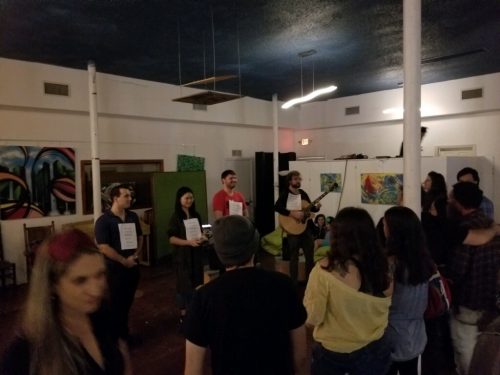
The group known as Contemporary Troubadour Experimentale involves the audience in its performances. (Photo courtesy of Juraj Kojš)
These topics continued to provoke thoughts in the next piece, in which performers walked around the space with earplugs in their ears. After the first maladroit part of the piece, where no one said a word, the performance gradually evolved through sudden, spoken words from which “connection” and “disconnection” stood out. One of the most effective elements of the quartet’s performance included the sound wall its members created while facing each other. Whenever a person walked into a space between them, it prompted the performers to hold a long chord for as long as the intruder was there.
In a concert-like setting, two artists experimented with electronics and voice. From their part of the room, the audience listened to Eastern curlicued vocal ornaments accompanied and transformed with electronics. In a physically divided ambient, the female play was actually the knitting of new meanings around the concepts of natural, distinguished, desirable, as well as connection and disconnection.
The final and central piece of Troubadour’s music playing was Kojš’s electro-magnetically sounded suitcase. In a psychedelic colorful appearance, the artist brought on-stage a suitcase that he theatrically put on a trash can. A world of sounds was released from this coffer. It responded to every artist’s movement.
Kojš chose three audience members to continue the show. Among the fortunate ones was the writer of this article. With the blindfold over my eyes, and through the physical sensations of wondering and isolation, I stepped into the interactive game with the suitcase and other guinea pigs. It led to a place between conscious and unconscious inner and outer sound worlds.
While trying not to slip on a banana peel while approaching the suitcase with a blindfold, I thought about how art continues to provoke, engage and stay unpredictable. Is there a difference in observing someone eating “Comedian,” or engaging in the Troubadours’ entertainment? This group of young musicians whose experimental music performances happened in tiny spaces of Basel illuminated the prevailing idea of Basel – concept above all.
ArtburstMiami.com is a nonprofit source of theater, dance, visual arts, music and performing arts news. Sign up for our newsletter and never miss a story.
Top photo: The group, which named itself medieval European male musicians, sing along with portable instruments. (Photo courtesy of Juraj Kojš)
No posts found
Arturo O’Farrill – family, jazz and the music of Cuba, revisited
Written By Fernando Gonzalez
December 23, 2019 at 11:15 PM
Born in Mexico City and raised in New York City, pianist, composer and educator Arturo O’Farrill grew up close to Cuba and its culture.
Geography and physical distances can be just an illusion. After all, O’Farrill is the son of the great, late Cuban composer and arranger Arturo “Chico” O’Farrill and is himself a leading figure in Afro-Cuban jazz.
In the past two decades, professional and family reasons have taken O’Farrill to his father’s homeland.
The results include albums such as “Cuba: The Conversation Continues,” which was recorded in Havana and features his Afro Latin Jazz Orchestra and several top-flight Cuban musicians. The album earned a 2016 Grammy nomination, and O’Farrill won a Grammy, his sixth, for “Best Instrumental Composition” for the “Afro Latin Jazz Suite,” the centerpiece of the recording.
In 2017, O’Farrill also celebrated Cuban music history – and his family´s – in a moving collaboration with Cuban pianist, composer and arranger Chucho Valdes, son of the late Cuban pianist, composer and arranger Bebo Valdes, another essential figure in the history of modern Afro-Cuban music and a friend of Chico O’Farrill. The resulting “Familia,” a tribute to the elders, is a multigenerational recording that features younger musical members of both families.
O’Farrill and his Afro Latin Jazz Orchestra will present some of this work, and more, in “Jazz Roots: Cuba: New Perspectives” on Jan. 10 at the Adrienne Arsht Center for the Performing Arts. Brazilian guitarist Diego Figueiredo is scheduled as the opening act.
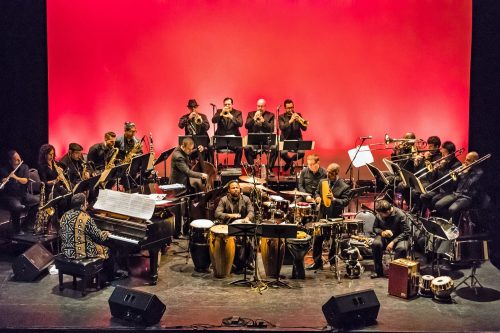
Arturo O’Farrill and his Afro Latin Jazz Orchestra are scheduled to perform on Jan. 10 at the Adrienne Arsht Center for the Performing Arts. (Photo courtesy of artist management)
“One of the things that I’d like to do is play the ‘Afro Cuban Jazz Suite’ (Chico O’Farrill’s landmark 1950 piece) and then my ‘Afro Latin Jazz Suite’ back to back,” said O’Farrill, from his home in New York City.
Chico O’Farrill’s “Afro Cuban Jazz Suite” featured Charlie Parker, saxophonist Flip Phillips, drummer Buddy Rich, and Machito and his Afro-Cubans, the premier Latin orchestra of the time.
“It was state-of-the-art Latin music and state-of-the-art jazz,” O’Farrill said. “My idea was to revisit the piece without trying to replicate it or being nostalgic. The state of the art of Latin music has changed and became more inclusive of all of the Americas. Jazz itself has become a different language. So I think it’s a beautiful conversation and an entry point to talk about the way that things change.”
He also plans to include pieces from “Familia,” such as his Grammy-winning composition “Three Revolutions,” and Bebo Valdes’ “Ecuación.”
Chico O’Farrill studied in the United States and eventually settled in New York City in 1948. In later years, he briefly returned to Cuba, then moved to Mexico, then went back to New York, where lived until his death in 2001. He was 79. He last visited Cuba in the late 1950s.
“My father died with tears in his eyes because he was never able to return to Cuba,” O’Farrill recalled. “He talked very little about Cuba. I think he avoided it. Toward the end of his life, when he remembered his childhood, he would cry. It was a painful subject. When he expressed his interest in going back, some in Miami’s Cuban-American community were very, very forceful in letting him know that if he went back, they would stop supporting his music. And so that by the time he decided to go back, it was too late because he was too old and ill. So that part of it, that part of returning him, returning his ashes and his music to Cuba, was very, very much a part of my personal journey.”
O’Farrill first traveled to the island nation for a solo piano concert at the Havana International Jazz Plaza Festival in 2002. He took his father’s ashes back to Havana in 2016. That trip included a concert featuring both a chamber group and a big band, playing a selection of Chico O’Farrill’s classical and jazz compositions.
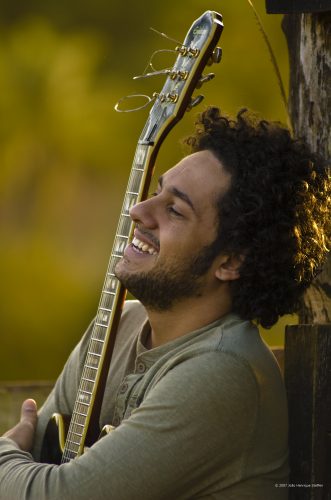
Guitarist Diego Figueiredo, a native of Brazil, will serve as the opening act. (Photo courtesy of Joao Henrique Steffen)
He underlines that connecting with Cuba has been both “a musical thing and a personal thing — and it’s an apolitical thing.”
“There are hard-liners that insist that any time you interact with Cuba, you’re making a political statement. But for me, knowing the sights, sounds and smells that influenced my father and his creative growth was really important,” he said. “[Cuba] was not only the place that was his home when he was a child but the place that shaped his aesthetics and thinking and, consequently, his music-making. So personally, it was a very important journey, because it was closure for me.”
What: “Jazz Roots: Cuba: New Perspectives” featuring Arturo O’Farrill & The Afro Latin Jazz Orchestra, with Brazilian guitarist Diego Figueiredo as opening act
When: 8 p.m. Jan. 10
Where: John S. and James L. Knight Concert Hall at the Adrienne Arsht Center for the Performing Arts of Miami-Dade County, 1300 Biscayne Blvd., Miami
Cost: $45-$125
More information: 305-949-6722; arshtcenter.org
ArtburstMiami.com is a nonprofit source of theater, dance, visual arts, music and performing arts news. Sign up for our newsletter and never miss a story.
Top photo: Arturo O’Farrill says connecting with Cuba has been both “a musical thing and a personal thing — and it’s an apolitical thing.” (Photo courtesy of Laura Diliberto)
No posts found
South Beach Jazz Festival to feature Sanborn, local music scene
Written By Tracy Fields
December 23, 2019 at 4:49 PM
Now in its fourth year, the South Beach Jazz Festival has established itself on this area’s cultural calendar. Its founder is happy about that, of course, but what really pleases him is having the festival accomplish its mission.
“The measure of our success is not only to entertain, it is to showcase the extraordinary abilities of people with disabilities and create greater awareness and acceptance,” said David New, who is blind. Each act in the lineup features at least one artist who has a disability or is dealing with serious illness.
Multi-Grammy winner David Sanborn is set to kick off the festival on Jan. 3 and feature an American Sign Language interpreter at the concert. His is one of just two ticketed shows across the festival’s three days; most events are free. Among these is the culminating performance by legendary percussionist Sammy Figueroa on Jan. 5.
The Miami-based Figueroa has worked with artists including David Bowie, Luther Vandross, Sonny Rollins, the Average White Band and the Spam Allstars, in addition to leading his own ensembles. His career spans six decades so far and he’s not slowing down, despite a recent heart attack.
“It wasn’t a heart attack where you fall over,” he said. “It was a feeling like acid reflux, you know?” His distress subsided, then returned, and he decided to go to the hospital. Wise choice – there he learned he had three blocked arteries and would be staying for a week.
Since then, he has changed his diet and lifestyle, and says he’s like a kid again. “I feel better than ever and have a new lease on life.”
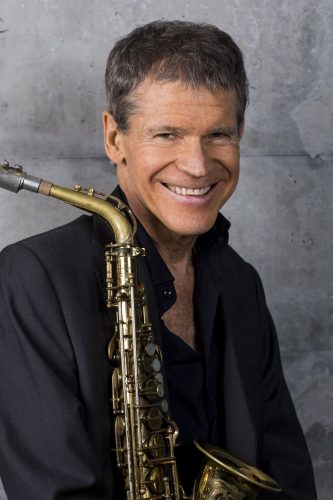
Multi-Grammy winner David Sanborn is set to kick off the festival on Jan. 3. (Photo courtesy of Artist Management)
He’s excited about the festival performance with his Cal Tjader tribute band, Sally’s Tomato. The group takes its name from a tune that was recorded by the vibraphonist and bandleader Tjader and written by Henry Mancini for the movie “Breakfast at Tiffany’s.”
Figueroa recalled meeting Tjader, one of the greatest non-Latin leaders of Latin bands, in San Francisco while working with Ashford and Simpson.
“We talked for hours,” Figueroa said. He decided that night to do a tribute to him – someday.
Tjader died in 1982. “Maybe 10, 15, 20 years later, I said there’s not Cal Tjader music anymore,” Figueroa recalled. “Nobody has done a tribute to Cal Tjader.”
Other local stars who will perform at this year’s festival include vibraphonist Alfredo Chacon, saxophonist Yainer Horta, flutist and singer Magela Herrera and trombonist Ruben Caban, who will play during a six-hour, free event on Jan. 4 at Lummus Park.
Earlier in the day, Grammy-winning drummer Jonathan Joseph is scheduled to lead an all-ages master class at the Miami Beach Community Church. And that night, pianist Kiki Sanchez will entertain at the Capital One Cafe on Lincoln Road.
The festival’s other ticketed event will be Jan. 5: a jazz brunch with drummer Reuben Hoch’s Chassidic Jazz Project at the Marseilles Hotel.
That afternoon, violinist, vocalist and educator Nicole Yarling will present up-and-coming musicians on the student stage at 1111 Lincoln Road. Pianist Fanni Sarkozy, trombonist William Cepeda and singer Ashley Pezzotti will play on the main stage at Euclid Avenue and Lincoln Lane North before Sally’s Tomato appears.
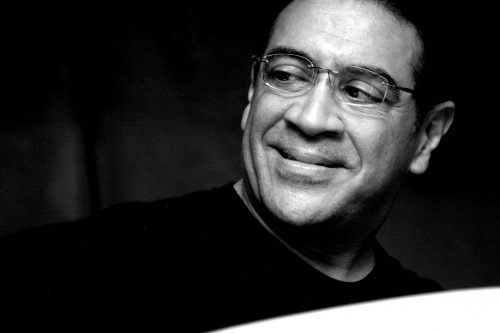
Miami-based Sammy Figueroa has worked with artists including David Bowie, Luther Vandross, Sonny Rollins, the Average White Band and the Spam Allstars. (Photo courtesy of Artist Management)
The festival will end with a screening of the biopic “Ray,” starring Jamie Foxx as Ray Charles, on the wall at SoundScape Park on 17th Street.
Figueroa said he really enjoys the South Beach Jazz Festival. “Where it’s located, the people that come to the concerts to perform, the setting, outdoors, people just having a great time, eating great food, listening – all their senses are open in this sense,” he said. “The visuals are beautiful.”
The festival’s success speaks to the growth of the local music scene, he said.
“What it means to me is that the Miami scene is continually progressing,” he said. “Now Miami is turning into the way New York was in the ’70s and ’80s. All these festivals are happening, this is phenomenal.”
What: South Beach Jazz Festival
When: Jan. 3-5
Where: Locations around Miami Beach
Cost: Most shows are free, but admission to the ticketed events is $40-$75
More information: sobejazzfestival.com
ArtburstMiami.com is a nonprofit source of theater, dance, visual arts, music and performing arts news. Sign up for our newsletter and never miss a story.
Top photo: Drummer Reuben Hoch’s Chassidic Jazz Project will present a jazz brunch at the Marseilles Hotel on Jan. 5. (Photo courtesy of Artist Management)
No posts found
Seraphic Fire to croon Christmas songs, old and new
Written By Mike Hamersly
December 17, 2019 at 5:00 PM
While fighting the holiday rush in the annual fruitless search for the year’s must-have Christmas gifts, which nowadays begins even before we sit down to Thanksgiving dinner, you might find yourself longing for a time when things were simpler, calmer, more peaceful.
Feeling a bit like Linus, in the classic TV special “A Charlie Brown Christmas,” who rebels against the crass commercialization of the holiday? Unplug, take a step back and return to the solemn, joyful, soothing, true roots of Christmas by enjoying the lovely, soul-enriching sounds of Seraphic Fire, the South Florida a cappella vocal group that puts on a holiday concert every year.
But be warned: This is not a show for fans of the novelty song, “Grandma Got Run Over by a Reindeer.” Rather, “A Seraphic Fire Christmas” – on Dec. 22 at the South Miami-Dade Cultural Arts Center in Cutler Bay – is an intimate, candlelit tour through traditional Christmas music, both ancient and contemporary, performed by 13 singers with no instrumental backing whatsoever.
“The whole point is for time to stand still for a second,” says James K. Bass, who sings bass with the group and is associate conductor of Seraphic Fire. “Concertgoers come and tell us afterward that just sitting in the low light and hearing the incredible voices of Seraphic Fire is something that makes Christmas just seem so different, rather than the kind of raucousness that we hear when we go to the mall and hear the music that’s on the speakers. So it’s just a very different experience.”
Brett Karlin, artistic director of the Master Chorales of South Florida and Tampa Bay, will be conducting the concert.
“We begin our programs with Gregorian chants, and you’ll hear a nod to the medieval, with some of what we consider the ancient carols of Europe,” Bass says. “And we always perform some variant of new music, in a way that is incredibly delicate at times and very crystalline. It’s not your typical Christmas concert where you’re going to go hear a ‘Hallelujah’ chorus and ‘Joy to the World’ and loud things.”
The program strategically intertwines ancient and modern works in a way that highlights their similarities, and it can be a learning experience for the listener.
“For part of the concert at the beginning, the men will do the original Gregorian chant for ‘Adeste Fideles,’ which became ‘O Come, All Ye Faithful,’” Bass says. “And we work the single-line version of the original ‘Adeste Fideles’ into the modern, harmonized four-part version of ‘O Come, All Ye Faithful.’ So people get to see where this music came from. They see the origins.”
Though the emphasis of the show is decidedly on older pieces, recent composers also get their due.
“We have two larger works, five or six minutes apiece, by English composer Cecilia McDowall and American composer Dominick DiOrio,” Bass says. “Cecilia’s piece was written in the last two years, but it really uses the idea of medieval rhythms to create her setting of ‘Alma Redemptoris Mater.’
“Then DiOrio wanted to write a winter piece, but with a non-sacred nature. So his piece is called ‘Woods in Winter,’ and it describes all these interesting images and scenes. And it’s hard for a person in Miami to conjure these images, but right now we’re rehearsing in Vermont, and we’re sitting in the mountains with ice and snow and a frozen lake. So the images in this piece are all describing the sound that you hear when things freeze – the sound of the icicles falling and how they create their own noises. It’s a very fascinating piece.”
Although this concert is fully focused on Christmas music, it nonetheless falls in line with the raison d’être of Seraphic Fire, which was founded by conductor Patrick Dupre Quigley, who is also its artistic director.
“The overall mission is to give high-level performances, and be the preemptive national standard, of music prior to 1750 and new music after 1950,” Bass says. “It’s to allow our community in South Florida to hear some of the greatest music written in the world be performed in the way that you may have heard it at that time. There are many wonderful pieces of music that exist from an earlier time period that you don’t get to hear very often, so our mission is to bring those pieces to South Florida.
“And people don’t realize that prior to the 20th century, the majority of music written was vocal music, and written for vocal ensembles, which is exactly what Seraphic Fire is,” he adds. “The modern-day orchestra didn’t even exist until the middle- to late-1700s, so all of that music written before that, from 800 to 1700, is almost all vocal music. And it takes a certain type of singer, with a certain knowledge, to be able to bring that music to life.”
Bass says that for him and the other members of Seraphic Fire, the Christmas season always means a little more.
“It’s a more special time,” he says. “There’s an eagerness and an anticipation that doesn’t exist at any other time of year. And for almost everyone that loves this time of year, whether you’re Christian or whether you just kind of celebrate the holiday in general, the musical aspect is almost equal to the commercial aspect. Yes, we want to have gifts, and we do parties and all that. And one of the things that I love about it, is it really doesn’t matter what tradition you’re from or how religious you are – there’s an amazing, almost global unification in the fact that at this time of year, music is elevated. It’s elevated to part of the entire experience. You cannot have Christmas without the music.”
What: “A Seraphic Fire Christmas”
When: 4 p.m. Dec. 22
Where: South Miami-Dade Cultural Arts Center, 10950 SW 211th St., Cutler Bay
Cost: $20-$55; $5 tickets for age 13-22; purchase at cultureshockmiami.com
More information: smdcac.org
ArtburstMiami.com is a nonprofit source of theater, dance, visual arts, music and performing arts news. Sign up for our newsletter and never miss a story.
Top photo: Seraphic Fire was founded by conductor Patrick Dupre Quigley (front), who is also its artistic director. (Photo courtesy of Southern Land Films)
No posts found
The Heavy Pets to rock the North Beach Bandshell for the holidays
Written By Mike Hamersly
December 16, 2019 at 3:29 PM
Craving a bit more energy from your holiday music than the traditional “Jingle Bell Rock” can deliver? The Heavy Pets has a rocking solution.
The Fort Lauderdale-based jam band that blends jazz, blues, funk, disco and reggae with straight-up rock ’n’ roll brings its third annual Holiday Ball to the North Beach Bandshell on Dec. 21, with the bluesy Roosevelt Collier Band also sharing the bill.
Any doubt that this show will pack a punch is squelched by Relix magazine, which dubbed The Pets “a living, breathing force of nature.”
“I think you just gotta go and hear it,” says guitarist and vocalist Jeff Lloyd, when asked to sum up the band’s sound. “We’re a rock ’n’ roll band at the core, and are high-energy and dance-y. We do a lot of different things on the records, but for the most part our live shows are pretty high-energy.”
Heavy Pets fans will hear plenty of tracks from the group’s fourth full-length studio album, “Strawberry Mansion,” including “Higher,” “Second Sky” and “Rainy Days.”
“You can expect to hear a bunch of songs from the latest record, and we’re gonna probably dive deeper for some older cuts as well,” Lloyd says. “And then you never really know what’s gonna happen. The general format of the show is that each band is gonna play a set, and then we’ll do some kind of collaboration between the two bands to finish out the show.”
Can fans expect any new music or traditional holiday tunes at the show? Lloyd plays it cool: “I’d rather that be a surprise.”
Pedal steel guitar master Collier, a Miami native who describes his mix of blues, gospel and rock as “dirty funk, swampy grime,” got his start playing in the House of God Church in Perrine, Fla., alongside his uncles and cousins in The Lee Boys. He and The Heavy Pets have performed together often, so it was only natural that the two musical forces would join for a proper tour.
“Over the years, we’ve gotten the opportunity to play with [Collier] so many times – he’s come on the road with us and toured with us, and he’s used some members from this band as his backing band,” Lloyd says. “So then finally, earlier this spring, we decided to make it official and do something together, and we did a small run around Florida, and now we’re trying to bring the Florida jam scene to the south of Florida.”
The jam scene has treated The Heavy Pets well, as the band has performed at popular festival circuit concerts such as Bonnaroo, Gathering of the Vibes, Summer Camp Music Festival, Wakarusa Music Festival, Langerado and more. Unlike many other groups, its members don’t mind the label “jam band.”
“Not at all,” Lloyd says. “I do think it kind of pigeonholes you, and so some people, rightfully so, have an aversion to that term, or anything that they think is construed as ‘jam band’ music. That kind of goes for any genre of people – people naturally think that they already know what they like and don’t like, but I think if people give us a chance, we’ll have a little something for everybody.”
Whenever the term “jam band” is mentioned, two groups invariably come to mind: Phish and the band that inspired the whole movement, the Grateful Dead. And yes, The Heavy Pets is heavily influenced by both.
“We’re a bit younger, so initially Phish was a huge influence when we were first getting this thing started,” Lloyd says. “But [the Dead] was certainly an important part and a big inspiration, and let’s face it, a lot of music that you hear today in our scene – there wouldn’t even be that scene if it wasn’t for the Grateful Dead, so you gotta give credit where credit is due. This whole festival scene – whether people know it or not, it’s all about [late Grateful Dead leader Jerry Garcia].
“I’m always impressed by festival-goers, whether it’s their first one or 50th one,” he continues. “I think people go with a sense of wonder, and letting things happen and letting the music take them places. It’s a choose-your-own-adventure situation, from minute to minute at a festival. And something that people don’t know is just how much work goes into putting those things on, so kudos to the people that throw these events, because it’s really amazing what they do.”
In keeping with the holiday giving spirit, the Holiday Ball represents more than music. Attendees are encouraged to bring canned food and unwrapped toys for charity.
“It’s both a show and a fundraiser, and a community event,” Lloyd says. “We always do a toy drive and a food drive, and it’s something that we take great pride in doing. It’s a party that will make people move and dance, but the Holiday Ball is our chance to do a little more with it.”
Proceeds and donations from the show benefit both The Rhythm Foundation’s Miami Beach Youth Music Festival in early 2020 and the Miami women and children’s shelter, Lotus House.
“Just being part of a community that’s given so much to us, we’re just trying to give whatever we can back to it,” Lloyd says.
What: The Rhythm Foundation presents The Heavy Pets Holiday Ball
When: 7 p.m. Dec. 21
Where: North Beach Bandshell, 7275 Collins Ave., Miami Beach
Cost: $20 advance; $30 day of show
More information: rhythmfoundation.com
ArtburstMiami.com is a nonprofit source of theater, dance, visual arts, music and performing arts news. Sign up for our newsletter and never miss a story.
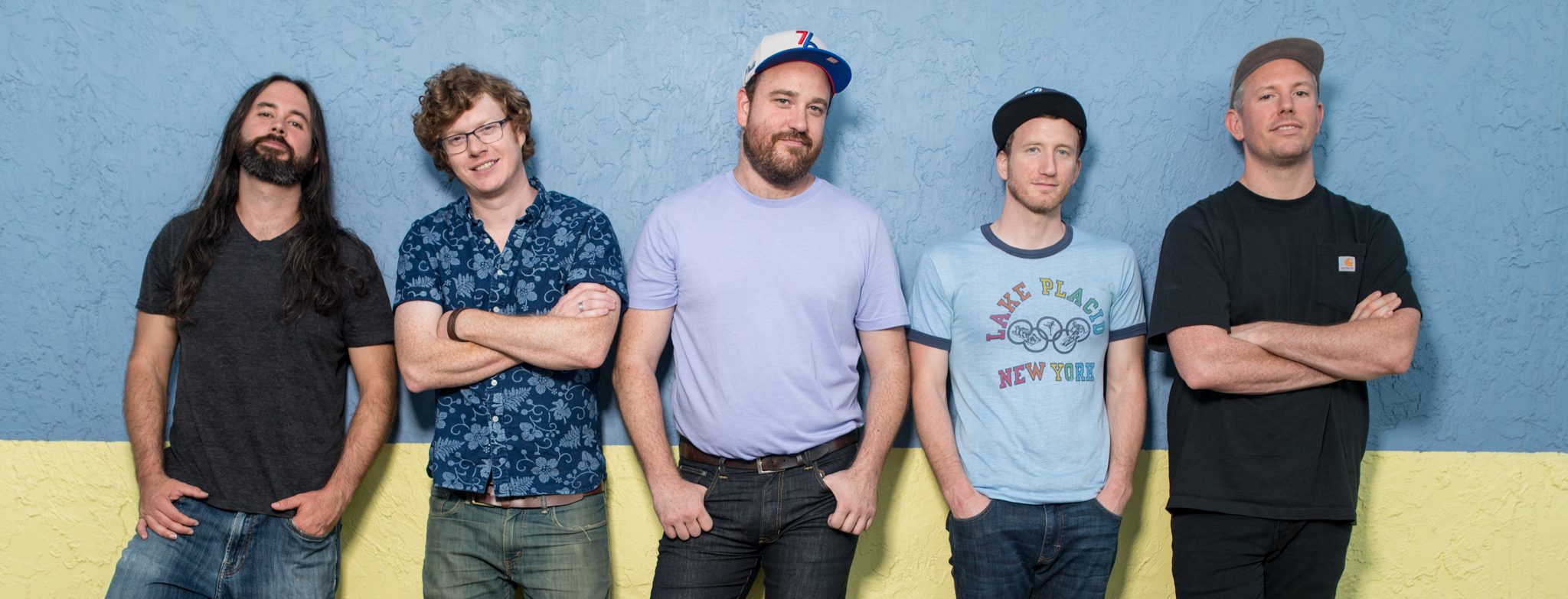
Top photo: The band includes, from left, Mike Garulli, Jeff Lloyd, Jim Wuest, Jamie Newitt and Tony D’Amato. (Photo courtesy of Romy Santos)
No posts found



Recent Comments