Juneteenth in Miami: Song, dance, film, spoken word and storytelling
Written By Tracy Fields June 15, 2021 at 7:17 PM
Kunya Rowley is executive producer and artistic director for Hued Songs, which is presenting The Juneteenth Experience, in partnership with the Rhythm Foundation. (Photo courtesy of Hued Songs)
The importance of Juneteenth — short for June 19, 1865, when the last enslaved people in the United States learned of their emancipation more than two years prior — continues to grow and resonate in South Florida. Miami-Dade County has made it a paid holiday, and a variety of area celebrations are planned to mark the occasion.
Perhaps the most stately event will be “Juneteenth on Ali Baba Avenue,” presented by the Opa-locka Community Development Corp. (OLCDC). In addition to the usual festival features of live entertainment, visual and performing arts, contests and food, this special celebration boasts Dr. Joanne Hyppolite.
Haitian-born, she was chief curator at HistoryMiami Museum before becoming African Diaspora curator at the Smithsonian National Museum of African American History and Culture in Washington, D.C. She is expected to lead a historic remembrance of the Emancipation Proclamation.
“Juneteenth is about more than just commemorating the end of slavery. It’s about celebrating and enacting Black liberation,” OLCDC chief operating officer Nikisha Williams said in a release. “At its core, OLCDC’s mission is to liberate Black and brown people socially, economically, and politically, and a Juneteenth festival is the perfect way to celebrate that.”
All activities will take place from 4 to 9 p.m. June 19 at The ARC (Arts and Recreation Center), 675 Ali Baba Ave., Opa-locka. The event is free.
Across the bay on North Beach, the Juneteenth Music & Food Festival will feature food, drink and entertainment for what organizers are calling “an unforgettable day.”
The free event — set for noon to 7 p.m. at The Sand Bowl @ Bandshell Park, 7275 Collins Ave., Miami Beach — is being presented by The Hungry Black Man media company. The aim, according to organizers, is to highlight Black culinary and musical expression, with an array of Creole, Midwestern, soul foods and more (plus vegan options!) and amix of soul and rap, jazz house, blues and metal sounds. Among those scheduled to participate are the band Elements and DJ Tyree. Food and drink must be purchased separately.
Later, at the nearby North Beach Bandshell, Hued Songs and The Rhythm Foundation will present The Juneteenth Experience, including song, dance, film, spoken word and storytelling. Before the performances, visitors may stroll through an area with artisans and vendors. Three short films focusing on Black identity will be shown starting at 7 p.m., with performances by a group of singers, actors and spoken-word artists following at 8 p.m.
In-person attendance will be limited; there also will be a livestream. Both are free.
The city of Miami Beach’s Juneteenth ceremony will take place in Pride Park, across from the convention center at 1809 Meridian Ave., at the rainbow eucalyptus planted last year in observance of the holiday. The poet, Vaughns, will appear there as well, along with the Peter London Global Dance Co. and the New World School of the Arts High School Jazz Band.
This celebration, set for 9 to 10 a.m., will also honor two young Miami Beach residents: Egyptia Green, who organized Black Lives Matter demonstrations throughout 2020; and Leandra Hall, a high school senior who won The Miami Herald’s Silver Knight Award for creating “AfroTechie” to give minority children access to STEM education (science, technology, engineering and mathematics).
This event will be streamed on the city’s Facebook page.
“The City of Miami Beach has benefited immeasurably from the contributions of Black Americans,” said Melissa Berthier, its assistant director of marketing and communications. “The commemoration of Juneteenth is just one way that Miami Beach proudly celebrates freedom and the impact of the Black community on our city — past, present and future. ”
In South Beach, it’ll be a big night at The Betsy Hotel, 1440 Ocean Drive. From 6 to 11 p.m., there will be live jazz in the lobby by pianist Allen Paul and singers Carole Ann Taylor, Brenda Alford, Nicole Yarling, and Leesa Richards. Outside, from 9 to 9:30 p.m. at the Poetry Rail in the adjacent alley, poets Rebecca “Butterfly” Vaughns and Geoffrey Philp are scheduled to appear, along with jazz saxophonist and peace activist Gregory LeDon, who will accompany them with improvisations. Both events are free.
Review: A reassuring closure to Seraphic Fire’s virtual season
Written By Nevena Stanić Kovačević June 10, 2021 at 10:12 PM
Conductor Patrick Dupré Quigley, the ensemble’s founder and artistic director, chose a selection of music from Wolfgang Amadeus Mozart and Claudio Monteverdi. (File photo courtesy of Seraphic Fire)
Miami’s Grammy-nominated choral ensemble Seraphic Fire wrapped up its virtual season, known as Season S, with the music of Wolfgang Amadeus Mozart and Claudio Monteverdi.
This last presentation, on May 23, marked the first time these artists gathered after more than one year apart – and the intensity of emotions they exuded made their sacred music shine even brighter.
Seraphic Fire cautiously approached every detail in preparing for the first in-person recording in still unstable conditions. Humbly rather than pompously, the ensemble gathered around a finely chosen repertoire. In the ascetic acoustic space, the sonority of evenly employed male and female voices carried an intimate atmosphere over the screen.
Conductor Patrick Dupré Quigley, the ensemble’s founder and artistic director, chose five pieces from Monteverdi’s collection, “Selva Morale e Spirituale” (1641). The vocalists and guest instrumentalists elegantly interpreted the first piece, “Beatus vir,” and “Confitebor tibi Domine” continued the musical call-and-response, with a joyful trio featuring Arwen Myers’ warm soprano, James Reese’s crystal tenor and John Buffett’s expressive baritone, supported by “basso continuo” (continuous bass) in low instruments. The voices would often align with instrumental timbres in resonant harmonies, immersing the listener in the musical aesthetics of the Baroque period.
In the same spirit, “Deus tuorum militum” featured three male voices: Patrick Muehleise (tenor), James K. Bass (bass) and Steven Eddy (bass). They attentively shaped the song structure and presented the compelling use of male voices in Monteverdi’s opus. With a perfect pronunciation of the text in “Iste confessor,” sopranos Nola Richardson and Chelsea Helm briskly emphasized the melodic word painting. Almost without vibrato and with exquisite symbiosis of voices, this short and celebratory piece was effective and memorable.
Due to their high professionalism, but also partly to their placement, the musicians communicated flawlessly. The quintet members surrounded the choir, providing enough space for the instruments to resonate. The two violins from the choir’s left side led the instrumental dialogue with the “grosso” section — organs and cello — supported by the double bass on the right side.
Katie Hyun (violin), Sarah Stone (cello), Justin Blackwell (organ), and Nathaniel Chase (double bass) performed on modern-day instruments but with baroque bows. Led by Edson Scheid de Andrade’s voluminously ornamented melody on the violin, this chamber ensemble contributed to the historical interpretation of Monteverdi’s piece. They festively delivered the composer’s tonal thoughts, particularly in cadences.
With high precision, Quigley finely brought out wide dynamics ranges in “Dixit Dominus.” Extended sustained chords between the canonical segments suggest Monteverdi’s shift to the new musical thinking of the time, in which monody (solo vocal style) and harmony overtake the direction of music history, and lead us to Mozart.
From Mozart, Seraphic Fire began with “Missa brevis” in F major (K. 192, 1774). Quigley marvelously led musicians and listeners through recognizable and enchanting melodies of Mozart’s classicism.
“Kyrie” immediately suggested the shift in articulation, dynamics and phrases compared with the ensemble’s expression of the Monteverdi music. They also emphasized Mozart’s early operatic qualities in the vocal lines of “Gloria.”
During the interlude, “Sonata da chiesa” in F major (K. 224, 1776), the instrumentalists masterfully reminisced the baroque atmosphere from the beginning of the concert, shaping their phrases in the terraced dynamics. This church sonata is the composer’s reflection on the baroque genre articulated through the use of the old form and “basso continuo” (continuous bass) line in low instruments.
Nothing less was expected from such a high-production recorded performance. The sound producers outstandingly conveyed an almost accurate impression of the acoustic glow of an in-person experience. Yet, the full voluminosity of “Credo,” the hopeful tone of the quartet in “Sanctus” (with a stellar performance from Amanda Crider), and the combination of pathos and jubilation in “Agnus Dei” elicited a feeling of regret at having to listen to this concert in a digital sound format.
As kind of a postlude for the whole season, Seraphic Fire performed Mozart’s short communion motet, “Ave verum corpus” (K. 618, “Hail, true body,” 1791) — it provided a glorious closure for an unusual-but-successful season of music.
The delicate transition between Monteverdi and Mozart’s works delivered both sonorous blending and masterful distinction of baroque and classical styles. The members of both Seraphic Fire and the instrumental ensemble seemed to be engrossed in the performance. These fine musicians prove that focus, persistence and love of art can overcome the challenges of having to relearn the craft of group performance – and can provide a renewed and spectacular experience. It sets an example for coping with new obstacles and expectations in the times after a crisis.
Arturo Sandoval to kick off Blue Note series in Miami Beach
Written By Tracy Fields May 26, 2021 at 12:46 AM
Cuban-American jazz trumpeter is eager to return to the stage in June at the North Beach Bandshell in Miami Beach. (File photo courtesy of artist management)
The Blue Note Jazz Club, a New York institution with branches around the world, is expanding its reach to South Florida with a Miami Beach concert series starting with Arturo Sandoval on June 5 and 6.
The Cuban-American jazz trumpeter’s story is the makings of a movie, literally. A chance meeting with jazz superstar Dizzy Gillespie took Sandoval from his native Cuba to the world stage and ultimately to a new home in the United States. You may know the tale from the 2000 biopic, “For Love or Country,” which starred Andy Garcia as Sandoval.
Having hunkered down for the past year-plus like the rest of us, Sandoval, 71, is eager to get back on stage: “I’m happy that I’m finally … next month we’re gonna start working, oh my goodness!” he said.
The two nights at the North Beach Bandshell will mark his first performances since the pandemic, but he’s hardly been idle. Sandoval has been working on scores for a couple of movies – though he couldn’t disclose which ones – and has also been making videos, practicing and discovering a new skill: writing.
In addition to opinion pieces in South Florida’s Spanish-language publication, Diario Las Americas, Sandoval has “started writing poems, something I never did in my life. Never spent a minute writing words, that’s something completely new to me,” Sandoval said, adding that he’s “very happy that this thing appeared in my life at this age.”
Sandoval seizes opportunities. When the legendary Gillespie visited Cuba in 1977, it changed Sandoval’s life completely. Sandoval, a longtime fan, was alerted by a friend at the musicians’ union and wound up driving Gillespie around, but says he was too shy to tell his hero that he, too, played the trumpet.
Hours later, the American was shocked to find Sandoval at a government-arranged jam session. “Dizzy couldn’t believe it,” Sandoval recalled. “He said – excuse me – ‘What the hell my driver is doing with the trumpet?’”
Gillespie soon found out. It was the beginning of a relationship that lasted until his death in 1993.
“That thing changed my life upside-down,” said Sandoval. “That was like a big door opened in front of me.”
His late mentor is never far from his thoughts.
“You know, I try to keep his music alive, and I play a lot of his tunes every single day,” said Sandoval, whose big-band album, “Dear Diz (Every Day I Think of You),” won a Grammy in 2012.
Bandshell audiences will get to remember along with him: “There’s gonna be a lot of Dizzy tunes and, besides that, doesn’t matter what I play, his influence is always there,” Sandoval said.
The June 5-6 shows are the first in a new venture between the club and The Rhythm Foundation, which operates the bandshell for the city of Miami Beach. The series will continue with shows by multi-genre pianist and composer Robert Glasper on June 12 and Big Freedia on June 26. Big Freedia has been instrumental in popularizing bounce, a strain of hip-hop originating in New Orleans. She and the Soul Rebels are expected to play with a special guest, Cuba’s Cimafunk.
“The Blue Note Jazz Club pop-up in Miami Beach marks a significant milestone in our growth at the North Beach Bandshell,” said The Rhythm Foundation director James Quinlan, in a release. “We are honored to welcome their 40 years of experience with the leading jazz artists of our generation.”
WHAT: “Blue Note presents Arturo Sandoval”
WHEN:8 p.m. Saturday, June 5, and 7 p.m. Sunday, June 6
Written By Deborah Ramirez April 27, 2021 at 10:37 PM
Marlow Rosado, seen here with his Grammy and Latin Grammy awards, is promoting two new albums, both born during the coronavirus lockdown. (Photo courtesy of the artist)
During the pandemic’s darkest days, when clubs were shuttered and his performances were canceled, Marlow Rosado retreated to his Miami Lakes recording studio. He had traditional salsa, a lifelong passion, and Zen, a longtime interest, on his mind.
Rosado, 52, a Grammy and Latin Grammy winner, has emerged with two new recordings and a sense of peace. The albums, he says, represent a new phase in his musical career and a cause for celebration.
“Los Colores de la Salsa” (The Colors of Salsa) is a modern take on traditional Latin dance rhythms that he recorded with his longtime friend, veteran vocalist Frankie Negron. The official video for the track, “Depende de Ti” (It Depends on You) has garnered more than 1 million views on YouTube since the album was released in early March.
“Orun” is a deeper, almost meditative recording and Rosado’s first Latin jazz album. (He interprets the Yoruba word as meaning a protective ancestral spirit.) The album also marks the first time the Puerto Rican musician has worked with Afro-Cuban jazz legend Chucho Valdés. The veteran musician is a guest artist on the track, “Marlow y Chucho,” which Rosado wrote.
“I was able to produce two amazing albums,” Rosado says. “They are very special because they came from a place of despair — of what’s going to happen, I’ve got nothing to do, no work, nowhere to go — to a place of hope for the future.”
Rosado is no stranger to beating the odds. His music isn’t played on Latin commercial radio even though he has won two of the music industry’s biggest awards: a 2012 “Best Tropical Latin Album” Grammy for “Retro,” which he recorded with his band, Marlow Rosado y La Riqueña, and a 2015 “Best Children’s Album” Latin Grammy for “Los Animales.”
He is one of salsa’s underground heroes.
“The overwhelming programing [on commercial Latin radio] is urban music,” says Rosado, a pianist, arranger, songwriter and bandleader. “There are thousands of ‘salseros’ with records out there, but there’s no salsa on the radio.”
(Video courtesy of JN Music Group)
Zen has helped him deal with the ups and downs of the music industry, he says.
Rosado was first attracted to Eastern philosophies as a teenager, when he picked up a copy of “The Pocket Zen Reader.” After visiting Nepal in 2007, to perform in a jazz festival, he was hooked. When the festival ended, Rosado spent seven days in the capital of Kathmandu, visiting a Buddhist temple.
He has returned to the Himalayan country twice: “Nepal was a life-changing experience.”
It’s among the poorest countries in the world, he says, “yet we have so much to learn from them.”
What Rosado learned was to try to see opportunities in life’s challenges, he says. His two new albums reflect this mindset.
“Colores” has Rosado’s trademark “salsa gruesa” (heavy) style – blaring horns, rapid-fire percussion and lyrical piano solos — with shades of urban music. He recorded the album with Negron, a salsa and Latin pop singer of Puerto Rican heritage, from New Jersey, who became popular in the late ’90s with hits such as “Con Amor Se Gana” (You Win With Love).
Rosado says he and Negron, who moved to South Florida a few years ago, went into the studio together, not knowing what to expect.
“It was a fun record to do because there was nothing else to do, we were in quarantine. So, we had a good time doing this,” Rosado recalls. “It’s probably the only record I’ve done that way … we were thinking, ‘If things ever get back to normal, we’re going to release this album,’ and we did.”
Rosado wrote most of the songs on the record, including the call-and-response “Depende de Ti.”
“It calls on younger Latin urban artists to ‘defend’ tropical Latin rhythms that first arrived in the Caribbean on slave ships,” he says. “We’re asking the younger musicians who are hot right now to respect this music, not to dismiss it as old people’s music.
“The original rappers were the ‘soneros’ (salsa vocalists), the rhymers – we invented that.”
The more melodic “Orun” with Valdés is a departure from Rosado’s “heavy metal” style of salsa.
In a recent video for the album, filmed at his Coral Springs home, Valdés had words of encouragement for Rosado.
“He has a great talent and a high level of composition and a tremendous swing on the piano – an incredible vibe,” says Valdés, smoking a cigar on his patio. “All I can say to Marlow is what [jazz composer] David Brubeck once said to me: ‘Marlow, never stop.’”
Valdés is one of Rosado’s idols.
“Chucho is like royalty. He was somebody that I saw as untouchable, as way out there, like a Miles Davis,” he says.
Rosado’s love affair with Latin tropical dance music has never waned. He grew up in Puerto Rico listening to his salsa heroes on the radio – piano giants like Eddie Palmieri, Larry Harlow and Papo Lucca. As a youngster, he taught himself to play the piano by listening to his favorite salsa records.
Marlow Rosado hard at work in his Miami Lakes recording studio. (Photo courtesy of Deborah Ramirez)
After moving to Miami at age 14, Rosado continued to nurture his interest in music. This led to a full scholarship at Florida Atlantic University in Boca Raton, where he graduated with a bachelor degree in music education and jazz composition.
After college, Rosado found a secure day job, as a music teacher at Marjory Stoneman Douglas Elementary School in southwest Miami-Dade County. He spent 10 years in the classroom – by then he had a wife and twin daughters – before taking a leap of faith to become a full-time musician. He has survived by learning to multi-task.
“I do everything: I’m a studio owner, I have a rehearsal hall, I’m a recording engineer, I’m an arranger, a pianist, I do events – like Christmas parties – I’m a songwriter and a producer,” Rosado says. “I stopped being [mostly] a piano player when I became a businessman.”
His many talents have helped him find steady work. Through a mutual friend, in the late ’90s, he met powerhouse songwriter-producer Desmond Child, whose hits include “Livin’ on a Prayer” and “Livin’ La Vida Loca.” Child, who also writes for and produces Latin artists, signed Rosado to his publishing company.
Through his association with Child, Rosado has written songs and produced albums for some of the biggest names in the Latin music industry, including fellow Puerto Rican artist Ricky Martin, Mexican rock star Alejandra Guzmán and Puerto Rican pop diva Yolandita Monge.
In 2015, Rosado won a Latin Songwriters Hall of Fame “La Musa” (The Muse) award, named after Child’s mother, Cuban composer Elena Casals. Child is a co-founder of the organization.
“Desmond has been an angel,” Rosado says. “He was the first person to sign me as a songwriter. He’s been a total force in my career.”
Rosado hopes more people will get to know his work. “Orun,” which is now available on all digital platforms, features all Rosado-written tracks except for the Rafael Hernández classic, “Capullito de Alelí,” which he performs with guest saxophonist Ed Calle.
Rosado says he feels a spiritual connection to the recording, which features a “babalao,” a Santeria priest, chanting a prayer on the title track.
“These are not just my latest records,” Rosado says. “They really mark a period in life that affected the entire planet. They are what kept me sane and kept me busy. They’re very special.”
For more information on Marlow Rosado and his music, check out his official website at Marlowrosado.com.
Inaugural Bayfront Jazz Festival aims to help ‘bring back joy’
Written By Mike Hamersly April 26, 2021 at 2:16 PM
Groundbreaking pianist Chucho Valdés says he has been keeping busy during the pandemic by composing, performing online, and teaching young students through his academy. (Photo courtesy of OCP Photography Miami)
With the weather turning balmy and the world slowly beginning to open up again during the COVID-19 pandemic, International Jazz Day on April 30 couldn’t come at a better time.
Especially in Miami, where the inaugural Bayfront Jazz Festival will celebrate this truly American form of music this weekend.
The two-day concert, on Friday-Saturday, April 30-May 1, at the FPL Solar Amphitheater at Bayfront Park, aims to help “bring back joy” after more than a year of forced cultural isolation, according to organizers.
“That was the inspiration,” says Manuel Molina, who along with partner Amos Rozenberg makes up Melrose Media, which is hosting the festival. “Miami is one of the first cities to open, having small concerts with limited audiences, and the city has been wanting to revitalize downtown. Also, the weather is great, and it was not that complicated to convince great artists to come here.”
Of course, the live-music scene is far from all the way back to normal. The 10,000-seat amphitheater can allow only 15 percent capacity for the festival, which adds up to 1,500 socially distanced patrons per day (the concert is also available through livestream video). And yes, masks are mandatory, except while eating or drinking.
“We hope that now, step by step, this [festival] is the first initiative, and we will be able to increase in size and bring more people for the next event that we are programming,” says Molina. “Hopefully, at one point everybody will feel much more comfortable, and be vaccinated, and we’ll drop those masks.”
Aymée Nuviola, who portrayed Celia Cruz in a 2015 series, is known as “La Sonera del Mundo” for her improvisational vocal skills. (Photo courtesy of Blue Note Tokyo)
The festival’s lineup would be stellar by any standard, but it seems even more so for jazz fans who have been starved for live music. Friday night kicks off with jazz-funk vibraphonist Roy Ayers (whose groovy, laid-back 1976 standard “Everybody Loves the Sunshine” suits the Magic City well) and his quintet, followed by legendary Cuban pianist, bandleader and composer Chucho Valdés and his quartet.
Saturday offers a slightly different vibe, with jazz drummer Mark Guiliana laying down adventurous electronic sounds in the late-afternoon sunshine with his Grammy-nominated ensemble Beat Music! Later, the renowned Cuban duo of pianist Gonzalo Rubalcaba and vocalist Aymée Nuviola (“La Sonera del Mundo”) take the stage fresh off their 2020 release, “Viento y Tiempo,” recorded live at Blue Note Tokyo. The festival closes with a bluesy bang with Tony- and Grammy-winning jazz vocalist Dee Dee Bridgewater and the eight-piece Memphis Soulphony.
The hugely influential and groundbreaking pianist Valdés – best known for co-founding the Orquesta Cubana de Música Moderna in 1967 and the Afro-Cuban jazz group Irakere in 1973 – has been keeping busy during the pandemic by composing, performing online, and teaching young students through his academy. But nothing beats performing in front of a crowd, and the Miami resident is itching to get onstage for the first time since December 2019.
“It will be the first concert I will do during the pandemic for a live audience,” says Valdés, now 79, who is also well-known for being the son of legendary pianist and bandleader Bebo Valdés. “I’m really happy to celebrate, as every year, the International Jazz Day, and it can’t be in a better place than Bayfront Park for the sound and the beauty. For me, [Jazz Day] is a really important day for all the musicians that play that genre. The first Jazz Day I performed was at the White House in 2016, and in 2017 it was in Havana, and I also was part of it.”
The music of Valdés’ group Irakere, whose many innovations included blending complex Afro-Cuban percussion and rhythms with traditional jazz, isn’t a great fit for a quartet and therefore won’t be part of his set, which will run about 75 minutes. (“But if the audience asks for more music, of course we will play longer,” he says).
Considered one of the most gifted jazz pianists of his generation, Gonzalo Rubalcaba was born into a musical family in Cuba. (Photo courtesy of Yuka Yamaji)
Still, to Valdés, Irakere’s legacy continues to resonate today.
“We never thought it was going to be a success, but we knew we were breaking some barriers and creating new sounds with great musicians with a lot of possibilities,” he reflects. “And as a result, Irakere was a starting point of the Cuban music that we are listening to today. Today, all the musicians recognize that the music changed after this band. They talk about a ‘before’ and ‘after’ Irakere.”
Not surprisingly, Valdés’ musical foundation began with the teachings of his father, Bebo.
“I learned from him the jazz, the Afro-Cuban and the orchestration,” he recalls. “And when I turned 15, I started to be the pianist of his orchestra. When he had a recording session, I played the piano and he was the conductor. In that way, he showed me how to develop myself into the background of an orchestra under the conduction of a maestro.”
Although Valdés will turn 80 on Oct. 9, he possesses the creative energy of a man decades younger.
“There is still a lot to learn, and I have a lot of ideas to develop,” he says. “Right now, I just finished composing a suite in four movements. The premiere will be in November here in Miami, and then we’ll present it in Europe and then back to the rest of the U.S. I’m also creating music for the future with new musical concerns that I have. That’s what keeps me focused.”
WHAT: Bayfront Jazz Festival
WHEN: 7:30 p.m. April 30 and 4:30 p.m. May 1
WHERE: FPL Solar Amphitheater at Bayfront Park, 301 N. Biscayne Blvd., Miami; livestream available on mobile, desktop, tablets, Apple TV and Roku TV
COST: $55.25-$195.25 per day for in-person performances; $15 for one-day livestream pass and $25 for two-day pass
South Florida’s own Roosevelt Collier to headline Afro Roots Fest
Written By Fernando Gonzalez April 22, 2021 at 9:54 PM
Headliner Roosevelt Collier has a style, both muscular and expressive, that suggests an organic blend of gospel, blues, rock and funk influences. (Photo courtesy of Roosevelt Collier)
A master of the pedal and lap steel guitars, South Florida’s own Roosevelt Collier believes his music has never been more needed than during these challenging times.
“I want to bring a positive vibe, so for that 2 hours I’m playing, you can’t help but forget everything that happened bad in your life,” he said in a recent interview. “My No. 1 goal since I started playing has always been to try to heal and touch the soul, whether I’m playing world music, blues, funk jazz, hip-hop, soul, it doesn’t matter. It’s just the nature of my instrument and my gospel roots.”
Collier is headlining the 23rd edition of the Afro Roots Fest Miami Beach, set for 7:30 p.m. Saturday, May 1, at the North Beach Bandshell, 7275 Collins Ave. Presented by the Miami-based nonprofit Community Arts and Culture (CAC), the annual event was virtual last year due to pandemic-related safety concerns and restrictions.
But this year, it returns with an ambitious program of both in-person and virtual performances – featuring Collier with a few special guests, including: Cameroonian bass player, vocalist and songwriter Richard Bona; Ghanaian djembe player Weedie Braimah; and Afro-Nicaraguan singer-songwriter Philip Montalbán. Georges Collinet, host of the long-running world music program Afropop Worldwide, will be the emcee.
Multidisciplinary ensemble Fulu Miziki, from the Democratic Republic of Congo, and musician Vieux Farka Touré, from Mali, will appear in specially pre-recorded performances streamed from their respective homes in Africa.
That’s one of the benefits of keeping a virtual component: “It’s great because, for example, these two African bands wouldn’t have been able to come to the States the way things are,” said Jose Elias, CAC executive and artistic director.
Organizers realized the possibility of reaching a global audience after moving performances from the stage to the web last year. Elias noted that the 2020 edition of Afro Roots Fest “had a number of countries all over the world tuned in that wouldn’t have known [about the festival] if not for the virtual presentation.”
He called it “kind of the silver lining” in an otherwise challenging situation for artists and presenters, brought about by the COVID-19 pandemic, and said CAC plans to continue using this hybrid model of in-person and virtual programming as it moves forward.
“It really does open up your brand to a bigger audience than normally you would have just doing the whole local thing,” Elias said. “It also brings new opportunities for musicians, a new source of income that wasn’t really explored that much before.”
The event’s emcee, Georges Collinet, is host of the long-running world music program Afropop Worldwide. (Photo courtesy of Afropop Worldwide)
For Collier, who as he puts it, “was raised in the sound of the church,” the setting represents a larger stage for his music and his message. At the House of God Church in Perrine, he was brought up in the Sacred Steel tradition — a gospel style that developed after a group of Pentecostal churches in the 1930s introduced the lap steel guitar to their services. He also served an apprenticeship as a member of the ground-shaking band of his uncles and cousins, The Lee Boys.
Not surprisingly, Collier’s style, both muscular and expressive, suggests an organic blend of gospel, blues, rock and funk influences. His tone and pitch-bending may one moment evoke the style signatures of Jimi Hendrix or Jeff Beck — and startle the listener the next by suggesting the deep cry of a church singer.
“The steel guitar has no frets, so by nature it’s close to a vocal sound,” he explained. “So our job in church was to enhance the singers, the church leader and the vocalist. We had to mimic and play exactly what they were singing. So I spent all of my life just behind these powerhouse gospel singers. That’s how I’ve gotten my own voice.”
His broad musical range and technical brilliance turned Collier into a regular “artist at large” at festivals. It also led to performing with musicians such as The Allman Brothers Band, The String Cheese Incident, Buddy Guy, and Robert Randolph. A collaboration with bassist, composer and producer Michael League, founder and leader of the jazz-world fusion band Snarky Puppy, resulted in Collier’s 2018 debut album on the band’s label, GroundUP Music.
The album, titled “Exit 16” after the Florida’s Turnpike exit for his hometown, “tells the story of where I come from, who I am, and where I’m going,” said Collier. “Being raised in the church, being raised in the sound, was to learn how to touch people’s lives, how to use my instrument to help heal people. It’s something in you. Church brought out that. And my No. 1 goal today still is to help heal and touch folks’ lives.”
WHAT: 23rd annual Afro Roots Fest
WHEN: 7:30 p.m. Saturday, May 1, with doors opening at 7 p.m.
WHERE: North Beach Bandshell, 7275 Collins Ave., Miami Beach
COST: Pods of two and four people range in price from $70 to $220
Piano phenom Brandon Goldberg to play outdoors at Arsht Center
Written By Tracy Fields April 7, 2021 at 3:52 PM
Brandon Goldberg’s first album climbed to No. 7 on the JazzWeek charts in summer 2019. Around that same time, Goldberg played the Newport Jazz Festival. (Photo courtesy of John Abbott)
No longer the pint-sized prodigy who once wowed Steve Harvey and his television audience, Brandon Goldberg is now a veteran musician with an impressive history. Yet he’s still not old enough for a full Florida driver’s license.
It’s been a while since music-lovers have had a chance to catch him in a performance, but the Miami-based pianist is now set to play at 7:30 p.m. Friday, April 16 at the Adrienne Arsht Center for the Performing Arts of Miami-Dade County, 1300 Biscayne Blvd., Miami. The show, at the center’s Thomson Plaza for the Arts, is part of the outdoor series, “Jazz Roots on the Plaza.”
“I’m really looking forward to that gig,” says Goldberg, 15. “It’s gonna be the first gig I’ve played for people since the pandemic.”
The teenager certainly wasn’t idle over the past year, though. He spent some of that time making an album with Ralph Peterson Jr., a protege of the legendary drummer Art Blakey.
Peterson, 58, died of complications from cancer on March 1, and Goldberg said he values having made the album to “really document the special connection that we had.”
He said Peterson gave him a card when they first met: “He told me to dial it, don’t file it. I actually waited like six months because I was too scared to call him.”
Goldberg expects the album — which also features saxophonist Stacy Dillard, trumpeter Josh Evans and bassist Luques Curtis — to be released later this year. It will be his second album.
The first was “Let’s Play!” climbed to No. 7 on the JazzWeek charts in summer 2019. Around that same time, Goldberg played the Newport Jazz Festival.
“That was amazing,” he said, though not because he led a trio at the storied event, but rather because of the other musicians he got to meet and see perform. “I’m so lucky to be able to do that, to have access to my heroes.”
That would be huge for anybody, but especially for one so young. Goldberg began his musical journey at age 3.
Brandon Goldberg, 15, at center, got to record an album with the late Ralph Peterson Jr., left, and bassist Luques Curtis. (Photo courtesy of John Abbott)
“So I started playing the piano because there was a piano in the house,” he said. He began trying to pick out melodies he’d heard, and his parents encouraged him. They hired teachers for him, but that wasn’t immediately successful.
“I didn’t have the attention span for any of the teachers,” he said.
Still, his love of music persisted: “Just through meeting a bunch of teachers, I slowly figured out what I wanted to do.”
Goldberg loves jazz, though he composes and performs classical music as well. (The Miami Symphony Orchestra has played his work.)
“Jazz, I guess I was first exposed to it when my grandparents showed me a Rat Pack video,” he said. “I really dug into that and, for a while, that was all I would listen to.”
He discovered jazz pianists including Bill Evans and Oscar Peterson and developed an aspiration: “To somewhat be able to do something like that is amazing.”
He’s been amazing people for years, with high-profile performances on musician Harry Connick Jr.’s talk show and at Jazz at Lincoln Center in New York City, among others. He said the jazz community has embraced him warmly.
“I’m lucky to be so close to so many musicians, because it’s really like a family,” he said.
At the Arsht Center, the “Jazz Roots on the Plaza” series aims to welcome the “community safely back to our campus to connect with the live performing arts once again,” said Liz Wallace, vice president of programming.
“Guests can expect amazing lighting and audio to further enhance the performance experience, along with food and beverage options delivered directly to their tables,” she added. “Plus, these events are always created with safety in mind, including masks, health screenings, social-distanced tables and more.”
The April 16 performance will see Goldberg join local standouts Dion Kerr on bass and Harvel Nakundi on drums.
“I’m really excited,” said Goldberg, who has seen the two perform and admires them. “I’ve never played with them before.”
The Brandon Goldberg Trio performance, presented by “Jazz Roots on the Plaza,” is sold out. For more information, visit Arshtcenter.org.
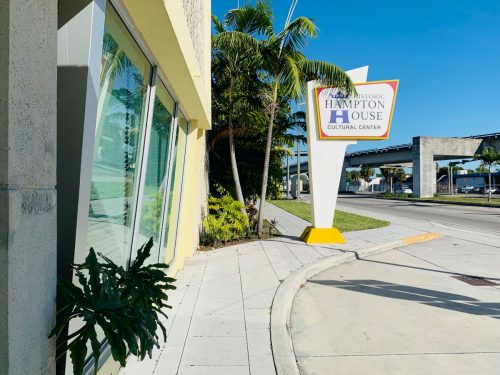
‘From BeBop to HipHop’ – exploring the Hampton House legacy
Written By Deborah Ramirez March 22, 2021 at 5:10 PM
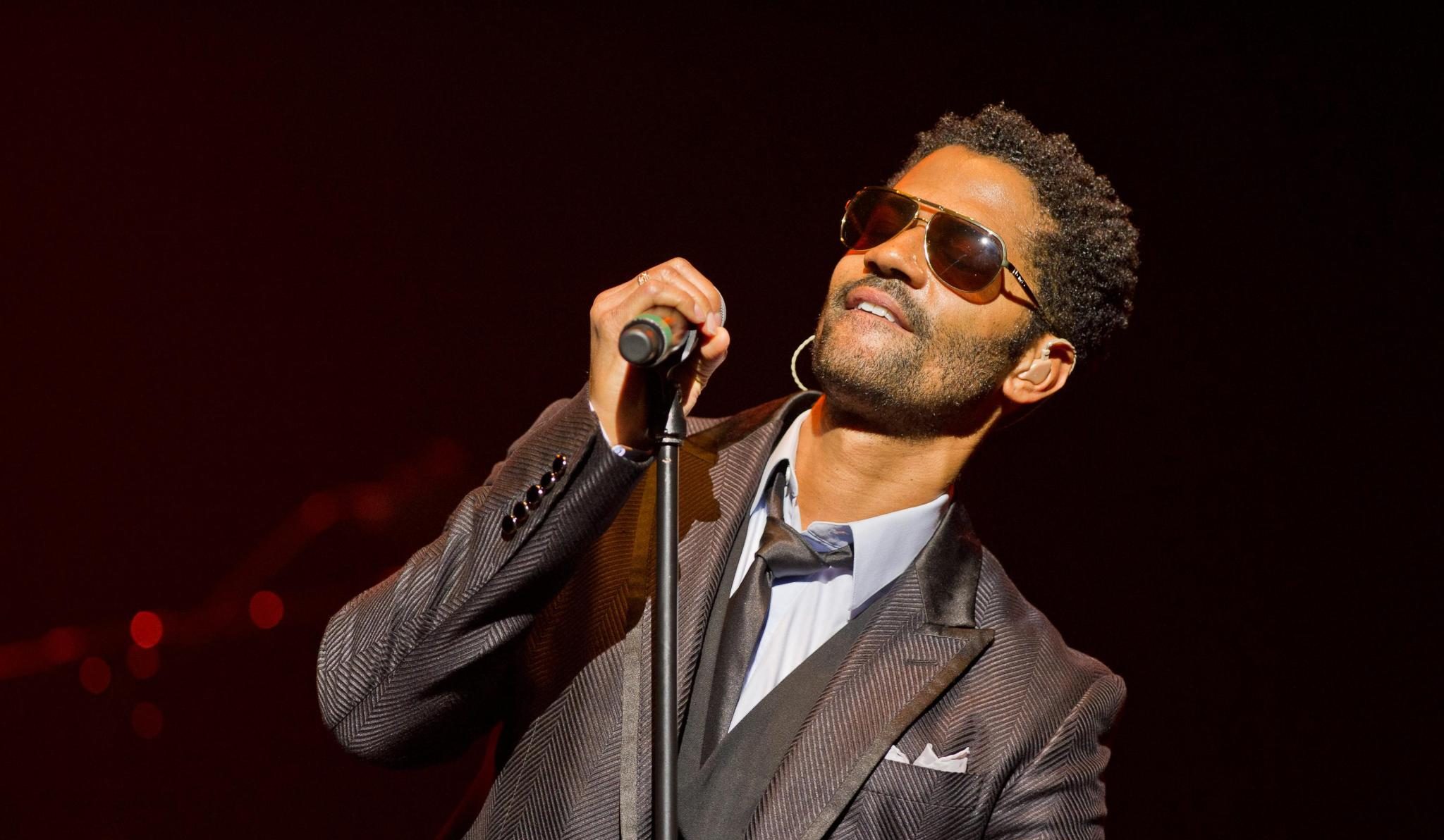
R&B and neo-soul singer-songwriter Eric Benét inaugurates “From BeBop to HipHop,” a new concert series that starts March 27 at Miami’s Historic Hampton House. (Photo courtesy of the artist)
Shortly after the Oscar-nominated movie, “One Night in Miami,” was released on Amazon Prime Video in January, the Historic Hampton House saw its web traffic increase and new faces show up at its door.
Both online and in-person visitors wanted to learn more about Miami’s legendary motel, a place that was central to the plot in Regina King’s directorial debut. During Jim Crow years, the Hampton House was a safe haven for civil rights icons and Black celebrities and tourists. Many learned about it from the “Green Book,” a guide for African-American travelers.
A museum and cultural center since 2015, the Hampton House, located near Brownsville, a historic Black neighborhood west of Liberty City, labored in relative obscurity until “One Night in Miami” came along. Some South Floridians first learned about the iconic site from Kemp Powers’ award-winning play, which ran in 2018 at Miami Beach’s Colony Theatre. But it was the film version, also written by Powers, that reached a far wider audience.
“We went from about 200 to 2,000 hits a day right after the movie came out,” said Jacqui Colyer, who chairs the Historic Hampton House Board of Trustees, a nonprofit that runs the county-owned property. “And we would get visitors all the time, which was difficult because we had been locked down for nine months.”
Now reopened at half-capacity due to the COVID-19 pandemic, the center is ready to leverage the new spotlight that Hollywood has afforded it. Preservationists such as Colyer hope to boost public awareness about Hampton’s role in the history of Miami’s civil rights movement.
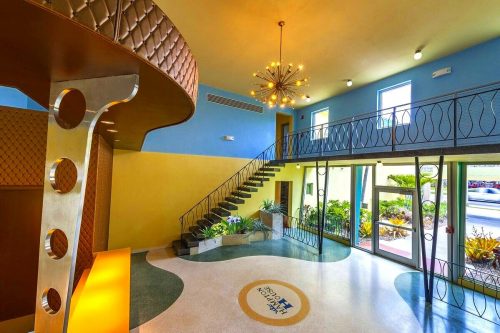
Once Miami’s crown jewel of segregation-era motels, the Historic Hampton House was restored and reopened as a museum and cultural center in 2015. (Photo courtesy of Historic Hampton House)
Toward this goal, the venue is launching “From BeBop to HipHop,” a six-concert series that will pay tribute to Hampton’s jazz lounge – also known as “the Cotton Club of the South” – where entertainers including Josephine Baker, Nat King Cole, Nina Simone and Sammy Davis Jr. once performed.
The series opens Saturday, March 27 with R&B and neo-soul singer-songwriter Eric Benét, a multiple Grammy nominee best known for songs such as “Spend My Life with You,” “You’re the Only One” and “Sometimes I Cry.” He is scheduled to perform two dinner shows – at 6:30 p.m. and 9 p.m. – in the venue’s open courtyard, with socially distanced tables and limited pod seating, mask-wearing requirements, and meals curated by local celebrity chefs, according to organizers.
Tickets are available for purchase on the Hampton House’s revamped website, which will be updated with information on the remaining concerts in the series, said Wayne Anderson, director of public relations.
Organizers hope to recreate the vibe that gave the Hampton House its segregation-era soundtrack. Most Black celebrities who performed there also stayed there, because they were not allowed to stay at Miami Beach hotels where they also performed.
“We wanted to take that and bring it forward to today’s hip-hop artists,” said Anderson, who helped curate the series. “It will span different genres and musical styles to mirror some situations going on back then.”
The Oscar-nominated motion picture, “One Night in Miami,” has brought new attention to the Historic Hampton House, which is central to the film’s plot. (Photo courtesy of Historic Hampton House)
The Hampton House is also fundraising to install a new audio-visual permanent collection that will allow visitors to live the “Green Book” story as it was experienced at the boutique motel. The goal is to have the exhibit up by year’s end, Colyer said.
It will cover some of the themes raised in “One Night in Miami.” The movie tells a fictionized story about a Hampton House encounter between Malcolm X, Cassius Clay, Sam Cooke and Jim Brown the night of Feb. 25, 1964, when Clay defeated Sonny Liston for the heavyweight boxing title. Shortly after, he became Muhammad Ali.
In the movie, the four men come together to discuss their roles in a changing American society.
For locals, the Hampton House was the happening place. It had a famed jazz club, an all-night restaurant and a grand pool that welcomed Black children who were banned from swimming in Miami’s public pools.
The Rev. Martin Luther King Jr. was a frequent guest, who swam in its pool and reportedly practiced his famous “I Have a Dream” speech at the venue. It’s also where John Lewis did role-playing in non-violence workshops, and where Malcolm X and Clay shared ice cream to celebrate the boxer’s new status as the world’s heavyweight champion.
The Rev. Martin Luther King Jr. enjoys a dip in the Hampton House pool. The civil rights leader was a frequent guest at the segregation-era motel. (Photo courtesy of Historic Hampton House)
“To have this iconic relic positioned where it was and the role and significance it played to African-American travelers and in the community, and then to understand who was there and why they came – all of those things are really very powerful,” Anderson said. “So, you walk in there and you’re impacted by that, you are overcome with those emotions.”
Colyer recalls her emotions when she first set sights on the Hampton House, in the early 1960s, as a 14-year-old riding the bus. It was the same bus line where a driver once told her to sit in the back of the vehicle, along with her two siblings. She heeded her mother’s advice, she said, and ignored the driver.
The Hampton House provided a stark contrast to the indignities of Jim Crow. For the young teenager, it symbolized a world that could be.
(Inspicio, an arts publication platform sponsored by Florida International University, had the opportunity to speak with the Historic Hampton House’s founding CEO and president, Dr. Enid Curtis Pinkney. In this video, she discusses whether the Hampton House was the hot place to be from the moment it opened or required time to evolve. Link to more related videos below.)
“I just thought it was the most beautiful hotel I had ever seen – unlike any of the other “Green Book” hotels in Miami – none of the others had architectural character or design,” Colyer said. “The Hampton House, on the other hand, was absolutely stunning.”
Honoring its legacy is not just about the past, but also about the future.
“When we share what we know in our past about ‘Green Book’ hotels and the ‘Green Book’ experience, it gives people the understanding of what it was like,” Colyer reflected. “But it also says that America can do better and that America wants to do better.”
African-American singer dashes elitist notions in ‘Opera … From a Sistah’s Point of View’
Written By Michelle F. Solomon February 23, 2021 at 11:21 PM
Angela Brown’s Metropolitan Opera debut in the title role of Aida during the 2004-2005 season catapulted her to soprano stardom. (Photo courtesy of Roni Ely)
Angela Brown’s original show, “Opera … from a Sistah’s Point of View,” aims to demystify the art form.
“The biggest misconception about opera is that it is only for an elitist audience,” Brown says. “Anyone can enjoy opera if they choose. Anyone can see themselves in the stories.”
Along with the Florida Grand Opera, Brown will present two performances, at 3 p.m. and 7:30 p.m. Feb. 28, at Miami’s Historic Hampton House. Strict COVID-19 guidelines and restrictions will be in place, including mandatory face coverings.
A typical performance – although Brown is quick to point out that no two “Sistah’s” shows are the same – features the soprano performing an opening aria then launching into a tongue-in-cheek commentary meant to “blow up any preconceived notions about opera,” she says.
As Brown recalls, the original “Sistah’s” was conceived in 1997 in her agent’s car: “We were driving to New York City from Bloomington, Ind., for the Birgit Nilsson Prize competition at Carnegie Hall. I was jotting down ideas.
“To be honest, I didn’t think opera companies were always going to be wanting to hire me, so I needed a vehicle to support myself in music. That’s when ‘Opera … from a Sistah’s Point of View’ was born.”
Soprano Amanda Sheriff, a Florida Grand Opera Young Artist, will appear as part of Angela Brown’s “Opera … from a Sistah’s Point of View.” She recently appeared with Michael Miller in “New York Stories,” as part of the Florida company’s “Winter Season of Specials and Shorts.” (Photo courtesy of Nicholas Svorinich)
As it turned out, Brown was named a finalist in that highly prestigious competition, which was founded by the Swedish dramatic soprano best known for performing in the operas of Richard Wagner and Richard Strauss.
It was only the beginning for Brown. The Indianapolis-born singer’s Metropolitan Opera debut in the title role of Aida during the 2004-2005 season catapulted her to soprano stardom. As the Ethiopian princess in Giuseppe Verdi’s classic opera, she brought the audience to its feet and drew the attention of the opera world. Since then, she has cemented her stature as a dramatic soprano known for her portrayal of Verdi’s heroines, her inspired interpretations of African-American spirituals, and her infinite range.
Brown’s relatability shines through for both opera lovers and those new to the genre, says Florida Grand Opera’s general director and CEO, Susan T. Danis.
She is happy Florida Grand Opera is taking performances out into the community this season.
“We’re getting to present [programs] outside of the box,” Danis says.
During the Feb. 28 performances, Brown plans to incorporate young up-and-coming Black opera singers. This would be for only the third time – and the first time in front of a live audience.
“Yes, your audience is going to be the first to see the new live ‘Sistah’s’ with the up-and-comers,” Brown says. “Usually, I do all the singing and all the talking. This time, I get to do a little singing and a lot of talking and let the Young Artists shine.”
Baritone Angel Refusé is another Florida Grand Opera Young Artist who will perform in “Opera … from a Sistah’s Point of View.” (Photo courtesy of the artist)
The time to spotlight Black and brown rising stars was right for many reasons, Brown says. “Not because of the political climate or the social unrest or the political scene or the pandemic. It was an idea whose time had come.”
Brown says performing with Florida Grand Opera Young Artists creates a nice mix of voices. They include soprano Amanda Sheriff, baritone Angel Refusé, and countertenor Key’mon W. Murrah (who took first place in Houston Grand Opera’s 2021 Concert of Arias in early February). Jared Paroune, a pianist with the Florida Grand Opera, will be an accompanist.
“I knit the program together with stories and anecdotes, something that happened in my life or onstage that fits with the next musical piece,” she says.
FGO Young Artist Key’mon W. Murrah recently won first place in Houston Grand Opera’s 2021 Concert of Arias. (Photo courtesy of Benjamin Boutell)
When asked whether the world’s opera stage has lacked diversity, Brown says that hasn’t necessarily been the case, but “the thing is that we haven’t always gotten the shine,” she says.
In her opinion, Black female opera singers have fared better than their male counterparts. “It was a thing where directors didn’t want the audience to see a Black man hugging and kissing on a white woman onstage. They kept the races ‘pure.’”
Her hourlong show addresses all of that and more, she says, and provides a chance for those who have had little exposure to opera to see snippets that will whet their appetites.
“It’s about diversity. It’s about education,” she says. “It’s about knowing how to paint with the many colors we have on our palette. About not burying your head in the sand. It’s about having fun on the operatic stage.”
Review: South Beach Chamber Ensemble’s ‘Black Voices’ a heartfelt response to a painful year
Written By Tracy Fields December 14, 2020 at 4:48 PM
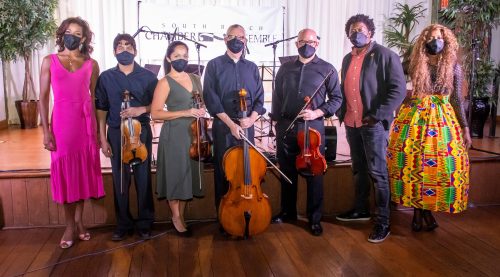
Acclaimed vocalist Nicole Henry, far right, served as host for the South Beach Chamber Ensemble’s presentation of “Black Voices: An Evening of Music and Thought” on Dec. 6. (Photo courtesy of Mitchell Zachs)
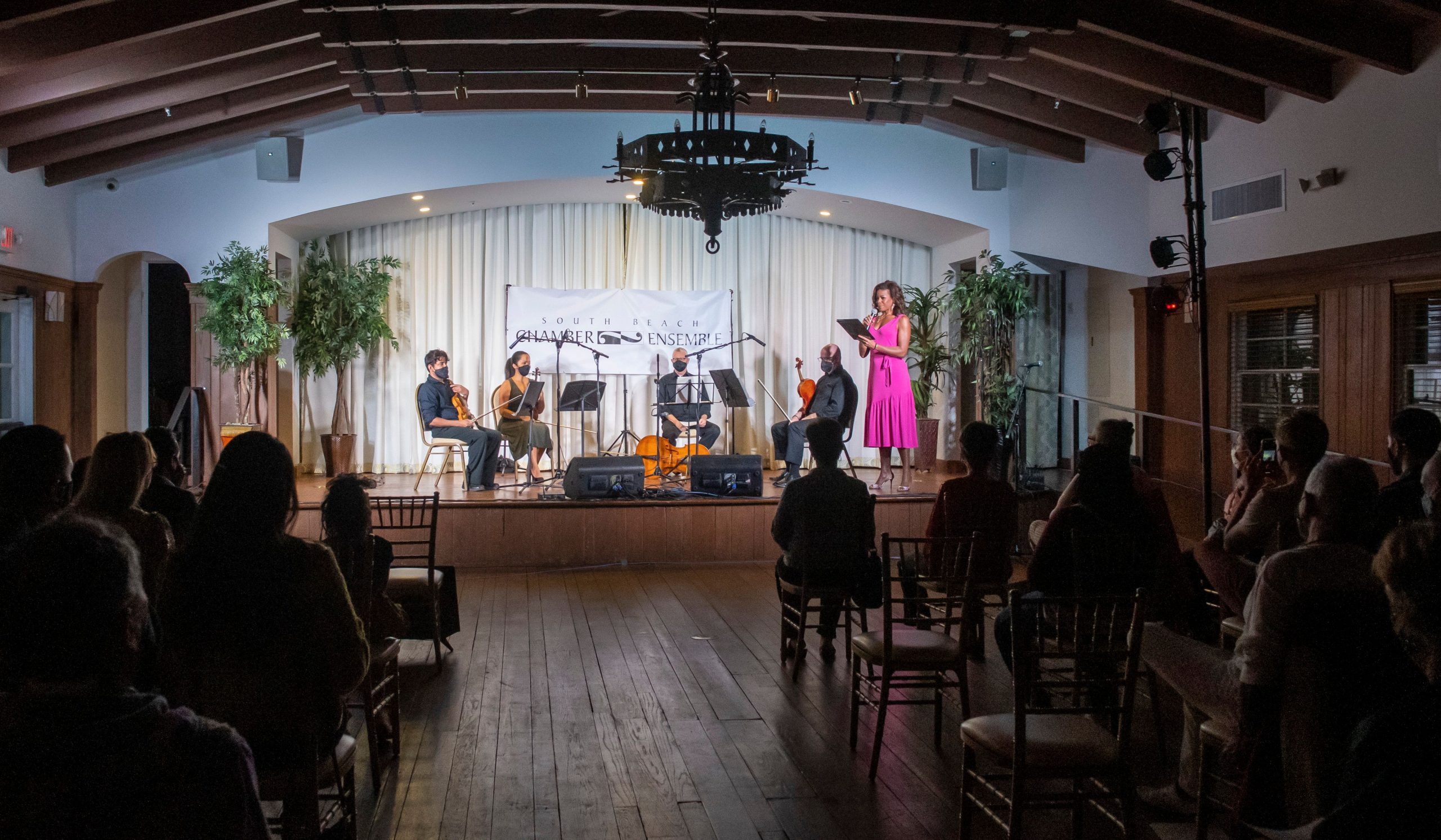
For its inaugural livestream event, the South Beach Chamber Ensemble presented “Black Voices: An Evening of Music and Thought” – with works by composers of African descent interspersed with spoken-word performances by Black poets.
The Dec. 6 program – which was offered in-person at the Miami Beach Woman’s Club as well as online – was a response to this year’s cascade of painful events, said Michael Andrews, the ensemble’s founder and executive artistic director.
“The final straw for me was George Floyd,” he said. The movement for racial justice that followed Floyd’s death in May while in police custody in Minneapolis – along with the COVID-19 pandemic – convinced him that it was time for the 23-year-old ensemble to do something different.
“I thought: We cannot do business as usual. We can’t do that. It’s a whole different world.”
The concert began with a mix of words and notes. Darius V. Daughtry, published poet and founder of the Art Prevails Project, which focuses on theatrical performance, arts education and community engagement, presented “These Black Voices.” His spoken-word performance was accompanied by a wordless version of “Lift Every Voice and Sing” (often referred to as the Black national anthem), performed by the show’s host and local favorite, Nicole Henry.
The stars of the evening were, from left: Nicole Henry, Tony Seepersad, Ericmar Perez, Michael Andrews, JT Kane, Darius V. Daughtry and Allison Matulli. (Photo courtesy of Mitchell Zachs)
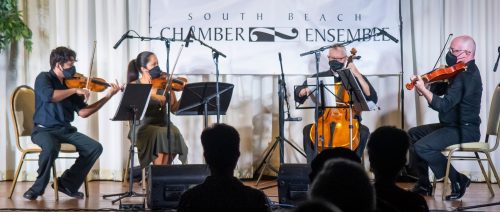
Then the chamber ensemble, all masked in black, played the program’s oldest composition, “String Quartet No. 1 in C Major,” a 1771 piece by Joseph Bologne, the Chevalier de Saint Georges. Born on Guadeloupe to an enslaved Senegalese mother and a French planter, he came to be “widely regarded as the most accomplished man of his age,” according to Artaria.com, which catalogs sheet music from Artaria Editions. He was a noted swordsman and virtuoso violinist as well as a composer. He also was conductor of the leading symphony orchestra in Paris.
The quartet – violinists Tony Seepersad and Ericmar Perez, with JT Kane on viola and Andrews on cello – took flight on this sprightly piece.
Next was Allison Matulli’s earnest delivery of her work, “How Many More.” With topics ranging from Floyd’s death to her young son’s racist encounter at a park, its themes included motherhood, loss, and their intersection.
Last summer, the Education Week journal published an opinion piece by Matulli, “Why I Showed My Young Children the Video of George Floyd’s Death.” An attorney who also has a master degree in education, Matulli works to help young people understand the law and their rights.
The quartet returned with a composition from the last century, George Walker’s “String Quartet No. 1” from 1946. Walker was the first African-American to win a Pulitzer Prize for music, in 1996.
Then it was Daughtry’s turn again. He recited “Poems Like These,” which battered the listener with percussive words capturing the excruciating repetitiveness of police killings of unarmed Black Americans.
It began with:
“I’m so damn tired of writing poems like these
I’m good at it though
At penning pain
Making paint out of bloodstains.”
The South Beach Chamber Ensemble began the performance with the program’s oldest composition, “String Quartet No. 1 in C Major.” (Photo courtesy of Mitchell Zachs)
In introducing the next piece, Daniel Bernard Roumain’s “String Quartet No. 1: X,” Andrews mentioned its complicated rhythms and dissonance. The jagged, driving work evoked the martyred civil rights activist’s uncompromising nature and impactful life.
Daughtry’s “Dead Black Boys,” a meditation on constant mourning for lives lost, followed. Then came the final musical selection, the program’s newest: Jessie Montgomery’s “Strum,” from 2012. With a range of dynamics, tempos and techniques, it offered the quartet a chance to show off a bit.
At the close, the poets and Henry reprised “These Black Voices,” reciting the names of some of those lost to police violence and questionable circumstances. Then Henry sang the opening of “Lift Every Voice and Sing.”
The evening suffered a bit from technical troubles, notably with the announce microphones early on. But the quartet’s sound was clear and beautiful. Virtual attendees were treated to more intimate views of the performers than would have been possible in person.
The entire performance of “Black Voices” by the South Beach Chamber Ensemble is available on the group’s Facebook page, and there’s a shortened version on YouTube. For more information, visit Sobechamberensemble.biz.
Flutist Nestor Torres to perform at Ancient Spanish Monastery in North Miami Beach
Written By Deborah Ramirez December 8, 2020 at 6:46 PM
A versatile performer who moves between Latin jazz, classical music and other genres, Nestor Torres will perform with his trio on Dec. 13 at The Ancient Spanish Monastery in North Miami Beach. (Photo courtesy of Wm. S. Haynes Co.)
A 12th-century monastery near the hustle and bustle of Biscayne Boulevard may seem an unusual sacred spot. But it’s one that Nestor Torres, a practicing Buddhist, finds most inspiring.
“I’ve always been enchanted by the environment and the space,” said the Latin Grammy-winning flutist and composer, who first performed at the North Miami Beach landmark after moving to South Florida in the early ’80s.
Torres returns to The Ancient Spanish Monastery on Dec. 13 for an annual fundraising concert. This year, the outdoor event will require social distancing and mask-wearing, and will also be livestreamed for those who prefer to watch from home.
Torres and his trio – Jorge Luis Sosa on keyboards, Agustin Conti on bass, and Rey Monroig on drums – will perform a mix of Latin jazz standards, Christmas favorites and some of Torres’ original compositions.
“Guests are excited about the combination of Nestor’s rhythmic and melodious music featured in our beautiful natural environment,” said Janie Greenleaf, president of The Ancient Spanish Monastery Foundation, which supports the historic site.
St. Bernard de Clairvaux is a medieval monastery that arrived from Spain in boxes and, thanks to a local philanthropist, found a home off North Dixie Highway in the mid-1960s. The 20-acre property includes an open courtyard, cloisters, lush gardens, and an Episcopal church and museum.
Torres, who practices Nichiren Buddhism and sees a mentor in Buddhist philosopher-educator Daisaku Ikeda, is drawn to a space where Cistercian monks once prayed and chanted.
“In these times that we’re living, we are in great need of sacred spaces – and not just a church or a house of worship,” he said. “For me, the significance of a sacred space is the space that we create between each other based on fundamental mutual respect and appreciation for each person.”
Torres has encountered sacred spaces throughout his career.
Born and raised in a musical family in Mayagüez, Puerto Rico, Torres, who is 63, moved to New York as a college freshman, spending several years performing with Cuban charanga bands and completing his education. He is a classically trained flutist who studied at New York City’s Mannes School of Music and the New England Conservatory of Music in Boston.
After moving to Miami in 1982, Torres became a soloist focused on jazz, but also incorporating classical music, Latin rhythms, hip hop and reggaeton. He has released 18 albums to date and performed with artists ranging from Herbie Hancock and Tito Puente to Gloria Estefan and Israel “Cachao” López.
“It is natural for me to go from one genre to another,” he said. “It is who I am.”
At his core, Torres is about the bond between music and spirituality.
He was a practicing Buddhist in 1990 when he suffered a boating accident that left him with 19 fractures, a collapsed lung and other injuries. “It was from the accident that I experienced what Buddhism really is,” he said.
At the time, Torres’ career as a jazz soloist was taking off. He had just released his first label album, “Morning Ride,” which made it to the Top 10 on Billboard’s contemporary jazz charts.
But his career went south during his long recovery. At the time, he had no health insurance, and it was questionable if he would perform again. It was during this period he discovered something that has now become popular: the value of frontline health-care workers.
“The ones who were always there were the nurses … they were so caring and loving and giving,” Torres recalled. “It was because of them I was able to recover.
“It also dawned on me that here I was, a celebrity with a career that was taking off. I came to realize they were the real celebrities.”
Torres was struck by another moment of enlightenment on the day his album, “This Side of Paradise,” was to receive a Latin Grammy Award as “Best Latin Pop Instrumental Album.” The date was Sept. 11, 2001.
The musician was in Los Angeles, on his way to a Buddhist Center for morning meditations, when he heard the news about the terrorist attacks.
Up to then, an ecstatic Torres had viewed winning a Latin Grammy as a crowning moment in his career.
“Something so important to me in a moment became meaningless,” he reflected. “Because my feeling at the time was that if my work as an artist could not contribute to transforming people’s hearts, so that something like that would not happen again, then what was it worth?”
He was determined to find out. Focused on New York, Torres embarked on what he now calls a spiritual musical pilgrimage, visiting churches and houses of worship from different faith traditions, near Ground Zero. He played wherever he was allowed to bring his flute and his portable recording equipment.
The list included St. Peter’s Catholic Church in Manhattan’s Financial District, which had been used as a staging ground for rescue workers and recovery operations. There, within its sanctuary, he improvised.
“I was hoping to capture something about the spirit of the city, what was going on at the time,” he recalled. “I wanted to be an agent of change.”
It took Torres about two years to edit and transcribe his New York improvisations. In 2004, Florida International University asked him to compose and perform a piece for the Dalai Lama, who was visiting the campus for a lecture on world peace.
The commissioned work and his Sept. 11 compositions became the foundation for “Dances, Prayers & Meditations for Peace.” The seminal 2006 recording included “Saint Peter’s Prayer,” an ode to his improvised performance at the lower Manhattan church.
“What keeps me going is my Buddhist practice,” said Torres, commenting on the struggles of the past year.
He has stayed busy, completing his second classical album, recording a single with Dominican urban artist-producer Maffio, and working as an artist-in-residence with the Florida Youth Orchestra. He is about to release a Latin-style Christmas single that he recorded with young musicians he mentored.
“So as challenging and difficult as this pandemic has turned out to be for so many of us, this is an opportunity to transform any situation to value,” he said. “It’s about making a determination – as long as we never give up, we will never be defeated.”
WHAT: “Jazz Holiday at the Monastery,” featuring Nestor Torres
WHEN: 7-9:30 p.m. Dec. 13
WHERE: The Ancient Spanish Monastery, 16711 W. Dixie Highway, North Miami Beach
COST: $100 VIP tickets with open bar, food, outdoor seating (limited); $25 virtual tickets.
IlluminArts bringing together chamber music, visual arts and social justice
Written By Sean Erwin November 27, 2020 at 5:15 PM
Miami-based mezzo-soprano Amanda Crider has been the driving force behind IlluminArts. (Photo courtesy of Francisco Moraga)
Seven years ago, Miami-based mezzo-soprano Amanda Crider settled in to enjoy a chamber music program in Washington, D.C., that featured art song (poetry set to music) – a genre of music she adores – when something unusual happened.
“There I was at a performance with a soloist and pianist I liked and respected in this traditional hall looking over the traditional printed program and I found myself … bored,” she said.
From that experience came the idea for IlluminArts, a musical series that bridges two often-completely different audiences: classical music lovers and contemporary visual arts enthusiasts.
IlluminArts performances originally took place in residences, specifically of Miami private art collectors.
“I hosted the first concert in the home of a friend with a terrific collection,” Crider recalled. “She invited everyone in the art world. I sang and planned the music around her art collection.”
Trained as a concert pianist before attending the Manhattan School of Music for voice, Crider had an extensive network of music colleagues to draw from, but her links to the visual arts were fewer. For help, she turned to Miami art collector and filmmaker Dennis Scholl, who was also vice president for arts at the Knight Foundation at the time.
“I probably would hear, when I was at the Knight Foundation, several thousand grant ideas a year. There were one or two that I immediately thought, ‘I’m doing this,’ and Amanda’s idea for IlluminArts was one of those,” said Scholl, who is now president and CEO of Oolite Arts in Miami Beach.
What sold Scholl on IlluminArts was Crider herself, and her strength as both an in-demand concert vocalist and an artistic director with a knack for programming classical music.
“The thing that’s special about IlluminArts is that Amanda takes risks,” Scholl added. “She did a massive program at the De la Cruz Art Collection that packed the house, and it was a risk that she took. It was a work that had a ton of moving parts, lots of artists, a number of disciplines and unfamiliar material. Much could have gone wrong, but the audience was open to the experimentation and embraced it.”
Since 2013, her deepening encounter with the visual arts has shifted Crider’s programming increasingly toward social justice issues. This year’s IlluminArts season highlights themes from the empowerment of young women to the effects of climate change.
For example, the Dec. 2 program, “Unmasked,” will bring together the Institute of Contemporary Art, Miami and the nonprofit Girl Power, which helps “at-promise girls ages 11 – 17.” The virtually streamed performance will present masks created by the girls – set to music from composers such as Barbara Strozzi and B.E. Boykin and performed by tenor Karim Sulayman, sopranos Susan Hellman Spatafora, Michelle Trainor and Jaylyn Simmons, male soprano Elijah McCormack, and mezzo-soprano Chrystal Williams.
Dennis Scholl, president and CEO of Oolite Arts in Miami Beach, said: “The thing that’s special about IlluminArts is that Amanda Crider takes risks.” (Photo courtesy of Maribeth Koeth)
“As I got into the arts and visual arts, I found myself drawn more to those artists who had social justice issues evident,” she said. “I like when audiences go to concerts and enjoy them, but I would also want them to leave with thoughts of what it meant to them.”
For the Jan. 31 program, IlluminArts and Oolite Arts will co-present “Rising” at the North Beach Bandshell in a (safety permitting) live performance centered on the work of film artist Sasha Wortzel. A South Florida native, Wortzel’s works frequently investigate the stories of the marginalized.
“I had already been invited to do a show for Oolite about the environment and climate crisis when the pandemic hit,” Wortzel said. “I was struggling to figure out what to do with the grief, since it was such a time of loss, with people losing their lives and their livelihoods. And the show became about creating a place of mourning and a place of hope.”
Set to music by Pulitzer-prize winning composer Caroline Shaw and performed by the Grammy-award winning Attacca Quartet, “Rising” centers on segments of videos from Wortzel’s upcoming art installation at Oolite, titled “Dreams of Unknown Islands.”
“In those film segments, I take inspiration from the cycles of the Earth – the breeding season of sea turtles and the cycles of the sun – to cope with the pandemic’s disruption of time,” she explained.
In March, IlluminArts will unite Philadelphia-based vocal sextet Variant 6 and neo-classical dance company Dimensions Dance Theatre of Miami plus six contemporary composers coming together in a program of all-new works.
Variant 6 mezzo-soprano Elisa Sutherland recalled the inspiration behind the IlluminArts program.
“We asked ourselves, ‘What about vocal music can lend itself well to dance?’” she said. “Having a strong concept of rhythm is good when you are trying to have people also choreograph the work. The composer can also obscure the rhythm intentionally for the same reason …
“We then gave the word ‘transform’ to the composers in July. They could do whatever they wanted.”
A South Florida native, Sasha Wortzel’s works frequently investigate the stories of the marginalized. (Photo courtesy of Jessica Rivas)
For tenor James Reese, the theme took its bearings from the pandemic’s effect on live performance.
“Singing in the way we sing in Variant 6 and dancing are both in-person experiences, and the pandemic canceled that,” he said. “So much of my life is tied up singing with other people. This is why we have asked composers to write about this idea of transformation.”
Another Variant 6 member, soprano Rebecca Myers, said she connected with Crider while performing in Seraphic Fire.
“I just really look up to her as an entrepreneur and as a really intelligent person,” Myers said. “We love and respect what she is doing.”
Reese added: “She totally embodies being a bada** singer but also a sharp, savvy entrepreneur, and someone who is tuned in not only to their own singing but also to the music scene at large.”
The IlluminArts season opener, “Unmasked,” featuring ICA Miami and Girl Power, will be available online at 8 p.m. Dec. 2. For more information and to purchase tickets for this and other IlluminArts events, go to Illuminarts.org/events.













Recent Comments