Nu Deco Ensemble Puts Modern Spin On the Traditional Orchestra
Written By Rebekah Lanae Lengel October 15, 2023 at 7:43 PM
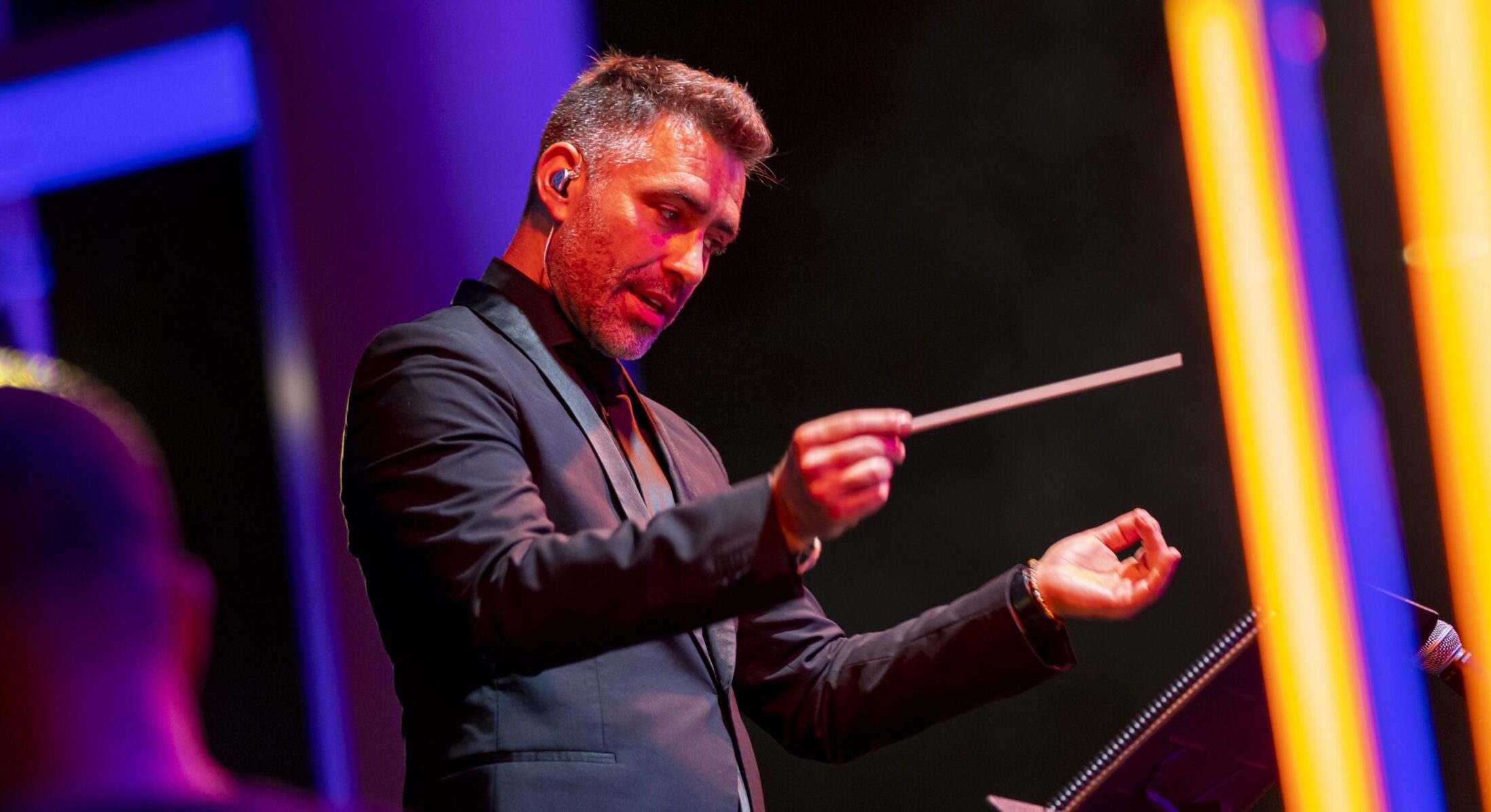
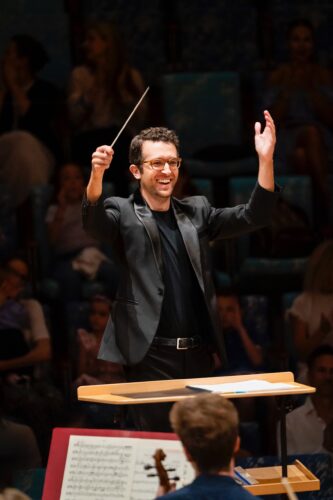
Miami-native Jacomo Bairos conducts Nu Deco Ensemble in April of 2023 at the North Beach Bandshell. Nu Deco opens its ninth season Saturday, Oct. 21 at New World Center. (Photo courtesy of Alex Markow)
Sam Hyken and Jacomo Bairos co-founded Nu Deco Ensemble in 2015 as a 21st-century orchestra celebrating living composers, reimagining all musical genres and collaborating with guest artists — many of whom had never worked with a live orchestra.
As they embark on their ninth season, they remain as dedicated and focused on the music as ever. They have a major label CD release with Sony, national touring opportunities, and a vibrant youth ensemble. Nu Deco’s even gone viral online becoming introduced to a whole legion of new audiences when a clip of its 2018 Outkast Suite was shared on hip-hop social media accounts.
“It allows us to really put our sound out there in the way we believe it should be put in and the way it sounds, but it’s being backed by this big major label, so it’s like a signal for the world. ‘Hey, these guys have arrived. Like it or not, they’re here. They’re making some noise.’ ”
Tank and the Bangas singer Tarriona “Tank” Ball performs with Nu Deco Ensemble in May of 2021 at the North Beach Bandshell. The band joins Nu Deco again on Saturday, Oct. 21. (Photo courtesy of Alex Markow)
Nu Deco kicks off its ninth season on Saturday, Oct. 21 at New World Center with a show that will include an original commission from previous collaborator pianist Aaron Parks, and the return of another collaborator, the Grammy-nominated New Orleans band Tank and the Bangas, in a concert that Bairos describes as a true celebration of Americana.
“We have a rich musical history in this country that encompasses everything from classical to jazz to funk to hip hop to spoken word. It’s a very creative melting pot that this country has produced. And I think this concert is really highlighting that eclectic stew of artistry and creativity and stylistic differences. It’s everything from brand new relevant music to timeless, Pulitzer Prize-winning classics.”
Tank and the Bangas, a band acclaimed for their musicality and live performances, will join the orchestra for a second time, having first performed in 2021 with Nu Deco.
“Their music is infectious,” says Bairos. “Tank herself, is a genius. She’s a poet, she’s a singer, she works a room like you can’t believe.”
Bairos says that Tank and the Bangas front woman, Tarriona “Tank” Ball has a talent for connecting with her audience primarily how she taps into important issues in what he says is an authentic and powerful way.
“ . . .The ways she discusses female empowerment, Black empowerment, Black female empowerment, musical empowerment through the Black lens. It’s just endless. . . . (The band) just knows how to do it in a way that’s like really fun and really approachable.”
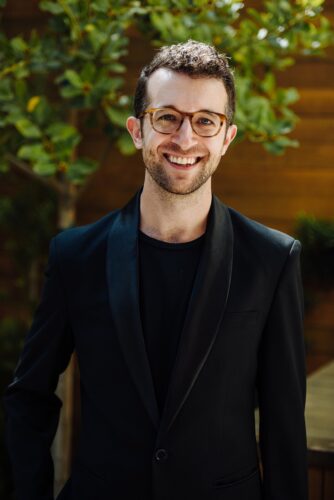
Nu Deco Ensemble, was founded by Jacomo Barios, pictured, and composer, arranger and producer Sam Hyken in 2015. (Photo courtesy of Alex Markow)
Ball, fresh from an Emmy nomination for her hosting of the PBS show “Ritual,” is no stranger to collaboration, having worked with the Chicago Symphony and Louisiana Philharmonic Orchestra, even if it wasn’t part of her original plan.
“It’s something that came along accidentally,” she reveals of her collaborations with orchestras. “I would have never expected that anybody would have wanted these little poems and little quirky songs to be accompanied by an amazing orchestra. It’s shocking every time you hear that they took the time to do this. It makes the magic even more magical.”
New Orleans’ Tank and the Bangas returns to the stage with Nu Deco Ensemble at New World Center on Saturday, Oct. 21. (Photo courtesy of Nu Deco)
The band is coming up on its own 10th anniversary. For the Nu Deco Ensemble concert, songs from its latest Grammy-nominated album “Red Balloon,” will be on the setlist. A deluxe version of the album is expected to be re-released in December.
On working with Nu Deco, Ball says, “The arrangements were such a fresh take on everything. I love when I go inside of a situation; I don’t really know what’s about to happen but I get excited once it’s really happening.”
The rest of the Nu Deco season will include collaborations with guests Joy Oladokun, St. Paul and the Broken Bones and Will Liverman, as well as a new lounge series at The Citadel in Little Haiti that will feature a smaller ensemble as an opportunity for new audiences to be introduced to their work.
Nu Deco Ensemble with Jacomo Bairos in concert at the Arsht Center In March of 2023. (Photo courtesy of Alex Markow)
“It’s a great way to experience high quality, world class live music, orchestral based live music that’s crossover, that’s cool, that’s contemporary, that’s fresh, but in a super digestible way,” says Bairos.
With a continued focused on the future, Nu Deco is also committed to supporting the next generation of musicians as their Nu Deco NXT youth ensemble continues to grow and they remain poised to capitalize on the opportunities that continue to come their way, while staying firmly planted in South Florida.
Says Bairos, “We finally have it all off the ground, we just need to keep working on it and keep expanding it and keep growing it in a way that gives impact. I see this 10 years from now, and being the orchestra of Miami for Miami, that means we can do all kinds of different things.”
WHAT: Nu Deco Ensemble featuring Tank and the Bangas
WHEN: 8 p.m., Saturday, Oct. 21
WHERE: New World Center, 500 17 Street, Miami Beach
ArtburstMiami.com is a nonprofit media source for the arts featuring fresh and original stories by writers dedicated to theater, dance, visual arts, film, music and more. Don’t miss a story at www.artburstmiami.com.
No posts found
Stéphane Denève goes for eternal theme in upcoming New World Symphony concert
Written By Michelle F. Solomon October 12, 2023 at 11:54 PM
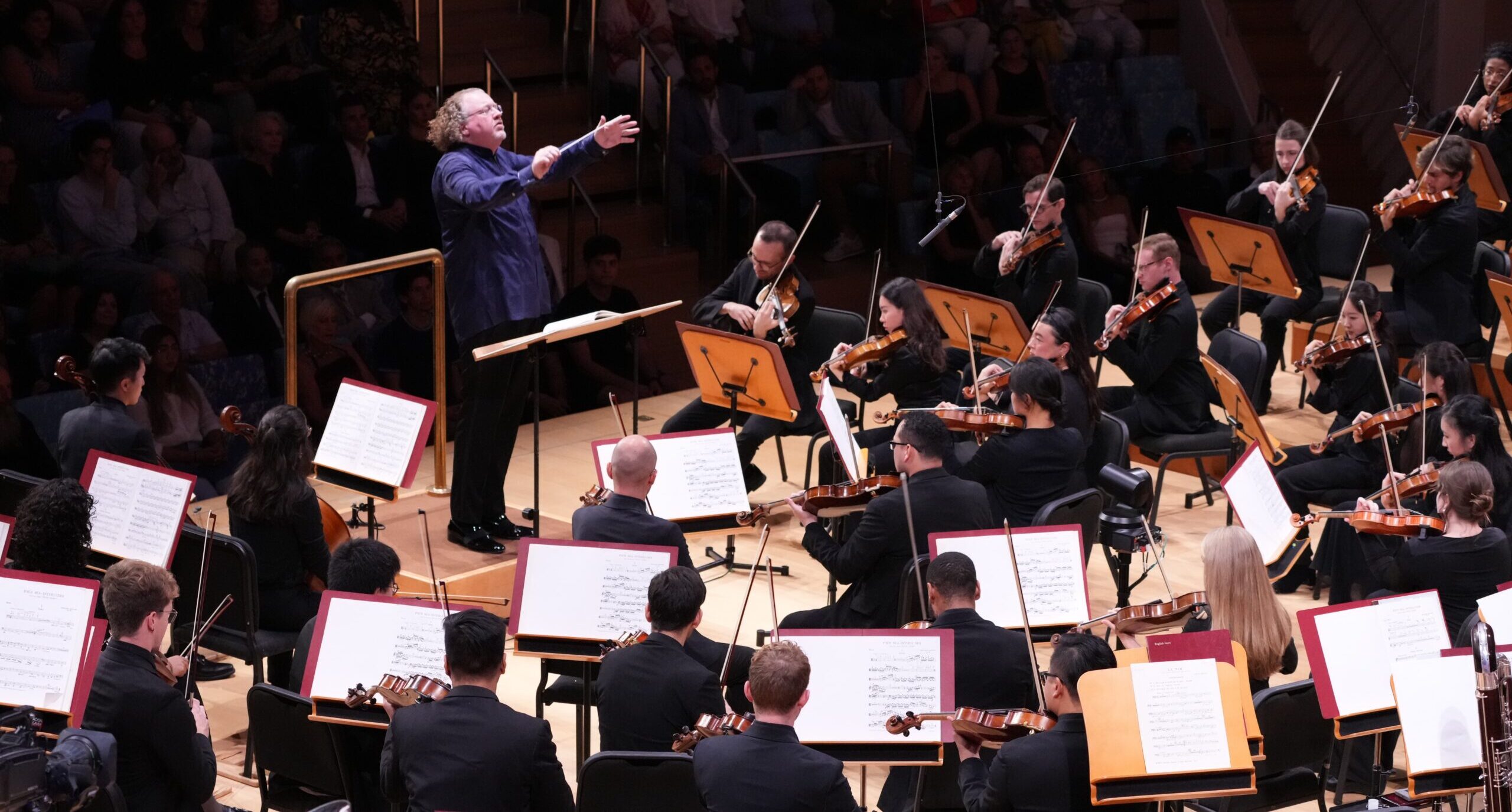
Stéphane Denève, the New World Symphony’s artistic director, leads the orchestra in “Denève: Prokofiev’s Romeo + Juliet,” on Saturday, Oct. 14 and Sunday, Oct. 15 at the New World Center, Miami Beach. (Photo courtesy of Rui Dias-Aidos/New World Symphony)
In September, New World Symphony artistic director and conductor Stéphane Denève stepped onto the stage wearing a blue, silk Japanese jacket he most likely picked up traveling in Asia on tour with an orchestra.
It was a definitive choice since a digital projection of Hokusai’s famous very blue “The Great Wave off Kanagawa” to accompany Claude Debussy’s “La Mer.” Being one to engage his audience even before a note begins, a projection on the large screen, the same one that would soon cast the image of “The Great Wave” showed a black and white photo of Debussy, the famous Hokusai ocean print hanging not far from where the composer was seated in his studio.
Denève loves a back story such as that — he feels that it adds an element to an audience’s experience rather than immediately back to the audience on the podium letting the music start right in.
As he says, he likes a narrative. On Saturday, Oct. 14, NWS opens its season with a program that Denève says follows the narrative of eternal life and love.
Stéphane Denève conducts the New World Symphony orchestra in a concert of Debussy and Britten on Saturday, Sept. 16. (Photo courtesy of Rui Dias-Aidos/New World Symphony)
There have already been two concerts with the new artistic director, who is only the second to be in that position in the history of the orchestra. “Denève’s Debut” was in April and then aforementioned blue-themed program in September, but the maestro says this is the official opening.
“Those were pre-concerts — this is the start of the season,” he says, adding that this is the first concert of 2023-2024 with the Saturday night simulcast of New World’s Wallcast, a 7,000-square-foot projection wall, in its SoundScape Park.
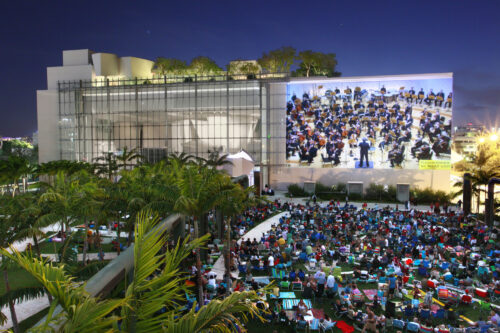
New World’s Wallcast events have hundreds of people on the lawn outside of the Frank Gehry-designed building on blankets, on beach chairs, tailgating with picnic baskets, and all the while listening to classical music.
The Wallcast, a draw to New World Symphony by many who may never purchase a ticket to the orchestra’s concert, is another perfect fit for the artistic director – the idea of accessibility for audiences to experience classical music, whether they ever step inside the door or not.
“Coming to see the orchestra isn’t supposed to be mystifying,” he says. Whether someone is inside the hall or outside on the lawn taking in the music, he wants his audiences to know that “you can come with whatever knowledge you have about the music. I’m always sad when people go to a museum, and they are worried that they don’t know what to say about the art. The purpose is to create something that interacts with you – making you at ease to discover. Not ‘What should I think? What should I say?’ ”
The Wallcast, outside of the New World Center in Miami Beach, simulcasts New World Symphony concerts. (Photo courtesy of Rui Dias-Aidos/New World Symphony)
And that’s again where the idea of a narrative for his concerts comes in. This weekend’s “Denève: Prokofiev’s Romeo + Juliet,” features three pieces with the first by Baltimore-based composer James Lee III titled “Visions of Cahokia,” a composition that was commissioned by the St. Louis Symphony, of which Denève is music director. The piece premiered with that orchestra in January of 2023. Lee, who Denève notes will be in the audience for the performance, has a history with New World Symphony. The composer’s “Sukkot Through Orion’s Nebula” was premiered by NWS founder Michael Tilson Thomas and the orchestra in October of 2011. Denève has also included the work in the St. Louis Symphony’s repertoire.
“He is a really wonderful symphony composer,” says Denève of Lee. “I have performed four different pieces of his.” “Visions of Cahokia” fits the eternal life-love throughline of the concert. Located across the Mississippi River from St. Louis, Cahokia was the largest pre-Columbian city north of Mexico, and, at its peak from 1050 through 1200 had a population between 10,000 and 20,000 people.
While most of the ancient city, which was somehow abandoned in 1400, now lies buried under highway and development in St. Louis, Denève says that Lee’s composition brings to light the story of the eternity of a civilization.
Stéphane Denève commissioned “Visions of Chokia” by composer James Lee III for the St. Louis Symphony. Now, New World Symphony will perform it. (Photo courtesy of Roy Cox Photography)
The second piece, which features pianist Gabriela Montero, is Sergei Rachmaninoff’s “Piano Concerto No. 2 in C Minor, Op. 18.” Listeners may recognize melodies of modern songs that were swiped from the concerto: Frank Sinatra’s 1945 “Full Moon and Empty Arms” and Eric Carmen’s 1975 “All by Myself,” songs about lost love and longing.
As the finale, Denève says he’s recast Sergei Prokofiev’s “Suite from Romeo and Juliet.” “Every conductor, including myself reworks the selection. The ballet is 2½ hours long and he actually wrote three different suites that kind of don’t work together.”
Not for Denève’s season-opening theme.
“My selection is more about finding the narrative arc and trying to really convey the emotional story and this idea of eternal love” of Shakespeare’s famous star-crossed lovers.
Stéphane Denève conducts NWS at a 2023 Gala concert. (Photo courtesy of Blooming Photo Co.)
“I love the dialogue that these pieces form,” he says, comparing them to planets orbiting each other in perfect harmony.
For the people inside the concert hall and those who’ll camp out on the lawn for Saturday night’s Wallcast, Denève has a request. “Come as you want. Come with an open mind and we will transport you,” he says with confidence.
WHAT: New World Symphony: “Denève: Prokofiev’s Romeo + Juliet”
WHERE: New World Center, Michael Tilson Thomas Performance Hall, 500 17th St., Miami Beach.
WHEN: 7:30 p.m., Saturday, Oct. 14 (with Wallcast and live webcast) and 2 p.m. Sunday, Oct. 15;
COST: $75-$125; Wallcast free.
INFORMATION: 305-673-3331 or 800-597-3331, also nws.edu
ArtburstMiami.com is a nonprofit media source for the arts featuring fresh and original stories by writers dedicated to theater, dance, visual arts, film, music and more. Don’t miss a story at www.artburstmiami.com.
No posts found
Chad Goodman started with the trumpet then the road led to conducting
Written By Sebastián Spreng October 6, 2023 at 11:19 AM
Conductor Chad Goodman was a conducting fellow at New World Symphony. Now he’s artistic director of Miami’s Illuminarts and conductor of the Elgin (Illinois) Symphony Orchestra (Photo courtesy of Jiyang Chen/Illuminarts)
It is “the” question that every new music graduate asks himself, the same one Chad Goodman raised in his book “You Earned a Music Degree. Now What?” the distressing abyss that opens above all recently graduated is especially pressing in every artistic discipline. In his case, both luck and perseverance have gone hand in hand. Entering a dialogue with the young conductor confirms his enthusiasm and contagious energy, removing all doubt that Goodman, in addition to honoring the meaning of his surname, embodies the optimistic message of the new generation.
As the world of music is also no stranger to the changes that happen without pause, we are witnessing the replacement of orchestral leaders who inevitably give way to young maestros. Goodman competes with his peers in a race where the one who doesn’t risk doesn’t win.
Born in Baltimore in 1989, Goodman says “the music came through jazz. I wanted to play the trumpet like my father and grandfather. They gave me their instrument, and so it all began.”
At 13, he joined the Maryland Youth Symphony Orchestra, where, he says, Dvorak’s “New World Symphony” changed his life.
“The wonderful summer camps in Interlochen connected me to the world.” At Eastman, he followed his trumpet training ending in San Francisco, where Martin Seggelke, the director of the San Francisco Wind Ensemble, encouraged Goodman to look into orchestral conducting.
“He saw a capacity that I didn’t imagine. He was right.” He founded the Elevate Ensemble, where he says he also had to learn the business side — how to do fundraising while establishing a composer’s program. “I see it as an essential mission of a conductor to stimulate and disseminate the composers of his own time . . . I ended up commissioning fifteen new works. Besides, being in the Bay Area was an ideal conjunction.”
Chad Goodman’s greatest ambition and dream is to become a conductor of a ‘great American orchestra,’ like his mentor Michael Tilson Thomas. (Photo courtesy of New World Symphony/IlluminArts)
That vertiginous roller coaster, in which he took every chance, paid off first as a cover and then as Assistant Conductor at the San Francisco Symphony, where he learned his trade alongside big names until the end of this first term. It was then he moved to Miami Beach as a Conducting Fellow at the New World Symphony.
Neither the threat of hurricanes nor the pandemic allowed Goodman to make the most of his time at the America Orchestral Academy.
“Only the privilege of sharing subscription concerts with star conductors brings an unparalleled experience, listening to their criticisms and enriching comments. Just being at rehearsals is invaluable. All of that, plus the formal training, is a possibility that only happens in the NWS. Imagine having the chance to conduct fourteen concerts in one season, a dream. To me, those four years seem more than eight in experience,” says Goodman. “At NWS, it was like arriving by bus and… getting on a jet airplane.”
At the end of his years with NWS in 2022, two big surprises awaited him. First, the prestigious Elgin Symphony Orchestra named him its fifth conductor in its seven decades of existence. The second was related to the Miami artistic environment as the artistic direction of Illuminarts, the fascinating Miami musical alternative created by mezzo-soprano Amanda Crider, now celebrating its tenth anniversary.
“I feel I have the best of two worlds — on the one hand, an orchestra that is a hotbed of talents and constantly visited by celebrities, taking advantage of its proximity to Chicago, and on the other, to continue in Miami in an organization that aims at various artistic disciplines based mainly on the musical side.”
The first program of IlluminArts’ 10th anniversary season will be at Vizcaya. “A place with a unique atmosphere,” he says, adding that last year, Illuminarts successfully performed Britten’s “The Turn of The Screw.”
On Saturday, Oct. 28, the musicians will perform “Songs of the Night” featuring baritone Jesse Blumberg. Goodman calls it “a compendium of gems” that includes Tchaikovsky’s “Souvenir de Florence,” songs by Samuel Barber and Gerald Finzi plus the magical “Fanfare for St. Edmundsbury” by Benjamin Britten.
“Imagine that on a full moon night. It is the ideal setting with a program in every sense related to its founder James Deering.”
That show is already sold out.
There are upcoming plans to work with galleries and museums including Oolite Arts. Goodman says the second concert will be at Miami’s LnS Gallery with a recital by Crider and baritone Keith Phares set for Friday, Nov. 17. Details will soon be announced, he says.
“Amanda started this incredible organization that deserves full recognition,” says Goodman.
About audiences’ response, Goodman says, “The secret is in how music is presented.” (Photo courtesy of Jiyang Chen/Illuminarts)
About the audience’s response, Goodman says, “The secret is in how music is presented.” And advice from Michael Tilson Thomas (MTT). “Much of his legacy is to have inspired so many communities, to have instilled in them their passion and commitment to music. He has transferred that responsibility to us. I immensely value his teaching and advice: ‘You are in the right place; keep working, study, and get ready because what is coming is intense. In the meantime, be patient and find your balance.’ Therefore, it is essential to maximize the time lived with music regardless of age; every hour spent with music counts.”
Goodman cites Ravel as his favorite composer, followed by Stravinsky and Sibelius. On a pedestal is Beethoven, to whom he feels “an inexplicable visceral connection.” Among his conductors, MTT has a preferential place much before the SFO and NWS “his connection and work with American music is extraordinary. I learned a lot also from Manfred Honeck and Susanna Mälkki. I admire those who, having reached the top, are still curious, researching, and studying, for instance, Herbert Blomstedt, who at age 96 continues to lead with the same passion of youth. And if I should choose from the past, definitely: Gustav Mahler. Closer, Carlos Kleiber . . .I’m afraid that all conductors will say the same.”
If his greatest ambition and dream is “to become the conductor of a great American orchestra, like my mentor Michael Tilson Thomas,” yet Goodman is aware of the opportunity and challenge that constitutes a city like Miami, “which grows at an unstoppable pace but given its size it already needs more classical music, a great professional orchestra, more opera and much more, but… that’s what we are for.” It is, therefore, worth noting that an NWS alumnus now nurtures the community where he received his remarkable training.
When Goodman wrote his guidebook for graduates, perhaps, he didn’t realize that he would be the first beneficiary in applying his advice. The results are in sight, and that boy fascinated with Dvorak’s New World Symphony and who, paradoxically, graduated from the New World Symphony in Miami Beach, is today and, as Forbes magazine stated, “an entrepreneur who brings innovation to classical music.”
ArtburstMiami.com is a nonprofit media source for the arts featuring fresh and original stories by writers dedicated to theater, dance, visual arts, film, music and more. Don’t miss a story at www.artburstmiami.com.
No posts found
Musical history is personal to Arturo O’Farrill and so is the future of Latin jazz
Written By Fernando Gonzalez October 5, 2023 at 10:45 PM
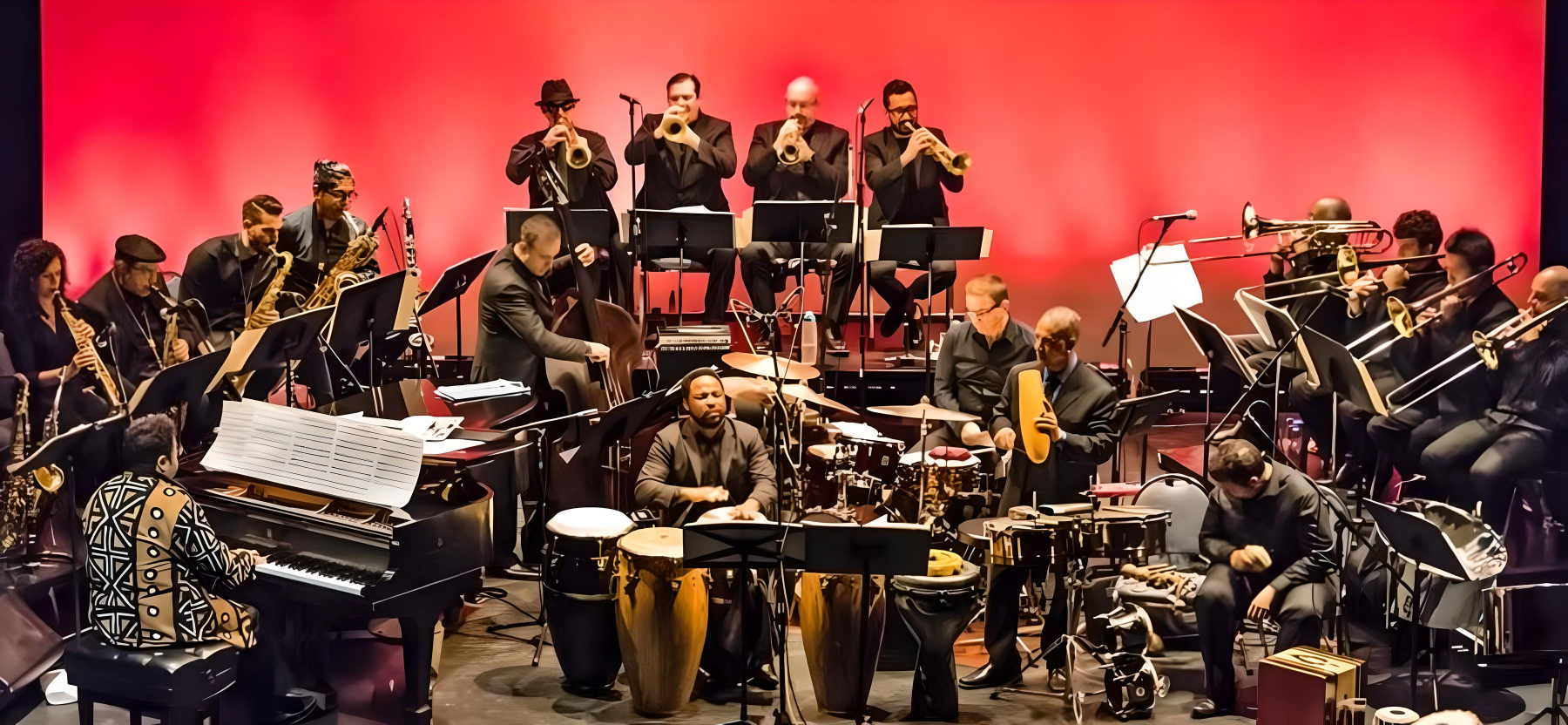
Arturo O’Farrill and the Afro-Latin Jazz Orchestra will be at the Miami Beach Bandshell on Saturday, Oct. 21 at 8 p.m. presented by MDC’s Live Arts Miami.
The big band is to jazz what the symphony orchestra is to classical music and, for a composer, an instrument of unmatched power with a rich palette of sounds to match. But that is only part of what led pianist, composer, and educator Arturo O’Farrill to organize and lead the 18-piece Afro-Latin Jazz Orchestra.
“I’ll tell you what the Orchestra represents for me,” he says during an interview via telephone from his home in Los Angeles. Born in Mexico and raised in New York, O’Farrill has been in Los Angeles working as a professor of Global Jazz Studies and Assistant Dean for Equity, Diversity, and Inclusion at UCLA. “What interests me is that Machito and Mario Bauzá came to New York City to play, saw the big bands of Cab Calloway and Count Basie, and said, ‘Why can’t we do that with our music?’ ”
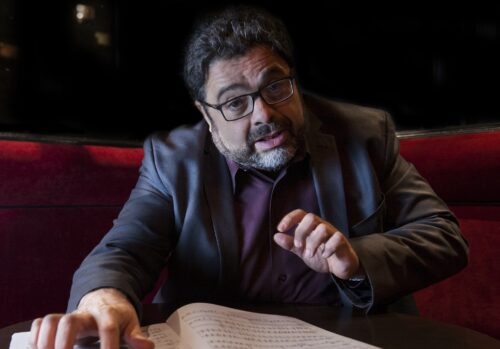
Arturo O’Farrill at Jazz Café Montparnasse, Paris, France, Jan. 14, 2016. (Photo courtesy of Sophie Le Roux/Live Arts Miam at Miami Dade College)
He continues: “I thought it was such a powerful thing to say ‘We are Afro-Cubans. Why don’t why can’t we do that in our own style?’ And they created (the big band) Machito and His Afro-Cubans. It was such a beautiful, self-affirming statement, and with that, they sparked this burning flame that has not gone out. The Orchestra represents saying, ‘We are Latinos, we’re Afro-Latinos, and we’re reclaiming this tradition that is as much a part of our life as it is of anyone else’s.’ ”
Arturo O’Farrill and the Afro-Latin Jazz Orchestra will be at the Miami Beach Bandshell at 8 p.m. on Saturday, Oct. 21, presented by Miami Dade College’s Live Arts Miami.
O’Farrill — winner of six Grammys and two Latin Grammys as a composer and solo artist, and four Grammys and a Latin Grammy with the Afro-Latin Jazz Orchestra — grew up surrounded by the big band and orchestral traditions.
His late father, the great Cuban composer and arranger Arturo “Chico” O’Farrill, wrote notable large ensemble pieces in the jazz and Latin jazz idioms and was a friend and collaborator of Frank “Machito” Grillo and Bauzá.
Musical history is personal to O’Farrill, so is the future of Latin jazz.
From left, Telmary Diaz, Dayme Arocena, and Aymee Nuviola will perform with Arturo O’Farrill and his orchestra at the Miami Beach Bandshell. (Photos courtesy of Live Arts Miami at Miami Dade College)
“Even their name was revolutionary: Machito and his Afro-Cubans. At that time, nobody was calling anything ‘Afro-Anything.’ And here’s the other lesson on why I also created the Orchestra. Call it what you want, but all the rhythms in Cuba and the rhythms that become jazz are rooted in African subdivisions of syncopations,” says O’Farrill, who has embraced a Pan-Latin approach in his work. “As I continued my journey, I discovered that those (African) rhythms made their way through Colombia, Brazil, Venezuela, and all the Americas. In acknowledging the roots of our music, we can safely travel the future.”
He’s enthusiastic about working with Cuban singers Aymée Nuviola and Daymé Arocena and rapper Telmary Diaz, who will be special guests at the Bandshell appearance.
“Aymée, Daymé, and Telmary are three really different artists that represent the vanguard of great female she-power to me, ” says O’Farrill. “Aymée’s repertoire is a beautiful reinterpretation of standard Cuban repertoire. I don’t even know where to put Daymé’s music. It’s all original, and she does this powerful rumba-based, timba-based modern contemporary Cuban music. And, of course, Telmary is one of the great raperas of our time. To see these three powerful women take the stage is a thrill because jazz and Latin music are very male-centered – and wrongly so. It’s past time that women take what’s rightfully theirs.”
Arturo O’Farrill: Tiny Desk Concert
He expects the program to be “a celebration of visioning,” says O’Farrill, connecting the music’s history and its possibilities.
“This music is not static, and every time it embraces a young artist, it grows,” he says. “We still play classics like (Tito Puente’s) ‘Babarabatiti,’ we still play (Mario Bauza’s) ‘Mambo Inn,’ but then maybe we’ll go to something I wrote.”
When the Orchestra performs Bauza’s “Kenya,” O’Farrill says he imagines being in the audience at the Cotton Club when Machito and his Afro-Cubans first played it.
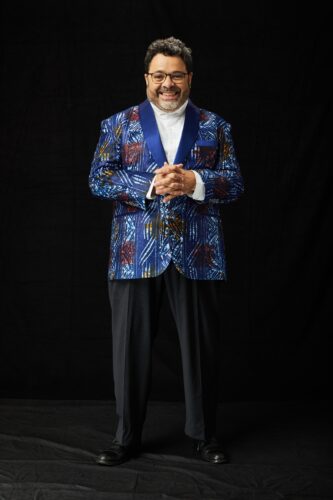
Arturo O’Farrill says his performance with his orchestra at the Miami Beach Bandshell will be “a celebration of visioning.” (Photo courtesy of Jen Rosenstein/Live Arts Miami at Miami Dade College)
“Do you think anybody there was comfortable? No. They were experiencing something new — and to me, that’s exciting. I want to play with that vision and that energy. The job of the artist is to pose challenges, and you can’t challenge unless you also comfort, so there’s a little bit of both in what we do. I want to take people on a journey.”
WHAT: LiveArts Miami presents Arturo O’Farrill with the 18-piece Afro-Latin Jazz Orchestra (ALJO) and guests Aymée Nuviola, Daymé Arocena, and Telmary Diaz
ArtburstMiami.com is a nonprofit media source for the arts featuring fresh and original stories by writers dedicated to theater, dance, visual arts, film, music and more. Don’t miss a story at www.artburstmiami.com.
No posts found
Steel drums, costumes and plenty of Caribbean culture a Miami Carnival tradition
Written By Jonel Juste October 5, 2023 at 7:56 PM
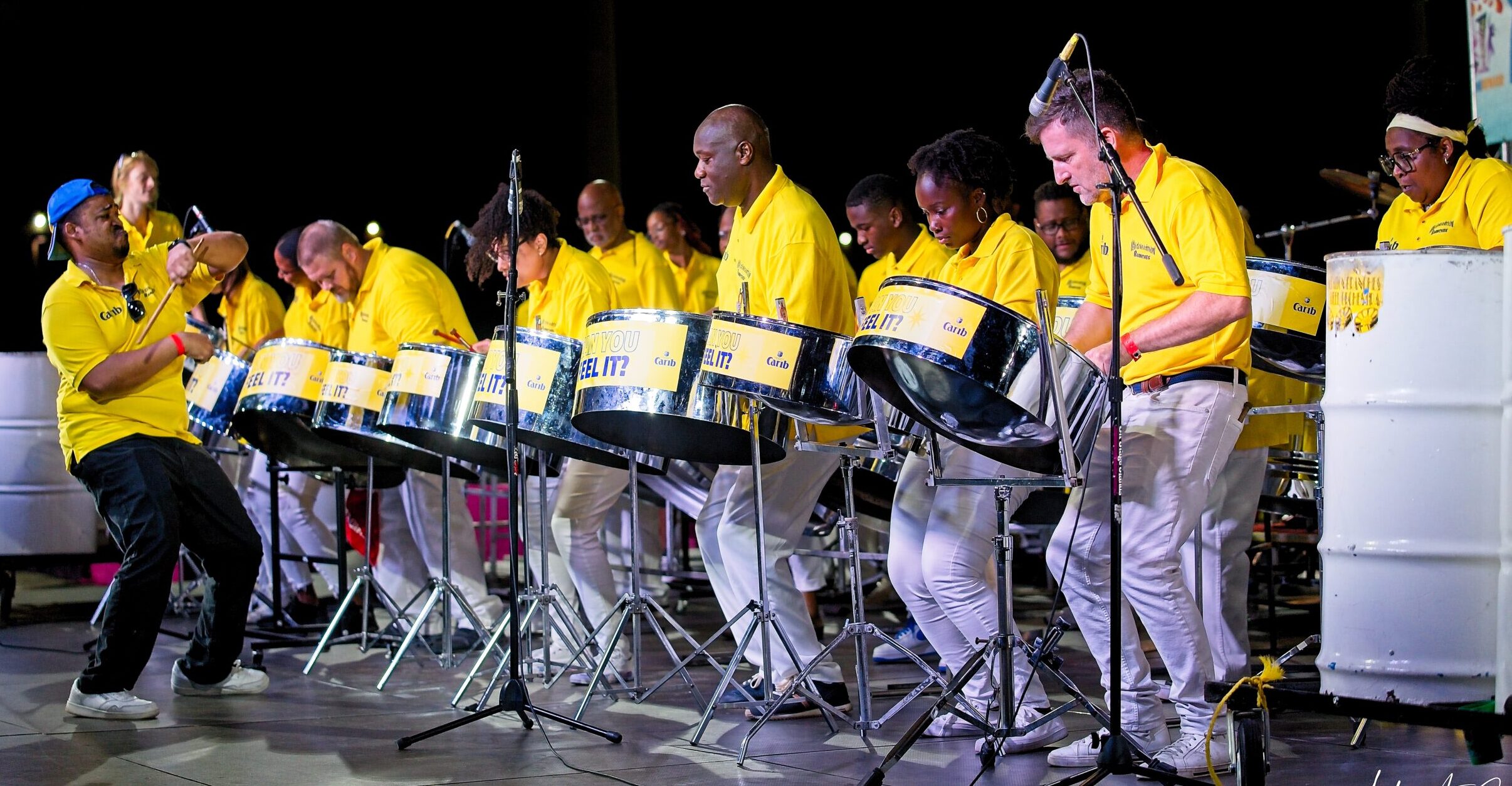
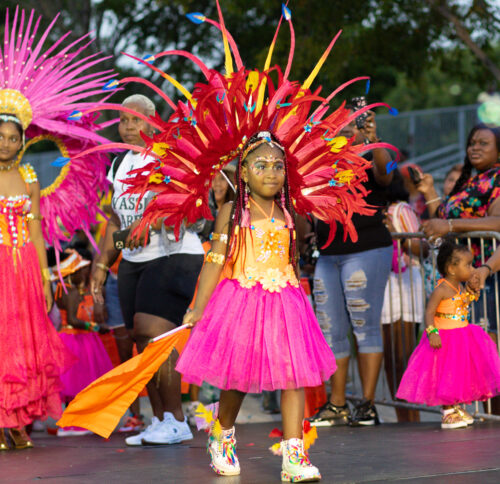
A key component of the Miami Carnival is Panorama, the steelpan competition. The steelpan plays a pivotal role in all aspects of the carnival. This year, the competition is on Friday, Oct. 6. (Photo courtesy of Mark James)
Miami Carnival has been a fixture in South Florida for nearly four decades. According to Shane Carter, vice chair of Miami-Broward One Carnival, one of the reasons for this, he believes, is its capacity to bring people together, both culturally and socially.
“Like Thanksgiving, the Fourth of July, and many other holidays that foster gatherings of family and friends,” says Carter,“our Carnival plays an integral part in keeping friends and family celebrating together under the guise of culture.”
“Inclusiveness” is how Carter describes Miami Carnival as it approaches its 39th year. “We’ve seen individuals from diverse backgrounds use Miami Carnival as their introduction to this vital cultural event.”
Carter emphasizes that Miami Carnival transcends Caribbean Americans, welcoming the entire South Florida community. According to him, it’s an opportunity to reconnect with friends, spend time with family, savor Caribbean cuisine, groove to music, and discover a heritage that might not be familiar to them. “It is visually a beautiful event, with people and costumes that are worthy of being on any great stage.”
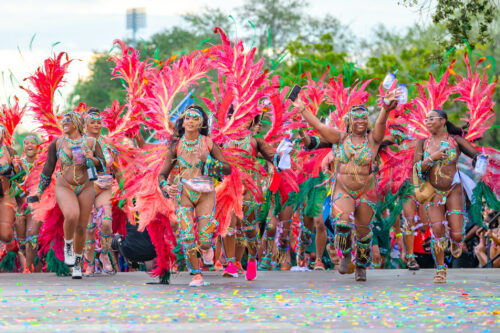
The parade of the bands at Miami Carnival features over 18,000 participants from over 20 mas bands dancing along a parade route. (Photo courtesy of Tech Your Picture)
What sets Miami Carnival apart from other cultural events, according to Carter, is the symbolism it carries. “While it has evolved over the years, the carnival remains a commemoration of what ancestral slaves did to keep some of their African practices alive.”
This symbolism will come to life on Sunday, Oct. 8, during the masqueraders (or mas) bands parade, where participants don costumes, masks, and disguises to dance through the parade route. The costumes add an artistic narrative to the heart of the carnival, and attendees are encouraged to join a band and “play Mas.”
The festivities began on Saturday, Sept. 30 with the Junior Carnival, also known as “Kiddies Carnival” with a focus on introducing the next generation to the mas and Carnival culture.
On Friday, Oct. 6, the steel band competition called Panorama takes place at Central Broward Regional Park in Lauderhill. Dexter Bleasdell, the Panorama manager, highlights the significance of the event within Miami Carnival, describing it as a platform for steelpan musicians to unite and showcase their unique talents on a grand stage. More than twenty bands will participate in Panorama this year.
“Panorama’s role within Miami Carnival is to create an avenue for steelpan musicians to get together and showcase their unique talent to the world. This musical event contribution is significant as it sets the stage for carnival revelers for Jou-vert and Grand Parade,” says Bleasdell.
The global recognition of the steelpan was emphasized on July 24 when the United Nations declared Aug. 11 as World Steelpan Day. Google even celebrated this musical instrument with a dedicated Google Doodle last year.
The festivities began on Monday, Sept. 30 with the Junior Carnival, also known as “Kiddies Carnival,” aimed at introducing the next generation to the mas and Carnival culture. (Photo courtesy of Miami Carnival)
“Hopefully, this acknowledgment can create employment opportunities for pan musicians, arrangers, tuners, educators, and anyone involved in the steelpan industry,” says Bleasdell.
The celebrations continue on Saturday, Oct. 7, with J’ouvert, a lively celebration featuring calypso/soca bands and their followers dancing through the streets, covered in colored paints, mud, oil, and other materials.
The big finale of Miami Carnival is on Sunday, Oct. 8 with the mas bands parade and a concert. According to the organizers, the Sunday parade will feature more than 18,000 masqueraders in more than twenty mas bands.
The concert segment serves as a platform for showcasing international Caribbean talent, with performances from prominent Soca acts and live bands. Past years have featured renowned artists such as Machel Montano, David Rudder, Super Blue, and Wyclef Jean.
This year’s lineup includes artists like Bunji Garlin, winner of the 2013 Soul Train Award for Best International Performance for the song “Differentology,” Claudette Peters, known as Antigua’s “Soca Diva,” and Olatunji Yearwood, the face of Afrosoca music, an emerging genre fusing Soca and Afrobeats.
A reveler enjoys Miami Carnival’s street party J’ouvert. (Photo courtesy of Neil Brent Photography)
Carter introduces an innovation for Panorama this year, a “bull track” concept that provides backstage interaction with the audience and pan players before their performances.
Another noteworthy aspect of Miami Carnival, according to Carter, is its role in showcasing participants’ creativity and artistic expression through elaborate costumes and performances. “This aspect of the tradition promotes cultural preservation and creativity among its participants.”
Carter says the atmosphere is meant to be a place where people can revel in their culture and others experience the phenomenon known as Carnival.
WHAT: The Miami Carnival
WHEN: Steel Band Panorama competition, 4 to 11 p.m., Friday, Oct. 6; J’ouvert Mas, 7 a.m. to 3 p.m., Saturday, Oct. 7, Central Broward Regional Park; Mas Band Parade and Concert, 11 a.m. to 11 p.m., Sunday, Oct. 8 at Miami-Dade County Fair and Exposition Fairgrounds
WHERE: Central Broward Regional Park, 3700 NW 11th Place, Lauderhill, and Miami-Dade County Fair and Exposition Fairgrounds, 10901 SW 24th St., Miami.
COST: $30, $50, $65, $150 for general admission pass, $2,500 for VIP experience.
ArtburstMiami.com is a nonprofit media source for the arts featuring fresh and original stories by writers dedicated to theater, dance, visual arts, film, music and more. Don’t miss a story at www.artburstmiami.com.
No posts found
Review: Rhythm meets roots in a concert by Cuban masters Chucho Valdés and Albita Rodríguez
Written By Helena Alonso Paisley September 28, 2023 at 7:32 PM
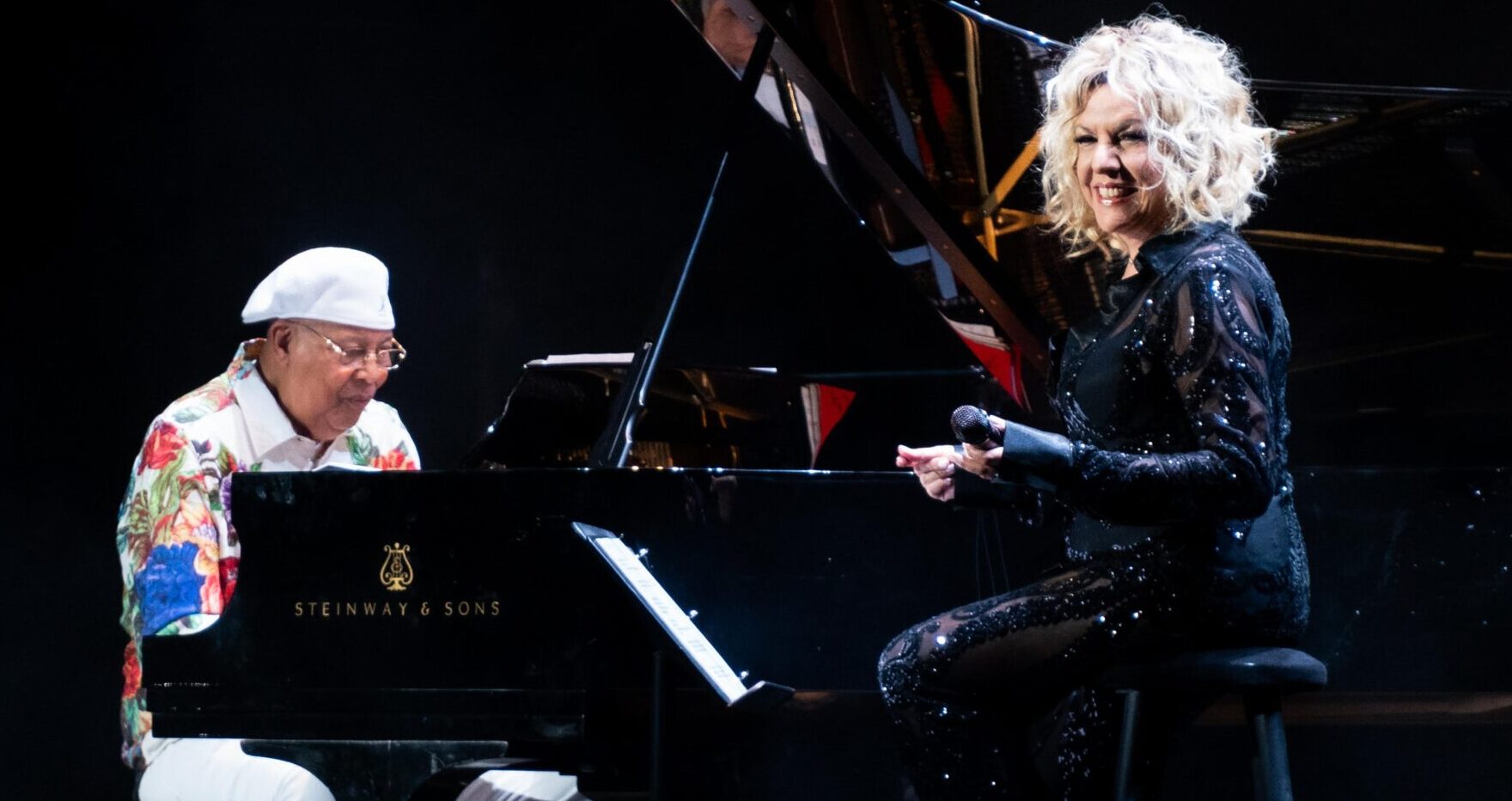
Afro-Cuban jazz pianist Chucho Valdés and singer Albita Rodríguez joined forces in a “Masters of Roots” concert at the Miami-Dade County Auditorium before embarking on a European tour. (Photo courtesy of InnerCat Films/Albita Rodriguez)
The broad range of Afro-Cuban music was on brilliant display on Friday, Sept. 22 at the Miami-Dade County Auditorium when pianist Chucho Valdés and singer Albita Rodríguez joined forces in “Masters of Roots: Albita and Chucho Valdés in Concert.” By the evening’s end, the nearly full auditorium was overflowing with joy, vitality and cubanidad.
Valdés’s roots are firmly set in the Latin jazz tradition—a musician friend said Valdés is an American when playing jazz and a Cuban when improvising. Albita’s roots, on the other hand, are planted deep in the Cuban countryside, in the rich soil of “punto guajiro,” an improvisatory folk form that requires as much on-the-spot versifying skills as the most accomplished hip hop freestyler.
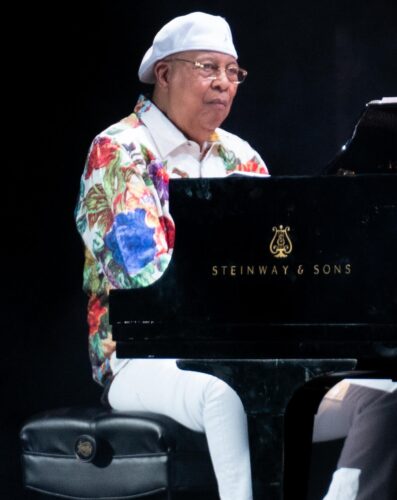
Seven-time Grammy winner Chucho Valdés, now 82, began piano lessons with his father, Bebo Valdés, at the age of three, and still plays with the vitality of a man half his age. (Photo courtesy of InnerCat Films/Albita Rodriguez)
Valdés’s creative impulse spans genres in much the way his giant hands span the octaves. He started the evening by asking the audience to imagine Wolfgang Amadeus Mozart, a glass of rum in one hand and a fat cigar in the other, lounging on a beach outside of Havana. Then he laughed as he launched into his composition “Mozart a la Cubana,” which, he said, showed what the iconic classical composer would have sounded like had he been born in Cuba.
His next piece traveled further south, to Argentina. “Lorena’s Tango,” which Valdés called “less ‘tango’ and more ‘tengo,’” meaning “I have” in Spanish. Truer words were never spoken. Valdés demonstrated on this swinging virtuoso piece that, whatever ‘it’ is, at nearly 83 years old, he’s clearly still got it, and in spades.
To watch Chucho Valdés at the piano is to observe a master—not at work, but at play. His deft brown fingers will sometimes perform the most delicate dance on the ivories, later to bounce up and down like so many teenagers in a mosh pit, finally to careen down the keyboard like a fearless middle-schooler on a Slip N’ Slide.
Valdés’s musicians—Armando Gola on electric and upright bass; Horacio Hernández on the drum set; and Roberto Vizcaíno on congas—are all stellar performers in their own right, and the pieces of the band fit together like cogs in a fine clock, supporting one another and allowing each to shine in extensive solos on pieces like “Bacalao con Pan.”
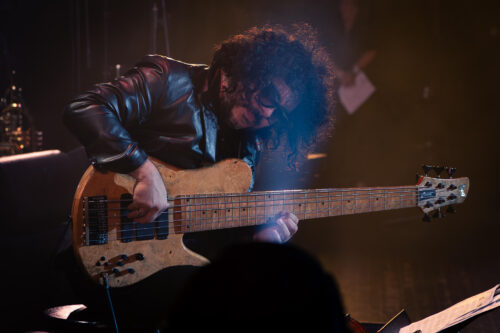
Switching from upright to electric bass in “Mambo Influenciado,” Armando Gola was featured in a long and rich solo. (Photo courtesy of InnerCat Films/Albita Rodriguez)
When Albita joined Valdés onstage, it was clearly a meeting of artistic equals with tremendous respect and affection for one another. She recounted the conversation when the pianist called her on the phone a year ago:
—” ‘Albita?’ he said.
‘Chucho?’ I said.
‘How did you know who I was if I’m not a singer?’
‘Who doesn’t know who you are, Chucho?’ I said.”
“La Negra Tomasa,” written in 1937, was their first tune together, hearkening back to the singer’s past as much as Cuba’s. Just as Valdés’s first teacher at the age of three was his father Bebo Valdés, Albita learned to sing from her parents, who performed Cuban traditional folk music professionally as the duo Mima and Pipo. She explained her infancy, saying, “My mother didn’t give me milk, she gave me ‘puntos guajiros.’ ” It seems as if most of the audience had received a similar upbringing, as they immediately joined in on the chorus with gusto.
With virtuosic conga rhythms, Roberto Vizcaíno of Chucho Valdés’s Royal Quartet planted the band firmly in Afro-Cuban soil. (Photo courtesy of InnerCat Films/Albita Rodriguez)
Although there was a smattering of young gay couples and a few families with children in tow, much of the nearly full house was somewhere north of 50. They had clearly been listening to Albita’s music for a very long time. Perhaps even since her arrival in Miami in 1993 as a rebellious, androgynous-looking 31-year-old who earned her living singing early mornings for factory workers in Hialeah and performing Friday happy hours at Yuca Restaurant with the four amazing, funky and beautiful young musicians that had followed her across the Mexican border.
With her spiky hair, a black studded wristband and skinny black jeans, Albita arrived on the Latin music scene like a hurricane in a petite and powerful package.Thirty years later, her voice is still a force of nature. She traded in the spikes on her bracelet for sequins long ago and her short haircut for big, blond curls. Still, that singular voice of hers is as full of gravel and grit as ever. If anything, it has only become richer and smokier with the years.
Drummer Horacio Hernández shredded on a long solo at the concert’s end, eliciting cheers from the enthusiastic crowd. (Photo courtesy of InnerCat Films/Albita Rodriguez)
The only head scratcher during the concert was when a group of guayabera-clad children came out to accompany Albita on “Coro a la Caridad,” a song dedicated to the Virgin of the Caridad del Cobre. Squeaky clean, with sunflowers in hand, they seemed more appropriate for a 1950s children’s television hour than for a concert showcasing two of Cuba’s musical royalty.
When Albita sang her old hits like “¿Qué Culpa Tengo Yo?,” and standards like “Lágrimas Negras,” the nostalgia in the house was palpable. Although you couldn’t tell who among the listeners was remembering their lost youth in Cuba and who was channeling their lost youth in Coral Gables, the auditorium was so alive with the feeling of belonging, both in the music and the moment, that it didn’t much matter.
And while it may be true that you can never go home again, at this concert, you felt pretty darned close.
ArtburstMiami.com is a nonprofit media source for the arts featuring fresh and original stories by writers dedicated to theater, dance, visual arts, film, music and more. Don’t miss a story at www.artburstmiami.com.
No posts found
The Opera Atelier’s ‘Spain, My Love ~ Cuba, My Love’ Evokes a Sense of the Past
Written By Jonel Juste September 25, 2023 at 7:07 PM
Singers Silvia Ludueña and Carlos Silva perform the duet “Torero quiero ser” from “El Gato Montés” during Spain, My Love in 2021, a production by The Opera Atelier production. On Saturday, Sept. 30, the opera group performs “Spain, My Love ~ Cuba, My Love” at the Miracle Theatre in Coral Gables. (Photo courtesy of Javier Fontanella)
The Opera Atelier, in honor of National Hispanic American Heritage Month, which runs through Oct. 15, is adding its voice to the local and nationwide celebration. They’ve teamed up with Voices of Miami for “Spain, My Love ~ Cuba, My Love” at the Miracle Theatre in Coral Gables on Saturday, Sept. 30.
The program will showcase Spanish-themed operas, highlighting the cultural heritage of Spain in addition to Cuban music.
Daniel Daroca, the music director of The Opera Atelier, says that the title of the evening evokes a sense of the past.
“It immediately transports us to the realm of nostalgia, as it poetically evokes our exile from Spain, followed by our departure from Cuba (here, Cuba symbolizes any of the sister republics of Latin America). For Latin Americans, Spain serves as an anchor, tethering us to the roots of the Arcadia from which we sprang,” says Daroca.
Opera singer Greisel Domínguez of Voices of Miami performing “O mio Fernando” from La Favorita (Donizetti) during “Spain, My Love,” in 2021, a production by The Opera Atelier. (Photo courtesy of Javier Fontanella)
The program includes selections from operas such as “Il Trovatore,” “Don Carlo,” “Ernani,” and “Carmen,” as well as selections from zarzuela, often referred to as the Spanish equivalent of operetta.
“. . . . Selections that are representative of specific themes.” says Daroca. “In ‘Tu che le vanitá’ from Verdi’s ‘Don Carlo,’ Elisabetta decries the futility of life, a central theme in Spanish literature, and comments on her involuntary exile. The aria also indirectly reveals the exploitation of women, traded as pawns in political marriages. There is much richness in the text, translated later by the composer into exalted music,” he explains.
Soloists include Jorge Arcila, Yetzabel Arias, Marinel Cruz, Greisel Domínguez, Eglise Gutiérrez, Carlos Jimeno, Erzhan Kulibaev, Silvia Ludueña, and Carlos Silva, accompanied by pianists Eva Garrucho and Daroca.
Daniel Daroca, the music director of The Opera Atelier. (Photo courtesy of Xiomara Ponce)
The evening will also pay homage to Cuban musicians who have left their mark on the world stage, introducing rhythms like rumba, bolero, guaracha, mambo, son cubano, and salsa. Throughout the program, classical melodies by composers such as Ernest Lecuona, who composed over 600 works, and the also-prolific Jorge Anckermann, will be featured.
Greisel Dominguez, opera singer and choir director of Voices of Miami, says that the Miami chorus, which has been part of the community since 2014, has frequently collaborated with The Opera Atelier.
“Mostly all opera and zarzuela presentations require a choral ensemble to bring out the true flavor and grandeur of the program,” she says. Currently, Voices of Miami is working on a world premiere of the zarzuela “La ruta de Don Quijote” with the Florida International University Music Department and Maestro Gustavo Sanchez from Spain.
According to Dominguez, the group is “spreading its wings” with more collaborations such as the one with FIU and performances with groups like The Opera Atelier. “Sometimes this type of music can be thought of as old fashioned, but we work to erase this frame of mind. We . . . do this by increasing people’s knowledge and desire of opera, zarzuela and classical music in all its forms.”
Giselle Elgarresta singing the third act from Verdi’s La Traviata from Great Opera Moments in 2014, a production by The Opera Atelier. (Photo courtesy of Javier Fontanella)
The Opera Atelier, founded in 2011 and incorporated in Florida in 2012, is dedicated to revitalizing opera and promoting aesthetic education, says Daroca. “(We) strive to go beyond the trappings, the empty gestures, and the common places that sometimes mire the art form. Instead, TOA seeks to engage the audience in universal and contemporary themes.”
Its “Culture for the Mind and the Heart,” underscores the group’s commitment to education by staging diverse works, including classics and experimental pieces like “Miami Transfer or “La Voix humaine” by Poulenc.” They also create original operas for children and performed by children, such as “The Not So Little Prince” and “Frau Haydn in Trouble.”
A series presented in collaboration with the Miami-Dade Public Library, according to Daroca, was dedicated to creative women. Entitled “No Room of Her Own,” after Virginia Woolf’s “A Room of One’s Own,” Daroca says that “the activities brought to the fore the prejudices and difficulties women encountered solely because of their gender.”
Daroca invites audiences not familiar with opera to get an introduction with “Spain, My Love ~ Cuba, My Love,” saying that the program will be an enticing entry point into the art form.
“Opera, at its core, is sung drama, and this production combines rich variety and theatrical elements. Brilliant zarzuela selections provide a fiery contrast while the music of Cuba will submerge the audience in moments of nostalgia.”
ArtburstMiami.com is a nonprofit media source for the arts featuring fresh and original stories by writers dedicated to theater, dance, visual arts, film, music and more. Don’t miss a story at www.artburstmiami.com.
No posts found
Review: Live Arts brings Sona Jobarteh to Superblue in a spectacular Miami debut
Written By Helena Alonso Paisley August 29, 2023 at 5:47 PM
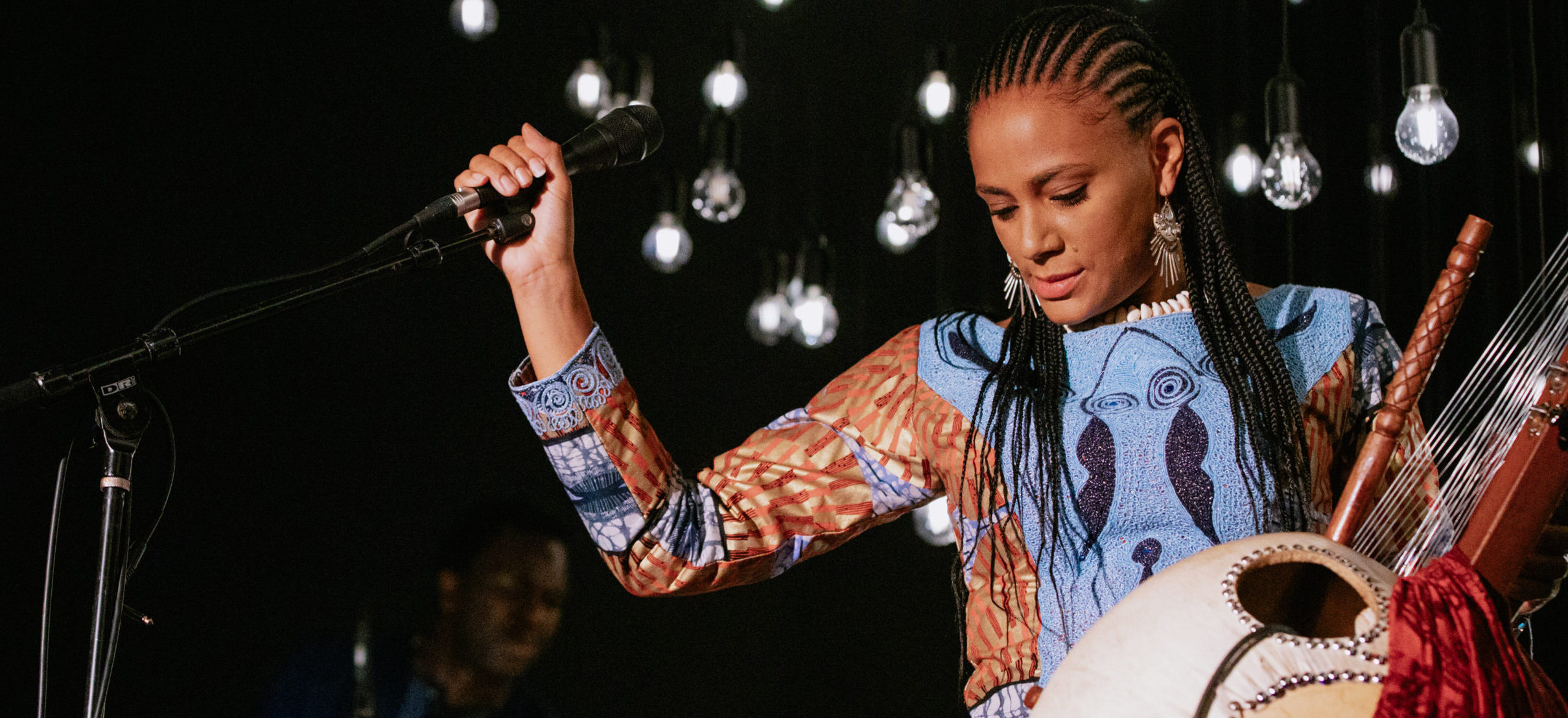
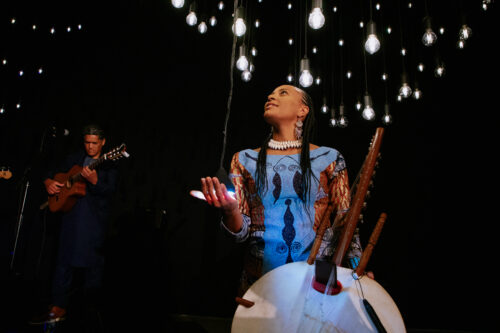
Kora player Sona Jobarteh’s brightly colored traditional attire contrasts with the dark background of Rafael Lozano-Hemmer’s immersive installation in a performance presented by Live Arts Miami on Saturday, Aug. 19 at Superblue, Allapattah. (Photo courtesy of Liliana Mora/Live Arts Miami)
The tiny West African nation of Gambia could not have found a better ambassador for its rich cultural heritage than kora player and singer Sona Jobarteh. Brilliant, beautiful and charismatic, the 39-year-old mesmerized a sold-out audience in her Miami debut on Saturday, Aug. 19 with her virtuoso musicianship, charming stories and intriguing ideas. She covered just about everything from educational reform to the artist’s role in society to finding a path that allows us to break free from traditions that limit us while at once upholding those that lift us up.
The show was Live Arts Miami’s first stab at presenting music at Superblue in Allapatah, a two-year-old museum whose specialty is immersive visual art installations, not intimate concerts.
Other than having to call an ungodly 7:30 a.m. soundcheck to accommodate Superblue’s regular visiting hours, the pairing of museum and music was a match made in heaven.
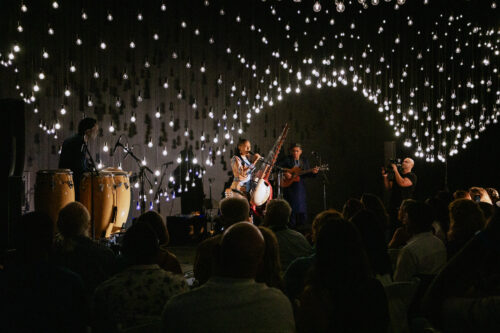
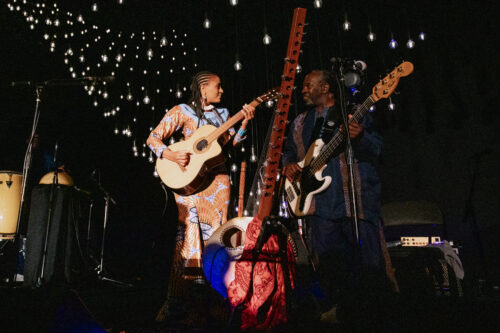
At Superblue, the warm lights of installation artist Rafael Lozano-Hemmer’s “Pulse Topology” surrounded Sona Jobarteh and her fellow musicians, percussionist Mouhamadou Sarr and guitarist Eric Appapoulay. (Photo by Liliana Mora, courtesy of Live Arts Miami)
For the evening performance, Jobarteh and her pared-down three-member band (percussionist Mouhamadou Sarr, bassist Andi McClean and guitarist Eric Appapoulay) shared the space with Mexican-Canadian artist Rafael Lozano-Hemmer’s “Pulse Topology,” a gorgeous, thought-provoking piece made up of 3,000 retro light bulbs that hung from the gallery’s high ceilings in undulating waves.
The lights pulsed with the individual heartrates of previous visitors who had placed their hands beneath special sensors placed around the room. They provided a stunning visual backdrop for the stage that felt like a warm embrace for audience and artists alike.
Jobarteh plays a 21-string kora. Made from a large gourd, the instrument sounds like a cross between a harp and a classical guitar. In Jobarteh’s hands, it was surprisingly versatile. The music was at times meditative and trancelike, and with all those glowing lights it was as if you had wandered into a place of worship celebrating an ancient candlelit rite that was as holy as it was chill.
But when the effervescent Sarr would ramp up the tempo with the bright lightning runs on his congas and the deep dum dum of his big calabash drum, we could have been sitting in the coolest and toniest of downtown discotheques— a friend said that it seemed like the entire audience was vibrating in their seats, itching to get up and dance.
Before she played the piece “Dunoo,” which she translated as “responsibility,” Jobarteh spoke of the sacred role that musicians play in the lives of their listeners — “listeners whom they will never meet, but whom they nevertheless leave their mark on.” It was clear how deeply she takes to heart her responsibility as an artist to make music that is as honest as it is uplifting—especially for her younger listeners.
Sona Jobarteh, among the 3,000 lightbulbs of the immersive installation “Pulse Topology” that provided the backdrop for her performance. (Photo courtesy of Liliana Mora/Live Arts Miami)
“Whatever we put in their minds today,” she said, “will flourish tomorrow. Let it be something we can be proud of.”
Jobarteh also spoke compellingly of the paradoxical role she plays as a Gambian artist: women, she explained, have not played the kora professionally since the instrument was first used in the 14th century. Until now, that is.
“Society changes, so women must be a part of that change in tradition. But this is not to take away from the generations that have gone before us,” she said.
As she introduced “Ballaké,” an homage to the influential kora master Ballaké Sissoko, she said that the song was also a tribute to her father, who, when she came to him at seventeen and implored him to give her lessons, agreed to break with 700-year-old tradition and teach her the instrument. Great musicians like these, Jobarteh said, live by the Gambian principal that “what you acquire you must leave behind. Don’t take it with you…pass it on before your time is done.”
Jobarteh put down her kora and picked up a guitar, however, for “Nna Kangwo,” a song from the region of Malil that was the ancestral birthplace of what would later in America become the blues. In her introduction, she spoke passionately of the power of music that is “born out of the real, lived life experience of the people to which the music belongs. . . . It is not the beats,” she said, “it’s not the timing or the keys or the notes or the chord progressions. It is the language of people’s life.”
Sona Jobarteh picked up her guitar for a number of songs, seen here jamming with bass player Andi McClean. (Photo courtesy of Liliana Mora/Live Arts Miami)
And Jobarteh is changing lives daily in what she called her “real calling”—education. In 2015, she started a school that now has 32 full-time students and which she dreams one day will have hundreds more. Her goal, she said, is to “decolonize education” –to center learning for African students in the history, culture and life experiences of their fellow Africans. At the Gambia Academy, male and female students learn academics, practical life skills and, of course, traditional dance and music, including the kora.
In their 90-minute performance, Jobarteh and her musicians managed to create a deeply meaningful sense of connection with her audience. Even the dreaded singalong—so often cringeworthy—was somehow transcendent under her tutelage. Jobarteh convinced the entire audience to buy in, with everyone singing the few words they had just been taught in Mandinka: “Oyiyo, woyiyo jarabi, woyiyo woyiyo jarabi,” with everyone singing with utter abandon. It was a song about love, Jobarteh said. With 205 voices joining in under the lights of the gallery’s 3,000 electric stars, the room seemed fairly bursting with it.
Live Arts Miami next presents Jamaican-American performance artist Shamar Watt presents the world premiere of his work “Summon” at 8 p.m.Saturday, Sept. 23 and 3 p.m., on Sunday, Sept. 24 at the Sandrell Rivers Theater, 6103 NW 7th Ave., Miami. Information at liveartsmiami.org.
ArtburstMiami.com is a nonprofit media source for the arts featuring fresh and original stories by writers dedicated to theater, dance, visual arts, film, music and more. Don’t miss a story at www.artburstmiami.com.
No posts found
Julian ‘JuJu Royal’ Marley brings his ‘Colors of Royal’ to Miami Beach Bandshell
Written By Jonel Juste July 12, 2023 at 2:41 PM
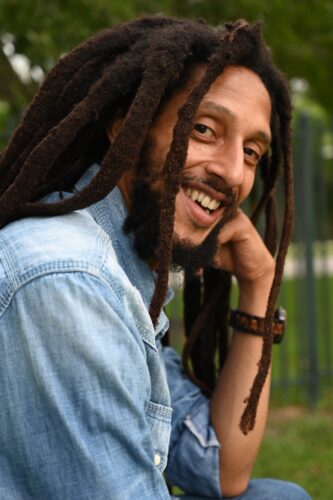
Julian Marley comes to the Miami Beach Bandshell with his band The Uprising on Saturday, July 15, performing songs from his latest release “Colors of Royal” (Photo courtesy of Matthew Gallimore)
Julian Marley promises that fans coming to see him perform at his upcoming show at the Miami Beach Bandshell on Saturday, July 15 will experience something truly personal.
“It will basically show the fans what I do inside my house,” says Marley, who will be playing songs along with his band The Uprising from his latest release, “Colors of Royal,” which came out in March.
The inspiration for the album’s title comes from Marley’s nickname, JuJu Royal, a tip to his being the only one of the legendary Bob Marley’s sons born in England, where he was raised by his mother Barbados-born Lucy Pounder.
Marley, 48, reveals that the album’s title also signifies the amalgamation of his personal tastes, representing the vibrant range of his musical expression.
Following in his father’s footsteps, Julian Marley is a devout Rastafarian who says he uses his music to inspire his life and spirituality. (Photo courtesy of Credit Andre Gordon)
“The Colors of Royal is basically the colors of Julian,” said Marley.
He’s also lined up special guests who will be performing at the bandshell show. “We will be basically feeding people with good vibration and music,” says Marley. One of the highlights of the night will be the collaboration with Cuban reggaeton rapper and singer Osmani “La Voz” Garcia on the song “Summer Love,” from the latest release. A fusion of English and Spanish vocals signifies a cultural bridge between Miami and Jamaica, illustrating the global nature of Julian Marley’s music.
Miami holds a special place in the heart of the Marley family since it has been their home for decades. In 1976, Bob Marley bought his mother a home in a South Dade neighborhood, now known as Pinecrest. The family’s studio there, the Lion’s Den, has been a creative hub for the Marley’s music-making endeavors.
While Miami itself may not have directly influenced Julian Marley’s artistic style – that was honed in England and Jamaica – the city’s diverse music scene and vibrant energy have undoubtedly contributed to the inspiration behind some of his works.
“Some songs like ‘Summer Love’ have a reggaeton feel, other songs have a dancehall flavor. Miami has a variety of music and artists, different vibes,” says Marley.
Reflecting on his upcoming Miami performance, Marley expressed his excitement, emphasizing that the city is his home base. Performing in front of a local audience is a particularly gratifying experience for the artist and his band. “It’s always good to play at home or close to home.”
Miami has witnessed numerous memorable performances and collaborations by the Marley siblings over the years.
With the release of “Colors of Royal,” Julian Marley offers his fans a glimpse into his artistic exploration. (Photo courtesy of Matthew Gallimore)
“We have memories of so many nights of big shows during festivals such as the Bob Marley Festival, the Kaya Fest,” recalls Marley. The Bob Marley Festival was conceived by Cedella Marley Booker, Bob’s mother, and the Kaya Fest by Bob’s son, Stephen.
When asked about his musical journey and the influence of his legendary father, Marley humbly emphasizes that his love for music comes from within. While acknowledging the impact of his family’s musical legacy, he says he strives to forge his own path and create music that resonates with his own spirit.
“Music has always been my love. I don’t play music just because of my parents but it’s a natural fire inside,” he says.
Marley has established himself as a notable artist in his own right. His debut album “Lion in the Morning,” released in 1996, helped launch him into the public eye.
In 2009, Julian Marley’s career rose to new heights with the success of his Grammy Award nominated release entitled, “Awake.” (Photo courtesy of Matthew Gallimore)
The record was followed by international tours with The Uprising and a collaboration with Lauryn Hill on her Grammy-winning album, “The Miseducation of Lauryn Hill.” In 2009, Marley’s album “Awake” received multiple Grammy nominations and was honored as the “Best Album of the Year” at the International Reggae and World Music Awards in 2010.
He says that his band has been a crucial component of his musical journey.
“It’s called Uprising because it uplifts me,” he says.
Musical journeys part of Coral Gables CAP Summer Concert Series
Written By Mathew Messa June 20, 2023 at 5:24 PM
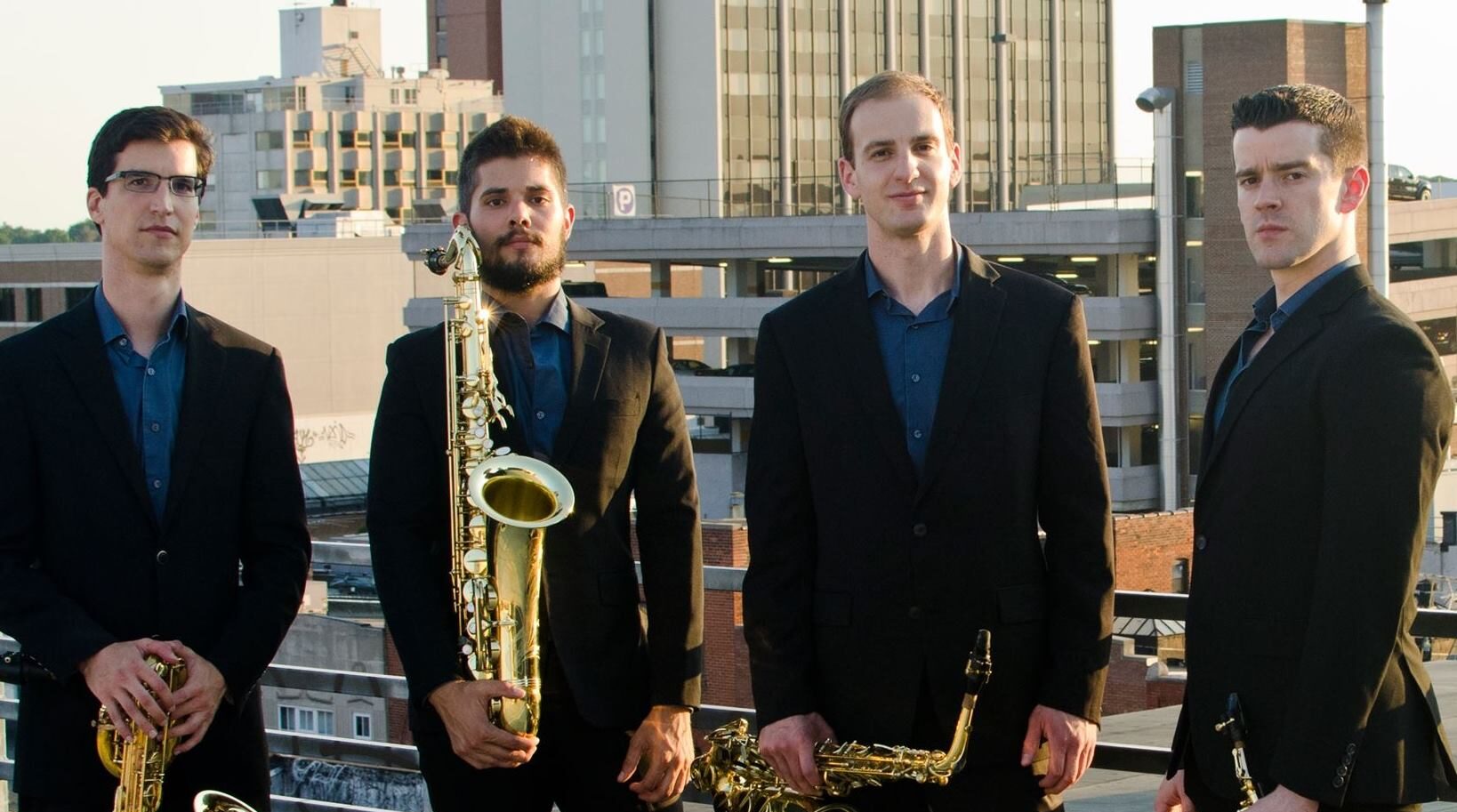
The Sinta Quartet is, from left, Danny Hawthorne-Foss, Joe Girard, Zach Stern and Dan Graser. The saxophonists are changing the way the musical instrument is marginalized. The foursome performs Thursday, Aug. 3, as part of the Community Arts Program Summer Concert Series. (Photo courtesy of Community Arts Program)
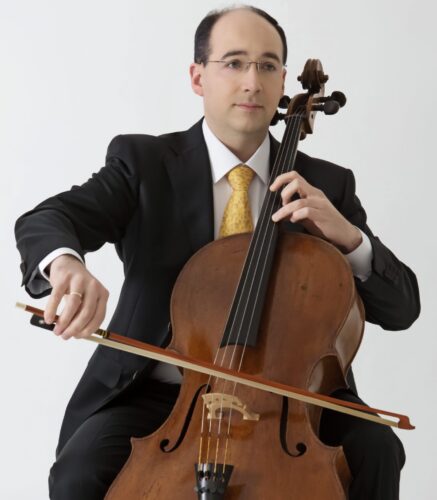
In the second installment of the Community Arts Program Summer Concert Series on Thursday, June 22, audiences will certainly hear the musicianship of Mark Kowoser, the principal cellist for the Cleveland Orchestra, which has made him a sought-after guest soloist for major symphonies. But this year, Mark Hart, executive and artistic director of the Community Arts Program, says the concert experience will be even more personal in the intimate surroundings of the Coral Gables Congregational Church.
Hart, who founded the Community Arts Program a decade ago and its after-school Conservatory of the Arts is always looking for ways to improve the audience experience he says. The Summer Concert Series has been held at the church since 1985. The 2023 series began on Thursday, June 8, and features performances each Thursday through Aug. 17.
This year, audiences will hear from the performers throughout the evening about their background and their relationship to the music they are playing.
Mark Kosower, principal cello of The Cleveland Orchestra performs Thursday, June 22 and is featured in the first master class open to any musician young or old on Friday, June 23. (Photo courtesy of Community Arts Program)
The idea came from a survey of those who attended last year’s series and also feedback that Hart, well, took to heart.
“What I found was so many people would either ask me after the concerts, or I would get phone calls and emails from people asking me about the artists and wanting to know more information about them,” says Hart, adding that when he floated talkback idea, he was met with the overwhelming response, “Yes, we would love to hear more about the artists and their stories in this setting.”
This year’s lineup is diverse and packed with talent.
Kowoser, joined by pianist Melivia Raharjo, will perform the music of Beethoven, Coleridge-Taylor Perkinson, Krenek, Myaskovsky, and Martin at 7:30 p.m., Thursday, June 22 in the historic church.
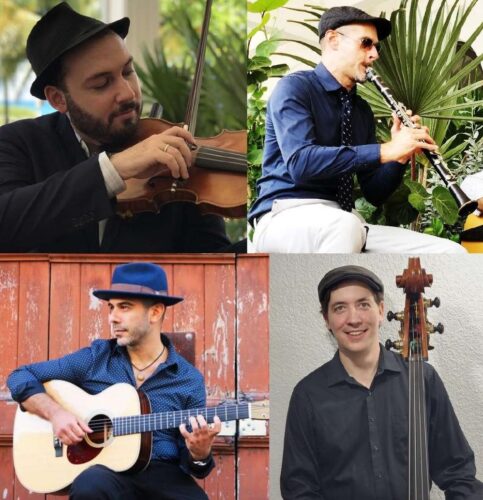
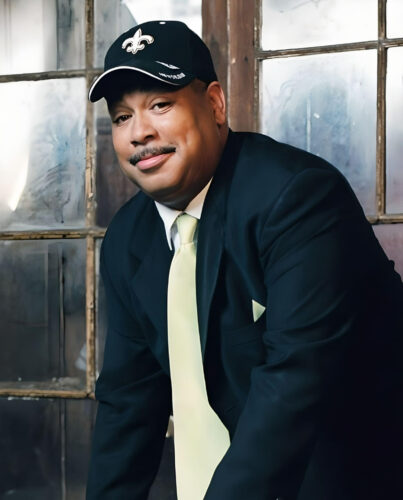
On Thursday, July 6, it’s 5 String Swing with Steffen Zeichner, violin; Flexter Henderson, clarinet, saxophone and cajón; Greg Diamond, guitar, and Benjamin Whitman, bass. They’ll perform songs from Cole Porter to George Gershwin and talk about their love of the music from the Great American Songbook. Enter the world of The Big Easy on Thursday, July 20 with New Orleans’ musicians Shannon Powell, drums and vocals; Kyle Roussel, piano; and Grayson Brockamp, bass.
5 String Swing, led by Grammy-winning violinist Steffen Zeichner, pictured top left, will perform July 6. Clockwise are Ziechner, Flexter Henderson, Benjamin Whitman and Greg Diamond. (Photo courtesy of Community Arts Program)
Dan Graser, one-fourth of saxophone group Sinta Quartet, is one of the artists that will share his story when they headline the CAP series on Thursday, Aug. 3.
Formed in 2011 by Graser, Zach Stern, Joe Girard and Danny Hawthorne-Foss when the four members were attending the University of Michigan, the Sinta Quartet is a rarity — a professional classical saxophone quartet.
” . . . Frequently people would see a saxophone quartet and think ‘Oh that’s probably going to be a jazz thing,’ or ‘That’s probably going to be a pop or light classical and then jazz thing,’ ” says Graser. “If there’s one thing (that) I think people have gotten a better sense of, it’s just how much of a chameleon the saxophone can be.”
After touring extensively around the U.S. and the globe, and releasing two albums, Graser believes they are widening the narrow view around what the saxophone sound — that it can be a classical instrument and not pigeon-holed into jazz or pop. “Both of those are fine art forms, but the saxophone is capable of a lot more,” he says.
Graser and the quartet will perform a program titled “New Traditions,” which features works by traditional composers Antonín Dvořák, György Ligeti, and bluegrass musician Bela Fleck.
Performers featured in the concert series will host a two-hour master class and jam session open to anyone, from kids to adults, the Friday morning following their performance inside the Coral Gables church. Kosower will host the first in the series on Friday, June 23 at 10 a.m. Other classes and jam sessions are with 5 String Swing, who will perform in the concert series on Thursday, July 6, and New Orleans’ drum master Shannon Powell, who performs in the series on Thursday, July 20 and will host a class-jam on Friday, July 21. The Sinta Quartet will host the final master class and jazz session on Friday, Aug. 4.
The Shannon Powell Trio, featuring New Orleans percussionist Shannon Powell, performs July 20. (Photo courtesy of Community Arts Program)
For Graser, Stern, Girard and Hawthorn-Foss, who are all either university or private instructors, and whose quartet is proudly named after one of their influential music professors, Donald Sinta, the opportunity to teach the next generation of musicians is invaluable.
“If you ask a lot of musicians what made them take up an instrument or what made them decide to study an instrument as a major, it’s usually that they had a direct encounter with it from a guest performer in their school, or they had a guest performer come to their community,” says Graser, “These days, of course, they may stumble upon it online and such and become interested that way, but really a lot of our direct experiences are the inspiration to take up instruments.”
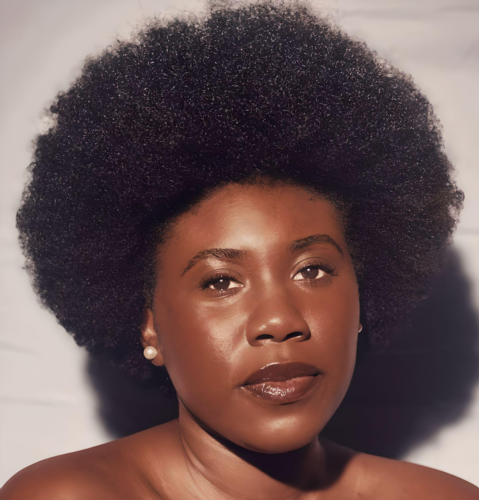
For Cameroonian-American jazz vocalist Ekep Nkwelle, her earliest inspiration might fall under Graser’s “these days” category. She recalls being in high school and watching an episode of a Looney Tunes cartoon show with her younger brother. She heard the red-haired monster Gossamer (Kwesi Boakye) perform jazz vocalist Sara Vaughn’s version of “September in the Rain” in the episode “Monster Talent.” After dozens of television rewinds, the two took to the internet and found Vaughn’s live rendition of the song.
“From then on, not only was that song and rendition, and that album my thing, but from then on Sara Vaughn became my person,” says Nkwelle, “I felt like she was my fairy godmother inducting me into the world of jazz. I’ve always strived to sing with that same spirit and that same soulfulness that she has.”
Years after she discovered Vaughn’s song, Nkwelle placed second in the Sara Vaughn International Jazz Vocal Competition in 2022 against contestants from over 25 countries. Now, after recently graduating with a master’s degree in jazz voice from New York’s Juilliard School, Nkwelle is transitioning to a full-time career as a recording and performing artist. She admits it was an increasingly intimidating idea as she neared the end of her studies.
Ekep Nkwelle performs for CAP’s summer concert series as the final of the 2023 season on Thursday, Aug. 17. (Photo courtesy of Community Arts Program)
“Honestly, coming out of school, it was very scary. I think around January I began to think about what was next, but I had a little more time to sit in school, and be sheltered and not actively have to experience that anxiety,” says Nkwelle, “But by the time I got to May, I began to realize that my June, July, and August looked really good in terms of like opportunities in New York and in (Washington) D.C. That’s when I was like ‘Oh not only do I think that I can do this, but I’m also already doing it,’ I just didn’t realize.”
The wealth of opportunity also helped quell her family’s fears. Nkwelle’s parents, who immigrated to the United States from Cameroon, worried that a life of hardship could be ahead of her with a career in music.
“It’s not because they didn’t believe in me, it’s not because they didn’t love me, it was a fear that came from a lack of understanding… my mother once had a heart-to-heart with me and she let me know that in Cameroon when you see musicians or you see artists, you see struggle,” says Nkwelle.
Eventually, as Nkwelle’s career began to take shape, her mother came around. Between performing at NPR’s famed Tiny Desk with the Juilliard Jazz Ensemble and preparing to record her first album, due early next year, Nkwelle is rising, and she wants students that may be in the audience at her CAP performance in August to take away a message that they can find success as performers. too.
“I feel like there’s no better way I can say it… If you work hard, if you are determined to make this thing happen for you, and you are consistent, it could happen to you.”
Nkwelle closes out the summer series on Thursday, Aug. 17, joined by pianist Luther Allison, Jason Clotter on bass, and Hank Allen-Barfield on drums.
WHAT: “Community Arts Program 2023 Summer Concert Series ”
WHERE: 3010 De Soto Blvd., Coral Gables
WHEN: Performances 7:30 p.m. Thursdays, through Aug. 17. Master classes and jam sessions 10 a.m. Fridays, through Aug. 4.
TICKETS: $35 in advance, $40 at the door. Master classes and jam sessions are free and audiences are invited to watch. Musicians who want to perform or jam need to register.
‘Juneteenth Juke Joint’ Returns as Annual Event at the Arsht
Written By Jonel Juste June 12, 2023 at 2:54 PM
The Adrienne Arsht Center’s Ziff Ballet Opera House turns into a lively Juke Joint for a Juneteenth celebration on Wednesday, June 14. (Photo courtesy of Taylor Brown)
The Adrienne Arsht Center began its Black culture celebration, “The Juneteenth Juke Joint,” in 2022. Now it seems that the celebration of Black culture, music, and food in the American South has gained annual status.
The event is part of The Heritage Project, a program created by the Arsht Center with a commitment to promote social equality and amplify Black voices, according to Zaylin Yates from the Heritage Project Committee.
This year’s event starts at 7 p.m. on Wednesday, June 14.
For generations, Juneteenth has been celebrated as the country’s “second Independence Day.” It commemorates the end of slavery when federal troops arrived in Galveston, Texas on June 19, 1865, to free enslaved people.
Guests enjoy the 2022 Juneteenth Juke Joint, the first edition. The event at the Ziff Opera House returns this year. (Photo courtesy of Taylor Brown)
Also known as Juneteenth National Independence Day, or Black Independence Day, Juneteenth, a combination of “June” and “nineteenth,” has been celebrated since as a day of gathering, cookouts, music, and pride in Black freedom. In 2021, President Joe Biden signed the Juneteenth National Independence Day Act that recognized June 19 as a federal holiday.
Juke Joints, explains Yates, were backwoods, roadside establishments run and patronized by Black Americans in the years after slavery ended. They were primarily found in the South and were safe spaces for Black people to gather and find solace while drinking and listening to music of Black artists and finding joy among each other while escaping the outside world.
The Arsht Center’s “Juneteenth Juke Joint” was created a year after Juneteenth was recognized as a National Holiday.
The dance party kicks off with a mix of pan-African beats by DJ Shacia Päyne Marley (Photo courtesy of artist management)
“Although Juneteenth stems from a negative part of history, we choose to celebrate Black joy and freedom, which is something that everyone in Miami can enjoy,” says Yates, who adds that last year’s event sold out in only a few weeks.
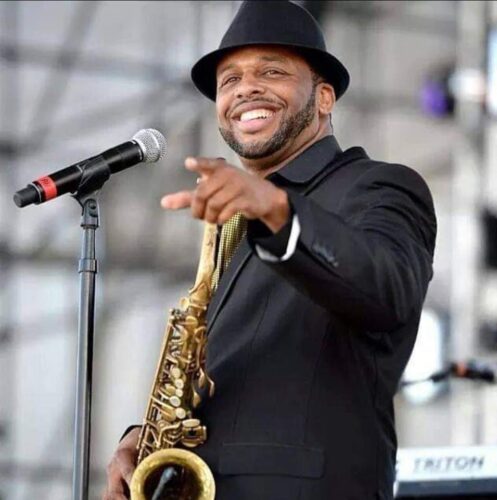
The event, meant for those 18 years and older, features a mix of pan-African vibes with smooth jazz from DJ Shacia Päyne Marley, granddaughter of Bob and Rita Marley, and renowned saxophonist, producer, and composer Melton Mustafa Jr.
“I think these types of events either celebrate, teach, or evoke a conversation, which is why paying homage to history is always important,” says Yates.
Mustafa Jr. is returning for the second edition of Juneteenth Juke Joint at the Arsht.
Saxophonist, producer and composer Melton Mustafa Jr., aka, Mustafa on Sax, performs once again at this year’s ‘Juneteenth Juke Joint.” (Photo courtesy of artist management)
The son of international jazz trumpeter, Melton Mustafa Sr., Mustafa Jr. views Juneteenth as a day of celebration, reflection, and obligation to honor those who came before him. He goes on to say that music and the arts as a whole are a way to spark dialogue and bridge gaps between different cultures.
The saxophonist says his performance will feature a celebration of Black American Music, taking the audience through several genres of music such as gospel, blues, jazz, rhythm and blues, pop, funk and hip hop.
“Music has always been a part of every important Black movement. It is a way to showcase importance and our creativity. My hope is to continue to create music that fuels today’s movements. To have it serve as a reminder of the stock that we come from,” he says.
WHERE: Ziff Ballet Opera House at the Adrienne Arsht Center, 1300 Biscayne Blvd, Miami, FL 33132
WHEN: 7 p.m., Wednesday, June 14. Doors open at 6:30 p.m. with a curated happy hour menu featuring soul food-inspired bites and alcoholic drinks for those 21 and over.
COST: $35, general admission; soul food-inspired platters range from $12-$18 a plate; beverages from $12-24.
Miamibloco: Building community one samba groove at a time
Written By Fernando Gonzalez May 18, 2023 at 10:07 AM
SuOm Francis and Brian Potts are the founders of Miamibloco who will be hosting Miamibloco Saidiera Social at the Miami Beach Bandshell on Monday, May 29. (Photo courtesy of Osmany Torres)
The definition of Bloco de Carnaval in a dictionary will likely turn up “street bands” or “a group of musicians and dancers who perform during the Brazilian Carnaval, typically parading through the streets.”
But there is more to blocos than that, says performer and educator Brian Potts, founder and director of Miamibloco, a percussion ensemble that mixes traditional samba and elements from various musical traditions in South Florida.
“Bloco is a community event. It’s people spontaneously gathering in the street or rehearsing loosely before carnival. It’s not set up, so here you have the professional musicians, and here are the amateurs. It’s just people playing music, and it’s what binds these communities together,” says Potts, who received his Doctor in Musical Arts (DMA) from the University of Miami, who” fell in love” with Brazilian music and has been traveling to Brazil to study and perform for the past 13 years. “Think of the bloco and all that it involves as a community-building technology.”
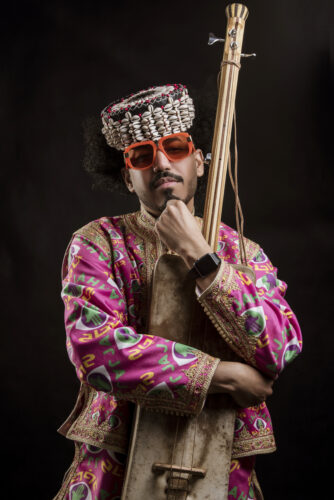
Samir Langus of Ait Melloule, Morroco, is the headline feature at Miamibloco Saideria Social. (Photo courtesy of Hicham Laabd)
Inspired by the approach of Batuquebato, a Brazilian group in which he also plays in Rio de Janeiro, Potts opened the drumming of Miamibloco to other music beyond samba.
“I’m never going to be Brazilian,” says Potts, a long-time South Florida resident born in Dallas, Texas. “And we’re never going to be of Rio de Janeiro. We’re always going to be from Miami, and what Miami has to offer is this incredible mixture and diversity of cultures and music. So we try to be ourselves and take the influences of the people in the group.”
Miamibloco’s Bateria Saideira, the bloco’s performance group, will play at the Miami Beach Bandshell on Memorial Day. The “From Samba to Gnawa” event will feature the 40-plus-member drumming ensemble, augmented by artists from Brazil, Morocco, Nicaragua, Venezuela, and Colombia. The guests include multi-instrumentalist Munir Hossn, Jason Matthews, keyboardist of Electric Kif, local favorite guitarist and deejay DJ Le Spam, percussionist Gilmar Gomes and Grammy-nominated Moroccan musician Samir Langus and his group.
Saideira translates as “nightcap,” here a musical nightcap; Monday’s show is the third installment of Miamibloco’s Saideira Social.
In Potts’s words, the performance is “an opportunity to show what a bloco can do.”
“Throughout the evening, we’ll be playing samba but also electronic music, cumbia, and a collaboration with Langus, a master in the Gnawa tradition, and his group,” says Potts. “He is bringing in a whole other tradition, and we’re going to build something new together, which I think is a very exciting thing. ”
On timbau, Gilmar Gomes, from Bahia, Brazil, at the 2022 December Miamibloco event. (Photo courtesy of Osmany Torres)
Additionally, Langus will be hosting a Miamibloco pre-party on Saturday night. He and his group will be presenting Gnawa music and will be joined by members of Miamibloco. “It’ll be an intimate jam session,” says Potts. (8 p.m., Saturday, May 27, TheUnderstory, 7135 NW 1st Court, Miami; $15 in advance, $20 at the door.)
In the bloco, trained and amateur musicians play side by side. Those new to musical performance not only learn to play the instruments and patterns of samba but how to work together as an ensemble. Call it community-building — with a groove.
“I see Miamibloco as a way of teaching people about community and community participation,” says SuOm Francis, Miamibloco’s co-founder and director of community operations. “You may play one instrument, one note, but if you’re not there, there will be a void. Your note is important for the sound of the group. (Playing in the bloco) is a tool to belong to Miami in a different way.”
Miamibloco only recently became officially a non-profit organization. So far, it’s been self-funded and “very grassroots,” says Francis. “We’re only doing it when and if the Miami Beach Bandshell has a space, and they have opened their doors to us.” The saideiras are part of the Bandshell Laboratories residency program sponsored by The Rhythm Foundation.
Multi-instrumentalist Munir Hossn will debut a song collaboration with Miamibloco. (Photo courtesy Osmany Torres)
Still, the ensemble offers several programs, including community workshops, which Francis describes as “contained, one-hour experiences,” the Bateria Academy, a two-month course with weekly rehearsals and supplemental videos created to develop technique on your chosen instrument, and the Bateria Saideira, which is Miamibloco’s performance group. Membership is open to anyone through an audition process.
In the community workshops, “we don’t go very deep musically, but within an hour, we’re doing something together,” says Potts. “And getting that many people playing music together is very powerful.”
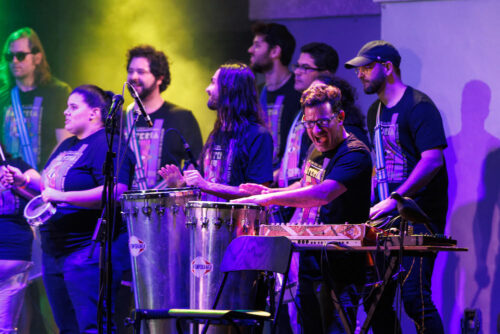
Brian Tate, Carol Delgado, Alejandro Elizondo, Lex Schmidt, Brahm Mansla, Roberto Roman, Armando Lopez and Jose Javier Freire at a previous Miamibloco social. (Photo courtesy of Osmany Torres)
The bloco “is like a force to fight against all of the struggles that everybody has to go through in their everyday life, and all the separation we feel from each other, being locked in front of our screens, locked in our own little worlds,” he continues. “Bloco gives you a reason to come and be with people and make art together, and in doing so, break through many of our social boundaries.”
WHAT: Miamibloco’s Bateria Saideira with guests Munir Hossn, Jason Matthews, DJ Le Spam, Gilmar Gomes, and Moroccan musician Samir Langus and his group.














Recent Comments