Blog Article Category: Dance
Amid uncertainty, Dimensions Dance hopes to unveil cutting-edge works later this year
Written By Sean Erwin
March 31, 2020 at 5:46 PM
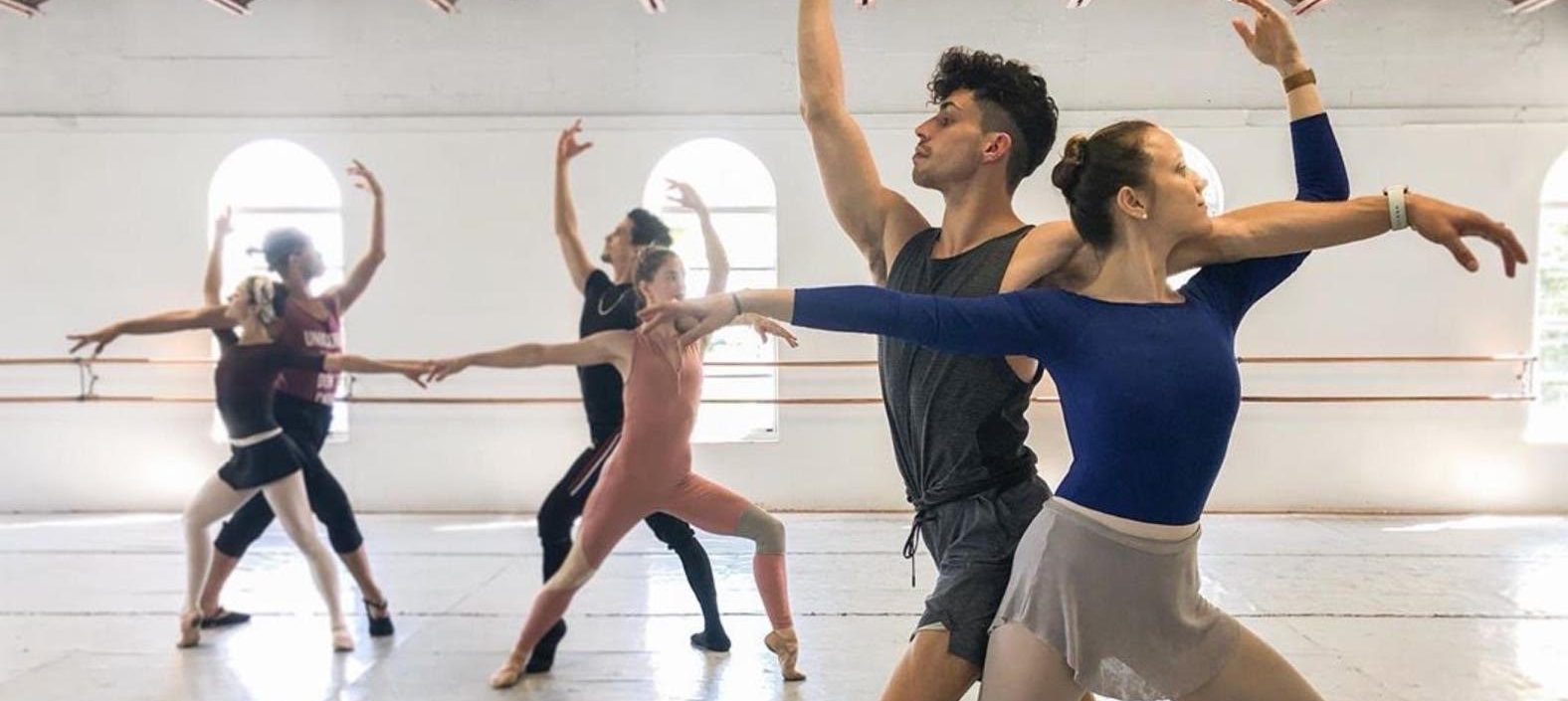
Ryan Nicolas DeAlexandro and Trisha Carter rehearse with other company dancers in the background. (Photo courtesy of Andrea Spiridonakos)
Dimensions Dance Theatre of Miami’s March Lab series has become known for “out-of-the-box” works by local, up-and-coming and cutting-edge choreographers.
And, true to form, the company was set to present innovative new works about Miami’s distinctive histories and architectures during its 2020 Lab Series at the South Miami-Dade Cultural Arts Center’s Black Box Theatre on March 21 and 22. Then the virus hit.
Still, the preview serves as a tantalizing snapshot of the company’s work in progress. The pieces are expected to appear in the company’s July and November 2020 performances.
The centerpiece of the hourlong program was to be a new work by choreographer Kevin Jenkins.
South Florida audiences adored Jenkins’ “C’est La Vie,” which the company debuted in 2017. In “C’est La Vie,” gorgeous, quirky vignettes – set to French crooner Marie Laforet – showcased fickle, young love at its mercurial best. That was three years ago.
Since then, Jenkins has made the Magic City his home, and his newest work, “DECO,” takes its inspiration from Miami’s neighborhoods and its tradition-rich people.
“Audiences will probably see the art deco shapes and lines in the movements,” Jenkins said.
The choreographer layered multiple meanings within the work. Some passages, for example, reflect the resistance of the Miccosukee Indians to the advancing federal army during the Seminole Wars.
As the dancers prepared to rehearse on a recent afternoon, the choreographer reflected on his choice to set the work to Mexican composer Arturo Marquez’s dramatic 1994 orchestral composition, “Danzon No. 2.”
“This is the only company that could do this piece justice based on the passion and spirit DDTM brings to the performance of it,” Jenkins said.
During rehearsals, six dancers in a line faced the back wall and posed – hips cocked, arms overhead as a svelte Miranda Montes de Oca and Ryan Nicolas DeAlexandro (both dancers new to Dimensions Dance this year) strode to the front. As the two soloed to the side, the remaining dancers formed couples for a series of lifts.
“DECO” shows off Jenkins’ distinctive style – furious upper-body work with arms, wrists, hands and fingers ceaselessly in motion in a kind of kinetic pantomime reminiscent of Bollywood dancers. Below the torso, everything stays calm. The footwork is simple but grounded.
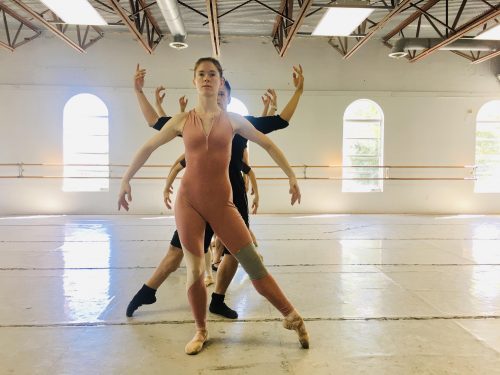
Chloe Freytag is a veteran of Dimensions Dance Theatre of Miami. (Photo courtesy of Andrea Spiridonakos)
When the tempo slowed, company veterans Fabian Morales and Chloe Freytag took the spotlight with jazzy rolls of the hips and s-rolls of the upper torso. Salsa movements peppered their sequences.
In another vignette from “DECO” – titled “Amanhecer” – the cello laid down successive long notes, and Morales lifted dancer Claudia Lezcano through a series of splits that crossed the room. In one sequence, the two played a game of hide-and-seek among the other dancers, who stood motionless like totems. The segment closed with a sequence of lifts and Morales supporting Lezcano.
The piece titled “Olimpico” forms part of the full-length “DECO” but was intended as a stand-alone work for the Lab. “Olimpico” featured Montes de Oca and DeAlexandro in a fiery, lightning-fast pas de deux set to the driving rhythms of flamenco guitar.
Especially notable here was DeAlexandro, who not only supported Montes de Oca in deep back-bends and lifts but also snapped out combinations as complicated as hers.
Jenkins said he likes to make the guys work: “I wanted to do a fun piece, and I’m a big believer that the guys have got a free pass in dance for a long time.”
Another work scheduled for the Lab was “Preludes” by South Florida choreographer and Miami City Ballet dancer Ariel Rose. Dimensions Dance has frequently showcased his works, including 2017’s “Esferas” and last July’s “Equus.
In “Preludes,” the pas de deux featuring DeAlexandro and Lezcano started slow, with each dancer turning alone. As things heated up, the two snapped out sequences that criss-crossed the floor repeatedly. As the piano wound down, they completed turns as a couple, DeAlexandro lifting Lezcano repeatedly.
Carlos Guerra and Jennifer Kronenberg – both former Miami City Ballet principal dancers and now the company’s co-artistic directors – coached the two dancers during rehearsal.
Kronenberg shed light on the choice of the music, explaining that the piano work comes from the 2015 “Preludes” album by Jorge Mejia, president of the Latin division at Sony/ATV Music Publishing.
Mejia is a product of Miami’s New World School of the Arts, Kronenberg said, and she got to know him while dancing with Miami City Ballet. A chance Lincoln Road re-connect led to Dimensions Dance performing a set of “Preludes” for the Lab.
For now, Dimensions Dance is on hold. But with the pieces now hopefully debuting in July and November, the company is giving audiences something to look forward to.
ArtburstMiami.com is a nonprofit source of theater, dance, visual arts, music and performing arts news. Sign up for our newsletter and never miss a story.
No posts found
Miami dance artist Dale Andree’s National Water Dance aims to inspire unity amid crisis
Written By Jordan Levin
March 25, 2020 at 1:34 AM
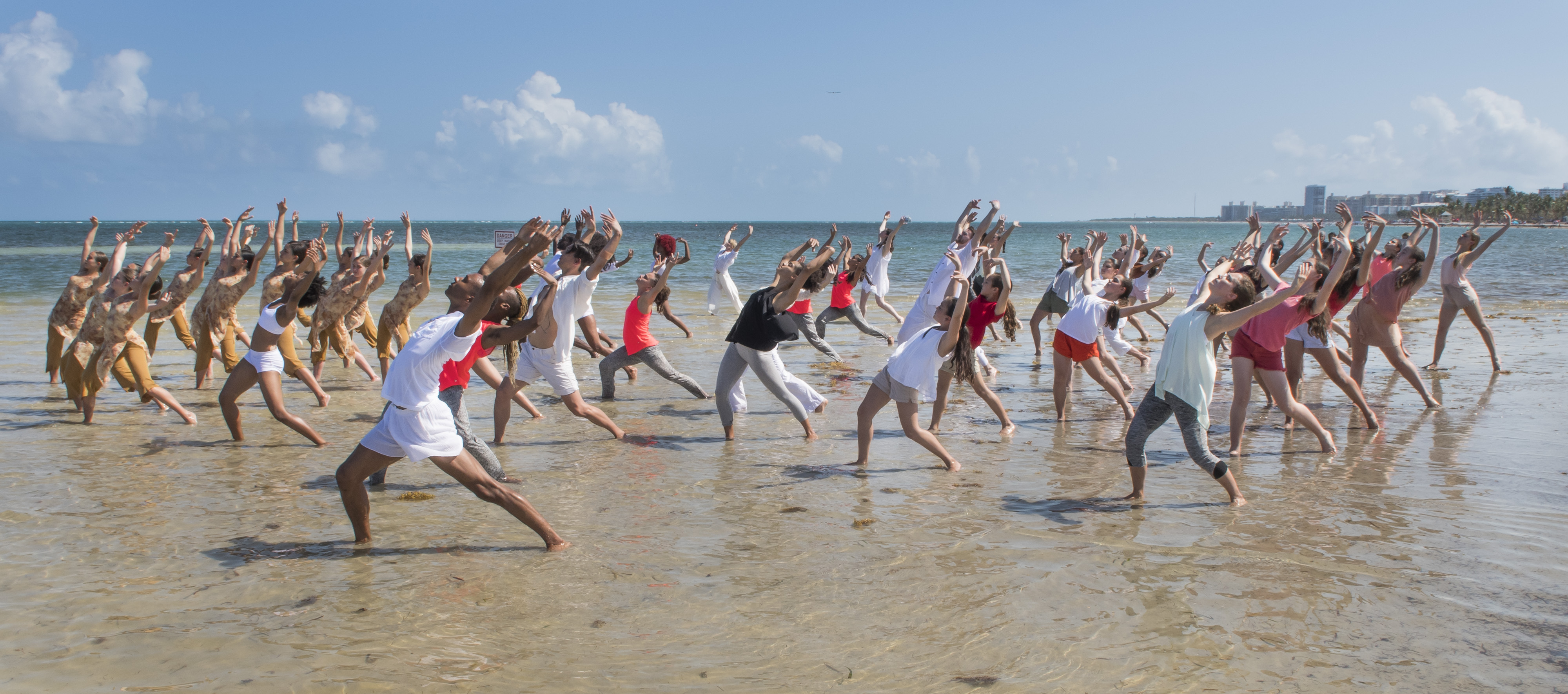
The National Water Dance performance on Key Biscayne at the beach near the Biscayne Nature Center on April 14, 2018. (Photo courtesy of Mitchell Zachs)
Dale Andree created National Water Dance as a way to unite dance artists and communities in a creative response to a global crisis she’d become acutely conscious of after nearly four decades in Miami: climate change, sea-level rise and the powerful, essential nature of water.
Now the dance artist is re-shaping her project to respond to a new world upheaval: the coronavirus pandemic.
Andree is calling on dancers in Miami and across the nation to join National Water Dance in “dancing for our lives” online on April 18, creating hope and togetherness through movement at a time of growing isolation.
“There’s always that question of, ‘What’s the point?’ There’s a huge point. We’re not giving up. Being in our bodies is the one thing we have and have to try to protect,” says Andree. “We’re dancers, and moving, and made of water. What are we saying with the movement we create? How do we send that out into the world?”
This year was slated to be the biggest yet for National Water Dance, which has taken place every other year since Andree launched it in 2014. More than 100 dance ensembles, university dance departments and other groups from 36 states and Puerto Rico were prepared to simultaneously dance outdoors at 4 p.m. April 18, at water sites ranging from Miami’s Virginia Key Beach to mountain streams to the Great Lakes.
For the first time, Andree was set to stage a dance around the Lincoln Memorial Reflecting Pool on the National Mall in Washington, D.C., creating a potent physical and symbolic metaphor for bringing the country together around a crucial environmental issue. All the performances were going to be livestreamed on the National Water Dance website, in a gorgeous panoply of dance and American natural beauty.
All of that changed early in March, as Andree was in D.C. to plan the Reflecting Pool performance with area dance companies and universities. Like the rest of the world, Andree has been adjusting continually as the coronavirus pandemic has escalated, closing parks, universities, beaches and gatherings across the country. (Although her permit for the National Mall has not been pulled, Andree does not know whether they will be able to perform there.)
Decades of living in Miami and dealing with tropical storms have helped Andree to deal with this fluid new disaster.
“It’s that hurricane energy – you can’t do anything about it, so you improvise,” says Andree, a longtime dance mentor and creator who launched her first Miami dance troupe in 1985 and taught at the New World School of the Arts for 20 years. “You have to deal with the immediate.”
Like so many other artists, she is turning online. Since groups can’t perform together, individual participants are being called to dance in their backyards or kitchens or wherever they can at 4 p.m. EST on April 18.
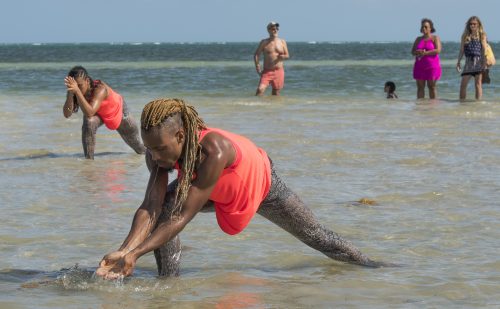
The Jubilation Dance Ensemble from Miami Dade College’s Kendall Campus performed in 2018. (Photo courtesy of Mitchell Zachs)
To unite them choreographically (if not physically), they’ll incorporate specific dance combinations they can learn from a video on the project’s social media accounts. Everyone will film themselves on Facebook Live or Instagram Live. Afterward, participants will upload the videos to their social media accounts, tagging National Water Dance and using the hashtags: #nationalwaterdance, #nationalwaterdance2020 and #dancingforourlives.
“I feel like I’m on an internet highway,” Andree says, jokingly, of her accelerated education in online performance and social media.
In Miami, Andree’s NWD Projects troupe, plus regular collaborator Michelle Grant-Murray, coordinator of dance at Miami Dade College, and her Olujimi Dance Theatre, will perform and livestream separately. Andree is reaching out to other local companies, schools and arts organizations to join them.
She and project social media director Elsa Roberts hope that, as they spread the word virtually, more and more people will join in dancing together in a moment of national and creative unity – like drops of water streaming together into a giant virtual pool.
Roberts, who lives in Seattle, says working on National Water Dance has been inspiring. A freelancer whose roommate was just laid off from a restaurant, Roberts has been reeling from the changes of the last several weeks.
“People need a sense of connection, and this is providing that,” Roberts says. “It’s really nice to be involved in a production so grounded in people and the planet.”
Andree hopes National Water Dance will inspire not just dancers but everyone who watches to contemplate some basic questions: What unites us? What is essential for us as human beings? As communities?
“When something like this happens, you’re stripped down,” she says. “How am I connecting to other people? What am I feeling? How do I say it? People are slowing down, thinking about how we fill our time and what does that mean. This is the time to look around us with a lot more reflection, that will give us a deeper understanding as we move forward.
“We’re all in this together.”
What: National Water Dance
When: 4 p.m. April 18
Cost: Free
More information on the performance or how to participate: nwdprojects.org
ArtburstMiami.com is a nonprofit source of theater, dance, visual arts, music and performing arts news. Sign up for our newsletter and never miss a story.
No posts found
Dance NOW! Miami hopes to present Isadora Duncan tribute as part of Program III
Written By Sean Erwin
March 19, 2020 at 6:26 PM
Dance NOW! Miami’s Program II “Contemporanea 2020” was to include company works as well as pieces by Isadora Duncan such as “Ave Maria” (1914). (Photo courtesy of Isadora Duncan Dance Ensemble)
Dance NOW! Miami was all set for its tribute to modern dance pioneer Isadora Duncan.
The company’s Program II: “Contemporanea 2020” was to take place March 21 at the Aventura Arts & Cultural Center and star special guests, members of Italy’s Opus Ballet.
Of course, Program II was canceled as a result of the coronavirus outbreak. But the company’s hope is that much of the performance can be presented as part of its Program III: “20 Years of NOW!” at the Broward Center for the Performing Arts in Fort Lauderdale on May 29 and the Colony Theatre in Miami Beach on May 30. If travel bans are lifted by then, the Opus Ballet could still be part of the program, according to the company’s website.
Before the cancellation, Artburst Miami had a chance to witness a rehearsal for the performance, which was to feature pieces by Duncan as well as company works. Program II intended to juxtapose the power of the individual with the power of the group – and to show how dance resonates with these themes as much today as it did 100 years ago.
The rehearsal began with Duncan’s 1924 masterpiece, “Dubinushka.” Dancers reached and pulled in two long lines as a deep Russian baritone belted out a chant. The dancers’ tight coordination was awesome; they seemed to be guiding a warship into dock.
They repeated the sequence as dancer Benicka Grant broke from the group. Arms crossed on her chest, she snapped one arm in a right angle, her fist pointing upward, revealing a muscled upper arm as she lunged to the side. She looks snatched from a 1960s Soviet propaganda poster promoting proletarian internationalism.
When the piece ended, the dancers flowed right into “Varshiavianka,” the second of Duncan’s “Russian revolutionary dances,” which were created while she lived in Russia. Duncan expressed communist sympathies and had her U.S. citizenship revoked in the 1920s.
Dancer Anthony Velazquez strode to the center, carrying a massive red flag. In time to the march, he ran to the corner, did a lunge and defiantly swept the flag from side to side. He fell back and gripped his chest as if struck. Before he collapsed, Grant rushed forward, took up the flag and cradled him to the ground. She then repeated the sequence and also collapsed, as another dancer cushioned her fall and took up the flag.
“They are getting shot,” explained Dance NOW! Miami’s co-artistic director, Hannah Baumgarten. “We don’t often think these days about those times when people died for a cause that way.”
Dance NOW! Miami co-artistic director Diego Salterini, who is Italian, locates the power of Duncan’s work in its simplicity.
“In the ’60s, we kind of lived communism in a friendlier way [in Italy] than they did here in the U.S.,” he said. “There is a kind of charm to those pieces – the power of the people. It’s important we take that power and rise up when we go to vote.”
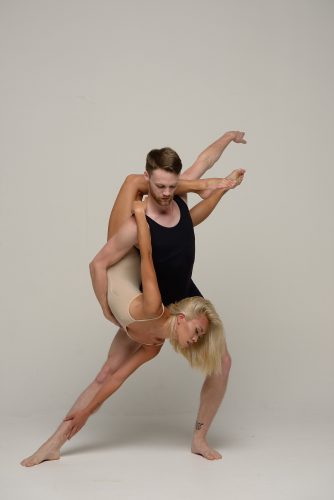
Dance NOW! Miami’s Isabelle Haas and Matthew Huefner. (Photo courtesy of Dance NOW! Miami)
Dancer Isabelle Haas, who’s in her first year with the company, shared the challenges she experienced connecting with Duncan’s Soviet choreographies.
“The whole Isadora thing is emotion before motion. It was challenging to get to the emotion of the piece,” Haas said.
Andrea Mantell-Seidel – who is associate professor of religious studies and professor emeritus of dance at Florida International University and past artistic director of Miami’s Isadora Duncan Dance Ensemble – coached the company on Duncan’s technique for the performance.
“[Mantell-Seidel] continued saying, ‘Oppression, oppression,’ and asking us to think about what makes us feel oppressed,” Haas added.
The other pieces in the company’s “Duncan Suite” included “Ave Maria” (1914) and “Harp Etude” (1917), set to Chopin’s Op. 25, No. 1.
As the dancers set up for “Harp Etude,” Baumgarten said, “In these earlier works, like ‘Ave Maria’ and ‘Harp Etude,’ you see how Duncan discarded the tricks of ballet for a deep experience of human emotion.”
As an innovator, Duncan (1877-1927) broke with classical dance technique and returned to the ancient Greeks for inspiration. That Greek influence shines in “Harp Etude.”
As the piano music started, dancer and rehearsal director Allyn Ginns Ayers floated forward, wearing a semi-transparent white robe, a light mantle attached at her wrists pulsing like wings. During the piano’s arpeggios, she held her arms in front and pushed forward as if swimming.
Baumgarten leaned over and observed, “You can imagine how Duncan must have shocked audiences … being almost naked underneath that robe.”
In addition to the Duncan revivals, the company was to perform a Baumgarten-Salterini collaboration titled, “One, No One, Everyone.” Temporarily substituting for dancer Anthony Velazquez, Baumgarten danced the principal role during the rehearsal. She soloed, executing a series of turns before being lifted by dancers David Harris, Joshua Rosado and Matthew Huefner.
Crossing the floor, the dancers repeatedly placed hands to hips, paused off-balance, then dominoed forward. The group moved beautifully, both in couples and as an ensemble.
“One, No One, Everyone,” Baumgarten later said, “is made up of stories of longing, where the dancers repeatedly attempt to escape the grind of their lives but predictably fall back into their soul-grinding routines.”
Program II also was to include Angela Gallo’s “Those Things,” Baumgarten’s “Unburden,” and Salterini’s “Chronicles.”
To find out when Dance NOW! Miami will continue performing, keep checking its website, dancenowmiami.org.
ArtburstMiami.com is a nonprofit source of theater, dance, visual arts, music and performing arts news. Sign up for our newsletter and never miss a story.
No posts found
Piano Slam 12 highlights socially conscious young poets
Written By Sean Erwin
March 11, 2020 at 10:54 PM
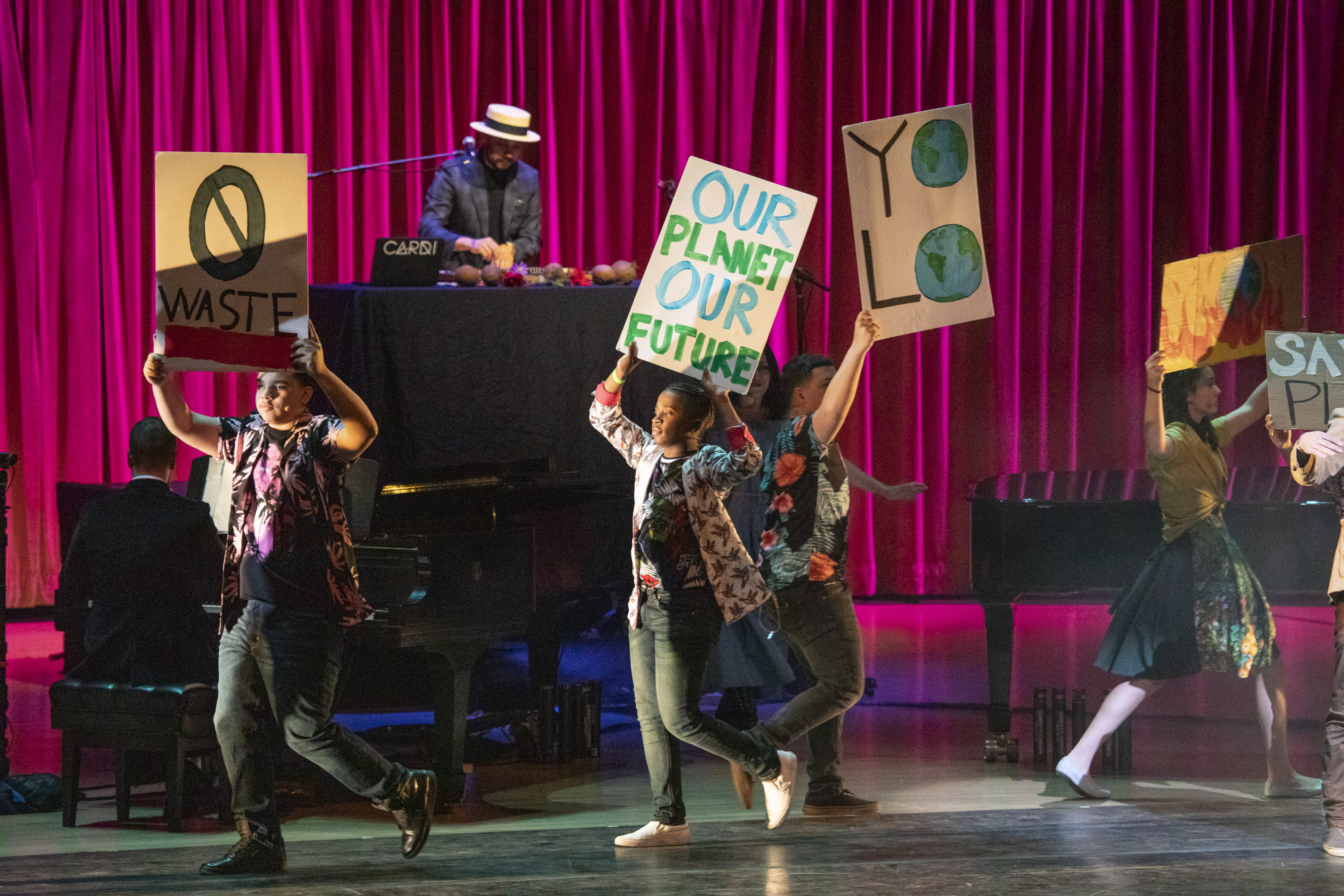
The evening’s poetry touched on powerful topics, including the environment. (Photo courtesy of Cristian Lazzari)
Young poets had the chance to shine as they reflected on socially charged themes at the Dranoff International 2 Piano Foundation’s Piano Slam 12.
The event, which blends classical music performance, poetry and spoken word competition, took place Feb. 28 at the Adrienne Arsht Center for the Performing Arts and featured 17 poets, selected from more than 4,000 Miami-Dade County public middle- and high-school students.
Speaking before a packed house at the Knight Concert Hall, Miami-Dade schools superintendent Alberto Carvalho emphasized the value the district places on the arts as well as the success of Piano Slam, which is now in its 12th year. About 83,000 county students have participated in the program’s outreach activities since 2009, he said.
The performance began with Daniel Strange, director of contemporary keyboard studies at the University of Miami’s Frost School of Music, and Rachel Ohnsman, a post-graduate student and teaching assistant for the Frost’s Creative American Music Program at Frost, taking their places at the pianos, accompanied by Argentine vocalist/songwriter Roxana Amed. Strange and Ohnsman played throughout the program, mainly as accompaniment to a deejay.
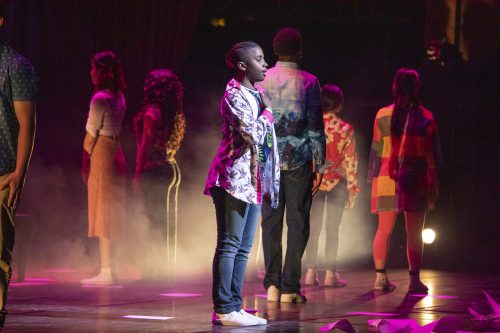
Participant Shemar Canty, from Ponce De Leon Middle School. (Photo courtesy of Cristian Lazzari)
In the first of several numbers choreographed by Miami dancer Rosie Herrera, 20 students carrying flashlights circled four young soloists who freestyle-danced at the front of the stage. As the number came to a close, Miami Norland Senior High 12th-grader Anaisa Tate stood at the center, gently swaying as she laid down the lines of her poem, “Crossroads.”
Tate spoke of Miami as a city of “new tempos/flowing in with the movement of people/the hymns of runaway slaves,” then shifted focus to Coral Gables, a city “built on the base of thick coral/and the broad backs of Bahamian accents.”
As Tate wrapped up, four young women joined her on-stage and, as a group, they swayed, sweeping arms into pivots in a second Herrera-inspired choreography.
Student poems touched on powerful themes: the potential effect of a climate crisis on Miami and their personal futures, the effects of gender and racism on self-esteem and a sense of belonging.
Brenis Bostick, a junior from Miami Norland Senior High, presented, “Mother Miami,” invoking concerns with resource depletion, air and water pollution and the changing climate.
“Mother Miami cries to me/hear her sad harmony/’help me to be what I once was.’”
As he spoke, students backlit in scarlet littered the stage with sheets of paper.
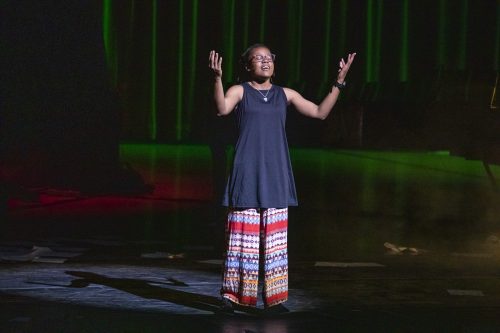
Participant Ariyelle Dickson, from Everglades Preparatory Academy. (Photo courtesy of Cristian Lazzari)
Eighth-grader Vivian Diep from Southwood Middle School carried the climate theme forward with her poem, “Strong Winds.” She expressed her struggle with Miami’s deepening urbanization.
Other students criss-crossed the stage, fanning scattered papers into the air, as she delivered lines like, “This city is getting grayer and grayer/with its advanced machinery/my green leaves try to keep the atmosphere healthy/aiming to keep the air clean and fresh.”
Then one student executed a series of backbends that closed with her facedown in the middle of the mess.
Ponce De Leon Middle’s Shemar Canty celebrated his same-sex orientation in “My Truth.” Carefully pacing his delivery, the eighth-grader pronounced a string of ringing self-affirmations: “With my sassiness and jigs/with my over-the-top personality/I am a vivacious, infectious song.”
As he finished, the hall exploded with applause, and the stage transformed into an all-out dance party.
At the close of the performance, Carlene Sawyer, creator and producer of Piano Slam and executive director of the Dranoff foundation, announced the evening’s winners.
These included:
Alisha Gay, SLAM North, Middle School English
Azul Girola, South Miami Middle, STEM
Ariyelle Dickson, Everglades Preparatory Academy, High School English
Brenis Bostick, Miami Norland High, STEM
ArtburstMiami.com is a nonprofit source of theater, dance, visual arts, music and performing arts news. Sign up for our newsletter and never miss a story.
No posts found
brigid baker wholeproject goes ‘All the Way’ in March program
Written By Sean Erwin
March 4, 2020 at 7:44 PM
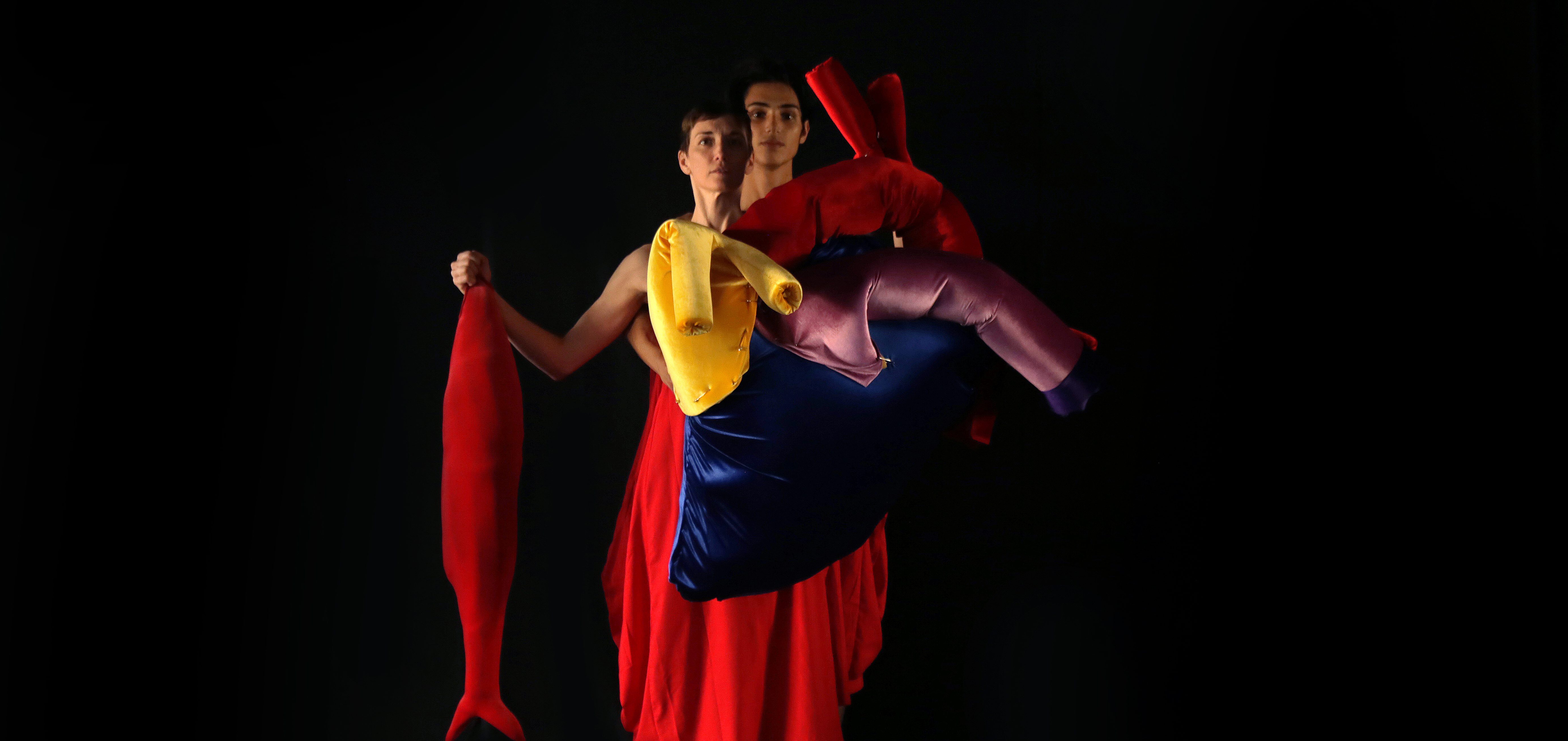
Amy Trieger and Isaiah Gonzalez in brigid baker wholeproject’s “All the Way.” (Photo courtesy of Oui Collective)
Eight-foot, fluorescent tentacles stretch from the floor. A gold-lacquered ballgown hovers in the corner among gold chainlinks the size of an arm. Every corner of brigid baker wholeproject’s Little Havana studio suggests an alternate reality seeping through.
On the dance floor, the company hones “Persian Love,” the final number of its March program, “All the Way,” which runs March 5 to 8 at the Miami Dade County Auditorium’s On.Stage Black Box Theater.
As they rehearse, the dancers form a line then sashay back, right legs kicking, fingers snapping. They skip sideways and pop into a lunge before spinning forward on the diagonal, arms punching forward.
They alternate between quick walks and sprints, complicated group rhythmics giving way to a solo as dancer Liony Garcia flails his arms over back-snapping backbends. The sequence wraps up with the dancers coupling up in a merengue grind to a recording of Holger Czukay’s 1979 “Persian Love” – a wild adventure in sampling that mashes a calypso beat with steel drums and the chant/lament of Farsi lyrics the composer captured on short-wave radio.
The dancers collapse, gulping air, and Miami choreographer Brigid Baker exclaims, “It’s great! It’s like a washing machine.”
“The whole thing is about hope in the darkness and what it is that permits connection,” Baker tells the reporter. “I’m not interested in the problems that are out there, but I am interested in the solutions.
“As Mr. Rogers used to say, ‘Look for the helpers!’”
She explains the new program’s main prop: an ottoman-sized, anatomic heart, the arteries and veins constructed from purple, yellow and scarlet velvet.
“In the middle of ‘Persian Love,’ the heart floats to the middle then hangs over the floor,” she says.
The program opens with one of Baker’s signature home-made film clips, set to Frankie Knuckles’ uptempo, “Take Me Higher.” The clips show sequences of people climbing a steep staircase or rocketing past the Statue of Liberty with jetpacks before ending with a full-sized killer whale kite-sailing above the beach.
Acting as counterpoint to Baker’s self-described “hack job” videos are slick, highly engineered media clips by Justin Trieger, New World Symphony’s director of new media.
In one Trieger-engineered segment – “All Night Long” – a black orb floats in a starry sky. During the Czukay-contrived soundtrack a voice scats/talks, “Got to keep moving ‘til the break of day,” and a sharp-heeled walk marks time. The orb gradually brightens on one edge to reveal the bright side of a gorgeous moon.
Baker’s choreography accompanies the segment. The dancers walk stiffly, straight legs on demi-pointe, then suddenly melt, bodies jazzy, arms swaying to each side accenting hip rolls, arms circling. Baker scats out the rhythms as the recording closes with poet Charles Bukowski reciting his poem, “All the Way.” As the poet repeats, “If you’re going to try, go all the way,” the dancers’ movements pick up the pace, the sequence half-walked, half-pantomimed to Bukowski’s intonations.
At the end of the segment, a gorgeous choir erupts with composer Thomas Ades’ Arcadiana 6: “O Albion” for string quartet. Forming two lines, the dancers reach, spin and drop, arms sweeping out. They couple up and briefly melt in an embrace. As a group, their weight shifts to the side and they float to the back of the room. Here, a video will show everyone, “getting it together,” Baker explains.
When asked where “All the Way” fits in with the company’s other recent programs – such as 2017’s “Big Beautiful” and 2019’s “Remain in Light” – dancer Garcia emphasizes the similarities: “I think there are different fields she likes to move in.”
Dancer Amy Trieger continues, “In this program, we are being asked to move between the fields and to take the audience with us each time.”
“That’s right,” Baker interjects. “Once the field has arisen, it’s my responsibility to practicalize it.”
Dancer Isaiah Gonzalez points out that 8-foot tentacles were a main prop of “Remain in Light,” while the centerpiece of “All the Way” is the velvet heart.
“In ‘Remain in Light,’ it was about the extremities, while in ‘All the Way,’ it’s about the actual organs and going to the core.”
What: brigid baker wholeproject presents “All the Way”
When: 8 p.m. March 5-8
Where: On.Stage Black Box Theatre at Miami Dade County Auditorium, 2901 W. Flagler St., Miami
Cost: $25
More information: 305-547-5414; miamidadecountyauditorium.org
ArtburstMiami.com is a nonprofit source of theater, dance, visual arts, music and performing arts news. Sign up for our newsletter and never miss a story.
No posts found
Prepare to be surprised with Jérôme Bel’s ‘Company, company’ at ICA Miami
Written By Mike Hamersly
February 23, 2020 at 5:01 PM
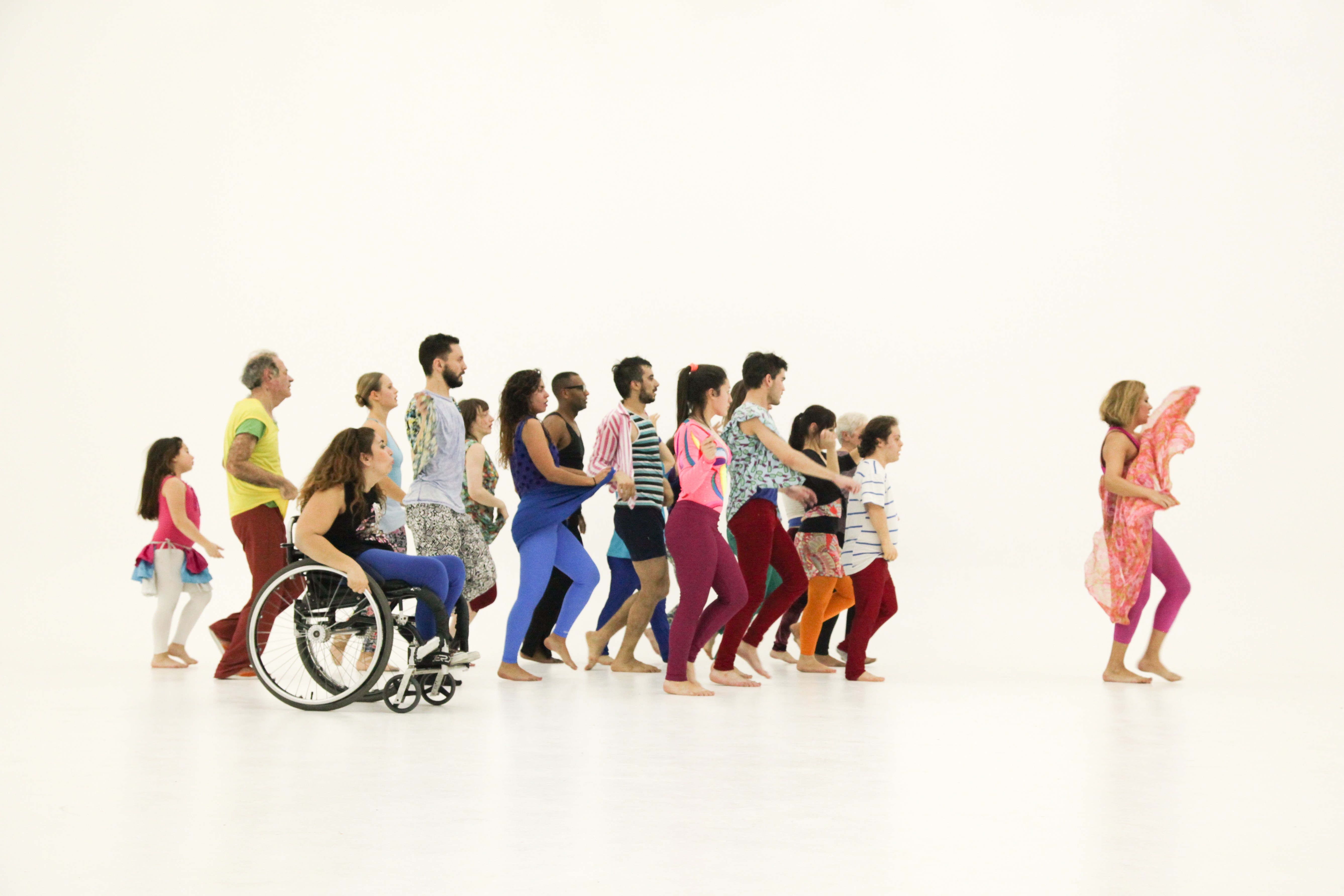
Jérôme Bel’s “Company, Company,” in 2015 at Museo de Arte Moderno de Buenos Aires, Argentina. (Photo courtesy of Josefina Tommasi)
If you’ve ever sat in a theater watching a dance performance and thought, “I’ve seen this before,” a production by Jérôme Bel might cure your artistic ennui.
The renowned French dancer and choreographer – whose works have been performed in collaboration with esteemed institutions such as the Opera National de Paris, the Theatro Municipal do Rio de Janeiro, and New York’s Museum of Modern Art – aspires to challenge both his dancers and viewers with a fresh, ever-changing approach to the art form.
“I want to offer new ways,” Bel says. “I hate tradition when they alienate bodies and mind. My aim is to use dance in order to emancipate the dancers, but also the audience.”
Bel makes his South Florida debut from Feb. 27-29 at the Institute of Contemporary Art Miami (ICA Miami) with his new work, “Company, Company,” which imagines choreography as a “flexible framework.” In other words, if you think you know what will unfold onstage, prepare to be surprised.
“In the contemporary arts field, the audience shouldn’t expect anything,” Bel says. “That’s the ‘contract’ it requires. As a spectator myself, I like contemporary arts because I don’t know what I will watch, experience. As a choreographer, I try to produce a performance that the audience has never experienced. ‘Company, Company’ doesn’t look like anything you have seen already.”
The work features a cast of locals, both professional and amateur, with vastly different backgrounds, body types and skill levels, and it aims to celebrate the joy of expression while downplaying judgment.
“I realized that professional dancers are very standardized, their bodies, their way to dance,” Bel says. “I thought that I could think about different bodies. And I found many different ones who were dancing in so many different ways that I have decided to show the diversities of dancing. That is why this performance gathers very different bodies, cultures, ages, ethnicities.”
It’s a bold statement, and a refreshing break from tradition.
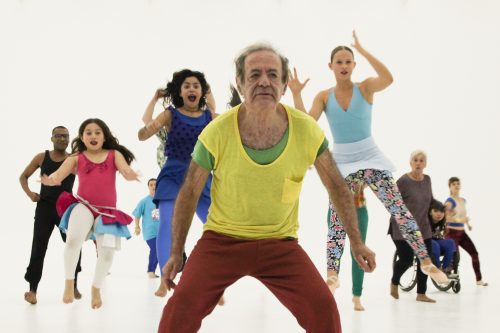
“Company, Company” features a cast of professional and amateur locals with different backgrounds, body types and skill levels. (Photo courtesy of Josefina Tommasi)
“I think it articulates the complex balance between community and diversity, group and singularity – how to be together, keeping the singularity of each individual,” he says. “Usually, dance produces community and ensemble through the uniformization of the dancers. I think this policy is not relevant anymore. Some dance companies sometimes make things [seem] like an army.”
“Company, Company” has been performed all over the world, and while it remains constant conceptually, its players change from city to city.
“The cast is local for ecological reasons,” says Bel, who answers, “to save the world,” when asked to sum up his artistic mission. “I didn’t want to put performers on planes anymore. I was thinking local to reduce the carbon footprint of the performance.
“People are hired in every city and, of course, they produce a totally different show from one cast to another, from one city to another. And each cast is closer, then, to the culture of the audience. The cast represents the audience, more or less.”
Bel is one of a handful of choreographers, mostly French, who have been linked to the “non-dance” movement of the early ’90s, which has been described as approaching performance art. He vehemently rejects this affiliation, however.
“I don’t use this term,” he says. “[A reporter] from ‘Le Monde’ wrote this once, and then I [was] stamped with this term, which is ridiculous. I push forward the dance, but I am not against dance. And especially not with this production, ‘Company, Company.’ It is a total misunderstanding of my work.”
Perhaps to emphasize his love of dance, Bel lists an incredibly diverse group of his idols, names that include Vaslav Nijinsky, Isadora Duncan, Josephine Baker, Trisha Brown, Tatsumi Hijikata, Lucinda Childs, Merce Cunningham, Anna Halprin, Pichet Klunchun and Bob Fosse.
Bel’s unique style is a perfect fit with ICA Miami, which strives to be “a platform for the exchange of art and ideas in the broadest possible sense,” according to its associate curator, Stephanie Seidel.
“I think Jérôme Bel is an extremely important example of a choreographer who bridges the world of dance with the world of visual artists,” she says. “We really feel that his interdisciplinary approach to dance is something that is really relevant and also is something that we really value. I had seen his work personally in dOCUMENTA (13) in 2012 [in Kassel, Germany], which is one of the most important art exhibitions, so it’s a real honor to be able to bring him here to Miami.”
What: “Company, Company,” by Jérôme Bel
When: 7 p.m. Feb. 27 and 28; 1 p.m. Feb. 29
Where: Institute of Contemporary Art Miami, 61 NE 41st St.
Cost: $15 general admission; $10 for members
More information: icamiami.org/program/jerome-bel
ArtburstMiami.com is a nonprofit source of theater, dance, visual arts, music and performing arts news. Sign up for our newsletter and never miss a story.
No posts found
Review: Street dance confronts realities of structural racism in ‘Love Heals All Wounds’
Written By Sean Erwin
February 23, 2020 at 4:25 PM
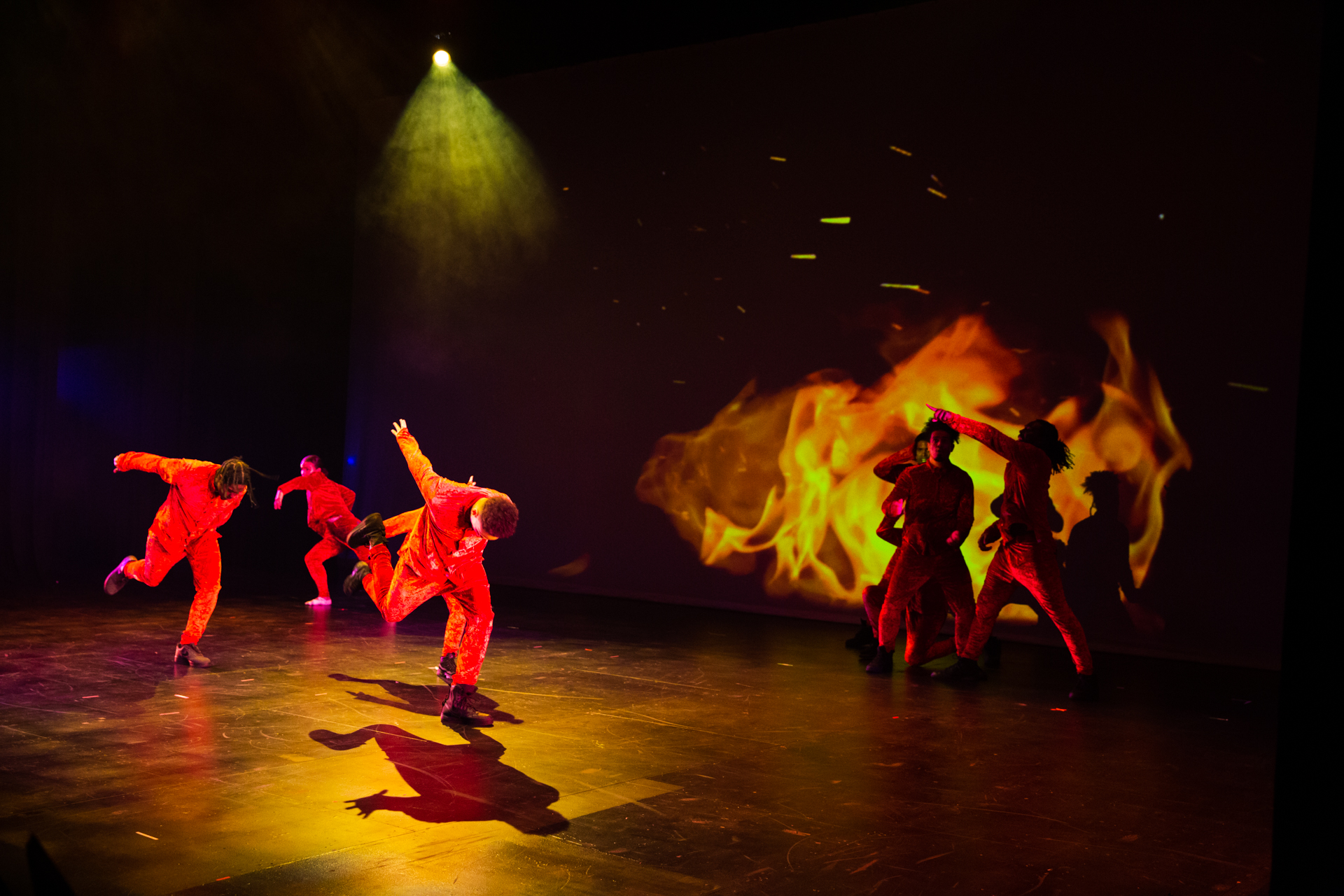
“Love Heals All Wounds” used street dance, poetry, film and live music to discuss subjects such as social injustice, racism and environmental destruction. (Photo courtesy of Amanda Smith Photography)
“Love Heals All Wounds” – the latest collaboration from South Florida’s Jon Boogz and Memphis-based Lil Buck – combined theater and poetry, dance and film to address issues of racism, police violence, mass incarceration and gender oppression in its Feb. 8 presentation at the Adrienne Arsht Center for the Performing Arts.
The program, at the Arsht’s intimate Carnival Studio Theater, offered an exciting and smart mix of street dance, spoken word and visual projections and extended the vocabulary of street dance to embrace activist narratives and social commentary.
It opened to a backdrop of pulsing stars, and Jon Boogz and Lil Buck stretched side by side on the floor as violinist Jason Yang spun out a mournful, adagio melody.
Boogz and Buck slowly stood while, at center stage, poet Robin Sanders – in a full-length, white-and-gold dress – chanted verses to the sound of flowing water.
“Hydrants spray water as brown as their skin,” Sanders chanted, introducing the theme of environmental racism.
In silky blue shirts, the two dancers sent waves rippling from shoulders to fingertips and back, while scenes flashed behind them showing hurricanes flooding city streets and citizens from low-income neighborhoods struggling to rebuild.
Five other dancers formed a pyramid around Boogz and Buck. The group cycled through patterns of snap pivots and re-directions, torsos rippling, arms and hands fluttering. Projected behind them, a man held high the sign, “Flint Lives Matter.”
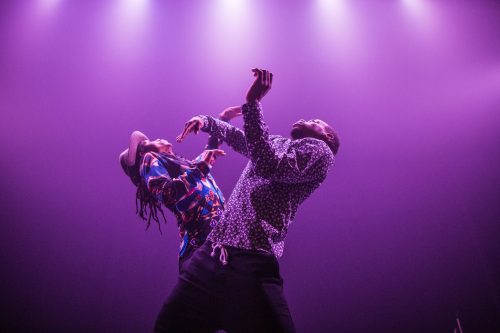
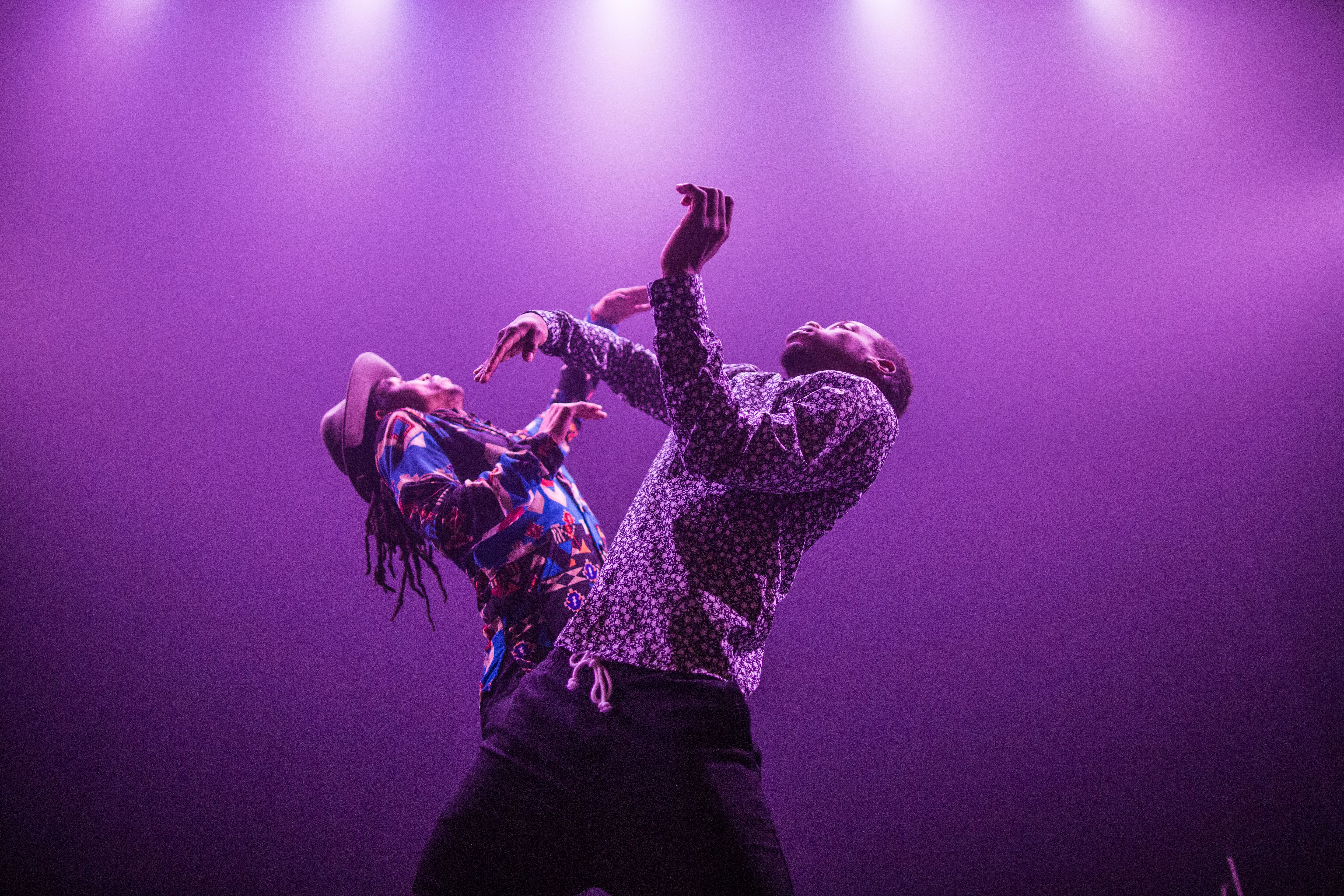
Jon Boogz, left, and Lil Buck in “Love Heals All Wounds.” (Photo courtesy of artist management)
Then Sanders returned, and the group formed a tight line behind her. As they swayed gently, she asked the audience to “breathe deeply” and “inhale the stench of inequality,” marking the shift from water to the element of air.
Of the four opening vignettes featuring elements, “Fire” was especially effective. As four dancers in red formed a cross on the floor, Sanders’ verses played with associations of fire to anger, with phrases such as “ashes of destruction,” before centering on a message of renewal, “I can tame them. I can restore them.”
With that, the four dancers stood and began a complicated sequence of moon walks, floating forward and to the sides as images of fires raging through Baltimore minority neighborhoods appeared on the screen behind them. The scene ended with the dancers huddling around the poet.
“Love Heals All Wounds” consistently resisted the temptation to soften the harsh social realities it framed. From vignette to vignette, talk of the power of unconditional love or faith in social progress consistently shifted to show the violent realities of structural racism for many African-Americans in the United States.
In one instance, Sanders introduced the next piece with the half-sung, half-chanted refrain, “Black boy, you bring so much joy,” as dancers in street clothes circled the floor, clapping and stomping. Forming a tight group at the front of the stage, they took turns rapping lines and snapping out athletic dance sequences.
As the audience joined in a call-and-response, the theater morphed into a neighborhood street corner. One dancer explained to the audience how he managed to add a twist to his flip. Another riffed on Sanders’ opening lines, strutting to the center with, “Black boy, black joy, I’m talking about me.” The audience burst into applause.
The warmth and camaraderie of the scene vanished with the wail of police sirens. The dancers scattered as the vibe shifted instantly from joyful to dark.
This performance was followed by a brilliant examination of the contemporary crisis of mass incarceration and its roots in the history of American slavery.
“What’s going on?” questioned Sanders, as she opened the segment spinning out lyrics that forged potent links with the visuals.
As she spoke of “power as the new narcotic,” and being guilty “by simply breathing while being brown or black,” black-and-white images of chain gains and prison yards full of African-American men flashed on the screen.
Four dancers in prison suits stood at the center of blocks of light on the floor, crisscrossed with shadows reminiscent of prison bars. The men shed their shirts, framing startling choreographies that ran the gamut of the penal experience from the hammer strikes of forced labor to impacts received from beatings.
One dancer in street clothes bobbed and feinted like someone locked in argument, half pantomiming, half dancing. Exasperated, he raised arms in surrender, then kneeled and placed his hands behind his head as a voiceover described the meteoric rise of U.S. incarceration rates during the past 50 years.
It was the evening’s most powerful piece.
ArtburstMiami.com is a nonprofit source of theater, dance, visual arts, music and performing arts news. Sign up for our newsletter and never miss a story.
No posts found
Miami Sunshine Tango Festival to meld Buenos Aires with the beach
Written By Sean Erwin
February 21, 2020 at 3:51 PM
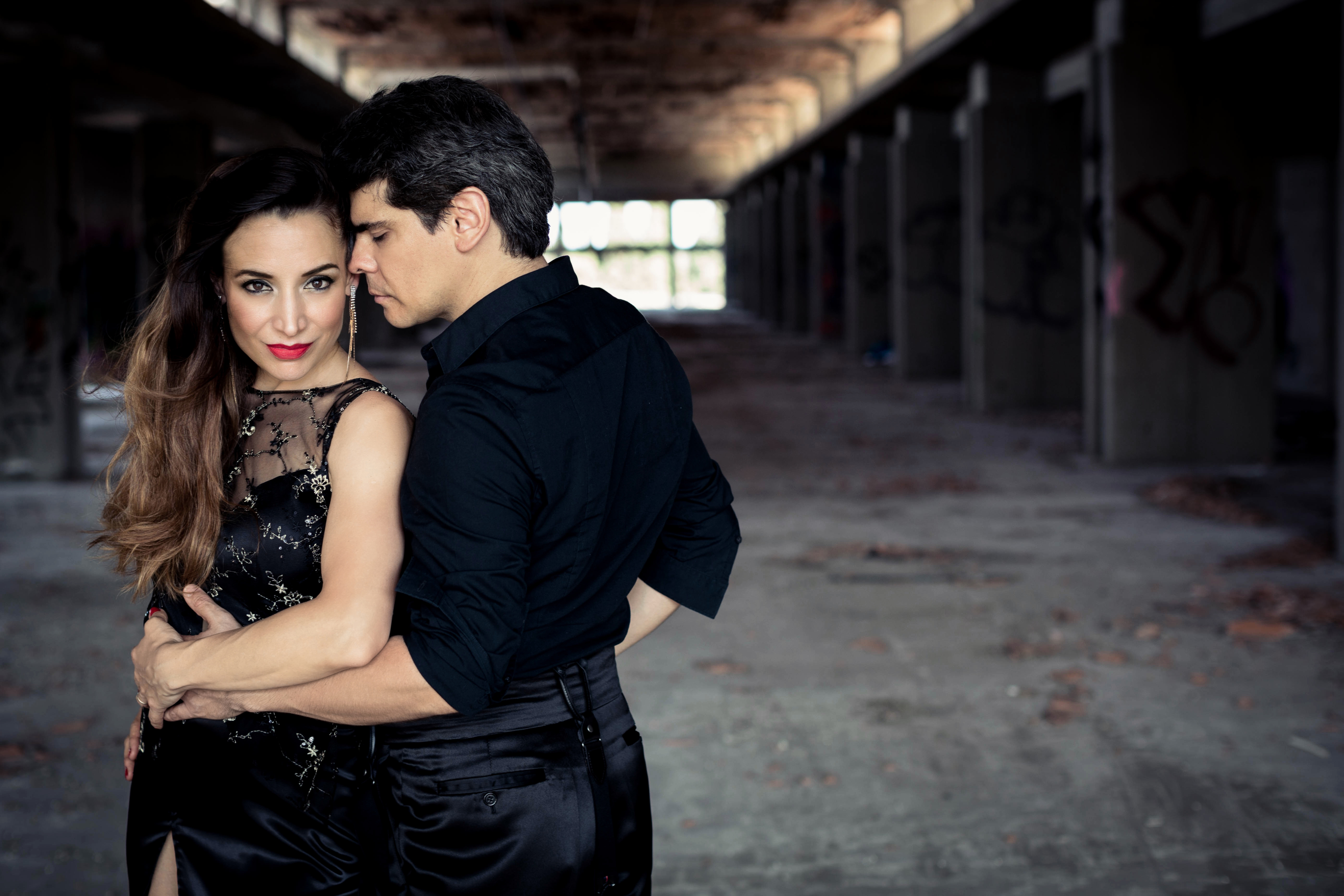
Alejandra Hobert and Adrian Veredice will be featured in the Miami Sunshine Tango Festival. (Photo courtesy of Michele Maccarrone)
Some of the world’s best Argentine tango dancers and musicians will converge on Sunny Isles Beach over three nights to recreate the flavor of an authentic Buenos Aires “milonga” (dance gathering) – but with a Miami twist.
“If we were doing this in Buenos Aires, we would hold the festival in the middle of the city,” says Mariano Bejarano, organizer of the Miami Sunshine Tango Festival. “To bring tango to Miami has to be done in the Miami way. We want to mix in the beaches and Miami’s Caribbean vibe.”
The festival, from Feb. 21-23 at the Ramada Plaza By Wyndham Marco Polo Beach Resort, will feature tango classes, poolside practices and beachside milongas.
While growing up in Argentina, Bejaraon hated tango, he says, but was immersed in its culture.
“Tango in Argentina is something which, since you’re a kid , you listen to it whether you like it or not,” he says. “Subliminally, whether you like it or not, you hear it everywhere. I never liked tango, but my blind grandfather would sing the lyrics, so when I started to get into tango, I asked myself, ‘How come do I know these lyrics?’”
He caught the tango bug after moving to Miami where he started to dance, teach and organize events promoting the art form. With the large number of Argentines that call South Florida home, Bejarano holds high hopes that tango could really take off here.
“Because of the Latin culture here in Miami, Miami could be one of the main cities outside Argentina where tango is danced and performed,” he says.
But first, he has to attract new audiences and young people to an art form that presents itself as foreign, stiff with tradition and out of touch. For that reason, Bejarano has invited performers with a proven track record for connecting with young people and international audiences.
Among them is La Juan D’arienzo orchestra, whose name recalls one of the most famous Argentine tango composers. As a band leader, D’arienzo’s music energized night halls from the 1930s until his death in 1976.
As the orchestra’s band leader and principal bandoneonista (bandoneon player), Facundo Lazzari learned the accordion-style instrument from his grandfather, Carlos Lazzari, who originally performed with the famous D’arienzo.
Lazzari took up the instrument, “because I fell in love with this style of tango.” He had the chance to play with his grandfather for a year, and their time together was enough for him to forge a link with tango’s authentic tradition.
“It is a big responsibility to take care of our music and our legacy,” Lazzari says. “The name of Juan D’arienzo itself acts as bridge with the past and makes our sound unique.”
While dedicated to keeping this past alive, Lazzari also recognizes the need for tango to grow by connecting with new audiences, many of whom don’t speak Spanish.
“Our audience is not only Argentinian now, but from everywhere in the world, so this time we are going to play one tango in English for the very first time in Miami during our U.S.-Canada tour,” he says.
Of course, the immersive Buenos Aires experience also requires the world’s most prominent practitioners of the dance. Among those showcased in the festival will be Gustavo Naveira and Giselle Anne; Virginia Gomez and Christian Marquez; Manuela Rossi and Juan Malizia; and Alejandra Hobert and Adrian Veredice.
Hobert and Veredice call Miami home. When they are not traveling internationally to teach and perform, the couple live in Weston, where they raise their two young daughters and offer a tango class. They have been dancing together for 23 years, having first met in Buenos Aires.
“My [guitarist] brother plays in San Telmo, the neighborhood where we lived in Buenos Aires which is rich in tango tradition,” she says. “Though he’s two years older than I am, we both started playing and dancing at the same time.”
Meanwhile, Veredice started dancing tango while studying architecture – but it was not his first dance.
“I did folk-dancing before tango. But while I was at the university, I began listening to tango all the time,” he says. “Once I started to learn the dance, I transitioned to only tango pretty quickly.”
What: Miami Sunshine Tango Festival
When: Feb. 21-23
Where: Ramada Plaza By Wyndham Marco Polo Beach Resort, 19201 Collins Ave., Sunny Isles Beach
Cost: Milongas, performances and classes range from $10-$385
More information: miamisunshinetangofestival.com
ArtburstMiami.com is a nonprofit source of theater, dance, visual arts, music and performing arts news. Sign up for our newsletter and never miss a story.
No posts found
Review: New World Symphony and Miami City Ballet do honor to Stravinsky and Balanchine
Written By Sean Erwin
February 11, 2020 at 3:00 PM
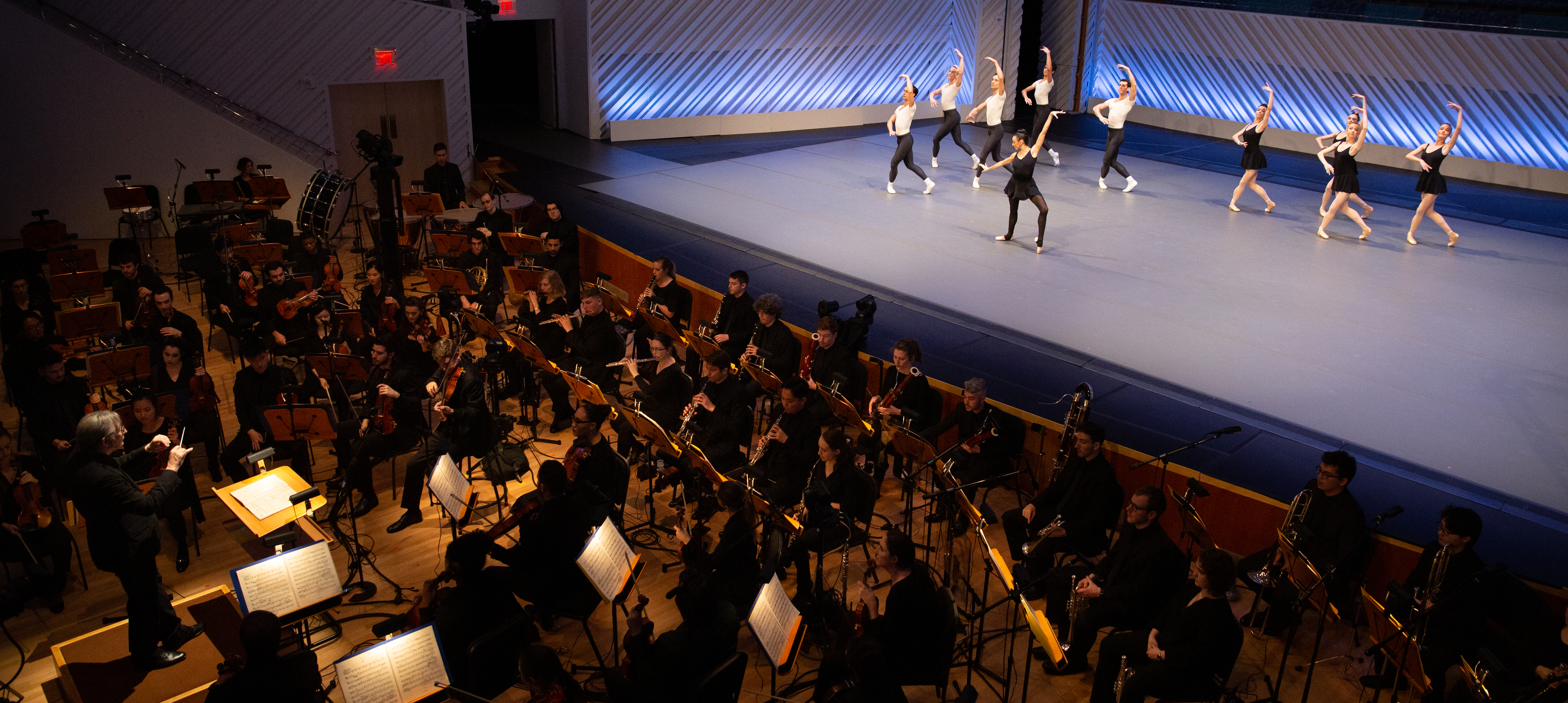
“Stravinsky and Balanchine: A Monumental Collaboration” at the New World Center paid tribute to two giants of music and dance. (Photo courtesy of Alexander Iziliaev)
There was palpable excitement in the air as two giants – Miami City Ballet and New World Symphony – came together Jan. 31 for “A Monumental Collaboration.”
The program at Miami Beach’s New World Center was a fitting tribute to the artistic union of two other giants: composer Igor Stravinsky and choreographer George Balanchine.
“Stravinsky and Balanchine: A Monumental Collaboration” opened with a video introduction by New World Symphony artistic director and conductor Michael Tilson Thomas and Miami City Ballet artistic director Lourdes Lopez. It drew parallels with Stravinsky and Balanchine’s collaboration and explained the personal connections that Thomas and Lopez had to the composer and choreographer.
The evening began with the ballet, “Apollo.” Stravinsky’s work first debuted in Washington, D.C., in 1928 with choreography by Adolph Bolm. When Sergei Diaghilev’s Ballets Russes dance company performed “Apollo” a few months later in Paris, it was paired with choreography by an emerging talent, the 24-year old George Balanchine. It became the first collaboration between Stravinsky and Balanchine.
For this latest performance, Thomas carefully unfolded the opening motif of “Apollo,” pacing the all-wind orchestration through the prologue’s nuanced variations on the opening motif of dotted rhythms.
As the theme expanded, it connected gorgeously with the violin solo rendered by New World Symphony fellow Kevin Chen. With the start of Chen’s solo, MCB’s Renan Cerdeiro entered in white tights and a draped tunic. At first tentative in his attack, Cerdeiro settled into the space and shaped a terrific “Apollo” who stretched and lunged, alternating between strict dance and miming the performance of the thaboura.
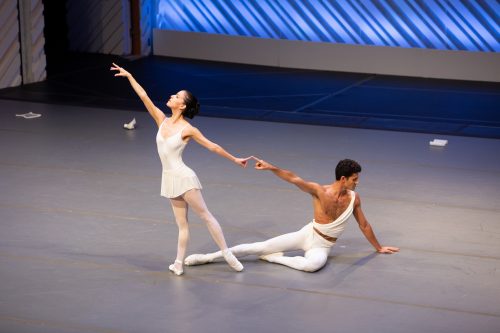
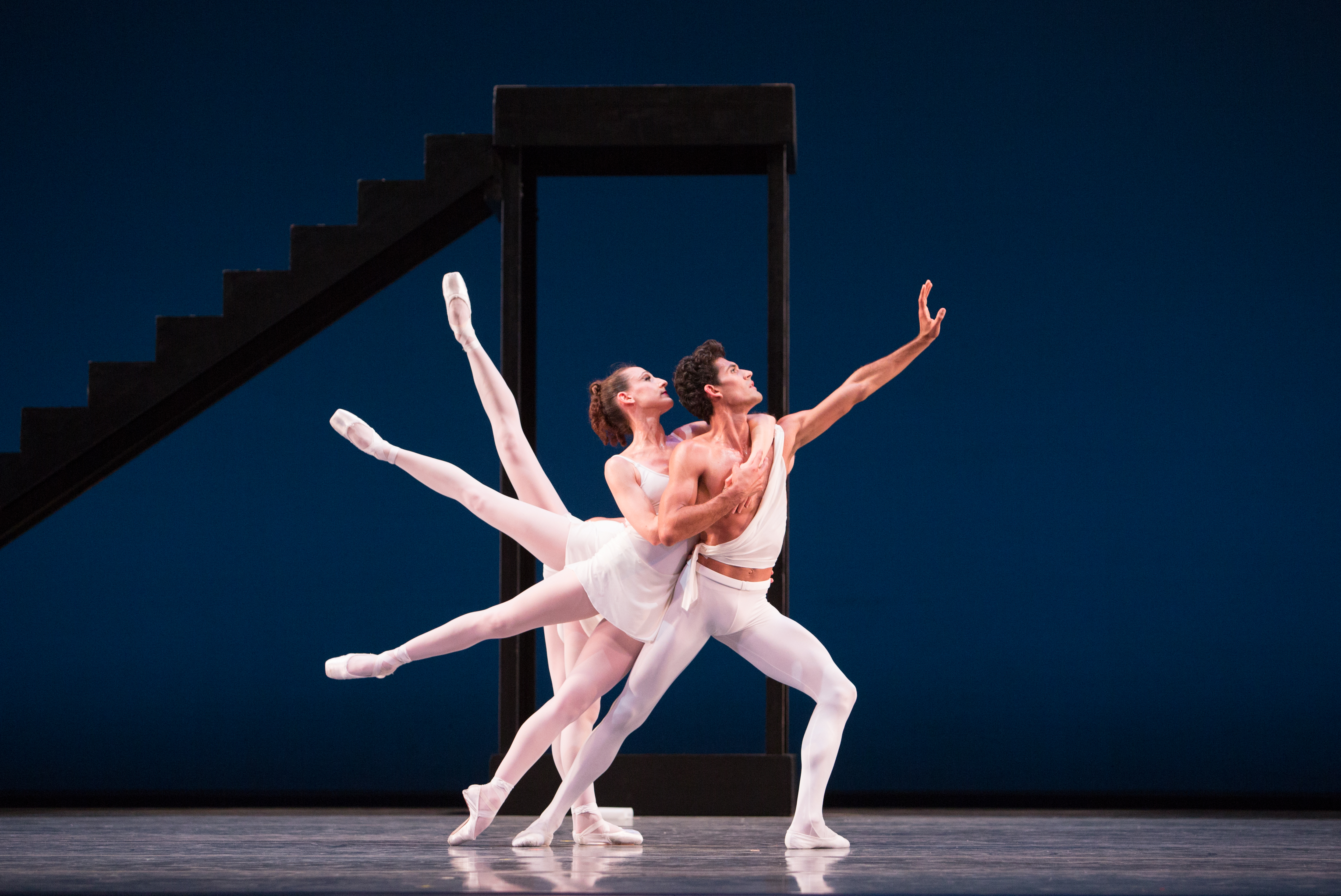
Miami City Ballet’s Katia Carranza and Renan Cerdeiro in “Apollo.” (Photo courtesy of Alexander Iziliaev)
The prologue closed with the appearance of the muses: Emily Bromberg as Calliope (poetry), Jennifer Lauren as Polyhymnia (mime), and Katia Carranza as Terpsichore (dance and song). All three sparkled, both in their solo variations and together with Cerdeiro, whether performing a weave at the center or miming the horses of Apollo’s chariot. Carranza was especially memorable in the way she communicated the nuances of the orchestra’s phrasing with her upper body and the timing of her footwork.
Next up was “Circus Polka” (1942), which Balanchine originally choreographed as a dance for 50 elephants, commissioned by circus man P.T. Barnum.
Miami City Ballet performed this back in 2018, with 48 students acting as the elephants and Lopez assuming the role of ringmaster.
For “A Monumental Collaboration,” both the elephants and the students were replaced with sumptuous, thought-provoking visuals projected on the hall’s massive sails by Emily Eckstein.
“Circus Polka” opened with a chaotic tumbling of strings and, from there, the melody vaulted forward. Especially notable were the gorgeous, controlled bass tones in the baritone and trombone that alternated with the winds. The music remained tongue in cheek and danceable from start to finish, barreling through to a final thud.
Eckstein’s Monty Python-style visuals meshed humans and circus animals with machines, suggesting how mass entertainment connects performers and audiences in a kind of assembly line.
The evening closed with Stravinsky’s “Violin Concerto in D Major” (1931). Stravinsky’s score stems from a collaboration in Paris between Stravinsky and violin virtuoso Samuel Dushkin. Balanchine had a choreography premiere at the 1972 Stravinsky Festival organized to recognize the composer’s death.
“Violin Concerto” starts with a toccata followed by two arias composed of a pas de deux danced by two couples; it ends with a capriccio for the entire cast.
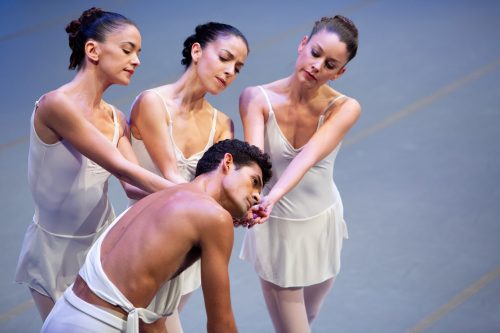
Miami City Ballet dancers perform in “Apollo,” which became the first collaboration between composer Igor Stravinsky and choreographer George Balanchine. (Photo courtesy of Alexander Iziliaev)
Each movement opens with a chord Stravinsky devised with Dushkin, which stretches from D to E to A6 and serves as an emotional thermometer for each of four movements. Violinist James Ehnes was brilliant in the opening toccata, cutting sharply through the opening repetitions of sixteenths and eighths that shuffled first between solo strings, winds and double reeds before being asserted again in increasingly dramatic combinations of voices.
In the first aria, soloists Kleber Rebello and Nathalia Arja powerfully channeled the shrill and otherworldly quality Ehnes laid down, as Rebello pilloried Arja at the center of the stage or pivoted her attitude from behind with the foot of her stretched leg on his throat.
The refrains of the chord in the second aria – danced by soloists Cameron Catazaro and Ashley Knox – shifted from shrill and threatening interruptions to a signal of the complicated emotions powering their pas de deux, as Ehnes developed an increasingly conversational quality with the orchestra.
While both soloists danced notably here, this was a breakout performance for Catazaro as he ate space and radiated theatricality in support of a distraught Knox, sweeping his arm over her shoulders, his hands over her eyes and, with the soloist’s final note, pulling her into a deep backbend.
In the final capriccio, Ehnes decorated the pulse of the orchestra with accents as the dancers skipped forward bent low, elbows covering their eyes. At the center, the two pairs of soloists circled each other in a Russian folk dance that closed the evening on a joyous note.
Most took to their feet as Thomas, Lopez and Ehnes joined the dancers onstage to receive the applause of an enthusiastic audience.
ArtburstMiami.com is a nonprofit source of theater, dance, visual arts, music and performing arts news. Sign up for our newsletter and never miss a story.
No posts found
Review: Flamenco Sephardit presents a tour de force at Temple Emanu-El
Written By Sean Erwin
February 5, 2020 at 6:41 PM
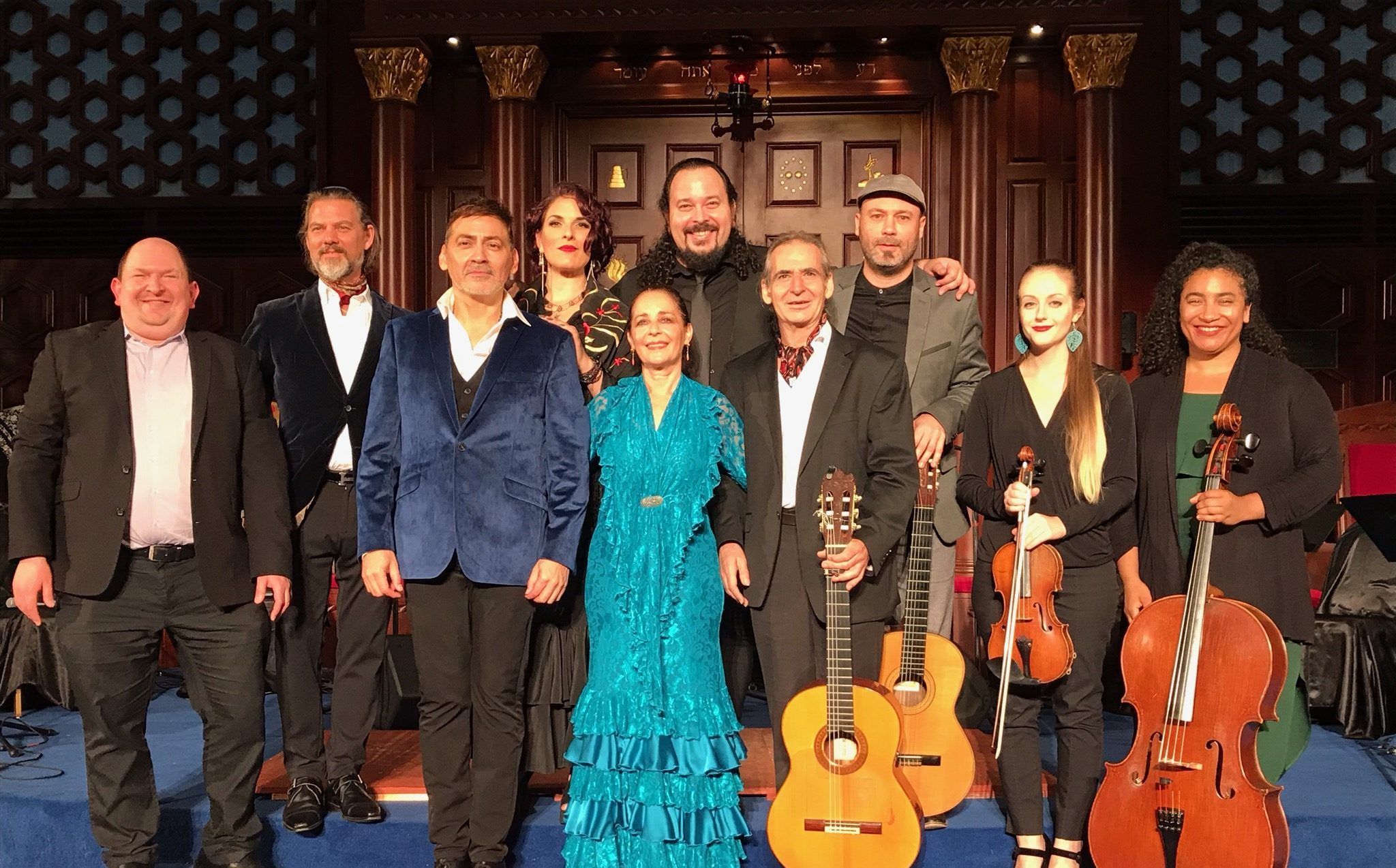
From left: Jeffrey Eckstein, Rabbi Marc Philippe, Jorge Robledo, Audrey Babcock, Celia Fonta, Jose Moreno, Paco Fonta, Michel Gonzalez, Katherine Kobylarz and Chava Appiah. (Photo courtesy of Jeffrey Eckstein)
Miami increasingly figures as an international center for flamenco, second to Madrid, of course. Yet amid this sea of offerings, Flamenco Sephardit’s latest program in Miami Beach shone bright.
The Jan. 26 performance, “Flamenco Sephardit VII,” presented a fusion of Andalusian and Jewish traditions – blending Spanish flamenco with Ladino music and dance. It took place in a packed Temple Emanu-El and featured the well-known, husband-and-wife team of Celia and Paco Fonta. (The couple belongs to the Miami-based flamenco group, Siempre Flamenco, which is known for the annual Festival de Cante Flamenco shows in September that have delighted audiences for more than a decade.)
After a quick introduction, Rabbi Marc Philippe – one of the evening’s singers – spoke about Ladino and flamenco’s connection to North African Muslim art forms and told the audience to think of the performance as an act of light and love.
Though flamenco dance and music are well-known, Ladino music is not as recognizable. Once spoken by Sephardic Jews from the Iberian Peninsula to the Ottoman Empire, Ladino is a dialect of 15th-century Spanish mixed with French, Italian, Portuguese, Greek, Turkish, Arabic and Hebrew.
Nowhere was this more evident than in the evening’s second piece, “Fel Sharah Canet Betet Masha” (“Walking down the street”), whose lyrics read as a mash-up of languages.
New World Symphony fellows Katherine Kobylarz on violin and Chava Appiah on cello laid down a slow, off-beat melody that spun into a gorgeous ballad with Philippe on vocals. This set up the entrance of dancer Jorge Robledo, who sprang to the center of the stage, striking in a blue velvet jacket and black vest.
With the bimah right at eye level, the synagogue proved a spectacular place to view the dancer’s quick footwork. Robledo caused the edges of the makeshift dance surface to pop off the floor with the strength of his rapid heel strikes. He snapped out an opening sequence before Celia Fonta – striking in a full-length turquoise dress ringed with ruffles from the waist down – joined him.
The two circled, mirroring each other’s sudden shifts of posture, pulses in shoulders, and quick snaps of the head. The audience burst into appreciative applause.
Celia Fonta returned with “Como la Rosa” (“Like the Rose”), and she was marvelous.
Mezzo-soprano Audrey Babcock, whose gorgeous operatic vocals were a highlight of the evening, spun a slow and mournful melody, accompanied by Appiah’s cello and Paco Fonta and Michel Gonzalez on guitar.
Celia Fonta theatrically arched her back and worked her arms sinuously while tapping out tight percussive sequences, her feet pacing the rhythms of her husband’s guitar. She floated forward on a wave of eye-popping footwork, pulling out all the stops as she high-stepped across the stage. Her solo ended and the audience went wild.
Another highlight was a “seguiriya,” which is a type of flamenco music in the “cante jondo” vocal style (“deep music”). It opened dramatically with Robledo slow-walking to the center, his eyes locked on Babcock. Without relaxing his gaze, he crouched and pivoted in place, finding the singer’s eyes repeatedly as he raised arms overhead. When Babcock’s solo ended, Robledo’s fireworks began.
As Paco Fonta spun an insanely rapid guitar solo, both dancer and guitarist riffed off the other’s rhythms, the dancer’s arms circling, fingers snapping, left hand holding open his jacket. Then with a snap of his head, he froze.
With the sanctuary silent, the audience first applauded but stopped as the violin and cello drove the melody forward. Robledo responded with intricate, infectious footwork that sent the hall vibrating. Many in the sanctuary swayed, and some at the front raised their hands. When the number ended, audience members got to their feet.
But the evening contained one more surprise, “A La Una,” which closed the performance spectacularly. Percussionist Jose Moreno started with a drum solo then suddenly sprang to the center of the stage and belted out a song before unmasking his skills as a dancer with a sequence of whip-like turns and lightning rhythms. Moreno’s theatrics ended the evening with the audience again on its feet.
ArtburstMiami.com is a nonprofit source of theater, dance, visual arts, music and performing arts news. Sign up for our newsletter and never miss a story.
No posts found
Jon Boogz and Lil Buck bring ‘Love Heals All Wounds’ to the Arsht
Written By Jordan Levin
February 3, 2020 at 10:49 PM
Jon Boogz, left, and Lil Buck in “Love Heals All Wounds.” (Photo courtesy of artist management)
South Florida-raised dancer/choreographer Jon Boogz has always wanted to use dance to tell stories that matter.
Growing up, the only things he loved as much as dancing were issue-driven films such as “Schindler’s List” and “The Color Purple.” As a street dancer in the style called popping, however, Boogz was in a world where success typically means getting on TV shows, touring with pop stars, winning competitions, and constantly upping your virtuosity. Not breaking hearts, opening minds, or changing worlds. He wanted more.
“People like to put boundaries on the art form,” Boogz says. “I always wanted to create powerful stories with it.”
Boogz has done just that with “Love Heals All Wounds,” an acclaimed multimedia theater work he created with Lil Buck, a dance star who made famous the Memphis jookin style. The show, which has been touring for two years, comes to the Adrienne Arsht Center for the Performing Arts on Feb. 8 and 9.
“We’ve been getting immense feedback,” he says. “During [question-and-answer sessions], people are crying, saying their lives are changed.”
“Love Heals All Wounds” uses street dance, poetry, film and live music to express the two men’s feelings on subjects such as social injustice, racism and environmental destruction. The show has received a passionate response, giving Boogz faith that they’re having an impact.
He also hopes it shows other dancers from the B-boy and street dance worlds that they, too, can find creative fulfillment and success outside pop videos and commercials.
“We want to empower people like us, give kids who come from neighborhoods like we come from something else to aspire to,” Boogz says. “There’s always been people thinking more uniquely and artistically about the [street dance] genre, but there wasn’t a lane for it. We’re opening up a new highway.”
Boogz, 32, grew up in Hollywood and North Miami, and began dancing as a young boy in Miami’s underground B-boy scene. He competed in the Bboy Masters Pro-Am, a major event on an international circuit of B-boy conventions and contests. In 2009, feeling like he’d done everything he could in Miami, Boogz and a girlfriend moved to Los Angeles.
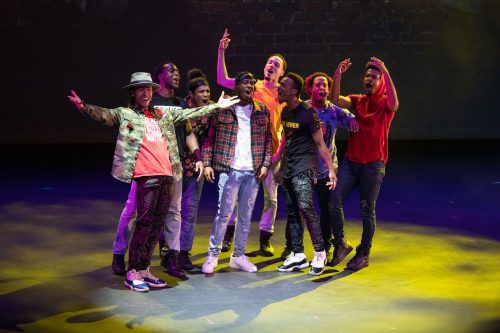
“Love Heals All Wounds” uses street dance, poetry, film and live music to discuss subjects such as social injustice, racism and environmental destruction. (Photo courtesy of artist management)
But things quickly went sour. He split with the girlfriend, struggled in the intensely competitive commercial scene, and found himself sharing a tiny apartment with four other guys.
“You see all these dancers on shows like ‘So You Think You Can Dance.’ I was like, ‘How do I separate myself? Should I be doing what they’re doing?’” he says. “I realized I had to combine the things I’m passionate about: storytelling in film and storytelling through dance.”
Depressed, broke and ready to return to Miami, Boogz went to a street dance jam at an L.A. studio, where he encountered Lil Buck.
“I’m letting out all my frustrations and this guy comes up to me and says, ‘Where are you from, dude? I’ve never seen anyone pop like that. Your style is amazing,’” Boogz recalls.
Buck invited him to join his crew, which performed on the sidewalks of Venice Beach for tips, a lifeline that enabled the Miami dancer to pay his bills and pursue his career. Boogz began making short films on subjects including domestic violence and suicide. In the next two years, the pair bonded over their dreams to take street dance beyond the street.
“He had a similar passion to take street dance to the next level,” Boogz says. “We were looking at the era of Gene Kelly, Fred Astaire, the Nicholas Brothers, when dancers were superstars. We said, that’s where street dance needs to be.”
Buck’s career took off around 2012, after a video of him improvising with world-famous cellist Yo-Yo Ma to “The Dying Swan” went viral. He went on to tour with Madonna, earn raves in the mainstream cultural press, and do commercials for Versace and Apple.
The two friends reconnected in Las Vegas in 2014, when Boogz got his own break performing with Cirque du Soleil there, just as Buck was leaving the show. The duo realized they finally had the resources and visibility to bring their artistic dreams to life.
They formed a nonprofit, Movement Art Is, and their first effort was “Color of Reality,” a 2016 short film they created in reaction to the wave of police shootings of young black men.
In the film, covered in a collage of paint by artist Alexa Meade, they flow from pain at television news to rejection on the street. “Color of Reality” went viral, pulling almost 400,000 views on YouTube.com. Other issue-driven dance films followed: “Am I A Man,” on the mass incarceration of black men; “Funeral for America,” where they bury racism; and a Ted Talk performance, “Honor Thy Mother,” on environmental threat, for the 2017 Vancouver edition of the famous conference.
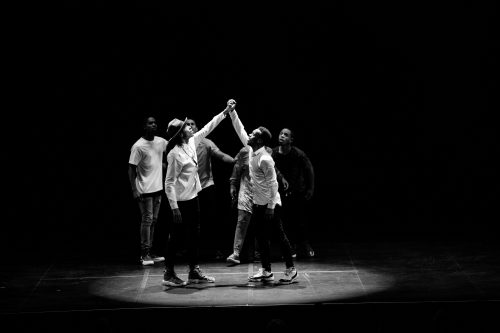
“Love Heals All Wounds” will be at the Adrienne Arsht Center for the Performing Arts on Feb. 8-9. (Photo courtesy of artist management)
“Love Heals All Wounds,” which they launched in 2018, is their most ambitious project yet. Boogz says it’s inspired by the often-overwhelming news of racism, intolerance, violence and environmental threats that have surged during the current administration – and by their own experiences.
“A lot of this comes from our lives,” he says. “I’ve been pulled over by cops and had illegal [things] happen to me. And, of course, everything going on in our country now inspired the work.
“You can’t be an artist and not be inspired by the times. We’re the newscasters, and we’re reporting live from the authentic stage of the people. It’s my duty to do that through my work. Hopefully, we won’t always have to do that. But until then, it has to be part of my life mission and art’s mission.”
This will be the first Miami performance of “Love Heals All Wounds,” and Boogz is thrilled. Along with Buck, he will join eight other dancers, spoken word poet Robin Sanders and violinist Jason Yang onstage.
“I’m so excited to bring it home,” he says. “Words can’t describe how I feel. For me to do this show in Miami means so much to me.”
He and Buck think art is more effective at inspiring people to take action and come together than political speeches and venting on social media.
“If I preach what I think, people might turn off. ‘Oh, here’s another rant.’ But when you allow people to take it in through movement, music, poetry, storytelling, they absorb it in a different way,” he says. “I’ve had people come up and say, ‘Your show has changed my whole outlook on life.’ You can’t put a value on that.”
What: Jon Boogz and Lil Buck’s “Love Heals All Wounds”
When: 7:30 p.m. Feb. 8 and 3 p.m. Feb. 9
Where: Carnival Studio Theater at Adrienne Arsht Center for the Performing Arts of Miami-Dade County, 1300 Biscayne Blvd., Miami
Cost: $40
More information: 305-949-6722; arshtcenter.org
ArtburstMiami.com is a nonprofit source of theater, dance, visual arts, music and performing arts news. Sign up for our newsletter and never miss a story.
No posts found
Miami City Ballet, New World Symphony unite for ‘A Monumental Collaboration’
Written By Sean Erwin
January 27, 2020 at 5:19 PM
Tricia Albertson and Renan Cerdeiro in “Apollo.” (Photo courtesy of Alexander Iziliaev)
If only one titan, Atlas, could support the Earth on his shoulders, for two together would even the sky be the limit?
The 20th century experienced just that when choreographer George Balanchine and composer and pianist Igor Stravinsky collaborated in Paris and Washington, D.C., in 1928 on their ground-shifting ballet, “Apollo.” Their artistic partnership shifted the tectonics of both classical dance and music.
In a tribute to the composer and choreographer’s artistic union, New World Symphony musicians have teamed up with Miami City Ballet dancers for “Stravinsky and Balanchine: A Monumental Collaboration,” to be presented at Miami Beach’s New World Center at 7:30 p.m. Jan. 31 and Feb. 1. The program features “Apollo” with two other Balanchine ballets: “Circus Polka: For a Young Elephant” and “Stravinsky Violin Concerto.”
For New World Symphony’s artistic director and co-founder, Michael Tilson Thomas (who will conduct the performances), the seeds of the event were sown decades back.
“It was in the late 1980s that I first wandered over from the Lincoln Theatre, which was then the home of the New World Symphony, to the storefront on Lincoln Road that was then the home of the Miami City Ballet. Since then, I dreamed of uniting the brilliant young musicians of the New World Symphony with the extraordinary dancers in the Miami City Ballet,” he said in a statement.
The organizations have worked together before, but the opportunity to produce a full-length Balanchine/Stravinsky program together was the result of both good timing and the personal connections that Thomas and Miami City Ballet’s artistic director, Lourdes Lopez, had to Stravinsky and Balanchine, respectively.
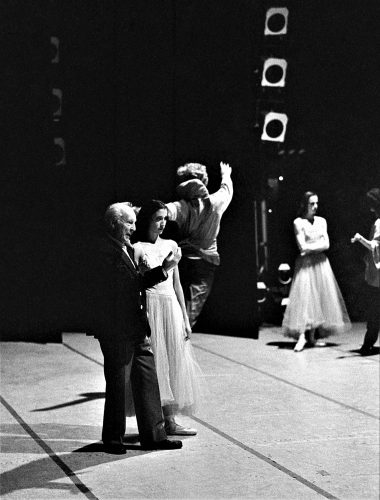
Miami City Ballet’s artistic director, Lourdes Lopez, was a student of famed choreographer George Balanchine. (Photo courtesy of Steven Caras)
“Lourdes Lopez was a student of Balanchine, [Michael Tilson Thomas] worked and studied with Stravinsky – we could think of no better collaboration for our 21st century institutions and audiences,” said the New World Symphony’s president and CEO, Howard Herring, in an email.
New World Symphony already had a Stravinsky festival programmed for its 2020 lineup, so when Thomas approach Lopez with the idea of doing a full-length program, she found it an attractive fit with the company’s recent programming.
“They were hoping for ‘Symphony in 3 Movements,’ but it would not have fit in the NWS space. However, ‘Apollo’ we had just done last season and ‘Violin Concerto,’ this season,” she said by email.
The joint venture presented practical challenges, and its own set of firsts, said Lopez.
“They are removing the seats where the audience usually is and placing the musicians there,” Lopez said. “The dancers will be where the musicians usually are. The audience will be only in the mezzanine and in the round.”
In another first, New World Symphony’s Wallcast will project both the music and dance to the audience out in nearby SoundScape Park, 400 17th St. Wallcast seating is free.
The symphony’s simulcasts of concerts have become a preferred way to pass an evening for many South Florida music lovers. However, ballet simulcasts are something new to the area.
For Lopez, meeting the challenges of live-streaming ballet was “about bringing the level of dance and music that both these institutions are noted for to our communities and showing them what Miami is capable of.”
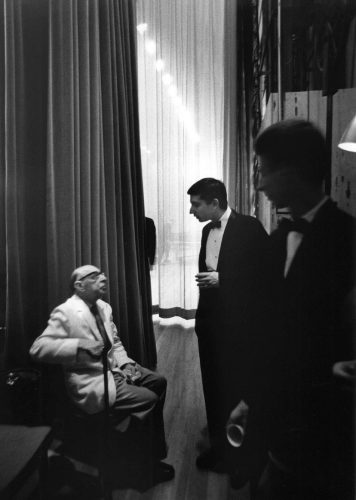
New World Symphony’s artistic director and co-founder, Michael Tilson Thomas, worked and studied with composer Igor Stravinsky. (Photo courtesy of Arnold Newman)
The Wallcasts allow park audiences an intimacy with the performers that competes with even theater in the round for full immersion, Herring added.
“For an audience member, the traditional perspective is one-directional. Each New World Symphony Wallcast features more than 700 individual shot changes allowing audiences closeup views of soloists and artists, sweeping views of the stage, and unique human perspectives of the performances,” Herring said.
The event also will bring the South Florida performing arts scene to the world. Medici TV will The Feb. 1 performance will air live on Medici.tv, a worldwide classical music streaming platform, where it will remain available for viewing.
When asked how projects like this one strengthen the profile of both classical dance and music in South Florida, Lopez replied, “The most interesting thing for me is that Miami has two artistic directors who head leading dance and music institutions in the U.S., and who both were mentored by the greatest creative geniuses of 20th century dance and music. I can’t think of another city in which this could happen.”
What: “Stravinsky and Balanchine: A Monumental Collaboration”
When: 7:30 p.m. Jan. 31 and Feb. 1
Where: New World Center, 500 17th St., Miami Beach
Cost: $75-$195
More information: 305-673-3331; nws.edu (click on “Events & Tickets”)
ArtburstMiami.com is a nonprofit source of theater, dance, visual arts, music and performing arts news. Sign up for our newsletter and never miss a story.
No posts found

Recent Comments