
Visual Art
MOAD at Freedom Tower Explores How America Shaped Abstract Art
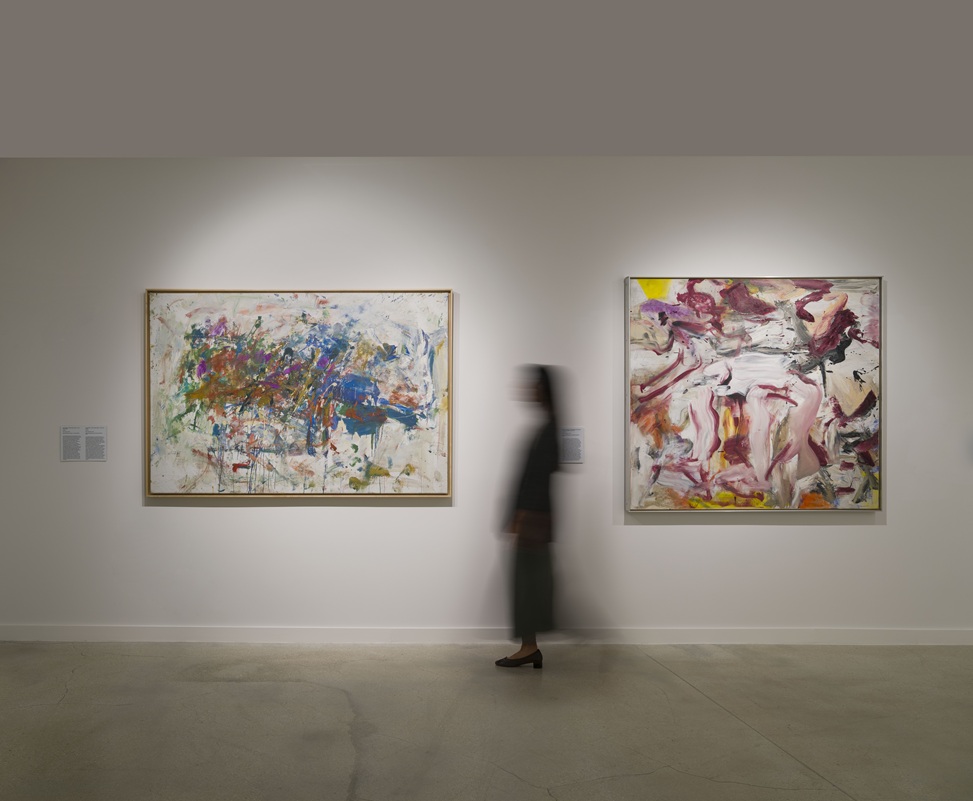
At left, Joan Mitchell, “Untitled” (1960), oil on canvas. At right, Willem de Kooning, “Figures in a Landscape #2” (1976), oil on paper laid on canvas, are among the highlights in “Abstraction as Legacy,” MOAD at the Freedom Tower, Miami, through Sunday, Oct. 18. (Photo by Oriol Tarridas)
Inside the Freedom Tower, where exhibitions focus on immigration, the Cuban exile experience and, for now, a journey through the world of soccer, abstract art isn’t necessarily what people expect to find. On a recent afternoon, a father and son visiting Miami for the FIFA World Cup discovered the Museum of Art and Design galleries on the landmark’s second floor where “Abstraction as Legacy” is hung.
They stuck around and examined each work. For Amy Galpin, that’s exactly the kind of unexpected encounter she had hoped for. The executive director and chief curator of the Museum of Art and Design at Miami Dade College conceived the exhibition as part of the nationwide America250 initiative.
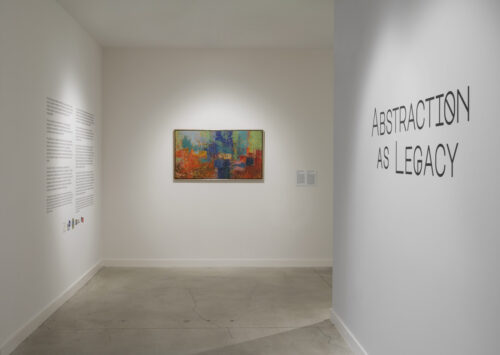
George Morrison’s “Traversal” (1958), is one of the first works visitors encounter in “Abstraction as Legacy,” reflecting on the exhibition’s expanded view of American abstraction. (Courtesy of Art Bridges and the Estate of George Morrison. Photo by Oriol Tarridas)
“We wanted to do something that would be unique and distinctive,” Galpin said. “Quickly we came to the idea of abstraction and thinking about the role of abstraction in postwar U.S. visual culture and history.”
The exhibition explores how American abstraction became one of the nation’s most influential contributions to art history.
“It is really the first time following World War II that we see the international art world looking to the U.S. as innovators, particularly what’s happening with the New York School of painters and that’s represented in the show by William de Kooning, Hans Hofmann as well as Joan Mitchell.”
Bringing together many of those artists required borrowing extensively from private collections. Nearly every work in the exhibition is on loan from collectors, artists, and institutions, giving visitors a chance to experience paintings that are seldom exhibited together. Only the salon-style installation at the end of the exhibition is drawn from the museum’s permanent collection.
“For me, it was an incredible opportunity to present work that are not often seen in public spaces in Miami,” said Galpin.
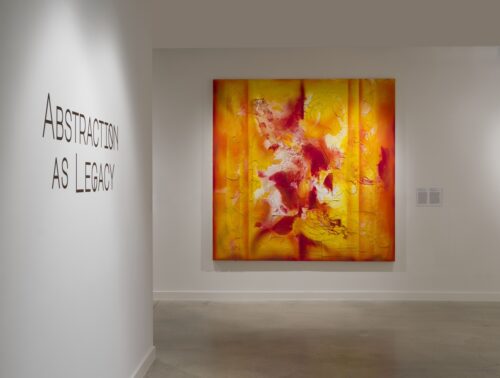
Vaughn Spann’s “Mercy after Rage” (2025), made with polymer paint and mixed media on wood, is featured in “Abstraction as Legacy” at MOAD at the Freedom Tower. (Courtesy of the artist and David Castillo. Photo by Oriol Tarridas)
Broadening American Abstraction
There are works by artists who deal with the environment, who are influenced by architecture, and some who focus on the body. “In terms of putting this together, I was looking for all the different story points to bring together. I wanted to make sure that I told certain stories, that there was a lot of different types of abstraction and to show the breadth of abstraction in the United States. And how it would all work.”
The first work visitors encounter is George Morrison’s “Traversal” with its vibrant blues, turquoise and fiery reds welcoming with an explosion of color.
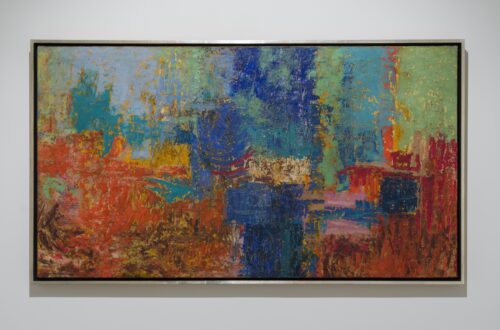
George Morrison’s “Traversal” (1958), opens “Abstraction as Legacy.” (Courtesy of Art Bridges and the Estate of George Morrison. Photo by Oriol Tarridas)
The painting broadens the idea of who belongs in the story of American abstraction, according to Galpin. “For an America250 show I think it was important to have American Indigenous artists – he’s a member of the Chippewa Tribe, spent much of his life in Minnesota, lived in New York and showed alongside de Kooning.”
It was also a way, she said, to start the show in the moment.
“The year of the piece is 1958, and while there were abstract artists active in the U.S. in the early 20th century, this is when the post-war conversation was really beginning. I wanted a painting that was of that spirit. And this is one of the works, too, in the show that speaks also to the international.”
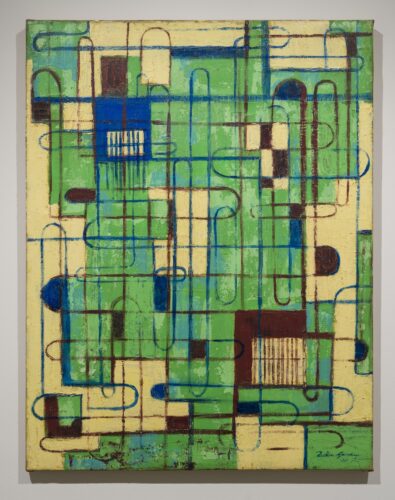
Born in Havana, Zilia Sánchez fled to New York after the Cuban Revolution and later settled in Puerto Rico. Her “Untitled” (1960) is featured in “Abstraction as Legacy” at MOAD at the Freedom Tower. (Courtesy of Cota Cohen. Photo by Oriol Tarridas)
Nearby is Zilia Sánchez’s “Untitled,” (1960). Born in Havana, she fled to New York to escape the Castro regime. “She became part of a Cuban exile group in New York of poets, of painters, and then spent much of her adult life in San Juan, Puerto Rico,” said Galpin.
Like Morrison, Sánchez challenges a traditional understanding of who shaped American abstraction.
“One of the things that was important in presenting this exhibit is to show that American abstraction is many things… just as our country is not one thing… it’s a multitude of voices.”
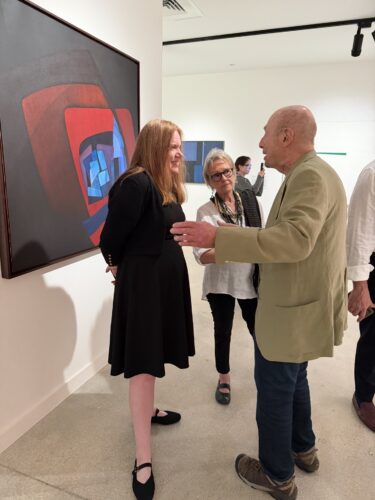
Amy Galpin, executive director and chief curator of MOAD at the Freedom Tower, with Barbara Young and Dan Gelfman at the opening of “Abstraction as Legacy” in front of Noemí Ruiz’s “Vibración en rojo y azul” (1981). (Painting courtesy of the Patricia and Phillip Frost Art Museum, Gift of Dr. Gamaliel R. Herrera. Photo by Barbara Perales)
And it is fitting at the Freedom Tower, she emphasized. “It speaks to the role of migration. In our country, artists first as immigrants, but also artists moving to different artistic centers and being influenced by different artistic centers. There are also two Cuban artists represented in the exhibit, Sánchez and Carmen Herrera,” said Galpin, pointing out that both were impacted by international influence, and both were women.
Borrowed Works Tell the Story
After Morrison there’s Joan Mitchell paired with Hans Hofmann.
On loan from collector Jorge M. Pérez’s contemporary art space El Espacio 23 in Allapattah is Hofmann’s “Yellow Glow” (1960).
“It’s a small work, but it really packs a punch,” Galpin exclaimed.
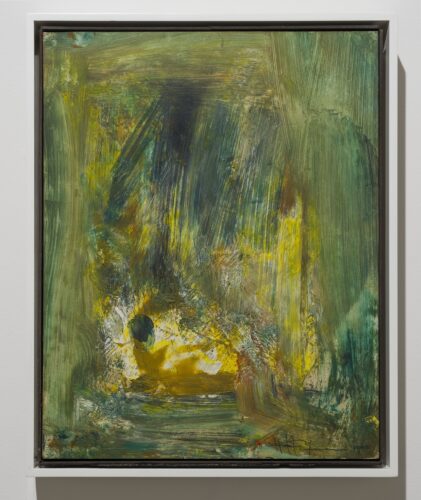
Hans Hofmann’s “Yellow Glow” (1960), courtesy of Jorge M. Pérez, El Espacio 23, is featured in “Abstraction as Legacy” at MOAD at the Freedom Tower. Photo by Oriol Tarridas.
Patricia Hanna, the curator of the Jorge M. Pérez Collection, said that the selection of the painting was an intentional and smart choice by Galpin. “It’s a kind of transition between the hard-edge abstraction to more gestural with hints of figuration,” Hanna explained.
As visitors move through the gallery they encounter works by Sam Gilliam, Lloyd Kiva New, Noemí Ruiz, Young-Il Ahn and Vaughn Spann.
The “coda” of the exhibition is a salon-style wall of works from MOAD’s collection.
“The collection was really founded by Miami artists, the two Bobs, Robert Thiele and Robert Huff, who were employed by Miami Dade College as professors and built the collection for this space.”
Hanna said that a show focused on the legacy of abstraction and its history in the U.S. that includes works from Miami collectors at the Freedom Tower was an exceptional choice for America250.
“People think about Miami as everything new and contemporary, but there are art collections in Miami that have this historical perspective.”
WHAT: “Abstraction as Legacy”
WHERE: Museum of Art and Design (MOAD) at Freedom Tower, 600 Biscayne Blvd., Miami
WHEN: 10 a.m. to 6 p.m. Wednesday through Sunday. Through Sunday, Oct. 18
COST: $18, adults $14, seniors (62 and older), $12, students and children (ages 7–12) Free for MOAD members, Miami Dade College students, faculty and staff with ID, and select other visitors. Admission includes access to Freedom Tower exhibitions.
INFORMATION: (305) 237-7700; moadmdc.org
ArtburstMiami.com is a nonprofit source of theater, dance, visual arts, music and performing arts news. Sign up for our newsletter and never miss a story.