
Visual Art
Honey-Barrel Boat Becomes the Heart of ‘Exile’ at Piero Atchugarry Gallery
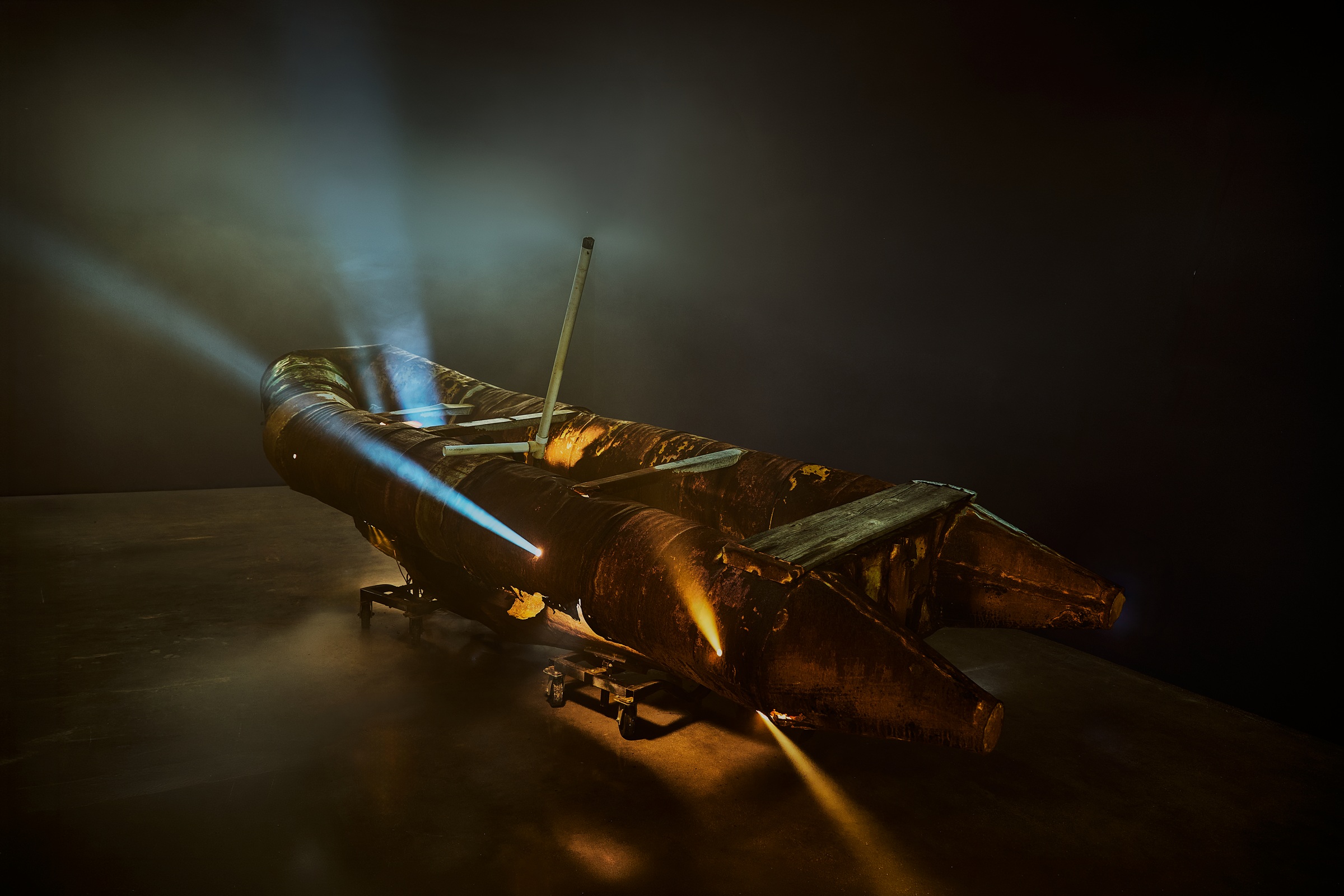
The work that gives the exhibition its title, “Exile” is a large-scale installation centered on a refugee boat salvaged from the coast of Miami after washing ashore in Key Biscayne, by Ruben Millares and Antonia Wright at the Piero Atchugarry Gallery in Miami, through Sunday, July 26. (Photo by Rudy Duboué, courtesy of the artists)
An ingeniously engineered refugee boat washed ashore on Key Biscayne in 2022. Four years later, it is the centerpiece of Antonia Wright and Ruben Millares’ exhibition “Exile.”
Now at the Piero Atchugarry Gallery in Miami, this is the last week to catch a glimpse of the vessel and other works in the show. It closes on Sunday, July 26 and is part of the Progressive Art Brunch, an event which features a dozen local galleries open from 11 a.m. to 4 p.m.
In a darkened room in the gallery, Wright and Millares have kept the refugee raft intact, bringing emotional meaning through thoughtfully orchestrated sound and light.
Welded together from steel honey barrels, marked with the words “Cuban Honey” and powered by a pre-Castro Chevrolet engine, the homemade balsa washed ashore at Crandon Beach and was headed to a scrapyard. A friend at the Key Biscayne Nature Center contacted the artists to ask if they were interested.
They jumped at the chance.
“When we saw it, we said, ‘We have to preserve this thing. This is beautiful,’ ” said Millares.
Engineering as an Escape
Rather than altering the boat, Wright and Millares took care to preserve the object exactly as they found it.
“Whoever made it made this beautiful object,” Millares said. “We didn’t want to mess with that integrity of the boat.”
However, the idea of what to do with the salvage didn’t come to the two artists immediately.
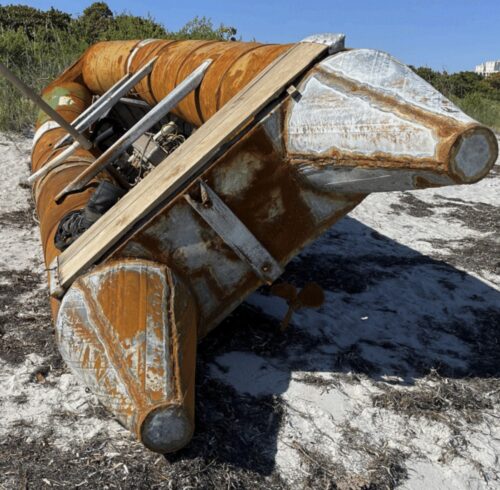
A homemade balsa washed ashore at Crandon Beach in Key Biscayne in 2022. It is now the centerpiece of the installation “Exile” by Antonia Wright and Ruben Millares. (Photo courtesy Ruben Millares)
After deciding they wanted to do something with it, they arranged to have it towed across Biscayne Bay and up the Miami River to their studio.
“We lived with it for four years,” Millares said. Living with the boat became part of the artistic process.
The artists examined every detail of its construction, discovering an extraordinary level of craftsmanship hidden beneath its rusted exterior.
The vessel was built from welded steel barrels once used by Cuba’s state honey industry.
“When it came to the beach, it had ‘Cuban honey’ on each barrel in English. We started looking into, what is Cuban honey?’ “ Wright said.
Researching the barrels revealed another layer of the story.
Wright said they discovered that the Cuban government produces the honey and sells it to Europe as one of the country’s prized exports.
“They have a whole organic farming system in Cuba because they can’t afford pesticides; everything is still done with ox and cart, so there’s no big machinery. They claim it is the purest honey in the world. It is very regulated,” she said.
Constructing a boat as an escape vessel carried significant risk on its own, but stealing the government-owned barrels to build it added another level of danger.
“If you get caught making any boat in Cuba, you’re not allowed to have a boat,” Millares said. “It was all hand-welded in secrecy.”
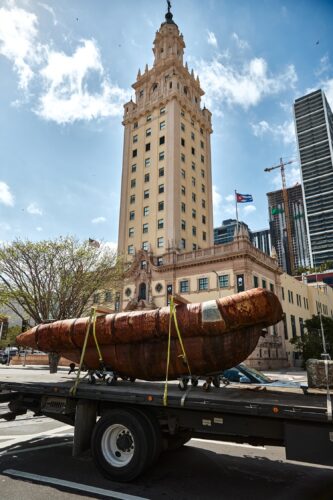
A piece of “Exile” on a flatbed truck on the way to the exhibition passes by the Freedom Tower. (Photo by Rudy Duboué, courtesy of the artists)
The boat’s ingenuity extended well beyond its materials.
“It has a 1942 Chevy engine,” Millares said. “The engineering is incredible.”
A handmade propeller, water-cooling system and carefully hammered steel siding all suggest the painstaking effort required to secretly build a vessel capable of crossing nearly 100 miles of open water. Although handmade from steel barrels and salvaged materials, Wright said its silhouette evokes that of an inflatable Zodiac.
The artists estimate as many as 12 to 15 people could have made the crossing aboard the vessel.
Early ideas for the project were dramatically different.
The artists discussed filming the boat burning at sea or filling it with books before setting it ablaze.
“It felt so heavy,” Millares said. “It was such a loaded object already. How do you intervene in a respectful way?”
Ultimately, they realized the structure itself already carried the emotional weight.
Art From Artifact
Instead of physically altering it, they composed a seven-minute soundscape that emerges from speakers concealed inside the boat.
Deep ocean recordings blend with orchestral timpani, distant explosions, vibrations and the recorded buzzing of bees. An inaudible heartbeat reverberates through the space at a frequency below human hearing, producing vibrations that can be felt by those standing nearby.
“The boat itself is like a being,” Millares said. “As the sound is playing, the boat is physically vibrating, and you’re getting a physical sensation.”
The buzzing bees reference the honey barrels from which the vessel was constructed.
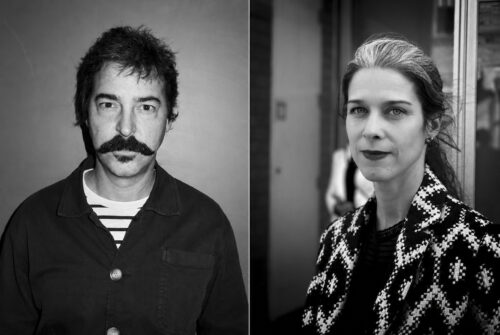
The artists: Ruben Millares, left, and Antonia Wright. (Photo of Wright by Butch Quick, photos courtesy of the artists)
The exhibition’s lighting slowly reveals another haunting detail.
As visitors spend time in the gallery, beams of light emerge through seven bullet holes scattered across the hull.
“We wanted to highlight that,” Wright said. “To talk about the violence that’s embedded on our borders, but also to use the bullet holes to honor these people.”
Both artists have Cuban family roots, making the work personal. Although the boat came from Cuba, Wright and Millares said they intentionally broadened the exhibition beyond a single migration narrative.
“It starts from the Cuban experience for us,” Millares said. “But we were really talking about worldwide migration and all the migration crises around the world. This is a symbol, a metaphor for migration in general.”
Beyond the Boat
The gallery’s second room expands on those ideas.
Wright presents a series of cyanotypes made by placing shattered glass over light-sensitive paper before exposing each image.
She explained the process. “I smash glass over light-sensitive paper and make an exposure using the glass. So, the glass becomes like a negative print to each one.”
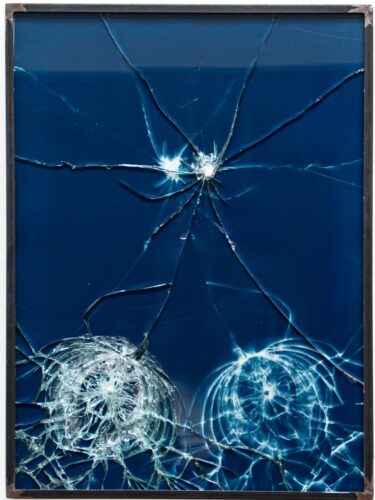
Antonia Wright, “OK,” 2026, cyanotype, broken glass, artist steel frame. (Photo courtesy of the artist and Piero Atchugarry Gallery)
The finished works echo the violence suggested by the bullet-riddled boat.
“The photos reflect those moments of violence,” Wright said.
Millares’ silkscreen paintings are built from thousands of numbers cut from financial statements, tax returns and investment documents.
He describes them as “visual cacophonies,” dense fields of information that overwhelm on purpose.
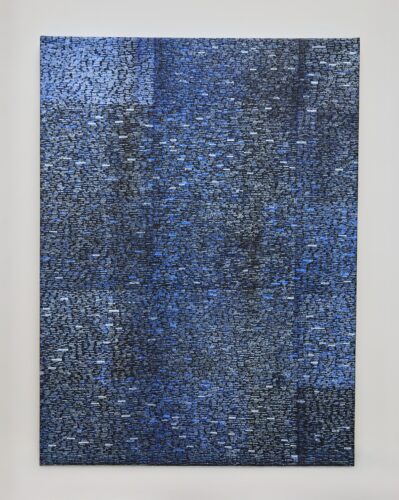
Ruben Millares, “Paint by Number,” 2017, acrylic on canvas, 36 x 48 in. (Photo courtesy of the artist and Piero Atchugarry Gallery )
“I just layer number upon number. So much data that you can’t decipher and you can’t come to some conclusion from,” he said. “How many migrants are there in the world? How many applications for asylum? How many people died crossing?”
One collaborative sculpture in the middle of this room embeds the boat’s handmade paddle into a block of South Florida oolitic limestone sourced from material associated with Vizcaya.
“When we first saw the boat, the paddle was with it and when we got back it was gone,” said Millares. They tracked it down to “reunite them.”
Displayed apart from the vessel, “Desembarco” becomes both a marker of arrival and a reminder of everything left behind. “It was this idea of the crossing and the migration, and the paddle being the arrival.”
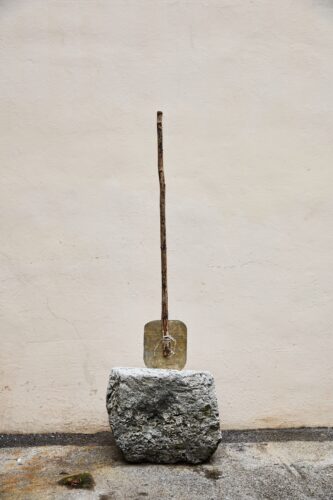
Antonia Wright and Ruben Millares, “Desembarco,” 2026, wood, metal, paddle, oolite, 78 x 24 x 29. (Photo courtesy of the artists and Piero Atchugarry Gallery )
The boat offers no names and no history beyond the evidence welded into its steel. The artists said they never discovered whether the Cuban balseros aboard reached Florida, were intercepted or died at sea.
“We didn’t want to simulate what it was to be on the boat. That wasn’t the idea. We’ve never done it. We didn’t want to try to make something didactic like, oh this is what it is to cross through the Florida Straits,” Millares said.
For Wright, it is a representation of the emotional state of migration that’s been going on for centuries.
“These boats, for instance, have always been a barometer for a level of desperation.”
WHAT: “Exile”: Antonia Wright and Ruben Millares
WHEN: 11 a.m. to 5 p.m. Tuesday through Saturday; special showing on last day of exhibition, Sunday, July 26, as part of Progressive Art Brunch, 11 a.m. to 4 p.m. See the galleries participating in the PAB.
WHERE: Piero Atchugarry Gallery, 5520 NE Fourth Ave., Miami
COST: Free
INFORMATION: 305-639-8247; Pieroatchugarry.com
ArtburstMiami.com is a nonprofit source of theater, dance, visual arts, music and performing arts news. Sign up for our newsletter and never miss a story.