
Visual Art
Why Ken Griffin’s First Basquiat Exhibition Was Always Meant For PAMM
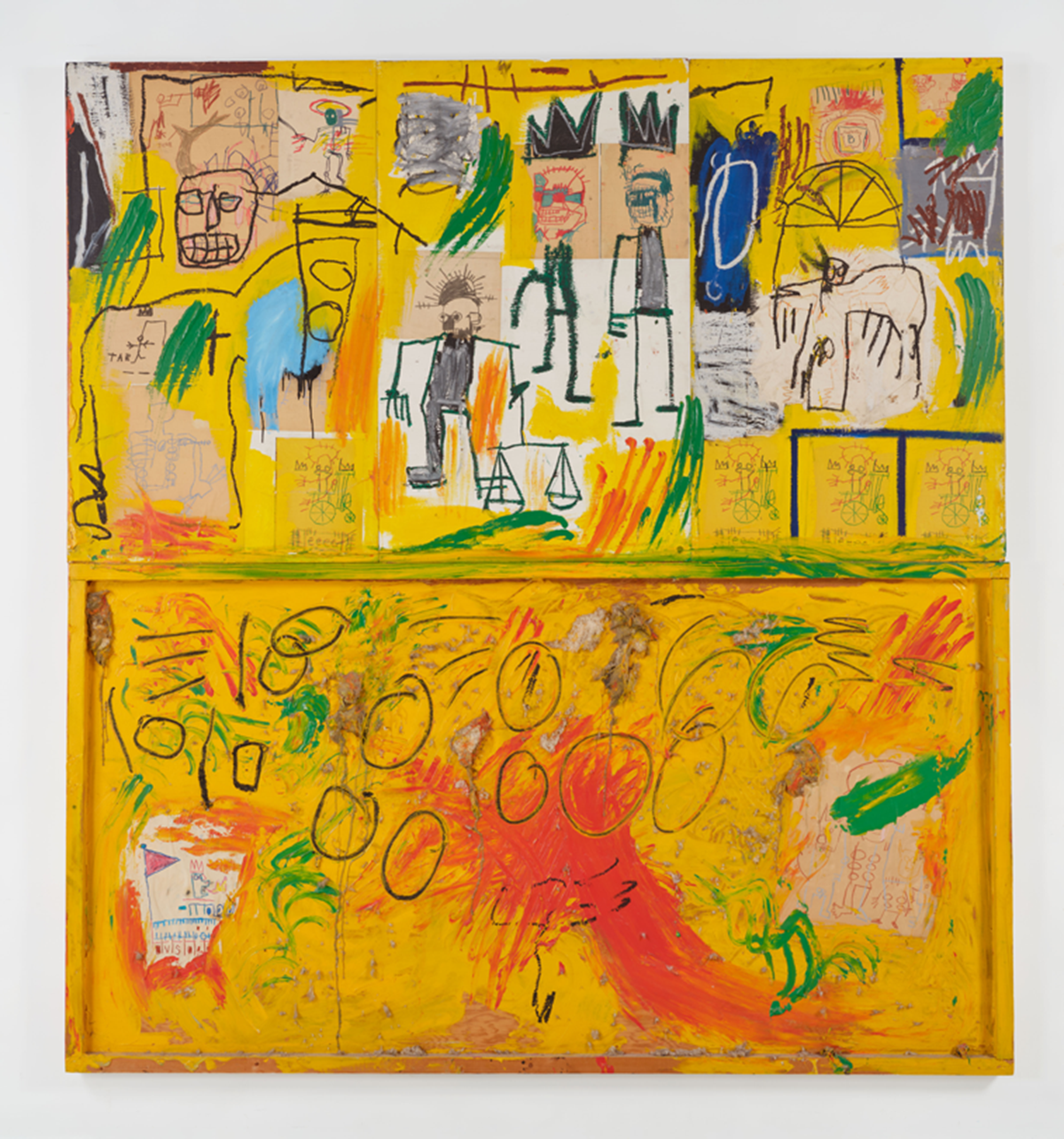
Jean-Michel Basquiat, “Untitled (Yellow Tar and Feathers),” 1982, is one of 10 works in “Basquiat: Figures, Signs, Symbols” from the Kenneth C. Griffin Collection opening Thursday, June 25 at Pérez Art Museum Miami and on view for nearly a year. (Kenneth C. Griffin Collection. Artwork © Estate of Jean-Michel Basquiat. Licensed by Artestar, New York.)
A new exhibition at Pérez Art Museum Miami didn’t begin with the idea of a collector lending paintings to a museum. It began with a realization.
Megan Kincaid, curator of the Kenneth C. Griffin Collection, recalled that shortly after joining the team, she was looking at the collection with its owner when she saw more than a remarkable group of paintings. Something stood out.
“You have a Basquiat show on your hands. This is ready to go. This is museum quality.”
That realization became “Basquiat: Figures, Signs, Symbols,” which opened Thursday, June 25, and will be on view for nearly a year through Sunday, June 6, 2027.
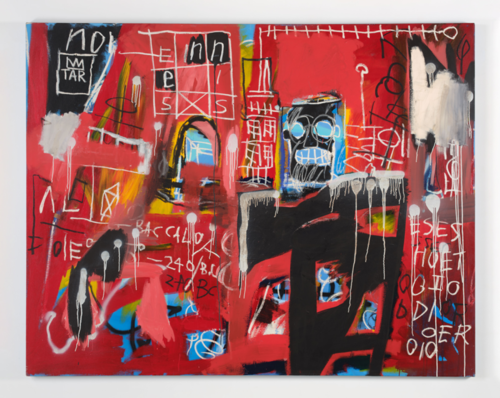
Jean-Michel Basquiat, “Untitled,” 1982. (Kenneth C. Griffin Collection. Artwork © Estate of Jean-Michel Basquiat. Licensed by Artestar, New York.)
The exhibition brings together 10 works by Jean-Michel Basquiat from the Kenneth C. Griffin Collection in the first public exhibition drawn from the collection. Spanning works created between 1982 and 1985, Kincaid said the exhibition functions as “a kind of retrospective” of Basquiat’s most significant period.
[RELATED: More Basquiat at The Bonnier Gallery]
For both the collector and the curator, there was never any doubt where that exhibition belonged.
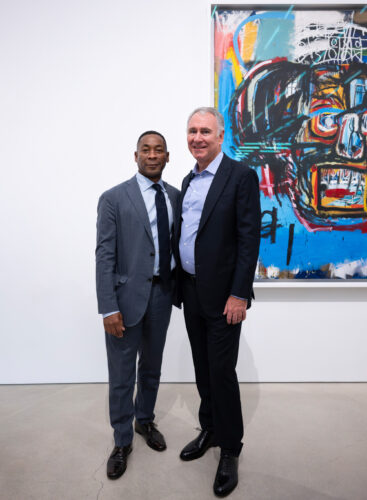
Collector Kenneth C. Griffin, right, and Pérez Art Museum Miami Director Franklin Sirmans stand in front of Jean-Michel Basquiat’s “Untitled” (1982), one of the centerpiece works in “Basquiat: Figures, Signs, Symbols,” the first public exhibition drom the Kenneth C. Griffin Collection now at PAMM. (Photo by World Red Eye)
“Without question, it was always going to happen for Ken at the Pérez,” said Kincaid, who is co-curator of “Basquiat: Figures, Signs, Symbols.” “It was the right venue, and Miami was where he wanted to stage an exhibition of this kind. It’s important to remember that this is the first time Ken’s ever presenting a section of his collection as a show with his name on it, and it was decisive and important that the show take place in Miami.”
The Right Place at the Right Time
The decision reflected more than geography. It reflected a relationship that had been taking shape since Griffin moved Citadel’s headquarters from Chicago to Miami in 2022. The move returned the Florida native—born in Daytona Beach and raised in Boca Raton—to his home state. Two years later, his $10 million gift to PAMM established the Kenneth C. Griffin Gallery, which now hosts the first public exhibition drawn from his collection.
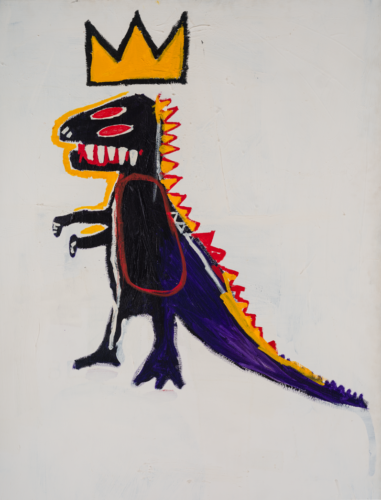
Jean-Michel Basquiat, “Pez Dispenser,” 1984. (Kenneth C. Griffin Collection. Artwork © Estate of Jean-Michel Basquiat. Licensed by Artestar, New York.)
“Basquiat: Figures, Signs, Symbols” represents a watershed moment for Miami’s cultural landscape. It is the first public exhibition drawn from one of the world’s premier private Basquiat collections, presented at a museum whose director, Franklin Sirmans, has spent more than three decades studying the artist, and it arrives as Miami continues to establish itself as an international art destination.
For Sirmans, PAMM’s director and co-curator of the exhibition, the moment is about more than one collector or one museum. It’s another chapter in Miami’s cultural evolution.
“We’re incredibly fortunate,” Sirmans said. “This is a really fascinating moment to think about how the landscape is being enriched by new people coming in.”
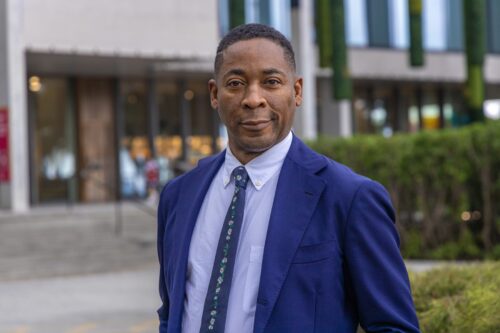
Franklin Sirmans, director of Pérez Art Museum Miami and co-curator of “Basquiat: Figures, Signs, Symbols,” has spent more than three decades studying Jean-Michel Basquiat. (Photo by Lazaro Llanes, courtesy of Pérez Art Museum Miami)
There was another draw that made PAMM the perfect fit. Sirmans has spent more than three decades studying Basquiat, beginning with his undergraduate thesis while at Wesleyan University and continuing through major exhibitions that have shaped scholarship on the artist, including co-curating the 2005 landmark show “Basquiat” at the Brooklyn Museum, which traveled to the Museum of Contemporary Art, Los Angeles and the Museum of Fine Arts, Houston.
“If you could pick a museum director in the country to curate a Basquiat show, it would be Franklin,” Kincaid remarked.
Why Basquiat Endures
Sirmans said there are many reasons why more than three decades after his untimely death from a drug overdose in 1988 at the age of 27, Basquiat remains one of the defining artists of the late 20th century.
“The work at its core is about humanity,” Sirmans said. “It’s about people and times and eras of human beings.”
Born in Brooklyn to a Haitian father and a Puerto Rican mother, Basquiat drew on a wide range of cultural references that shaped both his life and his work. For Sirmans, those influences give the exhibition a particular resonance in Miami.
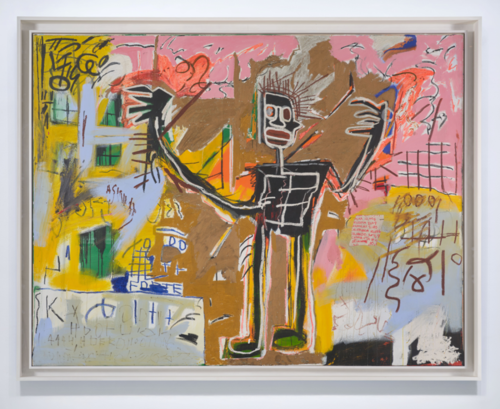
Jean-Michel Basquiat, “Untitled (Tenant),” 1982. (Kenneth C. Griffin Collection. Artwork © Estate of Jean-Michel Basquiat. Licensed by Artestar, New York.)
“We have three different languages in the gallery alone… Creole, Spanish and English… there aren’t that many American cities where you think about language in the same way that you do here.”
While the artist’s work resonates with audiences around the world, Miami’s deep Caribbean and Latin American cultures, central to the city’s identity, may allow many visitors to connect in a deeper way.
“I think it can sound trite sometimes when you say, ‘Yes, he is a Black person, his father was from Haiti, his mother was from Puerto Rico.’ All those aspects are part of it. They’re not the end-all and be-all, but I think they are something that makes the presence of not only the artist, but the work speak to that kind of heritage, that kind of upbringing,” Sirmans explained.
One notable omission among the works is “Boy and Dog in a Johnnypump,” considered one of the crown jewels of Griffin’s collection. Kincaid calls the 1982 work a tour de force of the collection, and of Basquiat’s entire career. “The only reason it is not in the show here is because it is in another exhibition that Ken has supported at the Hirshhorn Museum (in Washington, D.C.).” The private sale made headlines when Griffin acquired the painting for more than $100 million in 2020, making it one of the most valuable Basquiat works in any private collection.
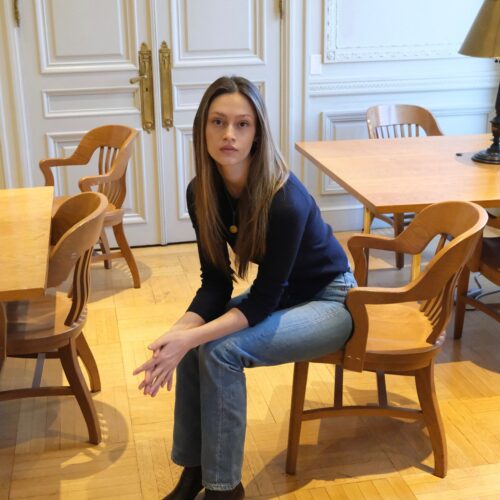
Megan Kincaid, curator of the Kenneth C. Griffin Collection and co-curator of “Basquiat: Figures, Signs, Symbols,” while looking at the collection with its owner said, “You have a Basquiat show on your hands.” (Photo courtesy of Megan Kincaid)
But rather than keeping it tucked away, Kincaid said this reinforces Griffin’s philosophy of making the collection accessible.
“I’m very lucky to work for a collector who has the vision to share his collection with the public,” she said. “There was the exhibition in terms of content, and there was this vision to make this work accessible. There’s the vision as a collector and the vision as one of civic responsibility.”
That same philosophy shaped the exhibition itself.
“It was absolutely a decision to present as much as we could, and we want people to feel empowered to make their own personal choice about what they like best,” Kincaid said. “To over-curate the exhibition would have been a bit of a disservice.”
Looking Closely
Along with the nine works, the exhibition includes a sculpture known as “Untitled (Box)” — though Kincaid noted that “crate” is probably a more accurate term. The piece revealed a surprise when it was brought to PAMM.
“This was one work we acquired with this show in mind when we were offered it and it came to our attention, and it’s centered in the gallery,” Kincaid said, noting that it highlights another aspect of Basquiat’s artistic practice through his use of found and assemblage materials. “We were able to open it for the first time here.”
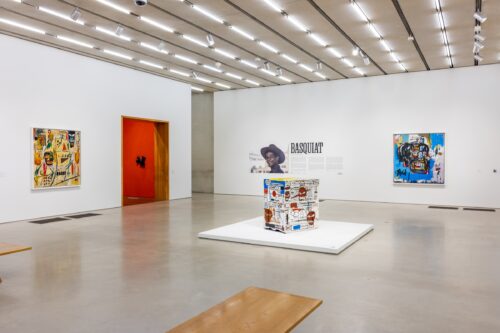
“Untitled (Box),” 1985, is in the center of the gallery, and was acquired with the PAMM exhibition in mind. Shown on the wall behind the crate is “Untitled (“Skull”), painted in 1982 and regarded as Basquait’s breakthrough year. (Photo by Lazaro Llanes, courtesy of Pérez Art Museum Miami)
The work first debuted publicly in 1985 in a highly unusual setting: the legendary Area nightclub in New York City, where a famous photograph captured Basquiat himself sitting atop the crate.
In a previous life, the wooden crate had been used by artist Robert Rauschenberg, widely regarded as the father of assemblage art in the United States, to house and transport his paintings before Basquiat incorporated it into his own work.
“It is an art historical object where Basquiat is commenting on his own lineage and place within the canon of American art,” Kincaid said. “It is a super special object in that it has so many layers of meaning and significance.”
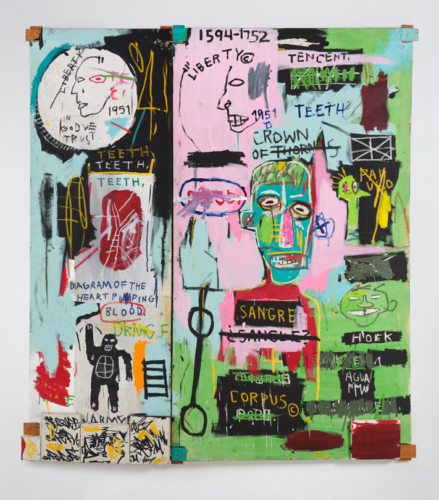
Jean-Michel Basquiat, “In Italian,” 1983. (Kenneth C. Griffin Collection. Artwork © Estate of Jean-Michel Basquiat. Licensed by Artestar, New York.)
Sirmans said it is that kind of layering that will be eye-opening for visitors when they are face to face with the works.
“It’s the awe of standing in front of great paintings and I think that is what’s going to be revelatory for a lot of people who only know (Basquiat) from reproductions. What it is to be standing in real time and be among others in the space of the gallery who are all contemplating the work for a moment in time. These paintings demand that kind of slow experience.”
WHAT: “Basquiat: Figures, Signs, Symbols” from the Kenneth C. Griffin Collection
WHEN: Opens Thursday, June 25 through Sunday, June 6, 2027. 11 a.m. to 6 p.m., Monday, Friday, Saturday and Sunday. Thursday, 11 a.m. to 9 p.m. Closed Tuesday and Wednesday.
WHERE: Pérez Art Museum Miami, 1103 Biscayne Blvd., Miami.
COST: $18, $14 for seniors 62 and older, students, and children 7 to 18; children under 6, free admission. Other free admission for military, healthcare, first responders, Florida educators, and disabled visitors and an accompanying caregiver. Admission is free from 5 to 9 p.m. every Thursday.
INFORMATION: 305-375-3000 and pamm.org.
ArtburstMiami.com is a nonprofit media source for the arts featuring fresh and original stories by writers dedicated to theater, dance, visual arts, film, music, and more. Don’t miss a story at www.artburstmiami.com.