
Artburst Extras
Three Painters, Three Perspectives: ‘In Three Movements’ at Opa Projects
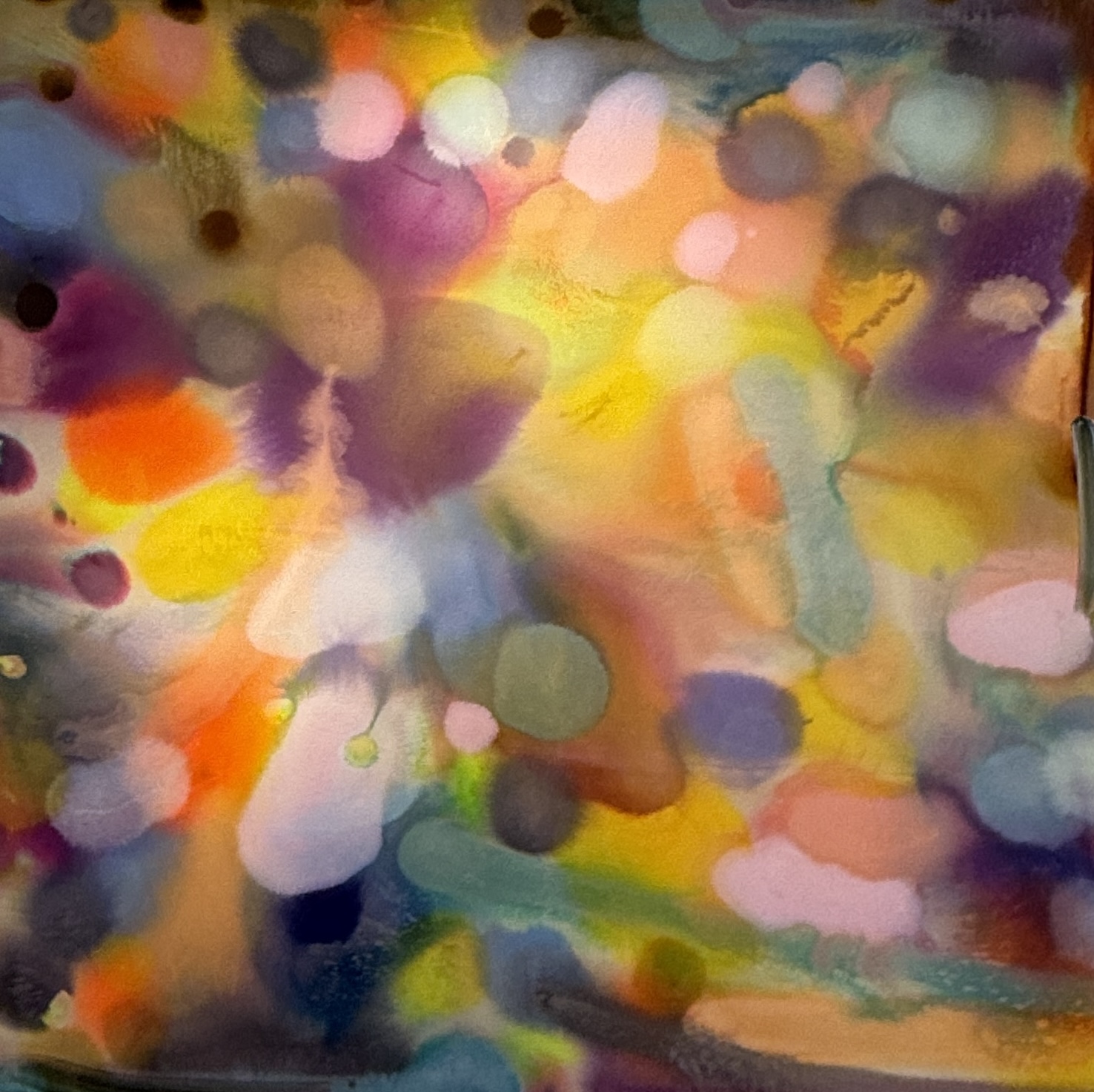
Emma Johnson Stone, “The light doesn’t just touch one area of the field,” 2024. Ink, pigment and acrylic on canvas, 70.8 x 70.8 in. (Photo by Erin Parish)
In music, a movement is a distinct section within a larger composition, carrying its own atmosphere and rhythm while contributing to the overall progression. The exhibition “In Three Movements” at Opa Projects is structured in much the same way. Bringing together Douglas Kneese, Murray Clarke, and Emma Stone Johnson, it unfolds as a sequence of distinct presentations, each maintaining its own identity while contributing to a larger curatorial investigation.
Located in Miami’s Little River district, Opa Projects was founded in 2025 by art advisor and historian Billy Tartour. The gallery, with its high ceilings and generous natural light, has established itself in Miami through exhibitions that prioritize material inquiry and artists at various career stages. It maintains a broad international perspective, rather than a regional one. “In Three Movements” exemplifies this commitment through a presentation devoted to painting as an international language with continued vitality.
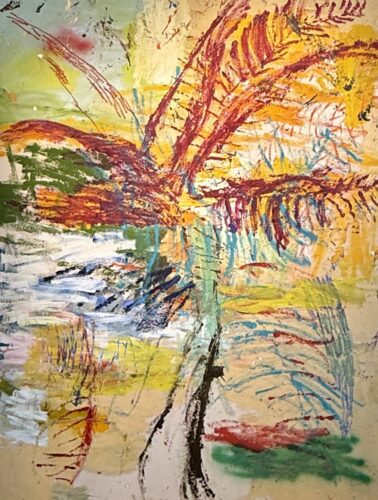
Douglas Kneese, “Palmeira no final de tarde I,” 2026 Oil stick, acrylic and spray on canvas 190 x 145 cm, 190 x 150 cm, 74.8 x 57 in. (Photo credit by Erin Parish)
The exhibition brings together three painters from different geographic and generational backgrounds: Douglas Kneese (b. 1996, Brazil), Murray Clarke (b. 1992, United Kingdom), and Emma Stone-Johnson (b. 1982, United Kingdom). Despite these differences, the exhibition reveals universal affinities in their treatment of color and commitment to painting as a material practice.
Group exhibitions, by default, present a shared theme or curatorial argument. This exhibition functions through pacing and placement, like a symphony. Each artist occupies a distinct register while contributing to the structure of the whole.
Douglas Kneese establishes the exhibition’s opening movement through a vigorous physicality visible from the start, placed to be seen from the gallery entrance. His paintings read well from a distance while rewarding close inspection and maintaining integrity, a hallmark of successful painting and an issue perhaps absent in reproductive media.
Suggestions of boats, water, vegetation, or a palm tree provide an armature upon which Kneese builds his compositions. These references surface briefly before returning to the broader activity of the paint itself. Layers accumulate, and gestures echo each other. Surfaces are revised, scraped back, and rebuilt. Kneese shifts freely between abstraction and representation, treating both as available strategies rather than opposing categories. Paint handling drives the work. One can see that they were made on the floor, unstretched, with evidence of boot prints derailing the idea of preciousness. These traces of the artist’s feet, and hands, come as a surprise, carrying evidence of the dialogue between the artist and the painting.
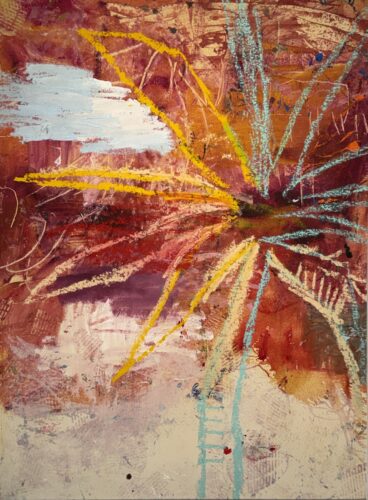
Douglas Kneese, “O Coquiero na boca da noite,” 2026. Oil stick, acrylic and spray on canvas 140 x 110 cm, 55.11 x 43.3 in. (Photo by Erin Parish)
Kneese displays the literal qualities of the medium through rough, hand-hewn applications of paint. Any illusionistic tendencies are interrupted by the insistence of the painted surface itself. Rhythms established by tree forms determine the course of mark-making, often creating the effect of a “visual echo” or afterimage, a visual phenomenon in which the eye temporarily perceives the inverse of a color after prolonged exposure. These effects cause certain forms within the paintings to linger momentarily in the mind, extending their presence beyond the initial act of looking.
If Kneese’s paintings have a location, they inhabit a tropical environment shaped by wind and shifting weather. Yet these references remain subordinate to the paint itself. They exist first as a material construct and second as an image.
Murray Clarke’s paintings shift the tone. Where Kneese emphasizes gesture and reworking, Clarke is devoted to concentration and precision. His hyperreal paintings of domestic textiles are meditations on the visual richness within one’s immediate surroundings. They contemplate a personal space close to the body but not of the body. They are as close as the arm on one’s sweater or one’s blanket. From a distance, these read as solid surfaces. Upon closer inspection, they unravel into networks of carefully modulated color. Light appears to emanate from within.
By isolating garments from their wearers, Clarke redirects attention toward the objects themselves. The paintings are intimate without relying on a storyline about unseen events. Areas of woven texture become rivers of color. Jewel-like tones develop through accumulation, creating the impression that light emanates from within the painting.
A magnified mohair sweater becomes something to consider as a visual nest of textures. Rugs, blankets, and folded textiles become opportunities to notice relationships of color and texture that ordinarily pass unnoticed. The work never flexes into a mere display of virtuosity.
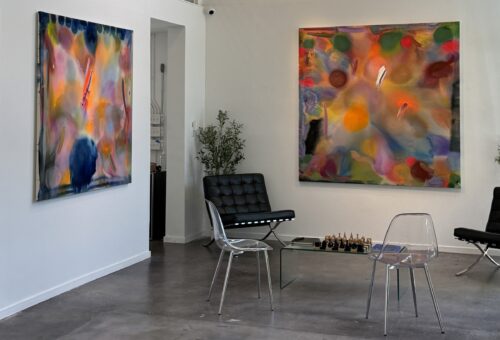
Emma Johnson Stone, “Pre-dawn shapes,” 2026. Pigment, ink and acrylic 150 x 150 cm, 59 x 59 in., “Inner Bloom,” 2026, pigment, ink, acrylic and liquid aluminum 180 x 180 cm, 70.8 x 70.8 in. (Photo credit Erin Parish)
A sweater suggests a shifting vista. A blanket evokes the movement of water. Familiar objects reveal unexpected complexity through attention. Clarke’s paintings encourage sustained observation without demanding explanation. Their strength lies in their quiet insistence that ordinary material experience is worthy of prolonged contemplation, as well as the richness of quietude.
Emma Stone Johnson’s use of atmospheric abstraction forms the exhibition’s third movement. Through staining, pouring, layering, and interruption, she creates paintings that construct spaces untethered to gravity, evoking luminous afterimages expanded into immersive fields of color.
Spare foreground elements move at times across fields of color, activating depth and establishing shifting relationships within the artwork. Spatial conditions remain unfixed while areas of luminosity emerge through successive washes and glazes, creating the sensation that light originates from within the painting itself, echoing Clarke’s work.
Johnson frequently darkens the edges of her paintings. This vignette effect intensifies the sensation of internal illumination. Transparent layers build gradually upon one another, creating a stained-glass-like quality that elevates the work toward the sublime. The paintings suggest environments governed by sensation rather than geography.
Some moments recall Helen Frankenthaler’s groundbreaking pouring of paint or Ross Bleckner’s atmospheric intensity, particularly in his color-driven works. These references never reign over her efforts. Johnson has a visual vocabulary distinctly her own.
The artists’ paintings occupy visual spaces unconstrained by physical laws. Color establishes space and expands and contracts. Foreground forms interrupt otherwise broad passages, preventing the compositions from settling into pure atmosphere. The work demonstrates how structure and openness can coexist within the same painted field.
What ultimately unites these three artists is their use of color and commitment to abstraction, creating a visual field. Despite their distinct approaches to paint handling, Kneese, Clarke, and Johnson each work from remarkably similar palettes. The careful jewel-like tones of Clarke and Johnson modulate chromatically across their surfaces, while Kneese is an intentional bull in a china shop. His color sensibility is similar, yet he uses those colors to tint his whites. This dramatically shifts the register away from preciousness.
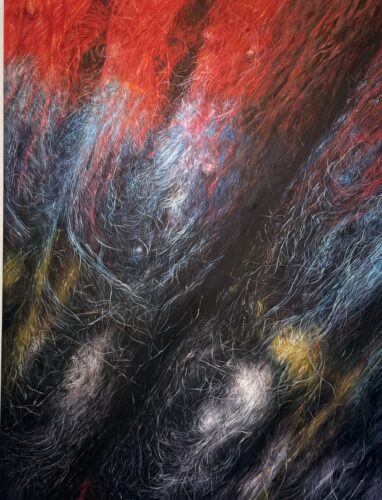
Murray Clarke, “Blossom,” 2026. Oil on canvas, 170 x 130 cm, 70 x 51 in. (Photos by Erin Parish)
The paintings inhabit different environments. Clarke’s works belong to interiors shaped by domestic experience; Kneese’s paintings evoke tropical landscapes animated by weather and movement. Johnson’s paintings occupy sky-like psychological spaces. Together, they encompass interior, exterior, and imaginative realms while remaining grounded in the language of painting.
“In Three Movements” demonstrates that pace and placement are effective curatorial tools. Through three distinct artistic voices, Opa Projects has assembled an exhibition that demonstrates the continued vitality of painting as a medium capable of sustaining different approaches within a serious context.
Paul Delaroche is famously credited with declaring in 1839 that “painting is dead.” Today, the statement reads more as a historical curiosity than a prophecy.
Opa Projects affirms its commitment to artists making rigorous and compelling work, while Kneese, Clarke, and Johnson demonstrate that painting remains capable of reinvention without abandoning its fundamental concerns.
Kneese builds through friction, gesture, and revision. His marks remain rough and direct, continually reinforcing the literal presence of the painted surface. Clarke accumulates through transparency and precision. Color gathers incrementally until it achieves the appearance of solidity while retaining its underlying complexity. Johnson constructs through stain, glaze, interruption, and luminosity. Her surfaces suggest light emerging from within through carefully orchestrated layers of paint.
Painting is alive and well, and these artists show exactly why.
WHAT: “In Three Movements”
WHEN: 11 a.m. to 6 p.m., Tuesday through Friday, 11 a.m. to 5 p.m., Saturday. Closed Sunday and Monday. Through Saturday, July 25.
WHERE: Opa Projects, 7622 NE 4th Court, Miami
COST: Free
INFORMATION: 516-807-5419 and opaprojects.com
ArtburstMiami.com is a nonprofit media source for the arts featuring fresh and original stories by writers dedicated to theater, dance, visual arts, film, music and more. Don’t miss a story at www.artburst.com.