
Visual Art
Artists Turn Margaritaville Inside Out at Locust Projects
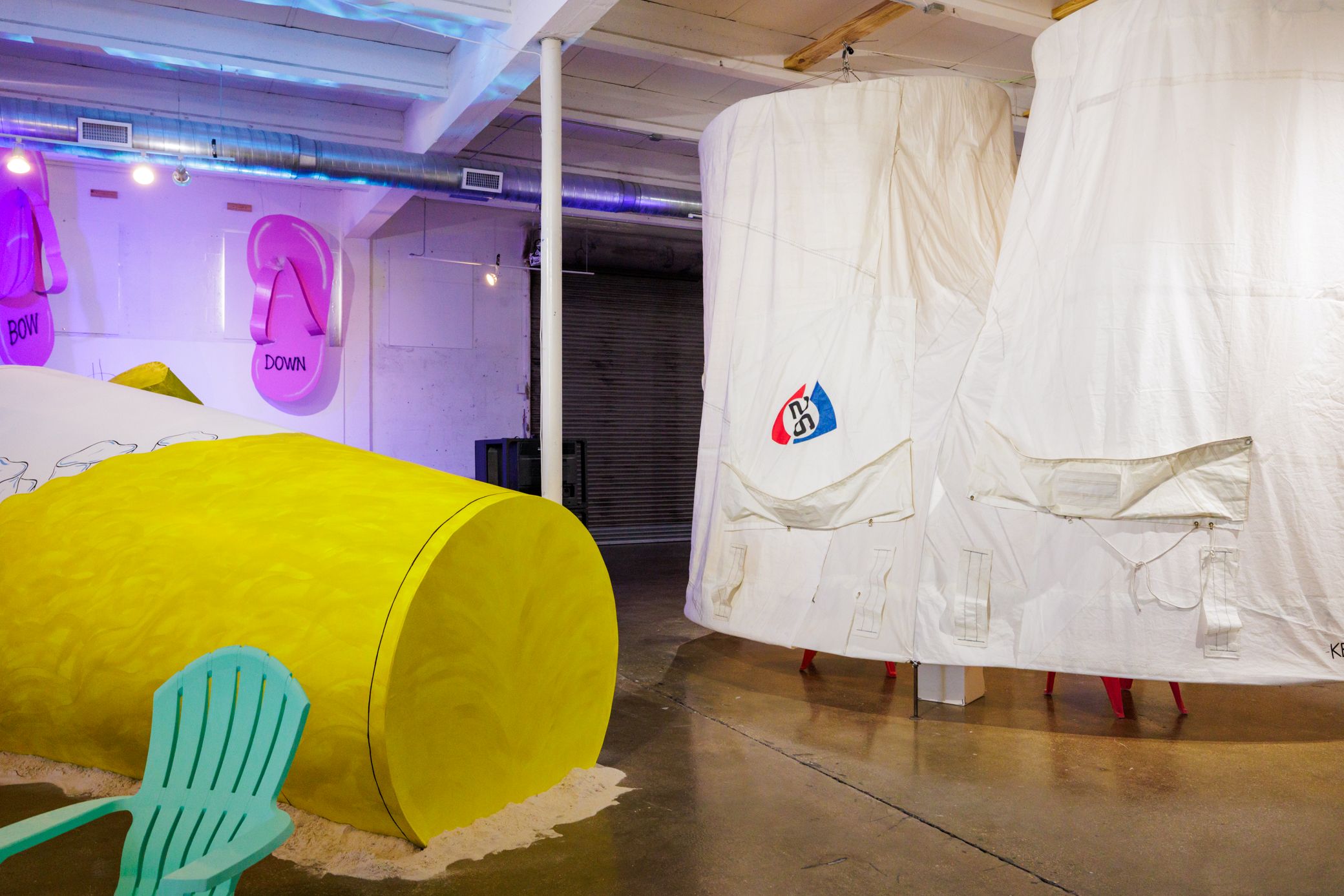
A twelve-foot spilled margarita and a monumental pair of cargo shorts made from real sails in the site-specific installation “Lost Shaker of Salt” at Locust Projects through Saturday, June 20. (Photo by Pedro Wazzan, courtesy of Locust Projects)
At first glance, “Lost Shaker of Salt” at Locust Projects in Little River appears to be a breezy summer diversion.
Upon entering the exhibition space, visitors encounter Kelly Breez and Patty Gone’s brightly colored homage to Jimmy Buffett’s Margaritaville empire, anchored by a giant margarita knocked onto its side.
Oversized flip-flops are tacked on one wall. Humongous cargo shorts dangle upside down and dominate another area. A tiki-inspired sports bar with tropical-print stools and video screens occupies another corner.
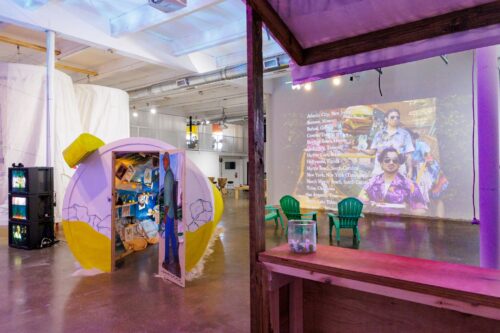
Installation view of Kelly Breez and Patty Gone, “Lost Shaker of Salt,” 2026.at Locust Projects. (Photo by Pedro Wazzan, courtesy of Locust Projects)
Two oversized Adirondack chairs face a campy performance-art film that traces a path from Caribbean sugar plantations and rum production to the modern fantasy of escape marketed by Margaritaville.
But Breez and Gone are selling something entirely different.
“I would say the concept of Margaritaville as a whole is that they’re selling you pure escapism,” says Breez, a Miami-based multidisciplinary artist. “Just vibes and happy hour and drinks and everything is fine. But there really is this absolute underlying dark side to Margaritaville, which was really what we wanted to dig a little deeper into.”
She compares the installation itself to that tension.
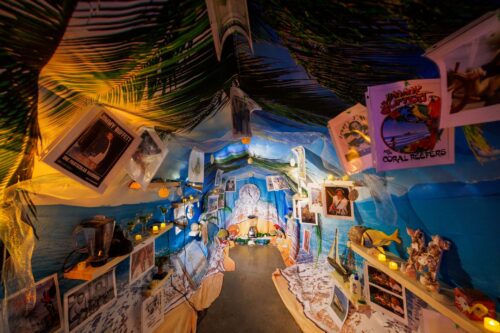
Visitors are invited to walk inside the margarita — a dense, found‑object sculptural environment of memorabilia-style elements assembled from collected materials. (Photo by Pedro Wazzan, courtesy of Locust Projects)
“There’s this giant margarita, let’s go stand inside of it, and some Adirondack chairs, let’s have a sit. And giant shorts,” she says. “But inside there is this anti-colonialist memorial library.”
Visitors are invited to walk inside the margarita — a dense, found‑object sculptural environment of memorabilia-style elements.
“I’m a huge maximalist,” Breez says, explaining that her usual instinct is to fill a space with objects and materials. For this project, however, she deliberately pulled back, allowing the giant cargo shorts and margarita to become the focus.
Beneath the humor and nostalgia, the commissioned works are meant to evoke more complicated questions about who gets to be part of this paradise and who gets left out. Margaritaville isn’t just a kitschy theme — it points out a much larger critique of American culture.
Gone, a Los Angeles-based trans artist, poet and educator, approached Margaritaville from a different perspective than Breez. While Breez grew up immersed in South Florida boating culture, Gone became interested in what the lifestyle brand reveals about broader ideas of belonging and the balance of power.
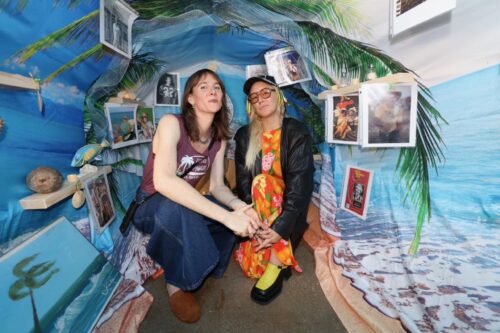
Patty Gone and Kelly Breez inside the installation of the giant margarita surrounded by Breez’s found object art. (Photo by Logan Fazio, courtesy of the artists)
“Margaritaville is kind of like the gateway to thinking about a certain kind of straight white culture in Florida, but then maybe the U.S. more broadly,” Gone says.
She became particularly interested in the sports bar as a cultural symbol.
“I think about the bar itself as a sports bar, especially as a nexus of that kind of social culture,” Gone says. “A kind of patriarchal escapism.”
The centerpiece of the site-specific installation — a monumental pair of cargo shorts measuring 12 feet tall and 17 feet wide — carries a personal connection for Breez.
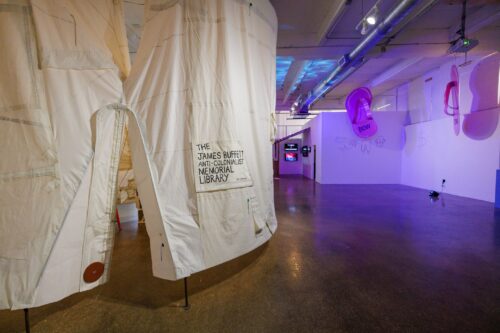
Many of the sails used to construct the oversized shorts came from the artist’s family sailing trips with her ather, including voyages to Key West.(Photo by Pedro Wazzan, courtesy of Locust Projects)
A South Florida native, she grew up sailing with her father and listening to Buffett’s music on the water. Many of the sails used to construct the oversized shorts came from those family sailing trips, including voyages to Key West.
Built entirely from repurposed sailcloth, the sculpture required months of planning, fabrication and hand sewing. Breez worked alongside her father and stepmother, transforming their home into what she describes as “an absolute factory” during the construction process.
The giant shorts also function as the James William Buffett Anticolonialist Memorial Library.
Visitors can enter through the fly, then sit in the library among books selected by Gone examining tourism, colonization, sugar production and the history of the Caribbean and Latin America.
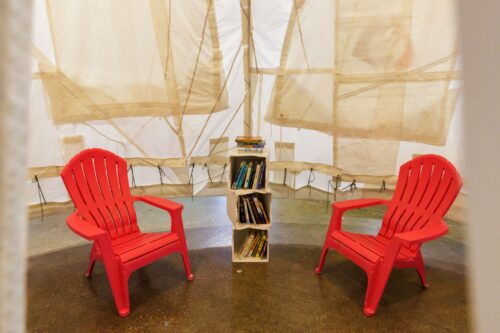
Visitors can enter through the fly of the giant cargo shorts, then take in books in the James William Buffett Anticolonialist Memorial Library.
(Photo by Pedro Wazzan, courtesy of Locust Projects)
“There’s a lot of really good stuff in here about the beginning of the sugar trade and how that has to do with the beginning of cocktails,” Breez says.
Those themes reappear in Gone’s multi-channel video installation, which traces the history of the margarita far beyond the frozen cocktails served at chain restaurants and beach bars.
“I was trying to think of how we got here?” Gone says. “How did we get to this sports bar, Margaritaville culture?”
Researching the origins of mixed drinks led her into histories of colonial trade routes, sugar production and empire.
“The first mixed drink is made in India,” Gone says. “Mixed drink culture is so embedded with colonialism.”
The video follows that history from India to Europe and the Caribbean, where sugar production fueled colonial economies and transformed drinking culture.
One discovery particularly surprised her.
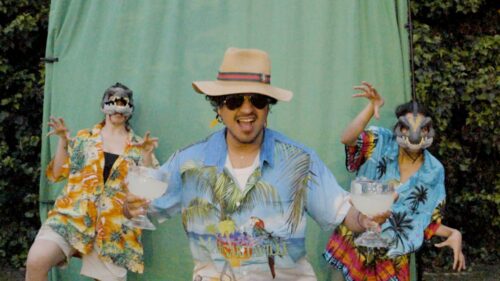
Film still of Xochitl Loco, Abhijeet “Moodzi” Mudgerikarin, and Elaina Moreno in
Patty Gone’s “Lost Shaker of Salt, 2026.” (Photo courtesy of Patty Gone)
“They’re drinking so much punch at the Declaration of Independence party,” Gone says. “It was wild to me to find that. They’re drinking all these mixed drinks made with ingredients connected to slave labor and that’s their official drink.”
Eventually the story arrives at Buffett himself, whose laid-back image became the foundation of a billion-dollar lifestyle brand that includes restaurants, resorts and retirement communities.
For Gone, that evolution became part of the exhibition’s larger narrative.
“When Jimmy Buffett comes in, he’s this countercultural figure at first,” she says. “Then where does it start to go?”
Neither artist is interested in simply mocking Buffett or his fans but examining the culture. The surroundings are familiar, but they are amplified.
For some visitors, that realization takes time.
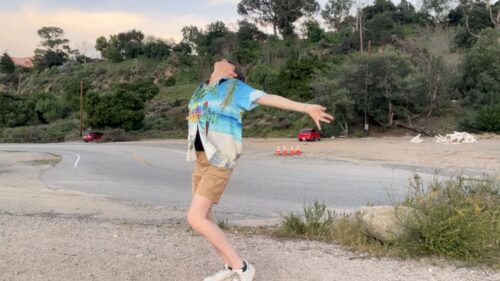
Film still of Patty Gone in Patty Gone’s “Beachfront Views.” (Photo courtesy of Patty Gone)
“It takes a bit for satire to sink in sometimes,” Gone says. “It takes you to sit with it for a second.”
About 25 miles north of Locust Projects is the Margaritaville Hollywood Beach Resort, one of the most visible examples of the lifestyle brand built around Buffett and the promise of tropical escape. Proximity makes the exhibition’s examination of tourism, leisure and paradise feel even more relevant in South Florida.
At the installation’s opening, Breez recalls that many visitors initially responded to the colorful visuals and tropical atmosphere before discovering the exhibition’s deeper themes.
“Some people were ready to just call it cheery and summery,” she says. “But there are indications of the dark underbelly.”
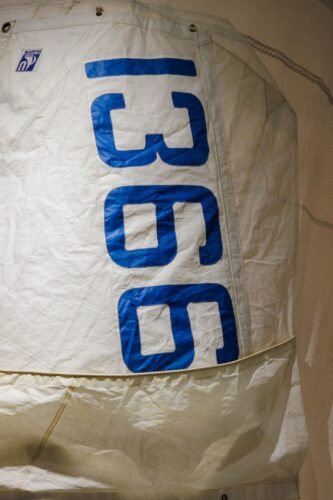
Built entirely from repurposed sailcloth, the sculpture required months of planning, fabrication and hand sewing. (Photo by Pedro Wazzan, courtesy of Locust Projects)
There’s the sports bar, the memorabilia, a stacked cube monitor tower showing Buffet’s early videos, and there are the Big Pharma commercials playing on a loop at the sports bar promising the same feel-good lifestyle for the Boomer generation.
And then slowly the question sinks in — who is this “good life” really meant for?
WHAT: Kelly Breez and Patty Gone: “Lost Shaker of Salt”
WHEN: 11 a.m. to 5 p.m. Tuesday through Saturday. Through Saturday, June 20.
WHERE: Locust Projects, 297 NE 67th St., Miami
COST: Free
INFORMATION: (305) 576-8570 or locustprojects.org.
ArtburstMiami.com is a nonprofit media source for the arts featuring fresh and original stories by writers dedicated to theater, dance, visual arts, film, music, and more. Don’t miss a story at www.artburstmiami.com.