
Visual Art
Dahlia Dreszer Turns Memory Into Bloom at Miami Beach Botanical
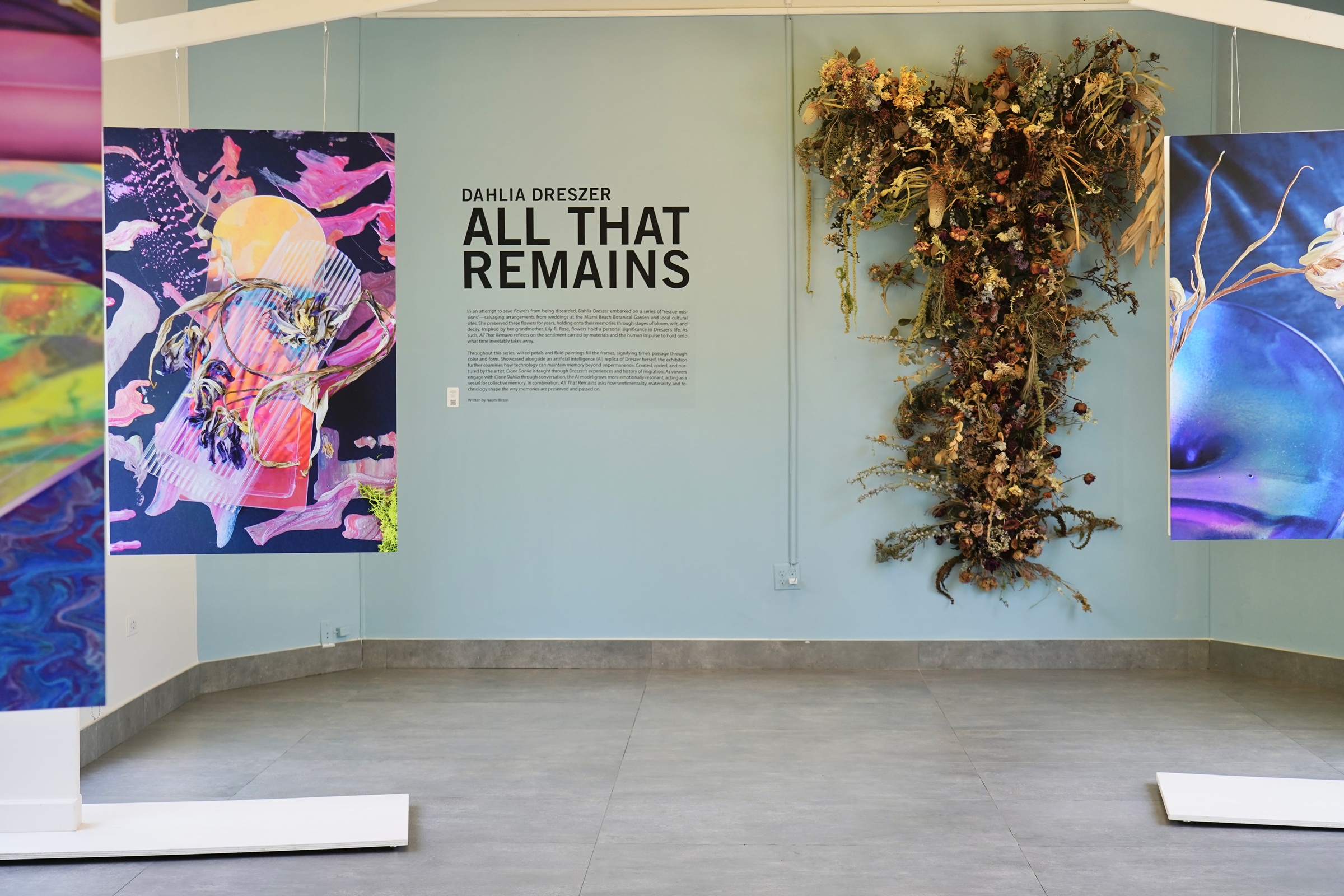
“All That Remains” by Dahlia Dreszer is on exhibition at the Miami Beach Botanical Garden through Tuesday, May 26. Dreszer is also hosting workshop events throughout the month. (Photo courtesy of the artist)
Dahlia Dreszer’s “All That Remains,” on view at the Miami Beach Botanical Garden, is less a conventional exhibition than an immersive environment shaped by suspended photographic panels, preserved flowers rescued from past celebrations, and an AI-generated digital counterpart of the artist herself. The Miami-based, Panama-born artist transforms the garden’s gallery into a meditative space where large-scale photographic still lifes, dried botanicals, and technology coexist in thoughtful dialogue about memory, loss, and preservation.
Dreszer’s practice has long explored identity, heritage, and the construction of home across diasporic experience. Rooted in her Latin American and Jewish background, her work often uses carefully staged imagery to merge the intimate and the symbolic.
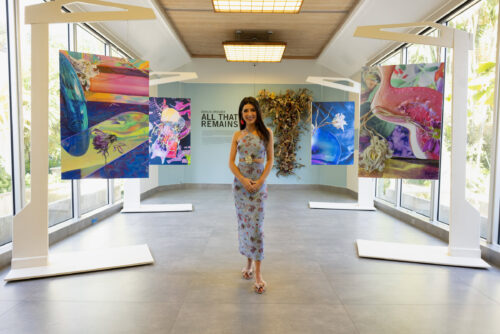
Artist Dahlia Dreszer stands within her exhibition “All That Remains” at the Miami Beach Botanical Garden, where suspended photographic works and preserved organic materials create an immersive meditation on memory and transformation. (Photo courtesy of the artist)
In “All That Remains,” however, those concerns become more personal and more vulnerable. The project was sparked by the death of her grandmother, Lily R. Rose, who named the artist after the dahlia flower and shared with her a lifelong love of gardens and preservation.
That family connection anchors every aspect of the show. Dreszer explained that after her grandmother passed away, she began what she calls “rescue missions,” collecting discarded floral arrangements after weddings and events. Flowers destined for the trash became the raw material for remembrance. Hung upside down in bathtubs, closets, and corners of her home, they were dried, cataloged, and stored for years until they reemerged here as sculpture and image. What others considered waste became an archive.
This act of salvaging gives the exhibition its emotional core. Dreszer is not simply preserving petals; she is preserving gestures, rituals, and relationships. She has described the flowers as symbols of family, aging, beauty, and impermanence. Those themes are evident throughout the installation, where the dried blooms carry a haunting elegance. They no longer possess the lush freshness associated with celebration, yet they have gained something deeper: history.
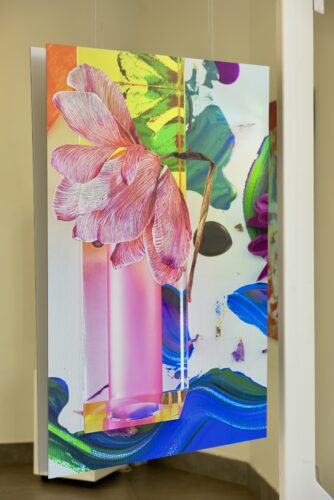
Detail view of Dahlia Dreszer’s photographic work “All That Remains VIII,” where a preserved flower intersects with layered color and light, reflecting themes of impermanence and constructed memory. (Photo courtesy of the artist)
The photographs themselves are sumptuous and meticulously composed. Dreszer stages each image as a hybrid of still life, portrait, and psychological landscape. Wilted florals mingle with reflective heirlooms, painted surfaces, and found objects, many passed down through generations or carried through previous bodies of work. Vases and mirrored surfaces subtly reveal traces of the artist herself — a silhouette here, the glint of a camera there. She is both maker and participant, visible yet elusive.
That tension between presence and disappearance is one of the exhibition’s strongest qualities. Dreszer’s images feel theatrical, but never artificial in a hollow sense. She embraces staging as a way to tell truths that documentary realism cannot. Her camera, she suggests, is as interpretive as a paintbrush. The resulting works occupy an in-between space where reality is heightened, memory is choreographed, and symbolism blooms from everyday materials.
Color plays a central role. Saturated reds, golds, and vivid tropical hues pulse through the compositions, recalling both Latin American visual culture and the emotional charge of family memory. Red, in particular, appears as a recurring note of vitality. Dreszer has connected it to her grandmother’s belief in optimism and resilience. Here it becomes a thread linking grief to celebration.
The Botanical Garden provides an inspired setting. Outside the gallery walls, living plants continue their own cycles of budding, flowering, and decay. Inside, Dreszer presents flowers arrested in time. The contrast sharpens the exhibition’s central question: what does it mean to preserve something that was meant to fade? The scent of dried florals reportedly meets visitors as they enter, blurring boundaries between artwork and environment. Even the custom hanging structures were designed to respond to the gallery’s limited wall space and floor-to-ceiling windows, allowing natural light to participate in the installation.
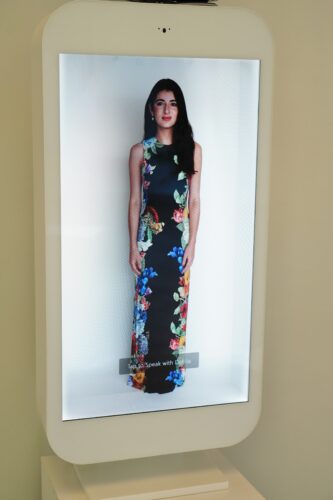
An interactive digital component, “Clone Dahlia,” in Dahlia Dreszer’s “All That Remains” invites viewers to engage directly with the artist’s image. (Photo courtesy of the artist)
Yet “All That Remains” is not nostalgic. One of its most surprising dimensions is technological. A centerpiece of the exhibition is “Clone Dahlia,” an AI-generated digital version of the artist that interacts with visitors in real time. Rather than treating artificial intelligence as a gimmick or a threat, Dreszer frames it as a collaborator and a vessel. The clone responds to questions about the work, asks visitors about their own memories, and stores those exchanges as an evolving oral archive.
This component could have felt trendy or distracting. Instead, it extends the show’s larger themes with intelligence. If flowers can preserve memory materially, perhaps technology can preserve it conversationally. If family stories risk disappearing with each generation, perhaps new tools can help carry them forward. Dreszer does not offer easy answers, but she asks timely questions about authorship, legacy, and simulated presence.
Importantly, the AI element never overshadows the tactile richness of the physical work. The true power of the exhibition lies in its material intelligence: brittle petals, fragile stems, faded blossoms, and reflective surfaces, arranged with painterly care. Dreszer understands that grief is experienced through objects as much as ideas. We keep the scarf, the vase, the bouquet, and the letter. We assign emotion to matter because matter outlasts the moment.
There is also generosity in the project. Dreszer has spoken of wanting visitors to discover their own meanings rather than be told what to think. That openness gives the exhibition broad resonance. One need not share her biography to feel the poignancy of trying to hold onto something already passing.
Miami’s art scene often prizes spectacle, speed, and novelty. “All That Remains” offers something rarer: slowness, reflection, and tenderness. It asks viewers to look carefully at what has withered and to recognize beauty there. It reminds us that endings can be fertile ground for transformation.
In a city built on reinvention, Dreszer has created a quietly moving show about what survives it. “All That Remains” is less concerned with loss than with continuity — the ways love lingers in color, in gesture, in flowers rescued from the edge of disappearance.
WHAT: Dahlia Dreszer: All That Remains
WHERE: Miami Beach Botanical Garden, 2000 Convention Center, Miami Beach
WHEN: 9 a.m. to 5 p.m., Tuesdays through Sundays. Through Tuesday, May 26. Mother’s Day Floral workshop, 2 to 4 p.m., Sunday, May 10; 6:30 p.m., Wednesday, May 20, artist talk Dahliah Dreszer in conversation with José Carlos Díaz (chief curator, Pérez Art Museum Miami); 11:30 a.m., Thursday, May 21, Flower Crown workshop
COST: Free but RSVP requested.
INFORMATION: (305) 673-7256 and mbgarden.org
ArtburstMiami.com is a nonprofit media source for the arts featuring fresh and original stories by writers dedicated to theater, dance, visual arts, film, music, and more. Don’t miss a story at www.artburstmiami.com.