
Visual Art
Frost Art Museum Revisits Landmark Exhibition of Modern Cuban Painters
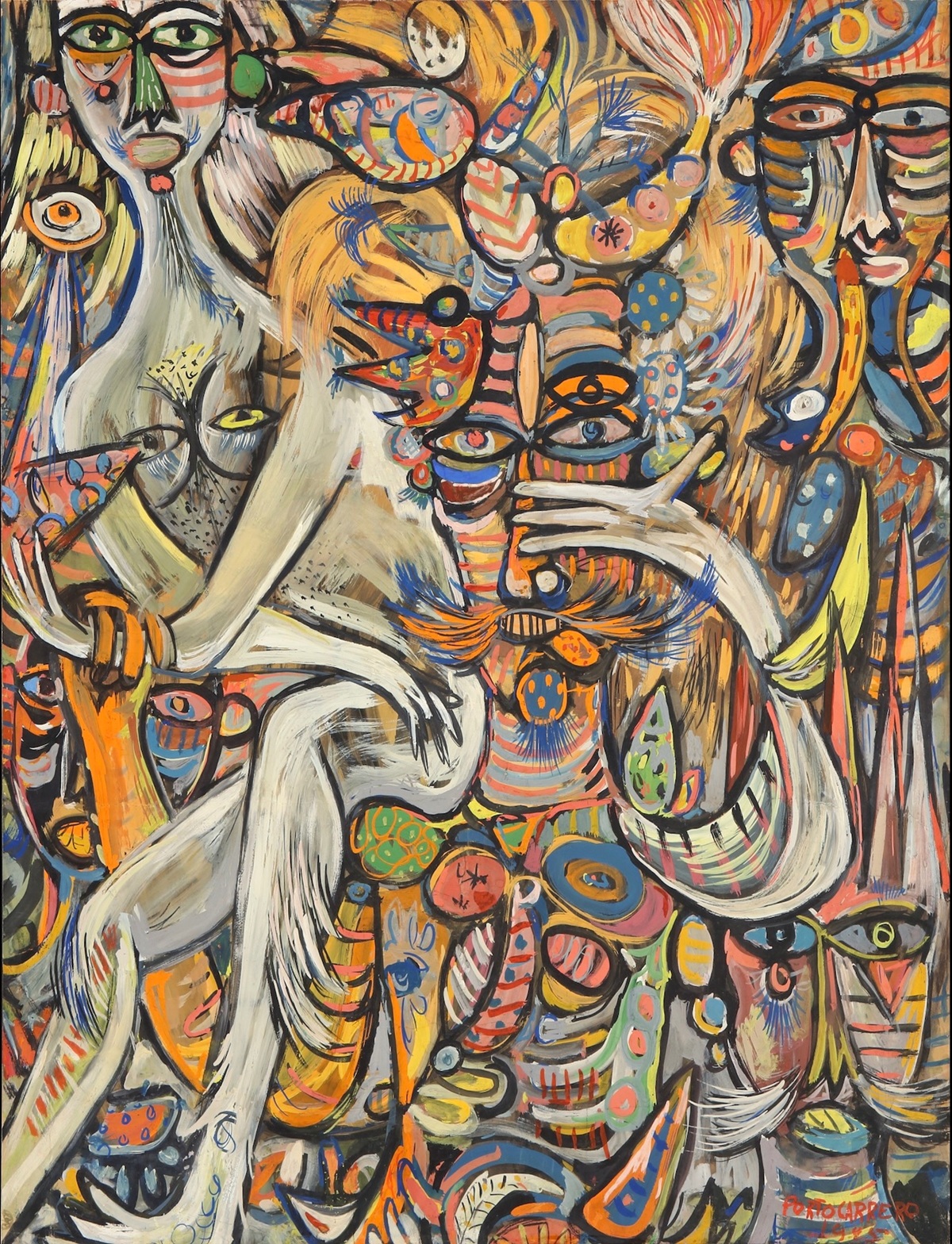
Tené Portocarrero. “Figure for an Imaginary Mythology,” 1945. Gouache on paper mounted on cardboard. 36 x 27 inches. Courtesy of Latin Art Core. (Photograph by Rogelio López Marín “Gory”)
Revisiting an art exhibition means reconsidering its original concept and the works of the artists it featured from a new perspective.
“Modern Cuban Painters from Havana to New York Revisited,” on view through Sunday, Oct. 18 at Miami’s Patricia & Phillip Frost Art Museum, is a must-see in a city with a sizable Cuban population.
Originally titled “Modern Cuban Painters from Havana to New York,” the exhibition was first presented at Bonhams’ New York headquarters for a month beginning in February.
The word “Revisited” was added specifically for the Miami edition to distinguish this new version from the one previously shown in New York.
Both, however, draw inspiration from the landmark 1944 exhibition Modern Cuban Painters at New York’s Museum of Modern Art, organized by Alfred H. Barr Jr., the museum’s founding director, and Cuban art critic and curator José Gómez Sicre.
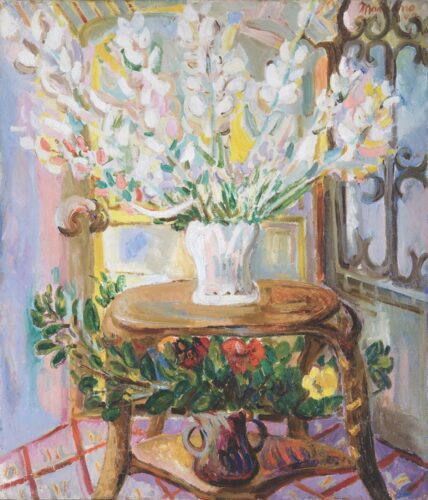
Mariano Rodríguez. “Gladioli,” 1942. Oil on canvas. 29 x 25 inches. Emilio and Silvia Ortiz Collection. © Estate Mariano Rodríguez. (Photograph courtesy of the Mariano Rodríguez Foundation)
By the time MoMA presented the exhibition, Cuba was experiencing a period of renewed cultural confidence and artistic innovation. The country had been operating under the 1940 Constitution for four years, following the 1934 repeal of the Platt Amendment, whose inclusion in the 1901 Constitution had long undermined Cuban independence and sovereignty in its relationship with the United States.
“Modern Cuban Painters” (MoMA, New York, 1944) brought together 13 Cuban painters, including figures from two generations of the country’s modern art movement, including artists from the first avant-garde (1920–1930) and the second (1940–1950). Barr distinguished between the two groups, referring to them as “the older generation” and “the young artists.”
Comparing the artist rosters, “Modern Cuban Painters from Havana to New York Revisited,” curated by Elizabeth T. Goizueta and Cristina Figueroa Vives, features Carlos Enríquez, Amelia Peláez and Fidelio Ponce de León from the first avant-garde, along with Mariano Rodríguez, Mario Carreño, Cundo Bermúdez, René Portocarrero and Roberto Diago from the second.
One notable addition is Wifredo Lam, who was not included in the 1944 MoMA exhibition.
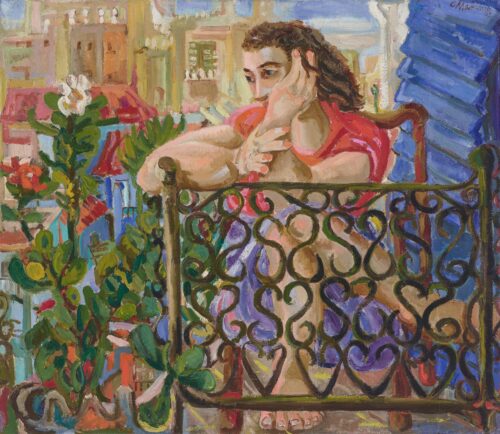
Mariano Rodríguez. “Woman on a Balcony,” 1942. Oil on canvas. 26 x 30 inches. Isaac and Betty Rudman Trust. © Estate Mariano Rodríguez. (Photograph courtesy of the collector)
This edition at the Frost Art Museum is far more expansive and in-depth than Bonhams.
“With larger galleries, we have the wonderful opportunity to add more works—whether from the original MoMA exhibition or from the leading New York galleries of the 1940s—as well as photographs and letters,” Goizueta said.
The expanded scope also was what prompted the addition in the exhibition’s title.
“With so many new gems,” Goizueta added, “we realized that the character of this second exhibition had changed—for the better, I dare say—and that change is reflected in the new title.”
The exhibition also incorporates previously unseen materials from the José Gómez Sicre Visual Archive.
“Moreover, it allows us to bring together, eight decades later, a significant group of works, while incorporating previously unseen materials from the José Gómez Sicre Visual Archive—photographs, correspondence, and scrapbooks—that enrich our understanding of the context in which these works were produced and circulated,” Vives said.
The exhibition offers a rare opportunity to see in Miami works such as Amelia Peláez’s “Marpacífico” (1936) and “The Balcony” (1942); Cundo Bermúdez’s “Portrait of María Luisa Gómez Mena” (1943); and Antonio Gattorno’s “Self-Portrait” (1944) and “Portrait of Concha” (1941).
Also on view are important works by Mario Carreño (“Goddess of the Sea,” 1943), Wifredo Lam (“Le Sorcier de l’océan (Alafi Incam / Ogun Ferraille),” 1947), Mariano Rodríguez (“The Breakfast,” 1943, and “Gladioli,” 1942), and René Portocarrero (“Spring,” 1940), as well as signature works by Carlos Enríquez (“Nude,” 1940) and Fidelio Ponce de León (“Saint Ignatius of Loyola,” 1940).
Taken together, these elements broaden the interpretive horizon of “Modern Cuban Painters from Havana to New York Revisited” and shed new light on the Cuban avant-garde movement.
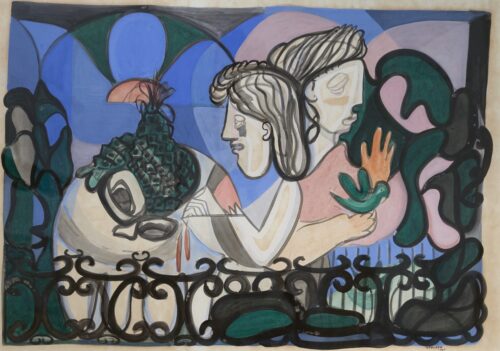
Amelia Peláez. “The Balcony,” 1942. Gouache on paper mounted on board. 24 x 33 inches. Isaac and Betty Rudman Trust. © Amelia Peláez Foundation. (Photograph courtesy of the Amelia Peláez Foundation)
In this sense, the first avant-garde constructed a modern vision of Cuba, one whose The first Cuban avant-garde helped shape a modern vision of the country’s national identity, viewing it as a cultural and social achievement. Two influential movements, “Revista de Avance” (1927) and the Grupo Minorista (1923), played central roles in developing that vision.
“Revista de Avance” challenged the prevailing academic artistic traditions rooted in colonialism, while the Grupo Minorista embraced the idea that art and politics were inseparable. The group opposed Gerardo Machado’s dictatorship and U.S. imperialist interventionism and, in many respects, aligned itself with 20th-century Cuban political and revolutionary thought.
Although the first and second avant-gardes differed in style and artistic approach, both explored themes including mestizaje, landscape, rural and domestic life, popular culture, the relationship between the individual and society, desire, solitude and Afro-Cuban identity. Together, these subjects helped define and express a modern sense of Cuban national identity.
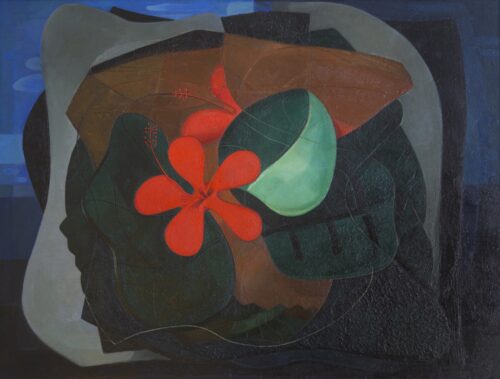
Amelia Peláez. “Marpacífico,” 1936. Oil on canvas. 29 x 37⅜ inches. Giulio V. Blanc Collection. Courtesy of Lodovico and Margherita Blanc. © Amelia Peláez Foundation. (Photograph courtesy of the Amelia Peláez Foundation)
Those themes were shaped in part by international artistic influences, but Cuban artists transformed them through their own experiences, subjects and visual language.
Barr emphasized that modern Cuban painting succeeded in blending influences from Paris, Mexico, the Renaissance and the Baroque with what he described as “native Cuban elements.”
Goizueta said the exhibition “takes a broader view: recognizing and bringing to light the importance of that exhibition, along with others, during the 1940s, the difficult years of the world war and its aftermath.”
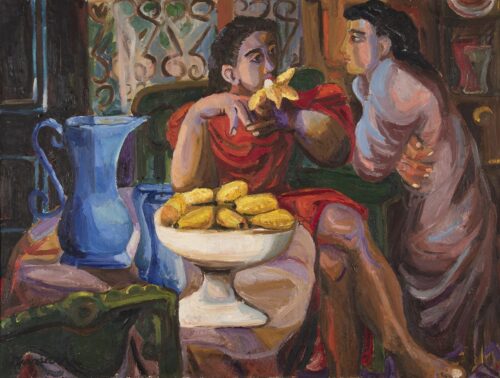
Mariano Rodríguez. “The Breakfast,” 1943. Oil on canvas. 30 x 41 inches. Claude and María Ruibal Collection © Estate Mariano Rodríguez. (Photograph by Cora Jean Rafe, courtesy).
Rather than simply recreating the 1944 MoMA exhibition, the Frost presentation expands the story through additional artworks, photographs, correspondence and archival material.
Seen together, the paintings and archival materials offer a broader view of how Cuban artists of different generations developed a modern visual language while exploring questions of national identity, everyday life, landscape, race and culture.
The political climate that culminated in the 1940 Constitution was embraced by much of Cuba’s artistic and intellectual community as part of a broader quest for democracy and modernization. More than 80 years later, “Modern Cuban Painters from Havana to New York Revisited” offers a chance to reconsider that cultural moment and the artists who helped define it.
ADDITIONAL PROGRAMMING
A series of special lectures are planned surrounding the exhibition. On Tuesday, Sept. 15, from 11 a.m. to 1 p.m., “Revisiting Modern Cuban Painters: From Archive to Exhibition, features a panel discussion with Elizabeth T. Goizueta, Cristina Figueroa Vives, and María Martínez-Cañas about the roles of archives and primary sources in researching, writing, and exhibiting the history of Cuban modernism.
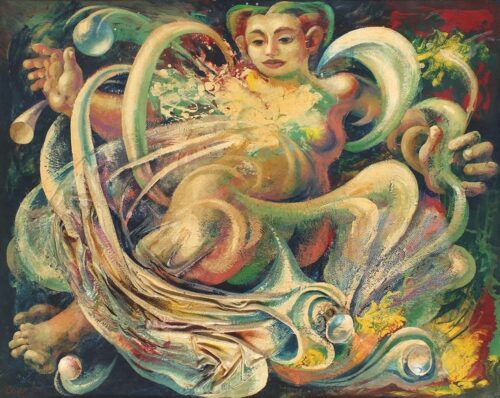
Mario Carreño. “Goddess of the Sea,” 1943. Duco, seashells, sea fan, and textile collage on panel. 37¼ x 46½ inches. Courtesy of Latin Art Core. (Photograph by Rogelio López Marín “Gory”)
The panelists will discuss the research and writing processes behind the project and the ways archival materials helped reconstruct the artistic exchanges between Havana and New York during the 1940s. The conversation will consider the José Gómez Sicre Visual Archive and its integration into the exhibition. The event is free, but an RSVP is required.
On Thursday, Sept. 24 from 11 a.m. to 1 p.m., “Curator’s Cut,” a series of daytime conversations, features curator Cristina Figueroa Vives, co-curator of “Modern Cuban Painters from Havana to New York Revisited,” and Miami-based artist Alejandro Piñeiro Bello discuss the role of identity and memory in his paintings and the Caribbean influences that have shaped his practice. RSVP required.
WHAT: “Modern Cuban Painters from Havana to New York Revisited.”
WHERE: The Patricia & Phillip Frost Art Museum,10975 SW 17th St., Miami
WHEN: 11 a.m. to 5 p.m., Tuesday through Sunday. Through Oct. 18.
COST: Free
INFORMATION: (305) 348-2890. or https://frost.fiu.edu
ArtburstMiami.com is a nonprofit media source for the arts featuring fresh and original stories by writers dedicated to theater, dance, visual arts, film, music and more. Don’t miss a story at www.artburstmiami.com