
Visual Art
Still Underrated, Modern Master Louise Nevelson Gets Her Due at the Frost
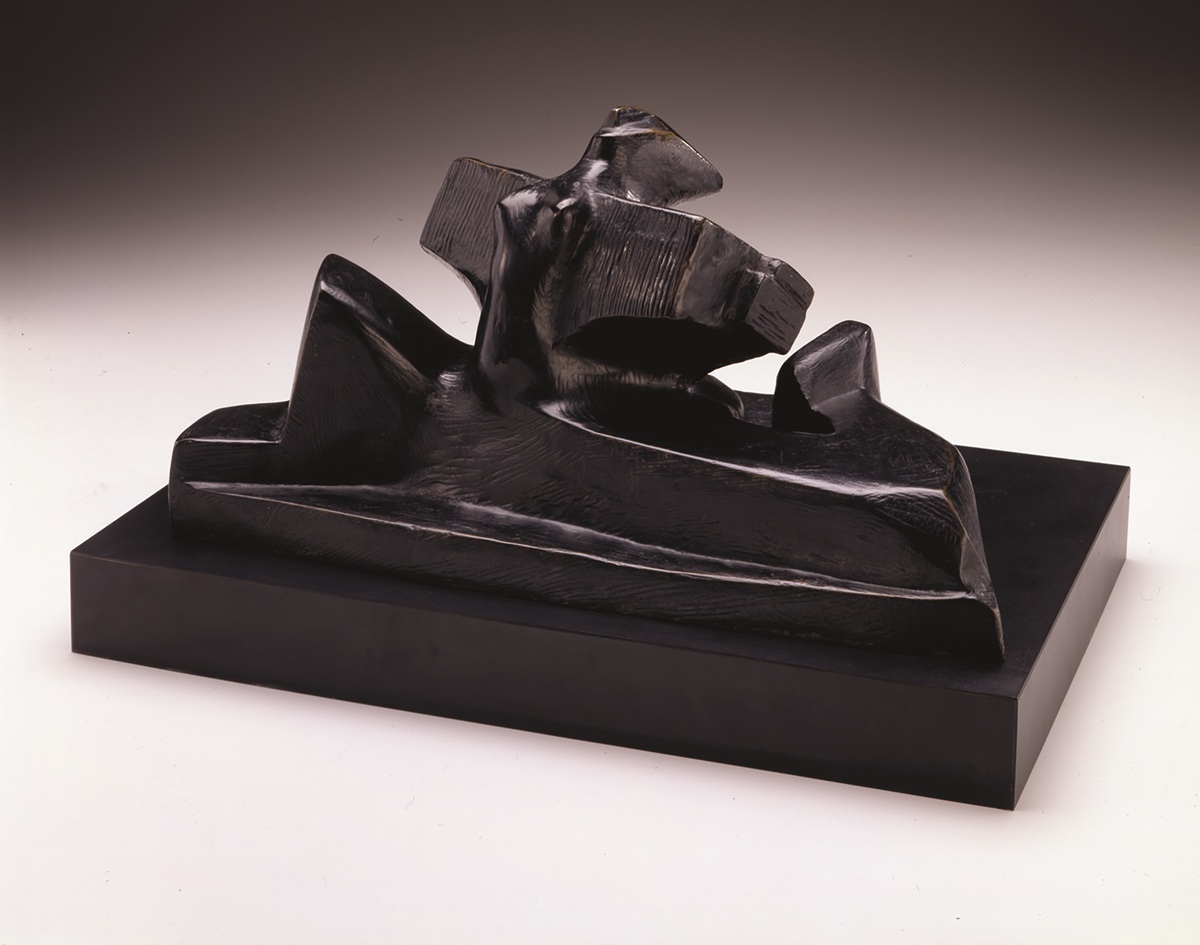
(Louise Nevelson (1899–1988), Martha Graham, ca. 1950. Cast bronze, 8 x 17 7/8 x 9 3/4 inches. Collection of the Farnsworth Art Museum, Rockland, Maine, gift of Louise Nevelson, 1984.23.8. © 2026 Estate of Louise Nevelson / Artists Rights Society (ARS), New York. “Dawn to Dusk” now at the Frost Museum through January 2027)
One of the most important, yet underrated American modern artists of all time is getting the retrospective treatment at the Patricia and Phillip Frost Art Museum at FIU – and it’s not who you might expect.
Louise Nevelson may not be among the first names that come to mind in the pantheon of important artists of the modernist movement. In the mid-20th century, she was a household name, representing the U.S. at the Venice Biennale and appearing on the cover of Life magazine. Today the public is more likely to know Pablo Picasso and Henri Matisse, Mark Rothko and Jackson Pollock, even Georgia O’Keeffe and Helen Frankenthaler.
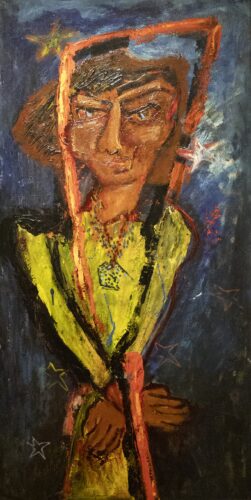
Louise Nevelson (1899–1988), “Woman with a Red Scarf, circa. 1947. Oil on board, 56 5/8 x 33 x 1 3/8 inches. Collection of the Farnsworth Art Museum, Rockland, Maine, bequest of Nathan Berliawsky, 1980.35.24. © 2026 Estate of Louise Nevelson / Artists Rights Society (ARS), New York
But the Russian-born Jewish-American might just dwarf them all in terms of influence. Her large-scale, abstract sculptures made way for a bold new typology: installation art, going beyond sculpture and considering the way an artwork is staged.
“She is, in many ways, the founder of what we understand as installation art,” said Jaime DeSimone, chief curator at the Farnsworth Art Museum in Nevelson’s hometown of Rockland, Maine. “In one of her first shows, she creates an environment where she’s inviting the visitor to engage with these sculptures. She’s thinking about the way the floor is, the way the walls are covered, using blue lights. This is so much more than just a sculpture that she’s created from discarded wood and fragments and unified by paint.”
“Louise Nevelson: Dawn to Dusk,” opening at the Frost Museum on Thursday, Aug. 20, features a number of Nevelson’s installation works. The artist executed most of her sculptures monochromatically, usually in solid black but also occasionally working with white or gold. These colors correlate to specific themes in Nevelson’s life. Black often represents her interest in space and celestial bodies amid the technological progress of the 20th century, as do the futuristic, abstract forms they take influenced by cubism, Art Deco, and the rising skyscrapers of her adoptive home of New York.
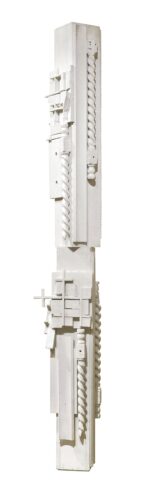
Louise Nevelson (1899–1988), Dawn Column I, 1959. Wood and found wooden objects painted white, 92 3/8 x 13 1/2 x 13 1/2 inches. Collection of the Farnsworth Art Museum, Rockland, Maine, museum purchase, 1979.81. © 2026 Estate of Louise Nevelson / Artists Rights Society (ARS), New York.
White works such as “Dawn Column I,” meanwhile, indicate matrimonial themes, sometimes reflecting on the artist’s own failed marriage. The piece comes from the larger 1959 installation “Dawn’s Wedding Feast,” created for the Museum of Modern Art’s group exhibition “Sixteen Americans” in New York. The installation marked a major turning point for Nevelson’s career and progression as an artist – it was the first time she had used white on such a scale – and earned her the Venice commission, for which she appropriated parts of the installation into a new work, “Voyage.” The individual components have been split up and are now held by various museums.
“Because of what we understand of Nevelson’s work, she’s constantly creating, and as pieces evolved, she would disassemble them and make them into new works,” DeSimone said. “So people can see how a single column has kind of lived on into a unique work of art.”
But there’s more to her career than the large-scale, sculptural pieces she’s best known for. “Dawn to Dusk,” which travels to the Frost from Rockland, features a number of objects from the Frost’s own collection that offer a broader view of Nevelson as an artist. These include jewelry and a unique set of works on paper: a series of collages made from photographs of Nevelson’s own work.
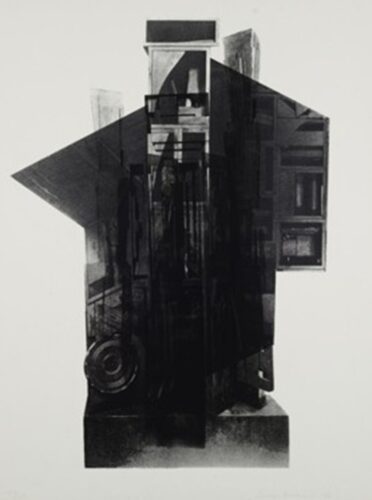
Louise Nevelson (1899–1988), Mariner Man, from the portfolio Façade: Twelve Original Serigraphs in Homage to Edith Sitwell, 1966. Silkscreen, mylar, 23 x 17 1/2 inches. Collection of the Patricia and Phillip Frost Art Museum. Gift of Dr. and Mrs. Rudolph E. Drosd. MET 77.21.5. © 2026 Estate of Louise Nevelson / Artists Rights Society (ARS), New York.
“What’s nice about this exhibition is that it shows these early paintings, it shows sculpture, it shows collage, it shows other forms of assemblages,” said Natalia Zuluaga, chief curator at the Frost Museum. “And I think when you’re able to see the full breadth of her practice. You see the way in which she developed that language.”
And beyond her art, there are ways in which Nevelson’s life story is likely to appeal to Miamians. The artist was a first-generation American, joining a wave of Jewish immigration from the Russian Empire – specifically what is now Ukraine – to the United States. Her family spoke Yiddish at home and struggled to assimilate into the small town, which led Louise to marry early in order to escape to New York in the early 1920s. There, she rebelled against the stifling confines of her husband’s conservative values and expectations of submissive domesticity, eventually divorcing him and taking up art full-time.
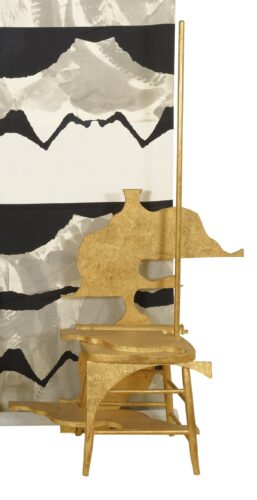
Louise Nevelson (1899–1988), Orfeo: Gold Throne I, 1984. Gold leaf on wood, 36 3/4 x 35 x 18 1/2 inches. Collection of the Farnsworth Art Museum, Rockland, Maine, gift of Louise Nevelson, 1985.23.29. © 2026 Estate of Louise Nevelson / Artists Rights Society (ARS), New York.
“I think Louise was an intellectually curious person, and it’s worth looking at the kinds of questions that she asked about the moment in time that she was living in, right? Like for me, maybe this is like a story that kind of touches upon the way in which we learn and read and think about the world,” Zuluaga said. “But yeah, she was an immigrant. She was a first-generation immigrant who was growing up in a port town, trying to find her way into New York City in order to pursue a career in art. I think from that perspective, also, there’s a lot of compatibility or parallels to many stories in our community.”
Though she may not be as famous as Picasso or Pollock, Louise Nevelson’s place in the modern art canon is as solid and firm as her sculptures are pitch black. Now, Miami will get the chance to come into deeper contact with this vital artistic voice.
WHAT: “Louise Nevelson: Dawn to Dusk”
WHERE: Patricia and Philip Frost Art Museum, Florida International University Modesto A. Maidique Campus, 10975 SW 17th St., Miami
WHEN: 11 a.m. to 5 p.m. Tuesday through Sunday. Thursday, Aug. 20 through Sunday, Jan. 17, 2027
COST: Free
INFORMATION: (305) 348-2890; frost.fiu.edu
ArtburstMiami.com is a nonprofit media source for the arts featuring fresh and original stories by writers dedicated to theater, dance, visual arts, film, music and more. Don’t miss a story at www.artburstmiami.com