
Visual Art
Lea Nickless Reveals the History Beneath ‘The Magic of Miami Beach’
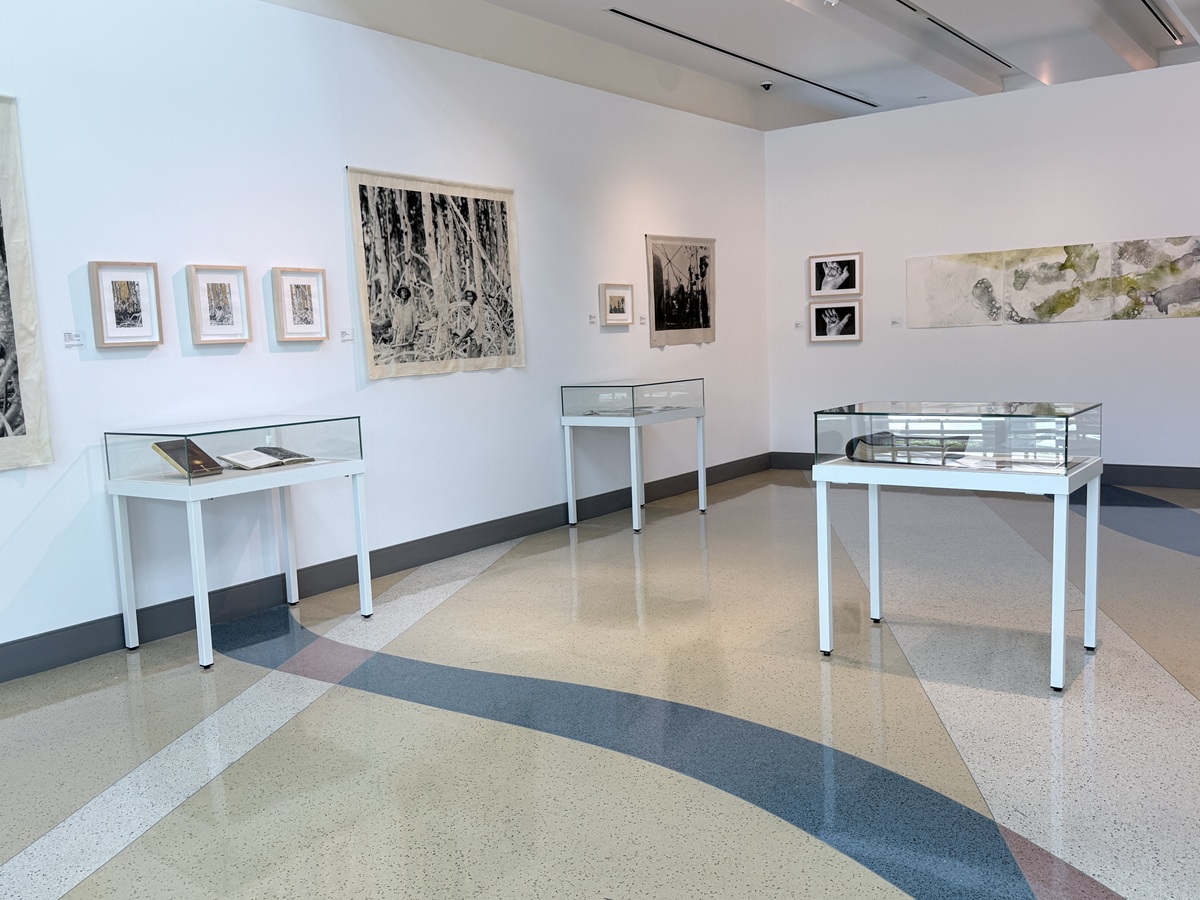
Installation view of Lea Nickless’s “The Magic of Miami Beach” at the Miami Beach Regional Library, where photographs, works on paper and archival materials explore the area’s natural and developed landscape. (Photo by Erin Parish)
Seeing Miami Beach as a paradise means overlooking some of the work that made it look that way. Before the hotels and beaches became their defining images, it was an inhospitable mangrove and a mosquito-filled swamp. The population consisted of workers transforming the strip of land to be habitable, even desirable, reforming the cluster into a model of hospitality.
Lea Nickless’s exhibition, “The Magic of Miami Beach,” looks at that history through photographs, paintings, source materials and a fragment of brain coral. On view at the Miami Beach Regional Library, the show takes its title from a 1938 book by Charles Edgar Nash. It asks visitors to look beyond the finished landscape and consider both the people who changed it and the natural world that was already there.
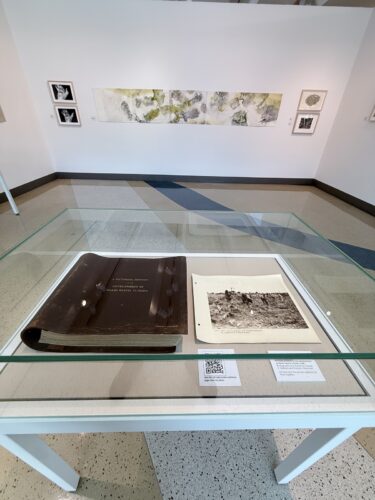
Archival materials, including “A Pictorial History of the Development of Miami Beach, Florida,” are displayed alongside works by Lea Nickless in “The Magic of Miami Beach.” (Photo by Erin Parish)
The photographs are presented to be factual, while the paintings open onto everything that photography does not contain: geological time, microscopic life, and the invisible structures beneath the surface.
The result is a multimedia exhibition which exists between the recorded and the imagined.
Nickless, an artist and curator emerita at the Wolfsonian–FIU, has spent decades working with historical objects and researching their stories
She retains the physical evidence of the landscape that preceded the city. In one image, a forlorn man appears as if swallowed by a tangle of trunks and roots. In another, a solitary figure stands in uneasy contrast to heavy machinery.
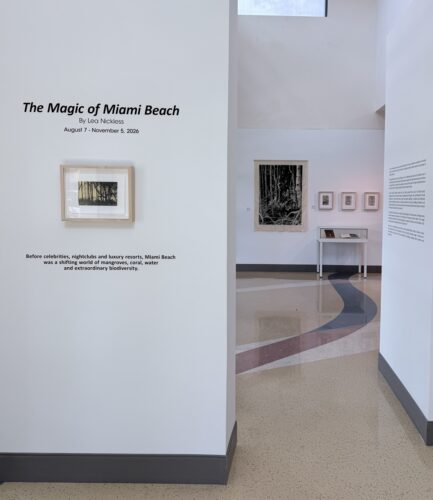
The entrance to Lea Nickless’s “The Magic of Miami Beach,” on view at the Miami Beach Regional Library through Nov. 5. (Photo by Erin Parish)
The artist complicates the photographs further by painting over them with ink and watercolor. The division between photographic image and abstraction produces a tension between evidence and the imagination. The large works seem to be on the verge of becoming ghostly, bleached by the same relentless Florida sunlight that makes Miami Beach so visually seductive.
That tension becomes increasingly important as Nickless moves beneath the visible landscape. A sample of Brain (brain) coral sits within a vitrine. With its millipede-like textures and fossil associations, it recalls another Miami hidden beneath the vegetation. Coral is simultaneously biological material, geological record, and evidence of the physical foundation upon which the city was constructed.
The coral, presented as an object of knowledge, also introduces another aspect of Nickless’s project: the impulse to extract nature from its surroundings, classify it, preserve it, and display it. The brain coral becomes an artifact of the very landscape that development has transformed.
“Drift” pushes the exhibition downward. In the series of small works measuring 11 by 15 inches, Nickless imagines microscopic forms resembling cells and bacteria. The scale shifts from landscape to microcosm. Disparate shapes occupy the same field as though they belong to a larger system of coexistence.
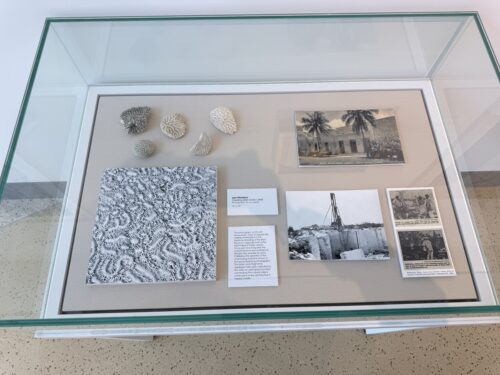
Coral specimens, historic photographs and Lea Nickless’s “Bleaching Brain Coral” are brought together in a display examining Miami Beach’s natural history and development. (Photo by Erin Parish)
Hands are prominent in “Inversion 2” and “Inversion 3,” bringing the exhibition’s concern with labor back into focus. Nickless moves between recognizable images and abstraction throughout the show. The smaller black-and-white photographs share imagery with larger works, encouraging viewers to look again at details they may have passed over.
There are moments when the work recalls Charles Burchfield in its sensitivity to the psychological possibilities of landscape, although Nickless is less interested in nature as an expression of individual emotion than in the systems operating beneath it.
“Night Bloom,” with its African baobab, brings a contemporary image into the exhibition. The city is presented instead as one point within a much larger system of movement, migration, geology, ecology, and human intervention.
Historical materials gathered in “A Pictorial History of the Development of Miami Beach, Florida,” presented in books and glass cases include a QR code, offering visitors another way to explore the people and places behind the work.
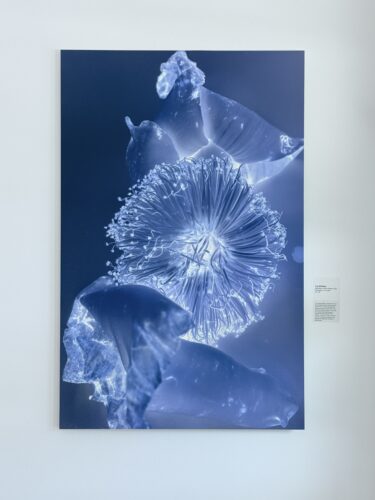
Lea Nickless’s “Night Bloom, African Baobab,” a pigment-ink work, is included in “The Magic of Miami Beach.” (Photo by Erin Parish)
For someone who has never lived here, Miami Beach can appear almost absurdly beautiful. To someone who knows Miami-Dade, the mangroves, coral and photographs of workers and machinery reveal more of what shaped that view. Nickless brings the labor behind the familiar landscape into focus while asking visitors to look more closely at the natural world beneath it.
Nickless’s achievement is to make that concealed labor visible, an exhibition that is educational as well as aesthetically beautiful.
On Saturday, Oct. 10, from 10 a.m. to noon, a panel discussion presented by the Miami-Dade Public Library System, “Building Paradise: Bahamian Labor and the Making of Miami,” will feature Nicklees, along with Sharony Andrews Green, historian and author, and Gabriella Roman, community programs manager, Vizcaya Museum and Gardens. Oscar Fuentes will moderate the discussion. The program will begin with a tour of the exhibition, followed by opening remarks by The Honorable Tyson C. McKenzie, Consul General of The Bahamas in Miami.
WHAT: “The Magic of Miami Beach,” an exhibition by Lea Nickless
WHERE: Miami Beach Regional Library, 227 22nd St., Miami Beach
WHEN: Library hours are 9:30 a.m. to 8 p.m. Monday through Thursday and 9:30 a.m. to 6 p.m. Friday and Saturday. Through Thursday, Nov. 5, 2026.
COST: Free
INFORMATION: (305) 535-4219 or mdpls.org
ArtburstMiami.com is a nonprofit media source for the arts featuring fresh and original stories by writers dedicated to theater, dance, visual arts, film, music and more. Don’t miss a story at www.artburstmiami.com.