
Visual Art
El Espacio 23 Stages Ambitious Show on Latin American Art
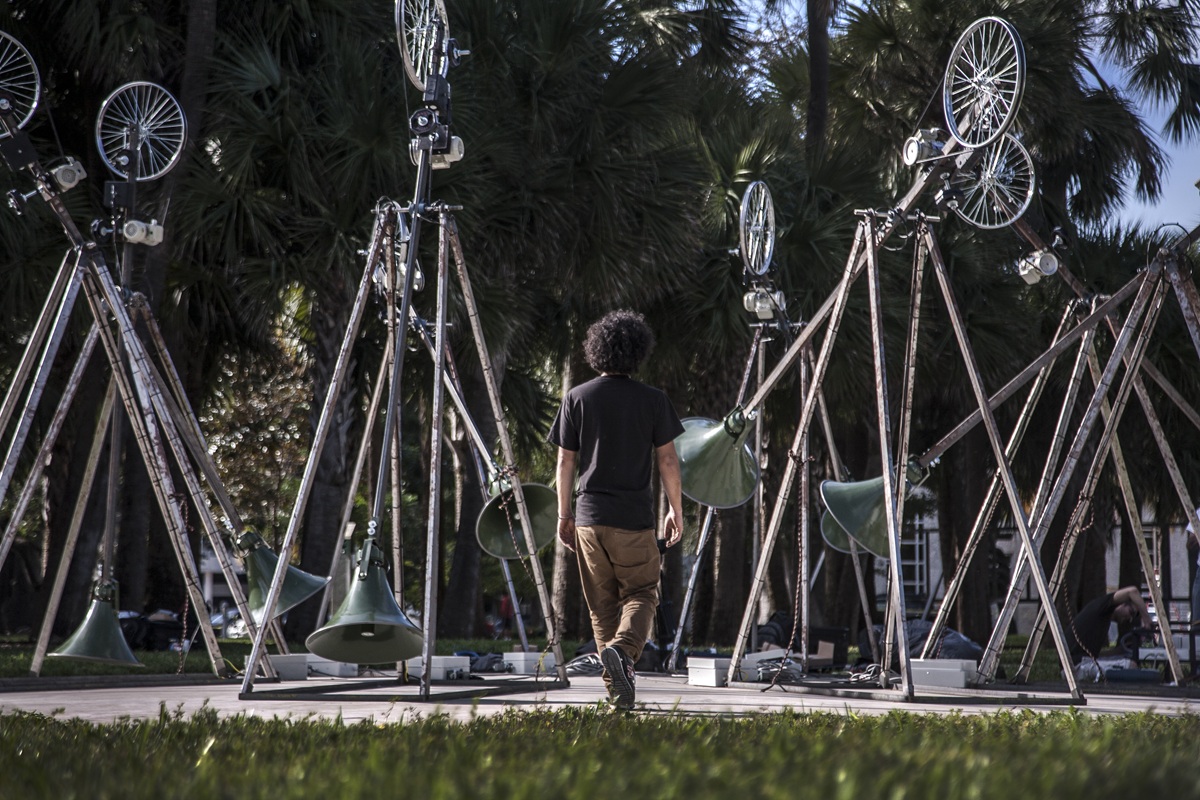
Peruvian artist Jose Carlos Martinat’s kinetic sculpture “Manifestos” is included in El Espacio’s “Nothing Is Lineare: Relations Across Latin America and Its Diasporas,” on view through Saturday, Aug. 14, 2027. It features a system of pendulums with speakers, each playing a different art manifesto in its original language. (Courtesy of El Espacio)
How do you summarize the culture of an entire country, let alone a region that spans two continents? This is the difficult task the curators at El Espacio 23 have given themselves this year. The private museum owned by billionaire real estate developer and art collector Jorge Pérez is mounting an ambitious new show dedicated to Latin American art, “Nothing Is Linear: Relations Across Latin America and Its Diasporas.”
The first challenge? Figuring out what “Latin” even means.
“The main question is ‘What is “Latin American?”’ What does it mean to be Latin American?” says Patricia Hanna, director at El Espacio 23. “And that’s why we think ‘What is Latin American art?’ There’s so many ebbs and flows, and so many migrations and movements. That’s why we came up with the title ‘Nothing is Linear,’ because this is in constant flux, and it’s a shared narrative from so many different contexts, different generations, different circumstances.”
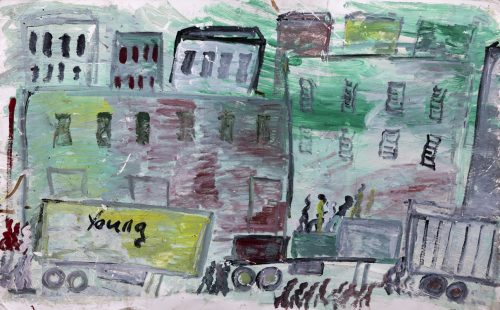
In keeping with the show’s broad conception of Latin identity and influence, several unconventional selections were made from the collection. Purvis Young of Black American heritage was included because of his close connection to Miami. Pictured is “Figures and Trailers on the Street,” oil on board. (Courtesy of El Espacio)
Coming up with a show spanning multiple countries was already enough of a challenge, but the curators also had to account for two additional presentations of the exhibition at two very different museums, El Museo del Barrio in New York and the Museo del Arte Contemporaneo in Monterrey, Mexico.
“New York wanted to focus on the Latinx aspect of our collection, because it’s very relevant to their audience and programs, while the museum in Monterrey wanted to highlight the Latin American nucleus of our collection,” says Anelys Alvarez, chief curator at El Espacio. “But we’re in Miami, and we see all these terminologies and all these borders in a more fluid way.”
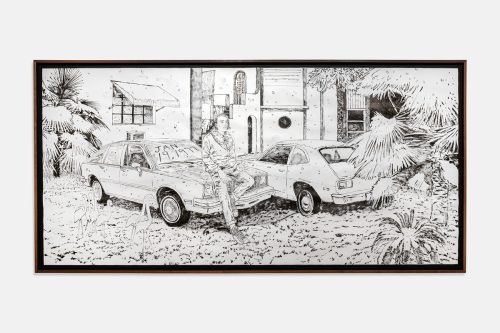
Local artist Hernan Bas depicts Miami on the mythical “Snow Day” of January 19, 1977 in the acrylic on paper, “MIAMI, FL, JANUARY 19, 1977 8:45 AM, 2022. (Courtesy of El Espacio)
The team ultimately decided to split the show into four overarching sections, each focusing on a broad theme. “Spaces of Meaning,” for instance, accounts for work that deals with place and built environments – there’s a Hernan Bas painting of Miami on the mythical “Snow Day” of January 19, 1977, as well as a quirky conceptual work from Cuban artist Reynier Leyva Novo collecting dust samples from various U.S. monuments.
But just as ideas around Latin identity and political boundaries can get fuzzy, so does the curation occasionally blur borders between subject areas. The transition between the sections “Gestures of Resistance,” including political artworks, and “Symbolic Languages,” on Latin American abstraction, includes pieces that straddle both subject areas.

Allora & Calzadilla’s “Untitled (Solar Catastrophe Series)” is constructed from broken solar panels. (Courtesy of El Espacio)
A geometric painting by Allora & Calzadilla is constructed from broken solar panels while a large-scale work by Mariela Scafati, collecting snippets of political radio shows in Argentina painted on gray backgrounds, resembles a color field painting reminiscent of Barnett Newman.
In keeping with the show’s broad conception of Latin identity and influence, several unconventional selections were made from the collection. Purvis Young and Myrlande Constant, of Black American and Haitian heritage respectively, were included because of their close connection to Miami.
A massive, wall-sized woodblock print by Chicago-born Yashua Klos, depicting Black automotive workers in tribute to his father’s family from Detroit, was chosen due to its relation to the industrial murals of Diego Rivera and other Mexican muralists. The curators drew on the theories of Brazilian philosopher Leila Gonzalez, who argued that the African slave trade serves broadly to connect the cultures of many countries in the Americas.
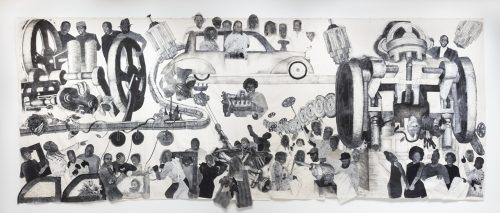
The massive, wall-sized woodblock print, “Our Labour” (2020-21) by Chicago-born Yashua Klos was chosen due to its relation to the industrial murals of Diego Rivera and other Mexican muralists. (Courtesy of El Espacio)
Some of the most surprising parts of the show features works that defy what usually goes on view at a contemporary art museum. Inside a dedicated gallery space, Peruvian artist Jose Carlos Martinez’s kinetic sculpture “Manifestos” features a system of pendulums with bicycle wheels attached to one end (in reference to Marcel Duchamp’s original “Bicycle Wheel” readymade sculpture) and megaphone loudspeakers attached to another. When operational each speaker will play a different art manifesto in its original language – André Breton’s “Surrealist Manifesto” in French, for instance.
Meanwhile, the exhibition’s opening section, “Embodied Histories,” includes works focused on the body. Among them is a portrait by Wifredo Lam that stands apart from his better-known work: an unknown nude woman reclines as servants attend her, in an Orientalist-style scene.
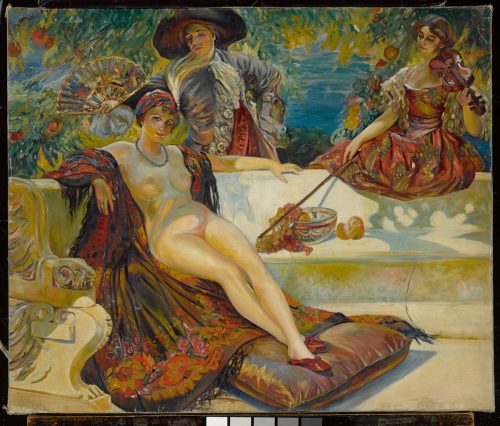
Featuring orientalist elements, an early work from Wifredo Lam’s pre-modernist period reflects the layered histories of Latin identity a century ago in “Sin título (Baño de sol”). (Courtesy of El Espacio)
Lam painted it in Spain in the 1920s to make ends meet, before becoming known for his more abstract work. The painting reflects the layered histories of Latin identity a century ago: Lam was a Cuban painter of African and Asian heritage, living in Spain, the former colonial power in Cuba, and working in a genre shaped by a Eurocentric view of the Middle East.
Adding further to the conversation, the curators decided to pair the Lam work with a more contemporary piece, a self-portrait by Mexican artist Alida Cervantes.
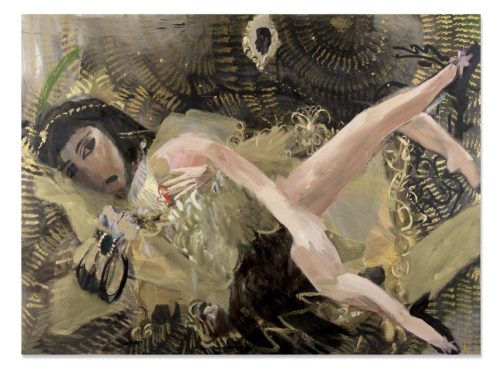
El Espacio’s curators paired a Wifredo Lam work with a more contemporary piece, an abstract self-portrait by Mexican artist Alida Cervantes titled “Desde que te conoci (Since I Met You”). (Courtesy of El Espacio)
Though the artist poses in a similar way to the Lam painting, the figure is abstracted, closer to the cubist style the Cuban would eventually adopt. The discourse between the two pieces is proof that across time and borders, Latin art continues to transform.
WHAT: “Nothing Is Linear: Relations Across Latin America and Its Diasporas.”
WHERE: El Espacio 23, 2270 NW 23th St., Miami
WHEN: 10 a.m. to 5 p.m., Thursday through Saturday. Through Saturday, Aug. 14, 2027.
COST: Free with reservation online at elespacio23.com
INFORMATION: (786) 490-9090 or elespacio23.com
ArtburstMiami.com is a nonprofit media source for the arts featuring fresh and original stories by writers dedicated to theater, dance, visual arts, film, music and more. Don’t miss a story at www.artburstmiami.com