
Artburst Extras
‘My Silence Is Made of Explosions’ Reframes Surrealism at VISU Contemporary
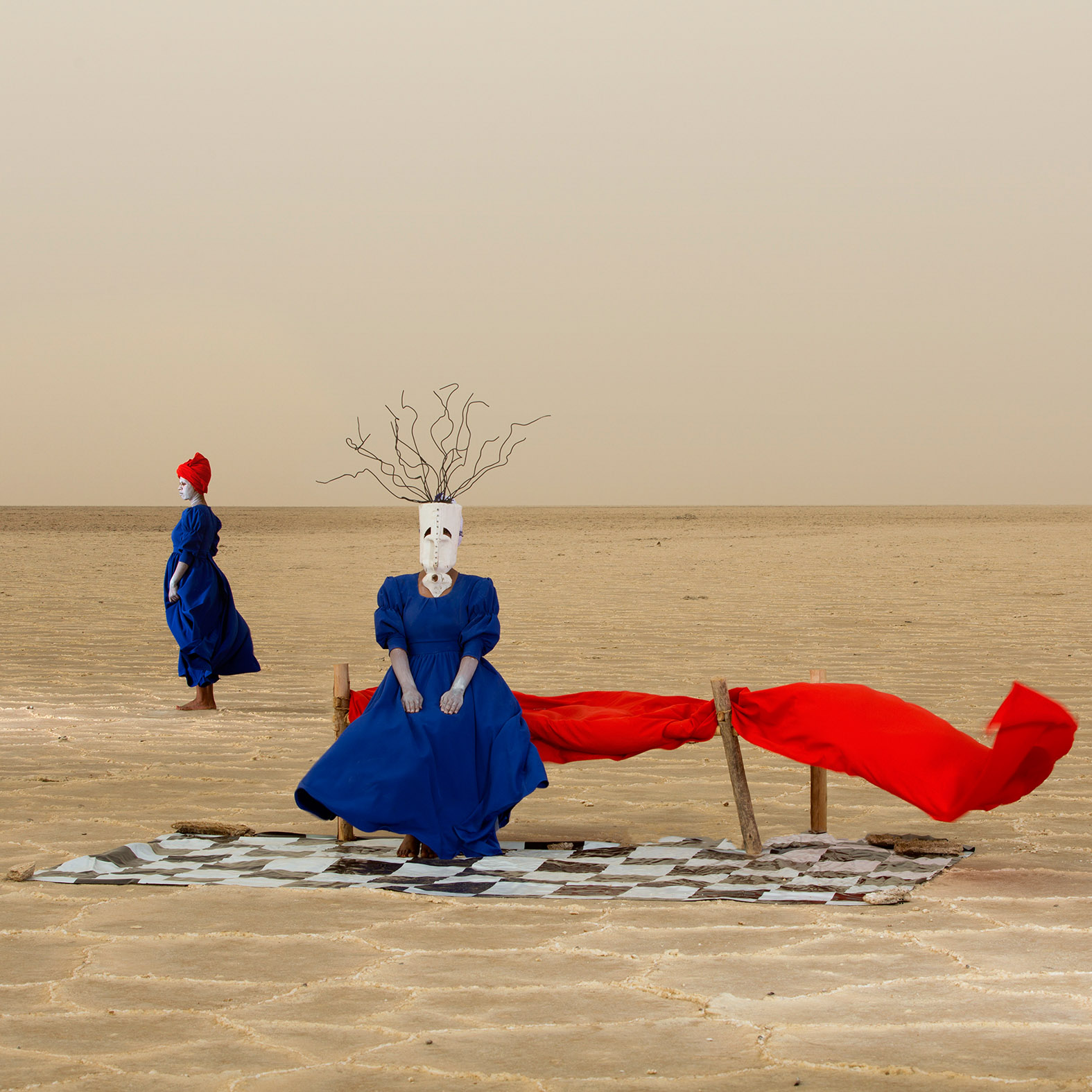
Aïda Muluneh, “The Sorrows We Bear,” 2018. Archival pigment print, 31.5 x 31.5 in. Edition of 7, featured at VISU Contemporary gallery as part of “My Silence is Made of Explosions.” (Courtesy of the artist and David Krut Gallery, New York)
At VISU Contemporary, “My Silence Is Made of Explosions” presents Surrealism not as a historical reference, but as a living, evolving language shaped by contemporary women artists. On view through Sunday, May 31, the exhibition brings together a group of photographers whose works challenge perception, destabilize meaning, and reframe the image as a psychological space rather than a fixed document.
The premise is ambitious: to position Surrealism as urgently relevant today. But what ultimately gives the exhibition its strength is not the concept alone — it is how that idea materializes through specific works that linger in the viewer’s mind.
Photography, traditionally associated with truth, becomes something far more unstable here. Across the exhibition, images feel constructed yet emotionally precise, suspended somewhere between documentation and imagination. As noted in the exhibition materials, the works reject fixed narratives in favor of ambiguity and psychological depth. But it is in the individual works that this tension becomes fully realized.
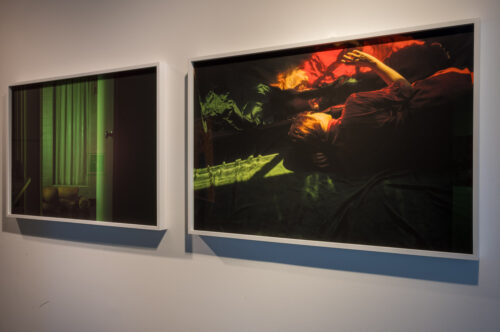
Installation image of Tania Franco Klein, “Body (Self-Portrait),” from “Positive Disintegration,” 2016. Archival pigment print, 27½ x 41⅜ in. Edition 5 of 6 + 2 AP. “Positive Disintegration (Self-Portrait),” from “Positive Disintegration,” 2016. Archival pigment print, 28¼ x 42¼ in. (© Tania Franco Klein. Courtesy of the artist and Yancey Richardson, New York)
Aïda Muluneh’s photograph immediately commands attention through its bold, graphic composition. A figure stands against a saturated yellow background patterned with repeated eyes, the face partially obscured yet sharply defined. The image feels both controlled and disorienting — its symmetry suggests order, while the repetition introduces unease. The gaze becomes fragmented, multiplied, turning the act of looking into something unstable. It is an image that does not resolve, instead holding the viewer in a state of heightened awareness.
Nearby, Tania Franco Klein’s work shifts the tone toward something quieter, yet equally charged. In her staged photographic scene, a figure appears suspended within a dim, cinematic environment, caught between presence and disappearance. Light moves across the body in a way that feels almost theatrical, suggesting a moment unfolding rather than a moment captured. There is a sense of internal tension — as if the image exists at the edge of a dream or memory, never fully settling into clarity.
The exhibition also carries a strong local connection through Jen DeNike, whose work bridges photography, performance, and movement. Her collaboration with Barbara von Portatius introduces a layered, almost painterly approach to the image. In one of DeNike’s photographic works, the body is not static but activated — wrapped in reflective material and surrounded by shifting light. The result is an image that feels sculptural, as though the figure is being constructed in real time. Light becomes both medium and subject, dissolving the boundary between photography and performance.
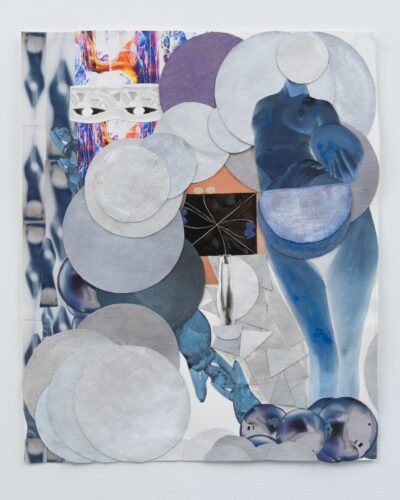
Jen DeNike and Barbara von Portatius, Sun and Moon Act I, No. 2, 2026. Collaged pigment prints, acrylic paint, ink, graphite, and paper in custom maple artist frame, 25 x 21.25 x 2 in. Unique. (Courtesy of the artists)
Movement is central to DeNike’s practice, and that sense of motion is palpable even within stillness. The image captures a fleeting gesture, yet it resists being fixed. Instead, it suggests continuation — a moment before or after something has occurred. This temporal ambiguity aligns closely with the exhibition’s broader engagement with Surrealism, where time and meaning are never fully anchored.
Zanele Muholi’s self-portraiture introduces a different kind of intensity. In contrast to the constructed environments seen elsewhere, Muholi’s work is direct, confrontational and deeply present. The artist’s gaze meets the viewer head-on, unflinching and deliberate. The photograph is striking in its tonal depth — the richness of black against light creates a powerful visual contrast that emphasizes both presence and form.
There is no ambiguity in the act of looking here, yet the image still resists simplification. Muholi’s self-portraits operate on multiple levels simultaneously: as a portrait, as a performance, and as an assertion. The work holds a quiet authority, transforming the photographic surface into a space of visibility and control.
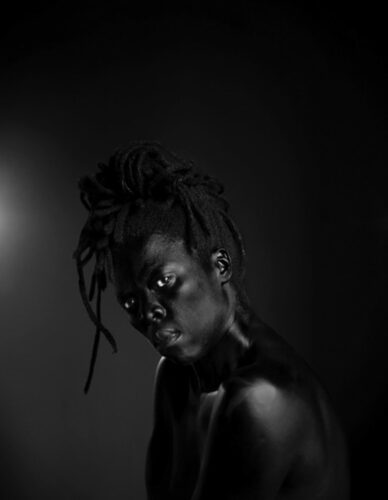
Zanele Muholi, Bakhululekile, Bloemfontein, 2019, Gelatin Sliver Print, 23⅝ x 18¼ inches, Edition 5 of 8 (© Zanele Muholi. Courtesy of the artist and Yancey Richardson, New York)
Throughout the exhibition, the body emerges as a central site of transformation. It is fragmented, obscured, multiplied, or intensified, but never passive. In some works, the body merges with its surroundings; in others, it becomes a surface onto which meaning is projected. This fluidity reinforces the exhibition’s exploration of Surrealism as a method rather than a style — a way of accessing internal states that cannot be fully articulated.
The curatorial approach, shaped in part by conversations with the gallery’s leadership, emphasizes Surrealism as a framework for confronting rather than escaping reality. This perspective is evident in how the works engage with perception itself. Images do not offer resolution; they create friction. They ask the viewer to remain in a space of uncertainty, where meaning is continuously shifting.
Pacing of the show supports this experience. Each work is given room to breathe, allowing viewers to move between images without being overwhelmed. The rhythm encourages a slower, more deliberate engagement — one that mirrors the psychological depth of the works themselves.
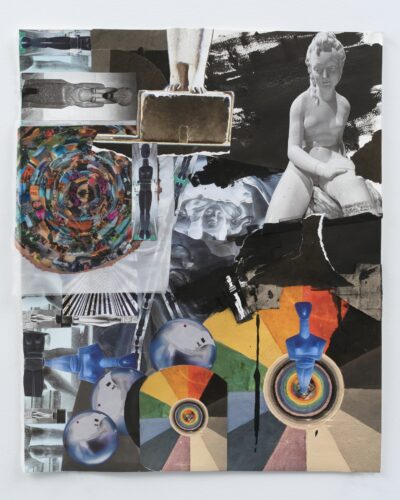
Jen DeNike and Barbara von Portatius, Sun and Moon Act II, Nov. 12, 2026. Collaged pigment prints, acrylic paint, ink, graphite, and paper in custom maple artist frame, 25 x 21.25 x 2 in. (Courtesy of the artists)
What distinguishes “My Silence Is Made of Explosions” is its ability to balance concept with material presence. The Surrealist framework is not imposed — it emerges organically through the works. Each image becomes a point of entry into a larger conversation about perception, identity, and the instability of meaning.
By grounding its ideas in specific, visually compelling works, the exhibition succeeds in reactivating Surrealism for a contemporary audience. It is not a return to the past, but a continuation — one that reflects the complexities of the present moment.
At VISU Contemporary, the result is an exhibition that does not simply illustrate Surrealism, but inhabits it — creating a space where images linger, shift, and quietly unfold over time.
WHAT: “My Silence Is Made Of Explosions” a group exhibition of contemporary Surrealist photographers
WHERE: VISU Contemporary Gallery, 2160 Park Ave., Miami Beach
WHEN: 11 a.m. to 6 p.m. Thursday through Saturday or by appointment. Closed Sunday through Wednesday. Through Sunday, May 31, 2026.
COST: Free
INFORMATION: (513) 659-4690 or https://visugallery.com.
ArtburstMiami.com is a nonprofit media source for the arts featuring fresh and original stories by writers dedicated to theater, dance, visual arts, film, music and more. Don’t miss a story at www.artburstmiami.com.