
Artburst Extras
‘Re.Imagination at Fundación Pablo Atchugarry’ Finds Meaning In What Returns
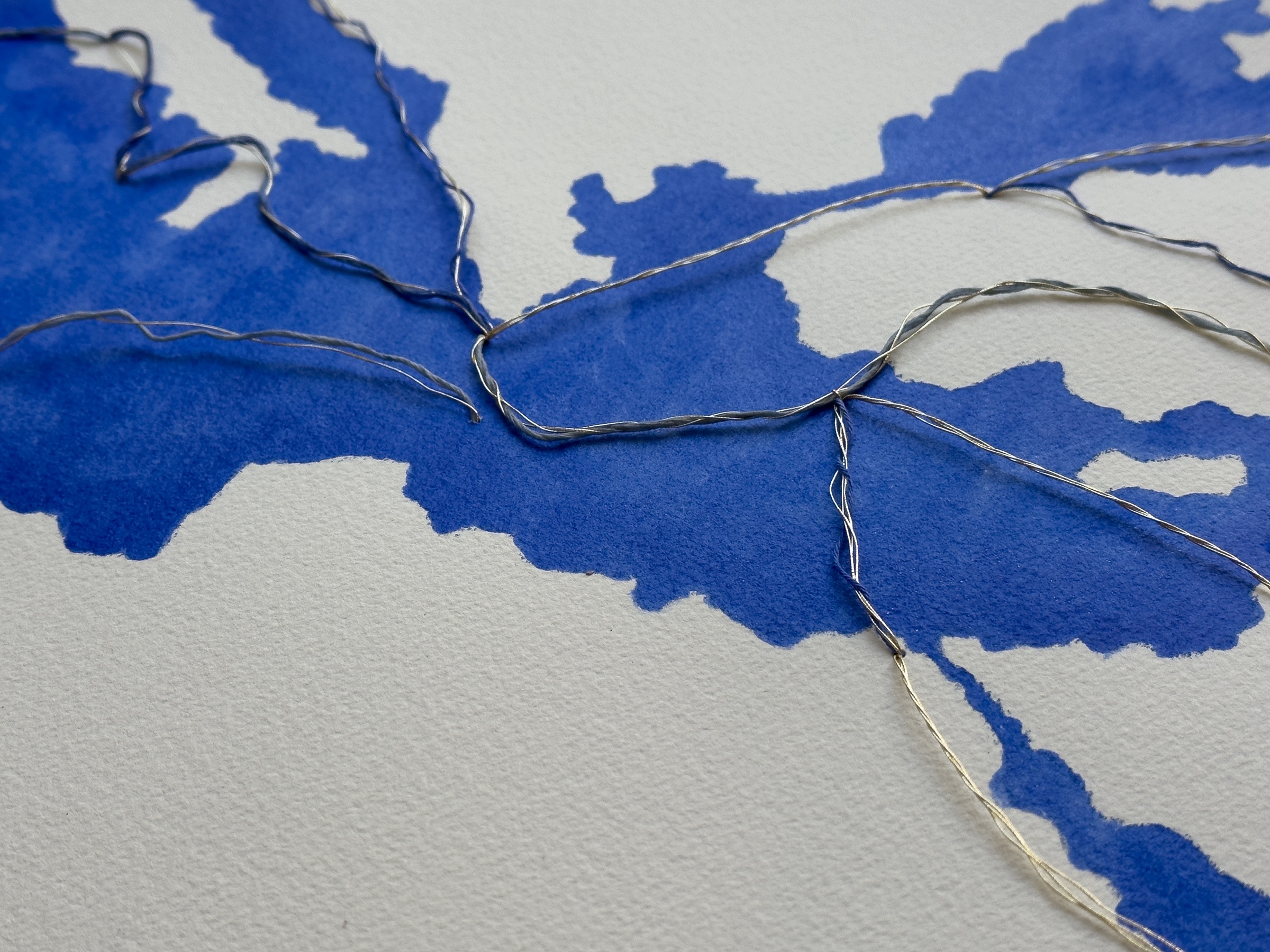
Fernanda Froes, “Lapis Lazuli: Rotas,” 2026. Tempera of ultramarine pigment on paper, with gold threads and threads dyed with ultramarine pigment. 23 x 16 in each, in “Re.Imagination” at Miami’s Fundación Pablo Atchugarry. (Photo by Zachary Balber)
Works face one another across the room, not quite aligned, but held in proximity. A landscape dissolves into pigment. Nearby, a field of blue becomes a map. The connections are not immediate, but they begin to register, slowly, across materials, surfaces, and forms. Drawing on Jorge Luis Borges’s short story “La Trama” (“The Plot”), curator Ross Karlan builds the exhibition “Re.Imagination” around the suggestion that history does not move in a straight line. It returns, each time slightly altered.
Presented by The55Project Art Foundation and on view at Fundación Pablo Atchugarry, “Re.Imagination” brings Brazilian, American, and Dominican voices into proximity, not to resolve their differences but to remain in dialogue.
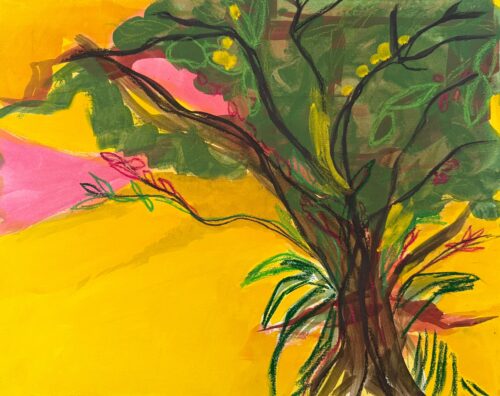
Heloisa Maia, “Sertão Landscapes Series,” 2023. Acrylic, dry pigment, pastel and oil stick on paper. 15.7 x 19.7 in. (Photo by Zachary Balber)
The show unfolds through a series of correspondences instead of a fixed narrative. Materials, images, and gestures begin to echo across works, allowing connections to form gradually across time and place.
The exhibition begins with the material weight of the earth. In Heloísa Maia’s “Sertão Landscapes Series,” the land emerges through layers of saturated color—yellows, reds, and greens that feel almost unstable, as if the landscape were in the process of forming or dissolving.
Trees stretch and bend, their outlines shifting, held together by pigment that carries the trace of the land itself. Nearby, Fernanda Froes’s “Lapis Lazuli: Céu e Terra” moves in a different register. Its deep blue surface initially reads as a night sky, but the scattered points are not stars. They mark the locations of lapis lazuli mines across the world. In other works, blue fragments are traced by delicate lines that map their routes across continents.
The exhibition’s logic depends on these proximities, though they do not always carry the same weight. In some moments, connections emerge directly through material and form. In others, they rely more on the curatorial narrative, asking the viewer to bridge the gap. This tension becomes part of the experience, revealing how repetition is not only seen, but constructed.
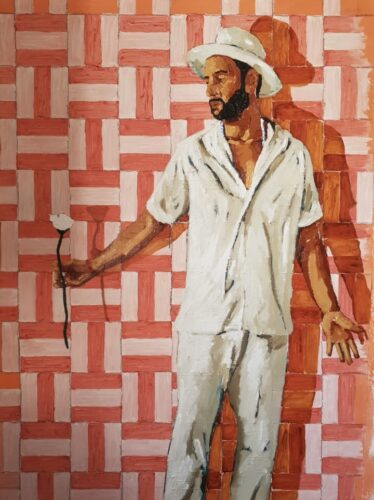
Pedro Delgado Anjos: “Pinturas funfun #2,” 2026. Acrylic on canvas. 43.3 x 55 in. (Photo by Zachary Balber)
In Pedro Delgado’s self-portraits, personal history is inseparable from spiritual practice. A figure dressed in white stands against a tiled, rhythmic ground, holding a single flower. His body is both present and absorbed into the surface. The white clothing suggests a ritual dimension. Delgado’s engagement with Candomblé brings another layer into the space, where land, body, and belief are intertwined. Nearby, John Brendan Guinan’s ornate masks approach belief from a different angle, drawing from a self-constructed system that blends Catholicism, technology, and speculative forms.
Maria Lira Marques, now 81, brings this connection closer to the surface, working with pigments drawn from the soil of the Jequitinhonha Valley in Minas Gerais, Brazil. Her paintings carry a knowledge of the land that is both tactile and lived, built through decades of working with its materials rather than representing it.
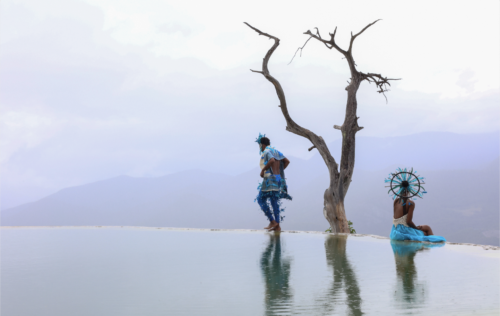
Yelaine Rodriguez, “Children Of The Water (Oaxaca), featuring Jose David, and Tifani Hernandez,” 2023, from the “Children Of The Water Series,” 2023. Photograph on archival paper, framed. 40 x 60 in. (Photo by Yelaine Rodriguez)
In Cássio Markowski’s series “I Hear in the Sea the Stories of the Rivers,” archival images drawn from Portuguese collections surface histories of colonization and displacement. The sea becomes both passage and witness, holding fragments of lives otherwise obscured. Across from this, Yelaine Rodriguez’s “Children of the Water” approaches water through spirituality and the body. Her photographs, taken in the Dominican Republic and Mexico, gesture toward syncretic traditions where water is not only element but presence—linked to feminine figures and to rituals that persist across geographies.
The final section turns toward memory, where the exhibition becomes quieter. Liene Bosquê’s photographic series begins with an act of loss. After her grandmother’s death, she traced the outline of every object in the apartment, on the floor and on the walls, marking the exact space they once occupied before they were removed. The photographs that remain are already one step removed from the original gesture. They are records of absence, but also of care, holding space for what can no longer be seen.
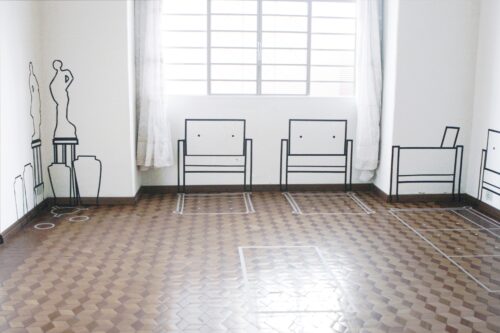
Liene Bosquê, “What Remains (series),” 2011. Print on paper mounted in a sintra board. 10.5 x 7 in. Photo: Liene Bosquê
Nearby, Nino Cais’s “Opera of the Wind” presents a series of stands arranged like a dispersed score, suggesting sound without producing it. A shared memory remains just out of reach.
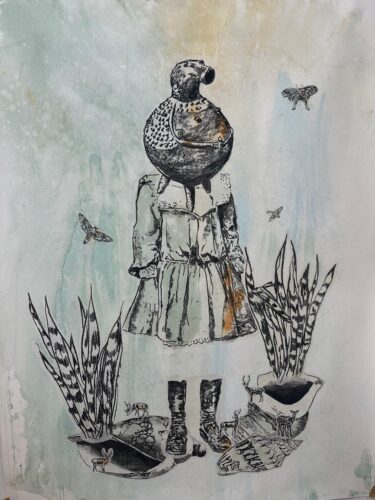
Cássio Markowski, “Escuto no Mar as histórias dos Rios #1,” 2026. Graphite and gouache on rice paper. 67 x 49.2 in. (Photo by Zachary Balber)
The exhibition closes by turning outward again. In Rafael RG’s triptych, three stars are named after enslaved men who escaped in 1853. Drawing from a historical newspaper report, the artist reconstructs the sky from that night, mapping memory onto the cosmos. Each panel holds a different register—document, field, and mark—but together they trace a line between history and imagination.
Across the exhibition, connections surface gradually, returning in different forms.
WHAT: “Re-Imagination”
WHERE: Fundación Pablo Atchugarry, 5520 NE 4th Ave., Miami
WHEN: 11 a.m. to 5 p.m. Tuesday through Saturday. Through Saturday, May 2
INFORMATION: (305) 639-8247 and Fundación Pablo Atchugarry Miami
ArtburstMiami.com is a nonprofit media source for the arts featuring fresh and original stories by writers dedicated to theater, dance, visual arts, film, music and more. Don’t miss a story at www.artburstmiami.com.