Blog Article Category: Artburst Extras
Monthly Roundup For August: Grants For Artists
Written By Josie Gulliksen
August 20, 2026 at 5:37 PM
Artist grants are vital to the sustainability of Miami’s thriving cultural community. (Digital collage by Jean Blackwell Font)
Each month, Artburst highlights grant and fellowship opportunities for artists in Miami-Dade County, across South Florida and beyond. We’ve included key eligibility requirements, application deadlines and links to learn more. Some opportunities appear again from previous roundups because applications are accepted on a rolling basis or deadlines have not yet passed.
Note that all applications must be submitted by 11:59 p.m. on the deadline date.
Miami Light Project ScreenDance Miami Festival 2027
Open Call for submissions to the annual festival highlighting choreographers and directors who are working with emerging and new concepts in movement and dance on film and on camera.
Click here for details. Deadline is Aug. 31, 2026.
Art in Public Places Call to Artists – Capital Improvement Program Miami International Airport
Open call for submissions to local, national, and international professional visual artists or artist-led teams for proposals for commissions in various areas of the Miami International Airport as part of their Capital Improvement Program. Multiple commissions will be awarded in the range of $100,000 to $500,000.
Click here for details. Deadline is Sept. 21, 2026.
Oolite Arts Teen Residency Program
Open call for teen artists ages 16-18 for the mentorship-based program providing them access to one-on-one time with professional artists including critiques, workshops, curation, professional development, studio visits, access to Oolite’s printshop, fabrication space and digital lab as well writing support from a professional writer and speaking opportunities.
Click here for details. Deadline is Sept. 14, 2026.
South Arts
Southern Prize for Literature
Open to writers 18 years and older who are developing book-length manuscripts awarding one winner $25,000 and two runners-up $10,000 each. The award can provide writers with funds for research, workspace and equipment, manuscript consultation, editing, coaching, and legal consultations. Applicants are required to submit a project description, statement of intent and work samples.
Click here for details.
Literary Arts Project Grants
These grants support literary arts organizations and small presses whose focus is contemporary literary arts. Funds aid organizations in development, production and public engagement of their projects of poetry, fiction, creative or literary nonfiction, young readers literature and scriptwriting. Awards are up to $5,000 per project.
Click here for details.
Deadline for both is Oct. 7, 2026
The Gibbes Museum of Art Society 1858 Prize for Contemporary Southern Art
Open call for submissions to artists for an opportunity to win $10,000 and have their work exhibited for one year at the Gibbes Museum and be a three-day series of events in Charleston honoring them. Applicants are required to submit up to 10 images of their work, a brief artist statement, resume or CV, completed application and the $35 submission fee.
Click here for details. Deadline is Sept. 14, 2026.
Deering Estate 2027 Artist-in Residence Program
There are two Artist-in-Residence at Deering Estate one for a Studio Artist-in-Residence and the other for a Non-Studio Artist-in-Residence. Both offer emerging and mid-career visual, literary, performing and cross-disciplinary artists. The studio program provides artists with access to a designated studio from 7 a.m. to 7 p.m. with a commitment of a minimum of 30 hours a week in the studio. Artists must allow access to Deering Estate visitors during special events and daily operating hours. The non-studio residency requires a written proposal that correlates with Charles Deering’s artistic vision. A site visit, tour and research is strongly encouraged prior to submitting the proposal.
Click here for details. Application deadline is Aug. 31, 2026.
Miami DDA Downtown Creative Collaborative Grants
The program offers artists, innovators and community builders from $5,000 to $50,000 in grants to fund creative events and initiatives in Downtown Miami between October 2026 and September 2027. The three-tier funding structure, Tier 1 ($5,000–$7,500) for small, hyperlocal activations for up to 499 people; Tier 2 ($10,000–$15,000) for medium-sized events between 500-999 people and Tier 3 ($20,000–$50,000) for large-scale cultural festivals and installations with an expected attendance of more than 1,000 people. The grants are designed to match proposals with the appropriate level of event scale, community reach and city coordination.
Click here for details. Application deadline is Aug. 24, 2026.
The Fundación Ama Amoedo Grants
Open call submission in four categories – artists, art and social engagement, organizations and publications with a significant connection to Latin America, all eligible to receive one of 10 grants of $10,000. The connection can be through nationality, cultural heritage and/or the project’s location.
Click here for details. Application deadline is Sept. 9, 2026.
South Florida Cultural Consortium
Grants to Visual and Media Artists in all South Florida counties, Palm Beach, Broward, Miami-Dade and Monroe, of $7,500 and $15,000. This is a merit-based grant that examines the artist’s work over three years before the submission process. Applicants must attend at least one workshop prior to applying.
Available Summer Workshops
Saturday, Aug. 22 at noon – Register
Application Deadline: Sept. 14, 2026, click here to apply
South Arts Spring 2026 Grants Cycle
Southern Artist Spotlight Grants
The pilot grant program provides grant opportunities to documentary filmmakers, musicians and dancers, fiction and poetry writers and all forms of visual arts. Grants are awarded on a first-come, first-serve basis and require a dollar-for-dollar cash match. Maximum request is $8,000 for dance and $5,000 for all other disciplines. Projects must take place between July 1, 2026, and June 30, 2027, and applications must be submitted 60 days before the project start date.
Click here for details; applications accepted on a rolling basis.
Arts in Rural Places Grants
Organizations in rural, isolated, or small communities are eligible for up to $3,000 in support for community engagement projects. Opportunities are open to the same groups and applications, and project windows are all the same as the Artist Spotlight Grants mentioned above.
Click here for details; applications accepted on a rolling basis.
Professional Development for Arts Organizations
Arts organizations with operating budgets of $500,000 or more are eligible for up to $1,000 for professional development support. Open to artist ensembles, producing and presenting organizations, visual and performing arts centers, museums, film festivals, arts service organizations, community arts organizations, and art councils. Projects must take place between July 1, 2026, and June 30, 2027, and applications must be submitted 60 days before the project start date.
Click here for details; applications accepted on a rolling basis
Miami-Dade County Department of Cultural Affairs
Audience Access Grant Program
Non-profit arts organizations who create, perform, exhibit and/or present the arts are eligible to request up to $5,000 to help pay for arts program ADA/access technology and services including American Sign Language (ASL) interpreters, captioning, audio description, materials in accessible format, ADA/access training, and other types of services for audiences of all abilities.
Click here for details, application deadline is ongoing, but applications must be submitted at least one month prior to the need of the technology/service expansion.
Community Grants Program
A quarterly program for non-profit organizations developing small to medium-scale community-based cultural programs, projects and events, such as fairs, parades, neighborhood festivals, conferences and publications.
Courtesy Review Deadline: Aug. 27, 2026
Application Deadline: Sept. 3, 2026
Women in Film & Television Florida
Feature Film Finishing Project Scholarship Grant
Open to Women in Film Florida members awarding $3,000 to help complete an existing feature film project. Requirements include females in at least two of the following key positions —principal actor, writer, director, producer, cinematographer, or editor, film length between 60 to 120 minutes. Principal photography must be completed and not have already been in commercial or festival distribution.
Click here for details. Application deadline is Sept. 1, 2026.
Film Florida
Florida Emerging Filmmakers Fund
Open to Film Florida members for free, non-members pay a $50 fee. Awards of $1,000 to $2,000 in cash to filmmakers as well as mentorship with an industry professional throughout a project. Short and long formats and all genres are eligible, demonstrate advanced and innovative skills in filmmaking and support the organization’s mission of creating jobs in Florida’s film and entertainment production industry. Projects must be filmed entirely in Florida by a Florida crew with post-production done in Florida.
Click here for details, no deadline.
Additional Links
A listing of where to check periodically for available grants, workshops, resources, and application assistance.
Miami-Dade County Department of Cultural Affairs: https://miamidadearts.org/
Florida Division of Arts & Culture: dos.fl.gov/cultural/grants/grant-programs/specific-cultural-projects/
Knight Foundation: https://knightfoundation.org/
The Jorge M. Pérez Family Foundation: https://jmperezfamilyfoundation.org/grant-opportunities/
Film Miami https://www.filmiami.org/grants.asp
Green Space Miami: https://greenspacemiami.org/
AIRIE (Artists in Residence in Everglades): https://www.airie.org/
Funding Arts Network: https://fundingartsnetwork.org/home/grants/
Broward County Cultural Division: https://www.broward.org/Arts/Funding/Pages/artistsupport.aspx
ArtburstMiami.com is a nonprofit media source for the arts featuring fresh and original stories by writers dedicated to theater, dance, visual arts, film, music and more. Don’t miss a story at www.artburstmiami.com
No posts found
Edwidge Danticat’s ‘Dèy’ Connects Haiti, Miami and a Close Call at a Local Mall
Written By Michelle F. Solomon
August 20, 2026 at 2:04 PM
Edwidge Danticat’s new novel, “Dèy,” was partly inspired by a frightening 2017 false alarm at Aventura Mall, where she thought she was caught in a mass shooting. Danticat will discuss the book with Miami Herald Haiti/Caribbean correspondent Jacqueline Charles on Saturday, Aug. 29 at Coral Gables Congregational United Church of Christ, 3010 De Soto Boulevard, Coral Gables. (Photo courtesy Penguin Random House)
While doing some last-minute Christmas shopping for her daughter in 2017, novelist Edwidge Danticat had an experience that would become a spark for her latest novel, “Dèy.”
It was Dec. 23, 2017, and Danticat was inside Aventura Mall when she heard a series of loud pops that sounded like gunshots.
“We hear about mass shootings all the time in this country, and I immediately thought, ‘I am in one right now,'” she recalled.
It turned out to be a false alarm. But as she later wrote in a letter to readers, her body may have recovered from its fight-or-flight response, it did not forget.
She first wrote about the experience in “This is My Body,” an essay in her 2024 collection, “We’re Alone.” There the character of Magnolia Elie, a Haitian American real estate agent and mother, began to emerge.
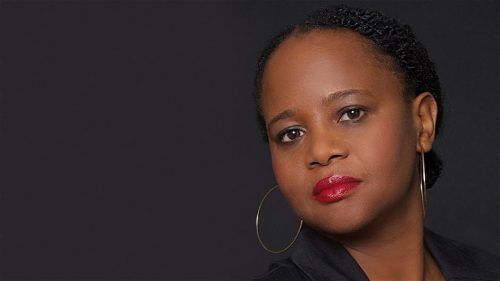
Edwidge Danticat lived in Miami for more than two decades before moving to New York to teach at Columbia University. Her new novel, “Dèy,” is deeply rooted in Miami. (Photo courtesy of Lynn Savarese)
“Magnolia’s character grew out of that moment in the mall when I thought my life might end dramatically and violently,” Danticat wrote on her website in a letter to readers.
“Dèy,” which will be released on Tuesday, Aug. 25 by Penguin Random House, takes its title from the Haitian Kreyòl word for grief and mourning. Magnolia survives a mass shooting. But rather than talking about how it affected her, she tells no one and tries to go back into the life she was already questioning — selling real estate in rapidly changing Miami neighborhoods, raising a daughter nearing adolescence, living apart from her partner and worrying about her parents still in Haiti.
Loss and mortality have long been themes in the author’s books, along with family, migration, memory and belonging. In “Dèy,” it is also about people trying to remain connected across distance and to feel rooted in the different places they call home.
She confided that those questions are especially personal in a novel she was writing as she prepared to leave Miami for New York after living in South Florida for more than two decades.
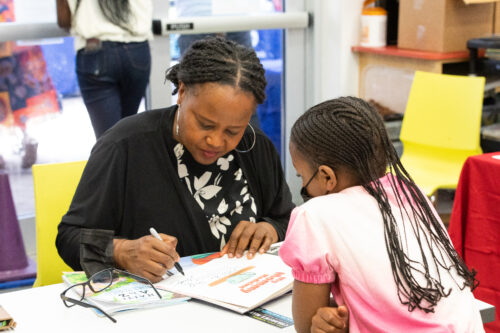
Haitian American author Edwidge Danticat is also the author of children’s books. Here she signs her book “My Mommy Medicine” at the 2019 Miami Book Fair. (Photo courtesy of Miami Book Fair)
Danticat moved to New York to teach at Columbia University, where she is on the faculty in African American and African Diaspora Studies.
“In a way it was kind of like this book is also about saying goodbye to Miami,” she said.
Danticat will be in conversation with Miami Herald Haiti/Caribbean correspondent Jacqueline Charles to discuss “Dèy” on Saturday, Aug. 29 at Books & Books in Coral Gables.
The two will have much to talk about, said Charles, including that both were at Aventura Mall during the 2017 scare that helped set the novel in motion. Danticat said she started texting Charles that day “because it was news” when she got a return text: “I’m in the mall, I’m hiding in a closet in a store.”
Charles said that in the years since the incident, she and Danticat have revisited that day many times in their conversations. “Even more so we’ve shared many discussions about Haiti, the ongoing violence, the aftershocks, and the voice notes she has received from relatives that include the sounds of gunshots in the background,” Charles said.
For her, the novel’s depiction of Haitian life in Miami is immediately recognizable.
“If you’re Haitian and from Miami you recognize yourself in this book,” she said.
Charles pointed to details including the neighborhoods, the strict Haitian household, the “aunts” who aren’t actually blood relatives and even the different ways Haitians refer to Haiti — as “down there” or “back there” — depending on their relationship to the country.
The novelist said those details are part of a larger set of themes she has returned to again and again in her work. She grew up in Haiti during “a time of dictatorship where you would hear about neighbors disappearing, so this precariousness of life was always part of my psyche.”
She said Magnolia’s story is more rooted in the present as people in Haiti, including members of Danticat’s own family, contend with displacement and armed violence.
Her more than two decades in Miami and Little Haiti also brought other concerns into the novel: environmental vulnerability, gentrification, migration and the uncertainty immigration status can create for families.
“People coming and new arrivals and a feeling with issues like TPS have the constant question in mind ‘What is home? What is belonging?’ ”
Charles said that tension between places is one of the parts of “Dèy” she finds most familiar.

Edwidge Danticat’s book “Create Dangerously” become a work of theater at Miami New Drama in 2023. (Photo courtesy of FURIOSA Productions)
“This is the story of many of us in the diaspora who must remain connected, either because our family still lives there or we grieve for the country of our childhood,” she said. “The Haiti she describes is spot on. She avoids overwhelming you with gang violence and instability while conveying how Magnolia straddles and attempts to navigate two worlds simultaneously. Instead, she weaves them into her everyday reality.”
For their conversation at Books & Books, Charles said there will be questions that come out of their shared personal experiences.
“As someone who has had many heart-to-heart conversations with her — sometimes in the middle of the night while we were both writing — about Haiti and its ripple effects, I want to ask her about how she processes grief and the invisible scars that few see.”
Making Magnolia a real estate agent allowed Danticat to explore the question of home in a literal way.
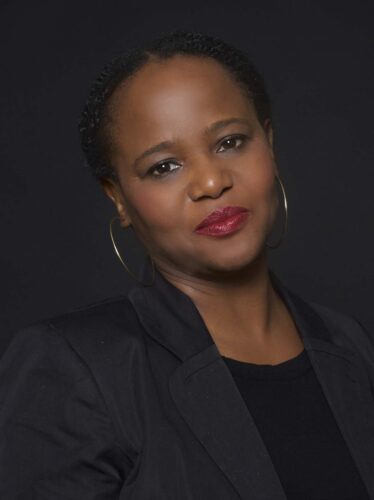
Edwidge Danticat returns to Miami with “Dèy,” her first novel in more than a decade, a book she has described as both a love letter and a goodbye to the city she called home for more than 20 years. (Photo by Lynn Savarese)
Magnolia helps other people buy and sell homes while wrestling with her own ideas about where she belongs. She is also aware that in a rapidly changing Miami, real estate can mean opportunity for some while displacement for others, Danticat explained.
“I wanted to pick that profession because it gives you an opportunity to explore what home can mean,” she said, “both in terms of physical spaces” and in terms of memory and the places where families gather and create their lives.
Within hours of surviving the shooting, Magnolia is back at work showing a Brickell condominium, trying to return to the ordinary routine of her life.
Charles cites a sentence in the novel about one of Magnolia’s clients, a professor who has moved away but is reluctant to sell her Brickell condominium.
In the novel, Magnolia observes of the professor, “While growing roots elsewhere, she’s nevertheless having trouble letting go.”
For Charles, the passage captures the complicated struggle between building a life elsewhere and remaining attached to the place left behind.
For Danticat, the book was a way to hold onto the city she had come to know through its neighborhoods and communities. And after more than 20 years here, she said there was no separating the novel from the place that helped produce it.
“This is definitely a book born out of the soil of Miami.”
WHAT: Edwidge Danticat discusses her new novel, “Dèy,” in conversation with Miami Herald Haitian/Caribbean correspondent Jacqueline Charles.
WHEN: 7 p.m. Saturday, Aug. 29
WHERE: Coral Gables Congregational United Church of Christ, 3010 De Soto Boulevard, Coral Gables.
COST: Free or entry with book cost $33.64 includes fees and one or two guests; RSVP required.
INFORMATION: Books & Books, 305-442-4408
ArtburstMiami.com is a nonprofit media source for the arts featuring fresh and original stories by writers dedicated to theater, dance, visual arts, film, music, and more. Don’t miss a story at www.artburstmiami.com
No posts found
12 Miami Arts Share in $60,000 For Locust Projects’ WaveMaker Grants
Written By Artburst Editor
August 9, 2026 at 8:11 PM
Bex McCharen was one of the recipients of a grant for New Work for the experimental documentary project “Queer Atlantics” as part of Locust Projects 2026 WaveMaker Grants. (Photo courtesy of Locust Projects)
A dozen Miami artists and collectives will receive a total of $60,000 to develop projects ranging from art on basketball courts and Miami beaches to an experimental radio installation and an exhibition inside a Coral Gables bar.
The 12 are recipients of Locust Projects‘ 2026 WaveMaker Grants, the 11th year of a program designed to support experimental work created outside traditional arts spaces. The grants, supported by the Andy Warhol Foundation for the Visual Arts’ Regional Regranting Program, provide artists with awards of up to $6,000.
Since the program began in 2015, WaveMaker has awarded $750,000 to 152 Miami artists, curators and collectives, according to Locust Projects. There were 115 applicants who submitted projects that were evaluated for their artistic rigor, connection to Miami-Dade, community impact, feasibility and accessibility to the public.
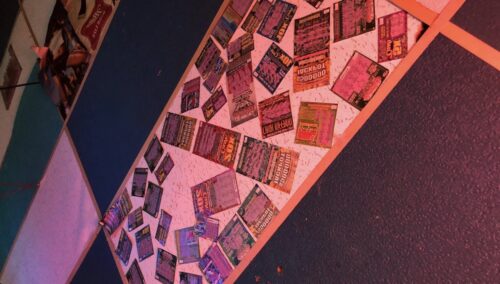
Larí García and Sue Montoya, “Reasoning and Feeling” at Seven Seas Bar. (Photo courtesy of Locust Projects)
The seven artists receiving $6,000 New Work/Projects grants offer a particularly wide-ranging look at where Miami artists are turning their attention. The projects are intended to eventually move beyond the grant stage and into public view. WaveMaker specifically supports work presented in unconventional spaces and made accessible to the public, with this year’s projects planned for locations including beaches, basketball courts, parking lots, transit hubs and a neighborhood bar.
Artists larí garcía and Sue Montoya will create “Reasoning and Feeling,” a two-person exhibition at Coral Gables’ Seven Seas Bar that considers the disappearance of informal community gathering places, or “third spaces.”
Lisa Kusanagi’s “Until My Ocean Dries” will take place along Miami’s coastline, where the artist will use a monumental calligraphy brush and ocean water to write words on concrete pathways that gradually disappear in the heat.
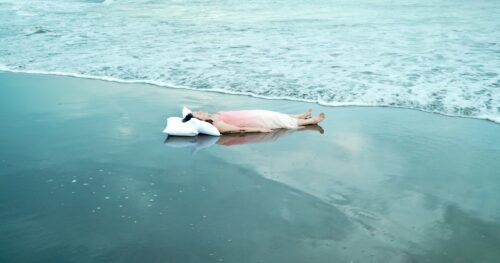
Lisa Kusanagi, “Until My Ocean Dries.” (Courtesy of Locust Projects)
Najja Moon will turn outdoor basketball courts throughout Miami-Dade into classrooms for “Movement Studies,” a lecture-performance series that uses basketball as a way into art history.
Enrique Villacreses’ “NIJI: BLUE,” meanwhile, transforms a sports field into an outdoor installation and performance viewed both from the ground and through aerial drone footage.
Other New Work recipients are Bex McCharen for the experimental documentary project “Queer Atlantics”; Ọmọlará Williams McCallister for “CREAM (Community Rules Everything Around Me),” a project built around a speculative local paper currency; and Luka Gotsiridze for “GO TO BED,” an interactive public art project exploring rest, memory and what it means never to have had a bed of one’s own.
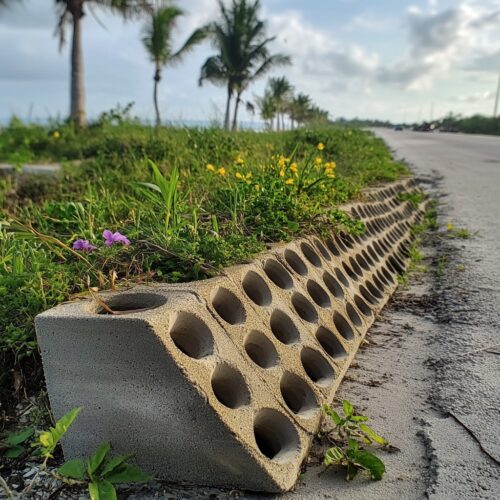
Teri Watson, “SEED Erosion Blocks. “(Photo courtesy of Locust Projects)
Isabella Bru will receive a $6,000 Long-Haul Project grant for “We Are Permitted,” the monthly series that turns parking lots and transit hubs into free pop-up galleries. Research and development grants of $2,000 each go to Nicole Combeau, Orlando Estrada and Oscar Rieveling, while Teri Watson will recieve a $4,000 implementation grant for “SEED Erosion Blocks,” which repurposes invasive sargassum seaweed into modular concrete blocks designed to help stabilize shorelines while functioning as public art.
ArtburstMiami.com is a nonprofit media source for the arts featuring fresh and original stories by writers dedicated to theater, dance, visual arts, film, music and more. Don’t miss a story at www.artburstmiami.com
No posts found
July Monthly Roundup: Grants For Artists
Written By Josie Gulliksen
July 16, 2026 at 2:34 PM
Artist grants are vital to the sustainability of Miami’s thriving cultural community. (Digital collage by Jean Blackwell Font)
Each month, Artburst highlights grant and fellowship opportunities for artists in Miami-Dade County, across South Florida and beyond. We’ve included key eligibility requirements, application deadlines and links to learn more. Some opportunities appear again from previous roundups because applications are accepted on a rolling basis or deadlines have not yet passed.
Note that all applications must be submitted by 11:59 p.m. on the deadline date.
The Latest
Miami-Dade County Department of Cultural Affairs
Arts Grants Workshop Series
An introductory online workshop about the County’s arts grants funding program portfolio for arts organizations, community nonprofit organizations producing cultural arts projects, individual artists, and artist collectives is a chance for prospective applicants to learn which grant opportunities best fit with their projects. A Q&A session with follow the workshop.
Tuesday, July 28, 2026, at 11 a.m., click here to register.
Deering Estate 2027 Artist-in Residence Program
There are two Artist-in-Residence opportunities at Deering Estate: one for a Studio Artist-in-Residence and the other for a Non-Studio Artist-in-Residence. Both offer emerging and mid-career visual, literary, performing and cross-disciplinary artists. The studio program provides artists with access to a designated studio from 7 a.m. to 7 p.m. with a commitment of a minimum 30 hours a week in the studio including granting access to Deering Estate visitors during special events and daily operating hours. The Non-Studio residency requires a written proposal that correlates with Charles Deering’s artistic vision: Invitation for a site visit, personal tour and research is strongly encouraged prior to submitting the proposal.
Click here for details. Application deadline is Aug. 31, 2026.
Miami DDA Downtown Creative Collaborative Grants
The program offers artists, innovators and community builders from $5,000 to $50,000 in grants to fund creative events and initiatives in Downtown Miami between October 2026 and September 2027. The three-tier funding structure, Tier 1 ($5,000 to $7,500) is funding for small, hyperlocal activations for up to 499 people; Tier 2 ($10,000 to $15,000) is for medium-sized events between 500 to 999 people and Tier 3 ($20,000 to $50,000) is for large-scale cultural festivals and installations with an expected attendance of more than 1,000 people. Proposals should align with the appropriate level of event scale, community reach and city coordination.
Click here for details. Application deadline is Aug. 17, 2026.
Miami Beach Bandshell Laboratories
The Rhythm Foundation, operators of the Miami Beach Bandshell for more than a decade, are currently commissioning site-specific projects for its 2027 season. They are seeking multi-disciplinary, tech forward works that incorporate music and visual arts and collaborations with local and international artists. The open-air space presents diverse and multi-cultural musical and theatrical events.
Click here for details. Application deadline is July 31, 2026.
The Fundación Ama Amoedo Grants
Open call submissions are in four categories: artists, art and social engagement. Organizations and publications with a significant connection to Latin America, are eligible to receive one of 10 grants of $10,000 to be awarded. The connection can be through nationality, cultural heritage and/or the project’s location.
Click here for details. Application deadline is Sept. 9, 2026.
Edge Zones Call to Artists – Miami Performance International Festival ‘26
Edge Zones Contemporary Art is accepting proposals from both emerging and established artists for both live and video performances for the 15th Edition of the Miami Performance International Festival ’26 which will feature live performances at Edge Zones Art Center (3317 NW 7th Ave. Circle, Miami) and a curated selection of video performances streamed online. The video performances should explore themes of inquiry, transformation and connection while reflecting on life in an era of uncertainty, instability and change. All proposals will be evaluated by a selection committee.
Submission Guidelines: Artists may submit live performances of up to 20 minutes or videos of no more than three minutes. Selected works will be presented in public settings or on social media, and participating artists will receive an honorarium.
Click here to e-mail submissions. Application deadline is Aug. 15, 2026.
South Florida Cultural Consortium
Grants to Visual and Media Artists in all South Florida counties, including Monroe, of $7,500 and $15,000. This is a merit-based grant that examines the artist’s work over three years before the submission process. Applicants must attend at least one workshop prior to applying.
Available Summer Workshops
Wednesday, July 22 at 1 p.m. – Register
Tuesday, Aug. 4 at 5:30 p.m. – Register
Saturday, Aug. 22 at noon – Register
Application Deadline: Sept. 14, Click here to apply
Still Available
O, Miami 2026-2027 Poetry Coalition Fellowship
O, Miami, the nonprofit behind the annual O, Miami Poetry Festival held each April during National Poetry Month, is accepting applications for a paid fellowship for a South Florida resident. The 10-month fellowship runs from Sept. 2, 2026, through June 30, 2027, and offers hands-on experience in the organization’s community engagement, festival production, publishing and education programs. Applicants should demonstrate an interest in poetry, the arts and cultural programming, as well as familiarity with the Miami community. The part-time independent contractor position is limited to 20 hours per week and pays $2,000 per month, distributed biweekly, along with a one-time $1,500 health and wellness stipend.
Click here for details. Application deadline is July 31, 2026.
Jubi Arriola-Headley South Florida Book Prize
O, Miami is accepting applications for its first annual book prize. The manuscript must be full-length, between 48 and 100 pages, written by a poet with strong ties to South Florida, which could include Miami-Dade, Broward, Palm Beach or Monroe counties. The applications is open to both residents and former residents and to emerging and established poets regardless of publication history.
Click here for details. Application deadline is Aug. 15, 2026.
Oolite Arts – Multiple awards and residencies
Oolite Arts currently has six award and residency opportunities.
Cinematic Residency: The residency for South Florida filmmakers who are looking to expanding a short-form work into a feature-length film features an award of $50,000, access to rental camera packages and equipment, mentorship from industry professionals and advisors, access to studio workspace, a housing stipend, access to Oolite Arts facilities, subscriptions to filmmaking platforms and tools, networking with local, national and international filmmakers and eligibility for alumni opportunities and professional support beyond the residency.
Home + Away Residency: A series of multi-week paid artist residencies include a three-month residency at The Bag Factory in Johannesburg, South Africa, a five-week residency at Artspace San Antonio in Texas and four weeks at MASS MoCA in North Adams, Mass.
Studio Residency: 24-hour access to studio space at Oolite Arts with commitment to use of at least 15 hours a week. Monthly meetups are required as well as active participation in quarterly open studios, openings and special events. Included is a $15,000 annual housing stipend.
The Ellies: Categories include the Creator Award providing $10,000 in unrestricted funding to 35 South Florida artists; Art Teacher Travel Award supporting six public and charter school K-12 art teachers with $5,000 each for travel that strengthens their classroom practice; Curatorial Practice and Critical Writing Award with $10,000 awarded to two curators or art writers whose work advances and supports contemporary visual artist and their practice.
Click on the links above for details on each. Application deadline is July 31, 2026.
South Arts Spring 2026 Grants Cycle
Southern Artist Spotlight Grants
The pilot grant program provides grant opportunities to documentary filmmakers, musicians and dancers, fiction and poetry writers and all forms of visual arts. Grants are awarded on a first-come, first-serve basis and require a cash match. Maximum request is $8,000 for dance and $5,000 for all other disciplines. Projects must take place between July 1, 2026, and June 30, 2027, and applications must be submitted 60 days before the project start date.
Click here for details; applications accepted on a rolling basis.
Arts in Rural Places Grants
Organizations in rural, isolated, or small communities are eligible for up to $3,000 in support for community engagement projects. Opportunities are open to the same groups and applications, and project windows are all the same as the Artist Spotlight Grants mentioned above.
Click here for details; applications accepted on a rolling basis.
Professional Development for Arts Organizations
Arts organizations with operating budgets of $500,000 or more are eligible for up to $1,000 for professional development support. Open to artist ensembles, producing and presenting organizations, visual and performing arts centers, museums, film festivals, arts service organizations, community arts organizations, and art councils. Projects must take place between July 1, 2026, and June 30, 2027, and applications must be submitted 60 days before the project start date.
Click here for details; applications accepted on a rolling basis
Miami-Dade County Department of Cultural Affairs
Audience Access Grant Program
Non-profit arts organizations who create, perform, exhibit and/or present the arts are eligible to request up to $5,000 to help pay for arts program ADA/access technology and services including American Sign Language (ASL) interpreters, captioning, audio description, materials in accessible format, ADA/access training, and other types of services for audiences of all abilities.
Click here for details, application deadline is ongoing, but applications must be submitted at least one month prior to the need of the technology/service expansion.
Community Grants Program
A quarterly program for non-profit organizations developing small to medium-scale community-based cultural programs, projects and events, such as fairs, parades, neighborhood festivals, conferences and publications.
Workshop: Aug. 6, 2026 at 10 a.m. – RSVP
Courtesy Review Deadline: Aug. 27, 2026
Application Deadline: Sept. 3, 2026
Women in Film & Television Florida
Feature Film Finishing Project Scholarship Grant
Open to Women in Film Florida members, an award of $3,000 will help complete an existing feature film project. Requirements include females in at least two of the following key positions —principal actor, writer, director, producer, cinematographer, or editor, film length between 60 to 120 minutes. Principal photography must be completed and not have already been in commercial or festival distribution.
Click here for details. Application deadline is Sept. 1, 2026.
Film Florida
Florida Emerging Filmmakers Fund
The program is free for Film Florida members, while nonmembers must pay an application fee. Selected filmmakers will receive cash awards ranging from $1,000 to $2,000, along with mentorship from an industry professional throughout their project. Both short- and feature-length films in all genres are eligible. Applicants should demonstrate advanced and innovative filmmaking skills while supporting Film Florida’s mission of creating jobs in the state’s film and entertainment production industry. Projects must be filmed entirely in Florida, using a Florida-based crew, with post-production completed in the state.
Click here for details, no deadline.
Additional Links
A listing of where to check periodically for available grants, workshops, resources, and application assistance.
Miami-Dade County Department of Cultural Affairs: https://miamidadearts.org/
Florida Division of Arts & Culture: dos.fl.gov/cultural/grants/grant-programs/specific-cultural-projects/
Knight Foundation: https://knightfoundation.org/
The Jorge M. Pérez Family Foundation: https://jmperezfamilyfoundation.org/grant-opportunities/
Film Miami https://www.filmiami.org/grants.asp
Green Space Miami: https://greenspacemiami.org/
AIRIE (Artists in Residence in Everglades): https://www.airie.org/
Funding Arts Network: https://fundingartsnetwork.org/home/grants/
Broward County Cultural Division: https://www.broward.org/Arts/Funding/Pages/artistsupport.aspx
ArtburstMiami.com is a nonprofit media source for the arts featuring fresh and original stories by writers dedicated to theater, dance, visual arts, film, music and more. Don’t miss a story at www.artburstmiami.com
No posts found
Oolite Arts Expands The Ellies With Awards for Curators, Art Writers
Written By Michelle F. Solomon, Artburst Editor
July 14, 2026 at 10:11 PM
John Abodeely, president and CEO of Oolite Arts, speaks to prospective applicants during an information session about The Ellies awards and the organization’s 2027 Open Call.
For the first time since launching The Ellies in 2018, Oolite Arts is expanding its annual awards program to include cash awards for curators and art writers.
The new Curatorial Practice and Critical Writing Award is part of Oolite Arts’ 2027 Open Call, with applications open through Friday, July 31 for curators and art writers across Miami-Dade, Broward, Palm Beach and Monroe counties. Selected applicants will receive support in 2027.
While many arts grant programs focus exclusively on artists, relatively few provide direct support to the curators and critics whose research, exhibitions, publications and writing help make artists’ work visible and accessible to the public. The new award broadens The Ellies’ investment in South Florida’s visual arts community by recognizing those who contribute to its cultural infrastructure, according to Rina Carvajal, senior director of programs for Oolite Arts.
“The Curatorial Practice and Critical Writing Award represents an investment in the intellectual and critical framework that supports artists and strengthens the long-term vitality of the visual arts in our region,” Carvajal said.
Drawing on decades of experience as a curator and arts administrator, Carvajal said the new award recognizes the critical role curators and writers play in supporting artists.
“Throughout my career, I have seen how transformative thoughtful curatorial work and rigorous art writing can be for artists and communities alike,” she said. “These awards acknowledge that cultural ecosystems are built not only by those who create art, but also by those who help us understand why it matters.”
The award provides $10,000 each to two curators or art writers whose work advances critical discourse in contemporary visual art while supporting the visibility, understanding and long-term development of artists and their practices. It recognizes the role criticism, curatorial research and writing play in connecting artists with broader audiences, institutions and public discourse.
“South Florida is home to an extraordinary community of artists, but a thriving arts scene also depends on the people who research, interpret, document, and champion their work,” Carvajal said.
In addition to The Ellies, Oolite Arts’ annual Open Call includes Studio Residencies, which provide free studio space, professional development and housing support for visual artists; Home + Away Residencies, offering national and international travel opportunities; and the Cinematic Residency, which supports filmmakers through mentorship and professional development.
Applications for The Ellies, Studio Residencies, Home + Away Residencies and the Cinematic Residency will be accepted through the end of July.
Additional information and eligibility requirements at oolitearts.org/ellies-open-calls/
ArtburstMiami.com is a nonprofit media source for the arts featuring fresh and original stories by writers dedicated to theater, dance, visual arts, film, music and more. Don’t miss a story at www.artburst.com.
No posts found
‘Under Pressure” at Tomás Redrado Art Explores Material and Memory
Written By Olga Garcia-Mayoral
July 14, 2026 at 9:26 PM
Installation view of “Under Pressure,” curated by Tomás Redrado, featuring works by Guadalupe Reyna, Kristin Reger, and Tali Halpern at Tomás Redrado Art in Miami. The exhibition is on view through Wednesday, Aug. 5. (Photo by Evelyn Sosa, courtesy of Tomás Redrado Art)
The first impression of “Under Pressure” at Tomás Redrado Art is not one of visual excess but of restraint. The gallery is remarkably spare, allowing each work by Guadalupe Reyna, Tali Halpern, and Kristin Reger to occupy its own physical and emotional space. Rather than competing for attention, the three artists establish distinct rhythms that gradually begin to converse with one another.
Although they work in very different media—encaustic painting, textile, and sculpture—the exhibition finds common ground in the way each artist transforms everyday materials into something contemplative. Wax, thread, fabric, wire and stretched forms all become vehicles for exploring memory, resilience and personal experience.
Reyna’s encaustic paintings possess an unusual luminosity. Built through repeated applications of beeswax and pigment, the surfaces appear to glow from within, revealing evidence of the artist’s hand beneath translucent layers. Rather than depicting literal narratives, the paintings suggest cycles of preservation and change, where each layer simultaneously conceals and reveals those beneath it. The rich reds and earthy tones evoke organic forms without becoming descriptive, their shifting textures unfolding over time.
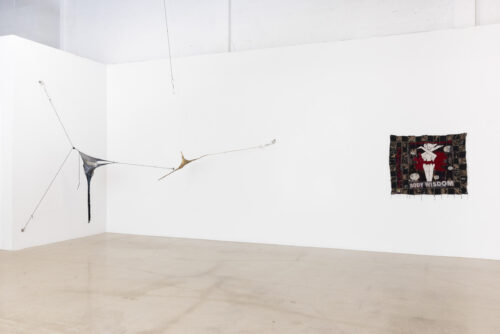
A suspended sculptural installation by Kristin Reger shares gallery space with a textile work by Tali Halpern in “Under Pressure,” an exhibition exploring transformation through sculpture, fiber and encaustic painting. (Photo by Evelyn Sosa, courtesy of Tomás Redrado Art)
Across the gallery, Halpern’s textile works introduce a very different tempo. Dense with embroidery, beadwork and stitched fragments, the compositions reward close viewing. Bits of language, images and decorative elements emerge gradually from the fabric, creating visual diaries assembled through countless hours of handwork. While some references draw from contemporary culture and personal identity, the works never feel illustrative. Instead, they communicate through accumulation, allowing meaning to emerge slowly through repeated looking.
Reger’s suspended sculptures activate the gallery in an entirely different way. Thin cables stretch across corners and walls, supporting delicate biomorphic forms that appear almost weightless. Their balance feels precarious without becoming unstable, creating a dynamic relationship between the sculptures and the surrounding space. Empty space becomes an active component of the exhibition, with distance, gravity and tension shaping the installation.
One of the exhibition’s strengths is its pacing. Redrado resists overcrowding the gallery, allowing generous intervals between works. That openness gives each artist room to establish an independent voice while revealing subtle connections across the exhibition. Themes of transformation, vulnerability and endurance emerge naturally through the materials rather than being explicitly stated.
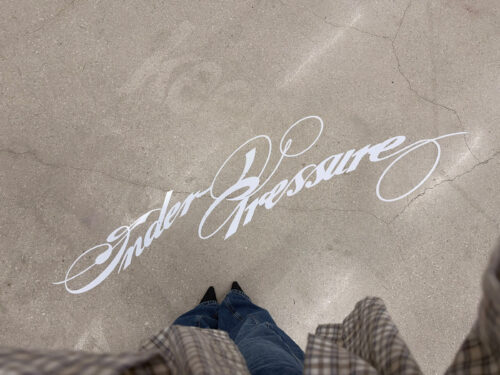
“Under Pressure” greets visitors at the entrance to Tomás Redrado Art, setting the tone for an exhibition centered on material transformation, resilience, and the physical traces of lived experience. (Photo by Evelyn Sosa, courtesy of Tomás Redrado Art)
Despite the exhibition’s title, “Under Pressure” does not dwell on anxiety. Instead, it considers pressure as a creative force—one capable of altering wax through heat, tightening thread through repeated stitching, or pulling sculptural forms into delicate balance. The works suggest that change is rarely effortless, yet they also demonstrate the surprising resilience of materials subjected to sustained care and attention.
The result is a thoughtful group exhibition that rewards patience. Rather than delivering immediate answers, “Under Pressure” unfolds gradually, finding extraordinary emotional weight in ordinary materials.
WHAT: “Under Pressure”
WHERE: Tomás Redrado Art, 1015 NW 23rd St., Unit 2, Miami
WHEN: 2 to 6 p.m. Tuesday through Saturday and by appointment. Through Wednesday, Aug. 5, 2026.
COST: Free
INFORMATION: (305) 774-7740 and tomasredradoart.com
RECENT ART REVIEWS ON ARTBURST:
Elisa Turner: Leyden Rodriguez-Casanova State of Transition at Dimensions Variable
Olga Garcia-Mayoral: The Geometry of Silence at Durban Segnini Gallery
ArtburstMiami.com is a nonprofit media source for the arts featuring fresh and original stories by writers dedicated to theater, dance, visual arts, film, music, and more. Don’t miss a story at www.artburstmiami.com.
No posts found
The Geometry of Silence: Medina and Tagliafico in Coral Gables
Written By Olga Garcia-Mayoral
July 14, 2026 at 8:03 PM
Installation view of “The Silent Paths: Medina & Tagliafico,” featuring works by Carlos Medina and Pedro Tagliafico at the Durban Segnini Gallery in Coral Gables. The exhibition is on view through Aug. 7, 2026. (Photo by Pavel Acosta, courtesy of Durban Segnini Gallery)
“The Silent Paths” at Durban Segnini Gallery in Coral Gables unfolds less as a dialogue between two Venezuelan artists than as an invitation to slow down. Sculptures and installations by Carlos Medina are paired with paintings and mixed-media works by the late Pedro Tagliafico in an exhibition where abstraction communicates through restraint rather than spectacle.
In a city where exhibitions often compete for attention through scale and sensory overload, “The Silent Paths” offers something increasingly rare: space for contemplation. Silence is not presented as emptiness but as an active condition—one that asks visitors to notice subtle shifts of light, material and perception.
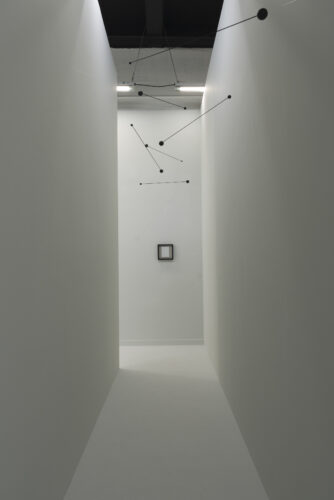
Carlos Medina’s suspended sculptural installation transforms geometric lines into an immersive spatial experience in “The Silent Paths: Medina & Tagliafico” at Durban Segnini Gallery. (Photo by Pavel Acosta, courtesy of Durban Segnini Gallery)
Although Medina and Tagliafico worked independently across different generations and mediums, their works meet through a shared commitment to economy of form. Neither artist pursues abstraction as decoration. Instead, each reduces visual language to its essentials, allowing line, geometry and repetition to become vehicles for reflection.
Medina’s sculptures establish the exhibition’s most immediate physical presence. Delicate metal rods extend into space with remarkable precision, appearing almost weightless as they trace geometric forms in midair. Their shadows become as important as the objects themselves, constantly changing as visitors move through the gallery. Rather than occupying space, the sculptures seem to reveal it.
One of the exhibition’s greatest strengths is Medina’s ability to make viewers conscious of their own movement. Walking around his suspended constructions, perspectives continually shift; lines align, separate and overlap, transforming simple structures into changing spatial experiences. The work rewards patience rather than immediate recognition.
Equally compelling are his transparent installations, where slender acrylic elements evoke atmospheric phenomena without literally depicting them. Instead of representing clouds or rain, they suggest fleeting natural events through lightness, rhythm and nearly invisible material. The gallery itself becomes part of the work as reflections and shadows activate the surrounding architecture.
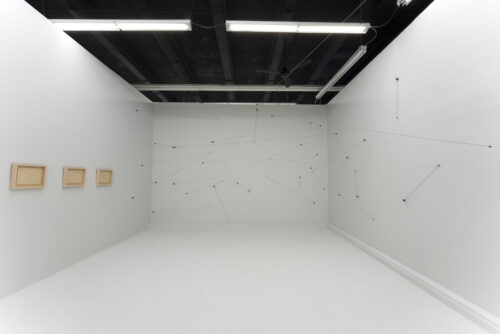
Installation view highlighting Carlos Medina’s delicate linear sculptures and wall-mounted works in “The Silent Paths: Medina & Tagliafico,” on view through Aug. 7 at Durban Segnini Gallery. (Photo by Pavel Acosta, courtesy of Durban Segnini Gallery)
If Medina’s contribution explores space, Tagliafico turns inward toward time.
His paintings and mixed-media works are built through repeated linear gestures that gradually accumulate into delicate grids. At first glance they appear almost monochromatic, but sustained viewing reveals subtle variations in texture, density and tone. The surfaces carry evidence of countless measured decisions, transforming repetition into meditation.
Unlike the rigid geometry associated with much 20th-century abstraction, Tagliafico’s grids never feel mechanical. They breathe. Small irregularities interrupt their apparent order, reminding viewers that these structures emerge through the artist’s hand rather than mathematical perfection. The result is work that feels simultaneously disciplined and deeply human.
Several pieces reveal an extraordinary sensitivity to material. Linen, graphite, oil, acrylic and wood become active participants in the image rather than passive supports. Time is allowed to remain visible through slight chromatic shifts and accumulated surfaces, giving the work a quiet physical presence that resists reproduction.
What makes “The Silent Paths” particularly successful is that neither artist overshadows the other. Rather than establishing a hierarchy, the installation allows their distinct practices to resonate across the gallery. Medina’s suspended linear structures echo Tagliafico’s drawn grids, while Tagliafico’s restrained surfaces provide a contemplative counterpoint to Medina’s spatial interventions. This creates unexpected visual conversations unfolding across rooms.
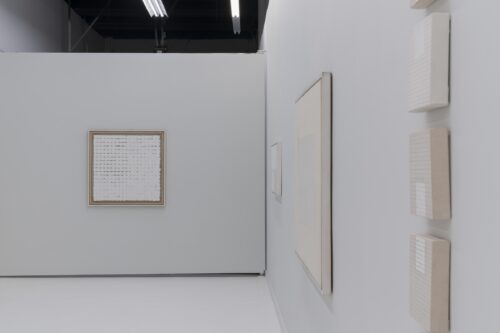
Pedro Tagliafico’s minimalist mixed-media works reveal subtle rhythms of line, repetition, and material in “The Silent Paths: Medina & Tagliafico” at Durban Segnini Gallery. (Photo by Pavel Acosta, courtesy of Durban Segnini Gallery)
The exhibition also reflects Durban Segnini Gallery’s commitment to Latin American abstraction while expanding beyond familiar narratives of geometric modernism. Instead of emphasizing historical movements, the presentation focuses on ideas that remain remarkably contemporary: perception, presence, materiality and the act of seeing.
Perhaps the exhibition’s greatest achievement lies in its confidence. It never demands attention through dramatic gestures or elaborate interpretation. Instead, it trusts viewers to slow their pace, allowing meaning to emerge gradually through observation. That confidence feels refreshing in today’s accelerated visual culture.
“The Silent Paths” demonstrates that abstraction can still surprise, not through complexity alone, but through clarity. Medina and Tagliafico show how the simplest line, carefully placed, can reshape the perception of space and time. Their works linger beyond the gallery, inviting sustained reflection on the expressive possibilities of restraint.
WHAT: “The Silent Paths: Medina & Tagliafico”
WHERE: Durban Segnini Gallery, 3072 SW 38th Ave., Coral Gables
WHEN: 10 a.m. to 5 p.m., Monday through Friday; 11 a.m. to 3 p.m. Saturday. Through Friday, Aug. 7.
COST: Free
INFORMATION: (305) 774-7740 and durbansegnini.com
ArtburstMiami.com is a nonprofit media source for the arts featuring fresh and original stories by writers dedicated to theater, dance, visual arts, film, music, and more. Don’t miss a story at www.artburstmiami.com.
No posts found
Arts News in Short: Jaguar Parade, Underline Shortlist, WDNA Vinyl and More
Written By Michelle F. Solomon, Artburst Editor
June 29, 2026 at 5:02 PM
“Ecosystem” by Busy, Pinecrest Gardens, 11000 Red Road, is part of the Jaguar Parade at locations across Miami-Dade County. (Photo courtesy of the Jaguar Parade)
From a public art project arriving with the FIFA World Cup to new museum initiatives, and music programming, here’s what’s making news across South Florida’s arts community.
Jaguar Parade brings Brazilian public art to Miami
As Miami welcomes visitors for the FIFA World Cup, another international attraction is dotting the streets of the city: 11 monumental jaguar sculptures created by Brazilian artists.
Painted sculptures at locations throughout Miami, named “The Jaguar Parade Miami 2026,” transforming public spaces into an open-air exhibition while raising awareness about jaguar conservation. After the exhibition concludes, the sculptures will be auctioned, with proceeds benefiting Onçafari, a nonprofit organization dedicated to protecting jaguars in Brazil.
The project officially launched with a June 22 reception at Emporium B Gallery in Little River featuring participating artists, representatives from the Brazilian Consulate and two full-size jaguar sculptures that are now on display.
Where to See the Sculptures
Miami Beach
“Oblivion” by Gus Attab, Miami Beach Bandshell, 7275 Collins Ave.
“Pantera Fractalis” by Laila Mackenzie, in front of the Cavalier Hotel, 1320 Ocean Drive
“Neon Botanica” by Lettice, in front of the Avalon Hotel, 700 Ocean Drive
“Forest Guardians” by Sophie Reiterman, In front of Sephora, 818 Lincoln Road
Sunny Isles Beach
“Inu Keneya” by Kassia Borges, 16690 Collins Ave.
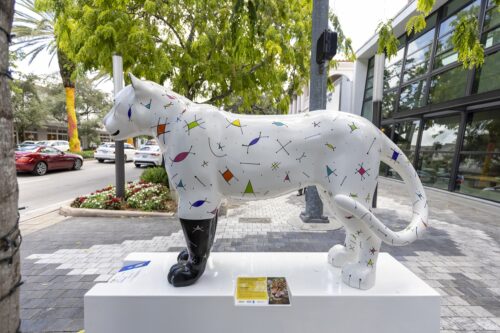
“Happy Soul,” by Cintia Abravenel is in Coral Gables. (Photo courtesy of Jaguar Parade)
Coral Gables
“Preserving is Necessary” by Livia Mourao and Rui Machado, 150 Miracle Mile
“Happy Soul” by Cintia Abravanel, 150 Miracle Mile
Miami Gardens
“Full Amazon” by Vinicius Zoia, 18605 NW 27th Ave.
Pinecrest
“Ecosystem” by Busy, Pinecrest Gardens, 11000 Red Road
Wynwood
“Coexistence” by Guilherme Kramer, Casa Ronaldo, Wynwood Marketplace, 2250 NW Second Ave.
See photos and descriptions of all the jaguars here.
Costumed reading explores aftermath of Peru mining disaster
“What If Works” presents a costumed reading of “The Weight of Dust,” an original play inspired by the 1983 San Gerónimo mining disaster in Peru, at 7 p.m. on July 31 at the Westchester Cultural Arts Center.
The drama follows a company owner’s daughter and a journalist as they investigate the decades-old catastrophe, uncovering concealed safety failures, fabricated reports and the lasting impact of silence and inherited trauma. Admission is free. More information at www.whatifworks.com
The Underline’s Finalists for New Public Art Commission
Four finalists have been selected by Friends of the Underline for the inaugural Underline Plinth project, a new biennial public art initiative that will commission rotating sculptures for The Underline’s Inter Grove Gallery in Coconut Grove.
Created as part of the America250 commemoration marking the nation’s 250th anniversary, the project asked artists to respond to the question: “What does it mean to be an American today?” The shortlisted proposals are “A Forest for Many” by Carlos Betancourt and Alberto Latorre, “Growth Rings” by Robert Chambers, “A Seat at The Table” by Morel Doucet and “Still Becoming” by Kennedy Yanko.
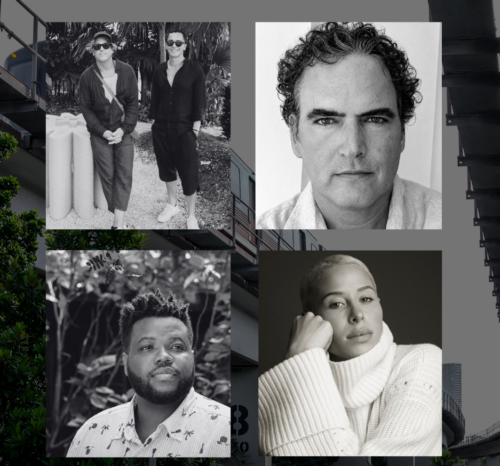
Clockwise from left, the shortlisted artists for The Underline project are Carlos Betancourt and Alberto Latorre, Robert Chambers, Kennedy Yanko and Morel Doucet. (Photo courtesy of The Underline)
The proposals will be shared with the public later this year for community feedback before The Underline Art Advisory Council selects the winning artist. The selected work is expected to be installed in spring 2027.
Located in The Underline’s Inter Grove Gallery at 2771 SW 27th Ave., Miami, the Underline Plinth project will feature a newly commissioned sculpture by an American artist whose work reinterprets history and heritage in honor of America250.
The Underline is a 10-mile linear park, urban trail, and living art destination transforming the land beneath Miami’s Metrorail into a public space. When complete, it will span from the Miami River in Brickell to the Dadeland South Metrorail Station in Kendall. Learn more at www.theunderline.org.
PAMM’s first digital art commissions draw global response
More than 750 artists from 50 countries applied to Pérez Art Museum Miami’s inaugural open call for digital art commissions, but only 21 projects will receive funding and production support through 2027. The initiative reflects the museum’s growing investment in artists working with emerging technologies while strengthening connections between South Florida, Latin America, the Caribbean and the African Diaspora.
The selected projects span video games, CGI films, AI-driven animation, virtual reality, immersive installations and other digital formats exploring identity, migration, memory and technology.
Two Miami artists are among the recipients: Unkle Luc, whose “MIAMI 2006” combines archival footage and AI animation to examine the city’s cultural landscape, and Sofia Valiente. Awards range from $2,500 to $15,000, with production support for works scheduled for completion by 2027.
More information and the complete list of commissioned artists at pamm.org
WDNA gives Miami’s vinyl community a weekly platform
On Friday, June 26, Miami’s WDNA-FM launched “Selector Sessions with DJ Le Spam.”
Recorded live at Reserved Hifi in Little River, the weekly program pairs selections from DJ Le Spam’s collection of Latin, funk, Miami bass, Haitian, Brazilian and jazz recordings with guest sets from local vinyl DJs and collectors. Scheduled guests include Mr Brown, Lula Rios, Ack Daddy, Djinji Brown and RicoSon.
Hosted by Spam Allstars founder Andrew “DJ Le Spam” Yeomanson, the program will air Fridays on WDNA 88.9 FM and stream worldwide.
More information at WDNAradio.org
Grammy Camp in Miami
Nearly 40 South Florida high school students spent a week immersed in the music industry when Grammy Camp Miami settled in at Art House Studios from Tuesday, June 23 and ended on Saturday, June 27.
Selected through a competitive application process, participants explored songwriting, music production, music business and performance while working alongside industry professionals. This year’s mentors included multi-platinum songwriter and producer Poo Bear, Grammy-winning singer-songwriter Richard Marx and Latin Grammy-winning artist Joaquina. More information at grammymuseum.org
ProjectArt Resident Artists at Locust Projects Exhibit ‘The Places We Make’
An exhibition at Locust Projects, “The Places We Make,” brings together the work of ProjectArt’s 2025–26 Miami Resident Artists alongside artwork created by students participating in free after-school arts programs at Miami-Dade public libraries.
ProjectArt is a paid teaching artist residency that partners with public libraries to provide free arts education while supporting the professional development and artistic practices of working artists.
“The Places We Make” brings together work by 2025–26 ProjectArt resident teaching artists Nina Osoria Ahmadi, Luz Estrella Cruz, Niko Devera, Estrella Dominguez and Sofia Villalonga alongside artwork created by students during a nine-month residency in Miami-Dade public libraries.
The exhibition, on view at Locust Projects, through Saturday, July 18, reflects the collaborations that grew out of free after-school arts classes, with artists and students exploring identity, memory, community and place through a range of media.
A reception will be held at the art space from 6 to 8 p.m., on Thursday, July 9.
Also, upcoming at Locust Projects, is the LAB (Locust Art Builders) Mentor Meet and Greet.
Artists, educators, arts and business leaders and mentors are invited to meet the LAB teen cohort, preview works-in-progress, and share insights over coffee and light bites from 10 a.m. to noon on Tuesday, July 14 as they finalize their collaborative exhibition opening Saturday, July 18.
Locust Projects is located at 297 NE 67 St., Miami.
Information at www.locustprojects.org.
ArtburstMiami.com is a nonprofit media source for the arts featuring fresh and original stories by writers dedicated to theater, dance, visual arts, film, music and more. Don’t miss a story at www.artburst.com.
No posts found
June Monthly Roundup: Grants For Artists
Written By Josie Gulliksen
June 24, 2026 at 6:30 PM
Artist grants are vital to the sustainability of Miami’s thriving cultural community. (Digital collage by Jean Blackwell Font)
Each month, Artburst rounds up grants available to artists in Miami-Dade County and across South Florida and beyond. We’ve included key eligibility information, application deadlines, and links to learn more. Several of the opportunities carry over from the previous month since some applications are accepted on a rolling basis.
Note that all applications must be submitted by 11:59 p.m. on the deadline date.
The Latest
O, Miami 2026-2027 Poetry Coalition Fellowship
O, Miami, founders of the O, Miami Poetry Festival which happens every April in honor of National Poetry Month and other year-round programming, is offering a paid fellowship to a South Florida resident. The 10 month-long fellowship from Sept. 2, 2026 through June 30, 2027, is an immersive opportunity to learn and participate in all aspects of O, Miami including community engagements, festival production, publishing and education residencies. Applicants should have a demonstrated interest in poetry, the arts, and cultural programming and have a knowledge about Miami. This is an part-time, independent contractor role, limited to 20 hours weekly at a rate of $2,000 per month, paid bi-weekly, plus a one-time $1,500 health and wellness stipend.
Click here for details. Application deadline is July 31, 2026.
Jubi Arriola-Headley South Florida Book Prize
O, Miami is also currently accepting applications for its first annual book prize. The manuscript must be full-length, between 48 and 100 pages, written by a poet with strong ties to South Florida, which could includes Miami-Dade, Broward, Palm Beach or Monroe counties. Open to both residents and former residents and to emerging and established poets regardless of publication history.
Click here for details. Application deadline is Aug. 15, 2026.
Oolite Arts – Multiple awards and residencies
Oolite Arts currently has six award and residency opportunities.
Cinematic Residency: The residency for South Florida filmmakers who are looking to expanding a short-form work into a feature-length film features an award of $50,000, access to rental camera packages and equipment, mentorship from industry professionals and advisors, access to studio workspace, a housing stipend, access to Oolite Arts facilities, subscriptions to filmmaking platforms and tools, networking with local, national and international filmmakers and eligibility for alumni opportunities and professional support beyond the residency.
Home + Away Residency: A series of multi-week paid artist residencies include a three-month residency at The Bag Factory in Johannesburg, South Africa, a five-week residency at Artspace San Antonio in Texas and four weeks at MASS MoCA in North Adams, Mass.
Studio Residency: 24-hour access to studio space at Oolite Arts with commitment to use of at least 15 hours a week. Monthly meetups are required as well as active participation in quarterly open studios, openings and special events. Included is a $15,000 annual housing stipend.
The Ellies: Categories include the Creator Award providing $10,000 in unrestricted funding to 35 South Florida artists; Art Teacher Travel Award supporting six public and charter school K-12 art teachers with $5,000 each for travel that strengthens their classroom practice; Curatorial Practice and Critical Writing Award with $10,000 awarded to two curators or art writers whose work advances and supports contemporary visual artist and their practice.
Click on the links above for details on each. Application deadline is July 31, 2026.
Sandrell Rivers Theater
Cultural Arts Partnership Residency (CAP@SRT Residency) managed by Fantasy Theatre Factory
The yearlong residency at Sandrell Rivers Theater in Liberty City is open to emerging and under-sourced performing arts groups in Miami-Dade County. It provides groups with free office space, rehearsal and performance space at the theater as well as hands-on production, marketing and publicity support. Additionally, groups will receive one-on-one mentoring sessions with Fantasy Theater Factory leadership through its Business of the Arts Session.
Click here for details. Application deadline is July 15, 2026.
Still Available
South Arts Spring 2026 Grants Cycle
Southern Artist Spotlight Grants
The pilot grant program provides grant opportunities to documentary filmmakers, musicians and dancers, fiction and poetry writers and all forms of visual arts. Grants are awarded on a first-come, first-serve basis and require a dollar-for-dollar cash match. Maximum request is $8,000 for dance and $5,000 for all other disciplines. Projects must take place between July 1, 2026, and June 30, 2027, and applications must be submitted 60 days before the project start date.
Click here for details; applications accepted on a rolling basis.
Arts in Rural Places Grants
Organizations in rural, isolated, or small communities are eligible for up to $3,000 in support for community engagement projects. Opportunities are open to the same groups and applications, and project windows are all the same as the Artist Spotlight Grants mentioned above.
Click here for details; applications accepted on a rolling basis.
Professional Development for Arts Organizations
Arts organizations with operating budgets of $500,000 or more are eligible for up to $1,000 for professional development support. Open to artist ensembles, producing and presenting organizations, visual and performing arts centers, museums, film festivals, arts service organizations, community arts organizations, and art councils. Projects must take place between July 1, 2026, and June 30, 2027, and applications must be submitted 60 days before the project start date.
Click here for details; applications accepted on a rolling basis
Miami-Dade County Department of Cultural Affairs
Audience Access Grant Program
Non-profit arts organizations who create, perform, exhibit and/or present the arts are eligible to request up to $5,000 to help pay for arts program ADA/access technology and services including American Sign Language (ASL) interpreters, captioning, audio description, materials in accessible format, ADA/access training, and other types of services for audiences of all abilities.
Click here for details, application deadline is ongoing, but applications must be submitted at least one month prior to the need of the technology/service expansion.
Women in Film & Television Florida
Feature Film Finishing Project Scholarship Grant
Open to Women in Film Florida members awarding $3,000 to help complete an existing feature film project. Requirements include females in at least two of the following key positions —principal actor, writer, director, producer, cinematographer, or editor, film length between 60 to 120 minutes. Principal photography must be completed and not have already been in commercial or festival distribution.
Click here for details. Application deadline is Sept. 1, 2026.\
Film Florida
Florida Emerging Filmmakers Fund
Open to Film Florida members for free, non-members must pay a fee. Awards of $1,000 to $2,000 in cash to filmmakers as well as mentorship with an industry professional throughout a project. Short and long formats and all genres are eligible, demonstrate advanced and innovative skills in filmmaking and support the organization’s mission of creating jobs in Florida’s film and entertainment production industry. Projects must be filmed entirely in Florida by a Florida crew with post-production done in Florida.
Click here for details, no deadline.
Additional Links
A listing of where to check periodically for available grants, workshops, resources, and application assistance.
Miami-Dade County Department of Cultural Affairs: https://miamidadearts.org/
Florida Division of Arts & Culture: dos.fl.gov/cultural/grants/grant-programs/specific-cultural-projects/
Knight Foundation: https://knightfoundation.org/
The Jorge M. Pérez Family Foundation: https://jmperezfamilyfoundation.org/grant-opportunities/
Green Space Miami: https://greenspacemiami.org/
AIRIE (Artists in Residence in Everglades): https://www.airie.org/
Funding Arts Network: https://fundingartsnetwork.org/home/grants/
Broward County Cultural Division: https://www.broward.org/Arts/Funding/Pages/artistsupport.aspx
ArtburstMiami.com is a nonprofit media source for the arts featuring fresh and original stories by writers dedicated to theater, dance, visual arts, film, music and more. Don’t miss a story at www.artburstmiami.com
No posts found
2026 Miami Arts Marketing Project conference spotlights creative growth, entrepreneurship
Written By Josie Gulliksen
June 22, 2026 at 5:31 PM
From left, George Neary, founder of Tours ‘R Us moderated the day’s first panel “Scaling Creative Growth,” with Krista Oldfield, chairperson, Miami-Dade Beacon Council Financial Advisory Council, Dejah Carrington, co-founder of the art membership program at Commissioner, and Kendrick Vasquez, founder/creative director of HGAB Studios. (Photo courtesy of Arts & Business Council of Miami)
Mitchell Bierman, the keynote speaker at this year’s 2026 Miami Arts Marketing Project addressed Miami’s arts leaders, artists, and creatives, and individual artists and creatives, acknowledging the importance of connectedness in continuing to shape the “community’s identity.”
Bierman was one of 12 speakers and panelists at the annual conference on Thursday, June 11 at Miami-Dade College’s Wolfson Campus.
Bierman, an attorney with Weiss Serota Helfman Cole + Bierman, who has served on the boards of Perez Art Museum Miami, Miami-Dade Art in Public Places and the Miami-Dade County Department of Cultural Affairs presented “Building Miami: The role of Arts, Culture, and Creativity in a Global City.”
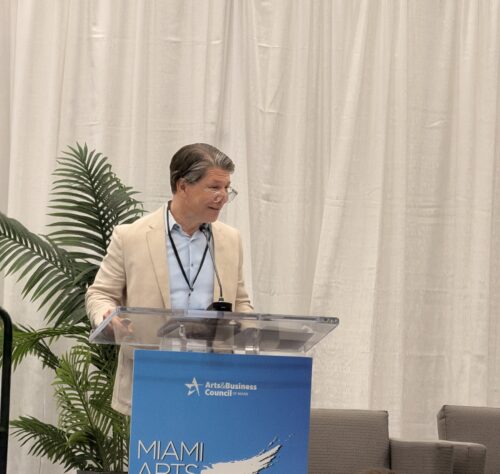
Attorney Mitchell Bierman of Weiss Serota Helfman Cole + Bierman, the day’s keynote speaker, presented “Building Miami: The Role of Arts, Culture, and Creativity in a Global City.” (Photo courtesy of Arts & Business Council of Miami)
“As a third-generation Miamian,” said Bierman, “I have seen our city evolve into what is has become, a global international city.”
He recalled when in the 1980s the Concert Association of Florida, New World Festival of the Arts, artist Christo’s Pink Islands project and then the television show “Miami Vice” happened and “it changed our idea about ourselves, we were cool.”
Bierman pointed out that decades later brought the Miami City Ballet and Edward Vilella, New World Symphony and Michael Tilson Thomas, the Miami-Dade Department of Cultural Affairs helmed by Michael Spring and the Miami-Dade Art in Public Places program. “All those began to create the cultural fabric we have in Miami today,” said Bierman.
He talked about the Kaseya Center (formerly the American Airlines Arena), and Marlins Park (now loanDepot Park) which he said “are more than just sports venues. Then Art Basel in the 2000s put us on the global stage.”
Creating civic identity and dialogue plus telling community stories “that connectedness can be difficult to achieve but these cultural institutions are helping shape our community’s identity.”
Moderating the day’s first panel “Scaling Creative Growth,” was George Neary, founder of Tours ‘R Us and former associate vice president of cultural tourism for the Greater Miami Convention & Visitors Bureau. Joining him was Dejah Carrington, co-founder of Commissioner, an art membership program, Kendrick Vasquez, photographer/videographer, and founder/creative director of HGAB Studios. and Krista Oldfield, chairperson, Miami-Dade Beacon Council, financial advisory council.
When the question was posed about how artists can find success on their own terms and remain financially sustainable, the group responded with advice from their own career trajectories.
“Align with what feels natural, this helps it feel right and you’ll find your people/tribe across all sectors. Remember we’re all individuals on our own path,” said Oldfield.
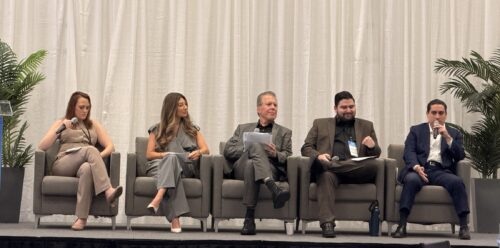
Emily Finch, assistant professor of Reference and Scholarly Communication at the University of Miami, moderated “Legal Foundations and Creative Entrepreneurs,” with Kayla Moran, founder and managing attorney at Kayla Moran Law, Alan David Barson, partner, Greenspoon Marder, Tyler Litwak, associate, Malloy & Malloy and Zachariah Evangelista, partner, Ser & Associates. (Photo courtesy of Arts & Business Council of Miami)
Carrington said, “define your purpose and get real with your own expectations. There’s a difference between market dynamics and creativity itself. Being an artist is difficult; I don’t want to sugarcoat it because it is important to acknowledge what you might give up in that creative process and ensure you are ok with that.”
And Vasquez urged attendees to “understand what success means to you and decide which lifestyle helps you build that.”
Seeing themselves as entrepreneurs is often difficult for artists and creatives but is necessary as they often work as both collaborators and leaders and is something with which all three panelists could relate.
“80% of the conversation I have with creators is helping them understand they are entrepreneurs, whether it is doing something as a creative individual or an organization, you are an entrepreneur,” said Vasquez.
Acknowledging the entrepreneurial process is vital to continue moving forward. “Be clear about your value and how you present yourself,” advised Carrington, “establish a long-term vision and develop relationships early on, all of this is entrepreneurial work.”
Relatability and a unique perspective are also critical. Said Oldfield, “look closely at what you offer and why it is important to your audience then find a link to creating visibility and showcasing your value.”
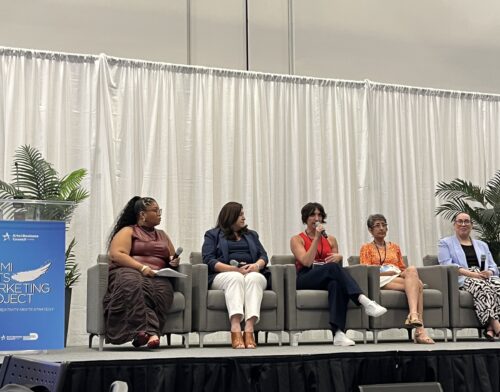
From left, Heaven Jones, outreach manager Arts & Business Council of Miami, moderates “Communicating Your Work” panel with Suzanne Scarfield Scarano, president of Forethought Marketing, Neysa King, founder of Heart-Centered Writing, Lisa Palley, of Palley Promotes and JennyLee Molina, principal of JLPR and 305 Day founder. (Photo courtesy of Arts & Business Council of Miami)
Next up was “Communicating Your Work,” moderated by Heaven Jones, outreach manager, Arts & Business Council of Miami, and featuring Neysa King, founder of Heart-Centered Writing, Suzanne Scarfield Scarano, president of Forethought Marketing, Lisa Palley, principal of Palley Promotes, and JennyLee Molina, principal of JLPR and 305 Day founder.
The communications experts tackled questions about marketing, communications, and publicity.
Collectively, the foursome agreed that public relations is about building relationships that are mutually beneficial.
Panelists stressed the importance of authenticity, strong writing, active listening and consistently sharing one’s work to build trust and visibility.
When it comes to communicating authentically, King said, “It requires all the weird connections you have and the courage to express that openly and honestly How do I sound true and like myself, that is the true competitive edge.”
Creating a clear position is vital for any organization, “everyone has their own anchor and for me it’s authenticity, adventure and fun, they need to be part of what I do. Ask yourself what you are providing for the client, be clear on what you do; what benefit will they have from the experience; why do you believe it will be beneficial to them?”
Building trust is also key, said Palley. In the more than two decades she worked with the Miami Book Fair she emphasized that she “worked to involve the community, each day I grew as a professional and was also bringing people into the fold.”
Molina focused on “fine tuning your bio, your website, whatever you use to present your work, you have to continually evolve and change,” a philosophy that helped her organic idea of Miami’s 305 Day into a 13-year success story.
Closing out the conference was the panel “Legal Foundations and Creative Entrepreneurs,” moderated by Emily Finch, assistant professor of Reference and Scholarly Communication at the University of Miami. Panelists included Tyler Litwak, associate at Malloy & Malloy; Zachariah Evangelista, partner with Ser & Associates; Kayla Moran, founder and managing attorney at Kayla Moran Law; and Alan David Barson, partner at Greenspoon Marder.
The panel explored how being legally literate can protect creatives, why incorporating as an artist can support long-term sustainability, contracts, labor, and ownership, and how to determine when to seek legal advice.
“Everything nowadays is about content, and everything is being clipped making it imperative to own your creation,” said Morgan. Barson followed saying, “ownership determines who captures the value, if you understand the rights of your work, you can protect your future options for using and getting paid for your work.”
What if a creative project spawns into something larger? “As s a creative it is important to protect that project in the early stages,” said Litwak
Panelists offered practical tips for artists and creative entrepreneurs navigating the business and legal aspects of their work. Some of the advice was:
- Choose the business structure that best fits your goals rather than assuming an LLC is right for everyone.
- Build relationships with trusted attorneys and accountants who understand your work.
- Use contracts to define ownership, payment, royalties and responsibilities before projects begin.
- Treat sweat equity as an asset when negotiating collaborations.
There are Miami Arts Marketing Project programs throughout the summer with a series of virtual Maximizing MAMP Workshops coming up July.
Info and register at artsbizmiami.org/events.
ArtburstMiami.com is a nonprofit media source for the arts featuring fresh and original stories by writers dedicated to theater, dance, visual arts, film, music and more. Don’t miss a story at www.artburst.com.
No posts found
After 30 years, Summer Shorts honors the people who built it
Written By Miguel Sirgado
June 12, 2026 at 1:21 PM
Stephen Trovillion and María Elena García appear in the third annual Summer Shorts festival in 1998, three years after City Theatre launched the short-play event at the University of Miami’s Ring Theatre. To celebrate 30 years, the festival features an afternoon preview and one-night event at the Westchester Cultural Arts Center on Saturday, June 13. (Photo Courtesy of City Theatre)
Thirty years after an ambitious theatrical idea at the University of Miami’s Ring Theatre grew into one of Miami’s most enduring theater traditions, City Theatre is taking time to honor the people who helped make it possible.
Unlike the festival’s traditional multi-performance run of affordable 10-minute plays, the nonprofit’s flagship “Summer Shorts” has been reimagined as a one-day celebration on Saturday, June 13 at the Westchester Cultural Arts Center. First, there’s a 2 p.m. preview performance. The premium-priced evening cabaret gala features 10 short plays with dinner and live music.
Honored at the evening event will be co-founder Susan J. Westfall and founding board chairman Alan H. Fein.
Honorees Alan H. Fein, Susan J. Westfall will be honored during the 30th anniversary celebration of Summer Shorts on June 13. The one-night event at the Westchester Cultural Arts Center pays tribute to the people who helped build one of Miami’s longest-running theater traditions. (Photo courtesy of City Theatre)
” ‘Summer Shorts’ traditionally runs for several weeks, but this year we asked ourselves how we could keep producing the work while adapting to the realities we’re facing,” Ramírez says. “We’re trying to balance what we can realistically afford with the experience audiences expect from ‘Summer Shorts.’ Presenting all 10 fully produced plays in a single day became a way to preserve the heart of the festival while working within those realities.”
Both performances feature the a lineup of 10 short plays, including three world premieres by Miami playwrights Paolo Benedict, Alize Medina and Paul Torres Wong.
“We wouldn’t have made it to 30 without our audiences and our artists,” says Ramírez, City Theatre’s executive director. “It feels like a celebration of the connection that we’ve been able to make through theater.”
According to Ramirez, the 2 p.m. preview features the same lineup of 10 fully produced short plays that will be performed at the evening event.
“The evening event serves as a fundraiser for City Theatre, while the afternoon performance provides a more accessible price point. Sometimes you have to think outside the box to keep making theater happen,” Ramirez says.
City Theatre executive director Gladys Ramírez, right, and artistic director Margaret Ledford are marking the 30th anniversary of Summer Shorts, the company’s flagship festival that has introduced generations of audiences and playwrights to short-form theater since 1996. (Photo by Morgan Sophia Photography)
“Summer Shorts” has occupied several homes over the years, including the Ring Theatre, the Adrienne Arsht Center and, more recently, the Westchester Cultural Arts Center. The anniversary format also gave organizers an opportunity to recapture some of the communal spirit that shaped the festival’s earliest years.
“We wanted to capture the essence of what they created in 1996,” Ramírez says. “The sharing of a meal together, the conversation, the community. Those are the experiences people remember.”
Hola Hi performing at Summer Shorts in 2025. The group returns this year as City Theatre reimagines its flagship festival as a one-night, cabaret-style anniversary celebration. Pictured from left: Caleb Joseph, Angelina López Catledge and Paul Curtis. (Photo by Morgan Sophia Photography)
As City Theatre looks ahead, Ramírez hopes “Summer Shorts” continues to be more than a showcase for new plays.
“I hope it’s less of just a show and more of a community cultural experience that connects us with each other,” she says. “The plays will always be new. They’ll always be different. What makes ‘Summer Shorts’ special is all the people who get to be in the room and share that experience together.”
WHAT: City Theatre’s 30th Anniversary of “Summer Shorts.”
WHEN: 2 p.m. preview, 7 p.m. performance and dinner, Saturday, June 13.
WHERE: Westchester Cultural Arts Center at Tropical Park, 7930 SW 40th St., Miami.
COST: $25 general admission, preview matinee (no food or beverage included);evening, $175
general admission, $250 VIP, both include dinner.
INFORMATION: westchesterculturalartscenter.com or (305) 226-0030
ArtburstMiami.com is a nonprofit media source for the arts featuring fresh and original stories by writers dedicated to theater, dance, visual arts, film, music and more. Don’t miss a story at www.artburst.com.
No posts found
Will Your Vote Decide Miami’s First Official Anthem?
Written By Artburst Editor
June 8, 2026 at 1:16 PM
Elevated Tracks 305 finalists have been announced and public voting runs June 7 through June 14, 2026. (Graphic from Elevate Tracks)
Will Miami’s anthem be “Miami Es Miami,” “Souls Alive in the 305,” “Mayami, My Miami” or “DALE 305”?
Those are among the finalists in Elevated Tracks 305, an independent community-driven competition that aims to create what organizers say could become Miami’s first official anthem.
Public voting is underway through Sunday, June 14, giving listeners a chance to help decide which song best captures the city’s culture, energy and identity.
Presented by Elevate Cities in partnership with Guitars Over Guns, the Frost School of Music at the University of Miami and Young Musicians Unite, the initiative invited musicians to submit original songs inspired by Miami. Entries came from across generations and musical styles, ranging from established performers to middle school students.
The finalists reflect many sides of the city, from bilingual tributes and Latin-infused tracks to songs celebrating Miami’s neighborhoods, nightlife and multicultural character.
Adult finalists include “305” by Adrian Gonzalez of ¡SUÉNALO!, “Miami Es Miami” by Hussein Abdala featuring Carlos Oliva, “Mayami, My Miami” by Richard Bona and Ellene Masri, and “Souls Alive in the 305” by Jose Conde. Other finalists are “Big City Bright Lights,” “Dance in Miami,” “MIAMI,” “Miami,” “My Ami” and “RUMBA.”
The youth category features five finalists ages 11 to 15, including “DALE 305” by 11-year-old Skye Aria, “La Gringa Tiene Tumbao” by Abi-G, “Miami Despierta” by Shantel Ruiz, “Miami On My Tongue” by Soleil River Nation and “Nature of Miami” by Bands.
The competition is supported by a roster of honorary co-chairs that includes Grammy-winning Miami music figures Gloria and Emilio Estefan, Jon Secada, Rico Love, Rudy Pérez and Danny Flores.
Public voting accounts for 50 percent of each finalist’s score, while a panel of judges drawn from Miami’s music, education and nonprofit communities will determine the remaining 50 percent.
Full finalists songs are on dedicated YouTube playlists (Youth Finalists Playlist and Adult Finalist Playlist). Voters are encouraged to listen to the entries before casting one vote in both the adult and youth categories. Votes can be cast at @ElevateMiamiTogether.
Winners are expected to be announced the week of June 22.
ArtburstMiami.com is a nonprofit media source for the arts featuring fresh and original stories by writers dedicated to theater, dance, visual arts, film, music and more. Don’t miss a story at www.artburstmiami.com
No posts found

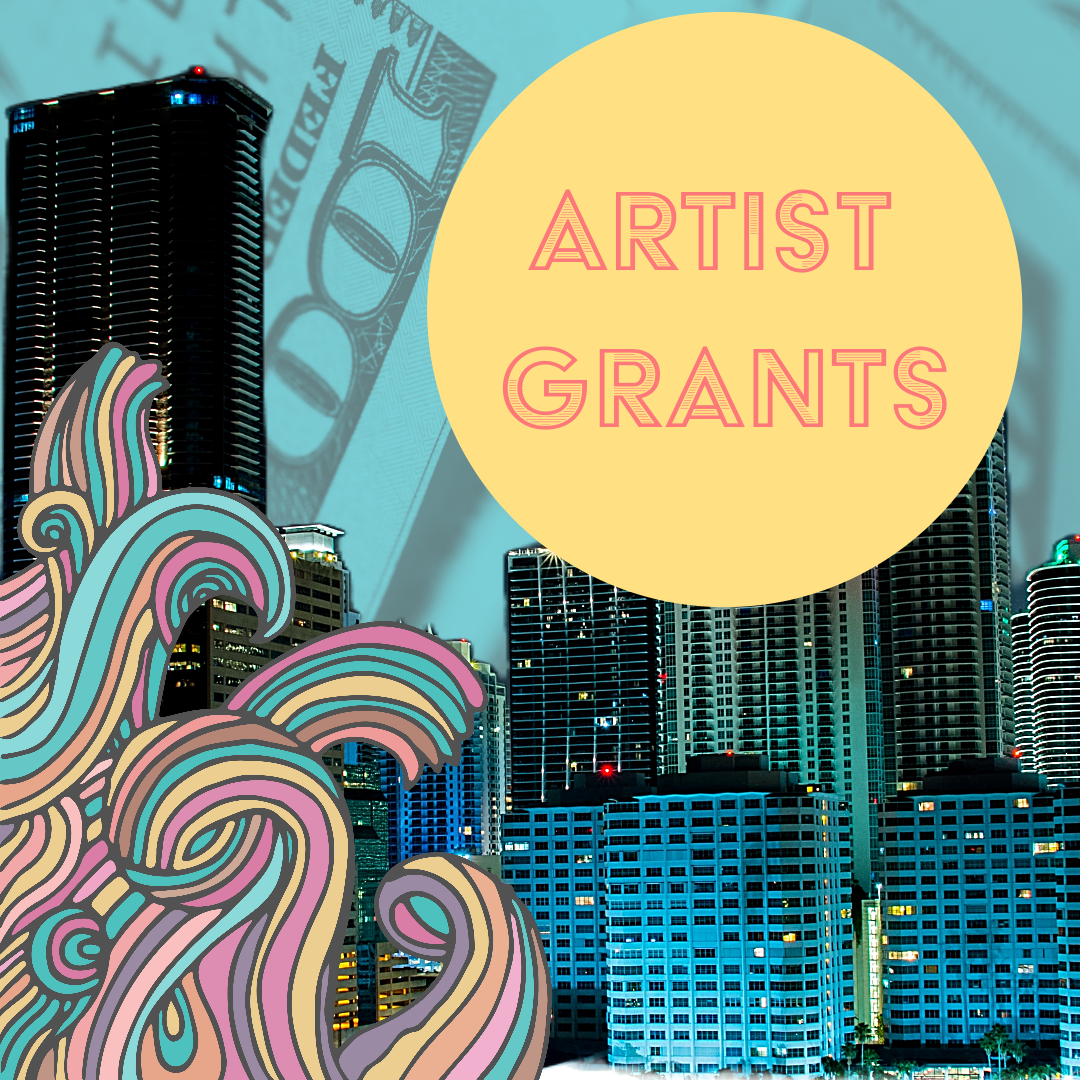
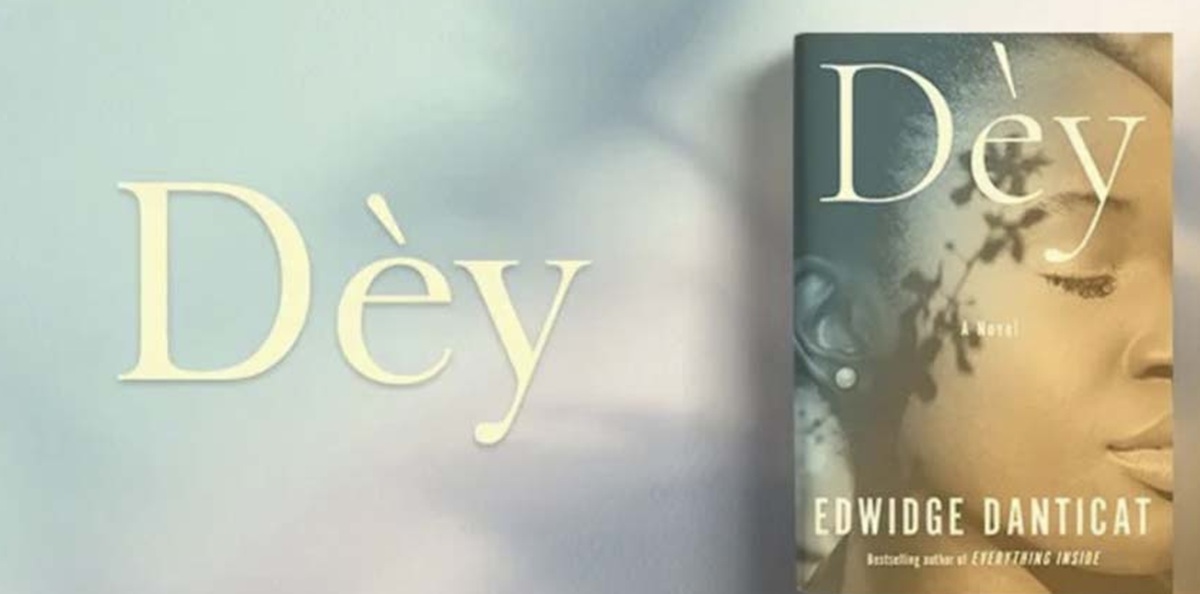
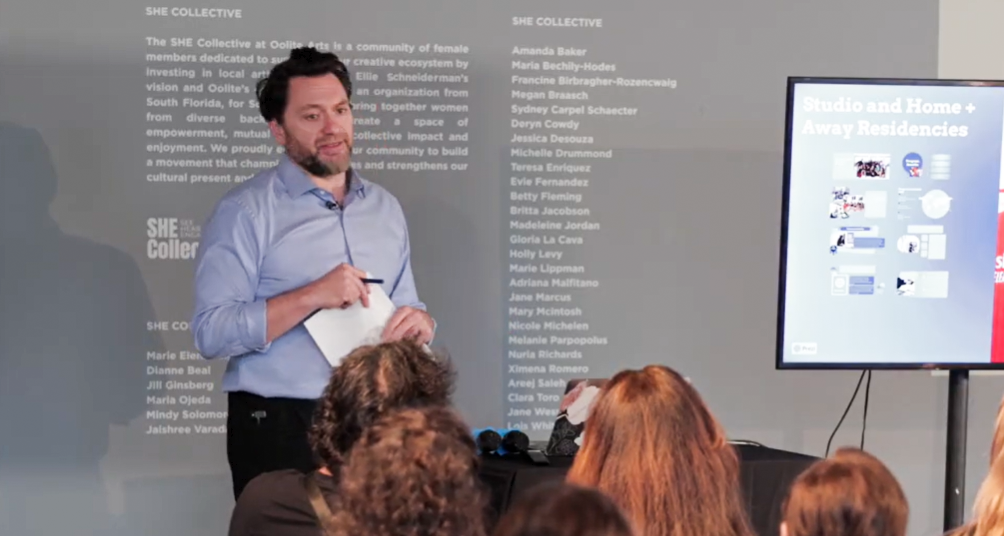
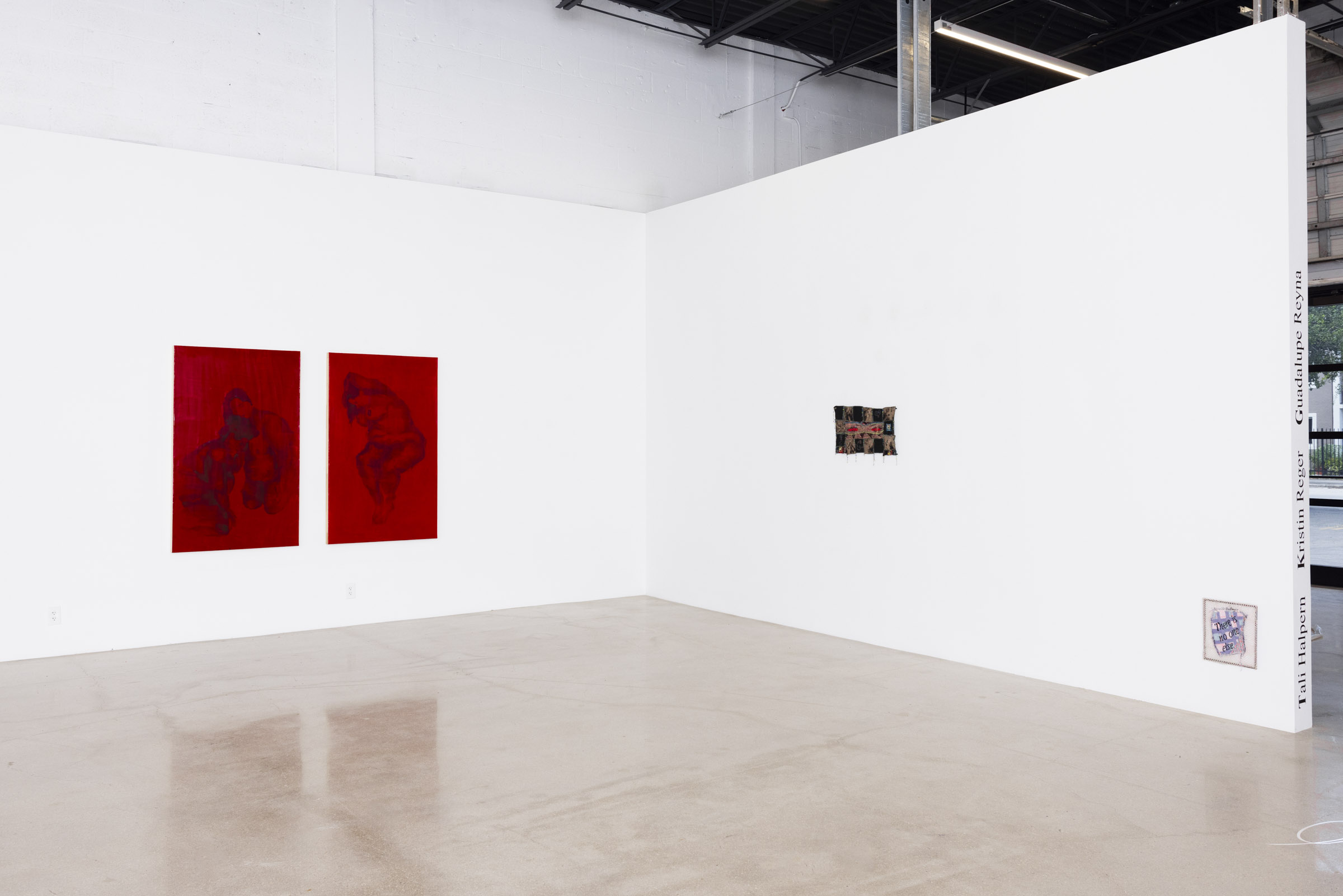
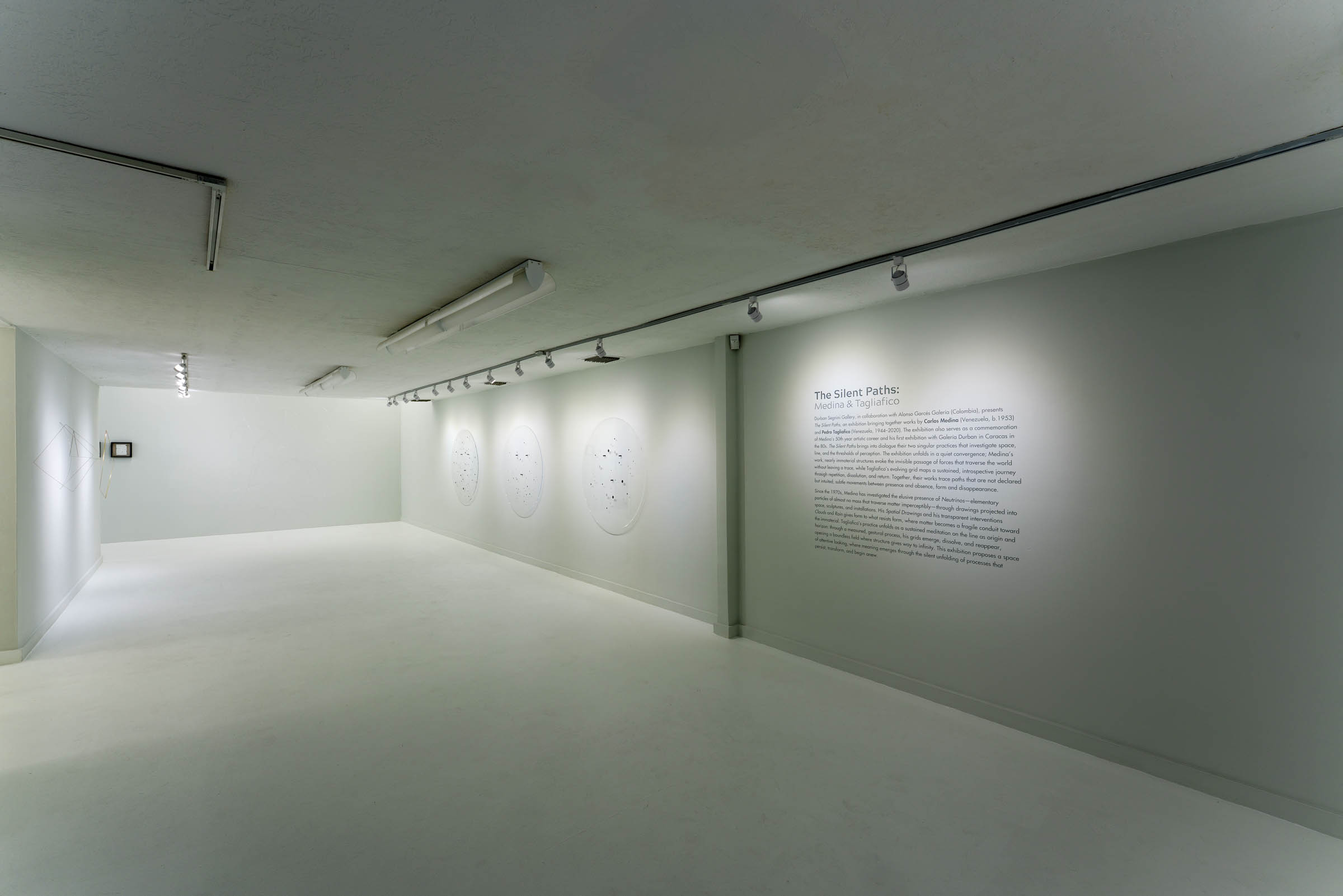
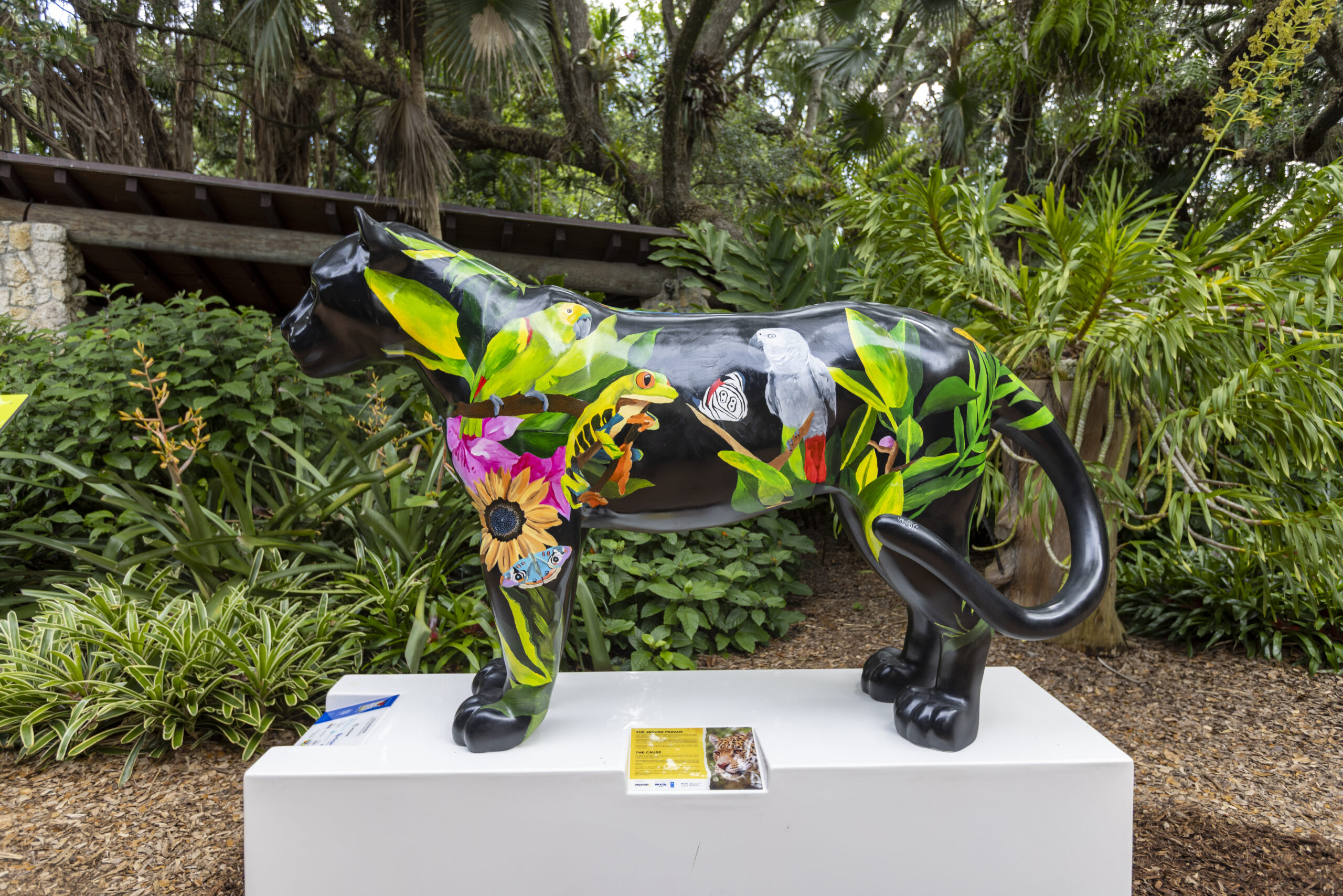
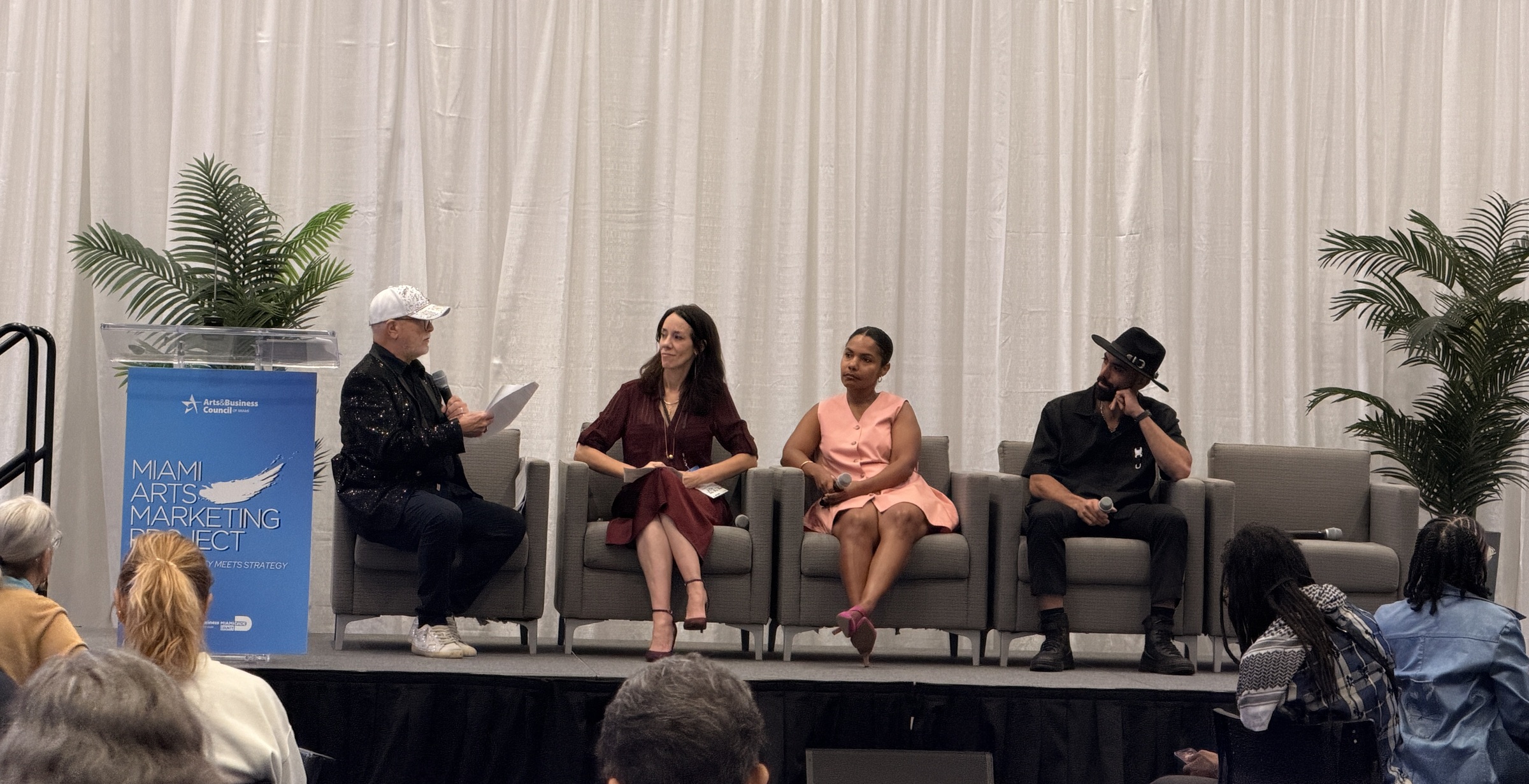
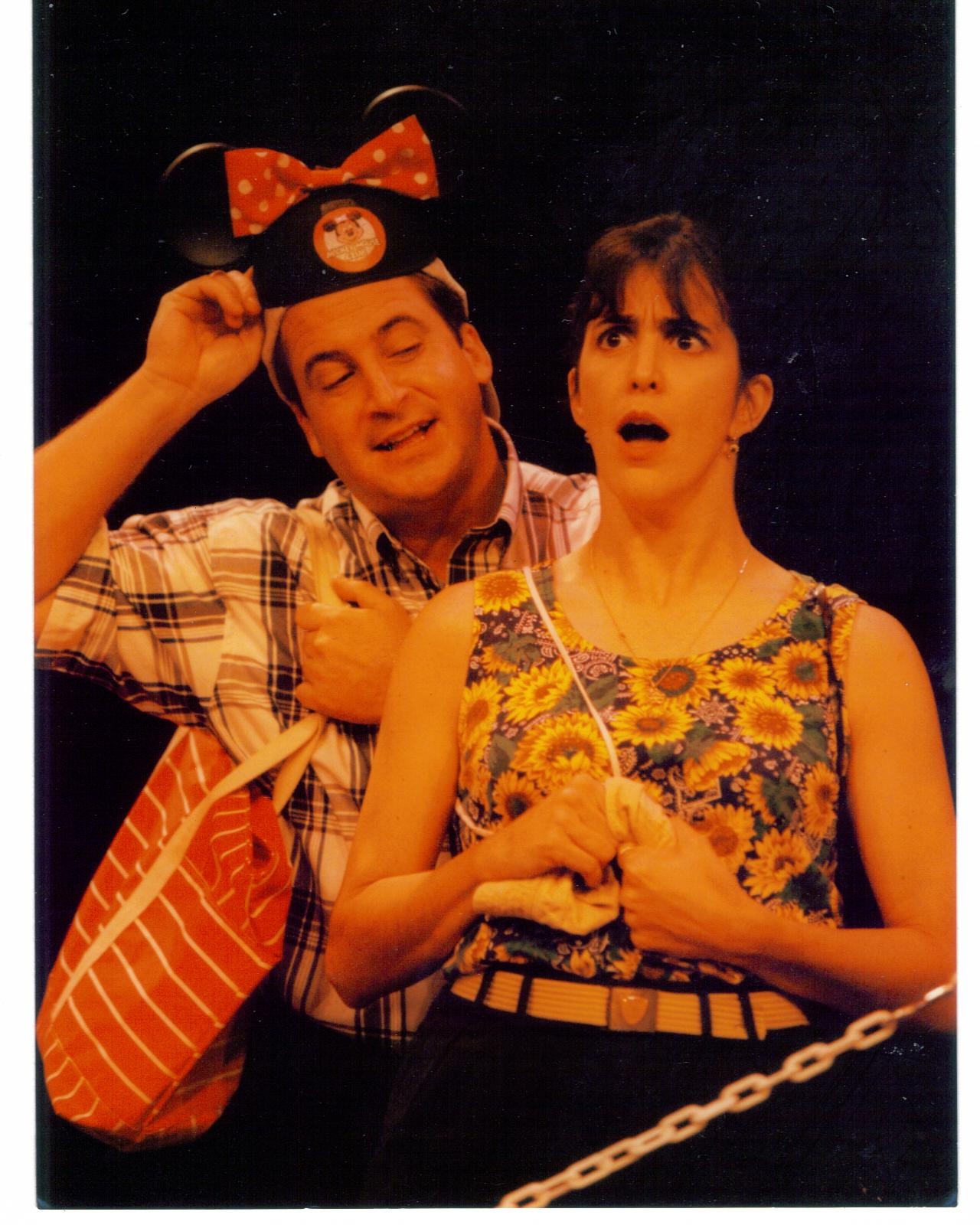
Recent Comments