
Theater / Film
Review: A Little-Known Story, a Captivating Premiere: Miami New Drama’s ‘Gandhi and the Jew’
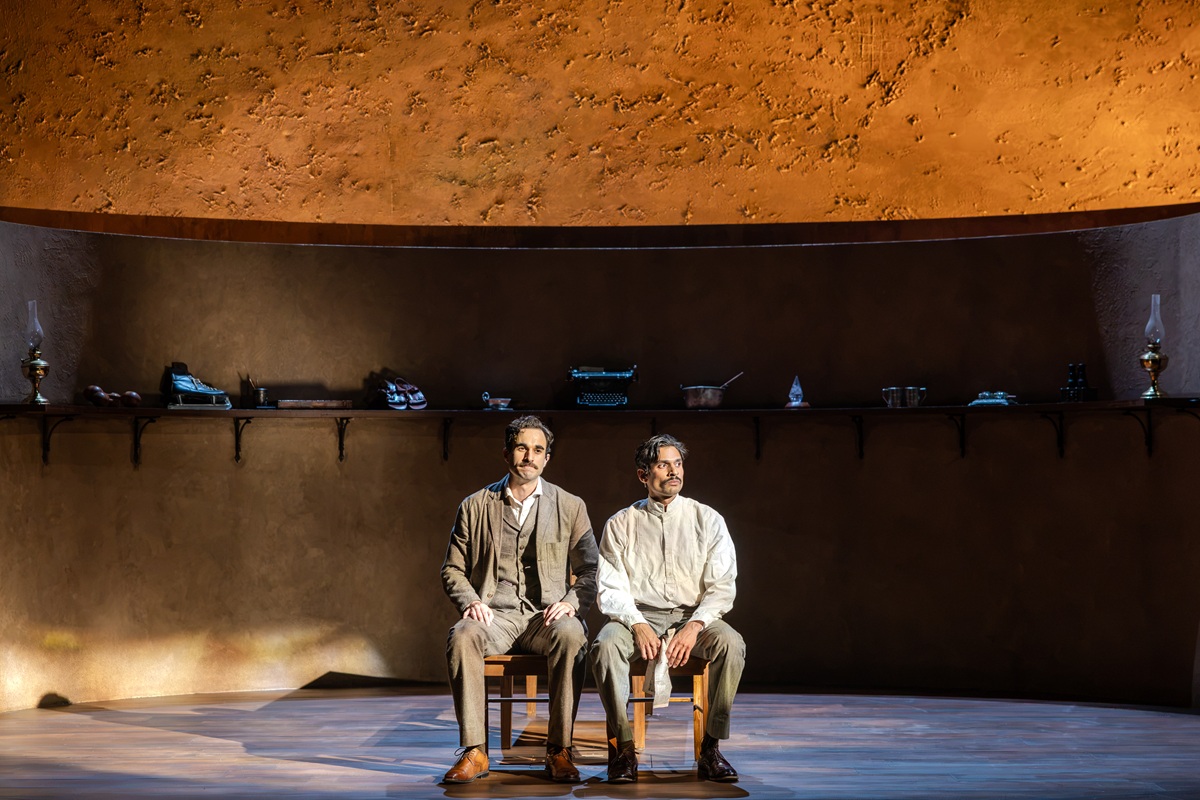
Max Katz as Lower House and Keshav Moodliar as Upper House in Miami New Drama’s production of Harley Elias’s world premiere play ‘Gandhi and the Jew’ at the Colony Theatre, Miami Beach, through Sunday, Dec. 6. (Photo by Ari Feldmiller, courtesy of Miami New Drama)
On the way out of a performance of Miami New Drama’s “Gandhi and the Jew,” one woman said she was eager to research more about the two men’s friendship that had deeply enthralled her as it played out on the stage of the Colony Theatre.
The feeling is collective and it comes from how the play came into existence and a very personal connection.
This world premiere by playwright Harley Elias was born from an idea that he brought to Miami New Drama’s artistic director, Michel Hausmann. It delves into the unlikely friendship of Hermann Kallenbach, a Jewish architect, and Mohandas Karamchand Gandhi, then a young lawyer in South Africa, years before he became the figure remembered around the world as Mahatma Gandhi.
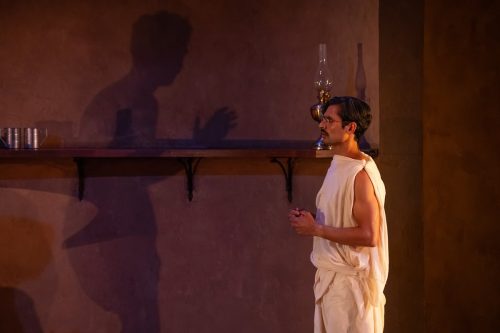
Keshav Moodliar as Gandhi ponders the shadow of his friend in Miami New Drama’s ‘Gandhi and the Jew.’ (Photo by Ari Feldmiller, courtesy of Miami New Drama)
For years, Elias had heard about Gandhi from his grandfather who was an Indian Jew of Iraqi descent. Then while on his honeymoon in South Africa, Elias stayed in a guesthouse, which he describes as “billed as Gandhi’s former home,” where he learned about Kallenbach who had lived there. The discovery sent Elias back to South Africa to explore their history and study hundreds of letters.
It is this lived and learned experience that gives the play a sense of knowing and intimacy.
The play opens in Johannesburg in 1904. A mutual friend has sent Gandhi (Keshav Moodliar) to see architect Kallenbach (Max Katz). One of Gandhi’s clients, an Indian landowner, needs help developing a property.
Their banter makes for a lively first meeting, though some historical context is needed to follow what is happening. The government is blocking the project, claiming it is a sanitation issue. The men understand the real reason: Indians are being shut out. The friendship begins here as Kallenbach offers to put the plans in his own name.
Elias’s descriptive attention to detail in that first meeting in Kallenbach’s office offers a glimpse of what will emerge in this engaging buddy story. Gandhi notices speed skates on one of the shelves – “What are those, knives on your shoes?” He then begins to compare his small office across the street to Kallenbach’s – the architect has shelves, decorations, windows to the streets.
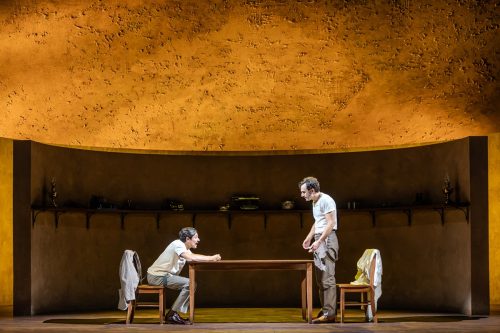
Max Katz as Hermann Kallenbach and Keshav Moodliar as Gandhi sit together in the home they end up sharing. The household objects lining the shelf help make their life together feel lived in. (Photo by Justin Swader, courtesy of Miami New Drama)
It’s the beginning of what will be a consistent thread in the play of the two men’s relationship. The script identifies the characters as “Upper House” and “Lower House,” labels that eventually become a joke about their household and a shorthand for their relationship.
After Gandhi is injured in an attack, Kallenbach asks him to move in. He offers to cover their expenses so Gandhi can leave his law practice and devote himself to the fight against injustice.
The hierarchy that becomes their pet names for one another comes from Kallenbach comparing their arrangement to the British Parliament: the Lower House raises money while the Upper House sits above it, rejecting everything.
Elias understands the appeal of the bromance comedy. One of the play’s most charming passages comes as Gandhi sizes up the Kraal. Kallenbach lists his creature comforts: a stable, a horse, a garden and a tennis court. Gandhi revises the inventory. The horse is unnecessary; the garden is too small; the tennis court could make room for more vegetables.
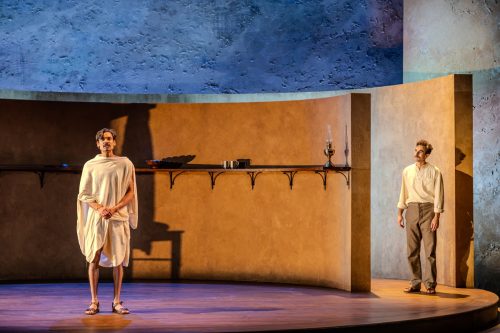
Christopher and Justin Swader’s broad semicircular set design frames Gandhi and Kallenbach at a distance from one another, foreshadowing the years and history that will pull them apart. (Photo by Ari Feldmiller, courtesy of Miami New Drama)
The odd couple have friendly quarrels as housemates. The comedy makes their friendship feel easy and lived in.
New York-based actors Katz as Kallenbach and Moodliar as Gandhi embody their characters, with a chemistry that makes the friendship, its ups and downs, and the passage of time feel genuine. Moodliar, especially, has to convey Gandhi’s transformation from a lawyer into a harbinger of world peace. It’s a tall order for the diminutive figure, and the actor captures it.
Katz’s character arc is wonderfully defined, from the bachelor architect-about-town to a man with a steadfast commitment in the final act. Both actors make their characters relatable, putting neither on a pedestal, an easy trap with historical figures.
Scenic designers Justin and Christopher Swader create an expansive, semicircular world, with a broad open floor and a long shelf of household objects. Props designer and set dresser Jameelah Bailey creates the historic period to perfection along with her associate props coordinator Elon Donovan. The designs upper and lower sleeping spaces make their living arrangement visible.
The warm, sand-colored lighting by Oliver Wason has an almost “Indiana Jones” glow, and Sinan Refik Zafar’s sound design, including natural sounds of the outdoors and the starting up of a car, adds to the atmosphere.

Max Katz brings a searching intensity to Kallenbach, whose friendship with Gandhi changes how he sees the life he has been living. (Photo by Ari Feldmiller, courtesy of Miami New Drama)
At a vegetarian restaurant where they’ve accidentally bumped into one another, both men appear in gray suits as costumer Beth Goldenberg gives the moment a striking visual symmetry.
One of the production’s most tender images comes after the two men have gone their separate ways and reunite. Gandhi gives Kallenbach homespun cloth he has made for him and carefully helps him dress. It is one of the places where director Margot Bordelon, who previously directed Miami New Drama’s “English Only,” gives the story the necessary room to breathe. While she keeps the pacing at the clip that a two hander needs, there are places where she makes the wise choice not to rush the play back into dialogue but allows for the moment to unfold – watch for this in the “tomato scene.” Her direction moves seamlessly between domestic comedy, direct address and larger historical events; it’s not an easy task.

Max Katz’s Kallenbach steadies Keshav Moodliar’s Gandhi in an emotional moment in Miami New Drama’s world premiere of ‘Gandhi and the Jew.” (Photo by Justin Swader, courtesy of Miami New Drama)
But it is the men’s separation in the last half of the play that brings the story to its emotional high point. Gandhi and Kallenbach plan to travel to India together, but World War I intervenes while they are en route. The script presents Kallenbach as a German enemy combatant, and he is interned; Gandhi continues to India alone. The war divides them for 23 years. They meet again in 1937, when Kallenbach has been trying to help his family escape Nazi persecution and he comes to Gandhi with a deeply personal question about a Jewish home in Palestine. Their affection survives, while their convictions collide.
For this play, Broadway is not an abstract possibility for Miami New Drama. “A Wonderful World” premiered at the Colony before transferring to Broadway, and “Here There Are Blueberries,” which began as a workshop at Miami New Drama, is now playing on Broadway. “Gandhi and the Jew” has the emotional and theatrical reach to follow that track.
Some extended passages of dialogue slow its momentum, though. Selective tightening and more room for physical action and silence could help the ideas land with greater force. The play also moves quickly through historical references, from anti-Indian laws in South Africa to Kishinev, Zionism and Palestine. Viewers unfamiliar with those histories may struggle to grasp the high stakes. “Here There are Blueberries” faced a similar challenge and used projections to help orient the audience.
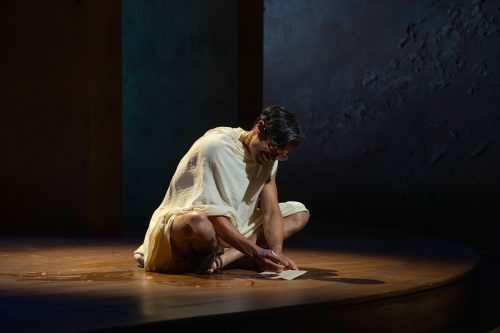
Keshav Moodliar as Gandhi bends over a page in a quiet moment onstage. The play makes room for the private man behind the figure remembered around the world. (Photo by Ari Feldmiller, courtesy of Miami New Drama)
Photographs of Gandhi and Kallenbach would also give a face to the real people behind the story, especially since Gandhi is often remembered in his later years from photos and movies.
Everything in “Gandhi and the Jew” comes together around the personal connection at the heart of Elias’s writing. That sense of knowing carries through the performances and the production, and that’s what gives this multifaceted study an intimacy that makes it fascinating. Elias has now worked with Hausmann on several world premieres for Miami New Drama, where the artistic director has produced and directed some of Elias’s work. Elias describes Hausmann as his “theatrical soulmate.” A buddy story that created a buddy story. And a wonderful achievement at that.
WHAT: “Gandhi and the Jew,” a Miami New Drama world premiere written by Harley Elias and directed by Margot Bordelon
WHERE: Colony Theatre, 1040 Lincoln Road, Miami Beach
WHEN: 8 p.m. Thursday, Friday and Saturday; matinees 2 p.m. Saturday and 3 p.m. Sunday. Closing performance 6 p.m. Sunday, Dec. 6.
COST: $45, $55, $58, $66, $75, $92. $99, $115.
INFO: 305-674-1040 and miaminewdrama.org
ArtburstMiami.com is a nonprofit media source for the arts featuring fresh and original stories by writers dedicated to theater, dance, visual arts, film, music, and more. Don’t miss a story at www.artburstmiami.com