
Visual Art
Southern Artists Put Wealth, Faith and Labor on View at Barry University
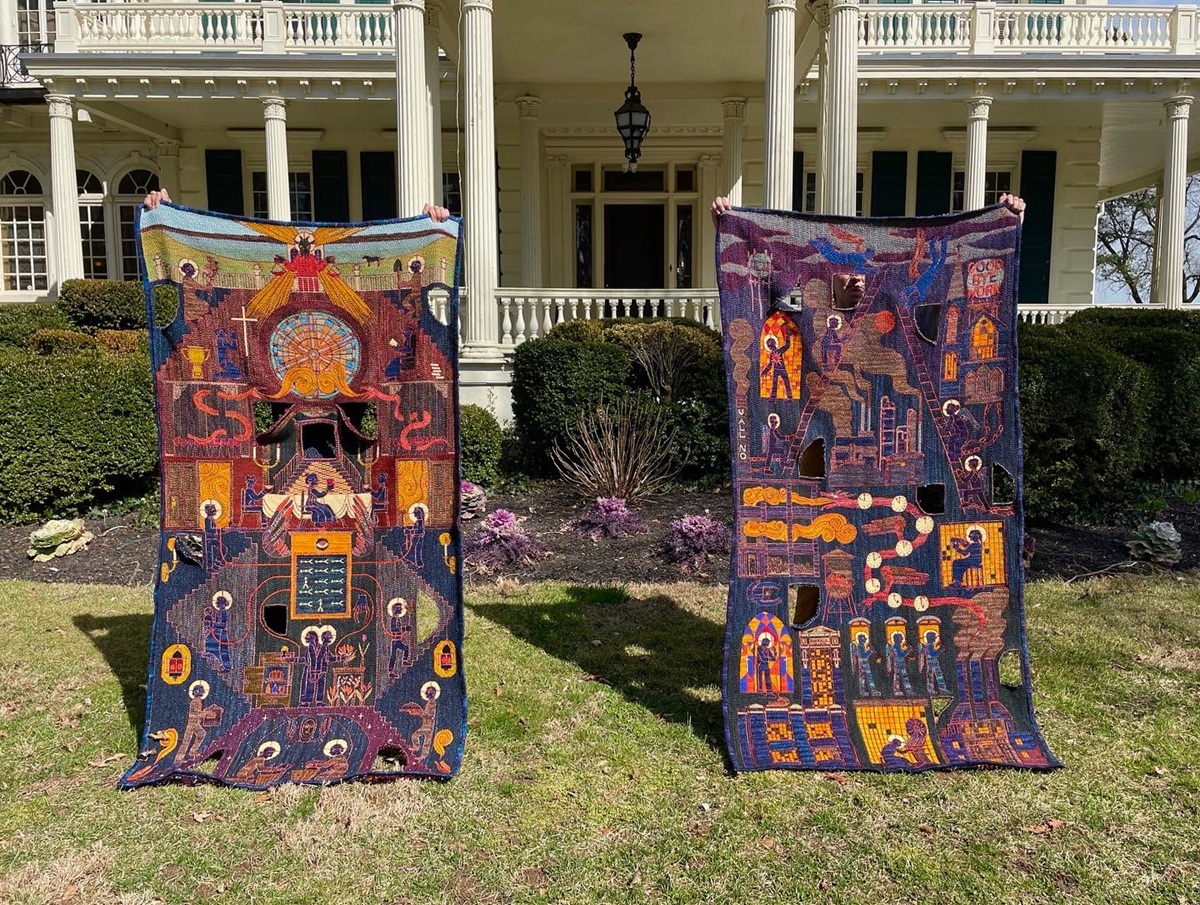
Workshop of the World I & II” by textile artist and labor organizer Tabitha Arnold is featured in The Southern Pize and State Fellowships For Visual Arts Exhibition at Barry University. (Photo by Heather Moqtaderi)
At first glance, Edgar Cano’s “Modern Penance” looks more like a photograph than a painting. The work depicts a man sprawled across a rug-covered floor, rendered in such precise detail that it might be mistaken for an image made by artificial intelligence.
Cano, amused by the suggestion, points out that he completed the piece in 2016. It took about two months.
“Fortunately, at that time we didn’t know too much about the use of AI,” he says with a laugh.
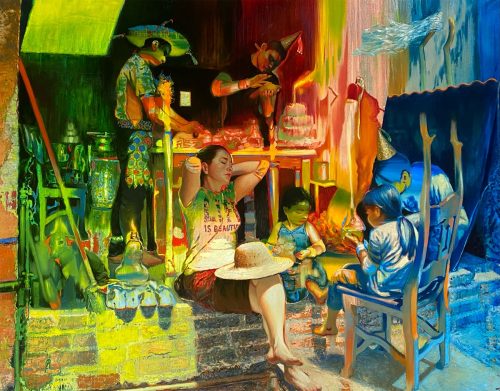
“Life is Beautiful” by Edgar Cano. The Louisiana-based artist is one of nine artists featured in DVCAI’s Southern Prize and State Fellowships for Visual Arts Exhibition.
(Photo by Anna Poe)
But the Louisiana-based artist freely admits to nursing an obsession with realism back then, which would often spill onto his canvas. He’s somewhat recovered now, and, like most artists, his work is fluid, growing and moving.
The dreamy slow dance he has been having with realism has mostly shifted. Now he has picked up the pace, easing into a fast foxtrot of bold strokes and thoughts.
The resulting works, including “Life Is Beautiful” and “We Were Not Alone,” are now on view at The Southern Prize and State Fellowships for Visual Arts Exhibition.
The exhibition, organized by South Arts and curated by Shannon Rae Lindsey, is part of a regional tour. It was shown at KMAC Contemporary Art Museum in Louisville, Kentucky, from Aug. 30 to Nov. 2, 2025, and at the LSU Museum of Art in Baton Rouge from June 4 to Sept. 6, 2026. Its Barry University presentation is the tour’s first South Florida stop. It opens Thursday, Nov. 19, and runs through Saturday, Feb. 27, 2027.
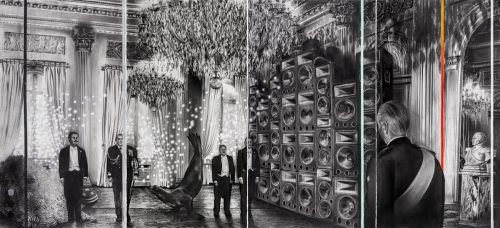
“Eucharist of Amnesia” by Gonzalo Fuenmayor. The artist relies on elaborate settings and architecture, baroque patterns and Victorian palaces, to bring his point across.
(Photo by Edson Smittery)
The exhibition features the nine recipients of the 2025 South Arts State Fellowships for Visual Arts, one from each state in the organization’s region: Cano of Louisiana, Loretta Pettway Bennett of Alabama, Gonzalo Fuenmayor of Florida, Masela Nkolo of Georgia, Travis Townsend of Kentucky, Stephen Phillips of Mississippi, Lydia C. Thompson of North Carolina, Felicia Greenlee of South Carolina and Tabitha Arnold of Tennessee. Arnold won the Southern Prize, and Miami-based Fuenmayor was named a finalist.
“It’s a very competitive competition, and so it’s a real honor to be able to showcase these artists from these Southern states,” Gordon-Wallace says.
What Cano is to oil on linen, Fuenmayor is to charcoal.
The brilliant “Eucharist of Amnesia” and the captivating “We all Have our Shadows” offer intricate conversations on wealth and power using light and then layered shades of black.
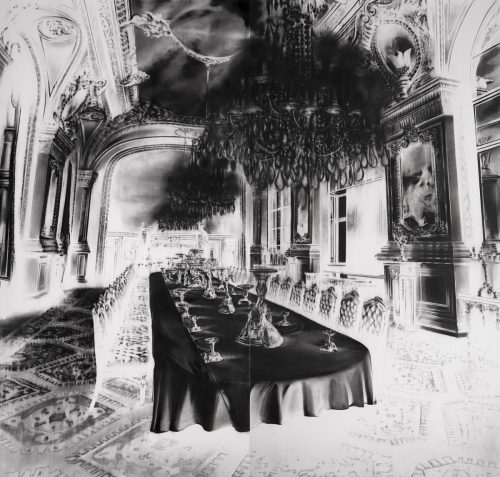
We all Have our Shadows” by Florida-based charcoal artist Gonzalo Fuenmayor.
(Photo by Edson Smittery)
Fuenmayor says that he relies on elaborate settings and architecture, baroque patterns and Victorian palaces, to bring his point across.
“I’m interested in that dichotomy between excessive wealth and how that wealth was achieved,” explains Fuenmayor.
He makes that tension visible through his treatment of light and shadow.
“In one, I’m inverting the values, so everything that’s lit is made into shadows, and everything that’s in shadows is lit. So it’s like a negative. So the simple gesture of flipping the values attempts to make the viewer question, ‘What’s inside? What’s in the shadows? What’s lit, and so forth.”
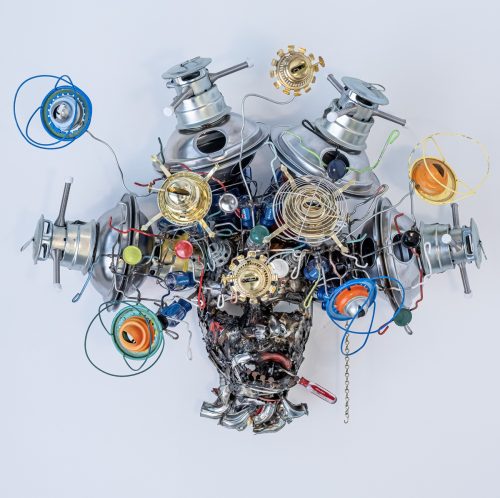
“Mukanda Mask” is a mixed medium sculpture by Georgia-based Congolese artist Masela Nkolo. (Photo by Stephanie Hanlon)
While Fuenmayor features elements of established architecture, Georgia-based Nkolo elevates everyday objects and industrial materials into mesmerizing visual explosions. It then culminates into an overall examination of African spiritual traditions and Congolese art.
“I try to create a bridge between African classic art and the contemporary world in general,” Nkolo says.
Nkolo started on this path when his formal education centered primarily on European art; It nonetheless boomeranged into a desire to delve right back into his own ethnicity.
Questions arose about Christianity and how it reconciles (or not) with traditional belief systems: “Why do we have to rebuke our own culture in the name of Jesus?” he asks. The answer made him refuse to ignore the ancestral call of the past.
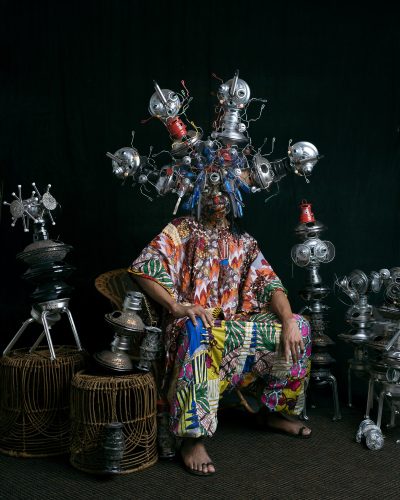
“Mukanda Mask.” The digital photograph by Congolese artist Masela Nkolo will be on view at Barry University’s Monsignor William Barry Library. (Photo by David Clifton Strawn)
Nkolo believes that when it comes to art, participation from the audience is essential. It must be activated, he said. It simply will not do just to call it art and then hang it up on a white wall.
For Arnold, a textile artist from Tennessee, taking action and art are often one and the same.
She painstakingly infuses fabrics with chaos, fire and color, creating riveting silent scenes packed with workers who vigorously advocate for their rights and justice.
“I live in Tennessee, I live in the South, and a lot of my work is really specifically about labor in this area of the country and our really unique labor history that’s little known compared to other places that might have a bigger industrial history,” says Arnold.
For Arnold, that labor history is inseparable from her identity as an artist and organizer.
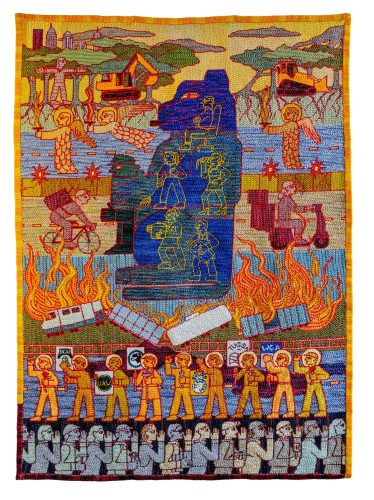
“Hot Labor Summer” by Tennessee-based artist and labor organizer Tabitha Arnold. (Photo by Tabitha Arnold
“So being a Southern artist and a Southern labor organizer is something I’m really proud of, and I think is worth celebrating.”
Arnold says she gravitated to textiles because she noticed that people responded to textiles in a different way than they do to paintings. Textiles resonate more with those who might not feel welcome or educated or as familiar with other art media.
It’s also a familiar vehicle for spreading a message.
“I hope that they feel inspired to get educated about what their rights are and what opportunities they might have to take collective action with their coworkers or even with other tenants in their apartment building. There’s so many ways to join a larger movement of people, and it feels so much better than struggling in isolation.”
Gordon-Wallace points out that Arnold’s pieces and those of other artists in the exhibition demonstrate a wide variety of talent in the South.
“It’s not a monolithic show,” she said. “Some of the works are ceramics, textile installations and mixed media, and many of our artists have been accidentally ignored for many years.”
She says that sometimes there is the perception that artists from the South may lack the sophistication that their Northern counterparts do.
But Gordon-Wallace begs to differ.
“None of this is true.”
WHAT: The Southern Prize and State Fellowships for Visual Arts Exhibition
WHERE: Barry University’s Monsignor William Barry Library, 11300 NE 2nd Ave., Miami Shores.
WHEN: Opens Thursday, Nov. 19, from 6 to 9 p.m., with reception and exhibition walkthrough. Regular hours: 7:30 a.m. to 10 p.m., Monday through Friday; 9 a.m. to 8 p.m. Saturday; 10 a.m. to 10 p.m. Sunday. Through Saturday, Feb. 27.
COST: Free
INFORMATION: 786-306-0191 and www.dvcai.org
ArtburstMiami.com is a nonprofit media source for the arts featuring fresh and original stories by writers dedicated to theater, dance, visual arts, film, music, and more. Don’t miss a story at www.artburstmiami.com