
Visual Art
Pixar Exhibit Brings Movie Magic to Frost Museum of Science
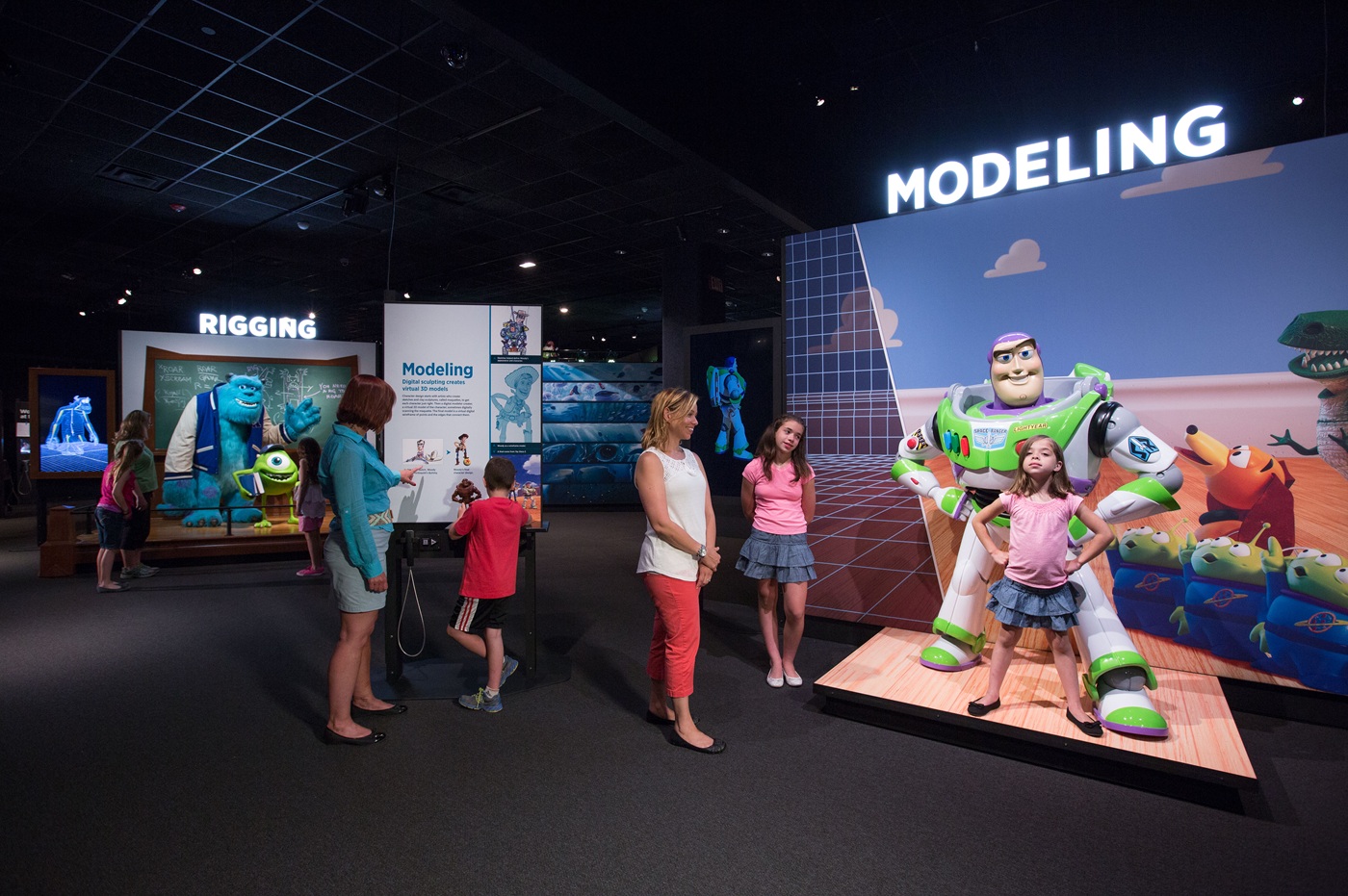
Visitors explore the modeling and rigging sections of “The Science Behind Pixar,” a traveling exhibition coming to the Phillip and Patricia Frost Museum of Science, opening Saturday, Oct. 10. (Photo by Michael Malyszko)
Buzz Lightyear may have doubts about humans and space travel, but when it comes to bringing Pixar characters to life, filmmakers take technology to infinity and beyond.
“The Science Behind Pixar” exhibit, opening Saturday, Oct. 10 at the Phillip and Patricia Frost Museum of Science, shows visitors that creating a Pixar film takes not only creativity, but also some pretty sophisticated technology.
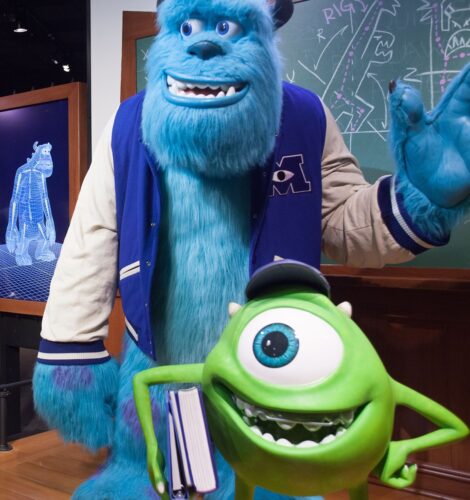
Sulley and Mike from “Monsters, Inc.” are among the familiar Pixar characters featured throughout “The Science Behind Pixar,” which explores the technology and artistry behind the studio’s films. (Photo by Michael Malyszko)
Through the exhibition, visitors explore the filmmaking techniques behind Pixar favorites including “Toy Story,” “Finding Nemo,” “Monsters, Inc.,” “The Incredibles” and “Brave.”
Analisa Duran, Knight vice president of science education at Frost Science, says that the exhibit offers a behind-the-scenes look at how creativity, engineering, art and math bring these movies to life.
“And that really was the perfect fit for us. We are a science museum and it’s part of our mission to bring experiences that get people excited about STEM to the museum and this exhibit is definitely going to do that,” Duran says.
More than 50 interactive experiences introduce visitors to parts of the filmmaking process through familiar Pixar characters including Buzz Lightyear, Dory, Mike and Sulley, Edna Mode and WALL-E.
Michael Horvath, vice president of exhibits at the Museum of Science in Boston, helped develop “The Science Behind Pixar” in collaboration with Pixar Animation Studios. He says activities such as rigging help visitors understand the complexity behind creating an animated character. Rigging determines how a digital model can move.
One gallery experience lets visitors manipulate a rigged version of Jessie’s face from “Toy Story.”
“They can move her eyes in every direction and change her eyelids and just see how much articulation can be done in one character, which is a toy, by the way,” says Horvath. “It’s not even a real face, but it makes you appreciate the level of detail that Pixar puts into a character, and you get to play and sometimes break those models.”
Taking a complicated filmmaking technique like rigging and turning it into something that museum visitors can understand and try for themselves was a challenge facing the team that created “The Science Behind Pixar” in 2015. The idea for the exhibit followed another collaboration between the Museum of Science in Boston and a Hollywood film studio.
In 2005, Horvath says they launched “Star Wars: Where Science Meets Imagination,” which was an exhibit developed with Lucasfilm that later led to the “The Science Behind Pixar” exhibit.
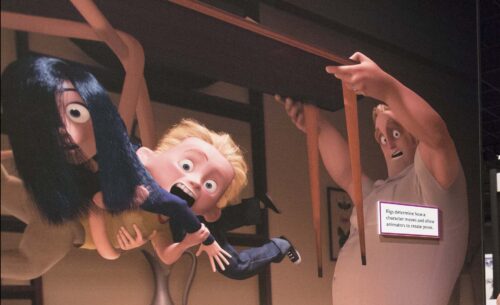
An exhibit display featuring characters from “The Incredibles” helps explain rigging, the process that allows animators to control how digital characters move and pose. (Photo by Michael Malyszko)
That same year, the Museum of Modern Art in New York opened the exhibit “Pixar: 20 Years of Animation,” focusing on the art of Pixar. But Horvath says that exhibit left the science and technology side of the studio’s work untold.
This gap brought Pixar and the Museum of Science in Boston together to figure out how to turn the studio’s highly technical, largely digital filmmaking process into a museum experience.
“On our end, we were like what could we do? What would visitors do? Is this experience that we’re making better than a TV documentary,” Horvath says. “So, the idea of making things physical and real and also making them experiential and interactive is really important to us.”
Horvath says that there were many iterations of designs and prototypes developed to get ready for the exhibit.
“We’d have meetings and say, ‘Hey, tell me more about this thing,’ and then we’d sort of go back and forth and we would develop things,” he says.
Horvath says that Pixar even had to go back into older “Brave” files and change parameters so that visitors would be able to see what happens when simulations are altered, allowing people to turn off the simulation controlling the characters’ clothing and hair.
“It’s just so fun to see clothing not drape the way it should drape, and just turn, basically, into paper doll clothes,” he says. “So, to get the scenes where the clothing was wrong or the hair wasn’t right was just doing crazy anti-gravity things.”
Horvath explains that Pixar can also create an entire field of grass by changing parameters on a parabola, which is a U-shaped mathematical curve. This concept turned into an exhibit element where visitors could manipulate the parameters themselves and create different fields of grass.
He shares that during prototyping, he watched a young girl view the video about the blades of grass in “Brave.” Afterward, he noticed that she had written something on her hand.
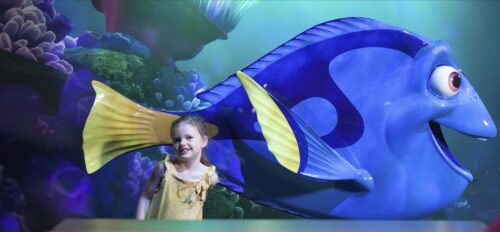
Dory from “Finding Nemo” is featured in “The Science Behind Pixar,” where visitors can experiment with lighting effects and learn how Pixar creates believable underwater scenes. (Photo by Michael Malyszko)
“And, then we asked her, ‘What did you write on your hand?’” Horvath says. “And she said, ‘I wrote the word ‘parabola’ because I wanted to go home and Google it and find out more about it.’”
This encounter led the team to include more information explaining what a parabola is and how it relates to computational thinking, he says.
Now, 11 years after the exhibition debuted in Boston, one of two versions of the traveling exhibit comes to Frost Science. The exhibit has toured internationally and nationally since 2015.
Horvath says Frost’s large gallery allows the exhibition to be seen much as it was originally designed, rather than divided among smaller spaces.
“I think the visitors will really love to see it there. I’m excited to see it there.”
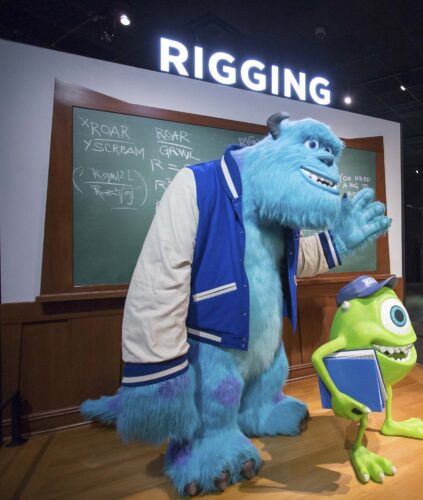
Sulley and Mike from “Monsters, Inc.” are featured in the rigging section of “The Science Behind Pixar,” where visitors learn how animators create movement in digital characters. (Photo by Michael Malyszko)
The exhibit is designed for all ages, with some experiences created specifically to engage younger visitors. Horvath recalls watching two adults play with one of those activities, using magnetic 3D parts to assemble a robot in the modeling section.
“I was like, yep, we did it. We made it for little kids and big kids,” he says.
Frost will also put its own touch on the traveling exhibit. A live clownfish aquarium will greet visitors in the foyer before they enter the exhibition, bringing “Finding Nemo” into the experience.
The museum is also creating a Pixar Pass that will connect concepts from the exhibit to other parts of Frost, including the planetarium and aquarium.
Duran hopes the experience continues for families after they leave the museum, whether they talk about what they learned on the drive home or rewatch a favorite Pixar film with a better understanding of what went into creating it.
“They didn’t just create fire by pressing a button, right? They created a simulation based on code,” Duran says.
WHAT: “The Science Behind Pixar”
WHERE: Phillip and Patricia Frost Museum of Science, 1101 Biscayne Blvd., Miami
WHEN: 10 a.m. to 5 p.m. Monday through Thursday, 10 a.m. to 6 p.m., Friday through Sunday. Opens Saturday, Oct. 10 through Sunday, April 11, 2027.
COST: Included with museum admission, $29.95 for adults, $24.95 for children ages 4-11 and free for children ages 3 and under, museum members and active military/veterans with identification.
INFORMATION: 305-434-9600 or frostscience.org.
ArtburstMiami.com is a nonprofit media source for the arts featuring fresh and original stories by writers dedicated to theater, dance, visual arts, film, music and more. Don’t miss a story at www.artburstmiami.com.