
Visual Art
Five Artists Explore Excess and Care at The CAMP Gallery
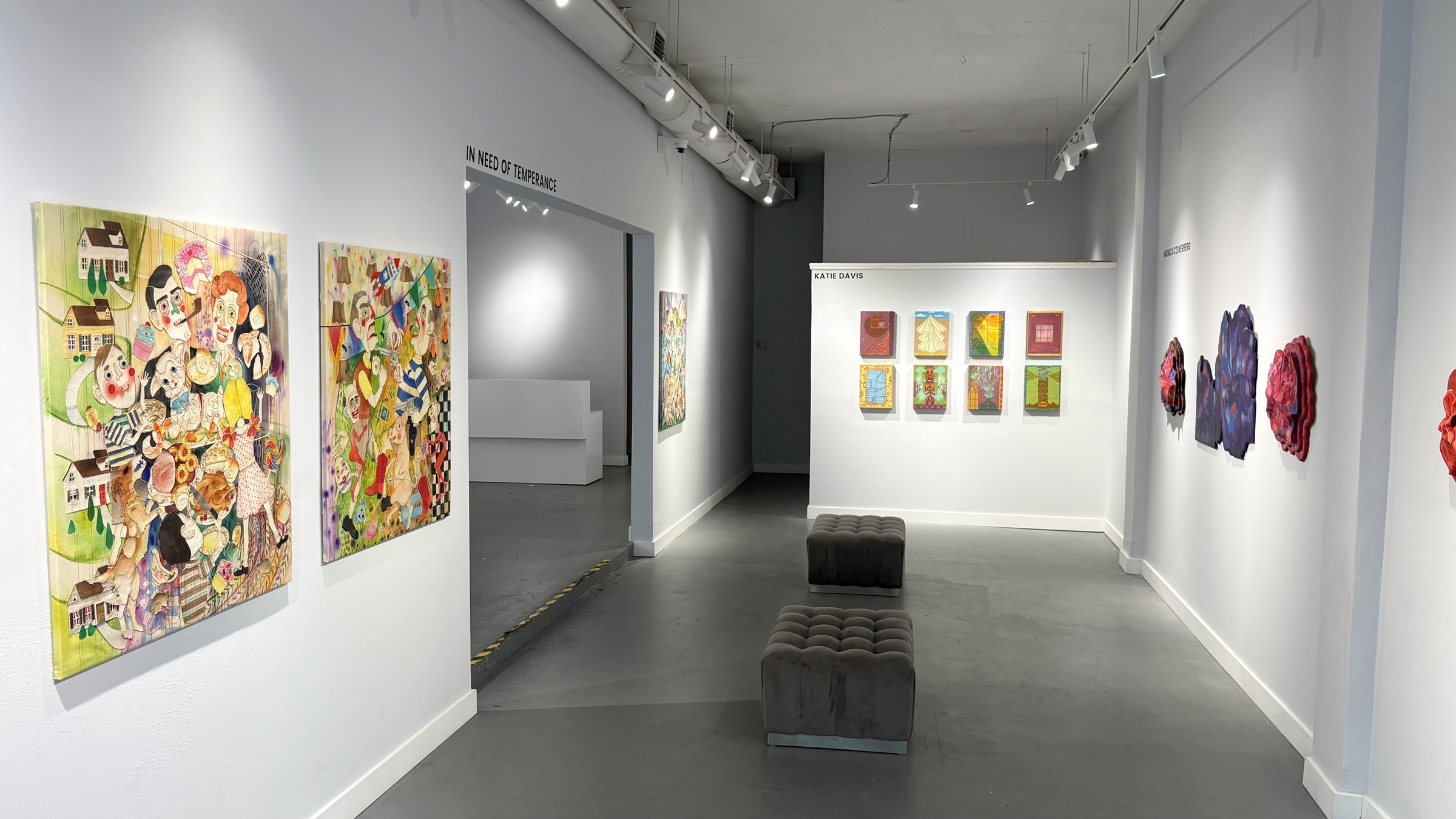
Installation view of “In Need of Temperance” at The CAMP Gallery, where works by Amanda Kate Walker, Katie Davis and Monica Czukerberg consider contemporary appetites, excess and the question of restraint through distinctly different visual languages. (Photo courtesy of The CAMP Gallery.)
There is something wonderfully chaotic about Amanda Kate Walker’s “Family Dinner.”
Bodies, faces, plates, patterns and fragments jostle for attention across a raw canvas that Walker has painted, cut, collaged and stitched together. The scene is recognizable—a family gathered around food—but order has given way to abundance. Faces overlap with dishes and domestic objects, while the visible seams interrupt the painted surface. There is almost too much to take in at once.
That visual excess provides a fitting entrance into “In Need of Temperance,” one of two exhibitions currently occupying The CAMP Gallery in North Miami.
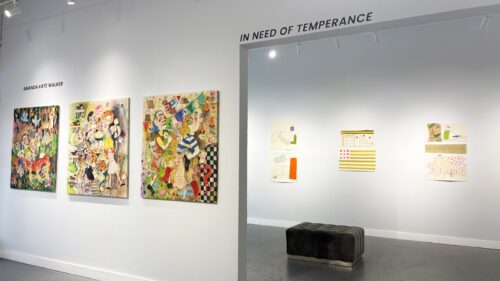
Amanda Kate Walker’s densely populated, stitched-and-collaged canvases command one side of “In Need of Temperance,” while works by Mabelin Castellanos introduce a quieter vocabulary of thread and cloth nearby. (Photo courtesy of The CAMP Gallery.)
Across the gallery, “Social Proof of Care” changes the pace. Here, Amy Putman and Miami artist Mabelin Castellanos use textiles to explore relationships through materials that have been touched, stitched, exchanged and preserved.
The two exhibitions, on view through Saturday, Oct. 3, are distinct, but experiencing them together creates an intriguing conversation. “In Need of Temperance” brings together Walker, Katie Davis and Miami-based Monica Czukerberg, whose approaches range from densely populated stitched paintings to small, carefully arranged works and embroidered organic forms.
Walker approaches the idea of excess through humor and accumulation.
Her four large works—“Family Dinner,” “Mermaid,” “Might Makes Right” and “Sunday Drive”—are made from acrylic-painted pieces stitched and collaged onto raw canvas. Their visible seams give the works a handmade physicality, while their crowded compositions resemble theatrical scenes populated by unruly characters.
“Family Dinner” makes the exhibition’s concern with excess especially tangible. The canvas is crowded almost to its edges. People, animals, plates of food and domestic details overlap, with one element competing with another for attention. A subject usually associated with comfort and togetherness becomes visually overwhelming. Rather than illustrating temperance directly, Walker makes abundance difficult to ignore.
Davis approaches desire from a very different direction.
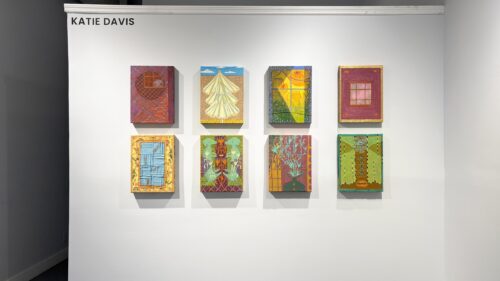
Katie Davis’ “The Algorithm Knows” series turns digitally cultivated desires into tactile objects, using textiles, paint and colored pencil to explore the increasingly intimate relationship between algorithms and what we want. (Photo courtesy of The CAMP Gallery)
Eight modestly scaled works from Davis’ ‘The Algorithm Knows’ series hang together in a precise arrangement. Made with textiles, paint and colored pencil, the works depict familiar objects and desires—a swimming pool, flowers, horses, a patio umbrella and even Wiener dogs.
Their titles change the way those otherwise ordinary images register. “The Algorithm Knows You Want A Pool,” “The Algorithm Knows You Still Think About Horses” and “The Algorithm Knows You Love Wiener Dogs” recall the oddly specific advertisements and recommendations that can appear after an online search or moment of curiosity.
The humor comes from recognition. Davis takes the familiar experience of having a preference returned as a digital recommendation and gives it a physical presence. In an exhibition concerned with restraint, the works introduce a contemporary complication: desire can now be continually observed and placed back in front of the consumer.
Czukerberg provides a quieter visual counterpoint.
Her “Dentro De Mi” and “Vida” combine acrylic and oil painting with embroidery, with the canvases hand-stitched onto wood panels. Flowers and organic forms dominate the works, while irregular contours and stitched surfaces give them an object-like presence that distinguishes them from the paintings nearby.
Moving into “Social Proof of Care,” the atmosphere shifts again.
Amy Putman and Mabelin Castellanos both work with textiles, but their approaches are strikingly different.
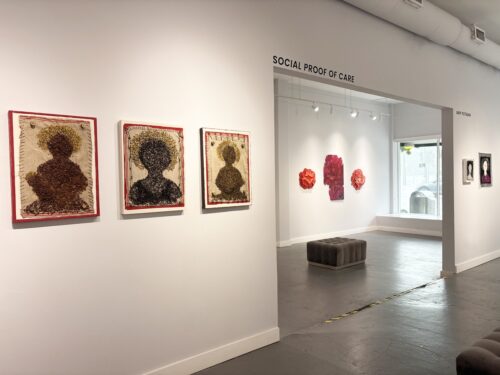
An installation view of “Social Proof of Care” shows Amy Putman’s tactile portraits alongside works by Mabelin Castellanos. The exhibition considers care through materials and gestures associated with connection, memory and the handmade. (Photo courtesy of The CAMP Gallery)
Putman’s portraits are tactile accumulations. Fabric, yarn, buttons and safety pins gather around human figures; some works also incorporate bullet shell casings. In “Phoebe,” wool, silk and linen handwoven by Putman’s mother, Eileen Goldman, become part of the work.
The materials reward close looking. Buttons and pins are not hidden within the construction but remain visible across the surfaces. The safety pin, an ordinary object designed to fasten separate pieces together, takes on particular visual weight when repeated across a human figure. Rather than painting a portrait solely through likeness, Putman builds one through layers of material.
Castellanos works with cotton and rayon thread on muslin, creating scenes that possess the immediacy of drawings despite being sewn.
Her subjects are deliberately ordinary.
There is a doctor’s appointment. Three people knit. A mother embraces a child. Elsewhere, a small bird appears on the opposite side of a barrier. The spareness of Castellanos’ compositions stands in sharp contrast to Walker’s crowded canvases in the neighboring exhibition.
In “Doctor’s Appointment,” two figures sit beside one another on a sofa. There is no dramatic action. The significance of the scene comes instead from proximity: one person has accompanied another and remains seated alongside them.
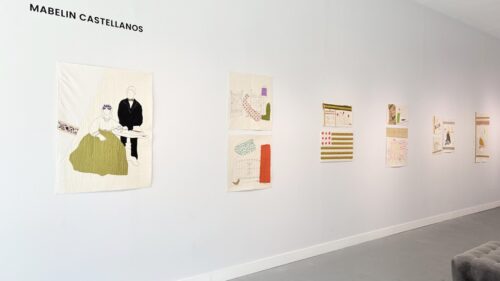
Mabelin Castellanos transforms cotton and rayon thread on muslin into intimate scenes of everyday life, where companionship, family and small acts of presence become subjects worthy of attention. (Photo courtesy of The CAMP Gallery)
The use of thread slows that ordinary moment down. A contour that could be made quickly with pencil instead has to be constructed through cloth, giving physical weight to a scene that might otherwise pass unnoticed.
The contrast between the two exhibitions is clearest when moving physically between the gallery spaces. Walker fills the canvas with competing figures and objects. Davis isolates recognizable desires into eight small works. Czukerberg turns toward embroidered natural forms. Putman builds portraits from accumulated materials, while Castellanos pares human interaction down to stitched figures and simple gestures.
“Doctor’s Appointment” is among the quietest works in either exhibition. Two people remain seated together, surrounded by little else. After the crowded table of “Family Dinner” and Davis’ orderly inventory of algorithmic wants, Castellanos’ modest scene changes the rhythm of the visit.
Nothing monumental is happening.
One person is simply there with another.
And Castellanos gives that ordinary act enough space—and enough time in thread—to be noticed.
WHAT: “In Need of Temperance,” featuring Amanda Kate Walker, Katie Davis and Monica Czukerberg, and “Social Proof of Care,” featuring Amy Putman and Mabelin Castellanos.
WHERE: The CAMP Gallery, 791–793 NE 125th St., North Miami
WHEN: 11 a.m. to 6 p.m., Wednesday through Saturday. Through Oct. 3, 2026..
COST: Free
INFORMATION: (786) 953-8807 and thecampgallery.com/
ArtburstMiami.com is a nonprofit media source for the arts featuring fresh and original stories by writers dedicated to theater, dance, visual arts, film, music, and more. Don’t miss a story at www.artburstmiami.com.