
Theater / Film
‘Deconstructing a Human Sacrifice’ Workshop Digs Into Family Secrets at LakehouseRanchDotPNG
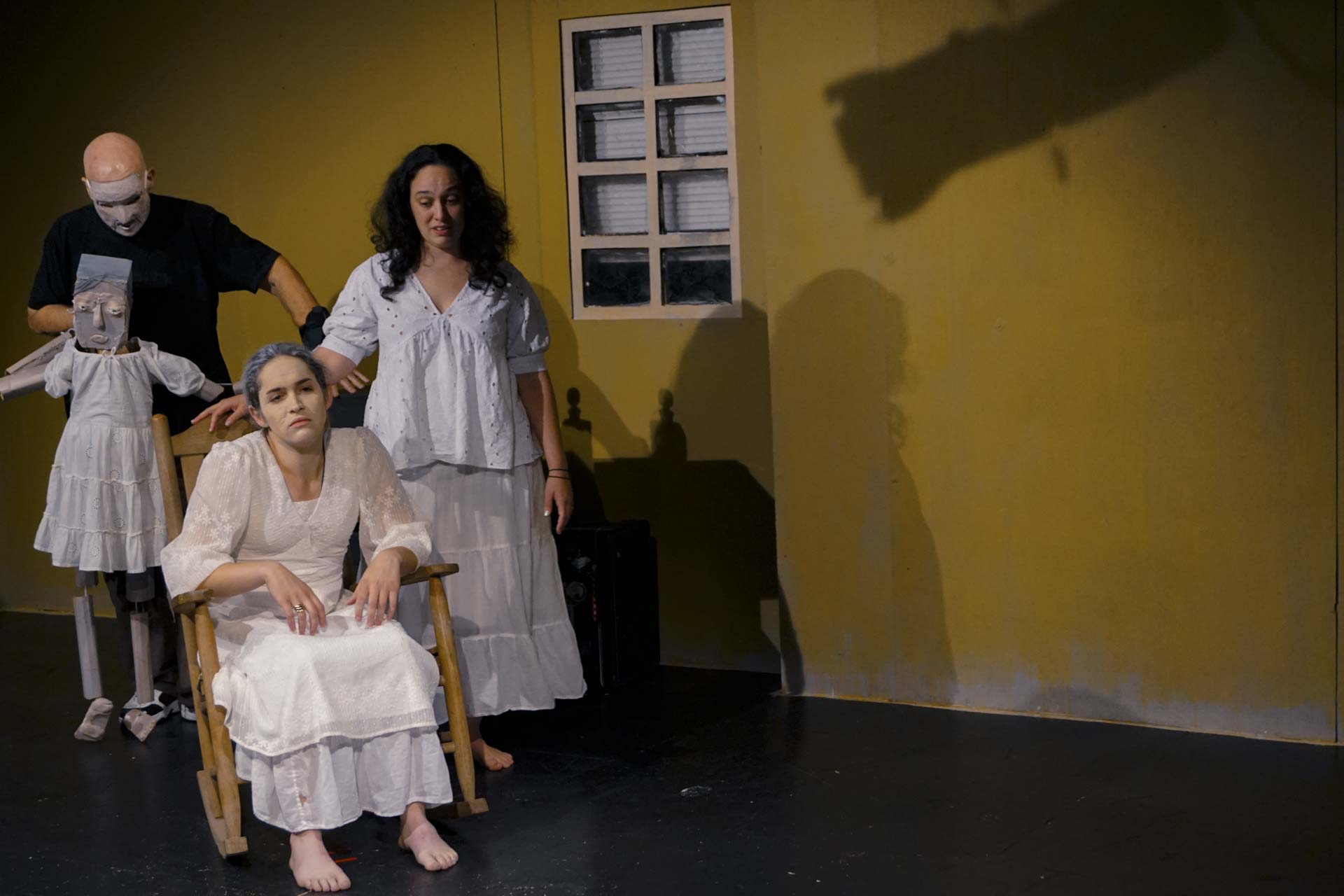
The Lucindas in Erin Proctor’s “Deconstructing a Human Sacrifice” at LakehouseRanchDotPNG, Richard Headley, River Iraida Estrada, and Sara Jarrell. (Photo courtesy of LakehouseRanchDotPNG)
Having a character already onstage as the audience enters a theater is a familiar device. In “Deconstructing a Human Sacrifice,” it has a strong effect. An old woman sits in a rocking chair in a stark house. Soon a visitor will arrive, trying to unravel a disturbing piece of family history for her own self-preservation.
Playwright Erin Proctor’s search for answers becomes a cathartic act as she considers whether the bizarre trauma has passed through generations, leaving her with gripping anxiety almost as if it were carried in her DNA.
The woman in the rocking chair is Lucinda Ward Mills, one of three Lucindas, played by River Iraida Estrada. The young actress is made up to look elderly, and the play acknowledges the obvious age difference with a joke about how difficult it is to find older actresses.
That willingness to acknowledge the people putting on the show is part of Proctor’s approach to telling her family’s story. People from the 1930s scroll through cellphones. Characters break the fourth wall. The past is present, but so are the actors bringing it to life.
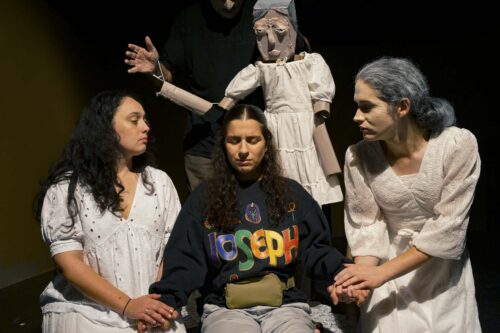
From left, Sara Jarrell, Olivia Polo, and River Iraida Estrada. Richard Headley is in the back. (Photo courtesy of LakehouseRanchDotPNG)
The one-act is being presented by LakehouseRanchDotPNG and directed by Brandon Urrutia, co-founder and artistic director of the Miami Lakes-based company, as a fully staged workshop production. It offers an opportunity to see a play while its writer is still exploring what works and what needs more attention. It’s not a usual occurrence in South Florida theater and something to be seen.
The play continues to evolve. Its New York development includes upcoming inclusion in the Spark Theater Festival at the 28th St. Theater on Oct. 16 and 23. A previous Aug. 3 reading was presented by the Center at West Park.
In this staging, Olivia Polo plays Erin, who enters carrying a suitcase. Lucinda gets up and takes her luggage, a familiar gesture that briefly makes this seem like an ordinary visit to an older relative.
The suitcase holds a surprise revealed later: an accordion, which old Lucinda plays. During a talkback after Saturday night’s performance, Proctor explained that the instrument changes depending on what a cast member can play. Here, Estrada’s accordion skills became part of the staging.
But Lucinda has been dead for decades. In rural Kentucky in 1933, she was killed in a ritual sacrifice involving her children. Erin, her great-great-great-granddaughter, has a need to know what happened and how religion became tangled up in such a horrifying act.
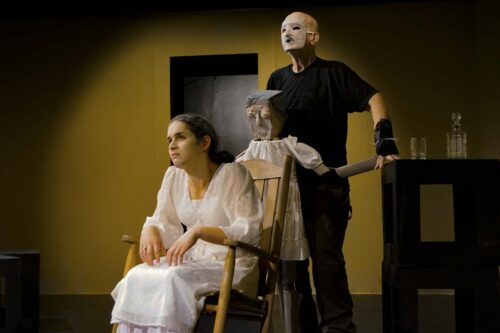
The Lucindas: River Iraida Estrada and Richard Headley. (Photo courtesy of LakehouseRanchDotPNG)
She asks those questions repeatedly, trying to make sense of a family story that newspaper reports have not fully explained to her. At one point, Erin pulls out her cellphone to show the chilling accounts after the incident in 1933.
To Proctor’s credit, the scene doesn’t become a joke about time travel. No one reacts to the cellphone as some newfangled contraption. The older Lucinda simply scrolls, interested in relishing her celebrity.
Estrada’s elderly Lucinda is only one version of the woman Erin encounters. Sara Jarrell plays a younger Lucinda, spunky and bourbon-swilling. Her earthy presence gives Lucinda some life beyond the terrible details of her death.
Then there is Richard Headley’s Lucinda, a dark, menacing figure wearing a frightening mask and manipulating an odd, paper-like puppet (created with craft by Kaleb Hernandez Arci) through which the character speaks. This Lucinda seems to come from somewhere beyond the world of the other two. Creepy hardly covers it. This is no comforting ghost dropping in to help a descendant sort through the past.
The three Lucindas are among the production’s most interesting choices. Erin gets no single version of her ancestor to question; the differences between them keep the encounters unpredictable.
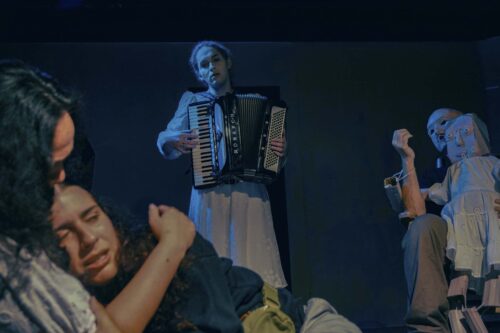
From left, Sara Jarrell, Olivia Polo, River Iraida Estrada. and Richard Headley in Erin Proctor’s “Deconstructing a Human Sacrifice.” (Photo courtesy of LakehouseRanchDotPNG)
Religion is woven through the play, but giving the audience a way to get a connection between the three Lucindas and the Holy Trinity would be a strong choice for such a darkly religious themed play.
The male/puppet Lucinda’s threatening presence also suggests an opportunity to connect this character to John, Lucinda’s son, who choked and killed his mother in the ritual, as is revealed in the play. As male figure in the cast, the character could offer a subtle echo of the son who was responsible for his mother’s death by his own hands.
That connection might give one scene particular power. Jarrell’s Lucinda uses zip ties to chain Erin to a chair. Maybe they’ll sacrifice her. Had Headley’s figure performed that action, even a slight suggestion of John might have brought the son’s role into sharper focus.
The cellphones and occasional remarks to the audience bring humor into the grim story. They also prepare the audience for the ending, when the characters become actors staging a play.
The shift follows the approach Proctor has established, but it doesn’t land with the strength of what comes before it. After the questions, the menace and the restraint, the return to putting on a show lets some of the tension slip away.
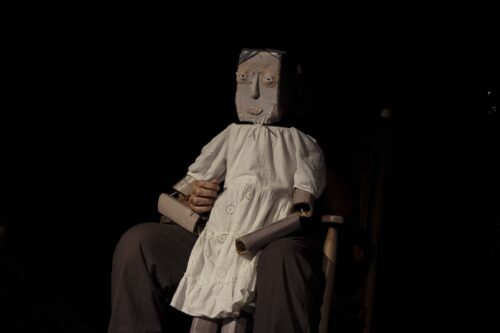
Richard Headley as Puppet Lucinda. (Photo courtesy of LakehouseRanchDotPNG)
During the talkback, Proctor explained that theater is her safe space, which is why she brings the ending back there. That explanation gives the choice a personal meaning that needs to be more apparent in the performance. The ending could do more to show what this return to safety means for Erin after such a disturbing encounter.
Proctor’s vulnerability is what makes the play compelling. An actress as well as a playwright, she has considered playing Erin herself. Casting another actress is a better choice, allowing for the audience to experience the distance she’s kept for so long from the deeply personal material.
Urrutia and the cast give three distinct faces to a woman whose death could easily overwhelm everything else about her. This workshop version makes Erin’s arrival in that strange house compelling. Her way out could be just as strong.
The set is stark with the sound of a cold, whistling wind bubbling up frequently throughout.
Proctor’s willingness to confront her family’s disturbing and bizarre history and her inventive use of three Lucindas make this a play worth following. “Deconstructing a Human Sacrifice” creates a curiosity in many ways including wanting to know how the play itself will eventually end up.
WHAT: LakehouseRanchDotPNG’s Workshop Production of “Deconstructing a Human Sacrifice” by Erin Proctor
WHERE: Main Street Players, 6812 Main St., Miami Lakes
WHEN: 8 p.m., Friday and Saturday, 2 p.m. Sunday. Through Sunday, Sept. 20.
COST: $20 general admission; $50 “Art Believer” supporter.
INFORMATION: (305) 558 -3737 or https://www.lakehouseranchdotpng.com/
ArtburstMiami.com is a nonprofit media source for the arts featuring fresh and original stories by writers dedicated to theater, dance, visual arts, film, music and more. Don’t miss a story at www.artburstmiami.com.